The HOA Fined My Injured Daughter Two Hundred Dollars, So I Followed Every Number They Thought No One Would Read
Chapter 1: The Ticket Beside the Bent Pink Handlebars
The crack came before I saw Laura fall.
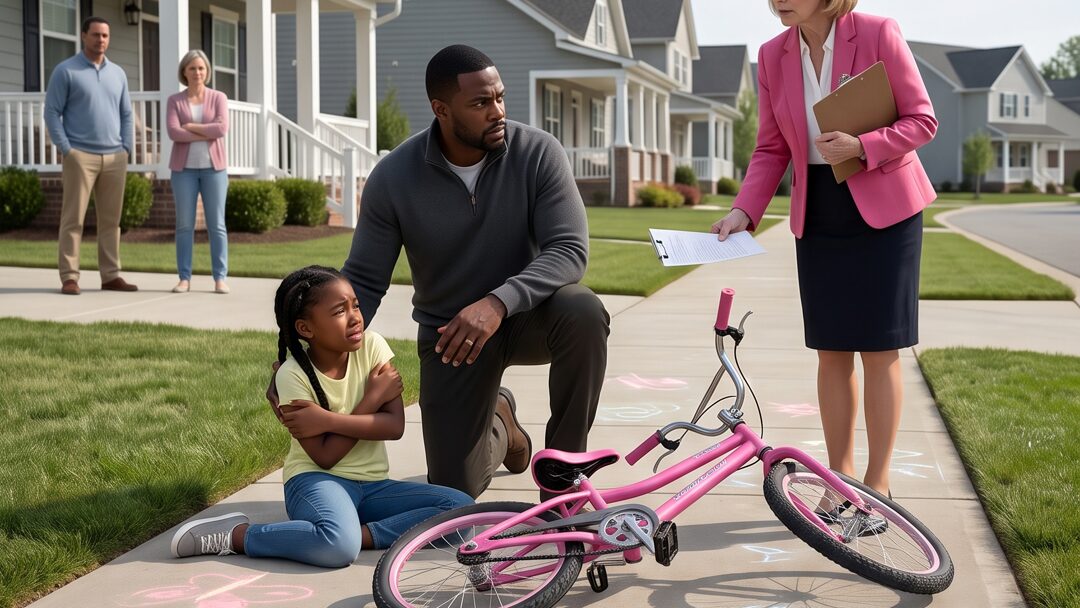
It was sharp enough to turn my head from the open garage—a dry metallic snap, then the scrape of something hard across concrete. By the time I reached the driveway, my daughter’s pink bicycle was sliding on its side and Laura was folded beside it, one sneaker trapped under the rear wheel.
For half a second, she made no sound.
Then she screamed.
I ran.
Chalk covered the sidewalk around her in bright islands of blue, yellow, and purple. She and two neighborhood kids had spent most of the morning drawing a crooked rainbow from our driveway to the corner. Now one pink handlebar pointed toward the grass at an angle I knew it had not held ten minutes earlier.
Laura clutched her left arm against her stomach.
“Daddy.”
“I’m here.”
I dropped beside her. “Don’t move it.”
“It hurts.”
“I know. Look at me.”
Her face had gone gray beneath the tears.
Behind me, a woman said, “This is exactly the hazard I was talking about.”
I looked up.
Susan White stood three feet away in a bright pink blazer, a clipboard tucked against one hip. She was the HOA president, though she carried herself as if the title had been issued by a federal agency rather than seventy-six homeowners who rarely attended meetings.
“Susan,” I said, “back up.”
She did not.
“The bicycles and chalk materials have been obstructing the common walkway since nine this morning.”
Laura whimpered.
I slid one hand under her shoulder without lifting her arm. I had taken enough workplace safety courses to know that the instinct to fix a position could make an injury worse.
“What happened?” I asked Laura.
“She—”
Laura’s breath hitched.
Susan spoke over her. “I asked the children to clear the walkway. Your daughter continued riding through the marked area.”
I looked at the bicycle.
The front wheel was twisted sideways. One handlebar had rotated down. Near the stem, a small metal clamp sat crooked.
“What did you do to the bike?”
Susan’s expression changed by less than an inch.
“I did not do anything to the bicycle.”
“You were standing right here.”
“I was addressing a violation.”
Laura started crying harder.
I took out my phone. “I’m calling for help.”
“That is your choice.”
The sentence was so calm I almost missed what she did next.
Susan lowered her clipboard, pulled a sheet from beneath the top page, and placed it against the bicycle’s bent handlebars so she could finish writing on it.
Across the top, in bold type, were the words NOTICE OF VIOLATION.
Below that, handwritten in blue ink:
$200.
For a moment I thought I had misunderstood.
“My daughter is on the ground.”
“The violation existed before the accident.”
“You’re writing her a ticket?”
“I’m issuing the homeowner a fine for repeated obstruction of a common pedestrian route.”
Laura’s crying turned into short, frightened gasps.
I stood slowly.
I am six feet two. Susan was not. I watched her shoulders stiffen anyway, and that alone kept me from moving closer.
“Move away from my daughter.”
“I am entitled to document—”
“Move.”
A front door opened across the street. Someone stepped onto a porch. Another person slowed near the mailbox cluster.
Susan glanced at them, then at me.
“I will not be intimidated because you refuse to supervise—”
I folded the notice once.
She stopped speaking.
I put it in my pocket.
“When my daughter is safe,” I said, “I will respond to whatever you think this is.”
Then I bent and lifted Laura.
She screamed the moment her arm shifted.
Every thought in my head disappeared except one: I should have been closer.
I should have been outside instead of sorting tools in the garage. I should have heard the argument before the crack. I should have seen Susan approach. I should have known something was wrong.
The drive to the emergency department took eleven minutes.
It felt like an hour.
Laura sat belted beside me with her arm supported on a folded sweatshirt. At every turn she sucked air through her teeth. I kept one hand on the wheel and the other open between us, palm up, as if she could somehow transfer the pain into it.
“Was it Susan?” I asked at a red light.
Laura’s eyes were closed.
“What?”
“Did she touch your bike?”
“She grabbed—”
The light changed. A horn sounded behind me.
Laura shook her head hard. “I don’t know. It went weird.”
I did not ask again.
At the hospital, the nurse took one look at the swelling and moved us ahead of the waiting room.
The X-ray showed a fracture that required surgery. The orthopedic surgeon pointed to the image and explained it with the measured voice doctors use when they know the parent is trying not to hear the worst word in every sentence.
“There’s displacement here. We’ll need to stabilize it. Two pins, most likely.”
Laura looked at me.
“Pins?”
“Temporary,” I said.
The surgeon nodded. “That’s the expectation.”
I signed forms.
Insurance forms. Consent forms. Financial responsibility forms.
My handwriting got worse with each page.
By late afternoon, Laura was under medication and no longer crying. I sat beside her bed with the folded violation in my pocket and stared at the white band around her wrist containing her name and date of birth.
Eight years old.
Two pins.
A two-hundred-dollar fine.
The numbers did not belong together, yet my mind kept arranging them in a column.
When the pain medicine began wearing off that evening, she woke crying before she opened her eyes. I held her good hand and counted breaths with her because counting was the only thing I knew how to control.
One.
Two.
Three.
She squeezed my fingers.
“Daddy?”
“Yes.”
“Is my bike broken?”
I looked away.
“I’ll take care of it.”
That was what I always said when I was afraid.
I’ll take care of it.
Not I’m scared.
Not I don’t know.
Not I should have been there.
Just the promise.
Two days later, before Laura had spent a full forty-eight hours at home, someone rang the doorbell.
The mail carrier stood outside with a certified envelope.
“I need a signature.”
The return address belonged to the homeowners’ association.
Chapter 2: The Certified Letter Asked for More Than a Signature
The certified letter did not ask how Laura was recovering.
It gave me ten business days to acknowledge a hearing date.
I read it standing at the kitchen counter while she slept in the living room with her cast elevated on two pillows. The television was muted. A bowl of cereal had gone soft beside her because the pain medication made her nauseated.
The letter cited Article VII, Section 9 of the association rules.
Repeated obstruction of common pedestrian access.
Failure to correct after verbal notice.
Failure to cooperate with an authorized board representative.
The last line bothered me most.
The enclosed violation history reflects prior documented incidents.
Prior.
I took the folded two-hundred-dollar notice from my wallet and laid it beside the certified envelope.
The paper from the sidewalk had a preprinted date.
Saturday’s date.
But beneath the violation code, Susan had already typed a reference number.
Not handwritten. Typed.
The fine had not begun on the sidewalk.
I waited until Laura woke.
“Can I ask you something?”
She watched me from the couch, suspicious in the way children become suspicious when adults pretend a question is casual.
“Is it about my arm?”
“No.”
“That means yes.”
Despite myself, I smiled.
“It’s about before your arm.”
She looked at the cast.
“What did Susan say to you before you fell?”
Laura picked at a loose thread on the blanket.
“She said we couldn’t put chalk there.”
“Anything else?”
“She said bikes weren’t supposed to be on the sidewalk.”
“The neighborhood sidewalk?”
She shrugged.
“I told her everybody rides there.”
“And then?”
Laura’s mouth tightened.
“She stood in front of me.”
My pulse changed.
“Did she touch the bike?”
“I don’t know.”
“You said at the hospital she grabbed—”
“I said I don’t know.”
I stopped.
Her eyes filled, not with pain this time.
“I don’t remember right.”
That was enough.
“I’m sorry.”
I closed the letter and went to make her something she might actually eat.
That evening, after she fell asleep, I opened my laptop.
I work in records compliance. Not glamorous records. No dramatic raids, no hidden accounts in tropical banks. Most of my days involve comparing retention schedules, transaction logs, approval chains, and the boring places where people assume no one will look twice.
I requested my own HOA file.
The property-management portal gave me eleven documents.
Three architectural notices from years earlier. One pool form. Two assessment statements.
And five complaints involving “common-area obstruction.”
I opened the first.
Children’s recreational materials left within pedestrian corridor.
The second:
Recreational items creating impediment within pedestrian corridor.
The third:
Repeated recreational activity resulting in impediment to pedestrian corridor.
Different dates.
Different alleged complainants.
Nearly identical language.
I printed them.
Then I noticed the timestamps.
Two complaints supposedly submitted by different residents had been entered four minutes apart.
A third, ten days later, used the exact phrase “pedestrian corridor,” a term I had never heard anyone in our neighborhood use unless they were reading from association language.
The next morning I called the management office.
A clerk answered.
“I’m requesting the full complaint history associated with my property.”
“You can submit a written records request.”
“I did.”
“For financial records?”
“For all records supporting the enforcement action.”
A pause.
“You’ll need to be more specific.”
So I became specific.
Complaint intake logs. Board correspondence. Enforcement notes. Vendor records related to common walkways. Meeting minutes authorizing the fine schedule.
The clerk sighed quietly.
“That’s extensive.”
“How extensive?”
“I can’t say until it’s reviewed.”
By afternoon, Susan emailed me personally.
Mr. Carter,
Your request appears excessively broad and potentially burdensome. The association will make eligible records available subject to processing costs and applicable confidentiality restrictions.
Processing estimate: $60.
I read the message twice.
Then I laughed once, without humor.
Laura heard me from the couch.
“What?”
“Nothing.”
“You do that when it’s something.”
I closed the laptop.
“It’s grown-up paperwork.”
Her face flattened.
“Is it Susan?”
I did not answer fast enough.
Laura turned back to the television.
That should have warned me.
Instead, I paid the sixty dollars.
Two days later I went to the HOA office, a converted room at the back of the clubhouse that smelled of toner and old coffee. Susan was there when I arrived.
Of course she was.
A neat stack of documents sat on the table.
“This is what the association determined responsive,” she said.
I looked at the stack.
Maybe forty pages.
“My request identified eleven categories.”
“Certain materials are privileged.”
“By whom?”
“The association.”
“That wasn’t my question.”
Her lips pressed together.
“You seem determined to turn an unfortunate accident into an attack on the board.”
“My daughter had surgery.”
“I am aware.”
“You issued a fine while she was on the ground.”
“The violation preceded the accident.”
There it was.
Confirmation.
“You had it prepared.”
“I had documented repeated noncompliance.”
“By an eight-year-old?”
“By the homeowner.”
I held her gaze.
Behind her, a framed photograph showed the clubhouse pool full of children.
Susan followed my eyes.
“You think rules are cruel until you live in a community where nobody follows them,” she said. “Then the same people who complained about enforcement complain about property values, insurance, maintenance, safety. Someone has to be willing to be unpopular.”
For the first time, she sounded less like a villain than a person who had repeated the same justification until it became structural steel inside her.
Then she slid the sixty-dollar receipt toward me.
“Your copies.”
I took them home.
That night, while Laura slept, I sorted every page by date.
Complaint logs.
Minutes.
Expense summaries.
A vendor list.
The first financial irregularity was not dramatic.
Landscaping services: $14,000 annually.
The amount itself meant nothing. Our subdivision had entrances, common strips, trees, irrigation beds.
I searched the vendor name.
No useful website.
I searched the mailing address.
A residential street across town.
I stared at it.
I had seen that address before.
Not in my work.
Not online.
In the HOA records.
I went back through the stack until I found a board reimbursement form from eighteen months earlier.
Emergency materials pickup.
Authorized by Susan White.
The reimbursement address listed for secondary delivery contact was the same house.
The same number.
The same street.
I leaned closer to the page.
Next to the address was a surname I recognized from Susan’s annual disclosure form.
Her sister’s.
Chapter 3: The Numbers Looked Wrong Until One of Them Looked Familiar
The landscaping company receiving fourteen thousand dollars a year was registered to a garage.
I confirmed it on a Tuesday morning at the county records office.
The clerk rotated the monitor slightly toward me without comment. The business filing showed an active registration, a mailing address, and no commercial location. The address matched the house tied to Susan’s sister.
“Can I get a certified copy?”
“You can.”
I paid the fee.
Outside, I sat in my car with the document on the passenger seat and felt the clean, dangerous satisfaction of being right.
That feeling lasted less than ten minutes.
Because being right about an address did not prove what I wanted it to prove.
A residential business could still be legitimate. A relative could still perform real work. Fourteen thousand dollars could be high, low, or reasonable depending on the contract.
So I went home and built a table.
Invoice date.
Payment date.
Amount.
Service period.
Approval.
Vendor address.
I told myself I was checking my own bias.
By midnight, I had found three things I did not like.
The first was repetition: nearly identical invoice amounts across seasons.
The second was vague service language: grounds maintenance, seasonal support, site remediation.
The third was enforcement timing.
Two homeowners received escalating fines within weeks of questioning association spending.
That could still be coincidence.
I highlighted it anyway.
The next afternoon, I walked to the mailbox cluster because Laura wanted fresh air. Her cast was covered in signatures from classmates. She moved more slowly now and hated when I hovered.
“You’re doing it again,” she said.
“What?”
“Walking like I’m ninety.”
I stepped back half a pace.
“Better?”
“No.”
At the garage entrance, she stopped.
Her pink bicycle leaned against the far wall exactly where I had placed it after bringing it home from the hospital.
I had not touched it.
The front wheel was still twisted.
Chalk dust clung to one tire.
“When are you fixing it?”
“When your arm is better.”
“My arm doesn’t fix bikes.”
“I know.”
“So when?”
I looked at the bent handlebar.
“Soon.”
She studied me.
“You keep saying that.”
Before I could answer, someone called my name.
A man stood near the mailbox cluster holding a bundle of envelopes. I knew him by sight but not well. His mailbox had once been dark green. Now it was a washed-out gray.
“You’re the one fighting the sidewalk fine, right?”
The word fighting irritated me.
“I’m disputing it.”
He gave a short laugh. “Sure.”
Laura wandered toward our driveway.
The neighbor lowered his voice.
“Susan put a lien warning on us over that mailbox.”
I looked at the faded metal box.
“You’re serious?”
“Three notices. Then legal fee language.”
“For paint?”
“For noncompliance after notice.”
He said the phrase with practiced bitterness.
“Did you challenge it?”
“At first.”
“What happened?”
“Association counsel sent a letter. My wife said pay it before the mortgage company sees anything weird.”
He shifted the mail under his arm.
“Everybody thinks they’ll fight until the first letter has an attorney’s name on it.”
That evening I added his enforcement dates to my table.
Then I found another family who had lost pool access over an unresolved exterior-storage violation. Their alleged violation was a child’s portable basketball base left visible beside a garage.
I did not need everyone to like me.
I needed a pattern.
But patterns can be manufactured by the person looking for them.
I knew that better than most.
So I wrote two headings on a legal pad.
Evidence supporting selective enforcement.
Evidence against selective enforcement.
The second column stayed too empty.
That bothered me.
Three nights later, Michelle Torres knocked on my door.
I knew her as someone who had lived in the development almost from the beginning. She brought casseroles when people were sick, attended meetings without speaking much, and had once defended Susan in a neighborhood message thread after a special assessment fight.
She did not come inside.
“I heard you’ve been asking people about old violations.”
“I’ve been asking about enforcement.”
“Same thing to people who don’t want their names in it.”
“I’m not publishing names.”
“That’s not what scares them.”
“What does?”
Michelle looked toward the street before answering.
“Being next.”
There was no drama in the way she said it. That made it worse.
I opened the door wider.
“Come in.”
She shook her head.
“I only came because you need to slow down.”
“Susan’s sister is connected to a vendor receiving fourteen thousand a year.”
Michelle’s face changed.
Not surprise.
Recognition.
“You knew.”
“I knew they were related.”
“Did the board?”
“I don’t know what was formally disclosed.”
“That’s not an answer.”
“No.” Her voice sharpened. “It’s the answer I have.”
I stepped onto the porch and closed the door behind me so Laura would not hear.
“People were threatened over mailboxes. Pool access. Sidewalk chalk.”
“I know.”
“And nobody did anything?”
Michelle looked at me for a long moment.
“You think nobody did anything because everyone was afraid of Susan.”
“Were they?”
“Yes.”
The answer came too quickly.
Then she added, “But that isn’t how it started.”
I waited.
She rubbed her thumb along the edge of her phone.
“Six years ago, the association was close to not making payroll on contracted services. People weren’t paying assessments. Two vendors walked. The pool almost didn’t open. Insurance jumped. Everybody came to meetings furious, and nobody wanted a dues increase.”
“What does that have to do with selective fines?”
“I’m telling you there was a before.”
“And now?”
“Now is worse.”
The words sat between us.
I lowered my voice.
“Did Susan use fines to cover budget gaps?”
“I don’t know.”
“Did she steer contracts?”
“I don’t know.”
“You know something.”
Michelle’s eyes hardened.
“I know you’re taking pieces you understand and building a person you can hate.”
“My daughter has pins in her arm.”
“I know that.”
“She fined us while Laura was on the ground.”
“I know.”
“Then what exactly are you defending?”
“I’m not defending her.”
For the first time, Michelle looked tired.
“I’m warning you that if you tell this story as if Susan woke up one morning and decided to become a tyrant, you’ll miss the part that matters.”
A car turned onto the street. Michelle stepped off the porch.
“What part?”
She stopped at the walkway.
“The part where we asked her to take control.”
I said nothing.
Michelle looked back at me.
“You’re looking at what she became, Patrick. Not why we let her become it.”
Chapter 4: The Woman Everyone Feared Had Once Been the One They Needed
Michelle admitted her part before I had a chance to accuse her.
“I voted for it,” she said.
We were sitting at her kitchen table three nights after she stopped me on my porch. She had invited me over after Laura went to bed, though invited was generous. Her message had said: Come at eight. Don’t bring copies.
I brought a notebook anyway.
Michelle noticed it and gave me a look.
“You always do that?”
“Do what?”
“Make everything a record.”
I set the notebook facedown.
“Tell me what you voted for.”
She wrapped both hands around a coffee mug she had not touched.
“Emergency authority. Temporary. That was the word everybody liked.”
“How temporary?”
“Ninety days.”
“And?”
“And then ninety became six months. Six months became a year.”
I waited.
Michelle looked toward the dark window above the sink.
“Back then, we were a mess. Not the kind of mess people post about. The boring kind. Half-paid invoices. Late assessments. People promising checks and never sending them. The pool company threatened to walk. Landscaping stopped for three weeks. Trash overflowed at the clubhouse after one contractor quit.”
“And Susan fixed it.”
“She got people paid.”
“How?”
“She called vendors herself. Negotiated. Threatened legal action where she had to. Raised late fees. Collected old balances.”
“Used fines?”
“Some.”
“Selective fines?”
Michelle’s mouth tightened.
“Not at first.”
That mattered.
I hated that it mattered.
She stood and opened a drawer near the refrigerator. From the back, beneath a stack of appliance manuals, she removed a folder with bent corners.
Old meeting packets.
I recognized Susan’s formatting immediately. Bold headings. Numbered motions. Clean tables.
Michelle opened one.
“Look.”
The minutes were six years old.
Emergency vendor authorization.
Temporary suspension of standard bid requirement.
Board president authorized to secure continuity of essential services.
The vote had been unanimous.
Michelle’s name was there.
So was Jonathan Allen’s.
“You gave her sole authority?”
“We gave her speed.”
“That’s not the same thing.”
“It became the same thing.”
I read the packet again.
There were unpaid assessment figures. Insurance increases. A note from a contractor terminating service for nonpayment. A pool opening delay.
None of it looked invented.
None of it made the $200 notice beside Laura’s bicycle less ugly.
But it changed the shape of the story I had been telling myself.
The next morning, I requested archive access through the management office.
Susan denied it.
I appealed to the board secretary.
Two days later, I was allowed into a storage room behind the clubhouse for ninety minutes under supervision.
The room smelled like paper that had been closed too long.
Boxes were labeled by year.
I started with the crisis period.
My first surprise came within twenty minutes.
One invoice I had flagged as suspicious—emergency grounds remediation—matched photographs of storm damage, a contractor cancellation, and a same-week replacement crew.
The amount was high.
The work was real.
I moved it from my suspicious column to verified emergency expense.
Then another.
Temporary pool equipment repair.
I had thought the description vague.
The maintenance log showed a pump failure three days before opening.
Real.
A third invoice for debris removal aligned with a county notice.
Real again.
By the fourth correction, I was angry.
Not at Susan.
At myself.
I had wanted every strange line to be rotten because rotten was easier.
The clerk supervising me looked up from her phone.
“You all right?”
“Fine.”
I crossed out another note.
Back home, I opened the spreadsheet and removed three rows from my anomaly list.
Laura was at the dining table doing schoolwork one-handed.
“You lost?”
“What?”
“You keep making that face.”
“What face?”
“The one when numbers are being rude.”
I looked at her.
She grinned.
For a second, the room was normal.
Then she glanced toward the garage door.
“My bike still broken?”
“Yes.”
“You said soon.”
“I know.”
“Can we fix it?”
“Not yet.”
“Why?”
“Because I need to understand what happened.”
She stared at me.
“To the bike?”
“Yes.”
“You already know what happened to me.”
The pencil in her good hand stopped moving.
I had no answer that did not sound wrong.
“I just need time.”
She looked back at her worksheet.
“That’s what you keep saying.”
That night, I went into the garage alone.
The bicycle leaned where it had been for weeks.
I took a rag and wiped dried chalk from the frame.
The pink paint was scraped near the pedal. One grip was torn. The handlebar sat crooked, frozen in the posture of the fall.
I cleaned around the damage without adjusting it.
Not repair.
Preservation.
I told myself there was a difference.
Three days later, the archive copies arrived electronically.
I rebuilt the timeline.
The emergency years showed what Michelle had described: real cash pressure, real contractor departures, real unpaid balances.
Susan’s decisions had not saved everything.
But they had saved enough.
The pool opened.
Trash service continued.
Insurance did not lapse.
That was the small truth I had not wanted.
Then I moved forward in time.
The emergency ended.
Collections improved.
Assessment arrears fell.
The temporary bid suspension should have expired.
Yet the same vendor relationships remained.
Some invoices became less specific, not more.
And one pattern kept surfacing.
A payment for pest control.
Same week: another payment for grounds support.
Same amount.
Different descriptions.
I checked the bank summary.
Both cleared.
I checked the vendor list.
Different company names.
Then the mailing addresses.
One went to the residential address linked to Susan’s sister.
The other went to a post office box.
I searched prior records.
The post office box appeared again on a vendor intake form signed during the crisis period.
Authorized by Susan.
I printed both payment records and laid them side by side.
Same week.
Same amount.
Different service labels.
No emergency.
No storm.
No service disruption.
No supporting report.
For the first time since Michelle’s kitchen, certainty returned.
Smaller than before.
Harder.
I called Michelle.
She answered on the third ring.
“I found something.”
Silence.
“What?”
“Two payments. Same amount, same week, different labels.”
“Could be legitimate.”
“Then there should be support.”
“Maybe there is.”
“There isn’t in the archive.”
Another silence.
Then Michelle said, “Patrick, after the crisis, Susan stopped asking.”
“Asking what?”
“Permission.”
I looked at the two pages.
The temporary authority had not disappeared.
It had changed owners.
Chapter 5: Two Years of Deposits Left a Hole No Explanation Could Fill
The same five-figure discrepancy appeared three times.
I thought I had made a formula error.
So I started over.
First pass: thirty-one thousand eight hundred and forty dollars unexplained.
Second pass: thirty-two thousand one hundred and ten.
Third pass, after correcting a duplicate deposit entry: thirty-one thousand nine hundred and sixty.
Close enough to make my stomach tighten.
Too large to dismiss.
Too inconsistent to accuse.
For four nights, I worked after Laura went to bed.
Bank summaries on one screen.
Association reports on another.
Printed ledgers spread across my desk.
I matched deposits collected against amounts reported, then matched disbursements against vendor totals. Forty-one thousand dollars in collected funds moved through categories that did not reconcile cleanly across two years.
Some of it had explanations.
Some did not.
The missing structure bothered me more than the missing money.
Transactions passed through summaries without source documentation.
Adjustments appeared without notes.
Vendor totals changed between draft and final reports.
I emailed Jonathan Allen.
He did not answer.
I emailed again.
He replied twelve hours later.
Patrick,
I am not comfortable discussing incomplete financial data outside formal board review.
I wrote back:
Then let’s discuss the complete data. Please identify where it is maintained.
No response.
The next afternoon, I went to the management office.
Jonathan was there.
He was thinner than I expected, with wire-framed glasses and the careful posture of a man who spent his life trying not to be the person a room was angry at.
“You can’t just show up,” he said.
“I emailed.”
“That doesn’t create an appointment.”
“Neither does not answering.”
The clerk behind the desk looked at us, then found a reason to leave.
Jonathan lowered his voice.
“You are making assumptions from partial records.”
“Then provide the source records.”
“There are confidentiality issues.”
“For bank reconciliations?”
“For certain attachments.”
“Which attachments?”
He looked toward the closed office door.
That was enough.
“You don’t know.”
“I didn’t say that.”
“You signed the reports.”
His face changed.
Only slightly.
But I saw it.
“You signed them,” I repeated.
Jonathan removed his glasses and cleaned them with the edge of his shirt.
“I signed treasurer summaries.”
“Based on what?”
“Packets prepared for review.”
“Prepared by Susan?”
“Prepared through management.”
“That wasn’t my question.”
His jaw tightened.
“You think this is simple because you work with records.”
“I think a signature means something.”
“So do I.”
“Then show me what yours meant.”
For several seconds, neither of us spoke.
Finally, Jonathan said, “There were months when I did not independently verify every supporting invoice.”
The sentence landed softly.
That made it worse.
“How many months?”
“I don’t know.”
“You’re the treasurer.”
“I’m a volunteer.”
“So is Susan.”
“That is not the same.”
“No,” I said. “Apparently not.”
He put his glasses back on.
“I trusted the summaries.”
“Why?”
“Because during the crisis years, the alternative was paralysis.”
“The crisis ended.”
“Yes.”
“But the shortcut didn’t.”
He looked away.
That was my answer.
Not theft.
Not yet.
But failure.
The kind built from small permissions and tired people.
I went home with nothing new on paper and more than enough to keep going.
That evening, Laura’s medical brace was hanging from the damaged bicycle handlebar.
I stopped in the garage doorway.
She must have left it there after therapy.
The white Velcro straps looked absurd against the pink frame.
I almost moved it.
Instead, I took a photograph.
Then I hated myself for taking it.
Inside, Laura was eating apple slices at the kitchen counter.
“How was therapy?”
“Fine.”
“Range of motion?”
“Fine.”
“Pain?”
“Fine.”
I stood there.
She looked at me.
“What?”
“You keep saying fine.”
“So do you.”
I sat across from her.
For once, I closed the laptop before speaking.
“You’re right.”
She took another apple slice.
“I know.”
I smiled despite the knot in my chest.
Then my phone buzzed.
An email from the management office.
Additional financial documents had been released.
Laura watched my eyes move toward the screen.
“Go ahead.”
“What?”
“Do your Susan thing.”
I did not touch the phone.
“Laura.”
“You talk about her all the time.”
“I don’t.”
“You do.”
“That’s not fair.”
She laughed once, not because anything was funny.
“You ask me if my arm hurts and then you look at papers.”
The words were quiet.
I would have preferred anger.
“I’m doing this because of what happened to you.”
“No.”
Her eyes stayed on the apple slice in her fingers.
“You’re doing it because of her.”
I opened my mouth.
Nothing came.
Laura slid off the stool and walked away.
The email remained unread for nearly an hour.
When I finally opened it, I found bank detail I had requested weeks earlier.
I rebuilt the reconciliation again.
This time, the path sharpened.
A cluster of deposits flowed into association accounts, then appeared in summary reports under broader categories. Several disbursements matched vendors I had already flagged. One repeated route moved through different labels but returned to the same approval pattern.
Susan.
Management processing.
Jonathan’s signature.
Not one bad invoice.
A system.
I printed the schedule.
On the last page, I circled the unresolved amount.
$31,960.
Roughly thirty-two thousand dollars.
I should have felt triumphant.
Instead, I found Laura standing in the garage.
She had turned on the overhead light.
The bicycle was between us.
“I want to ask you something,” she said.
“Okay.”
She touched the good handlebar with her right hand.
“Did you see her do it?”
I knew exactly what she meant.
“Do what?”
“Touch my bike.”
The question was simple.
My answer was not.
“I saw Susan near you.”
“That’s not what I asked.”
I looked at the twisted stem.
“I heard the crack.”
“Did you see her touch it?”
“No.”
Laura stared at me.
The garage seemed too bright.
“But she was there,” I said. “She was stopping you. She had the notice. She—”
“Did you see her?”
“No.”
Laura nodded once.
Not relieved.
Not upset.
Just confirming something.
I realized then that over the past weeks, I had let people hear what they wanted.
Neighbors had said Susan hurt Laura.
I had not corrected them.
I had said she was there.
I had said she was enforcing.
I had said the bicycle failed during the confrontation.
All true.
Not the same truth.
Laura let go of the handlebar.
“Then why does everybody say you did?”
The words hit harder than accusation.
I had no answer that did not belong to me.
Chapter 6: The Strongest Case Was Weaker Than the Story I Wanted to Tell
The bicycle could support two explanations.
That was what the repair shop owner told me without knowing why I cared.
He stood in my garage, turned the handlebar stem gently, and pointed to the clamp.
“This could’ve loosened over time.”
“Could someone have caused it?”
“By grabbing the bars hard? Maybe. By twisting them? Maybe.”
“Would you be able to tell?”
“Not after a crash like this.”
He looked at me.
“You need me to say which happened?”
“I need you to tell me what the damage says.”
“It says either is possible.”
I paid him for the inspection.
After he left, I sat on the garage floor beside the pink bicycle.
For weeks I had treated uncertainty like an obstacle someone else had placed in my way.
Now it was mine.
Laura had forced me to look at it.
I opened the binder I had been building for the meeting.
The first section was labeled INCIDENT.
Photographs.
Medical records.
The $200 notice.
My notes.
I removed one page.
At the top I had written: Enforcement intervention caused bicycle failure.
I tore it in half.
Then I rewrote the section title.
FACTS I CAN SUPPORT.
The words felt smaller.
Stronger.
The next three days became an exercise in subtraction.
I removed speculation.
I separated financial anomalies from verified emergency expenses.
I built a timeline showing when temporary authority began and when the emergency conditions ended.
I documented related-party contracting.
I charted selective enforcement against homeowner complaints about spending.
That last pattern became harder to ignore.
Two residents questioned vendor costs.
Both received escalated violations within weeks.
A family challenged pool accounting.
Their recreational access was suspended over an unrelated exterior issue.
The faded-mailbox neighbor had asked for meeting minutes before the lien warning.
Not proof by itself.
Together, a pattern.
Michelle called me the night before the packet deadline.
“I need to tell you something.”
Her voice was low.
“About Susan?”
“Yes.”
I waited.
“After the budget crisis, some of us asked her to give authority back.”
“How many?”
“Four at first.”
“What happened?”
“She said the board couldn’t function if every decision became a public argument.”
“And?”
Michelle exhaled.
“One of the four got a compliance notice the next month.”
“For what?”
“Fence stain.”
I closed my eyes.
“Another?”
“Pool suspension.”
“The family I found.”
“Yes.”
“You knew this.”
“I knew the timing.”
“Why didn’t you say it before?”
“Because I signed the motion that gave her the authority.”
There it was.
The surprise no invoice could produce.
Michelle was not only afraid of Susan.
She was afraid of herself.
“I thought if I helped you, you’d make me part of it.”
“You were part of it.”
“I know.”
Her voice cracked on the last word.
I said nothing.
That was my oldest habit.
Silence as control.
This time, I forced myself past it.
“Then be honest at the meeting.”
Michelle laughed bitterly.
“You say that like honesty is free.”
“No.”
I looked at the binder.
“I’m starting to understand it isn’t.”
The meeting packet arrived by email at four twelve the next afternoon.
Susan’s cover letter described the upcoming open session as a response to “misinformation, reputational harm, and escalating homeowner hostility.”
Attached was a scanned copy of Laura’s violation.
The same $200 notice.
Under it, a paragraph accused me of allowing repeated unsafe obstruction of common walkways and then using an unrelated accident to attack volunteer board members.
I read the sentence twice.
Then a third time.
My first instinct was physical.
Heat in my face.
Tightness in my hands.
I wanted to put the medical images on the first page of my presentation.
I wanted to make every person in that room look at the pins in Laura’s arm before Susan said a single word.
I wanted to make the injury do work for me.
That realization stopped me.
Laura was in her bedroom.
I knocked.
“Can I come in?”
She was drawing with her right hand, slowly.
“Okay.”
I sat on the floor.
“I need to tell you something.”
She kept drawing.
“I don’t know exactly what caused the bike to fail.”
“I know.”
“I should have said that sooner.”
She looked at me.
“To who?”
“Everybody.”
The pencil stopped.
“I was angry.”
“You’re still angry.”
“Yes.”
“Are you going to stop?”
I thought about Susan.
The invoices.
The notice.
The way she had stood over Laura.
“No.”
Laura looked back at the paper.
“But I’m going to be careful what I say.”
She nodded.
It was not forgiveness.
It was enough to continue.
That night I rebuilt the binder one final time.
Section one: confirmed incident facts.
Section two: enforcement chronology.
Section three: records-access barriers.
Section four: verified financial anomalies.
Section five: related-party vendor disclosures.
Section six: payments requiring independent review.
No accusation of deliberate injury.
No claim of theft.
No sentence I could not defend.
The case became weaker than the story I wanted.
And stronger than the story Susan expected.
At six thirty the next evening, I loaded the binder into my car.
The bent handlebar rested in a separate box.
I had removed it from the bicycle only after photographing every angle.
At the end of our street, cars were already lining both sides of the road.
I turned toward the clubhouse.
The parking lot was full.
People stood outside the entrance.
By the time I reached the door, the room had hit capacity.
And Susan had already begun speaking.
Chapter 7: She Raised My Daughter’s Violation Over Her Head Like a Trophy
Susan was holding Laura’s violation above her head when I entered the clubhouse.
The room was packed shoulder to shoulder. Folding chairs filled the center aisle. Homeowners stood along the back wall and near the vending machines. Someone had opened the side door because the air had gone stale.
Susan stood at the front beneath the association seal.
In one hand was the microphone.
In the other was the scanned copy of the $200 notice.
“This father,” she was saying, “allows repeated obstruction of a common walkway, refuses corrective guidance, and then uses an unrelated accident to accuse volunteers who have spent years protecting this community.”
A few heads turned when they saw me.
Susan saw them turn.
Then she saw me.
She did not lower the paper.
For one second, the entire story collapsed into that image.
Laura crying on concrete.
The pink bicycle twisted beside her.
The notice against the handlebars.
Susan writing.
Me folding the paper because I had nowhere else to put the anger.
Now she held the same violation above a crowd like proof that I had failed my daughter.
I carried the binder to the empty presentation table.
Beside it, I set the narrow cardboard box containing the bent handlebar.
I did not open the box.
Susan continued.
“Board members have been subjected to harassment, insinuations of theft, and statements implying deliberate physical harm to a child.”
That part was aimed at me.
And it was not entirely false.
I looked around the room.
The faded-mailbox neighbor was standing near the wall.
Michelle sat three rows back.
Jonathan was at the board table with his hands clasped too tightly.
The association attorney sat beside him.
Susan finally lowered the notice.
“Mr. Carter has requested time to present.”
I heard the dismissal in the word present.
Not explain.
Not challenge.
Present.
I walked to the microphone.
No applause.
Good.
I did not want any.
I opened the binder.
“My daughter was injured during an enforcement confrontation on our sidewalk.”
Susan shifted.
I continued.
“She required surgery. Two pins. She is recovering.”
Someone in the back murmured.
I looked at Susan’s copy of the violation.
“Ms. White issued that notice at the scene.”
Susan reached for her microphone.
I raised one hand.
“I’m not finished.”
The room changed slightly.
Not in my favor.
Just toward attention.
I placed the original folded notice on the table.
“This document was prepared before the accident. I know that because it had a preassigned reference number and because the association’s own records show an enforcement history before that day.”
Susan leaned toward her microphone.
“Exactly. Which proves the violation was not retaliation for the accident.”
“Yes,” I said.
She stopped.
I let the silence hold.
“Yes. It proves the enforcement existed before the accident.”
Several people turned toward me.
I could feel them waiting for the accusation I had once wanted to make.
I looked at the box containing the handlebar.
Then I looked at Laura’s violation.
“I also need to say something clearly.”
My mouth went dry.
“I cannot prove Susan White deliberately caused my daughter’s bicycle to fail.”
The room became still.
Susan’s face changed first.
Not relief.
Suspicion.
I heard a chair creak.
From somewhere near the back, someone whispered, “What?”
I continued before fear could make me retreat.
“I did not see her damage the bicycle. The physical condition of the handlebar assembly supports more than one possible explanation. I heard the failure. I saw the confrontation. I saw my daughter fall. I saw the notice issued while she was on the ground.”
I looked directly at Susan.
“But I cannot truthfully claim I saw intentional sabotage.”
The faded-mailbox neighbor stared at me.
Michelle closed her eyes.
For weeks, I had imagined this meeting as a place where certainty would win.
Instead, I had just surrendered the most emotionally powerful accusation in the room.
Susan smiled.
It was small.
“Thank you,” she said into her microphone. “I believe that clarification speaks for itself.”
“It does.”
Her smile disappeared.
I turned the first page of the binder.
“Now we can talk about what the records do support.”
I projected the timeline.
Emergency financial crisis.
Vendor departures.
Temporary authorization.
I showed the real invoices first.
Storm cleanup.
Pool equipment repair.
Emergency grounds work.
“These expenses were legitimate,” I said. “I initially flagged some of them. I was wrong.”
That sentence cost me less than the first.
And did more.
People leaned forward.
I moved to the next page.
“The problem begins after the emergency conditions ended.”
I showed the board authorization dates.
Then the later contracts.
“The temporary bidding exceptions remained in practice.”
Susan interrupted.
“Because continuity still mattered.”
“I agree continuity mattered.”
Again, she hesitated.
I put up the related-party vendor record.
“The landscaping contractor receiving approximately fourteen thousand dollars annually was registered to a residential address connected to your sister.”
The room broke into noise.
Susan raised the microphone.
“That relationship was known.”
“Where was it disclosed?”
“To the relevant board members.”
“Show the disclosure.”
“I am not required to produce privileged board communications on demand.”
The association attorney leaned toward her, but she waved him off.
I switched pages.
“Then there are the payments.”
Two same-week amounts appeared side by side.
Different labels.
Different vendors.
Same amount.
One address tied to the relative-linked company.
One post office box connected to an intake form authorized under Susan’s emergency authority.
“Where are the supporting records?”
Susan answered immediately.
“Administrative gaps do not equal theft.”
“I agree.”
The room went quiet again.
Her eyes narrowed.
I had taken that word away from her too.
“I am not accusing you of theft tonight,” I said. “I am showing that association funds moved through a reporting system with concealed conflicts, incomplete documentation, and approval patterns that continued long after the emergency authority should have ended.”
Jonathan looked down.
I turned to the enforcement timeline.
“Then homeowners who questioned spending began receiving escalated violations.”
The pool suspension.
The faded mailbox.
The fence stain.
The dates appeared one by one.
Susan stood.
“This is offensive. You are implying that routine enforcement was retaliatory because dissatisfied residents happened to complain about other matters.”
“That is possible.”
A few people made frustrated sounds.
I raised my voice slightly.
“It is also possible that a pattern this consistent deserves independent review.”
Susan laughed once.
“An independent review paid for by whom? The same homeowners you claim I’ve harmed? Do you know what this association looked like six years ago?”
“Yes.”
That stopped her.
I changed the slide.
Unpaid assessments.
Contractor withdrawals.
Service interruptions.
Her work.
Her success.
“I know you helped keep this association functioning.”
The room seemed to move backward.
Susan stared at me.
I continued.
“You pushed collections. Replaced vendors. Kept insurance active. The pool opened because you made decisions other people avoided.”
For the first time that night, she looked unprepared.
“You don’t get to rewrite that history,” I said. “Neither do I.”
Michelle stood.
Not dramatically.
She simply rose from the third row.
Susan saw her.
“No,” Susan said.
Michelle’s face tightened.
“I helped give her the authority.”
The room turned.
Michelle looked at no one except the board.
“I voted for the temporary emergency powers. I defended them. I told people Susan needed room to act.”
Susan’s voice sharpened.
“Michelle, sit down.”
Michelle did not.
“I also knew residents who questioned vendor decisions started getting enforcement pressure.”
“That is not true.”
“I knew the timing.”
“You knew rumors.”
“I knew because one of them came to me.”
Susan’s hand tightened around the microphone.
Michelle’s voice shook, but she kept going.
“I said nothing because I was afraid everyone would ask why I helped create the system.”
No document could have done what that confession did.
The room did not erupt.
It became quieter.
Because suddenly there was no clean division between guilty and innocent.
Susan had taken power.
Others had handed it to her.
Jonathan had signed reports.
Michelle had stayed silent.
I had let people believe more about Laura’s accident than I could prove.
The association attorney whispered urgently to Jonathan.
Susan looked toward the door.
For the first time, she seemed smaller than the room.
Then she said, “Related-party contracting was necessary. We had vendors walking away. We had unpaid bills. We had residents refusing assessments and then demanding perfect services.”
Her voice was no longer polished.
“I used people who would answer the phone.”
“That may explain the beginning,” I said.
“It explains everything.”
“No.”
I turned to the final accounting schedule.
“Not this.”
Forty-one thousand dollars in collected funds.
Unreconciled reporting movements.
Approximately thirty-two thousand requiring source-level explanation.
“I am not saying thirty-two thousand dollars was stolen.”
Susan exhaled sharply.
“I am saying the records do not let homeowners determine what happened to it.”
I looked at Jonathan.
His face had gone pale.
The room waited.
He removed his glasses.
“I signed those summaries.”
Susan turned toward him.
“Jonathan.”
He did not look at her.
“I signed them.”
The association attorney said, “You should be careful.”
Jonathan gave a humorless laugh.
“I have been careful for six years.”
He stood.
“I reviewed summary packets. I did not independently verify every supporting invoice.”
Voices rose.
Susan stepped toward him.
“You are not going to shift your failure onto me.”
“No,” Jonathan said.
Finally, he looked at her.
“I’m putting mine where it belongs.”
The room fell silent.
Jonathan turned toward the board secretary.
“I am requesting an immediate independent financial review, preservation of all association records, and temporary suspension of disputed enforcement actions pending that review.”
Susan stared at him.
Then at Michelle.
Then at me.
The violation notice still lay on the table between us.
No one applauded.
No one needed to.
For the first time, the board had been forced to ask a question Susan could not answer by holding up a rule.
Chapter 8: Fixing the Bicycle Did Not Undo What Happened, and That Was the Point
The independent review cleared three invoices I had once marked as suspicious.
I read that sentence twice.
Then I read the rest.
Six weeks after the clubhouse meeting, the findings arrived in a forty-three-page report.
Some emergency vendor substitutions were legitimate.
Some high costs were supported.
The review found no basis to call every questionable payment theft.
It also found undisclosed related-party contracting, inadequate source documentation, inconsistent approval controls, selective enforcement concerns, and financial reporting failures serious enough to require corrective action.
The unresolved amount was not neatly labeled stolen.
Some of it was reclassified.
Some required repayment.
Some remained subject to further documentation.
The truth was less dramatic than the version people had repeated on the neighborhood app.
It was also enough.
Susan resigned three days later.
She did not apologize.
At the revised HOA meeting, she sat at the end of the board table in a navy jacket instead of pink.
When the board accepted her resignation, she spoke for less than a minute.
“I made decisions during periods when many homeowners demanded services but rejected the costs associated with them. I will not apologize for keeping this community operational.”
She paused.
“I acknowledge that certain procedures should have been more formal.”
That was as close as she came.
I watched her fold her hands.
For a moment, I remembered Michelle’s kitchen.
The unpaid bills.
The contractor walkouts.
The people who had asked Susan to take control.
Then I remembered Laura crying on the pavement.
Both things were true.
The association voided a group of selectively escalated fines, including ours.
The $200 notice was canceled.
Records-access rules were rewritten.
Related-party contracts now required formal disclosure and recusal.
Jonathan accepted censure and stepped down as treasurer.
A repayment agreement covered unsupported vendor charges the review could identify with confidence.
Nobody left in handcuffs.
Nobody stood and cheered.
People argued over audit costs for another month.
It felt disappointingly real.
At home, I found Laura in the garage staring at the bicycle.
The cast was gone now.
Her arm was thinner than the other one.
She still had therapy.
Still guarded certain movements.
The pink frame leaned against the wall, half-cleaned and incomplete.
The old damaged handlebar assembly sat on my workbench.
“You keeping that forever?” she asked.
“What?”
“The broken part.”
I looked at it.
“I thought I might need it.”
“For what?”
I almost said evidence.
Instead, I asked, “Do you want the bike fixed?”
She gave me the look children give adults who have finally arrived at a question everyone else understood weeks earlier.
“Yes.”
So we fixed it.
Not back to exactly what it had been.
The replacement handlebar component was darker than the original and slightly different in shape. I could have ordered a closer match.
Laura said she did not care.
That mattered.
She held tools with her good hand while I adjusted the stem. I explained less than usual.
At one point, she said, “You’re doing the face.”
“What face?”
“The numbers-being-rude face.”
“I’m tightening a bolt.”
“Same face.”
I laughed.
She did too.
When the bicycle was ready, I rolled it onto the driveway.
Laura stood beside it.
“You don’t have to ride today.”
“I know.”
“We can wait.”
“I know.”
I stopped talking.
She put one foot on a pedal.
Her first movement was awkward.
Then steadier.
I walked beside her for half the driveway before she looked at me.
“Dad.”
“What?”
“You’re doing the ninety-year-old walk.”
I stopped.
She rode on.
At the corner, she passed the clubhouse.
She did not slow down.
She did not look at it.
The replaced handlebar caught the afternoon light for a second as she turned.
I went back inside.
The canceled $200 notice was still in a folder on my desk.
For months, I had kept every page.
Every envelope.
Every receipt.
Every version of what happened.
I took the notice out.
The fold I had made beside Laura’s bicycle was still sharp across the middle.
I held it for a moment.
Then I dropped it into the recycling bin.
Outside, I heard the soft click of bicycle gears and Laura calling to another child down the street.
I did not go to the window.
The story has ended.