When My Neighbor Smashed My Mailbox, She Never Expected Me to Ask for the County Map
Chapter 1: The Morning the Mailbox Broke Before Breakfast
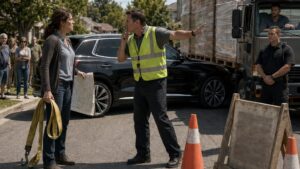
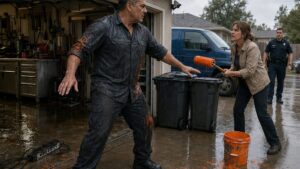
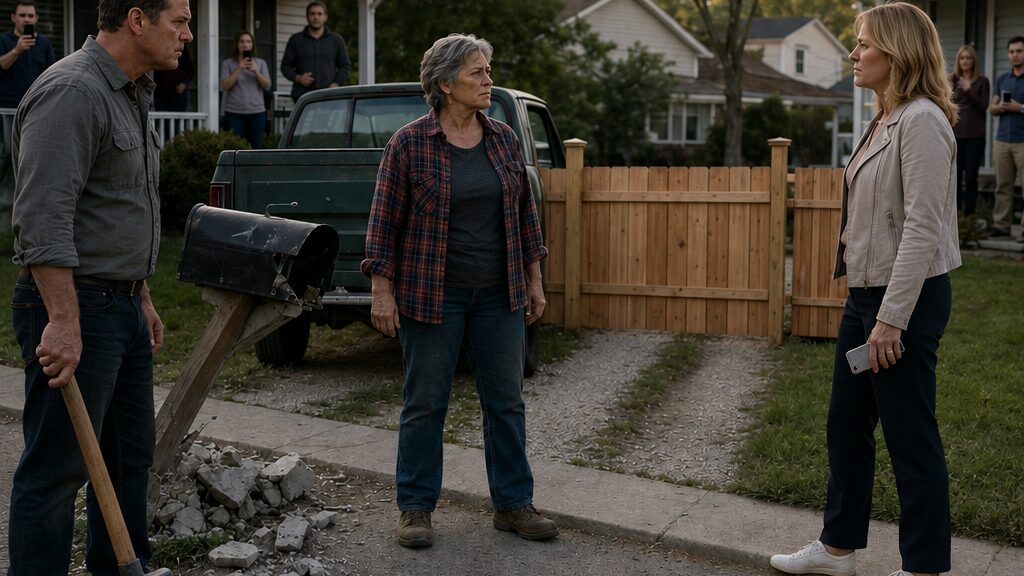
The first sledgehammer strike landed before Ruth Mitchell reached the road.
She heard concrete crack, sharp and hollow, then saw a gray chip skip across the asphalt and stop near the toe of her work boot.
Kevin Roberts lifted the hammer again.
“Don’t,” Ruth said.
He swung anyway.
The second blow broke a wedge from the footing beneath her mailbox. The black metal box tipped several inches toward the ditch, its post shuddering. Kevin straightened with both hands on the handle and looked at her as though he had completed a repair she had refused to authorize.
Across the road, a porch door opened.
Ruth noticed that before she noticed Angela.
Angela Roberts stood at the edge of her driveway in clean white sneakers and a pale jacket, one hand holding her phone against her thigh. She did not look surprised by the hammer.
Ruth stopped beside the ditch.
“What are you doing?”
Kevin wiped his mouth with the back of his wrist. “Moving what shouldn’t be here.”
“That’s my mailbox.”
“It’s over the corrected line.”
Ruth looked from him to the broken footing. The mailbox had been in that spot for twenty-six years. Before that, another post had stood within a foot of it. She knew because she had helped dig the old one out after a snowplow clipped it.
“Corrected by who?”
Angela answered.
“The survey used for our architectural approval.”
Her voice carried easily. Two houses down, another neighbor had stepped onto a porch. Someone farther up the cul-de-sac held a phone chest-high.
Ruth felt the old temptation rise in her: say nothing until she knew everything. Let other people spend their words. Words were what people used when they wanted witnesses.
She looked at Kevin.
“You could have knocked on my door.”
“We did,” Angela said.
“You left notices.”
“That counts.”
“No,” Ruth said. “It counts as leaving paper.”
Angela’s mouth tightened.
Kevin planted the hammer head on the ground. “Read the rules next time.”
Ruth almost laughed. Not because anything was funny, but because the sentence sounded borrowed.
She turned toward her driveway.
Her old green pickup sat where she had left it the night before, dust along the wheel wells, a coil of orange extension cord visible behind the bench seat. Beyond it ran the narrow gravel track between her property and the Roberts lot.
Or it had run there yesterday.
Fresh cedar panels now cut across it.
Ruth did not move for several seconds.
The fence was new enough that the boards still held their raw honey color. Three sections ran along the side yard, then turned at a hard angle across the pale gravel strip. New posts had been sunk where tire ruts used to pass toward the rear acre.
The mailbox no longer mattered.
She walked away from Kevin without asking permission.
“Ruth,” Angela called.
Ruth kept going.
The gravel crackled beneath her boots. Weeds had grown up through the center of the track in recent years, but the two shallow wheel paths were still there. One led directly into a cedar post.
She stopped close enough to smell fresh-cut wood.
Behind her, Kevin said, “That’s our fence.”
Ruth crouched and brushed loose dirt from the base of the nearest post. The concrete collar was pale and damp.
“When did this go in?”
“Yesterday,” Angela said.
Ruth stood.
“You put it across the track.”
“It’s inside our approved boundary.”
“That wasn’t my question.”
Angela folded her arms. “The track isn’t a road.”
Ruth looked past the fence toward the rear acre. From here she could see only the top of the old equipment shed and a line of trees. The access curved behind them.
She had not driven the pickup back there in more than three years.
That fact arrived with an uncomfortable weight.
Angela mistook her silence for uncertainty.
“You’ve been cutting across our side for years because nobody stopped you,” she said. “That doesn’t make it yours.”
A neighbor across the road shifted position, phone still raised.
Ruth felt heat climb her neck.
She had spent thirty-one years supervising maintenance crews in buildings where one loose valve could flood three floors. She had learned early that the loudest person in a room usually knew the least about the system inside the walls.
But this was not a boiler room.
This was her driveway, her leaning mailbox, her neighbors watching.
“Who approved this exact line?” she asked.
Angela gave a thin smile. “The HOA approved the fence.”
“Exact line.”
“The application included the survey.”
“Can I see it?”
“You can request records like everyone else.”
Kevin snorted.
That sound nearly did what the hammer had not.
Ruth turned toward him. For one second she imagined lifting the broken mailbox post and dropping it across the hood of his truck. The image came clean and satisfying.
Then she saw the porch phones.
She put both hands into the pockets of her faded overshirt.
“When you broke the footing,” she said, “did you measure first?”
Kevin’s face changed.
Only slightly.
Angela stepped between the question and the answer. “Your mailbox was an encroachment. We’re done pretending old habits are property rights.”
There it was.
Not the fence. Not the mailbox.
Old habits.
Ruth looked again at the gravel strip. Her grandfather had called it the back lane, although no sign had ever named it. Her husband had called it the track. County papers, if she remembered correctly, called it something else.
She had not looked at those papers in years.
Maybe longer than she wanted to admit.
A small piece of broken concrete clicked under Kevin’s boot.
Angela glanced toward the watching houses, then back at Ruth. Her expression softened into something almost reasonable.
“We’re trying to improve our property,” she said. “We followed the process. You can’t show up after approval and decide everything stays the way it was in 1985.”
Ruth studied her.
For the first time that morning, she wondered whether Angela truly believed every word.
That was worse than simple malice.
Ruth walked to the fence and looked through the narrow spaces between boards. The route beyond was clear except for brush near the rear bend. No other vehicle access reached her back acre without crossing a drainage swale and a steep embankment from the county road.
Angela came closer.
“If you need to get back there,” she said, “use the other side.”
“There isn’t another side.”
“There’s always another option.”
Ruth turned.
Angela’s smile had returned, small and controlled.
“Drive around,” she said. “Or sell it.”
Chapter 2: Please Call Enforcement and Bring the County Map
The first cedar post sat directly in the left wheel rut.
Ruth knew because she measured it with her own stride.
Seven paces from the edge of her driveway to the post. Two more to the old drainage stone. Then the second rut disappeared beneath the fence corner.
She walked it twice before Angela came outside again.
By then Kevin had moved the sledgehammer into his garage. The mailbox still leaned toward the ditch.
“Are you planning to pace holes in my yard?” Angela asked.
Ruth stopped beside the post.
“Your yard?”
Angela held up her phone. “I’m documenting this.”
“Good.”
That answer unsettled her more than protest would have.
Ruth crouched and pressed her thumb into the fresh soil. The fence contractor had cut through compacted gravel to set the post. Beneath the loose brown dirt was the old pale aggregate, crushed hard by years of tires.
She remembered taking feed sacks back there when her husband still kept two stubborn goats he swore were temporary. She remembered a utility trailer. Her grandfather’s tractor. A county brush crew once, long ago.
Memory was not proof.
Ruth knew that better than anyone.
Angela moved closer. “The HOA approved our application. The contractor followed the survey. You don’t get to tear anything out because you remember driving here.”
“I haven’t touched it.”
“You threatened me.”
“I told you you’d want to move it.”
“That is a threat.”
Ruth looked at her.
Behind Angela, a curtain shifted in a neighboring window.
Public pressure had a sound. Not shouting. Small things. Screen doors. Footsteps slowing. A mower shutting off before the job was finished.
Ruth straightened.
“Show me the approval.”
“I don’t have to show you anything.”
“You keep saying it proves your right.”
“It proves we followed procedure.”
“That’s not the same sentence.”
Angela’s jaw tightened.
Kevin appeared at the garage entrance but did not come down the driveway.
Ruth looked at the fence again.
“When did your surveyor mark this?”
Angela hesitated.
“Last month.”
“With pins?”
“Of course.”
“Where?”
Angela pointed vaguely toward the side yard.
Ruth followed the gesture and saw one bright ribbon near a stake. New. Clean. Too far from the gravel to answer what she needed.
She walked three paces farther down the track.
“Stay off our property,” Kevin called.
Ruth stopped.
There was the question.
Not whether they were rude. Not whether the fence was ugly. Not whether the HOA had stamped a form.
Whose right existed where?
She turned back.
“I believe this is a recorded access.”
Angela gave a quick laugh. “You believe.”
“A right-of-way.”
“You have a driveway.”
“To the house.”
“You have land behind the house. That doesn’t mean you get a private road across ours.”
Ruth felt the sting because part of it was true. She had not used the track regularly. She had not cleared the center weeds last spring. Or the spring before that.
Angela saw something in her face and pressed harder.
“You let it grow over. Now we improve our yard and suddenly you remember you own a highway?”
Kevin came farther out.
“Enough, Angie.”
She looked at him.
“Why? She’s the one harassing us.”
The word landed neatly where the phones could catch it.
Ruth saw the neighbor across the road raise his device a little higher.
She could walk away. Go inside. Find papers first.
That was what she usually did.
Silence had always felt cleaner than performance.
But silence had also brought her to a morning where a man could smash her mailbox and a woman could stand over an old track calling her a trespasser.
Ruth took her hands from her pockets.
“Call code enforcement.”
Angela blinked.
Kevin looked at her.
Ruth nodded toward the phone. “You said I’m harassing you. Call them.”
For a moment nobody spoke.
Then Angela smiled.
“You think I won’t?”
“I think you should.”
Angela unlocked her phone.
Ruth added, “Ask them to bring the county map.”
The smile vanished.
Not entirely. Just enough.
A tiny pause.
Ruth saw it.
So did Kevin.
“What county map?” he asked.
Angela turned on him. “The parcel map.”
Ruth said nothing.
Angela tapped the screen hard enough that Ruth could hear it.
The call itself was brief. Angela used words like repeated intrusion, approved fence, escalating behavior. She said Ruth was refusing to respect the survey.
She did not mention the sledgehammer.
When she ended the call, she looked almost relieved.
“They’re sending someone.”
“Good.”
“You might want to move away from the fence.”
Ruth stepped back onto the center of the gravel track.
“I’m standing where I’m standing.”
A dark SUV entered the cul-de-sac twenty minutes later.
Before it reached them, another car arrived.
Sharon Lopez parked beside the curb and got out holding a folder against her chest.
Ruth had not seen the HOA president in person for almost a year. Sharon was the kind of woman who remembered meeting dates and insurance renewals and which neighbor had failed to submit a paint chip before repainting a shutter.
She looked first at the broken mailbox.
Then at the fence.
Then at the people watching.
Her face tightened.
“Ruth,” she said, “do not touch that fence.”
“I haven’t.”
“I received a report that you threatened removal.”
“I told Angela she’d want to move it.”
“That can be interpreted several ways.”
“Apparently.”
Sharon lowered her voice. “This needs to stop becoming a spectacle.”
Ruth looked around at the porches.
“You might tell the person who brought the hammer.”
Kevin shifted.
Angela said, “The mailbox was over the line.”
Sharon closed her eyes for half a second.
That was the first useful reaction Ruth had seen from her.
The county vehicle stopped behind Sharon’s car. A code officer stepped out carrying a tablet and a narrow clipboard case.
He listened to Angela first.
Ruth noticed that.
Angela showed him her phone, the fence approval, photographs, a survey image too small to read from where Ruth stood. Sharon supplied the HOA application.
The officer asked Ruth one question.
“What are you claiming?”
“Recorded vehicle access to the rear parcel.”
“Document number?”
“I don’t remember it.”
Angela exhaled through her nose.
Ruth continued, “Early sixties. Possibly sixty-two.”
The officer looked up.
“Grantor?”
“My grandfather.”
That changed something.
Not enough to prove anything. Enough to slow him down.
He opened a county mapping application on his tablet and began walking.
Ruth followed at a distance.
He reached the first post.
Stopped.
Zoomed the screen.
Walked six more yards.
Stopped again.
The neighbors had gone quiet.
The officer looked from the tablet to the gravel, then toward Ruth’s rear acre. His mouth opened as if he were about to ask another question.
Instead, he bent over the screen and enlarged something with two fingers.
“What?” Angela said.
He did not answer.
Halfway down the track, the code officer had stopped speaking.
Chapter 3: The Old Plat Proved Less Than Ruth Expected
The code officer turned his tablet toward Ruth.
“There’s an easement reference.”
Angela spoke first. “A what?”
He did not look at her.
The map on the screen showed modern parcel lines in clean digital colors. Beneath them, faint enough to miss at first glance, ran a dashed notation along the side boundary.
The officer tapped it.
“Reference number here. Old instrument. I can’t tell dimensions from this layer.”
Ruth felt something loosen inside her chest.
Not victory.
Recognition.
“I told you,” she said.
The words came out before she could stop them.
Angela stared at the screen. “That could be utilities.”
“Could be,” the officer said.
Ruth’s relief tightened again.
He opened another panel.
“It may also be access. I need the recorded instrument.”
Sharon stepped closer. “Does this mean the fence is in violation?”
“It means I’m not making that determination from a map layer.”
Angela folded her arms. “So nothing has been proven.”
The officer looked at the fresh post.
“I wouldn’t say nothing.”
For one satisfying second, Ruth watched Angela lose color.
Then the officer added, “And I would not remove anything today.”
The satisfaction disappeared.
By early afternoon Ruth was sitting beneath fluorescent lights at the county records office with her hands flat on a laminate counter.
The clerk had pulled three digital scans and one index entry.
The oldest document was difficult to read. Typewritten language wandered across a faded page crowded with stamps. Ruth recognized her grandfather’s surname before she understood the rest.
The date was 1962.
The clerk enlarged a section.
Ruth leaned closer.
A right-of-way.
For ingress and egress.
The words were there.
Vehicle access across an eight-foot strip.
She read them twice.
Then a third time.
The route followed what had become the gravel track.
Her grandfather had not merely used it. He had been party to its creation.
Ruth sat back.
The clerk said, “You may want certified copies.”
“Yes.”
Her voice sounded different to her.
Stronger than it had that morning.
She paid for copies of the instrument and the associated plat. On the plat, the track appeared as a thin faded line, almost delicate compared with what had happened around it over sixty years.
When Ruth returned home, Sharon’s car was waiting.
So was Angela.
Kevin was nowhere in sight.
Ruth stepped from the green pickup holding a manila envelope.
Angela looked at it immediately.
“You found something.”
Ruth closed the truck door.
“I found the easement.”
Sharon held up one hand. “Before this gets worse, the board needs to review everything.”
“The county record says eight feet.”
“Recorded when?”
“Nineteen sixty-two.”
Angela laughed once, without humor. “You’re serious.”
Ruth removed the certified copy.
Angela did not take it.
Sharon did.
She read standing beside Ruth’s leaning mailbox, turning the page once, then again.
“This is real,” she said.
Ruth hated how good that felt.
Angela’s face hardened.
“Then why wasn’t it disclosed with the fence application?”
Sharon looked up.
“That is a separate issue.”
“No, it isn’t. The HOA approved the fence.”
“The HOA does not extinguish recorded property rights.”
Ruth looked at Angela.
There it was at last: the reversal she had imagined from the moment the officer went quiet.
She expected satisfaction to settle cleanly.
Instead, Sharon kept reading.
Then stopped.
“What?”
Sharon’s eyes moved to Ruth.
“I need to check our archive.”
“For what?”
“Maintenance history.”
Ruth frowned.
Angela seized on it. “What maintenance history?”
Sharon closed the folder.
“The association has old transition records from before the current covenants were consolidated.”
“That has nothing to do with my easement,” Ruth said.
“Maybe not.”
Ruth heard the caution.
She disliked it more than open opposition.
An hour later they were in the HOA office, a converted room beside the neighborhood pool. Ruth had avoided it for years.
She had ignored election notices. Budget meetings. Requests for volunteer committees. When envelopes arrived, she opened what concerned dues and left the rest in a drawer.
Now she sat across from Sharon while Angela occupied the chair beside the filing cabinet.
Sharon pulled an old binder from a lower shelf.
“This association inherited records from the prior road-maintenance group,” she said. “They’re incomplete.”
Angela leaned forward. “But they exist.”
“Some do.”
Ruth held the certified easement against her knee.
Sharon turned pages.
There were lists of culvert repairs, gravel purchases, shared mowing, handwritten initials.
Then she found a photocopied memo.
The paper was newer than the 1962 instrument but old enough that the toner had faded gray.
Sharon read silently.
Ruth watched her expression.
“What does it say?”
Sharon slid the page across the table.
It referred to the rear track.
Temporary suspension of shared maintenance.
No regular vehicle use anticipated.
Owner to maintain private access if resumed.
Ruth read the lines twice.
Angela pointed.
“There.”
“That does not terminate an easement,” Ruth said.
“I didn’t say it did.”
“You’re acting like it does.”
Angela’s voice sharpened. “You stood out there like we built a fence across an active road. This says nobody expected regular use.”
Ruth looked at Sharon.
“Who wrote it?”
“The copy doesn’t say.”
“There has to be an original.”
“Maybe.”
The door opened.
The code officer entered holding a printed packet.
He had found the same 1962 instrument.
For ten minutes they compared documents. He confirmed the recorded right-of-way existed. He also confirmed the fence appeared to cross the mapped corridor.
Ruth waited for the sentence she wanted.
It comes down.
He did not say it.
“Existence is one issue,” he said. “Current enforceability, exact field location, scope, and remedy are others. I can document a likely obstruction. I cannot settle a private easement dispute from this room.”
Angela sat back.
Ruth felt the floor shift beneath her.
“But it’s recorded.”
“Yes.”
“And the fence crosses it.”
“Based on what I see, likely.”
“Then what is complicated?”
“Sixty years.”
The officer’s answer was quiet.
He pointed to the maintenance memo.
“Long nonuse does not automatically erase a recorded easement. But I’m not going to tell a property owner to start demolition when we have questions about exact location, maintenance history, and whether later agreements changed practical use.”
Ruth stared at the faded memo.
Her clean reversal had lasted less than an afternoon.
The officer left copies of his preliminary notes. Sharon said the board would request legal review. Angela walked out without looking at Ruth.
Ruth remained seated.
The room smelled faintly of chlorine from the pool next door.
Sharon gathered papers slowly.
“You should go through your own records.”
“I have.”
“All of them?”
Ruth did not answer.
Sharon looked at her.
“That’s what I thought.”
At home, Ruth spread everything across the kitchen table.
The certified 1962 instrument.
The plat.
The HOA memo.
She made coffee and forgot to drink it.
Near dusk she examined the memo again under the brighter light above the stove.
Temporary suspension of shared maintenance.
No regular vehicle use anticipated.
Owner to maintain private access if resumed.
Something about the final line bothered her.
Not the wording.
The slant.
The letter R in resumed.
She brought the page closer.
Her late husband had made his capital R with a hard vertical stroke and a short hooked leg. Ruth had watched that shape on grocery lists, birthday cards, work orders, notes stuck to the refrigerator.
She looked at the initials near the bottom margin.
They were faint.
She had dismissed them as filing marks.
Now her hand went cold around the paper.
The maintenance note was in her husband’s handwriting.
Chapter 4: Her Husband’s Note Changed the Meaning of Silence
Ruth unlocked the steel cabinet at six fourteen the next morning.
The key resisted.
She had to twist it twice, then pull the door toward herself before the latch gave with a metallic snap.
For three years, the cabinet had stood in the corner of the utility room behind a stack of folded tarps and a broken shop fan. Ruth passed it every time she changed the furnace filter. She had told herself there was nothing inside she needed.
Now the maintenance memo lay on the workbench beside her.
Her husband’s handwriting stared up at her.
Temporary suspension of shared maintenance.
No regular vehicle use anticipated.
Owner to maintain private access if resumed.
Ruth opened the cabinet.
The smell came first: machine oil, old paper, dry wood. On the top shelf sat two coffee tins filled with bolts, a rusted tape measure, and a yellow legal pad curled at the edges. Below them were folders labeled in her husband’s block letters.
TRACTOR.
DRAINAGE.
BACK LOT.
She did not touch that one immediately.
Her hand moved to the tape measure instead.
The yellow casing had a black thumbprint near the lock. She remembered exactly when it had gotten there. Her husband had been repairing the gate frame on the rear acre, grease on both hands, insisting the post was square when it visibly leaned.
Ruth put the tape back.
Then she took out the BACK LOT folder.
Inside were receipts, sketches, gravel invoices, and a carbon copy of the same maintenance note.
This copy had more writing.
At the bottom, beneath the lines Sharon had shown them, was an additional sentence that had been cut off from the HOA photocopy:
Shared contribution paused pending drainage repair. Access rights unchanged.
Ruth read it once.
Then again.
Her knees weakened enough that she sat on the utility stool.
The note did not surrender anything.
Her husband had agreed to stop shared maintenance because the drainage swale had begun washing gravel out near the rear bend. The track had not been abandoned. The cost arrangement had been paused.
She should have felt vindicated.
Instead, anger came first.
At Sharon for producing an incomplete copy.
At Angela for seizing on it.
At the county for making sixty years sound like a defect.
Then the anger turned.
Because Ruth knew why nobody had a better record.
After her husband died, the HOA had sent a letter about rear access maintenance. Ruth had opened it at the kitchen counter, read half, folded it, and put it beneath a stack of insurance papers.
A second notice came months later.
She ignored that one too.
She had not wanted to discuss the back acre.
Not with Sharon. Not with neighbors. Not with anyone.
Facts could speak for themselves, she had thought.
Only she had locked the facts in a cabinet.
By nine, Ruth was at the county archive with the full carbon copy sealed in a clear sleeve.
The clerk compared it with the HOA photocopy.
“This isn’t a county record,” the clerk said. “But the language may help establish intent.”
“Can you tell why their copy is missing the last line?”
“No.”
“Was it removed?”
The clerk looked at her carefully. “I can tell you it’s a different reproduction. I can’t tell you why.”
Ruth nodded.
She had promised herself not to turn uncertainty into accusation.
That promise lasted until she saw Raymond Young waiting outside.
He leaned against an older sedan with a folded map under one arm.
“You look mad,” he said.
“I’m improving.”
Raymond glanced at the clear sleeve.
“You found the long version.”
Ruth stopped.
“You knew there was one?”
“I knew your husband didn’t give things away by accident.”
“That isn’t an answer.”
Raymond looked toward the archive doors.
“No. It isn’t.”
He had worked as a survey technician before retirement, though never on the original 1962 instrument. Ruth knew him from the years before newer houses filled the outer lots.
They spread the county plat across the hood of his car.
Raymond placed one finger on the faded line.
“Your grandfather didn’t create this because he liked sharing roads.”
“What did he create it for?”
“To keep the rear pieces usable.”
He traced the route from the cul-de-sac edge toward the back parcels.
“When the original acreage was divided, the frontage made the houses easy to sell. The rear land was the problem. Without this strip, some of it would have no practical vehicle route unless somebody built over the drainage grade.”
Ruth looked at the line.
“So he granted access.”
“He helped formalize it.”
“For who?”
“For parcels that needed it. Including yours.”
The answer was simple enough that she mistrusted it.
“Then why did everybody stop using it?”
Raymond folded his arms.
“Some rear pieces got absorbed into front lots. Some owners stopped farming. Some built other arrangements. Your husband used this one longer than most.”
Ruth said nothing.
Raymond studied her face.
“You stopped after he died.”
It was not a question.
“I stopped needing to go back.”
“That’s not the same thing.”
Ruth folded the plat too sharply.
Raymond caught one edge before it creased.
“I’m not taking their side.”
“It sounds like you’re practicing.”
“I’m saying a road can exist on paper while disappearing in people’s minds.”
She looked toward the parking lot.
“That’s convenient.”
“It’s also what happened.”
The words followed her home.
That afternoon Ruth walked to the rear acre on foot.
She could not use the track now because of the fence, so she went down the far edge of her property, crossed the shallow drainage swale, and climbed the embankment slowly.
The route left mud on her boots.
At the top, the rear acre opened behind a line of trees.
The equipment shed leaned slightly to one side. Tall weeds had grown through the gravel where the track curved in. Two shallow ruts remained, faint but visible.
Ruth stood among them.
She had told Angela there was no other route.
That was true.
She had told herself she had not used the track because she did not need it.
That was not.
Near the shed stood the unfinished gate frame.
Two posts. One crosspiece. No gate.
Her husband had been building it the summer before his health failed.
Ruth turned away.
She had not come back because the place contained too many unfinished things. A broken mower. Stacked lumber. A coffee mug still sitting on a shelf inside the shed until weather cracked it.
The track had not simply grown over.
She had let it.
When Sharon called that evening, Ruth answered on the third ring.
“I found the complete note,” Ruth said.
Silence.
“Complete?”
“The HOA copy is missing the last line.”
Sharon’s tone changed. “What line?”
“Access rights unchanged.”
Another silence.
“I need a copy.”
“You’ll get one.”
“Ruth, I didn’t alter anything.”
“I didn’t say you did.”
“You were thinking it.”
Ruth looked through the kitchen window toward the cedar fence.
“Yes.”
Sharon exhaled.
“I inherited that binder. I don’t know who copied what.”
“I believe you.”
“Do you?”
Ruth considered lying.
“No.”
The honesty surprised both of them.
Sharon said, “Then bring it to the meeting.”
“What meeting?”
“You’ll receive notice.”
The line went dead twenty minutes before a delivery truck stopped at Ruth’s driveway.
The driver handed her a certified envelope.
The return address belonged to the HOA.
Ruth signed.
Inside was a formal notice requiring her to cease threats of unauthorized fence removal, avoid entry onto the Roberts property, and attend a board hearing concerning what the subject line called escalating nuisance conduct.
She read the notice standing beside her broken mailbox.
At the bottom, in bold type, was a warning that any unapproved interference with the fence could expose her to enforcement action.
Ruth looked past the leaning post toward the overgrown gravel track.
For years she had said nothing.
Now the silence itself had become evidence against her.
Chapter 5: Angela Had More to Lose Than a Cedar Fence
Ruth’s name appeared on the agenda beneath the words NUISANCE ESCALATION.
She saw it before she entered the meeting room.
The page had been taped beside the door, directly below a reminder about pool hours and above a notice requesting volunteers for spring landscaping.
RUTH MITCHELL — NUISANCE ESCALATION / BOUNDARY DISPUTE.
She stood there long enough for gravel dust from her boots to mark the polished tile.
“Are you coming in?”
Sharon held the door open.
Ruth pointed at the page.
“That your wording?”
“The board’s.”
“You’re president.”
“I’m not the board.”
Ruth almost turned around.
That was the old instinct. Leave before people could frame her. Refuse the room. Keep the documents and let everyone else exhaust themselves.
Then she remembered the cabinet.
She walked inside.
Angela sat at the far end of a folding table with Kevin beside her. Two board members had arranged folders and bottled water. The air conditioner ran too cold.
Kevin did not look at Ruth.
Angela did.
On the table in front of her sat the fence approval, the survey image, and a real-estate folder Ruth had not seen before.
Sharon began without ceremony.
“This is not a trial. The board is addressing safety, access, property interference, and potential association exposure.”
Angela lifted a hand.
“I need it noted that we relied on written approval.”
“It is noted,” Sharon said.
“And that Ruth threatened demolition.”
Ruth placed the complete maintenance note on the table.
“I said she would want to move the fence.”
Angela gave a sharp laugh. “That is not better.”
One board member asked, “Did you arrange equipment?”
Ruth looked at Sharon.
“Where did that come from?”
“Answer the question.”
Ruth felt every eye in the room.
“Yes.”
Kevin finally looked up.
Angela turned toward him, then back to Ruth.
“You rented an excavator?”
“I reserved one.”
“For our fence.”
“For access work if I am legally authorized.”
Angela pushed her chair back an inch.
“And you people are calling me the problem?”
Nobody had called her anything.
That was the first time Ruth noticed how frightened Angela looked.
Not weak. Frightened.
Sharon redirected them to the documents.
The complete note changed the room. The missing line—Access rights unchanged—destroyed the easiest argument that Ruth’s husband had intended surrender.
But it did not answer everything.
The board still questioned exact easement width in the field. The old map had to be reconciled with the modern survey. Sharon repeated that the HOA approval had concerned fence design and placement information submitted by the Roberts household, not title guarantees.
Angela’s face tightened at that distinction.
“You approved it.”
“We approved what was represented.”
“You had the old records.”
“Incomplete records.”
“You’re trying to put this on us.”
Sharon’s voice stayed level. “I’m trying to keep the association from making a second mistake because everyone is angry about the first.”
Ruth disliked her less for that sentence.
Not much less.
Enough.
The meeting continued until one board member asked why the fence had become urgent.
Angela looked at the real-estate folder.
Kevin rubbed both hands over his knees.
Sharon said, “That question matters because timing has been raised.”
Angela’s eyes flashed. “Our finances are not association business.”
“No,” Sharon said. “But reliance and urgency are.”
Ruth stayed quiet.
Angela looked at her.
“You want to know?”
“No.”
The answer came too quickly.
Angela heard it.
“That’s your whole problem,” she said. “You never want to know anything about anybody until they’re in your way.”
The room went still.
Ruth felt the accusation because it reached beyond the fence.
Angela opened the folder.
“We’re refinancing.”
Kevin stared at the floor.
“The appraisal was delayed,” Angela continued. “Kevin’s work changed. Our rate adjustment is coming. We needed the property cleaned up before the second inspection.”
Kevin said, “Angela.”
“No. She thinks this is some game.”
Ruth looked at him.
“What changed with work?”
He did not answer.
Angela did.
“Hours. Contracts. Pick a word.”
Kevin stood abruptly.
“I said enough.”
His chair scraped the floor.
For a second Ruth saw the man with the sledgehammer again.
Then he put both hands flat on the table and spoke without looking at her.
“I never saw the full plat.”
Angela went motionless.
Sharon said, “Kevin.”
He shook his head.
“She told me the survey settled it.”
Angela’s face reddened. “You agreed.”
“I agreed the mailbox was over the line.”
“You broke it.”
“I know what I did.”
Ruth did not move.
Kevin finally looked at her.
“I thought the corrected line meant the old post was on us. I thought the track was just where you’d been driving.”
“You could have asked.”
“Yes.”
No excuse followed.
That made the admission harder to dismiss.
Angela turned on him.
“So now you’re helping her?”
“I’m not helping anybody.”
“You stood there.”
“I know.”
“You swung the hammer.”
“I know.”
The second time sounded different.
Ruth had imagined Kevin and Angela as one force because it had been easier. Two people against one widow. One house against another.
Now a crack had opened between them.
She did not enjoy it.
That surprised her.
Sharon called a ten-minute recess.
Outside, Ruth stood beside her pickup while the meeting-room windows glowed behind her.
Angela came out alone.
“You think you’ve won.”
Ruth leaned against the truck.
“No.”
“You have an easement.”
“I have a record.”
“You have the county looking at us. The board looking at us. An appraiser asking why there’s a property dispute.”
There it was.
Not just privacy.
Not just status.
A number on a loan.
A deadline.
Fear wearing expensive shoes.
Ruth said, “You still put the fence across the track.”
Angela’s eyes filled, though no tears fell.
“We bought a house with a side yard. The records we were shown did not say an old lane could reopen whenever you changed your mind.”
“I didn’t change my mind.”
“You stopped using it.”
Ruth looked down at the gravel dust on her boots.
“Yes.”
Angela had not expected that.
Neither had Ruth.
“I stopped,” Ruth said. “I didn’t surrender it. But I stopped. I didn’t maintain it. I ignored letters. I let people believe things because I didn’t want to explain myself.”
Angela folded her arms, but the gesture had lost some of its certainty.
“That doesn’t fix what this does to us.”
“No.”
“You could agree it’s abandoned.”
“No.”
The word was quiet.
Angela’s mouth tightened.
“That’s what I thought.”
She went inside.
Ruth stayed beside the pickup until Sharon opened the door.
“We’re reconvening.”
The meeting ended without a victory.
The board froze any physical action pending a final county field review. Angela refused a proposal for a removable gate because she would not sign anything acknowledging active vehicle access before the appraisal. Kevin said almost nothing.
Ruth went home furious at everyone.
Including herself.
Two days later, a county envelope arrived.
She opened it at the kitchen table.
The written finding was narrower than she wanted and stronger than she expected.
The county identified the fence as an obstruction within the documented access corridor, subject to final field limits and private-property enforcement. The instrument remained recorded. The maintenance note did not show termination.
Then came the sentence that changed everything:
The county would not select the remedy.
The easement holder could pursue lawful restoration of access within the documented scope, subject to damage limitations and applicable notice.
Ruth read that paragraph three times.
Angela had wanted the county to stop her.
Instead, the county had put the choice in Ruth’s hands.
Chapter 6: The Excavator Arrived Before Anyone Knew Her Decision
The flatbed turned into the cul-de-sac at seven twelve on Tuesday morning.
Every curtain moved.
Ruth stood beside her green pickup with the county finding folded in her shirt pocket and watched the excavator ride toward her on steel tracks chained to the trailer bed.
The machine was smaller than the one people would later claim she brought.
It still looked enormous beside a cedar fence.
The operator eased the truck to the curb.
Across the Roberts yard, a back door slammed.
Angela came out first.
Kevin followed more slowly.
“What are you doing?” Angela shouted.
Ruth did not answer until the truck stopped.
The excavator operator climbed down and looked from Ruth to the fence.
“You want me staged here?”
“For now.”
Angela crossed the lawn.
“You cannot tear down my fence.”
Ruth took the county paper from her pocket.
“I have not said what I’m removing.”
“You rented an excavator.”
“Yes.”
“For landscaping?”
“No.”
Kevin stopped several yards behind his wife.
Ruth looked at him.
He looked at the machine.
Then he stepped sideways, clearing the track entrance.
Angela saw it.
“What are you doing?”
Kevin said, “Not standing in front of that.”
“You’re unbelievable.”
“I’m done pretending I know what those papers say.”
Her face changed.
Ruth had expected anger.
What she saw was panic.
“You told me we were handling this together.”
“We were.”
“Were?”
Kevin looked toward the broken mailbox, still leaning beside the road.
“I handled enough.”
The words landed harder than any apology.
Neighbors appeared at driveways. Phones emerged.
Ruth hated them immediately.
The same audience that had watched Kevin swing the hammer now waited for her to answer with a machine.
For one hot second, she wanted to give them the scene they expected.
She imagined the bucket closing around the first cedar panel. Posts lifting. Concrete breaking. The whole polished boundary laid flat in a line of splintered sections.
She had the finding.
She had the old plat.
She had the complete maintenance note.
She had waited.
The operator approached.
“I need your marks.”
Ruth looked at the fence.
Angela stepped closer.
“If you touch all of it, I’ll sue.”
“Maybe.”
“You think that paper protects you from damage?”
“No.”
That stopped her.
Ruth unfolded the county finding across the hood of the green pickup.
A field technician had marked the corridor limits the previous afternoon. Eight feet, adjusted to the measured historic alignment. The fence crossed it at an angle.
The operator studied the drawing.
“You don’t need the whole run,” he said.
Angela stared at him.
Ruth said, “Show me.”
He walked to the cedar panels and pointed.
“This corner post is outside most of the corridor. That one’s near the edge. If access is all you need, we can take the crossing section and leave the side run.”
“How many panels?”
He counted.
“Three. Maybe a partial fourth if the field mark is tight.”
Ruth looked at the long fence.
Three panels.
For days she had pictured the entire structure as the offense.
Now the actual obstruction was smaller.
That should have made the choice easy.
It did not.
Angela’s voice dropped.
“You brought that machine before you knew.”
Ruth turned.
“Yes.”
The watching neighbors grew quieter.
Angela looked almost vindicated.
“There. You wanted revenge.”
Ruth felt the paper in her hand.
She could lie.
She could say she had rented the machine only because scheduling required it. That would even be partly true.
Instead she said, “I reserved it before the HOA meeting.”
Kevin looked at her.
Sharon’s car entered the cul-de-sac just in time to hear the next sentence.
Ruth continued.
“I was angry.”
Angela gave a short, bitter laugh.
“You expect that to help?”
“No.”
Sharon got out holding a folder.
“Nothing happens outside the marked corridor.”
“I know,” Ruth said.
“Nothing happens without documentation.”
“I know.”
“And the board has counsel reviewing—”
Ruth turned toward her.
“I know.”
The sharpness in her voice stopped everyone.
She looked at the phones.
At Kevin.
At Angela.
At the machine.
Then at the pale gravel track disappearing beneath the fresh cedar.
“I also know I let that road disappear.”
Nobody spoke.
Ruth pointed toward the rear acre.
“My husband died. I stopped going back. I stopped clearing it. I ignored letters because I didn’t want to explain why I wasn’t using it. I thought if the right existed on paper, that was enough.”
Angela’s expression shifted.
Ruth went on before courage became embarrassment.
“It wasn’t enough. Not for people who moved here later. Not for the board. Maybe not even for you.”
Angela said, “So you admit—”
“I admit silence made confusion easier.”
Ruth’s voice hardened.
“I do not admit you had the right to block it.”
The distinction stayed between them.
Sharon looked down at her folder.
Kevin stared at the gravel.
Ruth turned to the operator.
“Three panels.”
Angela flinched.
Ruth pointed.
“Only what crosses the marked access.”
The operator nodded.
“No side run?”
“No.”
“No extra posts?”
“Not unless they prevent the opening.”
Angela looked from Ruth to the fence.
“You brought an excavator for three panels?”
Ruth almost smiled.
“For concrete footings.”
The operator did smile.
Then the machine started.
Its diesel engine filled the cul-de-sac.
The excavator rolled off the trailer slowly. Steel tracks touched pavement, then stopped at Ruth’s direction before entering the gravel.
Ruth walked ahead.
The old wheel ruts were barely visible beneath weeds, but now survey flags marked the corridor. She followed them to the fence.
The bucket rose.
Angela moved forward.
“Wait.”
Kevin caught her arm, not roughly.
She shook him off.
“Ruth.”
The use of her name sounded strange.
Not Mrs. Mitchell. Not she. Not this woman.
Ruth looked at her.
Angela’s face was pale.
“The appraisal is Friday.”
Ruth said nothing.
“If that opening is there—”
“The opening already exists.”
“Not to them.”
Ruth understood.
That was the whole fight in five words.
Not to them.
A right unseen. A road unused. A risk hidden until someone looked.
Angela had built her certainty on appearance.
Ruth had built hers on silence.
Both had wanted the world to accept what was convenient.
The excavator bucket hung above the cedar.
Ruth looked at the three panels.
Then at the operator.
“Hold.”
Angela inhaled.
Ruth walked to her pickup, took a roll of bright orange marking tape from behind the seat, and returned.
She tied one strip to the first panel.
A second to the next.
A third to the last section fully inside the corridor.
The orange pieces moved in the light morning air.
“That’s all,” Ruth said.
The operator lowered the bucket.
Behind her, someone on a porch whispered.
Ruth did not turn.
She stood in the gravel, facing the fence she had every reason to hate, and marked only three panels for removal.
Chapter 7: The Road She Reopened Was Not Only Through Their Yard
The green pickup hesitated at the gap.
Ruth felt it through the steering wheel before she understood why.
The engine idled low. Fresh gravel pressed pale beneath the front tires. Where three cedar panels had stood, there was now an eight-foot opening framed by two surviving posts and a temporary length of orange safety ribbon Sharon had insisted on until the final paperwork was complete.
Ruth could drive through.
That had been the point.
Still, she sat with one hand on the wheel and the other resting on the gearshift.
Several weeks had passed since the excavator removed the obstruction. The work itself had taken less than an hour. The operator had lifted the three panels, loosened the concrete around the posts, and set everything neatly on the Roberts side. No cheering. No applause. No dramatic collapse.
Only machinery, measurements, and the hard scrape of old gravel being exposed again.
The county finding had been attached to the HOA record. The board had amended the property file to flag the easement. Kevin had paid for the mailbox footing without being asked twice.
Angela had not spoken to Ruth since.
Now the track waited.
Ruth eased the truck forward.
The first tire crossed the line where the fence had been.
Nothing happened.
No one came running.
No official vehicle appeared.
No neighbor raised a phone that Ruth could see.
The pickup rolled onto the old gravel strip.
Branches brushed the passenger-side mirror. Weeds bent beneath the tires. The two shallow ruts appeared and disappeared ahead of her like something remembering its shape.
Ruth drove slowly.
At the rear bend, she stopped.
A washout had eaten part of the edge, exactly where the old maintenance note said drainage repairs had been needed. She got out and stood beside it.
Raymond had warned her.
“Rights don’t fill holes,” he had said.
She had disliked the sentence because it was true.
Ruth crouched and picked up a handful of loose gravel. The stones pressed into her palm.
For years she had treated the track like a fact that existed without care. A line on paper. A thing other people ought to respect because it was true.
But roads, unlike facts, disappeared when nobody used them.
She dropped the gravel.
The truck continued toward the rear acre.
When the trees opened, Ruth saw the gate frame.
She hit the brake too hard.
The pickup lurched.
For a moment she sat perfectly still.
Two old posts stood near the shed with a horizontal crosspiece between them. One post leaned slightly inward. The lumber had silvered with age. Vines climbed the lower section.
Her husband had built most of it one summer afternoon while complaining that Ruth held a level like she was trying to win an argument with gravity.
She had forgotten the exact shape of the top joint.
Now she could see it from the windshield.
Ruth shut off the engine.
The sudden quiet was worse than the noise.
She stepped out.
The rear acre smelled of dry weeds and old wood. Somewhere beyond the tree line, a mower ran on another property.
Ruth walked to the gate frame.
One hinge bracket had been installed.
The second still sat in a small coffee can on the ground beneath the weeds.
She knew that without looking.
When she finally bent down, the can was there.
Rust had eaten the rim.
Inside were bolts, washers, and the second hinge.
Ruth sat on the low concrete block beside the post.
For three years she had told herself the back acre was inconvenient.
Then unsafe alone.
Then unnecessary.
The truth was smaller and harder.
Her husband had planned to finish the gate on a Saturday.
He had gone to the hospital on Thursday.
The unfinished frame had become the last ordinary promise in a life that ended before either of them understood it was ending.
Ruth had not stopped using the road because she no longer needed the land.
She had stopped because every trip led here.
She pressed both hands together until the hinge bracket dug into one palm.
A vehicle approached behind her.
Ruth stood quickly.
For one foolish second she expected Angela.
It was Raymond.
He parked at the edge of the clearing and got out carrying a shovel.
“You followed me?”
“No.”
“You just happened to bring a shovel to my back acre?”
He looked at the washout.
“I heard you finally drove through.”
“Neighborhood intelligence service?”
“Something like that.”
Ruth glanced toward the gate frame.
Raymond saw it.
His expression changed, but he did not say he was sorry.
She appreciated him for that.
He leaned the shovel against the truck.
“You going to finish it?”
“I don’t know.”
“That’s an answer.”
“No. It’s avoidance with punctuation.”
Raymond smiled faintly.
They spent an hour clearing the worst weeds from the track. Not rebuilding it. Not pretending one morning could erase neglect.
Just enough to see where the gravel still held.
By the time Ruth drove home, mud marked the truck doors and her shoulders ached.
Angela was waiting at the opening.
Ruth stopped.
Angela stood just outside the easement corridor with a folder under one arm.
For a moment neither woman spoke.
Then Angela said, “I need to ask you something.”
Ruth shut off the engine but stayed behind the wheel.
“That depends.”
“I want a gate.”
Ruth looked at the opening.
Angela continued quickly.
“A real one. Recorded agreement. Wide enough for your access. Locked only if you have the key. Something that keeps the side yard from being completely open.”
Ruth got out.
“You refused a gate at the meeting.”
“I know.”
“The appraisal?”
Angela looked away.
“It happened.”
“And?”
“Lower than we wanted.”
Ruth waited.
Angela’s mouth tightened.
“We refinanced anyway.”
That answered more than the words did.
Ruth looked at the folder.
“You already had something drafted?”
“An outline. Not a contract.”
“By who?”
“The board’s counsel suggested what would need to be addressed.”
Ruth almost laughed.
“Now you trust the board?”
“No.”
The answer was immediate.
Ruth respected it.
Angela opened the folder.
The proposal did not deny the easement. That was the first thing Ruth noticed.
It described a vehicle-access opening, minimum clear width, maintenance responsibilities, emergency access, notice for major work, and a removable gate structure.
Ruth read slowly.
Angela stood in silence.
At the bottom was a blank signature line.
“You expect me to sign this today?”
“No.”
“Good.”
“I expected you to say no.”
Ruth handed the papers back.
“I might.”
Angela looked up.
“Might what?”
“Agree to a gate.”
For the first time since the dispute began, Angela had no prepared response.
Ruth pointed toward the gravel.
“But not so you can pretend the road disappeared.”
Angela nodded once.
“And not so I can pretend I didn’t let it.”
The words felt heavier spoken aloud.
Angela looked at the track, then at Ruth’s mud-streaked pickup.
“I thought you were waiting for a chance to tear everything down.”
“I was, for about ten minutes.”
Angela gave a tired, involuntary laugh.
Ruth did too.
It ended quickly.
Some things were not repaired by sharing one laugh.
The next week, Ruth went to the HOA office voluntarily.
That alone drew a look from Sharon.
Ruth placed three documents on the table: the county finding, the proposed gate arrangement, and a one-page maintenance schedule.
Sharon read the schedule first.
Annual gravel inspection.
Drainage clearing.
Shared notice before heavy vehicle use.
No waiver through temporary nonuse.
Costs allocated by agreed responsibility, not assumption.
Sharon looked up.
“You wrote this?”
“Yes.”
“You want the association involved?”
“I want the record clear.”
“That is not the same thing.”
“I know.”
Sharon turned to the last page.
There was a signature at the bottom.
Ruth Mitchell.
For years, Ruth had thought independence meant never needing to explain herself.
Now she understood what that silence had cost.
She still did not like meetings.
She still did not trust every rule because someone printed it on letterhead.
She still believed Angela had been wrong, Kevin had been reckless, and the HOA had hidden too comfortably behind procedure.
None of that changed because Ruth accepted her own part.
She had let a road vanish from use and expected everyone else to remember it.
She had let grief make decisions while calling the result privacy.
She had waited for facts to speak in a room she refused to enter.
Sharon tapped the maintenance plan.
“This will need review.”
“Of course it will.”
“You hate that sentence.”
“Yes.”
Sharon almost smiled.
Ruth gathered her copy and left.
Outside, her old green pickup waited at the curb.
She drove home, passed the repaired mailbox, and turned toward the opening in the cedar fence.
Fresh tire tracks ran through the gravel now.
Her tracks.
At the rear acre, the unfinished gate frame still stood.
Ruth parked beside it and took the old yellow tape measure from the truck.
She hooked one end to the leaning post.
The distance was wrong by nearly an inch.
Her husband had been wrong.
Ruth laughed out loud.
Then she measured again.
The story has en