She Mocked His Clearance Patio Chairs—Then the HOA Learned What He Had Been Quietly Fixing
Chapter 1: The Chairs Karen Said Lowered Everyone’s Value
Karen Adams took the photograph before Anna had even peeled the orange clearance sticker from the chair.
Patrick Hall was still tightening the last bolt when he heard the camera shutter from the sidewalk.
He looked up from one knee, a socket wrench in one hand and his worn leather work gloves lying on the concrete beside him. Karen stood at the edge of their front walk with her phone held chest-high. She wore pressed white pants, sunglasses, and the expression she usually reserved for delivery trucks parked more than ten minutes.
Anna stopped pulling at the sticker.
“Did you just take a picture of our chairs?”
Karen lowered the phone. “Only for reference.”
“Reference for what?”
Patrick watched her glance over the two powder-coated metal chairs and the small matching table Anna had found at the garden center for seventy percent off. They were plain charcoal gray, sturdy, and small enough to fit beneath the porch window without blocking the walkway.
Karen’s gaze landed on the bright sticker still clinging stubbornly to one armrest.
“For the exterior standards discussion,” she said.
Patrick almost smiled.
He had lived in Brookstone Ridge for sixteen years. He had watched three management companies come and go, two presidents resign, and one memorable board spend forty minutes debating whether holiday lights could remain up through the first weekend in January. He had never heard of an exterior standard governing the retail price of patio furniture.
Anna folded the sticker into her palm.
“There’s a discussion about our chairs?”
“It isn’t about you specifically.” Karen’s tone made that impossible to believe. “We’re trying to maintain a more consistent appearance. Buyers notice these things.”
Patrick set the wrench down.
“What things?”
Karen gestured toward the patio as if the answer were obvious. “Visible furnishings. Landscaping. Presentation. We’re trying to move Brookstone Ridge toward a more premium look.”
Across the street, a garage door rattled open. Karen lowered her voice.
“You know what happened at the open house on Willow Bend. People commented that parts of the neighborhood looked tired.”
Anna glanced at Patrick. “Our chairs are brand-new.”
“That isn’t what I mean.”
Patrick knew exactly what she meant.
He could have told Karen what the chairs had cost only because Anna had announced the bargain three times on the drive home. He could also have told her that their mortgage had been paid off two years earlier, that they had no interest in replacing useful things simply because newer versions existed, and that he had spent thirty-one years supervising municipal facilities where a ten-dollar gasket sometimes mattered more than a ten-thousand-dollar lobby renovation.
Instead he picked up the wrench.
“Do the covenants prohibit them?”
Karen’s mouth tightened slightly.
“The board is reviewing updated expectations.”
“That wasn’t my question.”
Anna gave him a look that said, finally.
Karen shifted the phone into her other hand. “The documents give the association broad authority over exterior appearance.”
“Then send us the section.”
“I’m sure management can do that.”
Patrick nodded. “Good.”
He returned to the chair.
Karen remained there long enough that he could feel her waiting for something—a defense, perhaps, or embarrassment. When neither came, she looked at Anna instead.
“I’m only trying to protect everyone’s values.”
Anna’s voice stayed pleasant. “Then I’m sure the rule will be easy to show us.”
Karen walked away without answering.
Patrick tightened the bolt until the chair stopped rocking.
Anna sat down in it experimentally.
“She was disappointed you didn’t tell her what we paid for the house.”
“She already knows.”
“She was disappointed you didn’t tell her what we have in the bank.”
Patrick pulled on one glove to carry the cardboard packaging toward the garage. “That would make this dumber, not better.”
Anna watched Karen disappear around the curve of the sidewalk.
“You always think ignoring people makes them stop.”
“Usually does.”
“Usually makes them find someone else.”
Patrick paused.
He knew that tone. Anna used it when she thought he was technically correct and practically wrong.
Inside, he washed the grease from his hands and pulled the Brookstone Ridge governing documents from a kitchen drawer. He kept the printed copy because websites changed and board portals lost files. The binder was old enough that the plastic cover had yellowed.
Anna made coffee while he worked through the architectural section.
Exterior paint colors. Fencing. Permanent structures. Satellite equipment. Window coverings visible from the street. Nothing about movable patio furniture beyond a general nuisance clause that would have required something damaged, unsafe, or obviously abandoned.
He checked the amendments.
Nothing.
“Premium?” Anna asked.
“Not a legal term in here.”
“Maybe it’s hidden between ‘tasteful’ and ‘Karen likes it.’”
Patrick looked over the binder at her.
She smiled into her mug.
His phone buzzed just after noon.
A message from Lisa Garcia, the community manager.
Subject: Exterior Appearance Review.
Patrick opened it expecting a neutral acknowledgment of Karen’s concern.
Instead, the message stated that the Hall property had been identified for review under the association’s “enhanced curb-appeal initiative.” It listed three items: patio furnishings inconsistent with desired community presentation, mulch requiring refreshing, and “visible utility-style storage” beside the garage.
Patrick read the last line twice.
The utility-style storage was a sealed deck box containing gardening tools.
Anna leaned over his shoulder.
“Where did ‘enhanced curb-appeal initiative’ come from?”
Patrick searched the online board minutes.
The phrase appeared nowhere.
He opened the last three months of meeting records. The board had discussed entrance landscaping, seasonal flowers, and “general appearance concerns.” There had been no vote creating new homeowner standards.
Anna took the phone from him.
“This is what I mean.”
Patrick said nothing.
“She says something on the sidewalk. You let it slide. By lunch it becomes an initiative.”
“It’s an email.”
“With Lisa’s name on it.”
That changed the weight of it.
Karen’s opinion was irritating. Management correspondence could become a file, a violation history, a fine.
Patrick went back through the message more carefully. Near the bottom was a sentence asking them to “address the listed conditions within fourteen days to avoid further compliance action.”
He felt the amusement leave him.
He called Lisa, but the office recording said she was away until Monday.
Anna tapped the patio-chair line.
“Are you still going to ignore it?”
Patrick looked through the front window.
The two inexpensive chairs sat square and level on the patio. The orange sticker was gone. Nothing about them looked neglected. Nothing about the yard looked neglected.
On the concrete beside the garage, his work gloves rested where he had left them.
For the first time that morning, the problem did not look like Karen’s taste.
It looked official.
Patrick reopened the board minutes and searched again for every phrase in Lisa’s email.
Not one of the three demands appeared in any published rule or recorded vote.
Chapter 2: The Man Karen Mistook for Maintenance Staff
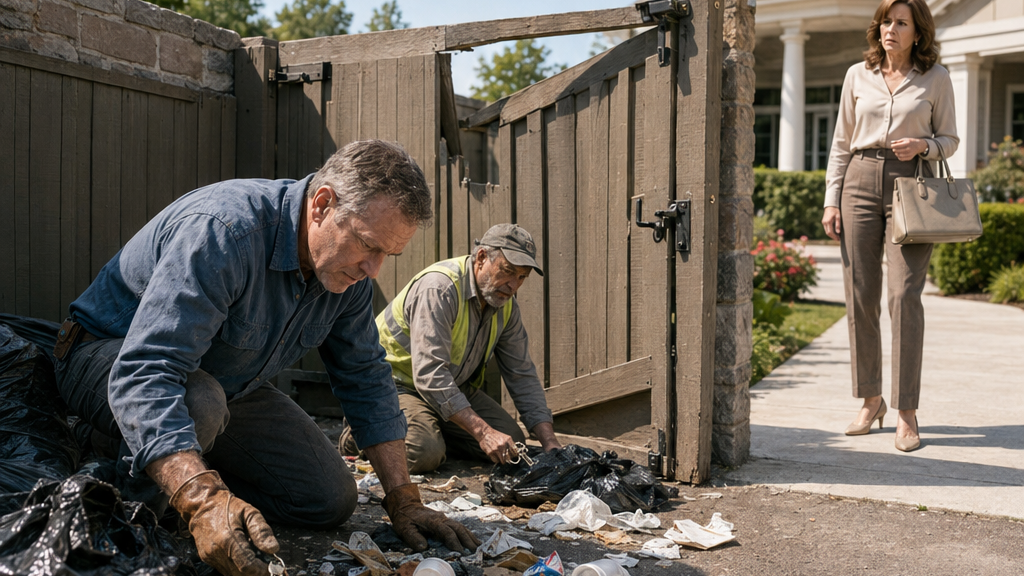
Patrick’s hand disappeared almost to the wrist beneath a torn trash bag before his fingers touched metal.
“Got them,” he said.
The groundskeeper let out a breath. “I thought they went into the compactor.”
Patrick pulled free a small key ring coated with coffee grounds and something sticky he chose not to identify. He held it by the largest key.
The groundskeeper laughed. “You just saved me a very bad phone call.”
Patrick wiped the ring on a discarded paper towel and handed it over.
It was Monday morning, and he had stopped at the clubhouse only because Lisa’s office opened at eight-thirty. He had planned to ask about the appearance notice, leave a copy of the covenants on her desk if necessary, and be home before Anna finished her second cup of coffee.
Instead he had found the trash enclosure looking as if someone had overturned half a dumpster onto the pavement.
Three bags had split. Paper plates, plastic cups, takeout containers, and yard debris had blown against the fence.
The groundskeeper had been trying to gather everything while searching for his keys.
Patrick had done what he had always done when faced with a mess and one person trying to handle it alone.
He put on the gloves he kept in his truck.
They had nearly finished when Karen Adams came around the clubhouse corner.
She was carrying a leather tote and looking at her phone. She stopped.
“Oh, good. Someone finally came.”
Patrick looked up but said nothing.
Karen pointed toward a loose cluster of trash near the curb.
“Make sure that gets picked up too. Residents shouldn’t have to see this first thing in the morning.”
The groundskeeper glanced at Patrick.
Patrick glanced back.
Karen continued before either spoke.
“And the inside needs to be washed down. It smells every time that gate gets left open.”
Patrick bent and picked up a flattened drink cup.
“Gate doesn’t stay shut.”
Karen was already turning toward the clubhouse entrance.
“Then maintenance needs to fix it.”
Patrick tested the enclosure door with his boot. The latch tongue struck the plate a quarter inch too low. Unless someone lifted the gate while closing it, it bounced back open.
He had noticed the worn hinge before he noticed the trash.
“The top hinge is sagging,” he said. “That’s why the latch misses.”
Karen turned around.
For the first time, she looked directly at his face rather than his faded blue work shirt, gloves, and the trash bag in his hand.
Her expression changed in stages.
Confusion first.
Then recognition.
“Patrick?”
“Morning.”
She stared at him. “I thought you were—”
He waited.
Karen recovered quickly. “I didn’t realize you were helping.”
The groundskeeper suddenly became very interested in tying a bag.
Patrick lifted the gate with one hand and closed it. The latch clicked cleanly into place.
“Lift it about half an inch and it catches,” he said.
Karen looked toward the clubhouse windows.
“Well. That’s helpful.”
Patrick removed one glove with his teeth and folded it into the other.
“It needs a hinge adjustment. Maybe replacement if the holes are wallowed out.”
“You should tell management.”
“I intend to.”
The groundskeeper rubbed the recovered keys between his palms.
“I already did.”
Karen looked at him.
He seemed to regret speaking, but continued.
“More than once.”
Karen’s embarrassment hardened into defensiveness.
“This is exactly why we contract maintenance. Residents shouldn’t have to be doing this.”
Patrick looked at the last bag by his feet.
“Neither should he, over and over, if the gate can be fixed.”
“I’m sure there’s a process.”
“There usually is.”
The words came out flatter than Patrick intended.
Karen caught it.
Her eyes narrowed slightly. “If this is about Saturday—”
“It isn’t.”
“You seemed upset about the appearance review.”
“I asked for the rule.”
“And Lisa can explain it.”
“That’s why I’m here.”
Karen gave a short nod, relieved to move the conversation back onto ground where titles and procedures mattered.
“The board is trying to improve standards. Sometimes people take changes personally.”
Patrick pulled his second glove off.
“You thought I was maintenance five minutes ago.”
Color rose along Karen’s neck.
“I made an assumption because you were cleaning the trash area.”
“Yes.”
“I apologized.”
“You explained.”
The groundskeeper looked down.
Patrick immediately regretted the edge in his voice. He had no interest in humiliating her beside a dumpster. That would only turn the moment into the kind of contest he hated.
He picked up the final loose wrapper and put it into the bag.
“Forget it.”
Karen adjusted the strap of her tote.
“I do appreciate you helping.”
Patrick nodded.
She walked inside.
The groundskeeper waited until the door closed.
“You could’ve let her keep going another minute.”
“That wouldn’t fix the hinge.”
The groundskeeper laughed once.
Patrick carried the bags back into the enclosure and studied the hardware. The upper hinge screws were pulling from softened wood. Rust had formed beneath the bracket where the gate sagged under its own weight.
“This has been like this awhile.”
“Since spring.”
“You submit a work order?”
“First one in April.”
“And?”
The groundskeeper reached into his pocket and pulled out his phone. After several taps, he showed Patrick a closed maintenance request.
Deferred—noncritical.
A second request from June carried the same notation.
Patrick frowned.
“What would it cost?”
“For the hinge? Contractor said maybe two hundred with labor. Less if they just reinforce it.”
Patrick looked beyond the enclosure toward the entrance drive.
Fresh ornamental grasses had been installed along the clubhouse wall. New stone planters framed the walkway. He had noticed them when they appeared, mostly because the tags from the landscaping company had stayed attached for three days.
The groundskeeper followed his gaze.
“Different budget.”
Patrick had heard those words hundreds of times in municipal work.
Different budget could be a legitimate accounting constraint.
It could also be a convenient way to spend money where people could see it while letting smaller problems repeat until they became expensive.
He folded his gloves and carried them under one arm.
Inside the clubhouse, Lisa was already at her desk.
Patrick introduced himself even though they had spoken by phone several times over the years.
“I know who you are,” she said with a smile. “Karen mentioned the patio issue.”
Of course she had.
Patrick placed a printed copy of the email on the desk.
“I’d like to know what section authorizes these three items.”
Lisa’s smile faded into professional concentration.
She turned to her computer.
“The enhanced curb-appeal initiative came from the board.”
“Which meeting?”
She began searching.
Patrick waited.
A minute passed.
Then two.
Lisa clicked through another folder.
“Hm.”
He recognized that sound too.
It was the sound of someone expecting a document to exist and discovering it did not appear where it should.
“I may need to pull the resolutions separately,” she said.
“That’s fine.”
She looked relieved by his tone.
“I’ll get back to you.”
Patrick nodded and started toward the door.
The groundskeeper was sweeping the last few scraps from the pavement outside.
Patrick stopped beside him.
“That first hinge request,” he said. “April?”
“April eighth.”
“And the second?”
“June nineteenth.”
Patrick looked again at the new planters.
“Both rejected?”
“Deferred.”
“By who?”
The groundskeeper hesitated.
“Management sent the response. But the board cut a bunch of small maintenance items after the spring budget review.”
Patrick felt something settle into place—not an answer, exactly, but a better question.
Karen’s mistake beside the dumpster no longer bothered him much.
The hinge did.
Two requests.
Two refusals.
And a gate still spilling garbage into the street.
Chapter 3: The Upgrades Nobody Remembered Approving
Lisa Garcia called Patrick Wednesday morning and opened with, “I can’t find the resolution.”
Patrick was at the kitchen table with his coffee untouched beside him.
Anna looked up from the newspaper.
“What resolution?”
Lisa hesitated on speakerphone.
“The one establishing the enhanced curb-appeal standards.”
Patrick leaned back.
“So there isn’t one?”
“I didn’t say that. I said I can’t find a separate resolution. The board discussed appearance improvements several times, and I was given direction to begin reviews.”
“By the board?”
“Through Karen, primarily.”
Anna folded the newspaper.
Patrick looked at her and saw the answer she wanted him to give.
Instead he asked Lisa, “Was there a recorded vote?”
Another pause.
“Not that I’ve located.”
Patrick rubbed his thumb along the edge of the printed notice.
“Then put ours on hold.”
Lisa exhaled quietly. “I can suspend follow-up while I clarify the authority.”
“That’s all I’m asking.”
After the call ended, Anna stared at him.
“That’s all?”
“For now.”
“Patrick, she turned Karen’s opinion into an official warning.”
“Lisa thought she had board direction.”
“Because Karen told her she did.”
He gathered the papers.
Anna’s irritation sharpened.
“You’re doing it again.”
“Doing what?”
“Finding the narrowest possible problem so you don’t have to deal with the bigger one.”
Patrick stopped.
She pointed toward the front patio.
“This started with her telling me our chairs made the neighborhood look cheap. Then she photographed them. Then an email showed up with a deadline. Now we know no one actually voted on the standard.”
“And the notice is paused.”
“For us.”
That landed.
Patrick looked toward the window.
Two houses down, a neighbor was trimming shrubs along a porch. Patrick wondered whether that homeowner had received a similar email and simply complied.
He hated that Anna could make a point without raising her voice.
By ten-thirty he was at the management office again.
Lisa had printed the last six months of board minutes and pulled a folder of vendor invoices. She looked less defensive than she had Monday and more annoyed with the records themselves.
“I want to be clear,” she said. “There was definitely discussion about improving curb appeal.”
“I saw it.”
“And Gregory said at the March meeting that Karen could work with landscaping and management on presentation issues.”
Patrick nodded.
“That’s not the same as adopting new homeowner restrictions.”
“No.”
The word came reluctantly.
Lisa slid one page toward him.
“I’ve put your case on administrative hold.”
At the top, beside the Hall address, she had written REVIEW PENDING BOARD AUTHORITY.
It was a small thing, but Patrick felt some tension leave his shoulders.
“Thank you.”
He could have stopped there.
That was exactly what he normally would have done.
His own problem had been neutralized. No fine was pending. No deadline remained.
Then he noticed an invoice beneath the meeting minutes.
Entrance Enhancement—Phase Two.
He recognized the landscaping contractor’s name from the tags left on the new planters.
“What’s Phase Two?”
Lisa looked down.
“Additional ornamental beds at the main entrance, stone edging, lighting adjustments.”
“How much?”
She told him.
Patrick looked again.
The number was not catastrophic. It was simply much larger than he expected.
He turned another page.
Clubhouse Landscape Refresh.
Another invoice.
Seasonal Color Rotation.
Another.
“You don’t mind if I look at the approved budget?”
Lisa’s expression changed.
“This isn’t about your patio anymore, is it?”
“No.”
She studied him for a second, then opened a digital file.
The annual budget had a line for grounds enhancement and another for routine maintenance. Patrick traced the amendments approved during the spring review.
Several small maintenance allocations had been reduced.
Waste enclosure repair.
Storm-drain cleaning.
Fence stabilization.
Irrigation valve replacement.
None was individually expensive.
Together, they had created enough room to preserve the landscaping package without raising dues midyear.
Patrick felt the familiar irritation he had known in city buildings when somebody delayed a roof patch so a lobby could be repainted before a council tour.
“What was the reasoning?”
Lisa shook her head.
“You’d need to ask the board.”
“Did the reserve consultant recommend these deferrals?”
“Reserve items and operating items aren’t exactly the same thing.”
“I know.”
She looked at him more carefully.
Patrick realized she did not know his background.
He did not offer it.
“What I’m asking,” he said, “is whether there was a maintenance assessment behind the cuts.”
“I don’t know.”
The office door opened.
Gregory Wilson stepped in carrying a folder and stopped when he saw Patrick.
“Everything okay?”
Lisa looked at Patrick, then at Gregory.
“We’re sorting out the Hall compliance notice.”
Gregory nodded as though this were a minor inconvenience already halfway solved.
“Karen mentioned it.”
Patrick wondered exactly what version Karen had mentioned.
“I also asked about the new appearance standards.”
Gregory set the folder down.
“We’ve been trying to raise the presentation level. Nothing extreme.”
“Were standards adopted?”
Gregory’s confidence weakened.
“We approved the general direction.”
“Did you approve Lisa sending violation-style notices for patio furniture, mulch depth, and deck boxes?”
Gregory looked at Lisa.
She answered before he could.
“That’s what I’m clarifying.”
Gregory rubbed his forehead.
“I may have assumed Karen was working within the existing architectural rules.”
Patrick nodded slowly.
That was different from corruption. Different from conspiracy.
It was also how bad procedures usually began.
One person assumed another had checked.
The next person assumed the first had approved.
Eventually a homeowner received a fourteen-day deadline and believed the rule had existed all along.
“I’m not looking to make this bigger than it is,” Patrick said.
Anna would have laughed if she were there.
Gregory gave a relieved smile.
“I appreciate that.”
“But while I was looking, I noticed several maintenance items were deferred during the same period the entrance upgrades continued.”
The smile disappeared.
“Those are separate priorities.”
“Maybe.”
Patrick tapped the waste-enclosure line.
“This one has already generated repeat work.”
Gregory glanced at Lisa.
“The gate?”
“Patrick helped with the cleanup Monday,” she said.
Recognition flickered across Gregory’s face. Karen had evidently mentioned that too.
Patrick kept his voice even.
“I’m not saying the flower beds caused the hinge to fail. I’m asking how the board is choosing what can wait.”
Gregory pulled out a chair.
For the next twenty minutes, they went through the spring adjustments.
The deeper Patrick looked, the less satisfying the simple explanation became. No one appeared to have hidden money. No suspicious vendor connections surfaced. The board had done something more ordinary.
They had prioritized things homeowners noticed immediately.
Flowers.
Edging.
Lighting.
Fresh mulch.
Things that photographed well.
The unattractive work—drains, hinges, minor structural repairs—had been easier to postpone because successful maintenance often looked like nothing happening.
Gregory finally said, “We were under pressure not to raise dues.”
Patrick understood that too.
“So visible improvements stayed because people had already been told they were coming.”
“Yes.”
“And maintenance got squeezed.”
“When it seemed noncritical.”
Patrick looked down at the list.
There was a reference code beside storm drainage that he had not noticed earlier.
Reserve Study—Monitor Deterioration.
“Can I see that report?”
Lisa opened another folder.
The reserve-study summary was nearly a year old.
Patrick skimmed until a paragraph stopped him.
The rear drainage swale and two collection structures showed progressive sediment buildup and edge deterioration. Cleaning and corrective grading were recommended before another heavy seasonal cycle. Deferral, the consultant warned, could increase erosion and downstream repair costs.
Patrick read the paragraph again.
“When was this scheduled?”
Gregory leaned over.
“Next budget year, I think.”
Patrick turned to the spring amendment sheet.
The drainage allocation had been reduced four months after the warning.
Outside the office window, the new ornamental grasses at the clubhouse shifted gently around fresh stone edging.
His patio chairs suddenly seemed very far away.
Patrick closed the report.
The problem was no longer whether Karen Adams had invented a standard.
The question was what Brookstone Ridge had postponed so everything visible could look expensive.
Chapter 4: The Pretty Entrance and the Water Behind It
The standing water began less than twenty feet behind the new stone monument at Brookstone Ridge’s entrance.
Patrick noticed it Saturday morning because one of the ornamental grasses was leaning sideways, its roots dark with mud while the others stood upright in fresh mulch.
He slowed his truck.
Behind the landscaped bed, a shallow sheet of water had collected along the rear edge of the entrance berm. It was not deep, but it was wrong. The nearest collection grate should have drawn it away.
Patrick parked near the clubhouse and walked back with his work gloves tucked beneath one arm.
The landscaping looked good from the road. New stone edging. Fresh mulch. Grasses staggered in neat groups. Low-voltage lights aimed toward the Brookstone Ridge sign.
From behind, the installation looked different.
Water had pushed silt into the mulch. The turf downhill from the bed was soft enough that Patrick’s boot sank nearly half an inch. A thin brown line marked where runoff had escaped the swale and spread toward the sidewalk.
He pulled on his gloves and crouched beside the nearest drain.
The grate was packed with leaves, sediment, and a web of fine roots.
That alone did not bother him.
What bothered him was the depression around it.
The soil had begun washing away from one corner, leaving the grate slightly higher than the ground that was supposed to feed it.
Patrick pressed two fingers into the softened edge.
He had seen this pattern before.
Not here.
For years, in municipal parks and public buildings, he had watched minor drainage problems become expensive because nobody wanted to spend money on work visitors would never notice. A blocked inlet became standing water. Standing water killed turf. Turf failure exposed soil. Then the first hard storm carried the soil somewhere it was never meant to go.
By the time somebody said, Why didn’t maintenance catch this? the original repair had become the cheapest thing nobody had approved.
“Patrick?”
He looked up.
Gregory Wilson stood near the monument sign with a travel mug in one hand.
“What are you doing?”
“Looking at your pretty entrance from the back.”
Gregory came closer.
Patrick stepped aside.
The HOA president stared at the water.
“That wasn’t there when they finished.”
“Probably was. Just not enough to notice.”
Gregory frowned at the clogged grate.
“The landscaper should clean that.”
“Maybe.”
Patrick pointed beyond the inlet toward the rear swale.
“Come look at this.”
They followed the shallow depression behind the homes bordering the entrance. In several places, grass had grown through a film of deposited silt. One concrete structure was ringed with cracked soil where water had repeatedly risen and fallen.
Gregory lowered his coffee.
“This is the drainage item from the reserve report?”
“Part of it.”
“I thought they were talking about long-term grading.”
“They are. But this is what long-term grading problems look like before somebody calls them urgent.”
Patrick knelt beside another grate and pulled away a handful of wet leaves.
Water moved immediately.
Not much. Enough.
Gregory watched the thin stream disappear between the bars.
“You knew that would happen.”
“I knew it should.”
“You did this kind of work?”
Patrick peeled off one glove.
“I supervised municipal facilities for thirty-one years.”
Gregory stared at him.
Patrick could almost see a version of Monday morning rearranging itself in the other man’s mind: the old shirt, the gloves, the dumpster, Karen’s mistaken assumption.
“You never mentioned that.”
“You never asked.”
Gregory gave him a look that was not quite amused.
“That sounds like something you say a lot.”
Patrick looked back at the drainage line.
Probably because it was.
A landscaping contractor’s pickup entered the neighborhood and slowed when the driver saw them. The contractor parked nearby and walked over.
“Everything all right?”
Gregory pointed at the water.
“Did this come from the entrance work?”
The contractor shook his head quickly.
“We didn’t alter the swale.”
“Did you raise the bed?”
“A few inches for the planting soil, but everything was supposed to drain behind it.”
Patrick asked, “Was this grate cleaned before installation?”
The contractor looked toward it.
“That’s association maintenance.”
“So no?”
“We install landscape material. We don’t service storm structures unless it’s in the scope.”
Patrick nodded.
A familiar answer.
Not dishonest.
Just narrow.
Gregory sighed.
“I’m going to call Lisa.”
Patrick stood.
“Call the reserve consultant too.”
“You think it’s that serious?”
“I think you paid someone to warn you about it. You might as well ask what the warning means.”
Gregory looked again at the wet ground.
“All right.”
It was more than Patrick had expected.
By Monday afternoon, Lisa emailed to confirm that Gregory had requested a site review.
Patrick showed Anna the message.
“That’s good,” she said.
“It’s a start.”
She watched him sort through the maintenance pages at the kitchen table.
“You sound disappointed.”
“I’m not.”
“You look disappointed.”
Patrick removed his glasses.
“The board agreeing to inspect something shouldn’t feel like a victory.”
“No. But last week they were inspecting our chairs.”
That pulled a smile from him.
It did not last.
The inspection was scheduled for Thursday.
Karen heard about it before then.
She approached Patrick near the mailboxes Wednesday evening while he was carrying a small package home.
“I understand you’ve expanded your complaint.”
Patrick stopped.
“It isn’t my complaint.”
“You brought Gregory into the drainage issue.”
“He was standing next to it.”
Karen folded her arms.
“Patrick, I know you’re upset about the appearance notice, but turning every maintenance item into evidence against the board isn’t constructive.”
He studied her face.
She seemed genuinely offended, not frightened.
“That water has nothing to do with my patio furniture.”
“It has everything to do with what this has become.”
“What has it become?”
“A campaign.”
Patrick almost laughed.
“A campaign for what?”
“To make me look irresponsible.”
There it was.
Not guilt.
Not exactly.
Something more personal.
“I didn’t create the reserve report.”
“No, but you went digging for it right after your notice.”
“I went digging for the rule behind my notice.”
“And then for invoices.”
“Because the maintenance cuts were on the same records.”
Karen’s voice lowered.
“You’re making normal budget decisions sound suspicious.”
“I haven’t accused anyone of stealing anything.”
“You don’t have to. People hear ‘unapproved standards’ and ‘deferred maintenance’ and start imagining things.”
A neighbor passed behind them carrying mail. Karen waited until the person moved on.
Then she said, “Brookstone Ridge has to compete with newer communities. Their entrances look better. Their common areas look newer. Buyers compare.”
Patrick looked toward the front of the subdivision.
From the mailbox cluster, the fresh entrance beds were visible beyond the curve of the street.
“Water doesn’t care what buyers compare.”
Karen exhaled through her nose.
“There. That.”
“What?”
“You act like anything cosmetic is frivolous.”
“I didn’t say that.”
“You don’t have to.”
For the first time, Patrick saw something underneath her annoyance. The word buyers had changed her tone. Tightened it.
But before he could ask, she stepped back.
“The board has another enhancement proposal coming up.”
Patrick frowned.
“Before the drainage review is finished?”
“It’s already been in development.”
“What kind of proposal?”
“Updated front-yard appearance guidelines and an expanded entrance package.”
He stared at her.
“You’re proposing more?”
“We can address more than one thing at a time.”
“Can we afford to?”
Karen’s face went still.
“That’s for the board to decide.”
“No. That’s for every homeowner funding it.”
Her mouth tightened.
“The proposal will be on the agenda.”
She walked away before he could answer.
Thursday’s inspection confirmed what Patrick had suspected.
The reserve-study consultant did not declare an emergency. That almost made the finding easier for Karen to dismiss.
The problem was progressive.
Sediment needed removal. Two collection points needed correction. Sections of the swale required regrading before continued runoff deepened the erosion.
The consultant gave Gregory a range of costs.
The lower number was manageable.
The higher number—if postponed another year and followed by serious storm damage—was not.
Standing beside the entrance, Gregory stared at the written estimate.
“So we should have done this already.”
The consultant chose his words carefully.
“You had a recommendation to begin preventive work.”
Patrick said nothing.
He did not need to.
Gregory looked toward the new flowers.
That afternoon, the board agenda arrived by email.
Item one concerned the reserve inspection.
Item two concerned routine maintenance.
Item three read: Premium Community Appearance Proposal—Presented by Vice President Karen Adams.
Patrick read it twice.
The inspection had not stopped her.
If anything, it seemed to have made her more determined.
Chapter 5: What Karen Was Really Afraid of Losing
Karen was standing at her mailbox holding a real-estate valuation printout when Patrick came around the sidewalk curve.
She folded it too late.
He caught only the top half of the page—an aerial image of her house, a price estimate beneath it, and a graph trending downward from an earlier peak.
Karen shoved the paper into her mail bundle.
Patrick could have kept walking.
Three weeks earlier, he would have.
Instead he stopped.
“You planning to sell?”
Karen’s expression sharpened.
“That’s none of your business.”
“No.”
He shifted the work gloves tucked into his back pocket. He had been fixing a loose board on his side gate when Anna reminded him that if he intended to talk to Karen before Thursday’s meeting, continuing to avoid her was an unusual strategy.
Patrick had not appreciated the observation.
Now Karen stared at him as if he had deliberately caught her doing something private.
He said, “I’m not asking for a number.”
“Then what are you asking?”
“Why you’re pushing the appearance proposal before the maintenance review is finished.”
Her posture changed.
“That has nothing to do with this.”
She tapped the folded valuation paper against the stack of mail.
Patrick waited.
Karen hated silence more than he did.
Eventually she said, “You think everything you can’t see is more important than everything you can.”
“No.”
“That’s exactly how you talk.”
“I think fixing drainage before planting more flowers is probably cheaper than repairing erosion after planting more flowers.”
“That’s not what I mean.”
Patrick looked at her.
“Then tell me what you mean.”
For several seconds, the only sound was a lawn mower somewhere behind the row of houses.
Karen looked toward her own home.
It was one of the larger models in Brookstone Ridge, with a three-car garage and a recently replaced front door. Patrick remembered workers installing the door in winter.
“I may have to sell sooner than I expected,” she said.
He said nothing.
“My husband’s work changed this year.”
Patrick waited again.
Karen’s mouth tightened, but she continued.
“His commission structure changed. We’ve had some expenses. Nothing catastrophic.”
The final phrase came too quickly.
Patrick recognized it because he had used versions of it himself years ago when problems were still technically manageable.
Karen looked down at the paper.
“We bought when prices were high. If we sell in a soft market, I need this neighborhood to show well.”
Patrick leaned against the mailbox post.
“So the entrance package is about your house.”
“No.”
Her answer came instantly.
Then, more quietly, “Not only my house.”
“Karen—”
“Everyone benefits from higher values.”
“Maybe.”
Her eyes flashed.
“You say that like property values are shallow.”
“I didn’t say that.”
“For some of us they aren’t theoretical.”
Patrick let that sit.
There was a difference between understanding someone and agreeing with them. He had spent enough years managing public crews to know the difference mattered most when a person had caused a problem for reasons that made sense to them.
Karen unfolded the valuation sheet again, but only enough to look at it herself.
“You and Anna can sit there in those cheap chairs and laugh about whether the neighborhood looks premium because you’re settled.”
Patrick almost corrected her.
Not with account balances. Not with the fact that the house was paid off.
Something more important stopped him.
She was right about one thing.
He was settled.
Karen was not.
That did not justify the notices.
But it explained the urgency he had not understood.
She continued.
“Buyers see mismatched furniture. Old mulch. faded fences. A mailbox post that needs paint. They don’t know whose responsibility anything is. They see a neighborhood that looks like it’s slipping.”
Patrick said, “And you decided you could make people fix things that weren’t against the rules.”
Her face hardened again.
“I was trying to raise expectations.”
“With fourteen-day compliance emails.”
“I did not write the management language.”
“You gave Lisa the list.”
Karen looked away.
That was answer enough.
Patrick pushed off the mailbox post.
“I understand why you care.”
She gave a small, bitter laugh.
“Do you?”
“Yes.”
That surprised her.
He continued.
“But fear about what your house might sell for doesn’t make your preference a covenant.”
Karen’s eyes narrowed.
“And your maintenance background doesn’t make you the board engineer.”
“No.”
“Then stop acting like you’re the only person who understands priorities.”
Patrick felt the old instinct rise in him.
Withdraw.
Let the argument burn itself out.
He almost followed it.
Then Anna’s words came back: For us.
Their notice had been paused.
Other people might still be changing their homes because Karen had learned that confidence often sounded enough like authority.
Patrick said, “Did you know the drainage allocation was reduced?”
“I knew some work moved.”
“Did you know the reserve consultant had recommended preventive work first?”
“We can’t do every recommendation at once.”
“Did you know the trash gate repair had been deferred twice?”
Karen frowned.
“That’s two hundred dollars.”
“Exactly.”
“What does a gate hinge have to do with property values?”
Patrick looked at her for a moment.
“Everything you don’t think buyers see.”
She shook her head.
“That doesn’t even make sense.”
“It does to the groundskeeper cleaning trash from the road every week.”
Karen gathered the mail against her chest.
“So what do you want? An apology?”
“No.”
That answer seemed to unsettle her more than yes would have.
“I want you to withdraw the premium appearance proposal until the board knows what maintenance actually costs.”
“No.”
Patrick had expected resistance.
He had not expected the answer to come so fast.
“Why?”
“Because if I withdraw it now, everyone will treat the whole idea like some embarrassing mistake.”
“Parts of it were.”
“The standards may have been handled badly. That doesn’t mean the objective is wrong.”
“You sent people requirements that weren’t requirements.”
“And Lisa is correcting that.”
“For me.”
Karen looked at him.
Patrick continued.
“How many other people got notices?”
“I don’t know.”
“You should.”
Her face flushed.
“You’re enjoying this.”
Patrick’s response came so quickly it surprised him.
“No.”
Karen went quiet.
He looked at the valuation paper in her hand.
“I don’t want your house to lose value. I don’t want you cornered financially. And I don’t want to stand in a meeting and make you look foolish.”
Her expression shifted, suspicious now for a different reason.
“But?”
“But I’m going to ask what was authorized, what was deferred, and what it costs us to keep pretending the visible stuff is the only stuff that matters.”
Karen stared at him.
“You’ve already made up your mind.”
“I’ve spent most of my life letting louder people make up theirs.”
The sentence came out before he could soften it.
For years, that had been the bargain he told himself was dignity.
Fix the problem.
Skip the meeting.
Let somebody else explain it.
Let somebody else take credit.
Let somebody else make the next decision.
Then complain privately when they learned nothing.
Karen seemed to hear something in his tone.
Her voice lowered.
“You really think I’m hurting people.”
“I think you scared Anna with an official notice you couldn’t support.”
Karen’s eyes dropped.
“And I let it go because I thought ignoring it made me above the argument.”
He pulled the gloves from his back pocket and looked at them.
“That part’s on me.”
Karen said nothing.
Patrick turned toward his house.
Behind him she said, “I’m not withdrawing the proposal.”
He stopped.
“I know.”
“You’ll have to challenge it at the meeting.”
“I know that too.”
Patrick walked home with the gloves in his hand.
Anna was on the patio when he reached the driveway, sitting in one of the clearance chairs with her feet resting on the second.
“Well?”
Patrick looked at the chair, then at her.
“I’m speaking Thursday.”
Anna lowered her coffee.
For once, she did not smile.
“Good.”
Patrick looked back toward Karen’s house.
He understood her better than he had an hour earlier.
That was going to make Thursday harder.
It was not going to make him stay quiet.
Chapter 6: The Meeting Where Patrick Finally Stopped Staying Quiet
Karen’s Premium Community Appearance Proposal was the first substantive item on the agenda.
Patrick saw it projected onto the clubhouse wall before he found a seat.
He carried a thin folder, six printed photographs, and the pair of worn work gloves he had nearly left in the truck.
Anna sat beside him.
“You brought them?”
Patrick looked down at the gloves.
“Seemed appropriate.”
Residents filled most of the folding chairs. More than usual.
Word had traveled.
Lisa Garcia sat at the end of the board table with a laptop open. Gregory Wilson occupied the center seat. Karen sat two places away, her proposal packet arranged squarely in front of her.
She did not look at Patrick.
Gregory called the meeting to order.
Routine business passed quickly.
Then Karen stood.
Her presentation was polished and, Patrick admitted privately, not ridiculous.
She talked about consistent landscaping, maintained exterior furnishings, refreshed mulch, and visible signs of neglect. She cited competitive communities and recent buyer expectations.
She did not use the phrase cheap-looking.
She did not mention Patrick’s patio.
If someone had entered the room that evening with no history, her proposal might have sounded reasonable.
That was what made the problem difficult.
Karen finished with a proposed committee review process and additional entrance improvements.
Gregory thanked her.
Before he opened board discussion, Lisa raised a hand.
“There is an administrative issue that needs to be addressed first.”
Karen looked toward her.
Lisa turned to the audience.
“In reviewing recent appearance notices, management determined that several items were presented as enforceable standards without a corresponding adopted rule or resolution.”
A murmur moved through the room.
Patrick saw Karen straighten.
Lisa continued.
“Those notices have been suspended pending board review.”
A homeowner near the aisle lifted a sheet of paper.
“Does that include the one about decorative planters?”
Another voice came from behind Patrick.
“What about porch furniture?”
Lisa said, “If you received a recent exterior appearance notice that does not cite a specific covenant or adopted guideline, please contact management. We are reviewing them individually.”
The room changed.
Not dramatically.
No applause.
Something more useful happened.
People began checking their own papers.
A neighbor across the aisle whispered to the person beside her.
Patrick felt Anna glance at him.
For them, she had said.
Gregory raised a hand for order.
“This is partly my responsibility,” he said.
Karen turned toward him.
Gregory continued.
“I gave Karen broad direction to work with management on appearance concerns, and I failed to verify where that direction ended and enforcement authority began.”
Patrick had not expected that.
Neither, apparently, had Karen.
Gregory looked at Lisa.
“Management acted based on what appeared to be board direction. That process was too loose.”
Karen leaned toward her microphone.
“I think we need to distinguish procedural confusion from the underlying need for standards.”
“We will,” Gregory said. “But first we need to understand the process.”
Patrick felt his prepared remarks becoming less necessary.
That was almost enough to make him remain seated.
Almost.
Then the board treasurer moved to the next packet.
“We also need to discuss the reserve consultant’s drainage update.”
A number appeared on the screen.
The recommended preventive work was considerably higher than the amount left in the current maintenance allocation.
Gregory said, “We can cover the first phase, but only if we postpone discretionary landscape work.”
Karen’s jaw tightened.
“The entrance contract is already partially planned.”
“Not executed,” Lisa said.
Karen turned toward Patrick for the first time.
There it was.
The moment he could have let someone else handle.
Gregory asked whether any homeowner wished to comment.
Patrick stood.
His knees felt more noticeable than they should have.
He carried his folder to the small table reserved for speakers.
Then, after a moment’s hesitation, he placed the work gloves beside it.
Karen’s eyes dropped to them.
Patrick opened with the thing he least wanted to say.
“I should have raised some of this sooner.”
The room quieted.
He had expected to explain budgets.
Instead, he heard himself explaining silence.
“When my wife and I received an appearance notice I couldn’t match to any written standard, my first instinct was to get our notice stopped and leave it there.”
Anna watched him from the second row.
“That would have solved our problem.”
He looked around the room.
“It would not have solved the process that created it.”
One of the homeowners holding a notice lowered it to her lap.
Patrick opened his folder.
“I’m not here to argue that landscaping doesn’t matter. It does. I’m not here to argue that property values don’t matter. They do.”
Karen looked up.
“I’m here because the same records that showed how appearance instructions became enforcement also showed what we were postponing.”
He placed the first photograph on the document camera.
The clubhouse trash enclosure filled the screen.
The gate hung slightly crooked.
Several people recognized it.
Patrick put on the second photograph: the worn upper hinge.
“That gate repair was deferred twice.”
Karen leaned toward her microphone.
“Patrick, this is exactly the kind of small maintenance issue that can be handled separately.”
He looked at her.
“It was separate.”
He changed the photograph.
Trash scattered beyond the enclosure.
“That’s why nobody fixed it.”
The room went still.
Patrick did not mention Karen mistaking him for maintenance staff. He did not need to. The point had become larger than the embarrassment.
“The groundskeeper cleaned this repeatedly because the gate wouldn’t latch. The repair was estimated at a few hundred dollars. Instead, we paid repeatedly for cleanup and still had trash visible from the clubhouse road.”
He changed photographs again.
Standing water behind the entrance landscaping appeared on the wall.
“The drainage issue is bigger. But the pattern is the same.”
The reserve-study consultant, seated near the board treasurer, nodded slightly.
Patrick continued.
“When I worked municipal facilities, we had a phrase for this. Invisible success.”
He paused.
“Nobody compliments a drain for working. Nobody photographs a hinge because it closed. Nobody notices a roof because it didn’t leak.”
His hand rested near the gloves.
“But when you stop paying attention to those things, eventually everybody notices.”
Karen shifted in her chair.
Patrick looked directly at her.
He could have told the room about the valuation printout.
He could have explained her fear.
It would have made his argument easier.
It would also have turned private pressure into public punishment.
He chose not to.
“Karen is right about one thing,” he said.
Her expression changed.
“How this community looks matters.”
Several heads turned toward her.
Patrick continued.
“But appearance can’t become a substitute for condition. And preference can’t become a rule because someone speaks with confidence.”
Karen’s face reddened, but she did not interrupt.
Gregory asked, “What are you recommending?”
Patrick closed the folder.
“Pause discretionary appearance spending until the maintenance review is complete. Identify every recent notice issued without a specific rule. Withdraw the unsupported ones. Then decide what standards the community actually wants through the process we already have.”
The board treasurer asked, “And the drainage?”
“Fund the preventive phase now.”
“That may require moving money.”
“Then move it openly.”
The sentence stayed in the room.
A homeowner near the back raised a hand.
“My letter said I had to replace my porch bench.”
Another said, “Mine was mulch color.”
Lisa began writing.
Karen leaned forward.
“I want it on record that I never intended for management to cite people for things that weren’t enforceable.”
Patrick looked at her.
Lisa said gently, “The lists you sent were formatted as compliance items.”
Karen closed her eyes briefly.
When she opened them, the fight in her face had changed.
Not gone.
Reduced to something tired.
Gregory said, “Karen, did you believe these were existing standards?”
She hesitated.
Patrick could see exactly how easy it would be for her to say yes.
Instead she answered, “Some were. Some were expectations I thought the board had agreed we should move toward.”
“Had we adopted them?”
“No.”
There was no gasp.
No dramatic reaction.
Just the sound of Lisa typing.
Patrick realized that was enough.
Gregory looked down at his notes.
“I should have caught the distinction.”
For the first time since the issue began, responsibility did not belong to one person.
That made the correction less satisfying in the way stories usually promised satisfaction.
It also made it more believable.
The board spent the next forty minutes untangling decisions.
The entrance expansion was suspended.
The second phase of decorative landscaping was postponed.
Immediate funds were authorized for the trash enclosure repair and first-stage drainage correction.
Lisa was directed to audit recent appearance notices.
The architectural committee would review any future standards before enforcement.
Then Gregory made one final motion.
“A full maintenance-priority review before the next discretionary improvement contract.”
The treasurer seconded it.
The vote passed.
Karen voted yes.
Patrick noticed because he had not expected her to.
After the meeting, residents clustered around Lisa with copies of notices.
Patrick stayed near the back of the room, gathering his photographs.
Karen approached.
Her expression was guarded.
“You could have told them.”
Patrick knew immediately what she meant.
About the valuation.
About why she was afraid.
He folded one glove into the other.
“That wasn’t mine to tell.”
Karen looked at him for a long moment.
“Thank you.”
It was not an apology.
Patrick had not expected one.
She glanced toward the residents waiting at Lisa’s table.
“I still think standards matter.”
“So do I.”
“You made that very difficult to say tonight.”
“That wasn’t the goal.”
She almost smiled.
Almost.
Gregory called Patrick over before she could respond.
“We’re putting the maintenance review in writing tomorrow.”
Patrick nodded.
Gregory lowered his voice.
“And I’d like you to look at the priority list when it’s drafted.”
Patrick’s first instinct was immediate.
No.
He had retired for a reason.
He had no desire to become an unpaid substitute facilities department for Brookstone Ridge.
Then he looked at the gloves in his hands.
Helping did not have to mean disappearing into the work while someone else made every decision.
“I’ll review it,” he said. “I won’t run it.”
Gregory smiled.
“Fair.”
Patrick and Anna walked home together under the clubhouse lights.
At the corner, Anna slipped her hand through his arm.
“You did all right.”
“I talked too long.”
“You talked seven minutes.”
“Felt longer.”
She laughed.
Behind them, the clubhouse doors opened and closed as residents carried their notices out into the night.
The cosmetic spending was suspended.
The unsupported standards were being reviewed.
The drainage work had funding.
For the first time, Patrick could see an actual correction taking shape.
But he had spent enough years around committees to know that one meeting could change a vote faster than it changed a habit.
The question now was whether Brookstone Ridge would still care about the invisible work after everyone stopped being embarrassed by how visible the mistakes had become.
Chapter 7: The Things That Looked Cheap and the Things That Lasted
The repair truck reached the Brookstone Ridge entrance before the landscaping crew ever returned.
Patrick noticed it at seven-thirty on a Tuesday morning: a white utility truck parked beside the monument sign, orange cones around the nearest collection grate, and two workers lifting compacted sediment from the drainage structure with long-handled tools.
The ornamental grasses were still there.
So were the stone edging and the low-voltage lights.
But nobody was planting the next phase of flowers.
Anna stood beside Patrick at the kitchen window with a mug in both hands.
“Look at that,” she said.
“Drain cleaning.”
“I know.”
“You said it like you’d spotted wildlife.”
“I’ve seen flowers installed here every six months. This is rarer.”
Patrick smiled.
Six weeks had passed since the meeting.
Long enough for embarrassment to cool.
Long enough, he had worried, for urgency to cool with it.
But the maintenance review had survived.
The waste-enclosure gate had been repaired first. Not patched. The contractor had removed the upper hinge, reinforced the mounting surface, replaced worn hardware, and realigned the latch.
The invoice was less than the association had spent on repeated cleanup visits over the previous months.
Patrick knew because Gregory had sent the updated maintenance list to the board and copied him, just as promised.
Patrick had reviewed it once.
Then he had sent it back with three comments and a sentence at the bottom:
This should belong to the board and its contractors, not to me.
Gregory had responded: Agreed.
That mattered more to Patrick than he expected.
He had spent too much of his working life becoming indispensable by quietly taking responsibility nobody had formally assigned. Retirement had not cured the habit. Neither had the fight with Karen.
The difference now was that he could help without disappearing into the problem.
Later that morning, he walked toward the clubhouse.
The trash enclosure gate clicked shut behind the groundskeeper with one easy motion.
The man saw Patrick and opened it again just to demonstrate.
“Watch this.”
He let go.
Click.
Patrick nodded solemnly. “Technology.”
The groundskeeper laughed.
“No lifting. No kicking. No praying.”
“Luxury community now.”
“That’s what I hear.”
Patrick looked at the repaired hinge.
No one driving past would notice it.
That was the point.
Near the clubhouse entrance, Lisa Garcia was taping a printed notice inside the glass bulletin case.
Patrick waited until she stepped back.
“What’s that?”
“Updated architectural-review procedure.”
“Another initiative?”
She gave him a dry look.
“Don’t start.”
He read the first paragraph.
Any compliance notice involving architectural or aesthetic standards now had to cite the specific covenant, adopted guideline, or recorded board resolution supporting it.
“No ‘general direction’?” Patrick asked.
Lisa folded her arms.
“I have retired that phrase from my professional vocabulary.”
“Probably wise.”
She hesitated.
“There’s something else.”
From her folder, she removed a single-page document.
At the top was the appearance checklist Karen had circulated months earlier—the one that had eventually produced comments about porch furniture, mulch, storage boxes, decorative planters, and other visible details.
Across the page, in Karen’s handwriting, was one line:
Withdrawn pending formal community review.
Patrick read it twice.
“She did this?”
“Yesterday.”
“Voluntarily?”
Lisa smiled slightly. “After a forty-minute discussion.”
“That sounds more like Karen.”
“She still wants some of the ideas considered.”
“That’s allowed.”
“Yes.”
Lisa slipped the page back into the folder.
“That distinction has become surprisingly popular around here.”
Patrick continued home by the long route.
At the entrance, workers had cleared enough sediment that water from a test hose moved cleanly into the grate rather than spreading across the grass. Stakes marked the section of swale scheduled for corrective grading the following week.
Nothing about it was dramatic.
Nobody stood around watching.
There was no crowd celebrating responsible drainage.
Patrick found that reassuring.
When he reached his driveway, Karen was walking toward him from next door.
For a second, he wondered whether Lisa had called her.
Karen carried no folder.
No phone.
No compliance list.
She stopped near the edge of the Hall patio.
The clearance chairs were exactly where they had been on the Saturday she photographed them.
Anna had added two plain cushions.
Karen glanced at them.
Patrick waited.
“I saw the drainage crew,” she said.
“So did I.”
“They’re doing more than I realized.”
“Yes.”
She looked toward the entrance.
“The updated estimate was lower because they got to it before more of the bank washed out.”
“That helps.”
Karen nodded.
For several seconds neither spoke.
Patrick had learned not to fill every silence for other people.
Eventually Karen said, “Lisa probably told you I withdrew the checklist.”
“She mentioned it.”
“I still think some standards need updating.”
“I know.”
“I’m not apologizing for caring what the neighborhood looks like.”
“I didn’t ask you to.”
Karen’s eyes moved back to the patio chairs.
“I handled some of it badly.”
Patrick said nothing.
It was as close as she was likely to come, and he had no intention of forcing it into a larger performance.
She continued.
“I was worried.”
“I know.”
Her face changed slightly.
Not alarm.
Recognition.
She understood that he meant more than the board proposal.
Patrick added, “I didn’t tell anyone.”
“I know that too.”
Karen looked down at the sidewalk.
“The house situation isn’t settled.”
“I’m sorry.”
“We’ll manage.”
He nodded.
She gave a small, tired smile.
“That sounds like something you’d say.”
“Probably.”
Before she left, Karen touched the back of one of the patio chairs.
“For what it’s worth, they don’t look bad.”
Patrick looked at the chair.
“They never did.”
Karen gave him a look.
Then, unexpectedly, she laughed.
“All right. I walked into that one.”
“Yes.”
She headed home.
Patrick watched her go without feeling victorious.
That surprised him less than it once would have.
Victory had never really been what he wanted.
That afternoon, he cleaned his work gloves.
He brushed dried mud from the seams, worked a little leather conditioner into the cracked palms, and left them on the garage workbench to dry.
Anna appeared in the doorway.
“Those things are older than some marriages.”
“They’re fine.”
“They’re practically historic.”
“Still work.”
She looked toward the patio.
“I know a pair of chairs like that.”
Patrick shook his head.
The following Saturday, he mounted a simple hook beside the garage door and hung the gloves there.
Not because he planned to stop using them.
Because he was tired of dropping them wherever the last job ended.
Across the subdivision, the repaired common area had already begun returning to the background. The trash gate shut. The drainage moved water where it was supposed to go. The groundskeeper no longer chased loose garbage across the pavement.
Most residents would eventually stop thinking about any of it.
Patrick hoped they did.
That evening, Anna carried two glasses of iced tea onto the front patio.
She sat in one clearance chair.
Patrick took the other.
A family walked along the sidewalk toward the clubhouse. Farther down, two neighbors stopped near the repaired common area while their children rode bicycles in circles around them.
The entrance still looked good.
The difference was that something underneath it worked now too.
Anna touched the arm of her chair.
“You realize Karen’s original photograph is probably still on her phone.”
Patrick leaned back.
“Hope she got my good side.”
“You were kneeling with a wrench.”
“Then probably not.”
Anna laughed.
Patrick looked toward the garage.
His cleaned work gloves hung beside the door, visible but unremarkable.
For years, he had thought dignity meant needing no one to understand him.
Now he knew better.
Sometimes dignity meant letting a shallow judgment pass.
Sometimes it meant helping with a mess even when someone mistook the work for your station.
And sometimes it meant standing up in a crowded room and making people look directly at what everyone had found easier not to see.
He rested his hands on the inexpensive metal armrests.
They were still sturdy.
Still level.
Still exactly where Anna had wanted them.
Nothing about them had changed.
Only what they had come to mean.
The story has ended.