The HOA Painted a Yellow Line Through His Family Alley—Then the Old Plat Changed Who Controlled It
Chapter 1: The Yellow Line Appeared Before Anyone Asked
The machine sounded wrong before Mark Hall even knew what it was doing.
A mechanical rattle came through the open kitchen window, followed by the short hiss of compressed paint. Mark set down his coffee and stepped onto the back porch.
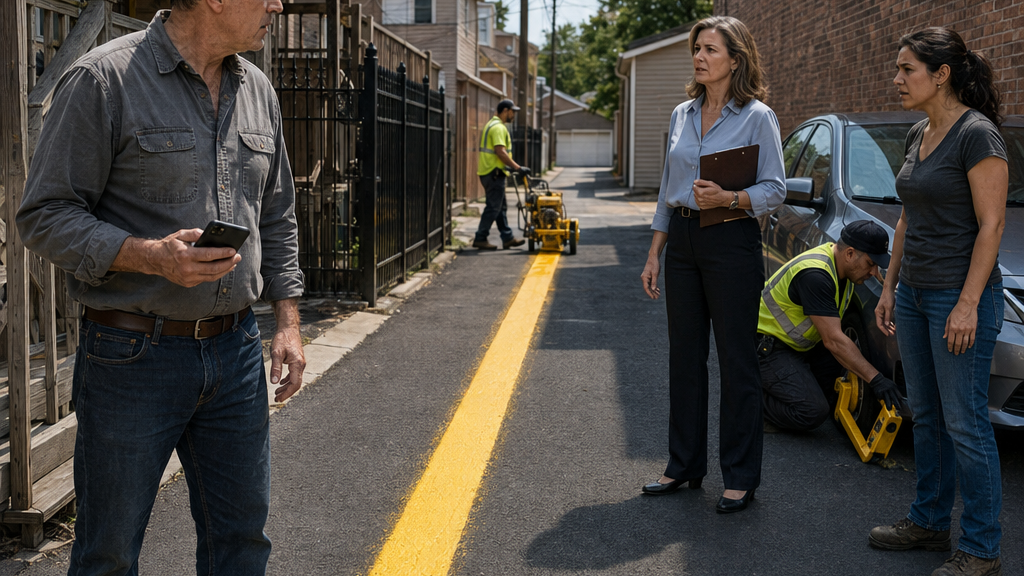
Twenty yards away, a contractor in a fluorescent vest was pushing a yellow striping machine down the narrow alley beside Mark’s house.
A fresh line shone against the dark pavement.
For several seconds Mark simply watched.
The alley was fourteen feet wide at its narrowest point, bordered on one side by the brick wall of his rental property and on the other by garages and fences belonging to neighboring homes. His family had used it since before he was born. His father had called it the back lane, never the alley, and had been particular about keeping its entrance clear.
Mark walked down the porch steps.
“Morning.”
The contractor stopped pushing.
“Morning.”
“What are you painting?”
The man glanced at the line as if the answer were self-evident. “No-parking boundary.”
“Ordered by who?”
“Association.”
Mark looked behind him.
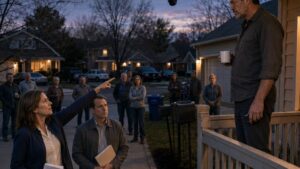
A white management-company SUV sat near the mouth of the alley. Debra Clark was standing beside it with a clipboard tucked under one arm.
That explained the contractor. It did not explain the paint.
Mark walked toward her.
“Debra.”
She looked up. “Mark.”
“You want to tell me why there’s yellow paint going down my alley?”
Her expression tightened slightly at the word my.
“We’re standardizing the fire-access lane.”
“This isn’t an HOA fire lane.”
“It’s been treated as association access for years.”
“Used as access,” Mark said. “That isn’t the same thing.”
Debra glanced toward the contractor.
“We discussed access enforcement at the last board meeting.”
“You discussed painting my property?”
“We discussed keeping the lane clear.”
“No one called me.”
“The manager sent notice.”
“Not to me.”
Debra opened the clipboard and turned several pages. “Property owners were notified through the community bulletin.”
Mark stared at her.
“A bulletin isn’t permission.”
She exhaled through her nose. “Mark, nobody is trying to take anything from you.”
Behind them, the contractor restarted the striping machine.
The hiss of paint made Mark turn.
“Stop.”
The contractor immediately released the handle.
Debra said, “He has authorization.”
“From the HOA.”
“Yes.”
Mark pulled his phone from his pocket.
He did not step in front of the machine. He did not touch the equipment. Instead, he photographed the bright line, the contractor, the management SUV, and the point where the stripe passed beside the brick wall.
Debra watched him.
“You’re making this harder than it needs to be.”
“I’m documenting it.”
“For what?”
“I don’t know yet.”
That answer seemed to unsettle her more than an argument would have.
Mark moved farther into the alley and photographed the old drainage edge, the garage corners, and the pavement seam near his back gate.
Then a metallic clank came from behind him.
Nicole Ramirez had appeared at the top of the porch steps.
“Mark?”
He turned.
A second contractor was crouched beside the front wheel of Nicole’s compact sedan. A yellow steel immobilizer was already locked across it.
Nicole hurried down the steps.
“What is he doing?”
The contractor stood. “Vehicle is inside a marked restricted access area.”
“There wasn’t a marked restricted area when I parked there last night.”
He pointed toward the new stripe.
Nicole looked at Mark.
“Can they do that?”
Mark did not answer immediately.
He was looking at the line.
The paint was still wet.
“You put the boot on after they painted it?” he asked.
The contractor shrugged. “We enforce what management gives us.”
Debra stepped forward.
“The lane has to stay clear.”
Nicole’s voice sharpened. “I have work in forty minutes.”
“There’s a release number on the notice.”
“Why should I have to call anybody? I pay rent for that parking space.”
Mark felt the words land harder than Debra’s clipboard ever could.
He had told Nicole where to park when she moved in. He had pointed to the space himself.
Debra said, “Mark, this is exactly why the board had to establish a boundary.”
Mark looked at her.
“Show me the easement.”
“The what?”
“The recorded easement that gives the HOA control of this lane.”
Debra’s face changed, only slightly.
“The association has maintained that alley for decades.”
“That isn’t what I asked.”
“We plow it. We sweep it. Contractors use it. Residents use it.”
“Recorded easement number.”
“I don’t carry land records around with me.”
“Then stop acting like you’ve already read one.”
Nicole looked between them.
The contractor shifted uncomfortably.
Debra lowered the clipboard.
“I am not going to debate property law in an alley.”
“Good,” Mark said. “Just give me the document you relied on before authorizing this.”
She did not answer.
The silence was small, but Mark felt the entire scene change inside it.
Until then, Debra had sounded like someone enforcing a settled fact.
Now she sounded like someone defending a practice.
Those were not the same thing.
Mark photographed Nicole’s immobilized wheel.
“I’ll cover whatever they charge to remove it,” he told her.
Nicole stared at him. “Why should you?”
“Because I told you to park there.”
Debra said, “You’re making this personal.”
“It became personal when somebody locked my tenant’s car on property I’m responsible for.”
He turned back to the parking contractor.
“Don’t touch the second tenant’s vehicle until somebody shows me the authority for this.”
The man looked at Debra.
Debra hesitated, then gave a short nod.
“Hold further enforcement.”
Nicole folded her arms. “That doesn’t get this one off.”
“I know,” Mark said.
The yellow stripe extended almost the full length of the alley now, bright enough to look permanent.
Mark had spent years ignoring little things there.
The landscapers crossing through.
The HOA snow contractor making an extra pass.
Neighbors cutting behind the garages rather than walking around the block.
None of it had seemed worth an argument.
The alley had always remained his whether people used it or not.
At least, that was what he had assumed.
Debra closed her clipboard.
“Mark, this didn’t start today.”
He looked at her.
“What does that mean?”
“It means the association has treated this as common access for more than twenty years.”
“And?”
“And nobody has objected.”
Mark looked once more at the wet yellow line.
This time it did not look like paint.
It looked like twenty years of silence somebody else had decided meant consent.
Chapter 2: The Plat in His Father’s Old Folder
The old plat was not where Mark remembered putting it.
At nine that night, the dining table was covered in warranty deeds, tax statements, insurance renewals, faded closing papers and envelopes his father had labeled in block letters decades earlier.
Through the kitchen window, the yellow stripe caught the alley light.
Mark could see it every time he raised his head.
He opened another file box.
Nothing.
His father had kept records with a seriousness Mark used to tease him about.
Never throw away paper that proves where you stand.
Mark had heard that sentence so many times as a teenager that it had become family background noise.
Now he found himself wishing he had listened more carefully.
A thin brown folder sat wedged behind a stack of old utility bills.
PROPERTY—REAR ACCESS was written across the tab.
Mark stopped.
He carried it to the table and opened it.
Inside was a folded sheet larger than the folder itself, brittle at the creases and marked with a county recording stamp.
He unfolded it slowly.
A survey drawing emerged.
Lot lines.
Measurements.
A narrow rectangular strip running alongside the property.
Mark leaned closer.
There it was.
The alley.
Not a blank gap between properties. Not an unnamed community lane. A measured strip tied directly to the parcel his father had purchased.
He placed his phone beside it and pulled up that morning’s photographs.
In one image, the new yellow stripe ran along the same physical edge drawn on the old plat.
Mark sat back.
For the first time since Debra had arrived with the contractor, he felt something close to relief.
Then he caught himself.
A piece of paper in his dining room was not the same thing as a complete title search.
The next morning he was at the county recorder’s office shortly after it opened.
A clerk helped him locate the older deed references associated with the parcel. Mark gave her the current property information, then the recording details from his father’s folder.
She studied the plat.
“This is a good starting point.”
“Does it show the access strip as part of the parcel?”
“It appears to.”
“Appears?”
She looked over her glasses at him.
“I don’t give title opinions.”
Mark almost smiled. “Fair enough.”
She showed him how the older records were indexed.
Grantor.
Grantee.
Book.
Page.
Subdivision references.
Mark spent nearly an hour following entries through years of transfers and supplemental filings.
He found maintenance agreements for other sections of the community. Utility easements. Drainage rights. A recorded pedestrian path elsewhere in the development.
Nothing naming the HOA as the holder of an easement over his alley.
He checked again.
Then a third time.
The clerk returned with another volume.
“Anything?”
“I can find the property transfer. I can find utilities. I can find the subdivision declarations.”
“But?”
“No HOA easement for the alley.”
She took the page reference from him and searched another index.
“That doesn’t mean there isn’t one.”
Mark’s relief tightened.
“You just said you couldn’t find it.”
“I said I couldn’t find it where we’re looking. Records can be indexed under older owners, predecessor associations, alternate parcel descriptions. Sometimes agreements are referenced indirectly.”
“So no easement doesn’t mean no easement.”
“Not yet.”
Mark nodded.
It was exactly the kind of answer he did not want and knew he needed.
He photographed the allowable public records and requested certified copies of the relevant deed and plat.
While he waited, he looked again at his father’s recorded transfer.
The purchase date sat there in black type.
For years Mark had thought of the property as something his father bought because it was affordable and needed work. He remembered weekends fixing gutters, repointing brick and scraping old paint.
But the folder suggested something else.
His father had not simply bought a house.
He had learned every boundary attached to it.
Mark suddenly understood why the old man had saved survey copies long after the mortgage papers became irrelevant.
By noon, Mark was back at the property.
Nicole’s car was still booted.
She stood beside it with her phone in one hand.
“They finally answered.”
“What did they say?”
“One hundred forty dollars.”
Mark stared at the yellow device.
“For what?”
“Release fee.”
“I said I’d cover it.”
“I heard you.”
She did not sound grateful.
Mark looked at her.
Nicole slipped the phone into her pocket.
“I’m not asking you for money, Mark. I’m asking whether I’m supposed to park there tonight.”
He glanced toward the space.
Yesterday he would have answered immediately.
Now he hesitated.
“That’s exactly the problem,” Nicole said.
“I’m checking the records.”
“You’ve owned this place how long?”
“Thirty-one years.”
“And you don’t know whether they can tow or boot me from the spot you rented to me?”
The question stung because it was not unfair.
“I know what my deed says.”
“That’s not what I asked.”
Mark rubbed his thumb against the folded edge of the certified-copy receipt in his pocket.
“I’m going to get you an answer.”
“When?”
“As soon as I can.”
Nicole looked at the boot.
“I can’t take ‘as soon as I can’ to work.”
Mark took out his wallet.
She shook her head.
“Pay the company directly. I don’t want cash from you.”
“All right.”
“And I’m parking on the street tonight.”
“All right.”
She walked back toward the house.
Mark remained beside the car.
The old plat had given him what he wanted that morning: proof that his memory of the property was not imaginary.
But Nicole’s question had exposed the weakness in that comfort.
Ownership recorded fifty years ago did not tell him what everyone had been doing for the fifty years since.
His phone rang.
The property manager’s name appeared on the screen.
Mark answered.
“Mark, I understand you’re disputing yesterday’s enforcement.”
“I’m disputing the HOA’s authority to enforce there.”
“The board’s position is that it’s established common access.”
“Based on what recorded instrument?”
A pause.
“I’ll have to refer that to the board.”
“Please do.”
“We also need to advise you not to obstruct the lane.”
“I haven’t.”
“Good.”
Mark looked at Nicole’s locked wheel.
“Your contractor did.”
There was another pause.
After the call ended, Mark dialed the release number and paid the $140.
The contractor said someone would come within two hours.
Mark wrote the confirmation number on the back of the receipt from the recorder’s office.
For the first time, the dispute had a cost he could count.
It was no longer yellow paint and offended pride.
Someone who had trusted him had lost the use of her car because he and the HOA disagreed about a strip of asphalt neither side had bothered to define while things were easy.
Mark folded the old plat carefully and slid it into a clean document sleeve.
Then he called a property attorney.
Chapter 3: The Years Mark Never Put in Writing
Jonathan Wright looked at the old plat for less than a minute before asking the question Mark had hoped would not matter.
“Who maintained the alley?”
Mark sat across from him in a narrow office lined with deed books and survey maps.
“My family did.”
Jonathan raised his eyes.
“Only your family?”
Mark hesitated.
“Mostly.”
“That’s not the same answer.”
“The association snow contractor has gone through there.”
“How often?”
“Most winters.”
“For how long?”
“I don’t know. Years.”
Jonathan made a note.
“What else?”
“They sweep it sometimes.”
“Who pays?”
“The HOA, I assume.”
“You assume?”
“I’ve never received an invoice.”
Jonathan leaned back.
“And residents use it?”
“People pass through.”
“With your permission?”
Mark’s jaw tightened.
“I never stopped them.”
Jonathan tapped his pen once against the desk.
“That matters.”
“My deed doesn’t change because I let somebody walk through.”
“I didn’t say it did.”
“Then why do we keep talking about what neighbors did?”
“Because you didn’t hire me to tell you what you want the facts to mean.”
Mark fell silent.
Jonathan pulled the copy of the plat closer.
“This is useful. Very useful. The deed chain you brought appears consistent with it. And so far I don’t see a recorded association easement in the material you found.”
“So they have no right.”
“I didn’t say that either.”
Mark gave him a hard look.
Jonathan did not react.
“Property rights can be affected by more than one kind of recorded document. Conduct matters. Agreements matter. Reliance can matter. State law matters. I need the whole history.”
“The whole history is that my father bought it and I own it.”
“No. That’s the history you remember because it helps your side.”
The sentence irritated Mark enough that he nearly stood.
Instead he looked at the framed survey on the opposite wall.
Jonathan continued.
“Did you ever tell the HOA not to maintain it?”
“No.”
“Did you ever reimburse them?”
“No.”
“Did you ever put up private-access signage?”
“No.”
“Gate?”
“No.”
“Written notice?”
“No.”
Mark shifted in his chair.
Jonathan closed the folder.
“This may still be your alley. But if everybody has behaved for twenty years as though the association has some access rights, we need to know why.”
On the sidewalk outside, Mark stood for several minutes before heading home.
He had expected the attorney to turn the plat into a weapon.
Instead Jonathan had turned it into a question.
By midafternoon, Mark was walking the alley with his phone, photographing old pavement seams and drainage edges.
Paul Robinson came through the gate behind his garage carrying a bag of recycling.
“You documenting the crime scene?”
Mark looked at him.
Paul lifted one hand. “Bad joke.”
“Apparently I’m documenting twenty years of bad assumptions.”
Paul set the bag beside his bin.
“Debra talked to you?”
“Jonathan did.”
“Attorney?”
“Yes.”
Paul grimaced. “That escalated fast.”
“The HOA painted my property and booted Nicole’s car.”
“I’m not defending that.”
“But?”
Paul looked toward the yellow line.
“But you know people have used this alley forever.”
“Using something doesn’t mean you own it.”
“I didn’t say we owned it.”
“Debra did.”
“She said the association controls access.”
“Which is a prettier way of saying the same thing.”
Paul rubbed the back of his neck.
“You really don’t remember?”
“Remember what?”
“After the big snow. Maybe twelve years ago.”
Mark waited.
“The plow couldn’t get through the main drive because the delivery truck was stuck. You opened your back gate and told everybody to use the alley.”
“For one storm.”
Paul shook his head.
“You said, ‘Use it if you need it.’”
“That means during the storm.”
“Maybe that’s what you meant.”
“It obviously was.”
“To you.”
Mark stared at him.
Paul continued carefully.
“After that, people kept using it. Landscapers. Contractors. Trash crews. You never said anything.”
“Because I wasn’t interested in fighting with neighbors over someone driving through.”
“I know.”
“Then why are you acting like I gave it away?”
“I’m not.”
Paul picked up the recycling bag again.
“I’m saying maybe everybody got comfortable with an arrangement nobody bothered to define.”
The words stayed with Mark after Paul went inside.
He searched his old photographs that evening.
Most were ordinary property pictures: roof repairs, storm damage, a cracked retaining edge, before-and-after shots for insurance.
Then he found one from seven winters earlier.
The alley was buried under four inches of snow.
An HOA plow was halfway through it.
Another photograph showed landscaping debris stacked near the entrance while an association contractor loaded it into a trailer.
Mark had taken both photographs.
Neither had bothered him enough to complain.
He found more.
A sweeper.
A utility truck.
Neighbors walking bicycles through.
One photograph even showed Mark standing beside an open gate while two contractors carried equipment past him.
He set the phone down.
The yellow line still angered him.
The boot on Nicole’s car still felt indefensible.
But the story he had told himself—that the HOA had simply appeared one Tuesday and claimed something it had never touched before—was no longer completely true.
The next morning Jonathan called.
“I finished the preliminary search.”
Mark stood at the kitchen counter.
“And?”
“I still haven’t found a recorded easement granting the association control over the alley.”
Mark closed his eyes briefly.
“So we were right.”
“About that part.”
“There’s always another part with you.”
“That’s why you hired me.”
Mark looked through the window at the yellow line.
Jonathan continued.
“There are maintenance records referenced in board packets. I want copies. I also want the original declaration amendments and anything showing how access has been treated historically.”
“But no easement.”
“Not one I’ve found.”
Mark allowed himself a breath.
Then Jonathan said, “Don’t confuse that with saying the HOA has no argument.”
“What argument?”
“Long use. Maintenance. Your permission, whether formal or informal. Possibly reliance. We need to know exactly what they believe they acquired and under what theory.”
“I never signed away anything.”
“I believe you.”
“That should matter.”
“It does.”
“Then what are you telling me?”
Jonathan was quiet for a moment.
“I’m telling you your title may be stronger than their authority, but your own conduct is going to be part of this story whether you like it or not.”
Mark looked down at his father’s plat lying beneath a clear plastic sleeve.
The lines on it were precise.
His own history with the alley was not.
For thirty-one years he had believed silence was the easiest way to remain a good neighbor.
Now both sides were trying to decide what that silence had meant.
Chapter 4: Why Debra Was Afraid to Leave It Open
The first thing Debra Clark put on the clubhouse screen was not a deed, a plat, or a board resolution.
It was a photograph of an ambulance.
The image had been taken from the far end of the alley. A sedan sat too close to one brick wall, a pickup angled along the other side, and the ambulance was stopped between them with barely enough room for a person to squeeze through.
Mark had not seen the photograph before.
The folding chairs behind him shifted as residents recognized the location.
Debra stood beside the screen with one hand resting on the conference table.
“This is why the board acted.”
Mark had come prepared for a title argument. Jonathan’s preliminary notes were in a folder under his arm. He had certified copies of the old plat and deed. He had photographs of the yellow line. He had the receipt for Nicole’s $140 release fee.
None of them looked as powerful as the ambulance.
“When was that?” Mark asked.
“February.”
He looked again.
He remembered the cold snap. He remembered seeing emergency lights reflected against the rear windows of the neighboring garages. He had assumed the vehicle had entered from the main street.
Debra clicked to a second photograph.
The ambulance was backing out.
“We had a medical call to the end unit,” she said. “The crew couldn’t get through cleanly.”
A board member added, “They lost several minutes repositioning.”
Mark felt the room begin to tilt away from property lines.
“So you painted my alley.”
Debra’s expression sharpened. “We marked a path that was already being used as access.”
“Without checking whether you had the authority.”
“We checked the association history.”
“That isn’t a title search.”
“No, Mark. It isn’t. But when an ambulance can’t get to somebody, you don’t spend six months debating vocabulary.”
Jonathan was not there. Mark had decided to attend alone because he did not want every conversation to turn into lawyer against lawyer.
Now he wondered whether that had been pride.
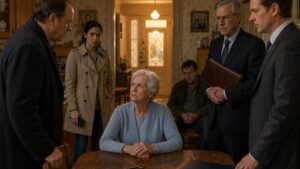
A thin elderly resident sitting near the aisle raised her hand.
Debra stopped.
The woman looked at Mark.
“That ambulance was for me.”
The room became quiet.
Mark knew her by sight. He had held the clubhouse door for her more than once. He did not know her name.
She spoke without drama.
“I was having trouble breathing. My neighbor called. They got to me. I’m fine.”
Mark nodded slowly.
“But I heard them outside,” she continued. “I heard the engine backing up. I heard somebody yelling for a car to be moved. It felt like forever.”
Mark glanced at the screen again.
The pickup in the photograph did not belong to Nicole. The sedan did not belong to either of his current tenants.
Debra said, “After that, the board asked management to come up with a way to keep fourteen feet clear.”
“Did anybody ask me?”
“We believed the association controlled the access.”
“That’s the problem.”
“I understand that’s your position.”
“No. That’s not my position. That’s the question you should have answered before you put a boot on somebody’s car.”
A murmur moved through the chairs.
Debra’s jaw tightened.
The property manager opened a binder.
“The association has maintained that lane since at least the early 2000s.”
Mark held up a hand.
“I’m not disputing that you’ve maintained it.”
That admission drew a few surprised looks.
A week earlier, Mark might have hated saying it aloud.
Now he knew pretending otherwise would only make him look dishonest.
“The HOA plowed it,” he continued. “Swept it. Contractors used it. Neighbors used it. I allowed a lot of that.”
Debra looked at him carefully.
“But permission to use something isn’t permission to claim it,” Mark said.
One of the board members asked, “If you allowed access for years, what exactly were we supposed to think?”
Mark did not answer immediately.
That was the question Jonathan had been forcing him to face.
“You were supposed to ask,” he said.
Then, after a moment, “And I probably should have made the answer clearer before now.”
The atmosphere changed again.
Not much.
Enough.
Paul Robinson, seated near the back, lowered his eyes.
Debra turned off the projector.
“We didn’t paint the line because we wanted your property.”
“Then why not tell me about the ambulance?”
“We sent a notice about emergency access.”
“A general notice.”
“Yes.”
“To the whole community.”
“Yes.”
“Not a request to alter my property.”
Debra folded her hands on the table.
“No.”
It was the first clean answer she had given him.
Mark opened his folder and slid a copy of the old plat onto the table.
“This shows the alley with my parcel.”
The property manager leaned forward.
Debra did not touch it.
Mark continued. “The county search so far has not found an HOA easement.”
“So far,” Debra said.
“Yes. So far.”
The association counsel, who had been silent at the end of the table, finally spoke.
“That distinction matters.”
Debra turned toward him.
He had the calm expression of someone who had spent the meeting waiting for facts to catch up with emotion.
“Do we have a recorded access easement?” he asked the property manager.
“We have maintenance history.”
“That wasn’t my question.”
The same sentence Mark had used in the alley.
The manager flipped through the binder.
“I haven’t located a recorded easement yet.”
Debra stared at him.
Mark saw something pass across her face—not guilt, exactly. More like calculation collapsing.
“You told me we had established control,” she said.
“We have established use.”
“That’s not the same thing,” Mark said quietly.
Debra looked at him.
For once, she did not argue.
The counsel asked, “Who authorized the striping?”
Debra answered before anyone else could.
“I did.”
“And the parking enforcement?”
“I approved it after management recommended keeping the lane clear.”
“Before title review?”
Debra’s eyes stayed on the table.
“Yes.”
There it was.
No conspiracy.
No hidden payoff.
No gleeful theft.
Just an official decision made too quickly because the person making it was convinced the danger of waiting was greater than the danger of being wrong.
Mark should have felt vindicated.
Instead he thought about the woman hearing the ambulance outside.
Debra looked at him.
“I would make the safety decision again.”
“You’d boot my tenant again?”
Her expression tightened.
“No.”
It was a smaller answer than an apology.
It mattered more.
The counsel closed the binder in front of him.
“Pending completion of title review, I recommend the association suspend all parking enforcement in the alley and authorize no additional markings or physical controls.”
One board member immediately objected.
“What if somebody blocks it again?”
“Then we address an immediate obstruction as an emergency issue,” counsel said. “We do not continue asserting property authority we haven’t documented.”
Debra leaned back.
For the first time since Tuesday, Mark saw her without the clipboard, the contractor, or the board position around her.
She looked tired.
Not defeated.
Afraid of making the wrong choice twice.
After the meeting, Mark walked home through the alley.
The yellow line glowed beneath the security lights.
Near the far end, he stopped at the place shown in the ambulance photograph.
If two cars parked carelessly, the lane really would become too narrow.
He measured the space with his eyes.
Then he heard footsteps.
Debra was coming from the clubhouse.
She stopped several feet away.
“I should have checked the title before authorizing the paint.”
Mark looked at her.
“Yes.”
She accepted the answer.
“But if we remove every restriction and somebody blocks this again—”
“I didn’t say remove every restriction.”
“You said you own it.”
“I believe I do.”
“That sounds like the same thing.”
“It isn’t.”
Debra looked down the length of the alley.
“What are you proposing?”
“I don’t know yet.”
She gave a tired laugh without humor.
“That’s reassuring.”
Mark looked at the yellow line.
“For now, nobody boots another car.”
“The counsel already said that.”
“And nobody paints anything else.”
“Agreed.”
They stood in silence.
Neither of them had won.
That realization was strangely useful.
The next morning, before Mark had finished his coffee, Jonathan called.
“The association’s lawyer contacted me.”
Mark straightened.
“And?”
“They’ve formally suspended enforcement.”
“That’s good.”
“It is.”
Mark waited.
Jonathan continued.
“They’re also requesting a survey and title conference.”
“So they’re backing down.”
“Don’t get ahead of yourself.”
Mark closed his eyes.
“You really enjoy saying that.”
“No. I enjoy saying things before my clients make expensive assumptions.”
“What do they want?”
“To determine what the association actually has.”
“And if they have nothing?”
“Then the conversation becomes what happens next.”
Outside the window, the yellow line remained exactly where it had been.
The boot was gone.
The argument was not.
Chapter 5: The Survey Pin Beneath Decades of Asphalt
The surveyor found the iron marker under less than two inches of hardened dirt.
He had been working along the alley edge for almost forty minutes when his metal probe struck something with a dull, unmistakable click.
Mark heard it from six feet away.
The surveyor scraped with a narrow hand tool until a rust-dark circle emerged beside the pavement.
“There.”
Mark crouched.
“That’s it?”
“Looks like an old monument. Don’t touch it yet.”
The surveyor set up his equipment, checked the old plat again, and took another reading.
The yellow line crossed the alley several feet inside the area Mark believed belonged to his parcel.
For days Mark had imagined this moment as a clean victory.
The old marker would appear.
The measurements would line up.
Everything would become simple.
Instead he found himself watching the surveyor work with the same caution he had felt in the recorder’s office.
Jonathan had warned him twice already: a boundary monument could strengthen the title position without answering every question about use.
Still, when the surveyor finally stood and said, “Your recorded dimensions are tracking closely,” Mark felt his shoulders loosen.
“How closely?”
“Close enough that I’m not seeing anything here that explains the HOA’s claim as ownership.”
Mark looked at the yellow stripe.
It suddenly appeared less permanent.
The surveyor added, “That doesn’t answer whether somebody has access rights. I’m only telling you where the boundary appears to run.”
“I know.”
This time, he actually did.
By Friday afternoon, Jonathan had received copies of the HOA’s historical maintenance records.
They sat across the conference table in two stacks.
One stack belonged to Mark.
The other belonged to the association.
Jonathan tapped the HOA pile.
“Snow removal. Sweeping. Drain clearance. Patching. Landscaping access.”
“For twenty years?”
“Records go back nineteen that I can verify.”
Mark leaned back.
“That’s a lot of maintenance.”
“Yes.”
“Paid by the HOA.”
“Yes.”
Mark disliked the satisfaction in Jonathan’s refusal to soften facts.
“And the other stack?”
“Your title records. Recorded plat. Deeds. Survey material.”
“Easement?”
Jonathan shook his head.
“Still nothing recorded granting the HOA unrestricted control over the alley.”
Mark stared at him.
“That should be the end of it.”
Jonathan slid one of the maintenance invoices toward him.
“No. It should be the end of pretending the facts only point one direction.”
Mark picked up the invoice.
The description was ordinary: rear access snow clearing.
An address range followed.
No ownership claim. No easement reference. Just work performed and paid.
Another invoice listed asphalt patching.
Another, storm-drain clearing.
Mark remembered all of it happening.
He had simply never thought of the bills.
“What exactly can they claim from this?”
“That’s the wrong question.”
“What’s the right one?”
“What do you want after the title issue is resolved?”
“My property.”
“You already have a strong argument for that.”
“Then I want them off it.”
Jonathan studied him.
“Completely?”
Mark opened his mouth.
Nothing came out.
He pictured the elderly resident at the meeting.
He pictured the ambulance backing through the alley.
Jonathan watched him notice his own hesitation.
“That’s why this isn’t finished,” he said.
On Monday, the association requested a meeting in the clubhouse office rather than the larger boardroom.
Debra was already seated when Mark arrived.
No projector.
No audience.
Only Debra, the property manager, the association counsel, Jonathan, and two sets of documents.
The counsel began.
“Our title review has not located a recorded instrument establishing association ownership of the access strip.”
Mark heard the sentence carefully.
Not ownership.
“What about an easement?” Jonathan asked.
“We have not located a recorded easement granting the association the enforcement authority exercised last week.”
Debra stared at the table.
The property manager added, “We do have longstanding maintenance and use.”
Jonathan nodded. “So do we.”
Mark looked at Debra.
“Then remove the line.”
She met his eyes.
“We’re prepared to.”
He had not expected the answer to come that quickly.
“And reimburse Nicole.”
“We’ll discuss the enforcement charge.”
“No. We’ll reimburse it.”
Debra’s mouth tightened.
The association counsel said, “That can be resolved.”
Mark felt something almost like victory.
Then Debra pulled a document from her folder.
“There’s a condition.”
Jonathan leaned back slightly.
Of course there was.
Debra slid the paper toward Mark.
“If the HOA removes the markings and acknowledges that it does not own the alley, you grant the association permanent unrestricted access for emergency, maintenance, service, and community passage.”
Mark read the first page.
Then the second.
The language was broader than anything he had expected.
Vehicles.
Contractors.
Residents.
Agents.
Invitees.
Successors.
Reasonable association purposes.
No expiration.
No meaningful limit.
He looked up.
“This gives you almost everything you thought you had before.”
“It gives the neighborhood certainty.”
“It gives the HOA permanent control without calling it ownership.”
“It gives emergency vehicles access.”
“Emergency vehicles are one line in here.”
Debra crossed her arms.
“What happens under your version when somebody decides they don’t want the trash contractor crossing?”
“Then we define trash access.”
“And snow removal?”
“We define that.”
“And utility work?”
“That too.”
“And when the board changes in five years?”
“Then they read the agreement.”
Debra shook her head.
“I’m not replacing one ambiguity with twelve smaller ones.”
Mark pushed the document back.
“You’re asking me to solve your uncertainty by giving up the right to say no forever.”
“We are asking you to recognize how this lane has actually functioned.”
“And I’m asking you to recognize why you’re sitting here negotiating instead of enforcing.”
The room went still.
Jonathan did not intervene.
Mark understood why.
This was no longer about discovering the facts.
It was about choosing what to do with them.
Debra leaned forward.
“Mark, I have thirty-eight homes to think about.”
“And I have property you painted without asking.”
“I admitted that was handled badly.”
“You authorized it.”
“Yes.”
“And now you want me to sign an agreement broader than anything you could prove you already had.”
“Yes,” she said.
The bluntness stopped him.
Debra continued.
“Because I don’t want the next board president getting a call that an ambulance can’t get through and finding out nobody knows what they’re allowed to do.”
For a moment, Mark saw the same fear from the clubhouse meeting.
Not power.
Responsibility without certainty.
But he also saw Nicole’s booted car.
Good intentions had already become authority once.
He stood.
“I won’t sign this.”
Debra looked disappointed rather than surprised.
“Then we may be at an impasse.”
“No,” Mark said. “We’re at the point where we stop pretending unrestricted access is the only kind of access.”
He gathered his papers.
Outside, the yellow line had begun to fade where tires had crossed it.
For the first time, Mark did not enjoy seeing that.
The line had become a problem both sides could point at while avoiding the harder question underneath it.
Jonathan followed him outside.
“You handled that better than I expected.”
Mark looked at him. “That supposed to be a compliment?”
“Moderately.”
“What happens now?”
Jonathan put the folder under his arm.
“If you want maximum leverage, we can demand removal, reimbursement, written acknowledgment, and no association access beyond whatever rights they can prove.”
“And if I don’t?”
“Then we draft something narrower.”
Mark looked down the alley.
A delivery van entered slowly, passed between the garages, and disappeared around the far end.
Nobody stopped it.
Nobody had stopped vehicles like it for years.
Jonathan said, “Winning the boundary question won’t decide what kind of neighbor you want to be after.”
Mark watched the van leave.
Before sunset, Debra sent a short email.
The HOA would remove the yellow markings immediately if Mark granted permanent unrestricted access.
Mark read it twice.
Then he printed it, placed it beside his father’s plat, and wrote one sentence across the top of the proposed agreement.
Too much.
Chapter 6: He Could Close the Alley Completely
Jonathan placed three sheets of paper on the desk and said, “You have enough leverage now to make the paint disappear.”
Mark did not touch the papers.
“How much leverage?”
“Enough that association counsel is advising them not to continue asserting enforcement authority without an agreement.”
“And if I refuse every agreement?”
“They remove the line. They reimburse the fee. They stop acting like the alley is common property unless they decide to litigate whatever use rights they think exist.”
Mark leaned back.
“So I can close it.”
Jonathan chose his words carefully.
“You may have a strong basis to restrict access beyond whatever legal rights others can establish.”
“That sounded expensive.”
“It sounded accurate.”
Mark smiled despite himself.
Jonathan slid the first page toward him.
“This is the version you asked me to prepare.”
Mark read it.
No general community passage.
No HOA parking enforcement.
Emergency access permitted.
Utility access permitted when legally required.
Association contractors allowed only for specifically defined maintenance approved in writing.
No transfer of ownership.
No creation of unrestricted public or community access.
Revocable provisions where permitted.
Clear notice requirements.
It was nothing like Debra’s proposal.
Mark felt a quiet satisfaction.
Then Jonathan placed a second sheet beside it.
“What’s that?”
“A diagram.”
The survey drawing had been simplified into an access plan.
A marked corridor had to remain clear for emergency vehicles.
Parking areas were designated outside it.
Trash and utility access were shown separately.
Mark studied the page.
“This could have prevented all of this.”
“Yes.”
“Why didn’t the HOA do this first?”
“Because people tend to formalize arrangements after they fail.”
Mark looked at him.
“That supposed to make me feel better?”
“No.”
Later that afternoon, Mark returned home to find Nicole sitting on the porch steps.
Her car was parked on the street.
“You know the boot is gone,” he said.
“I know.”
“You can use the parking space again for now.”
She shook her head.
“I’m good on the street until you people figure out who owns planet Earth.”
Mark sat one step below her.
“That bad?”
Nicole looked at him.
“You really want to know?”
“Yes.”
“I think the HOA was wrong.”
“That part I like.”
“I’m not finished.”
He nodded.
“I also think you’re enjoying being right more than you think you are.”
Mark frowned.
“They put a boot on your car.”
“I remember.”
“I paid the fee.”
“I know.”
“They painted property they didn’t own.”
“Probably.”
“Probably?”
Nicole shrugged.
“I’m not the lawyer.”
Mark looked away.
She continued.
“I’m saying I don’t want to be the reason this turns into some ten-year neighborhood war.”
“It won’t.”
“You’ve been photographing the alley every day.”
“For documentation.”
“You printed the email and wrote on it in marker.”
Mark turned toward her.
“How do you know that?”
“You left it on the kitchen counter when you came down to fix the sink.”
He almost laughed.
Nicole did not.
“I was mad,” she said. “I’m still mad. I missed work. I had to call my supervisor and explain why my car had a clamp on it behind my own building.”
Mark’s expression softened.
“But?”
“But I also use that alley. Delivery drivers use it. The trash crew uses it. That ambulance used it.”
He looked toward the rear gate.
“So I should give them whatever they want?”
“No.”
“What are you saying?”
“I’m saying don’t make the alley useless just because they were wrong about owning it.”
The sentence stayed with him after Nicole went inside.
That evening Mark took another photograph of the yellow stripe.
It was fading.
Tires had broken the clean edge into streaks.
He stood where his father used to park a workbench during summer repairs and remembered something he had not thought about in years.
His father had been protective of the property, but not precious about it.
Neighbors borrowed tools.
Kids cut through the side path.
Contractors used the rear gate.
His father complained constantly about people leaving things open, blocking drains, parking badly.
But he almost always started with the same question.
What do they actually need?
Mark had inherited the records.
He was less certain he had inherited that part.
The next meeting took place in Jonathan’s office.
Debra arrived with association counsel.
No property manager.
No board members.
That alone made the room feel different.
Jonathan placed the proposed limited-access agreement between them.
Debra read the first page.
Then the second.
Her expression hardened.
“This can be changed by a future owner.”
“Some provisions can,” Jonathan said. “Others can be structured to survive ownership changes.”
“That’s exactly what I was trying to avoid.”
Mark said, “You were trying to avoid ever having to ask permission again.”
“Yes.”
The answer was immediate.
“At least you’re honest.”
Debra looked at him.
“I’m not ashamed of wanting certainty.”
“You shouldn’t be.”
She seemed surprised.
Mark continued.
“But certainty for you can’t mean surrender for me.”
Debra turned back to the agreement.
“Emergency access only?”
“Emergency access is guaranteed.”
“Trash?”
“Defined service schedule.”
“Snow?”
“Association may clear the alley under written permission without acquiring additional rights.”
“Utility contractors?”
“Where legally required, yes.”
“Residents?”
“Not unrestricted vehicle access.”
Debra pushed the paper away.
“What about ordinary passage?”
“Pedestrian passage can be addressed separately.”
“That is exactly what I meant about twelve smaller ambiguities.”
“No,” Mark said. “These are twelve things you used to treat as one thing because nobody bothered separating them.”
Debra looked at him for a long moment.
“Future boards will hate this.”
“They can read.”
“That has never stopped a board from misunderstanding a document.”
Jonathan covered a smile with his hand.
Even Debra’s expression softened for half a second.
Then she became serious again.
“What if somebody blocks the emergency corridor?”
“The HOA can notify me or the property owner.”
“What if nobody answers?”
“Emergency services don’t need permission in an emergency.”
“And if it’s a resident’s vehicle?”
“We include a removal procedure limited to actual obstruction of the defined emergency corridor.”
Debra looked at association counsel.
He nodded slowly.
“That is workable.”
She turned toward him.
“You told me unrestricted access was cleaner.”
“It is cleaner.”
“Then why are we discussing this?”
“Because cleaner for the association is not necessarily supportable against the owner.”
Mark said nothing.
Debra rubbed a thumb over the edge of the paper.
Her resistance was no longer about proving the alley belonged to the HOA.
It was about what happened when she no longer had the power to solve every future problem with one rule.
Mark understood that fear.
For thirty-one years, he had solved the same uncertainty by doing the opposite.
He had made no rule at all.
Both approaches had failed.
Debra stood.
“I need the board to review this.”
“Of course.”
“I’m not promising approval.”
“I know.”
“And if they reject it?”
Mark looked at the unrestricted agreement she had brought the week before, then at Jonathan’s narrower proposal.
“The unrestricted version is off the table.”
Debra held his gaze.
“You’re willing to risk the board saying no?”
“Yes.”
“Even if that means a legal fight?”
Mark thought of the yellow line.
Nicole’s car.
The ambulance photograph.
His father’s folder.
Paul reminding him of words he had spoken casually twelve years before.
Use it if you need it.
He had finally begun to understand how much trouble could grow from a sentence when nobody defined what need meant.
“I’m willing to fight over ownership,” he said. “I’m not willing to fight for the right to make the alley useless.”
Debra looked down at the proposal again.
Mark pushed it gently toward her.
“Emergency access stays. Necessary service access stays. Ownership stays mine. Enforcement has limits. Maintenance doesn’t become possession.”
She picked up the document.
For a moment neither of them moved.
Then Debra tucked it into her folder.
“I’ll take it to the board.”
Mark nodded.
She reached the door, stopped, and turned back.
“If they accept this, the yellow line comes out.”
“It should.”
“And if they don’t?”
Mark looked at the proposal still open on Jonathan’s desk.
“Then at least we’ll finally know what we’re actually arguing about.”
Chapter 7: They Removed the Line but Kept the Way Open
The contractor truck returned on a Tuesday morning.
Mark heard the engine before he saw it, and for one strange second his body reacted exactly as it had two weeks earlier.
Then he looked through the kitchen window.
This time there was no striping machine in the truck bed.
There was a pressure washer, a surface grinder, and several containers marked for paint removal.
Mark set down his coffee.
Nicole was already outside.
She stood near the rear steps with her arms folded, watching two workers examine the yellow stripe.
“One of them asked me where they should start,” she said when Mark came down.
“What did you tell him?”
“That I’m staying out of HOA property law forever.”
Mark smiled.
The line had faded under tires and weather, but enough remained to cut a bright path beside the brick wall. One worker sprayed a test section. Water and loosened paint ran toward the drain in thin yellow streams.
Mark watched the color lift from the pavement.
He had imagined this moment many times during the first week.
In those versions, Debra stood nearby embarrassed. The board admitted everything. Somebody used the word apology several times. Mark said very little because he had been right all along.
None of that happened.
The contractors simply worked.
The yellow line became pale, then broken, then disappeared section by section.
Debra arrived twenty minutes later carrying a slim document folder.
No clipboard.
Mark noticed that first.
She waited until the grinder stopped before approaching him.
“The board approved it.”
He looked at the folder.
“All of it?”
“The revised version.”
“Emergency corridor?”
“Yes.”
“Service access?”
“As scheduled and defined.”
“No general parking enforcement.”
“No general parking enforcement.”
“Maintenance doesn’t create ownership rights.”
Debra gave him a tired look.
“That sentence appears three separate times.”
“Jonathan likes clarity.”
“So do I, apparently.”
She held out the folder.
Mark opened it.
The agreement had already been signed by the authorized association representatives. A survey exhibit was attached. The access corridor was marked clearly. Emergency vehicles could enter without delay. Utilities could use the route where legally necessary. Association contractors could perform specified snow clearing, drainage work, and scheduled service access under written permission.
Residents did not gain unrestricted vehicle passage.
The HOA did not acquire ownership.
Maintenance did not become possession.
No future board could cite the agreement as permission to regulate the alley as common property.
Mark turned another page.
“And the enforcement charge?”
“Approved for reimbursement.”
“For Nicole?”
“And the other tenant if there was a charge assessed.”
“There wasn’t. I stopped them before they got that far.”
Debra nodded.
“The board also approved written notice that the prior parking action was suspended and should not be treated as precedent.”
Mark looked up.
“That came from counsel?”
“Mostly.”
“Mostly?”
“I added the precedent language.”
That surprised him.
Debra saw it.
“I don’t want another board reading old minutes ten years from now and deciding we already settled this the other way.”
Mark closed the folder.
For several seconds neither said anything.
Behind them, the grinder started again.
A worker moved slowly across the stripe, leaving ordinary gray pavement behind.
Nicole came down the steps.
Debra turned toward her.
“The association is reimbursing the $140 release fee.”
Nicole looked at Mark.
“He already paid it.”
“I know. The reimbursement can be issued to him, or directly to you if you paid anything else associated with the enforcement.”
Nicole shook her head. “Just give it back to Mark.”
Debra nodded.
Nicole hesitated.
“Are they going to boot me again?”
“No,” Debra said.
The answer came without qualification.
“Not for parking in the designated space. The new agreement defines the emergency corridor. Mark will give you the updated parking diagram.”
Nicole looked at the workers.
“So this is actually done?”
Mark almost answered yes.
Then he stopped himself.
“The ownership question is done enough,” he said.
Nicole laughed.
“That sounds like your lawyer.”
“It’s contagious.”
She went back inside.
Debra watched her leave.
“I owe her an apology.”
Mark looked at her.
“Yes.”
“I sent one with the reimbursement notice.”
“That’s better than telling me.”
Debra accepted that too.
The worker nearest them shut off the grinder.
Only a narrow patch of yellow remained near the alley entrance.
Debra looked at it.
“I still think keeping this lane clear matters.”
“So do I.”
“You didn’t say that at the first meeting.”
“I wasn’t ready to.”
“And I wasn’t ready to admit I’d acted before checking the title.”
Mark glanced at her.
“That sounds dangerously close to both of us learning something.”
“Don’t make it sentimental.”
“I wouldn’t dare.”
She almost smiled.
Then her expression became serious.
“The board wanted one more provision.”
Mark stiffened.
Debra lifted a hand.
“It’s already in there. You approved it through Jonathan.”
“What provision?”
“That future owners receive a copy of the access agreement with the property records.”
Mark relaxed.
“Yes.”
“So nobody gets to say they didn’t know.”
“No.”
Debra looked down the alley.
“That part I like.”
Mark followed her gaze.
For years, he had treated the absence of conflict as proof that the arrangement was working.
It had not been working.
It had simply remained undefined.
That was not the same thing.
The final patch of yellow disappeared.
The pavement underneath was slightly lighter, a faint ghost of where the stripe had been.
Mark expected to feel triumphant.
Instead he felt something quieter.
Relief, mostly.
And responsibility.
That afternoon he taped a new parking diagram inside the rear entry for Nicole and the other tenant.
The message was plain.
Keep the emergency corridor clear.
Park only in the marked private spaces.
No HOA enforcement except for actual obstruction under the written procedure.
Nicole read it while holding a grocery bag.
“You made rules.”
“I wrote down rules.”
“Big growth.”
“Keep pushing.”
She smiled and went upstairs.
Later, Paul Robinson came through the alley carrying two flattened boxes.
He stopped when he saw the line was gone.
“So you won.”
Mark leaned against the porch rail.
“We settled it.”
Paul looked disappointed by the lack of drama.
“That sounds less satisfying.”
“It’s more useful.”
Paul nodded toward the far end.
“Can I still walk through?”
“Yes.”
“Do I need a permit?”
“No.”
“Written authorization?”
“Don’t test me.”
Paul laughed.
Then he became more serious.
“For what it’s worth, I should’ve said something years ago.”
“About what?”
“About everybody treating it like it belonged to everyone.”
Mark looked at him.
“I should’ve said something too.”
Paul gave a small nod.
That was enough.
Two days later, the reimbursement check arrived.
Mark deposited it and sent Nicole a photograph of the receipt with a short message: Closed out.
She replied with a thumbs-up and nothing more.
That felt appropriate.
There was no board celebration.
No neighborhood meeting announcing a victory.
The alley simply returned to ordinary use.
Trash contractors came through on schedule.
A utility worker used it once to reach a service box.
Cars stayed outside the emergency corridor.
The HOA snow contractor received a copy of the access terms before winter.
People adjusted.
On Sunday evening, Mark cleared the dining table.
His father’s old folder was still there, its cardboard edges softened from age.
Mark opened it and unfolded the stamped plat one more time.
The alley remained exactly where it had always been.
Fourteen feet wide.
Measured.
Recorded.
His father had saved the paper because boundaries mattered.
Mark understood that now.
But beside the old plat he placed the new agreement.
Not behind it.
Not in another box.
Beside it.
The survey exhibit showed the same strip of land, but now it also showed the corridor people could use when they needed it.
Ownership on one page.
Responsibility on the other.
Mark slipped both documents into the folder and wrote a new note on the inside cover.
Current access agreement attached.
He did not write private.
He did not write HOA dispute.
He did not write never surrender.
He closed the folder and returned it to the cabinet where his father had kept the property records for decades.
Outside, a car moved slowly through the alley and continued without stopping.
No yellow line told it where authority began.
No silence was being asked to explain what everyone meant.
The way stayed open.
The boundary stayed clear.
For Mark, that was finally enough.
The story has ended.