The HOA Dug a Utility Trench Across His Pasture—Then the Old Boundary Marker Changed Who Had Authority
Chapter 1: The Trencher Was Already Inside His Pasture
Robert Carter heard the trencher before he saw it.
The grinding carried across the western pasture in hard mechanical bursts, wrong enough among the cattle and summer insects that he stopped halfway through closing a gate. For a second he thought the county was working along the road.
Then he saw dirt rising beyond the drainage ditch.
Robert left the gate hanging and drove his old pickup across the pasture.
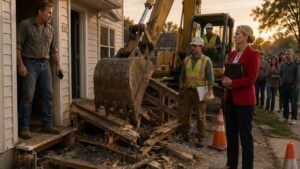
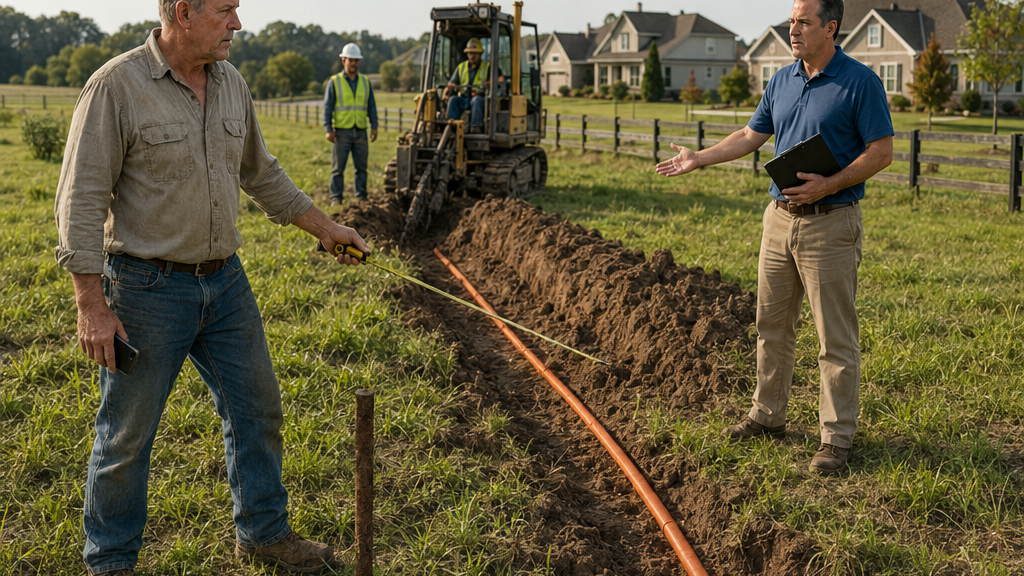
Six workers in reflective vests stood along a fresh cut running parallel to the subdivision fence. A compact excavator waited farther ahead while the trencher chewed another strip from the ground Robert’s cattle had grazed for years.
He parked thirty yards away.
Nobody came to meet him.
“What are you putting in?”
The subcontractor foreman pointed toward several coils beside the ditch. “Water and communications.”
Robert looked down into the excavation.
Bright orange conduit already rested along the bottom.
His anger changed shape.
This was not a crew marking a route. They had already installed part of it.
“Who authorized you to come onto this property?”
The foreman glanced toward a man wearing clean work boots and a blue polo rather than a safety vest.
Anthony Hill walked over holding a clipboard.
“Morning, Mr. Carter.”
Robert knew the name. Anthony managed the homeowners association next door, though they had spoken only a handful of times.
“Did you authorize this?”
“The association did.”
Robert pointed at the trench. “The association doesn’t own this pasture.”
Anthony’s expression remained politely patient. “We have utility access along this boundary.”
“No, you don’t.”
Anthony looked briefly toward the operator, who had shut down the machine.
“We have a recorded easement.”
Robert stared at him.
Behind Anthony stood neat rows of newer houses, small ornamental trees, fresh sidewalks, and privacy fences. Fifteen years earlier most of it had been brush and soybean ground. Robert had watched the subdivision advance a phase at a time without objecting. He had sold none of his acreage and joined none of their agreements.
His father had once warned him that development rarely arrived as a single dramatic event.
It came a few feet at a time.
Robert walked away from Anthony and pushed through knee-high grass near an old fence corner.
“What are you looking for?” Anthony asked.
Robert ignored him.
He remembered repairing that corner with his father after a storm. A drainage ditch curved south, but the deed line itself did not. His father had shown him the reference point so often that Robert could still picture the toe of his boot beside it.
Robert scraped the grass apart.
Rust showed beneath the roots.
He bent down and exposed the rounded top of an iron survey pin.
“There.”
Anthony stepped closer.
Robert stood and looked from the pin to the trench.
The excavation was not merely brushing the boundary. It sat several yards inside where Robert believed the line ran.
He retrieved a tape measure from his truck.
Anthony gave a short, uncomfortable laugh. “You don’t need to measure it yourself. The contractor has engineered plans.”
Robert hooked the tape near the pin.
“The engineered plans don’t move iron.”
He stretched the tape toward the cut, took photographs with his phone, then photographed the pin from three directions.
Anthony’s confidence did not disappear, but Robert saw irritation underneath it.
“Mr. Carter, this route was approved months ago.”
“By whom?”
“The board.”
“Your board can’t approve my land.”
“The easement can.”
“Show it to me.”
Anthony opened his clipboard case and removed a photocopied page. A highlighted line crossed the middle of dense legal text. At the top was a recording reference from the county deed books.
Robert expected something vague.
It wasn’t.
The description referred to a strip along the western side of the Carter tract and granted access for construction and utility purposes.
For the first time that morning, Robert said nothing.
Anthony watched him read.
“We didn’t make this up,” he said.
Robert read the recording number twice.
The date was old. Older than the subdivision. Older than Anthony. Old enough that Robert had been a boy when the document was filed.
But the parcel reference looked real.
“Give me a copy.”
Anthony handed it over.
Robert folded it once.
“Until I verify this, nobody digs another foot.”
Anthony’s jaw tightened. “I can’t stop a contracted project because you don’t recognize a recorded easement.”
Robert looked toward the orange conduit in the trench.
“You can stop because the landowner standing in front of you is disputing your authority.”
For several seconds, neither man moved.
Then Anthony turned toward the foreman.
“Hold here while we sort this out.”
Robert felt some pressure leave his chest.
The operator climbed down from the trencher.
It was only a pause, but it mattered.
Robert walked the disturbed strip slowly. Fresh clay had been piled over grazing grass. Tire marks crossed the shallow ditch. In places, the trench seemed closer to his interior fence than to the subdivision itself.
He photographed everything.
When he reached the iron pin again, Anthony was waiting beside it.
“I’ll email you the recorded instrument,” Anthony said.
“Do that.”
“And the route plan.”
“Do that too.”
Anthony hesitated.
“I need you to understand something. This project supplies the next section of homes. We already delayed once.”
Robert slipped his phone into his pocket.
“Then you should’ve been certain before you started.”
He returned to the truck carrying the copied easement.
As he drove toward the house, he looked back through the mirror. The workers were standing around the silent machine.
For nineteen years, Robert had believed knowing his own line was enough.
Now there was an old county recording number in the passenger seat telling him memory might not be the same thing as authority.
At 4:18 that afternoon, Anthony’s email arrived.
Attached were the easement, the route drawing, and the contractor schedule.
Robert opened the schedule first.
Work was listed to resume at seven Wednesday morning.
Chapter 2: The Paper Anthony Thought Ended Everything
The easement number was genuine.
Robert confirmed that much before dinner.
The county’s online index showed the same recording book, the same page, and the same family surname Anthony had handed him beside the trench.
That bothered Robert more than if the document had been obviously wrong.
He printed the page and spread it across his kitchen table beside a yellowed plat from his own file cabinet.
The old plat showed his western boundary as a straight line.
The easement description was harder to understand. Bearings, distances, references to a proposed road, language about access for construction.
Robert called Jennifer Lewis.
She had handled a title issue for him several years earlier.
“I need you to tell me whether somebody has a right to dig across my pasture.”
“That’s a larger question than it sounds.”
“They’re already digging.”
That changed her tone.
“Send me everything.”
Robert forwarded Anthony’s files.
Jennifer called back twenty minutes later.
“Don’t touch the conduit. Don’t block the equipment. Photograph the condition tonight.”
“I already did.”
“Good. And Robert?”
“What?”
“Don’t decide what the document means before I read the full chain.”
He looked at the old iron pin visible through his kitchen window only as a dark spot beyond the pasture.
“I know where the line is.”
“That isn’t what I said.”
He disliked the answer because he knew why she gave it.
The next morning Robert was at the trench before seven.
Anthony arrived in an SUV shortly after the contractors.
“I thought we were holding.”
“We did overnight.”
“That’s generous.”
Anthony exhaled. “I sent you the recorded easement.”
“And I sent it to counsel.”
The foreman stood near the trencher, waiting.
Anthony pointed toward the disturbed strip.
“This corridor was part of the engineering package. Nobody here chose it yesterday morning.”
Robert walked toward the iron pin and set one end of his tape against it.
“Then tell me why your corridor is over here.”
Anthony followed.
“You keep treating that pin like it’s the entire survey.”
“It’s a monument.”
“It may be a monument. It may also be old.”
Robert looked at him.
“So is your easement.”
Anthony did not answer immediately.
The contractors watched from a distance.
Robert stretched the tape toward the trench and read the measurement.
Anthony glanced at it despite himself.
“This needs a licensed surveyor,” he said.
“First sensible thing you’ve said.”
That landed harder than Robert intended.
Anthony’s face changed.
“I am trying to keep a project moving that fifty-seven households have already paid assessments toward. If I stop contractors every time an adjoining owner objects to a line shown on recorded documents, the association pays the change orders.”
“And if you don’t stop when the adjoining owner is right?”
Anthony looked toward the trench.
For the first time, his answer was quieter.
“Then we have a different problem.”
He ordered the foreman to hold another hour while he called Melissa Walker.
Robert returned to his truck and found an email from Jennifer.
Call me before you say anything else.
He called.
“Where are you?”
“At the pasture.”
“Go home and look at the attachments Anthony sent.”
“I already did.”
“No. Look at all of them.”
Robert drove back irritated.
At the kitchen table, he opened the route package again.
Jennifer directed him to the notification folder.
There were two letters addressed to Robert Carter.
One dated six weeks earlier.
Another dated three weeks after that.
Robert recognized both envelopes.
He had received them.
The first had carried the HOA logo in the corner. He had opened it, read the first paragraph about utility improvements, and put it with junk mail because he was not an HOA member.
The second he had barely looked at.
Jennifer stayed silent until he spoke.
“They sent me notice.”
“They sent you notice of proposed work.”
Robert rubbed a hand over his jaw.
“I told Anthony nobody contacted me.”
“You weren’t personally called. But that’s different from receiving nothing.”
He stared at the route attachment.
A thin line ran near the western edge of his tract.
He had never opened it.
The discovery felt like giving away ground.
“Does this make their easement valid?”
“No.”
“Does it give them permission?”
“Not by itself.”
“Then why does it matter?”
“Because facts matter even when they’re inconvenient to us.”
Robert leaned back.
Jennifer continued.
“If this turns into a dispute, you don’t get to say there was no notice. You get to say the notice did not establish a legal right to enter your land.”
That distinction irritated him because it was exact.
He thought of the letters he had tossed aside.
For years his rule had been simple: HOA business belonged to HOA people. He stayed out of their meetings, ignored their newsletters, declined invitations to discuss drainage and fence maintenance because none of their covenants controlled him.
It had felt like independence.
Sitting at his kitchen table, it looked a little more like avoidance.
“All right,” he said. “What about the easement?”
Jennifer paused.
“That’s the interesting part.”
Robert straightened.
“The recorded document exists. Anthony wasn’t bluffing.”
“But?”
“But it’s not written like a permanent utility easement.”
She emailed him an enlarged page.
Robert opened it.
Halfway through the granting language, Jennifer had marked a phrase.
Temporary right of entry and construction access.
Robert read it twice.
“Temporary.”
“Yes.”
“How temporary?”
“That’s what I’m trying to determine.”
The phone buzzed with another incoming call.
Anthony.
Robert let it ring once before answering.
“Melissa says the easement is valid,” Anthony said. “Our counsel reviewed the title package when the association acquired the common property.”
“Did counsel review the whole chain?”
A pause.
“I assume so.”
Robert looked at Jennifer’s highlighted phrase.
“Don’t assume.”
Anthony’s voice hardened again. “We have crews standing idle.”
“And I have an open trench in my pasture.”
“We’ll give you until tomorrow morning. After that, unless there’s actual evidence the easement terminated, we’re proceeding.”
Robert ended the call and looked through the window toward the western field.
Jennifer was still on the other line.
“You heard that?”
“Enough of it.”
“Can we prove termination by morning?”
“I don’t know.”
Robert disliked those words almost as much as Anthony’s certainty.
Then Jennifer said, “There should be another document if this was temporary. The question is whether anybody ever recorded what ended it.”
Robert looked down at the old easement.
One reference in the legal description mentioned a proposed county road.
He had lived there most of his life.
There had never been a road on that side of the farm.
Chapter 3: The Road That Was Never Built
The county index showed another filing nobody had included in Anthony’s packet.
Jennifer found the reference at 8:12 Wednesday morning.
“Don’t celebrate yet,” she told Robert over the phone. “We need the actual instrument.”
He was already pulling on his boots.
Forty minutes later he met her at the county records office.
The clerk brought them a scan of an old deed book entry, then another page referenced beneath it. The papers smelled faintly of toner, but the typed language belonged to another era.
Robert stood at the counter while Jennifer followed each cross-reference.
The original easement had been granted for construction of a proposed connector road and related utilities.
“That’s the road named in Anthony’s document,” Robert said.
Jennifer nodded.
The right had been temporary, but temporary did not automatically mean expired. It could have remained effective until completion, abandonment, or another condition spelled out elsewhere.
Robert forced himself not to jump ahead.
“What happened to the road?”
Jennifer tapped the next reference.
“That’s what this may answer.”
The clerk retrieved another recorded instrument.
This one had been filed years later.
Jennifer read silently.
Robert watched her expression instead of the paper.
Finally she pushed the page toward him.
A county transportation project number appeared near the top. Beneath it was language releasing temporary construction rights associated with the abandoned connector project.
Robert found his family surname.
Then the parcel number.
Then the western tract.
“The easement was released.”
“This easement was released,” Jennifer corrected.
He gave her a look.
She didn’t apologize.
“Precision matters.”
“When?”
She pointed to the recording date.
Decades earlier.
Long before the HOA existed.
Long before its first house had been framed.
Robert felt a sharp rush of satisfaction, followed almost immediately by anger.
“They sent a crew onto my land using a dead easement.”
“They used a title package containing a reference to an easement. We don’t know yet why the release wasn’t included.”
“Does that difference matter?”
“It will matter when deciding whether this was negligence, a title error, or something worse.”
Robert wanted a cleaner answer.
He wanted somebody to have done something obviously foolish so he could remain entirely right.
Instead Jennifer kept putting edges around his certainty.
They copied the release and the index pages.
Outside, Robert called Anthony.
“I found the termination.”
Silence.
“What termination?”
“The temporary easement your route relies on was released after the road project was abandoned.”
Another silence.
Longer this time.
“Send it to me.”
“I will.”
“Are you sure it covers the same instrument?”
“My attorney is standing beside me.”
Jennifer lifted one eyebrow.
Anthony said, “Send it.”
They did.
For twenty minutes nothing happened.
Then Anthony called back.
His voice had lost the dismissive edge from Tuesday.
“We’ve stopped the crew.”
Robert looked at Jennifer.
“Good.”
“Melissa wants to review this with counsel.”
“She can review it as long as she wants.”
Anthony hesitated.
“Robert, I owe you something.”
Robert waited.
“I shouldn’t have treated your objection like you were just angry about construction.”
The apology was incomplete, but it was real enough that Robert did not press him.
“You should’ve stopped when I disputed the line.”
“Yes.”
That word surprised him more than the apology.
By noon, Robert and Jennifer were standing beside the old iron pin.
Jennifer held the original plat while Robert cleared grass around the monument.
The old road corridor on the documents ran near the western edge, but the released construction strip did not perfectly match the excavation.
“Even if the easement had survived,” Robert said, “they’re too far in.”
“Maybe.”
He frowned.
“You’ve been hanging around me too long.”
She smiled. “You need a survey.”
Robert looked toward the trench.
The orange conduit curved away through the exposed soil.
“What about this pin?”
“It helps.”
“My father showed me this pin when I was twelve.”
“It still needs to be tied into the recorded description.”
Robert crouched beside it.
He remembered his father driving a fence staple into a post nearby, then telling him never to let the pasture line become something remembered only by argument.
At the time Robert had thought the lesson was about land.
Now he wondered whether it had also been about records.
His phone rang.
Melissa Walker.
It was the first time she had called him directly.
“Mr. Carter, I’ve reviewed the release you sent.”
Robert remained crouched beside the pin.
“And?”
“It appears the old temporary construction easement was released.”
Appears.
He almost challenged the word, then stopped.
She was doing what Jennifer had done: leaving room for what had not yet been proved.
Melissa continued.
“But that is not the only recorded utility document affecting the development.”
Robert stood.
“What document?”
“A utility agreement executed when the original subdivision phase was approved.”
“With whom?”
“Prior owners of several adjoining parcels.”
“My father?”
“I don’t know yet.”
That answer sharpened his attention.
Melissa emailed it while they spoke.
Jennifer opened the attachment on her phone.
The agreement was much newer than the abandoned-road easement. It authorized certain utility installation and maintenance rights along specified edges of multiple parcels.
Robert felt the satisfaction of the morning drain away.
“Does it cover my land?” he asked.
Jennifer scanned the description.
“Possibly part of the boundary area.”
Melissa said, “Our counsel believes it supports the route.”
“Your counsel believed that yesterday too.”
“I understand why you don’t find that reassuring.”
Her tone was controlled, not defensive.
Robert looked at the open trench.
“Nobody resumes work until this is settled.”
“I agree.”
That stopped him.
Melissa continued.
“I don’t want another foot disturbed until we know where the legal line and any valid utility rights actually fall.”
It was the first time anyone from the HOA had spoken as if uncertainty itself justified stopping.
Robert looked toward the subdivision.
For two days, he had wanted exactly that.
Now that he had it, the problem had become less simple.
Jennifer enlarged the newer agreement.
“There are no usable field measurements here,” she said.
“What does that mean?”
“It references parcel edges, common corners, and recorded plats. It doesn’t tell us where this trench sits on the ground.”
Robert looked down at the rusted pin beside his boot.
“So we know the old easement is dead.”
“Yes.”
“We know this newer agreement might matter.”
“Yes.”
“And we still don’t know whether they had the right to dig where they dug.”
Jennifer folded the copy of the released easement and slid it into her file.
“Exactly.”
Robert stared at the trench that had seemed so obviously wrong Tuesday morning.
The question was no longer whether an old document existed.
It was whether the modern one reached the dirt already torn open in front of him.
Chapter 4: Nineteen Feet Beyond the Assumption
Paul Wright refused to begin with the orange paint marks.
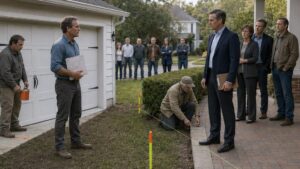
He stood at the edge of the pasture Thursday morning with a survey rod in one hand and Robert’s old plat folded beneath his arm, while Anthony pointed toward two bright marks the utility contractor had sprayed along the grass.
“Those are where the engineers had the route,” Anthony said.
Paul looked at them.
“That tells me where somebody wanted the route.”
He turned to Robert.
“And your iron pin tells me where somebody set iron. Neither one gets to win just because it’s convenient.”
Robert almost smiled.
It was exactly the answer Jennifer would have liked.
Paul spent the first hour doing almost nothing that looked dramatic.
He checked recorded corners. He walked toward the road. He returned to the old fence line. He set equipment on a tripod and sighted across the pasture while Robert, Anthony, and Melissa waited farther back.
Melissa had arrived before eight.
She wore flat shoes inappropriate for wet pasture grass and carried a thin folder against her side. Unlike Anthony on Tuesday, she did not try to direct anybody.
“What do you expect he’ll find?” she asked Robert.
“The line.”
“I mean which version.”
Robert looked at her.
“That’s the problem, isn’t it?”
Melissa accepted that without argument.
The trench remained open.
Overnight moisture had darkened the soil along its edges, and the orange conduit seemed brighter against the clay than it had before. The sight still angered Robert, but the anger had become harder to use. Too many pieces were now real at once: the dead easement, the newer agreement, the notices he had ignored, the possibility that some utility right existed even if this route was wrong.
Paul finally called them over.
He had uncovered the old iron pin fully and set another temporary mark farther south.
“This pin is good,” he said.
Robert felt the statement land more deeply than he expected.
Paul pointed toward the instrument.
“It ties into the recorded description within tolerance. Same with the southern corner.”
Anthony looked toward the trench.
“So the legal line is where Robert said?”
“Close to where he said.”
Robert glanced at Paul.
“Close?”
Paul ignored him.
“The line runs here.”
He walked several paces through the grass.
Melissa followed.
Paul stopped, turned, and pointed toward the excavation.
At that location, the trench was clearly inside Robert’s property.
Anthony rubbed the back of his neck.
“How far?”
“Depends where you measure.”
They walked north.
At first the encroachment was narrow. A few feet. Then more.
The farther they went, the worse it became.
Near the middle of the disturbed strip, Paul stopped again.
He had the survey rod set near the trench and another marker aligned with the legal boundary.
“Measure it,” Robert said.
Paul looked at him.
“I already did.”
“Tell us.”
Paul checked his notes.
“Nineteen feet, two inches at the widest point I’ve found so far.”
Nobody spoke.
Robert looked at Anthony.
Two days earlier Anthony had stood beside the same trench and told him the route had been engineered.
Now the distance between the legal line and the orange conduit was wide enough to park a truck.
Melissa stepped closer to Paul.
“Does the newer utility agreement change that?”
“It might establish rights along a parcel edge,” Paul said. “I’m not interpreting the legal effect of the agreement. I’m telling you where the parcel edge is.”
“And the trench?”
“Is not on that edge.”
That was the first clean answer Robert had received all week.
It should have felt better.
Instead he looked down the torn strip and noticed how much pasture had been disturbed.
The contractor had stacked subsoil over topsoil in places. Tire tracks crossed a low drainage swale. Grass roots had been shredded along a stretch where his cattle normally fed after rain.
Paul walked the excavation slowly.
“You can’t just push this back in and call it restored.”
Melissa turned to him.
“Why not?”
“Compaction. Soil layering. Drainage. Depends how much heavy equipment crossed it.”
Robert watched Melissa’s face.
For the first time, the problem seemed to be growing for her rather than shrinking.
Anthony said, “We can restore grass.”
Paul looked at him.
“Grass is the last thing you restore.”
Anthony did not argue.
By late morning, Paul’s crew had marked the actual boundary with temporary stakes.
The old iron pin remained untouched.
Robert stood beside it while Paul photographed the alignment.
“You were right about this one,” Paul said.
Robert nodded.
“Mostly.”
Paul smiled faintly.
“Mostly is what surveys are for.”
That irritated Robert less than it would have a day earlier.
Melissa joined them.
“We’re stopping all work in the disputed area.”
Robert looked toward the idle excavator.
“All work?”
“Until counsel resolves the utility agreement and we have an alternate route evaluated.”
“That should’ve happened Tuesday.”
“Yes.”
The directness caught him off guard.
Melissa looked toward the houses.
“There’s something else you need to understand.”
Robert’s shoulders tightened.
“What?”
“The new phase has occupied homes in it already.”
“I know there are houses.”
“Not just houses. People. Some of them are waiting on the permanent utility connection this line was supposed to serve.”
Robert said nothing.
Melissa continued.
“We have temporary arrangements in place, but they weren’t intended to run much longer.”
“That’s not my doing.”
“No.”
She looked at him.
“But stopping this route affects people who weren’t part of the decision to cross your land.”
Robert felt anger rise again, this time because the statement sounded too much like pressure.
“Don’t put that on me.”
“I’m not.”
“It sounds like you are.”
“I’m telling you the consequence.”
Robert looked at Anthony.
Anthony was staring at the marked boundary rather than at him.
Melissa said, “I made commitments based on the route we were given. Homeowners made plans based on those commitments.”
“And I made plans based on owning my own pasture.”
“I know.”
The answer left nowhere easy for his anger to go.
Paul returned with one final measurement and handed Robert a preliminary field sketch.
The trench line crossed deep into his property, then curved back toward the subdivision.
Nineteen feet at the widest point.
Robert traced the mark with his thumb.
The proof he had wanted was there.
But beside it, beyond the fence, stood roofs belonging to people he had never met.
Melissa closed her folder.
“If this route stays shut, permanent service for some of those homes may be delayed.”
Robert looked again at the old iron pin.
For the first time since Tuesday, proving where the line was no longer felt like the hardest part.
Chapter 5: The People Waiting on the Other Side
The first homeowner Robert met Friday morning was carrying two plastic jugs of water from the clubhouse.
She stopped when she saw Melissa walking beside him.
“Is this about the utility delay?”
Melissa nodded.
“We’re working through it.”
The homeowner looked past her toward Robert.
He expected accusation.
Instead she said, “We were told it was a contractor problem.”
Robert glanced at Melissa.
Melissa’s expression tightened.
“It became more complicated than that.”
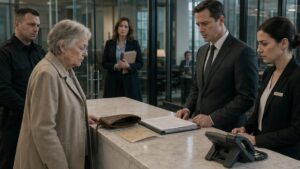
The HOA clubhouse sat near the newest section of the subdivision, a low brick building with a meeting room, management office, and a view toward unfinished lots farther west.
Robert had not set foot inside it before.
He had been invited to meetings more than once over the years, usually when drainage or fence maintenance touched adjoining property. His answer had always been the same: he was not a member.
Now he followed Melissa and Jennifer through the front door.
Several residents waited near the office counter.
A man with a toddler on one hip asked Anthony when the permanent line would be finished.
Anthony said, “We don’t have a date yet.”
The man exhaled.
“We close on the sale of our old place next week.”
Robert looked away.
He had imagined the subdivision mostly as rooftops and traffic.
It was harder to think that way with a tired child leaning against a father’s shoulder.
Inside the meeting room, Jennifer placed Paul’s preliminary survey beside the newer utility agreement.
“The good news,” she said, “is the agreement does appear to authorize certain utility work associated with the subdivision.”
Robert frowned.
Melissa sat straighter.
Jennifer raised a hand.
“The bad news is that nothing I’ve seen gives the association the right to place the line nineteen feet inside Robert’s parcel.”
Melissa nodded slowly.
“So we’re discussing rerouting.”
“We’re discussing everything.”
Robert leaned back.
Outside the glass door, he could see a section of bright orange conduit stacked beside temporary fencing near the unfinished homes.
The same material looked different here.
On his pasture it had looked like an invasion.
Here it looked like something people were waiting for.
Anthony entered carrying another file.
“I found the project communication log.”
Melissa looked at him.
“All of it?”
“As far as I can tell.”
He set it down.
Robert noticed the hesitation between them.
Jennifer opened the file.
Emails. Contractor questions. Schedule updates.
Then Anthony pointed to one entry.
“Tuesday morning.”
Robert leaned forward.
The note summarized his first objection.
Landowner disputes boundary and easement. Requests cessation pending verification.
Jennifer looked at Melissa.
“What time did you receive this?”
Melissa did not pretend not to understand.
“Before noon.”
Robert felt the room narrow.
The trenching had continued after noon Tuesday.
Not all day, but long enough for additional conduit to be placed and more pasture opened.
“You knew.”
Melissa’s gaze remained on the paper.
“I knew you disputed it.”
“And you told them to keep going.”
“I told Anthony to continue to the next planned stopping point while counsel checked the recorded easement.”
Robert stood.
Jennifer said his name quietly.
He stayed on his feet.
Melissa looked up at him.
“I had the recorded instrument, an engineering plan, a contractor mobilized, and more than fifty homes tied to the project schedule.”
“You also had the landowner telling you it wasn’t your ground.”
“Yes.”
That single word stopped him again.
No excuse.
No claim that she had not understood.
Just yes.
“Why?” Robert asked.
Melissa folded her hands.
“Because I’d already promised the board and the residents that the permanent connection would be finished this month.”
Anthony shifted in his chair.
Melissa continued.
“We had delayed once. Costs were increasing. Homeowners were angry. I believed stopping the crew over what I thought was a boundary disagreement would make the situation worse.”
“You believed I was wrong.”
“I believed the documents would prove you wrong.”
Robert looked toward the orange conduit outside.
“And when they didn’t?”
“I stopped.”
“After more digging.”
“Yes.”
Her voice was quieter now.
Robert wanted to dislike her more cleanly than he did.
Instead he saw someone who had mistaken refusing to reverse course for competence.
It was not so different from his own habit of refusing to open anything with the HOA logo on it.
The damage was not equal.
But the stubbornness felt familiar.
Jennifer slid another sheet across the table.
“We have options.”
The first was aggressive: seek emergency relief broad enough to halt work affecting the entire phase until title issues were resolved.
The second was narrower: prohibit any further entry onto Robert’s land while allowing the HOA to pursue an alternate route within its own property.
Robert read both.
“What would the first one do to the residents?”
Jennifer did not soften it.
“It could delay more than the disputed segment, depending on how the project is interconnected.”
Melissa said nothing.
Robert looked at her.
“You want me to choose the second.”
“I want a route that works.”
“That’s not what I asked.”
Melissa paused.
“Yes.”
Robert leaned back down into his chair.
Anthony opened an engineering sketch.
“There may be an alternate alignment.”
A route curved along HOA-controlled common property and then behind the new homes.
Robert studied it.
“Why wasn’t this the original route?”
“Longer,” Anthony said. “More boring under pavement. More restoration. More money.”
“How much more?”
“We don’t know yet.”
Robert almost laughed.
Of course.
The cheap route had crossed his pasture.
The expensive route stayed on their own side.
He walked to the window.
A resident outside was speaking with the property manager’s assistant. Two children stood near a temporary water station while their mother filled a container.
Robert thought about his father.
Keep the western pasture intact.
He had always heard the promise as a command never to yield land.
But his father had also spent forty years trading labor with neighbors he didn’t especially like, clearing fallen trees from shared roads and fixing fences before arguments grew around them.
Robert turned back.
“I want my land restored.”
Melissa nodded.
“I want the damaged grazing documented.”
“Agreed.”
“I want every future entry onto my property to require written authority that has actually been verified.”
Jennifer wrote it down.
Melissa said, “That’s reasonable.”
Robert looked at Jennifer.
“What happens if I don’t ask for the broad shutdown?”
“You preserve your property claim and pursue the narrower remedy.”
“And they can keep working elsewhere?”
“If the work is unquestionably on their land.”
Robert stared at the engineering sketch.
The old impulse was still there.
Make them feel the cost.
Make them understand what Tuesday had felt like.
But the residents outside had not sent the trencher across his grass.
Robert folded the aggressive draft and pushed it back toward Jennifer.
“I don’t want leverage used just to punish homeowners who had nothing to do with this.”
Melissa looked at him carefully.
Robert pointed to the alternate alignment.
“If there’s a way to keep that line on their side, then that’s what we talk about.”
Jennifer closed the broader draft.
The choice relieved nobody.
The reroute would cost more. The pasture still required repair. Liability still had to be addressed.
But for the first time all week, the next problem was not about who could force whom to stop.
It was about whether they could draw a line everyone would actually respect.
Chapter 6: Robert Chose the Line Instead of Revenge
Melissa arrived Monday expecting Robert to demand the whole project be frozen.
He could tell from the documents stacked in front of her.
Board counsel had prepared responses to an injunction request. Anthony had contractor delay estimates. Jennifer had brought Paul’s survey, photographs of the damaged pasture, and a preliminary restoration assessment.
Robert brought one sheet of paper.
They met in a conference room at Jennifer’s office.
Melissa glanced at Robert’s page.
“Is that your demand?”
“It’s the part I care about most.”
Jennifer looked at him but did not interrupt.
Melissa read it.
No entry onto Carter property for construction, maintenance, surveying, staging, or access without independently verified written authority and direct notice to the owner.
She read it again.
“That’s it?”
“No.”
Robert pointed toward the other folders.
“You still restore the pasture. You still cover documented grazing loss. You still pay whatever costs came from putting your trench where it didn’t belong.”
Melissa waited.
“But I’m not asking you to shut down work that stays on your property.”
Anthony let out a breath.
Melissa looked at Robert.
“You understand the alternate route is expensive.”
“I understand mine was cheaper.”
No one answered that.
Anthony opened the new engineering plan.
The revised line ran entirely through HOA-controlled property, crossed beneath a paved internal road, then followed common landscaping before reaching the new homes.
“Contractor says it can be done,” Anthony said.
“How much delay?”
“About three weeks if permits move.”
Melissa added, “And a substantial change order.”
Robert studied the map.
The route began near the same corner where the iron survey pin sat on his side of the boundary.
From there, however, the new line bent away.
He tapped the beginning point.
“Use Paul’s permanent reference when you stake this.”
Anthony nodded.
“We can.”
Jennifer moved to the restoration figures.
The damaged pasture required more than seed. Compacted areas needed loosening. Soil layers had to be corrected where practical. The drainage swale needed repair. Robert’s cattle would have to stay out of the section until grass reestablished.
Melissa asked questions about the grazing-loss estimate.
Robert expected himself to resent them.
Instead he answered.
Number of cattle affected. Duration. Acreage. Feed substitution.
Facts were easier than anger.
Halfway through the discussion Melissa closed one folder.
“There’s something I want on the record.”
Jennifer’s pen stopped.
Melissa looked at Robert.
“When Anthony reported your objection Tuesday morning, I made the decision not to stop immediately.”
Anthony glanced down.
Melissa continued.
“I was under schedule pressure. I’d told residents the connection would be complete. I believed the easement packet was enough, and I treated verification as something that could happen while work continued.”
Robert said nothing.
“That was my decision.”
Jennifer asked, “Are you willing to state that to the board?”
Melissa hesitated.
There it was.
The real cost.
Not money.
Not contractor scheduling.
Admission.
“I’ll state that the work should have stopped once the boundary and authority were challenged.”
Robert watched her.
“That’s different from saying you meant to trespass.”
“I didn’t mean to trespass.”
“I know.”
The words surprised both of them.
Robert leaned back.
“You thought being decisive meant not backing up.”
Melissa gave a faint, tired smile.
“Something like that.”
Robert looked at the notice provision on his own page.
“I thought staying independent meant ignoring anything with HOA letterhead.”
Jennifer looked at him.
“You did.”
He nodded.
“I won’t do that again.”
Melissa said, “You’re not joining the HOA.”
Robert almost smiled.
“No.”
Anthony laughed once, softly.
The room loosened by a degree.
Then Jennifer returned them to the agreement.
The association would fund restoration.
Documented grazing losses would be reimbursed.
The utility line would be rerouted entirely within HOA-controlled property.
Any future request involving Robert’s land would require direct written notice, title verification, and survey confirmation where boundaries were involved.
Anthony added a proposal of his own.
“We should make that an association procedure, not just a term for Robert.”
Melissa looked at him.
“What exactly?”
“No contractor entry onto adjoining private property until management has verified title authority and the adjoining owner has been contacted.”
Robert thought back to Tuesday morning.
Anthony standing beside the trench with a clipboard, certain that a recording number answered everything.
Now Anthony was the one asking for a rule that would prevent the same shortcut.
Melissa nodded.
“Draft it.”
Jennifer looked toward Robert.
“You still have the option of seeking broader relief if the agreement fails.”
Robert understood what she was giving him.
A last chance to hold the threat over them.
He folded his one-page condition and placed it beside Paul’s survey.
“I don’t want a bigger fight. I want a boundary that stays a boundary.”
By late afternoon they drove to the pasture.
Paul had set fresh stakes along the verified line.
The old iron pin remained exposed near the corner, dark with rust.
Anthony stood on the HOA side holding the alternate route drawing.
He measured away from the boundary rather than toward it.
Robert noticed.
“So that’s where it goes?” he asked.
Anthony pointed to a row of stakes curving back into subdivision property.
“That’s where it goes.”
Melissa stood beside them.
“The board has to approve the settlement and the new procedure.”
“When?”
“Thursday.”
Robert nodded.
He would normally have considered that the end of his involvement.
Melissa seemed to know it.
“I want you there.”
Robert looked at her.
“At the board meeting.”
“I’m not a member.”
“I know.”
“Then why?”
“Because we’re going to explain why the procedure is changing.”
Robert looked toward his pasture.
The trench remained open but silent.
Beyond it, the alternate route stakes curved away from the iron pin and stayed firmly on the other side.
For years he had believed the safest relationship with the HOA was no relationship at all.
Melissa held his gaze.
“Thursday at six-thirty.”
Robert did not answer immediately.
Then he said, “Send me the notice.”
This time, he intended to open it.
Chapter 7: The Boundary They Would Both Remember
Robert almost turned around in the clubhouse parking lot.
Through the windows he could see rows of folding chairs, homeowners settling in, and Melissa standing beside a projection screen with a packet in her hands. He had spent years treating that building as a place where other people’s rules were discussed.
Now his name was printed on the meeting agenda.
He sat in the truck for another ten seconds, then picked up the envelope Melissa had mailed him.
He had opened it the day it arrived.
That fact, more than the invitation itself, was why he finally went inside.
Anthony saw him first.
“You came.”
“You sent a notice.”
Anthony smiled carefully. “We did.”
Robert took a chair near the back.
He was not there to join anything. He reminded himself of that twice before the meeting began.
Melissa called the room to order at six-thirty.
The early business moved quickly: landscaping, reserve expenditures, a pool repair. Robert listened with the detached attention he had always assumed association meetings deserved.
Then Melissa reached the utility project.
The room changed.
Several residents turned toward Anthony. One man asked immediately when permanent service would be completed.
Melissa held up a hand.
“Before we discuss the new schedule, the board needs to address why the original route was stopped.”
Robert felt eyes move toward him.
He disliked that enough to consider leaving.
Melissa did not introduce him dramatically.
She did not call him a victim or ask him to stand.
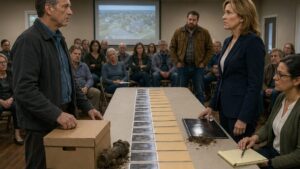
She placed Paul’s survey on the table.
“The association’s original contractor entered adjoining private property while installing the utility line.”
Murmurs spread through the room.
A homeowner near the front said, “We were told there was an easement.”
“There was an easement reference in the title package,” Melissa said. “The temporary easement we initially relied on had been released decades ago.”
Another homeowner asked, “So nobody checked?”
Melissa paused.
“Not thoroughly enough.”
Robert watched Anthony.
On Tuesday morning, Anthony had pointed toward a highlighted document as though the paper itself settled the matter. Now he sat with his hands folded, listening without trying to defend the decision.
Melissa continued.
“A later utility agreement also existed, but the association proceeded without establishing the exact field location of the property boundary.”
She changed the projected image.
Paul’s survey appeared beside the original route.
Even from the back of the room, the error was obvious.
The trench crossed beyond the legal line.
Melissa pointed to the widest section.
“At one location, construction reached approximately nineteen feet inside Mr. Carter’s property.”
The room went quiet.
Robert had expected that number to feel satisfying when other people heard it.
Instead he remembered the first morning: orange conduit at the bottom of the trench, Anthony’s clipboard, his own certainty colliding with an old recording number he had never seen.
Melissa rested both hands on the table.
“There is another part of this that belongs to me.”
Anthony looked up.
Robert did too.
“When Mr. Carter challenged the boundary Tuesday morning, management reported that objection to me. I authorized work to continue to the next stopping point while we relied on the existing title packet.”
Someone asked, “Why?”
Melissa looked toward the residents rather than toward Robert.
“Because I had committed to a completion schedule. We had already delayed the project. I believed the recorded materials would support the route, and I treated verification as something we could finish while construction continued.”
She let that sit.
“That was the wrong decision. Once ownership and authority were directly disputed, work should have stopped until they were verified.”
No applause followed.
Robert was glad.
A woman near the aisle asked whether the mistake would increase assessments.
Anthony answered.
“The reroute costs more. The board is reviewing how the change order will be funded within the project budget and reserves.”
Another resident said, “So we’re paying because someone didn’t check the property line?”
The edge in his voice was understandable.
Melissa did not dodge it.
“The association will bear costs associated with its project decisions.”
Robert looked at her differently then.
Not more warmly.
More accurately.
She had not become harmless because she admitted the mistake. She had simply stopped hiding behind confidence.
Anthony presented the new procedure next.
Any proposed work touching adjoining private property would require title verification before contractor mobilization. If boundaries were material, an independent survey had to be confirmed. The adjoining owner would receive direct written notice and a contact person before any entry occurred.
A board member asked whether owner acknowledgment meant an adjoining owner could veto lawful easement work.
“No,” Anthony said. “It means we confirm the right before we use it.”
Robert thought that was probably the clearest thing Anthony had said all week.
The board approved the procedure.
Then Jennifer, sitting along the side wall, handed Robert the final restoration agreement.
He had reviewed the numbers already.
Pasture repair.
Drainage correction.
Documented grazing loss.
Professional expenses related to establishing the boundary and restoring the disturbed area.
No enormous penalty.
No theatrical punishment.
Enough to repair what had been damaged and to make the cost of the shortcut belong to the people who had chosen it.
Robert signed.
Melissa signed after him.
When the meeting ended, homeowners gathered around Anthony with scheduling questions.
Robert was nearly at the door when Melissa called after him.
“One more thing.”
She held a small form.
He looked at it suspiciously.
“What now?”
“Official adjoining-owner contact information.”
Robert stared at her.
Melissa almost smiled.
“Email, mailing address, preferred phone number.”
“You already have my mailing address.”
“We had an address. We didn’t have a reliable process.”
Robert took the form.
A month earlier he would have refused on principle.
He filled it out.
Melissa watched him sign.
“This doesn’t make you an HOA member.”
“Good.”
“It also doesn’t mean we’ll agree next time.”
“I wouldn’t count on it.”
That earned a real smile.
Outside, Anthony caught up with Robert.
“The contractor starts the reroute Monday.”
“On your side?”
Anthony nodded. “Very much on our side.”
Several weeks later, the western pasture was green again in uneven shades.
The restored strip had not fully disappeared. New grass was shorter, and Robert could still see where equipment had compacted the soil before the restoration crew corrected it.
But the drainage swale carried water properly.
The cattle had returned.
Near the boundary, Paul had installed a new permanent reference marker a short distance from the old iron pin.
Robert had specifically asked him not to remove the original.
The new marker was cleaner, brighter, easier to find.
The old one remained rust-darkened and low in the grass.
One afternoon Robert walked out to inspect the fence.
From the subdivision side came the muffled sound of construction.
For an instant his body tightened automatically.
Then he saw the new utility trench.
It ran from the common area, curved behind the houses, crossed beneath the internal road, and remained clearly beyond the surveyed boundary.
Bright orange conduit lay beside it.
This time it did not cross his pasture.
Anthony stood near the contractor and saw Robert watching.
He raised one hand.
Robert raised his in return.
No one crossed the line.
Robert walked to the iron pin and cleared a little grass from its top with his boot.
For years he had believed a boundary stayed safe because a man knew where it was and refused to give an inch.
He still believed the first part.
The second had changed.
A boundary also stayed safe because people marked it, recorded it, answered notices about it, challenged mistakes early, and stopped pretending silence was the same thing as strength.
He looked toward the newer permanent marker, then toward the rerouted trench on the other side.
The old iron pin had not moved.
Neither had the property line.
What had changed was that everyone involved finally knew exactly where it was—and Robert had decided he would no longer leave that knowledge sitting unread in an envelope.
The story has ended.