The HOA President Called Her Dramatic Over a Blocked Driveway—Then His Own Parking Rule Turned Against Him
Chapter 1: The Blue Truck Between the White Lines
Rachel Miller saw the blue pickup before she saw her garage.
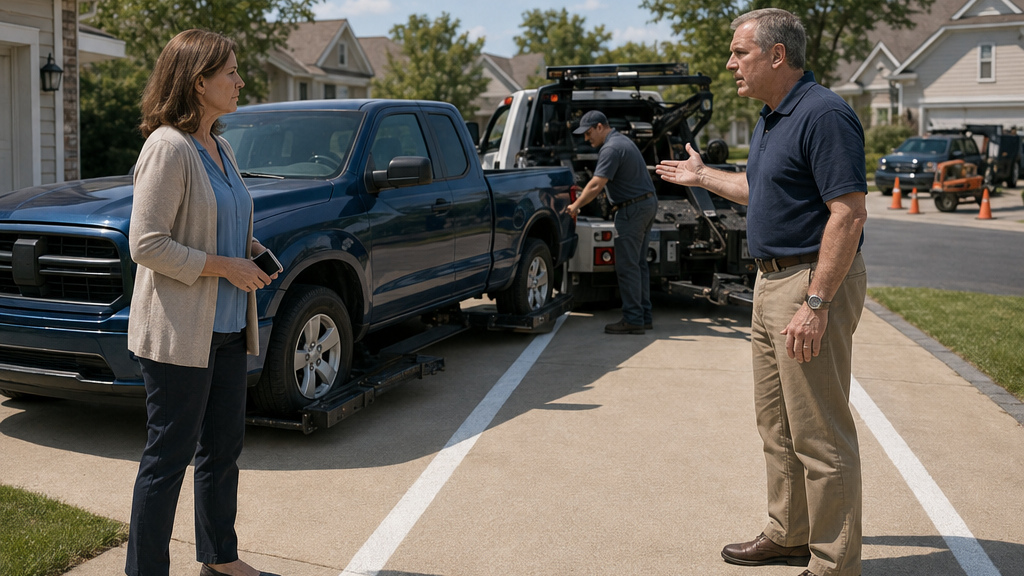
It sat sideways across the lower half of her driveway, its rear tires just inside one white line and its front bumper hanging across the other, leaving no space for her sedan to turn in without clipping either the truck or the curb.
Rachel stopped in the street.
For a few seconds she assumed the driver was still inside. She waited behind the wheel, turn signal ticking, watching the pickup’s dark windows.
No movement.
She checked the time on the dashboard. 12:18.
She had come home from the medical office because she had forgotten a folder she needed for an afternoon meeting. She should have been inside for five minutes and back on the road.
Instead, she lowered the window and looked toward the house next door.
Jeffrey Roberts’s front door was closed.
Rachel knew the pickup. It belonged to Jeffrey’s adult son, Joshua. She had seen it in the neighborhood dozens of times, usually evenings and weekends, but lately it had appeared during weekday afternoons too.
She waited.
At 12:23, she considered backing into the neighbor’s empty curb space and walking inside. Then she looked at the two white lines bordering her driveway.
Three summers earlier, she had repainted them herself after the old paint had faded almost to gray. They weren’t decorative. They marked the edges clearly where the driveway widened toward the street.
No one could mistake where it began.
At 12:29, Rachel finally parked along the curb across from her own house.
She was unlocking her front door when Joshua came out of Jeffrey’s house carrying a paper cup.
“Oh,” he said, seeing her car across the street. “Were you waiting?”
Rachel looked at him.
“For about fifteen minutes.”
Joshua glanced toward his truck as if checking whether it had somehow moved.
“I was only inside for a minute.”
Rachel almost smiled.
“Fifteen.”
He gave a small shrug. “Okay. Fifteen.”
She kept her voice even. “I need you not to park across my driveway.”
“I wasn’t really parked.”
Rachel looked at the truck.
Joshua followed her gaze.
“I mean, I wasn’t staying. Dad needed something. I just ran in.”
“I understand. But I couldn’t get into my driveway.”
He shifted the cup to his other hand. “You could’ve honked.”
“I could have. I’d rather not have to.”
Something in her tone must have reached him, because the easy expression left his face.
“All right,” he said. “I won’t do it again.”
“Thank you.”
That should have been enough.
Rachel had lived in the house eleven years. She knew how quickly small neighborhood conflicts became permanent ones if people gave them too much oxygen. A trash can left out too long became a complaint. A barking dog became an email chain. Someone’s hedge became a board discussion.
Three years earlier, Rachel had objected when a landscaping crew repeatedly left equipment beside her mailbox. She had been right, technically. The equipment had blocked the sidewalk.
But after she complained, two neighbors stopped making casual conversation with her for months.
She had hated how much that bothered her.
So when Joshua moved the pickup and lifted a hand in apology, Rachel chose to believe the matter was finished.
She retrieved her folder and returned to work.
The next day, the driveway was empty when she came home.
Rachel noticed that fact and immediately felt ridiculous for noticing it.
Thursday morning, she left before eight. On her way out, she saw a landscaping trailer parked near the small cluster of visitor spaces farther down the street. Several spaces had been blocked with orange cones because workers were replacing shrubs and irrigation around the common area.
She barely registered it.
At lunchtime, she stayed at work.
At five-thirty, her driveway was clear.
By Wednesday of the following week, Rachel had almost forgotten the blue truck.
Then she turned onto her street at 12:11 and saw it again.
Same pickup.
Same position.
This time it was farther across the driveway.
Rachel slowed until the car behind her had to brake.
She drove past, circled the block, and returned.
The truck hadn’t moved.
She parked at the curb.
For a moment she sat with both hands resting on the steering wheel.
The irritation was different now. The first time could have been thoughtless. This time came after a direct conversation and a direct promise.
She took out her phone.
Not to call anyone.
Just to photograph what she was seeing.
The picture framed the blue pickup in the middle and the two white lines disappearing beneath it.
Rachel stared at the image.
It looked worse in the photograph than it had from behind the wheel.
She put the phone in her purse.
Joshua did not come outside.
After ten minutes, Rachel walked into her house through the front door. She made coffee she did not want and stood at the kitchen window where she could see part of the truck.
Twenty-two minutes later, an engine started.
She watched Joshua pull away without looking toward her house.
That bothered her more than if he had waved.
It meant he had not forgotten.
He had simply decided her request did not matter enough to change what he was doing.
That evening, Rachel carried her trash bin to the curb and looked at Jeffrey’s house.
A light was on above the porch.
She hesitated.
There were several things she could do instead. She could wait for Joshua and speak to him again. She could leave a note. She could tell herself it had only happened twice.
But she heard her own voice from the week before.
I need you not to park across my driveway.
And Joshua’s answer.
I won’t do it again.
Rachel crossed the strip of grass between the properties and walked toward Jeffrey Roberts’s front door.
Chapter 2: The Neighbor Who Called Her Dramatic
Jeffrey opened the door before Rachel had fully lowered her hand from the second knock.
“He’s not hurting anything,” he said.
Rachel blinked.
She had not yet explained why she was there.
Jeffrey leaned one shoulder against the doorframe. He was in his late fifties, broad through the chest, wearing a navy polo with the subdivision’s small HOA emblem embroidered near the pocket.
“So Joshua told you?”
“He said you were upset about where he parked.”
“I asked him not to block my driveway.”
“He was there for a few minutes.”
“He was there long enough that I couldn’t pull in.”
Jeffrey sighed through his nose. “Rachel, come on.”
The phrase irritated her more than the sigh.
“I’m not asking for anything complicated.”
“No, but you’re turning something small into something complicated.”
She looked past him into the hallway. A folded walker stood near the wall beside a pair of women’s shoes. Rachel remembered hearing from someone that Jeffrey’s wife had recently had surgery, though she did not know what kind.
Rachel softened her voice.
“I’m not trying to make your life harder. I just need the driveway clear.”
Jeffrey shifted his weight.
“There’s a parking issue right now. You’ve seen the work down by the common area.”
“The landscaping?”
“Half the guest spaces are tied up with the contractor staging. Everybody’s having to be flexible for a few weeks.”
Rachel frowned. “What does that have to do with my driveway?”
“It means people stop where they can stop.”
“My driveway isn’t guest parking.”
“Nobody said it was.”
“Then Joshua shouldn’t be using it.”
Jeffrey’s jaw tightened.
“He’s visiting his mother. He comes in, helps her with something, leaves. We’re talking ten minutes.”
“Today it was more than twenty.”
Jeffrey gave a short laugh without humor. “Do you time him?”
Rachel felt heat rise into her face.
“No. I was trying to get into my own house.”
“You got into your house.”
“That’s not the point.”
“Then what is the point?”
She opened her mouth and realized she was suddenly defending something she had assumed did not require a defense.
The driveway was hers.
The truck had blocked it.
She had asked Joshua to stop.
Those facts had felt simple until Jeffrey stood there making them sound petty.
“The point,” Rachel said, “is that I asked him once. He said he wouldn’t do it again.”
Jeffrey looked away toward the street.
“He probably forgot.”
“He didn’t forget.”
“You don’t know that.”
“I spoke to him directly.”
Jeffrey rubbed a hand over the back of his neck. “Rachel, you’ve lived here long enough to know people help each other. We’ve got parking squeezed because of the project. My wife can’t get around easily right now. Joshua’s coming in and out. Nobody is trying to disrespect you.”
The word landed oddly.
Rachel had not used it.
But it was exactly what she had begun to feel.
“I’m asking him not to block the driveway,” she said again.
“And I’m telling you it’s temporary.”
“Temporary doesn’t mean I agreed to it.”
Jeffrey’s expression hardened.
“You’re being a little dramatic.”
Rachel stood still.
For an instant she saw herself the way she imagined he saw her: a woman on a neighbor’s porch arguing over white paint and a few feet of asphalt while someone inside recovered from surgery.
That old discomfort returned—the memory of neighbors going quiet around her after the mailbox complaint.
She almost apologized.
Instead, she said, “I hope your wife feels better soon.”
Jeffrey’s expression eased, as if he believed the conversation had ended in his favor.
“Thanks.”
Rachel walked home.
Inside her kitchen, she placed her keys on the counter and stood there without taking off her shoes.
She was angry at Jeffrey.
But she was angrier at herself for leaving the porch without making one thing clear.
He had not agreed that Joshua would stop.
In fact, the more she replayed the conversation, the more obvious it became that Jeffrey believed Joshua should be allowed to continue.
People stop where they can stop.
Everybody’s having to be flexible.
It’s temporary.
Rachel looked through the window toward the driveway.
The two white lines caught the late light.
She took her phone outside.
This time she photographed them deliberately: one picture from the garage looking toward the street, one from the sidewalk facing the house, and one close enough to show where the paint met the pavement.
Then she opened her messages.
She considered texting Jeffrey.
She did not have his number saved.
She considered emailing the HOA management office.
Then stopped.
What exactly would she write?
My neighbor thinks his son can block my driveway?
She could already hear how small it sounded.
That hesitation annoyed her because she recognized it for what it was. She wanted some outside authority to tell her she was entitled to object before she objected more firmly.
The next morning, she searched the HOA portal.
She found parking rules for streets, guest spaces, overnight vehicles, commercial vehicles, and trailers.
Nothing said homeowners had to share private driveways during temporary parking shortages.
Nothing said they did not.
Rachel clicked through meeting minutes from the previous two months.
The landscaping project appeared repeatedly. Contractor schedule. Irrigation replacement. Shrub removal. Guest-space closures.
No mention of private driveways.
Friday afternoon, Rachel called the management office.
Margaret Wright answered.
Rachel kept the explanation brief.
“I’m not filing a complaint yet,” she said. “I just want to know if the association has a temporary parking rule because of the landscaping work.”
“A temporary rule?”
“For driveways.”
There was a pause.
“What kind of driveway rule?”
Rachel explained.
Margaret sounded surprised. “I’m not aware of anything authorizing someone to obstruct another owner’s driveway.”
“Jeffrey said everybody was expected to be flexible.”
Another pause.
“He may have been speaking generally.”
Rachel thanked her and ended the call.
That was the first moment she understood Joshua’s confidence.
He had not simply decided her driveway was convenient.
His father had given the convenience a justification.
Rachel opened a notebook and wrote down the date, the time, and what Margaret had said.
Then she wrote the dates of both conversations with Joshua and Jeffrey.
Looking at the page, she saw the problem immediately.
Everything important had happened verbally.
Joshua could say she had never clearly warned him.
Jeffrey could say she had misunderstood.
Rachel had spent years believing that putting neighbor disagreements in writing made them more hostile.
Now she saw the other side of that instinct.
If nothing was written down, the person most comfortable retelling the conversation got to decide what had happened.
She called the city’s non-emergency line.
A clerk answered after a short hold.
Rachel explained that a vehicle had repeatedly blocked access to her private residential driveway. She asked what she was legally allowed to do if it happened again.
The clerk asked whether the vehicle was hers.
“No.”
“Do you know the owner?”
“Yes.”
“Have you asked them to move it before?”
“Yes.”
“That helps practically, but it isn’t the deciding factor.”
Rachel gripped her pen.
The clerk explained that a vehicle obstructing access to a private residential driveway could qualify for removal under city rules if the property owner requested an authorized tow and the circumstances met the ordinance.
Rachel wrote slowly.
“Do I have to warn them again first?”
“No,” the clerk said. “Not if the vehicle is actually obstructing access when you call.”
Rachel looked at what she had written.
She had spent days wondering whether she was allowed to insist on something she had already asked for twice.
Now she had an answer.
And for the first time, she wondered what she would do if the blue truck came back.
Chapter 3: When the Tow Truck Finally Came
The blue pickup was across Rachel’s driveway again the following Tuesday.
She did not stop in the street this time.
She drove past her house, pulled into an open curb space half a block away, and took out her phone.
12:07 p.m.
Her thumb hovered over the saved contact she had added three days earlier after calling a licensed towing company and asking how private-property removals worked.
The dispatcher answered.
Rachel looked down the street at the truck.
“It’s blocking my driveway again,” she said.
The dispatcher asked several questions. Address. Vehicle description. Whether she owned or controlled the property. Whether the truck was currently preventing access.
“Yes.”
“Can you meet the driver?”
“Yes.”
Rachel ended the call.
Her hands were shaking.
That embarrassed her.
She had imagined this moment several times since Friday. In every version, she felt calm because she had checked the rule, made the call, and done everything correctly.
Instead, she felt as though she had started something she might not be able to stop.
She walked home and stood near the garage.
The white lines looked almost offensively bright.
Nine minutes later, a tow truck turned onto the street.
The driver pulled up without blocking traffic and stepped down from the cab.
Rachel showed identification, confirmed the property, and explained where the pickup had been sitting.
The driver looked at the truck, then at the driveway.
“That yours?”
“The driveway is. The pickup isn’t.”
He nodded.
Rachel expected someone from Jeffrey’s house to appear immediately.
No one did.
The tow driver backed into position.
The mechanical clank of the wheel lift sounded much louder than Rachel expected in the quiet street.
Metal slid beneath the blue pickup.
Rachel’s stomach tightened.
There was still time to stop this.
She could knock next door.
She could call Joshua.
She could tell the driver never mind.
Then she remembered Jeffrey’s porch.
You’re being a little dramatic.
The driver crouched to secure the truck.
The front door next door flew open.
Jeffrey stepped outside.
“What the hell is this?”
The tow driver stood.
Rachel felt the instinct to retreat before Jeffrey even crossed the lawn.
She stayed where she was.
“Rachel?”
His voice rose.
“You called a tow truck?”
“Yes.”
“For Joshua’s truck?”
“It’s blocking my driveway.”
“He’s inside for ten minutes.”
“I don’t know how long he’s been inside.”
Jeffrey reached the pavement and looked at the wheel lift already locked around the tires.
“You need to stop this.”
The driver glanced at Rachel rather than Jeffrey.
Jeffrey noticed.
“I’m the HOA president,” he said. “There’s a temporary parking situation in this neighborhood.”
The driver’s expression did not change. “I’m just handling the removal request, sir.”
Jeffrey turned to Rachel.
“You know why he’s here. His mother needs help.”
“I know your wife is recovering.”
“Then what are we doing?”
Rachel hated the question because part of her understood it.
If Joshua had parked along the curb, she would not have cared how many times a day he came.
If he had called and asked once because he needed to unload something, she probably would have said yes.
But that was not what had happened.
“We’re keeping my driveway clear.”
Jeffrey threw up one hand.
“Nobody’s denying it’s your driveway. But the board has asked residents to cooperate while parking is limited.”
Rachel looked at him.
“The board?”
“Yes.”
“Show me the rule.”
He stared at her.
“The rule?”
“The written rule that says residents can block private driveways because guest spaces are closed.”
Jeffrey’s face changed.
Not much.
But enough.
His anger remained while something underneath it faltered.
“This isn’t about a written rule.”
“You just said the board asked residents to cooperate.”
“It did.”
“Then where is that decision recorded?”
Jeffrey looked toward the tow driver, then toward his house.
“It was discussed.”
“At a meeting?”
“We don’t need a formal vote every time something practical comes up.”
Rachel heard the sentence and felt the argument shift beneath them.
Until that moment, Jeffrey had spoken as though there were an established policy and Rachel was refusing to cooperate with it.
Now there was only something discussed.
Something practical.
Something no one needed to vote on.
The driver finished securing the pickup.
Jeffrey stepped closer to Rachel.
“Call this off. We can sort it out later.”
Rachel kept her voice low.
“I tried sorting it out before.”
“You talked to Joshua once.”
“I talked to him. Then I talked to you.”
“You never said you were going to tow him.”
“I shouldn’t have to announce every consequence before you take me seriously.”
Jeffrey’s mouth tightened.
The tow driver walked back toward the cab.
Jeffrey looked at the blue pickup.
“This is going to cost him hundreds of dollars.”
Rachel said nothing.
“He’s helping his mother.”
“I know.”
“Then you know this is unnecessary.”
Rachel looked at the two white lines disappearing beneath the pickup.
“No,” she said. “I know it was avoidable.”
Jeffrey stared at her.
The tow truck engine deepened.
The blue pickup rose slightly.
For the first time since Rachel had come home, Jeffrey stopped arguing.
The truck rolled forward.
Its rear tires crossed one white line, then the other.
A minute later it was moving down the street.
Rachel watched until it turned the corner.
She expected satisfaction.
Instead, she felt an uncomfortable mixture of relief and guilt.
Jeffrey remained on the curb.
“You could’ve knocked.”
Rachel turned toward him.
“I did.”
“Today.”
“No. Before. More than once.”
“That’s not the same thing.”
“You told me I was being dramatic.”
Jeffrey looked away.
For several seconds neither spoke.
Then he said, quieter, “We could have handled this differently.”
Rachel almost agreed.
The problem was that she knew he meant she could have handled it differently.
She went inside.
At 2:40, her phone rang.
Joshua.
Rachel let it ring twice before answering.
“Your truck was blocking my driveway.”
“I know where it was.”
His voice was tight but controlled.
“Dad says you had it towed.”
“I did.”
“Why didn’t you call me?”
“I asked you not to park there.”
“I wasn’t staying.”
Rachel closed her eyes.
“You said that the first time.”
Joshua exhaled.
“The tow yard says it’s two hundred eighty dollars.”
Rachel felt the number land between them.
“I’m sorry it costs that much.”
“You’re sorry?”
“I’m sorry this became expensive. I’m not sorry I needed access to my driveway.”
Joshua said nothing for a moment.
Then: “Dad said temporary parking was okay because of the project.”
There it was.
Not proof, exactly.
But confirmation.
“Did he say my driveway was okay?”
“He said people were using whatever space wasn’t causing a problem.”
“You blocked me from getting in.”
“I didn’t know you’d be home.”
Rachel gripped the phone more tightly.
“That doesn’t make it better.”
Joshua was silent.
Then he said, “Fine,” and ended the call.
Rachel stood in the kitchen holding the phone.
I didn’t know you’d be home.
The sentence bothered her more than the anger.
It confirmed what she had suspected: the driveway had become acceptable not because anyone believed it was public, but because they believed Rachel would not be there to object.
That evening, Jeffrey did not come over.
Wednesday passed quietly.
Thursday, Rachel arrived home and found a white envelope tucked behind the storm door.
The return address belonged to the HOA management company.
Rachel opened it standing in the entryway.
It was a compliance notice.
The association had received a report concerning unauthorized painted markings visible from the street.
Rachel read the sentence twice.
Then she stepped outside and looked down at the two white lines bordering her driveway.
The same lines Jeffrey had spent days insisting did not matter enough to respect were now, apparently, important enough to become an HOA violation.
Chapter 4: The Rule That Was Never Voted On
Margaret Wright read the compliance notice twice, then turned to her computer.
“I need to find the section this was issued under.”
Rachel sat across from her in the small management office, the notice lying between them beside three printed photographs of her driveway.
Margaret typed.
Clicked.
Scrolled.
Her expression changed from professional concentration to mild irritation.
Rachel noticed.
“What?”
“I’m looking.”
“That sounds different from finding.”
Margaret gave her a brief glance.
“It is.”
The office sat beside the subdivision clubhouse, separated from the pool entrance by a narrow hall that smelled faintly of carpet cleaner. Through the window behind Margaret, Rachel could see the common-area landscaping project that had started all of this. Pallets of stone occupied three guest spaces. A trailer filled two more. Orange cones marked an irrigation trench near the sidewalk.
Margaret clicked through another file.
“What exactly did Jeffrey tell you about the paint?”
“He didn’t. The notice showed up after the tow.”
“And when were the lines painted?”
“Three summers ago.”
Margaret looked at the photographs.
“They’re not new?”
“No.”
“Any prior violation?”
“None.”
Margaret leaned back.
Rachel had brought more material than she wanted to admit: photographs with dates, the city ordinance number she had written down, notes from her conversations, a copy of the tow receipt Joshua had mentioned only because Jeffrey had later emailed the board complaining about it.
She had almost brought the entire binder from her kitchen.
Then she stopped herself.
She did not want to prove that Jeffrey was a terrible person. She wanted someone to tell her whether the HOA had actually authorized what he kept claiming it had authorized.
Margaret tapped the notice.
“I can’t find a rule prohibiting these particular markings.”
Rachel let out a breath.
“That doesn’t mean there isn’t an architectural standard somewhere,” Margaret added. “I’m checking older resolutions.”
“Of course.”
Margaret heard the edge in Rachel’s voice.
“I’m not trying to dodge you.”
“I know.”
“No, I don’t think you do.”
Rachel looked up.
Margaret folded her hands.
“When homeowners have a dispute with a board member, everything I say can sound like I’m protecting the board. Sometimes I am protecting the association. Those are not always the same thing.”
The distinction interested Rachel.
“So what happens with the notice?”
“I’m putting it on administrative hold until I can identify what authority supports it.”
“That means no fine?”
“No fine while it’s under review.”
It was a small victory.
Rachel had expected satisfaction.
Instead she looked through the window at the contractor trailer and remembered Jeffrey saying everybody had to be flexible.
“What about the parking?”
Margaret’s mouth tightened.
“I’ve been looking at that too.”
She opened a folder of board correspondence.
“The project was approved in May. Contractor staging took out seven guest spaces. The board discussed the shortage.”
“Discussed.”
“Yes.”
“But voted on something?”
Margaret hesitated.
“That’s what I’m trying to determine.”
She turned the monitor slightly.
Rachel could see an email chain.
Most of it was mundane: contractor schedule changes, concerns about delivery access, complaints about residents leaving cars overnight in guest spaces.
Then Margaret scrolled to a message from Jeffrey.
Rachel leaned closer.
The wording was practical rather than official. Residents should be patient. Short stops near open driveways or curb cuts could be treated as temporary options if they were not causing problems. Encourage flexibility until contractor staging was reduced.
Rachel read it again.
“Open driveways?”
“That’s his language.”
“Did the board approve that?”
“I don’t see a motion.”
“Did you send it to residents?”
“No.”
“Then who saw it?”
“Board members. Possibly the landscaping supervisor. Jeffrey may have repeated it verbally.”
Rachel sat back.
That explained Joshua.
Perhaps others too.
Jeffrey had not invented a formal rule. He had turned his own logistical suggestion into something he spoke about as if the community had accepted it.
Margaret opened another email.
One board member had replied that curb parking should be used where permitted. Another had warned against blocking mailboxes and fire hydrants.
No one mentioned private driveways.
Rachel pointed.
“So nobody agreed to that part.”
“Not in writing.”
“Would it even be within the board’s authority?”
Margaret chose her words carefully.
“The HOA manages common areas and enforces the governing documents. It can regulate certain visible conditions and parking in association-controlled areas. It cannot casually convert privately controlled access into overflow parking because the president thinks that would be useful.”
Rachel felt a sharp burst of vindication.
Then Margaret continued.
“But Jeffrey wasn’t inventing the parking shortage.”
Rachel looked outside again.
“No.”
“It has been bad. I’ve had complaints from residents with visiting nurses, family caregivers, delivery people. Jeffrey’s wife has been recovering, and he’s had family coming in and out several times a day. The contractor also slipped behind schedule.”
Rachel looked at the temporary fencing, the uprooted shrubs, the dusty orange cones.
For the first time, the conflict looked larger than the blue pickup.
Not more justified.
Just larger.
“He should have asked,” she said.
“Yes.”
“And after I said no, that should have been the end.”
“Yes.”
Margaret’s answer was immediate this time.
Rachel looked back at the email.
“How many people did he tell this to?”
“I don’t know.”
That bothered her.
Because if Joshua had heard that unused driveway entrances were fair game, maybe others had too.
Margaret closed the file.
“I’ll notify you in writing that the paint notice is suspended. I’m also going to ask Jeffrey for the source he relied on.”
“He’s not going to like that.”
“No.”
“Does that matter?”
Margaret gave a tired smile.
“In my job? Constantly.”
Rachel gathered her photographs.
Before leaving, she paused at the window.
A landscaping supervisor was directing a small loader while a worker shifted cones from one set of guest spaces to another.
“How long until these spaces reopen?”
Margaret glanced outside.
“They were supposed to reopen two weeks ago.”
“So Jeffrey has been managing a temporary problem that keeps becoming less temporary.”
“That would be one way to describe it.”
Rachel left the clubhouse less angry than when she arrived.
That unsettled her.
Anger had been simpler.
Jeffrey had been wrong. She still believed that.
But now she could see the chain of reasoning that had allowed him to become wrong with such confidence.
The landscaping project fell behind.
Guest spaces disappeared.
His wife needed help.
People complained.
He came up with a workaround.
Nobody stopped him.
Then Rachel did.
That did not make her unreasonable.
But it explained why Jeffrey treated her boundary as an obstacle rather than a boundary.
Two days later, the promised email arrived from Margaret.
The driveway-line violation was formally placed on hold pending review.
Rachel saved it.
Then she did something she wished she had done at the beginning.
She sent a short email to both Jeffrey and Margaret.
My driveway must remain unobstructed at all times. I do not consent to its use for temporary parking or loading. Please treat this as written notice going forward.
She read it three times before pressing send.
The message felt harsher than it was.
That realization embarrassed her.
Nothing in it insulted anyone.
Nothing threatened anyone.
It simply said no.
Jeffrey did not reply.
For almost three weeks, Joshua’s blue pickup did not cross the white lines.
Rachel began to believe the problem had finally ended.
On a Tuesday afternoon, she left work early for a dental appointment.
When she turned onto her street, she saw the blue pickup before she reached her mailbox.
It was back across the driveway.
Not beside it.
Not touching one edge.
Across both white lines.
Rachel slowed.
This time she did not wonder whether Joshua had forgotten.
She wondered why, after a tow, a $280 bill, an HOA dispute, and written notice, he had decided to do it again.
Chapter 5: The Second Tow Changed the Story
Rachel checked the time before she did anything else.
1:14 p.m.
She parked around the corner.
At 1:32, the blue pickup had not moved.
At 1:47, it was still there.
Rachel sat in her car with the towing company’s contact open on her phone.
This was what she had prepared for.
Yet calling now felt different from the first time.
The first tow had been an answer to a question: Would Jeffrey and Joshua respect the boundary once there was a real consequence?
Apparently not.
At 2:03, Rachel walked back to the driveway.
She took one photograph.
Then another.
She could see movement through a window at Jeffrey’s house but could not tell who was inside.
At 2:18, more than an hour after she had arrived, she called the tow company.
The same dispatcher answered.
Rachel gave the address.
“You’ve had this vehicle before,” the dispatcher said after checking the system.
“Yes.”
“Still obstructing access?”
“Yes.”
“All right.”
Rachel ended the call.
This time her hands did not shake.
That disturbed her more than shaking had.
The tow truck arrived nineteen minutes later.
No one came outside while the driver began securing Joshua’s pickup.
Rachel stood just inside the two white lines, arms folded lightly against herself.
She had spent weeks looking at those lines as evidence.
Now they felt different.
Not proof for Jeffrey.
Not proof for Margaret.
Not even proof for the city.
They were simply the place where she had said her permission ended.
Joshua came out when the pickup was already lifted.
He stopped halfway down the Roberts driveway.
“You called them again?”
Rachel turned.
“You’ve been blocking me for over an hour.”
“I was helping Mom.”
“I know.”
His face tightened.
“Then why didn’t you just knock?”
Rachel almost laughed, not because it was funny but because the sentence had become so predictable.
“Joshua, I sent written notice.”
“To Dad.”
“To your house and the management office.”
“He handles the HOA stuff. I don’t read his HOA emails.”
“I told you in person before the first tow.”
Joshua looked at the truck.
The driver moved around the rear axle checking straps.
“You knew,” Rachel said.
Joshua pushed both hands into his pockets.
“Yes.”
The admission was so quiet Rachel almost missed it.
“You knew I didn’t want you parking here.”
“Yes.”
“Then why are we doing this again?”
Joshua’s gaze remained on his truck.
For a moment, Rachel expected another version of I was only inside for a minute.
Instead he said, “Because my dad told me not to worry about it.”
Rachel said nothing.
Joshua rubbed the toe of his shoe against the pavement.
“He said the HOA was going to straighten it out.”
“Straighten what out?”
“The parking thing. Your lines. All of it.”
“My lines?”
“He said you weren’t supposed to have them anyway.”
Rachel felt something cold settle in her chest.
“So because he thought my paint might violate an HOA rule, he told you it was okay to block the driveway?”
Joshua looked uncomfortable.
“Not exactly.”
“What exactly?”
He sighed and looked toward his parents’ house.
“My mom had surgery. She’s not supposed to put weight on one leg. I’ve been coming by almost every day. Groceries. Pharmacy. Moving stuff around. Dad gets angry when I park farther down because he says Mom shouldn’t have to wait for me to bring things in.”
“There’s curb parking thirty yards away.”
“I know.”
That answer stopped her.
“You know?”
“Yes.”
“Then why not use it?”
Joshua’s jaw moved.
“Because every time I do, he starts in.”
Rachel studied him.
Until then, she had thought of Joshua as casually entitled. A grown man doing whatever was easiest because his father would defend him.
That was not entirely wrong.
But it was incomplete.
Joshua lowered his voice.
“He’s been wound tight since Mom got home. The project is behind. People call him about parking. She needs something every hour. I come over, he tells me where to stop, and if I argue with him, I get twenty minutes of how nobody helps and everybody complains.”
Rachel looked at the tow truck.
“So it was easier to let me be the problem.”
Joshua flinched.
He did not deny it.
Rachel felt the anger she had been holding shift.
Not disappear.
Shift.
“You had choices,” she said.
“I know.”
“You could have called me.”
“I know.”
“You could have parked down the street.”
“I know.”
“You could have told him I had already asked you not to.”
“I did.”
Rachel frowned.
Joshua looked embarrassed now.
“After the first tow, I told him I wasn’t doing it again. He said you’d cool off. Said the board would deal with the lines and you’d get over it.”
Rachel stared at him.
The driver shut a metal compartment.
Joshua looked toward the truck again.
“I should’ve told him no.”
“Yes.”
“I didn’t want another fight with him.”
“And you thought I was easier.”
He swallowed.
“Yeah.”
The honesty hurt more than another excuse would have.
Because Rachel understood the logic.
She had done a smaller version of the same thing herself.
She had avoided writing things down because she did not want neighbors thinking she was difficult. She had swallowed irritation until a tow truck became easier than one more direct confrontation.
Joshua had avoided fighting with Jeffrey until Rachel became the person who absorbed the inconvenience.
Neither choice made the other person responsible for their discomfort.
The tow driver approached.
“Ma’am, we’re ready.”
Rachel nodded.
Joshua stepped forward.
“Can I pay something now and stop it?”
The driver shook his head. “Once it’s hooked and authorized, you’ll need to deal with the yard.”
Joshua closed his eyes briefly.
Rachel could see the moment the financial consequence became real again.
“I’m not paying it this time,” he muttered.
“That’s between you and your father,” Rachel said.
Joshua looked at her.
“No. It’s between me and me.”
The truck pulled away.
Rachel watched the blue pickup disappear for the second time.
There was no satisfaction now.
Only the strange relief of hearing Joshua finally say something without Jeffrey’s reasoning attached to it.
That evening, Rachel was bringing her trash container back from the curb when Joshua approached from the sidewalk.
He had apparently gotten a ride home from the tow yard.
“They said three-ten,” he said.
Rachel stopped.
“And there’s another fee if I don’t pick it up tonight.”
“I’m sorry.”
Joshua gave a tired half-smile.
“You always say that part.”
“Because I am.”
“But you’d call again.”
“Yes.”
He nodded as though the answer mattered.
“Fair.”
Rachel rested one hand on the trash handle.
“How’s your mother?”
“Getting better. Slowly.”
“I’m glad.”
Joshua looked toward his father’s house.
“I should’ve handled this differently.”
Rachel waited.
“I knew you were serious after the first tow. Dad kept saying the HOA would back him. I let that become an excuse.”
Rachel appreciated that he did not ask whether she forgave him.
“I should’ve put things in writing sooner,” she said.
Joshua looked surprised.
“That doesn’t make the parking okay.”
“I know.”
“It just means I let this stay vague too long.”
He nodded.
The moment almost felt like an ending.
Then Jeffrey’s front door opened.
“Joshua.”
His voice carried across the lawn.
Joshua’s shoulders tightened.
Jeffrey walked toward them holding several sheets of paper.
“Tell me you didn’t pay that tow.”
“Not yet.”
“Good. I’m disputing it.”
Rachel’s stomach tightened.
Jeffrey looked at her.
“This has gone far enough.”
Rachel glanced at Joshua.
His face had closed again.
“What exactly are you disputing?” she asked.
“The authority for the tow. The markings. The access issue. All of it.”
“The city already confirmed—”
“I’m not arguing municipal code on the sidewalk.”
Jeffrey lifted the papers.
“I’m putting temporary parking on the board agenda. We’re going to establish what residents are expected to do when common parking is restricted.”
Rachel stared at him.
“You want the board to create a rule now to justify what you already told people they could do?”
“I want the board to solve a problem instead of letting one homeowner turn it into a feud.”
Joshua looked away.
Rachel felt the old impulse to defend herself immediately.
To list every warning.
Every photograph.
Every time she had waited.
Instead, she said, “Put it on the agenda.”
Jeffrey seemed surprised.
Rachel wheeled her trash container toward the garage.
Behind her, she heard Joshua say quietly, “Dad, that’s not what happened.”
Rachel stopped but did not turn around.
Jeffrey replied too softly for her to make out.
A few minutes later, an email notification appeared on her phone.
HOA Board Meeting Agenda — Thursday.
One item had been added near the bottom.
Temporary Parking and Residential Access.
The fight was no longer going to happen at the edge of Rachel’s driveway.
It was going into the record.
Chapter 6: A Board Meeting About Two White Lines
Jeffrey began the meeting by calling the driveway dispute a problem of “community cooperation.”
Rachel knew then that he had decided not to talk about Joshua first.
The clubhouse meeting room held twelve folding chairs, a long laminate table for the board, and a wall-mounted television nobody had turned on. Margaret sat at one end with a laptop open.
Rachel chose a chair in the second row.
She carried one photograph.
Only one.
She had brought a thick folder in her car, then left it on the passenger seat.
Jeffrey sat in the center of the board table.
“The contractor project has created a temporary shortage,” he said. “We’ve had residents, guests, caregivers, and family members needing reasonable short-term access. The question is whether we want to clarify expectations until the affected spaces reopen.”
One of the board members looked at the agenda.
“Are we creating a new policy or discussing an old one?”
Jeffrey’s pause was brief.
“Clarifying.”
Margaret looked up.
“I think we need to be precise about that.”
Jeffrey glanced at her.
Margaret continued.
“I have not located a previously adopted temporary-parking policy authorizing use of privately controlled driveways or driveway entrances.”
The room became very still.
Jeffrey tapped his pen against the table.
“No one is proposing that people take over somebody else’s driveway.”
Rachel looked at the photograph in her lap.
“That’s what happened.”
Jeffrey exhaled.
“We’ll give homeowners a chance to speak.”
When Rachel’s turn came, she walked to the end of the table and placed the photograph down.
The blue pickup filled the center of the image.
The two white lines ran beneath it.
Rachel did not mention the tow bills.
She did not mention being called dramatic.
She did not mention Jeffrey’s violation notice.
Not yet.
“I agree there has been a parking shortage,” she said.
Jeffrey looked up.
It was clearly not the opening he expected.
“The contractor took spaces out of use. Families still needed to visit. Some residents have caregivers. Deliveries still have to happen. I understand that.”
One board member nodded.
Rachel continued.
“But a real inconvenience does not create permission that nobody gave.”
Jeffrey shifted in his chair.
Rachel touched the edge of the photograph.
“This is my driveway. Joshua Roberts blocked it more than once. I asked him directly not to. I later asked Jeffrey for help. After that, the vehicle returned.”
Jeffrey leaned forward.
“And nobody disputes that you objected eventually.”
Rachel looked at him.
“Eventually?”
“You never gave the board a written complaint until after the towing began.”
The sentence landed exactly where Rachel knew it would.
She could deny nothing.
“That’s true.”
Jeffrey seemed almost surprised by the admission.
Rachel faced the board.
“I should have put it in writing sooner. I thought talking to my neighbors should be enough. When it wasn’t, I waited because I didn’t want to make a small issue bigger.”
Margaret watched her carefully.
Rachel went on.
“That was my mistake. But my mistake in documenting it does not turn silence into consent.”
The board member nearest Margaret asked, “Did the board ever vote to allow temporary use of private driveway areas?”
“No,” Margaret said.
The second board member shook his head.
“I knew we had parking trouble. I knew Jeffrey was telling people to be flexible. I did not understand that meant driveways.”
Jeffrey turned toward him.
“That’s not what I told people.”
Margaret opened an email on her laptop.
“You used the phrase ‘open driveways or curb cuts as temporary options if they aren’t causing a problem.’”
Jeffrey’s face tightened.
“That was an informal email during a contractor issue. Not a policy.”
Rachel felt something inside her settle.
There it was.
The distinction she had been trying to reach for weeks.
Not a policy.
Jeffrey noticed her expression.
“I’m not pretending it was formally adopted,” he said. “I’m saying we had to manage an actual problem in real time.”
“And you did,” Rachel said.
He looked at her.
“You made a practical suggestion because parking was bad.”
“Yes.”
“But you treated my refusal like I was violating that suggestion.”
Jeffrey’s pen stopped moving.
Rachel could see the fatigue in his face now. Not only anger.
His wife’s recovery.
The project delays.
Residents calling him.
His son refusing to argue with him until the problem landed elsewhere.
None of that disappeared because he had been wrong.
But none of it gave him authority he did not have either.
Margaret cleared her throat.
“There’s another issue we should resolve.”
She turned to Rachel.
“The driveway-marking violation should not have been issued.”
Jeffrey’s jaw tightened.
Margaret continued before he could interrupt.
“I found no applicable standard supporting it, and the markings predate this dispute by several years. I am recommending formal withdrawal.”
One board member said, “Agreed.”
The other nodded.
Rachel felt the small, sharp satisfaction she had expected earlier.
It lasted perhaps two seconds.
Then Jeffrey said, “Fine.”
He pushed his chair back slightly.
“Withdraw it.”
No apology.
No argument either.
Margaret typed a note.
Jeffrey looked at Rachel.
“If your concern is the violation, it’s gone.”
“My concern is what happens next time.”
“What next time?”
“When parking gets tight again. When there’s road work. When the pool closes spaces. When somebody decides a private driveway is available because the owner isn’t home.”
Jeffrey rubbed his forehead.
“We can handle that without turning it into some giant rulemaking exercise.”
“How?”
“Common sense.”
Rachel looked at the photograph.
Common sense was what each of them had believed they possessed from the beginning.
Joshua believed a quick stop caused no harm.
Jeffrey believed temporary pressure required flexibility.
Rachel believed a verbal request should settle it.
Everyone had called their own assumption obvious.
Jeffrey lowered his voice.
“Can we take five minutes?”
The board recessed.
In the short hallway outside the meeting room, Jeffrey approached Rachel alone.
Margaret remained inside.
Jeffrey folded his arms.
“Your violation is being withdrawn.”
“I heard.”
“I’ll make sure Joshua stays off your driveway.”
Rachel waited.
“And I’ll withdraw the parking item,” he continued. “We don’t need to drag this through another meeting.”
“What do you want from me?”
“Drop the policy issue.”
Rachel studied him.
There was no menace in his voice.
If anything, he sounded tired.
“Why?”
“Because I made a judgment call during a messy situation. Maybe it was too broad. Fine. But turning every judgment call into a formal rule teaches people that board members can’t solve anything without paperwork.”
Rachel understood that fear.
She had spent years avoiding paperwork for the opposite reason.
Jeffrey wanted flexibility because he feared paralysis.
Rachel had wanted informality because she feared conflict.
Both had discovered what ambiguity cost.
“If I agree,” she said, “the next board president can make the same judgment call.”
Jeffrey looked away.
“The spaces will reopen.”
“That’s not the point.”
His mouth twitched.
“You’ve said that before.”
Rachel almost smiled.
“Yes.”
Jeffrey lowered his voice further.
“My wife couldn’t get from the front door to the car without help for six weeks. The contractor was behind. People were calling me at home. Joshua was the one person I could count on to come when I asked. I wasn’t trying to steal your driveway.”
“I know.”
That answer surprised him.
Rachel continued.
“I don’t think you woke up wanting to make my life difficult. But once I said no, you decided your reason mattered more than my answer.”
Jeffrey’s expression hardened, but only briefly.
“And you decided a tow truck was easier than another conversation.”
The words hit.
Rachel let them.
“Yes,” she said. “Eventually I did.”
Neither spoke for a moment.
Then Rachel looked through the doorway toward the board table.
“That’s why I want the rule.”
Jeffrey shook his head.
“That makes no sense.”
“It does to me. I don’t want the next person to have to get as angry as I got before anyone decides whose permission matters.”
The meeting resumed.
Rachel returned to her chair.
Jeffrey sat down slowly.
When public discussion reopened, Rachel made one request.
Not a punishment.
Not a fine.
Not Jeffrey’s resignation.
She asked the board to adopt a written rule stating that temporary parking arrangements involving privately controlled driveways or access points required the homeowner’s consent, and that temporary changes to community parking practices required recorded board approval.
The second board member read the language twice.
Margaret suggested a small amendment covering emergency access.
Jeffrey stared at the agenda.
Then he said, “We can circulate draft language next month.”
Rachel felt the old temptation.
Take the win.
The violation was gone.
Joshua had finally admitted fault.
Jeffrey had promised to keep him away.
She could walk home without making herself the person who forced a vote.
Her pulse quickened.
She thought of the unopened email she had avoided sending weeks earlier because saying no in writing had felt too hostile.
Then she looked at the photograph.
Two plain white lines.
Nothing angry about them.
Nothing personal.
Just a boundary visible before anyone needed to argue about it.
Rachel raised her hand.
“I’d like the board to vote tonight on the principle, with final wording handled by management.”
Jeffrey looked directly at her.
“Rachel.”
Her name sounded like a warning and a plea at the same time.
She kept her voice level.
“I don’t want a private exception for me. I want the same rule to apply when it’s somebody else’s driveway.”
Margaret looked toward the board.
The member beside her straightened the papers in front of him.
Jeffrey slowly set down his pen.
“All right,” he said. “Put it to a recorded vote.”
Chapter 7: The Driveway Stayed Quiet After That
The new parking guidance arrived on Rachel’s phone at 8:06 on a Monday morning.
She read it standing beside her kitchen counter with one shoe on.
Temporary parking arrangements could not obstruct privately controlled driveways or access points without the homeowner’s consent. Temporary changes involving common-area parking had to be approved and recorded by the board. Emergency access remained exempt.
There was no mention of Jeffrey.
No mention of Joshua.
No mention of towing.
Rachel read it twice anyway.
Then she opened the attached meeting minutes.
The vote had been four to one.
Jeffrey had voted in favor.
That surprised her more than if he had voted against it.
At the meeting, after Rachel requested a recorded vote, the discussion had lasted another forty minutes. One board member wanted the language delayed for legal review. Margaret suggested approving the principle immediately and letting management refine the wording before distribution.
Jeffrey had said very little.
When the vote came, he raised his hand with the others.
Rachel had gone home unsure whether that meant acceptance or exhaustion.
Now the policy was real.
So was the withdrawal of her paint violation.
Margaret’s email included that confirmation separately, almost clinically: no violation would remain on Rachel’s account.
Rachel closed the message.
For weeks she had imagined that moment as something larger.
Instead, the dishwasher hummed.
Her coffee had gone lukewarm.
Outside, the driveway was empty.
She finished putting on her shoes and left for work.
By the end of that week, the landscaping contractor had moved its staging trailer away from the common area. Three guest spaces reopened first. Then four more.
The pressure that Jeffrey had treated like a permanent emergency began disappearing one parking space at a time.
Rachel noticed because she had trained herself to notice.
The orange cones vanished.
The pallets were hauled away.
Families who had been parking along the curb began using the guest spaces again.
What had seemed impossible to manage a month earlier quietly became ordinary.
Joshua’s blue pickup still appeared at his parents’ house.
But now it parked in a guest space when one was available or farther down the curb when it was not.
It never crossed Rachel’s white lines.
At first she watched for it.
Then she became aware that she was watching and forced herself to stop.
The towing company’s number remained saved in her phone.
Each time she scrolled past it, she felt a little less satisfaction than she expected.
One Saturday morning, Rachel carried a small can of white pavement paint out to the driveway.
A section near the curb had faded where tires and rainwater had worn it thin.
She crouched beside it with a narrow roller.
Three years earlier, when she had first painted the lines, the job had felt practical.
During the dispute, those same lines had become evidence.
Now, as she rolled fresh white paint over the faded section, they felt ordinary again.
She preferred that.
A car door closed nearby.
Rachel looked up.
Joshua stood beside the curb.
He was alone.
His blue pickup was parked down the street, fully clear of her driveway.
For a moment neither of them spoke.
Then Joshua gestured toward the paint.
“Touching them up?”
“Just this part.”
He nodded.
Rachel set the roller on the tray.
Joshua stayed on the sidewalk rather than walking closer.
“I wanted to tell you something.”
Rachel waited.
He glanced toward his parents’ house.
“My mom’s doing a lot better.”
“I’m glad.”
“She’s using a cane now. Mostly.”
“That’s good.”
Joshua shoved his hands into his jacket pockets.
“And I wanted to say I’m sorry.”
Rachel did not answer immediately.
He continued before she could.
“Not because of the tow fees.”
A faint smile touched Rachel’s mouth.
“That helps.”
Joshua gave a short laugh.
“I deserved those.”
“I wasn’t going to say that.”
“You were thinking it.”
“Maybe.”
The small humor passed.
Joshua looked at the driveway.
“I kept telling myself it was only ten minutes. Or twenty. Or that you weren’t home. And after Dad told me the HOA would handle it, I let myself believe it wasn’t really my problem.”
Rachel remembered their conversation beside the second tow truck.
You thought I was easier.
Joshua seemed to remember it too.
“I knew you had asked me to stop,” he said. “That’s the part I should’ve admitted sooner.”
Rachel nodded.
“Yes.”
“I was mad at you for towing me.”
“I know.”
“I was more mad at him.”
Rachel did not ask who he meant.
Joshua looked toward his parents’ house again.
“He was dealing with a lot. But that didn’t mean I had to do everything he told me.”
“No.”
“And it didn’t mean you had to absorb it.”
The word stayed with Rachel.
Absorb.
That was exactly what had happened.
Jeffrey absorbed calls from residents.
Joshua absorbed Jeffrey’s pressure until he shifted it toward Rachel.
Rachel absorbed her irritation until it became procedural action.
Everyone had kept pushing discomfort sideways.
Nobody had wanted to be the first person to say plainly: this part belongs to me, and that part belongs to you.
Rachel wiped a spot of paint from the roller handle.
“I could’ve written sooner,” she said.
Joshua frowned slightly.
“You already told me.”
“I did. But after you ignored me, I kept hoping another conversation would somehow feel easier.”
“That doesn’t make what I did your fault.”
“I know.”
Rachel realized she believed that now without needing to add anything else.
Joshua nodded.
“Anyway. I’m sorry.”
“Thank you.”
He started walking away, then stopped.
“Dad’s still annoyed.”
Rachel almost laughed.
“That also helps.”
Joshua smiled.
“He’s less annoyed than he was.”
“I’ll take that.”
He headed toward his parents’ house.
Rachel returned to the white line.
She finished the faded section, capped the paint, and stood.
For the first time in weeks, she did not photograph it.
A few days later, Margaret sent an update confirming that all contractor staging had been moved to an off-site lot. The final guest spaces would reopen by Friday.
Rachel read the message once and deleted it.
She did not save it into a folder.
She did not screenshot it.
She did not need it as evidence.
On Friday evening, Rachel pulled into her driveway after work and saw Jeffrey near the curb.
He was carrying his empty trash container back toward his garage.
Their eyes met.
For several months before the conflict, they had exchanged the kind of neighborly greetings that meant almost nothing and still mattered.
Morning.
How are you?
Looks like rain.
After the towing started, even that had disappeared.
Jeffrey stopped.
Rachel got out of her car.
He looked at the newly painted section of the line.
“I saw the final guidance.”
“So did I.”
Jeffrey nodded.
“The spaces are all reopening tomorrow.”
“Margaret told me.”
He shifted the trash container from one hand to the other.
“My wife’s walking better.”
“Joshua mentioned that.”
Another nod.
Silence stretched between them.
Rachel did not rescue it.
That was new.
Months earlier she would have filled the pause with something polite to make sure Jeffrey understood she was not angry.
Now she could let silence belong to both of them.
Jeffrey glanced toward the common area.
“I should have asked before telling people those driveway entrances were an option.”
Rachel looked at him.
He did not say he was sorry.
Not exactly.
But he had not qualified the sentence either.
“Yes,” she said.
Jeffrey rubbed his thumb along the trash-bin handle.
“I thought I was solving a temporary problem.”
“I know.”
“And then once I’d said it, changing course felt like admitting I didn’t know what I was doing.”
Rachel had not expected that.
Jeffrey looked uncomfortable after saying it.
“That doesn’t excuse the violation notice,” he added.
“No.”
“I shouldn’t have pushed that through.”
“No.”
He gave her a tired look.
“You’re not going to make this easier for me, are you?”
Rachel considered the question.
Then she smiled slightly.
“I spent too much time making it easy.”
Jeffrey looked down.
After a moment, he nodded.
“Fair enough.”
He started toward his house.
At the edge of Rachel’s driveway, he stopped.
Not dramatically.
Not as if he were making a point.
He simply noticed where the white line ran and changed his path by half a step, keeping his shoes on the sidewalk.
Rachel noticed too.
Jeffrey looked back.
“We’re probably not going to agree about the tow.”
“Probably not.”
“I still think you could’ve called that day.”
“And I still think I’d already called enough times.”
A faint, reluctant smile appeared on his face.
“Also fair.”
He continued home.
Rachel stood beside her car for another moment.
The driveway between the two white lines was empty.
No truck.
No tow equipment.
No notice tucked behind the door.
Nothing to prove.
She went inside without checking whether Jeffrey looked back.
The towing company’s number stayed in her phone for another week.
Then one afternoon Rachel found it while searching for something else.
She looked at the contact.
For months, saving that number had felt like preparation.
Deleting it might once have felt like surrender.
Now neither seemed true.
Rachel pressed delete.
The boundary remained exactly where it had always been.
She simply no longer needed a tow truck to believe she was allowed to keep it there.
The story has ended.