The Chair at the End of the Driveway Wasn’t a Violation Until Someone Needed Mercy
Chapter 1: The Green Chair That Appeared Before Breakfast
Matthew Harris nearly backed over the chair before he saw it.
The garage door had lifted halfway, the SUV was already rolling, and his travel mug was wedged between his knees because the cup holder still had Emily’s glitter-covered water bottle in it. Then the rear camera flashed a blocky green shape at the end of the driveway.
He braked hard enough for coffee to splash across his wrist.
“Seriously?” he muttered.
The chair sat exactly where it had sat the day before. And the day before that. Folded tight, green canvas faded at the corners, aluminum legs scratched white along the edges. It leaned against nothing. It did not look dropped. It looked placed. Carefully. Deliberately. Right at the line where his driveway met the sidewalk.
Matthew put the SUV in park and sat there, watching it in the rearview mirror as if it might move on its own.
Behind him, Anna Martin appeared in the doorway from the kitchen, one hand around her own mug, the other pulling her robe shut. “Again?”
“Fourth morning,” Matthew said.
Anna came down the two garage steps and crossed her arms against the early air. She did not step past the garage threshold. That was Anna’s way when something might become an argument with a neighbor—observe first, be seen second.
Matthew got out and walked to the end of the driveway. Across the street, sprinklers ticked over a strip of lawn cut so evenly it looked brushed. Somewhere a dog barked once and stopped. The chair waited in the pale wash of morning as if it had an appointment.
He looked left, then right. No one was on the sidewalk. No jogger. No landscaper. No kid cutting through yards. The houses along Alder Creek Lane sat in their usual breakfast silence, blinds half open, porch flags still.
He picked the chair up by one cold aluminum leg.
It was lighter than he expected.
“Maybe someone forgot it after a cookout,” Anna said.
“Four times?”
“Maybe kids?”
Matthew looked at the neat row of homes. Kids left scooters in lawns and basketballs under cars. They did not fold lawn chairs and place them with the seat facing east every morning before seven.
He carried it to the side of the garage and leaned it beside the recycling bin.
Anna watched him. “You should ask around.”
“I’ll put a note on the community board.”
“You hate the community board.”
“I didn’t say I’d read the replies.”
She gave him the look she used when he tried to make inaction sound like a plan.
Matthew wiped coffee off his wrist with the bottom of his T-shirt. “I’m late.”
“You’re always late when something weird happens and you hope it fixes itself.”
He wanted to say it was only a chair. He also knew that in Briar Creek, “only a chair” could become a thread with forty-seven comments before lunch. Last spring, a basketball hoop left at the curb for two days had become a debate about emergency vehicle access, property values, and whether children needed “visual structure.” Matthew had watched it unfold on his phone at midnight and promised himself never to become the subject line.
By Friday, the chair had become impossible to ignore.
Tuesday morning, it was back at the driveway edge.
Wednesday, Matthew moved it into the garage, shut the door, and found it outside again on Thursday—not his chair from the garage, but what looked like the same one, or its twin, folded in the same exact position. That bothered him more than he admitted. He checked the garage and found the first chair still leaning beside the freezer.
There were two.
On Thursday evening, he stood over them while Emily crouched nearby, her backpack still on, inspecting the fabric with the seriousness of a detective in a cartoon.
“This one has a tear shaped like Florida,” she said, pointing.
Matthew glanced down. “That does not look like Florida.”
“It does if Florida got stepped on.”
Anna, sorting mail at the kitchen island, did not laugh. “Did you post on the board?”
Matthew took out his phone. “I started to.”
“You started to?”
“It sounded weird.”
“It is weird.”
He opened the neighborhood app and found the draft still waiting: Does anyone know who keeps leaving a green folding chair at the end of my driveway? He had not posted it because the sentence made him sound like the kind of person who turned furniture into crime. He deleted “keeps” and typed “has been.” Then he deleted the whole thing.
Anna set the mail down. “Matthew.”
“I’ll ask the neighbors directly.”
“When?”
He looked toward the front window. The street beyond the glass was calm, almost staged. “Tomorrow.”
Emily stood up. “Maybe it’s for someone.”
Anna looked at her. “What do you mean?”
Emily shrugged. “It’s always facing the same way.”
Matthew turned. “What?”
“The chair. When it’s folded, the seat part faces that way.” She pointed down the street, toward the slope that curved past the mailboxes. “Like whoever uses it wants to look there.”
“You noticed that?”
“It’s been there all week.”
There was no accusation in her voice. That made it worse.
Matthew stepped outside again. The late light had turned the concrete gold. At the driveway edge, the second chair stood where he had left it after bringing it back out, because a small irritated part of him wanted whoever was doing this to see that he had noticed. He bent down and turned the chair slightly. Then he stopped.
Emily was right. The chair had always faced east, down the gentle curve of sidewalk toward the older section of Briar Creek, where the trees were taller and the houses had narrower porches.
Before he could decide what that meant, a woman’s voice called from the sidewalk.
“Matthew?”
Debra Clark stood two houses down, phone in hand, sunglasses perched on her head though the sun was already low. She wore a pale blue blouse tucked into white jeans and the careful expression of someone trying to appear neighborly while gathering evidence.
“Debra,” he said.
She walked closer, her eyes dropping to the chair before returning to him. “I was going to ask if everything was all right.”
“With what?”
She smiled, but not fully. “The item at the end of your drive.”
“The chair?”
“Yes. The chair.”
Anna appeared behind the screen door. Emily pressed close beside her.
Matthew kept his tone light. “We’re trying to figure out whose it is.”
Debra lifted her phone a little, not quite hiding that the camera app was open. “It’s been there several mornings.”
“I know.”
“Is someone leaving it for pickup? Donation? Bulk trash?”
“No.”
“Because if it’s being stored there, even temporarily, the guidelines are fairly clear about visible personal property.”
“It isn’t mine.”
Debra’s eyebrows rose, as if that made the situation cleaner for her. “Then it may be unauthorized placement.”
Matthew looked at the chair. Unauthorized placement. The phrase took something strange and made it official.
“I’m handling it,” he said.
“I’m sure.” Debra’s smile tightened. “I only mention it because people notice. And once people notice one thing, they begin asking why their thing was treated differently.”
“No one’s treating anything differently.”
“Good.” She tapped her phone screen once. “Then it should be simple.”
Matthew saw the tiny movement and felt heat crawl up his neck. “Did you just take a picture?”
“For reference,” Debra said. “Not a complaint. Just reference.”
Anna opened the screen door. “Debra, we don’t know who’s leaving it.”
“That’s why it should be removed.”
Matthew almost said he had already removed one. He stopped himself. Two chairs would sound worse than one.
Debra glanced past him toward the garage, then back to the driveway. “I’ll send over the courtesy language so you have the exact section. Nobody wants this to become anything.”
No one ever did, Matthew thought. Things became things anyway.
Debra walked on, phone still in her hand, posture straight, steps measured. Across the street, a curtain shifted and fell still.
That night, Matthew took both chairs into the garage and set them behind the lawn mower. He locked the side door. He checked the front camera on his phone before bed and saw nothing but a delivery truck at 8:13, a cat at 11:02, and the blue-gray stillness of the driveway afterward.
On Friday morning, the green chair was back.
Only one this time.
It waited at the edge of the driveway, folded tight, facing east.
Matthew stood in the garage with his keys in his fist. For the first time, he did not touch it. He stared down the street, trying to catch some movement he had missed, some figure turning a corner, some proof that this was an ordinary annoyance with an ordinary explanation.
Anna came up behind him. Her voice was quieter than before. “Matt.”
A folded sheet of paper lay under the doormat.
He had not noticed it when he stepped out. It was printed on white paper with the Briar Creek HOA letterhead at the top, the logo of two oak leaves framing a little roofline. No envelope. No signature in pen. Just a polite block of text.
COURTESY REMINDER: DRIVEWAY, WALKWAY, AND VISIBLE PROPERTY GUIDELINES.
Matthew read the first line twice. Then he looked at the chair again, sitting exactly where a stranger kept placing it, and felt the small mystery turn into something with teeth.
Chapter 2: Emily Watches the Driveway While Adults Guess Wrong
“Dad. Someone’s coming.”
Matthew woke to Emily’s whisper inches from his face.
For a second he did not know where he was. The room was still dark, Anna’s side of the bed was empty, and the digital clock read 6:12 in pale blue numbers. Emily stood beside him in her pajama pants and school sweatshirt, hair tangled over one shoulder, eyes wide with the thrill and fear of discovery.
“What?” he said, too loudly.
She pressed a finger to her mouth. “The chair. I saw it.”
That pulled him upright.
He found Anna in the living room, already at the front window with her arms folded tight. The house had that Sunday-morning hush before appliances and traffic woke up. Outside, the streetlamps were still on. The folded green chair stood at the driveway edge, half in shadow.
Emily climbed onto the arm of the sofa and parted the blinds with two fingers.
“I told you,” she whispered. “It’s not magic.”
Matthew crouched beside her, feeling foolish and alert at the same time. “Did you see who put it there?”
“No. It was already there when I came down. But someone’s walking this way.”
Anna looked over. “You came down at six in the morning to watch a chair?”
Emily did not take her eyes off the window. “Adults were guessing wrong.”
Matthew would have corrected her if she had not sounded so sure.
At first he saw only the empty sidewalk and the shine of dew on trimmed lawns. Then movement appeared at the curve near the mailboxes: a figure in a gray cardigan, moving slowly beneath the trees.
The man was older, thinner than Matthew expected, with one hand hovering near the hedges as if he did not quite trust the pavement. He wore dark slacks, walking shoes, and a flat cap pulled low. He stopped once near the corner, looked down as though measuring the rest of the distance, then continued.
Anna’s voice softened. “Who is that?”
“I’ve seen him,” Matthew said. “Maybe on Sycamore Court.”
Emily’s fingers tightened on the blinds. “He’s going to the chair.”
The man reached the driveway and stood beside the folded chair for a long moment. He did not look around guiltily. He did not hurry. He touched the top rail with two fingers first, almost a greeting, then unfolded it with careful, practiced motions. The metal legs clicked softly in the morning.
Matthew felt something shift inside him. Not understanding yet. Just the first uncomfortable sign that his irritation had been aimed at someone real.
The old man turned the chair so it faced east, toward the slow rise of the road. Then he sat.
Not casually.
He lowered himself like a person negotiating with pain. One hand clamped the chair back. The other pressed against his thigh. His shoulders lifted once with breath, then settled.
Emily whispered, “He needed it.”
No one moved.
The old man sat there for less than a minute, maybe more. Time became strange behind the blinds. The world outside was ordinary: a sprinkler clicking, a bird crossing the roofline, a car door shutting far away. But the chair at the end of Matthew’s driveway no longer looked like clutter. It looked like the only available answer to a question nobody had asked.
Matthew stood.
Anna caught his wrist. “Wait. What are you going to say?”
“I don’t know.”
“That’s not comforting.”
He moved toward the door anyway.
The old man was trying to stand when Matthew stepped onto the porch. The front door made its usual soft scrape, and the man looked over sharply. His hand tightened around the chair.
“Morning,” Matthew said.
The old man’s face changed fast: surprise, embarrassment, then a polite guardedness that made Matthew feel like he had walked in on something private.
“Morning,” he said.
Matthew came down the walk slowly, palms open, as if approaching a skittish animal. He hated that thought as soon as it came. This was a man, not a problem to manage.
“I’m Matthew Harris. This is my driveway.”
“I know.” The man gave a small nod. “Paul Nelson.”
They stood with the chair between them.
Matthew waited for an explanation, then realized waiting was the same habit that had gotten him there. “Are you the one leaving the chair here?”
Paul looked at the chair, then down at his shoes. “Yes.”
“Okay.” Matthew heard the thinness in his own voice. “Can I ask why?”
Paul’s fingers moved along the top rail, tracing a worn spot where the green fabric wrapped around the metal. “I take my walk early. Always have.”
Matthew nodded once.
“It’s a little farther than it used to be.” Paul cleared his throat. “This is a good place to stop before the hill.”
“The hill?”
Paul pointed down the street, toward the gentle rise past the mailboxes. Matthew had never thought of it as a hill. He drove over it every day.
“My legs don’t always agree with me by the time I get here,” Paul said. “I sit for a minute. Then I go on home.”
Matthew looked at the sidewalk. At the distance to the corner. At the ordinary slope that had never required anything from him.
“Why didn’t you ask?” he said.
Paul’s mouth moved like he might smile, but he didn’t. “I didn’t think anyone would mind.”
Behind Matthew, the front door opened. Emily came out before Anna could stop her. She padded down the walkway in socks, stopping just behind her father.
“You can sit,” she told Paul.
Paul looked at her, startled.
Emily pointed at the chair. “If you need to.”
A real smile crossed his face then, small and tired. “That’s kind of you.”
Matthew felt the words land as an accusation and a gift at the same time.
Anna stepped onto the porch, arms tucked around herself. “Mr. Nelson, are you all right walking alone?”
“I’m fine,” Paul said quickly.
Too quickly.
He folded the chair with the same care he had used to open it. “I’m sorry for the trouble. I’ll keep it off your property.”
“No,” Matthew said, but the word came out uncertain.
Paul paused.
Matthew tried again. “I mean, it’s okay. You can use it.”
Paul looked from him to Anna to Emily, measuring whether the offer was polite or real. “I don’t want to cause an issue.”
“It’s just a chair,” Matthew said.
The sentence sounded familiar in his mouth, but it meant something different now.
A car slowed at the curb.
Matthew turned and saw Debra Clark’s silver sedan rolling past, slower than traffic required. Her driver’s window was down. Her phone was mounted to the dashboard, but her eyes were on the driveway: Matthew, Anna, Emily, Paul, and the green chair folded at Paul’s side.
Debra pulled over three houses down and got out.
“Oh no,” Anna whispered.
Debra approached with a composed little frown, as if she had discovered a meeting being held without proper notice. “Good morning.”
Matthew said, “Debra.”
Her gaze moved to Paul. “Sir, do you live in the neighborhood?”
Paul straightened. “Yes, ma’am. Sycamore Court.”
“And is that your chair?”
“Yes.”
Debra nodded, as if each answer clicked into a box she had already prepared. “Then I’m glad we’ve clarified ownership.”
Matthew stepped slightly in front of Paul without meaning to. “He uses it to rest during his walk.”
Debra’s expression did not change much, but something behind her eyes hardened. “On your driveway?”
“At the end of it.”
“The end of the driveway is still part of the visible frontage under the guidelines.”
Emily said, “He’s tired.”
Anna touched Emily’s shoulder. “Em.”
Debra looked at the child, then softened her tone without softening the point. “I understand. But we have to be careful. If personal items are placed on driveways, sidewalks, or easements, it creates questions.”
“What questions?” Matthew asked.
“Liability. Access. Precedent. Whether other residents may place items there. Whether someone is being given private use of a common-facing area.” Debra glanced at Paul. “No one is saying there isn’t a reason. We’re saying there’s a process.”
Paul folded the chair tighter against his side. “I’ll take it with me.”
Matthew turned. “You don’t have to.”
“It’s no trouble.”
But his face had gone pale around the mouth. The hand gripping the chair trembled once, then stilled.
Debra had her phone out now. “Since this has continued after a courtesy reminder, I’ll need to document that we’ve spoken.”
“Debra,” Anna said, quiet warning in her voice.
“It protects everyone.” Debra took one photo of the folded chair, then another wider one that included the driveway line. “This is now a documented violation.”
The words hung there in the clean Sunday morning, too official for the smallness of the chair, too cold for the way Paul’s shoulders had lowered.
Matthew looked at Paul and saw that the old man was already stepping away, carrying the green chair like something he had stolen.
Chapter 3: The Violation Tag Hanging From a Lifeline
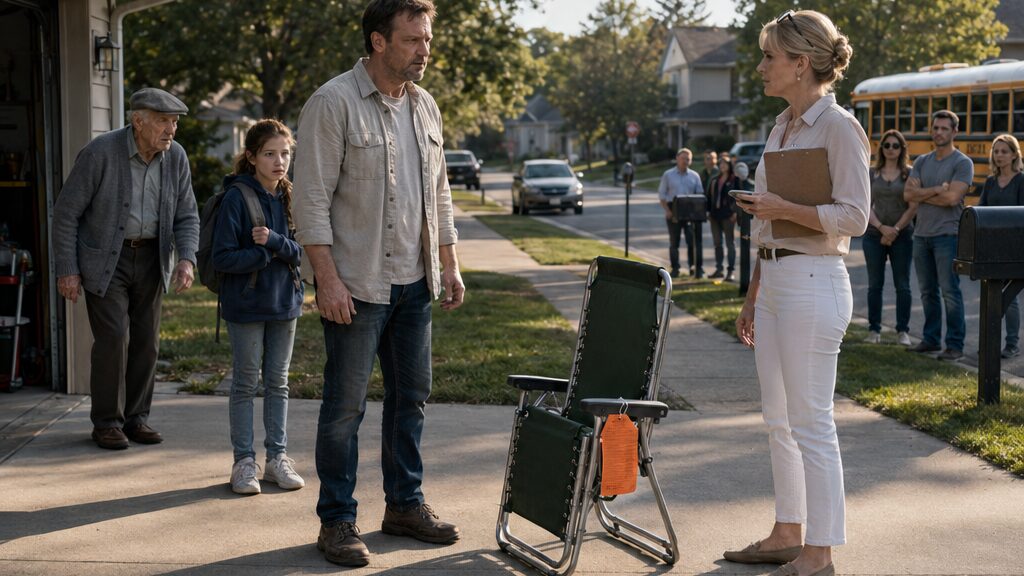
By Monday morning, the chair had a tag on it.
Matthew saw the flash of orange before he saw anything else. It swung from the arm of the folded green chair, bright as a warning flag, tied with a white plastic loop through the fabric strap. The chair stood at the end of his driveway in the exact place Paul had always put it, facing east toward the slope.
The tag read: NOTICE OF NONCOMPLIANCE.
Matthew stood barefoot on the cold concrete, his work shirt unbuttoned over a T-shirt, one hand still holding his belt. For a moment all he could hear was the low hum of the garage opener behind him and the distant squeal of school-bus brakes somewhere beyond the corner.
Anna came out with Emily’s lunch bag in her hand. She stopped beside him.
“Oh, come on,” she said.
Emily slipped around her and ran halfway down the driveway before Matthew caught her by the backpack.
“Don’t touch it.”
“But it’s mean,” Emily said.
“I know.”
“Then take it off.”
Matthew looked toward the sidewalk. Two children waited at the bus stop across the street, pretending not to stare. A neighbor stood near a mailbox with a coffee mug. The curtains in the house with the security camera had already shifted.
The tag moved slightly in the breeze.
Matthew did not take it off.
That was the part he would remember later: not Debra’s rule language, not the photos, not even Paul’s face. He would remember standing close enough to remove the tag with two fingers and choosing to wait because he did not want to be seen making it worse.
Anna noticed. “Matthew.”
“I need to think.”
“You’re thinking while a seventy-something-year-old man is about to walk up to that?”
He flinched. “I know.”
“No, you’re trying to decide which version of this makes you least uncomfortable.”
The words landed too cleanly to argue with.
A silver sedan was parked at the curb near the corner. Debra sat inside it, not hiding, not approaching either. She wore sunglasses though the light was still soft. Her window was cracked. A clipboard rested against her steering wheel.
Matthew felt anger rise, then shame behind it, because some part of him still wanted Debra to be the only person responsible.
The school bus appeared at the far end of the block. Its yellow shape moved slowly between the parked cars. The children across the street lifted their backpacks. Emily stayed beside Matthew, eyes fixed on the curve near the mailboxes.
“There,” she whispered.
Paul Nelson came into view.
He was walking slower than he had on Sunday. One hand brushed the tops of hedges where they reached near the sidewalk. He had no chair with him. His cardigan hung open, and his cap sat crooked, as if he had put it on without a mirror.
Matthew stepped forward, then stopped.
Paul had seen the chair.
More precisely, he had seen the orange tag.
He paused at the curb before Matthew’s driveway, not even touching the chair at first. His eyes moved over the printed warning, the plastic loop, the bold capital letters. The school bus sighed to a stop behind him. Its doors folded open with a hydraulic gasp.
For one terrible second, the whole street seemed arranged around Paul’s embarrassment.
The two children climbed onto the bus. The neighbor with the coffee mug looked down into his cup. Debra opened her car door.
Paul reached for the tag with fingers that did not quite close.
Matthew walked down the driveway.
“Mr. Nelson.”
Paul turned fast. “I’m sorry. I didn’t put it here today.”
“I know.”
“I was going to carry it from now on, but I suppose—” He looked at the chair again. “I suppose someone returned it.”
Debra’s heels clicked on the sidewalk. “The chair was found in recurring violation of visible-property guidelines.”
Paul’s face tightened. “I understand.”
Matthew looked at Debra. “Do you?”
Her jaw set. “Matthew, this is exactly why the process exists. It keeps individual feelings from creating inconsistent enforcement.”
“It’s a chair.”
“It is an unauthorized item placed repeatedly at a frontage line.”
“It’s where he rests.”
“And if he falls on your driveway? If another resident places a bench at the curb? If someone decides a cooler or a table or a sign is also harmless?” Debra’s voice remained controlled, which somehow made it worse. “The board has to consider the community, not only one situation.”
Paul reached for the chair back. “Please don’t argue. I’ll take it.”
He tried to fold it, but it was already folded. His hand stayed clamped around the frame anyway. His knuckles whitened.
Matthew saw it then—not just age, not only tiredness. Paul was holding himself upright with the chair.
“Sit down,” Matthew said.
“I’m fine.”
“Please sit down.”
Paul shook his head once. “Not with that on it.”
The bus pulled away. Its engine swallowed the street for a moment, then left behind a ringing quiet.
Emily stepped beside Matthew. “Dad, take the tag off.”
Debra said, “I wouldn’t advise removing an official notice.”
Matthew turned to her. “You tied a warning to the thing he needs to keep from falling.”
“That is not established.”
The words snapped something loose in him.
Matthew reached for the orange tag and tore the plastic loop apart. It came off with a small, cheap crack.
Debra inhaled. “Matthew.”
He held the tag in his fist and looked at Paul. “Why this spot?”
Paul stared at the tag, then at the chair. “It’s far enough.”
“Far enough from what?”
“My house.”
Matthew waited.
Paul swallowed. “If I can make it here, I can make it back.”
Anna had come down the driveway now. She did not speak.
Paul let out a small breath that was almost a laugh, but had no humor in it. “That sounds foolish when I say it out loud.”
“It doesn’t,” Emily said.
Paul looked at her, and his expression softened for half a second.
Matthew unfolded the chair. The metal legs clicked into place. He set it just inside his driveway, not on the sidewalk, angled toward the rise as Paul always angled it.
“Sit,” he said.
Paul hesitated. Debra stood with her clipboard held against her chest. A neighbor’s garage door opened across the street and stopped halfway, as if even the machine wanted to listen.
Finally Paul lowered himself into the chair.
His body betrayed him before his words did. The moment he sat, his shoulders sagged, and one hand pressed hard above his knee. His eyes shut for two breaths.
Matthew crouched slightly, not too close. “Do you need help getting home?”
“No.”
“Mr. Nelson.”
“No,” Paul said, sharper now. Then softer: “I’ve got it.”
Debra’s expression flickered. For the first time she looked uncertain, but she recovered quickly and slid a paper from her clipboard.
“Given the removal of the notice and the continuation of the violation, I’ll have to file this for board review.”
Anna stared at her. “You can see what’s happening.”
“I can see that we need a formal decision before this becomes a standing arrangement.”
Paul pushed himself up from the chair. “It won’t.”
Matthew stood. “Yes, it will. If he needs to rest here, he can rest here.”
Debra’s eyes moved to him. “Then you are accepting responsibility for the violation?”
The old Matthew would have asked what that meant. He would have requested the section number. He would have bought time with language.
Instead he said, “I’m accepting that I should have asked him before I let you turn this into one.”
Debra’s face colored, just slightly. “You’ll receive notice of the hearing.”
Paul folded the chair with shaking care.
“You don’t need to take it,” Matthew said.
“I do.” Paul did not look at him. “I’ve caused enough.”
“You haven’t.”
Paul tucked the chair under one arm. Without it on the ground, he looked suddenly smaller. Not weak exactly. Reduced by being watched.
He took two steps toward the sidewalk, then stopped near the curb.
Matthew thought he might say thank you. Or explain. Or ask for the tag.
Instead Paul looked at the slope ahead, the one Matthew had never called a hill, and said quietly, “I can find another street.”
Then he walked away carrying the chair that had just become evidence.
Chapter 4: The Route Paul Refused to Give Up
Matthew found Paul sitting on a curb two streets away with the green chair folded beside him and both hands pressed flat against the concrete.
For one confused second, Matthew thought Paul had dropped something. Then he saw the old man’s face: not panicked, not injured, but set in that hard, private expression people wore when they were trying to make their own body obey before anyone noticed it had stopped listening.
Matthew pulled his truck to the side of the road and cut the engine.
Paul looked up, and embarrassment moved across his face before recognition did.
“I’m not following you,” Matthew said, because it was the first thing that came to mind and the worst possible opening.
Paul gave a breathless little laugh. “That’s good. I’d hate to think I’d become interesting.”
Matthew stepped out. Late afternoon heat rose from the pavement, carrying the smell of fresh-cut grass and fertilizer. A landscaping contractor’s trailer rattled past at the corner, then disappeared toward the newer houses. This part of Briar Creek was quieter, older, with deeper porches and trees that had been allowed to grow wider than the approved ornamental pears near Matthew’s end.
Paul shifted as if he meant to stand.
“Don’t,” Matthew said.
Paul froze.
“I mean—please don’t. Not because I’m here.”
Paul’s hand moved to the chair. “I was only taking a minute.”
“You’re sitting on a curb.”
“It was available.”
Matthew looked down the street. The sidewalk rose gently, dipped at a storm drain, then curved toward Sycamore Court. From a car, the loop looked flat. On foot, for someone whose legs betrayed him halfway home, it was a map of small punishments.
Matthew shut the truck door and leaned against it, giving Paul space. “You said you could find another street.”
“I found one.”
“That wasn’t what I meant.”
“No, it was what I meant.” Paul adjusted his cap without looking at him. “Your driveway has enough trouble.”
“The trouble isn’t the driveway.”
Paul’s mouth tightened. “With respect, Mr. Harris, people say that before they hand you a paper proving otherwise.”
Matthew had no answer to that. The orange violation tag was folded in his glove compartment now, because he had not known what else to do with it. He had meant to throw it away. Instead he had placed it beside the registration and insurance card, as if keeping it made him more prepared.
“Debra filed for a hearing,” Matthew said.
“I assumed.”
“Thursday.”
Paul nodded once. “Then you should tell them I won’t use the chair again.”
Matthew waited for the irritation to come, but it did not. What came was a memory of his father standing in a kitchen years ago with a bruised hip, insisting he had slipped because the floor was wet. It had not been wet. Matthew had known it. His father had known Matthew knew. They had both chosen the lie because the truth required new arrangements neither of them wanted to discuss.
“Can I give you a ride home?” Matthew asked.
Paul’s eyes lifted sharply. “No.”
“Just to your porch.”
“I said no.”
There was no anger in the word. That made it harder to hear. It sounded practiced. Worn smooth from use.
Matthew glanced at the green chair. “Then let me carry that.”
Paul’s hand closed around the frame. “I can carry a chair.”
“I didn’t say you couldn’t.”
“You implied it.”
Matthew looked at him, then nodded. “Fair.”
They were quiet. A sprinkler hissed behind a hedge. Somewhere a garage basketball hoop thudded once, then again.
Paul stared at the sidewalk ahead. “I walk this loop every day.”
“I know.”
“No. You know I walk. You don’t know the loop.” His fingers rubbed the metal frame. “Out from Sycamore, past the mailboxes, up Alder Creek, around the little island with the crepe myrtle, then back past your place.”
Matthew pictured it. A useless suburban circle he drove without thinking.
“My wife liked your end of the street,” Paul said. “Before you lived there. Before the Harrises, before the family before you. There used to be a red maple near the driveway.”
Matthew turned toward him.
“It came down in a storm,” Paul said. “Long time ago now. But she always stopped there. Said the morning light came through that tree like stained glass.” His face changed, not dramatically, just enough for Matthew to feel he had been allowed too close. “When she got sick, that was the last place on the loop she could still reach before turning back.”
Matthew looked down at the curb between them.
Paul cleared his throat. “After she passed, I kept walking it. Not for exercise at first. More like…” He searched for the word and rejected several. “Attendance.”
Matthew did not speak.
“When my legs started acting up, I put the chair there. Told myself it was practical.” Paul’s hand tightened on the frame again. “Maybe it was partly that.”
The driveway became different in Matthew’s mind. Not his clean concrete apron, not a line between private property and public frontage, not a photograph in Debra’s phone. A stopping place. A remembered tree. A woman Matthew had never met pausing in morning light before turning home.
“You could have told me,” Matthew said, and regretted it immediately.
Paul gave him a tired sideways look. “Could I?”
Matthew looked at his shoes.
“I don’t mean that unkindly,” Paul said. “But a man doesn’t introduce himself to a neighbor by saying, ‘May I place my weakness at the end of your driveway every morning?’”
The sentence struck Matthew harder than any accusation would have.
His phone buzzed in his pocket. Anna.
He answered. “Hey.”
“You need to come home,” she said.
Her voice had the careful edge she used when Emily was nearby.
“What happened?”
“Email from Briar Creek. Formal notice. Possible daily fines if the item remains after the hearing.”
Matthew closed his eyes.
Paul heard enough. His face closed.
“How much?” Matthew asked.
“It says up to fifty dollars per day after board determination, plus administrative costs if enforcement continues.” Anna paused. “Matt, I’m not saying leave him on a curb. I’m saying this is not just Debra being annoying anymore.”
“I know.”
“Do you?”
He looked at Paul, who was now staring down the sidewalk with a fixed expression. “I’m with him right now.”
Anna was silent for a beat. “Is he okay?”
“He says he is.”
“That means no.”
Matthew almost smiled, but couldn’t. “I’ll be home soon.”
He hung up.
Paul pushed his palms against the curb. “I should go.”
Matthew stepped forward, then stopped himself. “Take your time.”
Paul looked up at him. “You have a family. A house. Fees. I’m not going to become the reason your mailbox fills with letters.”
“You’re not the reason.”
“I am the thing they can point to.” Paul took hold of the chair and, with visible effort, stood. “There’s a difference, but not to people with forms.”
Matthew reached for the chair before thinking.
Paul pulled it back. Not far. Just enough.
The movement was small, but the meaning was not.
Matthew lowered his hand. “Sorry.”
Paul adjusted his grip, breathing through his nose. “My physical therapist says I should use a cane.”
“Do you?”
“No.”
“Why not?”
Paul gave him a look that held both pride and self-mockery. “Because then people ask why.”
Matthew wanted to say that people were already asking. He did not.
They walked slowly toward Sycamore Court, Matthew keeping pace a few steps away. He did not offer his arm. He did not carry the chair. Twice Paul paused and pretended to admire landscaping. Matthew pretended to believe him.
At Paul’s porch, a narrow place with two rocking chairs and a clay pot full of dry soil, Paul leaned the green chair beside the door.
“This route,” Matthew said. “Your wife. Does anyone else know?”
Paul’s hand rested on the porch rail. “No one who needs to.”
“The board will ask why the chair has to be there.”
“Then tell them it doesn’t.”
“But it does.”
Paul looked at him. “Not enough to have it discussed in a room full of people who don’t know her name.”
The front door opened a few inches behind him, revealing a dim hallway and a pair of walking shoes placed neatly side by side. Paul did not go in yet.
Matthew heard himself ask, “What was her name?”
Paul’s eyes lifted.
For a moment Matthew thought he had crossed another line.
Then Paul said, “I don’t say it much anymore.”
“You don’t have to.”
“No,” Paul said. “I know.”
He stepped inside without giving the name.
When Matthew got home, Anna was at the kitchen island with the printed notice laid flat between two cereal bowls and Emily’s abandoned math worksheet. The Briar Creek letterhead looked even colder under the kitchen lights.
Emily sat beside it, drawing with colored pencils.
Anna tapped the notice. “Thursday evening. Community room. Seven.”
Matthew picked it up. The language was polite, procedural, and complete. He could almost admire how cleanly it removed every living thing from the situation.
Unauthorized placement of personal property.
Recurring visible frontage concern.
Potential liability.
Board review.
He looked over Emily’s shoulder. She was drawing the green chair, but not folded. Open. Facing a yellow circle of sun at the end of a gray driveway. A small stick figure sat on it, wearing a cap.
“Is that Mr. Nelson?” he asked.
Emily nodded. “He looks lonely when he stands.”
Anna looked at Matthew. The fear was still there in her face, but something else had joined it.
Matthew folded the notice once and placed it beside the orange tag he had brought in from the truck. Paper on paper. Rule on warning.
His phone buzzed again before he could speak. This time it was an automated calendar invite from Briar Creek HOA.
FORMAL HEARING: THURSDAY, 7:00 PM. COMMUNITY ROOM. ATTENDANCE REQUESTED.
Matthew looked at the date until the numbers blurred, knowing the question had changed. He no longer had to find out who owned the chair. He had to decide how much of another man’s private grief he was willing to expose to keep it there.
Chapter 5: Debra’s Rulebook and the Exception She Feared
The compliance packet called the chair an “unauthorized recurring object,” and Matthew hated that the phrase fit neatly into a box.
He stood just inside the Briar Creek HOA office on Tuesday afternoon, holding three stapled pages Scott Rivera had printed for him at the front desk. The office occupied a narrow room off the community center, with beige walls, a laminate counter, and a corkboard covered in pool hours, pruning reminders, and a cheerful flyer about the fall picnic. Under the fluorescent lights, the green chair had become a grayscale photograph labeled Exhibit A.
Not Paul’s chair.
Not a resting place.
Exhibit A.
Scott watched him read. The board president wore a light button-down with the sleeves rolled and the wary expression of a man who had learned that every neighborly problem came wrapped in legal-sounding language.
“I wanted you to see what the board will see,” Scott said.
Matthew flipped to the second page. Debra’s notes were precise.
Item observed at frontage line on multiple dates.
Resident acknowledged item not belonging to household.
Third party observed using item.
Notice removed by resident.
Matthew stopped there. “That last one is me.”
“Yes.”
“She tied a violation notice to an old man’s chair while he was walking up to it.”
Scott’s mouth tightened. “I’m not saying the optics are good.”
“The optics?”
“I’m saying the procedure is what it is.”
Matthew looked at him. “That sounds like something people say when they know the procedure is wrong.”
Scott rubbed the bridge of his nose. “Matthew, there are liability issues.”
“He sits for a minute.”
“On or adjacent to your driveway, depending on where someone wants to draw the line.”
“Then draw it where the person is.”
Scott leaned back against the counter. “You think I don’t understand the human side? I do. But if the association knowingly allows an object to be placed in a visible frontage area for one resident’s use, then the next person asks why they can’t put a bench outside for their dog walker, or a cooler for delivery drivers, or political signs outside the sign window. Then someone trips. Then someone says the HOA approved it.”
Matthew looked down at Exhibit A again. The orange tag showed as a dark strip in the photo. Paul was not in the picture. Somehow that felt like the whole problem.
“Debra said something about a previous dispute,” Matthew said.
Scott exhaled. “Of course she did.”
“She didn’t explain.”
Scott glanced toward the closed inner door. “It was before you moved in. A resident left a portable basketball hoop at the curb. Said it was temporary. Then his neighbor put out planters. Then someone else added a storage box. It turned into eighteen months of complaints. When the board finally acted, everyone blamed Debra for not enforcing early.”
“So now she enforces before thinking.”
Scott did not answer right away. “Debra doesn’t like being made to look inconsistent.”
“That’s not the same as being fair.”
“No,” Scott said. “It isn’t.”
The inner door opened.
Debra Clark stepped out carrying a binder thick enough to make Matthew’s jaw tighten. She paused when she saw him, then nodded with professional calm.
“Matthew.”
“Debra.”
Scott straightened, suddenly more formal.
Debra’s eyes went to the packet in Matthew’s hand. “Good. You have the materials.”
“I have a photo of a chair and three pages pretending no one knows what it’s for.”
Her expression cooled. “The board cannot govern based on informal sympathy.”
“It can govern based on common sense.”
“That is what rules are for. So each person’s common sense doesn’t become everyone else’s problem.”
Matthew almost snapped back, but something in her face stopped him. Not guilt. Not softness. Strain.
She set the binder on the counter. It landed with a heavy slap.
“You think this is about one chair,” she said.
“It is about one chair.”
“No. It is about whether the guidelines apply when the story attached to the object is sad enough.” Her voice stayed low, but each word came clipped. “And I promise you, Matthew, every object has a story once enforcement begins.”
Scott said, “Debra.”
She ignored him. “People always explain after the notice. The trailer is temporary because a cousin is moving. The dead shrubs are staying because money is tight. The broken fence is sentimental because a father built it. Sometimes it’s true. Often it is. But when you let one person ignore the rule because their reason sounds better in a room, you create a neighborhood where enforcement depends on who can make the board feel worst.”
Matthew stared at her.
For the first time, he understood not agreement, but machinery. Debra had built herself into a person who could survive complaints by refusing to be moved by them.
“That sounds exhausting,” he said.
Her face changed just enough to show he had hit something unguarded.
Then she picked up her binder. “It is responsible.”
She left through the side door.
Scott let out a long breath. “That could have gone worse.”
Matthew looked at him.
“I know,” Scott said. “Not funny.”
On the walk home, Matthew passed the corner where Paul had appeared every morning. The sidewalk looked too clean without him. No green chair. No folded aluminum. No mark that anything had happened except in a packet now waiting for Thursday night.
A mail carrier was sorting envelopes near the cluster boxes when Matthew reached Alder Creek Lane.
“You’re the chair house, right?” the mail carrier asked before seeming to regret it.
Matthew stopped. “Apparently.”
The mail carrier nodded down the street. “That older gentleman used to walk with a lady. Years ago. They’d wave at everybody.”
Matthew held still.
“They stopped for a while, then he started again alone.” The mail carrier slid envelopes into the box. “Never bothered anyone.”
Matthew wanted to ask her name. Paul’s wife. He wanted someone to say it easily because Paul could not. But the mail carrier shut the box and moved on before he found the nerve.
At home, Anna was in the kitchen with her laptop open and the HOA notice beside it. Emily’s drawing of the chair had been moved to the refrigerator with a magnet shaped like a strawberry.
Anna looked up. “I checked the bylaws.”
“You checked the bylaws?”
“I panicked productively.” She turned the laptop toward him. “They do have language about visible personal property. But there’s also an accommodation section. Mostly disability related. It says requests should go through the board and may require documentation.”
Matthew sat down.
“That’s good, right?” Anna asked.
“It’s good if Paul wants to be documented.”
Anna’s face fell a little. “He doesn’t.”
“No.”
“Could you ask him?”
Matthew looked toward the window. “I’m not sure I have the right.”
“Matt, if you don’t say enough, they fine us and push him away. If you say too much, you humiliate him. Those are both bad choices.”
“I know.”
“No, I mean this is why you can’t wait for it to become easy.”
He looked at her. It was not accusation now. It was something closer to fear.
Emily came in carrying her backpack, cheeks pink from the walk from the bus stop. “Is Mr. Nelson coming tomorrow?”
Matthew and Anna exchanged a glance.
“I don’t know,” Matthew said.
Emily opened the refrigerator and took out a juice box. “He should. I can put a note that says he’s allowed.”
Anna closed her eyes briefly.
Matthew’s phone buzzed with a text from a number he did not recognize.
This is Paul Nelson. Please don’t discuss my health at the hearing. Tell them I removed the chair. That should end it.
Matthew read it once. Then again.
Anna saw his face. “What?”
He passed her the phone.
She read the message and sat back slowly. “Oh.”
Emily, too short to read the screen from where she stood, looked between them. “What happened?”
Matthew took the phone back. His thumb hovered over the reply box. He typed three different answers and deleted them all.
Finally he wrote: I won’t say anything you don’t want said. But I don’t think saying nothing will end it.
Paul did not respond.
That night, Matthew laid the compliance packet, the orange tag, and Emily’s drawing on the kitchen table. Exhibit A. Notice of Noncompliance. A child’s green chair facing a yellow sun.
He stayed there after Anna went upstairs, staring at the three versions of the same object.
At some point, Emily came back down in her pajamas. She did not say anything. She slipped her drawing from the table, turned it over, and wrote something on the back with a purple marker. Then she tucked it inside the front pocket of Matthew’s hearing folder.
After she went upstairs, Matthew pulled the paper out far enough to read the words.
Ask him what kindness is for.
He put the drawing back, closed the folder, and understood that Thursday night might require the one thing he had avoided from the beginning: speaking without using someone else’s pain as proof.
Chapter 6: The Hearing Where Silence Became the Problem
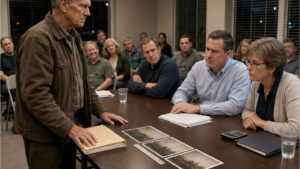
Debra projected the photograph of the tagged chair onto the community room wall, and the object looked larger than any chair had a right to be.
The image filled the white screen behind the folding table where the HOA board sat with paper cups, nameplates, and the strained expressions of volunteers regretting their civic involvement. The green canvas had turned dull under the projector. The orange notice hung from the arm like a public sentence.
Matthew sat in the second row with Anna on his left and an empty chair on his right that he kept pretending not to notice.
Paul had not come.
At the front, Scott Rivera tapped the microphone once. It squealed, then settled.
“We’re here to review a recurring visible-property concern at the Harris residence on Alder Creek Lane,” Scott said. “The board will hear from compliance, from the homeowner, and any directly involved resident if present.”
Debra stood with her binder open. She did not look pleased. She looked prepared.
“The item in question appeared repeatedly at the frontage line of the Harris property,” she said. “The owner of the item was later identified as a non-household resident. While the circumstances may invite sympathy, the guidelines do not permit ongoing placement of personal property in visible driveway or walkway areas without approval.”
Matthew heard Anna breathe in slowly.
Debra clicked to the next slide: a closer photo of the tag. “The concern is not whether the item is emotionally understandable. The concern is precedent, access, and association liability.”
A few residents nodded. A few looked at Matthew. One whispered to another and stopped when Scott glanced over.
Matthew kept his folder closed on his lap. Inside were the packet, the torn orange tag, and Emily’s drawing. He had planned three possible statements. One too legal. One too emotional. One that sounded like an apology but not enough like responsibility.
Scott looked at him. “Mr. Harris, you may respond.”
Matthew stood.
The room became too bright.
He opened the folder, then closed it again.
“I thought someone was messing with my driveway,” he said.
Anna turned her head slightly toward him.
Matthew kept his eyes on the screen, not the board. “That was my first mistake. The chair kept showing up, and I didn’t ask who needed it. I moved it. I complained about it in my kitchen. I let other people guess with me. By the time I learned Mr. Nelson was using it to rest during his walk, the story had already become a violation.”
Debra’s posture stiffened.
Matthew looked at the board now. “I’m not here to argue that the chair wasn’t there. It was. I’m not here to argue that I removed the tag. I did.”
Scott leaned forward slightly.
“I’m here because the way we handled it was wrong before the paperwork was ever correct.”
The room went very still.
Debra said, “The board should note that the homeowner has acknowledged removing an official notice.”
“I have,” Matthew said.
“And acknowledged the recurring placement.”
“Yes.”
“Then the violation itself is not in dispute.”
Matthew looked at her. “The meaning is.”
A murmur moved through the room, small but alive.
Scott raised a hand. “Let him finish.”
Matthew opened the folder and took out the orange tag. Its torn loop curled uselessly against his palm.
“This was tied to the chair before Mr. Nelson arrived,” he said. “During school-bus pickup. In front of neighbors. He saw it before he sat down. And he would not sit because we had turned the thing helping him into something shameful.”
Debra’s face flushed. “That is a characterization.”
“It is,” Matthew said. “Mine.”
Anna’s hand tightened around the strap of her purse.
“I don’t have the right to discuss Mr. Nelson’s private situation,” Matthew continued. “So I won’t. But I can discuss mine. I was more worried about being the house with the chair than being the neighbor who asked the right question.”
The door at the back of the community room opened.
Everyone turned.
Paul Nelson stood in the doorway, one hand on the frame, breathing carefully as if he had arrived from farther away than the parking lot. He wore his gray cardigan and cap. He had no chair with him.
Matthew’s empty seat suddenly felt like an accusation.
Paul looked at the room, at the projected photograph, at the bright enlarged tag. His mouth tightened, but he walked in.
Scott stood halfway. “Mr. Nelson, would you like a chair?”
Paul paused. A few people looked down at the empty seats around them.
“No,” Paul said. “Thank you.”
He remained standing at the back.
Matthew wanted to go to him. He did not. Paul had chosen the doorway, and Matthew understood enough now not to choose for him.
Debra cleared her throat. “Mr. Nelson, since you are here, the board may ask whether you are requesting an accommodation under the association guidelines.”
Paul’s hand tightened on the doorframe.
Scott said, “Debra, we can—”
“It matters,” Debra said. “If this is being framed as need rather than convenience, documentation may be required.”
Matthew felt Anna shift beside him.
Paul looked at Debra. “I’m not requesting anything.”
The words hit harder than Matthew expected.
Debra nodded once, as if that settled it. “Then the item should not recur.”
Matthew stepped away from his chair. “He shouldn’t have to turn his body into paperwork to sit down for two minutes.”
A board member whispered, “Matthew.”
Scott’s eyes warned him, but not harshly.
Debra closed her binder halfway. “This association cannot approve indefinite personal use of visible property space based on a vague statement.”
“It isn’t vague to the person standing at the back of the room because sitting became a debate.”
Paul looked down.
Matthew wished he could take the sentence back. Not because it was false, but because Paul had become the center of every face in the room.
He lowered his voice. “I’m sorry.”
Paul looked up.
Matthew faced him, not the board. “I don’t mean for saying that. I mean for making you come here. For not asking sooner. For letting you be discussed like a problem attached to my address.”
Paul’s expression trembled and then steadied.
Matthew turned back to the board. “Fine me if you need to. Cite my driveway if that’s the only category you have. But don’t pretend this is only about a chair. It’s about whether our rules have room for a neighbor to rest without being made to prove he deserves it.”
Debra stared at him. “That sounds generous until someone is hurt.”
“Then write a narrow rule,” Matthew said. “Write a permission. A temporary accommodation. A homeowner-maintained rest point. Put my name on the responsibility. Inspect the chair. Limit the hours. Do whatever makes the paper feel safe. But don’t solve liability by removing the human being.”
No one spoke.
At the back, Paul’s eyes had closed. Only for a moment. When he opened them, he was looking not at Matthew but at the projected photograph.
“That chair belonged to my wife,” Paul said.
The room changed.
Not loudly. No gasp. Just a collective stillness, as if every person had realized at the same time that they had been standing too close to something fragile.
Paul’s voice remained even. “We walked that route together. We stopped near Mr. Harris’s driveway when there was a maple there. She liked that spot. After she died, I kept walking. Then I got slower. Then I got stubborn.”
A few people looked away.
“I put the chair there because if I could reach it, I knew I could get home.” He touched the doorframe again. “That is all the medical declaration I care to give.”
Debra’s lips parted, then closed.
Scott leaned toward his microphone, but he did not speak yet.
Paul looked at Matthew. “You should not be fined for my pride.”
Matthew shook his head once. “It wasn’t only your pride.”
That, finally, silenced the last whisper in the room.
Debra recovered first. “Mr. Nelson, I am sorry for your loss. But the board still has to consider whether a personal memorial routine can override community standards.”
“It isn’t a memorial,” Matthew said. “It’s a walk.”
“It is an object placed in view of the community.”
“It is a chair.”
“It is a precedent.”
Scott lifted a hand. “Enough.”
Debra stopped.
Scott looked at the other board members, then at Matthew, then at Paul. His face carried the exhaustion of someone who could see the right thing and the risk of writing it badly.
“We’re going into closed discussion for ten minutes,” he said. “No vote until we come back.”
Debra turned toward him. “Scott—”
“Ten minutes,” he repeated.
The board members stood. Chairs scraped. Papers were gathered. Debra took her binder, but the projected photograph remained on the wall behind them: the green chair, the orange tag, the driveway line.
As Scott passed Matthew, he paused just long enough to say, quietly, “You understand that if we do this, it can’t just be feelings.”
Matthew looked toward Paul, still standing at the back because no offered seat was simple anymore.
“I know,” Matthew said. “That’s why it has to be a rule.”
Chapter 7: A Rule Small Enough to Hold Mercy
Scott returned with a single sheet of paper, and the room understood before he spoke that whatever was on it was not going to make everyone happy.
The board filed back to their seats in an uneven line. One member avoided Debra’s eyes. Another whispered something to Scott, received a short nod, and sat down. Debra came last, binder pressed to her ribs, lips tight enough to make her face look older.
The photograph of the chair still glowed on the wall.
Paul had moved from the doorway to the back row, but he had not taken the empty chair beside him. He stood with one hand resting on its plastic back, as though accepting the idea of support only if he could pretend he was not using it.
Matthew sat again beside Anna. His folder lay open on his knees. Emily’s drawing had slipped partly free, the purple question on the back hidden now against his leg.
Scott adjusted the microphone. This time it did not squeal.
“The board has discussed the matter,” he said. “We are not prepared tonight to revise the full visible-property guideline. That would require notice, drafting, and review.”
Debra’s shoulders lowered a fraction, as if she had expected that part to save her.
Scott continued. “However, the existing accommodation language gives the board limited discretion to approve temporary, specific arrangements when they do not obstruct access, create a nuisance, or shift maintenance responsibility to the association.”
The room stirred.
Debra leaned toward her microphone. “For the record, I object to applying that section without formal documentation.”
“Your objection is noted,” Scott said.
“I want that in the minutes.”
“It will be.”
Matthew looked back at Paul. The old man’s expression did not change, but his fingers tightened on the chair behind him.
Scott lifted the single sheet. “The proposed resolution is narrow. One folding chair may be placed fully on the Harris driveway, no closer than two feet from the public sidewalk, between the hours of six and nine in the morning. The chair must be removed or stored afterward. Maintenance and condition of the chair are the responsibility of the homeowner, with permission of the chair’s owner. The approval is temporary and reviewable in ninety days.”
A resident in the front row murmured, “That’s oddly specific.”
Scott looked up. “It needs to be.”
Debra said, “And if others request the same?”
“Then we review the same: location, obstruction, need, maintenance, and duration. Not rumor. Not photographs from car windows. Actual circumstances.”
For the first time that evening, Debra looked at Scott as if he had stepped off a curb she had expected him to share.
Matthew felt no triumph. The rule sounded small, cautious, almost stingy. But small was maybe the only size mercy could survive in a room like this.
Scott turned toward him. “Mr. Harris, this would require your consent as the homeowner.”
Matthew stood. “Yes.”
“Consent to maintain the chair?”
“Yes.”
“To keep it safely placed?”
“Yes.”
“To remove it if it becomes damaged or obstructive?”
“Yes.”
Scott nodded, then looked toward the back. “Mr. Nelson, the board is not asking for additional personal disclosure tonight. But this arrangement requires your consent too. The chair is yours.”
Paul looked at the projected image before answering. “It was my wife’s.”
The room held still.
Then he added, “But yes.”
Scott’s voice softened, though only slightly. “Would you like the chair to remain at the Harris driveway under this arrangement?”
Paul’s hand left the chair back. For a second he seemed to have nowhere to put it.
“I don’t want to make trouble,” he said.
Matthew turned. “You’re not.”
Paul looked at him, and something weary passed between them. Not gratitude exactly. Not forgiveness either. A recognition that both men had spent too long calling their fear by more respectable names.
Debra closed her binder. The sound cut through the quiet.
“I will not oppose the board’s vote,” she said.
Scott looked at her, surprised.
“But I will not apologize for enforcing the guidelines,” Debra continued. “This neighborhood has rules because unmanaged exceptions become disputes. I have seen that happen. I will not be the only person in this room who remembers that when the next exception arrives.”
No one answered.
Matthew studied her face. There was no warmth there, but neither was there the clean certainty she had carried into the room. She looked like someone who had given up a battle without giving up her reason for fighting it.
Scott called the vote.
It passed with one abstention.
Not unanimous. Not celebratory. No one clapped. The community room simply exhaled.
Afterward, people stood in small uncertain clusters, unsure whether to approach Paul or pretend the meeting had been ordinary. A board member gathered paper cups. Someone shut off the projector, and the chair vanished from the wall, leaving behind a pale rectangle of light.
Matthew placed the orange violation tag into his folder.
Debra saw him do it. “You don’t need that anymore.”
“I think I do.”
Her eyes narrowed slightly. “For what?”
“To remember what it looked like when we got it wrong.”
For a moment he thought she would answer sharply. Instead she looked past him toward Paul, who was speaking quietly with Scott near the back row.
“I did not know it was his wife’s chair,” Debra said.
“No.”
“He also did not tell anyone.”
Matthew nodded. “No.”
“That matters.”
“It does.”
She seemed to dislike that he agreed. Her grip tightened around the binder. “People hide details and then blame the process for not seeing them.”
“People hide details because sometimes the process punishes them for needing help.”
Debra looked at him then. The old argument rose in her face and fell back again, unfinished.
“I’ll make sure the notice is withdrawn,” she said.
“Thank you.”
“I said withdrawn. Not erased.”
“I understand.”
She left before he could decide whether that was concession or warning.
Anna came to stand beside him, her purse over one shoulder. “That was not how I thought tonight would go.”
“Me either.”
“You did okay.”
Matthew gave a short laugh. “That’s generous.”
“It was messy,” she said. “But you stopped hiding behind not knowing what to do.”
He closed the folder. The corner of Emily’s drawing pressed against the tag inside.
At the back of the room, Paul had finally sat down.
He had chosen the chair in the last row, not because someone had offered it, not because all eyes were on him, but because the room had begun to empty and sitting no longer seemed like a public declaration. He rested both hands on his knees and stared at the floor.
Matthew walked over but stopped a few feet away.
Paul looked up. “You kept my health out of it as much as you could.”
“I tried.”
“You said more than I wanted.”
“I know.”
Paul nodded. “You also said less than you could have.”
Matthew accepted that as the complicated mercy it was.
Scott handed Paul a copy of the resolution. “This is temporary, Mr. Nelson. Ninety-day review. We’ll need to make sure the placement is safe.”
Paul took the paper as if it were heavier than one page. “Everything is temporary at my age.”
Scott looked like he wanted to answer, then thought better of it.
Outside, the parking lot lights buzzed above a scatter of cars. Matthew walked with Paul toward the curb while Anna went ahead to warm up the SUV. Paul moved carefully, the folded resolution in his hand.
“I should tell you something,” Paul said when they reached the sidewalk.
Matthew stopped.
Paul looked across the darkened community lawn. “My wife made me promise I’d keep walking as long as I could. Not for her. She hated that sort of thing.” His mouth moved with a faint smile. “For me. She said if I stopped walking the loop, the house would get too large.”
Matthew waited.
“I thought the chair meant I was keeping the promise.” Paul folded the paper once, sharply. “Then this week I wondered if it meant I was near the end of it.”
“The end of walking?”
Paul looked at him. “The end of pretending walking was the only thing I needed.”
Matthew felt the words settle between them.
“My father did that,” he said before he could decide not to. “Pretended. Fell in his kitchen. Lied about why. I let him, because arguing felt cruel.”
Paul watched him.
“It wasn’t kindness,” Matthew said. “It was easier.”
Paul nodded slowly, not forgiving him for a different man, only hearing it.
Anna pulled up near the curb. The passenger window slid down. “Mr. Nelson, can we drop you home?”
Paul opened his mouth.
Matthew said, “You can say no.”
Paul looked at the dark sidewalk beyond the parking lot.
Then, with visible effort that had nothing to do with walking, he said, “Tonight, yes.”
On Friday morning, Emily was dressed before her alarm finished ringing.
Matthew found her in the garage, standing beside the green chair, which Paul had allowed him to bring home after dropping him off. It leaned against the wall between the mower and the recycling bin, no longer hidden, no longer evidence, not yet something else.
Emily held a sheet of notebook paper and a roll of clear tape.
“What are you doing?” Matthew asked.
“Making the rule friendlier.”
He looked at the paper.
REST HERE
The words were written in purple marker, with a small sun in the corner.
Matthew crouched beside her. “We have to ask Mr. Nelson before we put that on his chair.”
She frowned. “Why?”
“Because it’s his.”
“But it’s nice.”
“I know. Still his.”
Emily considered this, then nodded with the solemnity of a judge. “Can we put it out before he comes?”
Matthew looked toward the open garage door. The driveway waited in the dim blue before sunrise, empty at the edge for the first morning in a week.
He picked up the folded green chair.
“Yeah,” he said. “We can put it out.”
Chapter 8: The Driveway Where a Neighbor Finally Stopped Alone
The chair was already unfolded before sunrise, but this time Matthew had placed it there himself.
He set it two feet back from the sidewalk, exactly as the resolution required, though no one was outside to measure. The green canvas sagged slightly in the middle. One aluminum leg wobbled unless angled toward the expansion joint in the concrete. The small purple note Emily had made was taped to the top rail only after Paul, with a shy glance away, had said it was all right.
REST HERE.
Matthew stood over the chair in the cool morning and adjusted it so it faced east.
A month earlier, that direction had felt like a clue. Now he knew what it held: the curve past the mailboxes, the gentle rise he no longer dismissed as flat, the place where a red maple had once scattered light across the sidewalk for a woman he had never met.
Behind him, the garage door hummed closed. Anna had left early for an appointment. Emily was still upstairs, though Matthew suspected she was awake and listening for any sound from the street.
He should have gone inside. He had emails waiting, coffee cooling on the kitchen counter, a day that did not require him to stand in his driveway like a sentry.
Instead he stayed.
The first few weeks after the hearing had been awkward in small, ordinary ways. Awkward was better than cruel, Matthew had decided. Paul used the chair three or four mornings a week, never at the exact same time, never longer than a few minutes. Sometimes he nodded toward the house. Once he lifted a hand to Emily when she waved from the window. Twice he did not come at all, and Matthew had pretended not to check the sidewalk more often than necessary.
The ninety-day review sat on the calendar like a distant appointment with uncertainty.
For now, the chair stayed.
A dog walker passed on the opposite side of the street and glanced over, curious but not lingering. The neighbor with the security camera opened his garage, looked at the chair, then looked at Matthew. He lifted his coffee mug in a small salute. Matthew returned it.
At 6:43, Debra Clark appeared at the corner.
Matthew had not seen her on morning walks before the hearing. Or maybe he had never noticed. She wore a zip-up jacket, dark leggings, and the same composed expression she brought to meetings, though without the binder she seemed less armored.
She slowed when she reached the driveway.
Matthew braced himself.
Debra looked at the chair, then at the sprinkler head near the lawn’s edge. It had rotated too far, sending a thin spray toward the concrete. In another minute it would mist the chair leg and soak one corner of the canvas.
She stopped.
Matthew said nothing.
Debra stepped onto the driveway, took the back of the chair with two fingers, and shifted it six inches to the left, out of the sprinkler’s reach. The movement was brisk, almost irritated.
Then she looked at Matthew. “It would be a shame to have mildew create a maintenance issue.”
He almost smiled.
“Good point,” he said.
She nodded once and continued down the sidewalk.
No apology. No conversation. No softness that could be mistaken for surrender.
But the chair remained dry.
Matthew stood there after she passed, feeling the strange relief of a world not fixed, but altered by one small, reluctant act.
Paul came ten minutes later.
He walked with a cane now.
The first morning he had brought it, he had carried it more than used it, tapping it against the pavement as if trying to convince both himself and the neighborhood that it was optional. By the third week, he had stopped pretending. The cane struck the sidewalk in a steady rhythm: step, tap, step, tap. Not defeat. A new pace.
Matthew moved toward the garage, giving him the privacy of arrival.
“You don’t have to run off,” Paul called.
Matthew turned back. “Wasn’t running.”
“At your age, you should every now and then.”
Paul reached the chair and lowered himself carefully. He did it better now, with less of the sharp drop that had frightened Matthew that first week. The physical therapist had adjusted something, Paul had said without saying much. A medication. A schedule. A stubborn man’s permission to use tools.
He rested the cane across his knees.
Matthew stayed near the garage, not too close.
Paul looked at the note. “She still checks the tape?”
“Every night.”
“It has held up better than some official notices.”
Matthew laughed softly.
Paul looked down the street toward the rise. The morning light had begun to thin into gold around the roofs. “Some days I only make it this far.”
Matthew heard the admission for what it was: not information, but trust.
“That still counts,” he said.
Paul’s mouth twisted. “Does it?”
“I think so.”
“My wife would have disagreed just to keep me moving.”
“What was she like?”
Paul did not answer immediately. Before, Matthew would have hurried to fill the silence or retreat from it. Now he let it stand.
“She liked rules when they helped people find each other,” Paul said at last. “Hated them when they helped people hide.”
Matthew looked toward the place where the red maple had once been. “She sounds direct.”
“She was worse than direct.” Paul smiled, real this time. “She was usually right.”
A car rolled past slowly, then continued. No one took a picture.
Emily burst through the front door in sneakers and a hoodie, backpack bouncing against one shoulder. “Did he see it?”
Matthew turned. “Inside voice, Em.”
“We’re outside.”
Paul lifted a hand. “I saw it.”
“Do you like the sun in the corner? I wanted to draw a chair too, but Dad said signs should be readable from far away.”
“Your father has strong opinions about signage now,” Paul said.
Matthew winced. “I deserved that.”
Emily came halfway down the driveway but stopped before crowding Paul. She had learned that too. Kindness could still take up too much space if it rushed.
“Are you walking the whole loop today?” she asked.
Anna, appearing at the door behind her, gave Matthew a look that said she had tried to teach tact and would continue trying.
Paul did not seem offended. He looked at the road, then at his cane.
“Not today,” he said.
Emily nodded as if this were simply weather. “Half loop?”
“Chair loop,” Paul said.
“What’s that?”
“House to here. Sit. Back home. It has fewer hills.”
Emily considered. “That’s a good loop.”
Paul looked at Matthew, and there was something bright and painful in his eyes. “Yes,” he said. “It is.”
The school bus groaned somewhere beyond the corner. Emily glanced back at Anna, then ran to grab her lunch bag from inside. The morning resumed around them: garage doors, sprinklers, engines, shoes on pavement. All the ordinary sounds that had been present from the beginning, only Matthew heard them differently now, less like background and more like proof that people were always moving through private weather.
Paul pushed himself up after a few minutes.
Matthew stepped forward, then stopped, waiting.
Paul noticed. “You’re learning.”
“Slowly.”
“That’s the only way it stays learned.”
He took his cane and stood. This time he did not fold the chair.
For the first weeks, he had folded it every time he left, even though Matthew had told him he did not need to. Habit, pride, fear—Matthew never asked which. Then one morning Paul had left it open. Matthew had seen it from the kitchen window and felt, absurdly, like someone had trusted him with a key.
Paul adjusted his cap. “I may not come tomorrow.”
“Okay.”
“Or the next day.”
“Okay.”
“I’m not telling you so you’ll check on me.”
Matthew nodded. “I know.”
Paul gave him a look.
Matthew corrected himself. “I’ll try to know.”
That satisfied him.
Paul turned toward Sycamore Court, then stopped and looked back at the chair. The purple sign fluttered slightly where the tape had loosened at one corner.
“She would have liked this spot,” he said.
Matthew did not ask if he meant his wife or Emily. Maybe he meant both. Maybe the place had become large enough to hold more than one kind of love.
After Paul started back, Matthew walked to the end of the driveway and pressed the loose tape back down. The chair faced east. The note held. The concrete line beneath it was still a boundary, still property, still subject to rules written by people afraid of exceptions.
But now, each morning, it was also a place where someone could stop without explaining why he needed to.
Matthew stayed there until Paul reached the corner. The old man lifted his cane once without turning around.
Matthew lifted his hand back, though Paul could not see it.
Then he went inside to wake Emily for school, leaving the green chair open at the end of the driveway, exactly where it belonged.
The story has ended.