He Photographed Their Reserved Parking Spaces for Fourteen Nights—Then Refused the Punishment Everyone Expected
Chapter 1: The Walk Home Past Twenty-Three Empty Claims
A rusted grill stood in the middle of an empty parking space at twelve forty-three in the morning.
Patrick Carter slowed his car until the tires whispered over old salt. The grill had two crooked wheels, a dented black lid, and one silver handle wrapped in gray tape. It was positioned precisely between the white curb marks, as if someone had parked it there and expected the city to issue plates.
Behind it, three more spaces were blocked by a blue trash bin, two orange cones, and a pair of plastic lawn chairs facing the street.
Patrick stared through the windshield.
He had spent ten hours helping strangers breathe. His shoulders still carried the pressure of the hospital respirator straps, and the inside of his car smelled faintly of sanitizer and stale coffee. All he wanted was to park, cross the narrow sidewalk, and climb the stairs to his apartment.
Instead, he drove past his building.
At the next corner, a folding table occupied another space. A green trash can guarded the one beyond it. Snow had been shoveled into low gray ridges along the gutter, but the pavement itself was dry.
Patrick circled twice before finding a legal space three blocks away.
The walk back took seven minutes. It was not far by daylight. At one in the morning, with most porch lights off and his hospital badge turned inward beneath his jacket, it felt longer. He passed the grill again and noticed that someone had tied a strip of red cloth to its handle.
A marker, he thought.
Not an accident.
The next night, the grill was gone.
Patrick almost laughed when he saw the open space. Then he noticed the grill two houses farther down, occupying a different spot beside a pair of traffic cones. The blue bin had moved into the grill’s former place.
The objects were rotating.
He parked at the end of the block, close enough to see his building. When he returned from work the third night, a white pickup was idling beside the chairs. A man in a hooded coat stepped out, moved one chair onto the sidewalk, and backed the pickup into the space. He then placed the chair behind the truck.
Patrick lowered his window.
“Excuse me.”
The man looked over but did not answer.
“Are those assigned spaces?”
The man shut the truck door. “Ask Robert.”
“Who’s Robert?”
The man pointed toward a brick row house with a broad porch and a brass HOA plaque mounted beside the door.
Patrick knew the house. Robert Sanchez lived there. He was the association president, the man who chaired annual meetings in the community room and reminded tenants not to leave bicycles in shared hallways.
The man walked away.
Patrick parked beside the pickup, close to the curb but clear of every driveway. Before going inside, he took out his phone and snapped a single photograph.
The grill was visible in the foreground. So were the cones, the chair behind the truck, and Patrick’s car at the edge of the frame.
He did not think of it as evidence.
Not yet.
At four that afternoon, he found a yellow sheet tucked beneath his windshield wiper.
COMMUNITY PARKING NOTICE appeared across the top in bold letters. The rest was formal enough to sound official and vague enough to say very little. His vehicle had allegedly interfered with “established winter parking practices” and created “avoidable tension among residents.”
No fine was listed. No city ordinance was cited. At the bottom was a typed line directing questions to Nicole Miller, the property manager.
Patrick folded the notice along its existing crease and slipped it into his jacket.
The curb beside his car was marked with white municipal paint. No number. No resident designation. No accessible-parking symbol. Nothing suggested that the space belonged to the HOA or to a specific house.
He crouched and ran one gloved finger over the faded line.
Public curb.
That evening, before work, Patrick knocked on Robert’s door.
Robert opened it wearing jeans and a white undershirt, his reading glasses hanging from one hand. He was broad through the chest, with close-cropped gray hair and the expression of a man interrupted during something more important.
Patrick held up the notice.
“I parked legally last night.”
Robert glanced at the page. “You parked where people had cleared.”
“There was no car there.”
“That doesn’t mean it was open.”
Patrick waited.
Robert leaned one shoulder against the doorframe. “We had twelve inches of snow last week. People spent hours digging those spots out.”
“The plows cleared most of the street.”
“After we shoveled around the cars.”
Patrick kept his voice even. “The curb belongs to the city.”
Robert’s mouth tightened, though not quite into a smile. “That’s the kind of thing renters say when they haven’t lived through enough winters here.”
Patrick felt the remark land where Robert intended it to.
He rented the second-floor unit in a building owned by an investor who lived in another state. Robert owned his house outright, or at least spoke as though he did. On this block, ownership was not merely financial. It was a rank people carried in their posture.
“I’m not moving anyone’s property,” Patrick said. “I’m asking whether the HOA approved placing objects in public spaces.”
“We approve keeping order.”
“That isn’t what I asked.”
Robert’s eyes shifted toward the street. For the first time, Patrick noticed a woman seated just inside the front room. Only part of her was visible: silver hair, a blanket over her knees, one hand resting on the arm of a wheelchair.
Robert stepped sideways, narrowing the opening.
“You work nights,” he said. “You come home late. There are spaces farther down.”
“Three blocks down.”
“You’re young.”
Patrick looked at him.
Robert’s tone softened just enough to sound reasonable. “Some people here need the space near their doors.”
“Then apply for a legal restriction.”
Robert’s face changed again.
“We shovel them,” he said. “We maintain them. We’ve done it for years. You don’t get to arrive and rewrite how the block works.”
Patrick folded the notice once more.
He could have argued. He could have pointed toward the woman inside and asked whether she knew the curb had been filled with bins and chairs in her name. He could have said that after midnight, three blocks was not a harmless inconvenience for everyone.
Instead, he nodded.
“All right.”
Robert seemed surprised by how little satisfaction the answer gave him.
Patrick walked back toward his building. The grill sat under the streetlight with its taped handle shining. Across the road, someone had placed a second chair beside it.
His phone buzzed before he reached his steps.
The email was from Nicole Miller.
She wrote that the association had received reports of Patrick “disrupting longstanding winter parking arrangements.” She advised him not to move, photograph, or otherwise interfere with items placed by residents. Any further conduct, she added, could be reviewed under the community’s nuisance and harassment provisions.
Patrick read the message twice.
Then he looked across the street at the public curb and the objects occupying it.
The HOA had not answered his question.
It had threatened him for asking.
Chapter 2: The Warning Written Across an Orange Barrel
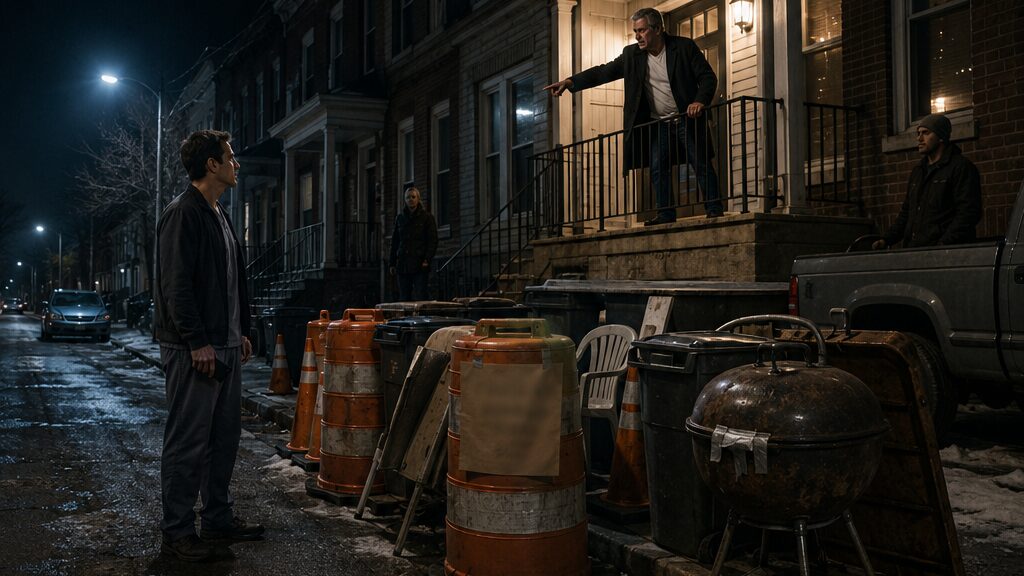
TOUCH IT AND FIND OUT was written in black marker beneath Patrick’s bedroom window.
The words appeared on a rectangle of white cardboard taped to an orange traffic barrel. Above them, in larger letters, someone had written RESERVED.
Patrick saw the sign when he pulled onto the block at twelve forty in the morning. There were eight barrels now, spaced along the curb like a construction barrier. Between them sat the rusted grill, two trash cans, three plastic chairs, a folding table, and several cones.
Nothing had been there when he left for work.
His car rolled slowly past his building. Behind a second-floor curtain, someone moved and then went still.
Patrick parked at the far end of the street and walked back with his phone in his pocket.
Robert was waiting on his porch.
He wore a dark coat over his undershirt and stood with both hands on the railing. Two neighboring homeowners had come outside as well. One remained near the white pickup. Another watched from the steps across the street.
The arrangement was too neat to be accidental.
Robert nodded toward the sign. “Should be clear enough now.”
Patrick stopped beside the first barrel.
“Did the city place these?”
Robert gave a short laugh. “You always need paperwork?”
“For traffic equipment in a public roadway? Yes.”
“They’re not in the roadway.”
Patrick looked down. The barrel’s base covered part of the painted parking line.
Robert came down one step. “Nobody’s stopping traffic.”
“You’re stopping parking.”
“We’re preserving access.”
“For whom?”
Robert glanced toward his front window. The light inside was dim, but Patrick could see the shape of the wheelchair again.
“My wife has home-care visits,” Robert said. “Drivers come at all hours. They need room.”
Patrick looked along the curb. The barriers covered nearly half the block.
“One space?”
Robert’s jaw moved. “It started with one.”
“And now?”
“Now we keep people from turning this street into a free lot.”
The man near the pickup spoke up. “We shovel. They don’t.”
Patrick did not turn toward him. “Do you have written authorization from the city?”
Robert spread his hands toward the watching neighbors. “You see this? This is what he does. He comes home in the middle of the night and interrogates people.”
Patrick heard the trap as clearly as if Robert had announced it.
If he raised his voice, the conversation would become proof of aggression. If he moved a barrel, the HOA would call it interference. If he retreated, the sign would remain.
He took out his phone.
Robert’s expression sharpened. “Nicole told you not to photograph residents.”
“I’m not photographing residents.”
Patrick framed the first barrel, the curb line, and the house number visible on the building behind it. The camera clicked.
“Object one,” he said.
For a moment, no one moved.
Patrick stepped to the second barrel.
Click.
“Object two.”
The homeowner across the street muttered something Patrick could not hear.
Robert descended the remaining porch steps. “Put the phone away.”
Patrick photographed the third barrel.
“Object three.”
“I’m speaking to you.”
Patrick turned the phone screen toward him. The image contained only the barrel, the curb, and a time stamp.
“Do you own this?”
Robert looked at the screen and then back at Patrick. “You know exactly what you’re doing.”
“Yes.”
That answer unsettled him more than denial would have.
Patrick continued down the line.
Object four was a cracked green trash bin.
Object five was a blue bin with one wheel missing.
Objects six and seven were plastic chairs weighted with bricks.
Object eight was the folding table.
The neighbors stayed outside. Their silence had changed. They were no longer waiting for Patrick to explode. They were watching him create a record.
At object eleven, headlights turned onto the street.
A white home-care van approached slowly, its roof light glowing pale blue. The driver stopped beside Robert’s house, but the barrels left no open curb. He lowered his window.
“Mr. Sanchez?”
Robert raised one hand and moved toward the street.
“You’ll have to pull around,” he called.
“There’s nowhere to stage,” the driver replied. “I need the lift side near the curb.”
Robert began dragging a chair aside. Its legs scraped loudly over the pavement. The man near the pickup moved a cone, then another, but the barrels were heavy and filled with sand.
The van remained angled in the traffic lane.
Patrick watched Robert struggle with the center barrel—the one carrying the warning. He could not move it alone. The base caught in packed snow near the gutter.
From inside the house came the dull sound of something striking a wall.
Robert froze.
The front door opened. A woman’s voice called his name.
The driver set his hazard lights and climbed out.
Patrick stepped toward the barrel.
Robert turned sharply. “Don’t touch it.”
Patrick stopped.
The words hung between them beside the sign that said the same thing.
The driver looked from Robert to Patrick, then walked around the van and entered the house with a folded wheelchair ramp under one arm.
It took eleven minutes to create enough space for the lift.
Patrick timed it without meaning to.
When Ruth finally appeared in the doorway, wrapped in a dark coat with a knit cap pulled low over her silver hair, she did not look at Patrick. Her attention stayed on the uneven path between the steps and the van.
Robert walked beside her chair, one hand on the handle and one lifted toward the driver as if directing traffic.
The warning barrel remained half in the street.
Patrick lowered his phone.
For the first time, the objects no longer looked merely absurd. They looked dangerous.
Robert returned after the van left.
“You saw why we need the space,” he said.
“I saw your barriers block the vehicle that needed it.”
“We didn’t know they were coming at this hour.”
“You said they come at all hours.”
Robert’s face darkened.
Patrick opened Nicole’s email on his phone. “Show me the city authorization.”
“I don’t have to show you anything.”
“So there isn’t one.”
“There is an understanding.”
“With whom?”
“The board.”
“The board does not own the curb.”
Robert took another step closer. The watching neighbors shifted but did not intervene.
Patrick felt the old instinct rise in him: stay calm, say less, record everything. Years earlier, when a charting error at the hospital had been blamed on him, he had learned what happened when memory stood against paperwork. He had been cleared only because a ventilator log proved when he entered the room.
Since then, he trusted timestamps more than explanations.
He lifted the phone again.
Click.
“Object twelve.”
Robert stared at him.
Patrick moved down the block, photographing each barrel, cone, chair, bin, table, and the grill. He included the threatening sign. He included the painted curb. In one frame, far in the background, his own car was visible three blocks away under a streetlamp.
At the grill, he paused.
Its lid was mottled with rust, but the handle had been repaired carefully. Someone had wrapped the tape in smooth overlapping bands.
“Object twenty-two,” Patrick said.
The last item was a small orange cone placed behind the white pickup.
He crouched to capture the cone, the license plate, and the curb line without including the watching man’s face.
“Object twenty-three.”
The camera clicked.
Robert stood in the center of the sidewalk, his breath visible.
“Now prove any of it belongs to me,” he said.
Chapter 3: Fourteen Nights Inside the Same Narrow Frame
The first barrel disappeared before sunrise and returned the next night two spaces farther down.
Patrick noticed because he had photographed a white scrape near its base. The mark curved like a thumbnail and showed clearly in both images.
He created a folder on his phone and named it CURB.
Night One contained twenty-three photographs.
Night Two contained nineteen. The folding table was gone, but the grill had moved in front of Patrick’s building. Two chairs had been replaced by trash bins.
Night Three contained twenty-one.
By Night Four, the objects had begun to look less like household property and more like pieces on a board. Their owners shifted them often enough to deny permanence, but never enough to release the curb.
Patrick recorded the time, temperature, location, and visible house numbers. He photographed from the same angles. Before each hospital shift, he checked his battery level. After each shift, no matter how tired he was, he walked the block.
The ritual steadied him.
At work, the night-shift colleague beside him noticed the spreadsheet open on his phone during break.
“You building a criminal case?”
“Parking complaint.”
The colleague leaned closer. “Against twenty-three suspects?”
“Twenty-three objects.”
“That sounds healthier.”
Patrick locked the screen.
On the fifth morning, another notice appeared beneath his apartment door. This one carried the HOA logo and Nicole Miller’s electronic signature.
It warned that photographing “resident-maintained areas” could constitute targeted harassment. The letter also referred to “association-regulated curb access.”
Patrick read that phrase three times.
Then he pulled up the city parcel map.
The HOA boundary ended at the sidewalk.
The curb and roadway belonged to the municipality.
He emailed Nicole one question: Please identify the governing document that grants the association authority over municipal curb parking.
She did not answer.
The next night, Jack Green was standing beside the rusted grill.
Jack lived in the end unit and had spent thirty years driving sanitation routes. He was a narrow man in his late sixties, with a gray mustache and shoulders permanently rounded from old work.
“You planning to collect that thing?” Jack asked.
“I’m documenting it.”
“I gathered that.”
Patrick raised his phone but did not take the photograph while Jack remained in frame.
Jack stepped aside. “Robert says you’re trying to get everybody fined.”
“Robert says a lot.”
“He’s not wrong about everything.”
Patrick photographed the grill.
Jack watched the screen. “You call right-of-way enforcement, they won’t sort family history from garbage. If the inspector tags these as abandoned obstruction, sanitation takes them.”
“That is the point.”
“Maybe.”
Patrick looked at him.
Jack rubbed one glove over the taped handle. “A crew sees a list. Barrel. Chair. Grill. They don’t see who carried it out or why somebody kept it.”
“Are you telling me it’s Robert’s?”
“I’m telling you removal is removal.”
Patrick waited for more, but Jack walked away.
On Night Seven, a freezing rain glazed the sidewalk. Patrick found Ruth Sanchez outside beneath the porch light, seated in her wheelchair with a blanket over her lap.
The home-care van was stopped in the traffic lane again.
The driver and Robert were trying to move two sand-filled barrels. One had frozen to the pavement.
Patrick stood under the awning of his building and took a photograph.
The frame captured the van’s rear corner, the hazard lights reflected on wet asphalt, and Robert bent over the barrel. Ruth was mostly hidden behind him.
The driver called for help.
Patrick took two steps forward.
Then Robert saw him.
“We’ve got it,” Robert said.
Patrick stopped.
The driver looked at him, then at Robert. After a moment, he returned to the barrel.
It took six more minutes to clear the lift.
Ruth’s face was pale from the cold.
Patrick photographed the open curb after the van left.
That image became number twelve in the folder.
By Night Ten, Nicole finally replied.
The association, she wrote, had historically recognized winter curb practices “in the interest of community stability.” She did not cite a declaration, rule, city agreement, or ordinance. She closed by warning that continued escalation could result in legal review at Patrick’s expense.
Patrick printed the email at the hospital.
He highlighted historically recognized and association-regulated curb access. Then he searched the municipal code during his break.
The relevant section appeared under obstruction of public rights-of-way.
No person could place chairs, cones, receptacles, furniture, equipment, or other objects in a public street for the purpose of reserving parking. Temporary emergency and permitted construction uses were exempt.
Patrick read it twice.
He found the permit database next.
No permit existed for Robert’s address, the HOA, or the block.
For the first time in days, he felt something close to relief. The rule was plain. Nicole’s language was not.
He saved the ordinance as a PDF and added it to the folder.
On Night Eleven, there were twenty-three objects again.
On Night Twelve, twenty.
On Night Thirteen, Robert moved the warning sign from the barrel to the grill. The cardboard had softened from damp, and the marker had bled around the words.
Patrick photographed it anyway.
By Night Fourteen, his gallery contained more than two hundred images.
He sat at his kitchen table after one in the morning, arranging them by date. The apartment was quiet except for the refrigerator motor and the occasional hiss of tires over wet pavement.
Each image proved something.
The objects were deliberate.
They moved between spaces.
They appeared in front of the same homes.
Robert and the other homeowners handled them.
Nicole had warned Patrick away while claiming authority the HOA did not possess.
The record was complete.
He opened the city’s 311 portal and began a report.
Address.
Dates.
Number of objects.
Applicable ordinance.
He attached the first ten photographs, then paused.
On the small preview of Night Seven, the home-care van’s hazard lights glowed behind a barrel. Ruth’s blanket was visible at the edge of the frame.
Patrick enlarged the image.
He had been there.
He had watched.
He had told himself that touching the barrel would let Robert accuse him of interference. He had told himself the driver had not asked him directly. He had told himself complete evidence would prevent future problems.
The photograph did not contain any of those explanations.
It contained a woman waiting in freezing rain.
Patrick closed the report without submitting it.
The next morning, he went to the municipal records counter before work. A clerk confirmed that the curb was public and that no accommodation permit had ever been requested for the Sanchez address.
“Can a temporary loading restriction be created for medical transport?” Patrick asked.
“With an application and supporting need, sometimes. Transportation division reviews it.”
“How long?”
“Depends.”
“Days?”
“Usually longer than that.”
Patrick looked at the ordinance printout in his hand.
“What happens if someone reports repeated objects?”
“Inspection first. If confirmed, removal notice or immediate abatement depending on hazard.”
“And fines?”
The clerk pointed to the penalty section.
Patrick read the line.
Up to $75 per item, per calendar day.
He calculated once, then stopped before reaching a total.
The number was large enough to change the nature of the conflict. It was no longer about a parking space or even twenty-three objects. If the city applied the maximum across the documented period, the consequence could reach far beyond anything Robert appeared to expect.
Patrick folded the ordinance and placed it inside Nicole’s two HOA notices.
For fourteen nights, he had been collecting proof that the neighbors were wrong.
Now the same file was asking what he intended to do with the power of being right.
Chapter 4: The Rule Robert Never Asked Ruth to Read
“Why have you been photographing my house every night?”
Ruth Sanchez sat just inside the open front door with one hand resting on the wheel of her chair. Robert was not beside her. That absence made the question harder to answer.
Patrick had crossed the sidewalk intending only to return a piece of mail delivered to his building by mistake. Ruth’s name was visible through the envelope window. He still held it between two fingers.
“I wasn’t photographing your house,” he said.
Ruth looked past him toward the curb. The rusted grill stood in the nearest space, flanked by a barrel and a blue bin.
“You were pointing the phone this way.”
“I was documenting the objects.”
“That sounds like a distinction people make when they don’t want to say yes.”
Patrick handed her the envelope.
Up close, she looked smaller than she had through the van window. Her silver hair was cut to her jaw. A narrow plastic tube ran beneath her nose and disappeared under the collar of her sweater. The wheelchair was not the temporary hospital model Patrick had assumed. It had a fitted cushion, worn hand rims, and a small oxygen holder attached behind the seat.
Ruth glanced at the envelope, then back at him.
“Robert says you’re trying to have us fined.”
“I filed nothing yet.”
“Yet.”
Patrick could have left. Robert’s porch camera was angled toward the door, and every conversation on the block seemed to become an HOA record by evening.
Instead, he took out his phone and opened the folder.
“I’m trying to establish what’s happening.”
Ruth held out her hand.
Patrick hesitated, then gave her the phone.
She moved through the images slowly.
Barrels. Chairs. Bins. Cones. The folding table. The grill.
In each photograph, the objects were sharp and centered. House numbers appeared where Patrick needed them. Time stamps sat beneath each frame. The photographs showed placement, repetition, and intent.
Ruth stopped at the image from the freezing-rain night.
The home-care van glowed in the background. Robert was bent over a barrel. Ruth herself appeared only as a wedge of dark blanket behind his shoulder.
“You took this while I was waiting?”
Patrick did not answer quickly enough.
Ruth enlarged the image with two fingers.
“You can barely see me.”
“The barriers were the subject.”
“Yes,” she said. “I can tell.”
She returned the phone.
Patrick put it away.
“Robert said the space was for your care visits.”
“One space was.”
The answer landed differently from Robert’s claim.
Ruth rolled backward to clear the doorway. “You might as well come in. He’s at the management office trying to make this disappear.”
Patrick stepped into the front room.
A portable ramp leaned against one wall. Medication bottles were arranged in a shallow basket beside the sofa. On a shelf above the television stood a photograph of a younger man beside Robert, both of them holding grilling tongs and laughing over the rusted grill before rust had taken most of its surface.
Patrick looked away before Ruth noticed.
She did anyway.
“Our son,” she said. “Alexander.”
Patrick remained standing.
“He died six years ago. Robert hasn’t cooked on that thing since.”
Outside, the grill’s taped handle was visible through the window.
Ruth followed his gaze. “That does not make it a legal parking permit.”
The bluntness surprised him.
She turned her chair toward the kitchen table. A stack of home-care forms sat beneath a ceramic mug.
“The first time the transport van couldn’t get close, I missed a pulmonary appointment,” she said. “The second time, they tried to move me across packed snow. The chair tipped. I wasn’t hurt badly, but Robert was there.”
“He applied for a loading restriction?”
“He told me he did.”
Patrick looked at the forms.
“Did you sign anything?”
“No.”
“Did the city inspect the curb?”
“Not that I know.”
Ruth pressed her thumb against the edge of the wheel. “He put out one old kitchen chair the next week. The driver pulled into that space. It worked.”
“And then one chair became twenty-three objects.”
“One chair became an idea Robert liked too much.”
The front door opened behind them.
Robert entered carrying a black binder. When he saw Patrick, his expression tightened.
“What are you doing in here?”
“I invited him,” Ruth said.
Robert looked at the phone in Patrick’s hand, then at the papers on the table. “You need to leave.”
Patrick remained where he was. “Did you submit an accommodation request?”
“I handled it.”
“That isn’t an answer.”
Robert placed the binder down with more force than necessary. “I spoke to Nicole. The board agreed we would maintain access.”
“The board cannot reserve a city curb.”
“The city never came when we called.”
Ruth turned toward him. “You told me they approved it.”
“I told you it was handled.”
“That is not the same sentence.”
Robert’s shoulders lowered slightly, but his voice stayed firm. “You missed two appointments. One driver left you in the cold. I fixed the problem.”
“You expanded it.”
“Because people ignored the chair.”
“So you added cones.”
“They moved those.”
“You added barrels.”
“They stopped moving them.”
Patrick heard the logic build itself one concession at a time. Each step had solved the failure of the previous one until Robert no longer saw the street—only resistance requiring a stronger barrier.
Robert faced Patrick. “You think a form would have protected her?”
“I think a form would have told the city what was needed.”
“And while they reviewed it?”
Patrick had no answer that did not sound theoretical.
Robert picked up the binder. “Exactly.”
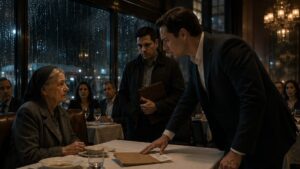
At the property-management office that afternoon, Nicole Miller closed the glass door before Patrick reached the reception desk.
He knocked once.
She opened it only wide enough to speak through.
“This is not a good time.”
“Robert is here?”
Her eyes shifted toward the conference room.
Patrick held up the municipal parcel map and the two notices she had sent him.
“I need the authority cited for these.”
Nicole lowered her voice. “The language was intended to de-escalate.”
“It threatened legal review.”
“You were documenting residents late at night.”
“I was documenting public obstructions.”
She glanced behind her again.
Patrick placed the notices against the glass. “You called the curb association-regulated.”
Nicole’s jaw tightened. “Robert said there was a board understanding.”
“With the city?”
“With the community.”
“That is not jurisdiction.”
The conference-room door opened.
Robert stood inside with two board members seated behind him. His binder was open on the table.
Nicole stepped into the hallway and pulled the office door shut behind her.
“All right,” she said. “The HOA does not own the curb.”
Patrick waited.
“There was never a municipal agreement.”
“Then why send the notices?”
“Because Robert said the saved space had existed for years without complaint. He said formal enforcement would create an accommodation issue and expose the association.”
“So you protected him.”
“I protected the contract.”
She said it without pride.
Nicole folded her arms. “He is the board president. My company can be replaced with thirty days’ notice. He wanted language strong enough to discourage interference.”
“And the other spaces?”
Her silence answered before she did.
“He kept expanding the arrangement,” she said. “Other homeowners wanted the same privilege. He told me consistency was safer than admitting the first space had never been authorized.”
Patrick looked through the glass at Robert.
The system had not grown from a rule. It had grown from a favor no one wanted to name, then hardened because naming it would expose everyone who had benefited.
At the municipal records counter the next morning, Patrick submitted the photographs for preliminary review.
He did not request maximum penalties. He asked for verification of jurisdiction and removal options.
The right-of-way inspector called him less than two hours later.
“I’ve reviewed enough to conduct a site visit,” the inspector said. “The objects constitute an active obstruction.”
“What happens next?”
“We can issue notices. Given the traffic barrels, the threatened interference, and the blocked transport vehicle, immediate abatement is also available.”
Patrick looked at photograph twelve on his screen.
“When?”
“Tomorrow morning. Five o’clock.”
Patrick’s grip tightened around the phone.
“I’ll need the complete fourteen-day file before then,” the inspector continued. “All original images, including metadata. The duration affects how the violations are assessed.”
Patrick looked through his apartment window.
Robert was outside moving the rusted grill into the space nearest his front steps.
At five the next morning, the city would take it.
By then, Patrick had to decide whether to send everything.
Chapter 5: At Five Oh Four the Street Began to Empty
The sanitation truck turned onto the block at 5:04 a.m. without flashing lights or sirens.
Its diesel engine filled the narrow street before anyone opened a door.
Patrick watched from his apartment window as six workers stepped down in reflective jackets. The right-of-way inspector arrived behind them in a city sedan and unfolded a clipboard beneath the streetlight.
Patrick had sent the full file at 3:17.
Every original photograph. Every time stamp. Every geolocation record. Nicole’s notices. The municipal parcel map. The images of the home-care van.
He had attached no recommendation about penalties.
That omission felt less neutral now than it had two hours earlier.
The crew began at the far end of the block.
A worker lifted the first cone and tossed it into the truck. Another rolled a trash bin toward the hydraulic lift. The plastic chair beside the white pickup cracked when it struck the metal floor.
Lights came on across the street.
By 5:07, the first front door opened.
The homeowner with the white pickup came outside in sweatpants and demanded to know who had authorized the removal. The inspector pointed toward the notices taped to each object and explained that public-right-of-way obstructions were being abated.
“I never saw a notice.”
“It was posted yesterday afternoon.”
“It was dark when I got home.”
“The posting period was not required in this case.”
The man reached for a cone. A sanitation worker placed one gloved hand between him and the truck.
“Sir, step back.”
Robert’s door opened at 5:09.
He came out fully dressed, as though he had not slept. Ruth remained inside behind the storm door.
Robert took in the barrels, the workers, and the inspector’s sedan. Then he looked up at Patrick’s window.
Patrick stepped away from the glass.
He did not want to hide, but he also did not want the first exchange to occur with Robert shouting upward from the sidewalk.
He pulled on his coat and went downstairs.
By the time he reached the curb, four barrels were already inside the truck.
Robert stood in front of the center barrel, the one that had carried the threatening sign.
“You can’t take these,” he said.
The inspector held out a copy of the ordinance. “They are unpermitted objects placed for the purpose of reserving public parking.”
“They’re temporary.”
“We have documentation covering fourteen consecutive days.”
Robert turned toward Patrick.
There was no confusion in his face. Only recognition.
“You sent him everything.”
Patrick stopped beside the inspector. “I reported the obstruction.”
“You waited two weeks.”
The accusation struck more precisely than Robert knew.
The sanitation supervisor signaled, and two workers moved toward the barrel.
Robert did not step aside.
“Mr. Sanchez,” the inspector said, “interference may result in a separate citation.”
Ruth opened the storm door.
“Robert.”
He looked back.
She remained inside, one hand braced against the frame. The oxygen tube ran beneath her nose.
“Move,” she said.
Robert stood still another second, then stepped onto the sidewalk.
The workers tilted the barrel onto a dolly.
Patrick watched each object disappear.
Every cone.
Every chair.
Every bin.
The folding table collapsed under its own weight when a worker lifted it. A rusted hinge broke, and the two halves were carried separately.
The street opened in sections. Empty pavement appeared where the improvised boundaries had been. Cars could have parked there immediately, but none did. The cleared spaces looked unnaturally wide.
At 5:15, only the grill remained.
It stood beside Robert’s steps, black lid mottled orange with corrosion, gray tape wrapped neatly around the handle.
The sanitation supervisor gripped one side.
Robert said, “Wait.”
No one moved.
He approached the grill but did not touch it.
“That one isn’t mine,” he said.
Patrick remembered his challenge beneath the warning sign: Prove any of it belongs to me.
The inspector checked the tag. “It was placed in the right-of-way.”
“It belongs to my son.”
Ruth made a small sound behind the door.
Robert corrected himself.
“It belonged to my son.”
The block went quiet except for the truck engine.
One worker looked toward the supervisor. The supervisor shook his head once.
“If it’s in the abatement order, it goes,” he said.
Robert placed his hand on the taped handle. His fingers remained there.
Patrick saw the photograph from Ruth’s shelf: Robert and Alexander beside the same grill, both laughing, smoke rising between them.
“This has nothing to do with him,” Robert said to Patrick.
“No,” Patrick answered. “It doesn’t.”
Robert looked at him as if he had expected triumph and did not know what to do with its absence.
The inspector stepped closer. “You need to release the item.”
Robert’s grip tightened.
Ruth opened the door fully.
“Robert,” she said again.
This time, her voice was softer.
He let go.
The workers rolled the grill toward the truck. One wheel wobbled violently. Halfway to the lift, it slipped off the axle and spun across the pavement.
Jack Green, watching from his porch, stopped it with his boot.
The crew lifted the grill.
Metal struck metal.
Robert did not look away.
Patrick raised his phone.
The screen framed Robert in the foreground and the grill rising behind him.
Before Patrick pressed the shutter, Ruth spoke.
“Please don’t.”
Patrick lowered the phone.
At 5:18, the last barrel disappeared into the truck.
Fourteen minutes after the crew began, the curb was empty.
The sanitation truck pulled away, leaving damp rectangles, crushed salt, and a single loose grill wheel near Jack’s shoe.
For a few seconds, the result was exactly what Patrick had wanted.
The public street was public again.
No signs. No threats. No household junk pretending to be law.
Then a white home-care van turned the corner.
It slowed near the Sanchez house.
There was now plenty of curb, but two residents who had come outside during the removal had already moved their vehicles into the newly opened spaces. One car sat directly in front of Robert’s steps.
The van stopped in the traffic lane.
The driver lowered the window. “I need the lift side clear.”
Robert looked along the curb as though the city had removed not only his objects but his ability to think.
The inspector checked his watch. “The spaces are first come, first served.”
“My wife has an appointment,” Robert said.
“That does not authorize reservation.”
The driver turned on the hazard lights.
Patrick looked at Ruth behind the storm door. She had closed her eyes.
Removal had ended the illegal system. It had not created a legal alternative.
Robert moved toward the parked car and struck the driver’s window with the flat of his hand. The startled resident lowered it.
“You need to move.”
“I just parked.”
“My wife needs access.”
“So did everybody else when your barrels were out.”
The exchange sharpened instantly.
Patrick stepped between them.
“Stop.”
Robert turned on him. “You wanted the curb open.”
“I wanted the obstructions gone.”
“Same thing, right?”
“No.”
The word surprised both of them.
Patrick went to the van and spoke with the driver. They found enough room near the fire hydrant for a temporary angle, though the lift extended partly into the lane. Patrick stood behind the van in his reflective hospital jacket and directed approaching cars around it until Ruth was secured inside.
No one thanked him.
After the van left, the inspector handed Patrick a printed acknowledgment of the abatement.
“The evidence supports daily violations,” he said. “We need to know whether you are affirming the full fourteen-day period.”
“Why do you need me to affirm it? The metadata is there.”
“Because several images show changed object counts and uncertain ownership. Your statement ties the sequence together.”
Patrick looked at Robert.
He stood beside the empty curb, holding nothing.
“What does affirmation trigger?”
“Formal penalty review. Maximum exposure is calculated per item, per day, though final assessment is discretionary.”
Patrick did not ask for the total.
The inspector handed him a card.
“Call before noon. If you do not affirm the duration, we proceed on the confirmed inspection date and the immediate-abatement costs.”
“And if I do?”
“All documented days remain available.”
Robert heard every word.
Patrick placed the card in his pocket.
It was 5:31 a.m.
By noon, he had to decide whether the fourteen nights were evidence of a continuing violation—or a weapon he was finally willing to use.
Chapter 6: The Evidence Included What Patrick Had Ignored
Photograph twelve showed Ruth’s van in the background.
Patrick noticed the detail at 8:46 that morning in an empty consultation room at the hospital.
He had opened the image to verify its date. Instead, he saw the driver standing beside the frozen barrel, one hand lifted toward Patrick.
At first Patrick thought the driver was pointing at Robert.
Then he enlarged the frame.
The driver was looking directly at the camera.
At Patrick.
His free hand was open, palm upward—the ordinary gesture of someone asking for help.
Patrick had cropped his memory more tightly than the photograph.
He remembered Robert saying, We’ve got it. He remembered deciding that stepping forward would create another confrontation. He remembered the logic clearly.
The image showed something else.
A man had asked for help. Ruth had waited in freezing rain. Patrick had remained beneath the awning because he wanted the record uncontaminated.
The door opened.
His night-shift colleague leaned in. “They need this room in five.”
Patrick nodded.
The colleague noticed the photograph. “That the parking case?”
“Yes.”
“Looks like somebody needed a hand.”
Patrick locked the phone.
At ten, Nicole called.
“The city sent a proposed corrective agreement,” she said. “They want everyone at the HOA room by eleven.”
“I’m working.”
“They said the penalty decision is due at noon.”
Patrick looked through the consultation-room glass toward the respiratory unit. His supervisor had already approved an hour away after hearing the phrase municipal deadline.
“I’ll be there.”
The HOA meeting room smelled of copier toner and burnt coffee. Robert sat at the end of the table with both hands folded over the black binder. Ruth was beside him. Nicole had arranged copies of the agreement at each chair.
The right-of-way inspector stood near the wall.
Jack occupied the final seat, invited as a resident adviser because of his sanitation experience. He gave Patrick a brief nod.
Nicole began without ceremony.
“The city is willing to suspend review of accumulated daily penalties if the association and responsible residents enter a corrective agreement today.”
Robert opened the binder. “There are no responsible residents identified.”
The inspector slid a page toward him. “There are photographs of you placing and moving several objects.”
“Several is not twenty-three.”
“No,” Patrick said. “It isn’t.”
Robert looked at him.
Patrick set his phone on the table but did not open the gallery.
Nicole continued. “The agreement requires removal of all private parking markers, withdrawal of the HOA notices sent to Patrick, reimbursement of abatement costs, and adoption of a written policy recognizing municipal jurisdiction.”
“And?” Robert asked.
Nicole’s silence made the next condition visible before she spoke.
“You resign as parking chair.”
Robert leaned back.
“No.”
Ruth turned toward him. “Read the rest.”
“I heard enough.”
“The city will also help review a timed medical loading zone,” Nicole said. “It would not be reserved all day. It would apply during verified care windows.”
Robert tapped one finger against the binder.
“So after everything, we ask permission to use the space in front of our own house.”
“It is not your space,” the inspector said.
Robert looked at Patrick. “You hear how easy that is for him? He walks in with a code section, and suddenly everybody talks like the last six months never happened.”
Patrick remained quiet.
Robert’s voice lost some of its hardness.
“The first van left,” he said. “Did Ruth tell you that? The driver looked at the snow and left. The second one tried to unload her halfway down the block. Her chair tipped. She hit the side of the lift.”
Ruth stared at the agreement.
“I called transportation. I called the city. I called the management office. Every person gave me another number.”
“You never filed the application,” Patrick said.
“I stopped asking.”
“That is not the same as being denied.”
“No. It is what happens before you admit nobody is coming.”
The room stayed still.
Robert opened the binder and removed several pages. Call logs. Printed emails. A handwritten list of departments and extension numbers.
He pushed them across the table.
Patrick read the dates. Robert had made calls. More than he had admitted. None had become a formal application, but the attempts were not imaginary.
“I put out one chair,” Robert said. “The van got in. Next week somebody moved it. So I used cones. They moved those too. The barrels worked.”
“And then you gave other owners spaces,” Nicole said.
Robert’s face closed again. “They helped keep ours clear.”
“You threatened Patrick,” Ruth said.
“I warned him.”
“You used me as the reason.”
“You were the reason.”
“No.” Ruth’s voice remained low. “I was the beginning.”
Robert looked at her.
She pressed one hand flat on the agreement. “You liked that people stopped arguing with you.”
He did not deny it.
That silence changed the room more than an admission would have.
Patrick unlocked his phone.
“I have two hundred seventeen images,” he said. “They establish repeated obstruction. They also show the van blocked on Night Seven.”
The inspector nodded. “That supports the hazard finding.”
“They show something else.”
Patrick turned the phone toward the table.
The driver’s raised hand was visible at the edge of the frame.
“He asked for help,” Patrick said. “I stood there and took the picture.”
Robert frowned, uncertain whether this was strategy.
Patrick continued. “I told myself I was avoiding escalation. I told myself the evidence had to be complete. But I let a dangerous situation continue because documentation felt safer than getting involved.”
Nicole looked down.
Jack watched Patrick without expression.
“I will affirm that the obstruction continued for fourteen days,” Patrick said.
Robert’s chair creaked as he shifted.
“But I am not requesting maximum penalties. I support suspension if the agreement is signed, the notices are withdrawn, the city’s costs are paid, and the loading-zone application is filed today.”
The inspector folded his arms. “The complainant does not control enforcement.”
“I understand.”
“But your requested remedy can be included in the record.”
Nicole pulled the two HOA notices from her folder.
“I’ll issue a written withdrawal to every resident who received or relied on these,” she said. “The board minutes will state that the association has no curb authority.”
It was not an apology. It was better than vague regret and less than full accountability.
Patrick accepted it.
The inspector pointed to the signature lines. “If all parties sign, accumulated penalties remain suspended during compliance. A future violation reinstates review.”
Jack picked up the loading-zone application. “I can help mark the turning radius. The van doesn’t need a whole-day reservation. It needs a clear window and enough lift space.”
Ruth nodded. “That is what I wanted.”
Robert looked at each person in turn.
Then he read the condition requiring his resignation as parking chair.
“No,” he said again.
Ruth closed her eyes.
Nicole leaned forward. “Robert, the board cannot preserve your enforcement role after you directed unauthorized notices.”
“I kept this block functioning for nine years.”
“You also told me to describe a city street as association-regulated.”
“Because nobody else would protect the people who live here.”
Patrick looked at the black binder, the call logs, the photographs on his phone, and the blank signature line.
Robert had needed help and refused to ask in a way that allowed anyone to say no. Patrick had needed certainty and refused to act until no one could dispute him.
Different fears. The same hunger for control.
The inspector checked the wall clock.
11:43.
“If the agreement is not signed by noon,” he said, “the suspended-penalty offer expires.”
Ruth placed the pen beside Robert’s hand.
He did not pick it up.
At 11:51, Nicole signed.
At 11:54, Ruth signed the accommodation application.
At 11:57, Patrick affirmed the fourteen-day record and attached his remedy statement.
Robert sat before the final signature line.
The second hand crossed twelve.
He pushed the agreement away.
“I will pay for the truck,” he said. “I will remove the objects. But I am not resigning because a tenant decided to teach the neighborhood a lesson.”
The inspector gathered the unsigned pages.
“Then there is no agreement.”
Robert’s refusal did not restore the barrels or return the grill.
It did something worse.
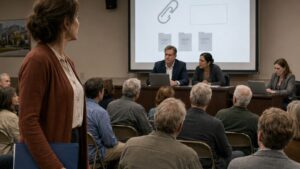
It reopened every penalty Patrick had tried not to unleash.
Chapter 7: The Curb Became Public Before Anyone Forgave Anyone
“Robert did not do all of this for me.”
Ruth’s voice carried farther than Patrick expected in the HOA meeting room. Conversations stopped. One board member lowered a paper halfway to the table. Robert, seated beside her, turned as if she had spoken from across the street rather than two feet away.
The hearing had been scheduled one week after the failed agreement. During that week, formal penalty notices had arrived at the Sanchez home and two neighboring houses. The amounts were not final, but they were large enough that Robert had begun calling them an attempt to force longtime owners out of the community.
Nearly every chair was occupied.
Patrick sat near the wall with his phone in his coat pocket. Nicole had placed printed copies of the photographs in three binders on the front table, though no one had opened them yet. The right-of-way inspector stood beside a city transportation representative. Jack waited near the back with a rolled curb diagram beneath one arm.
Robert leaned toward Ruth.
“You don’t need to do this.”
“Yes,” she said. “I do.”
He glanced around the room, aware of every face watching him. “You know why I put the chair out.”
“I know why you put out the first chair.”
Ruth rested both hands on her wheels.
“The chair helped the van stop near the ramp. I was grateful. Then someone moved it, and you added cones. When they moved those, you added barrels. Then the Bakers wanted a space. Then the other house wanted one. After that, this stopped being about my appointments.”
A board member cleared his throat. “Mrs. Sanchez, the concern was consistent enforcement.”
“There was no enforcement,” Ruth said. “There were favors.”
Robert’s jaw tightened.
“I was protecting you.”
“You were protecting the arrangement.”
The room remained quiet. No one applauded. No one shifted to comfort either of them.
Ruth looked toward Patrick.
“And he was not protecting me either.”
Patrick felt the attention turn.
She did not say it cruelly. That made it harder.
“He saw the van blocked,” she continued. “He took a picture.”
Patrick stood before anyone asked him to.
The HOA president’s chair at the front remained technically Robert’s, but Nicole had placed a second microphone on the side table. Patrick walked to it without bringing the binders.
“My complaint was accurate,” he said. “The curb was public. The objects were illegal. The association had no authority to issue the notices it sent me.”
Nicole looked down at the written withdrawal she had distributed that morning.
Patrick continued.
“I also had enough information before Night Fourteen to know the barriers were interfering with medical transportation. I waited because I wanted a complete record.”
Robert gave a humorless laugh. “Now he admits it.”
Patrick looked directly at him.
“Yes.”
The single word removed the argument Robert had prepared.
Patrick took his phone from his pocket and opened photograph twelve. He did not hold it up.
“The driver asked for help. I stayed under the awning because I believed touching anything would damage my complaint. That was a choice. It was not neutrality.”
The city representative made a note.
Patrick’s hand tightened around the phone.
“I support enforcement of the removal costs and the confirmed inspection-day violations. I am asking the city to suspend the accumulated fourteen-day penalties if the corrective agreement is signed today.”
A murmur passed through the room.
One homeowner turned toward Robert. Another looked at Patrick as though he had misunderstood the request.
Robert’s expression did not soften.
“You think that makes you generous?”
“No.”
“Then what does it make you?”
“Responsible for what I ask the evidence to do.”
Patrick placed the phone face down on the table.
The right-of-way inspector stepped forward. “The department retains final authority. However, the city is prepared to accept the revised agreement. Suspension remains conditional on full compliance. Any repeated obstruction will reopen the accumulated review.”
Nicole read the conditions aloud.
The HOA would acknowledge in its official minutes that it held no authority over municipal curb parking. Every prior warning based on the invented winter-parking arrangement would be withdrawn. The association would reimburse the city’s abatement costs from its general operating reserve, then recover documented shares from the residents who had placed objects.
A transparent complaint process would replace informal enforcement.
Robert would resign from the parking committee and could not direct property-management notices for one year.
The transportation department would establish a timed loading zone during Ruth’s verified care windows. It would not belong to the Sanchez household. Outside those hours, anyone could park there.
Nicole finished reading.
Robert stared at the signature page.
“You still want me removed.”
Patrick shook his head. “I want you unable to do this again.”
“That is the same thing dressed up.”
“No,” Ruth said. “It isn’t.”
Robert turned toward her.
She held his gaze.
“If you say this was all for me, I will oppose the agreement.”
His face changed.
Not dramatically. His shoulders lowered by less than an inch, and his hand moved away from the binder. But Patrick saw something give way: not Robert’s certainty that he had been treated unfairly, but his belief that Ruth would continue carrying the moral weight of his choices.
Robert looked around the room.
The homeowners who had followed his system avoided his eyes. Nicole waited with the pen. The board members remained silent.
Finally he said, “I should have filed the application.”
Ruth did not rescue him from the rest.
“I should not have told Nicole to send those notices,” he added. “And I should not have put that sign on the barrel.”
His eyes moved toward Patrick.
“I am not apologizing for needing the space.”
Patrick nodded. “You shouldn’t.”
Robert seemed almost irritated by the agreement.
“I am apologizing for acting like needing it made the curb mine.”
It was not a complete apology. It did not address the threat, the class insult, or the fourteen nights Patrick had walked home from three blocks away.
It was enough to make the next action possible.
Robert signed.
The hearing did not end cleanly. Two homeowners objected to paying removal costs. One board member argued that Nicole’s company should absorb part of the expense. Nicole accepted responsibility for the false wording but refused to accept sole blame for instructions documented in Robert’s emails.
The dispute continued for another forty minutes.
By the time they stepped outside, the late-winter snowbanks had collapsed into gray piles. Jack unrolled his diagram on the hood of a parked car.
The proposed loading zone covered twenty-eight feet near the Sanchez ramp. A small city sign would restrict parking only during Ruth’s scheduled transport periods. No chairs, cones, barrels, or household objects would be permitted.
The transportation representative measured the lift radius while the home-care driver tested the angle.
The van stopped once, close to the curb.
The side lift opened without entering the traffic lane.
Ruth watched from the sidewalk.
“That would have worked,” Robert said.
Jack kept his eyes on the tape measure. “Most proper things take longer than improper ones.”
Robert did not respond.
Early spring arrived slowly.
The city installed the timed-loading sign. Nicole mailed the notice withdrawals and included a plain explanation of municipal jurisdiction. Robert resigned from the parking committee but remained on the board, quieter than before and no longer seated at the center of every meeting.
No one placed another object in the street.
One night after his hospital shift, Patrick turned onto the block at twelve thirty-eight.
Three legal spaces were open.
He parked directly in front of his building and sat behind the wheel for a moment. The curb looked wider without the grill, though the white paint was the same as it had always been.
He reached for his phone.
The habit was automatic.
Open the camera. Frame the curb. Record the proof.
Before he pressed the shutter, he stopped.
Across the street, Robert was helping Ruth down the portable ramp toward the waiting van. He checked the city sign, then moved aside as the driver positioned the lift. No barrels had been needed. No one had been ordered away.
Patrick closed the camera.
Jack stood near his porch holding something round and black beneath one arm.
“Thought this belonged over there,” he said.
He crossed the street and handed Robert the loose grill wheel.
“The crew supervisor found it after the truck pulled out,” Jack explained. “A detached part wasn’t listed as an abated item. Took me a week of phone calls to get somebody to release it.”
Robert turned the wheel in his hands. Rust dust darkened his palms.
For a moment, Patrick expected him to say the grill should never have been taken. Instead, Robert ran one thumb along the worn rubber edge.
“Alexander replaced this wheel twice,” he said. “Kept buying the wrong size.”
Ruth smiled faintly from the van doorway. “He said the wobble gave it character.”
Robert looked at Patrick.
There was no forgiveness in his expression, but there was no challenge either.
“You working tonight?” he asked.
“Just finished.”
Robert nodded toward the open space behind Patrick’s car. “Good spot.”
Patrick glanced at the empty curb.
“It is.”
The van doors closed. Jack returned to his porch. Robert carried the salvaged wheel inside with both hands.
Patrick walked toward his building without taking a final photograph.
Behind him, the curb remained open—not because anyone had surrendered their need, and not because everyone had forgiven one another, but because no one was allowed to turn that need into ownership again.
The story has ended.