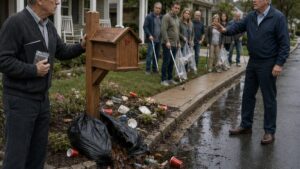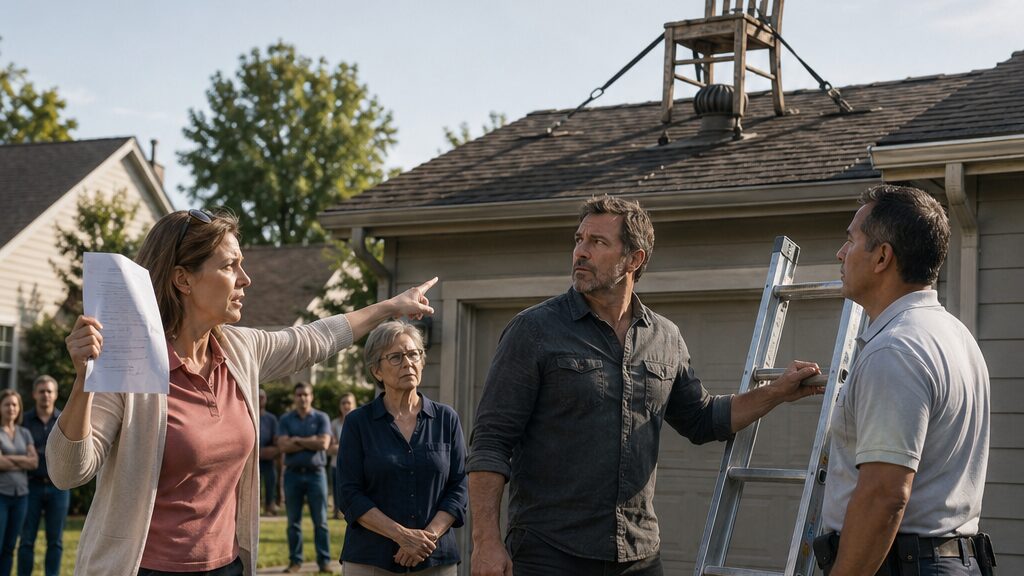
The Chair on Robert’s Roof Looked Ridiculous Until the HOA Learned What It Was Protecting
Chapter 1: The Chair Everyone Could See From the Street
Carol Johnson was standing in Robert Moore’s driveway when he came around the side of the house, holding her phone in both hands and aiming it at his roof.
She did not lower it when she saw him.
“Morning,” Robert said.
The camera shutter clicked.
He stopped beside his work van, one hand still on the side door. Above them, against the pale blue Monday sky, an old wooden chair sat near the rear slope of his roof as if someone had carried it up there for a better view and forgotten to come back down.
From the street, it looked ridiculous.
Robert knew that.
The chair had once been dark brown. Years of sun had bleached the back slats gray, and one front leg sat slightly higher than the other because of the metal bracket beneath it. Two black straps crossed low over the seat frame and disappeared toward mounting points near a discontinued vent.
Carol zoomed in.
“Could you not?” Robert said.
She finally lowered the phone. “Could I not photograph the dangerous object visible from a public street?”
“You’re in my driveway.”
“I stepped six feet in because your maple blocks the angle.”
“That doesn’t improve the sentence.”
Carol pressed her lips together. She wore walking shoes, black sunglasses, and the expression she used at HOA meetings when someone had failed to read an attachment.
Robert had known her for nine years. They had exchanged borrowed tools, misdelivered packages, and exactly one dinner invitation, which neither had repeated.
She pointed at the roof.
“Why is there a chair up there?”
Robert looked where she pointed, though he had already checked it before sunrise.
Every morning, before coffee, he went into the backyard and stood near the fence until he could see the rear strap, the left leg, and the narrow shadow beneath the seat. If the wind had shifted anything, he wanted to know before the neighborhood woke.
This morning, nothing had moved.
“It’s supposed to be there,” he said.
Carol stared at him.
“That’s your explanation?”
“It’s the one I’m giving you.”
“Robert, nobody puts a chair on a roof.”
“Apparently somebody does.”
Her jaw tightened. “People are talking about it.”
He glanced toward the street. A garage door two houses down was open. Someone inside moved behind a parked SUV, slow enough to be listening.
“Then they’ve got a subject for the morning.”
“This isn’t funny.”
“I didn’t laugh.”
Carol lifted the phone again, not quite taking another picture. “We have exterior standards.”
“You’re the board secretary. I’m aware.”
“We also have a provision against unsecured objects.”
“It’s secured.”
“You expect me to take your word for that?”
“No.”
“Then show me.”
Robert’s hand left the van door.
The change was small, but Carol noticed. Her shoulders came back.
“I’m not asking to climb up there,” she said. “I’m asking what it is attached to.”
“No.”
“Why not?”
“Because I said no.”
For a moment they stood beneath the absurd silhouette of the chair, neither willing to make the next movement.
Then something fluttered above them.
It was faint. Two quick beats, a scratch of dry material, then stillness.
Carol looked up.
Robert did not.
“What was that?”
“Squirrel, probably.”
“On the roof?”
“They’ve been known to travel.”
Her face changed—not to understanding, but to sharper suspicion.
Robert regretted the answer as soon as he gave it. He had never been good at lying, so he usually chose silence. Silence had the advantage of containing fewer parts that could come loose.
Carol stepped backward until she was again near the sidewalk.
“You know what this looks like?”
“A chair.”
“It looks like you dragged junk onto the roof and tied it down because somebody told you not to.”
“Nobody told me not to.”
“Not yet.”
That landed more heavily than she intended. Robert could tell by the quick movement of her mouth afterward, as though she might revise it.
She didn’t.
Instead she tapped the screen of her phone.
His own roof appeared there, bright and compressed. The chair looked worse in the photograph. Crooked. Exposed. Almost theatrical.
“What are you doing?” he asked.
“Sending this to Linda.”
“Carol.”
“To ask whether there’s already been a complaint.”
“There hasn’t.”
“You don’t know that.”
“I would.”
“Why?”
“Because people usually come to me first.”
“That,” Carol said, “is exactly the problem.”
She pressed send.
Robert heard the soft electronic whoosh.
Something inside him tightened.
Until that moment, he had treated her irritation as weather. Unpleasant, temporary, survivable. An HOA email could be ignored for a day. A complaint could be answered slowly. He had dealt with worse from property managers who thought a deadline made them engineers.
But now he pictured Linda King forwarding the photograph to the board. He pictured a maintenance vendor arriving without warning. Someone climbing. Someone cutting a strap because it looked simpler than asking.
His eyes went to the roof before he could stop himself.
Carol followed his gaze.
There it was again: the smallest shift beneath the chair. A pale edge of grass or feather in the shadow under the seat.
Carol took one step toward the house.
Robert moved between her and the side gate.
She stopped.
“That’s interesting.”
“What is?”
“You suddenly care where I stand.”
“I always care where people stand on my property.”
“No, you don’t.”
He said nothing.
Carol looked past him toward the backyard gate, then back at the roof.
“What’s under it?”
“Go home, Carol.”
Her face hardened at once.
“I asked you a reasonable question.”
“And I answered as much as I’m going to.”
“You didn’t answer anything.”
“That’s not the same thing.”
She tucked the phone under her arm. “You know, after the storm last year, we had a piece of somebody’s patio cover go through a fence three houses over.”
“I remember.”
“My insurance didn’t cover half of what I thought it did.”
Robert did not respond.
For one second, the anger left her voice. “People always say things are secure until they aren’t.”
He almost told her then.
Not everything. Just enough.
There’s a nest.
Don’t touch it.
Give me a little time.
The words rose and stopped behind his teeth.
Because once Carol knew, Linda would know. Then the board. Then someone would ask what kind of bird, whether he had permission, how long the chair had been there, who installed the brackets, what the vent was, why the rear anchor looked older than the front one.
Questions did not arrive alone.
Robert had learned that much.
Carol put her sunglasses back into place.
“I’m giving you a chance to handle it before this gets formal.”
“You already sent the picture.”
“That was a question.”
“With an audience.”
She looked at him for a long moment.
Then she said, “Fine.”
She walked across the sidewalk to her house.
Robert waited until her front door closed before going through his side gate.
In the backyard, the chair was harder to see. The roof angle hid most of the seat, but from beside the fence he could make out the old vent hood and the lower edge of the rear strap.
He stood still.
A small brown bird emerged from beneath the chair, landed on the roof three feet away, and watched him with a sharp black eye.
Robert exhaled.
“Still there,” he murmured.
The bird flicked its wings and disappeared over the ridge.
He went inside, washed his hands, and finally made coffee.
At 9:17, his phone buzzed.
The neighborhood group had seventeen new messages.
He did not open them.
At 9:26, Linda King emailed him.
Robert read the subject line and left the message closed.
At 10:03, someone slowed a pickup truck in front of his house.
At 10:41, he heard two women on the sidewalk.
“Is that really a chair?”
“I told you.”
He shut the front blinds.
By noon, irritation had become a pressure behind his eyes.
He opened Linda’s email.
The language was formal but not yet threatening: concern regarding exterior object, possible hazard, request for clarification. Carol’s photograph was attached.
Robert typed three replies and deleted all three.
The first said the chair was secured.
The second said the board had no business on his roof.
The third began, There are circumstances you do not understand.
That one bothered him most.
At 4:12, a white envelope appeared under his front door.
He had not heard anyone approach.
The HOA logo sat in the upper left corner. Below it, in bold type:
EMERGENCY EXTERIOR CONDITION REVIEW
Robert read the first paragraph standing in the hallway.
The board had received reports of a potentially hazardous object affixed to the roof. Pending verification, he was instructed not to alter, relocate, or further modify the installation. An inspection would be arranged. Failure to provide access or documentation could trigger emergency enforcement.
At the bottom, someone had added a handwritten note.
Forty-eight hours.
Robert looked through the front window toward the roofline reflected in Carol’s upstairs glass.
Then came the flutter again, almost too soft to hear from inside.
This time he did not feel annoyed.
He felt afraid of who might climb the ladder first.
Chapter 2: By Sunset the Complaint Had Become Official
The notice gave Robert forty-eight hours to remove or justify the chair, and by Monday evening someone had taped a second copy to the post beside his porch steps.
He tore that one down before the adhesive fully settled.
Across the street, a man pretending to check his mailbox looked away.
Robert carried the notice inside and laid it beside the first copy on the kitchen counter. The wording had changed between versions.
The earlier letter called the chair a potentially hazardous object.
The new one called it a disputed exterior structure.
That single word bothered him.
Structure meant standards. Measurements. Drawings. Installation history.
Documentation.
He called Linda King.
She answered on the fourth ring.
“Robert.”
“You upgraded my chair.”
A pause. “Excuse me?”
“It was an object at four. Now it’s a structure.”
“I didn’t write the second notice.”
“You signed it.”
“I authorize standardized notices.”
“So which is it?”
“Robert, I’m trying to keep this from becoming more difficult.”
“Then stop sending paper to my door.”
“That isn’t how an HOA works.”
“No, apparently it works by renaming furniture.”
Linda let out a controlled breath.
He could picture her at the small desk in the clubhouse office, reading glasses low on her nose, one hand flattening documents that were already flat.
“What I need from you,” she said, “is proof that whatever is on that roof is safely installed and permitted if a permit was required.”
“It’s secured.”
“That is not proof.”
“It wasn’t built as an occupied platform.”
“I didn’t say it was.”
“Carol did.”
“Carol raised a safety issue.”
“Carol took a photograph from my driveway.”
Another pause.
“I’ll speak to her about that.”
Robert leaned against the counter.
For a second, he considered taking the opening.
“There’s a reason I don’t want anyone touching it.”
“Then tell me the reason.”
He looked toward the back of the house.
“No.”
Linda’s voice cooled. “You understand how that sounds.”
“I understand how everything sounds once Carol forwards it.”
“Robert, I am not asking for your life story. I am asking for enough information to keep the board from taking action.”
“I’ll handle the roof.”
“You’ve had years to handle whatever that is.”
His fingers tightened around the phone.
“How would you know that?”
Silence.
Too much silence.
Robert straightened.
“Linda.”
“I’m looking at older neighborhood photographs.”
“From where?”
“The association archive. Holiday landscaping reviews. Exterior compliance records.”
“So now you’re searching old pictures of my house?”
“I’m trying to establish duration.”
The kitchen seemed to narrow around him.
The current chair was not the first one. He had replaced two rotted slats three years earlier and the front legs after that. From a distance, it was the same chair. Up close, almost nothing was original except part of the seat frame and the rear crosspiece.
Linda continued carefully.
“If this is a long-standing installation, that may matter. It may also create other questions.”
“What questions?”
“I would rather not speculate.”
He almost laughed.
“Seems popular today.”
“Send me anything you have by tomorrow afternoon.”
The call ended without either of them saying goodbye.
Robert stood still for several seconds.
Then he went outside.
He took his extension ladder from the garage but did not raise it to the roof. Instead he leaned it against the rear wall and climbed only high enough to see over the gutter.
The bird was there.
Small, brown-backed, alert.
Beneath the chair, tucked into the protected angle between the old vent housing and a narrow wooden curb, sat the nest. Dry grass. Fine fibers. Four pale eggs with faint speckles.
Robert descended immediately.
At the bottom, he called a wildlife rehabilitation number he had saved the previous spring.
The volunteer listened while he described the location.
“Are you planning to move the chair?”
“No.”
“Good.”
“The HOA might.”
“That’s harder.”
Robert stared at the ladder.
“Can they?”
“I can’t answer HOA law. I can tell you disturbing an active nest can create problems depending on the species and circumstances, and from a welfare standpoint you should avoid changing shade, access, or cover until you know exactly what you have.”
“I know there are eggs.”
“Then don’t touch anything yet.”
He closed his eyes.
There it was. A clean answer at last.
Not from memory. Not from stubbornness. Not from his father.
From someone with no stake in the house.
“Can you put that in writing?”
“I can email general guidance. I can’t certify what I haven’t seen.”
“Do that.”
The volunteer asked for photographs.
Robert climbed only to the gutter again, used the zoom on his phone, and took two careful pictures without reaching toward the nest.
When he came down, Carol was standing at the back corner of her yard.
Their fences met at an angle, leaving a narrow view between shrubs.
“You have a ladder out,” she said.
“So?”
“Are you removing it?”
“No.”
She folded her arms. “Then what are you doing?”
“Checking something.”
“Under the chair?”
Robert stared at her.
Carol’s expression shifted. “I heard it yesterday.”
He said nothing.
“A bird?”
Still nothing.
Her chin lifted slightly. “Robert, if you put a chair on your roof because of a bird, that does not automatically make it safe.”
“I didn’t say it did.”
“You don’t say much of anything.”
“That’s been covered.”
She looked toward the ladder.
“What kind of bird?”
“I don’t know yet.”
“So there is a nest.”
Robert’s silence answered for him.
Carol’s mouth parted, then closed.
For the first time since the argument began, she looked uncertain.
It lasted perhaps two seconds.
Then she said, “That still doesn’t explain the chair.”
“No.”
“Or the straps.”
“No.”
“Or why Linda says it appears in old photos.”
Robert felt the blood leave his face.
Carol saw that too.
“So it is old.”
“Go inside, Carol.”
“I’m asking because if that hardware has been sitting through storms—”
“Go inside.”
Her voice sharpened. “You don’t get to order me around because you’ve finally been caught hiding something.”
Robert stepped away from the fence before he said something worse.
By sunset, the volunteer’s email had arrived. The message was cautious, full of qualifications, but the central instruction was clear: avoid disturbing the active nesting site until proper identification and assessment.
Robert forwarded it to Linda.
For one minute, he felt relief.
Then she replied.
Thank you. This supports delaying physical disturbance pending inspection. It does not resolve structural safety or installation history. Please provide any documentation related to the vent alteration and roof attachment points.
Robert read the sentence twice.
Vent alteration.
He went into the utility room.
The old vent duct still terminated above the ceiling joists, capped from the inside with a metal plate his father had fitted years ago. Robert had checked it. He knew it was not carrying furnace exhaust, dryer air, or plumbing gas. It was a leftover roof opening from an abandoned whole-house fan system.
But knowing something in his own house and proving it to a board were different things.
He opened the metal cabinet where his father had kept manuals.
Furnace.
Water heater.
Electrical panel.
Roofing receipts.
A folder labeled HOUSE, which contained almost nothing useful.
No permit.
No drawing.
No record of the exterior alteration.
He sat back on his heels.
From the front room, his phone rang.
Unknown local number.
He let it ring once, twice, then answered.
“Robert Moore?”
“Yes.”
“This is Kevin Hernandez with municipal property inspection.”
Robert closed his eyes.
Kevin’s tone was neutral, almost tired.
“We received a complaint regarding a potentially dangerous roof installation at your address.”
“From Carol Johnson?”
“I don’t discuss complainants.”
“She told me she reported it.”
“Then you know more than I’m going to confirm.”
Robert looked at the open cabinet.
“When are you coming?”
“I have an opening tomorrow at nine.”
“That fast?”
“The complaint used the phrase immediate falling-object risk.”
Robert said nothing.
Kevin continued, “I’ll need access to the exterior. Possibly attic or utility space if the roof penetration is relevant.”
“It’s an old discontinued vent.”
“You have records?”
Robert looked again at the empty folder.
“No.”
A small pause.
“All right,” Kevin said. “Then we start with what’s physically there.”
After the call, Robert stepped onto the porch.
The HOA notice still lay on his kitchen counter behind him.
Across the street, two neighbors stopped talking when they saw him.
Carol’s curtains moved.
Above the roof ridge, the chair sat exactly where it had sat that morning, weathered and absurd, its shadow falling over what almost no one could see.
At 9:04 p.m., Kevin texted a confirmation.
Inspection scheduled: Wednesday, 9:00 a.m.
Robert read the message under the porch light.
For the first time since Carol had taken the photograph, he wondered whether the nest was going to save the chair—or force open everything he had kept shut around it.
Chapter 3: What Kevin Found Beneath the Seat
At nine the next morning, Kevin Hernandez placed an aluminum ladder beneath the roof chair while Carol stood in Robert’s driveway reading the HOA violation aloud.
“‘Potential falling-object hazard, unverified exterior modification, possible noncompliant attachment to roof assembly—’”
“Carol,” Linda King said quietly.
Carol lowered the paper half an inch. “I’m making sure he understands the scope.”
Robert stood near the garage with his arms folded.
“I understand paper.”
Three neighbors had found reasons to be outside. One watered a strip of lawn that did not need water. Another had stopped beside a stroller. No one came onto the property, but no one left either.
Kevin looked up at the chair.
He was in work boots and a municipal polo, no hard hat, no theatrical equipment. A tablet hung from one hand.
“Who installed it?” he asked.
Robert said, “Depends which part.”
Kevin looked at him.
“That answer is usually a bad sign.”
Carol gave a short, humorless breath.
Robert ignored her.
“The current front bracket is mine. One strap is newer. The rear mounting point was already there.”
“How old?”
“I don’t know exactly.”
Carol lifted the notice again. “Which is precisely—”
Kevin held up one hand.
She stopped.
He examined the roof pitch from the ground.
“Is there an active nest?”
Robert glanced at Carol.
“Yes.”
A murmur moved along the sidewalk.
Carol’s face tightened. “He only admitted that yesterday.”
Kevin looked at her. “I’ll speak to you when I need something.”
The bluntness surprised everyone, including Robert.
Kevin turned back.
“Where?”
“Under the seat. Rear side. Beside the old vent.”
“Can I see it from the ladder without touching the installation?”
“Yes.”
Kevin set one boot on the first rung.
Robert stepped forward.
“Don’t touch the rear strap.”
The entire driveway seemed to still.
Kevin looked down.
“Why?”
“Because I said not to.”
“That’s not enough.”
Robert felt every eye on him.
He could have explained the eggs. He could have explained the narrow clearance. He could have explained that if Kevin pulled the strap outward, the bracket might shift and the chair could scrape the nest.
Instead his old habit arrived first.
“Inspect before you move anything.”
Kevin studied him for a moment, then nodded once.
“Fair.”
He climbed.
Carol moved closer to Linda.
“Robert has been refusing access for two days.”
“I have not refused city access.”
“You refused the board.”
“The board isn’t climbing my roof.”
“The board wouldn’t have to if—”
“Enough,” Linda said.
Kevin reached gutter height and paused.
From below, only his shoulders and head were visible above the roof edge.
He leaned slightly to his left.
Then he stopped.
“What?” Carol asked.
Kevin did not answer.
He climbed one rung higher.
Robert watched his face.
The inspector’s expression changed almost imperceptibly. Professional concentration softened into recognition.
“Well,” he said.
Carol stepped forward. “Well what?”
Kevin lifted his phone and took a photograph without flash.
Then he descended three rungs.
“There’s a nest.”
Carol looked at Robert as if this were still an accusation.
“We know that now.”
“Four eggs,” Kevin said. “Active site from the look of it.”
The neighbor with the hose turned the water off.
Linda stared up at the chair.
“Directly beneath the seat?”
“In the protected angle beside the vent curb.”
Carol’s voice came quickly. “That doesn’t make the chair legal.”
Kevin looked down at her.
“I haven’t said anything is legal or illegal yet.”
“But it is a roof structure.”
“No.”
Carol blinked. “Excuse me?”
“Not automatically.”
Robert’s arms loosened.
Kevin continued, still on the ladder. “A chair being on a roof does not become an occupied deck because it looks strange. I need to inspect attachment, load, roof penetration, and whether it creates a hazard. Different questions.”
Carol’s cheeks colored.
“The notice says—”
“The notice is from your association.”
Linda said, “We understand that.”
Kevin looked back toward the chair.
“I’m going higher. Nobody touch the ladder.”
Robert’s pulse accelerated.
Kevin climbed until his torso disappeared above the gutter.
A small bird burst from beneath the seat.
Carol gasped.
The bird swept low over the driveway, passed within a few feet of the watching neighbors, and landed on a utility line.
For one second, no one spoke.
Then Kevin called down, “There it is.”
Robert looked up at the bird.
Carol did too.
Her face had lost the satisfaction she had carried into the driveway.
Linda said, almost to herself, “So the chair is shading it.”
“Partly,” Robert said.
Everyone looked at him.
It was the first explanation he had volunteered.
He continued because stopping now would be worse.
“The seat breaks the midday sun. The back cuts some wind. The vent curb gives the nest a corner.”
Carol stared. “You put a chair up there for that?”
“No.”
The answer came too fast.
Kevin’s head turned above them.
Robert felt it immediately.
Carol did too.
“What do you mean, no?”
He looked at the roof.
“I mean that’s not why it first went up.”
The bird on the wire flicked its tail.
Kevin descended slowly.
When he reached the driveway, he opened the photograph on his tablet and showed Linda first.
The nest sat in shadow beneath the chair seat. The eggs were plainly visible.
Carol leaned in despite herself.
Her expression changed again.
Not tenderness exactly. But something close to discomfort.
Kevin said, “I am not ordering immediate removal today.”
Carol straightened. “Because of the nest?”
“Because I have not found a basis for immediate removal yet, and because disturbing the area before we understand the nesting situation would be reckless.”
Robert felt relief move through him so quickly that his knees almost weakened.
Kevin glanced at him.
“Don’t celebrate.”
The relief stopped.
“What did you find?”
Kevin zoomed in on another photograph.
At the rear of the chair, partly hidden by a strap, a metal anchor plate met the roof curb. The plate was dark with age. Around one fastener, rust had spread into an uneven orange crescent.
Robert knew the spot.
He had known it was getting worse.
Not how bad. Not exactly.
But enough.
Kevin looked at him.
“This rear anchor is old.”
“Yes.”
“How old?”
“I told you. I don’t know exactly.”
“You replaced the front components.”
“Yes.”
“But not this.”
“No.”
“Why?”
Robert’s mouth went dry.
Carol stepped closer. “Because it’s been there for years.”
Kevin ignored her.
He crouched beside the ladder and enlarged the image again.
“There’s corrosion at the plate and possibly at the fastener head. I can’t tell from a visual check whether it’s superficial.”
“It held through last year’s storm,” Robert said.
Carol gave a sharp laugh.
Robert turned.
“What?”
She shook her head. “That is exactly what people say.”
The words struck differently now.
He remembered her standing by the fence, saying her insurance had not covered half the storm damage she expected. He had dismissed it as justification for meddling.
Now Kevin’s photograph sat between them.
Rust.
A fact.
Not gossip.
Kevin said, “The chair itself is not automatically prohibited. The nest is real. The immediate-removal demand is premature.”
Carol opened her mouth.
He continued before she could speak.
“But there may still be a safety issue.”
The neighbors on the sidewalk shifted.
Linda asked, “What happens now?”
“I need installation history. Any permit related to the vent modification. Any roof repair record showing the curb, anchor, or exterior attachment.”
Robert said nothing.
Kevin looked directly at him.
“You said this was a discontinued vent?”
“Yes.”
“What did it serve?”
“Old whole-house fan system.”
“Capped inside?”
“Yes.”
“By whom?”
“My father.”
“When?”
“I don’t know.”
Kevin’s eyes narrowed slightly.
“Was the exterior opening altered at the same time?”
Robert looked toward the chair.
The weathered back slats cast narrow shadows over the roof.
He could feel Carol watching him.
Linda too.
The absurd object had changed meaning twice in less than fifteen minutes. First junk. Then shelter. Now possibly both shelter and hazard.
Kevin closed the photograph and stood.
“I’ll need the original modification permit.”
Robert’s stomach tightened.
“There may not be one.”
Carol went completely still.
Kevin did not react with surprise.
“Then I need whatever record exists.”
“And if nothing exists?”
“We deal with that when we know.”
He picked up his tablet.
Robert heard the bird return before he saw it. A quick flutter above the gutter. It landed near the chair, waited, then slipped back beneath the seat.
Everyone watched.
For a brief moment, no one argued.
Then Kevin said, “Robert.”
“Yes.”
“Find me the permit.”
Robert looked up at the chair, at the old vent beneath it, at the rear anchor he had chosen not to replace.
The nest had prevented them from tearing anything down.
But the rusted hardware had opened a different door.
And behind that door was a history Robert had spent years pretending did not require paperwork, explanation, or Laura.
Chapter 4: The Permit Was Missing, but So Was Half the Truth
The city file showed the vent crossed out in red pencil and nothing else.
Robert sat at the municipal records counter with the photocopy flat beneath both hands, staring at the roof diagram as if another line might appear if he waited long enough.
The house outline was dated nineteen years earlier. Chimney. Plumbing stack. Ridge line. Rear roof plane.
And near the place where the chair now stood, a small square marked VENT had been crossed through with one hard diagonal stroke.
No note.
No permit number.
No inspection signature.
The clerk leaned over the counter.
“That’s everything attached to the parcel record.”
“There should be a modification.”
“There might have been work without a separate permit.”
“Or the record’s missing.”
“That too.”
Robert looked up.
The clerk had already turned toward a printer.
“You can submit a records search request,” the clerk said. “Older paper archives sometimes have things that never got scanned.”
“How long?”
“Depends.”
He almost asked for a number, then stopped. He had spent enough of the week discovering how useless numbers became when people did not want to promise anything.
He folded the copy once.
The clerk glanced back.
“You may want a contractor to document existing conditions.”
“I am a contractor.”
“Then you know what I mean.”
Robert did.
That was the problem.
By Wednesday afternoon, Kevin had emailed a short list of requested materials. Roof repair receipts. Vent history. Any documentation of the exterior anchor. Photographs predating the current chair if available.
Robert had answered with one line.
Searching records.
It was technically true.
By Thursday morning, he had searched the utility cabinet, garage shelves, filing boxes, and the metal trunk his father had kept beneath the workbench.
He had not called Laura.
That too was deliberate.
He returned home from the municipal office and went straight to the utility room.
The capped interior duct stood above him between joists, dull metal in the beam of his flashlight. The plate his father had fitted over the opening was still tight.
Robert reached up and ran a thumb along the edge.
He remembered handing his father the wrong socket.
Not much else at first.
Memory rarely came in complete scenes anymore. It came as pressure. A smell. His father’s irritated breath. Laura somewhere downstairs asking whether anyone wanted coffee.
Robert stepped back.
The old roof diagram crackled in his pocket.
He opened another storage box.
Tax records.
Insurance statements.
Receipts for paint his mother had chosen before she became too sick to care what color the hallway was.
At the bottom lay a large manila envelope with REAR ROOF written across it.
Robert froze.
The handwriting was not his father’s.
It was Laura’s.
He sat down on the concrete floor.
Inside were three receipts, a faded instant photograph, and a folded sheet from a roofing supplier. No permit.
The photograph showed the rear roof years earlier.
The vent was visible.
So was a chair.
Not the current chair exactly. Same shape, perhaps. Darker wood. Straighter back. One rear leg braced beside the vent curb.
Robert brought the photograph closer.
His father stood on the ladder below, one hand raised toward the roof. He was looking at someone outside the frame.
Robert knew who had taken the picture before he turned it over.
Laura’s handwriting.
Dad says this is temporary. I do not believe him.
Robert closed his eyes.
The chair had not started with the current nest.
He had always known that.
But seeing the photograph made the truth harder to arrange into the version he preferred.
His father had first carried the chair up during an unfinished repair after a storm loosened part of the vent housing. The old man had claimed the seat made a quick cover while he waited for flashing material.
Then their mother began watching birds use the protected corner.
Then the repair was postponed.
Then postponed again.
By the time Robert took over maintenance, temporary had become an object no one questioned inside the family because too many other things were going wrong.
He opened the supplier sheet.
At the bottom, beneath a list of flashing materials, someone had written:
Do not close rear opening until L sees it.
Robert recognized his own handwriting.
A younger version.
Sharper.
More careless.
He read the line again.
Until L sees it.
Not forever.
His phone buzzed.
A neighborhood group notification.
He almost ignored it.
Then he saw the preview.
UNPERMITTED ROOF ALTERATION?
Robert opened it.
Carol had posted the old HOA archive photograph beside a new one.
The caption read:
For transparency, this appears to be a long-standing roof modification rather than a temporary response to the current nest. The board should determine whether work was concealed and whether neighboring properties were exposed to an unmanaged hazard.
There were already replies.
Some cautious.
Some not.
One neighbor wrote: So he lied?
Another: This changes everything.
Robert’s hand tightened around the phone.
He read Carol’s words again.
Concealed.
Exposed.
Hazard.
He started typing.
You have no idea what you are talking about.
Deleted it.
He typed again.
The vent is discontinued and the nest is active. Stop spreading claims you cannot prove.
Deleted that too.
A third message appeared while he watched.
Linda King:
The board has not concluded that any violation was concealed. Please avoid presenting unresolved questions as findings.
Robert stared at the screen.
Carol replied almost immediately.
Then why did he refuse to explain it?
Robert set the phone down.
That was the question he could not dismiss.
Not because Carol deserved an answer.
Because he had made refusal do too much work.
He carried the envelope to the kitchen.
For ten minutes, he sorted the papers into piles. Useful. Not useful. Dangerous.
The photograph went into the dangerous pile.
Laura’s handwriting did too.
At five thirty, Kevin called.
“Find anything?”
“An old roof diagram.”
“Permit?”
“No.”
“Installation record?”
“No.”
“Anything showing age?”
Robert looked at the photograph.
“Yes.”
Kevin waited.
Robert could hear office noise behind him.
“Well?”
“There was a version of the chair up there years ago.”
A pause.
“How many years?”
“At least fifteen.”
Kevin’s voice changed.
Not accusing.
More attentive.
“And the anchor?”
“Could be from then.”
“Robert.”
“I know.”
“Do you?”
The question landed harder than Robert expected.
Kevin continued.
“I’m not trying to trap you. But if you knew the rear point was older than the current nesting situation and you let everyone believe this was just about the birds, that matters.”
“I never said it was just about the birds.”
“No. You mostly said nothing.”
Robert looked toward the back window.
The chair was hidden from this angle.
Kevin said, “Get a roofer to assess the anchor. I’ll hold off formal action until the HOA hearing if conditions stay stable. But I need the history before then.”
“There’s more paperwork.”
“Good.”
“It isn’t permit paperwork.”
Another pause.
“Then decide whether it explains the physical condition or only why you’re attached to it.”
The line went quiet.
Robert stood in his kitchen long after the call ended.
By Friday afternoon, the envelope remained on the table.
He had not contacted Laura.
He told himself he wanted to review everything first.
He told himself she had enough going on.
He told himself the handwriting might not mean what he remembered.
At six twelve, someone knocked on the front door.
Not Carol’s quick double knock.
Three slow strikes.
Robert opened it.
Laura Moore stood on the porch with her phone in one hand and Carol’s neighborhood post visible on the screen.
She looked past him once, toward the roof.
Then back at Robert.
“What exactly,” she said, “did you tell these people about me?”
Chapter 5: Laura Remembered the Promise Differently
“You told them this was for me?”
Laura did not step inside.
Robert stood with one hand on the door, blocking half the entrance without meaning to.
“I didn’t tell them that.”
Her phone remained between them.
“Carol’s post says there is a family-history claim.”
“Carol doesn’t know anything.”
“So where did she get that?”
“I don’t know.”
“Robert.”
He looked toward the street.
Carol’s car was in her driveway.
No movement at the windows.
“Come inside.”
Laura gave him a flat look.
“That sounded almost welcoming.”
He moved aside.
She entered carrying the same tension she had brought to funerals, hospital rooms, and their father’s final week—the kind that made every object in a room seem suddenly breakable.
The kitchen had not changed enough.
That was Robert’s first thought when Laura stopped near the table.
She saw the envelope immediately.
Her handwriting faced upward.
For a moment, she did not speak.
Then she touched the photograph with one finger.
“You found this.”
“Yes.”
“Where?”
“Utility box.”
She picked it up.
Their father on the ladder.
The chair above.
Laura’s old note on the back.
Dad says this is temporary. I do not believe him.
A sound escaped her. Not laughter.
“Of course.”
Robert crossed his arms.
“What does that mean?”
“It means Dad.”
“He did intend to fix it.”
“He intended a lot of things.”
The answer carried enough history that Robert felt himself harden.
“We’re not doing this.”
Laura looked at him.
“We are already doing it.”
She walked to the back window and angled herself until she could see part of the roof.
“So that is still up there.”
“There’s a nest.”
“I heard.”
“Active eggs.”
“I heard that too.”
“Then you understand why I didn’t remove it.”
Laura turned.
“No. I understand why you are not removing it now.”
The distinction irritated him because it was exact.
He picked up the supplier sheet.
“You wrote the envelope label.”
“So?”
“You kept the roof records.”
“For a while.”
“And this.”
He showed her the handwritten line.
Do not close rear opening until L sees it.
Laura read it.
Then read it again.
Robert watched for recognition.
Instead she frowned.
“That is yours.”
“I know.”
“You wrote that after Mom died.”
“I know when I wrote it.”
“Do you?”
His jaw tightened.
Laura placed the paper down.
“You called me and said Dad wanted to close the old vent. I told you not to let him erase that whole corner before I came back.”
“That is what I’m saying.”
“No.” Her voice remained quiet. “You keep turning it into something else.”
Robert looked away.
Laura stepped closer to the table.
“Mom sat in the upstairs room every spring and watched the birds come back to that part of the roof. After she got sick, Dad moved a chair up there during the repair, and she thought it was funny. Then birds started using the shade. That was the memory.”
“I remember.”
“Do you?”
“I was here.”
The words came sharper than he intended.
Laura went still.
There it was.
The old dividing line.
Who had stayed.
Who had left.
Robert pressed on before he could stop himself.
“I was here when Dad stopped finishing things. I was here when the roof leaked. I was here when he couldn’t climb the ladder anymore.”
Laura looked at the table.
“I know.”
“You came when you could.”
“That is generous.”
“It’s true.”
“No. It is what you say when you want credit without admitting you’re angry.”
Robert laughed once.
“Fine. I’m angry.”
“Good.”
“Good?”
“At least that’s a sentence.”
He turned away.
From the backyard came a faint tap against glass as a branch moved.
Laura waited.
Then said, “I never asked you to keep the chair.”
Robert faced her.
“You asked me not to close that part of the roof.”
“I asked you not to erase it without telling me.”
“That’s the same thing.”
“No, it isn’t.”
“It was to me.”
Laura’s expression shifted.
Not anger this time.
Something worse.
“You made it the same thing.”
Robert said nothing.
She looked back toward the roof.
“I wanted a chance to see it before Dad changed it. That was all.”
“You were upset.”
“Yes.”
“You said it was the last place Mom—”
“I know what I said.”
“Then don’t stand here and act like I invented it.”
Laura pressed her lips together.
For several seconds, neither spoke.
Then she sat at the kitchen table.
The movement surprised him.
“I did leave you with too much,” she said.
Robert did not answer.
She kept her eyes on the photograph.
“When Dad got worse, I stayed away because every call from this house made me feel sixteen again. Like someone was about to tell me what I had failed to do.”
“You could have answered anyway.”
“I know.”
“You could have come.”
“I know.”
“You could have helped me sell his equipment, deal with the bills, clean out—”
“I know, Robert.”
He stopped.
Laura looked up.
“I know.”
The room felt suddenly smaller.
Her voice lowered.
“I let you become the person who handled everything because it meant I didn’t have to. Then I criticized the way you handled it. That was unfair.”
Robert looked at the counter.
He had imagined apologies from Laura before.
In those versions, he felt vindicated.
This one made him tired.
She tapped the photograph.
“But you did something too.”
“What?”
“You turned being left with everything into permission to decide everything.”
He said nothing.
“The house. Dad’s tools. Mom’s things. The roof.”
“You didn’t want the house.”
“I didn’t say I wanted it.”
“Then what?”
“I wanted you to call.”
The sentence was so small he almost missed it.
Laura looked down.
“You kept saying, ‘I’ll take care of it.’ And eventually I understood that meant I would hear about decisions after they were done.”
Robert opened his mouth.
Closed it.
Outside, the bird landed on the gutter.
Its claws made a light metallic tick.
Laura heard it.
She stood and moved to the window.
“That’s the one?”
“I think so.”
They watched the bird disappear upward toward the hidden nest.
For a moment, the chair held only one meaning.
Protection.
Then Robert saw Kevin’s photograph in his mind.
The rusted anchor.
Laura said, “Carol’s post claims the installation may be dangerous.”
“She exaggerates.”
“That isn’t what I asked.”
Robert’s shoulders stiffened.
Laura turned slowly.
“Is it dangerous?”
“No.”
The answer came automatically.
She waited.
He hated that she knew him well enough to wait.
“Kevin found corrosion,” he said.
“How bad?”
“He doesn’t know.”
“Do you?”
“No.”
“Did you know there was corrosion?”
Robert looked at the floor.
Laura’s face changed.
“You did.”
“I knew the plate was aging.”
“Robert.”
“It held.”
Her eyes closed briefly.
When she opened them again, anger had returned, but controlled.
“You are doing it again.”
“Doing what?”
“Deciding that because your reason is good, everyone else has to accept the part you did not tell them.”
“The nest would be destroyed if they tore it down.”
“I believe you.”
“Then—”
“And the anchor may still be unsafe.”
He stopped.
Laura picked up her phone.
“There’s a hearing Monday?”
“How do you know?”
“Carol’s post.”
“Of course.”
“I’ll come.”
Robert stared at her.
“You don’t need to.”
“I know.”
The words echoed his own habits back at him.
He looked away.
Laura slipped the phone into her bag.
“But I am not getting up in front of the board to say you did nothing wrong.”
“I didn’t ask you to.”
“You were about to.”
“No.”
She gave him a look.
Robert felt heat rise in his face.
Laura continued.
“I’ll tell them the family history if it matters. I’ll tell them the chair existed before this nest. I’ll tell them what Mom remembered about that roof.”
Robert crossed his arms.
“And?”
“And you tell them about the anchor.”
He did not answer.
“If you do not,” she said, “I won’t defend you.”
“You think Carol deserves that?”
“This is not about Carol deserving anything.”
“She made it public.”
“Yes.”
“She called me dangerous.”
“Yes.”
“She implied I concealed illegal work.”
“Yes.”
“And you want me to help her?”
Laura stepped closer.
“No. I want you to stop helping her.”
The words landed cleanly.
Robert stared at her.
She picked up the old photograph and placed it back on the table.
“Every time you hide something real, you make her worst version of you easier to believe.”
At 8:37 that night, after Laura had left, Robert’s phone buzzed.
An email from Linda King.
EMERGENCY BOARD HEARING — MONDAY 6:30 P.M.
The message cited unresolved attachment safety, disputed installation history, and potential liability. If the board found immediate risk, it could authorize removal or stabilization.
Robert read the final paragraph twice.
The HOA expected Kevin’s findings.
It expected Robert’s records.
It expected an answer.
On the kitchen table, Laura’s photograph lay beside Kevin’s image of the rusted anchor.
For the first time, Robert understood that he could not protect the chair, the nest, and his own silence at the same time.
Chapter 6: The Hearing Where Nobody Got the Victory They Expected
Carol put Robert’s own old roof photograph on the clubhouse screen before he had taken his seat.
The image filled the wall.
His father stood on the ladder.
The earlier version of the chair sat above the vent.
A digital date stamp glowed in one corner.
Fifteen years old.
Around the room, folding chairs creaked as neighbors leaned forward.
Robert stopped in the aisle.
Carol held the remote.
“This photograph establishes that the installation predates the current nest by many years.”
Linda King looked toward Robert.
“Please sit down.”
He did.
Laura took the chair beside him.
She had arrived separately and had not spoken in the parking lot except to say, “I’m here.”
Kevin sat near the side wall with a folder on his lap.
Two board members faced the room from the long table.
Carol continued.
“The concern is not whether birds are present. They are. The concern is whether an undocumented roof installation has existed for years without inspection while projecting over an area exposed to neighboring property.”
Robert looked at the photograph.
Projecting over neighboring property was nonsense. The chair was nowhere near Carol’s lot line.
But not everything she said was nonsense anymore.
That was the harder problem.
Linda raised a hand.
“Carol, stick to verified facts.”
Carol’s jaw tightened.
“The age is verified.”
“Yes.”
“The missing permit is verified.”
“No. The absence of a located permit is verified.”
A quiet murmur moved through the room.
Carol set the remote down.
Robert saw exhaustion beneath her composure for the first time.
Then she said, “Last year, after the windstorm, I paid eleven thousand dollars for damage because my policy excluded part of the fence and exterior structure loss. I had a contractor tell me the debris came from a neighboring yard, and there was no way to prove which one.”
The room quieted.
Robert turned toward her.
Carol did not look at him.
“I was told everything nearby had been secure,” she said. “Everyone says that after something breaks.”
No triumph now.
Only a hard, private fear placed into public language.
Robert remembered the fence conversation.
He had heard the words and ignored the meaning.
Carol continued.
“So yes, when I saw an old chair on a roof, I treated it seriously.”
Laura leaned slightly toward Robert.
She did not whisper.
She did not need to.
Robert knew what she was thinking.
Understanding is not excuse.
Linda said, “And circulating an unverified allegation of concealed work was not appropriate.”
Carol’s face hardened again.
“I used the word appears.”
“You also used the word concealed.”
Silence.
Linda turned to Robert.
“Your turn.”
Robert had prepared notes.
He did not take them out.
He stood.
The screen behind Carol still showed the old chair.
“My father put a chair near that vent during an unfinished repair,” he said. “It stayed longer than intended.”
Someone shifted in the back row.
“Later, birds used the protected corner. The current nest is active. Four eggs as of the city inspection.”
He looked toward Kevin.
Kevin gave no reaction.
Robert continued.
“The current chair has replacement parts. Some attachment components are newer.”
Carol folded her arms.
Robert felt the next sentence resist him.
This was the point where he usually stopped.
Where silence became a wall and he mistook the wall for control.
Laura looked straight ahead.
Robert said, “The rear anchor is not newer.”
The room changed.
Not dramatically.
Just enough.
Carol’s arms loosened.
Linda leaned forward.
Robert kept going.
“I knew the plate was old. I knew there was visible deterioration.”
Kevin looked at him now.
Robert felt heat at the back of his neck.
“I did not know whether the fastener itself was compromised. I should have had it checked.”
Carol said, “So you knew.”
Robert looked at her.
“I knew enough to check it. I didn’t.”
No one spoke.
The admission felt worse than accusation.
And cleaner.
Linda asked Kevin, “Does that create immediate danger?”
Kevin opened his folder.
“My inspection did not establish imminent failure. It established corrosion requiring assessment and stabilization. I also found no basis to classify the chair itself as an occupied roof structure.”
Carol’s mouth tightened.
Kevin continued.
“I would not recommend tearing through an active nesting site without a controlled plan. I would also not recommend leaving the rear anchor unassessed.”
One board member asked, “Can it be temporarily stabilized?”
“Yes.”
“How?”
“A roofer can add a noninvasive restraint to an independent sound point without disturbing the nest area, assuming field conditions allow it.”
Linda looked at Robert.
“Will you permit that?”
“Yes.”
The answer came without hesitation.
Carol looked surprised.
So did Robert.
Linda folded her hands.
“Then I am proposing we pause emergency removal.”
A murmur moved through the room.
Carol turned toward her.
“Linda.”
“Temporary stabilization within forty-eight hours. Independent assessment. No removal until nesting conditions permit, unless Kevin identifies imminent danger.”
Carol stared at the old photograph on the screen.
“This is becoming grandfathering by sympathy.”
Robert stood again.
“No.”
Everyone looked at him.
He had not planned to speak twice.
“I don’t want it grandfathered.”
Laura turned her head.
Robert looked at the image of his father.
The chair.
The vent.
The whole frozen arrangement.
“When the nest is inactive, I’ll replace it.”
Carol blinked.
“With what?” Linda asked.
“A proper canopy. Low profile. Independently anchored. Documented.”
The words felt unfamiliar in his mouth.
Not because they were technical.
Because they meant removal.
One board member asked, “And the chair?”
Robert looked at Laura.
She did not save him.
“The chair comes down.”
The room remained quiet.
Carol looked almost disappointed by the absence of a fight.
Linda said, “You understand you are not required tonight to agree to permanent replacement if the current installation can be repaired.”
“I understand.”
“Then why?”
Robert glanced at the screen.
“Because keeping the purpose doesn’t require keeping every piece.”
Laura lowered her eyes.
Kevin closed his folder.
For the first time that evening, Robert felt no need for anyone to tell him he was right.
Linda drafted the motion aloud. Emergency removal paused. Temporary stabilization. Independent inspection. Correction of unverified language pending board review. Replacement plan submitted after nesting season.
Carol objected to the correction provision.
Linda looked at her.
“You posted a conclusion before inspection.”
“I posted a concern.”
“You used a conclusion.”
Carol’s face flushed.
Then she nodded once.
Not agreement.
Recognition that the record would show it.
The motion passed.
Outside, the parking lot was nearly empty by the time Robert and Laura reached their cars.
He stood beside his truck with the hearing papers folded in one hand.
Laura stopped three feet away.
“You surprised me.”
“That makes one of us.”
“You did know you were going to propose the canopy?”
“No.”
She almost smiled.
Robert looked toward the dark line of roofs beyond the clubhouse.
“I meant what I said.”
“I know.”
“When it’s empty, I’ll take the chair down.”
Laura nodded.
He waited for her to say something about their father.
She did not.
Instead she opened her car door, then paused.
“I’ll help.”
Robert looked at her.
“With what?”
“The chair.”
He said nothing.
“When the nest is empty,” she added. “I’ll come up there with you.”
Robert looked at the folded hearing papers in his hand.
For years, he had treated letting go as something other people demanded from the ground.
Now Laura was offering to climb the ladder with him.
And he still did not know whether, when the day came, he would be able to loosen the first bolt.
Chapter 7: When the Nest Emptied, the Old Story Could Move
The nest was empty.
Robert knew before he climbed the ladder.
For three mornings, no bird had slipped beneath the chair. No quick wingbeat had disturbed the shadow beside the vent. The nestlings had gone from restless movement to brief appearances at the roof edge, then vanished into the trees beyond the subdivision.
On the fourth morning, Robert climbed high enough to see inside.
Dry grass.
A few pale fragments of shell.
Nothing living.
He stayed on the ladder longer than necessary.
Below him, Laura said, “Well?”
Robert looked at the chair.
The temporary restraint installed after the hearing ran from the seat frame to a sound roof point well away from the corroded anchor. The roofing contractor had documented everything, photographed everything, and charged Robert enough that he had stopped making jokes about paperwork.
“It’s empty,” he said.
Laura shaded her eyes.
“You sure?”
“Yes.”
“Then come down.”
He did.
The new canopy components waited in the driveway under a tarp: a low metal frame, a narrow protective top, hardware sealed in labeled bags. Nothing sentimental about it. Nothing anyone would mistake for a place to sit.
Laura looked from the parts to the roof.
“So today.”
Robert wiped his hands on his work pants.
“That was the plan.”
“You can change the plan.”
He looked at her.
She shrugged.
“I’m not saying you should. I’m saying you can.”
Six weeks earlier, that sentence would have irritated him.
Now he understood what she was giving him.
Choice without rescue.
“No,” he said. “Today.”
They raised the ladder.
Robert went first.
Laura followed slowly, muttering once when her shoe slipped half an inch.
“You still hate ladders,” he said.
“I hate old ladders.”
“This one is new.”
“I hate new ladders with history.”
He almost smiled.
At roof level, the chair looked smaller than it did from the street.
That surprised him.
For years it had occupied more than physical space. It had been his father’s unfinished repair, his mother’s birds, Laura’s absence, Robert’s promise, Robert’s excuse. From below, all of that had made it large.
Up close, it was weathered wood and metal.
The rear anchor showed dark corrosion around the fastener plate.
Laura crouched beside the seat.
“This is worse than I pictured.”
“I know.”
She looked at him.
He corrected himself.
“I know now.”
That seemed to satisfy her.
Robert began with the front strap.
The buckle resisted, then released with a dry snap.
Next came the temporary restraint.
He left the old rear point for last.
Laura held the chair steady.
Robert fitted a wrench to the bolt.
It did not move.
He applied more pressure.
Still nothing.
“You want me to try?” Laura asked.
“No.”
“Of course not.”
He gave her a look.
She waited.
Robert adjusted the wrench and pulled again.
The bolt shifted with a sudden metallic crack.
Both of them froze.
The chair moved less than an inch.
But beneath the seat, something became visible.
A shallow mark cut into the underside of one slat.
Laura leaned closer.
“Wait.”
Robert stopped.
She brushed away dirt with her thumb.
There, nearly hidden by weathering, were two short lines and a crooked M.
Robert stared.
His father’s repair mark.
The old man had marked pieces he intended to refit with a carpenter’s pencil and a knife tip. Robert had seen the same crooked M on cabinet backs, fence rails, even the underside of a kitchen drawer.
Laura touched the mark.
“He repaired this one.”
“Yes.”
“You knew?”
“No.”
She sat back on her heels.
For a moment, the roof, the HOA, Carol, the permit—everything else seemed to fall away.
Laura said quietly, “I thought most of the chair was replaced.”
“It was.”
“But not this.”
“No.”
Robert looked at the slat.
A small piece.
One piece his father had held.
That was all.
And somehow it was enough.
He removed the bolt.
Together they lifted the chair.
The nest remained untouched beside the vent curb, empty and fragile.
Robert lowered the chair down by rope while Laura guided it away from the shingles.
At the driveway, the old wood landed softly on a folded moving blanket.
Robert came down last.
He stood over the chair.
Laura waited.
Then she said, “You don’t have to throw it away today.”
“I know.”
That afternoon, they separated the usable wood from the rotted pieces.
Robert set aside the slat with the crooked M.
He sanded only the roughest edges.
Laura watched from the workbench.
“You’re keeping it?”
Robert turned the slat over once.
“No.”
She frowned.
He handed it to her.
Laura did not take it immediately.
“Robert.”
“You wanted something from the house.”
“I said I wanted you to call.”
“I know.”
He held the wood out.
“This isn’t instead of that.”
Her face changed.
Slowly, she accepted it.
The slat looked ordinary in her hands.
Old.
Too light.
She ran a thumb over the repair mark.
“Thank you.”
Robert nodded.
They were carrying the remaining chair frame toward the garage when Carol appeared at the end of the driveway.
Robert saw her and stopped.
Laura did too.
Carol’s gaze went first to the bare roofline, then to the dismantled chair.
For one second, Robert expected something sharp.
A comment about compliance.
A reminder about the deadline.
Instead Carol said, “It came down.”
“Yes.”
“The nest?”
“Empty.”
She nodded.
Her hands were clasped in front of her.
That made Robert uneasy. Carol usually held something—a phone, a folder, a reason.
She looked at Laura.
Then at Robert.
“Linda sent me the draft correction notice.”
Robert said nothing.
Carol continued.
“It says the association’s initial characterization of the installation as an immediate falling-object hazard was not supported by the municipal inspection.”
“That’s accurate.”
“Yes.”
“And?”
Carol looked toward the sidewalk.
“And it says the claim that you concealed an unpermitted alteration was unverified.”
Robert waited.
She met his eyes again.
“I objected to that wording.”
“I know.”
“I thought it made me sound reckless.”
Laura’s expression did not change.
Robert said, “Were you?”
Carol looked at him for a long moment.
“Partly.”
The answer surprised him more than an apology would have.
She continued.
“I still think the anchor should have been checked.”
“So do I.”
“I still think you should have explained sooner.”
“So do I.”
Her mouth tightened.
“That’s inconvenient.”
Robert almost smiled.
Carol glanced at the dismantled chair.
“I used a conclusion before I had one.”
There it was.
Not forgiveness.
Not friendship.
Something smaller and more useful.
“I told Linda the correction should keep my original claim in it,” Carol said.
Robert frowned.
“What?”
“Not remove it. Name it.”
Laura shifted beside him.
Carol looked directly at Robert.
“If the notice only says there was confusion, then nobody is responsible for the confusion.”
The neighborhood was quiet around them.
Robert could hear a mower several streets away.
He said, “You’re agreeing to that?”
“Yes.”
“Why?”
Carol’s face hardened slightly, but not at him.
“Because I wanted the record when I thought it proved you were wrong.”
She glanced at the bare place on the roof.
“I don’t get to hate records now.”
Then she stepped back toward the sidewalk.
Robert watched her go.
Laura held the old slat against her side.
“She’s not easy.”
“No.”
“Neither are you.”
Robert looked at her.
Laura raised one eyebrow.
He turned back toward the roof.
Without the chair, the house looked strangely ordinary.
For the first time, Robert did not mistake that for loss.
Chapter 8: The Roof Looked Ordinary Again, but Robert Did Not
The corrected HOA notice arrived in a plain white envelope, and Robert opened it before taking off his work boots.
That alone felt unfamiliar.
He stood in the kitchen and read every line.
The association withdrew its initial emergency characterization of the roof chair as an established immediate falling-object hazard. The municipal inspection had not supported forced removal at that stage. The board also acknowledged that the circulated claim of concealed unpermitted work had been unverified when shared.
Carol’s original wording was referenced by date.
No euphemism.
No “miscommunication.”
At the bottom, Linda had added a new procedural rule approved by the board: exterior emergency enforcement based on disputed physical conditions would require independent inspection whenever practical before public characterization of fault.
Robert read that paragraph twice.
Then he folded the notice and placed it in the kitchen drawer.
Not framed.
Not displayed.
Just kept.
Two weeks after the chair came down, Kevin Hernandez returned to inspect the new canopy.
He stood in the driveway with his tablet while Robert waited beside the ladder.
The replacement was almost invisible from the street.
A low, narrow cover sat above the old vent area, independently anchored to sound points documented by the roofing contractor. It protected the corner from hard sun and direct rain without pretending to be furniture.
Kevin climbed.
Robert did not tell him what not to touch.
That was new too.
When the inspector came down, he entered notes into the tablet.
Robert waited.
Kevin looked up.
“You want the dramatic version?”
“No.”
“Good. I don’t have one.”
Robert folded his arms.
Kevin continued.
“Anchoring is sound. Existing discontinued vent remains capped inside. New cover does not create an occupied roof area. Documentation is complete.”
“That’s it?”
“That’s usually what people want from an inspection.”
Robert thought of Carol standing in the driveway weeks earlier, certain that authority would end the argument for her.
He thought of his own brief relief when Kevin found the nest.
How quickly he had wanted the same thing.
A verdict that made one person right enough to stop looking further.
Kevin handed him the electronic sign-off confirmation.
Robert glanced at it.
“Thanks.”
Kevin looked toward the roof.
“The birds may not come back.”
“I know.”
“Or they might.”
“I know.”
Kevin nodded.
Then he left.
No praise.
No joke about genius.
Robert preferred it that way.
That afternoon, Laura came by without announcing herself far enough in advance for him to prepare.
She stood on the porch holding the old chair slat in one hand.
“You brought it back?”
“No.”
He looked at it.
She had cleaned the wood but left the crooked M visible.
“I wanted to show you.”
She turned it over.
A small brass hook had been added to the back.
“For the wall?”
“My hallway.”
Robert nodded.
“That’ll work.”
Laura stepped inside.
She still paused in the entry as though the house might object, but the pause was shorter now.
Robert made coffee.
They sat at the kitchen table.
For several minutes they talked about nothing important.
A contractor who had overcharged Laura.
A leaking faucet.
The strange number of squirrels in her neighborhood.
Then she set down her cup.
“I need something.”
Robert’s shoulders tightened before he could stop them.
Laura noticed.
“Relax.”
“I am relaxed.”
“You look like someone served you legal papers.”
“What do you need?”
She looked toward the hallway.
“A key.”
Robert did not answer immediately.
Laura continued.
“Not a share of the house.”
“I didn’t say—”
“I know what you thought.”
He looked at his coffee.
She leaned back.
“I’m not asking to come whenever I want. I’m asking not to be a visitor you have to authorize every time.”
The old instinct rose.
Why?
For what?
How often?
Questions built like locks.
Robert looked at her.
Laura waited.
He got up.
In the utility drawer beside the refrigerator, he kept two spare keys.
One for emergencies.
One because his father had always insisted on keeping a spare and Robert had never decided who should have it.
He took the second key from the hook.
When he returned to the table, Laura stared at it.
“That easy?”
“No.”
She smiled faintly.
“Good.”
He handed it over.
Her fingers closed around the key.
Neither said anything.
Across the street that evening, Carol was watering two potted plants near her porch.
Robert took his trash bin to the curb.
They saw each other.
For a second, the old pattern returned in outline.
Carol with a reason to speak.
Robert preparing not to.
She lifted one hand.
“Inspection passed?”
“Yes.”
“I saw the board file.”
“Of course you did.”
Carol’s mouth moved slightly.
Not quite a smile.
“The canopy looks better.”
Robert looked up at the roof.
From the street, it barely registered.
“That was the idea.”
Carol adjusted the hose nozzle.
Then she said, “For what it’s worth, I’m sorry about the post.”
Robert met her eyes.
She did not add conditions.
He nodded once.
“I appreciate you correcting it.”
It was not forgiveness.
It did not erase the photograph, the speculation, or the way neighbors had looked at him.
But it was not nothing.
Carol turned back to the plants.
Robert rolled the trash bin into place.
That was all.
Later, inside the house, he took the remaining repaired slat from the old chair and set it on a shelf in the utility room.
Not hidden in a box.
Not mounted like a shrine.
Just there.
Above him, through the ceiling, the old vent remained capped.
The opening no longer meant unfinished business.
It was simply part of the house.
Near sunset, Robert heard wings.
He stopped in the kitchen.
Again.
A brief flutter near the rear roofline.
He went to the window.
A small brown bird landed near the new canopy.
It stood there for several seconds, head turning.
Robert did not move closer.
He did not reach for his phone.
The bird hopped once, disappeared beneath the edge, then emerged and flew toward the trees.
Robert stayed by the window.
On the table behind him lay Laura’s coffee cup from earlier, forgotten until she could return for it.
He looked at the open window latch.
Then, instead of closing it against the evening air, he pushed the window wider.
He took out his phone.
For once, he did not wait for someone else to ask.
He called Laura.
The story has ended.