My Neighbor Laughed at My Blocked Mailbox Until His Own Guests Had to Walk Through the Rain
Chapter 1: The Orange Notices in George Walker’s Hand
“You’re doing this on purpose.”
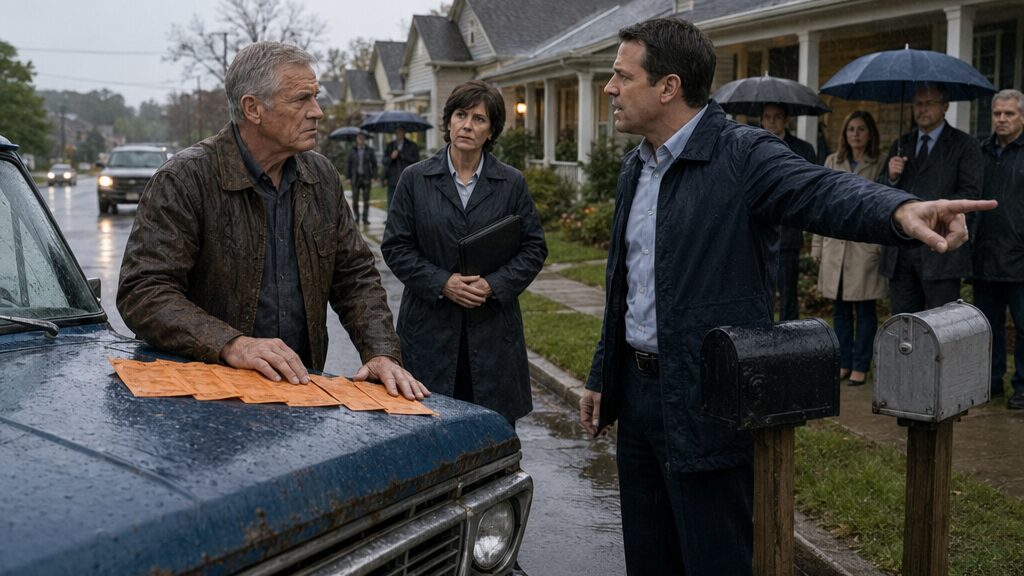
Rain ran from the brim of Jason Moore’s jacket and gathered along his jaw. He stood in the street between George Walker’s mailbox and the old blue pickup, close enough that George could smell coffee on his breath.
George held six orange postal notices against the truck’s wet hood. Their corners had softened in the rain.
Jason pointed past him toward a line of cars parked farther down the block. “My family is walking half a mile because of this thing. You know exactly what you’re doing.”
George looked at the phrase printed across the HOA complaint Jason had brought with him.
Unreasonable inconvenience.
He lifted the notices.
“That,” George said, “is what these have been saying for six weeks.”
Jason’s expression changed, but only for a second.
Six weeks earlier, the first car had seemed harmless.
It was a silver sedan parked near the curb in front of George’s house on a Friday afternoon. The rear bumper extended across the approach to his mailbox, but there was still open pavement on either side. George assumed the driver would move before the mail arrived.
By seven that evening, music drifted from Jason’s backyard, and the sedan remained.
George stood at the front window with one hand resting against the curtain. Through the dining room behind him, he could hear Linda opening and closing cabinet doors.
“Another party?” she asked.
“Family dinner, probably.”
“You say that every Friday.”
George watched two people carrying covered dishes walk toward Jason’s porch. “Doesn’t make it untrue.”
Linda came beside him. Since returning from the hospital, she moved more carefully, though she disliked anyone noticing. She looked at the sedan, then at him.
“Leave it alone.”
“I’m leaving it alone.”
“That tone means you’re measuring something.”
“I haven’t measured anything.”
“Yet.”
He turned away from the window.
The sedan was gone by eleven. No damage had been done. No confrontation had occurred. George told himself the matter had ended.
The following Friday, a black pickup occupied the same space.
This time its front tire sat almost level with the mailbox post. George walked out while the driver was still unloading folding chairs.
“Could you pull forward about ten feet?” George asked.
The driver glanced at the mailbox. “Jason said street parking was fine.”
“It is. I’m asking you not to block the carrier’s approach.”
The man looked toward Jason’s house as though permission might arrive from the porch.
Jason appeared in the doorway, smiling broadly. “Everything okay?”
“Your guest is in front of the mailbox.”
Jason stepped onto the lawn. “Mail already came.”
“Not today.”
“It’s nearly six.”
“Our carrier runs late sometimes.”
Jason gave a short laugh. “George, it’s a public street.”
The driver looked down, embarrassed but unwilling to move without Jason’s approval.
George held Jason’s gaze. “Public street doesn’t mean block whatever you like.”
“No one’s blocking your driveway.”
“I didn’t say driveway.”
Jason spread his hands. “Then I don’t know what you want me to do. I can’t tell people they aren’t allowed to park legally.”
The word legally settled between them like a challenge.
George went back inside.
The mail did not come that evening.
On Saturday morning, he found the first orange notice tucked behind the mailbox flag. It stated that delivery had been attempted and access had been obstructed.
He carried it into the house and laid it facedown beside the fruit bowl.
Linda noticed it before lunch.
“What’s that?”
“Nothing important.”
She turned it over. “It says delivery attempted.”
“Probably the replacement filters.”
“The pharmacy shipment is due this week.”
“It has tracking.”
“That wasn’t my question.”
George took the notice from her. “I’ll handle it.”
Linda studied him for a moment. “Please don’t turn this into a war with the neighbors.”
“I asked one man to move a truck.”
“And?”
“And apparently that qualifies as war now.”
The next Friday brought a white SUV. The Friday after that, a dark crossover. Sometimes the vehicles moved before the carrier arrived. Sometimes they did not. George began recognizing the sound of tires stopping beside the mailbox.
Each time, he felt the same small tightening beneath his ribs.
He spoke to Jason twice more.
The first time, Jason promised to “mention it.”
The second time, he said George should contact the city if he believed anyone was breaking a law.
Neither conversation changed where the guests parked.
The orange notices accumulated.
George kept them in the top drawer of his desk, arranged by date. He did not tell Linda there were four. He did not tell her he had driven to the post office twice to collect parcels that should have reached their house.
He also did not tell her that the pharmacy package had stopped moving through the tracking system.
On the sixth Friday, Amy Davis’s postal truck slowed in front of the house. A sedan blocked the mailbox completely, leaving barely a foot between its rear bumper and the post.
Amy leaned toward the windshield, saw George standing in his yard, and lifted one hand in apology.
Then she drove on.
George crossed the lawn as the sedan’s owner came out of Jason’s house carrying an empty casserole dish.
“You need to move the car.”
The woman stopped. “I’m leaving now.”
“You’ve been there three hours.”
Her face tightened. “Jason said it was okay.”
“It isn’t his mailbox.”
Jason appeared behind her, wiping his hands on a dish towel. “George, don’t corner my guests.”
“I asked her to move a car.”
“She’s moving it.”
“After the carrier passed.”
Jason looked toward the road. “Then pick up your mail tomorrow.”
George stared at him.
Jason’s tone softened, though not enough to become an apology. “I understand you like things orderly. But people come here because my brother’s going through a hard time. I’m not making them park three streets away over a mailbox.”
George heard the back door open behind him. Linda stood on their porch, one hand on the railing.
He lowered his voice.
“This has happened six times.”
“And nothing catastrophic has happened,” Jason said.
The woman hurried into her sedan.
George watched her pull away. He could have told Jason then. He could have said the package contained medication Linda had been prescribed after her hospitalization. He could have said the pharmacy had warned that interruptions mattered.
Instead, he glanced toward Linda and saw the way she turned her face from the street.
He said only, “Tell your guests to leave access.”
Jason shook his head. “It’s a public street, George.”
That evening, George called the pharmacy.
The representative asked for the tracking number, placed him on hold, and returned with a voice carefully emptied of blame.
“The shipment was returned to our distribution center after repeated delivery failures.”
George gripped the edge of his desk.
“Returned?”
“Yes, sir. The carrier marked the address inaccessible.”
“How soon can you resend it?”
“There may be a replacement authorization required. I can submit the request Monday.”
“Monday?”
“I’m sorry. That department is closed for the weekend.”
George looked toward the hallway. Linda was in the bedroom, sorting the pills remaining in her organizer.
“How many doses would she miss?”
“I’m not able to advise you medically, sir. You should contact the prescribing office or an urgent pharmacy.”
George thanked her because habit required it.
After the call, he opened the drawer and removed the orange notices. He placed them in a straight line across the desk, oldest to newest.
On the back of the final notice, he wrote the sentence Jason had repeated three times.
It’s a public street.
Chapter 2: The Rule Jason Thought Protected Him
By Monday morning, George had underlined Jason’s sentence hard enough to tear the orange paper.
It’s a public street.
He sat at his desk before sunrise with the six notices arranged beside his keyboard. Linda had obtained a temporary supply from a local pharmacy after two hours of phone calls, a physician’s authorization, and a copay neither of them had expected.
She had called it an inconvenience.
George knew she had chosen the word for his sake.
He opened the municipal code.
For thirty-two years, George had worked with property descriptions, easements, drainage boundaries, and arguments that began because someone assumed a line was where it looked as though it ought to be. Retirement had not erased his instinct for exact language.
The city prohibited parking that obstructed driveways, hydrants, marked access points, and postal operations. The HOA covenants addressed abandoned vehicles, commercial vehicles, lawn parking, and appearance standards. Neither document granted a homeowner ownership of the curb in front of his lot.
Jason had been correct about one thing.
The street was public.
By ten, George had printed three pages of regulations. By noon, he had highlighted two sentences that appeared to contradict each other until read carefully.
A vehicle could legally occupy the curb.
A carrier could legally withhold delivery if that vehicle prevented safe access.
The law did not promise common sense. It only separated responsibilities.
Linda found him at the kitchen table with a ruler laid across a parcel map.
“You’re measuring something now,” she said.
“I’m confirming the right-of-way.”
“For what?”
“So I know where the property line ends.”
“George.”
He kept his eyes on the map.
She pulled out the chair opposite him but did not sit. “The pharmacy fixed it.”
“They patched it.”
“I have the medicine.”
“This time.”
“What are you planning?”
“Nothing illegal.”
“That is not the reassuring answer you think it is.”
George folded the map. “Jason told me to call the city if I thought anyone was breaking a law. I’m checking whether anyone is.”
“And are they?”
“Not exactly.”
Linda closed her eyes briefly. “Then let it go.”
“They can obstruct the mailbox because the curb is public, but we carry the consequence.”
“They shouldn’t.”
“No.”
“But you’re not only trying to stop them.” Her voice remained quiet. “You’re trying to teach him something.”
George slid the notices into a folder. “Sometimes those are the same thing.”
“They usually aren’t.”
He went to the county records office that afternoon.
The clerk directed him to a public terminal, where he pulled the subdivision plat and enlarged the section containing his street. The recorded lot lines ended several feet behind the curb. A municipal right-of-way extended across the roadway, gutter, and part of the grass strip where both mailboxes stood.
George checked the dimensions twice.
Neither his mailbox nor Jason’s belonged to the curbside space in the way either man used the word mine.
He printed the plat.
On his way out, he stopped beneath the fluorescent light and studied the shape of the lots. His house and Jason’s had been built from the same plan reversed. Their driveways curved inward. Their mailboxes stood near the shared property line, separated by fourteen feet of curb.
Fourteen feet.
Enough for a truck.
That evening, Amy’s postal vehicle stopped while George was retrieving the empty trash cans.
She lowered the window.
“I’m sorry about Friday.”
“I know it wasn’t your choice.”
“We’re supposed to approach without backing or reaching around parked vehicles. It’s a safety rule.”
“Can you document every time access is blocked?”
“The notices are the documentation.”
“Can the post office require the cars to move?”
Amy shook her head. “We can notify the customer. Parking enforcement is local.”
“And if it keeps happening?”
“Delivery can be suspended until access is restored.”
George looked toward Jason’s house. Two children were drawing with chalk on the driveway while an adult carried grocery bags inside.
“Can I request a different delivery arrangement?”
“You could apply for a hardship exception, but those are generally for residents who physically can’t retrieve mail from the curb.”
George felt the answer close around the very thing he had refused to say.
Linda’s condition. Her recovery. Their need.
He thanked Amy and rolled the trash cans into the garage.
The next morning, the HOA website offered an online incident form. George opened it and filled in his address. He selected Parking and Access. A box requested a description of the impact.
He typed:
Repeated obstruction has caused failed deliveries, including—
He stopped.
Including what?
Medication for my wife.
Time-sensitive medical supplies.
A consequence more serious than Jason understands.
Any version made Linda’s private life part of an HOA file accessible to board members and management staff. George imagined sympathetic looks at the mailbox, lowered voices during neighborhood walks, questions disguised as concern.
He deleted the sentence.
Then he closed the form without submitting it.
On Friday afternoon, George went to the detached garage behind the house.
The old blue pickup sat beneath a film of dust. He had bought it twenty-three years earlier and used it for survey stakes, lumber, mulch, and every home repair too large for a sedan. Since retiring, he drove it only when necessary. A rust line had begun beneath the driver’s door, and the registration sticker was current, though the state inspection had expired the previous month.
He noticed that detail.
He chose not to treat it as important.
The engine resisted twice before turning over. Exhaust coughed from the tailpipe. George let it idle while he checked the tires and wiped the windshield with an old towel.
Linda appeared in the garage doorway.
“Where are you going?”
“Across the street.”
Her eyes moved from him to the truck.
“George, don’t.”
He opened the driver’s door. “Jason says the curb is available to anyone.”
“So you’re going to prove him right?”
“I’m going to let him live by his own rule.”
He backed down the driveway slowly.
At the curb, he turned the wheel and guided the pickup into the fourteen-foot space beside Jason’s mailbox. He adjusted twice, leaving the driveway clear and the tires close to the gutter.
Then he shut off the engine.
Across the lawn, Jason stepped onto his porch.
George climbed out, locked the truck, and met his gaze over the blue hood.
Chapter 3: The Long Walk From the Far Corner
The first guest arrived twenty minutes later and stopped in the middle of the street.
Her minivan idled beside the blue pickup while she looked from Jason’s crowded driveway to the open curb beyond George’s mailbox. A compact car already occupied that space, leaving nowhere nearby large enough for her vehicle.
George watched through the slats of his front blinds.
The woman lowered her window and called toward Jason’s porch. Jason came down the steps, scanned the street, and looked directly at George’s house.
George did not move.
Jason pointed toward the next intersection. The minivan continued down the block.
“That didn’t take long,” Linda said behind him.
George released the blind. “She found another space.”
“Farther away.”
“It’s a public street.”
Linda gave him a tired look and returned to the kitchen.
By seven, cars lined both sides of the road beyond the corner. Guests walked toward Jason’s house carrying foil pans, bags of groceries, and folded umbrellas. One man glanced at the truck and shook his head. Another took a photograph with his phone.
George felt a satisfaction he did not care to examine closely.
Jason had dismissed six failed deliveries as nothing catastrophic. Now each arriving guest forced him to step outside, explain the parking, and point down the wet pavement.
The inconvenience had become visible.
At eight, someone knocked on George’s door.
Jason stood on the porch without a jacket, his shirt darkened by drizzle.
“You need to move the truck.”
George remained behind the storm door. “Why?”
“You know why.”
“It’s legally parked.”
“It hasn’t moved in years.”
“It moved today.”
Jason’s jaw tightened. “My brother has his kids here. My mother may come Sunday. You’re making people walk from the far corner to settle some score.”
“I asked you to keep access open.”
“And I told people not to block the mailbox.”
George glanced toward the curb. “They did.”
“Not every time.”
“Enough times.”
Jason lowered his voice. “You’re claiming public parking belongs to you.”
“No. I’m using it.”
“That truck is an eyesore.”
“Then don’t look at it.”
Jason stared at him for several seconds. “You’re going to regret turning this into an HOA matter.”
“You made it an HOA matter when you joined the board.”
“I’m not on the enforcement committee.”
“But people listen to you.”
Jason stepped back from the door. “Move it by morning.”
George closed the door without answering.
Saturday passed without confrontation. The truck remained. No mail was scheduled, but George left it in place because one day would have made the point too easy to dismiss.
Sunday afternoon brought heavier rain.
George stood on the porch beneath the overhang when a sedan slowed, found no space, and continued around the corner. Ten minutes later, a man appeared at the far end of the block holding an umbrella over two girls. One carried a bakery box against her chest. The younger child stepped into a gutter puddle and stopped abruptly.
The man bent to inspect her wet shoe.
Behind them walked an older woman in a clear plastic rain bonnet, one hand gripping the arm of another relative.
George’s satisfaction thinned.
Jason came down the sidewalk to meet them. He took the bakery box and spoke to the older woman, then turned and looked toward George.
The expression on his face was not embarrassment. It was anger sharpened by something more personal.
Linda opened the porch door.
“Those are his nieces,” she said.
“You know them?”
“He mentioned his brother’s divorce last month. The children spend weekends here when their father has them.”
George watched the younger girl hop over another puddle.
“Jason could have told his guests not to block our mailbox.”
“Yes.”
“He chose not to.”
“Yes.”
Linda stood beside him. “That doesn’t make this pleasant.”
“It wasn’t meant to be pleasant.”
She looked at him then, and George wished he had chosen different words.
Before he could correct them, a gray sedan pulled up behind the truck. Pamela Green stepped out holding a black umbrella and a thin document case.
George recognized her from annual HOA meetings. She managed three communities and always looked as though she had arrived from a more urgent problem.
Jason met her near the curb.
Several guests remained under the porch roof, watching.
Pamela examined the truck, the mailbox, and the parked cars farther down the street. Then she walked toward George.
“Mr. Walker?”
“Yes.”
“We received a complaint concerning a potentially inoperable vehicle and deliberate obstruction of neighborhood parking.”
“I’m not obstructing parking. I’m occupying one legal space.”
Jason gave a humorless laugh. “That is exactly the kind of answer he keeps giving.”
George stepped off the porch.
Rain struck his shoulders before he reached the truck. He opened the driver’s door, retrieved the folder from the seat, and removed the orange notices.
Pamela’s gaze settled on them.
“What are those?”
“Failed-delivery notices.”
Jason folded his arms. “We’re talking about the truck.”
“We’re talking about unreasonable inconvenience,” George said.
He placed the notices against the blue hood so the rain would not tear them from his hand. Then he opened the complaint page Jason had given Pamela and read the phrase aloud.
“‘The placement of this vehicle has caused unreasonable inconvenience to residents and invited guests.’”
“That’s accurate,” Jason said.
George lifted the six orange slips.
“It’s also an accurate description of my last six weekends.”
The guests beneath Jason’s porch stopped talking.
Pamela took one of the notices. “These all relate to this address?”
“Yes.”
“And the access was blocked by visitors to Mr. Moore’s home?”
“Different vehicles. Same gathering.”
Jason looked toward the people behind him. “I told them to be careful.”
“After how many notices?”
“I didn’t know there were six.”
“I told you delivery was being interrupted.”
“You told me you didn’t like people near your mailbox.”
George felt anger rise, but he kept his voice level. “One of those failed deliveries was time-sensitive.”
Pamela looked up. “Medical?”
George hesitated.
Linda stood beneath the porch overhang, arms folded tightly against herself.
He could not make himself say it.
“It was important,” he answered.
Jason seized the pause. “And instead of filing a complaint or showing anyone these, he parked an abandoned truck in front of my house.”
“It isn’t abandoned.”
Pamela walked around the pickup. She checked the license plate, looked through the windshield, and wrote something on a form.
“Mr. Walker, when was this vehicle last regularly operated?”
“It runs.”
“That wasn’t my question.”
“It moved Friday.”
“Before Friday?”
George said nothing.
Pamela glanced at the inspection sticker.
Jason followed her gaze. “Expired.”
“By one month,” George said.
Pamela returned the orange notice. “Mailbox obstruction and vehicle compliance are separate issues. I’ll review both.”
Jason frowned. “Both?”
“Yes. If guest vehicles repeatedly prevented delivery, that requires attention.”
For the first time, Jason looked uncertain.
Then Pamela removed a white adhesive notice from her document case.
She pressed it against the inside of the pickup’s driver-side window.
George read the heading through the rain-spotted glass.
NOTICE OF POTENTIAL COVENANT VIOLATION.
“You’ll receive a hearing date,” Pamela said. “Until then, do not remove the notice.”
George looked at the orange slips in his hand, then at the white paper fixed inside his truck.
He had expected Jason to complain.
He had expected anger, embarrassment, perhaps even a threat to call parking enforcement.
He had not expected his own rule to open a second case.
Pamela closed her document case and walked back toward her sedan.
Behind George, the younger girl laughed as someone helped her remove her wet shoes on Jason’s porch.
The blue pickup remained exactly where George had placed it.
Now it belonged to the HOA dispute as much as it belonged to him.
Chapter 4: A Public Street and a Private Rule
“When did you last drive it anywhere but across the street?”
Pamela Green asked the question without looking up from the photographs spread across the conference table.
George had prepared for arguments about public right-of-way, curb ownership, mailbox access, and municipal parking authority. He had brought the recorded subdivision plat in a clear folder, along with copies of the city code and all six orange postal notices.
He had not prepared an answer to that question.
“The truck runs,” he said.
Pamela lifted her eyes. “I didn’t ask whether it runs.”
Across the table, Jason Moore sat with one ankle resting on his opposite knee. He had brought no folder. Only his phone and a legal pad.
George disliked that more than he would have disliked a stack of documents.
Pamela tapped the first photograph. The blue pickup sat beside Jason’s mailbox beneath a pale Friday sky.
The next image showed it in rain on Saturday.
The third had been taken Sunday morning. The fourth, Monday afternoon.
The tires occupied the same cracks in the pavement.
“These were submitted with the complaint,” Pamela said. “They show the vehicle remaining stationary for four consecutive days.”
“Parking for four days isn’t illegal.”
“We’re discussing HOA compliance, not criminal law.”
“The street belongs to the city.”
“The street does. The vehicle belongs to an HOA member.”
Jason leaned forward. “And the covenants prohibit storing an inoperable vehicle where it’s visible from the street.”
“It isn’t inoperable.”
“The inspection is expired.”
“By a month.”
Pamela raised one hand before Jason could answer. “The declaration doesn’t use the state’s definition of operable. It refers to vehicles that are unregistered, visibly disabled, or not regularly used for transportation.”
George opened his copy of the covenants to the marked page.
“Not regularly used is vague.”
“It is,” Pamela said. “Which is why I’m asking when you last used it.”
George could feel Jason watching him.
He could say he had driven it Friday. That was true.
He could say he planned to use it again. That might become true.
But the truck had spent most of the previous year beneath dust in the detached garage. Before Friday, its last trip had been to the hardware store eight months earlier.
“Last spring,” he said.
Jason let out a breath through his nose.
Pamela wrote something on her pad.
“That does not make it abandoned,” George said.
“No,” Pamela replied. “But it gives the complaint enough substance for a compliance review.”
George slid the parcel map across the table. “The truck is on public right-of-way. The association cannot assign that curb to Jason or prohibit lawful parking merely because his guests prefer it.”
Pamela studied the map. “I agree.”
Jason’s ankle dropped from his knee. “You agree?”
“The association cannot grant you exclusive use of public curb space,” she said. “Nor can it punish Mr. Walker simply because his vehicle occupies a legal parking area.”
George felt the first clean satisfaction he had experienced since entering the office.
It lasted less than five seconds.
Pamela placed her finger on the white compliance notice.
“But the association may enforce a covenant governing the condition and regular use of a member’s vehicle, regardless of whether that vehicle is parked on private property or within the community’s public streets.”
Jason’s posture eased again.
George looked from the white notice to the orange slips beside it.
Pamela followed his gaze.
“Now,” she said, “the mailbox issue.”
Jason sat forward. “That was not part of my complaint.”
“It became part of the review when Mr. Walker produced repeated USPS notices during my inspection.”
“He never filed anything.”
“That does not mean it did not occur.”
George slid the orange notices across the table in date order.
Pamela examined each one. The paper had dried with curled edges after Sunday’s rain. On the back of the final notice, Jason’s sentence remained visible in George’s handwriting.
It’s a public street.
Pamela read the dates aloud. Six Fridays across seven weeks.
“Were all these caused by guests visiting my house?” Jason asked.
George turned toward him. “You saw some of the vehicles yourself.”
“I saw people park near your mailbox. That’s different from blocking delivery.”
“The carrier marked the address inaccessible.”
Jason picked up one notice. “There’s no license plate on this. No photograph.”
“No. There’s only the consequence.”
Pamela placed the notice back down.
“Mr. Moore, did Mr. Walker ask you to instruct your guests not to park there?”
Jason glanced at George before answering. “He complained that people were too close to his mailbox.”
“I asked you three times to leave access.”
“You acted as if the curb belonged to you.”
“That was your interpretation.”
“And your response was to park a truck in front of my house for days.”
George felt the familiar urge to retreat into exact language. “In a legal public space.”
Pamela’s pen stopped.
“Mr. Walker, precision does not erase intent.”
The sentence landed harder than Jason’s accusations.
George looked at the parcel map, its black boundaries sharp and unquestionable. For most of his working life, lines had settled disputes. A monument existed or it did not. A deed included land or excluded it. When people argued, the record remained indifferent.
But the map could not explain why he had chosen that particular fourteen feet of curb.
Pamela gathered the photographs into one stack.
“I’m opening two separate compliance matters,” she said. “One concerning repeated interference with delivery access by guests associated with the Moore property. The other concerning the condition and prolonged placement of the Walker vehicle.”
Jason frowned. “So we’re both being investigated?”
“You’re both being asked to respond.”
“This is ridiculous. He created the problem.”
“No,” George said. “I returned it.”
Pamela looked at him. “That distinction may matter emotionally. It matters less procedurally.”
She handed each man a printed notice. The hearing was scheduled for Thursday evening at the HOA clubhouse.
“The board may dismiss either matter, impose corrective conditions, or assess penalties under the governing documents,” she said. “Before then, I suggest both of you consider whether you want a solution or a ruling.”
Jason stood first. “I want the truck removed.”
George collected his maps. “I want my mail delivered.”
Pamela remained seated. “Those goals are not mutually exclusive. You’re treating them as though they are.”
Outside, Jason walked ahead without waiting for him.
George returned home through the side door and placed the hearing notice beneath the parcel map on his desk. He intended to explain it to Linda after he had decided how much of the situation required explanation.
At dinner, she mentioned that the temporary prescription had made her tired. George asked about the dosage and whether she had called the doctor. He did not mention the hearing.
On Tuesday, he drove the pickup around the block, returned it to the same curb space, and took a photograph of the changed odometer reading.
The act felt less convincing than he had expected.
On Wednesday afternoon, he found Linda standing at his desk.
The parcel map lay open. The hearing notice rested on top of it.
She held the white paper in one hand and the final orange postal slip in the other.
“You hid this under a property map,” she said.
George stopped in the doorway.
“I was going to tell you.”
“When?”
“After I understood what the board could do.”
“It says they can fine us.”
“They haven’t decided anything.”
“It says the hearing is tomorrow.”
“I know.”
Linda looked toward the window. The blue pickup was visible beyond the front lawn, still parked beside Jason’s mailbox.
“You told me you were handling it.”
“I am.”
“No.” She placed the notices side by side on the desk. “You are arranging papers until they say what you want.”
George’s first instinct was to correct her. The papers already said what they said.
But her hand trembled slightly as she released the hearing notice.
She had found the document he concealed because he believed silence protected her.
Now the same silence had placed her name, their home, and the possibility of fines inside a dispute she had not been allowed to see.
Chapter 5: The Package Neither of Them Mentioned
Linda placed the returned pharmacy envelope beside George’s hearing papers.
The shipping label carried a black RETURN TO SENDER stamp across their address. A final orange notice had been folded inside the torn flap.
George had not seen the envelope since he collected it from the local pharmacy. Linda must have found it in the cabinet where he kept medical receipts.
“This is what you won’t say out loud,” she said.
They stood on opposite sides of the kitchen table. The overhead light made every crease in the envelope visible.
“I didn’t want your health discussed at an HOA meeting.”
“My health is already part of this.”
“Not if we keep it private.”
“It stopped being private when I had to call three offices because my medication went back to a warehouse.”
George pulled out a chair but did not sit. “You told me not to make a neighborhood issue out of it.”
“I told you not to start a war.”
“I asked him politely.”
“And when that failed, you parked a truck in front of his house.”
“He said the street was open to everyone.”
Linda touched the return stamp. “Did moving that truck get this package delivered?”
“No.”
“Did it prevent another missed dose?”
“No.”
“Then it wasn’t a solution.”
George looked toward the dark window above the sink. His reflection appeared beside Linda’s, close enough to suggest agreement.
“It made him understand the inconvenience.”
“Did it?”
“He complained.”
“That means he noticed his inconvenience.”
Her words were quiet, almost gentle, which made them difficult to resist.
George sat.
Linda opened the pharmacy envelope and removed the orange notice. “You told Jason one package was time-sensitive.”
“Yes.”
“You let him think it could have been anything.”
“I gave him enough information.”
“You gave him enough to preserve your pride.”
George’s jaw tightened. “I was trying to preserve yours.”
She lowered herself into the chair opposite him. “After the hospital, I asked you not to tell the whole street. I didn’t ask you to pretend nothing mattered.”
“I promised things would stay normal.”
“Normal does not mean invisible.”
The refrigerator motor started in the silence between them.
George looked at the printed hearing notice. He had planned his defense in numbered sections. Public right-of-way. Lack of exclusive curb rights. Valid registration. Unequal enforcement. Each point was accurate.
None explained the envelope.
“I don’t want them looking at you differently,” he said.
Linda’s expression softened, but not into surrender.
“They already look at you differently. Half the neighborhood thinks you dragged an old truck into the street because you hate family dinners.”
“I don’t hate family dinners.”
“I know.”
“Jason knows I asked him to stop.”
“He knows you were angry. He doesn’t know what you were afraid of.”
A knock sounded at the side door.
George glanced at the clock. Nearly nine.
Jason stood outside beneath the porch light, hands in his jacket pockets. He was alone.
George stepped onto the driveway and pulled the door mostly closed behind him.
“What do you want?”
Jason looked past him through the narrow opening. “I heard enough.”
George’s shoulders stiffened. “You were listening at our door?”
“I was taking my trash out. Your kitchen window was open.”
“It wasn’t an invitation.”
“No.”
Jason looked toward the truck. Rainwater from the weekend still darkened the rust line beneath its door.
“The package was medication?”
George did not answer.
“For Linda?” Jason asked.
“That is not your business.”
Jason rubbed one hand across the back of his neck. “I didn’t know.”
“I told you delivery was being interrupted.”
“You told me the mailbox was blocked.”
“What did you think mailboxes were for?”
Jason accepted that without defending himself.
For the first time since the conflict began, he seemed uncertain about where to put his hands.
“My brother’s wife left in August,” he said. “He moved into an apartment across town. The girls hate it there. They come here on his weekends because there’s room, and my mother comes because she thinks if she keeps making dinner, nobody will notice the family is splitting apart.”
George had not asked for the explanation, but he listened.
“People bring food,” Jason continued. “Sometimes there are more cars than I expect. I thought you were making a point about appearances. Empty curb, tidy street, everything where you wanted it.”
“You decided what kind of man I was because that was easier than moving a car.”
Jason’s mouth tightened. “Maybe.”
George waited.
Jason glanced toward the kitchen door. “Medication changes it.”
“It should not have required medication.”
“No.”
The admission came without qualification.
For one moment, George saw the possibility of ending the dispute before the hearing. Jason could withdraw the complaint. George could move the truck. Neither man would need to explain himself beneath clubhouse lights.
Jason looked at the pickup again.
“Move it tonight,” he said. “I’ll tell Pamela the vehicle complaint is resolved.”
George felt the possibility close.
“And the mailbox?”
“I’ll tell people not to block it.”
“You told me that before.”
“I mean it now.”
“Because you know what was in the package?”
“Because this has gone too far.”
George stepped closer. “Then withdraw the complaint without conditions.”
Jason shook his head. “I can’t make it look like you won by doing this.”
There it was—not the family, not the curb, not even the truck. The part of Jason that needed the neighborhood to see him as reasonable.
George recognized it because he carried its twin.
“You already know the obstruction caused medical harm,” George said. “But you still want me to move first so you can say the complaint worked.”
“I’m offering a way out.”
“For you.”
“For both of us.”
“No. You want the record to show my truck was the problem and your guests were a misunderstanding.”
Jason’s face hardened again. “And you want the record to say you were entitled to retaliate.”
“I never said entitled.”
“You didn’t have to.”
The side door opened.
Linda stepped onto the driveway holding the pharmacy envelope.
Jason looked at it, then at her.
“I’m sorry,” he said.
Linda did not answer immediately.
Finally she said, “Are you withdrawing the complaint?”
Jason’s silence answered first.
“I asked him to move the truck,” he said.
Linda nodded once. “Then you are sorry this became difficult for you.”
“That isn’t fair.”
“No,” she said. “It isn’t.”
Jason left without another word.
George remained in the driveway until the door of Jason’s house closed across the lawn.
Inside, Linda returned the envelope to the kitchen table.
George sat beside it, no longer seeing evidence only against Jason. The return stamp marked the cost of obstruction. The HOA notice marked the cost of retaliation. Both belonged in the same account.
“I can tell the board about the medication,” he said.
Linda folded her hands. “You can tell them the truth.”
“That is the truth.”
“Part of it.”
George looked at her.
She touched the keys to the blue pickup where he had left them on the table.
“You parked that truck to hurt him.”
“To make him understand.”
“You enjoyed it.”
He remembered the first guest driving away, the line of cars at the far corner, Jason stepping repeatedly into the rain.
“Yes,” he said.
Linda pushed the keys toward him. “Then tell them that too.”
George stared at the metal teeth resting between them.
“If you don’t,” she said, “I will attend the hearing and tell them myself.”
Chapter 6: The Hearing About More Than Parking
“I parked the truck there to inconvenience Jason.”
George said it before the board chair finished asking whether he wanted to make an opening statement.
The clubhouse meeting room went still.
Linda sat beside him, the returned pharmacy envelope in her lap. Jason occupied the opposite table with his phone facedown and his legal pad unopened. Pamela sat between the two sides near the end of the board’s folding tables.
George had brought the parcel map, municipal code, HOA covenants, photographs, pharmacy records, and orange notices.
He began with the one fact none of them could document for him.
“The truck was legally parked,” he continued. “But I chose that space because I knew it would interfere with parking for Jason’s guests.”
One board member leaned toward the microphone. “So you admit the placement was retaliatory?”
“Yes.”
Jason shifted in his chair.
George placed the blue pickup’s keys on the table.
“I believed that if he experienced the same inconvenience, he would finally understand what his guests had caused. That was not a solution. It was retaliation.”
Linda’s hand remained near his, not touching it.
The board chair glanced at Pamela. “Ms. Green, does this resolve the vehicle complaint?”
“No,” Pamela said. “Intent is relevant, but the cited covenant concerns condition and regular operation. The board still needs to consider whether the vehicle qualifies as stored or inoperable.”
George opened the folder containing the truck records.
“The registration is current. The inspection expired last month. Before this dispute, I had not regularly driven it since spring. I drove it around the block Tuesday after receiving the notice.”
Jason looked up sharply, perhaps surprised George had admitted that too.
“I do not believe one trip converts it into a regularly used vehicle,” George said. “I will renew the inspection or remove it within whatever reasonable period applies.”
The board chair studied him. “You’re not asking us to dismiss the violation?”
“I’m asking you to apply it accurately.”
He slid the orange notices forward.
“And to apply the same standard of accuracy to this.”
Pamela distributed copies to the board. The originals remained in front of George, arranged by date as they had been on his desk.
One notice might have been an accident. Six created a record.
George explained the weekly gatherings, his requests to Jason, Amy’s inability to approach the box safely, and the return of the pharmacy package. He avoided medical details until Linda placed the envelope on the table.
“It contained medication prescribed after my hospitalization,” she said. “We obtained a temporary supply locally, but not until after several calls and an additional payment.”
The board chair looked toward Jason. “Were you aware of this?”
Jason’s eyes moved first to Linda, then to George.
“I learned last night that the package was medication.”
“And did you amend or withdraw your complaint after learning that?”
“No.”
“Why not?”
Jason placed both hands on the table. “Because the truck complaint was still valid. One problem does not cancel the other.”
George heard his own thinking in the answer—the insistence that separate rules remained separate even when human motives tangled them together.
The board chair nodded slowly. “That is procedurally true. It does not answer why you continued seeking penalties without disclosing a fact relevant to the broader dispute.”
Jason’s face flushed. “I was going to explain tonight.”
“Then explain.”
He looked toward the residents seated along the back wall. A few were members of the social committee. Others had attended because neighborhood hearings attracted interest even when everyone pretended otherwise.
“My brother is going through a divorce,” Jason said. “He has two daughters. They spend weekends at my house because his apartment is small and they don’t feel settled there. My mother comes. Other relatives come. We have meals together.”
His voice lost some of its polished committee tone.
“I didn’t think the parking was causing real harm. I thought George wanted the curb clear because he prefers it that way. When he parked the truck, it made the visits harder for people who were already having a hard time.”
A board member asked, “Did Mr. Walker tell you postal delivery had been interrupted?”
“Yes.”
“More than once?”
Jason hesitated. “Yes.”
“Did you instruct your guests not to use that space?”
“I told some of them to leave room.”
“After the first notice?”
“I didn’t know about the first notice.”
“After he asked you?”
Jason glanced down. “Not consistently.”
The room remained quiet.
George had wanted Jason forced into that answer. Yet hearing it brought less satisfaction than he expected.
Jason had not invented his family’s need. The children in the rain had been real. So had the medication envelope. Neither burden erased the other.
Pamela opened the HOA declaration.
“The association has no current policy defining required clearance around curbside mailboxes,” she said. “We have relied on general nuisance language and municipal enforcement.”
“Meaning?” the board chair asked.
“Meaning residents receive inconsistent guidance. The city permits curb parking unless otherwise restricted. USPS may withhold delivery when access is unsafe. Our documents prohibit interference with services but do not specify a measurable access zone.”
“So Mr. Moore’s guests violated no explicit HOA parking rule?”
“Not one naming mailboxes. Their repeated conduct may still qualify as interference with delivery service.”
“And Mr. Walker?”
“The vehicle provision is explicit enough to enforce, though the remedy should be corrective before punitive.”
Jason leaned toward his microphone. “Then why are we treating these as equal?”
George answered before Pamela could.
“We shouldn’t.”
Jason turned toward him.
“They are not equal,” George said. “Your guests blocked delivery. I responded by intentionally creating a different inconvenience. My response did not restore service. It widened the dispute.”
The board chair watched him carefully. “What are you asking the board to do?”
George took out the final page in his folder.
It was not a defense. He had written it that afternoon after reviewing postal approach recommendations and measuring the curb.
“Establish a neutral mailbox-access standard,” he said. “No vehicle within a defined approach and departure distance during delivery hours, regardless of whose guest it is or which mailbox is affected. Written notice for a first violation. Escalation only after repetition.”
He handed the proposal to Pamela.
“For the truck, give me a deadline to renew the inspection and return it to regular use or remove it from visible street parking. Do not dismiss that requirement because Jason’s guests caused the first problem.”
One board member looked over the proposal. “This would restrict spaces in front of every curbside mailbox.”
“Only during delivery hours,” George said. “And only enough space for safe approach. It would not grant private ownership of the curb.”
Jason read the copy Pamela passed him.
“This removes more space in front of George’s property than mine,” he said.
“The carrier approaches his box from the direction of your house,” George replied. “The distance follows the route, not the lot line.”
“You measured this?”
“Yes.”
A faint sound came from the back row—not applause, but the shifting of residents who had expected a feud and instead received dimensions.
Pamela reviewed the page.
“This is workable in principle,” she said. “It would need confirmation from postal operations and review against municipal signage rules.”
The board chair conferred quietly with the other members.
George looked at the orange notices. For weeks he had imagined presenting them as proof that he was right. Now they seemed more useful as a sequence of failures—Jason’s refusal, George’s silence, the HOA’s lack of guidance, the carrier’s limited options.
The board chair returned to the microphone.
“The board will suspend penalties in both matters for seven days,” she said. “Mr. Walker and Mr. Moore will work with management to submit a joint curb-access plan that can apply throughout the community. Mr. Walker must also provide evidence of inspection renewal, regular use, or off-street removal of the pickup within that period.”
Jason raised his hand slightly. “And if we cannot agree?”
“The board will rule separately on both violations and proceed under the existing documents.”
George understood the choice.
He could leave with his evidence intact and trust the board to punish Jason. Jason could continue demanding removal of the truck and trust the covenant to punish George.
Or they could stand beside the same curb with a tape measure and write a rule neither man owned.
The board chair closed the hearing file.
“You have seven days.”
Outside the clubhouse, Jason stopped beneath the parking-lot light.
“I’m not agreeing to reserve half the street for mailboxes,” he said.
George put the orange notices back in their folder.
“And I’m not agreeing that your guests can decide what counts as enough room.”
Jason looked toward Linda, who waited near their car.
“Tomorrow morning,” he said. “At the curb.”
George nodded.
Neither man offered a handshake.
They had been given seven days to solve a problem they had spent six weeks proving belonged to the other.
Chapter 7: The Space Beside the Mailbox
Jason arrived the next morning carrying a tape measure instead of another complaint.
George saw him cross the lawn at eight sharp, the yellow case clipped to his belt and a legal pad tucked beneath one arm. The blue pickup still occupied the curb beside Jason’s mailbox. Its white compliance notice had begun peeling at one corner.
Jason stopped near the front bumper.
“I measured from the box to the driveway,” he said.
“From which side of the box?”
Jason’s mouth tightened. “Good morning to you too.”
George stepped off the porch with his clipboard.
Linda watched from inside through the storm door.
Jason pulled out the tape. “If we leave eight feet on either side, that should be enough.”
“For a carrier approaching from the wrong direction.”
“It’s a mailbox, George, not a loading dock.”
George walked to the curb. “Amy comes from the intersection. She needs a straight approach and enough room to pull away without backing.”
“So twelve feet before the box and six after?”
“Closer.”
“That removes nearly a full parking space.”
“It preserves delivery.”
Jason looked toward his driveway, then down the street where his guests had parked during the rain. “And it takes more curb from my side than yours.”
“The route comes from your side.”
“Convenient.”
George nearly answered with the old precision, the kind that sharpened rather than clarified. Instead, he held out the clipboard.
“Draw what you think is fair.”
Jason stared at him, then took it.
They worked for twenty minutes without agreement. Jason wanted equal distances on both sides of every mailbox. George wanted the dimensions based on Amy’s direction of travel. Jason proposed limiting the clearance only during a two-hour delivery window. George pointed out that route times changed.
The argument remained controlled, but every measurement carried six weeks of resentment.
At last Jason planted one end of the tape at the front edge of George’s mailbox.
“Fifteen feet before, five after,” he said. “That’s what the postal guidance recommends in some places.”
“You looked it up?”
“I’m capable of reading regulations.”
“I never said you weren’t.”
“You usually imply it.”
George wrote the numbers down.
Across the street, a neighbor slowed during a morning walk, noticed the tape measure, and continued without speaking.
Jason looked toward George’s frontage. “With that distance, nobody can park here during delivery hours.”
“That is the point.”
“You gain a permanently open stretch in front of your house.”
George followed his gaze. The proposed zone would keep the curb clear from the edge of Jason’s property almost to George’s driveway.
It would solve the problem.
It would also give George more empty space than the carrier actually needed once the truck was gone.
He knew it before Jason said it.
“You get the clean curb you wanted from the beginning,” Jason said.
George looked down at the measurements.
For years, he had corrected people who confused a practical boundary with a personal entitlement. Now his own proposal had drifted toward the same mistake.
He erased the line.
Jason frowned. “What are you doing?”
“Reducing it.”
“You just said fifteen feet was necessary.”
“I said approach space was necessary. I didn’t say every inch had to be treated as mine.”
They measured again.
This time George stood where Amy’s vehicle would approach while Jason marked the point at which a parked car would force her outward. They accounted for the mailbox post, the curve of the gutter, and the distance needed to pull away. The final zone was shorter than George’s first proposal and longer than Jason’s.
It cost both sides usable curb.
Neither man liked it completely.
That was the first sign it might be fair.
Pamela met them at the HOA office that afternoon.
She reviewed the drawing, asked for the delivery-time language to be broadened, and removed the phrase reserved area from George’s draft.
“No resident reserves public curb,” she said. “The rule protects service access.”
Jason leaned back in his chair. “How do we enforce it without signs?”
“Guest instructions first. Written warning after a documented obstruction. Repeated violations can proceed under interference with community services.”
“And residents’ own cars?” George asked.
“Same rule.”
Jason looked at him. “Including old pickups?”
“Especially old pickups,” Pamela said.
George accepted the point.
The board approved a temporary ninety-day policy two days later. Pamela sent a one-page notice to every household with curbside delivery. It did not mention George, Jason, Linda, the truck, or the orange slips.
It described only conduct and consequence.
Vehicles must leave sufficient access for postal delivery during service hours. Homeowners were responsible for informing guests. Repeated obstruction could lead to enforcement under existing nuisance provisions.
No one owned the space.
Everyone shared responsibility for keeping it usable.
Jason withdrew his request for immediate penalties. George signed a compliance agreement requiring him to renew the truck’s inspection or remove it from visible street parking by the end of the week.
On Friday morning, the pickup failed to start.
George sat behind the wheel while the engine clicked without turning over. The white HOA notice trembled against the glass each time he tried the ignition.
Jason appeared at the curb.
“Battery?” he asked.
“Looks that way.”
“I have cables.”
George considered refusing. The old impulse rose quickly: solve it himself, owe nothing, reveal no need.
Then he opened the hood.
Jason brought his SUV around. They connected the cables without conversation. On the second attempt, the pickup started with a deep, uneven rumble.
George removed the white notice from the window.
“I’m taking it for inspection,” he said.
Jason closed the hood. “I figured.”
“I’m not putting it back here.”
Jason nodded.
It was not an apology. Neither was George’s acceptance of the jumper cables.
The truck passed inspection after new wiper blades, a battery, and a repaired brake light. George began driving it once a week—to the hardware store, the recycling center, or nowhere more important than a loop through town.
He parked it in his own driveway.
The following month, Linda’s refill was scheduled to arrive on a Tuesday.
George knew the date because the pharmacy had sent three messages and because he still checked the tracking page more often than necessary.
At noon, Jason’s brother pulled up with the two girls. He began easing his sedan toward the curb near George’s mailbox.
Jason stepped off his porch and raised one hand.
“Not there,” he called. “Leave the box clear.”
The driver pointed farther down the street. Jason nodded.
There was no argument.
The sedan moved.
A few minutes later, Amy’s postal truck turned at the intersection. She approached the mailbox in a straight line, stopped without swerving, and placed a small pharmacy package inside.
George stood on the porch beside Linda.
Amy lifted her hand through the open window before continuing along the route.
Linda walked down the path and opened the mailbox. She took out the package, a utility bill, and a grocery flyer.
No orange notice waited behind the flag.
At the next house, Jason helped his nieces carry bags from the sedan. He glanced toward George, then toward the clear stretch of curb.
George gave him a small nod.
Jason returned it.
Inside, George carried the last orange notice to his study. He did not place it on the desk or leave it where anyone could see what had happened.
He filed it behind the approved access policy.
Then he closed the drawer.
The story has ended.