The Neighbor Who Tried to Destroy His Quiet Workshop Livestreamed Her Own Federal Crime
Chapter 1: The Hammer Fell Before Anyone Believed Her
The hammer struck the breaker box hard enough to throw blue-white sparks across Kathleen Wilson’s face.
She flinched, but she did not stop filming.
“I’m shutting down the dangerous AI before it burns our street!” she shouted at the phone clamped upright on a small tripod near Jeffrey Moore’s driveway.
The next blow buckled the steel door.
For half a second, the low hum from Jeffrey’s detached workshop continued as if nothing had happened. Then an electrical crack snapped through the yard. The exterior lights went dark, came back weakly, and began to pulse.
Jeffrey dropped the charging cable he had been coiling beside his PHEV.
“Kathleen. Put the hammer down.”
She turned the phone slightly, making sure both of them were in frame. Her cheeks were red, her hair windblown, her eyes bright with the certainty of someone performing for an audience she could not see.
“There he is,” she said. “The man protecting the machine that’s poisoning us.”
Jeffrey crossed the driveway without running. The first rule around damaged electrical equipment was not to create a second emergency by rushing into the first.
The second rule was to assume anyone holding a steel tool near energized conductors had already stopped listening.
Kathleen swung again.
“Do not hit that box.”
“You’ve had weeks to shut it down.”
“It is a live service panel.”
“That’s what you said to scare everyone.”
Her phone emitted a stream of faint electronic chimes as comments arrived. Kathleen glanced at the screen and lifted her chin.
“They’re saying I should open it,” she said.
Jeffrey stopped six feet away.
Only then did he see the rusted crowbar.
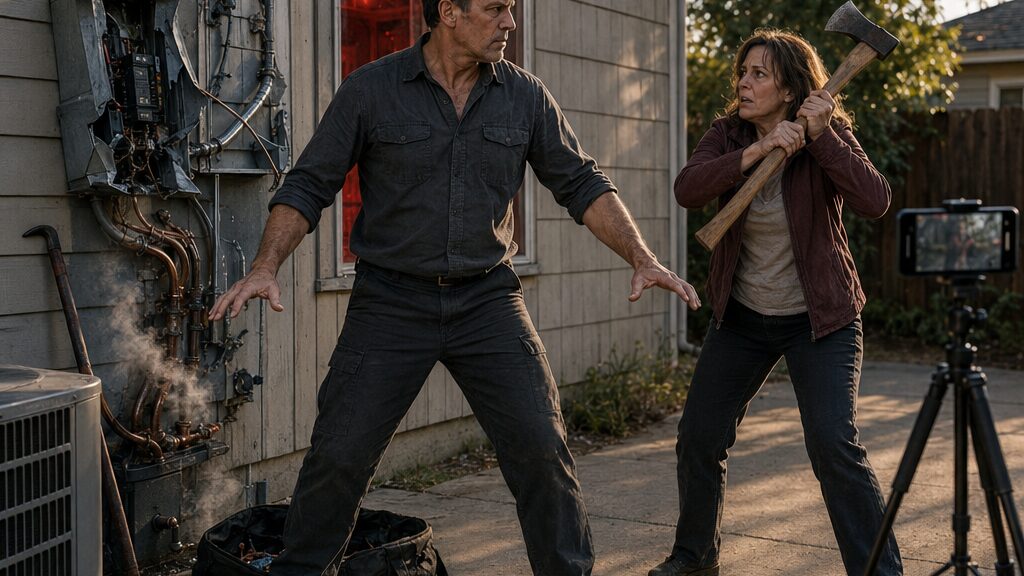
Its flattened end had already been driven behind the conduit running from the breaker box toward the workshop wall. The metal tube had been pulled nearly an inch away from its mounting clamps. Beside Kathleen’s open demolition bag lay a heavy pipe wrench and a wood-handled axe.
This had not begun when the hammer fell.
She had been working before he came outside.
Jeffrey’s right hand moved toward the phone in his pocket, then stopped. Calling first responders would take seconds. Kathleen could reach the exposed service conductors faster.
He looked past her to the disconnect mounted near the front corner of the house. It controlled the exterior charging branch and auxiliary workshop feed, but not the protected interior circuit.
“Kathleen, listen carefully. Step away from the wall.”
“You hear that?” she told her viewers. “He doesn’t deny what’s in there.”
“I’m telling you the equipment is energized.”
“You told the association everything was safe.”
“It was safe before you attacked it.”
That landed. Not as reason, but as humiliation.
Kathleen’s mouth tightened.
She raised the hammer again.
Jeffrey moved.
He crossed behind the PHEV, reached the exterior disconnect, broke the security seal, and pulled the lever down. The charger display died. The driveway lights vanished. A fan inside the workshop changed pitch but did not stop.
Kathleen stared toward the building.
“You said you couldn’t turn it off.”
“I cut the branch you were about to touch.”
“So you admit there are other power lines.”
Jeffrey looked at the bent breaker door. A thin ribbon of smoke slipped from the lower hinge.
“Yes,” he said. “And you do not understand any of them.”
Her viewers heard contempt where he had intended precision.
The phone chimed faster.
Kathleen seized the crowbar and leaned her weight against it. Metal scraped concrete.
Jeffrey stepped toward her.
She pointed the hammer at him. “Stay back. I have witnesses.”
“You have an audience.”
“They can see exactly what you’re doing.”
“So can my cameras.”
For the first time, uncertainty crossed her face.
It disappeared when a high alarm sounded inside the workshop.
Not a household smoke alarm. A clean, repeating electronic pulse.
Jeffrey pulled out his phone. The control application opened, froze, then displayed three red warnings.
EXTERNAL POWER INSTABILITY.
COOLING LOOP FAULT.
REMOTE SHUTDOWN UNAVAILABLE.
He tapped the emergency control. Nothing happened.
Kathleen heard the alarm and looked almost relieved.
“There,” she said to the livestream. “I told you. It’s failing.”
“You caused that.”
“The system was already unstable.”
“It was stable until you drove a hammer into its power controls.”
She reached for the pipe wrench.
Jeffrey saw where she was looking: the insulated copper lines feeding the heavy-duty HVAC unit. If she crushed one badly enough, the cooling loop would vent or seize. The server room would begin accumulating heat immediately.
He took another step.
Kathleen snatched up the pipe wrench and held it across her chest.
“Don’t touch me.”
“I’m not going to touch you. I’m going to stop you from killing yourself.”
“Threat recorded,” she said toward the phone.
Jeffrey’s jaw tightened.
Years earlier, he had watched a sentence clipped from a long technical briefing become proof of something he had never said. By the time he answered, the lie had hardened. Contracts disappeared. A project folded. People who had trusted him packed their tools into cardboard boxes.
He had learned not to argue inside someone else’s performance.
He had mistaken that lesson for a universal rule.
Inside the workshop, the alarm accelerated.
Jeffrey shifted his attention to the narrow reinforced window in the side door. Between the server racks, ordinary indicator lights blinked in disciplined rows. Green. Blue. Amber.
At the rear of the room, behind a partition Kathleen had never seen, one red status lamp came on.
A digital display beneath it awakened.
12:00.
11:59.
11:58.
Jeffrey forgot the phone, the comments, and the neighbors beginning to appear behind their curtains.
Kathleen had not merely damaged his workshop.
She had started a countdown.
Chapter 2: The Quiet Hum Became a Neighborhood Accusation
Three weeks earlier, Kathleen placed her phone on the association table and filled the room with the sound of a machine that did not exist.
The recording began as a distorted vibration. She raised the volume until the small speaker rattled against the wood.
“That,” she said, “is the sound before an electrical fire.”
Around the table, six residents leaned closer.
Jeffrey remained standing near the back wall. Through the meeting-room windows he could see the roofs of their houses, the neat driveways, and beyond them the upper edge of his detached workshop.
In reality, the cooling unit could barely be heard from the property line. Kathleen had recorded it from beside the exterior grille, then amplified the lowest frequencies until the playback resembled industrial machinery buried underground.
Sandra Martinez, the association secretary, lowered the volume.
“Let’s avoid conclusions before Ryan finishes,” she said.
Ryan Davis sat beside a folder of inspection records. He was broad-handed and careful, the kind of electrician who aligned papers before speaking.
“I finished two weeks ago,” he said. “The service upgrade passed. The breaker panel is correctly rated. Conduit, grounding, disconnects, load calculations—all above minimum code.”
Kathleen folded her arms. “You inspected what he allowed you to inspect.”
“I inspected the electrical system.”
“Not the artificial intelligence.”
Ryan looked at Jeffrey, then back at her. “That isn’t an electrical category.”
“It runs all night.”
“So do refrigerators.”
“No refrigerator needs that much cooling.”
Jeffrey felt the room waiting for him.
He had already provided the permit, the load schedule, the HVAC specifications, and a summary describing the visible server racks as equipment used for rendering and local automation testing. Every document was accurate.
None was complete.
“The cooling system regulates an indoor server room,” he said. “It is designed for continuous operation and low exterior noise.”
Kathleen gave a short laugh. “You hear how he talks? Every answer sounds prepared.”
“They are prepared,” Jeffrey said. “You submitted written questions.”
Sandra lifted one hand before Kathleen could respond.
“What people seem to need is reassurance,” she said. “Not another argument.”
Jeffrey looked at the residents. Two avoided his eyes. One kept glancing toward Kathleen’s phone as though the amplified hum might begin again by itself.
“What reassurance,” he asked, “would be different from the inspection?”
Sandra hesitated. “Could you shut the equipment down voluntarily? Forty-eight hours. Let everyone see whether anything changes.”
Ryan frowned. “There’s no technical reason for that.”
“It might lower the temperature of the conversation,” Sandra said.
Jeffrey’s answer came too quickly.
“No.”
The room became still.
Kathleen leaned forward. “Why not?”
“Because the system is intended for continuous operation.”
“That isn’t an answer.”
“It is the answer I can give.”
Sandra’s expression tightened. “Jeffrey, nobody is accusing you of a crime.”
Kathleen turned toward the others. “Not yet.”
Ryan opened his folder.
“These are thermal readings from the panel under full load. These are breaker temperatures. These are grounding tests. Nothing indicates an imminent fire, a magnetic hazard, radiation, or any other condition described in the complaint.”
He passed the photographs around. Each image was dated and signed.
Kathleen barely looked at them.
“Who paid you?”
Jeffrey saw Ryan’s patience change shape.
“I was hired for the original inspection by the contractor,” Ryan said. “I returned at the association’s request without charging Mr. Moore.”
“So you know him.”
“I know his breaker box.”
A few people smiled, but Kathleen did not.
“You all think this is funny because you don’t hear it at night,” she said. “You don’t feel it through your walls.”
Her voice softened. For a moment she was not performing.
“I wake up at two in the morning and that thing is still running. My lights flicker. My bill keeps climbing. Every month there’s another story about automation replacing somebody. Then he builds a sealed room full of machines and tells us we’re not allowed to know what they do.”
Jeffrey could have corrected three claims immediately. Her electrical bill had no connection to his meter. The cooling unit met nighttime noise limits by a wide margin. The windows were sealed for temperature control, not secrecy.
He could not answer the question beneath them.
What else was inside?
Ryan tapped the inspection folder. “Her service fluctuation is upstream. I noted that separately. It has nothing to do with your workshop.”
Kathleen looked around the table, searching for the attention that had begun to drift away.
“Then turn it off,” she told Jeffrey. “If it’s harmless, prove it.”
He thought of Carol Brown’s written instructions. No unscheduled shutdown. No public description of the protected cabinet. No confirmation of communications capability. No acknowledgment of remote monitoring beyond the approved cover function.
“I cannot authorize a voluntary shutdown.”
“Cannot,” Kathleen repeated. “Or will not?”
“Both.”
Sandra closed her eyes briefly.
Jeffrey heard the mistake as soon as it left him. It was precise, defensible, and useless.
Kathleen lifted her phone.
“Tell them what’s inside.”
“I have provided every disclosure required by law.”
“That wasn’t the question.”
“What is visible and relevant to the neighborhood is listed in the permit.”
“What isn’t visible?”
Ryan interrupted. “This meeting is about electrical safety. On that question, the installation is safe.”
But the room was no longer considering electrical safety. It was considering Jeffrey’s refusal.
He recognized the shift because he had seen it before.
Years ago, a rumor had spread that an automation project was collecting private worker data. The allegation was false, but the system had contained restricted performance metrics Jeffrey could not publicly discuss. He had waited for management to answer. Management waited for legal review. By the time the explanation arrived, nobody trusted it.
The project closed within a month.
Technicians who had worked beside him for years left carrying their belongings.
He had told himself that speaking sooner would only have made him look defensive.
Now Kathleen held up her phone and came closer.
“Say it plainly,” she said. “Are there systems in that workshop you are not authorized to discuss?”
Sandra rose. “Kathleen, stop recording.”
Jeffrey should have refused to answer.
Instead, tired of the room and angry at the trap, he said, “I am not authorized to tell you what is inside.”
Kathleen’s face changed.
Not fear. Victory.
That evening, Jeffrey found the video online.
She had removed Ryan’s inspection results, her accusations, Sandra’s objections, and every sentence Jeffrey had spoken before the last one.
The clip lasted six seconds.
Kathleen’s question came from off camera.
What are you hiding from us?
Then Jeffrey appeared, expression hard, voice flat.
I am not authorized to tell you what is inside.
Below it, the view count climbed.
Chapter 3: Every Warning Only Fed Her Audience
Kathleen was fastening yellow warning tape to Jeffrey’s fence when his phone alerted him that someone had crossed the camera zone.
She stood on the public side of the boundary with nearly four hundred viewers watching.
“People keep asking how close the danger is,” she told them. “This fence is less than thirty feet from the AI cooling system.”
The phone microphone amplified the workshop’s faint hum until it sounded like a generator under strain. In the yard itself, a delivery van passing at the end of the street drowned it out completely.
Jeffrey stepped onto his porch.
“Remove the tape.”
Kathleen glanced toward him but continued tying a knot.
“This is the property line.”
“You are attaching material to my fence.”
“It’s a warning, not damage.”
“It’s trespass.”
“I’m standing on the sidewalk.”
“Your hands are not.”
Comments rolled across her screen. She read one aloud.
“‘Ask him why the machine never sleeps.’ Good question.”
Jeffrey walked to the fence and cut the tape with a utility knife. Kathleen tilted the phone so his hand filled the frame.
“There. He’s destroying a public safety marker.”
“You put plastic tape on private property.”
“Because nobody else will act.”
Jeffrey pulled the remaining strip free and folded it once, then again, controlling the urge to crush it in his fist.
Kathleen’s audience had grown since the meeting. Each broadcast began with a new claim: headaches, flickering lights, heat beneath the soil, birds avoiding the roof. Whenever one explanation failed, she replaced it with something less measurable.
The viewers rewarded certainty, not correction.
A comment flashed across her screen telling her to expose the machine.
Kathleen smiled before she could hide it.
That smile explained more than any accusation had.
Her fear might have been real. So was the pleasure of being needed.
Jeffrey returned to the workshop and closed the door. The hum became fuller inside, layered with fans and circulating air. It had once represented order to him: balanced loads, controlled temperature, work completed without interruption.
Now he heard Kathleen’s distorted recording inside it.
At the main console, an alert waited in his secure inbox.
UNAUTHORIZED IMAGE DISTRIBUTION—LOCAL SERVICE IDENTIFIERS.
He opened the attachment.
Someone had photographed the labels on the exterior electrical service, including a partial equipment code and a routing marker not meant to appear online. Kathleen had posted the image with arrows and circles, asking whether the letters proved the workshop was connected to a private artificial intelligence network.
The image had already been copied.
Jeffrey called Carol Brown.
She answered on the third ring. “Tell me the cabinet was not photographed.”
“It wasn’t.”
“The exterior route?”
“Partial.”
Silence.
“Send me every link,” she said. “Do not respond publicly.”
“She is identifying infrastructure.”
“Which is why you will not confirm that the identifiers matter.”
“I don’t have to confirm anything. I can tell people she photographed private equipment.”
“And invite questions about why that equipment needs protection?”
Jeffrey looked through the narrow side window. Kathleen remained near the fence, speaking to her phone.
“She’s escalating.”
“Then document it.”
“I have been documenting it.”
“Continue.”
“That worked well last time.”
Carol knew what he meant. She had joined the program after his former automation project collapsed, but she had read the record. Delayed statements. Conflicting management language. Employees sacrificed to preserve an organization’s reputation.
“This is not that project,” she said.
“No. This time the restricted system is twenty yards from someone who thinks a fan is poisoning her.”
“We are reviewing approved public language.”
“When?”
“When security approves it.”
Kathleen’s voice rose outside.
Jeffrey watched another resident stop beside her. Kathleen pointed toward the workshop grille, then handed over the phone so the resident could listen to the amplified hum through headphones.
“By then,” Jeffrey said, “she’ll have written the language for you.”
Carol’s tone hardened. “You are under a nondisclosure agreement. No reference to protected communications, redundant routing, emergency function, or federal integration. Do you understand?”
“Yes.”
“Say it.”
“I understand.”
When the call ended, Sandra Martinez was standing outside the workshop door.
Jeffrey let her in before Kathleen could film their conversation.
Sandra held a printed copy of the service-label post. “This has gone too far.”
“You said that after the meeting.”
“I mean the photographs.”
“The accusations were acceptable?”
“No. They were manageable.”
“To whom?”
Sandra set the paper on his workbench. “The association cannot publicly accuse a resident of lying without evidence.”
“You have Ryan’s report.”
“That proves the electrical system passed inspection. It doesn’t explain the secrecy.”
“It doesn’t need to.”
“Legally, maybe not. Socially, it does.”
Jeffrey turned away.
Behind the server racks, a protected cabinet maintained its steady pattern of status lights. Sandra could not see it from where she stood, but her eyes followed his anyway.
“She’s misleading people,” Sandra said quietly. “I know that.”
“Then say so.”
“I can say the inspection found no hazard.”
“That is not the same sentence.”
Sandra’s discomfort was answer enough.
“If I challenge her publicly,” she said, “and something later goes wrong, the association becomes responsible for dismissing a warning.”
“If you keep treating every invented warning as equally possible, she becomes responsible for defining reality.”
Sandra looked at the humming racks.
“What aren’t you telling us?”
Jeffrey almost laughed. Not because it was funny, but because every path led to the same locked door.
“I cannot discuss all of the equipment.”
“Then help me understand why I should defend you.”
“Because the claim should require evidence. My silence is not evidence.”
Outside, Kathleen’s audience applauded through tiny digital symbols neither of them could see.
Sandra picked up the printed page. “I’ll issue a statement that the service was inspected and photographing private labels is inappropriate.”
“Inappropriate.”
“It’s what I can support.”
Jeffrey nodded once. Sandra left.
By evening, Kathleen’s newest livestream had more than a thousand views.
She stood in her kitchen beneath a bright overhead light. Unopened bills were stacked beside the phone. Jeffrey noticed them only when she reached for a glass of water and quickly pushed the envelopes out of frame.
“Tomorrow,” she told her viewers, “I’m giving the authorities one final chance. After that, ordinary people may have to protect themselves.”
Comments surged.
Some warned her not to trespass.
Others offered advice about cutting power.
One told her copper lines carried magnetic contamination and had to be removed from the source.
Kathleen read that comment twice.
Then she looked directly into the camera.
“People keep asking when I’m going to stop talking and act.”
A title appeared across the bottom of the livestream.
THE EMERGENCY SHUTDOWN—TOMORROW, 4:00 P.M.
Jeffrey saved the video to his evidence folder.
His cursor hovered over Carol’s secure address.
He could report the threat as an operational risk. He could call Sandra. He could request police presence before four.
Instead, he remembered a dozen previous broadcasts that had ended in nothing but tape, accusations, and amplified noise. Reporting each one had begun to feel like helping Kathleen enlarge them.
He closed the message without sending it.
Across the property line, Kathleen carried a heavy demolition bag through her back door and set it beside the steps.
Chapter 4: The Inspection Proved Less Than Jeffrey Needed
Ryan Davis found the pry mark before he opened the breaker box.
He crouched beside the conduit clamp and ran one finger across a bright crescent of exposed metal.
“This wasn’t here last time.”
Kathleen stood six feet away with her phone already recording.
“How convenient,” she said. “Damage appears right before the inspector comes back.”
Ryan looked over his shoulder. “That is not what I said.”
Jeffrey bent closer. The scratch cut through dust and weathering. Something flat and hard had been forced between the clamp and the conduit, then withdrawn.
A crowbar could have made it.
He looked across the fence toward Kathleen’s house. Her expression remained fixed on the phone, but her free hand disappeared into the pocket of her jacket.
“You tested the fitting,” Jeffrey said.
Kathleen laughed. “Now he’s accusing me because his own equipment is falling apart.”
Ryan stood.
“The fitting is not falling apart. Someone applied force to it.”
“Can you prove who?”
“No.”
“Then inspect the actual hazard.”
Ryan’s van occupied half the driveway. Its rear doors were open, revealing meters, insulated gloves, and a folding thermal camera. Sandra Martinez waited near the gate with the association folder pressed to her side.
The second inspection had been her idea. She had called it a chance to settle the matter before Kathleen’s scheduled broadcast the next day.
Jeffrey had agreed because refusing would become another clip.
Ryan removed the breaker-box cover and began methodically checking connections. Kathleen moved closer until he raised one hand.
“Behind the marker.”
She looked down at the strip of red tape he had placed on the pavement.
“I’m documenting.”
“You can document from there.”
“Why? Is it dangerous now?”
“It is energized now. It was energized during the first inspection. It will remain energized until I say otherwise.”
Kathleen aimed the phone at him. “So you admit there’s a risk.”
Ryan tightened a test lead. “Electricity is a risk when people strike equipment with tools or pry at live conduit. Used correctly, this installation is safe.”
Jeffrey watched Kathleen’s screen. Comments floated upward too quickly to read, but he saw the familiar pattern of alarm symbols and encouragement.
Ryan completed the external checks, then asked Jeffrey to cycle the cooling unit.
Inside the workshop, Jeffrey entered the authorized maintenance command. The low hum softened. Fans wound down in sequence.
The silence struck him harder than it should have.
Behind the visible racks, the protected cabinet shifted to internal circulation. A warning icon appeared on his control screen, ordinary during a brief service pause but still unwelcome.
Through the doorway, Kathleen saw his face.
“There,” she said. “Look at him. He knows what happens when it stops.”
Jeffrey turned toward her. “It is equipment. I monitor it when operating conditions change.”
“What equipment?”
“The server system listed in the permit.”
“Then why is there another cabinet behind it?”
Sandra looked past him.
The protected unit sat partly obscured by the last rack, a plain dark enclosure with no manufacturer markings. Two independent power lines entered through the floor. A separate fiber route disappeared into the rear wall.
Ryan had seen it before. His authorization covered the supporting electrical installation, not the cabinet’s function.
Kathleen zoomed in.
Jeffrey stepped across her line of sight.
“No interior recording.”
“Why?”
“Because this is private property.”
“That’s not a reason.”
“It is sufficient.”
Ryan restored the cooling circuit. The hum returned, smooth and controlled.
Kathleen lowered her phone only long enough to retrieve a small thermal camera from her bag.
“I brought evidence,” she said.
She attached it to her phone and displayed an image of Jeffrey’s workshop taken from her upstairs window. The walls appeared dark violet. Around the ventilation grille, a bright orange bloom spread across the image.
Sandra leaned closer.
“That much heat is coming out?”
“It’s exhaust from a cooling system,” Ryan said. “Heat removed from inside has to go somewhere.”
Kathleen swiped to another image. “The roof is warm at two in the morning.”
“Servers produce heat while operating.”
“So the machine never stops.”
Ryan exhaled through his nose. “Your refrigerator produces heat. Your water heater produces heat. Controlled temperature is not evidence of an emergency.”
“But if the cooling fails?”
Jeffrey answered before Ryan could.
“Automated protections reduce load and initiate shutdown.”
Kathleen caught the hesitation before his last word.
“And if that doesn’t work?”
“It works.”
“That wasn’t my question.”
For an instant, no one spoke.
Sandra stared at the thermal image. Normal color gradients had become proof of something sinister simply because they looked dramatic.
Ryan folded the camera attachment away from Kathleen’s phone.
“The only credible fire risk I see here is unauthorized tampering with the electrical or refrigerant systems.”
He wrote the sentence into his report, signed beneath it, and handed copies to Sandra and Jeffrey.
Kathleen refused hers.
“A report written after you spoke to him privately means nothing.”
“I spoke to him about access and operating procedure.”
“You’re protecting your first inspection.”
Ryan’s expression cooled. “I’m protecting people from someone who may decide a steel tool belongs near a live panel.”
Kathleen’s face flushed.
“I have never touched his panel.”
Jeffrey looked toward the fresh pry mark.
She followed his eyes, then raised the phone between them.
“Say it clearly,” she demanded. “Are you accusing me of a crime?”
Jeffrey could have said yes.
He had the mark, her announced shutdown, and weeks of escalating broadcasts. He had enough to file a report, though perhaps not enough to prove who had made the scratch.
Instead he said, “I’m telling you to stay off my property.”
Kathleen smiled as though he had retreated.
At the association office an hour later, Sandra placed Ryan’s signed finding on the table.
“This should end the safety complaint,” she said.
“It won’t,” Jeffrey replied.
“It gives us something official.”
“You already had something official.”
Sandra sat across from him. The blinds behind her cast narrow bars of light over the folder.
“What would you like me to do?”
“State that Kathleen’s claims are false.”
“I can state that no code violation was found.”
“She says radiation is poisoning the street.”
“I am not qualified to evaluate every claim she invents.”
“That is exactly how she keeps them alive.”
Sandra rubbed her forehead. “Then disclose enough to make them impossible.”
Jeffrey’s secure phone vibrated.
Carol Brown had returned his earlier call.
He answered with Sandra still sitting opposite him.
“I need approved language,” he said. “Today.”
Carol’s voice came through low and clipped. “The answer remains no.”
“There is evidence someone tested the exterior conduit.”
“Has law enforcement been notified?”
“Not yet.”
A pause.
“Why not?”
“Because I cannot identify the person.”
“You can report the damage.”
Jeffrey looked at Sandra.
“And explain why the route requires security?”
“You describe it as critical private infrastructure.”
“That phrase will make it worse.”
“It is the language available.”
Jeffrey stood and moved to the window.
“What happens if the protected circuit is interrupted?”
“The system changes state.”
“That is not useful.”
“It is accurate.”
“Carol.”
Her silence lengthened.
Finally she said, “A significant outage will generate an automatic federal incident response.”
Sandra heard enough to look up sharply.
Jeffrey turned away from her.
“How fast?”
“That depends on telemetry.”
“And what am I allowed to tell the association?”
“Nothing beyond the approved installation description.”
The call ended.
Sandra waited.
“Federal?” she asked.
Jeffrey put the phone away.
“I cannot discuss that conversation.”
Her face hardened with exhausted disbelief.
“You have legal proof,” she said, “but every answer you give makes the fear easier to sell.”
Jeffrey had no reply because she was right.
That night, his boundary camera sent a motion alert at 11:43.
He opened the feed.
Across the property line, Kathleen emerged from her back door carrying a heavy demolition bag. She set it beside the steps, opened the zipper, and checked the contents one by one.
A hammer.
A pipe wrench.
A rusted iron crowbar.
Then the curved steel head of an axe lifted briefly into view before she pushed it back inside.
Kathleen looked toward Jeffrey’s dark workshop.
She did not know the camera could see her.
Chapter 5: She Created the Fire She Came to Stop
The relay countdown fell below ten minutes as Kathleen crushed the first copper line.
The pipe wrench closed around the insulated tubing with a metallic bite. She leaned down with both hands and twisted.
Inside the workshop wall, something ruptured with a dull pop.
The cooling alarm changed from a pulse to a continuous tone.
Jeffrey saw the temperature graph climb.
“Kathleen, let go of the wrench.”
She turned toward the phone on its tripod.
“He’s panicking now because I reached the source.”
The livestream had drawn more than two thousand viewers. Their comments flickered across the screen in a blur.
Jeffrey remained near the damaged breaker box, one hand on the manual disconnect housing. The external branch was dead, but the protected circuit and main workshop feed were still energized.
Kathleen stood between him and the conduit.
The crowbar hung from the gap she had opened beside the wall. The hammer lay beneath the box. Her demolition bag remained open near the tripod, the axe handle protruding from it.
“Move away,” Jeffrey said. “The line you’re gripping is part of the cooling system.”
“That’s what creates the field.”
“It carries refrigerant.”
“You said it was harmless.”
“I said the installation was safe. You are tearing it apart.”
A comment appeared in large text because one viewer had paid to highlight it.
SHE WAS WARNED THE PANEL WAS LIVE. GET AWAY FROM IT.
Kathleen read it and scoffed.
“That inspector was covering for him.”
Another viewer posted a clip.
Ryan’s voice played through her phone speaker, distorted but unmistakable.
It is energized now. It will remain energized until I say otherwise.
For a moment Kathleen’s grip loosened.
Jeffrey thought she might step back.
Then the audience turned on itself. Comments accused the warning clip of being edited. Others urged her to call the fire department. Several told her not to touch copper. A few demanded that she finish before Jeffrey stopped her.
Kathleen looked at the number beside the viewer icon.
It rose again.
She tightened the wrench.
“You’re watching a neighborhood protect itself,” she said.
She pulled.
The copper tube kinked sharply. Pale vapor hissed from the damaged insulation.
Jeffrey reached for her, then stopped.
The wrench was steel. The conduit beside it had been torn partly away from the wall. If she shifted her footing and contacted the damaged service housing, she could place herself across a live path.
He could remove her in two seconds.
He could also drive current through her body.
He moved to the manual isolation cabinet instead.
“You’re letting it fail,” Kathleen called.
Jeffrey opened the cabinet, verified the indicator, and threw the secondary disconnect.
A heavy contactor slammed shut inside the wall. Half the workshop lights vanished. The protected cabinet remained active, now drawing from its isolated supply.
The temperature graph rose faster.
Kathleen stared at the darkened windows.
“You see?” she told the livestream. “There were hidden circuits.”
Jeffrey locked the disconnect open and pulled the insulated release from its slot.
“I just prevented you from being electrocuted.”
“You shut off evidence.”
“No. I sacrificed cooling capacity because you refused to step away.”
The words came out harder than he intended.
Kathleen flinched, but only for an instant.
She wedged the crowbar deeper behind the conduit and bore down. The mounting clamp tore free with a shriek of metal.
Inside the server room, fans accelerated to maximum speed. Their steady hum became a strained roar.
The relay display read 07:42.
Jeffrey opened the workshop door and heat pressed against his face. The visible server racks were already reducing load, but the protected cabinet could not simply shut down. Its internal battery status flickered between amber and red.
He keyed a local cooling override.
ACCESS BLOCKED—EXTERNAL LOOP FAILURE.
He had expected it.
Knowing did not make the message easier to see.
From outside came Kathleen’s voice.
“He’s locked himself inside with it.”
Jeffrey crossed to the rear cabinet and checked the secondary thermal channel. If the relay exceeded its operational threshold, the system would attempt an emergency transfer. With the external route unstable, the transfer could fail halfway through.
He looked through the door.
Kathleen had moved from the breaker box to the HVAC service lines. She raised the pipe wrench again.
Jeffrey stepped outside.
“Enough.”
She struck the copper assembly.
The remaining cooling unit shuddered and stopped.
The hum collapsed.
Fans wound down one after another. The sound that had fueled weeks of accusations disappeared from the yard.
In its place came silence, then the thin electronic scream of internal alarms.
Kathleen smiled toward the phone.
“I stopped it.”
Jeffrey stared at the workshop.
For three weeks she had described the hum as proof of danger.
Now its absence meant the danger was real.
A faint chemical odor drifted from the damaged line. Kathleen smelled it and took one uncertain step back.
“What is that?”
“Proof you have no idea what you’re doing.”
Her smile vanished.
The viewer count held steady. Thousands were watching the moment she had promised them.
Retreat would mean admitting that Ryan’s warning had been real, that the heat was controlled, that the equipment had been safe until she touched it.
She looked down at the wrench.
“I neutralized the field.”
“There was no field.”
“Then why are the alarms going off?”
“Because you destroyed the cooling system.”
Kathleen turned to the phone. “He admits the machine overheats.”
Jeffrey stepped between her and the conduit.
“Leave the property.”
She tried to angle the camera around him.
“Don’t block the evidence.”
“You have recorded yourself crossing a boundary, striking a live panel, prying loose conduit, and rupturing two cooling lines.”
“I recorded you threatening me.”
“I told you not to electrocute yourself.”
The relay timer reached 05:03.
Jeffrey heard the protected cabinet shift to battery.
A low warning tone sounded from inside, different from the others.
He needed to reach the PHEV.
The car’s bidirectional system could support the emergency cooling bridge if he connected it manually and bypassed the damaged branch. The procedure would take minutes he did not have.
Kathleen stood in his path.
“Move.”
She lifted the wrench. “Stay away from me.”
“I need to reach the vehicle.”
“So you can escape?”
“So I can stop the emergency you created.”
She looked toward the PHEV, then at the workshop.
Something in her expression changed. She had begun to understand that Jeffrey was not trying to save his rendering work. His attention kept returning to the rear of the room, to a point she could not see.
“What’s really in there?”
He said nothing.
Her fear returned, but now it carried vindication.
“I knew it.”
“Kathleen, step aside.”
“You lied to all of us.”
“I complied with every law that applies to you.”
“That’s not a denial.”
The viewers demanded answers.
Kathleen glanced at the comments and saw herself becoming the center of the story again.
Jeffrey took one step forward.
She backed toward the demolition bag, dropped the pipe wrench, and reached inside.
His eyes followed her hand.
The axe came out in one violent motion.
Its wooden handle was worn smooth near the base. The steel head looked old but heavy.
Jeffrey stopped.
Kathleen held it with both hands, breathing fast.
“Don’t come closer.”
He lowered his hands.
“You brought that here.”
“For the box.”
“You brought an axe to an electrical panel.”
“To stop the machine.”
The relay warning accelerated.
04:11.
04:10.
“Kathleen,” Jeffrey said, “put it on the ground.”
“You’re protecting something that’s poisoning us.”
“I am trying to keep you alive.”
“You don’t care about any of us.”
Her phone chimed.
A comment flashed large enough for both of them to read.
HE’S SCARED. DON’T LET HIM TAKE CONTROL.
Kathleen’s grip tightened.
Jeffrey saw the decision form before she made it. Not a plan. A refusal to look weak in front of the people who had rewarded every step that brought her here.
He shifted his weight.
“Kathleen.”
She swung.
Chapter 6: The Axe Broke Before His Silence Did
The axe head passed close enough for Jeffrey to feel air move across his cheek.
He stepped outside the arc, caught the wooden handle beneath Kathleen’s hands, and drove it downward before she could pull it back.
Her grip broke.
The axe remained between them.
Kathleen screamed into the phone, “He attacked me!”
Jeffrey twisted the handle away, braced it across his thigh, and snapped it with one sharp strike.
The crack silenced even the workshop alarms for an instant.
One half of the handle fell near Kathleen’s feet. Jeffrey carried the other half two steps away and flung the heavy steel head into the bare dirt beside the driveway.
It landed without bouncing.
Kathleen stared at the broken wood in her hands.
Jeffrey did not touch her.
He turned and ran into the workshop.
The relay timer read 03:36.
Heat rolled through the room. The visible racks had entered protective shutdown, their indicator lights fading row by row. At the rear, the protected cabinet remained active, its internal fans working against air that was already too warm.
Jeffrey opened the emergency power compartment and pulled out the vehicle bridge cable.
Outside, Kathleen recovered her voice.
“Call emergency services,” she told the livestream. “He used force against me. You all saw it.”
Jeffrey carried the cable through the side door and dragged it toward the PHEV. Kathleen stood beside the tripod, one hand pressed to her wrist though he had never touched it.
“Stay away from me,” she shouted.
He passed without answering.
At the car, he opened the charge port and switched the vehicle into bidirectional emergency mode. The dashboard asked for authorization. His fingers slipped once against the screen.
The relay timer fell below three minutes.
Kathleen had already called dispatch. Her voice overlapped with the livestream audio.
“My neighbor assaulted me with an axe.”
Jeffrey looked at her.
She corrected herself too late.
“He took my axe. He broke it. He’s running cables into the building. There are dangerous machines inside.”
The dispatcher’s voice was faint through the phone.
“Are you currently in danger?”
“Yes.”
Jeffrey locked the bridge cable into the PHEV, then ran the other end to the emergency inlet beside the workshop. The external branch was dead, so he opened the lower service compartment and connected directly to the isolated cooling bus.
The car gave a soft electronic tone.
Power available.
He closed the breaker.
Nothing happened.
Inside the workshop, the relay display flashed:
SOURCE PRESENT—PHASE VALIDATION FAILED.
Jeffrey swore under his breath, disconnected the bridge, rotated the adapter, and reseated it. The procedure was designed for deliberate maintenance, not a yard filled with damaged conduit and a woman narrating his movements as criminal behavior.
The phone on the tripod played overlapping comments aloud as viewers joined emergency calls from different locations.
“He has some kind of federal box,” one voice said through a reposted clip.
“No, it’s an AI core.”
“She swung first.”
“He charged her.”
“Someone call the fire department.”
Jeffrey reclosed the breaker.
This time the PHEV’s inverter engaged with a rising electronic note.
Inside, one emergency circulation pump started.
The returning hum was weak and uneven, but it was enough.
Jeffrey ran back to the protected cabinet.
02:07.
The temperature graph stopped climbing.
For five seconds it held flat.
Then it began to fall by tenths of a degree.
He opened the local control panel and initiated manual stabilization.
Kathleen appeared in the doorway, still holding her phone.
“You broke my arm.”
Jeffrey looked at the wrist she was flexing around the phone.
“Stay outside.”
“You assaulted me on camera.”
“You swung an axe.”
“I was defending myself.”
“You crossed my property carrying demolition tools.”
“To stop an emergency.”
“You created the emergency.”
The timer showed 01:34, but the status beneath it changed from TRANSFER PENDING to LOCAL SUPPORT ACCEPTED.
Jeffrey exhaled.
Kathleen aimed the camera past him.
For the first time, the protected cabinet was visible clearly on her livestream. Its plain exterior gave her audience no useful explanation, only a dark enclosure with independent power, fiber lines, and status displays unlike the rendering racks around it.
“What is that?” she demanded.
Jeffrey stepped in front of the lens.
“Stop recording.”
“You don’t get to order me around after attacking me.”
The dispatcher was still on her other line, asking for the address again. Kathleen gave it loudly.
Jeffrey looked at the cabinet.
The immediate failure had been delayed, not eliminated. The damaged cooling system still required professional stabilization. The relay’s automated telemetry had almost certainly transmitted the incident already.
Carol would ask when he first knew Kathleen had planned an emergency shutdown.
He would have to answer.
Yesterday.
He had saved the video and closed the report without sending it.
The old instinct had failed again. Silence had not starved the lie. It had cleared a path for it.
Kathleen pushed the phone closer.
“You told everyone it was just rendering equipment.”
“I said the visible servers were used for rendering.”
“What is behind you?”
He could refuse.
He could repeat the approved language and wait for responders to sort through the damage while Kathleen told thousands of people that the black cabinet was proof of an illegal experiment.
For years, Jeffrey had treated every unauthorized truth as more dangerous than any authorized silence.
Now the broken cooling lines hissed outside, and half an axe handle lay on his floor.
He chose the smallest truth that could stop the largest lie.
“That equipment supports a federal communications relay.”
Kathleen went still.
The livestream comments seemed to stop with her.
Then she laughed once, uncertainly.
“You expect people to believe the government put a secret relay in your shed?”
“Detached workshop.”
“Don’t correct me.”
“It is also integrated with a Department of Energy monitoring node.”
Her face lost color.
The dispatcher’s voice sharpened through the phone. “Ma’am, did he say federal communications equipment?”
Kathleen turned away from the speaker.
“He’s making it up because he attacked me.”
Jeffrey pointed toward the damaged wall.
“You struck its supporting breaker controls. You ruptured the cooling loop. You attempted to remove the electrical conduit. Then you swung an axe when I stopped you.”
“I was saving the street.”
“You livestreamed every warning you ignored.”
“That video proves what you did.”
“Yes,” Jeffrey said. “It proves everything.”
Kathleen looked down at her screen.
A gray banner had appeared across the top of the livestream.
CONTENT PRESERVED—REVIEW IN PROGRESS.
She tapped it.
The banner remained.
“What did you do?”
“Nothing.”
“You flagged me.”
“I have been trying to keep the relay online.”
The weak emergency hum continued behind him, powered by the PHEV in the driveway.
Kathleen backed out of the doorway.
At the far end of the street, an unmarked dark vehicle turned the corner.
Then another.
Neither used sirens.
Their arrival was more frightening because of the silence.
Kathleen lifted her phone higher, as though the audience inside it could still protect her.
The first vehicle stopped across Jeffrey’s driveway.
The second blocked the road behind it.
Doors opened in quick succession.
Jeffrey looked at the damaged breaker box, the torn copper, the broken axe, and the unsent warning he would soon have to explain.
The relay had survived.
That did not mean he had.
Chapter 7: The Livestream Became the Witness She Could Not Control
The first federal responder took Kathleen’s phone before anyone asked Jeffrey what had happened.
A second responder placed a hand against Jeffrey’s chest and stopped him at the workshop door.
“You need to step away from the structure.”
“The relay is on temporary cooling.”
“We know.”
“The vehicle bridge is carrying the load through an isolated bus. If someone disconnects it—”
“We know that too.”
The responder’s tone was not hostile. That made the order harder to resist.
Jeffrey looked past him. Two technicians in plain dark jackets entered the workshop carrying sealed cases. One knelt beside the protected cabinet. The other traced the emergency cable toward the PHEV.
Kathleen stood near the road with her arms folded tightly across herself. A uniformed officer had moved the broken axe head and both pieces of handle into separate evidence bags.
“My wrist needs medical attention,” she said.
A paramedic examined it beneath the open rear doors of an ambulance. Kathleen watched the federal responder scroll through her phone, her expression shifting each time he stopped the video.
“That is private property,” she said.
The responder looked up. “You broadcast it publicly.”
“I didn’t consent to seizure.”
“You called emergency services during a reported assault involving a weapon and protected infrastructure.”
“There was no weapon until he took it from me.”
Jeffrey closed his eyes for a moment.
The responder beside him noticed.
“Mr. Moore, do not engage.”
“I wasn’t going to.”
That was almost true.
Across the street, neighbors stood in driveways or behind open doors. Sandra Martinez had arrived carrying the association folder, though no one had yet asked for it. Ryan Davis’s van turned the corner and stopped behind the unmarked vehicles.
Temporary fans began inside the workshop.
Their sound was uneven, a rough imitation of the calm hum Kathleen had spent weeks condemning. Every few seconds, one unit changed speed to compensate for the damaged loop.
A federal investigator led Jeffrey to the end of the driveway.
“When did you first become aware that Ms. Wilson intended to interfere with the equipment?”
Jeffrey looked toward Kathleen.
She was telling the paramedic that Jeffrey had used excessive force after luring her onto the property. The paramedic did not respond.
“Yesterday,” Jeffrey said.
The investigator waited.
“She announced an emergency shutdown.”
“Did you report it?”
“No.”
“Why?”
“I judged it as another public performance.”
“You had prior evidence of escalation.”
“Yes.”
“You had video of her preparing tools.”
“After the inspection.”
“Did you report that?”
“No.”
The investigator’s eyes remained level. “Why?”
Jeffrey could have described the previous harmless broadcasts, the warning tape, the exaggerated claims, the months of empty threats. None changed the answer.
“I believed responding would reward the behavior.”
“And did it?”
“No.”
The admission sat between them without mercy.
Ryan approached only after an officer waved him through. He carried a tablet and the signed inspection report.
“I inspected the panel yesterday,” he said. “I warned her directly that it was energized.”
The investigator accepted the tablet.
“Do you have a recording?”
“Her livestream does.”
Kathleen heard him.
“That was before he altered the system,” she called from the ambulance. “He changed things after the inspection.”
Ryan turned toward her.
“I photographed every connection.”
“You were paid by him.”
“I was not.”
“You’re protecting your license.”
Ryan’s jaw tightened, but he faced the investigator again.
“The conduit was intact except for a fresh pry mark. The breaker box was fully operational. I documented temperatures, grounding, and load. Tampering was the only credible fire risk.”
The investigator added the report to a growing evidence file.
Kathleen watched another responder replay part of her broadcast. Her own voice carried across the driveway.
They’re saying I should open it.
Then Jeffrey’s warning.
Do not hit that box.
The investigator paused the footage.
Kathleen said, “You’re taking everything out of context.”
The responder advanced several minutes.
Ryan’s recorded voice played next.
It is energized now. It will remain energized until I say otherwise.
Then came the clang of the hammer, the crowbar scraping against the wall, and Kathleen telling her viewers she was neutralizing an illegal magnetic field.
No one needed to interpret it.
Sandra stepped forward with the association folder held against her chest.
“I have copies of every permit Mr. Moore submitted,” she said. “And correspondence asking us to enforce the property boundary.”
Jeffrey looked at her.
Sandra avoided his eyes.
The investigator opened the folder. Inside were meeting notices, Ryan’s first report, Jeffrey’s written objections to Kathleen’s recordings, and Sandra’s carefully neutral responses.
“You classified the complaints as unresolved?” he asked.
Sandra swallowed. “We confirmed there was no code violation.”
“That was not my question.”
“We kept the case open because residents continued expressing concern.”
“Which residents?”
Sandra glanced toward Kathleen.
“Primarily Ms. Wilson.”
The investigator closed the folder.
“You treated repetition as new evidence.”
Sandra’s face reddened.
“Yes.”
The temporary fans surged. Their rough hum spread through the yard.
For the first time since the vehicles arrived, Carol Brown appeared.
She stepped from the second unmarked vehicle holding a secure tablet and wearing the expression of someone who had already read the worst part of the report.
“Jeffrey.”
He waited.
“Operational integrity is stable,” she said. “The relay remained available.”
“Barely.”
“Yes.”
“Because I used the vehicle bridge.”
“We can see that.”
The investigator asked Carol to confirm the equipment’s function. She gave him the protected description in a voice stripped of detail: federally subsidized energy monitoring hardware integrated with emergency communications capability.
Kathleen laughed from the ambulance.
“So it was secret.”
Carol turned toward her.
“It was restricted. It was inspected, permitted, and safe.”
“You hid it in a residential street.”
“We placed supporting infrastructure where authorized.”
“You made me look irrational because he wouldn’t answer.”
Carol’s gaze shifted to Jeffrey.
For once, she did not defend the program immediately.
“We denied him usable public language,” she said. “Repeatedly.”
Jeffrey looked at her.
The investigator did too.
Carol continued. “We knew local hostility was escalating. We prioritized nondisclosure over community risk management.”
Kathleen seized the sentence.
“You hear that? They admit they caused this.”
“No,” Carol said. “We contributed to a vacuum. You filled it with false claims, trespass, property destruction, and an axe.”
Kathleen’s mouth opened, then closed.
The distinction was clean enough to leave no room inside it.
Later, in a temporary interview vehicle, Jeffrey watched selected segments of the livestream with an investigator.
The footage preserved more than the attack. It showed Kathleen moving the crowbar into position before Jeffrey entered the yard. It captured his repeated warnings, her decision to continue, the rupture of the cooling line, and the axe rising over her shoulder.
It also showed Jeffrey seeing the scheduled broadcast the night before on his phone.
“You saved this threat,” the investigator said.
“Yes.”
“You did not forward it.”
“No.”
“Your response prevented a wider outage. Your earlier silence increased the risk of one.”
Jeffrey looked through the small window toward his workshop.
“I understand.”
“Do you?”
He thought of technicians packing boxes years earlier. He had treated that memory as proof that public argument was useless. In truth, it had proved something narrower and more painful: delayed truth rarely arrived before fear had chosen its shape.
“I do now.”
Weeks passed before the workshop was fully repaired.
Kathleen was charged with offenses tied to trespass, property destruction, interference with protected infrastructure, and the axe assault. Her attorney argued panic, confusion, and public-interest intent. The livestream answered each claim with her own voice.
Jeffrey underwent a professional review.
He kept his contract, but the finding was not entirely favorable. He had acted correctly during the emergency and failed to report a credible precursor threat. Both statements remained in the record.
Carol’s program office created approved public language for future installations.
Sandra issued an association statement acknowledging that repeated accusations had been treated as unresolved evidence after technical findings had already disproved them.
Ryan replaced the damaged service components and refused payment for the final inspection.
Months later, Jeffrey found a white sign planted in Kathleen’s yard.
PROPERTY FOR SALE BY COURT-APPROVED AGREEMENT.
The house stood dark behind it. The warning tape was gone. So were the handwritten signs she had once placed in her windows.
At the bottom of the listing sheet, beneath the sale terms, appeared the name of the prospective buyer.
An AI infrastructure company.
Chapter 8: The Hum Returned on the Other Side of the Fence
The workers removed Kathleen’s last warning sign before they installed the first cooling unit.
It had been nailed to the inside of her garage door and read NO MACHINE OWNS THIS STREET.
One worker carried it toward a disposal bin while another guided a forklift across the driveway. The new cooling assembly suspended from its forks was nearly twice the size of Jeffrey’s damaged unit.
Sandra stood beside Jeffrey at the property line.
“That is going to upset people,” she said.
“It is permitted.”
“I know.”
“So was mine.”
Sandra winced.
Across the former Wilson property, technicians marked conduit routes in bright chalk. The house had been stripped to framing in several rooms. A reinforced equipment pad occupied most of the old backyard.
The buyer planned a neighborhood-scale server facility for distributed rendering, local data processing, and energy-balancing services. Nothing about it was classified. Everything about it was visible.
That had not stopped the rumors.
Sandra held out a folder.
“We’re having a briefing tonight.”
Jeffrey did not take it.
“You have engineers.”
“They can explain the equipment.”
“Then use them.”
“They cannot explain why people should believe them.”
Jeffrey looked at her.
Sandra’s expression carried no accusation this time. Only a request she disliked needing to make.
“Residents have already posted that the company chose this property because Kathleen discovered something,” she said. “Someone else says the federal government forced the sale to expand your relay.”
“Neither is true.”
“I know.”
“Then say so.”
“I have.”
The answer returned to him with uncomfortable precision.
He had said the same thing to her months earlier, and she had offered caution in place of clarity.
Now she was offering clarity and asking him to stand beside it.
Jeffrey took the folder.
The briefing was held in the same association room where Kathleen had once played her amplified recording.
This time, the cooling unit across the street could not be heard at all.
Company engineers displayed site plans, noise limits, fire suppression systems, electrical isolation procedures, and inspection schedules. They showed where heat would be vented and how the facility would reduce power during peak grid demand.
When the presentation ended, questions began.
Would the machines access private home networks?
No.
Would property values collapse?
No evidence suggested it.
Could the facility catch fire?
Any powered structure carried risk; the systems were designed to detect, isolate, and suppress faults.
A resident near the back raised a hand.
“What aren’t you telling us?”
The room shifted.
Jeffrey felt the old instinct close around him: do not step into another person’s framing; do not explain what cannot be fully explained; do not reward suspicion.
Then he remembered the countdown beginning behind the workshop window.
He stood.
“There are limits to what any private company must disclose,” he said. “That does not mean every unanswered question is evidence of danger.”
The room quieted.
“The visible systems can be checked. The permits can be read. Inspectors can test the electrical work. Noise can be measured. Claims should rise or fall on evidence, not on how often someone repeats them.”
Sandra watched him from the end of the table.
Jeffrey continued.
“My mistake was believing silence would make a false claim smaller. It did not. Silence gave it room.”
No one applauded.
He was grateful.
A resident asked about his workshop.
Jeffrey gave the approved answer.
“It contains rendering equipment, automation tools, and federally supported monitoring hardware. The installation is inspected. Some functions are restricted. The safety systems are not.”
That distinction was enough.
Not for everyone. A few faces remained doubtful. But doubt no longer controlled the room simply because it was loud.
Afterward, Sandra handed him a sealed envelope.
“This came with the association’s legal archive.”
The return address belonged to Kathleen’s attorney.
Jeffrey opened it outside.
The letter contained only three sentences in Kathleen’s handwriting.
You all needed someone to warn you. One day those machines will prove I was right. History remembers the first person who speaks.
Jeffrey read it twice.
Months earlier, he might have composed a reply in his head. He might have listed every warning she ignored, every false claim, every choice that turned fear into damage.
Now he folded the page and placed it back in the envelope.
Kathleen still needed the story to end with her as the person who had seen what others refused to see. No evidence could take that role from her because it had never been built from evidence.
He did not answer.
The next morning, technicians powered the new facility for the first time.
One cooling unit started, then another. Their fans synchronized gradually until a low mechanical hum crossed the property line.
Jeffrey stood beside his PHEV with the charging cable in his hand.
The sound was deeper than his workshop’s old hum, but not threatening. Air moved through engineered paths. Heat left controlled spaces. Status lights changed from amber to green.
Across the fence, Kathleen’s former kitchen window reflected the server housings behind it.
There was no sign bearing her name.
No crowd watched the reversal.
Jeffrey disconnected the charging cable and closed the port. The car showed a full battery.
His workshop operated steadily behind him. The repaired cooling unit carried its share of the morning air. Inside, the protected cabinet remained where it had always been, no longer surrounded by the same silence.
Sandra’s briefing notice was still pinned to the association board at the corner.
Jeffrey entered the car.
As he backed from the driveway, the new facility’s hum joined the quieter sound from his workshop. For a moment, the two systems seemed to answer one another across the fence.
He drove past the house Kathleen had lost to legal fees, civil liability, and the consequences of the evidence she had created herself.
He felt no victory.
He felt no fear.
At the end of the street, the PHEV accelerated without engine noise, leaving the hum behind him—not hidden, not distorted, simply heard for what it was.
The story has ended.