They Chained His Rusted Camper to a Truck Until the Quiet Old Man Revealed the Beach Was Federal Ground
Chapter 1: The Camper at the End of Their Beach
The first hammer blow struck close enough to William Nelson’s front tire to shake sand from the camper’s wheel well.
He opened his eyes before the second blow landed.
Through the thin curtain above his bunk, he saw the top of a wooden sign jerk downward with each strike. Red letters crossed the white board in uneven strokes.
NO CAMPING
PRIVATE COMMUNITY BEACH
The man swinging the hammer wore pressed shorts, polished deck shoes, and a pale shirt that looked too expensive for manual work. He drove the sign into the sand with the solemn anger of someone planting a national flag.
William checked the clock. Six fourteen.
He swung his feet to the floor and listened past the hammering. The concealed equipment cabinet beneath the narrow table gave off its normal low hum. No warning tones. No signal drift. Outside, waves rolled against the beach in slow, even sets.
He poured yesterday’s coffee into a dented metal mug and reheated it on the small stove.
The camper had once been cream-colored. Salt and years had reduced it to a map of rust stains, faded paint, and repairs that did not match. One headlight was newer than the other. The front bumper sagged slightly at the left corner, though the steel beneath it was heavier than anything visible from the outside.
The third hammer blow stopped.
“Are you awake in there?”
William lifted the mug and opened the door.
The man stood beside the sign with the hammer resting against one shoulder. Behind him, three residents watched from the paved footpath. One held a small dog. Another had a phone raised.
“You’re close to my tire,” William said.
The man looked him over, beginning with William’s worn boots and ending at his gray hair.
“You’re close to our homes.”
William stepped down into the sand. “That doesn’t answer what I said.”
The man’s mouth tightened. “Donald Green. I represent the residents along this stretch.”
William sipped his coffee.
Donald waited for recognition that did not come.
“This plot is not a campground,” he continued. “Families use it. Children play here. People have invested a great deal of money in this neighborhood.”
William looked toward the grass beyond the dunes. The plot had no benches, no gates, and no posted ownership signs. A narrow trail ran through beach grass where residents had walked to the water for years.
“I haven’t stopped anyone from using it,” he said.
“You’ve occupied it.”
“For three nights.”
“That is three nights too many.”
William set his mug on the camper step. He gripped the homemade sign and pulled once. The stake came free with a wet sucking sound.
Donald’s face changed. “Put that back.”
William turned the sign around and held it out to him.
“You can’t install signs on land you don’t own.”
A brief laugh came from the path, then died when Donald glanced toward it.
“You think because the police haven’t dragged you away yet, you have rights here?”
“I think you should take your sign.”
Donald snatched it from him. “We called the property manager.”
“Then speak to her.”
“We did.”
“Good.”
William picked up his mug and climbed back inside.
Donald stepped forward, but the camper door closed before he reached it.
For the next twenty minutes, William tried to read. He made it through the same paragraph four times while voices gathered outside. A camera shutter clicked. Someone knocked once, hard, then again.
He ignored it until the sound of tires crossed the packed access road.
When he looked through the curtain, a local police vehicle had stopped beside Donald’s car. A uniformed woman stepped out and approached with the careful expression of someone already tired of the conversation she was about to have.
William opened the door before she knocked.
“William Nelson?” she asked.
“Yes.”
“Sergeant Catherine Perez. We’ve received a complaint that you’re camping on private property.”
Donald stood several feet behind her with his arms folded. “Not a complaint. Multiple complaints.”
Catherine did not turn. “Mr. Green, give me a moment.”
William handed her a driver’s license first.
She checked it, then looked at him. “Do you have authorization to be here?”
“Yes.”
“Can you show me?”
William reached into the inside pocket of his charcoal jacket and removed a second identification card. He held it low enough that only Catherine could see.
Her gaze moved over the seal, the photograph, and the line of coded authority beneath his name. She read the credential twice.
“What agency is this division under?” she asked quietly.
“The contact number is on the back.”
She turned the card over and stepped away to call.
Donald paced behind her.
“This is absurd,” he said. “The vehicle is leaking rust. There could be fuel in the sand. There could be anything inside.”
William glanced at the ground beneath the camper. It was clean.
“You’ve inspected it?” he asked.
“I don’t need to crawl under a wreck to know what it is.”
Catherine returned after several minutes. Her face revealed little, but she handed both cards directly back to William.
“Mr. Nelson is authorized to remain here,” she said.
Donald stared at her. “By whom?”
“I cannot discuss the details.”
“This is residential property.”
“I checked the parcel reference. There is no basis for removal.”
Donald stepped closer. “People pay taxes here. We maintain this beach. We cleared trash from this lot when no one else cared.”
“I understand that,” Catherine said. “But you cannot remove him, block his vehicle, or interfere with his property.”
William heard the concession in her voice. She was trying to let Donald leave with his pride intact.
It did not work.
“So that’s it?” Donald asked. “A strange man hides behind a coded card, and the rest of us are told to accept it?”
“You’re being told there is no violation.”
Donald looked at William. “For now.”
Catherine’s eyes sharpened. “That is not what I said.”
A silver utility cart rolled down the access road before Donald could answer. Ashley Miller climbed out wearing a fitted navy blazer over beach clothes, a tablet tucked against her side.
She greeted Catherine by name, then turned toward the residents.
“I just spoke with the management office,” Ashley announced. “Enforcement is reviewing the situation.”
Catherine frowned. “I have already reviewed it.”
Ashley gave her a practiced smile. “Of course. I mean the property process.”
“There is no removal process.”
“Not today,” Ashley said quickly. “But we are documenting everything.”
The residents began murmuring. Donald’s posture straightened.
William watched Ashley rather than them. She had heard Catherine clearly. She was not confused. She had chosen different words because they gave the crowd what it wanted.
Catherine took Ashley aside near the utility cart. Their conversation dropped below the sound of the surf, but William saw Catherine point once toward the camper and once toward Ashley’s tablet.
Ashley nodded repeatedly.
When Catherine left, Ashley faced the residents again.
“The police cannot act until management completes its review,” she said. “That does not mean the vehicle has permission to remain indefinitely.”
Donald looked satisfied.
William felt the last of his amusement disappear.
He went back inside and locked the door. Beneath the table, he released a hidden latch. The ordinary wood panel swung inward, revealing a compact display covered in tide readings, frequency bands, and a map of the beachfront grid.
One light blinked amber near the northern edge of the plot.
William set down his mug and enlarged the alert.
SENSOR FOUR: CASING DISTURBANCE.
Someone had interfered with equipment buried beneath the beach.
Chapter 2: The Permission Ashley Chose to Hide
Ashley Miller deleted the sentence that said William Nelson had lawful authorization to remain on the beachfront plot.
She read Sergeant Perez’s message once more before removing the rest of the paragraph.
The original email was brief and direct:
Mr. Nelson’s credentials were verified through the listed authority. No trespass or camping violation exists at this time. Residents must not obstruct, damage, tow, or otherwise interfere with his vehicle.
Ashley kept only the first line of Catherine’s greeting and the final offer to answer procedural questions.
Then she forwarded the edited message to the neighborhood distribution list with her own note above it.
Management is continuing to pursue all available remedies. Please document any safety, sanitation, or access concerns related to the vehicle.
Within three minutes, replies appeared.
One resident claimed the camper blocked a sea view from the walking path. Another said her grandson had become frightened when William looked out the window. Someone attached a photograph of the camper taken in harsh morning light, its rusted panels filling the frame.
Ashley downloaded the image and placed it at the top of a new incident file.
It looked useful.
Her office sat beside the development’s small clubhouse, overlooking trimmed hedges and a fountain that had cost more to maintain last year than the beachfront plot had cost in a decade. Through the glass wall, she saw Donald Green approaching with two other residents.
She minimized Catherine’s original email.
Donald entered without knocking.
“Well?”
“We are building a record.”
“That is what people say when they intend to do nothing.”
Ashley remained seated. “The police confirmed that they cannot remove him immediately.”
“You told us the delay was procedural.”
“It is.”
Donald placed both palms on her desk. “Is he authorized or not?”
Ashley looked at the two residents behind him. One avoided her eyes. The other held a folder of printed complaints.
“The status is more complicated than a yes or no.”
Donald’s expression hardened. “That usually means yes.”
Ashley stood and closed the office door.
“The parcel is under a temporary administrative hold,” she said. “I received notice yesterday.”
“From whom?”
“Corporate.”
“And you did not tell us?”
“I was trying to get clarification.”
Donald walked to the window. From there, the top of William’s camper was visible beyond the dune grass.
For years, Donald had organized cleanup days on that plot. He had paid for dumpsters, rented brush cutters, and persuaded residents to remove broken glass after storms. He had circulated sketches for a private landscaped park with low fencing, native plants, and a stone path to the water.
Ashley had encouraged him.
Not formally. Never in writing. But she had stood beside the drawings at a resident meeting and called them “the future of the community.”
Donald turned back toward her. “You told us management supported the park.”
“I said the proposal had potential.”
“You told me to keep raising private funds.”
“I said visible community investment would strengthen the request.”
“I have checks from twenty-three homeowners.”
Ashley lowered her voice. “And if corporate discovers that I encouraged improvements on land not formally assigned to the association, what do you think happens?”
Donald studied her.
For the first time that morning, his anger became quieter.
“You promised something you didn’t control.”
“I repeated what the regional office led me to believe.”
“Did they?”
Ashley did not answer.
One of the residents shifted near the door. Donald noticed and opened it.
“Leave us.”
When they were alone, Ashley returned to her desk and pulled a blank document from a drawer. The letterhead belonged to the development-management corporation. Beneath it was a standard notice used for abandoned vehicles on association property.
The parcel line was empty.
“So fill that in,” Donald said.
“I cannot sign an eviction notice without a qualifying incident.”
“The vehicle itself is an incident.”
“Not under the code. It needs to block emergency access, create a hazard, or involve refusal after formal notice.”
Donald picked up the paper. “Then we give notice.”
Ashley took it back. “If this becomes a corporate review, I need the record to show that residents acted because of an immediate safety concern.”
“You want us to manufacture one.”
“I said document one.”
Donald smiled without warmth. “You were clearer when you wanted donations.”
Ashley felt heat rise beneath her collar.
“You think this is only about my job?” she asked. “Every week I receive complaints from people who expect this place to run like a private resort. If I tell them no, they call corporate. If I act, corporate asks why I acted. That camper is already in neighborhood groups. If I do nothing, I am the manager who allowed a homeless encampment on oceanfront property.”
“He is one man.”
“One man becomes two. Then someone posts that the beach is unregulated.”
Donald looked again toward the distant roof of the camper.
“He sits there drinking coffee while everyone else waits for permission.”
Ashley knew what Donald heard in his own sentence. Retirement had reduced his days to committees, calls, and projects people could ignore. He had once walked into rooms where decisions stopped until he spoke. Now corporate offices sent him automated replies.
The camper was not merely ugly to him. It was defiance without credentials he could see.
Ashley slid the blank notice into a folder.
“I can post this tomorrow morning,” she said. “After that, if he refuses to move and creates a safety problem, we have grounds to escalate.”
“What kind of safety problem?”
“I am not advising you to do anything.”
Donald’s eyes remained on her.
“But,” she continued, “if access were obstructed, if equipment were stored improperly, if residents felt threatened—those facts would matter.”
“Facts.”
“Documented facts.”
He nodded slowly.
By late afternoon, Ashley walked the beachfront path with her tablet. She photographed tire tracks, the camper’s bumper, a folding chair beside the door, and William’s dented mug resting on the step.
William sat inside with a book open but watched her through the screen door.
Ashley approached.
“You’ve caused a great deal of concern,” she said.
“I’ve parked a vehicle.”
“You are occupying community space.”
“Who owns it?”
“The development manages it.”
“That wasn’t my question.”
Ashley raised the tablet and took another photograph.
William’s gaze shifted to the corporate logo on her identification badge.
“Did Sergeant Perez explain the restriction?”
“She explained that police action was delayed.”
“No. She didn’t.”
Ashley lowered the tablet.
For a moment, neither of them spoke.
William could have ended the exchange. He could have named the corporation, given one number, and watched her expression change. Instead, he waited to see whether she would correct herself.
She did not.
“We will serve formal notice tomorrow,” she said.
William returned to his book. “Make sure you have authority.”
That evening, Donald backed his truck into his garage and opened the rear compartment.
He removed a heavy wooden stake first, then an industrial steel sledgehammer. A leaf blower rested beside a coil of thick tow chain, its hooks scarred from use.
Ashley stood at the garage entrance, looking at the equipment.
“I said documentation,” she told him.
Donald lifted the chain with both hands and let several feet of it strike the concrete floor.
The sound echoed through the garage.
“Then bring your phone.”
Chapter 3: A Warning Written on False Paper
William opened the camper door and found the name of his own corporation printed across an eviction notice.
NELSON COASTAL DEVELOPMENT MANAGEMENT
The paper had been taped over the center of the door during the night. Below the company name, a block of bold text ordered the immediate removal of an unauthorized vehicle from managed community property.
Ashley Miller’s signature appeared at the bottom.
William stood with one hand on the doorframe and read it twice.
Not because he doubted what it said. Because he wanted to understand how far she had gone.
The notice cited an abandoned-vehicle policy that applied only to paved association lots. The parcel number belonged to the clubhouse. The removal deadline had been altered by hand from seventy-two hours to six.
Someone on the walking path raised a phone.
William heard the faint sound of recording begin.
He peeled the notice carefully from the door, carried it inside, and laid it flat on the table beside his cooling coffee.
Then he photographed every page.
Outside, Ashley’s voice reached him through the thin camper wall.
“The deadline is clearly stated. Management has followed procedure.”
Donald answered loudly enough for the gathered residents to hear. “And if he refuses?”
“We will document noncompliance.”
William opened a secure folder on his tablet and uploaded the photographs. He added a note identifying the false parcel reference and the altered deadline.
A call flashed on the concealed monitor.
ERIC MARTINEZ — SECURE LINE
William answered.
“You have movement at the northern sensor,” Eric said without greeting. “Not tidal. Surface interference.”
“I saw it.”
“It happened again twelve minutes ago.”
William brought up the grid map. Sensor Four showed intermittent loss near the dune edge.
“Animal?”
“No. The housing shifted laterally. Someone struck or pulled the marker line.”
“There is no visible marker.”
“Then someone found it by accident, which is worse.”
William glanced toward the window. Donald stood near the beach grass, pointing out sections of the plot to several residents.
Eric continued. “Request a perimeter team.”
“No.”
“William.”
“Visible federal vehicles will compromise the monitoring pattern.”
“The pattern is already compromised.”
“We still have clean readings from the southern array.”
“And a local manager posting eviction notices on your door.”
William looked at the paper on the table. “How do you know that?”
“You uploaded it into a shared evidence folder.”
“I uploaded it into my folder.”
“You created the folder. I maintain the system.”
William almost smiled, but Eric’s voice remained hard.
“This is exactly what you do,” Eric said. “You wait until a situation becomes dangerous enough to justify the response you should have made earlier.”
“I have it under control.”
“That sentence should be engraved over every equipment failure report you ever hated.”
The words landed with more force than Eric intended.
Years earlier, aboard a temporary coastal station, William had watched a senior supervisor ignore repeated warnings about an unsecured battery housing. William had documented the problem, filed the correct report, and waited for authorization rather than challenging the man in front of the crew.
The housing tore loose during a storm.
A technician spent six months learning to use his left hand again.
William had promised himself afterward that he would never ignore a physical threat to secured equipment. Yet he had never fully admitted that silence could be another form of delay.
“Send me a remote diagnostic,” he said.
“I already did. And I’m placing a support unit on standby.”
“I did not authorize that.”
“You don’t need to activate them.”
“Eric.”
“Then don’t give me a reason.”
The call ended.
William remained at the table, looking at the cold coffee. He had spent most of his life around people who confused explanation with weakness. Silence had become efficient. It made arrogant people reveal themselves. It kept operations clean. It prevented conversations from becoming performances.
But silence also left empty space.
Ashley had filled it with paperwork.
Donald had filled it with ownership.
A sharp impact struck the sand outside.
William moved to the window.
Ashley was driving the wooden stake into the ground beside the camper. She used two hands on the sledgehammer and let its weight carry the blow. Donald stood nearby, directing her.
A printed copy of the notice had been stapled to the stake.
Residents lined the path, some curious, some uncomfortable. One woman tried to pull Donald aside, but he shook her off.
William stepped outside.
Ashley lowered the hammer.
“You are interfering with an official notice,” she said.
“You used the wrong parcel number.”
Her confidence flickered.
Donald stepped between them. “The land is managed by the association.”
“No,” William said. “It isn’t.”
Ashley lifted her phone and began recording. “Please state your name and confirm that you are refusing to comply.”
“You know my name.”
“Confirm it for the record.”
William looked directly at the camera. “Show the record where Sergeant Perez told you I was authorized.”
A murmur moved through the residents.
Ashley’s thumb tightened around the phone.
“She said police could not remove you at that time.”
“She said there was no violation.”
Donald turned toward Ashley. “Is that true?”
Ashley kept filming. “The legal status is under review.”
William nodded once. “That is not an answer.”
Donald looked from her to the camper. Doubt appeared briefly, but pride closed over it.
“You’re hiding behind technicalities,” he said. “This lot was abandoned before we cleaned it. We removed broken furniture. We cleared needles from the grass. We made it safe.”
“That may be true.”
“We paid for it.”
“That doesn’t make it yours.”
Donald’s face reddened.
William saw that he had chosen the wrong sentence. It was accurate, but accuracy alone did not lower pressure. He could have acknowledged the labor before drawing the boundary. Instead, he had reduced years of effort to a legal fact.
Donald heard contempt where William had intended precision.
“You live in a rusted box,” Donald said. “Don’t lecture me about ownership.”
William turned to Ashley. “Remove the false notice. Send a correction to every resident who received your message.”
“You are not in a position to issue instructions.”
William looked at the company logo on her badge, then at her signature on the notice.
He could make one call.
He did not.
Not yet.
“I’m giving you an opportunity to correct it yourself,” he said.
Ashley laughed, but the sound was too quick.
Donald took the sledgehammer from her and drove the stake deeper. Sand jumped around its base.
William returned inside and closed the door.
He hated the movement even as he made it. It looked like retreat. Worse, it allowed Donald to believe pressure was working.
On the concealed screen, the northern sensor blinked again. William opened the remote diagnostic Eric had sent. The casing remained intact, but the disturbance line extended toward the access road.
Heavy vehicle movement.
A truck engine started nearby.
William lifted the curtain.
Donald’s dark pickup rolled off the paved access lane and onto the sand. Its tires pressed deep tracks toward the camper. Ashley walked beside it, recording.
The truck stopped ten feet from the front bumper.
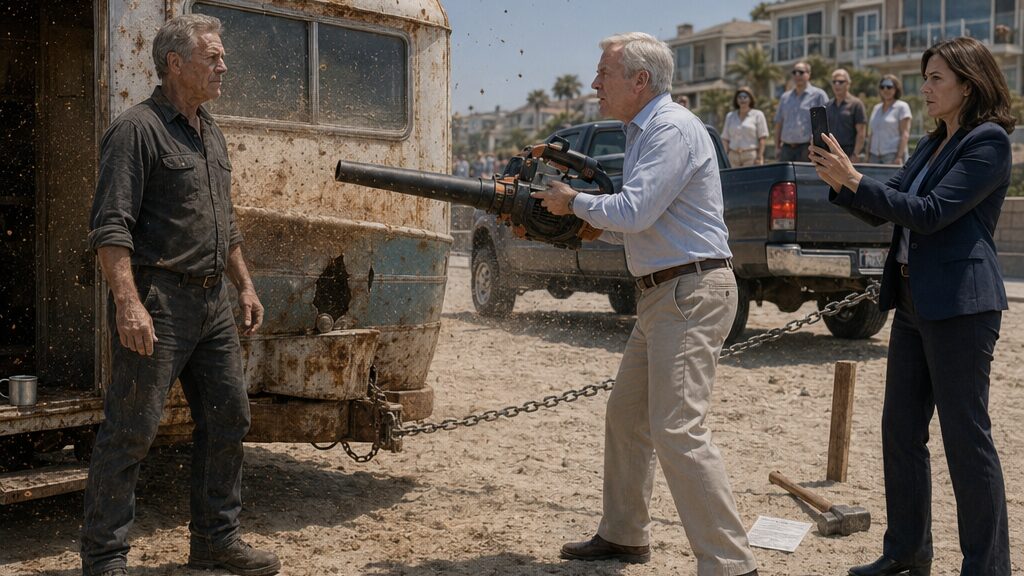
Donald climbed out, opened the rear compartment, and dragged the heavy tow chain into the sunlight.
He carried it toward the camper and dropped it beside William’s front wheel.
The hook struck the sand with a dull metallic weight.
This time, William did not reach for his coffee.
Chapter 4: The Chain Beside the Armored Compartment
The tow hook struck metal behind the camper’s rusted front bumper with a sound William felt through the floor.
Not the hollow clang Donald expected.
A dense, contained impact.
William opened the door and stepped down.
Donald crouched beside the bumper, feeding the heavy chain beneath its sagging left corner. Rust flakes broke loose under his hands and scattered across the sand. Ashley stood several feet away with her phone held horizontally, keeping both men in frame.
The wooden stake and false notice leaned behind her. The sledgehammer lay near Donald’s truck.
“You have one chance to remove that,” William said.
Donald looked up. “You had six hours to move.”
“The notice is false.”
“That will be for management to decide.”
“Ashley is management,” William said. “She already decided to lie.”
Ashley lowered the phone half an inch. “Everything is being recorded.”
William looked at the lens.
“That does not make it true.”
Donald pulled the chain tighter and searched for a purchase point. The visible bumper was mostly cosmetic, a weathered shell surrounding a reinforced assembly bolted into the camper’s structural frame. He found the steel loop beneath it and smiled.
“There,” he said. “More solid than it looks.”
William’s attention fixed on the hook.
It had settled six inches from the armored communications housing.
The compartment sat behind the front panel, sealed beneath ordinary wiring and corrosion-stained sheet metal. Inside were encrypted relays, emergency-band transmitters, and buffered recordings from the buried coastal array. The system had been designed to survive salt, impact, and severe weather.
It had not been designed to be ripped sideways by a truck.
“Do not attach the chain there,” William said.
Donald threaded the hook through the loop.
“You don’t give instructions here.”
William descended the final step and moved toward him.
Donald rose quickly, placing himself between William and the bumper.
“You touch me, and this becomes assault.”
“You are attaching a towing chain to my vehicle.”
“An abandoned vehicle under removal.”
“Your truck is not licensed for that. Your notice has no authority. And the point you chose contains protected equipment.”
Donald glanced at the rusted panel.
Then he laughed.
Ashley kept filming. “Protected from what?”
William heard the edge in her question. She wanted him to sound unstable. She wanted a statement she could separate from the scene and circulate.
He did not answer her.
Inside the camper, an alarm chirped once.
Soft. Mechanical. Impossible to mistake.
William turned his head.
Donald heard it too. “What was that?”
“A warning.”
“For your engine?”
“No.”
William stepped around him. Donald blocked him again.
The alarm sounded a second time, sharper now.
A display beneath the table would be showing lateral strain on the forward assembly. The hook had not yet pulled, but its weight was already twisting the external mount.
William looked at Ashley. “Tell him to remove it.”
She raised the phone higher. “You are refusing a lawful order to vacate.”
“There is no lawful order.”
“You received written notice.”
“You forged written notice.”
A few residents had gathered on the access path. Their voices carried over the wind. William recognized the woman who had tried to pull Donald aside earlier. She stood with both hands clasped near her chest, watching the chain.
Donald bent and lifted the free length.
“You see that truck?” he asked William. “It has enough torque to move twice this weight.”
“That is not the reassurance you think it is.”
Donald dragged the chain toward the rear hitch of his pickup.
William went back inside.
Ashley called after him, “Leaving the scene does not stop the removal.”
He ignored her and opened the hidden panel.
The status screen had shifted from amber to red.
FORWARD COMMS HOUSING
UNAUTHORIZED LOAD DETECTED
ESTIMATED FAILURE THRESHOLD: 0.4 METERS
A diagram showed the steel loop flexing toward the armored casing.
William touched the secure line.
Eric answered immediately. “I’m seeing strain.”
“He hooked the forward mount.”
“Which point?”
“Left loop.”
There was a pause.
“That sits beside the relay housing.”
“I know.”
“How much chain slack?”
William looked through the narrow front curtain. Donald was fastening the other hook to his truck.
“Almost none.”
“Cut the power feed and evacuate the vehicle.”
“No.”
“If the housing tears open, you could lose isolation.”
“The recordings are buffered.”
“That is not the only concern.”
“I know.”
Eric’s breath sharpened over the line. “Support is moving.”
“I did not activate them.”
“The distress threshold activated itself.”
William looked at the red diagram.
A memory came without invitation: a metal battery case shifting across a storm-wet floor, one mounting bolt snapping, then another. He had heard the technician shout before the housing struck him. William had been holding the report that proved he had warned everyone.
The report had not stopped the impact.
Outside, the truck door slammed.
William closed the panel and stepped out again.
Donald was walking toward the driver’s side. Ashley followed, recording over his shoulder.
William raised his voice enough for the residents to hear.
“The chain is attached beside an armored communications compartment. Pulling it may rupture protected equipment. Remove it now.”
Donald stopped.
For the first time, uncertainty crossed his face.
He looked at the camper differently—not with respect, but with calculation.
“Armored?” he asked.
“Yes.”
“What kind of communications?”
“I am not discussing that.”
“Convenient.”
“It is the last warning you will receive.”
Ashley moved closer to Donald. “He’s trying to frighten you.”
William looked at her. “You received a restricted-access directive.”
Her face tightened.
Donald turned toward her. “Did you?”
“It was a routine administrative notice.”
“What did it say?”
“That the parcel was temporarily unavailable.”
“Unavailable for what?”
Ashley kept the phone aimed at William. “It did not identify any federal equipment.”
William saw Donald make his choice.
Not because he believed her completely. Because retreating now would mean admitting that he had brought a chain and sledgehammer onto land he did not understand. The residents were watching. Ashley was recording. His truck was positioned like a promise.
He pointed at the camper.
“If there were protected equipment in there, there would be signs.”
“There should have been,” William said.
The answer surprised both of them.
Donald recovered first. “Exactly.”
William felt the truth of it cut through his anger. He had refused visible warnings because the operation depended on appearing ordinary. He had also known residents crossed the plot daily. He had trusted a management office he rarely inspected and a restriction notice no one outside it could see.
Secrecy had protected the equipment from attention.
It had not protected it from entitlement.
Donald opened the truck door.
William walked toward the chain.
Ashley stepped in front of him. “Do not interfere with the removal.”
“Move.”
“You are on camera threatening a property representative.”
William looked past her toward Donald. “Do not start that engine.”
Donald climbed into the cab.
The truck came alive with a heavy diesel growl.
Several residents backed away from the path. The woman who had tried to intervene called out, “Donald, wait.”
He closed the door.
Ashley retreated to the side, framing William, the camper, and the truck in one shot.
The chain still lay partly in the sand.
William took one step toward the bumper.
Donald shifted the truck into gear.
The slack vanished link by link, rising from the beach like a steel spine.
Chapter 5: The Nozzle Broke Before the Bumper Did
The truck lurched forward half a foot.
Inside the camper, something cracked.
William did not hear it so much as recognize it—a sharp internal snap transmitted through the frame. The left front corner dipped, and the chain pulled tight enough to sing.
“Stop!” he shouted.
Donald’s brake lights flared.
For one second, the truck held.
Then Donald opened the door and stepped out, leaving the engine running.
“What broke?” he called.
William moved toward the bumper.
Ashley followed with her phone, filming close enough that the lens nearly entered his path.
“Stay back,” William said.
“You damaged your own vehicle by refusing to cooperate,” she replied.
The chain had shifted the steel loop less than an inch, but that was enough. A narrow seam had opened behind the rusted panel. William saw a strip of black composite material beneath it.
The armored housing.
He crouched and reached for the hook.
Donald caught his shoulder.
William rose and removed the hand with one controlled turn of the wrist.
Donald stumbled a step.
Ashley inhaled sharply, delighted by the image she thought she had captured.
“You saw that,” Donald said toward the phone. “He attacked me.”
“You grabbed me,” William said.
“I was stopping you from tampering with the removal.”
William looked at the running truck, then at Donald.
“Turn off the engine.”
“No.”
“You have already damaged the housing.”
Donald glanced at the exposed black strip.
“What is that?”
“The reason you need to stop.”
William moved again.
Donald backed toward the tools near the truck bed. His eyes passed over the sledgehammer, then settled on the leaf blower.
He grabbed it by the handle.
The motor started after two hard pulls, filling the beach with a high mechanical roar.
Residents on the path began shouting. Their words disappeared beneath the engine.
Donald raised the blower tube between himself and William.
“Stay away from the chain.”
William stopped.
The long plastic nozzle pointed at his chest.
Donald’s stance was not trained, but fear and humiliation had made him unpredictable. He had expected William to retreat, argue, or beg. Instead, the old man had removed his hand as if it weighed nothing.
Ashley moved sideways, preserving her angle.
“Donald,” she called over the blower, “keep him away from the truck.”
William heard the instruction.
So did several residents.
Donald advanced one step and drove the air stream into William’s jacket. Sand and loose rust struck his trousers.
“You wanted a safety incident,” William said.
Donald could not hear him.
Or pretended not to.
William shifted toward the bumper.
Donald swung the tube across his path. The blast caught the camper step, sending William’s dented metal mug tumbling into the sand. Coffee spread darkly around it and vanished almost at once.
Something in William narrowed.
The mug had nothing to do with the operation. It was cheap, scarred, and older than some of the officers who worked beneath him. He had carried it through storms, temporary stations, and one hospital waiting room where a technician’s wife had asked him why no one stopped the battery housing before it failed.
He had given her the official sequence.
He had never told her that he had waited.
Donald shoved the nozzle toward his face.
William stepped into it.
The move startled Donald enough that his arms stiffened.
William caught the tube near the midpoint with his left hand, trapped it against his forearm, and turned his body. The plastic flexed. Donald tried to pull back.
William drove the tube downward across his knee.
The nozzle tore cleanly from the blower housing with a brittle crack.
The motor screamed freely in Donald’s hands.
For a moment, nobody moved.
William held the long black nozzle like a baton.
Donald dropped the blower and backed away.
Ashley’s phone remained raised.
The camera was pointed past William’s shoulder toward the open seam in the camper panel, where the black composite armor and a line of coded hardware were now visible.
“Lower the phone,” William said.
She took one step back but kept recording.
“This is evidence.”
“It is protected equipment.”
“You don’t get to destroy evidence because it embarrasses you.”
William saw the upload symbol at the corner of her screen.
The file was transmitting.
He crossed the distance before she understood his decision.
Ashley twisted away, clutching the phone to her chest. William struck her wrist with the hollow plastic tube—not hard enough to injure her, but enough to loosen her grip.
The phone fell.
He brought the nozzle down once.
The screen shattered against packed sand.
Ashley screamed.
He struck it again, driving the device face-first into the dirt.
The recording ended.
The leaf blower idled on its side until Donald kicked it away.
“You’re finished,” Ashley said, staring at the broken phone. “You’re going to prison.”
William dropped the nozzle.
“Your cloud upload may contain restricted imagery.”
“My phone contained proof that you attacked us.”
“It contained proof that you aimed a camera into secured equipment after being warned.”
Donald pointed toward the residents. “They saw you. Everyone saw you.”
William looked at the path.
Some faces held shock. Others held doubt. A man near the back was speaking into his own phone. The woman who had challenged Donald earlier knelt beside the fallen mug but did not pick it up.
Inside the camper, the alarm changed.
A pulsing distress tone sounded through the thin walls.
The system had registered physical damage and sent an automated federal alert.
Ashley heard it and stepped away from the vehicle.
“What is that?”
William did not answer.
He crouched beside the bumper and examined the seam. The outer shell had split. The armored housing remained sealed, but one mounting brace had fractured. Another pull could have torn the relay assembly sideways.
Donald moved toward the truck.
William stood.
“Do not touch the vehicle.”
Donald stopped. “You don’t order me.”
“The chain stays where it is until investigators document it.”
“You think a broken phone turns you into an investigator?”
“No.”
William looked toward the access road.
A faint siren rose beyond the houses.
Donald heard it too. Confidence returned to his face in a rush.
He pointed at William and shouted toward the path, “Tell them what he did. Tell them he attacked us with that thing.”
Ashley searched the sand around her phone. The main casing was broken, but a small indicator still blinked.
“It uploaded,” she said. “The clip is already online.”
William looked at her.
“How much?”
“Enough.”
One resident checked his phone. Then another.
Within seconds, William heard the fragment playing from several speakers: Donald’s blower roaring, William stepping forward, the plastic tube breaking, Ashley crying out. The earlier chain pull was not visible. Neither was Donald’s hand on William’s shoulder.
The clip began at the moment William moved.
His own silence had left Ashley free to choose the beginning.
Two police vehicles turned onto the beach access road.
Donald walked toward them before they stopped, pointing back at William.
“That man is armed,” he shouted. “He attacked us.”
William looked down at the detached nozzle lying beside the shattered phone.
Then he raised both empty hands.
Chapter 6: The Credentials Behind the Rusted Door
“Keep your hands where I can see them.”
Catherine Perez crossed the sand with one hand near her holster.
Behind her, another officer moved toward Donald and Ashley. The sirens cut off, leaving the camper’s distress tone exposed in the sudden quiet.
William stood beside the broken phone with his hands raised.
The tow chain remained taut between the camper and Donald’s idling truck.
“Sergeant,” he said, “the engine needs to be shut down.”
“Do not move.”
“The transmission is engaged.”
Catherine looked toward the truck. “Whose vehicle?”
“Mine,” Donald said. “He attacked us when we tried to remove an abandoned camper.”
“Turn it off.”
“He could run.”
“Turn off the truck, Mr. Green.”
Donald hesitated, then obeyed. The engine died. The chain slackened slightly but did not fall.
Catherine’s attention returned to William.
“What is that alarm?”
“Automated distress signal.”
“From what?”
“The forward communications housing.”
Donald spread his hands. “Listen to him.”
Catherine glanced at the open seam near the bumper. The black composite strip beneath the rusted shell was visible now.
Her expression changed.
“Mr. Nelson,” she said quietly, “is this related to the identification you showed me?”
“Yes.”
“Why did you not tell me the vehicle contained sensitive equipment?”
“You did not need that information at the time.”
“I may need it now.”
“You do.”
Ashley stepped forward. “He tore a machine apart and smashed my phone. The video is online.”
Catherine turned to her. “Stay where the other officer placed you.”
“He destroyed evidence.”
“He may have destroyed your property. That does not settle what happened before it.”
Donald pointed at the chain. “We posted notice. He refused. We began a lawful removal.”
Catherine looked at Ashley. “Did you tell him I confirmed Mr. Nelson’s authorization?”
Ashley’s lips parted.
Donald answered first. “She said the police were waiting on management.”
Catherine held Ashley’s gaze. “That is not what I told you.”
The distress tone stopped.
A deeper signal replaced it—three measured pulses from inside the camper.
William recognized the authentication sequence.
Support was near.
Catherine heard it too. “Open the vehicle.”
“Not until the perimeter is controlled.”
“I am controlling it.”
“There are at least six residents recording from the path.”
She looked back. Several phones lowered.
“Everyone behind the paved line,” Catherine ordered. “Now.”
The residents retreated slowly.
William lowered his hands only after she nodded. He reached into his jacket with two fingers and removed the credential card he had shown her the day before.
This time, he also took out a sealed identification wallet.
Catherine examined both.
“What exactly is your assignment?”
“Coastal communications integrity and sensor supervision.”
“Federal?”
“Yes.”
“Active?”
“Yes.”
Donald gave a short, disbelieving laugh. “He lives in that thing.”
William looked at him. “I work in it.”
A dark utility vehicle appeared at the access road without lights or markings. It stopped behind the police cars.
Eric Martinez stepped out carrying a hard equipment case.
He did not hurry. The lack of haste made everyone watch him.
Catherine moved to intercept him.
“Identify yourself.”
Eric presented his credentials and pointed toward the camper. “Automated distress alert from Mobile Station Seven. I am the assigned communications technician.”
Catherine checked the card, then let him pass.
Eric crouched near the exposed seam without touching it.
“Who attached the chain?”
Donald folded his arms. “I did.”
Eric looked up. “Did anyone authorize you?”
“The property manager.”
Eric turned to Ashley.
She looked away.
He opened his case and removed a handheld scanner. The device chirped as he passed it near the damaged panel.
“Outer mount fractured,” he said. “Housing seal intact. Relay isolation holding.”
William exhaled for the first time since the truck moved.
Eric glanced at him. “Half an inch more and the bracket would have sheared.”
Donald stared at the scanner. “What is inside?”
“Protected communications hardware,” Eric said.
“You expect us to believe that rust bucket is federal property?”
Eric straightened. “The exterior shell is privately registered. The command assembly and operational systems are federal equipment.”
“Privately registered to whom?”
William said nothing.
Catherine noticed.
“Let us take this one step at a time,” she said. “Mr. Nelson, open the door enough for me to verify the installation.”
William looked toward the path. The residents were farther back now. The second officer had collected the detached nozzle and was photographing the chain, the phone, and the sledgehammer.
William unlocked the camper.
The weathered door opened onto ordinary shelves first: books, folded blankets, a narrow stove, faded curtains.
Then he released the hidden latch.
The wall panel swung inward.
Coded displays illuminated armored racks. Signal maps glowed across recessed screens. Behind the books, secured modules ran in silent rows beneath tamper seals and identification plates.
Catherine stood on the step but did not enter.
Donald’s face lost color.
Ashley whispered, “You never disclosed this.”
William looked at her. “The restricted-access notice disclosed enough.”
“I never received operational details.”
“You received an instruction not to interfere.”
Catherine turned. “You told me the parcel status was under management review.”
“It was.”
“No. It was not.”
Eric connected a cable to the damaged housing. Data began scrolling across his tablet.
“The chain load triggered the distress transmission,” he said. “The system recorded the first strain, the truck movement, and the second contact event.”
Ashley’s head snapped toward him. “Recorded how?”
“Internal accelerometers and exterior security sensors.”
“Video?”
“Not from the public-facing side.”
Her shoulders eased slightly.
William saw it.
She thought the missing angle still protected her.
Donald stepped forward. “None of this excuses him attacking us.”
Catherine blocked him with one arm. “Stay back.”
“He broke her phone.”
“After you pointed a running blower at him?”
Donald looked toward Ashley.
She said nothing.
Catherine continued, “And after you attached a chain to equipment you had been warned was protected?”
“There were no signs,” Donald said. “No fence. No warning. People have used this beach for years.”
The words were angry, but they were not entirely wrong.
Catherine looked at William. “Was the public informed that this plot was restricted?”
“No.”
“Were visible markers installed?”
“No.”
“Why?”
“To preserve the monitoring pattern and avoid drawing attention to the station.”
Donald seized on the answer. “So we were supposed to guess?”
William met his gaze.
“No,” he said. “You were supposed to stop when police told you I was authorized. You were supposed to stop when I told you the equipment was protected. You chose not to.”
Donald’s jaw tightened.
“But,” William added, “the site should have had a clearer boundary before today.”
Eric looked at him, surprised.
Catherine was not.
She nodded once, as if he had finally answered a different question she had been asking since the first morning.
The second officer approached with Ashley’s damaged phone sealed in an evidence bag.
“The device is still connecting to cloud storage,” he said. “We may be able to preserve the account.”
Ashley crossed her arms. “You need permission.”
Catherine looked at the shattered screen. “You reported it as evidence in an assault. We will preserve relevant material.”
Eric returned to the camper and accessed the secure network. “There was a data request sent from the management office yesterday.”
William looked at him. “For what?”
“Parcel access records.”
Ashley spoke too quickly. “Routine inquiry.”
Eric’s fingers moved across the screen.
“And two incoming notices were delivered to the same account,” he said. “One from local law enforcement. One from corporate compliance.”
Ashley’s face changed.
Donald looked at her. “What notices?”
She did not answer.
The officer holding the phone read from a recovered cloud notification.
“There are deleted messages synced to the account.”
Catherine stepped closer. “Can you identify them?”
The officer turned the damaged device so she could see.
The first deleted message was Catherine’s full confirmation that William had lawful authorization.
The second carried the corporate seal and a direct instruction:
BEACHFRONT PARCEL TEMPORARILY RESTRICTED. NO EVICTION, TOWING, ENTRY, OR INTERFERENCE AUTHORIZED.
Both messages had been opened.
Both had been deleted before Ashley contacted the residents.
Catherine looked up.
Donald stared at Ashley as if seeing her clearly for the first time.
William stood beside the open rusted door, the hidden command center glowing behind him.
Ashley had not misunderstood the order.
She had buried it.
Chapter 7: The Owner Who Finally Drew the Line
Ashley demanded corporate protection before anyone had accused her of losing it.
“You need to contact regional leadership,” she said. “This has gone beyond local management.”
Catherine stood beside the damaged phone while the second officer photographed the deleted messages displayed on the recovered cloud account.
Donald looked at Ashley with an expression more wounded than angry.
“You knew,” he said.
“I knew there was an administrative restriction.”
“You knew the police cleared him.”
“I knew they declined immediate action.”
Catherine’s voice cut through hers. “That is not what the message said.”
Ashley turned toward William.
The camper door remained open behind him, revealing armored equipment beneath shelves of worn books. In the lowering afternoon light, the contrast looked almost deliberate. The exterior still carried every rust stain. The left front panel still sagged. Nothing about the vehicle had changed except what people were now permitted to see.
Ashley lifted her chin.
“Whatever your federal role is, you have no authority over my employment.”
William took out his phone.
“You are correct about one thing,” he said. “Federal authority does not decide your employment.”
He selected a number stored without a name.
The call connected after one ring.
“This is William Nelson,” he said. “Authenticate board control.”
Ashley’s face emptied.
A voice on the other end requested a code. William entered it.
Donald stared at him. “Nelson?”
William kept his eyes on Ashley.
“I am at the beachfront parcel beside the eastern development. The local property manager issued a fraudulent eviction notice, concealed a police clearance, deleted a corporate restriction order, and encouraged unauthorized towing that damaged protected equipment.”
Ashley stepped forward. Catherine stopped her.
“You cannot summarize it like that,” Ashley said. “You have not heard my side.”
William continued into the phone.
“Place Ashley Miller on immediate administrative termination. Preserve her email, cloud records, access logs, and resident communications. Suspend all local parcel directives pending review.”
The reply came through the speaker clearly enough for those nearest to hear.
“Confirmed, Mr. Nelson. Termination effective immediately. Records preservation initiated.”
William ended the call.
No one applauded.
The only sound was the faint ticking of the camper’s cooling metal and the surf dragging small stones back toward the water.
Ashley looked at the identification badge clipped to her blazer as though it belonged to someone else.
“You own the company,” Donald said.
“I control it.”
“You let us believe this land belonged to the development.”
“No,” William said. “I allowed residents to use it.”
“That is the same thing when no one says otherwise.”
William looked toward the walking path.
The residents had moved closer again, no longer recording openly. Some had brought trash bags to beach cleanups. Some had cut back invasive grass. Donald had organized much of it. William knew the reports. He had approved reimbursement requests without attending the meetings that produced them.
He had seen the parcel as a line on a map and a buffer around federal equipment.
They had seen it every morning.
“You were never granted ownership,” William said. “But you were given years of access without written limits.”
Donald gestured toward the truck, the chain, the broken phone. “So this is partly your fault?”
“The confusion is partly mine.”
Catherine watched him carefully.
William continued. “The chain is yours. The blower was in your hands. The decision to keep going after three warnings was yours.”
Donald’s mouth tightened, but he did not argue.
The second officer approached Catherine and spoke quietly. She listened, then turned to Donald.
“You will need to remain available while we document the attempted tow, the equipment damage, and the physical contact reported by both sides.”
“Am I under arrest?”
“Not at this moment. You are not free to leave with the truck.”
Donald looked toward the patrol vehicle, then back at William.
For the first time since the first sign had been driven into the sand, he seemed old.
Not weak. Not harmless. Simply stripped of the authority he had been borrowing from everyone around him.
“I thought I was protecting the neighborhood,” he said.
William glanced at the sledgehammer lying near the tire tracks.
“You stopped protecting it when being obeyed became more important than being right.”
Donald absorbed the words without lowering his eyes.
Ashley did not.
“I did what residents demanded,” she said. “Every complaint came to me. Every threat to call corporate came to me. You stayed invisible and expected the office to absorb everything.”
William looked at her.
There was truth there too.
She had falsified records. She had endangered people and equipment. But the structure above her had rewarded quiet resolution and punished visible conflict. William had allowed reports to reach him only after they had been filtered through layers of people afraid to sound difficult.
“You were under pressure,” he said.
Ashley’s expression shifted, almost hopeful.
“You still chose deception.”
The hope disappeared.
A corporate representative would meet her at the management office. Until then, Catherine instructed her to surrender her access badge and remain available for a formal statement.
Ashley unclipped it slowly.
The badge left a small crease in the fabric of her blazer.
Eric emerged from the camper carrying a diagnostic tablet.
“The housing can remain operational,” he told William. “The exterior brace has to be replaced. We should close the entire parcel until the unit is moved.”
William looked toward the residents.
Permanent closure would be simple. Fencing could arrive by morning. Signs could make every boundary unmistakable. No one would walk near the sensors again. No one would confuse access with ownership.
It would also punish people who had never touched the chain.
“How long until the current assignment ends?” he asked.
“Four days, if the southern array stays stable.”
William nodded. “Close the parcel for four days. After that, restore pedestrian access outside maintenance windows.”
Eric frowned. “You want the public back here?”
“With marked limits.”
Donald gave a bitter laugh. “Now you put up signs.”
“Yes.”
William walked to the false eviction notice still stapled to the wooden stake. He pulled the paper free, folded it once, and handed it to Catherine as evidence.
Then he gripped the stake.
It resisted more than the homemade sign had on the first morning. Donald had driven it deep with the sledgehammer.
William worked it loose without drama.
“Use this line for the temporary boundary,” he told Eric. “Not the dune edge. Leave the public path open.”
Eric studied him for a moment, then nodded.
Federal personnel arrived in two unmarked vehicles. They placed low temporary barriers around the operational area and raised clean signs at each approach.
RESTRICTED ACCESS
AUTHORIZED OPERATIONS IN PROGRESS
PUBLIC SHORELINE PATH REMAINS OPEN
The wording mattered.
William read every line before approving it.
As the chain was removed from the camper, Donald stood beside Catherine. He watched the heavy links fall from the reinforced loop into the sand.
“You could have told us who you were,” he said.
William crouched near the damaged bumper.
“I could have told you enough.”
Donald looked toward the residents. “Would it have changed anything?”
“For some people.”
“For me?”
William considered the question.
“You already had enough information to stop.”
Donald looked away.
The tow truck that came later belonged to a licensed operator. It removed Donald’s pickup from the sand for inspection, not William’s camper. No one made a joke about the reversal.
Ashley left carrying a thin envelope Catherine had given her with instructions for the records review. The termination itself had arrived electronically. She did not look toward the camper as she passed.
By sunset, the beach had quieted.
Eric sealed the exposed panel with a temporary brace. The black composite disappeared once more behind weathered metal. From ten feet away, the camper looked exactly as it had before.
William found his dented mug half-buried where it had fallen.
A shallow crease ran along one side, but it did not leak.
He carried it to the outdoor tap beside the camper and washed away the sand. Brown coffee residue swirled into the dirt and vanished beneath clear water.
Catherine approached as he dried the mug on his sleeve.
“You know I should have written a public incident note after the first call,” she said.
“You told Ashley clearly.”
“I told her privately.”
William looked at the new boundary signs.
“So did I.”
Catherine followed his gaze.
“Will you file charges over the phone?”
“That is not my decision alone.”
“You struck the device twice.”
“It was transmitting protected imagery.”
“It was also her property.”
“I know.”
She nodded. “That answer will help.”
William poured fresh coffee inside the camper and returned with the mug steaming between his hands.
He placed a folding chair beside the door.
Beyond the temporary barriers, residents walked the public path in silence. Some looked at him. Most looked at the signs.
Donald sat in the rear of a patrol vehicle with the door open while an officer completed paperwork beside him. He was not handcuffed. He watched federal personnel finish marking the ground he had called his park.
William sat down.
The rusted camper stood behind him, repaired but not restored, guarded without being displayed.
For years, he had believed that a boundary understood by the right people was enough.
Now the line was visible.
He drank his coffee as the last marker was driven into the sand.
The story has ended.