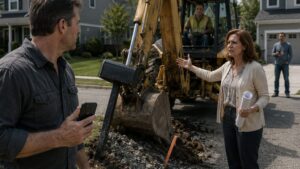
The Day Dennis Johnson Drew a Line the HOA Could No Longer Cross
Chapter 1: The Sticker Struck Before the Grass Was Measured
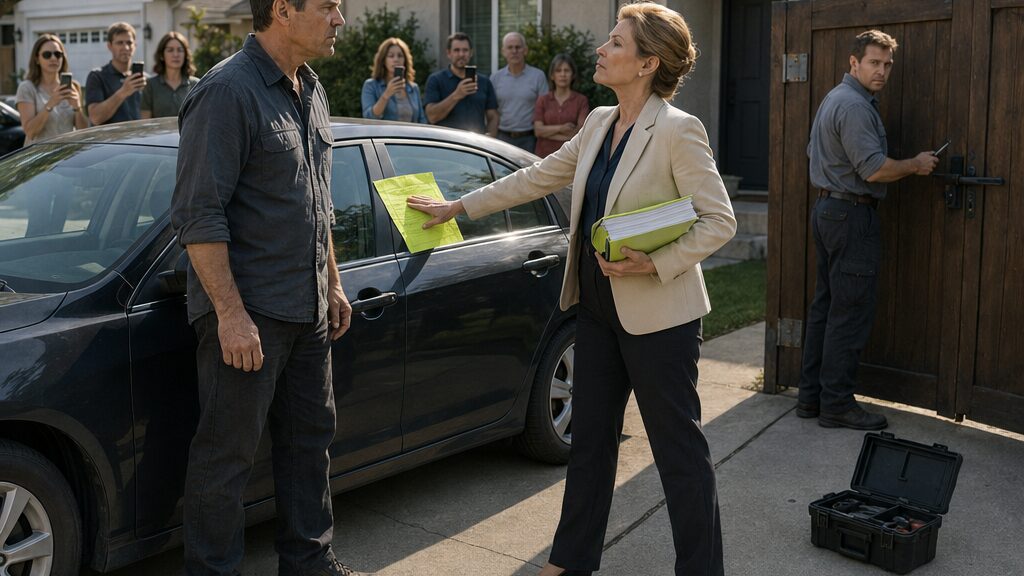
The neon sticker struck Dennis Johnson’s windshield with a flat, violent slap while the metal lawn gauge was still in his hand.
Karen Mitchell pressed both palms over the fluorescent orange rectangle, smoothing it against the glass as though sealing an official notice on an abandoned building. The sticker covered the lower half of the driver’s side windshield. Black letters warned of immediate enforcement action.
Dennis looked from the sticker to the gauge.
“You haven’t measured anything.”
Karen stepped back, her cream-colored blazer sharp against the dark side of his vehicle. “I don’t need a machine to see neglect.”
The gauge belonged to the HOA. She had handed it to him less than thirty seconds earlier, then accused him of refusing to cooperate before he had even lowered its narrow measuring plate into the grass.
Behind her, a gray service van idled at the curb. A man in a work shirt stood beside it with a compact black case in one hand. Dennis had seen locksmith cases during years of municipal property inspections. They were built to carry small tools without advertising what those tools could do.
Karen had brought one to a lawn inspection.
Dennis set the gauge on the hood of his vehicle. He did it carefully. The camera above his front door faced the driveway, and the vehicle sat at an angle that left the side gate visible through the space between the garage wall and the rear bumper.
He had spent twenty minutes that morning clearing pale dust from the seam in the concrete.
It ran from the edge of the sidewalk to the narrow strip beside the house, an ordinary expansion joint that happened to follow the surveyed property line almost exactly. A thin chalk mark, placed low enough to appear accidental, continued the line toward the locked wooden gate.
Karen stepped across it without looking down.
“You were notified twice,” she said.
“I received one email yesterday.”
“You ignored the courtesy warning.”
“It arrived at six-forty last night.”
“That was your opportunity to correct the violation.”
Dennis glanced toward the lawn. The grass stood even and green along the driveway. He had cut it the previous afternoon, not because of Karen’s email, but because Thursday was when he cut it. The blades reached the same height from the mailbox to the fence.
Karen opened a thick industrial book of neon stickers. Pink, yellow, orange, and green sheets fanned beneath her thumb.
The locksmith shifted beside the van.
“Mrs. Mitchell,” he said, “you said there was an access issue.”
“There is.”
His name was stitched on his shirt: George Moore.
George’s gaze moved from the lawn to the sticker on Dennis’s windshield. “I thought this was a gate authorization.”
“It is.”
Dennis said, “Authorized by whom?”
Karen turned toward George before he could answer. “The association has inspection rights.”
“That wasn’t my question.”
Her expression tightened, not with uncertainty but irritation at being made to explain herself. She pulled a folded document from a leather binder and held it toward George.
He reached for it.
Karen kept her fingers on the top edge while he read, forcing him to lean closer. Dennis could see the association letterhead, a block of typed text, and a signature line near the bottom. Karen’s hand covered most of it.
George frowned.
“Can I get a copy of that?”
“You have your work order.”
“I’d like to see the authorization language.”
“You just did.”
Dennis stepped toward them. Karen folded the page before he reached reading distance.
“I’ll take a look too,” he said.
“You were sent the governing documents when you purchased your home.”
“That page isn’t the governing documents.”
“It summarizes them.”
“Then there’s no reason to hide it.”
Karen slid the paper into her binder. “Hostility does not suspend enforcement.”
Dennis almost smiled. She had used the same word in three emails. Hostility meant a question she did not want to answer.
Across the street, a curtain moved in Heather White’s front room and went still.
Dennis had seen Karen on Heather’s property six months earlier, standing beside the widow’s back gate with a clipboard while two maintenance workers carried something through the yard. He had watched from his garage and told himself Heather must have agreed. Later, he learned about the fines, the threats, and the payment Heather had made from an account she once shared with her husband.
He had not forgotten the way she avoided looking at him afterward.
Karen followed his gaze and snapped her binder shut.
“This will not become another neighborhood performance,” she said. “The grass is one-eighth of an inch above the permitted height, and there is a possible unapproved structure beyond that fence.”
There it was.
Not grass.
Dennis looked toward the side gate. Behind it stood a narrow cedar enclosure built against the rear wall of the garage. It protected an outdoor water shutoff and stored two trash bins. It had been there for eleven years.
“What structure?” he asked.
“You know exactly what I mean.”
“I want to hear you say it.”
George lowered his case to the pavement. “Mrs. Mitchell, does the owner know we’re opening the gate?”
Karen’s answer came too quickly. “The owner has been properly notified.”
“That’s not consent,” Dennis said.
“The association does not require consent to investigate a violation.”
Dennis picked up the metal gauge and placed it vertically into the grass at the driveway edge. The plate settled between the blades.
“Three inches,” he said. “Exactly.”
Karen did not look.
“The allowable height is two and seven-eighths.”
“No, it isn’t.”
She opened the binder again. “The landscaping standard gives the enforcement chair discretion where visible unevenness affects neighborhood appearance.”
Dennis pulled a folded copy of the association rules from his back pocket. He opened to the marked page.
“Maximum height is three and a half inches. There’s no two-and-seven-eighths standard.”
Karen glanced at the page and dismissed it with a small movement of her chin. “That version is outdated.”
“It was downloaded from the resident portal this morning.”
“The portal has not been updated.”
“Then the residents are being fined under rules they can’t see.”
George looked at Karen.
For the first time, something in her posture shifted. Not fear. Calculation.
She turned away from the lawn and pointed toward the side gate.
“The landscaping issue is only one element of today’s inspection. Mr. Moore, prepare the lock.”
George did not move immediately.
Dennis placed the rule sheet on the hood beside the gauge. Then he walked toward the concrete seam he had cleared that morning.
Karen followed, her heels clicking once on each slab.
“The apron is common access,” she said.
“The sidewalk is. The apron isn’t.”
“The association maintains the visual continuity of all front-facing property.”
“That doesn’t make it yours.”
She raised the binder like a judge lifting a file. “Your deed is subject to the declaration.”
Dennis stopped with both boots behind the seam.
“Look down.”
Karen did not.
“Look down, Karen.”
Her eyes dropped at last.
The pale joint ran between them.
“This line,” Dennis said, “is within half an inch of the surveyed boundary. The sidewalk is on your side. My driveway begins on mine.”
“You cannot obstruct an authorized inspection.”
“You are not authorized to cross.”
George opened his case.
Inside, the tools rested in fitted black foam: tension wrenches, picks, a small bypass knife, and a compact driver with a narrow shaft.
The metallic click of the first tool leaving its slot seemed louder than the van’s engine.
Dennis turned his body toward the gate.
Until that moment, he had let Karen move, speak, mark the vehicle, and display the document. He had let each action become its own fact.
Now he stepped directly into the path.
Karen’s mouth hardened.
“Mr. Moore,” she said, “open it—or I will report that you refused a lawful order.”
Chapter 2: One More Step Became a Deliberate Choice
George’s bypass tool clicked open inches from the brass gate lock.
Dennis heard the small mechanical snap and felt his right hand close before he forced it open again.
He planted one boot along the concrete seam. The toe remained on his side. His heel touched the chalk mark leading toward the fence.
“You heard me refuse,” he said to George.
George held the tool low. “I heard you.”
“Then you know there is no owner consent.”
Karen moved beside him. “Owner consent is not required.”
George glanced at her binder. “Your work order says authorized access.”
“It is authorized.”
“By the association?”
“By the governing documents.”
Dennis said, “Show him the section.”
Karen looked at him with open impatience. “You do not control this inspection.”
“No. I control this gate.”
She gave a thin laugh. “That gate exists inside an HOA. You chose to live under collective standards.”
“I chose rules. Not you.”
The words landed harder than Dennis intended.
For a moment, Karen’s face changed. The board title, the binder, and the practiced certainty seemed to fall away, revealing a woman who had heard the sentence as a personal insult.
Then the expression vanished.
“The HOA owns this neighborhood,” she said. “Every homeowner’s choices affect every other homeowner’s investment.”
“The HOA owns the clubhouse and common land.”
“It governs the neighborhood.”
“Governing isn’t owning.”
“Semantics.”
“Property law.”
George closed the bypass tool halfway.
Karen noticed. “Do not let him intimidate you.”
“I’m trying to establish authority,” George said.
“You were given authority.”
“I was given a work order.”
She pulled it from her binder and tapped a line near the top. “Emergency exterior inspection.”
Dennis held out his hand. “Let me read it.”
Karen shifted the page away.
“Read it aloud,” he said.
“It is not addressed to you.”
“It concerns my gate.”
“It concerns association compliance.”
George exhaled and looked toward his van as if measuring the distance back to it. Then he pointed toward the gate.
“What’s the emergency?”
Karen answered, “A concealed structure with possible drainage impact.”
Dennis stared at her.
She continued, encouraged by the appearance of a formal explanation.
“During the last visual review, I observed a roofline extending behind the fence. No active architectural approval exists in the current file. If the enclosure redirects runoff toward neighboring lots, the association has a duty to inspect before further damage occurs.”
“The cedar cover?”
“So you admit it exists.”
“It covers the water shutoff and two trash bins.”
“You cannot establish that from here.”
“I can open it.”
Karen’s eyes narrowed. “Then do so.”
“No.”
George looked between them. “Why not open it and settle this?”
Dennis had known someone would ask. The reasonable question. The question that made resistance look theatrical.
“Because she did not request an inspection,” he said. “She arrived with tools to defeat a lock.”
Karen made a sound of disgust. “You refused three inspection notices.”
“I received one lawn email.”
“The structure was referenced.”
“No, it wasn’t.”
“Your refusal to acknowledge communication does not erase it.”
Dennis reached into the open window of his vehicle and removed a clear plastic folder from the passenger seat. He took out a folded site plan, yellowed slightly along the edges.
Karen watched him open it on the hood.
The drawing showed the house footprint, garage, fence line, and a narrow rectangle beside the garage wall. An approval stamp crossed one corner. The date was eleven years earlier.
Dennis placed his finger on the rectangle.
“Utility enclosure.”
Karen leaned close enough to see it but not close enough to concede that she was reading.
“This drawing predates the current architectural standards.”
“The structure predates them too.”
“Existing features can lose protected status if altered.”
“It hasn’t been altered.”
“That is what the inspection will determine.”
“You just changed the accusation.”
“I clarified it.”
“You said there was no approval. Here’s the approval.”
“For the original enclosure. Not necessarily the current condition.”
George studied the plan. “This looks pretty clear.”
Karen shut the folder with one hand.
The gesture was small, but it sent a sharp pulse through Dennis’s chest.
“Do not touch my papers.”
“Then keep them out of the work area.”
“This is not your work area.”
Her gaze flicked down to his boot on the seam.
For the first time, she stepped back behind the line.
Dennis noticed. So did George.
Karen noticed them noticing.
She opened the sticker book.
The pages made a stiff, adhesive crackle in the still air.
“Continued obstruction will result in daily fines,” she said. “Interference with an authorized contractor will be referred to counsel. If necessary, the association will place a lien.”
Across the street, Heather’s curtain moved again.
Dennis kept his eyes on Karen. “You told Heather that too?”
Karen’s thumb stopped between two neon pages.
“This is not about Mrs. White.”
“You told her she could lose her house.”
“I explained the consequences of unpaid assessments.”
“She wasn’t behind on assessments.”
“Her violation account was delinquent.”
“Because you fined her.”
“Because she refused correction.”
“You entered her yard.”
“With permission.”
Dennis saw the faintest tremor in Karen’s lower eyelid. Not guilt. Recognition that the conversation had moved beyond the day’s script.
George said, “Who is Mrs. White?”
“No one relevant to your work,” Karen replied.
Dennis looked toward the closed front window across the street.
He had promised himself that if Karen repeated the method, he would not intervene too early. He needed the threat stated, the tools visible, the boundary crossed knowingly. Facts, not suspicions. Evidence, not another resident’s word against a board officer’s records.
But hearing Heather reduced to no one relevant made the plan feel uglier than it had in his kitchen.
Karen tore a bright pink sticker from the book.
Dennis stepped toward her.
She moved faster.
The sticker struck his driver-side window and adhered across the glass with a rubbery slap.
“Tampering with this notice,” she said, “will constitute destruction of association property.”
Dennis stared through the pink film at the empty driver’s seat.
The vehicle looked impounded in its own driveway.
George lowered the tool. “That’s enough. I’m not touching the lock until I see something signed by the owner or a court.”
Karen turned on him. “You accepted the assignment.”
“Based on what you represented.”
“I represented association authority.”
“You represented legal access.”
“I will indemnify you in writing.”
George hesitated.
Dennis saw it happen. The calculation. The lost morning, the service call, the fear of leaving without payment, the comfort of a written promise from someone carrying official documents.
Karen saw it too.
She pulled a pen from the binder and wrote across the bottom of the work order.
“There. The association accepts responsibility.”
George read the added line.
His grip tightened around the tool.
Karen pointed beyond Dennis toward the gate.
“Cross the line.”
Chapter 3: The Paper Tore Before Dennis Lost Control
Dennis caught the sticker book before Karen could reach his side mirror.
His hand closed around the thick bound edge. Karen held the opposite side, and for one suspended second they stood linked by a block of fluorescent paper.
“Let go,” she said.
Dennis looked at the pink sheet covering his window, the orange notice across the windshield, and George’s tool angled toward the lock.
Then he pulled.
The adhesive-backed pages tore down the middle with a sound like heavy cloth splitting.
Karen stumbled one step forward but remained upright. Dennis held half the book in each hand. Neon pages hung in ragged layers from the broken binding.
He tore them again.
Orange, green, yellow, and pink pieces burst into the air. Some struck Karen’s blazer. Others spun across the hood, caught on the windshield wipers, or skittered over the driveway seam.
Dennis threw the remaining halves downward.
They hit the pavement at Karen’s feet.
“Not this driveway,” he said.
Silence followed.
Even the van seemed quieter.
Karen stared at the pieces clinging to her sleeve. Her face emptied, then sharpened with purpose.
She pulled out her phone.
Only then did she begin recording.
“This is Karen Mitchell, enforcement chair for the association,” she said, backing the camera away to frame Dennis. “I am documenting threatening behavior by a resident who has destroyed association property and obstructed an authorized contractor.”
Dennis looked directly into her phone.
“You started recording after you marked my vehicle twice.”
“He grabbed materials from my hands.”
“I took the sticker book.”
“He threw debris at me.”
“I threw torn paper.”
“You advanced aggressively.”
“I stepped toward my own vehicle.”
Karen turned the camera toward George. “Mr. Moore, did you witness him threaten us?”
George kept his eyes on the tool in his hand. “I saw him tear the book.”
“Did he move toward me?”
“He moved toward the vehicle.”
“You see?” Karen said, facing Dennis again. “Witnessed.”
Dennis felt heat rising along the back of his neck.
The paper tear had been satisfying for less than three seconds. Now it sat on the pavement as exactly the image Karen needed: a controlled board officer, a contractor, a resident surrounded by destroyed notices.
He had known she would try to reverse the scene.
He had not expected how easy he would make it.
Across the street, Heather’s front door opened a few inches.
Dennis inhaled slowly.
“Time is eleven seventeen,” he said. “Location is the north edge of my driveway at the surveyed boundary between my property and the public sidewalk.”
Karen lowered her phone a fraction.
He continued.
“Karen Mitchell has placed two adhesive notices on my vehicle without permission. George Moore has been instructed to bypass the lock on my side gate after I expressly denied access. The marked concrete seam is visible between us.”
Karen raised the phone again. “He is performing for the record.”
“Yes,” Dennis said.
George looked up.
Karen’s eyes narrowed. “What record?”
Dennis did not answer.
Not yet.
He pointed toward the pavement. “George, your left boot is still on the public side.”
George glanced down.
The toe of his work shoe stopped an inch short of the seam.
“Keep it there,” Dennis said.
Karen stepped closer to George. “Do not take instructions from him.”
“I’m taking note of where I’m standing.”
“You have written indemnification.”
“That doesn’t make the entry legal.”
“It makes the association responsible.”
“It makes someone responsible.”
Karen’s jaw flexed.
She held her phone away from her mouth and spoke more quietly. “You told me you had done association work before.”
“I have.”
“Then you understand inspection rights.”
“I understand I don’t pick a lock because a board member says she’s allowed through.”
“You saw the document.”
“I saw a summary.”
Dennis said, “A summary she wouldn’t let either of us hold.”
Karen swung the camera back toward him. “Your hostility is being documented.”
“You keep using that word.”
“Because you keep proving it.”
She tapped the screen and called emergency services.
Dennis heard the dispatcher answer through the phone’s speaker.
Karen’s voice changed at once—measured, breathless, carefully strained.
“I’m at a resident’s property with a licensed contractor. The resident has become aggressive. He seized materials from me, tore them apart, and threw them at my face.”
Dennis watched George.
The locksmith’s expression tightened at aggressive, then again at threw them at my face. He had seen the paper scatter. He had also seen Dennis leave distance between them.
Karen continued. “He is blocking a lawful inspection and threatening the contractor.”
“I never threatened him,” Dennis said clearly.
Karen turned away, lowering her voice as though Dennis’s correction were part of the danger.
“Yes, we need officers. He is escalating.”
The call ended.
She returned the phone to recording mode.
“You have made this much worse for yourself.”
Dennis looked at the torn neon pieces. Several had crossed the seam. One lay on the public sidewalk. Another was stuck to the toe of Karen’s shoe.
“That’s possible,” he said.
The answer unsettled her more than denial would have.
She opened the binder and removed the work order. “Mr. Moore, proceed before he has time to conceal the violation.”
George did not move.
“The police are coming,” he said.
“Which is why we need to complete the inspection. He has already demonstrated intent to destroy evidence.”
Dennis turned his head toward the cedar gate.
Behind it, nothing had changed. The enclosure remained approved. The bins remained inside it. The water shutoff remained bolted to the wall. Karen would find no secret construction.
But that was no longer the point.
She needed the entry itself.
If George crossed the line and defeated the lock, she could claim afterward that the inspection had become necessary because Dennis behaved irrationally. If he refused, she lost the authority she had performed in front of the neighborhood.
Karen took the pen from her binder again and pressed it into George’s hand.
“Initial the indemnification,” she said. “Then do the job.”
George looked toward Dennis.
“I have a business,” he said quietly. “People search my name.”
“Then don’t let him ruin it,” Karen replied. “You were hired to perform a lawful service.”
She pointed at the gate.
“Go.”
George opened the bypass tool fully.
Dennis felt his anger move through him again, cleaner now, colder. He could take the tool. He could close the case. He could open the gate himself and end the immediate danger.
Every choice would give Karen a different story.
So he stayed on the seam.
“Eleven nineteen,” he said. “Owner consent remains denied.”
Karen stepped around him.
Her heel crossed first.
Then the rest of her shoe.
She moved onto Dennis’s side of the line deliberately, phone raised, binder tucked beneath one arm.
“There,” she said. “Now there is no ambiguity. The association is exercising its inspection authority.”
Dennis looked down at her shoe.
“You chose that step.”
“I performed my duty.”
George lifted his case and crossed after her with one foot, then stopped with his legs divided by the seam.
Karen faced him.
“Finish crossing.”
He looked at the gate, then at Dennis’s hands.
Dennis kept them open at his sides.
“You can still leave,” Dennis said.
Karen answered for him. “He will not.”
She moved toward the gate and slapped the binder against the wooden slats.
“Open it.”
George took another step.
Dennis heard a faint notification tone from inside his house.
Karen did not.
The red ring around the camera above the front door glowed steadily.
Dennis’s phone vibrated once in his pocket, then again.
Karen raised her own phone toward him. “After the officers arrive, I will request charges, emergency fines, and immediate legal access. This could have ended with a simple inspection.”
Dennis took out his phone but did not unlock it.
George positioned the bypass tool beside the lock.
Karen said, “Do it before he interferes again.”
Dennis lifted one hand and pointed above the front door.
“Smile,” he said. “You’re live.”
Chapter 4: The Camera Was Not Recording for Dennis Alone
A woman’s voice came through Dennis’s phone before Karen could turn toward the camera.
“The locksmith is holding a bypass tool at a private gate,” Samantha Lee said. “The marked property boundary is visible beneath his feet, and the homeowner has denied consent multiple times.”
George froze.
Karen’s raised phone dipped toward the pavement.
The voice continued, calm and unmistakably broadcast-ready.
“For viewers joining us, this is a live feed from an ongoing investigation into disputed enforcement practices by the neighborhood association.”
Karen stared at Dennis. “You staged this.”
“No,” Dennis said. “You scheduled it.”
She swung toward the front door. The red ring around the camera glowed beneath the eave.
“You invited news cameras onto association property without notice.”
“My front door isn’t association property.”
“You created a confrontation for television.”
“I didn’t bring a locksmith.”
George slowly drew the bypass tool away from the gate. “Live as in right now?”
Dennis turned his screen toward him.
The local station’s page showed the driveway from above. A banner beneath the image read LIVE: HOA ACCESS DISPUTE. The frame clearly captured Karen and George beyond the concrete seam, the neon stickers on the vehicle, and the open tool case.
Comments and notification icons climbed too quickly to read.
George’s face lost color.
Karen moved close enough to see the screen, then stepped back as if it had given off heat.
“You manipulated the context,” she said. “You deliberately refused a routine inspection so you could manufacture outrage.”
Samantha’s voice answered through the phone. “Mrs. Mitchell, our station contacted the association twice this week seeking comment on allegations of unapproved property entry. We received no response.”
Karen looked around the driveway, trying to locate a crew that was not there.
“Recording private conversation without consent may violate state law.”
“You’re outside,” Dennis said. “At my house. Holding your own camera.”
“You concealed the commercial purpose.”
“This isn’t commercial.”
Samantha spoke again. “The feed is part of a public-interest report. The station has preserved the full recording from before Mrs. Mitchell arrived.”
Karen’s eyes snapped to Dennis.
Before she could answer, George crouched beside his tool case and pulled out the work order. His fingers moved quickly now, no longer careful about bending the page.
“Where does it say owner authorization?” he asked.
Karen did not look at him. “We have already discussed that.”
“No. You said association authorization.”
“It is the same under the declaration.”
George ran his finger down the typed lines. Then he stopped.
Dennis watched his expression change.
“What?” he asked.
George read aloud. “‘Inspection access authorized by owner. Owner unavailable during service window.’”
The driveway went silent.
Dennis held out his hand. “Let me see.”
George gave him the page.
Karen reached for it, but George moved between them.
“That’s my work order,” he said.
“It was prepared from association instructions.”
“You told my office the owner approved entry.”
“I told your office access was authorized.”
“That line says owner.”
“Then your office used imprecise language.”
George looked at the locked gate, then at Dennis. “Did you authorize anyone to open this?”
“No.”
“Did you tell the association you’d be unavailable?”
“No.”
“Did you request locksmith service?”
“No.”
George closed the bypass tool and placed it in its fitted slot. Then he set every other tool he had removed beside it, shut the case, and rested it on the pavement.
“I’m done.”
Karen’s voice dropped. “You accepted payment.”
“I accepted a service call based on false information.”
“You have written indemnification.”
“From someone who just changed the facts three times.”
He crossed back over the seam and carried the case toward his van.
Karen followed him two steps. “Leaving now will be treated as failure to perform.”
George turned.
“My license is worth more than this invoice.”
A front door opened farther down the street. Then another.
Neighbors came out with phones in their hands, some holding them low, others already recording. They did not crowd the driveway. They stopped along sidewalks and lawns, watching Karen stand amid torn neon paper.
She saw them and straightened.
“This is precisely why enforcement has become impossible,” she said, loud enough for the gathering residents. “Every rule violation becomes theater. Every request becomes persecution. People demand standards until enforcement reaches their own address.”
The statement had the shape of something she had believed for years.
Dennis almost heard the argument beneath it: lawns neglected one at a time, fences patched badly, property values slipping while everyone waited for someone else to object. Karen had turned that fear into permission.
She looked at the stickers on his vehicle.
“This resident destroyed official materials, interfered with a contractor, and provoked an incident for broadcast. Those facts will be included in the report.”
“They should be,” Dennis said.
Her certainty faltered.
“I tore the book,” he continued. “The recording shows that too.”
Samantha’s voice came through his phone. “Mr. Johnson, our viewers should understand that the station did not instruct you to destroy any property.”
“No,” Dennis said. “That was mine.”
He had expected vindication to feel like a door opening. Instead it felt like standing beneath a brighter light.
Karen seized on it. “There. He admits it. This was planned.”
“The recording was planned,” Dennis said. “The tearing wasn’t.”
“And why was it planned?”
He looked across the street.
Heather White stood at the edge of her porch.
She wore a pale sweater despite the warm day, one hand closed around the porch rail. Her front door remained open behind her, as though she had not decided whether to stay or retreat.
Dennis had hoped she would see Karen stopped. He had imagined that as a gift.
He had not imagined Heather seeing herself turned into the reason for a live broadcast.
Samantha filled the silence.
“Our investigation began after receiving reports from residents who said they were threatened with escalating fines and pressured to allow access to private yards.”
Heather’s hand tightened on the railing.
Karen looked toward her. Recognition moved between them.
“Mrs. White,” Karen said, “you signed the access acknowledgment.”
Heather did not answer.
“You were informed of your rights and obligations.”
Dennis stepped away from the gate. “Leave her out of this.”
Heather looked at him then.
The anger in her face was not for Karen alone.
“You already put me in it.”
Dennis stopped.
A neighbor’s phone remained aimed at the driveway. Karen’s camera was still recording. Samantha’s broadcast carried every word.
Dennis lowered his own phone.
“Heather—”
“You told the news station?”
“I didn’t give them your name.”
“You told them what happened.”
“I told them there was a pattern.”
“My life is not your pattern.”
Her voice was quiet, but it crossed the street without effort.
Dennis took one step toward her and stopped at the curb.
“I was trying to stop her from doing it again.”
Heather came down one porch step.
“You watched her do it the first time.”
The words struck harder than Karen’s sticker had struck the glass.
Dennis had no answer that did not sound prepared.
Heather looked at the camera above his door, then at the phones held by neighbors who knew enough now to guess the rest.
“You had no right to use what happened to me without asking.”
She turned and went inside.
The door closed with less noise than the tearing paper, yet everyone on the street heard it.
Chapter 5: The Neighbor Dennis Wanted to Protect Walked Away
Heather shut the door before Dennis finished saying her name.
He stood on the porch with one hand raised toward the wood, close enough to knock but unwilling to convert another refusal into something negotiable.
“Heather,” he said. “I came to apologize.”
No answer.
The narrow porch held two chairs. One had belonged to her husband; Dennis knew because it still faced the street at the same slight angle it had when the man was alive. Dust had gathered along the arms.
Dennis lowered his hand.
“I should have told you.”
The lock turned.
The door opened only as far as the chain allowed. Heather’s face appeared in the gap.
“You should have asked.”
“Yes.”
“Those are not the same thing.”
“No.”
She studied him, perhaps waiting for the explanation he always carried like a second set of documents.
He tried not to give it.
“I’m sorry.”
Her gaze shifted toward the street. The station van had never arrived, but the neighborhood still felt watched. Curtains moved. Phones had carried the footage far beyond the block.
“You got what you wanted,” she said.
“No.”
“Karen crossed your line. Everyone saw it.”
“That isn’t enough.”
“It looked like enough when those papers went flying.”
Dennis felt the tear again in his hands.
“That was a mistake.”
“It was anger.”
“Yes.”
“At least that part was honest.”
Heather began to close the door.
“Will you join the complaint?” he asked.
Her expression hardened.
He knew immediately that he had moved too quickly, turning apology into recruitment.
“I need you to understand what happened,” he said.
“I understand exactly what happened.”
“The work order was false. George kept it. The station preserved the feed. Other residents may come forward.”
“And you need me to make it a pattern.”
“I need the board to know it wasn’t one incident.”
“You need me to say on camera that I was frightened.”
“You don’t have to go on camera.”
“But I have to tell strangers.”
Dennis said nothing.
Heather unhooked the chain, opened the door wider, and motioned him inside.
On the dining table sat a small stack of receipts bound with a rubber band. Beside them lay a folded neon sticker, its yellow surface dulled and creased.
She picked it up carefully.
Karen had placed it on Heather’s storm door six months earlier. Dennis remembered seeing the color from across the street.
“I kept it because I thought I might need proof,” Heather said. “Then every time I looked at it, I felt foolish.”
“You weren’t foolish.”
“She told me the fines could become a lien. She said if I continued refusing access, the association could begin collection.”
Dennis looked at the receipts.
“How much did you pay?”
“That is not the part that kept me awake.”
She opened a drawer and placed the sticker inside, beside old envelopes and a photograph turned facedown.
“She stood where you stood yesterday and asked whether I understood what a lien could do to a widow on a fixed income. She knew this house was the last thing I had with my husband’s name on it.”
Dennis remembered the maintenance workers entering Heather’s gate. He remembered deciding not to interfere because she had nodded.
“I saw you let them in.”
“I let them in because I believed she could take the house if I didn’t.”
He looked at the floor.
Heather said, “You thought you were giving me justice. What you gave me was the whole neighborhood looking at my curtains.”
“I won’t mention you again.”
“That isn’t yours to promise anymore.”
The sentence left no room for repair. Not yet.
Dennis walked to the door.
Behind him, Heather said, “You always know exactly where the line is on paper.”
He turned.
She held his gaze. “People are harder.”
An hour later, Paul Garcia summoned Dennis to the HOA office.
Paul waited in a small conference room with two bottles of water and a document already placed at Dennis’s chair. His tie was loosened, and the skin beneath his eyes had darkened since the broadcast.
“We can resolve your account today,” he said.
Dennis remained standing.
“What account?”
“All pending enforcement matters. Landscaping, architectural review, obstruction.”
“There is no landscaping violation.”
“Then removing it should not concern you.”
Dennis looked at the document. The first page promised withdrawal of fines and confirmation that no lien would be pursued. The second contained confidentiality language and a release of claims against the association, its officers, contractors, and agents.
“You wrote this quickly.”
“Counsel did.”
“Before or after Karen crossed the line?”
Paul rubbed the bridge of his nose. “Dennis, the association has hundreds of homes to manage. A public fight helps no one.”
“It helped George decide not to open my gate.”
“It also showed you destroying association materials.”
“I know.”
Paul seemed disappointed that Dennis would not deny it.
“That footage permits the board to treat this as a mutual escalation,” he said. “Karen exceeded her role. You reacted improperly. We correct both sides and move forward.”
“How long have you known she exceeded her role?”
Paul sat back.
“There were concerns.”
“What concerns?”
“Questions about documentation.”
“Fines without votes?”
Paul’s silence answered.
Dennis pulled out the chair but did not sit. “How many?”
“We do not know.”
“Why not?”
“Enforcement logs were maintained by the chair.”
“You delegated the records to the person issuing the fines.”
“It was an efficiency measure.”
“It was avoidance.”
Paul’s face tightened. “I was trying to keep the board functional. Karen handled problems other members refused to touch. Residents complained about standards, then attacked whoever enforced them.”
“So you stopped checking.”
“I trusted an elected officer.”
“You trusted the quiet.”
Paul pushed the agreement toward him.
“Sign this. Your property is cleared. Karen’s access authority will be suspended pending review.”
“Privately.”
“Responsibly.”
Dennis thought of Heather’s closed door, the folded sticker in her drawer, and the way he had treated evidence as though possession gave him permission.
Then he thought of Karen’s revised story beginning before George had even left the driveway.
He slid the agreement back.
“No.”
Paul’s voice cooled. “Your destruction of association property remains documented.”
“So does everything before it.”
“You may not like how evenly a court weighs those facts.”
“This isn’t only my claim.”
“At present, it is the only documented incident.”
Dennis took a blank request form from a tray beside the conference-room door.
“I want every enforcement record connected to Karen’s inspections. Work orders, access acknowledgments, fines, board approvals, revisions, and digital logs.”
Paul stared at the form.
“That request is broad.”
“So was her authority.”
“Records review will take time.”
“The emergency meeting is in two days.”
“You may receive what can reasonably be produced.”
Dennis wrote the date and signed his name.
Paul did not reach for the request.
Dennis placed it on top of the confidentiality agreement.
“Preserve everything,” he said. “Especially what someone may already have changed.”
Chapter 6: The Missing Records Proved Less Than Everyone Needed
Karen entered the emergency board meeting dry, composed, and carrying a binder thick enough to make Dennis look dishonest before she opened it.
The muddy blazer was gone. She wore navy and white, her hair pinned cleanly back. No neon paper clung to her. No camera forced her to react in real time.
Paul sat at the center of the long table in the community room. Two other board members occupied the seats beside him. Dennis faced them from the first row with Samantha near the wall and George beside the rear exit.
A projector displayed a map of Dennis’s property.
The concrete seam crossed the image in a bright red line.
Karen placed her binder on the table.
“I welcome a complete review,” she said. “Public accusations have obscured the fact that every inspection at issue was performed under association authority, resident consent, or documented necessity.”
Dennis watched Paul.
The board president did not look surprised by the language.
Karen distributed copies of enforcement logs. Each entry included a date, violation category, notice status, and access disposition. The pages were orderly. Too orderly.
Heather White’s address appeared beside the phrase OWNER PRESENT—VERBAL CONSENT CONFIRMED.
Dennis felt his jaw tighten.
Karen turned to the board.
“Mr. Johnson has characterized a routine exterior inspection as forced entry. In fact, his property had an unresolved architectural question, he obstructed verification, and he destroyed official notices.”
She clicked a remote.
A still image appeared on the screen: Dennis holding the torn sticker book, pieces suspended around Karen’s shoulders. The frame showed none of the stickers on his vehicle and none of George’s tools.
A murmur moved through the room.
Dennis did not turn to see who had made it.
Karen continued. “The livestream was arranged in advance. That fact establishes provocation.”
Samantha raised her hand slightly. “The station can provide the complete timeline.”
“You are not a resident,” Karen said.
“I was invited by the board president to present preserved footage.”
Paul cleared his throat. “She will have time.”
Karen’s gaze remained on Samantha before returning to Dennis.
“The association cannot govern if a homeowner may manufacture confrontation, destroy materials, and then claim victimhood because a camera is present.”
For a moment, her argument almost held. Not because it was true, but because part of it was.
Dennis had torn the book.
He had withheld the plan.
He had wanted Karen exposed publicly, and somewhere beneath the legal preparation, he had wanted her embarrassed.
Paul lifted a printed report. “We also have a records issue.”
Karen’s posture did not move.
“Several original digital entries cannot be located,” he said. “The files produced yesterday appear to be exported summaries rather than source logs.”
“The software archives older drafts automatically.”
“Information services found no archive copies.”
“Then the migration failed.”
“Who maintained the enforcement database?”
Karen looked at him. “The enforcement chair.”
“Exclusively?”
“Primarily. Because no one else volunteered.”
One of the board members asked, “Were entries revised after the driveway incident?”
“Clerical corrections were made.”
“What corrections?”
“Formatting. Incomplete fields. Terminology.”
Dennis looked down at Heather’s line again.
“Was ‘verbal consent confirmed’ a formatting correction?” he asked.
Karen did not glance at the page. “That record predates this week.”
“Do you have the original?”
“It was superseded.”
“So no.”
Paul intervened. “We cannot conclude alteration from missing source files alone.”
That was the problem. The absence looked suspicious, but suspicion was not proof. Karen had brought paper. Dennis had brought questions.
Samantha connected her laptop to the projector.
The still image disappeared.
In its place came a timeline with timestamps: Karen crossing the seam, the first sticker striking the windshield, George opening the tool case, Dennis denying consent, Karen ordering him forward, the sticker book tearing, and the work order being read aloud.
She stopped the footage before Karen’s retreat from the driveway.
Several residents shifted, expecting the muddy fall they had seen online.
Samantha closed the video.
“The station will not replay the final seconds,” she said. “They do not add evidence about access authority.”
Dennis looked at her.
She gave him the smallest nod.
George came forward holding the original work order in a clear sleeve.
“My office received this from Mrs. Mitchell,” he said. “It states the owner authorized access and would be unavailable. Mr. Johnson was present and denied authorizing it.”
Karen folded her hands.
“The association arranged the service. The word owner may have been entered by the vendor.”
George shook his head. “The order came through our online form. Someone selected owner authorization.”
“Can you identify who?”
“Not from the printout.”
“Then it proves an error, not misconduct.”
The room quieted again.
George’s document proved what happened at Dennis’s house. It did not prove Heather’s entry was coerced, or that other records were false, or that Karen had built a system around intimidation.
Paul seemed to feel the balance returning to something manageable.
“At this stage,” he said, “we have one serious incident, disputed records, and conduct concerns on multiple sides.”
“Multiple sides,” Dennis repeated.
Paul met his eyes. “You destroyed property.”
“Yes.”
Karen looked toward him, prepared for argument.
Dennis stood.
“I knew she might come,” he said. “I positioned my vehicle so the camera could see the gate. I marked the boundary. I delayed filing some of what I had because Samantha asked whether Karen would repeat the same method when challenged.”
Whispers moved through the room.
Dennis kept going.
“I did not tell Heather White that her experience was part of why I contacted the station. I told myself I was protecting her. I was also making sure no one could stop the plan before I had proof.”
Karen leaned back slightly. His admission gave her something, but not in the way she expected.
“I tore the sticker book because I was angry,” Dennis said. “Not because it was necessary. Karen is responsible for crossing the line. I’m responsible for what I did and for the people I failed to ask.”
Paul looked down at his notes.
Samantha’s hands rested motionless on her laptop.
Dennis turned toward the rows of chairs.
Most were occupied. Some residents avoided his eyes. Others watched him with guarded interest. None had volunteered a statement.
He understood then that he could not force courage from them by presenting better evidence.
“If mine is the only incident anyone will speak about,” he said, “then judge mine alone. But don’t call silence consent. Not mine. Not anyone else’s.”
The rear door opened.
Heather stood in the doorway.
She held a folded yellow sticker between two fingers. Its creases caught the fluorescent light.
No one spoke as she walked toward the board table.
She placed the sticker beside Karen’s polished binder.
Then she looked at Paul.
“Would the board like to know,” she asked, “why I paid a fine I never owed?”
Chapter 7: The Boundary Became Larger Than One Driveway
Heather unfolded the yellow sticker and placed it flat beside Karen’s revised records.
The adhesive had dried years before it should have. One corner carried a faint gray fingerprint. Across the front, beneath the association logo, black letters warned that continued noncompliance could result in escalating fines, collection action, and legal remedies against the property.
Heather pointed to the handwritten date.
“That was the day she entered my yard.”
Karen looked at Paul rather than Heather. “Mrs. White signed an acknowledgment.”
“I signed a form after you were already inside.”
“You invited the maintenance workers through the gate.”
“You told me that refusing would make the penalties worse.”
“I explained the enforcement process.”
“You asked whether I understood what could happen to a widow who let fees accumulate.”
The room became still.
Karen’s face remained composed, but her hands separated on the table.
“That is not a threat,” she said. “It is a factual description of association remedies.”
Heather lifted the sticker.
“You stood on my porch and looked at the photograph of my husband through the window. Then you told me I should think carefully about protecting what he left me.”
Dennis watched Karen.
For the first time, she seemed less offended than exposed. The words had not come from a form or policy. They had come from her.
“I was trying to make you understand the seriousness,” she said.
“You understood exactly what would frighten me.”
Paul leaned toward the microphone. “Mrs. White, did you believe you had a choice?”
Heather looked at him.
“No.”
The answer changed the room more than any document had.
A man in the second row raised his hand. He remained unnamed, another homeowner who had watched from the safety of a chair until someone else spoke first.
“She told me contractors could remove my fence panels if I blocked an exterior review.”
Karen turned. “Your fence had visible deterioration.”
“That isn’t what I said.”
A woman near the aisle spoke next. “My car was stickered in my own garage apron.”
“Your vehicle obstructed sightlines.”
“You measured from the wrong corner.”
Another resident lifted a packet of notices. Then another stood without papers at all.
The accounts were not identical. Some concerned fines, others warning stickers, photographs taken over fences, contractors sent without appointments, or conversations framed as choices only after consequences were described.
The pattern did not emerge as one perfect accusation.
It formed through repetition.
Karen listened with growing rigidity.
When the room quieted, she stood.
“You are hearing grievances without context,” she said. “This neighborhood did not maintain itself by accident. Before I assumed enforcement, complaints went unanswered for months. Grass reached six inches. Trash bins remained visible. Unapproved additions spread because no one wanted confrontation.”
She looked at the residents.
“You demanded standards. You demanded stable property values. You demanded someone act.”
Her voice did not rise. That made it more persuasive.
Dennis could see why Paul had relied on her. Karen had entered every uncomfortable space the rest of the board avoided. She had translated fear of decline into schedules, notices, inspections, and results.
Then she had stopped distinguishing between necessary authority and personal obedience.
“The board review was scheduled because my department produced the only measurable improvements in three years,” she continued. “If current enforcement is weakened, the same people complaining tonight will complain next year that no one protected their investment.”
Paul looked down.
Dennis understood then.
Karen had not come to his house merely to prove the existence of an enclosure. She needed a visible violation, an urgent correction, something concrete to place before the review. Dennis had challenged her often enough to make him useful. If she found an altered structure, she justified the entry. If he refused, she justified stronger authority. If he became angry, she proved residents made enforcement impossible.
His driveway had been selected because either outcome could serve her.
“Your review was already happening,” Dennis said.
Karen looked at him.
“That’s why you needed my gate opened before the meeting.”
“I needed accurate records.”
“You needed a result.”
“I needed compliance.”
“You needed the board to believe only you could produce it.”
Her expression tightened.
“I did what no one else was willing to do.”
Paul’s shoulders shifted as if the sentence had landed partly on him.
One of the board members asked for a recess. Voices rose immediately around the room.
Paul struck the table once with his palm.
“We are not finished.”
He turned toward Karen. “Did you initiate the inspection at Mr. Johnson’s property because of the pending review of enforcement authority?”
“I initiated it because an unresolved structure appeared in a visual inspection.”
“Was the timing related to the review?”
“All enforcement activity informs review.”
“That is not an answer.”
Karen held his gaze. “The board wanted proof that stronger access procedures were necessary.”
Paul’s face changed.
“We asked for records.”
“You asked whether enforcement could function under current limitations.”
“We did not authorize forced entry.”
“I did not order forced entry. I exercised inspection rights.”
“With a locksmith.”
“Because the gate was locked.”
The simplicity of her answer emptied the room of ambiguity.
Paul removed his glasses.
“We will recess for ten minutes.”
Residents stood, but Dennis remained seated.
Heather sat one chair away, the old sticker folded in her lap. Samantha disconnected her laptop. George stayed near the rear door, holding his work order as though he still expected someone to dispute its existence.
Paul approached Dennis quietly.
“There may be a way to resolve this tonight.”
Dennis looked at him.
Paul lowered his voice. “Karen resigns from enforcement duties. The board refunds the most recent disputed fines. We adopt a contractor verification form and move forward.”
“What about the older fines?”
“We cannot reopen every account.”
“Why not?”
“Records are incomplete.”
“That is the board’s failure, not theirs.”
“A full independent review could cost the association tens of thousands of dollars.”
“So could pretending this is smaller than it is.”
Paul glanced toward the residents.
“People want closure.”
“Ask them.”
“I’m asking you. You brought the evidence.”
Dennis felt the old impulse rise—the need to choose the cleanest solution, define the line, prepare the language, and place everyone safely behind it.
Then he looked at Heather.
She was watching him.
Not waiting to see whether he could win.
Waiting to see whether he would decide for her again.
Dennis turned back to Paul.
“It isn’t mine to settle.”
The recess ended.
When Paul called the meeting back to order, he summarized the proposal: removal of Karen from enforcement, limited refunds, revised contractor procedures.
A few residents nodded. Others looked uncertain. It was enough to sound responsible and small enough to protect the institution.
Paul asked whether Dennis would accept it.
Dennis stood.
“No.”
Karen folded her arms.
Paul said, “What specifically do you want?”
Dennis looked at Heather.
“What would make residents safer?” he asked her.
The question seemed to surprise the room.
Heather did not answer immediately. She unfolded the sticker once more, smoothed it against the table, and spoke without looking at Karen.
“Repay fines that were issued without recorded approval. Open the enforcement files to the people whose names are in them. No contractor crosses private property without consent confirmed directly with the owner. And no one gets to call fear permission.”
A resident behind her added, “Independent review.”
Another said, “Preserve the digital records.”
Paul wrote each demand down.
Karen stood again. “This will paralyze enforcement.”
Heather looked at her.
“Then learn to knock.”
The board moved into discussion.
The vote was not unanimous. One member resisted the cost of outside review. Another wanted Karen suspended only from contractor access. Paul tried twice to narrow the preservation order.
But the testimony had made retreat visible.
Near midnight, the final motion was read aloud: Karen suspended from all enforcement authority pending investigation; physical and digital records preserved; disputed fines frozen; independent review initiated; owner consent required before contractors crossed private boundaries except under verified emergency conditions.
Paul called the vote.
Three hands rose in favor.
One remained down.
Karen did not look at Dennis when the result was announced. She gathered her binder slowly, page by page, as though order could still be restored by aligning the edges.
Outside the community room, residents clustered in small groups. No one cheered. Some exchanged copies of notices. Others wrote down dates.
Heather stopped beside Dennis.
“You asked,” she said.
He waited.
“That mattered.”
Then she walked toward the parking lot carrying the old sticker, no longer hidden in a drawer.
Chapter 8: No One Stepped Across the Line Without Asking
Samantha sent Dennis two versions of the broadcast ending.
The first stopped on Karen in the muddy runoff, one hand braced against the curb while torn neon paper clung to her blazer. The frame had already traveled across neighborhood pages and local comment threads. It was sharp, immediate, and satisfying in a way that required no explanation.
The second ended six seconds earlier.
George lowered the bypass tool.
He crossed back over the driveway seam, shut his case, and refused to open the gate.
Dennis watched both edits on his phone while standing beside his vehicle.
The neon stickers were gone from the glass, but their adhesive had left pale rectangles that caught the morning light. Rain during the night had washed chalk dust from the driveway. The concrete seam remained, darkened by water and easier to see than before.
Samantha called before he finished the second clip.
“The station will use whichever ending you approve,” she said.
“Why am I approving it?”
“Because the first edit centers what happened to Karen. The second centers what she tried to do.”
Dennis looked across the street.
Heather’s curtains were open.
“What do you prefer?” he asked.
“The first will get more shares.”
“That wasn’t my question.”
Samantha paused.
“The second is the better report.”
“Use that one.”
“You understand people will say we softened it.”
“Let them.”
“The muddy clip is already public.”
“I know.”
“We aren’t protecting her by excluding it.”
“No. We’re deciding what matters.”
Samantha was quiet for a moment.
“You’ve become less convenient as a source,” she said.
Dennis almost smiled. “Good.”
After the call, he opened the message from the HOA.
Karen’s suspension remained temporary pending the independent review. The board had begun issuing letters to residents with frozen fines. A new consent form required contractors to verify authorization directly with owners before entering private property.
The language was cautious. No admission of wrongdoing appeared anywhere.
Heather came outside carrying an envelope.
She walked to the mailbox, opened it, and stood reading beside the curb. Dennis recognized the association letterhead from across the street.
He waited.
She folded the letter and looked toward him.
“Repayment form?” he asked.
Heather crossed the street but stopped before the driveway.
“Yes. They want copies of receipts.”
“You kept them.”
“I kept everything.”
She held up the envelope. “They are refunding the fine and the maintenance charge. Not the legal consultation.”
“Put it in the review file.”
“I already wrote it down.”
Dennis nodded.
Heather looked at the clean windshield. “The adhesive came off?”
“Mostly.”
“There’s still a shadow.”
“It’ll fade.”
She looked toward the side gate.
“No one has tried again?”
“No.”
“Paul sent me the new access rule.”
“He sent it to everyone.”
“I read it twice.”
Dennis waited.
Heather said, “You asked me before answering the station.”
“Yes.”
“You still chose the same version I would have chosen.”
“I didn’t know that.”
“That’s the point.”
The words were gentle, but he felt their weight.
A vehicle stopped beside the community office farther down the block. Karen stepped out.
She carried two file boxes from the trunk and walked toward the building. Her posture remained straight. She wore no board badge, but nothing in her movement suggested surrender.
She saw Dennis and Heather watching.
Karen set one box on the pavement.
“You will regret weakening enforcement,” she called across the distance. “Six months from now, people will demand the same standards and pretend none of this happened.”
Dennis did not answer immediately.
He had once imagined this moment ending with the correct sentence—something final, clean, sharp enough to leave no room for reply.
Instead he saw a woman who still believed that without her pressure, order would collapse. Suspension had taken authority from her. It had not given her understanding.
Heather said, “She still thinks she was right.”
“Yes.”
“Does that bother you?”
“It used to feel unfinished.”
“And now?”
Dennis looked at the seam beneath his feet.
“She doesn’t have to agree with the boundary for it to exist.”
Karen lifted the box and carried it inside.
Heather remained at the edge of the driveway.
The rain had left a shallow line of water inside the concrete joint. No chalk marked it now. No warning sign stood nearby. Dennis had not added a chain, planter, or painted stripe.
He had considered all three.
Instead he left the seam as it was.
Heather looked down at it.
“May I come over?”
Dennis moved aside.
“You may.”
She stepped across.
Not because a form authorized her. Not because silence had been interpreted as permission. Not because refusal carried an unspoken threat.
She crossed because she had asked and he had answered.
Together they walked toward the vehicle. Heather examined the pale adhesive marks on the windshield, then rubbed one corner with her thumb.
“It will fade,” she said.
Dennis looked back toward the seam.
A boundary did not have to become a wall.
Sometimes it was only the place where one person stopped long enough to recognize another person’s right to choose.
The story has en