The HOA Paved Over George Harris’s Family Rights, Then Asked Him to Stay Quiet
Chapter 1: The Orange Flag Across Their Perfect Parking Lot
Donald Perez laughed before George Harris finished saying “mineral estate.”
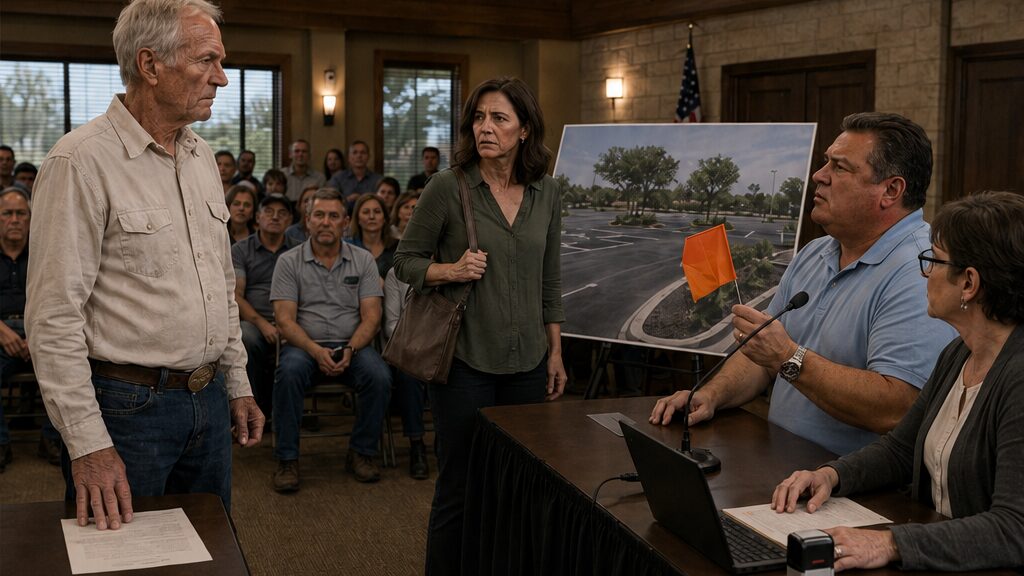
The sound struck the clubhouse meeting room harder than a gavel. A few homeowners smiled because Donald was smiling. Others lowered their eyes to the glossy rendering propped beside the board table: limestone entrance columns, young live oaks, a blue swimming pool, and a parking lot drawn so perfectly that not one painted line appeared crooked.
George remained standing in the center aisle.
He held a folded notice in one hand and a bright orange survey flag in the other. Dust still clung to the wire stem from the field behind the temporary construction fence.
“I’m not disputing your surface deed,” George said. “I’m telling you the mineral estate beneath Parcel Fourteen was reserved.”
Donald leaned toward the microphone. His pale blue polo carried the embroidered subdivision logo over his heart.
“Reserved by whom?”
“My grandfather.”
That drew another ripple of laughter.
Donald sat back. “Mr. Harris, your grandfather sold that ranch before half the people in this room were born.”
“He sold the surface.”
“And now, one month before our grand opening, you’ve discovered that the association owes you what? A royalty check?”
George looked toward the front row.
Linda sat near the aisle with her arms folded tightly across her blouse. She had bought her house in the subdivision six years earlier, after her divorce, when George had told her it was a safe place to start over. Her cheeks had gone red as soon as Donald mentioned the ranch.
George turned back to the board.
“I’m not asking for money tonight.”
“Then what are you asking for?”
“A pause in construction until the title history is reviewed.”
The room changed at that. A pause meant delay. Delay meant money. The clubhouse had already cost more than the board first promised, and every homeowner had received two emails assuring them the final paving would begin Monday.
Donald glanced at the HOA attorney, who gave a small shake of the head.
“We have a title commitment,” Donald said. “We have permits. We have recorded ownership of the common area. We are not stopping a two-million-dollar project because you found an old piece of paper.”
George unfolded his notice.
At the top was the subdivision parcel number. Beneath it were references to deed books, recording dates, and a reservation clause he remembered seeing as a young clerk in the county records office. He had not examined the original in years. Memory was not proof, but it was enough to make him warn them.
“I’m asking that this be entered into the minutes,” he said.
Donald sighed into the microphone. “Laura, record that Mr. Harris raised an irrelevant ownership claim regarding alleged mineral rights.”
Laura Lee looked up from her laptop.
“Irrelevant?” she asked.
“That is what counsel has advised.”
The attorney shifted in his chair but said nothing.
George walked to the architectural rendering. Donald’s smile faded as George laid the orange flag diagonally across the painted parking spaces.
The wire clicked against the board.
“This line,” George said, “comes off the old east boundary. Your parking lot crosses it twice.”
Donald lifted the flag as though it were litter and held it between two fingers.
“This is your evidence?”
“No. It’s a warning.”
The room went quiet enough for George to hear the air conditioner cycle off.
Donald placed the flag beside his microphone. “The association owns that property.”
“The surface.”
“You keep saying that as though it changes what we own.”
“It changes what you don’t.”
Someone near the back whispered. A phone rose above a shoulder, its camera pointed toward George.
Donald noticed it too. His voice became smoother.
“Mr. Harris, we respect the history of the land. That history is part of why people want to live here. But families have paid assessments for this clubhouse. Contractors are scheduled. Financing deadlines are in place. You cannot walk in with a farm marker and hold an entire neighborhood hostage.”
George felt the old correction form in his pocket, the one he had used for decades when a deed index contained a bad reference. Facts had once moved quietly from one ledger to another. No microphones. No neighbors deciding which truth was most convenient.
He looked at Laura.
“Will the parcel number and deed references be attached to the minutes?”
Before she could answer, Linda stood.
“Dad.”
George turned.
Her voice was low, but the room was listening too closely for privacy.
“Please stop.”
He stared at her.
She stepped into the aisle. “You said you wanted them to review something. They said they reviewed it. Let it go.”
“They haven’t reviewed what I gave them.”
“You don’t know that.”
“I know what a title commitment leaves out.”
“And everyone here knows you’re angry about what happened to the ranch.”
The words landed with more force than Donald’s laughter.
George saw her realize it. Her mouth tightened, but she did not take them back.
Donald folded his hands on the table. He no longer needed to speak. The dispute had become a family embarrassment, and family embarrassment was easier for a room to dismiss than a legal warning.
George refolded the notice carefully.
“I’m not angry about the ranch,” he said.
Linda looked away.
He walked to Laura’s end of the board table and placed the document beside her laptop.
“Date it received.”
Donald said, “We are not accepting liability by stamping your paper.”
“I didn’t ask you to.”
Laura opened a drawer and removed the association’s received stamp. She hesitated, looking first at Donald, then at George.
Donald gave an impatient wave.
The stamp came down with a flat mechanical crack.
RECEIVED.
Laura wrote the date beneath it and made a copy. George watched her attach the copy to a blank intake sheet before handing the original back.
Donald lifted the orange flag again.
“Would you like this returned too?”
George held out his hand.
Donald dropped it onto the table instead.
George picked it up. “Keep your rendering,” he said. “Keep the flag with the record.”
For the first time, Donald’s expression slipped.
“Why?”
“So nobody can say the line wasn’t shown to them.”
George left beneath the low murmur of the room.
Outside, the clubhouse walls stood unfinished beyond temporary fencing. Work lights cast long shadows over compacted soil. The future parking lot was only graded limestone then, pale and level beneath the dark.
Linda came through the door behind him.
“Dad.”
He stopped but did not turn.
“You could have told me before tonight.”
“I came to warn the board.”
“You came to prove you were right.”
He looked back at her. “Those aren’t always different.”
“That’s exactly the problem.”
She walked past him toward her car.
George drove home with the stamped notice on the passenger seat. His house stood outside the subdivision boundary, one of the few remaining brick homes from before the ranch roads became named streets. He entered through the kitchen, left the lights off, and went to the wood-paneled office at the rear.
The file cabinet resisted when he pulled the bottom drawer. He had not opened it since his wife died.
Behind tax receipts and old survey invoices lay a narrow folder marked HARRIS RESERVATIONS.
George set it on the desk.
Inside was a certified copy of a deed recorded in 1962. Halfway down the second page, beneath the property description, a paragraph began in language he had not forgotten:
Grantors reserve unto themselves, their heirs and assigns, all oil, gas, and other minerals in, on, and under the described premises, together with rights of ingress and egress reasonably necessary for exploration and production.
George read it twice.
Then he noticed a handwritten cross-reference in the margin—a deed-book number that did not appear anywhere in the HOA title packet Donald had displayed.
Chapter 2: What His Grandfather Refused to Sell
The handwritten number led George to a deed book the county’s digital index did not acknowledge existed.
He found it three mornings later in the records room, bound in cracked brown leather and stored on a lower shelf beneath volumes transferred from the old courthouse. The spine read 1962—SUPPLEMENTAL.
George carried it to a standing table beneath the fluorescent lights.
The county clerk watched him open it.
“I thought everything from that year had been scanned,” she said.
“Everything in the main index.”
“That sounds like a distinction only a retired records man would enjoy.”
“It’s the kind that ruins closings.”
The pages smelled faintly of dust and machine oil. George turned them by the upper corners, careful not to drag his fingers across the brittle paper.
The handwritten reference directed him to an affidavit recorded six weeks after his grandfather sold the ranch surface. It corrected an omission in the typed legal description and confirmed that the mineral reservation applied not only to the western pasture but to the east tract as well—the land where the clubhouse now stood.
George read the affidavit once without breathing.
The clerk came closer. “Is that it?”
“That’s part of it.”
“Good part or bad part?”
He pointed to the recording stamp.
“Good for the record. Bad for everyone who pretended it wasn’t there.”
The clerk searched the computer while George compared the affidavit with copies of the subdivision’s modern title commitment. The commitment began with a developer’s acquisition twenty-two years earlier. It listed easements, utility restrictions, drainage obligations, and HOA covenants.
It did not list the 1962 supplemental affidavit.
“That doesn’t extinguish it,” the clerk said.
“No.”
“Could there be a release under another name?”
“That’s what I’m here to find.”
They searched grantor and grantee indexes, probate transfers, mineral conveyances, correction deeds, and releases. George traced his grandfather’s interest through two estates and one family settlement until it reached George and his late brother. His brother’s share had passed to George years earlier.
Nothing released the minerals.
Nothing conveyed them to the developer.
Nothing waived access.
Near noon, the clerk pushed back from the computer.
“I can certify what exists,” she said. “I can’t certify what doesn’t.”
“You can certify that no release appears under the parties in the chain.”
“With a search limitation.”
“That’s enough.”
She studied him. “Are there houses over this?”
“Some.”
“How many?”
“I don’t know yet.”
That answer bothered him more than it should have. For years he had known every old fence corner, stock tank, and dry creek crossing on the Harris land. Yet he had let the new street names replace the old tract lines in his mind.
He ordered certified copies of the deed, affidavit, probate transfers, and mineral interest records. While the clerk prepared them, George unfolded a county parcel map across the table.
The clubhouse common area sat near the center of the old east tract.
Linda’s street curved across its southern edge.
George pressed his finger to her lot.
The clerk noticed. “Family?”
“My daughter.”
She stopped stamping.
George folded the map before she could ask more.
That afternoon, he met the licensed surveyor outside the subdivision’s rear boundary, where a drainage corridor separated the newest homes from undeveloped scrub. The surveyor carried a data collector and a bundle of orange flags. George brought copies of the 1962 metes-and-bounds description.
“Your bearings are old,” the surveyor said. “Magnetic references, fence calls, a mesquite corner that hasn’t existed in forty years.”
“There’s a buried iron pipe at the southwest call.”
“You know that?”
“I watched my father uncover it in 1978.”
The surveyor gave him a measuring look, then began entering coordinates.
They found the iron pipe beneath six inches of hard ground and roots. From there, the old line ran northeast toward the clubhouse, crossing the drainage corridor, passing behind three back fences, and cutting through the planned parking lot.
The surveyor set the first orange flag.
Then another.
The line grew visible one marker at a time.
George followed it with the deed description folded in his hand. Each flag made him feel steadier until they reached Linda’s street.
The surveyor checked the instrument, moved several feet, checked again, then planted a flag behind Linda’s cedar fence.
George stopped.
“Where does the mineral tract end?”
“Not here.”
“Show me.”
The surveyor displayed the parcel overlay. The old east tract continued beneath Linda’s lot and four neighboring homes before turning toward the subdivision entrance.
George stared at the screen.
The right existed beneath the houses as surely as it existed beneath the clubhouse. The deed’s access language was broad by modern standards, written before anyone imagined foundations, pools, gas lines, or children’s bedrooms above the minerals.
“Reasonably necessary,” George said.
“That’s what the deed says.”
“Reasonable changes when there are homes.”
“It changes what a court might allow. It doesn’t erase the estate.”
The surveyor moved on.
George remained beside the flag behind Linda’s fence.
He remembered standing with her on that lot before construction, when the sales trailer still smelled of new carpet and coffee. She had asked whether buying there was a mistake. George had looked across ground his family once grazed and told her the development was solid.
He had known the title history was incomplete.
He had told himself incomplete did not mean dangerous. The minerals had sat unused for decades. No operator had forced the question. No reason existed to burden Linda with an old reservation she could not control.
The surveyor called from farther up the line.
George pulled the orange flag from Linda’s fence line, then stopped.
Removing it would not change the boundary.
He pushed it back into the earth.
At home, he spread the certified documents across his desk. The stamps gave them authority, but the map gave them consequence. He overlaid the old tract on the subdivision plat and traced the boundary with a pencil.
Clubhouse.
Parking lot.
Drainage corridor.
Five homes.
Linda’s house.
The telephone rang.
George almost let it go to voicemail. The caller ID showed a number from Midland.
He answered.
“George Harris?”
“Yes.”
“My name is Jason Moore. I represent the operator that sent your family a lease proposal eighteen months ago.”
George looked toward the locked desk drawer.
“I remember.”
“We never received a rejection.”
“You didn’t receive an acceptance either.”
“No, sir. But the offer has an expiration date, and your mineral description just triggered a new title review on our side.”
George said nothing.
Jason continued. “The economics have changed. We’re willing to revise the bonus and discuss a surface-use plan.”
“There are houses now.”
“We know.”
“And a clubhouse.”
“We know that too.”
George opened the drawer.
Inside lay the unopened lease packet, exactly where he had placed it when Linda bought her home. He had never told her about the offer. He had never told his wife before she became ill. Silence had seemed like the cleanest way to keep a dormant right from becoming a family burden.
Jason said, “The proposal expires Friday.”
George rested his hand on the packet.
“What happens if I sign?”
“We begin formal access and permitting discussions.”
“And if access crosses occupied lots?”
“We use whatever route is legally and operationally available.”
George looked at the orange line he had drawn across Linda’s parcel.
“Send me the revised terms,” he said.
Chapter 3: The Promise That Made Him Stay Silent
Linda found the survey paint behind her fence before George found a way to warn her.
She arrived at his house just after seven the next morning, carrying an orange flag pinched between two fingers. She did not knock. The screen door slapped against its frame as she entered the kitchen.
“What is this doing in my yard?”
George looked up from the lease packet.
The flag landed on the table between them.
A crust of dark soil broke loose from the wire.
“The surveyor placed it.”
“I know a surveyor placed it. Why?”
George closed the packet.
Linda saw the logo on the cover. “What company is that?”
“Sit down.”
“No.”
He rose and poured coffee into a second mug anyway. She did not touch it.
“The old mineral tract crosses the subdivision,” he said.
“You told them it crossed the clubhouse.”
“It does.”
“You didn’t say it crossed my house.”
“The boundary passes under your lot.”
Her face emptied before the anger returned.
“Under the yard?”
“Under the lot.”
“So under the house.”
“Yes.”
She stared at him, waiting for the next sentence—the one that would make the first harmless. George had none.
“What does that company want?”
“To lease the mineral interest.”
“And you’re considering it?”
“I’m reviewing it.”
“You had that offer before the meeting.”
He did not answer quickly enough.
Linda stepped back from the table. “How long?”
“Eighteen months.”
Her voice dropped. “You knew.”
“I knew there was interest. That isn’t the same as knowing they would proceed.”
“You stood in front of my neighbors and made it sound like you found an old deed last week.”
“I warned the board about a title problem.”
“You let me stand there and defend them.”
“You didn’t defend them.”
“I asked you to stop because I thought you were fighting over history. All this time you had a drilling company waiting?”
“They weren’t waiting. The offer was dormant.”
“Because you hid it in a drawer.”
George looked at the screen door. Sunlight lay in a narrow grid across the kitchen floor.
“When your mother got sick, none of this mattered.”
“Don’t bring Mom into it.”
“She was already in it.”
Linda’s expression sharpened. “How?”
George sat down.
The memory came without ceremony: his wife at the same table, thinner than she admitted, reading a letter from his brother about selling the remaining mineral interest. George had argued that the land was the one thing their family had not surrendered. His wife had folded the letter and placed her palm over his fist.
Promise me it won’t become more important than Linda.
He had promised.
Not that he would sell. Not that he would waive the rights. Only that the land would not become a weapon inside the family.
“I told your mother I wouldn’t let the ranch divide us,” George said.
Linda laughed once, without humor. “You solved that by not telling me anything?”
“I thought if the rights stayed unused, there was nothing to tell.”
“You knew the title work was incomplete when I bought my house.”
“I knew the developer’s commitment started too late. I did not know whether the old reservation had been released elsewhere.”
“Did you check?”
George looked at the lease packet.
Linda understood.
“You didn’t.”
“I chose not to reopen it.”
“You chose for me.”
The sentence left no room for correction.
A truck door closed outside. Jason Moore appeared through the screen, carrying a rolled map tube and a leather folder.
George had forgotten they were scheduled to meet.
Linda looked from Jason to the lease packet. “Perfect.”
Jason paused at the door. “Bad time?”
“Come in,” George said.
Linda did not move.
Jason entered carefully and introduced himself. She declined to shake his hand.
“Tell me what your company can do under my father’s deed,” she said.
Jason looked at George.
“Tell her,” George said.
Jason set the map tube on the table.
“The reservation includes minerals and reasonable ingress and egress. That does not mean an operator can drive through a living room. Modern surface-use standards, municipal restrictions, state rules, and accommodation requirements all matter.”
“But you can enter the subdivision.”
“Potentially.”
“Across the clubhouse?”
“If that route is approved and reasonably necessary.”
“My yard?”
Jason chose his words more slowly. “The mineral tract extends beneath occupied lots. We would evaluate alternatives before proposing any route near a residence.”
“That wasn’t my question.”
“No,” he said. “It wasn’t.”
He unrolled an aerial map. Three possible access lines had been drawn across it. The most direct route entered from the north, crossed the clubhouse parking lot, and continued along the drainage corridor. A second route bent around the pool but clipped two residential lots. A third approached from county land to the west and required additional engineering and a longer lateral bore.
Jason tapped the first line.
“This is the least expensive surface route.”
George saw Linda looking at the bold line through the clubhouse.
“And the houses?” she asked.
“The well pad would not be on a residential lot. Subsurface development could extend beneath them from another location.”
“So you don’t need to tear up my yard.”
“Not if we secure a workable pad and corridor.”
Linda turned to George. “Then waive access beneath the homes.”
Jason said, “A blanket waiver could impair development of the tract.”
“I didn’t ask you.”
George folded his hands.
Linda pulled out a chair and sat across from him. Her anger had settled into something harder.
“Put it in writing,” she said. “No surface entry on my lot. No equipment through the residential streets. No future company claiming you gave them rights you forgot to mention.”
“I can restrict a surface route.”
“Waive it beneath the houses.”
“The minerals beneath the houses are still part of the estate.”
“There. That.”
“What?”
“That look. Like I asked you to burn the deed.”
George leaned back.
Jason quietly rolled up the map.
Linda picked up the orange flag. “You know what I thought this was when I found it? Trash from the construction crew. I pulled it out because I didn’t want it near the fence.”
“It marks a legal line.”
“It marks something you knew could reach my home.”
“I was trying to protect you.”
“No. You were protecting the promise as you understood it. You never asked what protection meant to me.”
She set the flag upright in the sugar bowl, its orange plastic square trembling above the table.
Then she left.
The screen door closed more gently than before.
Jason waited until her car had backed out.
“She’s not wrong,” he said.
George gave him a look.
“I’m not saying she’s entirely right either.”
“What does your operator need?”
“A decision by Friday. If you accept, we begin title certification and a state application. But you should understand something.” Jason reopened the map. “Your access language is broader than most modern reservations. If the HOA blocks the least damaging route, the company may argue for stronger remedies.”
“Stronger how?”
“An injunction. Court-supervised access. Damages for unreasonable interference. The leverage is real.”
“And the broad route?”
“Straight through the new parking lot.”
George looked toward the window. Beyond the glass, the old pasture had become rooftops and privacy fences. The visible land belonged to hundreds of people now. Beneath it ran a right written before any of them were born.
He signed nothing that morning.
After Jason left, George drove to the clubhouse site.
The temporary fence had been opened for paving crews. A road roller moved slowly across fresh black asphalt, compressing the surface where George’s orange flag had crossed the rendering.
Donald stood near the contractor’s truck, speaking into his phone.
George parked outside the barrier and watched a worker spray the first white line.
His stamped warning had been delivered.
The parcel number had been provided.
The deed references had been given.
Yet the asphalt continued pouring in a smooth, dark sheet over the exact route the surveyor had marked.
Donald saw George beyond the fence.
For a moment, neither man moved.
Then Donald turned his back and motioned for the roller to continue.
Chapter 4: The Minutes That Removed His Warning
Laura Lee saw the missing parcel number before she noticed George’s name had been reduced to two lines.
The approved minutes described his objection as a “general concern regarding historical mineral claims.” No deed references. No tract number. No mention of the orange survey flag laid across the parking-lot rendering.
She scrolled back to the top.
Meeting date correct.
Attendance correct.
Motion totals correct.
George’s warning erased.
Laura opened the folder where she kept her handwritten notes. She had written quickly that night, pressing hard enough to leave impressions on the page beneath:
Parcel 14. Deed Book 611. Supplemental affidavit. Surface ownership not disputed. Requests title review before paving.
Beside the entry, she had drawn a small orange line.
The board office was empty except for the hum of the refrigerator in the kitchenette. Through the window, workers tied red, white, and blue balloons to the new clubhouse railing. The grand-opening banner lay rolled across a table.
Laura printed the approved minutes and carried them into Donald’s office.
He was on the phone with a lender. He held up one finger without looking at her.
“Yes,” he said. “The certificate of completion will be filed Monday. No, there are no pending title disputes.”
Laura placed the minutes on his desk.
Donald’s eyes moved to the paper. His voice did not change.
“I’ll send the final package this afternoon.”
He ended the call.
“What is this?”
“You tell me.”
He read the highlighted section. “Approved minutes.”
“They are not the minutes I submitted.”
“The attorney revised them.”
“The attorney removed every identifying detail from George’s notice.”
Donald leaned back. “Because none of it was relevant to the association’s surface title.”
“Then why remove it?”
“To keep an unsupported claim from alarming homeowners.”
“It was attached to the intake record.”
“It was a letter.”
“It contained recording references.”
Donald pushed the pages back toward her. “You’re the treasurer, Laura. You know what happens if the lender sees an unresolved title objection two days before closing.”
“That is not an answer.”
“It is the only answer that matters this week.”
Outside, a worker tested the clubhouse speakers. A burst of music rattled the window, followed by feedback.
Laura lowered her voice. “Did you send George’s notice to the title company?”
Donald’s jaw tightened.
“I sent the title company what counsel advised.”
“That means no.”
“It means we have professionals handling this.”
“You told the board it had been reviewed.”
“It was reviewed.”
“By whom?”
Donald stood.
He was not an imposing man, but the office had been arranged to make him appear larger: framed sales awards, a photograph with county officials, the architectural rendering behind his chair.
“Do you know how close this association came to losing the clubhouse?” he asked.
Laura waited.
“The original construction lender pulled out after material costs increased. We had thirty days to replace the financing or forfeit the contractor deposit.”
“I know.”
“No, you know the public version. The replacement lender wanted additional security because our reserve account was too low.”
Laura looked at him.
Donald opened a drawer and removed a thin folder. Inside was a guaranty agreement.
His signature appeared twice.
“You personally guaranteed it,” she said.
“A portion.”
“How much?”
“Enough.”
The answer stripped some of the polish from him. For the first time, Laura saw the fatigue under his eyes and the looseness at his collar.
“If the loan fails,” he said, “the association loses the deposit, the contractor files claims, and I lose more than my position.”
“So you hid a title warning.”
“I prevented one old man’s unverified demand from collapsing a project hundreds of families already paid for.”
“He did not demand money.”
“Not yet.”
“He asked for a review.”
“Reviews take time. Time was the one thing we did not have.”
Laura looked down at the guaranty.
Donald had not signed it solely for the neighborhood. He had built his board presidency around the clubhouse. Every newsletter carried his photograph beside a progress update. He had promised that the amenity would raise resale values and prove the subdivision was no longer unfinished.
But the guarantee made the fear real.
That did not make the altered minutes less false.
She returned to her desk and searched the electronic files. George’s scanned notice was gone from the meeting packet. The intake log still showed a document received at 8:41 p.m., but the attachment field was blank.
Laura checked the locked cabinet where physical board records were stored.
Inside, beneath contractor change orders, she found George’s original notice clipped to the orange survey flag.
Donald had kept both.
The flag’s wire was bent where someone had forced the drawer shut.
Laura carried them into his office.
“You said counsel handled it.”
Donald stared at the flag.
“Put that back.”
“Why is the original in your drawer?”
“I intended to deliver it with the post-closing file.”
“After the parking lot was finished.”
“After we had the leverage to deal with it calmly.”
“You mean after the lender funded.”
Donald came around the desk and closed the office door.
“Listen to me. George Harris worked in county records. He knows exactly how much disruption an old deed reference can cause. He waited until the last month of construction to raise it publicly.”
“He says he warned us.”
“He made a performance.”
“He handed me a written notice.”
“And you think that was an accident? He wanted witnesses. He wanted us committed. If he were trying to protect the neighborhood, he would have brought this forward years ago.”
Laura thought of George’s face when Linda asked him to stop. Not triumphant. Not angry. Hurt in a way he tried to hide by folding his paper precisely along the same crease.
“He may have reasons,” Laura said.
“So do I.”
“You made those reasons the official record.”
Donald pointed toward the notice. “Return it to the cabinet.”
“I am keeping a copy.”
“No.”
“The treasurer retains financial and legal support files.”
“You retain what the president and counsel designate.”
Laura met his eyes.
“Are you ordering me to destroy my notes?”
“I’m telling you those notes are working material, not an official record.”
“That is not what I asked.”
Donald’s mouth tightened.
“Destroy them,” he said. “Before someone mistakes them for approved minutes.”
Laura left the office carrying nothing.
At the grand opening, she stood beside the registration table while residents toured the fitness room and children ran between balloon columns. Donald cut a ribbon beneath the new stone sign. Applause rose when he thanked the board for “protecting the community’s investment through every obstacle.”
George did not attend.
Near the parking lot, Laura watched a contractor place temporary cones over a shallow seam in the asphalt. The seam followed the direction George’s orange flag had marked across the rendering.
That afternoon, she drove to the county permitting desk with a routine clubhouse filing. While the clerk processed it, Laura asked for the public index to the old east tract.
The mineral reservation appeared within minutes.
The supplemental affidavit took longer.
When Laura read the same parcel number George had spoken at the meeting, her hands went cold.
She returned home after dark, spread her handwritten notes across the dining table, and made copies. On a clean sheet, she printed George’s address from the association directory.
She included three pages:
her original notes,
the intake log showing his notice had been received,
and the section of the approved minutes where the details had disappeared.
She did not include a letter.
She did not sign her name.
At the post office, Laura fed the envelope through the slot and kept her fingers against it until gravity pulled it away.
Chapter 5: The Permit That Made the Threat Real
The state commission examiner stamped the permit, then held it beneath her palm instead of sliding it across the desk.
“This authorizes the approved operation,” she said. “It does not excuse unnecessary surface damage.”
George looked at the red word pressed across the lower page.
APPROVED.
“I understand.”
“Most applicants say that before the trucks arrive.”
Jason Moore sat beside him with a rolled engineering plan balanced against his knee. “We have three evaluated access options.”
The examiner looked at George rather than Jason.
“And whichever one you choose, the surface owner can still challenge whether your use is reasonable. Your mineral estate predates the subdivision. That gives you rights. It does not give you immunity from consequences.”
George had spent thirty-four years watching people confuse recorded authority with good judgment. He had not expected the warning to sound like something he might once have said across a county counter.
“I understand,” he repeated.
This time, she released the permit.
Outside the commission office, Jason opened the plan across the hood of his truck. Orange lines showed the three possible routes.
The direct route entered through the clubhouse gate, crossed forty parking spaces, and reached the proposed pad near the drainage corridor. The second passed behind homes and required temporary use of two residential lots. The third approached from county land, avoiding the homes but adding engineering costs and months of work.
Jason tapped the direct line.
“This is the route the permit supports without amendment.”
“And the western approach?”
“Possible, but slower. Additional environmental review, another easement, more road construction.”
“How much more?”
Jason named the figure.
George looked at the clubhouse route.
“It is still cheaper than repairing five yards.”
“It is.”
“And safer than residential access.”
“Yes.”
“Then why did your first proposal include the lots?”
“Because companies price options before they price conscience.”
George folded the plan.
Jason watched him. “That bother you?”
“It bothers me that you said it plainly enough to sound honest.”
Back at his house, an envelope waited inside the screen door.
No return address.
Inside were copies of the meeting intake log, handwritten notes, and approved minutes. George placed them beside his stamped notice.
The handwriting on the notes was controlled and narrow. The capital R curved back under itself. He had seen the same hand on the received date beneath Laura Lee’s stamp.
George drove to the county office and requested the HOA’s construction-loan filings and recorded declarations. He did not need Laura to confess. Her copies told him where to look.
By late afternoon, he had a sequence.
His objection had been received three days before the final loan certification.
The board’s approved minutes had been amended two days later.
The lender’s affidavit stated there were no known ownership disputes affecting the common property.
The paving contract had been released the next morning.
Donald had not merely ignored him.
Donald had needed the warning to disappear.
George sat in his truck with the documents spread across the passenger seat. Vindication should have felt clean. Instead, he saw Linda standing in the meeting aisle and heard her say, You chose for me.
He had allowed silence to become another kind of alteration. He had not changed a record, but he had withheld enough truth for other people to build on a false assumption.
At the next HOA meeting, every chair was occupied.
News of the mineral permit had reached the neighborhood before George did. A resident email claimed he planned to place a drilling pad beside the pool. Another said the HOA would lose the clubhouse. Someone had posted a photograph of orange survey flags behind Linda’s fence.
Donald sat at the board table with the HOA attorney at his right. Laura’s seat was empty.
George entered carrying the approved permit and the access map.
The room’s conversations narrowed around him.
Linda stood near the back. She did not approach.
Donald opened the meeting without the usual announcements.
“Before rumors create further damage,” he said, “the board will address Mr. Harris’s attempted mineral operation.”
Attempted.
George almost smiled.
Donald continued. “The association owns and controls all common property. No industrial equipment will enter without board authorization.”
George raised the permit.
“The state has authorized the operation.”
“The state does not own our roads.”
“No. But your roads cross a recorded access right.”
The HOA attorney leaned toward the microphone. “That conclusion is disputed.”
“Then dispute it in court.”
Several people turned toward Donald.
George placed the permit on the table and unrolled the map. The orange direct route ran through the parking lot.
A woman in the first row said, “That goes past the pool.”
“It goes across the far parking section and into the drainage corridor,” George said.
A man behind her asked, “What about our houses?”
George pointed to the alternative lines. “The operator evaluated residential access. I rejected it.”
Linda’s face changed slightly.
Donald said, “You rejected nothing permanent. You can change your mind tomorrow.”
“I can.”
The answer sent a murmur through the room.
George did not soften it. False comfort had helped create the problem.
“I also have certified proof that my written objection was received before your loan certification,” he said.
Donald’s hand moved toward the microphone. “This meeting is not a courtroom.”
“No. In a courtroom, the minutes would matter.”
Laura entered through the side door.
She carried no papers. She sat in the last row and looked down when George glanced at her.
Donald moved to adjourn discussion, but homeowners began speaking over one another. Questions about assessments, insurance, resale values, and road damage filled the room.
Linda finally came forward.
“Are trucks coming?” she asked George.
The room quieted.
Jason had called that morning. The operator’s lease deadline had passed, but George had signed a limited acceptance contingent on final access terms. Mobilization had been tentatively scheduled while legal notices were served.
“Yes,” George said.
“When?”
“Monday.”
Linda stared at him. “You signed it.”
“I preserved the lease.”
“That is not what I asked.”
“I have not approved residential access.”
“You have not waived it either.”
Donald seized the opening.
“This is what I warned you about. He does not want recognition. He wants leverage.”
George turned to him. “I wanted a title review before you paved.”
“You wanted us afraid.”
“No. I wanted you informed.”
“Then why did you hide the lease from your own daughter?”
The question struck where Donald intended.
George looked at Linda.
She did not defend him.
The homeowners saw not a retired records technician with certified deeds, but a father who had concealed a risk beneath his daughter’s home. Donald’s wrongdoing did not erase George’s silence. Both could be true at once.
George rolled up the map.
“I will provide the board a written access proposal tomorrow,” he said.
Donald leaned back, sensing control returning.
“And if we reject it?”
George looked toward the new clubhouse windows, where the parking-lot lights reflected in perfect white rows.
“The operator will use the broad permit.”
He left before the room could decide whether that was a threat or a fact.
Outside, Linda caught him beside his truck.
“You are going to tear up the clubhouse.”
“I am trying to keep them away from the houses.”
“You keep saying what you are trying to do. You never say what you have decided.”
“I have not decided.”
“Then everyone else has to live inside your hesitation.”
She walked away and pulled out her phone.
By the time George reached home, the neighborhood message board carried a post from Linda Harris:
My father has confirmed that industrial equipment is scheduled to enter Monday. The current approved route crosses the clubhouse parking lot. Homeowners deserve to know before the board or my father makes another decision for us.
George read it twice.
Then he unfolded the access map on his desk.
The direct orange line looked less like a boundary than a blade.
Chapter 6: When the Rigs Reached the Clubhouse Gate
The lead rig stopped beneath the clubhouse sign at 7:12 Monday morning, its diesel engine idling while the approved order showed white against the windshield.
Donald stood in front of the locked gate.
Behind him, homeowners filled the sidewalk and spilled into the entrance lane. Some held phones. Others held printed copies of Linda’s message. A sheriff’s deputy waited beside a patrol vehicle, one hand resting on the hood.
George arrived in his truck carrying two maps.
The convoy stretched down the county road: drilling equipment, service trucks, a water unit, and Jason’s white pickup. The machinery made the subdivision’s stone entrance look decorative and fragile.
Donald walked toward George before he had closed his door.
“You will turn them around.”
George looked past him to the gate. “Open it.”
“The board denied your access proposal last night.”
“The board did not answer the proposal. You sent a refusal without a vote.”
“As president, I can protect common property from trespass.”
The deputy stepped closer. “Mr. Perez, the order recognizes access subject to the marked route. I am here to keep the peace, not interpret title law.”
Donald pointed at the rig. “That vehicle crosses association property, it is trespassing.”
Jason joined them, carrying the permit packet.
“The surface-use notice expired at six this morning,” he said. “We are authorized to enter.”
Homeowners pressed closer.
A man called out, “Is he putting a well by the pool?”
Another shouted, “What happens to the road?”
Linda stood near the clubhouse doors. She looked as though she had not slept.
George climbed onto the low stone planter beside the gate.
He did not ask for a microphone.
“The approved route crosses the east parking section,” he said. “It does not cross a residential lot. It does not place a pad beside the pool. It uses the drainage corridor to reach the proposed site.”
Donald laughed, but the sound held no ease now.
“You expect them to trust you after you kept the lease secret?”
“No.”
George let the answer stand.
“I expect the documents to be read. I should have made them read mine sooner. I should have told my daughter what could reach beneath her property. I did not. That was my failure.”
Linda lifted her head.
Donald looked unsettled. He had prepared to fight George’s certainty, not his admission.
George opened the first map across the planter wall.
A thick orange line ran directly through the middle of the parking lot.
“This is the broad permitted route. It is lawful. It removes more asphalt, limits parking for months, and gives the operator the simplest access.”
He opened the second map.
The orange line entered at the far edge of the lot, curved behind the maintenance building, and narrowed into the drainage corridor. It required removal of fewer spaces but depended on a permanent access agreement from the HOA.
“This is the route I offered the board. It costs the operator more. It preserves the pool access, avoids the residential streets, and places no surface equipment on a home lot.”
A woman near Linda asked, “Why would the company agree?”
“Because I conditioned the lease.”
Jason glanced at him. That detail had not been public.
Donald stepped forward. “He can say anything with trucks at the gate.”
George took a fresh orange flag from his pocket.
He walked to the asphalt just inside the locked entrance. The first white parking line began several feet beyond the gate. He pushed the flag’s wire into a crack at the pavement edge, setting it along the narrower route.
The small orange square trembled in the exhaust.
“This is where the limited corridor begins,” he said.
The rig supervisor sounded one short horn blast. The crowd flinched.
Donald turned on George. “You planned this spectacle.”
“I planned for the route to be visible.”
“You brought industrial equipment into a residential neighborhood to force a vote.”
“I brought the equipment after your board ignored notice, removed the parcel number from its minutes, and certified there was no dispute.”
The crowd quieted.
Donald’s face hardened. “That is false.”
“No,” Laura said.
She stood near the clubhouse steps holding a file box.
Donald stared at her.
Laura walked through the homeowners and placed the box on the planter wall beside George’s maps.
“These are my original meeting notes,” she said. “The intake log. Mr. Harris’s stamped notice. The draft minutes I submitted. And the revision returned to me for approval.”
She removed the bent orange flag Donald had locked in the cabinet.
A murmur passed through the crowd.
Laura held up the handwritten notes. “His parcel number was recorded at the meeting. His deed references were recorded. The approved minutes removed them.”
Donald reached for the papers.
Laura pulled them back.
“You told me to destroy these.”
“That is not what I said.”
“You said they were working material and ordered me to destroy them before anyone mistook them for official records.”
The HOA attorney rose from a folding chair near the door. “I advise everyone to stop making public statements.”
A homeowner asked, “Did the lender know?”
Laura looked at Donald.
George did not answer for her.
Donald’s shoulders lowered by a fraction.
“The loan would have failed,” he said.
No one spoke.
He looked around at the clubhouse, the stone columns, the pool fence, the families gathered beneath the sign bearing the association’s name.
“The original lender withdrew,” he said. “The contractor was prepared to keep the deposit. The replacement lender required a clean certification. If we delayed again, the association would have lost hundreds of thousands of dollars.”
“You signed the certification,” Laura said.
“I signed what counsel prepared.”
The attorney said, “Do not involve me in—”
Donald cut him off. “I signed it.”
His voice had changed. It no longer carried through the crowd as a board president’s voice. It belonged to a mortgage broker who knew exactly what a false assurance could cost.
“I also guaranteed part of the replacement loan,” he said.
A man near the gate said, “With association approval?”
Donald looked away.
The answer moved through the crowd before he gave it.
Linda came toward George.
“You knew about the guarantee?”
“Not until Laura’s documents showed me where to look.”
“Is that why he kept paving?”
“It is part of why.”
Donald faced George again. “If this project defaults, I lose my house.”
The anger around them shifted but did not disappear.
George saw fear in Donald’s face now, stripped of the blue polo and microphone. Fear did not excuse the altered minutes. It explained why Donald had kept choosing the next wrong step after the first one.
“Delay the operation sixty days,” Donald said. “Let me refinance the guarantee. Let the association find another solution.”
Jason spoke quietly beside George. “The operator will not hold the convoy for sixty days.”
Donald ignored him.
“You wanted acknowledgment,” he said to George. “You have it. Everyone knows you were right.”
“That is not what I wanted.”
“Then what?”
George looked toward Linda, then toward the rows of houses beyond the clubhouse roof.
“I wanted the rights recognized before people built more obligations over them.”
“They are recognized now.”
“Because the rigs are here.”
Donald’s mouth tightened.
George placed the limited-corridor agreement on the planter wall.
“This route protects the houses. The association grants permanent access along the marked line, reimburses certified survey and legal costs, corrects the minutes, and places the title issue in every future common-property disclosure.”
Donald scanned the first page. “And the parking lot?”
“Part of it comes out.”
“How much?”
“Twenty-eight spaces during construction. Twelve permanently converted to the corridor and safety buffer.”
Homeowners began calculating aloud what that meant for events, pool season, and assessments.
Donald reached the last page.
“This requires the president’s resignation.”
“It requires accountability before the agreement becomes effective.”
“You wrote that for me.”
“I wrote it for whoever signed the false certification.”
Donald looked up.
“What if the board refuses?”
George turned toward the lead rig.
The broad-route order remained visible in its windshield. The locked gate was the only thing separating the machine from the perfect asphalt Donald had protected at every cost.
George checked his watch.
“It is seven thirty-one,” he said. “At eight thirty-one, the operator proceeds under the broad permit unless the limited agreement is signed.”
“You
Chapter 7: What He Chose to Leave Beneath Them
Donald placed his resignation on the planter wall at 8:19.
The page lay beside the altered minutes, its lower corner lifting in the exhaust from the idling rig. He had signed it in black ink. Beneath his name, he had written that the resignation would take effect immediately upon the board’s acceptance of the limited access agreement.
No one applauded.
The homeowners stood in a rough half-circle around him, quiet now that the choice had become expensive instead of dramatic.
Donald removed the clubhouse key from his ring and set it on top of the letter.
“You have twelve minutes,” he told the remaining board members.
Laura opened the agreement to the signature page. The HOA attorney had spent the past half hour reading each clause and objecting to nearly all of them. The board had negotiated two changes: repair costs would be independently audited, and construction vehicles would be restricted during school drop-off and pickup hours.
George accepted both.
The essential terms remained.
The association would recognize the Harris mineral estate, correct the public minutes, disclose the encumbrance in future common-property documents, reimburse certified legal and survey expenses, and grant permanent access through the limited corridor.
In return, George would waive all surface entry across existing residential lots.
Not delay it.
Not promise to consider alternatives.
Waive it permanently.
Linda stood close enough to read the paragraph over his shoulder.
Her finger stopped beneath the legal description attached to the waiver.
“This includes my lot?”
“And the other occupied lots inside the tract.”
“The minerals stay yours?”
“Yes.”
“But no equipment can cross our property.”
“No surface equipment. No road through the yards. No pad beside a house.”
She read the clause again.
“You could have done this earlier.”
George looked at the orange flag beside the gate.
“I could have offered it earlier.”
“Would they have accepted?”
“I don’t know.”
“That isn’t what I asked.”
He folded his glasses and put them in his shirt pocket.
“No,” he said. “Not before the permit. Not before the trucks.”
Linda nodded once, but she did not look relieved.
George understood. The waiver protected her home. It did not erase the months in which he had let her believe there was nothing beneath it worth discussing.
Laura called the board to order on the clubhouse steps. There was no microphone, so she raised her voice only enough to carry.
Three board members voted to accept the agreement.
One abstained.
Donald did not vote.
At 8:26, Laura signed as acting president. The secretary signed beneath her. George added his name last.
Jason checked the time, then walked to the lead rig and tapped twice on the driver’s door.
The engine dropped from a hard idle to a lower rumble.
The gate opened.
The rig moved forward no faster than a walking man.
George stepped onto the asphalt ahead of it. He carried a bundle of orange flags and followed the narrow route he had drawn: along the far edge of the lot, behind the maintenance building, then toward the drainage corridor.
At each turn, he pushed another flag into a seam or strip of soil.
The machinery followed the line.
Homeowners moved back, watching the first tires cross the perfect white parking stripes. No one cheered when the asphalt cutter began marking the section that would be removed. Dust rose in a pale cloud and settled over the clubhouse sign.
Donald stood apart from the others.
Without the key ring and blue polo authority, he looked smaller but not harmless. He watched workers measure the corridor he had refused to acknowledge.
George stopped beside him.
“The lender will call today,” Donald said.
“Yes.”
“They may accelerate the loan.”
“The board will need counsel.”
“You got what you wanted.”
George looked toward Linda. She was speaking with Laura beside the waiver documents.
“No,” he said. “I got what I was entitled to. Those are not always the same thing.”
Donald’s face tightened.
“You think admitting your mistake makes you different from me?”
“No.”
That answer seemed to strike harder than an accusation.
George continued. “Making the next decision differently might.”
Donald stared at the torn line forming across the asphalt.
“I was trying to save the project.”
“I know.”
“You do not know what it is like to tell four hundred families their money is gone.”
“I know what it is like to avoid telling one person the truth because you are afraid of what it will cost.”
Donald looked at him then.
George did not offer forgiveness. Donald had altered records and signed a false certification. The board would decide whether to refer the matter to regulators or pursue him for damages. Fear explained the first compromise. It did not excuse the ones that followed.
Still, George no longer needed Donald to be simple.
By noon, the drilling equipment had cleared the entrance and reached the designated pad beyond the drainage corridor. Temporary fencing enclosed the route. The clubhouse remained open, though only half the parking lot could be used.
The association sent its first honest notice that afternoon.
It described the mineral reservation, Donald’s resignation, the limited access agreement, and the expected repair costs. It also warned that a special assessment would likely be required.
The responses came quickly.
Some homeowners blamed Donald.
Some blamed George.
Some blamed the developer, the title company, the board, or every person who had ever used the words property value in a meeting.
No one escaped cost.
Six months later, the parking lot had been repaired around a permanent gated lane along its eastern edge. Twelve spaces were gone. A low barrier separated the access corridor from the pool entrance, and new disclosure signs appeared in the clubhouse office.
The special assessment remained unpopular.
Donald sold his house before the end of summer. George heard that the lender had negotiated rather than foreclosed, but he did not ask for details.
Laura stayed on the board long enough to complete an independent records audit. After that, she declined to run again.
Jason’s operator completed the first phase of work without entering a residential lot. The western engineering route proved usable for later operations, though it cost more than the company preferred.
Linda visited George on an October evening carrying the original orange flag from her yard.
The plastic had faded along one edge.
“I found this in the garage,” she said.
George opened the screen door wider.
She stepped inside but remained in the kitchen.
“The HOA recorded the waiver,” she said. “I checked.”
“Good.”
“And the title company added it to my file.”
“They should have.”
She turned the wire between her fingers.
“I told Mom once that you cared more about that ranch than people.”
George waited.
“She said that wasn’t true. She said you cared about it because people kept leaving, and the land didn’t.”
He looked toward the office where the 1962 deed remained locked in the bottom drawer.
“Your mother understood me too well.”
“She also said understanding you was not the same as agreeing with you.”
“That sounds like her.”
Linda set the flag on the table.
“I’m still angry.”
“I know.”
“But I understand why you kept the rights.”
George rested his palm beside the flag, not touching it.
“I should have trusted you with the truth.”
“Yes.”
“I thought silence kept the land from dividing us.”
“It just made me stand on one side without knowing there was a line.”
He nodded.
They did not repair everything that evening. Linda did not hug him or say the past was settled. She stayed for coffee, and when she left, she used the screen door instead of letting it slam.
The following morning, George walked the access corridor alone.
Workers had reseeded the disturbed soil beside the repaired asphalt. Near the drainage channel, one orange flag remained where the permanent route turned away from the homes.
George pulled it free, then reconsidered.
He pressed it back into the ground at the edge of the restored grass.
Once, the flag had marked what his family refused to surrender.
Then it marked a warning no one wanted to read.
Now it marked the place where a lawful right had been narrowed by choice.
Beyond it stood the subdivision roofs, including Linda’s, untouched by equipment. Beneath them, the minerals still belonged to George Harris and his heirs.
Above them, people lived with the truth recorded at last.
The story has ended.