The HOA Blocked His Logging Road—Then He Found What Their Water System Was Built On
Chapter 1: The Morning the Cones Appeared on Kevin’s Road
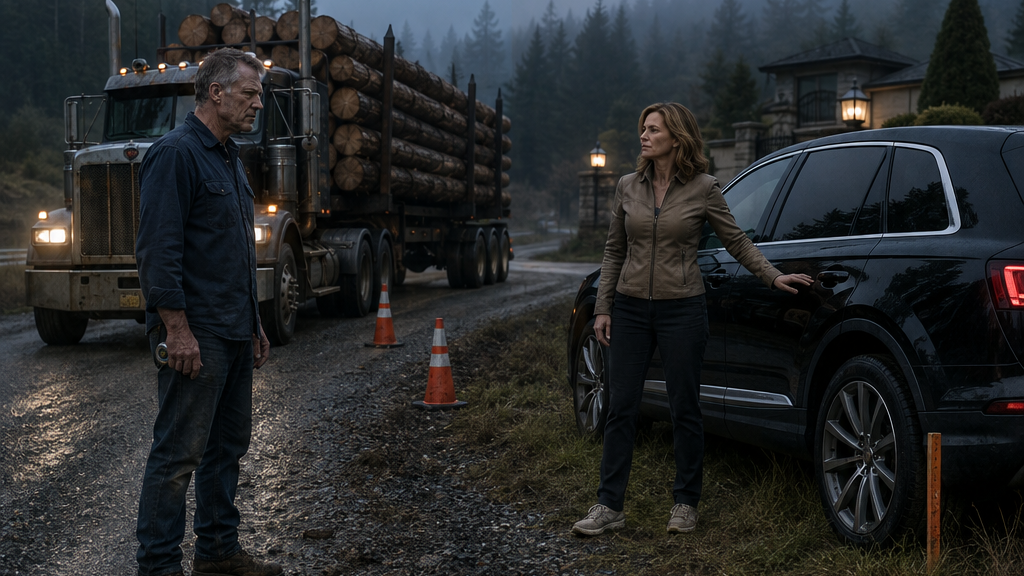
The orange cones were chained together.
That was the part that stopped Kevin Hall before the sun had cleared the firs.
One cone could have blown over. Two could have been left by a utility crew. But six of them stretched across the gravel turnout at the bottom of his logging road, connected by a bright plastic chain with a white sign hanging from the middle.
NO COMMERCIAL VEHICLES.
Thirty yards behind Kevin, a diesel engine idled in the cold morning air. The first empty logging truck of the day had arrived early to climb toward the landing, where a crew was already cutting timber.
Kevin shut the door of his old pickup and walked toward the cones.
Christine White stood beside a black SUV near the subdivision entrance, holding a travel mug in one hand and her phone in the other.
“You’ll need to turn him around,” she said.
Kevin looked past her at the truck.
“There isn’t anywhere to turn him around.”
“That’s not our problem.”
He crouched and lifted the plastic chain.
A small laminated card had been fastened beneath the sign. It carried the name of the homeowners association and a typed notice about road protection, safety, and unauthorized commercial use.
Kevin read it twice.
Then he looked at Christine.
“I don’t belong to your association.”
“The road serves the community.”
“The road serves my property.”
Christine gave a short breath through her nose.
“Your trucks are tearing it apart.”
Kevin glanced down.
The gravel was scarred with heavy tire tracks. Some were his. Some belonged to delivery vehicles, landscaping trailers, contractors, and the garbage truck that served the development every Thursday.
Near the subdivision gate, water had cut a shallow channel along one shoulder.
Christine pointed toward it.
“That happened after your loads started coming through again.”
Kevin said nothing.
The truck behind him gave a short air-brake hiss.
Christine took his silence as agreement.
“We’re not saying you can never use the road,” she continued. “The board is asking for reasonable limits until we can determine what traffic it can safely handle.”
“By chaining it shut?”
“You were notified.”
“No, I wasn’t.”
“We sent notice.”
“To who?”
Christine hesitated.
“The property owner.”
“You’re looking at him.”
For the first time, her expression shifted.
Kevin stepped over the chain and walked toward her SUV.
The development had been built beyond a stand of second-growth fir roughly fifteen years earlier. Its stone entrance, clipped shrubs, and paved internal streets had always looked slightly misplaced beside Kevin’s rough gravel road. He had never cared much. People could live however they wanted as long as they left him room to do the same.
Lately, that room had been shrinking.
First came complaints about truck noise before seven.
Then mud on the pavement after rain.
Then an email asking him to use an alternate entrance that would have added nearly four miles and required crossing another property.
Now there were cones.
Christine followed him.
“The board meets Wednesday,” she said. “If you want to present your case—”
Kevin stopped.
A white fiberglass boundary marker stood near the subdivision landscaping. Christine’s SUV was parked beyond it, its rear tires resting on packed gravel closer to Kevin’s gate.
He looked at the marker.
Then at the SUV.
“Who put that in?”
“The developer.”
“When?”
“I don’t know. It’s the property line.”
Kevin looked toward the ditch.
Years earlier, before the development existed, surveyors had set iron rods along this stretch. His father used to complain that road grading buried everything sooner or later.
Kevin walked into the grass.
“What are you doing?”
He pushed aside wet weeds with his boot.
“Looking.”
“For what?”
Kevin crouched near the ditch and pulled at a mat of dead grass.
Something orange showed underneath.
He cleared more dirt with his fingers.
A faded plastic cap sat over a short metal stake, almost level with the ground.
Christine came closer.
“That could be anything.”
Kevin rubbed the mud from it.
The cap had survey markings molded into the plastic.
Behind them, the truck driver climbed out of his cab.
“Kevin?”
“Give me a minute.”
Christine folded her arms.
“You can’t just decide an old stake overrides the association boundary.”
“I’m not deciding anything.”
“You’re obviously implying—”
“I’m looking.”
Kevin stood and sighted from the buried stake toward another old point he remembered farther up the road.
The line did not follow the decorative landscaping.
It cut outward.
Toward Christine’s SUV.
He walked to his pickup and opened the glove box.
Under registration papers, spare fuses, and a cracked pair of work gloves was a folded photocopy his father had carried for years.
The paper was soft at the creases.
Kevin spread it across the hood.
Property boundaries were drawn in black. An older handwritten notation crossed part of the road in faded blue pencil.
Christine looked over his shoulder.
“That thing could be thirty years old.”
“Twenty-eight.”
“So it proves nothing.”
“Maybe.”
Kevin traced the boundary with one finger.
His father had made him learn those lines when Kevin was barely old enough to drive. Not because they expected a fight, but because land had a way of changing in people’s minds if nobody remembered where it actually ended.
Christine tapped the white developer marker.
“That is the current line.”
Kevin looked from the map to the buried orange stake.
The two did not agree.
The driver called again.
“I’ve got another truck twenty minutes behind me.”
Christine stepped back toward the cones.
“Then you should call him.”
Kevin folded the old plat carefully.
“I’m not calling anybody yet.”
Her eyes narrowed.
“You don’t get to ignore the board because you don’t like the answer.”
Kevin slipped the plat into his jacket.
“I don’t get answers from your board.”
He unhooked the plastic chain and dragged the cones far enough aside for the empty truck to pass.
Christine moved toward him.
“You cannot do that.”
Kevin looked at her SUV.
Its rear bumper appeared to sit several feet beyond the line shown on his old plat.
He could not yet prove the plat still governed the ground.
But he could prove one thing.
The question was no longer whether his truck belonged there.
The question was whether Christine did.
Chapter 2: Four Feet Beyond the Line They Claimed
The violation notice arrived before Kevin reached the county offices.
Christine had sent it by email at 8:43 that morning.
He read it sitting in his pickup outside the records building.
UNAUTHORIZED REMOVAL OF TRAFFIC CONTROL DEVICES.
Below that came references to community safety, road preservation, and possible financial responsibility for future damage.
At the bottom, in bold type, was a deadline for compliance.
Kevin stared at the screen.
Then he laughed once, without amusement.
She had issued an HOA violation to a man who was not an HOA member on land that might not belong to the HOA.
He forwarded the message to himself, saved a copy, and went inside.
The county records office smelled like paper, dust, and old carpet. A clerk directed him to parcel maps and then to a survey technician when Kevin explained the discrepancy between the old stake and the developer marker.
The technician studied the parcel number.
“You’re Hall?”
“Yes.”
“You own the timber parcel north and west of Ridge View?”
“Yes.”
The technician enlarged a digital map.
Kevin leaned forward.
The subdivision boundary appeared as a clean modern line.
His parcel wrapped around it.
Then the road widened near the entrance.
The technician zoomed again.
Kevin felt the irritation in his chest sharpen into something colder.
The widened gravel turnout sat almost entirely inside his parcel.
“What’s that marker they put near the landscaping?” Kevin asked.
“Could be an improvement marker. Could be construction reference. I wouldn’t use it as a boundary monument without checking the survey.”
“So the association doesn’t own the turnout?”
The technician tapped the screen.
“According to this parcel layer, no.”
“That definitive?”
“No.”
Kevin frowned.
The technician turned toward him.
“Parcel maps are good for reference. They’re not a substitute for a licensed boundary survey. But I can pull the recorded plats and legal descriptions.”
He did.
The older documents took longer.
Kevin watched sheet after sheet appear on the monitor: the original timber parcel, a later subdivision plat, road notes, easement references.
The blue line from his father’s copy was there too, faintly reproduced across one page, but Kevin barely noticed it.
He was watching the property boundary.
The subdivision plat stopped before the turnout.
Not by inches.
By feet.
The technician pointed to a bearing and distance notation.
“If these monuments are still intact, your old stake may be one of them.”
Kevin took out his phone and showed him a photograph.
The technician enlarged it.
“That cap looks consistent with the survey listed here.”
Kevin leaned back.
“How far would the line be from where I found it?”
The technician made a rough calculation.
“Depends on the second monument. But if your photo is the right point, the line would probably run outside the decorative marker.”
“How far?”
“Could be three feet. Could be five.”
Kevin thought of Christine’s SUV.
Four feet.
Maybe more.
For most of the morning, he had wanted proof because he needed access.
Now he wanted proof because Christine had told him what he could and could not do while standing on his ground.
That difference should have bothered him.
It did not.
Not yet.
By noon, he was back at the turnout with printed copies of the recorded plat.
Christine arrived ten minutes later.
“You went to the county?”
“Yes.”
She looked at the papers but did not take them.
Kevin pointed to the old orange stake.
“That matches the recorded survey.”
“The board’s documents show the community road extends through here.”
“Show me.”
“I don’t carry association records in my car.”
“I’ve got mine.”
“You have copies of old maps.”
“Recorded maps.”
Christine’s jaw tightened.
She looked toward the turnout where the morning truck had left fresh tracks.
“That doesn’t change the road damage.”
“I didn’t say it did.”
“It also doesn’t mean you can run eighty-thousand-pound trucks wherever you want.”
“On my property?”
“If that’s what it turns out to be.”
Kevin almost smiled.
“That’s different from what you said this morning.”
Christine looked toward the houses behind the gate.
“You’re trying to turn a safety problem into a boundary argument.”
“You put a chain across my road.”
“Because nobody could get your attention.”
Kevin folded the papers.
“You had my phone number.”
“And every time we raised the issue, you said the road existed before the subdivision.”
“It did.”
“That isn’t an answer.”
“It is if you’re asking me to stop using it.”
Christine stepped closer.
“You don’t live with the consequences the way we do. Families drive this entrance. Children walk near it. Every time one of your trucks comes down, there’s gravel in the intersection and ruts on the shoulder.”
Kevin looked at the drainage cut beside the road.
Some of what she said was true.
The shoulder was worse than it had been two years earlier.
But he also knew the HOA’s landscapers drove dump trailers over the same surface. Construction vehicles had crossed it throughout the development’s expansion. Nobody had chained the road against them.
“I’ll talk about maintenance,” he said. “I won’t talk about you controlling access you don’t own.”
Christine’s voice cooled.
“Then I suppose the board will need to take further steps.”
At home that evening, Kevin spread the recorded documents across his kitchen table.
He placed his father’s worn copy beside the new printout.
The black boundary lines matched.
So did the old orange monument.
He took a ruler and compared distances.
Christine’s SUV had been approximately four feet over the line.
He should have felt satisfied.
Instead, he kept hearing her say further steps.
His phone rang just after seven.
The logging-truck driver was calling.
Kevin answered.
“Yeah?”
“You want the first load out at six tomorrow?”
“That’s the schedule.”
There was a pause.
“Woman from the subdivision was down there again.”
Kevin sat straighter.
“What was she doing?”
“Moving cones around.”
“Anything else?”
“Looks like she’s planning to leave that black SUV across the wide part.”
Kevin looked at the survey documents.
“Across my turnout?”
“That’s where it was when I left.”
The driver hesitated.
“You want me to hold the first load?”
Kevin stared at the faded blue line on the old plat.
His father had once told him that access disappeared a little at a time. First someone asked. Then they assumed. Then, eventually, they acted like permission had always been theirs.
“No,” Kevin said.
“Six o’clock?”
“Six.”
He ended the call.
On the table, the map proved where the line ran.
What it did not tell him was how far he was willing to go to make Christine respect it.
Chapter 3: The Truck Had Inches and Kevin Knew It
The trailer was already turning when Kevin saw how little room remained.
It was 6:08 Tuesday morning.
The loaded logging truck came down the grade slowly, its headlights cutting across the gravel turnout. Long fir logs were stacked behind the cab, dark with dew, their ends extending over the rear bunk.
Christine’s black SUV sat exactly where the driver had said it would.
Not across the whole road.
Just enough of it.
Enough to make every foot matter.
Christine stood beside the driver’s door wearing a light jacket over exercise clothes, arms folded tightly against the cold.
The orange cones formed a line from the subdivision entrance toward Kevin’s gate.
Kevin parked his pickup on the shoulder and got out.
“You need to move it.”
Christine did not look at the truck.
“The board has restricted heavy traffic until we resolve the road issue.”
“You don’t have that authority.”
“You removed our traffic controls yesterday.”
“From my property.”
“You claim it’s your property.”
Kevin walked to the rear tire of her SUV.
The faded orange survey stake was almost hidden in the grass beside it.
He uncovered the cap with his boot.
Christine glanced down.
“I told you yesterday. An old stake isn’t enough.”
Kevin took a tape measure from his pickup.
He stretched it from the monument according to the distance he had checked against the recorded plat.
The line fell beyond her SUV.
Not by much.
Roughly four feet.
He let the tape retract.
“Move your car.”
Christine looked at the orange stake, then at the loaded truck.
“No.”
The truck driver leaned from his window.
“Kevin?”
Kevin walked toward him.
The diesel engine vibrated through the ground.
“You got room?” Kevin asked.
The driver looked past him at the SUV.
“Not much.”
“Can you make it?”
The driver studied the turn.
“If the trailer tracks clean.”
Christine stepped nearer.
“If he hits my vehicle, I’m holding both of you responsible.”
The driver looked at Kevin.
That was the moment.
Kevin would remember it later more clearly than the sound that followed.
He could have lifted one hand.
That was all.
One hand would have stopped the truck.
The load could have waited. They could have called a surveyor. They could have called the sheriff before anything moved. Kevin had enough documentation to fight the access issue without risking anyone’s property.
But Christine was standing beside a vehicle parked four feet onto his land after he had shown her the records.
And something stubborn inside him refused to be the one who backed down again.
“Take it slow,” Kevin said.
The driver looked at him for another second.
Then he nodded.
The truck began moving.
Its front wheels cleared the SUV without difficulty.
The cab swung wide.
The first trailer bunk followed.
Christine watched with her jaw set.
For one second, Kevin thought the driver had judged it perfectly.
Then the rear section began tracking inward.
The gap narrowed.
Two feet.
Then less.
The driver was looking into his mirror.
Kevin saw the trailer corner coming toward the SUV’s rear quarter panel.
He knew.
Not guessed.
Knew.
There was still time to shout.
He said nothing.
Metal scraped metal.
The sound was not dramatic at first. It was a long, ugly grinding noise, followed by a sharp pop as the SUV’s side mirror folded and part of the rear bodywork buckled inward.
The driver hit the brakes.
The truck stopped.
Christine stared at her vehicle.
For a moment nobody moved.
Then she shouted, “Back up!”
The driver stayed still.
Kevin walked toward the SUV.
A deep scrape ran along the side. The rear door was dented. Trim hung loose near the wheel arch.
Christine turned on Kevin.
“You did that.”
Kevin’s first response came too quickly.
“You parked on my property.”
Her face changed.
Not just anger.
Recognition.
“You knew he couldn’t clear it.”
Kevin looked toward the truck.
The driver climbed down.
“I thought I had enough,” he said.
Christine pointed at Kevin.
“He told you to go.”
The driver did not answer.
Kevin felt the clean certainty he had carried since the county office begin to fracture.
The orange survey stake was still visible beside the damaged SUV.
It proved Christine had crossed the boundary.
It did not prove Kevin had behaved responsibly after she did.
“You need to move the vehicle now,” he said.
Christine stared at him.
“You think this is still about moving my car?”
She called the sheriff’s office.
Kevin did not try to stop her.
Twenty-five minutes later, a deputy stood in the turnout taking photographs.
He photographed the SUV.
The truck.
The cones.
The orange stake.
Kevin handed him copies of the county plat.
Christine talked rapidly, describing the previous morning, Kevin moving the cones, their argument, his insistence that trucks would continue.
The deputy listened without agreeing with either of them.
When she finished, Kevin said, “Her car’s over the line.”
The deputy looked at the survey documents.
“I can document where everybody says the line is. I’m not adjudicating a property boundary out here.”
Christine looked almost triumphant.
Kevin nodded.
“That’s fair.”
The deputy walked to the orange stake.
“You have a recent licensed survey?”
“Recorded plat. County records support it. I haven’t had a new boundary survey done.”
“Then that’s what you should get.”
Christine pointed toward the damaged door.
“And what about that?”
“That’s an insurance matter unless there’s evidence of an intentional criminal act.”
“He did it intentionally.”
Kevin looked at her.
The deputy did too.
“What exactly are you alleging?”
Christine’s eyes stayed on Kevin.
“He knew that truck would hit my car, and he let it happen.”
The driver shifted his weight.
Kevin could hear the engine ticking as it cooled.
The deputy turned to him.
“Mr. Hall?”
Kevin could have said no.
He could have said the driver believed he had clearance.
Both statements would have contained part of the truth.
Instead he looked at the narrow space between the trailer and Christine’s damaged SUV.
“I told her to move,” he said.
“That wasn’t my question.”
Kevin said nothing.
Christine gave a bitter laugh.
“There. You see?”
The deputy raised a hand.
“I’m not making conclusions here.”
An insurance tow truck was called. The loaded logging truck remained blocked until Christine’s SUV could be moved safely.
By then the morning schedule was ruined.
Kevin should have been furious about the lost hours.
He was not.
He stood near the ditch while the tow operator secured Christine’s vehicle.
The faded orange survey stake protruded from the grass.
Yesterday, finding it had felt like discovering a weapon.
Now it looked smaller.
Christine walked past him as the SUV was being loaded.
“You wanted to prove this was your road,” she said quietly.
Kevin looked at her.
“You proved something.”
She got into another resident’s car and left.
The deputy finished his notes.
Before leaving, he handed Kevin back the plat.
“Get the survey done,” he said. “And I’d keep every communication you have with the association.”
Kevin folded the papers.
“I will.”
The deputy hesitated.
“And Mr. Hall?”
Kevin looked up.
“If you saw that truck getting too close and had a chance to stop it, that may matter later, whether the boundary is yours or not.”
Kevin watched him drive away.
By midmorning, the damaged SUV was gone and the truck had finally continued down the road.
Only the orange cones remained.
Kevin carried them one by one off his property and stacked them beside the subdivision marker.
When he finished, his phone buzzed.
Christine had sent a single message.
I have told the deputy and my insurer that you deliberately allowed the collision.
Kevin read it twice.
Then he looked down at the old survey plat still in his hand.
For the first time since the cones appeared, proving where his property ended no longer seemed like the hardest part.
Chapter 4: The Blue Line Under the Gravel Road
The blue line crossed directly beneath the place where Christine’s SUV had been hit.
Kevin noticed it at 10:17 Tuesday night.
He had spread every document he owned across the kitchen table: the county plat, his father’s worn photocopy, photographs of the survey stake, Christine’s violation notice, the deputy’s incident number, and the first email from the insurance company requesting his version of events.
He had been searching for something that might protect him.
Instead, he found something that could hurt the entire subdivision.
The line was faint enough that he had ignored it the day before. Blue pencil ran from the development boundary, under the gravel turnout, then followed Kevin’s road for nearly two hundred feet before angling toward the houses.
Beside it, someone had written a small notation.
WATER.
Kevin leaned closer.
He remembered work being done there years ago.
Not clearly. Trucks. A trench. Ronald Harris arguing with a machine operator about where to pile dirt.
Ronald had owned the lower parcel then. He was the kind of man who made agreements by shaking hands and assumed paperwork would catch up later.
Kevin pulled another sheet toward him.
There it was again.
A utility installation reference from fifteen years earlier.
He sat back.
The argument over Christine’s SUV suddenly seemed small.
Kevin opened the county’s online records portal and searched the parcel. Several easements appeared: electric service, telecommunications, an old access strip farther north.
Nothing obvious matched the water line.
He searched again using the subdivision parcel.
Still nothing.
At eight the next morning, he was back at the county archive.
The clerk brought out older recorded documents while a survey technician helped him match book and page numbers.
Kevin pointed to the blue line.
“I’m trying to find whatever gives them the right to have that here.”
The technician studied the plat.
“Could be a separate utility easement.”
“That’s what I figured.”
They searched.
A document surfaced showing permission for installation during the development’s early construction phase.
Kevin read it slowly.
It referred to Ronald Harris as grantor and allowed temporary entry for trenching and pipe placement.
“What happens after installation?” Kevin asked.
The technician frowned.
“That’s what I’m looking for.”
The temporary permission was specific about equipment access, restoration, and construction dates.
It said almost nothing about permanent maintenance.
Nothing about future replacement.
Nothing about an easement running with the land.
Kevin felt something settle into place.
“So where’s the permanent one?”
The technician did not answer immediately.
“That doesn’t mean there isn’t one.”
“But you haven’t found it.”
“Not yet.”
Kevin waited while he searched under Ronald’s name, the developer’s name, the association’s legal description, and several indexing variations.
An hour later, there was still no recorded document clearly granting the subdivision permanent access to the pipe beneath Kevin’s parcel.
The technician finally turned from the screen.
“If this were mine, I’d talk to a property attorney before assuming what it means.”
Kevin nodded.
He understood the warning.
A missing document in one county database was not a magic switch. There could be rights created another way. There could be agreements he had not found. There could be legal doctrines he knew nothing about.
But the practical fact remained.
The association had chained off his road while its water system physically crossed underneath it.
By early afternoon, Kevin was standing at the turnout with the old plat folded in his jacket.
The damaged gravel had already been disturbed by the tow truck and the logging rig. The orange stake was still there.
He walked along the blue line’s approximate route.
Near the shoulder, an old metal utility marker protruded from brush.
He wiped it with his glove.
WATER MAIN.
Kevin stared toward the subdivision.
Roofs showed through the trees.
He imagined kitchen faucets, washing machines, showers, children filling glasses before school.
Then another thought came.
Christine had stood on this road telling him the HOA would determine how he used it.
If the records meant what they appeared to mean, he could make the association come to him now.
For several minutes, the idea felt good.
Too good.
His phone rang.
The display showed an unfamiliar local number.
“Kevin Hall?”
“Yes.”
“This is counsel for Ridge View Homeowners Association.”
Kevin looked toward the houses.
“I assumed I’d hear from you eventually.”
“I’d like to discuss two separate matters. The vehicle incident and a utility concern that has come to our attention.”
Kevin’s grip tightened around the phone.
“What utility concern?”
There was a pause.
“A water-main corridor.”
Kevin said nothing.
The attorney continued.
“My understanding is that you have been reviewing county records.”
“My understanding is your water line runs through my property.”
“We need to determine precisely what rights exist.”
“That sounds different from yesterday, when your president was telling me what rights I had.”
“I wasn’t there yesterday.”
Kevin looked down at the orange stake.
“No. You weren’t.”
The attorney suggested a meeting.
Kevin declined for the moment.
“I want copies of whatever the association believes gives it permanent access.”
“That’s reasonable.”
“And I want everything related to the road boundary.”
Another pause.
“I’ll speak with the board.”
Kevin almost said, Tell Christine to stay off my property.
Instead he stopped himself.
The collision had changed the usefulness of angry sentences.
That evening, the insurance adjuster called.
The damage claim would be investigated. Statements had been taken. The location of Christine’s vehicle mattered, but so did the truck’s movement and Kevin’s role in directing access.
No one was handing Kevin an easy victory.
After the call, he sat again at the kitchen table.
The old plat lay open beneath his hands.
The faded blue line no longer looked like an annotation.
It looked like leverage.
He traced it toward the subdivision.
For a moment he imagined telling Christine that the association could move the pipe at its own expense. Dig up the road. Find another route. Pay whatever that cost.
Then he remembered the deputy’s question.
Did you see that truck getting too close?
Kevin folded the map.
At nine the next morning, the HOA attorney called again.
“We’ve completed a preliminary search,” he said.
“And?”
“We have construction permission, engineering plans, and payment records.”
Kevin waited.
“But?”
The attorney exhaled.
“But at this point, the board has not located a signed, recorded permanent easement that matches the installed line.”
Kevin looked through his kitchen window toward the road.
The association had spent two days arguing over four feet of gravel.
Now the question was what Kevin would do with two hundred feet of pipe.
Chapter 5: Christine Finally Explained What the Board Had Hidden
“Are you going to make us move the water line?”
Emma Lewis asked the question before Kevin had taken off his jacket.
The HOA meeting room went still.
Kevin had expected Christine to speak first. She sat at the end of the long table with a stack of folders in front of her, her damaged SUV absent from the parking lot outside.
Emma sat two chairs away.
Kevin knew her only by sight.
She had lived in Ridge View for years and occasionally waved when she passed his gate.
Now she looked directly at him.
“I didn’t say I was making anybody do anything.”
“No,” Emma said. “But that’s what people are afraid of.”
Christine shifted in her chair.
“This meeting is supposed to address the road and utility records.”
“It is addressing them,” Emma said.
Kevin looked around.
Only Christine, Emma, the HOA attorney, and two homeowners were present.
No crowd.
No shouting.
That somehow made the tension worse.
The attorney placed a copy of the plat on the table.
“We should start with what we know. The current parcel records appear consistent with Mr. Hall’s position that the turnout is outside association ownership.”
Christine looked down.
Kevin noticed she did not challenge it.
The attorney continued.
“The association does have documentation showing that the water line was installed with permission from Ronald Harris. What remains unclear is whether a permanent easement was ever properly executed and recorded.”
One homeowner rubbed a hand across his face.
“What does that mean for us?”
“It means,” the attorney said carefully, “that we need to resolve it.”
Kevin leaned back.
Christine opened a folder.
“The road issue still exists.”
Emma looked at her.
“Christine.”
“It does. We can acknowledge the boundary problem and still acknowledge the trucks are causing damage.”
Kevin spoke.
“I already said I’d discuss maintenance.”
“You said it after removing traffic controls.”
“Traffic controls you put on my land.”
Christine’s mouth tightened.
The old argument was returning.
The attorney interrupted.
“We aren’t going to get anywhere by repeating Tuesday.”
Emma pushed a sheet across the table toward Kevin.
It was a budget summary.
Several numbers had been highlighted.
Road reserve.
Drainage work.
Water system reserve.
Kevin looked at the figures.
They were lower than he expected.
Much lower.
Emma tapped one line.
“We delayed resurfacing last year.”
Christine looked at her sharply.
Emma continued anyway.
“And the year before.”
Kevin lifted his eyes.
“Why?”
Nobody answered immediately.
Then Emma said, “Because we didn’t have the money without a special assessment.”
One of the homeowners stared at the table.
Kevin looked at Christine.
She folded her hands.
“The board decided the road could last.”
“You decided?”
“The board.”
Emma gave a tired shake of her head.
“We all went along with it.”
That admission changed the room.
Kevin had expected excuses.
Instead, Emma looked embarrassed.
She explained that drainage repairs had been deferred. Contractors had warned that the entrance shoulder was deteriorating. The water line was aging too, and the association had begun pricing eventual replacement.
The estimates were ugly.
A special assessment would have meant thousands of dollars per household.
Christine had opposed bringing it forward.
“Because people can’t afford it?” Kevin asked.
Christine looked at him.
“Some can’t.”
“And the rest?”
Her expression hardened.
“The last board president pushed through a roof assessment. He was voted out two months later.”
There it was.
Not noble concern.
Not simple greed.
Fear.
Kevin leaned back.
“So instead of telling everyone the road needed money, you decided my trucks were the problem.”
“They are part of the problem.”
“Part.”
“Yes.”
“That isn’t what your sign said.”
Christine’s cheeks flushed.
“The trucks accelerated the damage.”
“Maybe they did.”
She seemed surprised by the concession.
Kevin pointed to the budget.
“But you already knew the road was failing.”
Silence.
Emma answered for her.
“Yes.”
Kevin felt the shape of the conflict change.
Christine had not invented every complaint.
She had taken a real maintenance problem, hidden the financial weakness underneath it, and found a target easier to control than thirty angry homeowners.
Kevin understood the temptation more than he wanted to.
He had done something similar Tuesday morning.
He had taken a real boundary violation and used it to justify not stopping a truck.
Emma slid another sheet toward him.
It showed a proposed water-line repair corridor.
A blue engineering line crossed almost exactly where Ronald’s old permission had allowed installation.
“If we have to relocate it,” she said, “we don’t have enough reserve.”
Kevin looked at her.
“I haven’t asked you to relocate it.”
“Yet.”
The word hung there.
Christine spoke quietly.
“We need certainty.”
Kevin turned toward her.
“So did I Monday morning.”
She looked away.
After the meeting, they walked the road together.
The attorney stayed near the subdivision gate while Kevin, Emma, and Christine followed the gravel shoulder toward the old utility marker.
Emma pointed out places where runoff crossed the edge.
Kevin could see the damage more clearly now that he was not looking at it as an accusation.
The road did need work.
At the turnout, Christine stopped beside the orange survey stake.
“I should have waited for a survey,” she said.
Kevin looked at her.
It was not quite an apology.
“But?”
She glanced toward the ruts.
“But you should have listened when we told you the road was getting worse.”
Kevin almost laughed.
“You still can’t say you shouldn’t have blocked it.”
“I believed I was protecting the community.”
“By parking on my property?”
“By forcing the issue.”
Kevin stared at her.
Christine met his eyes.
Then she added, “And yes, I was worried that another assessment would end my term.”
The bluntness surprised him.
Not because it excused anything.
Because it did not.
She knew exactly where fear had bent her judgment.
Kevin knew something about that now.
That night, he sat at his kitchen table with two empty folders.
In the first, he placed notes for the hardest position he could take.
Formal recognition of his boundary.
Immediate removal of all HOA controls.
Full payment for road use.
Legal costs.
A new easement only at a price high enough to force the board to feel what it had done.
He stared at that list for a long time.
Then he opened the second folder.
In it he wrote a different set of terms.
Shared maintenance based on actual use.
No HOA authority over his private road.
Defined access for water-main inspection and repair.
A properly recorded easement.
Clear restoration standards if the road was dug up.
No unilateral signs, cones, or parking on his parcel.
He stopped before the final condition.
That one would have nothing to do with money.
Kevin leaned back and looked at the two folders.
One would punish Christine.
The other would solve the problem.
For the first time, he was not sure which one felt more like winning.
Chapter 6: Two Folders Sat Between Rights and Revenge
Christine came alone Friday afternoon.
No attorney.
No board members.
No black SUV.
She parked a borrowed sedan near the subdivision gate and walked the rest of the way to Kevin’s turnout.
Kevin was waiting beside the tailgate of his pickup.
Two folders lay on top of it.
Beneath them was the old plat with the faded blue line.
Christine stopped several feet away.
“What do you want?”
The question sounded different from anything she had said all week.
No board language.
No “community standards.”
No threat of enforcement.
Kevin looked at the folders.
“That depends.”
“On what?”
“On whether you want to settle the road or win an argument.”
Christine almost smiled.
“I don’t think I’m winning many arguments this week.”
Kevin did not answer.
He opened the first folder.
Christine watched his hands.
“This is one option,” he said.
Inside were notes for a new utility agreement requiring substantial compensation and eventual relocation of the water line if the association rejected his conditions.
Christine read the first page.
Her expression changed.
“You know we can’t afford this.”
“I know.”
“You’d force us to move the line?”
“I could ask.”
“Ask?”
“You’ve got a lawyer. I’m sure he’ll tell you what I can and can’t actually force.”
She closed the folder.
“You already know what this would do.”
Kevin looked toward the subdivision.
He did.
That was why he had written it.
For two days he had imagined Christine finally understanding what it felt like to have someone else control the ground beneath her feet.
He had imagined the board scrambling.
Residents blaming her.
The same certainty she had used against him turned back in her direction.
The thought no longer satisfied him the way it had Wednesday.
Christine touched the second folder.
“What’s that?”
Kevin did not answer immediately.
Instead, he reached into the cab of his pickup and removed a small envelope.
He had found it that morning in a box of old property papers his father had kept.
Inside was a yellowed note in Ronald Harris’s handwriting.
Nothing formal.
Nothing recorded.
Just a few lines written after the water-line work.
Kevin handed it to Christine.
She read silently.
Ronald had written that he had allowed the development’s line to cross the lower field because drilling another route would have cost too much. He expected the developer to “get the proper paper drawn up later” so future owners would know where everyone stood.
At the bottom was another sentence.
No sense making twenty families pay twice for the same water.
Christine read it again.
“He wanted the easement.”
“He wanted something formal.”
“But it never happened.”
“Looks that way.”
Christine handed the note back.
Kevin folded it carefully.
Ronald had made the kind of mistake Kevin’s father hated: trusting an unfinished agreement.
But his intent was clear.
He had not been surrendering the land.
He had been helping neighbors while expecting the boundaries to be respected.
Kevin looked at the first folder.
For a second, he still wanted to hand it over.
Christine had earned consequences.
Then another memory surfaced.
The loaded trailer.
The shrinking gap.
The moment when Kevin could have raised his hand.
Christine followed his gaze toward the turnout.
“You knew,” she said.
It was not a question.
Kevin looked at her.
“I knew it was too tight.”
She was silent.
“I didn’t know exactly what would happen,” he continued. “But I saw it closing.”
“And you let him keep going.”
“Yes.”
The word felt worse spoken aloud than it had inside his head.
Christine looked toward the road.
“My insurance company thinks that matters.”
“It probably does.”
“You could have denied it.”
“I could have.”
“Why aren’t you?”
Kevin rested both hands on the tailgate.
“Because your car being four feet over my line doesn’t change what I saw.”
Christine let out a breath.
For the first time all week, neither of them had a clean position to hide behind.
She had created the blockade.
Kevin had allowed the escalation.
The difference was no longer who had been perfect.
Neither of them had.
Kevin moved the first folder aside.
Then he pushed the second toward her.
Christine opened it.
She read slowly.
The agreement recognized Kevin’s ownership of the turnout and private road. It prohibited association enforcement devices on his land without written permission.
It created a defined water-line easement.
The HOA could inspect, repair, and eventually replace the pipe inside a limited corridor.
Any excavation had to restore the road to an agreed standard.
Maintenance costs on the shared approach would be allocated based on actual use rather than whichever side complained louder.
Christine turned the page.
“This is less than what your attorney could probably demand.”
“I don’t have an attorney yet.”
“You will.”
“Probably.”
She continued reading.
“You’re not asking us to move the pipe.”
“No.”
“Why?”
Kevin glanced at Ronald’s note.
“Because the pipe isn’t the problem.”
Christine looked at him.
“The problem is people deciding temporary permission means permanent control.”
Her eyes dropped back to the folder.
At the end was a section with one line marked in Kevin’s handwriting.
Christine read it.
Then looked up.
“No.”
Kevin closed the folder.
“Then we’re done.”
“You want me to issue a correction to every homeowner.”
“Yes.”
“You want me to say the association placed traffic controls outside its property.”
“Yes.”
“And that the board did not have authority to restrict your access.”
“Yes.”
Christine shook her head.
“You know what that will do.”
Kevin did not move.
“It will tell them the truth.”
“They’ll blame me.”
“They should know what happened.”
“The board approved the restrictions.”
“Then say the board approved them.”
Christine’s eyes narrowed.
“You want a public humiliation.”
“No.”
“It sounds like one.”
Kevin picked up the first folder.
“If I wanted humiliation, we’d be talking about this one.”
Christine stared at it.
Kevin set it down again.
“I’m not asking you to stand in front of your neighbors and apologize to me. I’m not asking them to vote you out. I’m asking the association record to say what the association got wrong.”
She looked toward the houses.
For several seconds, only the sound of a distant machine from Kevin’s upper property reached them.
Christine finally said, “And the truck?”
“What about it?”
“You correct your part too?”
Kevin looked at her.
That was the price hidden inside his demand.
He could not ask for an accurate record while preserving a convenient version of his own conduct.
“I’ll give the insurer an amended statement,” he said.
Christine’s eyebrows lifted.
“I’ll say I saw the clearance getting bad and didn’t stop the driver.”
“That could cost you.”
“Yes.”
“Why would you do that?”
Kevin looked down at the orange survey stake.
Monday morning, that little marker had seemed to divide right from wrong.
It had never been that simple.
“The line tells me what I own,” he said. “It doesn’t tell me everything I’m allowed to do.”
Christine closed the second folder.
She held it against her side.
“I need the board to approve this.”
“I know.”
“And counsel.”
“I know.”
She started toward the subdivision, then stopped.
“What if they won’t accept the correction?”
Kevin picked up the first folder.
“Then bring your attorney next time.”
Christine looked at it once.
Then at him.
For the first time since the cones appeared, neither of them needed to pretend they did not understand the stakes.
She walked back toward the subdivision carrying the workable agreement.
Kevin remained beside the tailgate.
The punitive folder stayed in his hand.
He opened it once more, looked at the terms, then tore the top page in half.
There was only one condition in the other folder he would not soften.
If the HOA wanted permanent rights beneath his road, it would first have to put the truth about the road itself on the record.
Chapter 7: The Line Stayed, but the Rules Changed
The last unauthorized sign came down on a Tuesday morning.
Kevin was standing beside his pickup when an HOA maintenance worker loosened the two bolts holding NO COMMERCIAL VEHICLES to a metal post near the turnout. The worker lowered the sign carefully, as though it might still cause trouble if dropped.
Behind him, two new survey markers stood where the recorded boundary had finally been verified.
They were not dramatic.
No flags. No warning paint.
Just permanent monuments placed by a licensed surveyor, establishing in metal what Kevin had spent weeks arguing in words.
Christine stood near the subdivision gate with a folder under one arm.
She watched the sign go into the maintenance truck.
“That’s all of them,” she said.
Kevin looked along the road.
“No cones?”
“No cones.”
“No temporary chains?”
“No chains.”
“Good.”
Christine gave him a thin look.
“You could enjoy this a little less.”
“I’m standing here drinking coffee.”
“That’s your version of enjoying it.”
Kevin almost smiled.
Three weeks had passed since he had given her the workable agreement.
Nothing after that had moved quickly.
The HOA attorney rewrote sections. Kevin finally hired his own attorney to review them. The surveyor confirmed the boundary. Engineers verified the water-main route. Insurance representatives asked more questions about the collision than Kevin liked answering.
The board argued about maintenance percentages.
Kevin argued about access language.
Christine objected to the correction notice twice.
Kevin refused to sign without it twice.
Eventually, the agreement on the table in front of them had become something neither side loved completely.
Which Kevin had begun to suspect was one sign that it might actually work.
Christine opened the folder.
“The board approved the final version last night.”
Kevin took the pages.
The first section acknowledged that the turnout and the upper gravel road remained Kevin’s private property.
The association had no authority to regulate his commercial access there.
The second section created a permanent utility easement following the existing water-main corridor.
It was narrow and specific.
The HOA could inspect, maintain, repair, and replace the line.
It could not use the easement for unrelated road access.
If the road was excavated, it had to be restored to an agreed standard.
Emergency entry was allowed.
Routine work required notice.
The blue line remained.
But now it had edges.
Kevin turned to the maintenance provision.
Heavy commercial traffic, association contractors, delivery services, and shared drainage impacts would all be considered when allocating work on the approach.
Nobody received a blank check.
Nobody got to declare the other side responsible for everything.
Christine watched him read.
“Well?”
“I’m reading.”
“You’ve read versions of this twelve times.”
“This one has signatures.”
“Not yours.”
“Exactly.”
She folded her arms.
Kevin reached the final pages.
The correction notice was attached.
It stated that the association had placed traffic-control devices beyond its property boundary and had lacked authority to prohibit Kevin’s use of his private access.
No accusation.
No excuses.
No mention of Christine personally.
Just the correction.
“You sent this?” Kevin asked.
“To every homeowner yesterday.”
Kevin looked up.
“And?”
“And what?”
“What happened?”
Christine glanced toward the houses.
“Exactly what I told you would happen.”
“One person yelled?”
“Several.”
Kevin waited.
Christine sighed.
“Some blamed me. Some blamed the board. Some blamed you. One homeowner thinks logging trucks should be banned from the county.”
“That sounds ambitious.”
“I told him that.”
Kevin looked down at the papers again.
“And the assessment?”
Her expression changed.
There it was—the part neither boundary markers nor easement language could erase.
The HOA had approved a smaller special assessment combined with phased road work instead of delaying everything again.
The water reserve would be rebuilt gradually.
The road drainage would be repaired before winter.
Some residents were furious about paying.
Others were angrier that the problem had been postponed so long.
Christine said, “Emma thinks the board should have done it two years ago.”
“She’s probably right.”
“I know.”
Kevin looked at her.
Three weeks earlier, that admission would have surprised him.
Now it only sounded tired.
Christine closed the folder.
“Your turn.”
Kevin knew what she meant.
The insurance statement.
He had amended it.
He had written that Christine’s SUV had been positioned inside his surveyed property and had obstructed normal commercial access.
He had also written that he had observed the trailer clearance becoming unsafe and had failed to direct the driver to stop.
His attorney had not been enthusiastic.
Neither had the insurance company.
The final allocation of responsibility had not been settled yet, but Kevin had already agreed that he would not demand reimbursement from the HOA for his legal review associated with the vehicle incident.
Christine knew that.
“So you’re really absorbing those fees?” she asked.
“Yes.”
“You don’t have to.”
“My lawyer would agree with you.”
“Then why?”
Kevin folded the agreement closed.
“Because I should have stopped the truck.”
Christine said nothing.
The sentence had become easier to say.
Not easy.
Just easier.
He looked toward the turnout.
The repaired gravel showed where the trailer had tracked through that morning. There was plenty of room now. Christine’s SUV was gone, the cones were gone, and the boundary was no longer being guessed from landscaping.
Kevin remembered the moment before the impact.
He had spent days telling himself Christine had created the situation.
That remained true.
It simply was not the whole truth.
Christine looked toward the new survey monument.
“I shouldn’t have parked there.”
“No.”
“I shouldn’t have put the cones there either.”
“No.”
She glanced at him.
“You really know how to accept an apology.”
Kevin took a drink of coffee.
“I didn’t hear one.”
Christine looked away, but there was the faintest movement at the corner of her mouth.
“Fine. I’m sorry.”
Kevin nodded once.
“Accepted.”
“That’s it?”
“That’s generally how it works.”
A car slowed near the subdivision entrance.
The driver looked from Christine to Kevin, then continued without waving.
Christine watched it go.
“People are still angry.”
“They’ll be angry for a while.”
“At you too.”
“I noticed.”
One resident had already complained that Kevin had “held the water system hostage,” even though Kevin had never threatened to shut it off.
Another had left a note asking whether logging operations could start later in the morning.
Kevin had agreed to review scheduling where practical.
He had not promised silence.
The settlement had corrected legal boundaries.
It had not transformed neighbors into friends.
Kevin preferred that to a false ending.
The HOA attorney arrived shortly before ten with the final recording packet.
They signed on the tailgate of Kevin’s pickup.
Christine signed for the association.
Kevin signed as landowner.
The attorney checked each page before placing the documents back into a stiff envelope.
“This should be recorded this afternoon.”
Kevin looked at the easement exhibit one final time.
The new drawing was clean and precise.
A blue utility line crossed his parcel almost exactly where the faded line had crossed Ronald Harris’s old plat.
Same pipe.
Different meaning.
Ronald had trusted that somebody would finish the paperwork later.
Years had passed.
Then more years.
Eventually, uncertainty had hardened into assumption.
Kevin had nearly answered that assumption with another kind of mistake.
He handed the document back.
“Record it.”
The attorney nodded and left.
Christine remained.
Across the turnout, the maintenance worker lifted the old sign into his truck.
“You keeping that?” Kevin asked.
Christine looked at the sign.
“No.”
“Good.”
“Why?”
“I don’t want it.”
“I thought you might hang it in your shop as a trophy.”
Kevin considered it.
Three weeks earlier, he might have.
Now the thing looked cheap.
Plastic lettering on aluminum.
Too much trouble had come from people treating signs as though they mattered more than lines underneath the ground.
The maintenance truck drove away.
Christine started toward the subdivision.
She paused at the gate.
“We have drainage work starting Thursday.”
“I know.”
“The contractor needs to stage equipment near the shoulder.”
“He called me.”
Christine waited.
“And?”
“I told him where he can park.”
Her eyes narrowed for half a second before she understood.
Then she nodded.
“Right.”
She continued up the road.
Kevin stayed by the turnout after she was gone.
A loaded logging truck appeared around the bend several minutes later.
The driver slowed.
Kevin stepped aside.
The truck took the turn cleanly, tires staying well inside the newly established boundary.
No cones forced it outward.
No parked vehicle narrowed the swing.
The trailer cleared with several feet to spare.
The driver lifted two fingers from the steering wheel as he passed.
Kevin returned the gesture.
Then he drove home.
Inside his kitchen, the table was finally clear except for two documents.
The first was his father’s old plat.
Its folds were nearly white from decades of opening and closing. The blue pencil line had faded enough that Kevin had to tilt the paper toward the window to see it.
The second was the certified copy of the new agreement he had received before the official recording packet left.
Kevin placed them side by side.
His father had once warned him that land could disappear a little at a time if a man stopped paying attention.
Kevin still believed that.
But there was another danger his father had never mentioned.
A man could spend so much effort defending a line that he forgot what the land on either side was for.
Kevin folded the old plat along its familiar creases.
He did not throw it away.
He placed it in the property file beside the new easement.
Then he closed the drawer.
Outside, water still ran beneath the gravel road toward the subdivision.
Logging trucks still used the road above it.
The line had never moved.
What changed was that everyone finally knew what it meant—and Kevin no longer needed someone else to lose in order to prove it was his.
The story has ended.