The HOA Cut His Water Line for a New Access Road—Then Kevin Checked the Easement They Never Had
Chapter 1: The Excavator Was Already in Kevin’s Yard
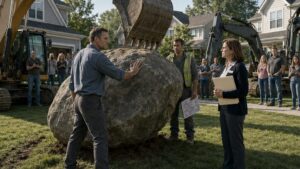
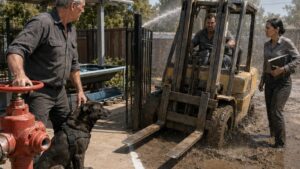
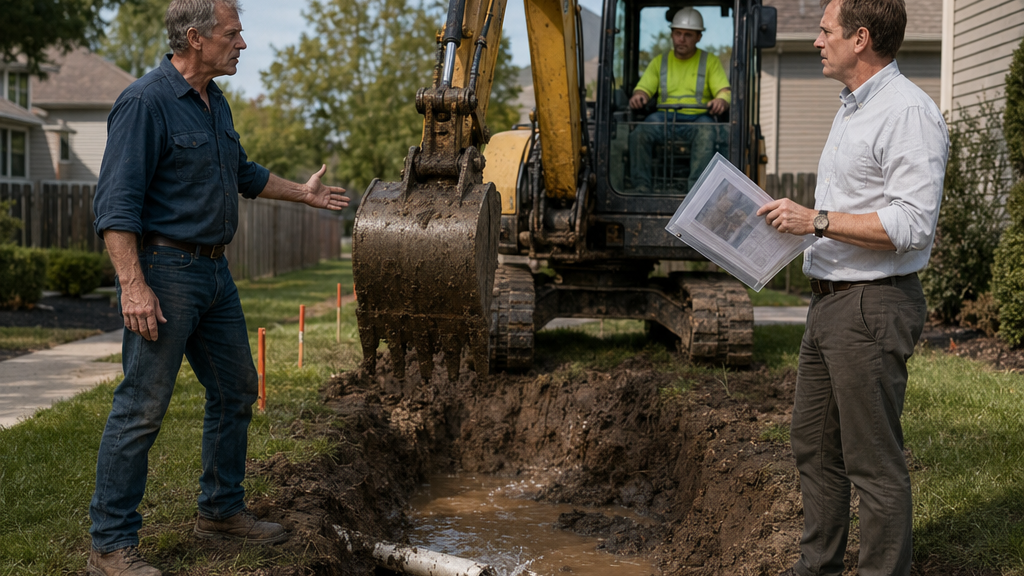
The excavator bucket came up with a strip of white pipe hanging from its teeth.
For half a second, Kevin Hall simply stared.
Then water burst from the trench.
It hit the raw dirt hard enough to turn the bottom of the cut into brown slurry, washing loose gravel toward the yellow machine’s tracks. The operator froze with the bucket suspended in the air.
Kevin was already moving.
“Shut it down.”
The operator looked toward the street instead of at him.
Kevin stepped closer. “Shut the machine down.”
The diesel engine dropped to an idle.
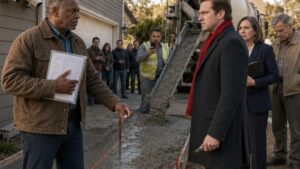
It was Tuesday morning, not yet nine, and the narrow strip beside Kevin’s house looked as though someone had opened it with a knife. Orange stakes ran through the grass in a straight line toward the back fence. A compact excavator sat halfway along them. Beyond it, two workers stood beside a trailer loaded with crushed stone.
Kevin had seen the stakes the evening before. He had assumed they marked utility locations for work along the common drainage area farther north.
He had not assumed anyone planned to dig through his yard.
He crouched beside the trench.
The white polyethylene line was unmistakable. He had installed enough of them during his years working municipal utility location to know what he was looking at before he touched it. His house service ran from the meter near the road, angled across this strip, then turned beneath the side yard.
Now it ended in a jagged cut.
Kevin stood.
“Who authorized you to dig here?”
The construction contractor, a broad man holding rolled plans, came over from the trailer. “We’re building the access lane.”
“On my property?”
“The HOA project.”
“That wasn’t my question.”
The man glanced toward the flooded trench. “We called for utility marks.”
Kevin looked at the orange paint. It identified a communications line farther east. There were no blue marks where his private water service crossed the work zone.
“Public locate doesn’t mark everything past the meter,” Kevin said. “You still have to know what property you’re working on.”
The contractor’s expression changed slightly. Not apology. Calculation.
“We have approved plans.”
Kevin had heard that sentence hundreds of times in different forms. Approved plans. Approved route. Approved permit. People liked those words because they sounded larger than the question immediately in front of them.
He pointed to the ground.
“This strip belongs to me.”
A pickup stopped at the curb.
Justin Miller got out carrying a clear plastic folder.
Kevin knew Justin well enough to have nodded to him at neighborhood cookouts and once helped him find a shutoff valve during a freeze. Justin lived several streets over and had been HOA president for nearly two years. He approached with the hurried stride of someone arriving to solve a problem he had already decided was smaller than his schedule.
“What happened?”
“They cut my water line.”
Justin looked into the trench and exhaled. “Okay. That can be repaired.”
Kevin watched him.
“That’s your first concern?”
“I’m saying we’ll get it addressed.”
“Who told them they could excavate here?”
Justin held up the folder. “This is the approved secondary-access project, Kevin. We went through municipal review. Fire access, maintenance access, grading. The whole thing.”
He slid a laminated site plan from the folder.
The drawing showed the neighborhood entrance, the newer homes at the rear, drainage lines, pavement widths, and a narrow lane running along the edge of Kevin’s parcel.
Kevin took the plan.
The line was labeled FUTURE ACCESS.
He read the notes once. Then again.
“Where’s the easement?”
Justin’s eyebrows pulled together. “It’s on the recorded subdivision plan.”
“No. I’m looking at a project drawing.”
“It references the subdivision plan.”
Kevin handed it back. “Show me the easement.”
The contractor shifted his weight.
Justin glanced at him as if he disliked having the conversation in front of workers.
“The city approved this.”
Kevin felt the first clean edge of anger settle into something colder.
“A city permit lets you build something you have the right to build. It doesn’t give you property.”
Justin gave a short, tired laugh.
“Kevin, nobody’s trying to take your property.”
“There’s an excavator sitting on it.”
“That corridor has always been designated for access.”
“Designated by who?”
“It’s in the community plans.”
Kevin pointed at the flooded trench.
“Then show me the recorded document that grants the association the right to cross this parcel.”
Justin looked back at the laminated sheet.
For several seconds, no one spoke.
Water continued pushing mud toward the excavator track.
The contractor finally asked, “Do you want us to stop for the day?”
Justin turned toward him.
Kevin expected the obvious answer.
Instead Justin said, “Pause excavation here until we repair the line. You can keep staging material by the street and working from the north end.”
Kevin straightened.
“No.”
Justin looked at him.
“You don’t have permission to stage, grade, drive, or dig on this strip until somebody shows me that right.”
“Kevin.”
“That isn’t complicated.”
Justin’s jaw tightened.
“We’ve already contracted crews. We have paving scheduled. This project came out of two years of safety complaints.”
“And none of that answers the question.”
A utility-repair technician arrived twenty minutes later. Kevin walked him to the meter and showed him where the private line entered the property. They capped the damaged section temporarily, but the technician explained that permanent restoration would require exposing several more feet and replacing the crushed portion.
Kevin asked how soon.
“Depends on authorization,” the technician said. “Who’s paying?”
Kevin looked toward Justin.
Justin said, “Have the contractor submit it.”
That answer bothered Kevin almost as much as the cut pipe.
Not because it meant he would have to chase reimbursement. Because everyone except him still seemed to be treating the event as an inconvenience inside a project that had already been decided.
By noon, Kevin had bottled water lined along his kitchen counter and a temporary hose connection that barely produced enough pressure to run one faucet.
The excavator remained parked beside the trench.
Justin came to the door before leaving.
“I’ll have Sarah send you the project documents.”
“Send me the easement.”
“She’ll send you what we have.”
Kevin leaned against the doorframe.
“Justin, what’s the recording number?”
“For what?”
“The easement.”
Justin hesitated.
Kevin saw the answer before he heard it.
“I don’t have that number in front of me.”
“Do you know whether there is one?”
Justin looked back toward the strip of torn earth and orange stakes.
“I know the project was approved.”
Kevin nodded once.
“That’s not what I asked.”
Justin left without answering.
Chapter 2: The Permit Proved Less Than Everyone Thought
At 2:17 that afternoon, Kevin received an email from Sarah Johnson with the subject line DAMAGE DURING ACCESS PROJECT.
The first sentence made his face go still.
The association regrets the inconvenience caused by the contractor’s accidental damage to a private service line.
He read the rest standing at his kitchen counter.
The contractor had been directed to coordinate repairs. The access project had been reviewed and approved by the municipality. The association expected work to resume after the damaged utility was secured. Any reimbursement questions should be directed to the contractor’s insurance carrier.
Kevin read it twice.
Not one sentence addressed ownership.
He opened the attached PDF.
Twenty-three pages.
Cover sheet. Grading plan. Drainage details. Turn radius. Emergency-vehicle dimensions. Contractor notes. Municipal approval stamps.
On three sheets, the same narrow line appeared beside his lot.
FUTURE ACCESS.
Kevin printed the pages and carried them to his dining table. From a drawer in the small desk near the hallway, he removed a folded plat he had kept since buying the property from his uncle eleven years earlier.
The paper had softened at the creases.
He spread it beside the new drawings.
Same strip.
Same forty-two-foot width.
Different meaning.
On his old plat, the eastern boundary of his parcel was clear. The strip was included inside his legal description. Near it, written in faded drafting text, were the words FUTURE ACCESS CONNECTION.
No easement width.
No grantee.
No recording reference.
No book and page number.
Kevin sat down.
During his working years, he had learned that missing information could be more important than present information. A line on a map told you where someone wanted something. An easement told you who had the right to put it there.
His phone rang.
Sarah.
“Kevin, did you get my email?”
“I did.”
“Good. I wanted to make sure you had the approvals.”
“I have the drawings.”
“Yes.”
“I still don’t have an easement.”
There was a pause.
“The subdivision plan shows the access.”
“It shows words.”
“Kevin, this project went through review.”
“I understand.”
“The association didn’t just invent a lane.”
“I didn’t say you did.”
Her voice softened, as though she were trying to keep the discussion administrative.
“I think we may be talking past each other.”
“No. We’re talking about two different things. You’re talking about permission from the city to construct an access lane. I’m asking what gives the HOA permission to construct it on land I own.”
Sarah was quiet.
Then she said, “I can ask counsel.”
“That would be useful.”
“The contractor needs to get back on schedule.”
“Then I’d ask quickly.”
Kevin regretted the sharpness as soon as he said it.
That was his habit. He avoided arguments until he had already passed the point where his words came out clean.
Sarah noticed.
“We’re trying to fix your water.”
“That should’ve happened before anyone talked about resuming construction.”
“I agree the damage is unfortunate.”
“Unfortunate is rain.”
She exhaled.
“I’ll pull the older files.”
After the call, Kevin went outside.
The temporary repair had stopped the leak, but the trench remained open. A short white section of pipe had been capped and wrapped, its clean plastic almost bright against the brown mud.
A neighbor slowed while walking a dog.
“You really stopping the access road?”
Kevin looked up.
“I’m stopping people from digging on my property until they show me they have the right.”
The neighbor shifted the leash to the other hand.
“I heard it’s for emergency vehicles.”
“That’s what the project is for.”
“So why fight it?”
Kevin felt something inside him tighten.
“I’m not fighting emergency access.”
“That’s not how people are hearing it.”
The neighbor continued down the sidewalk before Kevin could decide whether answering would help.
By dinner, two more messages had arrived.
One from Sarah, saying the historical files were being reviewed.
Another from Richard Wilson, the HOA treasurer.
Richard’s tone was less formal.
Justin says there may be a property-record issue. Before everybody gets worked up, can you tell me exactly what you think is missing?
Kevin called him.
“The recorded grant,” Kevin said.
Richard was silent for a moment. “You mean an easement.”
“Yes.”
“I assumed that strip was common property.”
“It isn’t.”
“I’ve seen maintenance trucks use it.”
“So have I.”
That answer came too easily.
Kevin stared out the kitchen window.
For years, the association’s landscaping crew had occasionally driven across the grass to reach a drainage inlet near the back corner. Once, after a storm, a tree-service truck had used the same route. Kevin had disliked the tire marks but never complained.
He had told himself it was neighborly.
Temporary.
Obvious.
Now he wondered what everyone else had learned from his silence.
The next morning he drove to the county records office.
The clerk listened while he gave the parcel number and HOA name. She searched the electronic index first, then older scanned records.
“Nothing under the association,” she said.
“Try the original developer.”
She did.
Several drainage easements appeared. Utility easements. A temporary construction easement from decades earlier on a different tract.
Nothing crossing Kevin’s strip for access.
“Could it be recorded under a predecessor?”
“It could.”
She searched again.
Kevin watched the screen populate with documents that looked promising until she opened them.
None granted vehicular access over his parcel.
The clerk finally leaned back.
“I’m not saying it doesn’t exist somewhere. But there’s no indexed access easement here that I can find.”
Kevin folded his hands.
“What about the subdivision plat?”
She pulled it up.
There were the same two words.
FUTURE ACCESS.
The clerk enlarged the image.
“That’s a planning notation.”
“So it isn’t a grant.”
“I can’t give legal advice.”
“I’m not asking you to.”
She looked at him.
“No. A label by itself isn’t the same thing as a recorded easement instrument.”
For the first time since the excavator bucket lifted his water line from the dirt, Kevin felt something close to relief.
It lasted perhaps five seconds.
Then he looked at the copied plans in his folder and thought about the paving crews, the HOA board, the neighbors already calling it a safety project.
If the association had no easement, the mistake was larger than the pipe.
And if the access right existed under some name nobody had searched yet, Kevin could make himself look like exactly what people were beginning to call him: the man who stopped a neighborhood improvement because he was angry about a repair.
The clerk printed the search summary.
At the bottom, the line for access easements under the HOA name was blank.
Kevin took the paper.
“Can you check one more thing?”
“What?”
“Every recorded easement touching this parcel.”
She typed for a while, then shook her head.
“Drainage. Utilities. Nothing for association access.”
Kevin looked again at the two faded words on the old plat.
Future access.
For years, everyone had apparently read them as a promise already kept.
Now he needed to find out whether anybody had ever actually made it.
Chapter 3: Forty-Two Feet the Records Could Not Explain
Rebecca Carter did not begin by asking what the HOA had done.
She began by asking what Kevin had done.
“Have you ever signed anything giving them permission to cross the strip?”
Kevin sat across from her desk with the plat open between them.
“No.”
“Any letter agreement?”
“No.”
“License?”
“No.”
“Email saying they can use it?”
“Not that I remember.”
Rebecca looked up.
“That’s different from no.”
Kevin frowned.
She tapped the edge of the plat.
“I’m not trying to weaken your position. I’m trying to find where it can be attacked.”
Kevin had found Rebecca through a former city engineer he trusted. Her office was plain, almost severe: gray filing cabinets, two shelves of property-law books, no framed courtroom photographs or oversized credentials. She had spent the first fifteen minutes looking at documents rather than reacting to his description of the excavator.
Kevin appreciated that.
He also disliked where her questions were going.
“Maintenance trucks have crossed there.”
“How often?”
“Maybe a few times a year.”
“With your knowledge?”
“Yes.”
“Did you object?”
Kevin leaned back.
“No.”
Rebecca made a note.
“Tree crews?”
“Once.”
“Landscaping?”
“Yes.”
“HOA drainage work?”
“Sometimes.”
“You ever put anything in writing saying those uses were temporary?”
Kevin stared at the plat.
“No.”
There it was.
Not a legal conclusion. Not yet.
But a fact he had spent two days avoiding.
He had wanted to be reasonable.
His uncle had been the opposite. Every fence post mattered to him. Every survey pin had been painted and protected. When Kevin bought the house and adjoining strip eleven years earlier, his uncle had walked him down the entire eastern boundary and pointed out where the water service, electrical conduit, and old irrigation sleeve ran.
“Don’t let anybody build over this,” he had said.
Kevin had promised.
Then he had spent eleven years trying not to be the kind of man who argued about tire tracks.
Rebecca slid the county search toward herself.
“This is helpful.”
“The clerk found no access easement.”
“I see that.”
“So they don’t have one.”
“I didn’t say that.”
Kevin looked at her.
Rebecca met his stare without concern.
“You hired me to verify it, not celebrate early.”
That irritated him because it was exactly what he would have told someone else.
For the next hour they traced ownership backward.
Kevin’s deed described the parcel by metes and bounds. The original subdivision plat showed the forty-two-foot strip within the larger tract later conveyed to Kevin’s uncle. Drainage rights were carved out separately. Utility rights had defined widths.
The phrase FUTURE ACCESS appeared on two planning sheets.
Rebecca found no language granting it.
She leaned closer to the screen.
“This note appears to originate in the preliminary subdivision package.”
“What does that mean?”
“It means somebody intended to solve access later.”
“But didn’t.”
“Maybe.”
Kevin gave her a look.
She ignored it.
They pulled the final recorded plat.
The line remained.
The notation remained.
Still no easement language.
Rebecca printed the relevant pages.
“So the city approved the subdivision knowing that was marked as future access.”
“Yes.”
“And the HOA later treated that mark like the access already existed.”
“That’s what it looks like.”
“Looks like?”
Rebecca put down her pen.
“Kevin, property disputes get ugly when people decide the first explanation they like is the whole explanation.”
He said nothing.
She continued.
“You have strong title evidence. But I want the original developer documents, the HOA declarations, amendments, any annexation instruments, and the active permit package. And I want you to be completely honest with me about historical use.”
“I have been.”
“Then say it plainly. Did you know people crossed that strip?”
“Yes.”
“Did you allow it?”
Kevin hesitated.
“I didn’t stop it.”
“That’s not the same answer.”
The room seemed smaller.
“Fine. Yes. I allowed occasional maintenance access.”
Rebecca nodded.
“Good.”
“Good?”
“Good that I know now instead of hearing it from their attorney.”
Kevin stood and walked to the window.
Below, cars moved slowly through the office complex.
“I didn’t give them a road.”
“I know.”
“I let a mower through. A truck after storms. That doesn’t mean they get to excavate forty-two feet of my property.”
“I agree those are different things.”
“Then why are you looking at me like I caused this?”
“I’m not.”
Rebecca closed one folder.
“I’m looking at you like a man who believed his boundary was obvious because it was obvious to him.”
Kevin turned.
That landed harder than he expected.
By Friday morning, they had the HOA declarations.
Nothing.
The amendments.
Nothing.
A recorded drainage agreement explained why association crews had historically entered one corner of Kevin’s property. It allowed limited access for inspection and maintenance of a stormwater structure.
Rebecca circled the clause.
“That may explain some of the old crossings.”
“So they had access.”
“For drainage maintenance. Not a permanent road. Not general vehicular access.”
Kevin felt the distinction settle into place.
His earlier tolerance had not created the same right the HOA was now claiming. But it had created a story people could tell themselves: crews had always gone through there, so of course the association controlled it.
That afternoon Sarah forwarded the permit package at Rebecca’s request.
Rebecca opened the file while Kevin sat beside her.
The application described a “secondary emergency and maintenance access connection” from the public street to the rear neighborhood lane.
The property-control section cited the recorded subdivision plat.
Rebecca’s face changed.
Not dramatically.
She simply stopped scrolling.
“What?”
She enlarged the page.
Under site control, the applicant had referenced the plat number and attached the sheet containing FUTURE ACCESS.
No separate easement instrument was listed.
Kevin leaned closer.
“They used the plat as proof.”
“It appears so.”
“Can they do that?”
“The city reviews what’s submitted. That doesn’t necessarily mean the city adjudicated ownership.”
She clicked through another attachment.
A survey drawing showed the proposed lane centered across Kevin’s strip.
His parcel number was printed beside it.
Rebecca sat back.
“This is worse for them than I expected.”
Kevin felt his pulse rise.
“Why?”
“Because the active permit doesn’t merely touch your land. The access design depends on it.”
She picked up the phone.
“Who are you calling?”
“The building department.”
Kevin watched her dial.
“What happens now?”
Rebecca paused before pressing the last number.
“If they agree the permit relies on property rights the applicant never established, they may suspend the work until it’s resolved.”
Kevin thought of the excavator.
Then the neighbors.
Then the dog walker asking why he was fighting an emergency route.
He had wanted his water restored and people off his property.
He had not expected to hold the switch on an entire neighborhood project.
Rebecca pressed the final number.
“This is the point,” she said, “where everybody stops arguing about the pipe.”
Chapter 4: When the Work Stopped, the Neighborhood Turned
The municipal inspector arrived before the construction crew finished unloading their coffee.
Kevin saw the city truck from his kitchen window at 7:18 Monday morning. By the time he reached the side yard, the inspector was standing beside the excavator with the contractor, comparing the permit packet to a printed parcel map.
Justin was already there.
Nobody waved.
The repaired white water line crossed the open trench beneath a temporary protective sleeve. The excavator sat six feet away, its bucket lowered to the ground.
The inspector walked to Kevin.
“You own this parcel?”
“Yes.”
“And you’re disputing the association’s right to construct through it?”
“I’m asking them to establish the right.”
The inspector glanced at Justin.
Justin folded his arms.
“We submitted the recorded subdivision plat with the permit.”
“I know,” the inspector said. “That’s why I’m here.”
He removed a bright notice from his clipboard.
The contractor stepped forward. “Are we shutting down the whole project?”
“For now, work in this access corridor is suspended.”
Justin’s expression hardened. “The permit was issued.”
“The permit was issued based on the application materials. We’re not making a title determination. We’re saying the applicant has to demonstrate site control before work continues across disputed private property.”
He fastened the notice to the temporary construction board.
STOP WORK.
The words were large enough to read from Kevin’s driveway.
For two days Kevin had imagined that sight.
He had imagined relief.
Instead he felt twelve pairs of eyes turning toward his house.
Workers began shutting equipment compartments. A delivery truck that had just pulled up was waved back toward the entrance.
The contractor asked Justin something quietly.
Justin answered without looking at Kevin.
By eight, the excavator was silent.
By nine, the neighborhood group messages had started.
Kevin did not belong to the main social-media page anymore. He had muted it years earlier. He still received screenshots.
One called him unreasonable.
Another said he was jeopardizing emergency access over a “technicality.”
A third asked why one homeowner could hold up a project everyone had already paid for.
Kevin deleted the messages.
At eleven, Richard Wilson knocked on his door.
Kevin let him in.
Richard carried a yellow legal pad filled with figures.
“This isn’t an official visit.”
“Those usually come by email.”
Richard almost smiled.
He sat at the kitchen table.
“The paving subcontractor is charging standby after Wednesday. We lose the concrete slot if this goes past the week. There’s equipment rental. Mobilization. Maybe a redesign.”
Kevin poured coffee.
“What do you want me to do with that?”
“Understand why people are nervous.”
“I understand money.”
Richard looked at him.
“That wasn’t what I meant.”
Kevin set down the mug harder than necessary.
“No, what you meant is that now the association has consequences, I’m supposed to feel responsible for them.”
“I didn’t say responsible.”
“You brought a page of numbers.”
Richard glanced at the legal pad.
“Fair.”
For a moment neither man spoke.
Then Richard pushed the pad aside.
“I voted for the project.”
Kevin waited.
“I believed the access was ours.”
“So did Justin.”
“So did Sarah. So did the engineer, apparently.”
“And none of you checked?”
Richard rubbed his forehead.
“Not the way we should have.”
That was the first sentence Kevin had heard from anyone on the board that resembled an admission.
It should have felt satisfying.
Instead it made the entire situation seem larger.
Richard continued.
“I pulled old maintenance invoices this weekend. We’ve been sending crews through that strip for years.”
“For drainage work.”
“Sometimes.”
“Exactly.”
“Sometimes landscaping. Tree work.”
Kevin looked away.
Richard noticed.
“You knew?”
Kevin said nothing.
“You knew they crossed there.”
“I knew maintenance trucks crossed.”
“And you never complained.”
“They weren’t building a road.”
“I understand that.”
“Do you?”
Richard leaned back.
“I’m trying to.”
Kevin walked to the window.
Outside, the stop-work notice moved slightly in the breeze.
“When you let your neighbor turn around in your driveway,” Kevin said, “you haven’t given him the driveway.”
“No.”
“But if he does it for ten years and you never say a word?”
Richard’s silence answered more than an argument would have.
Kevin turned back.
“I should’ve said something.”
Richard studied him.
“That matters.”
“It doesn’t create an easement.”
“I didn’t say it did.”
“It matters because everybody got comfortable.”
“Yes.”
Kevin sat down.
The sentence bothered him because it was true.
The association had made the larger mistake. They had ordered excavation without verifying title. They had damaged his water line. They had continued after he objected.
But Kevin had watched small uses accumulate and decided silence was easier than awkwardness.
He had assumed everyone understood the difference between courtesy and ownership.
Apparently they had not.
That afternoon, Sarah sent a formal notice to all residents stating that construction was temporarily suspended pending verification of property rights.
It did not name Kevin.
It did not need to.
At dusk, he walked down the side strip.
The repaired water line was covered now except for a short exposed section awaiting final backfill. Beyond it, survey stakes marked the centerline of the proposed lane.
Kevin counted the steps from his foundation.
Too close.
He already knew that.
The strange part was how obvious the danger looked once someone had cut the ground open.
A permanent lane there would put traffic, grading, drainage, and future maintenance directly over utilities his uncle had warned him about.
A pickup stopped at the curb.
Justin got out alone.
He did not have the plastic permit folder this time.
He approached the trench and looked at the repaired pipe.
“How’s the water?”
“Working.”
“Contractor paying?”
“So far.”
Justin nodded.
For several seconds they stood without speaking.
Then Justin said, “Richard told me you knew crews had used this strip.”
Kevin looked at him.
“I knew drainage and maintenance crews crossed occasionally.”
“You never objected.”
“No.”
Justin’s mouth tightened.
“Do you understand how that looks from our side?”
Kevin felt anger rise again, but this time there was something underneath it he could not dismiss.
“Yes.”
Justin seemed surprised.
Kevin continued.
“I understand how you could assume informal use meant nobody would object.”
“That’s not what I said.”
“It’s what happened.”
Justin stared at the stop-work notice.
“We’ve got residents saying the board wasted their money.”
“That isn’t my doing.”
“We’ve got residents saying you let people use this for a decade and suddenly decided it was private the day construction started.”
“That part isn’t true.”
Justin turned toward him.
“Then why didn’t you ever tell us?”
Kevin opened his mouth.
Nothing came.
The answer he wanted was easy: because nobody had tried to build a road before.
But that was not the entire answer.
He had seen trucks cross.
He had seen tire marks.
He had watched each board inherit the same assumptions.
And every time, he had chosen not to make an issue of it.
Justin took a step closer.
“I was wrong to tell the contractor to keep working after you challenged the easement.”
Kevin said nothing.
“But you’re asking all of us to understand your boundary now.”
Justin pointed toward the narrow strip.
“Why didn’t you make anybody understand it before?”
Kevin looked at the white pipe disappearing beneath the soil.
For the first time since the excavator cut through it, the hardest question was no longer what the HOA had failed to document.
It was what Kevin had failed to say.
Chapter 5: The Part Kevin Had Never Put in Writing
Kevin found his uncle’s measurements inside a coffee-stained envelope marked WATER—EAST SIDE.
He had been looking for a repair receipt.
Instead he sat down on the kitchen floor with the envelope open in his lap.
Inside were three sheets of yellow graph paper.
His uncle’s handwriting ran across them in short block letters: meter, shutoff, 32 feet, turn south, conduit below, do not cover.
Kevin recognized the sketch immediately.
He had seen it eleven years ago, when his uncle walked the property with him before the closing.
The memory returned in pieces.
His uncle pushing a screwdriver into the grass to mark the direction of the service line.
His boot beside the old survey pin.
The warning delivered without drama.
Don’t let anybody build over this side. Everything feeding the house crosses here.
Kevin had promised.
Then life had gone on.
A mower crossed the strip.
A stormwater crew crossed it.
A tree truck crossed it.
Kevin had watched and thought, They know it’s mine.
He had never once written those words down.
He placed the old sketch beside the contractor’s repair diagram.
The two routes nearly matched.
A white line ran through both.
At noon Rebecca called.
“The city is keeping the suspension in place.”
“For how long?”
“Until the HOA establishes access rights or changes the plan.”
“Good.”
Rebecca was silent.
“What?”
“You said that quickly.”
“They cut my water line.”
“I remember.”
“They told me the permit settled it.”
“I remember that too.”
Kevin stood and looked out at the idle equipment.
“What are you getting at?”
“You have leverage now. Decide what you want it for before somebody else decides for you.”
“I want them off my property.”
“Permanently?”
“Yes.”
Rebecca did not answer.
Kevin knew that silence. She used it when she wanted him to hear his own sentence twice.
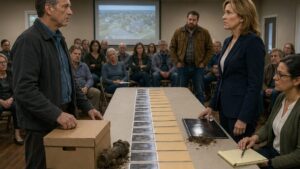
That evening, the HOA held a private meeting with Kevin, Rebecca, Justin, Sarah, Richard, and association counsel.
No folding chairs full of residents.
No microphones.
No audience.
Kevin preferred it that way.
Sarah had assembled three binders on the conference table.
Justin looked exhausted.
Richard looked worse.
Association counsel began with the legal position.
“We’re not conceding every issue involving historical use.”
Rebecca replied, “We’re not asking you to.”
“We do acknowledge there is no recorded general-access easement in favor of the association.”
Kevin looked at Justin.
Justin did not look away.
The admission was quieter than Kevin had imagined.
It also changed less than he expected.
The pipe had still been cut.
The project was still stopped.
His neighbors were still paying for the mistake.
Sarah slid a sheet across the table.
“This is an alternate route analysis.”
Kevin scanned it.
The proposed alternatives ran through common landscaping and around two existing structures. Each required major redesign.
“One option reduces emergency-vehicle turning clearance,” Sarah said. “The other would require relocating drainage infrastructure.”
“That’s your project problem,” Kevin said.
Rebecca glanced at him.
He knew what the glance meant.
Justin leaned forward.
“Do you know why I pushed this project?”
Kevin almost laughed.
“Because you thought you had access.”
“No.”
Justin’s voice was low.
“Last winter, an ambulance got delayed at the front entrance.”
The room changed.
Kevin stopped touching the paper.
Justin continued.
“A delivery truck had broken down in the entrance lane. Cars backed up behind it. The ambulance couldn’t get through for several minutes.”
Kevin looked at Richard.
Richard nodded once.
Justin said, “The resident survived. This isn’t that kind of story. But I was standing there watching paramedics carry equipment the last stretch because they couldn’t get the vehicle in.”
Kevin had never heard that.
“There had been complaints before,” Justin said. “Snow removal. Utility trucks. Fire department comments. After that morning I told the board we were done waiting.”
Sarah spoke quietly.
“The old plans showed future access. The city engineer said the geometry worked. We assumed the property piece had been handled when the subdivision was created.”
Kevin looked down at the words FUTURE ACCESS.
There it was again.
Not corruption.
Not conspiracy.
Something more ordinary and, in its way, more dangerous.
One person assuming someone before him had checked.
Then another.
Then another.
Until an excavator arrived.
Justin rubbed his thumb along the edge of the table.
“I should have stopped the contractor when you challenged it.”
“Yes,” Kevin said.
Justin nodded.
“Yes.”
No defense followed.
Kevin had expected satisfaction from hearing that.
Instead he thought of the ambulance.
He thought of a blocked entrance and paramedics carrying equipment on foot.
Then he thought of the white pipe hanging from the excavator bucket.
Both things could be true.
The neighborhood could need another access point.
And the HOA could have had no right to simply take his.
Association counsel began discussing possible temporary licenses.
Kevin barely heard him.
His uncle’s sketch was folded inside the folder beside his chair.
Don’t let anybody build over this side.
Rebecca eventually asked for a break.
Outside the conference room, Kevin leaned against the hallway wall.
“You knew about the ambulance?” he asked.
“No.”
“Does it change anything?”
“Legally?”
“No.”
Rebecca considered him.
“It may change what you want.”
Kevin looked through the glass door at Justin.
“I could stop the road.”
“At least on the current route, yes.”
“And make them redesign everything.”
“Yes.”
“Cost the association what?”
“Potentially a lot.”
“That means homeowners.”
“Ultimately.”
Kevin rubbed the bridge of his nose.
“That sounds like you’re telling me not to do it.”
“I’m telling you the choice is yours. That means the consequences are yours too.”
Kevin gave her a tired look.
“You’re expensive for someone who won’t tell me what I want to hear.”
“That’s part of the service.”
Back in the room, Kevin unfolded his uncle’s sketch.
He placed it over a copy of the proposed access lane.
The lane ran almost directly over the water service.
Sarah leaned closer.
“What is that?”
“My utility layout.”
Justin studied it.
“You had that the whole time?”
“I had it in a drawer.”
Kevin heard the irony as he said it.
The HOA had relied on old paper it had misunderstood.
Kevin had relied on old paper he had never shared.
Different mistakes.
But both involved assumptions.
He looked at Rebecca.
“If access moved west?”
She followed his finger.
“How far?”
“Enough to clear the water and conduit. Survey it properly. Control drainage. No general construction staging. No parking. Emergency and maintenance use only.”
Association counsel began taking notes.
Justin stared at Kevin.
“You’d consider an easement?”
Kevin folded the sketch.
“I’d consider giving you something you should have asked me for.”
The room went quiet.
Sarah asked, “Under what terms?”
“I don’t know yet.”
He looked at Rebecca.
“But I know I don’t want the answer to be no just because I finally have the power to say it.”
Later, outside, Kevin called Rebecca before she drove away.
“I want you to draft an offer.”
“What kind?”
“A real easement. Narrow. Surveyed. Protected utilities. Drainage limits. They pay for the damage, legal costs, maintenance, everything connected to it.”
“And if they refuse?”
“Then they redesign.”
Rebecca paused.
“You’re sure?”
Kevin looked toward the dark strip beside his house, where the repaired line lay beneath fresh soil.
“For eleven years I expected everyone to know what I meant without saying it.”
He glanced at the old sketch in his hand.
“I’m done doing that.”
Chapter 6: Kevin Drew the Line They Should Have Asked For
The new survey stakes did not follow the old orange markings.
That was the first thing Justin noticed.
He stood beside Kevin two weeks later while the survey crew finished flagging the proposed easement. The original route had run straight down the middle of Kevin’s forty-two-foot strip.
The new stakes bent west.
Only several feet.
Enough to matter.
Kevin walked the alignment with his utility sketch folded under one arm.
“Original lane centerline would have put the pavement here.”
He pointed at a blue-painted mark on the ground.
Justin looked down.
“That’s the water?”
“Main service.”
Kevin walked another fifteen feet.
“Electrical conduit angles under here.”
A survey stake stood beyond it.
“The shifted alignment clears both.”
Justin studied the narrow curve.
“Emergency vehicles can make this?”
“The engineer says yes if the entrance radius is widened slightly.”
“That costs more.”
Kevin looked at him.
“So did cutting the wrong place.”
Justin accepted that without argument.
They had reached a strange phase of the dispute.
The shouting Kevin had expected never came.
Instead there were revised drawings, insurance calls, survey invoices, legal drafts, and sentences beginning with if the board agrees.
Rebecca’s proposed easement was eight pages long.
Kevin read every one.
Emergency and maintenance access only.
No resident parking.
No construction storage.
No widening without written approval.
The HOA responsible for surface maintenance.
The HOA responsible for damage to Kevin’s utilities caused by access use.
Drainage prohibited from being redirected onto Kevin’s remaining property.
Repair reimbursement.
Attorney’s fees.
Survey cost.
Annual maintenance payment.
Justin called the annual fee unnecessary.
Kevin called it a reminder.
They met in the HOA conference room that Thursday.
Richard sat with a calculator.
Sarah had the revised engineering estimate.
Association counsel had covered his copy of the easement with notes.
Justin opened the meeting.
“The route works.”
Kevin waited.
“The cost is the problem.”
Richard turned the calculator around.
The number was not catastrophic.
It was also not small.
Survey changes, additional base work, revised drainage, protective barriers near the utility corridor, and legal expenses had pushed the project well beyond its original contingency.
“If we accept all of this,” Richard said, “we’ll probably have to delay two landscaping items until next fiscal year.”
Kevin almost smiled.
Two weeks earlier, the association had behaved as if its project justified excavating first and asking questions later.
Now decorative landscaping had entered the negotiation.
Sarah pointed at one clause.
“The indemnification language is too broad.”
Rebecca answered.
“Then propose narrower language.”
Association counsel did.
They spent forty minutes on it.
Another thirty on drainage.
Justin pushed back on the annual maintenance payment.
Kevin did not.
Eventually Justin looked at him.
“Why is this part so important?”
Kevin closed the document.
“Because twenty years from now I don’t want some board president looking at this lane and saying, ‘We’ve always used it, so it must be ours.’”
Justin’s expression tightened slightly.
“That’s not what I said.”
“It’s what everybody thought.”
No one contradicted him.
Rebecca slid a note toward Kevin.
He read it.
You can refuse entirely.
He looked at her.
She spoke quietly.
“You should remember that before you negotiate against yourself.”
Justin heard.
His shoulders stiffened.
Kevin leaned back.
For several seconds he pictured the easiest answer.
No.
No easement.
No road.
Make them redesign it around somebody else’s problem.
Legally, Rebecca believed he could.
Emotionally, part of him wanted to.
He remembered standing beside the trench while Justin held the laminated permit.
He remembered four days of bad water pressure and bottled jugs on his counter.
He remembered the neighbor asking why he was blocking a safety project as though Kevin had created the conflict by existing in the wrong place.
Then he remembered something else.
Justin standing at the private meeting describing paramedics walking because an ambulance could not pass the entrance.
Kevin picked up his pen.
“I’m not refusing.”
Justin stared at him.
“But I’m not giving you what you assumed you had.”
Kevin tapped the revised survey.
“This line. These restrictions. The utilities stay protected. You maintain the surface. If you damage something, you fix it. Nobody turns it into overflow parking. Nobody widens it because a future board thinks wider would be convenient.”
Richard said, “And the annual fee?”
“Stays.”
Justin rubbed his jaw.
“How much of this is about making a point?”
Kevin considered lying.
“Some.”
Rebecca looked at him.
Kevin continued.
“But points are cheaper than lawsuits.”
Richard gave a quiet laugh despite himself.
The tension in the room loosened.
Not much.
Enough.
Sarah turned to Justin.
“If the board approves tonight, I can get the revised permit package submitted tomorrow.”
“How long until construction restarts?”
“Best case? Another week.”
Justin looked at Kevin.
“Six weeks total.”
Kevin said nothing.
Six weeks was not nothing.
Workers had been rescheduled. Equipment moved. Paving delayed. Residents irritated. Board members blamed.
Kevin had caused some of that by asserting a right he actually had.
The HOA had caused more by assuming it had one it did not.
Neither fact erased the other.
Before the meeting ended, Rebecca requested one additional provision requiring the association to mark and protect Kevin’s utilities before any future excavation within the easement.
Association counsel agreed.
Sarah added it to the revision list.
Justin gathered his papers.
“You coming to the emergency meeting tonight?”
“No.”
Justin looked surprised.
“They’ll be voting on your proposal.”
“I know.”
“You don’t want to speak?”
Kevin shook his head.
“They have the terms. They have the survey. They have the numbers.”
He paused.
“They don’t need another argument from me.”
Outside, Rebecca walked with him toward the parking lot.
“That was restraint.”
“Don’t sound so surprised.”
“I’m your attorney. I bill for accurate observations.”
Kevin smiled for the first time all day.
Then Rebecca stopped beside her car.
“If they reject it, we go back to the other options.”
“I know.”
“You comfortable with that?”
“No.”
“Good answer.”
That evening Kevin stayed home.
At 7:42 he saw headlights moving toward the clubhouse.
At 8:16 a neighbor walked past his house without looking toward the porch.
At 8:53 Kevin received no message.
At 9:11 his phone finally rang.
Justin.
Kevin answered.
“How’d it go?”
Justin sounded tired.
“Long.”
Kevin waited.
“The board voted.”
“And?”
“They accepted the route.”
Kevin closed his eyes briefly.
“With the terms?”
“Most of them.”
“Most?”
“Annual fee stays. Utility protections stay. Drainage stays. Maintenance stays. Counsel wants one wording change on emergency access.”
“Rebecca reviews it.”
“I figured you’d say that.”
Kevin walked to the kitchen window.
Under the porch light he could just make out one of the new survey flags.
Justin continued.
“I supported it.”
Kevin looked at the flag bending away from the buried water line.
“Why?”
“Because we need the access.”
Justin paused.
“And because we should have asked.”
Kevin said nothing.
For once, silence did not feel like avoidance.
It felt finished.
Not the dispute.
Not yet.
But one part of it.
The next morning Sarah emailed the formal vote and revised proposal to Rebecca.
At the bottom was the board’s authorization to proceed with drafting the recorded easement.
For the first time, the HOA was not asking Kevin to accept a line someone else had drawn across his property.
It was asking permission to use the one he had drawn himself.
Chapter 7: The New Easement Left the Water Line Alone
Justin signed the document on the line directly beneath the words GRANT OF LIMITED ACCESS EASEMENT.
For a moment, Kevin watched only the pen.
Six weeks earlier, Justin had stood beside an open trench holding a laminated permit and insisting that the association already had the right to be there.
Now the conference table held three copies of the right it had never possessed.
Rebecca turned the document toward Kevin.
“Your turn.”
Kevin read the final page once more.
He already knew every clause.
The easement followed the revised survey, bending several feet away from his water service and electrical conduit. It permitted emergency vehicles and association maintenance traffic. It prohibited resident parking, storage, staging, widening, and unrelated construction use. The HOA would maintain the lane, protect the utilities, control drainage, and repair any damage caused by its use.
The contractor’s insurer had paid for the water-line restoration.
The association had agreed to reimburse Kevin’s legal fees and survey costs.
The annual maintenance payment remained.
Kevin signed.
Sarah Johnson gathered the pages for notarization.
Richard Wilson leaned back in his chair.
“Well,” he said, “that’s the most expensive line on a map I’ve ever voted for.”
Rebecca glanced at him.
“It was expensive before. You just didn’t know it.”
Richard accepted that with a small nod.
Nobody laughed.
The weeks had taken most of the humor out of the situation.
Association counsel slid one final sheet toward Rebecca.
“This confirms payment authorization.”
Rebecca checked it and passed it to Kevin.
The amount covered his legal expenses, the survey, and the remaining repair costs not handled directly by insurance.
Kevin looked at the number.
Six weeks earlier, money had not been what he wanted.
He had wanted water from his faucet.
He had wanted an excavator off his property.
Then, briefly, he had wanted the board to understand exactly how badly it had misjudged him.
That last desire had been the hardest one to let go.
Rebecca tapped a paragraph near the bottom of the settlement.
“There’s one remaining option.”
Justin looked up.
Kevin already knew what she meant.
The agreement did not waive every potential claim arising from the initial entry unless Kevin accepted the final release. Rebecca had explained that he could demand additional compensation for the unauthorized excavation and loss of use.
Association counsel had expected the demand.
Justin probably had too.
“How much?” Richard asked.
Rebecca did not answer for Kevin.
Kevin looked at the release.
He remembered carrying bottled water into his house.
He remembered the flooded trench.
He remembered the neighbor’s question: So why fight it?
There had been days when an extra penalty would have felt less like money than proof.
He put down the pen.
“No.”
Justin frowned. “No release?”
“No additional demand.”
Rebecca studied him.
“You’re sure?”
Kevin nodded.
“They’re paying what this cost me. The line is protected. The easement says what it means.”
He glanced at Justin.
“That’s enough.”
Justin lowered his eyes to the document.
Kevin could not tell whether the expression on his face was relief or embarrassment.
Maybe both.
Sarah left to make copies.
Richard followed association counsel into the hallway.
For the first time that morning, Kevin and Justin were alone at the table.
Justin turned the signed easement around and stared at the survey exhibit.
“I should have stopped the crew.”
Kevin said nothing.
“When you asked for the instrument number,” Justin continued. “Right then.”
“Yes.”
“I kept thinking the approvals meant somebody else had already checked.”
Kevin folded his hands.
“I kept thinking everybody knew occasional access didn’t mean permanent access.”
Justin looked at him.
“So we both assumed.”
“Not equally.”
A faint smile touched Justin’s mouth.
“No.”
Kevin let the silence sit between them.
It was not friendship.
Not yet.
Perhaps not again.
But it was cleaner than resentment.
Justin stood.
“For what it’s worth, I’m sorry about the line.”
Kevin nodded.
“That part was worth saying.”
Three days later, the recorded easement came back with its instrument number.
Kevin printed the first page.
He almost put it in the same desk drawer where his uncle’s utility sketch had sat for eleven years.
Instead he stopped.
He made two copies.
One went into his property file.
The other went into a clear sleeve with the utility sketch and revised survey.
Then he emailed the digital version to Sarah and asked her to attach it permanently to the HOA property records.
No assumptions this time.
The construction crew returned the following Monday.
Kevin stood near the side yard while the first machine came in.
It was not the excavator that had cut his pipe.
That machine was gone.
A smaller grader followed the new stakes, keeping west of the blue utility marks. Before any digging began, the contractor walked the route with Kevin and pointed out each marked service.
“Water here.”
“Yes.”
“Electrical angles there.”
“Yes.”
“We’re hand-digging within the tolerance zone.”
Kevin nodded.
That was all he had wanted the first morning: somebody to know what lay under the ground before treating the ground as empty.
The revised lane took shape slowly.
Stone first.
Then compacted base.
Drainage along the west edge, directed away from Kevin’s yard.
Protective markers remained where the buried services crossed nearby.
The delay had cost the association time and money. A landscaping project near the clubhouse was postponed. Residents complained about that too.
But the complaints faded.
People still waved at Kevin.
Some did not.
The neighbor with the dog stopped one afternoon while Kevin was checking his mailbox.
“I heard the road’s happening after all.”
“It is.”
“So you weren’t trying to block it.”
Kevin considered the question.
“I was trying to make them ask.”
The neighbor looked toward the narrow lane.
“That seems like a lot of trouble over asking.”
Kevin glanced at him.
“It became trouble because they didn’t.”
The neighbor nodded slowly and continued walking.
Kevin did not need anything more from the conversation.
By the end of the sixth week, the access lane was finished.
It was narrower than the original design and less visually imposing. A simple gate controlled routine entry. The pavement curved slightly where the survey stakes had bent away from Kevin’s utilities.
From his kitchen window, Kevin could see the difference.
Someone unfamiliar with the dispute might not notice it at all.
That pleased him more than he expected.
The final test came on a Thursday morning.
An HOA maintenance truck arrived to inspect the drainage inlet behind the homes.
Kevin heard the gate open.
For eleven years, trucks like that had simply crossed the grass wherever it was convenient.
This one stopped.
The driver checked something on a tablet, then followed the paved easement.
The truck stayed inside the recorded corridor.
Its tires passed several feet west of the place where Kevin’s water service lay beneath the ground.
No mud.
No rut.
No bucket teeth.
No exposed white pipe.
The driver finished the inspection and came back the same way.
As the truck reached the street, Justin was walking along the sidewalk.
He stopped beside Kevin.
Neither man said anything until the gate closed.
Justin looked toward the lane.
“Works.”
Kevin nodded.
“It does.”
“Maintenance crew has the restrictions in their work orders now.”
“Good.”
Justin put his hands in his pockets.
“We’re also adding property-right verification to future capital projects.”
Kevin glanced at him.
“That sounds painfully sensible.”
Justin smiled.
“I’ve developed an appreciation for boring paperwork.”
Kevin looked down the side yard.
The grass had begun to return along the disturbed edges.
Beneath it, the white line still carried water toward his house exactly as it had before the excavator arrived.
Only now the road bent around it.
Kevin had spent years thinking a boundary was something other people ought to recognize without being told.
The HOA had spent years thinking repeated convenience was proof enough.
Both beliefs had survived because neither had been forced into plain language.
The excavator had changed that.
Not gracefully.
Not cheaply.
But permanently.
Justin started down the sidewalk, then stopped.
“Kevin.”
Kevin looked over.
Justin pointed toward the finished lane.
“Thanks for not killing the project.”
Kevin considered the wording.
“I didn’t give you the road.”
Justin waited.
Kevin nodded toward the easement.
“I gave you permission to use part of my property for a specific reason.”
Justin smiled slightly.
“Right.”
This time the distinction required no argument.
Justin walked home.
Kevin remained beside the gate until another maintenance vehicle passed on the main street without turning in.
Then he went inside.
He opened the kitchen faucet.
Water struck the stainless-steel sink with steady pressure.
Kevin let it run for a few seconds, listening.
Six weeks earlier, that sound had disappeared because somebody looked at a line on a plan and assumed the rest had already been settled.
Now there was another line in the county records.
Surveyed.
Signed.
Recorded.
And the first maintenance truck to use it had passed Kevin’s buried water line without coming anywhere near it.
The story has ended.