The HOA Ordered Matthew King to Remove His Grandfather’s Boulder—Then the Survey Stakes Began Moving
Chapter 1: Three Excavators Arrived Before Matthew Finished His Morning Coffee
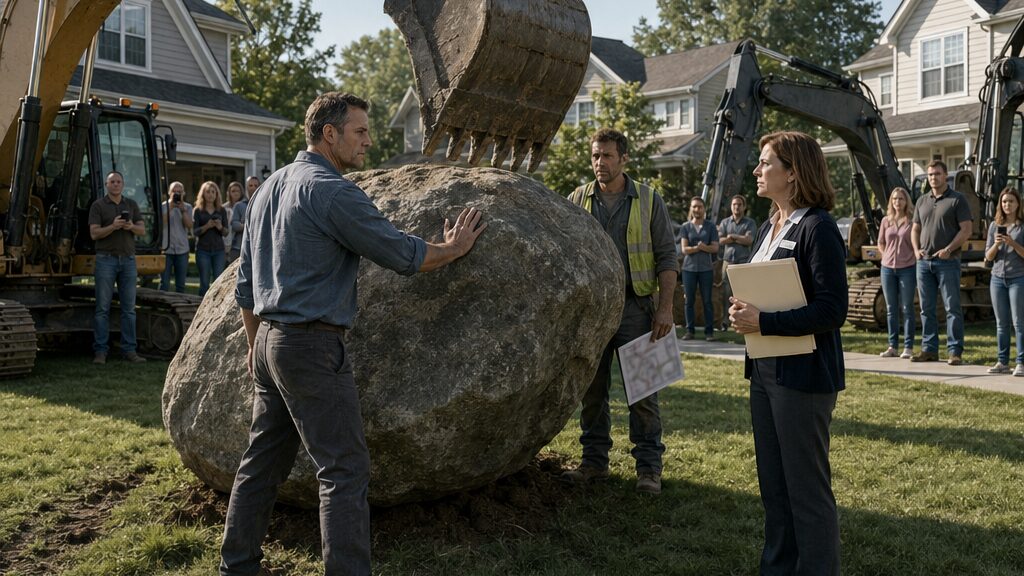
The teeth of the excavator bucket hovered less than a foot above the boulder when Matthew King stepped onto his porch with his coffee still in his hand.
Three machines occupied his front yard.
One sat beside the driveway, its rubber tracks crushing the edge of the grass. Another waited near the curb with its arm folded over the cab. The third had already crossed the shallow drainage swale and positioned itself beside the boulder, a gray mass of stone nearly as tall as Matthew’s chest and wider than his pickup.
Neighbors stood along the sidewalk in slippers, work clothes, and bathrobes. Two phones were raised.
Matthew set his mug on the porch railing.
“Shut it down.”
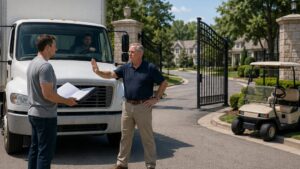
The operator looked toward Tyler Jones, who stood beside a utility trailer studying a clipboard. Tyler wore a reflective vest over a faded work shirt. He lifted one hand, and the excavator engine dropped to an idle.
Linda Harris emerged from behind the first machine carrying a white folder.
“You were notified,” she said.
She had dressed for an official confrontation: dark slacks, pale blouse, HOA badge clipped near her shoulder. Her voice carried just enough to reach the sidewalk.
Matthew walked down the steps. “A notice doesn’t give you permission to drive equipment onto my property.”
“It does when the board has declared an immediate safety condition.”
“The rock has been here longer than the association.”
“And now it’s leaning.”
Matthew looked at the boulder. It had not moved.
Its upper face sloped toward the street, darkened along one side by decades of rain. A shallow groove crossed the top where his grandfather used to rest a gloved hand while talking to neighbors. Matthew had done the same thing without realizing it until that moment.
He placed his palm against the stone.
Linda watched the gesture and gave a tired shake of her head.
“This is exactly the problem,” she said. “You’re treating a landscaping violation like a family member.”
A few neighbors looked away. One did not.
Matthew kept his hand on the rock. The stone was cool despite the morning sun.
“My grandfather told me never to let anyone move it.”
Linda opened the folder. “Your grandfather is not listed on the current deed.”
“He built this house.”
“He owned the lot. That does not exempt the lot from the covenants.”
Tyler approached, leaving the clipboard tucked beneath his arm.
“I was told access was cleared,” he said.
“It wasn’t,” Matthew replied.
Tyler looked at Linda.
She removed a stapled packet from the folder. “Emergency exterior hazard declaration. Approved yesterday evening.”
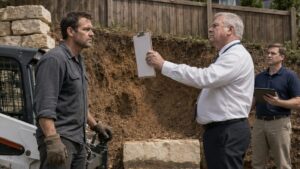
Matthew took it but did not move away from the rock. The first page carried the association letterhead, two signatures, and a photograph of the boulder taken from the sidewalk. A yellow line had been drawn along its upper slope.
“Who determined it was unstable?”
“The board inspected it.”
“You looked at it.”
“We observed visible erosion.”
“That isn’t a geotechnical inspection.”
Linda’s mouth tightened. “You had thirty days to provide your own report.”
“I had thirty days to answer a landscaping notice. Yesterday it became an emergency because I refused to remove it.”
“The situation changed.”
“No. The wording changed.”
Behind them, a machine gave a low hydraulic hiss. The operator had rested the bucket on the ground.
Tyler shifted his weight. “I’m not getting between you two. But I’ve got three operators billing time, and the work order says the site is legally ready.”
Matthew turned to the trailer. A utility locator wand leaned against one wheel beside a can of white marking paint.
“Show me your underground clearance.”
Tyler handed him another page.
Matthew read it once, then again.
His job with the municipal drafting office involved road plans, stormwater easements, and the dull precision of lines people ignored until a crew dug in the wrong place. The diagram attached to Tyler’s clearance showed a water service, gas line, and electrical feed. It also showed a rectangular work zone around the boulder.
But the base map was wrong.
“Where did this come from?”
“The HOA management company.”
“It’s a landscape sketch.”
“It’s what they provided.”
Matthew pointed to the lower corner. “No plat reference. No bearing. No control point. You can’t use this to establish a removal zone.”
Linda stepped closer. “You told the board there was nothing under the boulder.”
Matthew looked at her.
He had said the boulder was unquestionably legal. He had said it had been placed with the original development. He had said his grandfather knew exactly where it belonged.
He had never said he knew why.
“I said it wasn’t yours to remove.”
“You said you had records.”
“I said I would find them.”
“You didn’t.”
The neighbors had gone quiet enough that Matthew could hear the excavator’s cooling fan.
Tyler took back the page. “He’s right about one thing. This isn’t a survey-grade map.”
Linda’s expression changed. Not defeat—calculation.
“What does that mean?”
“It means I’m not putting a bucket below grade until I know what’s there.”
“You’re moving a rock.”
“A rock that size doesn’t come out without digging around it.”
Linda glanced toward the watching neighbors. “You told me your scan was clear.”
“My utility scan is clear. That tells me I’m probably not cutting gas or power. It doesn’t tell me about monuments, private drainage, old footings, or anything abandoned.”
For the first time that morning, Matthew felt the pressure ease.
Tyler motioned to the operator. “Back the bucket off.”
The steel teeth rose.
A murmur traveled along the sidewalk. One neighbor lowered her phone.
Linda closed the folder slowly. “The board’s declaration authorizes stabilization if the owner obstructs removal.”
Matthew studied her face. “What stabilization?”
She turned to Tyler. “You can expose the downhill side without entering the utility corridor.”
Tyler frowned. “That still means digging.”
“The hazard declaration says the stone may roll toward the sidewalk. If full removal cannot proceed, you are authorized to create a temporary retaining cut.”
Matthew read the last page of the packet. The wording was there, buried under a paragraph about public safety.
He felt something inside him shift.
Until then, he had assumed the machines were theater—expensive intimidation meant to make him surrender in front of the neighborhood. Linda had found a procedural path around his refusal.
Tyler rubbed a hand across his jaw. “A shallow test cut. Hand spot first. Then the small bucket.”
“No,” Matthew said.
Linda met his eyes. “You may challenge the action after the area is secured.”
“My grandfather put that boulder there forty years ago.”
“Then perhaps he should have left an explanation.”
The sentence struck harder than Matthew expected because it was true.
His grandfather had left tools labeled in block letters, coffee cans filled with sorted screws, tax records arranged by year, and a key ring on which every key had a stamped aluminum tag.
But the boulder had no file.
Only the warning.
Don’t let them move it, Matt.
Tyler called one operator down and handed him a shovel. Matthew remained beside the rock, his palm pressed against the weathered groove.
The worker cleared mulch from the lower edge. Beneath it lay compacted soil threaded with old roots.
“Nothing yet,” the worker said.
Linda stood near the sidewalk now, speaking quietly to Katherine Roberts, the HOA treasurer, who had arrived carrying a canvas tote. Katherine did not join the argument. She stared at the machines with the pinched expression of someone calculating costs.
Tyler crouched beside the worker and pushed a narrow probe into the ground.
It stopped after four inches.
“Stone?” Linda asked.
“Could be.”
Matthew’s fingers tightened against the boulder.
The operator returned to the cab. Tyler replaced the wide bucket with a smaller toothed attachment and directed him to scrape only the loosened soil.
The machine eased forward.
Steel entered earth with a sound like heavy cloth tearing.
The bucket lifted one shallow load. Then another.
On the third pass, one tooth struck something beneath the soil.
The sharp metallic scrape cut through the engine noise.
Tyler raised both arms.
The operator froze.
Nobody on the sidewalk spoke.
Matthew removed his hand from the boulder and stared at the narrow opening beneath it, where a curved edge of dull metal showed through the dirt.
Chapter 2: The Metal Circle Under the Rock Changed Every Argument
Tyler dropped to one knee and brushed the soil away with his glove.
A circular metal cap emerged beneath the boulder’s lower edge, no larger than the palm of his hand. Its surface was green-gray with age, but a ring of stamped characters appeared as he wiped across it.
“Don’t touch it with the bucket,” Matthew said.
Tyler looked up. “I wasn’t planning to.”
Linda remained near the sidewalk. “It could be debris.”
Matthew crouched beside Tyler.
The metal was not loose. It had been set into a narrow concrete collar buried below the soil. A triangle had been stamped into the center, surrounded by letters and a sequence of numbers.
Matthew read them twice.
“Subdivision control monument,” he said.
Linda came closer. “You can tell that from a dirty circle?”
“I can tell from the designation.”
“What designation?”
Matthew pointed without touching it. “SCM. Then the tract number.”
Tyler leaned nearer. “Is that like a property pin?”
“Not exactly. It’s a reference point surveyors can use to establish other points.”
One of the neighbors called from the sidewalk, “So the rock is on the property line?”
Matthew did not answer.
That question was larger than the discovery.
He stood and pulled out his phone. His hands were steady now, but the relief moving through him felt dangerous. The monument proved he had not been irrational. It proved the excavation should never have begun.
It did not yet prove what he had claimed.
Linda folded her arms. “Is it current?”
“A monument doesn’t expire.”
“It might be abandoned.”
“Then nobody touches it until the county confirms that.”
Katherine stepped past the machines. “Tyler, stop all work.”
Linda turned. “The hazard declaration is still active.”
“And our insurance does not cover disturbance of survey monuments,” Katherine said. “I checked while you were arguing.”
Tyler stood immediately. “All machines off.”
The engines shut down one by one. The sudden quiet exposed the ordinary sounds beneath the spectacle: a sprinkler ticking two houses away, a dog barking behind a fence, a delivery truck turning at the corner.
Matthew photographed the cap from several angles. Tyler placed two stakes around the opening and wrapped orange caution ribbon between them.
The boulder had not changed, yet the yard no longer looked the same. It was no longer an obstruction surrounded by machinery. It had become a shield over something everyone was afraid to touch.
Linda looked toward the neighbors.
“This does not establish that the boulder itself is protected,” she said.
“No,” Matthew replied. “It establishes that your contractor uncovered a control monument during an unauthorized excavation.”
“You received notices.”
“Not survey clearance.”
“You refused to cooperate.”
“I refused to surrender my yard.”
Her face sharpened. “And now you’re enjoying this.”
Matthew almost said yes.
The answer rose hot and immediate after weeks of letters, photographs, compliance deadlines, and Linda’s repeated descriptions of the boulder as an embarrassment. He imagined telling the watching neighbors that the HOA president had nearly ordered machinery through the neighborhood’s original survey reference.
Instead, he looked at the open soil.
“I’m trying to keep anyone from making it worse.”
By noon, the county survey office had instructed them to leave the monument exposed but protected. Tyler covered the opening with a weighted plastic utility box and submitted a stop-work notice. The machines remained where they were because moving them off the lawn would require crossing the disturbed area.
Their presence made the suspension look temporary.
At two o’clock, Matthew sat in the HOA clubhouse beneath fluorescent lights with an old subdivision plat spread across a folding table.
The document had come from the county’s digital archive. Its scan was faint, the paper edges shadowed by age. Linda sat across from him with Katherine and two board members. Tyler remained near the door, his work log on his knee.
Matthew traced the original road centerline with one finger.
“There,” he said. “Tract control monument four.”
A small triangle appeared near the corner of what had become his property.
Katherine leaned closer. “That number matches the cap?”
“Yes.”
Linda studied the page. “The symbol is near your lot. Not necessarily under the rock.”
“The original scale puts it within a few feet.”
“A few feet is not proof.”
“No. That’s why we need a licensed survey.”
One board member shifted in his chair. “How much?”
Katherine answered before Matthew could. “A boundary survey for one lot might be a few thousand. A control recovery affecting multiple parcels could be more.”
Linda looked at Matthew. “And who pays for that?”
“The association started excavation.”
“On your refusal to correct a violation.”
“Against a map that omitted the monument.”
Tyler opened his work log. “For the record, the map I received had no monument layer.”
Linda’s gaze snapped toward him.
“I’m not assigning blame,” he said. “I’m documenting site conditions.”
Matthew opened the county survey database on his laptop. He searched the tract number, then the monument designation.
A record appeared.
His first feeling was satisfaction.
His second was confusion.
The status field read: NOT RECOVERED.
Katherine saw it. “What does that mean?”
“It means a surveyor looked for it and couldn’t find it.”
“When?”
Matthew checked the entry. “Nineteen ninety-eight.”
Linda sat back. “Then it was abandoned.”
“No. It means it wasn’t found.”
“Because it was buried under a boulder.”
Matthew did not answer.
The room seemed to contract around the old plat.
If the monument had been accessible when the subdivision was established, someone had later concealed it. The boulder had not merely happened to stand nearby. Its position over the cap looked deliberate.
His grandfather had known.
Katherine tapped the screen. “Why isn’t this mentioned in your deed?”
Matthew had brought the deed from his home file cabinet. He opened it now and read the legal description again, though he already knew what it said: lot number, subdivision name, recorded map reference.
No monument.
No reservation.
No protective easement.
Linda’s voice became quieter. “You told us the boulder was unquestionably legal.”
Matthew looked at the plat.
“I believed it was.”
“That isn’t what I asked.”
He met her eyes. “I don’t know why the monument disappeared from later records.”
The admission changed the room more than an argument would have.
Linda’s anger steadied. Katherine began taking notes.
Tyler closed his work log.
The county survey clerk returned Matthew’s call just before the meeting ended. He put the phone on speaker.
After Matthew gave the tract number, the clerk was silent for several seconds.
“You physically recovered the cap?”
“Yes.”
“Do not disturb it. Do not replace the soil. A monument inspector will need photographs and coordinates.”
“The HOA was excavating around it.”
“Then all activity in that area should stop.”
“It has.”
The clerk asked for the old plat reference. Matthew provided it.
Another pause followed, accompanied by keyboard taps.
“This point was part of the original subdivision control network,” the clerk said. “If it is authentic and undisturbed, it may have evidentiary value beyond your parcel.”
Linda leaned toward the phone. “What does ‘beyond’ mean?”
“It may be one of the reference points used to establish several lot corners.”
“How many?”
“I can’t determine that from the desk record.”
Matthew stared at the faded lines spreading from the triangle on the plat.
The clerk continued. “Until a licensed surveyor evaluates the network, nobody should assume this proves any existing boundary.”
Linda’s expression shifted.
Matthew understood why.
A valid monument might protect his boulder. But if the neighborhood had been measured without it for decades, recovering it could call far more than one front yard into question.
Chapter 3: Orange Survey Flags Appeared Across Six Quiet Front Lawns
The first orange flag appeared inside Linda Harris’s flower bed three days later.
It stood between two clipped boxwoods, bright against the dark mulch, six feet inside the line where her fence had always suggested Matthew’s property ended.
Linda saw it through her front window before the survey crew finished setting the next point. She came outside without a jacket, crossed the lawn, and stopped over the flag as if it had been planted there as an insult.
“What is this?”
The surveyor lowered his instrument. “A temporary observation point.”
“On my property?”
“We haven’t determined that.”
Linda looked toward Matthew, who stood beside the boulder holding a copy of the original plat.
“Did you tell them to put it there?”
“No.”
“You’re the one who hired them.”
“The association agreed to share the preliminary cost.”
“After you threatened liability.”
Katherine, standing near the curb with a folder against her chest, said, “We agreed because the county recommended a control recovery.”
Linda ignored her. “Move the flag.”
The surveyor shook his head. “Please don’t disturb any markers until we finish.”
By midmorning, orange flags had spread across six front lawns.
One appeared beside a mailbox post. Another divided a narrow strip of grass from a concrete driveway. Two stood on opposite sides of a cedar fence that had been treated as a boundary since before Matthew finished high school.
Neighbors moved from yard to yard following the crew. Their questions came faster than the surveyor could answer.
“Is my fence wrong?”
“Does this affect the shed?”
“My closing survey showed the line over there.”
“Who pays if something has to move?”
Matthew answered only what he knew.
The recovered monument had been authenticated by its stamped designation, construction, and position relative to two surviving road references. It was not a random cap or abandoned utility marker. It belonged to the original subdivision survey.
That was the small victory he had expected to feel.
Instead, every new flag made the victory heavier.
The boulder stood behind him, silent and immovable, while uncertainty radiated outward from it.
The surveyor called Matthew over near Linda’s driveway.
He had set the instrument on a tripod and was comparing measurements on a tablet. A thin red line crossed the digital plat.
“What are you seeing?” Matthew asked.
“I’m seeing two different control histories.”
“Explain.”
“The original plat closes reasonably well from the recovered monument and the eastern road point. Later surveys appear to rely on replacement pins set after the road was widened.”
“How far apart?”
“Depends on the lot. A few inches in some places. More in others.”
Linda approached before Matthew could ask the next question.
“How much more?”
The surveyor turned the tablet so all three could see.
The red line passed along the side of Linda’s garage.
A second line, drawn in blue, cut through its rear corner.
Linda stared at it.
“No.”
“These are preliminary reconstructions,” the surveyor said.
“My garage was permitted.”
“A building permit does not certify the boundary.”
“I had a survey.”
“Do you have a copy?”
“Somewhere.”
Matthew saw the color leave her face.
The garage was not decorative. It held shelving, a workbench, and the freezer Linda used for the meals she prepared for her adult daughter’s family. More importantly, it was attached to the house by a narrow enclosed breezeway. If the original line cut through one corner, the problem would not be solved by moving a fence.
Linda looked at Matthew. “You knew.”
“I didn’t.”
“Your grandfather did.”
“We don’t know that either.”
“He buried the marker.”
“He protected it.”
“With a two-ton rock.”
Matthew looked back toward the boulder. “Maybe.”
Linda let out a short, humorless breath. “Three days ago you were certain it was some honorable family duty.”
“I was certain you had no right to remove it.”
“That is not the same thing.”
“No.”
The admission stopped her.
Matthew had spent the morning avoiding that distinction. He had told neighbors the monument was authentic, but not that authenticity might undermine the lines they had trusted for years. He had corrected technical misunderstandings while allowing the larger assumption to survive: that the discovery had proved him right.
His pride had lasted just long enough to make the next part feel like shame.
Katherine joined them. “The preliminary report goes to the board first.”
The surveyor shook his head. “The clients are the association and Mr. King jointly. Both receive it.”
Linda looked from Katherine to Matthew. “You made him a joint client?”
“We needed site access and record continuity.”
“You gave him control of information affecting my house.”
“I have no control over the measurements,” Matthew said.
“You control whether those measurements become a weapon.”
The words landed because he understood the fear beneath them.
A week earlier, Linda had stood in his yard with official papers and machines. Now a plastic flag in her flower bed had reduced her certainty to the same thin thing his had become.
Before he could answer, the surveyor walked toward the garage with a prism pole. He placed its tip at the rear corner, took a reading, then moved it six feet toward the flower bed.
The instrument beeped.
He checked the tablet.
“What?” Linda asked.
He did not respond immediately.
Katherine lowered her folder. “Is the garage over?”
“The original line appears to intersect the foundation by approximately eighteen inches.”
Linda’s hand tightened around the edge of her blouse.
“But,” the surveyor continued, “that is not a final boundary opinion. We still need the western references and the road-widening records.”
“How long?”
“Several days.”
Linda looked at the flag, then at Matthew.
“If your family concealed this, the association will hold you responsible.”
Matthew wanted to tell her that the HOA had brought the excavators. He wanted to remind her of the emergency declaration, the phones on the sidewalk, and the pleasure she had taken in making his refusal public.
Instead, he looked at the garage corner.
“I’m going to find out what happened.”
By late afternoon, the flags had become neighborhood landmarks.
Children avoided them. Homeowners photographed them. A neighbor who had supported the boulder’s removal asked Matthew whether the recovered monument could invalidate a recent sale. Another wanted to know if title insurance would pay for a shifted fence. Matthew referred both questions to professionals.
The machines had been removed from his lawn, leaving flattened tracks and a raw crescent of soil around the boulder. Tyler had covered the exposed cap with a locked utility box at the county inspector’s direction.
Matthew knelt beside it after the crew left.
The boulder’s surface carried a fresh scrape where the bucket had touched it. Beneath the scrape, almost hidden by lichen, was a shallow chiseled mark.
An arrow.
It pointed downward toward the buried cap.
He ran one thumb along the groove.
His grandfather had not merely known the monument was there. He had marked it.
Matthew went into the garage and pulled open the old steel cabinet beneath the workbench. Most of his grandfather’s tools remained arranged inside: plumb bob, folding rule, chalk line, hand level. On the bottom shelf sat a narrow steel box with a rusted latch.
Matthew had seen it for years.
He had never found the key.
His phone rang before he could lift it out.
The number was unfamiliar, but the voice was not.
“Matthew,” Dennis Miller said. “I heard the county recovered monument four.”
Matthew sat back on his heels.
Dennis had worked surveys with his grandfather before retiring. He had attended the funeral, spoken for less than a minute, and left before the meal.
“Yes,” Matthew said. “It was under the boulder.”
Silence filled the line.
Matthew looked at the steel box.
“Dennis, did you know?”
Another pause.
Then Dennis asked, “Have you opened the box under your grandfather’s workbench?”
Chapter 4: His Grandfather’s Notes Did Not Prove Him Innocent
Matthew forced the steel box open with a flat screwdriver.
The rusted latch snapped free and struck the concrete floor. Inside lay a folded hand-drawn map, two black-and-white photographs, a brass key, and a stack of index cards bound with a cracked rubber band.
He reached for the map first.
“Don’t read anything over the phone,” Dennis said.
Matthew held the receiver against his shoulder. “You knew this was here.”
“I knew your grandfather kept records.”
“You asked about the box before I told you where it was.”
Dennis was silent.
Matthew unfolded the paper across the workbench. Pencil lines showed the original subdivision road, six lots, and three small triangles labeled M-2, M-3, and M-4. The fourth triangle sat beneath a dark circle where the boulder now stood.
Two other triangles had been crossed out.
“What happened to monuments two and three?” Matthew asked.
“Road work.”
“What kind?”
“The county widened the street. New curb, new drainage, deeper grading. One point was dug out. The other disappeared when a contractor rebuilt the corner.”
“And nobody replaced them?”
“They set secondary pins.”
“That isn’t the same thing.”
“No.”
Matthew looked at the map again. Heavy pencil arrows connected the lost points to monument four.
The boulder had not protected an incidental marker. It covered the only surviving control point in that section of the subdivision.
“When did my grandfather put the rock there?”
“After the road project.”
“So he buried a public monument.”
“He protected it.”
“By making sure no surveyor could recover it?”
Dennis let out a breath. “That was not the intention.”
“The county record says not recovered.”
“I know what the record says.”
Matthew separated the index cards. Most contained measurements written in his grandfather’s square block lettering—bearings, distances, dates, initials. One card listed the road contractor and a county project number. Another carried only four words.
LEAVE THE HARRIS CORNER ALONE.
Matthew stared at the sentence.
“Dennis.”
No answer.
“What is the Harris corner?”
“You need to come over.”
“I need you to tell me now.”
“Not over the phone.”
Dennis ended the call.
Matthew remained at the bench, the dead line against his ear.
The first photograph showed the subdivision before most of the houses were complete. Bare lots stretched behind the boulder. His grandfather stood beside it wearing work boots and a canvas jacket, one hand resting on the stone’s upper groove.
The second photograph had been taken later. A small detached garage stood on the neighboring lot. Beside it was an older woman Matthew did not recognize.
On the back, his grandfather had written: Garage finished before error confirmed.
Matthew drove to Dennis’s workshop before dark.
The building sat behind a modest ranch house at the edge of town. Survey rods hung from wall brackets inside, and old wooden tripods stood folded in one corner. Dennis had prepared two cups of coffee but had not touched either.
Matthew placed the map on the worktable.
“You helped draw this.”
Dennis adjusted his glasses. “Your grandfather drew it. I checked the field measurements.”
“After the road work?”
“Yes.”
“You knew two monuments were gone.”
“We reported the first. By the time we realized the second replacement pin was wrong, houses were already going up.”
“How wrong?”
Dennis pointed to the crossed-out triangle near the old road bend.
“The grading contractor reset a reference from a construction offset. Someone later treated it as a boundary control. Each survey after that carried the error a little farther.”
“Toward the Harris lot.”
“Toward several lots.”
Matthew tapped the note. “Why leave that corner alone?”
Dennis did not look at him. “The garage.”
“The one in the photograph?”
“It belonged to a widow named Mrs. Harris. Linda’s husband’s mother.”
Matthew felt the story shifting beneath him.
“Was it over the line?”
“Possibly. Your grandfather never completed the corrective survey.”
“Why not?”
Dennis folded his hands. “He measured enough to know a formal correction would create trouble. The garage had just been built. The permit sketch followed the replacement pin. The bank had financed the work. Mrs. Harris had spent most of her insurance settlement on it after her husband died.”
“That doesn’t answer why he hid the monument.”
“He didn’t hide it from everyone. He placed the boulder so road crews and landscapers couldn’t destroy it. Surveyors who knew the original plat could still locate the point.”
“They didn’t.”
“No.”
“Because nobody documented the rock.”
Dennis’s face tightened. “Your grandfather believed the dispute would settle itself through occupation. Fences would stand. Owners would agree to what they used. He thought reopening the original lines would do more harm than leaving them alone.”
Matthew stepped away from the table.
For years, he had treated his grandfather’s warning as evidence of certainty. The man had sounded certain. Never let anyone move that rock.
Now the words carried something else: fear that the last fixed point might expose a choice he had never been willing to defend publicly.
“You let me stand out there and tell everyone he knew exactly what he was doing.”
“He did know.”
“That makes it worse.”
Dennis flinched.
Matthew gathered the index cards. “Did he have a duty to report the corrected measurements?”
“He wasn’t acting under a county contract. He made private observations.”
“He was a survey technician.”
“And a neighbor.”
“You say that like one cancels the other.”
“I’m saying he saw people, not just lines.”
Matthew held up the photograph of the garage. “And the people on the other five lots?”
Dennis looked toward the folded tripods. “We thought the original monument would stay protected. If a future survey ever required it, someone could make the correction carefully.”
“Someone like me.”
Neither man spoke.
Matthew’s phone vibrated against the worktable.
An email from the HOA management company had arrived with a formal attachment. He opened it while Dennis watched.
NOTICE OF CLAIM AND DEMAND FOR RECORDS.
The association accused Matthew and prior owners of his property of knowingly concealing a material boundary defect. It demanded reimbursement for excavation, survey costs, legal review, and any loss associated with affected lots.
Linda’s signature appeared beneath the board authorization.
Matthew read the final paragraph twice.
The association reserved the right to seek an injunction requiring disclosure of all family records and removal of any obstruction preventing complete survey access.
The boulder was no longer merely under threat because it looked ugly.
Now Linda was claiming his family had used it to hide the truth.
Chapter 5: Linda’s Best Argument Was the One Matthew Feared Most
Linda placed his grandfather’s handwritten card in the center of the clubhouse table.
LEAVE THE HARRIS CORNER ALONE.
The words faced Matthew as twelve homeowners settled into metal folding chairs behind him. Copies of the preliminary survey rested beside the board members’ water bottles. Red diagonal lines crossed garages, fences, driveways, and narrow strips of lawn.
Linda did not raise her voice.
“Your family knew,” she said.
Matthew sat opposite her with the steel box at his feet. Dennis had refused to attend.
“My grandfather knew there was a discrepancy.”
“He knew enough to identify our corner by name.”
“Yes.”
“And he concealed the original control point.”
“He protected it after two others were destroyed.”
“Under a boulder no one could move.”
The HOA attorney shifted a yellow pad closer. “Mr. King, did your grandfather ever notify the county, the association, or affected owners that later surveys might be relying on displaced monuments?”
“I haven’t found such a notice.”
“That means no?”
“It means I won’t claim more than the records show.”
A murmur moved through the chairs.
A week earlier, Matthew would have answered differently. He would have defended his grandfather first and examined the facts afterward. Now every careful admission felt like cutting away part of the story he had inherited.
Linda slid the old photograph across the table. The boulder stood alone in the image, with unfinished homes behind it.
“You said this was a harmless family landmark.”
“I said the HOA had no basis to excavate around it.”
“You let everyone believe the discovery cleared your family.”
Matthew looked at her. “I believed that too.”
For the first time, uncertainty passed through her expression. It lasted only a moment.
Then she opened another folder.
“My lender delayed my refinance after receiving notice of the boundary review. The appraisal cannot be completed until the garage issue is resolved.”
Someone behind Matthew whispered.
Linda continued. “Two other homeowners have received questions from insurers about structures near disputed lines. One couple is trying to sell. Their buyer has paused closing.”
Matthew had expected demands for landscaping costs and contractor fees. He had not expected Linda to expose her own finances in a room where reputation mattered to her almost as much as control.
“My home equity loan is not a luxury,” she said. “My daughter’s family has been living with me since her husband lost work. I need the funds to repair the roof and convert the upstairs room safely.”
Her voice remained controlled, but the skin around her eyes had tightened.
“The boulder was not simply unattractive,” she said. “It had become a visible sign that rules could be ignored. When one owner refuses compliance, every other enforcement action becomes harder. I believed removing it protected property values and the board’s credibility.”
Matthew glanced at the homeowners behind him.
That was Linda’s best argument because it contained enough truth to hurt.
He had refused mediation. He had promised records he did not possess. He had spoken with professional confidence while relying on a dying man’s warning as if it were a recorded easement. Linda had abused procedure, but Matthew had given her an easy picture to present: one stubborn homeowner claiming family sentiment placed him beyond ordinary rules.
“I should have admitted earlier that I didn’t know the full history,” he said.
Linda’s fingers stopped on the folder.
“That does not excuse what the board did,” he continued. “But I made the conflict harder to solve.”
The room quieted.
The HOA attorney asked, “Are you accepting liability?”
“No.”
“Then let’s avoid speeches about responsibility.”
Matthew held his gaze. “It wasn’t a speech.”
Katherine opened a thick binder at the end of the table.
“Before we discuss liability,” she said, “the board needs to review how the excavation was authorized.”
Linda turned toward her. “We already did.”
“No. We reviewed the declaration. We did not review the management file.”
Katherine removed three documents and placed them beside the handwritten card.
“The association’s property-maintenance policy requires title and recorded-easement review before physical removal of any permanent landscape feature larger than four feet. The management company requested that review.”
She pointed to the second page.
“The request was marked pending.”
Linda’s face hardened. “The safety declaration allowed immediate action.”
“It allowed stabilization after professional assessment.”
“The board assessed it.”
Katherine looked directly at her. “The policy defines professional assessment as a report by a qualified engineer, arborist, contractor, or other relevant specialist. We had photographs and complaints.”
One of the board members leaned forward. “You told us management had cleared removal.”
“I said management had prepared the work order.”
“That isn’t the same thing.”
Linda’s cheeks reddened, but her voice stayed level. “The boulder presented a risk.”
“Tyler’s notes say there was no observed movement,” Katherine replied. “His work order also says the HOA supplied the site map.”
Tyler sat near the wall. At Katherine’s nod, he stood.
“I accepted the job on the assumption that property and subsurface clearance were complete,” he said. “I should have verified more before mobilizing. I’ll own that. But I was not told a title review remained open.”
Linda looked down the table, one ally at a time.
The power in the room shifted without anyone celebrating it.
Matthew felt no satisfaction. Shared responsibility did not make the red lines disappear from the survey.
The attorney closed his yellow pad.
“There is another approach,” he said. “The association can petition for judicial determination of the controlling boundaries. We can challenge the recovered monument’s present legal effect, argue reliance on later surveys, and seek allocation of costs against the King property.”
“How long would that take?” Katherine asked.
“Months. Possibly longer.”
“And affected owners?”
“They would likely need to be joined.”
A woman in the second row said, “Joined how?”
“As parties whose property interests may be affected.”
“You mean sued?”
“Named in the action,” the attorney said.
An elderly homeowner near the aisle lifted a hand. “My wife and I paid off our place twenty years ago. Are you saying we’d need our own lawyer because of somebody else’s survey mistake?”
The attorney’s pause answered before his words did.
“It would be prudent.”
Another homeowner asked whether title insurance would cover representation. Someone else asked what happened if the original line crossed a sunroom. The room filled with overlapping voices.
Linda sat motionless.
Matthew watched her look past the attorney toward the older couple. She knew them. Everyone did. The man brought trash cans back from the curb for neighbors recovering from surgery. His wife maintained the small perennial bed beside the clubhouse.
The proposed lawsuit offered Linda a way to attack Matthew’s claim and distance the board from blame.
It also turned the neighborhood into defendants.
The attorney raised his voice. “No decision is being made tonight.”
“But you recommend litigation?” Katherine asked.
“I recommend preserving the association’s options.”
Matthew looked down at the steel box beside his chair.
Inside were the records that might strengthen his defense. They might also prove his grandfather had known enough to prevent this decades earlier.
Protecting only his own lot would be easy now. He could hire counsel, attack the unauthorized excavation, insist that every line be restored to the original plat, and let the losses fall where measurements placed them.
He could win the argument Linda had started.
Across the table, Linda read the same possibility in his face.
The attorney gathered the survey pages. “We will prepare a draft complaint identifying all affected parcel owners.”
The elderly homeowner’s chair scraped against the floor.
Matthew put one hand on the steel box.
By the next meeting, choosing silence would no longer protect his grandfather’s legacy. It would place six families between Matthew and the truth.
Chapter 6: Matthew Gave Up Part of His Yard to Tell the Whole Truth
Matthew carried the sealed steel box into the county mediation room and placed it between himself and the HOA attorney.
The box left a faint rust mark on the polished table.
Linda sat across from him with Katherine and the two board members. The affected homeowners occupied the chairs along the wall. No excavators waited outside. No one held up a phone. The pressure in the room came from paper—plats, insurance letters, appraisal notices, legal estimates, and a draft complaint thick enough to frighten anyone who opened it.
The mediator looked at Matthew.
“You requested this session before litigation was filed. What are you proposing?”
Matthew unlocked the box with the brass key he had found beneath the map lining.
Dennis had arrived ten minutes earlier and taken a seat at the back. He had said nothing.
Matthew removed the original field cards, the road-project sketch, both photographs, and his grandfather’s handwritten notes. He placed each item in a clear sleeve.
“These records belong in the discussion,” he said. “All of them.”
The HOA attorney leaned forward. “You are waiving any claim that they are private family papers?”
“I’m providing copies for settlement and county review.”
“Not the same thing.”
“The originals remain with me until they’re cataloged.”
Linda watched him. “What changed?”
Matthew met her eyes. “I stopped believing silence was the same as loyalty.”
He explained the destroyed road monuments without defending the decision that followed. His grandfather and Dennis had remeasured the affected area. They had confirmed that a replacement reference was misplaced. They had preserved monument four beneath the boulder but did not complete or record a corrective survey.
The mediator held up the photograph of the detached garage.
“And this structure?”
Dennis spoke from the rear of the room.
“It belonged to Linda’s mother-in-law.”
Every head turned.
Dennis rose slowly and came to the table.
“She was widowed,” he said. “The garage had been built with insurance money after a storm damaged the original outbuilding. By the time we confirmed the error, the foundation was finished and the loan closed.”
Linda looked at him. “My husband said his mother fought with the county over that permit.”
“She did. She thought the delay was paperwork.”
“Did she know the garage might cross the line?”
“No.”
“Did my husband?”
“Not from us.”
Matthew heard the bitterness beneath Linda’s next question.
“So everyone protected her by leaving her ignorant?”
Dennis looked down at the photograph. “That is what your grandfather-in-law asked us to do. Matthew’s grandfather agreed.”
“Why?”
“Because a formal correction would have stopped construction, triggered a title dispute, and possibly left her owing money on a garage she could not legally finish. They believed the neighbors could live with the occupied lines.”
Linda’s jaw tightened. “They made that choice for everyone.”
“Yes.”
The word settled heavily.
There was no hidden heroism large enough to erase it. Matthew’s grandfather had protected a vulnerable neighbor, but he had also passed the cost of that protection forward.
The mediator turned to Matthew. “Your proposal?”
Matthew unfolded a new drawing.
The county surveyor had helped prepare it from the preliminary measurements. The plan did not restore every original line. Instead, it used boundary agreements to preserve existing homes, garages, and major improvements while correcting future legal descriptions. Narrow strips of lawn would shift on paper. Two fences could remain under mutual easements. The boulder and monument would sit within a recorded access area.
Matthew pointed to the line between his property and Linda’s.
“My deeded side yard would narrow by four feet near the street and a little over two feet behind the garage.”
Linda leaned closer. “You’re giving that strip to my lot?”
“I’m agreeing that the occupied boundary remains. The original monument will still control the network, but the recorded agreement will protect your garage.”
The HOA attorney studied the dimensions.
“This reduces Mr. King’s usable frontage.”
“Yes.”
“And his setback flexibility.”
“Yes.”
Matthew had spent years assuming he might build a wider workshop beside the house. The new line ended that possibility.
One board member asked, “Why would you agree to it?”
“Because forcing the original line through Linda’s garage would repeat the same mistake in reverse. A measurement would become more important than what people built in good faith.”
Dennis lowered his eyes.
Matthew continued. “But the agreement only works if every affected owner receives independent review, the HOA contributes to survey and recording costs, and the association acknowledges that excavation began before required clearance.”
The attorney shook his head. “An admission of fault is unnecessary.”
“It is necessary to the homeowners being asked to release claims.”
“The board cannot expose the association to unlimited liability.”
Katherine opened a spreadsheet. “The litigation estimate already exceeds the association’s share of the proposed settlement. That is before individual defense costs or insurance deductibles.”
The attorney replied, “Cost is not the only issue. Precedent matters.”
“So does procedure,” Katherine said.
One board member pushed the drawing away. “I won’t vote for anything that says the board acted improperly.”
“Then the agreement fails,” Matthew said.
The room tightened.
He had expected the refusal. What he had not expected was Linda’s silence.
She studied the proposed line, tracing the narrow reduction along Matthew’s yard with one finger. Her refinance letter rested beside her hand. For weeks she had argued that his family should bear the consequences. Now he had placed a measurable consequence on his own property.
“You would sign this even if the association refuses reimbursement?” she asked.
“I would sign the boundary portion if every affected owner receives the same protection. I won’t sign a release pretending the excavation was properly authorized.”
Her gaze moved to the old photograph.
“My mother-in-law used that garage every day,” she said. “After she died, my husband kept her tools exactly where she left them. He wouldn’t let me replace the cabinets.”
Matthew said nothing.
“She never knew?”
Dennis answered. “No.”
Linda’s mouth pressed into a thin line.
The mediator called a recess.
In the hallway, homeowners gathered around the proposed map. Their voices remained low. They pointed not at who gained the most land, but at which sheds, fences, and driveways could stay.
Matthew stood alone beside a drinking fountain until Linda approached.
“You could have demanded the original line,” she said.
“Yes.”
“My attorney says your excavation claim is strong.”
“I know.”
“And you’re still reducing your yard.”
“It isn’t charity.”
“What is it?”
Matthew looked through the glass panel in the mediation-room door. The steel box sat open on the table.
“My grandfather protected your family and hid the cost. I’m trying to stop protecting people through secrecy.”
Linda glanced toward the affected homeowners.
“When I authorized the work,” she said, “I believed the title review was a formality. Management had never found anything under that rock in prior records.”
“You knew it wasn’t complete.”
“I knew it was pending.”
“That matters.”
“Yes.”
The admission was almost inaudible.
When the session resumed, the mediator asked whether the parties had changed position.
The reluctant board member again objected to any statement of procedural fault. The attorney proposed language saying only that “unexpected subsurface conditions” had caused the suspension.
Katherine refused.
Tyler’s work log, she said, already documented the missing monument layer. Omitting the pending review would merely create another record designed to hide an inconvenient fact.
Everyone looked toward Linda.
She closed her refinance folder.
“Enter the excavation authorization into the settlement record,” she said.
The attorney turned sharply. “Linda—”
“Include the management request showing title review pending. Include the emergency declaration. Include the contractor’s work order and stop notice.”
“That creates exposure.”
“The exposure already exists.”
The board member began to object, but Linda faced him.
“We asked these homeowners to accept corrected records. We cannot ask them to do that while editing our own.”
Matthew watched the words cost her something.
She did not apologize to him. She did not withdraw every claim. But she had chosen to place her own decision beside his grandfather’s notes, where neither could be protected by silence.
The mediator gathered the documents into one stack.
A final neighborhood vote would still be required. Title companies would review the agreements. The county would need to accept the monument and record the access easement.
Nothing was finished.
But the draft complaint was removed from the table.
In its place lay Matthew’s proposed boundary map and Linda’s authorization, both exposed to the same public record.
Chapter 7: The Boulder Stayed, but Nobody Could Call It Decoration Again
The county monument inspector’s drill bit touched the stone beside the boulder and screamed across the quiet front yard.
Matthew stood ten feet away with the access-easement documents folded beneath his arm. Six weeks earlier, three excavators had surrounded the same patch of lawn. Now one county truck occupied the curb, and the only machinery was a compact rotary drill held steady by a man kneeling beside the exposed survey cap.
Linda watched from her driveway.
The orange flags were gone. Their small punctures had closed beneath new grass, but Matthew could still remember exactly where each one had stood—through flower beds, beside fences, across driveways, and against the rear corner of Linda’s garage.
The inspector stopped drilling and cleared the dust with a hand brush.
A polished identification disk sat in the shallow recess he had made. It carried the county seal, the tract number, and a warning against unauthorized disturbance.
“This disk identifies the access point,” he said. “The original monument remains below grade. We’re not replacing it.”
Matthew glanced at the boulder. “And the stone?”
“It stays unless the county approves another method of protection.”
Linda crossed the strip of lawn between their properties.
“So it is officially protected now?” she asked.
“The monument is protected. The boulder is part of the recorded protection plan because removing it could disturb the monument or alter access conditions.”
The distinction sounded like something Linda would once have seized upon.
She only nodded.
The inspector locked the protective cover over the buried cap, photographed the disk, and handed Matthew a laminated copy of the monument-access notice.
“You’re the easement owner of record,” he said.
“I thought the county held the easement.”
“The county and licensed surveyors hold access rights. You own the land and carry the maintenance obligation.”
Matthew looked down at the notice. “Meaning?”
“Keep the area clear enough to reach. No permanent fence, structure, or deep-rooted planting within the marked radius. You must provide reasonable access after notice.”
The boulder had survived, but it no longer belonged only to his family.
That was the final price of preserving it honestly.
By evening, the annual HOA meeting had filled nearly every chair in the clubhouse. The boundary agreement occupied the first item on the agenda. Copies had been distributed beside ballots, along with a plain-language summary prepared by the county mediator.
The agreement preserved all existing houses and garages. Two fences would remain under mutual-use easements. Three legal descriptions would be corrected at the next sale or refinance. The association would pay half the shared survey costs from its reserve fund. The remaining cost would be divided among the affected owners according to the amount of legal work each parcel required.
No one received everything they wanted.
The elderly couple near the aisle would not need to hire separate counsel. Linda’s garage would remain fully within her recognized boundary. Matthew would surrender the strip along his side yard and abandon any plan for a wider workshop. The HOA would amend its enforcement policy so that future removal orders involving permanent features required completed title and professional review before equipment entered private property.
Katherine read the motion.
A board member seconded it.
Before the vote, Linda stood.
She had no folder in her hands this time.
“As board president, I am withdrawing the original removal order against the King property,” she said. “The recovered monument and recorded access plan supersede the landscaping citation.”
The room remained quiet.
She did not look at Matthew when she continued.
“The excavation authorization was issued before the required title review was complete. That failure is now part of the association record. Revised procedures are included in tonight’s motion.”
There was no apology.
Matthew had not expected one.
An apology offered under pressure might have made the room feel cleaner without changing what had happened. Linda’s statement did something less graceful and more useful: it placed responsibility where future boards could see it.
One homeowner raised a hand.
“Does this mean the boulder is now an HOA feature?”
A few people laughed softly.
Matthew answered before Linda could.
“No. It remains on my property.”
“But surveyors can enter your yard?”
“With notice.”
“So you won?”
Matthew looked at the map projected on the clubhouse wall. The revised line narrowed his lot beside Linda’s garage. The recorded monument symbol sat near the boulder, connected by reference lines to the surrounding parcels.
“I kept the rock,” he said. “That isn’t the same as winning.”
The vote passed with two objections.
Afterward, homeowners signed acknowledgment forms and gathered around Katherine to ask about recording dates. The elderly man near the aisle shook Matthew’s hand once, firmly, then moved aside without making a speech.
Tyler stood near the door holding a thin envelope.
“I brought the final work log,” he said.
Matthew accepted it.
Tyler glanced toward the projected map. “For what it’s worth, I’ve added title verification to my own commercial checklist. I should’ve asked better questions before I unloaded the machines.”
“So should I.”
Tyler gave a brief nod and left.
Dennis waited outside beside the clubhouse steps. He had attended the vote but remained in the back row.
“The agreement is fair,” he said.
“It’s workable.”
“Your grandfather would have hated losing that strip of yard.”
Matthew almost smiled. “He would have hated the easement more.”
Dennis looked toward the darkened street. “He thought he was buying people time.”
“He did.”
“That widow kept her garage.”
“And everyone else inherited the uncertainty.”
Dennis accepted the sentence without defending himself.
Matthew held out the brass key from the steel box.
“You should keep this.”
Dennis closed Matthew’s fingers around it.
“No. You opened it.”
They stood without speaking until the clubhouse door opened and Linda came out carrying the rolled projection map.
She stopped near them.
“The lender accepted the boundary agreement,” she said to Matthew. “The appraisal is scheduled again.”
“I’m glad.”
“My daughter’s family may still be there through winter.”
Matthew nodded.
Linda looked toward the line of houses beyond the parking lot. “My husband knew his mother’s garage had caused some kind of argument. He never knew what kind.”
“Neither did I.”
“No,” she said. “I suppose that was the problem.”
She walked to her car.
The next morning, Matthew returned to the boulder with a screwdriver and the laminated county notice.
On the back side of the stone, beneath the overhanging edge, his grandfather had fastened a small aluminum tag many years earlier. Rust stained the screw heads. The faded words were barely readable.
DO NOT MOVE.
Matthew removed the tag.
For a moment, the clean patch beneath it looked strangely exposed.
He ran his hand along the familiar groove on top of the boulder. As a child, he had believed the stone belonged to his grandfather because the old man always touched it that way. Later, Matthew had believed it belonged to him because he had inherited the house and the promise.
Now the stone marked something less private.
A mistake. A kindness. A concealed cost. A point from which lines could be drawn again.
Matthew fixed the recorded monument notice to a low steel post beside the rock. It listed the tract number, county contact, access requirements, and prohibition against disturbance. Nothing was hidden beneath family authority or unexplained warning.
When he tightened the final screw, Linda came out to collect her newspaper. She paused at the edge of her driveway and looked at the new marker.
“That’s permanent?” she asked.
“Yes.”
“It’s not attractive.”
Matthew looked at her.
Linda’s mouth shifted at one corner, not quite a smile.
“But it’s clear,” she said.
She carried the newspaper inside.
Matthew gathered his tools and stepped back.
The boulder remained exactly where it had stood for forty years, broad and weathered against the trimmed lawns. Yet it no longer looked like an object refusing to move.
It looked like a place where the neighborhood had finally stopped moving the truth around it.
The story has ended.