The HOA Blocked My Moving Truck, Then Learned the Road at Their Gate Was Never Theirs to Control
Chapter 1: The Morning My New Home Stayed Behind the Gate
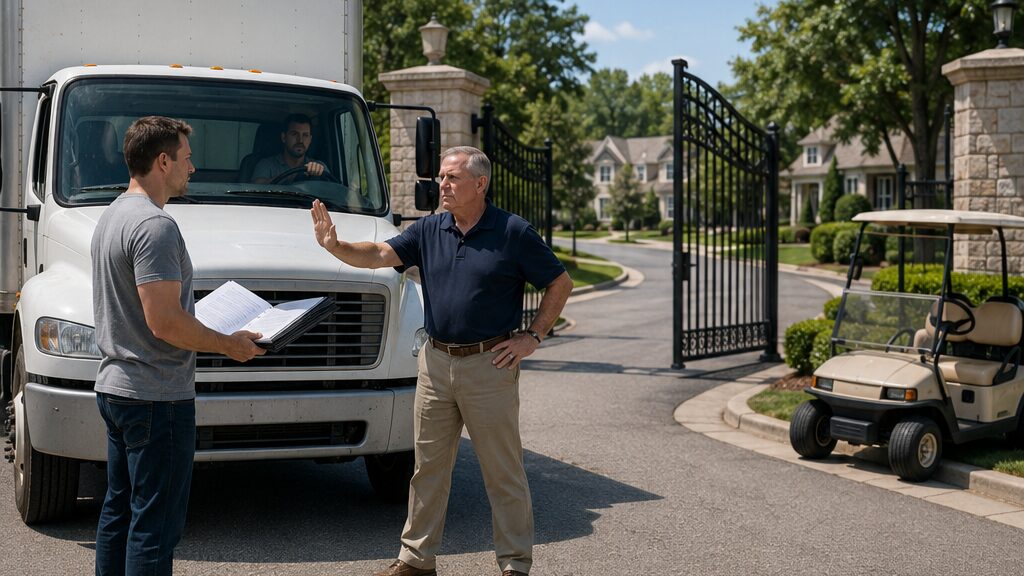
Paul Anderson stepped into the road before the moving truck had fully stopped.
The driver hit the brake hard enough that a stack of flattened boxes slid off the passenger seat. Through the windshield, Paul stood twenty feet ahead of us with one hand raised, his other resting on his hip as if the truck had wandered onto a runway.
Behind him, the black metal entrance gate to Maplewood Ridge was open.
My new house was less than half a mile beyond it.
I lowered the window.
“Is there a problem?”
Paul walked toward the cab. He was in his sixties, wearing khaki pants and a navy polo embroidered with the name of the homeowners association. A golf cart sat angled against the curb behind him.
“You can’t bring that truck in.”
I glanced at the driver.
He glanced back at me.
“It’s a moving truck,” I said.
“I can see that.”
I waited for the rest.
Paul pointed at the twenty-six-foot rental truck as though its size explained everything.
“Large vehicles need architectural committee approval. Ten business days in advance.”
For a moment, I thought he was joking badly.
“I closed on the house yesterday.”
“That doesn’t change the procedure.”
“I couldn’t request permission ten business days before I legally owned the property.”
Paul gave a small shrug.
“You could have coordinated with management.”
I climbed out of the cab with my closing folder tucked under my arm. The morning heat was already pressing against the pavement, though it wasn’t yet nine.
“My realtor sent the HOA my move-in date.”
“That’s not a vehicle permit.”
He spoke evenly, almost pleasantly. That made it worse.
I opened the folder.
“I have the closing documents. I have the address. I have the moving contract. If there was paperwork I was supposed to receive, I never got it.”
Paul barely looked at what I held out.
“That’s not relevant here.”
The sentence landed harder than it should have.
Not because I thought my closing papers gave me the right to ignore every neighborhood rule. I didn’t. I had signed the HOA disclosures. I expected restrictions on exterior paint, fences, maybe parking.
But I had spent years saving for the house.
I had signed the last document less than twenty-four hours earlier.
Everything I owned was behind me in a rented metal box.
And a man I had never met was telling me that proof I owned the place had nothing to do with whether I could enter it.
“Can we do this another way?” I asked. “Escort the truck. Let me unload. I’ll file whatever form you need Monday.”
Paul shook his head.
“If I make an exception for you, I have to make an exception for everybody.”
“I’m moving into my own house.”
“And we have rules for moves.”
The driver leaned out his window.
“Sir, I’m on the clock.”
Paul didn’t look at him.
I felt the argument rising in me, hot and ready. The easy version would have been to shout. Tell Paul to get out of the road. Tell the driver to pull forward and make him choose whether he really intended to stand there.
Instead, I shut the truck door.
Then I pulled out my phone.
Paul’s expression changed.
“What are you doing?”
“Documenting.”
I photographed the open gate.
The truck.
Paul’s golf cart.
Then I held my phone low enough to capture the time.
8:17 a.m.
Paul folded his arms.
“You can take all the pictures you want.”
“I probably will.”
That was the first moment he looked annoyed.
I opened the notes app and typed his name.
“Can you repeat the rule?”
He frowned.
“You heard me.”
“I want to write it down correctly.”
His jaw tightened.
“Large commercial vehicles require advance approval from the architectural committee. Ten business days.”
“Does that include moving trucks?”
“Yes.”
“Where is that written?”
“In the community handbook.”
“Can you show me?”
“I don’t carry a handbook in my golf cart.”
A sedan rolled up behind the moving truck, stopped, then backed away toward the visitor lane. The driver stared at us before making a three-point turn.
I could feel myself becoming a spectacle.
That bothered me more than I wanted to admit.
I had imagined my first morning in Maplewood Ridge differently. Truck in the driveway. Front door propped open. Maybe a neighbor giving an awkward wave while I tried to figure out where the coffee maker had been packed.
Instead, I was standing at the entrance like someone trying to sneak into a place he didn’t belong.
“Paul,” I said, keeping my voice low, “I’m not asking you to ignore the rules. I’m asking you to solve the problem.”
“I am solving it. The truck doesn’t enter until you have approval.”
“And how long does approval take?”
“The committee doesn’t meet on Saturdays.”
Of course it didn’t.
“When do they meet?”
“Tuesday evening.”
The driver made a sound under his breath.
I stared past Paul at the road beyond the gate. Fresh-cut grass. Identical mailboxes. A couple walking a dog. My street somewhere around the curve.
“So I’m supposed to leave everything I own in this truck until Tuesday?”
“That’s between you and the rental company.”
There it was.
Not anger.
Not cruelty.
Something colder.
Distance.
Paul had reduced the whole thing to procedure, which meant none of the consequences belonged to him.
I called the HOA management number printed in my closing packet.
Voicemail.
I called the emergency maintenance number.
A recorded message told me to contact local emergency services for life-threatening situations.
I called the realtor.
No answer.
The moving driver climbed down and stretched his back against the truck.
“I can give you some time,” he said quietly. “But company’s going to start charging if we go over.”
“How much?”
“Depends how long. You booked the morning window.”
I checked the time again.
8:41.
Paul had returned to his golf cart but had not left. He sat sideways in the seat, watching us.
That irritated me enough that I walked over.
“I’m asking one more time. Supervised entry. Straight to the house. We unload and the truck leaves.”
“No.”
“One-time written exception.”
“No.”
“Temporary permit.”
“There is no temporary permit.”
I nodded.
“Okay.”
Paul seemed almost relieved.
Then I took another photograph.
His relief disappeared.
By ten, the sun was reflecting off the truck’s white roof hard enough to hurt my eyes.
By eleven, I had called everyone I could think of.
By noon, I was still outside.
A few residents slowed when they passed. One asked Paul whether the gate was broken.
“No,” Paul said. “We’re dealing with a compliance matter.”
Compliance matter.
That was me now.
I sat on the curb with my closing folder beside me and watched the gate stay open for every ordinary car that came through.
At 12:23, the moving driver handed me his company tablet.
“You should look at this before it kicks in.”
A line near the bottom showed the additional hourly charges.
My rental period ended at two.
After that, the cost started climbing.
I looked at the open gate again.
Then at Paul.
He was still there.
Chapter 2: Six Hours of Heat Turned Procedure Into Harm
At two in the afternoon, I was still outside Maplewood Ridge.
The moving truck had become an oven.
The driver had opened the rear door for ventilation, but the air inside smelled like cardboard, fabric, warm plastic, and the faint chemical sweetness of packing tape. My couch, clothes, electronics, kitchen boxes, and everything else I owned sat stacked in the heat.
The driver showed me the updated rental screen.
The first overage had posted.
I photographed it.
“Sorry,” he said.
“You didn’t block the road.”
Paul had disappeared around lunchtime and returned in his golf cart with a drink cup.
That detail stayed with me.
Not because he wasn’t allowed to get lunch.
Because I had been afraid to leave.
If I drove away and the situation changed, I might lose my chance to get the truck through. So I ate crackers from a convenience-store bag the driver had in the cab and kept watching the gate.
At 2:34, an HOA management representative finally returned my call.
I explained what had happened.
There was a pause.
Then she said, “Mr. Lewis, the community handbook does contain a commercial-vehicle approval requirement.”
My anger lost a little of its certainty.
“You’re saying Paul is right?”
“I’m saying the rule exists.”
“That wasn’t my question.”
Another pause.
“The board president has authority to enforce association rules.”
“Does the rule specifically say the president can physically block a moving truck?”
“I don’t have the document in front of me.”
“Can you send it?”
She promised to email the relevant section.
It arrived ten minutes later.
I opened the attachment on my phone.
There it was.
Large commercial vehicles, including moving and construction vehicles, were supposed to receive advance approval. The language referred to road preservation, resident safety, and scheduling conflicts.
Ten business days.
I read it twice.
For the first time that day, I wondered if I had walked into this completely wrong.
Maybe the rule was ridiculous.
Maybe I had never been properly informed.
But ridiculous rules could still be rules.
I showed the language to the driver.
He read half of it and handed the phone back.
“So what happens?”
“I don’t know.”
That answer embarrassed me.
I had spent the morning feeling certain Paul was abusing authority. Now I had a written document that seemed to support him.
But one thing still bothered me.
The rule explained why approval was expected.
It did not explain why no accommodation was possible after I arrived.
It didn’t explain why my documents were irrelevant.
It didn’t explain why Paul had chosen to stand in front of the truck instead of finding a way to get a new resident into his house.
Around three, a board member I didn’t know arrived and spoke privately with Paul.
I watched them from the shade of the truck.
The board member looked toward me once, then shook his head at something Paul said.
Five minutes later, Paul walked over.
“The truck can enter at four.”
I stood.
“What changed?”
“We can authorize a limited exception.”
I stared at him.
“You told me there was no temporary permit.”
“This isn’t a temporary permit.”
“What is it?”
“A board-approved exception.”
“You could have done that this morning?”
His expression hardened.
“The board was not available this morning.”
I looked past him toward the golf cart.
“You were.”
“That’s not the same thing.”
By the time the truck finally rolled through the gate, I had been there almost six hours.
There was no victory in it.
The driver followed me to the house, backed into the driveway, and we unloaded faster than we should have. Nobody stopped for lunch. Nobody took a real break.
Every time I carried a box inside, I saw the sweat-darkened edge of the invoice on the kitchen counter.
The overage eventually came to just under two hundred dollars.
Monday morning, I printed everything.
The gate photographs.
The timestamps.
The email showing the handbook rule.
The rental invoice.
My closing documents.
I arranged them in order on the dining-room table, although I still didn’t own enough furniture to make the room look lived in.
Then I filed a written complaint with the HOA management company and copied the county office responsible for property and subdivision records.
I kept the complaint narrow.
I did not accuse Paul of corruption.
I did not threaten a lawsuit.
I wrote that I had been prevented from accessing my home for nearly six hours, that a one-time exception eventually proved possible, and that I wanted reimbursement for the unnecessary rental cost plus clarification of the association’s legal authority at the entrance.
The HOA response arrived that afternoon.
Three paragraphs.
The first quoted the large-vehicle rule.
The second said residents were responsible for reviewing community procedures before scheduling commercial access.
The third said the association considered the matter closed.
I read the letter twice.
Then I placed it on top of the invoice.
That should have been the point where I let it go.
Two hundred dollars was aggravating, not devastating.
I had the house.
My belongings were inside.
The move was over.
But the phrase “matter closed” sat badly with me.
Not because I wanted money anymore.
Because the letter treated those six hours as though they had happened by themselves.
My phone rang just before dinner.
Paul.
I almost let it go to voicemail.
Instead, I answered.
“Tyler.”
His tone was measured.
“I wanted to make sure you received the board response.”
“I did.”
“Good.”
Silence.
I waited.
Then he said, “I understand moving is stressful. But Maplewood Ridge has standards for a reason.”
“I’m aware of the rule now.”
“Then this should be simple going forward.”
I leaned against the bare kitchen counter.
“Paul, why wasn’t the exception offered at eight in the morning?”
“That’s already been addressed.”
“No, it hasn’t.”
He exhaled.
“New residents sometimes need time to understand how things work here.”
There was nothing openly insulting in the sentence.
That was what made it so effective.
It put me below him without saying so directly.
A newcomer.
A problem to train.
Someone who would eventually learn.
I looked at the stack of papers on my dining table.
The invoice.
The rule.
The closing documents he had barely glanced at.
“What gives the HOA authority over that entrance road?” I asked.
“The governing documents.”
“Which one?”
Another pause.
“Tyler, I’m not going to debate basic association authority with you on the phone.”
“I’m asking for the document.”
“You have the handbook.”
“That’s a rule. I’m asking what property right lets you enforce it there.”
His voice cooled.
“I think you’re making this more complicated than it needs to be.”
Maybe I was.
But for the first time since Saturday morning, I knew exactly what I wanted to find out.
Not whether the HOA had a rule.
It did.
I wanted to know what gave that rule power at the gate.
Chapter 3: The Old Plat Said Something the Handbook Never Did
The county records clerk slid a yellowed subdivision plat across the counter and said, “This one usually gets missed.”
I looked down at it.
Maplewood Ridge was there, but not the Maplewood Ridge I knew.
No decorative gate.
No stone entrance monuments.
No clubhouse.
Just parcel lines, road alignments, utility corridors, and blocks of small technical notes printed around the edges.
“What year is this?”
“Nineteen eighty-seven.”
I had gone to the county recorder’s office expecting ten minutes with a modern map.
Instead, I had spent nearly an hour moving backward through amendments.
The current subdivision records showed the association’s common areas clearly. The entrance landscaping belonged to the HOA. So did the narrow strips on both sides of the road.
But the clerk had noticed the original dedication reference and gone into the back room.
Now she tapped the old plat with one finger.
“Look here.”
A shaded corridor followed the road through the entrance.
Beside it was a recorded notation for public access.
I read the language once.
Then again.
“This is still active?”
“I can tell you it was recorded,” she said. “I can’t give you legal advice.”
“Has it been vacated?”
She searched the index.
“I don’t see a vacation instrument.”
That was the first moment the entire dispute shifted.
Not because I suddenly knew Paul was wrong.
I didn’t.
But the map raised a question the HOA handbook never mentioned.
The association owned landscaping beside the entrance.
It maintained the gate structure.
It had written rules governing large vehicles.
Yet the road underneath that gate appeared to sit inside a dedicated public-access easement created decades before the HOA developed its current procedures.
I paid for certified copies.
On the drive home, I kept thinking about Paul standing in front of the truck.
His certainty.
His insistence that closing papers were irrelevant.
His refusal to discuss where the authority came from.
At my dining table, I laid the 1987 plat beside a current county parcel map.
The shapes aligned.
The decorative entrance had changed.
The legal corridor had not.
I called Christopher Wright that afternoon.
He had handled a small property issue for someone I worked with, and when I explained the situation, he agreed to look at the documents before saying anything definitive.
The next morning, I sat across from him in a small office with the plat between us.
Christopher traced the easement with a pencil but never touched the paper.
“This matters,” he said.
“That means Paul had no authority.”
“I didn’t say that.”
My excitement cooled.
“What does it mean?”
“It means the HOA’s authority may be narrower than the handbook makes it sound.”
He pulled the modern map closer.
“A private association can adopt rules for property it owns and for members under its governing documents. But if this access corridor carries a valid public easement, they may not be able to use a private rule to block lawful passage the way they would on a purely private road.”
“So the gate shouldn’t even be there?”
“Not necessarily.”
“Then what does public access mean?”
“It means exactly what the recorded documents and applicable law say it means. Which is why we don’t jump from ‘interesting easement’ to ‘I can do anything I want here.’”
I sat back.
Christopher looked at me.
“What are you thinking?”
“Nothing.”
“That answer usually means something.”
I hesitated.
“I’m thinking they held me outside for six hours because of a rule that might not apply where they enforced it.”
“That may be true.”
“And they charged me for it.”
“The rental company charged you.”
“Because the HOA stopped the truck.”
“Also potentially true.”
His calmness irritated me.
I wanted him to say what I had been saying in my head since the county office.
Paul had been wrong.
I had been right.
Case closed.
Christopher wouldn’t give me that.
Instead, he asked for the HOA declaration, bylaws, vehicle rule, management correspondence, and every photograph I had taken Saturday.
I handed him the folder.
He flipped through it.
“You documented this well.”
“I was angry.”
“Those aren’t mutually exclusive.”
He stopped at the timestamped photograph of Paul standing between the truck and the open gate.
“This is useful.”
I felt a small, sharp satisfaction.
It was the first concrete payoff from all those hours of writing things down instead of shouting.
Christopher noticed my expression.
“Useful is not the same as permission to retaliate.”
“I didn’t say anything about retaliation.”
“You don’t have to.”
He turned the photo toward me.
“You found something that may show they overreached. That gives you leverage. It does not give you a blank check to create a new problem.”
I looked back at the image.
The truck.
Paul.
The gate.
At the time, it had looked like proof of my powerlessness.
Now it looked different.
Like evidence.
Maybe even leverage.
“What would you do?” I asked.
“I would ask them to reimburse the documented cost and revise the enforcement position if the easement analysis holds.”
“And if they refuse?”
“Then you decide whether the principle is worth more money and time.”
“That’s not very satisfying.”
Christopher smiled slightly.
“Most property law isn’t.”
I took the certified plat home.
For the next two days, I kept researching.
Old planning documents.
Archived road-maintenance references.
Association meeting summaries.
Nothing gave me the clean sentence I wanted: Paul Anderson had no right to stop your truck.
But the more I read, the stranger the HOA’s confidence seemed.
The recorded road corridor had been dedicated for access before the current association structure existed. The gate had been added years later as a decorative and security feature. The HOA maintained it, but maintenance was not the same thing as ownership of the underlying access right.
On Wednesday afternoon, I stood near the entrance and watched traffic.
A landscaping truck passed through.
No one stopped it.
Twenty minutes later, a pool-supply van entered.
Then a concrete contractor’s truck turned in, drove two streets over, and disappeared behind a row of houses under construction.
I took out my phone.
Not to photograph them.
To write down the company names.
All three already had legitimate business inside or around Maplewood Ridge.
All three used the same entrance corridor Paul had treated as though the HOA could close it whenever one of its private rules was not satisfied.
I stared at the list.
Landscaping.
Pool supply.
Concrete.
Christopher’s warning came back to me.
Leverage was not a blank check.
I understood that.
At least I told myself I did.
Then I opened my calendar.
Chapter 4: The Trucks Made My Point and Hurt People I Never Blamed
The first landscaping truck rolled through the Maplewood Ridge entrance at 8:06 on Monday morning.
Paul Anderson was sitting in his golf cart beside the gate.
I watched from my driveway two streets away through the company’s online arrival tracker, then walked toward the entrance slowly enough to pretend I had no reason to be there.
By the time I reached the corner, the truck was already inside.
Paul had not stopped it.
He had spoken to the driver for less than a minute, stepped aside, and watched the vehicle continue toward a house near the south end of the subdivision.
Nothing dramatic happened.
That was exactly why it felt so satisfying.
Two weeks earlier, my moving truck had been treated like a threat. Now a commercial landscaping vehicle nearly the same size had entered without ten business days of architectural approval.
I stood across the street with my hands in my pockets.
Paul saw me.
Neither of us waved.
The landscaping company had not been difficult to arrange. They already serviced several Maplewood Ridge homes. I had called their dispatcher and moved a consultation for my own backyard to a morning when one of their regular crews was already nearby.
The pool-supply distributor was even easier. I had ordered replacement equipment for a small pump system left by the previous owner and requested a delivery window instead of picking it up.
The concrete company took more effort.
I needed a legitimate reason for them to come.
A cracked strip beside my garage had been on the inspection report from closing. I had planned to repair it sometime in the fall. I moved that plan forward.
None of the businesses was fake.
None of the visits was unnecessary.
That distinction mattered to me.
At least at first.
Wednesday was the first day the schedules overlapped.
The pool-supply van arrived at 9:12.
The landscaping truck entered at 9:18.
At 9:24, a concrete delivery vehicle turned off the main road and approached the gate.
Paul was there before it arrived.
I had begun to recognize the way his golf cart appeared whenever something large entered Maplewood Ridge. He parked at an angle, stepped out, and stood where drivers could not avoid speaking to him.
The concrete truck stopped.
Paul walked to the cab.
They spoke.
Then the driver pointed at paperwork clipped near the dashboard.
Paul looked back toward the gate structure.
I could not hear the conversation, but I could see the moment it changed.
Paul stepped aside.
The truck rolled through.
For the first time since moving day, I smiled.
Not a polite smile.
Not relief.
Something sharper.
Paul looked directly at me as the truck passed.
I lifted one hand.
He did not.
By the end of the first week, the pattern was obvious.
Monday.
Wednesday.
Friday.
Commercial vehicles arriving inside carefully overlapping windows.
Sometimes the gate area stayed clear.
Sometimes two trucks met near the entrance and one had to wait while the other maneuvered through.
The decorative stone columns made the approach narrower than it looked from a car.
Paul started sending neighborhood notices reminding residents to schedule contractors carefully.
I received every one.
The first went into my paper file.
So did the second.
By the fourth, the folder would barely close.
I told myself I was creating a record.
The truth was less flattering.
I liked watching the stack grow.
Each page felt like evidence that Paul had noticed.
That mattered more to me than I wanted to admit.
On the second Wednesday, the landscaping truck was leaving as the concrete vehicle arrived.
A pool-supply van waited behind it.
For nearly four minutes, the entrance was a slow-moving knot of commercial traffic.
Paul stood near the curb speaking into his phone.
I was watching from the sidewalk when Nicole Johnson pulled up behind the pool van.
She lived three houses down from me. We had spoken several times since I moved in. She had brought over a package delivered to her address by mistake and once recommended a plumber.
She lowered her window.
“What is going on?”
“Contractors.”
“I can see that.”
The van ahead of her moved six feet and stopped again.
Nicole looked toward Paul, then back at me.
“Is somebody rebuilding the neighborhood?”
I almost laughed.
Then I saw the empty passenger seat beside her and the clock on her dashboard.
“You in a hurry?”
“My daughter has an appointment.”
The amusement disappeared.
“How late?”
“Already late.”
The concrete truck finally cleared.
Nicole started forward, then stopped beside me.
“Do you know why there are so many trucks lately?”
I could have answered honestly.
Instead, I said, “A lot of work happening, I guess.”
She studied me for a second.
It was not suspicion exactly.
More like disappointment beginning before she had enough information to justify it.
Then she drove away.
I watched her car disappear through the gate.
The next Friday, I moved two delivery windows closer together.
I told myself it was coincidence.
It wasn’t.
Paul had sent another notice the night before, this one warning that excessive commercial traffic could create “significant safety and access concerns.”
The phrase irritated me.
Safety and access.
Those were the same words used to justify keeping me outside my own neighborhood.
So I adjusted the pool delivery by thirty minutes and confirmed the landscaping crew for the same morning.
At 10:03, the gate was congested again.
A resident in an SUV leaned on the horn.
A delivery driver climbed down to guide another truck around the stone pillar.
Paul arrived, visibly angry.
This time he walked straight toward me.
“Are you coordinating this?”
I kept my face neutral.
“Coordinating what?”
“These vehicles.”
“They have legitimate business here.”
“That’s not what I asked.”
“You told me commercial vehicles needed approval.”
“They do.”
“Yet they’re entering.”
Paul lowered his voice.
“You think you’ve found some clever technicality.”
“I think I found a recorded easement.”
His eyes shifted.
Only slightly.
But I saw it.
“You should be very careful about taking legal conclusions from documents you don’t understand.”
“I have an attorney looking at them.”
“That doesn’t give you the right to interfere with residents.”
Behind him, the horn sounded again.
I glanced toward the gate.
“That sounds like an access problem.”
Paul stared at me.
For one satisfying second, I had given his own language back to him.
Then Nicole walked up.
She had parked outside the entrance and come on foot.
“Tyler.”
Her voice was quiet.
That worried me more than if she had shouted.
Paul looked between us.
Nicole ignored him.
“My daughter missed half her appointment Wednesday.”
I said nothing.
“And this morning my husband had to back out onto the main road because he couldn’t get through.”
“They’re legal deliveries.”
“I didn’t ask whether they were legal.”
The sentence hit differently coming from her.
I heard Christopher’s voice in it.
Leverage was not a blank check.
Nicole looked past me toward the trucks.
“I don’t like how Paul handled your move. Everybody heard about it.”
Paul stiffened.
She continued.
“But if you’re doing this on purpose, you’re not only doing it to him.”
“I’m proving a point.”
“To who?”
I had an answer ready.
The board.
Paul.
Anyone who thought the gate belonged to them.
But Nicole was standing there because her family had lost time in a conflict they had never joined.
My answer felt smaller before I said it.
Paul stepped back toward his golf cart without speaking.
That annoyed me too.
Some part of me wanted him to stay and hear Nicole criticize him as well.
Instead, I was the one left facing her.
“I’ll change the schedules,” I said.
Nicole gave a short nod.
“Good.”
She walked back to her car.
I stayed by the entrance until the trucks cleared.
For the first time, watching them roll legally through the gate did not feel like winning.
That afternoon, I canceled the remaining overlaps.
The individual appointments stayed.
The performance ended.
At 4:37, someone knocked on my front door.
A delivery carrier stood outside holding a stiff white envelope.
“Certified mail for Tyler Lewis?”
I signed.
The return address belonged to a law office.
Inside was a letter from the HOA’s attorney demanding that I stop intentionally interfering with community access and warning that the association was considering legal action.
At the bottom, one sentence had been underlined.
The association reserves all available remedies.
I put the letter on top of my paper file.
For the first time since finding the 1987 plat, I wondered whether I had taken a strong position and made it weaker with my own hands.
Chapter 5: The Letter Threatened Me, but the Board Had Its Own Problem
Christopher Wright read the attorney’s letter once and pushed it back across his desk.
Then he looked at me.
“You coordinated the deliveries.”
It was not a question.
“Yes.”
“How deliberately?”
I hesitated.
His eyebrows rose.
“Very.”
Christopher leaned back.
“You told me the businesses had legitimate reasons to enter.”
“They did.”
“That part helps.”
“I didn’t invent the deliveries.”
“That also helps.”
“So what’s the problem?”
“The purpose.”
I knew what he meant.
I still made him say it.
“What about it?”
“If your purpose was to demonstrate lawful access, that’s one thing. If your purpose was to cause congestion, that’s another.”
“They blocked me for six hours.”
“I know.”
“They cost me money.”
“I know.”
“They dismissed the complaint.”
“I know.”
Christopher tapped the certified letter.
“And none of that changes what you did afterward.”
The frustration that had been building since Nicole confronted me came out sharper than I intended.
“So they get to do whatever they want because they have an attorney?”
“No.”
“Then why does every conversation end with what I’m supposed to be careful about?”
“Because you’re the person sitting in my office.”
That shut me up.
Christopher pulled the 1987 plat from my file.
“You may have a legitimate claim that the association overreached at the entrance. You may also have a legitimate reimbursement claim. Those are strong because they’re simple.”
He placed the delivery calendar beside it.
“This is less simple.”
“I stopped the overlaps.”
“Good.”
“Nicole made the point before you did.”
“That was probably cheaper.”
I almost smiled.
Almost.
Christopher drafted a response that afternoon.
It was deliberately boring.
We denied that the HOA had authority to restrict lawful public access under the recorded easement. We stated that all commercial visits had legitimate destinations and purposes. We confirmed that I had discontinued overlapping scheduling. We requested reimbursement of the moving overage and a written explanation of the board’s legal basis for gate enforcement.
Then Christopher added one line I had not asked for.
Please preserve all board, management, and insurance communications concerning traffic-control authority at the Maplewood Ridge entrance.
I read it twice.
“Why insurance?”
“Because associations ask insurers questions when they’re worried about liability.”
“You think Paul knew?”
“I think I don’t know.”
He looked at me.
“That’s different.”
Two days later, Maria Sanchez called.
I had seen her name on HOA emails but never spoken to her directly.
“I’m calling as treasurer,” she said.
Her voice was formal, cautious.
“All right.”
“I’ve reviewed your reimbursement request.”
“And?”
“It’s not much money.”
“Then reimburse it.”
She paused.
“That isn’t the only issue anymore.”
I looked toward the paper file on my dining table.
“What issue is that?”
“The attorney bills.”
I had not expected that.
Maria continued.
“The association is spending more to argue about your two hundred dollars than the amount itself.”
“That wasn’t my choice.”
“No. But the board has to deal with where we are, not where we should have stopped.”
Something in the wording caught me.
“Should have stopped?”
Another pause.
“I’m reviewing records.”
“Which records?”
“I’m not discussing internal board material with you.”
“Then why did you call?”
“Because I need the certified copy of the easement your attorney referenced.”
“Paul has the subdivision documents.”
“I asked for what the board has.”
“And?”
Silence.
That was answer enough.
I sent her the certified plat.
The next morning, three association notices were waiting in my email.
One was a routine landscaping reminder.
One announced that commercial-vehicle enforcement was under review.
The third said the board would temporarily refrain from denying entry solely for lack of architectural approval while counsel evaluated governing documents.
I read that sentence five times.
Paul had not apologized.
The HOA had not admitted wrongdoing.
But the gate rule had stopped.
At least temporarily.
It was the first practical thing I had gained since the dispute began.
I printed the notice and placed it in the file.
The folder was now so thick that the metal fastener no longer reached properly.
That evening, Maria called again.
Her voice sounded different.
Less formal.
“Did Paul ever tell you about an insurance memo?”
“No.”
“What memo?”
She exhaled.
“I’m still working out what I can say.”
“Maria.”
“Last year, the association’s liability carrier reviewed a contractor incident near the entrance.”
I sat down.
“What did they say?”
“They questioned whether we should physically stop vehicles in the access corridor.”
The room went very still.
“Questioned how?”
“They wanted counsel to clarify where association authority ended and public-access rights began.”
I looked toward the front window.
From my house, I could not see the entrance gate.
I could picture it anyway.
Paul standing in the road.
His hand raised.
My closing folder open in front of him.
“Did Paul see the memo?”
“I don’t know yet.”
“You just told me the board had it.”
“I said the association had it.”
“That isn’t the same thing?”
“Not always.”
I pressed my fingers against my forehead.
“When was it sent?”
“Eleven months ago.”
“And nobody followed up?”
“I’m trying to answer that.”
My anger came back clean and immediate.
Not the complicated embarrassment I had felt after Nicole confronted me.
This was different.
“If they knew this was questionable, then Saturday wasn’t a misunderstanding.”
“I didn’t say anyone knew.”
“You said the insurer warned the association.”
“I said the insurer raised a question.”
I could hear the tension in her voice now.
She was trying to be fair to the institution she served while discovering that the institution might have failed to be fair to me.
“I’ll call you when I know more,” she said.
She did not call the next day.
Instead, Christopher forwarded me a document the HOA attorney had produced after his preservation request.
It was a short risk-management memo.
Near the bottom, one paragraph discussed the entrance.
Physical denial of access, it said, should be avoided until recorded easement rights were clarified.
The distribution line included the HOA president.
Paul Anderson.
I read his name once.
Then again.
For almost two weeks, I had been asking whether Paul misunderstood the limits of his authority.
Now the question had changed.
He had been warned there might be limits before I ever arrived.
The next email came from Maria.
The board requests your attendance at a closed session Thursday at 6:30 p.m. Please bring the original moving-company invoice and any supporting documentation.
I printed that too.
This time, I did not put it in the folder.
I left it on top.
Chapter 6: Paul Finally Explained Why He Could Not Admit Doubt
Paul had photographs spread across the clubhouse table before I even sat down.
I recognized the entrance immediately.
But it looked different.
A broken sprinkler head sprayed water over torn grass. A muddy tire track cut across the landscaped median. One young ornamental tree leaned at an angle beside the stone monument.
Paul tapped the first photograph.
“This is why.”
Maria sat at the far end of the table with two other board members. Christopher was beside me. The HOA attorney sat across from us with a yellow legal pad.
I had brought the moving invoice.
Paul had brought damage.
“What am I looking at?” I asked.
“A contractor incident from last year.”
He slid another photograph forward.
A large work truck had climbed the curb near the entrance. Broken branches lay across the grass.
“The driver ignored instructions. Damaged irrigation. Damaged landscaping. Nearly struck a resident who was walking her dog.”
Paul’s voice was controlled, but there was strain underneath it.
“We got complaints for weeks.”
Maria said, “Paul.”
He ignored her.
“Residents wanted to know why the board had no system for controlling large vehicles. They wanted to know why anyone could just come through.”
Christopher glanced at the photographs but said nothing.
Paul pointed toward me.
“So we created a procedure.”
“The ten-business-day rule,” I said.
“Yes.”
“And when your insurer warned you that physically blocking access might be a problem?”
The room tightened.
Paul looked at Maria.
She did not look away.
Finally, he said, “I saw the memo.”
There it was.
No dramatic reveal.
No raised voices.
Four words.
I saw the memo.
I leaned forward.
“Before my move?”
“Yes.”
“How long before?”
“Months.”
My hand closed around the edge of my chair.
“And you stood in front of my truck anyway.”
Paul’s face reddened slightly.
“The memo didn’t say the rule was invalid.”
“It said physical denial of access should be avoided until the easement was clarified.”
“It was a risk recommendation.”
“It was a warning.”
“It was not a legal opinion.”
Christopher finally spoke.
“Then why wasn’t a legal opinion obtained?”
Paul looked toward the HOA attorney.
The attorney did not answer for him.
Maria did.
“Because it was never formally referred to counsel.”
I stared at Paul.
“Why?”
He looked back at the photographs.
For the first time since I had met him, he seemed older.
Not weaker.
Just less certain.
“You weren’t here after that contractor incident,” he said.
“No.”
“I was.”
“That doesn’t answer the question.”
Paul rubbed his thumb along the edge of one photograph.
“Residents accused us of doing nothing. They said the board cared more about avoiding confrontation than protecting the neighborhood.”
One of the other board members shifted in his chair.
Paul continued.
“At the next meeting, people wanted barriers. Security. Fines. They wanted someone at the gate every time a large truck arrived.”
“And you gave them that.”
“I gave them a system.”
“You gave yourself authority you weren’t sure you had.”
His eyes lifted to mine.
“I gave residents what they demanded after we failed them.”
The sentence stopped me.
Not because it excused anything.
It didn’t.
But for weeks I had pictured Paul’s behavior as a simple appetite for control.
The photographs showed something else.
Fear.
Not fear of me.
Fear of being the man who had failed to control the entrance once and was blamed for it.
He had turned that fear into certainty.
Then used certainty as authority.
I looked at the photograph of the damaged landscaping.
“If you had shown me this at the gate, I would have understood why you were cautious.”
“You still would have wanted the truck through.”
“Yes.”
“Exactly.”
“That’s not exactly anything.”
I pushed the invoice toward him.
“I asked for an escort. I asked for a one-time exception. I asked for a temporary solution. You refused every one.”
Paul’s mouth tightened.
“I believed making an exception would destroy the procedure.”
“And then you made one six hours later.”
“That required board approval.”
“Which proves the problem could be solved.”
Paul started to answer.
Maria raised one hand.
“Both things can be true.”
Everyone looked at her.
She nodded toward Paul.
“The board had legitimate safety concerns.”
Then toward me.
“And the board handled Tyler’s move badly.”
Paul looked away.
Maria continued.
“The insurer raised a legal concern. It should have been reviewed. It wasn’t. That was our failure.”
The word our seemed to bother Paul more than if she had said his.
I should have felt satisfied.
Instead, I thought about Nicole.
Her daughter’s missed appointment.
Her question at the gate.
To who?
The HOA attorney turned toward Christopher.
“We are prepared to reimburse the documented rental overage.”
Paul’s head snapped slightly toward him.
Christopher said, “That addresses damages, not policy.”
“We’re reviewing the policy.”
I spoke before Christopher could.
“You should remove gate-level permit enforcement until the easement issue is resolved.”
Paul gave a short, humorless laugh.
“And there it is.”
“What?”
“You don’t want reimbursement.”
“I do.”
“You want to run the gate.”
The accusation landed because part of it was close enough to something ugly in me.
“I want you not to block people where you don’t have authority.”
Paul leaned forward.
“And the trucks? What was that?”
Nobody spoke.
He knew.
Nicole had known.
Christopher knew.
There was no useful lie left.
“I scheduled them.”
Paul nodded slowly.
“To make a point.”
“Yes.”
“You created congestion intentionally.”
“They were legitimate deliveries.”
“That wasn’t my question.”
The exact phrase Christopher had used.
I felt my face warm.
Paul pushed one photograph aside.
“You stood here tonight acting like every bad decision belongs on my side of this table.”
“I stopped the overlaps.”
“After residents complained.”
“Yes.”
“So you knew.”
I looked toward Maria.
She did not rescue me.
Neither did Christopher.
That was when the dispute finally stopped being clean.
Paul had knowingly enforced authority he had reason to question.
I had knowingly used lawful access to create inconvenience because I wanted him to feel powerless.
The scale was not the same.
But the impulse was closer than I liked.
The HOA attorney slid a two-page document across the table.
“We can resolve the reimbursement tonight.”
Christopher read it first.
His expression did not change.
Then he handed it to me.
The association would pay the moving overage.
In exchange, I would release all claims arising from the incident and withdraw my request for any formal policy correction related to the entrance.
I looked at the number.
It was almost exactly what I had demanded at the beginning.
Two hundred dollars.
For six hours.
For the heat.
For the humiliation.
For the whole paper file sitting beside my chair.
Paul said nothing.
Maria watched me carefully.
Christopher leaned close enough that only I could hear him.
“You don’t have to answer tonight.”
I read the release again.
I had wanted reimbursement.
Now it was sitting in front of me.
All I had to do was sign.
And let the gate rule remain somebody else’s problem.
Chapter 7: I Could Take Two Hundred Dollars or Change the Rule
Christopher called me the next morning before I had finished my coffee.
“They’ll pay the two hundred dollars today.”
I stood in the kitchen with the unsigned release still on the counter.
“That fast?”
“If you accept the reimbursement and close the rest.”
I looked at the paper.
The number had become strangely unimpressive overnight.
Two hundred dollars had started the entire fight. It had been the easiest thing to quantify: six hours, an overage, a charge I should not have had to pay.
Now the money felt like the smallest thing on the page.
“What happens to the vehicle rule?”
“Nothing, under the current draft.”
“And the gate?”
“The board keeps reviewing it.”
“That means nothing.”
“It means exactly what it sounds like.”
I carried the phone to the dining table.
My file sat there, thick enough now that the cover bent upward.
“What do you recommend?”
Christopher was quiet for a moment.
“If your only goal is compensation, take it.”
“And if it isn’t?”
“Then decide what you actually want corrected.”
That answer stayed with me.
Not what I wanted Paul to admit.
Not what I wanted the board to suffer.
What I wanted corrected.
By noon, I had written three demands.
Then I deleted two of them.
The first draft asked for reimbursement, attorney costs, a formal admission of improper enforcement, removal of Paul from any gate-related authority, and a written apology.
Reading it back, I heard the same hunger that had made me stack commercial deliveries against one another.
I wanted a document that said I had won.
I wanted Paul’s name attached to the loss.
Nicole’s voice returned to me.
To who?
I opened a fresh page.
This time I wrote only what would have prevented my moving-day problem.
No moving vehicle could be denied entry at the gate solely for lack of architectural approval where the recorded public-access corridor applied.
Residents would provide same-day notice when reasonably possible.
Large vehicles could still be directed, escorted, or scheduled inside association-controlled property for safety and road protection.
Actual obstructions could still be addressed.
The board would reimburse my documented overage.
I sent it to Christopher.
He called ten minutes later.
“You removed the penalty language.”
“Yes.”
“And the apology.”
“Yes.”
“And the demand that Paul lose authority.”
“Yes.”
“Why?”
“Because I don’t need him punished to know what happened.”
Christopher did not respond immediately.
“That’s a stronger position.”
“It feels weaker.”
“Those aren’t the same thing.”
That afternoon, Maria emailed to say the board would consider a revised policy at a final meeting the following evening.
When I arrived, the atmosphere was different from the closed session.
No photographs were spread across the table.
No certified letters.
No thick binders except mine.
Maria had a draft policy in front of her.
Paul had nothing.
The HOA attorney read through the proposed language.
“Association rules concerning scheduling, routing, and road protection remain enforceable on association-controlled property,” he said. “But gate entry itself cannot be denied solely for lack of advance architectural approval where doing so conflicts with recorded access rights.”
Maria looked at me.
“That addresses your main concern.”
“Yes.”
Paul leaned back.
“It creates another one.”
Nobody answered.
He pointed at the draft.
“We’re telling people the old procedure was wrong.”
Maria said, “We’re telling them it was too broad.”
“They’ll hear the same thing.”
One board member asked, “Does that matter if the new one is legally better?”
Paul looked at him.
“It matters if you’re the person who spent a year enforcing the old one.”
The room went quiet.
There it was again.
Not legal authority.
Not road safety.
Pride.
But this time it was spoken plainly.
Paul looked at me.
“You get your money. You get your rule changed. What exactly do you want me to sign?”
“I don’t need you to sign anything personally.”
“You expect me to enforce a policy that says I was wrong.”
“I expect the board to enforce the policy it adopts.”
“That’s easy for you to say.”
“No, it isn’t.”
He gave me a tired look.
I continued.
“I spent three weeks trying to make you uncomfortable because I was angry.”
Paul’s expression shifted.
Maria looked up.
“I scheduled those overlapping deliveries on purpose.”
“I know,” Paul said.
“I know you know.”
I rested both hands on the table.
“And I stopped because somebody who had nothing to do with our fight got hurt by it.”
Paul glanced toward the documents.
“That doesn’t erase it.”
“No.”
“Just like changing this policy doesn’t erase what happened at the gate.”
“No.”
For once, we agreed without either of us gaining anything from it.
Maria turned the draft toward Paul.
“This is not a confession.”
“It will be treated like one.”
“By who?”
“Residents.”
“Some of them already think we mishandled it.”
His jaw tightened.
“Then maybe I should resign.”
Nobody reacted immediately.
Paul looked around the table.
“I mean it. If the board believes the system I put in place was improper, find someone else to enforce the new one.”
The threat should have pleased me.
A month earlier, I might have imagined Paul leaving as the cleanest possible ending.
Instead, I felt tired.
I said, “I don’t want your job.”
He looked at me sharply.
“I don’t want your resignation either.”
“Then what do you want?”
“The next person with a moving truck not to sit outside for six hours.”
Nothing else came to me.
That was the whole answer.
Maria folded her hands.
“We’ll take fifteen minutes.”
Christopher and I stepped into the hallway.
He leaned against the wall.
“You did what you needed to do.”
“It doesn’t feel finished.”
“It isn’t.”
Through the clubhouse door, I could hear chairs shifting.
Low voices.
Then silence.
Fifteen minutes became twenty-five.
When the door finally opened, Maria motioned us back inside.
Paul’s chair was empty.
I looked toward the hallway.
“He left?” I asked.
Maria nodded.
“For a few minutes.”
The HOA attorney placed the revised policy back on the table.
One paragraph had been crossed out.
A new sentence had been written in the margin in blue ink.
Before I could read it, the door opened again.
Paul came back in.
He sat down without looking at me.
Then he pushed the paper across the table.
“One revision,” he said.
Chapter 8: The Gate Stayed Standing, but What It Meant Had Changed
Three weeks later, another moving truck appeared at the Maplewood Ridge entrance.
I was driving home when I saw it.
Same size as mine, maybe a little newer.
White box body.
Rental logo on the side.
A small car followed behind it with a mattress strapped badly to the roof.
My hands tightened on the steering wheel before I could stop them.
Paul’s golf cart was parked near the entrance.
He was standing beside the truck.
For a second, the whole first Saturday came back with embarrassing clarity.
The heat.
The closing folder under my arm.
The driver watching the clock.
Paul’s hand raised in the road.
I slowed.
The new policy had passed with his handwritten revision.
The association would not deny gate entry solely because a resident lacked advance architectural approval. Residents were expected to provide same-day notice whenever practical. The HOA could still manage routing, escort large vehicles through narrow interior areas, and intervene if a vehicle actually blocked access or created a safety hazard.
Paul’s addition had been one sentence:
Nothing in this policy limits the association’s responsibility to address immediate and documented safety risks.
It was reasonable.
That had surprised me more than if he had crossed out the entire page.
The board approved the policy unanimously.
Including Paul.
My overage reimbursement arrived five days later.
No apology came with it.
No admission.
Just a check and a short letter confirming that the vehicle policy had been revised.
At the entrance now, Paul stood beside the new moving truck with a clipboard.
I pulled into the visitor lane and watched.
The driver handed him something through the window.
Paul checked it.
Then he pointed down the road.
The truck moved.
That was all.
No six-hour delay.
No argument.
No president standing in front of the bumper.
The truck passed through the gate.
I sat in my car for another few seconds.
Paul noticed me.
We looked at each other across the entrance.
He gave one small nod.
I returned it.
That was the closest thing to reconciliation either of us seemed capable of.
Later that afternoon, I saw Nicole carrying groceries from her car.
I crossed the street.
“Need a hand?”
She looked at the bags, then at me.
“If you take the heavy one.”
I did.
We walked toward her house.
For the first half of the driveway, neither of us mentioned the gate.
Then she said, “I saw the moving truck.”
“So did I.”
“Went through pretty fast.”
“Yeah.”
She unlocked her front door.
“You got the policy changed.”
“The board changed it.”
“That sounds like attorney language.”
“Christopher may be rubbing off on me.”
She almost smiled.
I set the groceries on her kitchen counter.
Nicole folded the empty reusable bags and placed them beside the door.
“I’m glad they changed it.”
“Me too.”
She looked at me for a moment.
“But people still talk about the truck thing.”
I knew exactly which truck thing she meant.
Not mine.
The others.
“I figured.”
“Some people think it was funny.”
“That’s probably not the worst thing.”
“Some people think it was childish.”
“That’s probably not wrong.”
She seemed surprised by the answer.
I leaned against the counter.
“I was angry.”
“You had a reason.”
“I did.”
“That doesn’t make everything after it reasonable.”
“No.”
She nodded once.
It was not forgiveness because I had never asked her for any.
It was something better.
Accurate.
Before I left, she said, “For what it’s worth, Paul’s been less intense at the gate.”
I laughed once.
“That might be the nicest thing either of us gets out of this.”
“I wouldn’t go that far.”
When I got home, the paper file was still on my dining table.
It had stayed there through the entire dispute.
At some point I had stopped filing things neatly.
The early documents were organized by date.
Closing papers.
Photographs.
Rental invoice.
The HOA rule.
The complaint.
Then the folder thickened and the order deteriorated.
Newsletters.
Certified letters.
The 1987 plat.
Christopher’s correspondence.
The insurance memo.
The delivery schedule I regretted.
The settlement drafts.
The final policy.
I opened it from the beginning.
The first photograph showed Paul standing in front of my moving truck.
I remembered taking it because I wanted proof that somebody else was doing something wrong.
At the time, I had thought documentation would keep me calm.
It did.
Mostly.
But it had also given me something dangerous.
A way to turn anger into strategy without ever admitting I was angry.
I could schedule trucks politely.
Write measured emails.
Quote easement language.
Keep my voice low.
And still be trying to hurt somebody.
That was harder to accept than Paul’s rule had been.
I turned to the old subdivision plat.
The faded lines looked less dramatic now.
It had once felt like a weapon.
Now it looked like what it really was.
A boundary.
A description of where one kind of authority ended and another began.
The entrance gate had never disappeared.
The stone pillars were still there.
The black metal arms still opened and closed.
Paul still served as HOA president.
I still lived under association rules.
None of those things had been destroyed.
They had simply been narrowed into something closer to what they were supposed to be.
A few days later, I walked to the mailbox near sunset.
Paul was coming back from the clubhouse in his golf cart.
He slowed beside me.
“New homeowner got in all right?”
“I saw.”
“They gave notice this morning.”
“Seems to work.”
He nodded.
Then he looked toward the gate in the distance.
“Still think the ten-day rule was ridiculous?”
“Yes.”
That earned a faint smile.
“I figured.”
I waited.
He seemed about to drive away, then stopped.
“The contractor incident really was bad.”
“I believe you.”
“We needed something.”
“I believe that too.”
He looked at me.
“But not what you did,” I said.
“No.”
“And not what I did afterward.”
Paul rested one hand on the steering wheel.
“No.”
Neither of us apologized.
Maybe we should have.
But forced apologies would have turned into another contest over who had caused more damage.
Paul glanced toward my house.
“You settling in?”
“Finally.”
He nodded and drove on.
I watched the golf cart disappear around the curve.
The conversation was unsatisfying in exactly the right way.
Nobody had been transformed into a friend.
Nobody had been publicly disgraced.
The board had not collapsed.
I had not become the neighborhood hero.
The only thing that had really changed was the rule.
And me, a little.
Back inside, I found one last envelope on the counter.
The reimbursement check had already cleared, but I had kept the stub.
Two hundred dollars.
The amount that had once seemed large enough to justify every hour I spent fighting.
I put it in the folder.
Then I added the final policy behind it.
For a moment, I considered labeling everything properly and storing the file somewhere easy to reach.
Just in case.
That instinct made me smile.
I closed the cover instead.
The fastener still would not reach around all the paper, so I pressed the folder flat with both hands and tied it with a piece of string from one of my moving boxes.
Then I carried it to the spare room.
The room still held things I had not fully unpacked: a lamp without a shade, two unopened kitchen cartons, a stack of framed photographs leaning against the wall.
I opened the bottom drawer of a filing cabinet.
Put the folder inside.
Closed it.
Through the window, I could see part of the road leading toward the entrance.
A delivery van passed without stopping.
A few seconds later, the gate opened and closed again.
Ordinary traffic.
That was what I had wanted from the beginning.
Not a gate that belonged to me.
Not a gate that belonged to Paul.
Just a gate that let people through when it was supposed to.
The story has ended.