The Neighbor Who Called the HOA Over a Rotten Smell Never Asked What Was Growing Behind the Gate
Chapter 1: For Three Mornings, the Street Smelled Like Someone Was Hiding Something
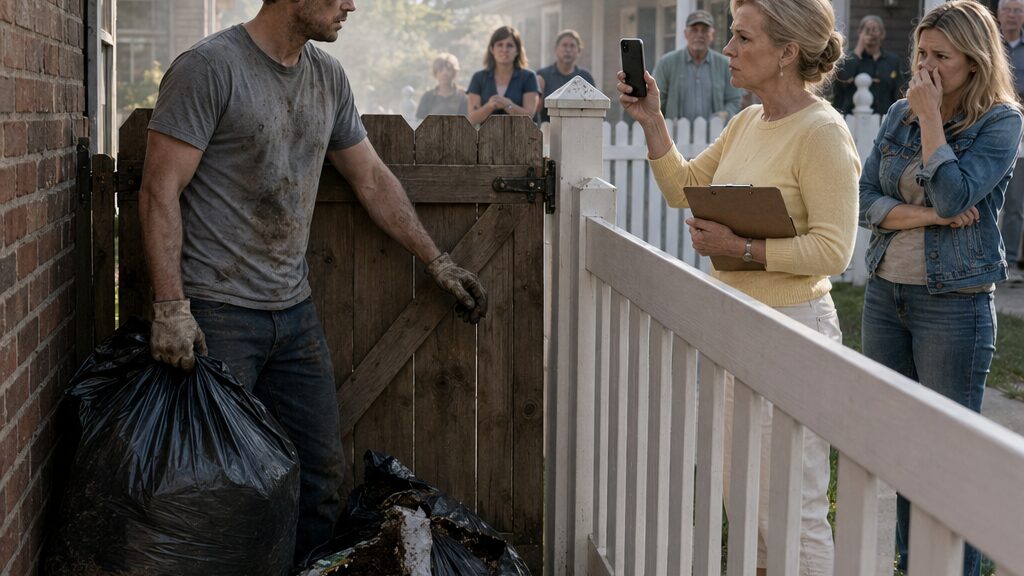
Ruth Moore pointed at Benjamin Wright before he had even set the black trash bags down.
“There,” she said from the other side of the white fence, her finger steady as a surveyor’s stake. “That’s where it’s coming from.”
Benjamin stood in the narrow strip between his garage and backyard gate with one bag in each hand, dirt on his jeans, and sweat already drying at the collar of his gray T-shirt. It was barely seven in the morning. Half the porch lights on Briar Glen Lane were still on, soft yellow squares against clean brick houses and trimmed lawns.
The smell hung low in the air.
It was sour, heavy, and earthy, the kind of smell that made people pause before breathing in too deeply. It drifted under the fence, over the sidewalk, and around Ruth’s flower beds, where every petunia stood in a row as if it had been warned.
Benjamin lowered one bag onto the concrete. “Morning, Ruth.”
“Don’t ‘morning’ me, Benjamin. This is the third day.”
“I know what day it is.”
“That smell has been through this whole corner since Monday.” She leaned closer to the fence, pale yellow sweater bright against the white boards. “And every time it’s strongest, you’re back there with those bags.”
Benjamin looked at the black plastic in his hand. They were not garbage bags, not really. Just contractor bags he had used because the brown paper sacks had split in the truck. He had learned that lesson on the first morning, when one tore open near the driveway and left a wet, dark streak that Ruth had stared at through her blinds.
He could have said all that.
Instead, he moved the second bag beside the first and wiped his palm against his jeans.
“It’ll pass,” he said.
Ruth’s mouth tightened. “That is not an answer.”
“It’s the one I have right now.”
Behind him, the wooden backyard gate stood closed. Benjamin had replaced two slats on it the week before, but the old latch was still his mother’s, dark metal worn smooth where her thumb used to press. He felt Ruth’s eyes move past his shoulder toward it.
“What exactly are you keeping back there?” she asked.
Benjamin bent to pick up both bags again. “I’m working on the yard.”
“Working on it how?”
He did not answer fast enough.
A delivery truck rolled slowly down the street, tires whispering on clean pavement. The driver glanced toward them, then away. Across the lane, a garage door opened halfway, stopped, then opened the rest of the way. Someone inside was watching.
Ruth lowered her voice, though not enough. “You know we have rules about sanitation.”
Benjamin laughed once under his breath, not because anything was funny, but because the word landed so far from what he was doing that he almost could not connect it to himself.
“Sanitation,” he repeated.
“Yes. Sanitation.” Ruth’s face flushed. “And odor. And exterior maintenance. This is not the county dump.”
The smell shifted as a breeze slipped between the houses. Benjamin saw Ruth draw back. She pressed two fingers under her nose.
He hated that it reached her. He hated that it reached anyone. He had worked late the night before turning soil under a work light, thinking he could get most of it covered before morning. The weather had not helped. Damp air held everything close.
“I’ll handle it,” he said.
“That’s what you said yesterday.”
“I said it would pass.”
“And it hasn’t.”
A woman in a denim jacket appeared at the corner, walking a small dog that pulled ahead with quick, nervous steps. Emily Jackson had moved in two streets over the previous fall, young enough to still wave at everyone, careful enough to notice who waved back. She slowed when she saw Ruth at the fence.
Then the smell reached her.
Emily’s expression changed before she could hide it. Her nose wrinkled, and she tugged the leash closer. “Oh.”
Ruth turned toward her instantly. “You smell it too, don’t you?”
Emily looked from Ruth to Benjamin, then to the closed gate behind him. “It’s pretty strong this morning.”
Benjamin felt the sentence settle into the space between them like another piece of evidence.
“It’s not trash,” he said.
Ruth lifted her eyebrows. “Then why are you carrying trash bags?”
“They’re not—” He stopped, because the correction sounded weak even to him.
Emily’s dog sniffed near the curb and sneezed. Ruth watched it as if the animal had testified.
Benjamin gripped the tops of the bags. The plastic stretched under his fingers. Inside one was a torn sack of organic fertilizer, dark and damp, bought from a farm supply store forty minutes away because the garden center nearby had been out of the gentler blend. Inside the other were broken weeds, old roots, and clumps of last year’s dead mulch. None of it was pretty. None of it was easy to explain from the wrong side of a fence.
“You could just say what it is,” Emily said, softer than Ruth.
Benjamin looked at her. There was no accusation in her face yet, only discomfort and curiosity, which somehow made it worse. Curiosity invited a story. A story invited questions. Questions would lead back to why the beds mattered, why he was in such a hurry, why the whole yard had sat untouched for nearly a year after his mother died.
He adjusted his grip. “I’m taking care of it.”
Ruth gave a clipped little nod, the kind she used at HOA meetings when someone had just confirmed her worst assumption. “Then you won’t mind if I document it.”
Benjamin’s head came up. “Document what?”
“The condition.” Ruth reached into the pocket of her white capri pants and pulled out her phone. “The board needs to know when something affects multiple homes.”
“Ruth.”
She raised the phone.
Benjamin took one step toward the fence. Not fast. Not threatening. Just enough that Emily’s dog backed up against her ankle.
“I’m asking you not to do that,” he said.
Ruth held the phone higher. “And I’m asking you to respect the neighborhood.”
The word respect hit him harder than it should have. He thought of the nights he had spent pulling bindweed out of the back beds by hand because his mother had hated chemical sprays. He thought of the receipts folded inside the kitchen drawer, the old notebook with Mary Wright’s neat handwriting, the tomato cages stacked against the shed because he had not yet found the strength to set them upright.
Respect.
He looked at the gate again.
The latch seemed smaller than he remembered.
Emily shifted on the sidewalk. “Maybe he really is handling it.”
Ruth did not look away from Benjamin. “Then he can handle the board asking questions.”
Benjamin swallowed. He wanted to open the gate. Part of him wanted to let them both look, let them see the straight rows he had marked with string, the compost turned under, the seedlings waiting by the back steps. He wanted the smell to become what it was: temporary, ugly, necessary.
But if he opened the gate now, he would also open the part of himself he had kept shut since the funeral. He could already hear Ruth asking why it had to be this week, why so many tomatoes, why the beds matched the old ones exactly.
He bent, hauled both bags against his legs, and turned away.
Ruth’s phone made a soft camera sound.
Benjamin stopped.
The sound was small, almost polite, but it changed the morning. It took his silence and pinned it to a record. It turned his closed gate, his dirty shirt, his black bags, and the sour air into something that could be shown in a meeting room without the hours of labor around it.
He looked back.
Ruth lowered the phone just enough for him to see his own gate framed on the screen.
“I’ll be bringing this to the board,” she said.
Benjamin stood there until Emily led her dog away and the delivery truck disappeared around the corner. Ruth stayed at the fence a moment longer, satisfied but tense, as if she had found proof of a problem and did not yet know whether she was relieved.
When she finally went inside, Benjamin carried the bags through the gate without opening it wide enough for anyone to see past him.
The latch clicked shut behind his back.
Chapter 2: The First Notice Arrived Before Anyone Knocked on the Door
The white envelope was taped to Benjamin’s front door before lunch.
He saw it through the glass panel from inside the house, a flat, official rectangle pressed just below the wreath his mother had hung there two Christmases ago and he had never taken down. The tape crossed the envelope at both ends. Whoever placed it there had made sure the wind would not carry it away.
Benjamin stood in the hallway for a few seconds without touching the knob.
Outside, the street was quiet. Too quiet. A lawn crew worked three houses down, but the mower had stopped. Somewhere beyond the fence line, a dog barked once and went silent.
He opened the door.
The envelope bore the Briar Glen Homeowners Association seal in navy ink. Under it, in a smaller line, was his address. No knock. No conversation. Just paper.
He pulled it free, and one corner tore.
Inside was a single-page notice with boxed paragraphs and the careful language of people who wanted a warning to sound like courtesy.
Reported nuisance odor affecting neighboring properties.
Possible violation: Article VII, Section 4: Offensive Odors, Sanitation, and Unapproved Composting or Organic Material Storage.
Response requested within forty-eight hours.
Benjamin read it twice. The first time, his jaw tightened. The second time, his eyes stopped on the word reported.
Not inspected. Not confirmed. Reported.
He carried the paper to the kitchen and laid it on the table beside a mug he had forgotten to drink from. Through the window over the sink, he could see the top of the backyard gate. Closed. Sunlit. Accused.
He took out his phone and opened the HOA portal. The form blinked at him with empty boxes.
Describe corrective action taken.
Attach supporting documentation.
Request hearing, if applicable.
His thumb hovered over the first field.
He typed: It is fertilizer for a garden.
Then he deleted it.
He typed: There is no garbage or sanitation issue.
He deleted that too.
The trouble with telling the truth was that it always asked for more truth behind it. Garden. What kind of garden? Why the rush? Why this smell? Why now, after months of letting the yard go brown at the edges while unopened mail stacked by the microwave and neighbors stopped asking how he was?
He locked the phone and pushed it away.
The kitchen still carried traces of his mother in ways that annoyed him because they were not dramatic enough to justify grief. A chipped blue bowl on the top shelf. A grocery list magnet shaped like a tomato. The folded dish towel she used to keep over rising bread, though neither of them had baked in years. Ordinary things, all of them, staying exactly where she had left them while he kept moving around them like furniture in a dark room.
He opened the junk drawer for a pen and found the seed packet instead.
It had slipped under a stack of appliance manuals and old takeout menus. The packet was faded at the edges, its paper soft from years of being handled. On the front, a bright red tomato split the frame with impossible gloss.
Brandywine. Saved best for last row.
His mother’s handwriting crossed the top in blue ink.
Benjamin sat down before he meant to.
For a moment the notice, the smell, Ruth’s phone, and the HOA portal all receded. He saw Mary Wright in the backyard with her sun hat low over her forehead, planting stakes by eye because she never trusted measuring tape for things that grew. He heard her telling him tomatoes punished impatience and rewarded stubbornness. He saw her at the sink washing dirt from her hands before loading paper bags with whatever the garden had given that week.
“Pantry day,” she would say, like it was an appointment with someone important.
When she got sick, the garden went wild. When she died, it went quiet.
Benjamin had told himself he would clear it when he could. Then spring had arrived without asking permission. One warm week, then two. The old beds had filled with weeds, and the tomato cages leaned in the shed like abandoned chairs. He had stood at the back window one evening and realized that if he missed this season, the garden would not merely be delayed. It would become something he had let end.
So he bought soil amendments, seed trays, stakes, gloves, and the fertilizer the farm clerk said would work fast.
“It’ll smell a couple days,” the clerk had warned.
Benjamin had nodded as if a couple days was nothing.
Now a couple days had become an HOA notice on his table.
The phone buzzed.
A message appeared from the HOA portal.
Informal fence-line review scheduled tomorrow at 4:30 p.m. Compliance chair will document exterior condition from accessible common and neighboring views.
Benjamin stared at the screen.
From accessible common and neighboring views. It meant Ruth did not need to come in. It meant the fence, the smell, and whatever she could photograph over or around the property line would stand in for the whole truth.
He opened the response form again.
For a long time he listened to the hum of the refrigerator and the distant return of the lawn mower. Then he typed one sentence.
I am addressing the odor and there is no sanitation hazard.
He read it, hated the weakness of it, and hated the thought of adding more.
He submitted it.
The portal confirmed receipt with a green check mark.
Benjamin stood, took the seed packet, and carried it outside.
In the backyard, the smell was stronger but less offensive to him now that he was inside its source. It belonged to the damp soil, the newly turned beds, the dark fertilizer already worked under the top layer. It was ugly, yes, but it was not rot. It was not neglect. It was the beginning of something doing the unpleasant work of becoming useful.
He crossed to the gate and touched the latch.
For one second, he imagined opening it before tomorrow’s review. He imagined knocking on Ruth’s door with the seed packet in his hand, inviting her to see the beds, saying his mother’s name in a voice that did not crack. He imagined the relief of ending the misunderstanding while it was still small.
Then he saw Ruth’s phone again. The way she had lifted it before asking. The way his gate had looked on her screen, reduced to evidence.
His fingers left the latch.
“No,” he said quietly, though no one was there.
He went back to the beds and knelt at the first row. The tomato seedlings waited in their trays, leaves trembling in the afternoon breeze. He pressed the seed packet into the pocket of his shirt like a note meant for later.
By four o’clock, he had planted eight seedlings and covered the strongest-smelling patch with straw. By five, a message appeared in the neighborhood group chat from the HOA board account.
Tomorrow’s informal review will include nuisance odor concerns reported near Lot 42.
No name. No address in the text.
But everybody on Briar Glen Lane knew Lot 42 was Benjamin’s house.
Across the fence, Ruth’s patio door slid open.
Benjamin stayed on his knees in the dirt.
“Benjamin,” she called, voice controlled and carrying. “We’ll be by tomorrow at four-thirty. Please make sure the side gate area is accessible.”
His hand closed around the small metal trowel.
The side gate area.
Not the garden. Not the truth. Just the area where suspicion could stand outside and look in.
He did not turn around.
“I heard you,” he said.
Ruth paused. “Good.”
The patio door shut.
Benjamin looked down at the row he had just planted, and for the first time that week, the little green leaves did not feel like proof that he was doing the right thing. They felt like hostages to his pride.
Chapter 3: Come Around Back Before You Decide What You Smell
Emily Jackson covered her mouth before she reached Benjamin’s side yard.
She had meant to walk past quickly, keep her eyes on the sidewalk, and avoid becoming one of those neighbors who slowed down near other people’s trouble. But the smell caught her halfway between Ruth Moore’s fence and Benjamin Wright’s garage, thick enough that she stopped without meaning to.
“Oh, come on,” she whispered.
At the end of the narrow alley, Benjamin stood with another dark bag braced against his hip. His shirt was stained at the shoulder. His hair was damp. He looked like he had slept badly and then punished himself with labor.
He saw her at the same moment she saw him.
Emily lowered her hand from her mouth, embarrassed by the gesture but not enough to pretend she had not made it. “Sorry.”
Benjamin gave a short nod. “It’s fine.”
“It’s just…” She glanced toward Ruth’s house. The blinds in the back window shifted. “It is stronger today.”
His face closed.
Emily regretted the sentence as soon as it left her mouth. She was not Ruth. She did not want to sound like Ruth. But she had seen the HOA message in the group chat. She had watched three neighbors react with the little shocked emojis people used when they wanted to gossip without typing words. She had told herself she only wanted to know the truth.
Now, standing close enough to smell it, she felt the pull of the simpler story.
Dark bags. Closed gate. Defensive man. Bad smell.
“Ruth said the board’s coming later,” Emily said.
“I know.”
“She’s making it sound like…” Emily stopped.
“Like I’ve got a pile of garbage back here?”
Emily looked at the bag.
Benjamin’s mouth tightened. “That’s what everybody thinks, right?”
“I didn’t say everybody.”
“You didn’t have to.”
From behind Ruth’s fence came the soft scrape of a patio chair. Emily turned. Ruth stood near her flower bed with a coffee cup in one hand, watching as if she had stepped outside by coincidence.
The side-yard alley suddenly felt narrow, the brick wall on one side and the fence on the other pressing Emily into the middle of someone else’s argument.
“Benjamin,” Ruth called. “If that bag is part of the odor source, you should leave it visible for the review.”
Benjamin stared at the closed gate. The latch sat just above his hand.
For a long second, Emily expected him to turn away like he had that morning. Instead, he dropped the bag gently onto the concrete and looked at her.
“Come around back,” he said.
Emily blinked. “What?”
“Come look before anyone files another notice.”
Ruth straightened. “That isn’t necessary.”
Benjamin kept his eyes on Emily. “You said it was stronger. You wanted to know why.”
“I didn’t say—”
“You came this far.”
That was true, and it stung because she had not admitted it to herself.
Emily looked toward Ruth. The older woman’s expression warned her without words: don’t be drawn in, don’t be fooled, don’t break the line. But curiosity had already opened something in Emily’s chest. Not nosiness exactly. Unease.
“Fine,” she said, softer than she intended. “I’ll look.”
Benjamin pressed the latch.
The old gate gave a brief metal click, then swung inward.
Emily expected clutter. At least disorder. Maybe a heap under a tarp, or bins gone sour in the sun.
Instead she saw rows.
Not perfect rows, but careful ones. Freshly turned earth divided into long dark beds. Straw tucked around small tomato plants. Wooden stakes set at intervals. Seed trays lined beside the back steps. A hose coiled near a bucket. Two ripped fertilizer sacks folded flat under a brick to keep them from blowing away. The smell was stronger inside the yard, yes, but it belonged to the beds like paint smell belonged to a newly painted room.
Emily stepped through the gate and stopped.
“Oh,” she said.
Benjamin picked up the dark bag and carried it to a wheelbarrow. “It’s fertilizer.”
Behind them, Ruth’s voice sharpened. “What kind of fertilizer?”
Benjamin did not answer her immediately. He tore the bag open farther and showed Emily the clumped dark material inside. “Organic blend. Stronger than I wanted. The garden center was out, and I’m late getting these in.”
Emily looked at the seedlings. Their leaves were small but bright, each one held upright by a thin stake. Near the shed, a stack of tomato cages leaned against the wall. The place did not feel hidden because it was shameful. It felt hidden because it was unfinished.
“You’re planting a vegetable garden?” Emily asked.
Benjamin gave a humorless half-smile. “Trying to.”
Ruth appeared at the fence line, rising slightly on the brick edging around her flower bed to see over. Her coffee cup was gone. Her phone was in her hand again.
“It’s still an odor affecting neighboring lots,” she said.
Emily turned. “Ruth, it’s not trash.”
“I didn’t say trash. I said nuisance.” Ruth’s gaze moved over the yard, slower now, searching for the part of the truth that still supported her. “And unapproved organic material storage is covered in the guidelines.”
Benjamin took off one glove and rubbed his forehead with the back of his wrist. “There’s nothing being stored. It’s worked into the beds.”
“That may not matter.”
Emily heard herself say, “Maybe it should.”
Ruth looked at her as though Emily had stepped out of place.
Benjamin bent to lift one of the folded sacks, and something slipped from his shirt pocket. A seed packet fell faceup onto the soil near Emily’s shoe. She picked it up before he could.
The front showed a red tomato. The paper was worn, softened at the corners. Across the top, in blue handwriting, someone had written: Saved best for last row.
Benjamin reached for it. “I’ve got it.”
Emily handed it back. “Is that old?”
“Yes.”
The word was too final for a simple seed packet.
Emily looked again at the yard and noticed what she had missed first: the beds were not newly invented. Their wooden borders were weathered. The path stones were sunk deep into the ground. Someone had gardened here for years before the weeds took over. Benjamin was not creating a project from nothing. He was bringing one back.
Ruth’s phone made a faint sound as she took another picture.
Benjamin’s shoulders stiffened.
“Ruth,” Emily said.
“What? I am documenting the actual condition now.”
“The actual condition is a garden.”
“The actual condition includes a smell strong enough to keep people from opening windows.” Ruth lowered the phone and looked at Benjamin. “You could have avoided all of this by telling us.”
Benjamin’s face changed then. Not anger exactly. Something colder, older, and more tired.
“I don’t owe the neighborhood a story every time I use my own backyard.”
“No,” Ruth said. “But you do owe the neighborhood compliance.”
The word seemed to land between the rows.
Emily waited for Benjamin to explain. To say whose handwriting was on the packet. To say why the beds looked familiar and why he was planting with the desperate pace of someone trying to beat more than weather.
He only put the seed packet back into his pocket.
“The smell will pass,” he said. “Give it a couple days.”
Ruth stepped down from the brick edging. “The board will decide what a couple days costs.”
Emily remained inside the gate, unsure whether she had been invited into truth or only the first room of it. The garden had answered the easiest question. It had not answered why Benjamin looked more cornered after being proven innocent.
Ruth’s voice came over the fence one last time, clipped and certain.
“Truth or not, Benjamin, the smell is still a violation.”
Chapter 4: The Rulebook Had No Line for a Promise
Ruth Moore placed Benjamin Wright’s photo packet under the clubhouse lights as if the table itself were a witness.
The pictures looked worse printed.
On her phone, the images had felt immediate and useful: a closed wooden gate, black bags on concrete, a patch of damp staining near the driveway, Benjamin’s shoulder half turned away. On paper, they looked harsher. The shadows collected around the gate. The bags seemed larger. The fence looked less like a boundary between homes and more like something built to conceal.
Ruth smoothed the corners of the packet with both hands.
Around the long folding table, the HOA board settled into the familiar sounds of small authority: paper cups set down, binders opened, pens clicked, chairs dragged an inch closer. The clubhouse smelled faintly of floor cleaner and old coffee. Outside the windows, the neighborhood pool sat covered and still.
A board member near the end of the table glanced at the first photo. “This is the odor complaint?”
“One of them,” Ruth said.
“One of them?”
“We have verbal complaints from three adjacent households and written concern from my property.” Ruth kept her voice measured. “The issue has persisted across multiple mornings and, according to yesterday’s review, intensified in the afternoon.”
Emily Jackson sat in the second row of folding chairs with her phone in her lap. She was not on the board, but residents were allowed to attend the first half of compliance meetings if the matter affected common interest. Ruth had noticed her slip in late, denim jacket buttoned, hair tucked behind one ear, looking like someone who had arrived with a reason and was trying to decide whether to use it.
Ruth looked away.
A board member flipped through the packet. “This says Lot 42 responded that there is no sanitation hazard.”
“He submitted that after the notice.”
“Did anyone knock before the notice?”
The question landed softly, but Ruth heard the shift it made. Two heads turned toward her.
She straightened in her chair. “The odor had already affected neighboring properties for three days. The rules allow immediate written notice in cases involving nuisance conditions.”
“Allow, yes,” the board member said. “Require, no.”
Ruth slid a printed section from the governing documents across the table. “Article VII, Section 4. Offensive odors. Sanitation. Unapproved composting or organic material storage. The language is clear.”
Another member adjusted his glasses. “What exactly is in the backyard?”
“A vegetable garden, apparently.”
“Apparently?”
“I was not invited onto the property.”
Emily looked up.
Ruth felt the small movement from the second row more than she saw it. She kept her eyes on the board.
“The resident opened the side gate for another neighbor,” Ruth continued. “There were planted rows, fertilizer sacks, and a strong odor consistent with organic material. He described it as fertilizer.”
“That sounds different from garbage.”
“It is still a nuisance if it affects surrounding homes.”
One of the older board members tapped the page. “Do our guidelines ban vegetable gardens?”
“No.”
“Do they ban fertilizer?”
“They limit composting and organic material storage and require approved landscape amendments when they create odor issues.”
“Approved by who?”
“The architectural and landscaping committee.”
The member glanced around the table. “Did we ever publish a list?”
Ruth had expected the question. She opened her binder to the tab she had prepared and removed a one-page landscaping addendum. “Approved amendments are generally standard retail lawn and garden products designed for residential use. The blend used at Lot 42 appears to be an agricultural organic fertilizer. Stronger concentration. Not typical for suburban beds.”
“Appears?”
Ruth paused.
In the photo, one sack label was partly visible but folded under itself. She had zoomed the image as far as she could. The brand did not appear on the approved examples. That should have been enough to proceed with caution.
“It is not on any prior approved submission,” she said.
“Did he submit a garden plan?”
“No.”
“Does he have to?”
Ruth’s fingers tightened on the binder spine. “Not for ordinary planting. But odor changes the matter.”
The room went quiet in that way board rooms did when people were not disagreeing loudly but were beginning to divide. Ruth hated that kind of quiet. It made every pause feel like a vote against competence.
For the last two months, complaints had come in about weeds near mailboxes, a basketball hoop left too close to the curb, holiday lights still hanging in March. At the last open meeting, a man from Pine Hollow Court had stood up and said the HOA collected dues but had no spine. Several residents had nodded. Ruth had felt their eyes on her, not because she was president—she was not—but because compliance had her name on it.
Soft, people had called them.
Selective, someone had said.
Ruth had gone home that night and reorganized three binders.
Now Benjamin Wright’s closed gate sat in front of her in black and white, and everyone wanted context after three days of breathing the problem.
“We cannot let residents decide that a nuisance becomes acceptable because their intention is wholesome,” she said. “If the smell reaches neighboring lots, we address it.”
Emily shifted again.
The board member at the end looked toward the second row. “Ms. Jackson, you were there?”
Emily’s cheeks colored. “For a few minutes.”
Ruth turned slowly. “This is board discussion.”
“It’s still open comment,” another member said. “Briefly.”
Emily stood halfway, then seemed to realize she did not need to stand at all. She sat back down. “It was a garden. Not trash. The rows were neat. He had tomato stakes, seedlings, straw. It didn’t look like neglect.”
Ruth kept her face still. “No one said the final intended use was neglect.”
“You kind of did,” Emily said, then looked down. “I mean, not in those words.”
A faint discomfort moved through the room.
Ruth placed her palm flat on the table. “The board is not punishing gardening. The board is addressing an odor complaint.”
“Did you get a picture of the rows?” the board member asked Emily.
Emily’s hand closed around her phone.
Ruth noticed.
For one breath, the whole room seemed to narrow around that small movement. Emily had taken pictures inside the gate. Ruth remembered now: the way Emily had held her phone low when Benjamin turned toward the wheelbarrow. Ruth had assumed it was habit, another neighbor gathering proof.
“Ms. Jackson?” the board member prompted.
Emily did not take out the phone. “I don’t think I should share pictures of his private yard without asking.”
Ruth almost laughed. The restraint came a day late.
“That is considerate,” Ruth said, “but we already have sufficient exterior documentation.”
“Exterior documentation of a gate,” Emily replied.
“Of the source area.”
“Not of what it actually is.”
The board member lifted a hand before the exchange sharpened. “All right. Let’s stay procedural.”
Procedural. Ruth took hold of the word like a railing.
The board reviewed the section again. They discussed whether fertilizer counted as storage once applied. They discussed whether temporary odor could be tolerated if it ended within a reasonable time. They discussed whether a warning was enough. Ruth answered each question cleanly. She did not raise her voice. She did not call Benjamin careless. She did not say what she had thought that first morning when she saw him with dark bags and no explanation: that another corner of the neighborhood was becoming something she could not control.
In the end, the board found its compromise.
A written directive would be issued. Benjamin had forty-eight hours to remove any remaining unapproved fertilizer or odor-producing organic material from accessible exterior areas and confirm that no additional application would occur without review. The garden itself would not be cited. Not yet. The odor would be.
It was less than Ruth wanted and more than Emily seemed able to accept.
When the meeting adjourned, Ruth stacked her papers with precise edges. Around her, chairs scraped and low conversations started. A board member told her she had handled a difficult situation thoroughly. Another said they should probably revise the fertilizer guidance before summer.
Ruth nodded to both.
Emily lingered near the back, phone still in her hand. Ruth watched her thumb wake the screen. For a second, the image appeared there: dark soil in clean rows, tomato stakes catching afternoon light, Benjamin standing off to the side with the seed packet half visible at his pocket.
Then Emily turned the phone face down.
Ruth carried the packet of gate photos to the recycling bin, then changed her mind and slid it back into her binder.
Outside the clubhouse, evening had settled over the lawns. Emily was already near her car, one hand on the door handle, not leaving.
Ruth walked past her.
“Emily,” she said.
Emily looked up.
“If you have something relevant, you should submit it.”
Emily’s mouth opened, then closed. Her eyes moved to the binder under Ruth’s arm. “I’m still deciding what’s relevant.”
Ruth got into her car and shut the door.
Through the windshield, she saw Emily stay there under the parking lot light, holding a photo that could soften the record and choosing, for now, not to let anyone see it.
Chapter 5: Samuel Remembered the Garden Before It Had a Fence
Samuel Hill called Benjamin over before the porch light came on.
“Ben,” he said from the far fence, not loud, but with the rough edge of a man who had already called twice and did not plan to do it a third time.
Benjamin had one knee in the dirt and both hands around a tomato seedling. He had just pressed the soil tight enough to hold it upright. The plant leaned anyway, as if it could feel the notice waiting in his email.
He looked toward the fence.
Samuel stood behind the weathered boards separating their yards, gray hair flattened from a cap he had removed and tucked into his back pocket. He had lived beside Mary Wright longer than Benjamin had owned anything, and for most of Benjamin’s life Samuel had spoken across that fence only when a tool was needed, a storm was coming, or a baseball had landed somewhere it should not have.
Tonight his elbows rested on the top rail.
Benjamin pushed himself up. “If this is about the smell—”
“It is.”
“Then I already know.”
Samuel looked past him at the beds. “You got forty-eight hours?”
Benjamin wiped his hands on his jeans and crossed the yard. The old path stones rocked under his shoes. “News travels.”
“Board member’s wife walks at six. She talks at six-fifteen.”
Benjamin stopped a few feet from the fence. “They didn’t cite the garden.”
“Not yet.”
“I can get the rest covered by morning.”
“That won’t change what’s already in the dirt.”
“It’ll fade.”
Samuel nodded once. “Likely.”
Benjamin waited for the advice he did not want.
Samuel gave it anyway. “You need to tell them why.”
“No.”
“Ben.”
“No.”
The answer came out too fast. Benjamin heard it and saw Samuel hear it too.
Samuel looked toward the old beds. In the low evening light, the garden was more shadow than shape: dark strips of soil, pale straw, thin green leaves trembling whenever a breeze slipped over the fence. It was hard to imagine that once, before the subdivision added privacy fencing, Mary’s garden had been visible from three yards over. Benjamin remembered being small enough to sit in the dirt while she moved between rows, handing cherry tomatoes through gaps in the old split rail to whoever passed.
“She would have hated this fence,” Samuel said.
Benjamin looked at the gate instead. “She liked privacy.”
“She liked shade. Different thing.”
The sentence landed with the weight of an old correction. Benjamin almost smiled, but it stopped before it formed.
Samuel’s gaze moved to the folded sacks by the wheelbarrow. “You used farm blend.”
“The garden center was out.”
“There were other stores.”
“I didn’t have another week.” Benjamin’s voice tightened. “I started late. The beds were packed hard, the weather turned warm, and everything online said if I didn’t get the soil moving now, I’d lose the season.”
“So you bought the stuff that smelled like a dairy barn.”
“It works.”
“It does.”
Benjamin looked at him sharply.
Samuel shrugged. “Your mother used it once. Long time ago. Whole back end of the street smelled like a fairground for two days. She brought tomatoes to every house after, daring anyone to complain.”
Benjamin looked down.
He had not known that. Or maybe he had been too young to remember. The thought of Mary doing the same thing—making a practical choice, enduring the smell, trusting the results—should have comforted him. Instead it opened something under his ribs.
“She knew what she was doing,” he said.
“So do you, mostly.”
“Mostly?”
“You’re planting angry.”
Benjamin let out a breath through his nose. “That’s not a gardening term.”
“It ought to be.”
For a while neither of them spoke. A sprinkler clicked somewhere down the block. A car door shut. On Ruth’s side, her curtains glowed in even rectangles.
Samuel rubbed the top of the fence with his thumb. “I should’ve come over sooner.”
Benjamin glanced up. “For what?”
“To help clear it. To tell you she’d already made the rows deep enough. To say that if you tried to bring this thing back alone, you’d do exactly this.”
“Exactly what?”
“Work yourself half sick and refuse to explain the part that matters.”
Benjamin’s throat moved. He turned away toward the seedlings because they were easier to look at than Samuel’s face.
“The part that matters is the garden,” he said.
“No. The part that matters is why there are going to be too many tomatoes for one man.”
Benjamin closed his eyes.
The secret was not dramatic. That was the strange cruelty of it. Mary had not run an organization or saved the town or kept some grand hidden ledger of generosity. She had grown vegetables. She had put them in paper grocery bags. She had driven them to the small food pantry behind a church outside the neighborhood because, as she put it, “People don’t need charity with an audience.”
Benjamin used to complain about loading the car.
“Again?” he would say as a teenager, embarrassed by the tomatoes rolling under the seats.
“Again,” Mary would answer. “And don’t bruise them.”
After she died, the pantry sent a card. He had left it unopened for three weeks. When he finally read it, he found a single line that undid him: We always knew summer had started when your mother’s tomatoes arrived.
He had folded the card and put it inside her garden notebook.
Now Samuel was watching him as if he knew every word.
“She told you?” Benjamin asked.
“She didn’t tell me much. I saw the bags. Helped load once when her hip was acting up.” Samuel paused. “She said not to make a fuss.”
“That sounds like her.”
“And you.”
Benjamin bent and picked up a loose stake, just to have something in his hand. “I promised her I wouldn’t let it turn into grass.”
“When?”
“At the hospital.” The stake pressed a shallow line into his palm. “She was half asleep. Maybe she didn’t even know what she was asking.”
“She knew.”
Benjamin shook his head. “You don’t know that.”
“No,” Samuel said. “But I knew Mary.”
That almost did it. Benjamin turned toward the shed and stood very still until the pressure behind his eyes receded.
Samuel let him have the silence, but only for a few seconds.
“Tell the board,” he said.
“So Ruth can turn my mother into a footnote on a compliance form?”
“So she can’t turn you into a nuisance case with no face.”
Benjamin looked back. “You think that’s better?”
“I think hiding the good she did doesn’t protect it.”
“It protects her from being discussed by people who didn’t know her.”
Samuel’s expression changed, not into anger, but into something harder to avoid. “People did know her, Ben. Maybe not the way you did. But enough.”
Benjamin’s grip loosened on the stake.
Over the fence, Samuel’s yard was dim and plain. No garden, no fuss, just a grill covered in black vinyl and two metal chairs near the back door. Samuel had been there when Mary’s ambulance came. He had mowed Benjamin’s strip by the curb the week after the funeral without saying he had done it. Benjamin had seen the cut line and never thanked him.
“I can remove the remaining bags,” Benjamin said. “Cover the beds again. Send them receipts. Keep it simple.”
“And if they tell you to dig it out?”
“They won’t.”
“You don’t know that.”
Benjamin looked at the tomato rows. The plants were still small enough that a careless shoe could end them. Removing the fertilizer now would mean disturbing everything he had just set in place. Roots. Soil. Timing. Promise.
Samuel saw him understand.
“That blend bought you time,” Samuel said. “Taking it out takes time back.”
Benjamin pressed the stake into the ground beside the nearest plant. The soil accepted it with a soft, damp sound.
Across the yard, the gate remained shut, its latch dark against the wood.
Samuel put his cap back on. “Mary never hid the good she did,” he said. “She just didn’t advertise it.”
Benjamin stood alone after Samuel went inside, the sentence still hanging over the fence between them.
Chapter 6: The Walk-Through Became More Than an Inspection
Ruth arrived with a clipboard, garden gloves, and an official removal form.
Benjamin saw the form first.
It was clipped to the top of her stack, white and clean, with checkboxes down one side and the HOA seal in the corner. Behind her stood two board members, both dressed for a Saturday errand rather than a confrontation. Emily Jackson waited near the sidewalk with her phone in one hand, not recording, just holding it. Samuel Hill leaned against his own fence, arms crossed.
The side-yard gate was still closed.
Ruth stopped on the concrete path between Benjamin’s garage and the fence. “Good morning.”
Benjamin looked at the gloves. “Planning to dig?”
“Planning to inspect safely if needed.”
“You won’t need to touch anything.”
“That depends on what we find.”
One board member cleared his throat. “Mr. Wright, we appreciate you making the area accessible.”
Benjamin almost said he had not agreed to make anything accessible. He had agreed only to be home. But he could feel Samuel watching from beyond the fence, and he could still hear what the older man had said the night before.
A nuisance case with no face.
Benjamin reached into his back pocket and removed a folded set of papers. His hand was steadier than he expected.
“Before anyone steps in,” he said, “I want to be clear. You’re here about odor, not garden approval.”
Ruth’s pen paused. “We are here about compliance.”
“That’s not clear enough.”
Her eyes sharpened. “Mr. Wright, refusing reasonable inspection will not help your case.”
“I’m not refusing.” He touched the latch but did not lift it yet. “I’m asking whether the garden itself is being cited.”
The board members exchanged a look.
“No,” one said. “The directive concerns remaining odor-producing organic material and future application.”
Benjamin nodded once. “Good.”
Ruth glanced at the paper in his hand. “What is that?”
“Receipts. Product label. Application date. Weather notes. The county extension office’s general guidance on odor duration for organic fertilizer.”
Ruth looked irritated before she could stop herself. “You contacted the county?”
“I asked a clerk where to find public guidance.”
Emily’s face changed, a small flicker of surprise. She had seen him silent, dirty, cornered. She had not seen him prepared.
Benjamin opened the gate.
He did not crack it just wide enough for a person to slip through. He swung it all the way back until it rested against the inside fence. The yard opened in full.
The smell was still there, but lighter now. Not gone. Not pleasant. But no longer the wall it had been two days before. Straw covered the darkest beds. Tomato plants stood in rows, tied loosely to stakes with strips of soft cloth. A handwritten map lay under a stone on the workbench near the shed. Beside it sat Mary’s old garden notebook, its cover faded green.
Ruth stepped in first, because Ruth always stepped in first.
Benjamin let her.
The board members followed. Emily stayed at the threshold for a moment, then crossed it. Samuel did not enter from his side. He watched over the fence, respecting the line he had urged Benjamin to open.
Ruth moved slowly along the path, eyes scanning for loose sacks, bins, piles. She found one folded fertilizer bag under a brick and pointed with her pen. “This needs to be removed.”
“It’s empty.”
“It still has residue.”
“I’ll dispose of it today.”
One board member looked at the beds. “You’ve already worked the material into the soil?”
“Yes. Four days ago for the first bed, three for the second, two for the last. No additional application since the notice.”
“Odor is reduced,” the other board member said.
Ruth wrote something down. “Reduced is not eliminated.”
Benjamin handed the papers to the nearest board member. “The product label says odor may last several days depending on moisture. The rain Monday night made it worse. I covered the beds with straw yesterday. It should continue fading.”
“Why use this product at all?” Ruth asked.
The question was not loud, but it was the one he had avoided since the first morning.
Benjamin looked toward the workbench. Mary’s notebook sat closed. The stone on top of the map held down a page that would have curled in the breeze.
“I started late,” he said.
“That doesn’t answer why.”
“It does for the product.”
“But not for the urgency.”
Emily’s hand tightened around her phone.
Benjamin felt the old instinct rise: stop here. Give them nothing extra. Let the rule be the rule, the paper be the paper, the garden be only dirt and plants. His mother had not grown tomatoes for recognition. She would not have liked people standing in her rows discussing intention like it was evidence.
Then he looked at the removal form on Ruth’s clipboard.
If he said nothing, that form could become the story. It could say odor source. Noncompliant material. Corrective action required. It could reduce Mary’s garden to a box checked under nuisance.
Benjamin walked to the workbench and lifted the stone from the map.
The page beneath it was not a map at all. It was a list in Mary Wright’s handwriting, columns of dates and counts: tomatoes, squash, beans, peppers. At the bottom of several entries, she had written pantry run.
He set the page on the nearest tomato stake and turned it so the board could see.
“My mother planted this garden for years,” he said. “Not as landscaping. As food.”
No one spoke.
He kept his voice level because if it broke, he knew he would stop.
“She took most of the summer harvest to a local pantry. Quietly. I didn’t help as much as I should have. After she died, I let the beds go. This spring I realized if I waited another season, I probably wouldn’t bring it back at all.”
Samuel looked down over the fence.
Benjamin continued. “I used the stronger blend because I was behind. That was my decision. The smell is my responsibility. But this is not garbage. It is not compost storage. It is not neglect.”
Ruth’s face had lost some color, but her pen remained in her hand. “Mr. Wright, no one is questioning your personal loss.”
“You are questioning the garden as if the only thing that matters is how it looked from outside a closed gate.”
“That gate was closed because this is private property,” Ruth said.
“It was closed because I kept it closed,” Benjamin replied. “That part is on me.”
The admission shifted the air more than any accusation could have. Emily looked up sharply.
Benjamin took the printed product label from the board member and tapped the dates he had written in the margin. “I should have answered the notice better. I should have told someone it was fertilizer before this got here. But the board also issued a nuisance warning without asking to see the source. Ruth photographed my gate and bags before knowing what they were.”
Ruth’s jaw tightened. “Affecting neighboring properties creates a duty to respond.”
“Yes,” Benjamin said. “Respond. Not assume.”
Emily stepped forward then. “I have something.”
Ruth turned. “Emily—”
“No.” Emily unlocked her phone. Her thumb moved quickly, then she held the screen toward the board members. “I took this when he opened the gate the other day. I didn’t submit it because I felt wrong sharing his yard without asking. But if you’re deciding based on pictures, this should be part of it too.”
On the screen, the garden glowed in late afternoon light. The rows were visible. The tomato stakes stood straight. Benjamin was at the edge of the frame, looking away, the seed packet tucked into his pocket. It was not flattering. It was not staged. It simply told a fuller truth.
One board member took the phone carefully and looked at it. The other leaned in.
Ruth’s pen lowered.
Benjamin did not thank Emily. Not yet. His throat was too tight for it.
The board members stepped aside and spoke quietly near the gate. Ruth remained by the beds, staring at Mary’s list. For a moment, without the clipboard lifted, she looked older than she had at the fence. Not defeated. Uncertain.
“My job is to protect the neighborhood,” she said, almost to herself.
Benjamin heard the strain beneath the words. “Then protect it from bad process too.”
Her eyes lifted to his.
The board members returned. “Mr. Wright,” one said, “we’re not ordering removal of the beds or any material already incorporated into them today. We do want remaining bags disposed of, no further application without written clarification, and a follow-up once the odor has fully dissipated.”
Ruth inhaled. “The violation should remain open.”
“It can remain open pending odor resolution,” the member said. “But the directive should be narrowed.”
Benjamin looked at the removal form. “I want that in writing.”
“We can send an updated notice.”
“No.” His voice stayed calm. “Before I agree to remove anything or stop anything, I want the board to sign that the garden itself is not a violation.”
Ruth’s mouth tightened. “That is not how these walk-throughs normally work.”
“Neither is issuing a warning before looking behind the gate.”
The board member looked from Benjamin to Ruth, then back to the open rows.
Benjamin picked up the empty fertilizer bag and held it by one corner. “I’ll remove the remaining source today. I’ll follow reasonable odor guidance. But I’m not digging up my mother’s garden because the first version of the story was easier to believe.”
No one moved for a moment.
Then Samuel Hill’s voice came from the fence, quiet but clear.
“That seems fair.”
Ruth looked at him, then at Emily, then at the board members now waiting for her response.
Benjamin kept the gate open behind them, wide enough for the whole yard to be seen, and waited to learn whether the neighborhood cared more about being orderly or being right.
Chapter 7: When the Smell Was Gone, the Tomatoes Were Still There
Emily noticed the smell was gone before she noticed the tomatoes.
She had braced for it when she turned onto Briar Glen Lane, that sour, earthy wall that had made everyone breathe through their mouths and speak with more certainty than they had earned. But the morning air was clean. Not perfumed. Not freshly mowed. Just ordinary summer air, warm from the pavement and carrying the faint sweetness of cut grass from somewhere down the block.
Then she saw the red.
At Benjamin Wright’s side gate, which stood open only halfway, a cardboard box sat on the ground with ripe tomatoes lined inside like something carefully counted. Their skins caught the sun. A few still had green stems attached. Behind the gate, Benjamin moved between the rows with a shallow basket hooked over one arm, his posture slower now, less like someone racing a deadline and more like someone afraid to trust what had survived.
Emily stopped at the sidewalk.
She had not planned to. She had only meant to walk past and see whether the updated HOA notice had changed anything visible. The board had sent the revised language two days after the walk-through: odor complaint pending resolution, no finding that the vegetable garden itself violated current guidelines, future odor-producing soil amendments subject to clarification before use. Dry words. Important words. They had landed in everyone’s inbox, and for once the neighborhood chat had gone quiet.
Benjamin looked up from the row. “Morning.”
“Morning.” Emily nodded toward the box. “They came in fast.”
“First ones always do when you stop staring at them.”
A small answer. Not unfriendly. Not an invitation.
She stayed outside the gate.
The top hinge had been oiled; it no longer squeaked in the breeze. That seemed to matter, though Emily could not have said why. A week ago, the gate had opened like evidence being forced into view. Now it rested at an angle Benjamin had chosen.
“They look good,” she said.
“They’re early. Some split from the rain.”
“They still look good.”
Benjamin set one tomato into the basket, then another. “Smell’s gone.”
Emily almost said, I noticed. Instead she said, “People noticed.”
His mouth moved slightly. “I’m sure they did.”
That was the trouble now. The truth had arrived, but it had not erased what had been said before it. Neighbors still slowed near the curb, only now they pretended they were admiring the plants beyond the fence. The same people who had complained through window blinds had started asking, lightly, whether Benjamin planned to sell any extras.
Emily had heard one woman say, “Well, I guess it really was fertilizer,” as if she had been neutral the whole time.
Benjamin lifted the basket and walked toward the gate. Emily stepped back, giving him room, though he did not come through.
“Thanks,” he said.
“For what?”
“The picture.”
Emily looked at the ground. “I should have shown it sooner.”
“Probably.”
The honesty stung less than she expected because he said it without cruelty.
“I didn’t know if it was mine to show,” she said.
“It wasn’t.”
“I know.”
“But it helped.”
Emily looked up. His face was tired in the direct sun, but the hard line around his mouth had softened. Not toward her exactly. Toward the morning, maybe.
Before she could answer, Ruth Moore appeared at the corner.
Emily saw the absence first. No clipboard. No binder tucked under her arm. No phone raised as if the day itself needed documentation. Ruth wore a blue blouse and carried only a small paper envelope. She walked with the careful posture of someone determined not to look uncertain.
Benjamin saw her too. His hand tightened around the basket handle.
Ruth stopped at the edge of the driveway, several feet from the gate. “Benjamin.”
“Ruth.”
Emily considered leaving, but Ruth glanced at her once and did not ask her to. That, too, felt like a change.
“I received the board’s revised notice,” Ruth said.
“I figured.”
“The odor issue appears to have resolved.”
Benjamin waited.
Ruth looked at the tomato box, then at the open gate. “I came to say that the initial notice should have included verification before it was posted.”
Emily watched Benjamin’s face. He did not rescue Ruth from the stiffness of her own apology.
Ruth pressed on. “I acted within what I believed was my role. But I should have asked to see the condition before documenting it the way I did.”
Benjamin set the basket on the ground inside the gate. “Yes.”
A flicker of discomfort crossed Ruth’s face. She had expected perhaps a nod, maybe a polite dismissal. Emily knew that because she had expected it too.
“I am sorry for that,” Ruth said.
The words stood there, plain and awkward.
Benjamin looked toward the rows. A few tomato leaves shifted in the heat. “I appreciate you saying it.”
Ruth waited for more.
He did not offer more.
The silence stretched until Ruth remembered the envelope in her hand. “The board is drafting clearer guidelines for garden amendments. Residents will be able to request approval before use. And odor complaints will require an actual review unless there’s an immediate health concern.”
“That sounds better,” Benjamin said.
“It is better.”
He met her eyes then. “It would have been better a week ago.”
Ruth nodded once, the motion small enough to keep her pride intact and clear enough to count. “Yes.”
Emily held still. It was not the warm scene people liked to imagine after misunderstandings. No one hugged. No one laughed at how silly it had all been. Ruth did not become suddenly gentle, and Benjamin did not become suddenly open. But something practical shifted between them. The rule that had been used like a wall had been taken apart and rebuilt into something closer to a gate.
A child on a scooter slowed near the sidewalk. “Are those tomatoes?”
Benjamin glanced at the box. “They are.”
The child looked toward Ruth, as if permission to admire produce might still be regulated. Ruth noticed and stepped back from the driveway.
Benjamin picked up one tomato with a split near the top. “This one won’t travel well,” he said, and held it out.
The child took it with both hands and rolled away like he had been trusted with treasure.
Emily smiled before she could stop herself.
Ruth watched the child go, then looked back at Benjamin. “Will you be keeping all of them?”
“No.” He reached into the box and shifted the tomatoes gently, setting aside the firmer ones. “First full box is already spoken for.”
“For family?” Ruth asked.
Benjamin paused.
Emily saw the old boundary rise in his face. The private part. The part that had made him stand silent beside black bags while the neighborhood decided what kind of man he was.
Then he took a breath and answered only as much as he chose.
“For my mother’s pantry route.”
Ruth did not ask what that meant. Maybe she understood enough. Maybe she finally recognized that enough was the point.
Benjamin carried the box inside the gate and set it beside the workbench. On the side, in black marker, he wrote Mary’s pantry in small, careful letters.
Emily watched from the sidewalk as he added the first full basket to it.
Chapter 8: The Gate Stayed Open Only As Far As Benjamin Chose
Benjamin wrote “Mary’s first box” on the cardboard crate and then stood there with the marker uncapped in his hand, unable to decide whether the apostrophe belonged to grief or habit.
The tomatoes inside the crate were not perfect. Two had pale scars near the stem. One was smaller than the rest, almost hidden in the corner. Another had ripened unevenly, red on one side and gold near the shoulder. His mother would have put that one on top.
“People like the odd ones,” she would have said. “They look like they came from somewhere real.”
Benjamin capped the marker and set it on the workbench. The late summer morning was already warm, but the backyard no longer held that sour, heavy odor that had made the neighborhood turn against him. It smelled like leaves now. Tomato vines. Damp straw. Sun on wood. The ordinary smell of work that had survived its ugly beginning.
The side gate stood open a little wider than his hand.
Not wide enough for anyone to wander in by mistake. Wide enough that a person passing by could see red through the gap if they slowed.
He lifted the crate carefully and carried it down the path. The gate brushed his shoulder as he passed through. For weeks, that touch had felt like a warning. Now it felt like a question he could answer differently each day.
Samuel Hill waited by the curb beside his old pickup. “You sure you don’t want me driving?”
“I’ve got it.”
“You said that before you remembered crates are heavier than seed packets.”
Benjamin shifted the box against his hip. “You can open the truck door.”
Samuel smiled and did.
They loaded the crate onto the passenger-side floor, where Benjamin had spread an old towel. He had planned to go alone. At six that morning, he had made coffee, packed the tomatoes, and told himself it would be cleaner that way. Then Samuel had appeared at the fence with his cap already on and asked what time pantry day started, as if there had never been a question of whether he was coming.
Benjamin had almost said no.
Instead, he had said, “Eight-thirty.”
That was progress, though it did not feel graceful.
Before he could close the truck door, Ruth Moore crossed from her driveway with a folded sheet of paper in her hand.
Samuel murmured, “Brace yourself,” but there was no bite in it.
Ruth stopped short of the curb. She had changed since the inspection in ways that were too small for gossip and too visible for Benjamin to miss. She still kept her yard exact. Her flower beds were still clipped and edged. But she no longer looked at his gate first when she came outside. She looked at him, then waited.
“Benjamin,” she said. “Do you have a minute?”
“Not long.”
“I know.” She held out the paper but did not step closer until he reached for it. “Draft fertilizer guidance. The board is circulating it for comment before the next meeting.”
Benjamin unfolded it.
The language was still stiff, but less accusatory than the first notice had been. It listed categories, distances from fence lines, temporary odor expectations, neighbor notification suggestions, and a simple pre-approval form for stronger amendments. It did not ban vegetable gardens. It did not treat every smell as a sanitation failure. It required confirmation before enforcement.
He read the middle section again.
Residents are encouraged to consider duration, season, weather conditions, and reasonable residential use before filing odor complaints.
Reasonable.
He looked up. “This is better.”
Ruth’s shoulders eased a fraction. “I thought you should see it before it goes out.”
“Why?”
“Because you’ll probably notice what we missed.”
Samuel turned his face toward the street, hiding whatever expression he had.
Benjamin folded the page along its original crease. “Move the notification suggestion below the confirmation requirement.”
Ruth blinked. “Why?”
“Because otherwise people will think the resident has to warn the neighborhood before using anything that smells for an afternoon. That’ll become its own problem.”
She considered it, then nodded. “That makes sense.”
“And don’t say ‘offending property.’ Say ‘source property.’”
This time Ruth’s face changed more visibly. Not embarrassment exactly. Recognition.
“I can do that,” she said.
Benjamin handed the page back.
Ruth tucked it under her arm, but did not leave. “The board also discussed a community garden committee.”
“No.”
The word came so quickly Samuel made a small sound that might have been a cough.
Ruth stiffened. “It was only an idea.”
“I’m sure it was.”
“The thinking was that your garden could serve as a model for—”
“No,” Benjamin said again, quieter.
Ruth stopped.
Benjamin glanced toward the side gate, open only that narrow distance. Through it, he could see the workbench, the stakes, the remaining tomatoes catching light between leaves. For a second he felt the familiar urge to shut the gate completely, to protect everything by making it unreachable.
But the crate sat in the truck at his side, marked with his mother’s name, going where she had always taken the first real harvest.
He did not need to shut everyone out to keep the garden from becoming theirs.
“It’s not a model,” he said. “It’s my yard. My mother’s beds. I’m willing to share what I learn. I’m not turning it into an HOA feature.”
Ruth held the answer without pushing back. The old Ruth would have corrected the tone. This Ruth looked down at the draft in her hands and nodded.
“Understood.”
Samuel opened the driver’s door. “We should go before these tomatoes become soup.”
Benjamin walked around to the other side, then paused.
Emily Jackson stood on the sidewalk two houses down, holding two empty paper grocery bags. She raised them slightly, like an explanation.
“I heard you might need extras,” she called.
Benjamin looked at the bags, then at Samuel, then back at Emily. “For the pantry?”
“If that’s okay.”
It was not an apology. Not exactly. But it was something more useful than another apology.
Benjamin took the bags from her. “Thanks.”
Emily glanced toward the open gate. “The rows look good from here.”
“From there is fine.”
She smiled, understanding the boundary well enough not to step closer.
The pantry operated out of a low brick building behind a church on a street Benjamin had not visited since the last summer Mary could drive herself. He remembered the back entrance before he remembered the sign. Remembered the dented metal cart. Remembered the smell of cardboard and canned soup and summer fruit. Remembered being seventeen and embarrassed to carry tomatoes past strangers who thanked his mother too warmly.
When he pulled into the small lot, his hands tightened on the steering wheel.
Samuel did not speak.
A clerk opened the back door as Benjamin lifted the crate from the truck. She looked at the tomatoes first, then at the writing on the side.
“Mary Wright,” she said.
Benjamin nearly dropped the box.
The clerk’s face softened. “I thought that name looked familiar. She used to bring these every summer.”
Benjamin swallowed. “I’m her son.”
“I’m sorry for your loss.” She touched the edge of the crate, not taking it yet. “We wondered if we’d see this garden again.”
Not her. Not him.
This garden.
Benjamin looked down at the tomatoes. For months he had imagined the promise as something private between himself and a hospital room, between guilt and memory, between a closed gate and dirt he could not bear to let go. But here, at the back door of a pantry, he understood that Mary’s garden had never belonged only to the yard. It had passed through hands he had never seen. It had started summers for people who did not know the shape of her beds or the sound of her laugh.
He let the clerk take the crate.
“I’ll have more next week,” he said.
Her smile was small but real. “We’ll be ready.”
On the drive home, Samuel kept the window cracked and said nothing until they turned onto Briar Glen Lane.
“You did all right,” he said.
Benjamin watched the familiar houses come into view: clean brick fronts, trimmed lawns, fences lined up like opinions. “She would’ve told me I planted the last row too close.”
“She would’ve been right.”
Benjamin laughed once, surprised by the sound.
When they pulled into his driveway, Ruth was kneeling by her flower bed with the draft guidance beside her, making notes in the margin. Emily was walking past with her dog. A child on a scooter waved a tomato-sticky hand from the corner.
The neighborhood had not transformed. It had not become kinder all at once. It still had rules, watchful windows, and people too ready to decide what they were smelling before they knew what was growing.
But the first thing Benjamin saw was the gate.
It had drifted in the breeze and opened wider than he had left it.
For a moment, the old fear moved through him. Too much visible. Too much exposed. He crossed the driveway, reached for the latch, and almost pulled it shut.
Then he stopped.
Inside the yard, the next set of seedlings waited in trays near the steps. Fall starts. Not many. Enough for greens, maybe carrots, maybe something Mary would have tried just to see if it would take.
He looked back at the street. Ruth was still writing. Emily had paused to untangle the leash from her dog’s front legs. Samuel carried the empty towel toward his own porch without asking if Benjamin needed anything else.
Benjamin adjusted the gate, not closed, not wide open.
Just a hand’s width.
Enough for air. Enough for light. Enough for someone to know there was life behind it without believing they owned the view.
Then he went inside the yard and set the next seedlings where the morning sun could reach them.
The story has ended.