The Woman Who Wanted the Old Oak Cut Down Until the Heat Came for Everyone
Chapter 1: The Notice Nailed Beneath the Sunset
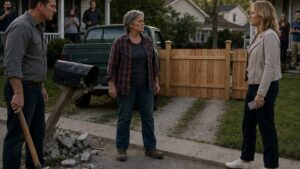
Karen Moore pointed at the oak as if it had stepped into her yard on purpose.
“That tree,” she said, standing on the sidewalk with her arms folded tight across her pale linen blouse, “is ruining my sunset.”
Andrew Rivera had been halfway through tightening the hinge on his front gate. The screwdriver was still in his hand, the old brass screw refusing to sit flush. Behind Karen, the evening sun had dropped low enough to break through the oak in long, gold splinters. The branches caught the light and scattered it across the street, across the mailboxes, across the narrow strip of lawn Karen had crossed without invitation.
Andrew looked past her at the canopy. The oak was wide, old, and uneven in the way living things became when no one had trimmed them into submission. Its largest branch stretched across the sidewalk, high over the cracked concrete, then leaned toward the road like an arm held out to slow traffic.
Karen followed his gaze and mistook his silence for agreement.
“You see it,” she said. “From my back patio, the whole thing is just branches. I used to get a clean view right between the houses. Now all I see is leaves.”
Andrew set the screwdriver on the gatepost.
“The tree was here before my house,” he said.
“That’s not an answer.”
“It’s the one I have.”
Karen gave a small laugh through her nose, not loud enough to be rude in the open but sharp enough to make the point. She turned toward the oak again and lifted her phone. Andrew watched the screen catch the light as she framed the branches, the trunk, his front yard, probably even his mailbox number.
The sight of the phone bothered him more than her words. A complaint said out loud could still dissolve in the air. A photo became a file. A file became an agenda item. An agenda item became men in work gloves feeding branches into a chipper.
“It needs to be cut back at minimum,” Karen said. “And honestly, Andrew, I think it needs to come down.”
His jaw tightened once. He did not let the rest of his face move.
The neighborhood around them held that polished Friday-evening stillness people paid fees to preserve. Sprinklers clicked behind fences. A delivery van rolled past two streets over. Somewhere, a garage door hummed shut. Oakridge Commons looked the way the brochure had always promised: low lawns, painted shutters, neat stone borders, seasonal wreaths placed just so. The oak did not match any of it. Its trunk was too thick. Its roots lifted the lawn in places. Its shade did not stop at Andrew’s property line.
That was what his father had loved about it.
Karen stepped closer to the curb, careful not to let her sandals touch the raised root near the sidewalk. “You’ve ignored the last two reminders about tree maintenance.”
“They were about overhang near the streetlight,” Andrew said. “I trimmed that.”
“With a handsaw.”
“It worked.”
“That isn’t the point.” Karen’s smile was controlled now, the HOA smile, the one Andrew had seen at spring cleanups and mailbox-painting reminders. “We have standards for a reason. Property values, safety, appearance. This isn’t a rural road.”
Andrew looked at the screwdriver on the gatepost. His hands wanted the simple problem of the hinge again. Metal, wood, pressure, turn. Fix the thing in front of you and stop before you stripped the screw.
“My yard is maintained,” he said.
“Your yard, yes. The tree, no.”
The sun slid lower, breaking apart behind the oak’s leaves. For a moment, Karen’s hair glowed at the edges, and her annoyance seemed almost borrowed from the light. Across the street, a curtain shifted in a front window. Andrew knew someone was watching. In this neighborhood, conflict traveled faster if no one appeared to hear it.
Karen lowered her voice. “Look, I’m trying to be reasonable before I make this formal.”
“Reasonable would be asking for trimming near your property line.”
“I am asking for a solution.”
“You’re asking me to cut down a living tree because you want a cleaner sunset.”
Her cheeks colored.
“That’s dismissive,” she said. “And it’s exactly the attitude people complain about with you.”
Andrew almost asked which people. He knew better. In an HOA, “people” meant anyone who did not want their name attached to what they wanted enforced.
Instead he picked up the screwdriver and put it into the back pocket of his jeans.
Karen watched the movement as if it confirmed something. “You don’t attend meetings. You don’t answer emails. You don’t return forms until the last possible day. Then you act surprised when people get frustrated.”
“I’m not surprised.”
“No. You just don’t care.”
Andrew looked at the trunk. The bark was ridged deep enough to hold shadows even in the sun. Near the base, where the roots spread into the soil, a small half-moon scar had darkened with age. He had been sixteen when his father backed a rented tiller into it, cursed in two languages, and then spent a whole Saturday sealing the wound like he had hurt a person.
Andrew had not thought about that in months. He disliked Karen for making him think of it now.
“I care about the tree,” he said.
Karen’s expression sharpened. “Then care about the rest of us, too.”
The words landed too close to something true. Andrew had no answer ready, and his silence gave Karen space to stand straighter.
“I’m the compliance chair,” she said. “I have to document complaints when they affect neighborhood standards. If you won’t work with me informally, I’ll file it formally.”
Andrew nodded once.
That irritated her more than an argument would have.
“You understand what that means?” she asked.
“It means you’ll file a complaint.”
“It means the board can require an inspection. If the tree is found to be unsafe or out of compliance, they can order corrective action.”
“Then they can inspect.”
Karen stared at him for a beat too long. In the oak above them, a breeze moved through the leaves, and the light changed again. The street darkened under the canopy while the roofs beyond it still held the last brightness. Andrew could see, from where Karen stood, how the tree divided the sunset. He could also see the long triangle of shade it laid across the sidewalk, the same triangle that kept the pavement from buckling worse every July.
But he did not say that.
He could have told her the tree shaded three yards by four o’clock. He could have told her the roots drank the rainwater that used to run down the slope before the new drains went in. He could have told her his father had fought the developer when they wanted to grade the whole corner flat.
Instead he said, “Have a good night, Karen.”
Her mouth tightened. “That’s your final answer?”
“It’s my answer tonight.”
She raised her phone again. This time she took a picture of the whole tree, then one of the lifted sidewalk seam, then one of Andrew’s front gate as if the crooked hinge had been conspiring with the oak.
Andrew felt heat move under his collar, but he kept his hands loose.
From two houses down, Dennis Hill called from his porch, “Evening, Karen.”
Karen turned with a smooth, public smile. “Evening, Dennis.”
Dennis sat in his usual chair, one knee wrapped in a beige brace, a glass of iced tea sweating on the table beside him. He looked from Karen’s phone to Andrew’s face and then up into the tree.
“Pretty night,” Dennis said.
“It would be,” Karen replied, “with a little less obstruction.”
Dennis did not answer. That was his way. He could leave a whole argument sitting in the air untouched.
Karen looked back at Andrew. “I’ll be submitting this Monday.”
He wanted to say, Do what you need to do. He wanted to sound bored, untouchable. But the old scar at the trunk pulled at his eye, and the words came out lower.
“You don’t know what you’re asking.”
Karen paused, and for the first time something besides irritation moved across her face. Not sympathy. Not curiosity. More like offense at being told there was a door she had not been allowed to open.
“Then maybe,” she said, “you should have explained it.”
She stepped back onto the sidewalk, checked the last photo, and walked away beneath the branches she wanted gone. The sun, cut into pieces by the oak, flashed across her phone screen as she typed.
Andrew stood by the gate until she reached her driveway. She did not look back. She lifted her phone once more, angled it toward his yard, and took one final picture for the report.
Chapter 2: A Quiet Man Skips the Hearing
The compliance letter was taped to Andrew’s front door so neatly that, for one ridiculous second, he thought it was a flyer for lawn service.
Then he saw the Oakridge Commons letterhead.
He stood on the porch before work with his lunch bag in one hand and his keys in the other, reading the first line through the clear plastic sleeve.
Notice of Formal Review: Mature Tree Maintenance and Potential Hazard.
The tape had been pressed flat at all four corners. Whoever placed it there had taken care not to damage the paint. That bothered Andrew. It made the whole thing feel polite, almost reasonable, as if the paper were not accusing the oldest living thing on the block of being a problem.
He pulled it down and read the rest at the kitchen counter.
The complaint cited “obstructed sightlines,” “possible branch hazard,” “root impact on common sidewalk,” and “negative effect on adjacent property enjoyment.” Karen’s name was not in the summary, but Andrew could hear her in the phrases. He could see her choosing words that sounded less personal than sunset.
At the bottom, in bold, was the hearing time.
Monday, 6:30 p.m. Homeowner may attend and respond.
Andrew checked the clock above the stove. He had ten minutes before he needed to leave. The hearing was that night.
His first thought was that they had sent the notice too late. His second was that the email had probably been sitting unread in the account he used only for HOA invoices and roof-color reminders. His third was his father’s voice saying, You can be right and still lose if you don’t show up.
Andrew folded the letter twice and put it beside the sink.
At work, he fixed three cabinet drawers, replaced a cracked doorframe, and ignored two calls from a number he recognized as Ryan Mitchell’s. By five-thirty, his shirt was stuck to his back, his knuckles were scraped, and the thought of sitting in the clubhouse under fluorescent lights while Karen described his tree like a disease made his shoulders lock.
He drove home instead.
The oak covered the front walk in late-afternoon shade when he arrived. The concrete under it was cool enough that the neighborhood kids sometimes stood barefoot there before sprinting across the hot road. Andrew noticed the hairline cracks near the root flare, the uneven slab Karen had photographed. He noticed, too, how the grass stayed greener within the canopy and how the air changed when he stepped beneath it.
His phone buzzed.
Ryan Mitchell again.
Andrew let it ring.
He made coffee though it was too late for coffee. He opened the compliance letter and set it beside his mug. Six-twenty. Six-twenty-five. At six-thirty, he stood at the kitchen sink and watched the reflection of the oak leaves tremble in the dark window.
At six-forty, Dennis knocked on the back door.
Andrew opened it before the second knock.
Dennis held up both palms. “Not here to start anything.”
“You came to ask why I’m not at the clubhouse.”
“That would be starting something.” Dennis leaned his shoulder against the doorframe. “So no.”
Andrew stepped aside. Dennis came in slowly, favoring his right knee. He had brought his iced tea in a plastic tumbler, which meant he had decided this was a conversation and not a message.
“They’re talking about it right now,” Dennis said.
“I know.”
“Karen’s prepared.”
“I assumed.”
Dennis looked at the letter on the counter. “You got notice.”
“This morning.”
“That’s not much notice.”
“It’s enough to show up if I wanted to.”
Dennis took that in. He had a way of making silence feel like a tool instead of an absence. After thirty years delivering mail, he probably knew every version of a person pretending not to wait for something.
Andrew turned the mug in place.
Dennis said, “You remember when your dad argued with the developer?”
Andrew did not answer.
“They wanted that tree gone before the first model home opened. Said it made the corner look unfinished.”
Andrew’s hand stopped on the mug.
“I was still doing the route then,” Dennis continued. “Your dad stood out there with a measuring tape and a city map like he was defending a courthouse.”
Andrew looked toward the front of the house. From the kitchen, he could see only the shadow of the trunk through the side window.
“He told me it was older than all of us,” Dennis said. “Told me a neighborhood shouldn’t start by cutting down the one thing that already knew the land.”
“That sounds like him.”
“It does.”
Andrew forced a dry smile, but it left quickly.
Dennis sipped his tea. “You could say that at the hearing.”
“I’m not turning him into an argument.”
“Nobody asked you to.”
“They will.” Andrew’s voice came sharper than he meant. “They’ll sit there and nod like it matters, then ask if I have documentation. Or they’ll call it sentimental. Or Karen will say she respects my father’s memory but rules are rules.”
Dennis looked down into his cup. “Maybe.”
Andrew hated the softness of the answer. He wanted Dennis to disagree, to tell him the neighborhood was better than that. Instead Dennis gave him the truth with no cushion.
The phone buzzed again. This time Ryan left a voicemail.
Andrew did not play it.
At seven-fifteen, headlights moved across the kitchen wall as cars turned out of the clubhouse lot and came back through the neighborhood. A few minutes later, Andrew’s phone lit with a text from Ryan.
We need to talk tomorrow. Complaint considered reasonable on paper. Inspection being scheduled. Please don’t ignore this.
Andrew read it twice.
Dennis saw his face change. “What’d he say?”
Andrew slid the phone across the counter.
Dennis put on the reading glasses that hung from his collar. His mouth pressed flat as he read.
“Reasonable on paper,” Dennis said.
“Everything’s reasonable on paper.”
Dennis handed the phone back. “There was a branch last month.”
Andrew looked at him.
“You didn’t hear?”
“No.”
“Storm snapped one off the side over Karen’s driveway. Not big enough to hit her car, but close enough to scare her. She was out there in the morning with a broom, angry as anything.”
Andrew remembered the storm. He had been working across town, came home after dark, saw leaves in the road, and cleaned his own side before sunrise. He had not checked Karen’s driveway. He had not asked anyone.
“That should have been in the complaint,” Andrew said.
“Maybe it was.”
Andrew picked up the letter again. Possible branch hazard. There it was, cleaned and flattened, hidden among the other phrases.
For the first time since Friday, Karen’s anger had another shape. Not a better shape. Not a fair one. But something with a crack in it where fear could have gotten in.
Dennis set his tumbler down. “You can still respond.”
Andrew looked at the hearing time printed in bold. Already past. Already missed.
“No,” he said. “Now I can react.”
Outside, the oak moved in the warm evening wind, its leaves brushing softly against one another. The sound reached the kitchen through the glass like someone turning old paper.
The next morning, the official email arrived.
Oakridge Commons Board has voted to authorize a certified inspection of the mature oak at 1146 Wren Lane. Pending findings, corrective action may be required.
Andrew read the attachment standing beneath the tree, the phone bright in his hand.
Near the bottom, below Ryan’s formal signature, one line had been added in smaller type.
Tree service estimates may be obtained in advance to prevent delay.
Chapter 3: The First Shade Everyone Pretended Not to Need
Elizabeth Thomas’s child stopped at the edge of the oak’s shadow and refused to step into the sun.
“Come on,” Elizabeth said, shifting the grocery bag higher against her hip. “It’s just across the street.”
The child shook their head and pressed both sneakers onto the shaded concrete as if the darkness beneath the tree were a painted safety line. Beyond it, the sidewalk shone white and empty. The afternoon heat rose from the pavement in ripples Elizabeth could almost see. Her scrub top clung to the back of her neck. The milk in the grocery bag already felt too warm.
“Three houses,” she said. “That’s all.”
“No.”
Elizabeth looked up and down Wren Lane, embarrassed by her own impatience and the absurdity of arguing with a child about sunlight. The heat advisory had come through her phone at noon, a flat government message that somehow sounded less urgent than the way the air pressed on her chest. At the clinic, two elderly patients had come in dizzy before lunch. By two, the parking lot had smelled like hot rubber and old pennies.
Now the stretch of sidewalk between Andrew Rivera’s oak and her own driveway looked longer than it had any right to be.
Andrew was in his yard, kneeling beside a coil of hose near the trunk. He had one hand on the spigot and the other shading his eyes as he watched them.
“You okay?” he asked.
Elizabeth wanted to say yes automatically. Everyone in the neighborhood said yes automatically. It kept things tidy.
“Just hot,” she said.
Andrew stood. “Wait there.”
He crossed to his porch, came back with two bottles of water from a small cooler, and held one out to her, then one to the child. He did not make a performance of kindness. He offered the bottles the way he might hand over a wrench.
“Thanks,” Elizabeth said.
The child drank immediately, cheeks flushed.
Andrew glanced at the sidewalk beyond the shade. “Give it a minute. The sun shifts off that stretch around four.”
Elizabeth looked at him, then at the hard bright pavement. “You know that?”
He shrugged. “I live here.”
It was not quite an answer. She had learned that about Andrew. He gave the smallest true statement and left the rest behind his teeth.
From across the street, a screen door creaked. Dennis Hill came down his porch steps carrying a red folding chair tucked under one arm. He moved slowly, as if every joint had negotiated separately before agreeing to the trip. He placed the chair under the oak, right where the shadow crossed the sidewalk, and sat with a sigh that sounded half relief, half victory.
“Well,” he said, “this is still the best seat on Wren Lane.”
Elizabeth laughed despite the heat. “You brought a chair?”
“Should’ve brought two.”
Andrew’s expression barely changed, but he went to the garage and returned with another red chair, older and sun-faded along the arms. He opened it beside Dennis, then, after a pause, pulled a third from the wall.
Elizabeth looked toward her house. She should keep moving. The groceries should not sit. Her child should not learn that refusing worked.
Then the child climbed into the third chair with the water bottle and leaned back as if they had checked into a resort.
“Five minutes,” Elizabeth said, but she sat on the low stone border instead of standing.
The shade was not just darker. It was different air. Cooler by enough to feel like mercy. The oak leaves above them moved in layers, filtering the sunlight into small shifting pieces that never settled long enough to burn. A delivery driver slowed as he passed, glanced at the three red chairs and the woman in scrubs sitting on the border, and gave a tired little salute.
Dennis lifted his bottle back.
Andrew adjusted the hose near the roots. He had spread mulch in a wide ring around the trunk, not the decorative dyed kind the HOA landscapers liked, but rough brown chips that smelled faintly of rain when the water touched them.
“You always water it in heat like this?” Elizabeth asked.
“When it needs it.”
“Doesn’t look like it needs much help.”
“It’s old,” Andrew said. “Old things can look fine until they don’t.”
Dennis looked at him when he said it, but Andrew kept his eyes on the slow darkening of the mulch.
A car door shut two houses away. Elizabeth turned and saw Karen Moore standing at the edge of her driveway, one hand on the open door of her SUV, the other holding a folder against her side. She was dressed for errands or a meeting, white pants, sleeveless navy blouse, sunglasses pushed up in her hair. She looked first at Andrew, then at Dennis, then at Elizabeth’s child sitting under the oak with both feet lifted onto the chair rung.
For a moment, no one spoke.
Elizabeth felt the old neighborhood instinct: do not get pulled into it. She had heard about the tree complaint from two different people who both claimed not to be gossiping. She knew Karen had filed something. She knew Andrew had skipped something. She knew, mostly, that she worked long shifts and did not have the energy to become a quote in somebody else’s board meeting.
Karen crossed the street anyway.
“Afternoon,” she said.
Dennis tipped his bottle. “Hot one.”
“Yes. It is.”
Her eyes moved to the chairs. “This is new.”
“Chairs?” Dennis asked mildly. “Been around for years.”
“Under Andrew’s tree.”
Elizabeth stood, suddenly aware of the grocery bag at her feet, the water bottle in her child’s hand, the fact that she looked like she had chosen a side by sitting down.
“We were just cooling off,” she said.
Karen’s smile was polite and tired. “Of course.”
Andrew turned off the hose.
The silence that followed was worse because there were ordinary sounds inside it: a sprinkler ticking, a lawn mower starting in the distance, leaves shifting overhead. Karen looked up into the canopy. The same branches that had broken her sunset now cut the heat into something bearable. Elizabeth saw the realization reach her and watched Karen refuse to let it show.
“There are proper ways to address common-area concerns,” Karen said.
Andrew’s voice stayed even. “This isn’t common area.”
“The sidewalk impact is.”
“The shade is, too,” Dennis said.
Karen looked at him.
Dennis leaned back in the red chair, his face damp, his hands wrapped around the cold water bottle Andrew had given him. He did not look dramatic. He looked old and hot and grateful not to be standing in the sun.
Karen’s expression flickered. Not softened exactly. Interrupted.
A phone chimed inside her folder. She opened it and pulled out a printed estimate clipped to the front of several pages. Elizabeth caught only the bold header from where she stood: TREE REMOVAL AND STUMP GRINDING.
Andrew saw it, too.
The air under the oak seemed to tighten.
Karen slid the papers back against her chest. “The board has to consider all options.”
Andrew stepped closer to the trunk. “You already got an estimate.”
“Preliminary,” Karen said.
“For removal.”
“For delay prevention.”
Dennis set his bottle down slowly.
Elizabeth’s child stopped swinging their feet.
Karen looked from face to face, and for the first time she seemed to understand that shade could gather witnesses. Her fingers pressed the folder’s edge until it bent.
“I’m not doing anything improper,” she said.
Andrew did not answer. His silence no longer felt peaceful to Elizabeth. It felt like a gate being locked.
Karen turned to leave, then stopped at the curb and looked back once at the red chairs beneath the oak. The child was still sitting in the cool shade, water bottle shining in both hands.
Karen’s phone chimed again. She glanced at the screen, and whatever she read made her mouth settle into a hard line.
“The inspection estimate is in,” she said. “And the removal estimate is lower than I expected.”
Chapter 4: The Orange Notice on the Living Tree
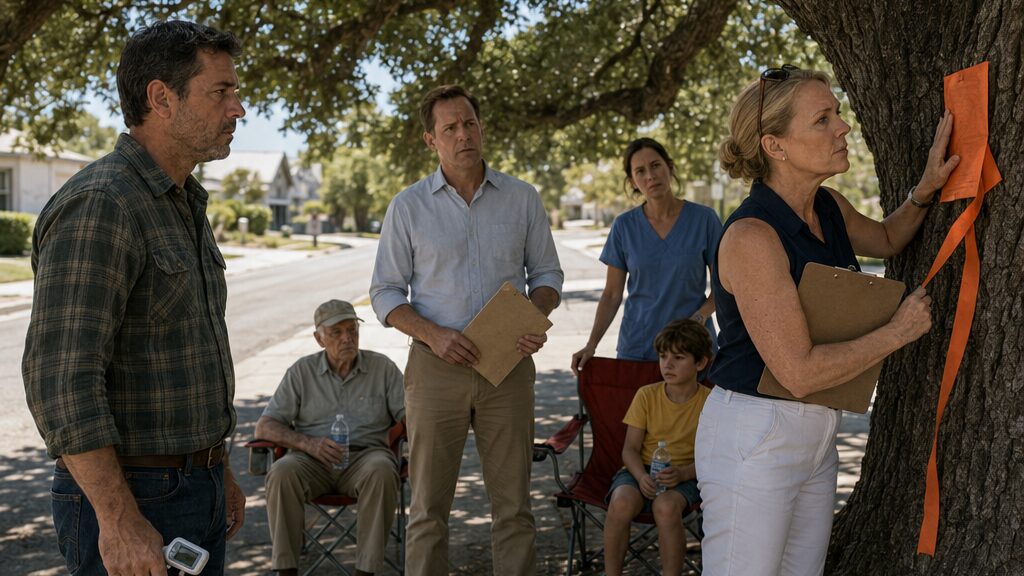
The orange notice had been zip-tied to the oak at eye level, and beneath it, three neighbors sat in the shade pretending not to read it.
Andrew saw the paper before he saw Karen.
It flapped against the bark in the thick noon air, bright enough to look almost childish against the dark ridges of the trunk. The words were printed in black block letters: PENDING CORRECTIVE ACTION REVIEW. Below that, in smaller type, someone had highlighted MATURE TREE HAZARD ASSESSMENT. The zip tie had been pulled tight around a lower branch stub, not deep enough to cut into the wood but tight enough to irritate Andrew’s hands before he even touched it.
Dennis sat in his red folding chair with his cap low over his forehead. Elizabeth stood beside the stone border, one hand resting on the back of her child’s chair. Another neighbor had stopped with a dog and remained under the canopy longer than any dog needed. No one looked relaxed. The heat advisory had changed the neighborhood’s manners. People who usually waved from driveways now drifted toward shade without admitting they were gathering.
Karen stood on the sidewalk in sunglasses, holding a clipboard and a roll of orange warning tape.
Andrew walked straight to the trunk. “Who put this on my tree?”
Karen did not step back. “It’s a notice, Andrew. Not a punishment.”
“Who authorized it?”
“The board authorized hazard review.”
“Review isn’t removal.”
“It can lead to removal.”
Dennis shifted in his chair. The metal legs scraped softly against the concrete.
Andrew looked at the zip tie again. He wanted to cut it off. He wanted to tear the orange paper down and hand Karen the pieces. He could feel everyone waiting for him to do something angry enough to become the story.
Instead, he put both hands on his hips and let them stay there.
“The trunk is on my property,” he said.
“The sidewalk impact is association concern,” Karen replied. “Ryan approved public notice because the tree affects pedestrian passage.”
At the sound of his name, Ryan Mitchell appeared from the direction of the clubhouse path, shirt sleeves rolled up, face already damp. He carried a folder under one arm and had the look of a man who had expected a conversation and found a scene.
“Let’s all take a breath,” Ryan said.
Nobody did.
The air under the oak was cooler, but it was not gentle. The day pressed down on everything beyond the canopy. Across the street, sunlight sat on Karen’s pale driveway like a sheet of metal. A delivery truck slowed at the corner and continued without stopping.
Andrew pointed at the notice. “Did you approve that?”
Ryan looked at Karen, then at the notice. “I approved posting that a formal review was pending.”
“On the tree?”
“I didn’t specify placement.”
Karen’s mouth tightened. “It needed to be visible.”
“To who?” Andrew asked. “The tree?”
A few of the neighbors almost laughed and then caught themselves.
Karen turned slightly, making her voice more public. “This is exactly the problem. Every concern gets treated like an attack. Last month a branch fell near my driveway. Had my car been parked a foot closer, we’d be talking about damage. If someone gets hurt, everyone here will ask why the board did nothing.”
Andrew looked at Ryan. “Was that in the hearing?”
“Yes,” Ryan said carefully. “Along with sightline obstruction, sidewalk lift, and maintenance concerns.”
“And the sunset?”
Karen’s sunglasses hid her eyes. “Property enjoyment is a legitimate concern.”
Dennis snorted once.
Karen turned on him. “You think this is funny?”
“No,” Dennis said. “I think it’s hot.”
The sentence hung there, simple and impossible to argue with. Dennis’s shirt was darkened at the collar. Elizabeth’s child had a water bottle pressed to one cheek. The dog at the edge of the shade lay down without permission from anyone.
Andrew looked at them all, then at the sunlit pavement beyond the oak. Something in him shifted—not softened, exactly, but moved from defense to use. Anger had nowhere to go if he kept swallowing it. Proof might.
He went into his garage.
“Andrew,” Ryan called after him. “Let’s not escalate.”
Andrew did not answer. He returned with two small thermometers from the pegboard beside his workbench, the cheap kind he used when checking attic ventilation on repair jobs. He set one on the curb in full sun, weighing it with a flat stone. The second he placed on the shaded sidewalk near Dennis’s chair.
Karen folded her arms. “What are you doing?”
“Waiting.”
“For what?”
“For the numbers to stop being emotional.”
Elizabeth looked down at the shaded thermometer. Dennis leaned forward despite himself. Ryan checked his watch, then stopped, as if realizing there was no procedural form for watching plastic thermometers heat up.
The sun thermometer climbed first. Within minutes the red line had pushed past one hundred. The one in the shade rose more slowly, hesitated, and settled far below it.
Andrew crouched and read both without touching them.
“In the sun, one hundred twelve,” he said. “In the shade, ninety-one.”
“That’s surface heat,” Karen said quickly.
“That’s where people walk.”
Ryan stepped closer and bent down. “Let me see.”
Andrew moved aside. Ryan read them, then looked toward the line where the shade ended and the white sidewalk began. Something in his face changed, not enough for a confession, enough for worry.
Elizabeth spoke before Andrew could. “At the clinic today, we had two heat cases before lunch. That stretch by the mailboxes is worse. My child wouldn’t cross it yesterday.”
Karen looked at Elizabeth, surprised by the steadiness in her voice.
“I’m not trying to be part of this,” Elizabeth added. “I just know what hot pavement does.”
Dennis lifted his cap and wiped his forehead with the back of his wrist. “That tree shades half this corner by four o’clock. Always has.”
Karen gave him a controlled look. “Always has doesn’t mean always should.”
“No,” Dennis said. “But maybe it means you ask more questions before calling a crew.”
At that, Ryan’s eyes moved to Karen’s clipboard.
Andrew saw it. “Crew?”
Karen’s grip tightened.
Ryan said, “No removal has been authorized.”
“That’s not what I asked.”
Ryan exhaled through his nose. “The board requested preliminary estimates so we would understand possible costs.”
“You requested them before the arborist report?”
Karen answered before Ryan could. “To prevent delay if the tree is deemed hazardous.”
Andrew looked at the orange notice again. The words seemed different now. Not review. Momentum. Not safety. Preparation.
“You were already pricing the end,” he said.
Karen’s face flushed, though whether from heat or anger, Andrew could not tell. “You don’t get to act like a victim when you skipped the hearing.”
The accusation hit clean because it was true.
Ryan shifted. “Andrew, she’s right that your absence made this harder.”
Andrew held his gaze. “And her estimate made it faster.”
For the first time, Ryan had no ready neutral sentence.
A breeze moved overhead. The oak leaves stirred, and shade shifted across Karen’s shoes. She looked down. Only for a second, but Andrew saw it: the tiny involuntary stillness of someone feeling relief from the thing she had named as the problem.
The child in the red chair said, softly but clearly, “It feels better here.”
Elizabeth touched the child’s shoulder. “I know.”
Karen looked up into the canopy. Her sunglasses reflected broken green and light. Andrew expected another rule, another phrase from the handbook.
Instead she said nothing.
The silence lasted long enough that Ryan crouched and took a photo of both thermometers with his phone.
“For the record,” he said.
Karen turned sharply. “Ryan.”
“We should include all relevant information.”
“Relevant information includes liability.”
“It also includes environmental effect and community use.”
“Community use?” Her voice rose, then came back under control. “This is not a park. This is private property creating common exposure.”
Andrew looked at the red chairs, the orange notice, the neighbors half-guilty in the shade. He thought of the first evening, Karen saying he did not care about the rest of them. He had wanted to reject the line completely. Now it had returned in a different form.
Maybe caring required more than refusal.
Ryan straightened. “The formal inspection is tomorrow morning. Nothing happens before the report.”
Karen faced him. “The board has authority to act if there’s credible hazard risk.”
“The board has authority after review.”
“And if a branch falls tonight?”
Dennis muttered, “Then it’ll have excellent timing.”
No one smiled.
Karen removed her sunglasses. Without them, she looked more tired than triumphant. Fine lines showed around her eyes. There was worry there, real enough to complicate the anger in Andrew’s chest.
“My mother sits on my back patio every evening,” she said, quieter. “She was out there when that branch came down. You weren’t. I was.”
Andrew’s answer caught behind his teeth.
He had not known that. He hated that he had not known. He hated more that Karen had not led with it because she had buried it under property enjoyment and sunset view and curb appeal until it sounded like vanity instead of fear.
Ryan said, “That should have been stated clearly.”
Karen looked at him as if he had betrayed her.
Andrew picked up the thermometer from the shade. It felt barely warm in his palm. The one from the sun was hot enough that he had to hold it by the edge.
“I’ll be here for the inspection,” he said.
Karen tucked her clipboard against her side. The orange notice rustled against the trunk between them.
“You should be,” she said. “Because if that arborist says this tree is unsafe, I don’t care how much shade it throws.”
Andrew looked at the zip tie. Then at the people sitting beneath the branches.
“Then we’ll find out what unsafe actually means,” he said.
Karen stepped back into the sun and immediately squinted. For one unguarded second, she looked relieved when the shade still touched her shoulder.
Then she turned to Ryan and said, loud enough for everyone to hear, “Liability still gives the board grounds to take it down.”
Chapter 5: The Report That Helped Both Sides
The city arborist tapped the oak with a rubber mallet and said, “Who started talking about removal before anyone looked inside the tree?”
Ryan Mitchell felt every face turn toward him.
He stood on Andrew Rivera’s lawn at 8:12 the next morning with a clipboard, a damp collar, and the growing suspicion that the board had done the procedural equivalent of backing a car down a driveway without checking the mirrors. Karen stood to his left, arms folded. Andrew stood near the trunk but not touching it. Dennis watched from the sidewalk with his cane hooked over one wrist. Elizabeth had stopped on her way to the clinic, still in scrubs, her child already dropped at summer care.
The arborist tapped again, listening.
The sound was dull but not hollow. Ryan had no idea what that meant. He disliked not knowing. It made him want to hide inside words like pending, conditional, and preliminary.
The arborist leaned close to the bark and examined a seam near the branch union. “You’ve got deadwood up high. Some weight over the sidewalk. Root lift, yes. But the trunk looks strong from here.”
Karen’s chin lifted. “A branch already fell.”
“I heard.” The arborist looked at the lower canopy. “Branches fall off healthy trees, too. Especially after a storm if pruning’s been neglected.”
Andrew’s mouth tightened at the word neglected.
Ryan wrote pruning neglected in his notes, then immediately regretted the shorthand. It looked accusatory. Everything looked accusatory once it landed on paper.
“Can it be made safe?” he asked.
The arborist gave him a brief glance. “That’s usually the better first question.”
Karen shifted. “And if the answer is no?”
“Then I say no.”
She waited.
The arborist did not help her fill the silence.
Ryan had served on the board for three years because he believed someone reasonable needed to be in the room. Reasonable, he had learned, often meant everyone left thinking he had privately agreed with them. He kept meetings calm. He read bylaws before quoting them. He treated every complaint as if it might become a lawsuit because, in an HOA, any complaint could. He had not thought of that as cowardice.
Now the orange notice still hung from Andrew’s tree behind the arborist’s shoulder, and the two thermometers from yesterday had become a problem Ryan could not unsee.
The arborist moved to the sidewalk, knelt by the raised slab, and ran two fingers along the uneven seam.
“This needs grinding or ramping,” the arborist said. “Not because it’s dramatic. Because someone will catch a toe.”
Karen looked at Andrew.
Andrew said, “I’ll pay my portion.”
“That’s not how common sidewalk repair works,” Ryan said automatically, then stopped because Andrew looked at him with a tired expression that said this was exactly the kind of thing that had kept him away from meetings.
The arborist stood. “I’ll send the report this afternoon. My field recommendation is selective deadwood removal, reduction over the sidewalk, mulch correction, and annual inspection. No removal recommendation unless the internal scan shows decay I’m not seeing.”
Karen took a step forward. “Internal scan?”
“Optional. Costly. Usually not necessary unless there’s evidence.”
“Could the board require it?”
Ryan heard the question under the question: Could the board keep pushing?
The arborist looked from Karen to Ryan. “The board can require a lot of things. Doesn’t mean the tree needs to come down.”
Andrew looked away, toward the canopy.
For a moment, Ryan saw the man not as the difficult homeowner in the file but as someone bracing before relief could show. That unsettled him. It was easier when residents were categories: nonresponsive, aggressive, cooperative, delinquent. Andrew had become nonresponsive in the paperwork. Under the tree, he looked like a man who had expected bad news and did not trust good news yet.
The report came at 2:43 p.m.
Ryan read it twice in the HOA office while the wall unit rattled and the printer beside him blinked low toner. The report was not the clean answer he had wanted. It made everyone partly right and therefore guaranteed no one would be satisfied.
The oak was structurally sound. The oak had deadwood. The root lift was a moderate pedestrian concern. The canopy provided substantial cooling to the public sidewalk and adjacent frontage. Removal was not recommended at this time. Improper heavy trimming could increase stress and long-term failure risk. Delayed maintenance could increase branch drop risk. Recommended: certified arborist pruning within sixty days, sidewalk mitigation, annual review, and watering during extreme heat.
Ryan highlighted the cooling sentence. He highlighted improper heavy trimming. He highlighted delayed maintenance.
Then he leaned back and rubbed both eyes.
Karen arrived five minutes later without knocking. “Did you get it?”
“Yes.”
“And?”
He handed her a copy.
She read standing up. Her expression moved only in small places: brow, mouth, the skin under her eyes. When she finished, she went back to the second page.
“It says deadwood,” she said.
“It says removal not recommended.”
“It says delayed maintenance increases risk.”
“It also says heavy trimming can harm the tree.”
Karen placed the report on his desk. “So we authorize proper trimming immediately.”
“Within sixty days.”
“Ryan.”
He knew that tone. It was the tone she used when a board member wanted to move a meeting because of a child’s recital or ignore trash cans left out after pickup. The tone said standards do not enforce themselves.
“We have an emergency heat advisory,” he said. “We also have several residents using that shade. I don’t want a crew under there without clear scope.”
Her laugh was short. “Yesterday you wanted relevant information. Today you have it.”
“Today I have a report saying the tree is healthier than the complaint suggested.”
“My complaint included branch hazard.”
“It also included your sunset view.”
Karen’s face went still.
Ryan wished he had not said it that way, but the sentence could not be called back.
She picked up the report and smoothed the top page with both hands. “You think this is about me being petty.”
“I think it started with more than one thing.”
“My mother was on that patio when the branch fell.” Her voice stayed level, which made it worse. “She doesn’t move quickly. I heard it crack and thought it had hit her.”
Ryan said nothing.
Karen looked toward the office window, where the parking lot shimmered in the afternoon glare. “Every evening, after I get her settled, she wants to sit outside. She can’t walk the block anymore. She can’t go to the garden club. She sits there and looks west because that’s what she can still do.” She turned back to him. “Then the tree grew across the view, and a branch fell, and Andrew acted like I was ridiculous for noticing.”
Ryan let the silence sit. For once, he did not fill it with procedure.
“That should have been the complaint,” he said.
Karen’s eyes sharpened. “I shouldn’t have to bring my mother into an HOA file to be taken seriously.”
“No,” Ryan said. “But you also shouldn’t turn fear into a removal campaign.”
She looked away first.
The office phone rang. Ryan ignored it.
“I’m proposing a board note,” he said. “No removal. Authorize certified pruning within the arborist’s scope, sidewalk mitigation review, and temporary suspension of further action until the next meeting.”
Karen’s mouth pressed flat. “Temporary suspension means Andrew does nothing for weeks.”
“It means we follow the report.”
“It means if another branch falls, that’s on us.”
“It means if we overcut and damage a healthy tree during a heat wave, that’s also on us.”
Karen gathered the papers. “Fine. Send your note.”
“Karen.”
She paused at the door.
“Don’t contact any crew until the board approves scope.”
She gave him a look that was not quite denial and not quite agreement. “I know the rules.”
After she left, Ryan sat with that sentence longer than he liked.
At 5:18 p.m., Andrew came to the office, still in work clothes, hair damp from the heat. He stood just inside the doorway as if expecting to be told he had come to the wrong place.
Ryan handed him the report.
Andrew read it slowly. Twice he stopped and looked at the page as if a sentence had struck a place behind his ribs.
“Healthy,” he said.
“With maintenance.”
Andrew nodded. “I can do maintenance.”
“Certified pruning. Not weekend handsaw work.”
A flash of irritation crossed Andrew’s face, but he swallowed it. “Fine.”
Ryan appreciated the word more than he expected.
“And the sidewalk?” Ryan asked.
“I’ll cooperate.”
“Good.”
Andrew folded the report carefully. “You moved on estimates before this.”
Ryan met his eyes. “Yes.”
“Why?”
“Because I thought preparing options was neutral.”
“And now?”
“Now I think neutral can still push something downhill.”
Andrew looked at him for a long second, then nodded once.
Ryan’s phone buzzed after Andrew left. A message from Karen.
I’ve spoken with a certified crew about preventive deadwood work. Dawn is the only slot before next week. Since report confirms risk, I believe delay is irresponsible. Will send invoice details if needed.
Ryan stood so quickly his chair rolled into the wall.
He called her. No answer.
He called again. No answer.
Then he called Andrew, but the call went to voicemail.
Outside the office window, the old oak’s crown rose above the rooftops, catching the low light. For the first time, Ryan did not see an item on the agenda. He saw a living thing with paperwork gathering around it.
He texted both of them in one thread.
No crew is authorized before board scope approval. Do not proceed.
Three dots appeared under Karen’s name, vanished, appeared again, then disappeared.
No reply came.
Chapter 6: What Andrew’s Father Wrote in Pencil
Dennis brought the folder in a grocery bag, as if the past were something that might leak.
Andrew found him on the porch at dusk, one hand gripping the rail, the other holding the plastic bag against his chest. The heat had loosened but not left. The day still clung to the porch boards and the brick steps. Behind Dennis, the oak spread its evening shade across the sidewalk, quieter now, stripped of neighbors and red chairs, with the orange notice still tied to its trunk.
“You got a minute?” Dennis asked.
Andrew looked at the bag. “What is that?”
“Something I should’ve given you before.”
Those words made Andrew open the door without another question.
They sat in the garage because Andrew could not stand the kitchen with the report on the counter and Ryan’s missed call blinking on his phone. The garage smelled of sawdust, oil, and the wet cardboard scent of old summer. Tools hung on pegboard exactly where his father had once outlined them in black marker. Andrew had kept the outlines even after changing half the tools. Some habits were not useful. Some stayed anyway.
Dennis set the grocery bag on the workbench and pulled out a weathered manila folder. The tab had softened at the edge. On the front, in pencil faded almost silver, someone had written: Wren Lane Oak.
Andrew did not touch it.
Dennis rubbed his thumb along the folder’s corner. “Your dad gave me this before he passed. Told me, ‘Dennis, if Andrew ever gets too stubborn to ask for help, hand him the paper.’”
Andrew’s throat closed before he could stop it.
“He said that?”
“Pretty close.”
“That sounds like him and not like him.”
Dennis smiled faintly. “He was sick. People get more direct when they’re tired.”
Andrew took the folder then. It felt lighter than it should have. Inside were copies of old subdivision maps, city correspondence, handwritten notes, a yellowing photo of the oak before the houses had finished going up. In the photo, the land around it was raw dirt and survey flags. The tree stood alone, too big for the new streets being drawn around it.
Andrew’s father was in one corner of the picture, younger than Andrew was now, one hand on his hip, the other pointing at something outside the frame. Andrew had forgotten how broad his shoulders had been.
Dennis watched him look.
“He fought them hard,” Dennis said. “Developer wanted a cleaner line. City didn’t want the drainage fight. Your father made himself inconvenient until they routed around it.”
Andrew turned a page. There were notes in his father’s blocky handwriting.
Shade reaches sidewalk by 2:30 in July.
Root zone must not be compacted.
Stormwater pools here if grade changes.
Neighborhood will forget why this mattered.
Andrew read the last line twice.
His father had always seen forgetfulness as a practical problem, not an emotional one. Label the breaker box. Write down the shutoff valve. Keep receipts. Mark the stud location. Make it easy for the next person to do right when you were not there to remind them.
Andrew swallowed hard.
Dennis shifted on the stool. “I didn’t say anything at first because I figured it was your business.”
“It was.”
“Maybe.” Dennis looked toward the open garage door, where the oak’s branches moved against the darkening sky. “But yesterday, sitting under there with that orange notice above my head, I started thinking maybe your dad didn’t save it for just your business.”
Andrew closed the folder partway. “Everyone wants a piece when it’s useful.”
“That isn’t fair.”
“No?”
Dennis did not flinch. “No. Elizabeth didn’t ask you to fight her fight. Her kid was hot. I’m old and my knee’s bad. I sat because it helped. That doesn’t make us thieves.”
Andrew looked down.
The anger had come too fast. He knew it. He had spent days swallowing words and now the wrong ones were leaking out.
“I’m tired,” he said.
“I know.”
“No, Dennis. I’m tired of people calling it Andrew’s tree when they want to blame me and the neighborhood’s shade when they want to sit under it.”
Dennis nodded slowly. “Then say that.”
Andrew laughed once, without humor. “At the meeting? Between agenda item three and pool furniture replacement?”
“If that’s where they’re trying to kill it.”
The word landed harder than Dennis seemed to expect. Kill. Andrew opened the folder again because looking down was easier.
Near the back was a loose page torn from a small notebook. The pencil was darker there, pressed deep.
Don’t let them call shelter a nuisance.
Andrew set the page flat with both hands.
For several seconds, the garage was full of small sounds: the fan turning in the corner, Dennis breathing through his nose, a car passing outside, leaves dragging lightly against one another.
“He wrote that when?” Andrew asked.
“Don’t know.”
Andrew knew. Or thought he did. During the last summer, when his father had slept in the recliner because lying flat hurt. He would wake before dawn, take notes on things nobody had asked him to solve, and leave them clipped to places around the house. Change furnace filter. Call roof guy before fall. Don’t trust cheap caulk. Some instructions were ridiculous. Some had outlived him.
Andrew touched the pencil line with one finger, careful not to smear what could no longer be rewritten.
His phone buzzed on the bench.
He ignored it.
It buzzed again. Then Dennis’s phone buzzed. Then Andrew’s lit with a text thread from Ryan, Karen’s name at the top.
No crew is authorized before board scope approval. Do not proceed.
Andrew stared at it.
“What crew?” Dennis asked.
Andrew scrolled up. There was Ryan’s earlier missed call. A voicemail. A text sent only to him fifteen minutes before the group message.
Call me immediately. Karen may have contacted a crew for dawn trimming.
Andrew played the voicemail on speaker.
Ryan’s voice came through tight and controlled. “Andrew, I need you to call me back. The report allows certified pruning, but the board has not approved scope. Karen says she spoke to a crew about preventive work. I’ve told her not to proceed. I’m calling an emergency board meeting tonight if I can get quorum, but you need to be ready to attend. This can’t be handled by texts anymore.”
The voicemail ended.
Dennis looked at the folder. Then at Andrew.
Andrew felt the old reflex rise: stay out, lock down, let them expose themselves. He had the report. Ryan had sent the warning. If Karen crossed a line, she would be wrong in writing.
But dawn came early. Crews worked fast. A healthy tree could be ruined by people who believed they were helping.
Dennis seemed to read the thought. “Paper won’t stop a saw.”
Andrew picked up his father’s note again.
Don’t let them call shelter a nuisance.
He had treated the sentence like a private inheritance, something between him and a dead man. Now, with Ryan’s message glowing on the bench and the orange notice still on the trunk outside, it looked less like memory and more like instruction.
“I don’t want to talk about him in that room,” Andrew said.
Dennis’s voice softened. “Then don’t talk about him for them.”
Andrew folded the notebook page carefully and slid it back into the folder. “Who do I talk about him for?”
Dennis pushed himself upright, slow and stiff. “For the tree. For yourself. Maybe for the rest of us if we’ve earned any part of it.”
Andrew looked out through the open garage door.
Across the street, Karen’s house showed one lit window at the back, facing west. For the first time, he pictured an old woman sitting there after a near miss, hearing a branch crack in the dark. He did not forgive Karen. But the image took some of the clean edge off his anger.
His phone buzzed again.
Emergency meeting confirmed. 8:30 p.m. Clubhouse. Tree action pending.
Andrew put the folder under his arm and took his keys from the hook.
Dennis stepped aside.
“You coming?” Andrew asked.
Dennis glanced toward his bad knee, then toward the oak. “I’ll be slow.”
“I’ll wait.”
“No,” Dennis said. “You won’t.”
Andrew looked at him.
Dennis pointed with his cane toward the street, toward the clubhouse lights beyond the roofs. “For once, Andrew, go before they finish talking without you.”
Andrew closed the garage door behind him, leaving the red chairs stacked against the wall and the old oak moving in the dark like something still breathing. He walked to his truck with his father’s folder held flat against his ribs, and this time, when the neighborhood tried to decide what the tree meant, he intended to be in the room.
Chapter 7: The Meeting Where Shade Became Evidence
Andrew arrived as Ryan Mitchell was saying, “If we approve the dawn work, we need the scope in writing before anyone touches a branch.”
The clubhouse went quiet when Andrew opened the door.
Not completely quiet. The air conditioner still rattled above the kitchenette. Someone’s pen clicked once and stopped. A paper cup crumpled softly in a board member’s hand. But the talking ended all at once, and every face turned toward Andrew as if he had interrupted a vote already finished.
He stood in the doorway with his father’s folder under his arm.
Karen sat at the front table beside Ryan, the arborist report in front of her, a yellow sticky note marking one page. Her hair was pulled back tighter than usual. Without sunglasses and without the bright sun to fight, she looked smaller and more fixed, like a person using posture to hold herself together.
Ryan pushed his chair back. “Andrew.”
Andrew nodded once. “You said I needed to be here.”
“I did.”
“Then I’m here.”
The words sounded too hard in the room. Andrew heard it himself. He looked toward the back wall where three framed photos showed different phases of Oakridge Commons: groundbreaking, first homeowners’ picnic, pool renovation. There was no photo of the oak. Not one.
Dennis came in behind him, breathing harder than he wanted anyone to notice. Elizabeth followed, still in her scrubs, phone in hand. A few unnamed neighbors slipped in after them, pulled by texts, heat, curiosity, or guilt. The small room filled quickly.
Karen’s eyes went to the folder under Andrew’s arm. “Is this going to be relevant?”
Ryan looked at her. “Let him sit down.”
“I’ll stand,” Andrew said.
That earned him a glance from Dennis. Not angry. Warning.
Andrew forced his fingers to loosen around the folder.
Ryan cleared his throat. “This is an emergency session regarding 1146 Wren Lane, mature oak action. For clarity, no final removal authorization was made at the previous meeting. Preliminary estimates were requested. After the arborist report, any work requires approved scope.”
Karen leaned forward. “And the report confirms deadwood and pedestrian risk.”
“It confirms maintenance needs,” Ryan said.
“It confirms risk,” Karen repeated.
Andrew opened the folder but did not take anything out yet. “You called a crew.”
Karen turned to him. “I called a certified crew to discuss availability for preventive deadwood removal.”
“Before the board approved scope.”
“Because waiting another week during heat and storm season is irresponsible.”
“During heat,” Elizabeth said from the side wall, “that tree is the only reason people can walk that side of the block after lunch.”
Karen looked back at her. “I understand that, Elizabeth.”
“No,” Elizabeth said, surprising even herself by stepping forward. “You understand it now because people saw it. But the complaint didn’t mention that. It made it sound like Andrew was refusing to maintain an eyesore.”
Andrew looked at her. He had not asked her to speak. Part of him was grateful. Part of him resented the need.
Karen’s face flushed. “I filed a complaint because a branch came down near my driveway and because the tree interferes with neighboring property enjoyment.”
“The sunset,” Dennis said.
Karen’s eyes flashed. “Yes, Dennis. The sunset. Since everyone wants to make that sound ridiculous.”
The room tightened.
Ryan lifted a hand. “Karen—”
“No.” She pushed her chair back, not standing but no longer settled. “I care for my mother every day. She sits on my back patio because it is the one part of the evening that still feels normal to her. She watches the sky change. That tree has grown into that view for years, and I said nothing because I didn’t want to be that neighbor. Then a branch came down so close I thought it had hit her. So yes, when I saw branches instead of sunset, I saw one more thing I couldn’t control.”
No one moved.
Andrew felt the anger in his chest lose its clean shape again. It did not disappear. It became heavier.
Karen looked at him then. “You made me feel foolish for saying it.”
Andrew’s mouth opened, but no answer came.
Because he had.
Not with jokes. Not with shouting. With the silence he used when he thought another person’s words were too small for what he knew.
Ryan spoke gently. “That explains the concern. It doesn’t explain moving ahead without scope.”
Karen’s jaw worked once. “I shouldn’t have contacted the crew after you said wait.”
It was not a full apology. It was a fact dragged over broken glass. But it changed the room.
Andrew looked down at the folder. His father’s handwriting waited inside, pencil pressed into old paper. He had imagined this moment with anger carrying him through it. Now anger was not enough.
He took out the arborist report first, not the note.
“This says the tree is healthy,” he said. “It also says it needs proper maintenance. I didn’t do enough of that.”
Karen’s head turned slightly.
Andrew kept his eyes on the paper. “I trimmed what I could reach. I watered it. I kept mulch around it. I thought that was protecting it. But if deadwood came down near your mother, then I missed something.”
The room did not soften. It listened.
Andrew set the report on the table beside Ryan’s copy. Then he took out his phone and opened the photos Ryan had taken under the tree: the orange notice, the red chairs, the thermometers. He handed the phone to Ryan.
“Yesterday, the sidewalk in sun was one hundred twelve,” Andrew said. “The sidewalk in shade was ninety-one.”
Ryan passed the phone to the nearest board member.
Andrew continued, “That doesn’t make branches safe. It doesn’t erase the sidewalk lift. It means if the board talks about risk, it has to count both risks. The risk of keeping it without care. And the risk of cutting it down like shade is decoration.”
Elizabeth’s phone chimed softly. She silenced it without looking.
A board member near the end of the table said, “What are you proposing?”
Andrew had rehearsed three versions in the truck and hated all of them. Too defensive. Too sentimental. Too much like begging.
He looked at Dennis, who gave him the smallest nod.
“A care plan,” Andrew said. “Certified pruning within the arborist’s recommended scope. No heavy reduction beyond that. Sidewalk mitigation reviewed separately. Annual inspection. Watering during extreme heat. I’ll contribute to the pruning beyond what the association covers if the board says the canopy benefits the common sidewalk.”
Karen’s mouth tightened. “That last part is convenient.”
“It’s true,” Andrew said. “You can’t call the shade public when people use it and private when it needs care.”
Ryan wrote that down.
Andrew saw him do it, and something in him nearly pulled back. Words became dangerous when written. They could outlive tone. They could be used later.
Then he thought of his father writing notes because he knew memory was weaker than paper.
He took out the small notebook page.
“My father kept records about this tree,” Andrew said.
The room shifted again, restless now, because grief had entered and nobody knew where to put their hands.
“I don’t like talking about him at board meetings,” Andrew said. His voice caught on board meetings, almost bitter enough to crack the sentence. He steadied it. “He fought to keep this oak when the subdivision went in. Not because it made our yard special. Because it shaded the sidewalk, held water at the corner, and made this street something other than hot roofs and concrete.”
Dennis looked down.
Andrew placed the pencil note beside the report.
Don’t let them call shelter a nuisance.
Ryan leaned forward to read it. He did not touch it.
Karen stared at the page longer than Andrew expected.
“That’s your father’s handwriting?” Ryan asked.
“Yes.”
“It isn’t a legal record,” Karen said quietly.
Andrew looked at her. “No. It’s a reminder.”
Her eyes lifted to his.
“For me first,” he added.
That was the part he had not planned to say. Once it came out, the rest followed differently.
“I thought keeping the tree meant keeping people away from what it meant. I skipped the hearing because I didn’t want to hear anyone reduce him to a footnote. That was my mistake. I left the room, and the room kept going without me.”
Ryan’s pen stopped moving.
Andrew felt exposed in a way he hated. Not heroic. Not clean. Just visible.
“But if this tree shades half the block, then I don’t get to protect it like it belongs only to my grief,” he said. “And the board doesn’t get to remove it like it belongs only to Karen’s complaint.”
Karen’s fingers curled around the edge of her report.
A board member asked, “What happens if we halt all action and a branch falls?”
Ryan answered before Andrew could. “We don’t halt maintenance. We halt unspecific removal or trimming beyond certified scope. That protects us better legally than acting outside the report.”
Karen turned toward him. “You’re changing your position.”
“I’m correcting it.”
The sentence landed harder than he seemed to expect. Ryan looked almost embarrassed by his own clarity.
He set his pen down. “I let the complaint move too far before the inspection. I thought requesting estimates was neutral. It wasn’t. It created momentum before facts. That’s on me as board president.”
No one applauded. The honesty was too practical for that. But the room’s balance shifted.
Karen sat very still.
Ryan continued, “I propose an immediate motion. No removal. No work before written certified scope approved by the board and homeowner. Pruning limited to arborist recommendations. Sidewalk hazard reviewed through association maintenance. Tree care plan drafted within seven days, including cost-sharing if the board acknowledges common-area benefit.”
A board member seconded it.
Karen did not speak.
Ryan looked at her. “As compliance chair, do you want your objection in the record?”
She glanced at the pencil note again. Then at Andrew.
“Yes,” she said. “I object to how long this went unmaintained.”
Andrew nodded once. He could accept that.
Karen swallowed. “And I withdraw any claim that removal is currently required by the report.”
The words seemed to cost her. They came out clipped and formal, but they came out.
Ryan wrote them down.
Then Karen added, almost too low, “I should have said more clearly that my concern started with my mother. Not just the view.”
Andrew felt Dennis looking at him, waiting to see whether he would punish the admission or receive it.
He said, “I should have checked after the storm.”
Karen’s face changed. A small crack, quickly covered.
The vote passed.
No removal. No dawn work. Certified pruning only after written scope. A seven-day deadline for a care plan.
For a moment, relief moved through Andrew so quickly it felt like weakness. Then Ryan slid a blank sign-up sheet across the table.
“One more thing,” Ryan said. “If we call this shared benefit, then we need shared commitment. Inspection coordination, watering rotation during advisories, pruning fund contribution, sidewalk review committee.”
The room that had been full of opinions became cautious.
Elizabeth stepped forward first and wrote her name.
Dennis followed, his handwriting slow and uneven.
Two neighbors added theirs after glancing at each other.
The sheet reached Karen. She held the pen for a long time.
Andrew watched without speaking. This was the test he had not expected: not whether Karen would lose, but whether the neighborhood would take even a small piece of what it had nearly allowed to be destroyed.
Karen signed.
Then she slid the paper to Andrew.
He looked at the names above his. He thought of the oak in the first subdivision photo, standing alone in raw dirt. He thought of his father knowing the neighborhood would forget. He thought of how angry he had been that people wanted shade only after they felt heat.
Maybe remembering was not something a person could force another person to do. Maybe it had to be built into chores, payments, meetings, water schedules, signatures.
Andrew signed last.
Ryan took the sheet and placed it on top of the arborist report and the pencil note. “Then we have a halt on removal and a required care plan.”
Karen looked up. “Required?”
“Yes,” Ryan said. “If it isn’t signed and funded, the board revisits action.”
Andrew stared at him.
Ryan did not look away. “You asked the neighborhood to share responsibility. Now it has to actually do it.”
Outside the clubhouse windows, the oak was only a dark shape beyond the streetlights, its leaves invisible but moving. Andrew had saved it from dawn. He had not saved it forever.
Chapter 8: The Same Shade, But No Longer Silent
Karen was sitting under the oak two weeks later, twenty minutes before sunset, facing away from the western sky.
Andrew stopped at the edge of his driveway with a coil of hose in one hand and did not move.
She had chosen the red chair closest to the sidewalk, the one with the faded armrest. A clipboard rested across her knees. Beside it sat a sealed envelope, a stainless-steel water bottle, and the signed care plan with blue tabs marking each page. The orange notice was gone. In its place, a small laminated tag hung loosely from a lower branch: Certified pruning scheduled. Protected shade tree. Please keep root area clear.
The oak looked lighter after the careful trimming, not smaller. Dead branches were gone from the upper crown. Sun slipped through cleaner spaces, touching the street in narrow strips. The shade remained broad enough to cover the sidewalk, the stone border, and Karen’s shoes.
She heard Andrew and turned.
“I didn’t want to leave this in your mailbox,” she said.
Andrew walked closer. “What is it?”
“The corrected record.” She touched the envelope. “And my contribution to the care fund.”
He set the hose down by the trunk. “Ryan already sent the minutes.”
“These are my words.”
That stopped him more than he wanted it to.
Dennis sat on his porch two houses down, pretending to read a newspaper. Elizabeth’s child was drawing with sidewalk chalk just beyond the shade line, dragging blue across the concrete where the trip edge had been temporarily ramped. The neighborhood had not transformed. Trash cans still stayed out too late. Someone still watered on the wrong day. The board still sent emails with too many bullet points. But the red chairs had not gone back into Andrew’s garage.
Karen lifted the envelope. Andrew took it.
He did not open it.
She seemed to expect that. “It says I overstated the need for removal before the report was complete.”
Andrew looked at the branch above her. “That must have been hard to write.”
“It was harder to send.”
He almost smiled, but not quite.
A breeze moved through the oak, stirring the laminated tag. The evening air was still warm, but the worst of the heat wave had broken. The street smelled faintly of cut wood from the pruning, though the crew had been gone for days.
Karen looked toward her house. “My mother sat here yesterday.”
Andrew followed her gaze.
“Here?”
Karen nodded. “Elizabeth helped me bring her over. Dennis made a production out of opening the chair.” Her mouth softened despite herself. “She said the shade felt like the old park near where she grew up.”
Andrew did not answer. He could picture it too clearly: Karen’s mother under the branches Karen had wanted gone, receiving from Andrew’s father’s tree a comfort that no board motion could describe.
Karen looked down at her hands. “During the advisory, before the meeting, she had one of her bad afternoons. The house was cool, technically. The thermostat said it was fine. But she kept saying the walls felt hot.” She paused. “I brought her outside after the sun moved. Just for a few minutes. Under here.”
Andrew’s throat tightened.
“She calmed down,” Karen said. “I didn’t tell you because I didn’t want it to sound like I was admitting defeat.”
“That isn’t defeat.”
“No,” she said. “I know that now.”
The child’s chalk scraped across the sidewalk. Dennis turned a newspaper page he had not been reading.
Andrew tucked the envelope under his arm. “The care plan starts Monday. Watering rotation only during advisories. Annual inspection in June. Pruning fund review each spring.”
Karen gave a small dry laugh. “You read it.”
“I signed it.”
“Not the same thing in this neighborhood.”
That time, Andrew did smile.
The space between them eased, but it did not erase. There were still the photos she had taken. The orange notice. The crew called too early. His own silence, which had left room for other people to write the story badly. Repair did not make those things vanish. It only gave them somewhere useful to go.
Karen stood and picked up the clipboard. “I’m not going to pretend I suddenly love that it blocks the whole sunset.”
“I wouldn’t believe you.”
“But it doesn’t block all of it,” she said.
Andrew looked west.
From beneath the oak, the sunset was broken into pieces. Not the clean sweep Karen had wanted from her patio, not the unobstructed view real estate listings promised. Light passed through leaves, caught on the trimmed edges of branches, scattered across the street and the red chairs and the chalk marks at their feet.
His father would have called it better that way. Andrew could hear him almost saying it, then almost not. Memory was strange. Some days it arrived as a voice. Some days as an instruction. Some days as shade.
Karen stepped off the sidewalk, then stopped. “Andrew.”
He looked back.
“I should have asked why it mattered before I decided what it was worth.”
He held the envelope tighter.
“I should have answered before making you guess,” he said.
She nodded. That was all. Not friendship. Not forgiveness dressed up for the neighborhood. Just two admissions passing each other under a living tree.
Karen walked home slowly, not toward the sunset but through the shade first, letting it cover her until the sidewalk forced her back into light.
Andrew uncoiled the hose and watered the mulch ring. He did it longer than necessary, watching the water darken the wood chips, watching it sink where roots knew what to do with it. Elizabeth called her child in for dinner. Dennis folded his newspaper and lifted one hand without standing. Across the street, Karen opened her back gate, then looked once over her shoulder at the oak.
Andrew pulled the notebook page from his pocket. He had started carrying it there after the meeting, though he knew he should leave it somewhere safer. The pencil line was faint now in the evening.
Don’t let them call shelter a nuisance.
He folded it again and put it away.
When he turned off the hose, the last of the sun was caught in the canopy. It did not blaze cleanly over the roofs. It filtered through branch and leaf, broken, cooled, shared. Andrew stood beneath it until the light moved across his face in pieces, and for the first time in years, he watched the sunset through the oak instead of around it.
The story has ended.