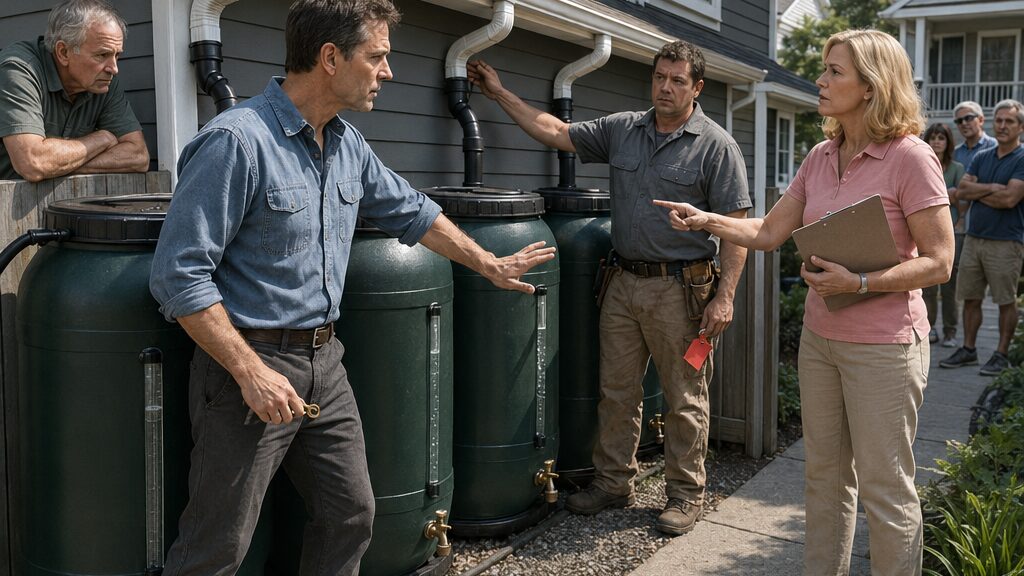
They Ordered Him to Remove the Rain Barrels Before the Street Needed Every Drop
Chapter 1: The Four Barrels Beside the Gray House
The contractor had one hand around the gutter connection when Andrew Harris stepped into the side yard holding an unopened violation notice.
“Don’t,” Andrew said.
The word was quiet, but it stopped the man more effectively than a shout.
Four dark-green rain barrels stood in a straight line against the gray siding, each one strapped to a low concrete base. Clear level tubes ran down their sides. Screened lids sat beneath the gutter splitters, and a narrow black overflow pipe disappeared behind the last barrel toward the back fence.
The contractor glanced toward Carol Baker.
Carol stood at the mouth of the side yard in a pink polo shirt, one hand holding a clipboard and the other resting on her hip. Two neighbors had slowed on the sidewalk. Another watched from behind a half-open garage door.
“We’re here under the architectural committee’s emergency authority,” Carol said. “The notice explains it.”
Andrew looked down at the envelope. His name had been printed above the words FINAL CORRECTIVE ACTION in red.
“It isn’t final if I haven’t had a hearing.”
“You received two prior warnings.”
“I received two requests for photographs.”
“And you refused to remove the barrels.”
“I refused to pretend a request for photographs was a removal order.”
Carol’s mouth tightened. She turned to the contractor. “Disconnect the downspout. We’ll leave the containers for him to dispose of.”
The contractor lifted his hand again.
Andrew stepped between him and the first barrel.
“I said no.”
One of the neighbors on the sidewalk slowed enough to stop pretending he was passing by. Andrew recognized the posture. Interest disguised as concern. He had seen the same thing at municipal work sites whenever a homeowner hoped an argument might become public.
Carol lowered the clipboard.
“These are visible from the street,” she said. “They don’t match the exterior standards. They may attract mosquitoes, create standing water, and redirect runoff onto neighboring property.”
“May?”
“That’s what the inspection is for.”
“No inspection was scheduled.”
“We’re inspecting now.”
“With a landscaping contractor?”
The contractor looked away.
Carol’s voice sharpened. “You’ve turned the side of your house into an industrial storage area.”
Andrew glanced at the barrels. Their surfaces were clean. The supply lines were clipped level. Every joint had been labeled in small black lettering no one could see from the sidewalk.
“They collect rain.”
“They’re ugly.”
There it was. Not safety. Not drainage. Not mosquitoes.
Ugly.
Carol seemed to hear herself, because she quickly added, “And they undermine the appearance standards everyone agreed to when they purchased here.”
Andrew slid a thumb beneath the edge of the envelope but did not open it.
“Section eight, paragraph four.”
Carol blinked. “What?”
“The covenant provision for forced exterior correction. It requires a documented hazard or a completed appeal before entry onto private property.”
“I know the covenants.”
“Then you know you can’t authorize disconnection this morning.”
Behind Carol, Samantha Wilson had appeared on her porch across the lane. She was holding a pruning glove in one hand. She did not wave.
Carol flipped through several pages on her clipboard. Her movements became brisker as she searched.
Andrew waited.
He had spent twenty years around people who mistook silence for uncertainty. In city meetings, silence made supervisors fill empty space with claims they had not intended to make. In the field, it made contractors look twice at a valve before turning it.
Carol found the page.
“This qualifies as a potential hazard.”
“Potential is not documented.”
“Do you want us to call county code enforcement?”
“You can call anyone you like.”
The contractor shifted his weight. “Ma’am, I’m not touching anything if ownership is disputed.”
“It isn’t disputed,” Carol said.
“It is now.”
Carol stared at Andrew as if he had arranged the interruption himself.
He reached behind the first barrel and withdrew a small brass key from his pocket. The metal was worn pale at the edges. He inserted it into the inspection latch and opened a narrow panel in the barrel’s upper side.
Inside, a stainless-steel mesh screen covered the inlet. A second screen protected the overflow port. Beneath them, a sealed diverter directed first-flush runoff into a separate pipe.
“No open standing water,” Andrew said. “No exposed inlet. No loose lid.”
He crouched and pressed his palm against the concrete base.
“Anchored at four points. Overflow is graded away from both foundations. The line discharges into the rear drainage swale, not Samantha’s yard.”
Timothy Nelson had joined the small gathering without Andrew noticing. The retired plumber leaned over the low fence separating his property from the lane.
“That a first-flush diverter?” Timothy asked.
“Yes.”
“What size overflow?”
“Two inch.”
Timothy nodded once, neither approving nor dismissing.
Carol took out her phone.
“What are you doing?” Andrew asked.
“Documenting the violation.”
She photographed the barrels from the narrowest angle, making the row appear crowded against the wall. Then she stepped closer to photograph the red corrective tag the contractor had brought.
The contractor had not attached it yet.
Carol held it against the first barrel with two fingers and took the picture anyway.
Andrew’s jaw tightened.
“That tag isn’t installed.”
“It reflects today’s enforcement action.”
“There is no enforcement action.”
“There will be.”
She turned the phone sideways and took another photograph. The red tag looked bright against the dark green plastic.
The watching neighbors now had a simple picture: four large barrels, a warning tag, and Andrew standing in the way.
Carol slipped the phone into her pocket.
“Emergency board hearing tonight. Seven o’clock. Clubhouse.”
Andrew finally opened the envelope. The first paragraph cited visual incompatibility. The second referred to possible water contamination. The third claimed that failure to permit access could result in daily fines.
At the bottom, Lisa Torres from the property-management company had signed electronically.
Andrew folded the notice along its original crease.
“You sent management a hazard summary without an inspection.”
“I sent the information available.”
“You sent your conclusion.”
Carol stepped closer. Her voice dropped low enough that the neighbors could not hear every word.
“Three people complained. One said the barrels were lowering buyer confidence. Another asked whether children could get into them. I’m responsible for addressing that before everyone starts building whatever they want beside their houses.”
“Then address what exists.”
“I am.”
“No. You’re addressing what it looks like from the street.”
For a moment, the anger left her face. Something more anxious took its place.
“You don’t know what happens when a board ignores a water hazard.”
Andrew waited, but she did not explain.
Instead she straightened and spoke loudly enough for the sidewalk audience again.
“Seven o’clock. Bring specifications, installation permits, and proof of drainage compliance.”
“There’s no county permit required for residential rain capture.”
“Then proving that should be easy.”
She signaled to the contractor, and they left without touching the system.
The neighbors dispersed more slowly.
Samantha remained on her porch. Their eyes met. Andrew expected her to say something, perhaps that Carol had gone too far, perhaps that the barrels did look severe from the road.
She looked down at the pruning glove and went inside.
Timothy stayed by the fence.
“You built all that yourself?” he asked.
“Yes.”
“Four barrels is more than most people need for tomatoes.”
Andrew locked the inspection panel and returned the brass key to his pocket.
“I don’t grow tomatoes.”
Timothy studied the gutter splitter, the overflow slope, and the clear level tubes.
“What are you expecting?”
“Rain.”
“That isn’t what I asked.”
Andrew picked up the contractor’s red tag from the gravel where it had been dropped.
Carol had left a faint thumbprint across the word REMOVE.
He carried it toward the trash, then stopped when he heard footsteps return at the front of the house.
Carol had come back alone.
She did not enter the side yard. She stood at the corner of the house, looking past the first three barrels.
Her attention had settled on the fourth.
Behind it, half concealed by the overflow line, a small pressure gauge was mounted to a narrow copper connection running into the ground.
Carol pointed.
“What is that measuring?”
Andrew closed his hand around the brass key.
“Not the barrels,” he said.
Chapter 2: The Hearing About What Neighbors Could See
The first image on the clubhouse screen had been cropped so tightly that the four barrels appeared to be leaning against Andrew’s house.
They were not leaning. The siding line in the corner of the photograph was.
Carol stood beside the screen with a wireless remote.
“This is the current exterior condition,” she said.
Andrew sat in the second row with a slim technical folder resting unopened across his knees. Twelve residents occupied the folding chairs around him. Samantha sat near the aisle. Timothy stood against the back wall with his arms folded.
At the front table, two architectural committee members flanked Lisa Torres, whose laptop displayed the property-management company’s logo.
Carol clicked to the next photograph.
The contractor’s red tag filled the center of the image.
“This morning, the homeowner prevented authorized corrective access.”
Andrew raised a hand.
The committee member nearest Lisa sighed. “You’ll have a chance to speak.”
“The tag wasn’t attached.”
Carol paused.
Andrew pointed toward the photograph. “She held it there for the picture.”
A murmur moved through the room.
Carol lowered the remote. “The image documents the planned corrective action.”
“It documents your fingers.”
Several heads tilted toward the screen. At the upper edge of the red tag, Carol’s thumb was visible.
Lisa leaned toward her laptop.
“Let’s keep this procedural,” she said. “Mr. Harris, you’ll be allowed to respond to each allegation.”
Carol advanced to a wider photograph showing the barrels from the sidewalk.
“The system is plainly visible from a common area and does not conform to approved exterior materials.”
Andrew opened the folder.
“The guidelines list prohibited materials. High-density polyethylene isn’t one of them.”
Carol looked to Lisa.
Lisa typed something, then said, “The committee retains discretion over unlisted modifications.”
“After review,” Andrew said. “I submitted a review request.”
Carol’s eyes moved toward him.
“When?” Lisa asked.
“Six weeks ago.”
“I have no application under your address.”
“I didn’t say application. I requested a technical site review before submitting because the form doesn’t cover water-capture systems.”
Lisa turned to Carol. “Did the board receive that?”
Carol placed the remote on the table.
“We received an informal email asking for someone to look at a proposed drainage modification. It did not include the required application fee.”
“The system was already installed when I sent it.”
“Which made it an after-the-fact request.”
“It made an inspection possible.”
Carol faced the residents again.
“The issue is larger than paperwork. Improperly stored water can breed mosquitoes, create contamination risks, damage foundations, and become accessible to children. The association cannot wait for an incident.”
Her voice remained controlled, but Andrew heard the tension underneath it. She was not inventing the concern entirely. She believed in it too strongly for that.
One of the committee members asked, “Are the barrels sealed?”
“Yes,” Andrew said.
“Can they be opened?”
“With a keyed inspection latch.”
“Can a child reach the lid?”
“A child can reach anything placed beside a house. The lid still can’t be opened without the key.”
Carol clicked to a photograph of the gutter connection.
“And what happens if the barrels overflow during a major storm?”
“The overflow line discharges to the rear swale.”
“Across common drainage property.”
“Into the drainage feature designed for roof runoff.”
Timothy uncrossed his arms.
“What fall did you put on that line?”
Andrew looked back at him. “Quarter inch per foot after the second elbow.”
“What diameter?”
“Two inch.”
“What’s the total capture capacity?”
“Eight hundred eighty gallons.”
The room went still.
Carol seized the number.
“Nearly nine hundred gallons of stored water beside one home.”
“Distributed across four anchored containers.”
“That amount is exactly why management was notified.”
Timothy pushed away from the wall.
“What load rating are the bases?”
“Three thousand pounds each.”
“First-flush volume?”
“Ten gallons per downspout before diversion.”
“Screens?”
“Three hundred micron at the inlets, finer at the hose outlets.”
Timothy looked toward Carol.
“Who performed the hazard inspection?”
Carol’s jaw shifted.
“The committee reviewed the installation.”
“From the sidewalk?”
“We inspected the visible condition.”
“That isn’t what I asked.”
Lisa stopped typing.
Timothy continued. “Did anyone open a panel? Test an anchor? Trace the overflow? Check the screens?”
“No one was permitted access,” Carol said.
Andrew turned in his chair. “No one requested it.”
“You refused access this morning.”
“After a contractor arrived to dismantle it.”
A second murmur crossed the room.
Lisa lifted both hands.
“All right. There was clearly a breakdown in process.”
Carol’s gaze snapped toward her. “The board acted on resident complaints and a reasonable safety concern.”
“Reasonable concern still requires documentation,” Lisa said.
The words did not exonerate Andrew, but they changed the room. Carol was no longer presenting an established hazard. She was defending an assumption.
Andrew placed the folder on the table nearest the aisle and opened it.
Inside were installation diagrams, material specifications, photographs of the concrete anchors, manufacturer sheets for the screened inlets, and a county guidance document confirming that no permit was required for his system.
Lisa reviewed the first pages.
“This is thorough.”
Carol remained standing.
“What isn’t in there?”
Andrew looked at her.
“The pressure gauge,” she said. “The one behind the fourth barrel.”
“That isn’t part of the rain-capture system.”
“Then why is it connected beside it?”
“It’s connected to a monitoring line.”
“For what?”
Andrew closed the folder halfway.
“The shared irrigation main.”
The residents shifted.
Carol stared at him. “You tapped into association infrastructure?”
“No. The gauge is on my private service branch before the isolation point.”
“Why are you monitoring it?”
“Because pressure changes.”
“That’s not an answer.”
“It’s the accurate one.”
Lisa turned another page. “Do you have readings?”
Andrew did not respond.
“Mr. Harris?” she asked.
He thought of the notebook in the bottom drawer of his workbench. Dates, times, pressure drops, recovery intervals. Numbers collected before dawn when the common sprinklers ran. Numbers that would lead to questions he did not want to answer in this room.
“Yes,” he said.
Carol folded her arms.
“Then provide them.”
“They aren’t part of this appeal.”
“If they relate to association infrastructure, they absolutely are.”
“They relate to my service branch.”
Timothy watched him from the back wall with a different expression now. Less skepticism. More concern.
Lisa tapped the folder.
“I’m willing to recommend a forty-eight-hour stay on enforcement while management reviews these specifications and arranges an inspection.”
Carol turned toward her. “The board has already issued a corrective deadline.”
“And management issued it based on the board’s summary,” Lisa said. “A summary that did not mention the homeowner’s technical review request.”
The silence that followed was not victory. Andrew could feel that immediately.
Carol sat down at last.
The committee voted to suspend removal for forty-eight hours. The contractor would not return. No fines would accrue until the inspection occurred.
A few residents nodded at Andrew as if he had won.
Then Lisa said, “The stay is conditional on full disclosure of any information relevant to the shared irrigation system.”
Andrew’s hand remained on the folder.
“I’ll provide the barrel specifications.”
“That isn’t what she asked,” Carol said.
Andrew looked toward the screen, where the cropped photograph still made his system appear crooked.
“I’m appealing a barrel violation.”
“And I’m asking whether you believe the neighborhood water system has a problem.”
He could have answered with one word.
Yes.
Instead he gathered the papers and slid them back into the folder.
“I’ll provide what relates to my property.”
The room cooled around him.
Samantha looked down. One committee member leaned back with visible frustration. Lisa closed her laptop halfway.
Carol did not smile, but she no longer looked cornered.
“Then the safety concern remains unresolved,” she said.
Andrew left before the chairs began scraping.
Outside, the air felt close and metallic. Storm clouds had gathered beyond the roofs, dark at their lower edges.
Timothy followed him into the parking lot.
“You had them,” Timothy said.
“I’m not trying to have anyone.”
“You had the review stopped. Then you made yourself look like you’re hiding something.”
“I am hiding something.”
Timothy’s eyebrows lifted.
Andrew unlocked his truck but did not open the door.
“The pressure has been drifting for weeks,” he said. “Small losses at first. Recovery taking longer after irrigation cycles.”
“How low?”
“Lower than it should.”
“Did you report it?”
“Not the latest readings.”
Timothy’s face hardened. “Why not?”
Andrew looked toward the clubhouse windows, where Carol’s silhouette moved behind the blinds.
“Because the last time I reported a system problem, management sent a contractor who changed the regulator without checking the downstream loss. Then they billed the association for a repair that didn’t fix anything.”
“That doesn’t answer why you stopped reporting it.”
“It answers enough.”
“No, Andrew. It explains why you’re angry.”
Timothy stepped closer.
“I checked my hose bib this afternoon. Pressure dropped nearly twelve pounds between three and four.”
Andrew’s hand tightened around the truck key.
The common irrigation cycle did not run at that hour.
“Was anyone watering?”
“Not on my side.”
A low roll of thunder moved across the neighborhood.
Timothy glanced toward the clouds.
“You think the main is going.”
Andrew looked back at the clubhouse, then toward the roofs beyond it.
“I think,” he said, “it already started.”
Chapter 3: The Storm Filled More Than the Barrels
The first barrel reached its marked limit at 11:47 that night.
Andrew saw the water rise into the clear level tube, shudder at the top line, and stop as the internal overflow engaged.
Rain hammered the roof hard enough to erase every other sound. Lightning flashed across the side yard, turning the four barrels white for an instant before the darkness returned.
He stood beneath the narrow eave in a rain jacket, one hand on the brass valve key in his pocket and the other holding a flashlight against his chest.
The overflow pipe should have carried excess water toward the rear swale.
Instead, the first junction vibrated.
Andrew crouched and aimed the beam beneath the barrels. Water moved through the pipe, but too slowly. Leaves and pale mulch had collected around the rear discharge where the landscaping crew had reshaped the common bed the previous week.
He swore under his breath.
The second barrel’s level climbed.
Across the lane, a porch light came on at Samantha’s house.
Her property sat several inches lower than his. Under ordinary rain, the shared swale carried runoff behind both houses. If the blocked outlet forced water back through the overflow line, it would spill along the side fence and cross directly toward her patio.
Andrew pulled the key free and opened the maintenance latch on the fourth barrel. Water trembled inside the chamber, dark and restless.
He could hear his father’s voice from years earlier, not as memory exactly but as instruction.
Never trust water because it looks still.
Andrew closed the latch and ran toward the rear fence.
The discharge outlet was buried beneath wet mulch and a folded strip of landscape fabric. He dug with both hands. Mud packed beneath his fingernails. The rain drove cold against the back of his neck.
A surge struck the blocked opening from inside.
Water burst sideways across the bed.
Andrew tore the fabric free. Leaves released in a dark clump, followed by a hard stream that shot into the swale.
For three seconds, the water moved correctly.
Then it backed up again.
The swale itself was blocked farther down.
A flashlight appeared on Samantha’s side of the fence.
“Andrew?”
“Stay on the porch.”
“My patio drain is filling.”
He climbed onto the low retaining edge and looked over. Water had begun spreading beneath her outdoor table, carrying petals and bits of mulch toward the back door.
“How high is it?”
“Over my shoes.”
“Get inside and move anything electrical.”
“My husband’s planters—”
“Leave them.”
She disappeared from the beam.
Andrew returned to the barrels. The third level tube had reached three quarters. He could not stop the roof runoff without disconnecting the downspouts, and doing that during the storm would dump the full flow beside his foundation.
He opened the lower service valve on the first barrel and attached a wide transfer hose. The other end ran to a cleanout port he had installed near the front drainage channel.
The brass key slipped once against the wet lock.
He wiped it on his sleeve and tried again.
The valve opened.
Stored water rushed forward, lowering the first barrel enough to accept more roof runoff. Andrew opened the balancing connections between the containers, distributing the load. Water traveled through the linked system in a controlled pulse.
The fourth barrel’s gauge settled.
He dragged a second hose beneath the side gate and laid it along the curb, directing discharge toward the storm drain at the end of the lane.
Headlights cut through the rain.
Carol’s SUV stopped near the mailbox cluster. She stepped out wearing a coat over her pajamas and held an umbrella that turned inside out almost immediately.
“What are you doing?” she shouted.
“Keeping the overflow out of Samantha’s house.”
Carol stared at the hose crossing the edge of the common walkway.
“You can’t discharge into the street.”
“Roof runoff is already going into the street.”
“This is stored water.”
“For six minutes.”
A flash of lightning revealed water racing along the curb toward the drain.
Carol looked past him at the barrels. “Are they overflowing?”
“No.”
“Then why is her yard flooding?”
“Because the rear swale is blocked.”
“Your system discharges into it.”
“So do six roofs.”
She opened her mouth, then stopped as Samantha called from the porch.
“The water’s going down.”
Andrew turned his flashlight toward the fence. The thin sheet across Samantha’s patio was retreating from the back door.
The second hose had bought enough time for the cleared section of swale to begin moving water again.
Samantha stepped into view, soaked from the knees down.
“You stopped it,” she said.
“Not yet.”
Andrew followed the rear line with his flashlight. Beyond Samantha’s fence, the swale crossed behind two more properties before reaching the common basin. The water remained high.
Timothy appeared through his side gate carrying a long-handled trenching shovel.
“Where’s the blockage?”
“Past the third lot.”
“You check the catch basin?”
“Not yet.”
Timothy looked at the barrels, then at the controlled flow along the curb.
“So they work.”
“They’re working.”
“That isn’t the same thing.”
“No.”
Together they moved behind the houses, following the swale through ankle-deep water. Carol came after them despite Andrew telling her to stay back.
At the third property, the water had pooled behind a recently installed decorative stone border. The landscaping contractor had built it across the shallow drainage route, leaving only a narrow gap packed with mulch.
Timothy drove the shovel under the stones.
Carol grabbed his arm.
“That border was approved.”
“It’s also a dam,” he said.
“You can’t dismantle common landscaping.”
A wave of runoff pushed over the top and spilled toward the lower yard.
Andrew crouched and pulled the first stone free.
“Document it tomorrow.”
Carol stood in the rain, breathing hard.
Then she bent down and lifted the next stone herself.
The three of them opened a channel. Water surged through, flattening ornamental grass as it moved toward the basin.
For several minutes, no one spoke.
The pressure against the swale dropped. Samantha’s patio cleared. The barrels continued accepting roof runoff without spilling beside the foundation.
Carol stared at the released channel.
“The contractor said this border wouldn’t affect drainage.”
“He was wrong,” Andrew said.
“You knew it was here?”
“I knew the swale had been narrowed. I didn’t know it was blocked.”
“Why didn’t you tell the board?”
“I did. Last month.”
Carol looked at him.
“Drainage obstruction near units fourteen through sixteen,” he said. “You acknowledged the email.”
Her face changed, though the rain made it difficult to read.
“I forwarded that to landscaping.”
“And closed it.”
“I was told it had been inspected.”
Timothy rested both hands on the shovel.
“Seems everybody keeps getting told things were inspected.”
Carol did not answer.
By two in the morning, the worst of the storm had moved east. The rain weakened to a steady fall. The four barrels stood full but stable, their level tubes nearly even.
Andrew checked every anchor, screen, and overflow connection. Nothing had shifted.
Carol waited near the side gate while Timothy returned home.
“You designed it for a storm like this,” she said.
“I designed it not to fail during one.”
“That’s not what I asked.”
He closed the last inspection panel.
She looked at the pressure gauge behind the fourth barrel.
“You said that wasn’t measuring the barrels.”
“It isn’t.”
“What does it say now?”
Andrew raised the flashlight.
The needle sat lower than it had on Monday, but not at zero. The shared irrigation line was under static pressure while the system remained unused.
“Enough for tonight,” he said.
Carol folded her arms against the cold.
“You keep answering the question beside the one I ask.”
“You keep asking after decisions are already made.”
She flinched as if the words had landed harder than he intended.
Then she looked toward the dark houses, their lawns shining beneath the streetlights.
“If there’s a problem with the shared line, I need to know.”
“You needed to know before you sent a contractor.”
“I’m asking now.”
Andrew thought of the notebook in his workbench. The oldest entries showed ordinary seasonal variation. The latest pages showed pressure losses that recovered more slowly each week.
He could have brought them to the hearing.
He had chosen not to.
“I’ll check it when the irrigation cycle starts,” he said.
Carol gave a tired, disbelieving laugh.
“You always make people wait until you’re ready.”
Andrew did not answer.
She left without saying good night.
At dawn, the storm had ended. Water dripped from the gutters in slow, regular taps. The barrels stood dark against the gray house, filled nearly to their lids.
Andrew walked barefoot through the wet side yard with a mug of coffee and watched the neighborhood sprinklers rise from the common lawn.
For half a second, nothing happened.
Then the heads coughed brown water. One released a weak fan that reached only a few feet. Another did not turn at all.
The pump housing near the common green gave a dull metallic knock.
Andrew set down the mug and went to the gauge.
The needle trembled at fifteen pounds, fell to eight, then dropped hard against the stop.
Zero.
He touched the glass as if pressure might return under his hand.
Across the lane, Samantha opened her front door and looked at the motionless sprinklers.
Farther down the street, other residents began stepping outside.
Behind Andrew, eight hundred eighty gallons of clean stormwater waited in silence.
In front of him, the shared system had nothing left.
Chapter 4: The Morning No Sprinkler Turned On
Samantha Wilson arrived with an empty watering can before Andrew had unlocked the first valve.
She stood at the opening of the side yard in rubber sandals, the dented metal can hanging from both hands. Behind her, the common lawn was already losing its storm-dark shine. The sprinkler heads remained raised but motionless, like small black pegs driven into the grass.
“I know it’s early,” she said.
Andrew looked at the watering can, then at her porch across the lane. Several clay pots had been pulled beneath the eaves during the storm. The flowers inside them leaned heavily, their stems bent under the previous night’s rain.
“They just got watered,” he said.
“The annuals did. The planters under the porch didn’t.” She glanced toward the barrels. “And the county alert says we’re not supposed to use household water outside.”
Andrew had read the alert fifteen minutes earlier. A pressure failure in the development’s irrigation network had forced the municipal department to isolate the shared branch while crews determined whether contamination had entered through the break. Drinking water remained available, but outdoor use was restricted until the damaged line could be tested.
“How much do you need?” he asked.
Samantha looked surprised by the question.
“Not much. Enough to keep the roots damp.”
Andrew stepped past her and opened the first inspection panel. The barrel’s clear tube showed nearly full. Eight hundred eighty gallons had sounded excessive in the clubhouse. This morning, with forty-three homes and a broken system, it looked small.
He took the brass key from his pocket.
Before he inserted it, Carol Baker’s voice came from the sidewalk.
“You shouldn’t distribute that.”
She approached carrying her clipboard beneath one arm. Her hair was still damp, and there were dark circles beneath her eyes. A white property-management vehicle was parked behind her SUV.
Lisa Torres got out of the passenger side while speaking into her phone.
Samantha’s fingers tightened around the watering-can handle.
Carol stopped beside the first barrel.
“The water hasn’t been tested,” she said.
“It came off my roof six hours ago,” Andrew replied.
“That doesn’t make it safe.”
“No one is drinking it.”
“You don’t control what people do after they leave your property.”
Andrew looked at Samantha. “Are you planning to drink it?”
“No.”
Carol ignored the question.
“If someone uses it improperly, slips on a hose, or claims their plants were damaged, the association could be drawn into it.”
“The association ordered the containers removed yesterday.”
“That doesn’t eliminate liability today.”
Lisa ended her call and joined them.
“The county inspector will be here this afternoon,” she said. “Until then, management recommends that no stored water be distributed through the common area.”
“This isn’t the common area,” Andrew said.
“The line of access is.”
There was no line yet. Only Samantha.
Andrew looked beyond Lisa and saw two more residents standing near the mailboxes. One held a plastic bucket. The other had brought a child’s small green watering can.
The sight irritated him more than Carol’s warning.
Yesterday, those same houses had watched a contractor arrive at his property. No one had stepped forward. This morning, people had found containers.
Samantha seemed to read the change in his face.
“I should have said something yesterday,” she said quietly.
Carol shifted. “This is not about who said what.”
Samantha kept her eyes on Andrew.
“I saw the contractor. I knew there hadn’t been a hearing. I stayed on my porch because I didn’t want Carol angry with me.”
Carol exhaled. “Samantha—”
“It was true.”
Andrew turned the brass key between his fingers. His father had filed one shallow groove into its side so he could identify it by touch. Andrew’s thumb found the groove now.
He could refuse everyone. The water was on his property. The system remained under dispute. Carol had made the liability argument for him.
He inserted the key.
The lock opened with a small metallic click.
Carol stepped closer. “Andrew, think carefully.”
“I am.”
He attached a short hose to the lower spigot and set Samantha’s can beneath it. The first turn of the valve released a cough of air. Then clear water flowed into the dented metal container.
Every head turned toward the sound.
It was ordinary water moving through an ordinary hose, but after the silent sprinklers and the county alert, it sounded louder than it should have.
Andrew watched the gallon marks inside the can.
“At two gallons, stop,” he told Samantha. “Pour slowly at the soil. Don’t wet the leaves.”
Carol’s expression shifted from alarm to disbelief.
“You stored all of this from last night?”
Andrew looked at the four level tubes.
“Every drop they could hold.”
He closed the valve at two gallons.
Samantha lifted the can. “Thank you.”
“This isn’t enough for lawns,” Andrew said loudly, turning toward the residents by the mailboxes. “It isn’t enough for everyone’s landscaping. Food plants, new trees, and anything that can’t survive two days without water come first.”
The resident with the bucket raised it slightly. “Who decides?”
“I do, while it comes from my tanks.”
Carol’s mouth tightened.
“That is exactly the kind of unmanaged distribution I warned about.”
Andrew faced her.
“Then manage the list.”
She blinked.
“You want association control now?”
“I want someone writing down addresses and amounts. You already have the clipboard.”
For a moment, neither moved.
Then Lisa took a pen from her bag and handed it to Carol.
“Documenting distribution would reduce uncertainty,” Lisa said.
Carol accepted the pen without looking at her.
By seven thirty, nine containers stood in the side yard. Andrew limited each household to two gallons. Timothy Nelson arrived with a folding table, a measuring pitcher, and the practical expression of a man who had decided criticism could wait until after the work.
He inspected the first barrel’s spigot.
“You’ll drain unevenly if you keep pulling from this one.”
“I know.”
“Then open the balancing line.”
“I’m keeping one isolated in case the others are contaminated.”
Timothy glanced toward the roof. “From what?”
“Dead animal in a gutter. Failed screen. Anything we haven’t seen yet.”
Timothy nodded. “Fair.”
Carol wrote addresses. She did not apologize for the day before, and Andrew did not offer to make it easier.
Samantha returned with her empty can and stood beside Carol.
“Andrew said two gallons per household,” Carol told her.
“I’m not asking for more. I’m helping carry for the woman at the end unit. She uses a walker.”
Carol checked the list and allowed it.
By nine, the neat row of containers extended from the side yard to the sidewalk. Plastic buckets, kitchen pitchers, a mop pail, and three proper watering cans waited beneath the gray wall. The four green barrels no longer looked like clutter. They looked like a boundary between people who had water and people who needed it.
That change unsettled Andrew.
He did not want their admiration any more than he had wanted their judgment. Both depended too much on what he could provide.
A county water-department inspector arrived shortly before ten. He tested the stored water, examined the sealed screens, and confirmed that it was suitable for non-potable landscape use.
“The storage design is better than most commercial kits,” he said.
Carol wrote that down.
Andrew noticed she underlined it once.
The inspector then examined the failed shared system with Timothy. They opened the metal irrigation enclosure near the common green. Mud had collected inside around the lower fittings. The controller displayed an error code, but the electrical components were intact.
Timothy knelt beside the main valve.
“Look here.”
He scraped wet soil away from the base of the enclosure. Beneath it, a narrow groove had formed through the compacted dirt.
Water had been moving there long before the storm.
Andrew crouched.
The soil along the branch fitting was stained orange-brown. Mineral deposits ringed the joint in several layers, each one marking an older leak line.
“That isn’t from last night,” Timothy said.
“No.”
“How old?”
Andrew touched the deposit with one finger. It flaked dry at the edge despite the wet ground.
“Months.”
Lisa leaned over them. “Could the storm have opened it further?”
“Yes,” Andrew said. “But it didn’t start it.”
Carol stood on the other side of the enclosure, still holding the distribution list.
“Would regular inspection have found that?”
Timothy looked up.
“If anyone had taken the cover off.”
No one spoke.
Andrew followed the leaking branch toward the pressure regulator. The bolts showed fresh tool marks. He remembered the contractor management had sent after his first warning. The regulator had been adjusted, but the downstream leak had continued pulling pressure from the system.
Timothy pointed toward a faded maintenance sticker inside the lid.
The inspection date was eight months overdue.
Lisa stared at it.
“I’ll check the service records.”
“You should check the invoices too,” Andrew said.
Carol looked at him sharply.
“You knew about this specific leak?”
“I knew pressure was falling.”
“That isn’t the same answer.”
“No,” he said. “It isn’t.”
Behind them, the first barrel’s clear tube had dropped below the top quarter mark.
The line of waiting containers still reached the sidewalk.
Timothy traced the mineral deposits with the end of a screwdriver. At the oldest ring, he stopped.
“Someone’s been tightening this fitting,” he said. “More than once.”
Carol lowered the clipboard.
“Who?”
Timothy looked toward the management vehicle, then back at the corroded joint.
“That’s what the maintenance records are going to tell us.”
Chapter 5: Every Drop Had a Cost
“You knew this could happen?”
Carol’s question carried across Andrew’s side yard, past the waiting residents and the falling water in Samantha’s dented can.
Andrew kept one hand on the valve. The clear tube beside him showed the first barrel at less than half capacity.
“I knew it was getting worse,” he said.
The water reached the two-gallon mark. He closed the spigot.
Samantha did not lift the can immediately.
Around them, conversation stopped.
Lisa Torres stood near the folding table with several printed service records. Timothy remained at the irrigation enclosure across the lane, where an emergency crew had exposed the failed branch. The old fitting lay on a tarp, its split widened by the storm but stained by months of leakage.
Carol came closer.
“How long have you known?”
“Known what?”
“That the shared line could fail.”
“I knew pressure recovery was slowing.”
“How long?”
Andrew looked at the residents. A man with a white bucket avoided his eyes. The woman holding the child’s watering can stared openly.
“Six weeks.”
Carol’s voice dropped.
“You installed these before that.”
“Yes.”
“But you increased the connections last month.”
Andrew did not answer quickly enough.
Carol saw it.
“You added capacity because of the pressure loss.”
“I finished the fourth barrel because the numbers changed.”
A low murmur passed through the line.
Samantha finally lifted her watering can. Her face held no accusation yet, which made Andrew more uncomfortable than anger would have.
Lisa opened the top service record.
“We received one written pressure complaint from Mr. Harris three months ago.”
“I sent two.”
“The second message was categorized as follow-up correspondence.”
“Because management closed the first request after changing the regulator.”
Lisa looked down at the paper.
“The contractor reported pressure restored to the approved range.”
“At noon, when the irrigation system was off.”
Timothy called from the enclosure.
“He’s right about that. Static pressure wouldn’t have shown the downstream loss.”
Carol turned toward Andrew again.
“Then why didn’t you send the later readings?”
The answer rose immediately: because you would have ignored them.
He nearly said it.
Instead he saw the service records in Lisa’s hands, the exposed fitting, and the containers waiting beneath his barrels. The evidence did not erase his choice. It only explained why he had made it.
“I stopped sending them,” he said.
Carol stared at him.
“You let the board hold a hearing about safety while you had records showing our system was failing.”
“The hearing was about my property.”
“The water system serves every property.”
“And the last time I tried to discuss it, I was billed for an inspection I didn’t request and told not to interfere with association equipment.”
“So you decided to watch it fail?”
“I decided to prepare for my own house.”
Carol gave a short, disbelieving laugh.
“And now you’re controlling who gets water.”
Andrew looked at the line.
“I’m measuring what’s available.”
“That isn’t the point.”
“No. The point is that you sent someone to dismantle the only reserve on the street.”
“And you said nothing that would have changed our understanding.”
The words landed because they were true.
Andrew bent to adjust the balancing line between the first and second barrels. Water moved through the clear connector, leveling the remaining supply.
Samantha set her can down.
“Arguing beside it won’t make more,” she said.
Carol turned away, but not before Andrew saw the strain in her face.
The emergency crew supervisor approached from the common green.
“We can isolate the split branch,” he said, “but the map we received doesn’t match the field layout. There’s an unmarked connection feeding the west landscaping zone.”
Andrew glanced at Timothy.
“That’s why pressure kept recovering after the scheduled cycle,” Timothy said. “The west branch must be bleeding down slowly.”
The supervisor unfolded a laminated system plan across the table.
“Do either of you know where this line was altered?”
Carol shook her head.
Lisa searched the service records.
Andrew knew.
Not the exact fitting, but the pattern. He had charted the delayed pressure recovery for weeks. Each evening, one zone held lower pressure longer than the others. He had marked the probable branch on a hand-drawn map inside his notebook.
The notebook was still in his workbench.
Carol followed his expression.
“You have something.”
Andrew looked toward his garage.
“Yes.”
“Bring it.”
The command in her voice almost stopped him.
Timothy wiped mud from his hands.
“Bring it because the crew needs it,” he said. “Not because she ordered you.”
Andrew went inside.
The notebook lay beneath a stack of unopened mail in the bottom drawer. Its cover was soft at the corners from use. When he opened it, dates and figures filled the pages in tight columns. Pressure before cycle. Pressure during cycle. Recovery time. Temperature. Suspected loss.
He had made the first entries for himself.
Later, he had kept recording because stopping would have felt like turning away from a leak he could hear but could not see.
He carried the notebook outside.
The residents watched him cross the yard.
At the table, he opened to a page marked with a folded corner.
“The west branch began holding low on the twelfth,” he said. “The loss became consistent on the nineteenth. Here.”
The crew supervisor traced Andrew’s sketched line.
“This connection isn’t on our map.”
“It was probably added when the common garden beds were expanded.”
Carol looked at Lisa.
“Was that approved?”
Lisa flipped through the records. “The landscaping contract mentions additional irrigation coverage. There’s no as-built drawing attached.”
Timothy tapped the sketch.
“If the unmarked branch crosses behind the mailboxes, we can isolate it here.”
The crew supervisor nodded. “That would preserve pressure to the fire-buffer strip while we repair the main split.”
Andrew showed them his recovery calculations. The numbers narrowed the likely connection point to a section beneath two decorative shrubs.
Within twenty minutes, the crew found the valve box hidden under landscape fabric.
When they closed it, the remaining system pressure rose by eleven pounds.
A few residents clapped once before realizing no one else had joined them.
Andrew wished they had stayed silent.
The small success did not repair the main line, but it stopped the hidden branch from draining what little pressure remained. The crew could now supply limited water to the common fire-buffer landscaping at scheduled intervals.
Timothy returned to the barrels.
“Your figures saved them half a day.”
“They should have had the figures weeks ago.”
Timothy looked at him. “Yes.”
There was no comfort in the agreement, only fairness.
By late afternoon, the second barrel stood nearly empty. The third remained above half. Andrew had stopped serving decorative lawns entirely. Residents accepted the restriction with varying degrees of grace.
Carol remained near the table even after Lisa left to call management. She had become quieter.
A woman approached with two large plastic tubs.
“I have hydrangeas along the whole north fence,” she said.
“One container,” Andrew replied. “Two gallons.”
“They cost hundreds of dollars.”
“So did everyone else’s landscaping.”
“I supported you at the hearing.”
Andrew remembered her chair had been empty.
“I didn’t see you there.”
“I emailed Carol afterward.”
Carol looked down at the list.
The woman flushed. “Fine. Two gallons.”
Andrew filled one tub.
When she left, Carol said, “You enjoy saying no more than you admit.”
He closed the valve.
“I’ve said yes all day.”
“Only after making everyone ask.”
The accusation was sharper because it reached beyond water.
Andrew’s hand moved toward the brass key in the lock.
“My system. My responsibility.”
“And everyone else’s dependence, now.”
“That wasn’t my choice.”
“No,” Carol said. “But keeping the warning to yourself was.”
Samantha returned from across the lane. Her granddaughter walked beside her carrying two empty pitchers for an elderly resident.
Samantha placed the dented can beneath the spigot.
Andrew opened the valve.
The flow had weakened. It no longer struck the bottom with force. It ran in a clear, narrow stream that made the emptiness above it visible.
Carol watched the level fall.
“How much is left?” she asked.
“Just under four hundred gallons.”
“For forty-three homes?”
“For the needs we approve, maybe through tomorrow morning.”
“We?”
Andrew glanced at the list she had maintained all day.
“You’ve been deciding too.”
Carol looked at the columns of names and amounts as if noticing her own handwriting for the first time.
The water reached two gallons. Andrew shut it off.
Samantha lifted the can, but the brass key caught her attention.
She leaned closer.
“Where did you get that?”
Andrew’s fingers closed around it.
“It was my father’s.”
Samantha’s eyes remained on the shallow groove along the key’s side.
“He used to mark his tools like that,” she said. “A single cut for the ones he carried outside.”
Andrew said nothing.
“I remember him watering the garden behind your old place,” she continued. “Before you moved here.”
Carol looked between them.
Samantha’s voice softened.
“That garden died during the shutoff, didn’t it?”
The remaining water settled inside the barrel with a hollow sound.
Andrew removed the key from the lock.
Samantha did not ask again.
She did not need to.
Chapter 6: The Garden He Could Not Save
Samantha placed the brass valve key on Andrew’s kitchen table and asked why he still carried it.
The key lay beside an old packet of tomato seeds he had taken from a drawer while searching for coffee filters. The paper packet was faded almost white at the folds. His father’s handwriting ran across the top in block letters: SAVE FOR SPRING.
“You brought this inside,” Andrew said.
“You left it in the barrel lock.”
“I was going back out.”
“You came in twenty minutes ago.”
Samantha sat across from him without removing her damp gardening shoes. Outside the window, the line at the barrels had thinned. Timothy was handling the final evening allotments.
Andrew picked up the key.
“I carry it because it opens the valves.”
“You could buy another key.”
“This one works.”
“That’s the kind of answer you give when the real one costs more.”
Andrew moved the seed packet away from the wet ring left by her glass.
Samantha watched his hand.
“I knew your father before you moved him into that house,” she said. “Not well. He used to come to the community garden when my husband was alive.”
“He liked talking to people who didn’t interrupt his instructions.”
“He liked anyone who let him correct their soil.”
Despite himself, Andrew almost smiled.
Samantha did not.
“What happened during the shutoff?”
He stood and carried his untouched coffee to the sink.
The kitchen window faced the narrow bed behind his house. Nothing grew there now except two stubborn clumps of rosemary. He had cleared the rest after moving in, telling himself he would plan it properly later.
“The city replaced a main near his street,” he said. “The job was supposed to take one day.”
“And it didn’t.”
“Three days. Then a contamination test failed, so outdoor service stayed off.”
“Where were you?”
“Across the county repairing a pump station.”
Samantha waited.
Andrew had learned that waiting could be used kindly too. He disliked it more in that form.
“My father called the first afternoon,” he said. “He said the garden would be fine.”
The tomatoes had been taller than the fence. Pole beans climbed strings Andrew had installed that spring. His father had spent weeks starting seedlings in paper cups along the kitchen windowsill.
“The second day, he asked whether I could bring water.”
“You couldn’t leave.”
“I could have.”
He turned from the sink.
“I told myself twenty thousand customers mattered more than one garden. That was true. It was also convenient.”
Samantha’s expression did not change.
“When you got back?”
“The restriction was still active. I brought containers from work. By then, the beds had gone dry in the heat. He tried to move water himself and fell beside the shed.”
“Was he hurt?”
“Bruised. Embarrassed.”
Andrew rubbed his thumb across the groove in the key.
“He never asked me again.”
The garden did not kill his father. Andrew knew the distinction and had repeated it often. His father’s health had already been failing. The fall had not caused the illness that followed.
But after the plants died, his father stopped going outside each morning. The kitchen blinds remained closed. Seed catalogs piled unopened near the chair.
“When I sold the house,” Andrew said, “I found barrels sketched on the back of an electric bill. He’d drawn gutter lines and storage tanks. Nothing detailed. Just the idea.”
“The ones outside are his design?”
“No. Mine.”
Samantha looked at the seed packet.
“But they started with him.”
Andrew sat again.
“I designed the system before I bought this house. The roof area, the average rainfall, the storage I could fit without blocking access. I chose the property because the side yard could hold four.”
Samantha leaned back.
“So when Carol said you were ruining the neighborhood, you weren’t protecting plastic tanks.”
“I was protecting something that works.”
“That too.”
The quiet between them lasted until Timothy knocked once and opened the back door.
“Last resident’s gone,” he said. “Third barrel is down to about a quarter. Fourth is still isolated.”
Andrew stood.
“Any change at the main?”
“Crew restored twelve pounds to the common strip. Not enough for normal cycles.”
Timothy noticed the key and seeds on the table but did not comment.
A car door shut outside.
Lisa Torres appeared through the side-yard gate carrying a folder. Carol followed several steps behind.
Andrew met them beneath the porch light.
Lisa did not waste time.
“Management has issued an emergency conservation directive,” she said. “All stored non-potable water within the development may be assigned to critical common landscaping until service is restored.”
Andrew stared at her.
“Assigned?”
“The fire-buffer strip along the western boundary is drying. The county has raised the fire-risk designation after the storm debris assessment.”
“You can restrict association water. You can’t confiscate mine.”
Lisa opened the folder.
“The declaration permits temporary access to private improvements when necessary to protect common property.”
Carol stood with her arms folded, but she did not look pleased.
Andrew read the cited section.
It covered emergency access for leaks, structural damage, fire suppression, and utility isolation. It did not specifically authorize taking privately stored water, but the wording was broad enough to create a fight.
“How much do you want?” he asked.
“All remaining capacity except what is reasonably necessary for household protection.”
“It isn’t drinking water.”
“Then management considers household necessity limited.”
Timothy stepped beside Andrew.
“You drain those tanks into the common sprinklers without controlling pressure, you’ll lose half through the broken system.”
Lisa looked at him. “The landscaping contractor says they can pump it into the irrigation enclosure.”
“The landscaping contractor built a dam across the drainage swale,” Timothy replied.
Carol closed her eyes briefly.
Lisa’s tone remained even.
“We have a duty to protect the common area. If Mr. Harris refuses voluntary release, management will seek emergency board authorization tonight.”
Samantha came to the doorway.
“And the residents’ gardens?”
“Private decorative landscaping is secondary.”
“My husband planted mine.”
Lisa’s expression softened, but only slightly.
“I understand. The priority is preventing broader property risk.”
Andrew looked toward the barrels. Their dark shapes stood beneath the eaves, no longer full enough to feel secure. He had opened them because people needed water. Now the same need was being converted into authority over what remained.
His first instinct was to lock every valve.
Carol spoke before he could.
“The directive is too broad.”
Lisa turned. “You asked management this morning to establish liability control.”
“I asked for distribution rules. Not confiscation.”
“The common strip affects every homeowner’s insurance exposure.”
Carol’s face tightened at the word insurance.
Andrew saw then that her fear had never been only appearance. It had lived beneath every clipboard and deadline, shaping the way she reached for control before information.
She noticed him watching.
“At another property,” she said, “years ago, a resident kept open rain containers behind a fence. A child got sick. No one could prove where the contamination came from, but the board had ignored complaints. The insurer dropped them during the claim.”
Her voice was flat, stripped of defense.
“I told myself I would never be on a board that waited.”
Andrew looked at the sealed lids of his system.
“You still had to look at what was actually here.”
“Yes.”
The admission came without apology.
Lisa checked the time on her phone.
“I need an answer.”
Andrew took the emergency directive and folded it once.
“No confiscation.”
Lisa’s shoulders stiffened.
“But I’ll give you a plan by sunrise.”
“A plan for what?”
“Keeping the fire-buffer strip alive without wasting the reserve through the broken main.”
“You can guarantee that?”
“No.”
“Then management can’t rely on it.”
Andrew handed the directive back.
“You relied on a contractor who inspected pressure while the system was off. You relied on an irrigation map that didn’t show an entire branch. You relied on a landscaping report that called a drainage blockage decorative improvement.”
Lisa held his gaze.
“What do you need?”
“The repair crew’s temporary hose, two backflow preventers, access to the west elevation drop, and authority to shut every ornamental zone that isn’t part of the buffer.”
Carol said, “The board can authorize the zone shutdown.”
Timothy added, “I can help build the bypass.”
Samantha looked at Andrew. “What about trust?”
No one else seemed to understand the question.
Andrew did.
He had spent weeks collecting numbers no one could use because he kept them in a drawer. He had built a reserve strong enough to help the street but designed control around a key only he carried.
He looked through the kitchen doorway at the seed packet beside the empty place where the key had rested.
“By sunrise,” he said, “the plan won’t depend on trust alone.”
Lisa closed the folder.
“We’ll meet at the irrigation enclosure at six.”
After they left, Andrew returned to the kitchen and opened the drawer beneath the workbench files.
Inside was a second brass key, newly cut and never used.
He placed it beside Timothy’s measuring pitcher.
Then he took out a clean sheet of paper and began drawing the bypass he should have shown someone before the water stopped.
Chapter 7: The Valve Only Andrew Could Open
“The replacement assembly won’t be here until Sunday.”
The emergency crew supervisor said it at six twelve Friday morning, standing beside the open irrigation enclosure with mud on his boots and a phone still in his hand.
Around him, the common green had gone dull at the edges. The western fire-buffer strip ran behind the last row of houses, a band of shrubs and low trees separating the development from an unmanaged field. Branches torn loose by the storm lay tangled in the dry grass beyond it.
Lisa Torres folded her arms.
“You said the line could be stabilized.”
“It can be isolated. Stabilized isn’t repaired.”
“How long can the buffer go without water?”
The supervisor looked toward the county water-department inspector.
“In this heat? Maybe a day before the shallow-rooted sections start stressing. Two before we lose some of them.”
Carol held a printed list of irrigation zones. Her thumb rested beside the western strip.
“And if we use the remaining pressure?”
“You’ll get weak flow at the lowest heads and nothing uphill.”
Andrew unrolled his drawing across the hood of Timothy’s truck.
The paper corners lifted in the morning breeze. Timothy set two wrenches on them to hold it flat.
“We don’t feed through the broken main,” Andrew said. “We bypass it.”
The supervisor leaned over the drawing.
Andrew had marked the four barrels at his house, the elevation drop toward the common green, the temporary hose route, and a connection point downstream of the isolated break.
“You want to gravity-feed from your storage tanks?”
“With a small transfer pump only at the rise. The rest follows the grade.”
“How much water is left?”
“About two hundred ninety gallons.”
Lisa looked at him. “That won’t sustain the whole strip.”
“It doesn’t have to. We soak the highest-risk root zones and leave the ornamental beds dry.”
Carol studied the drawing.
“The common roses are in that circuit.”
“They’ll have to wait.”
Several residents had gathered near the sidewalk. The woman with the hydrangeas stood among them, arms crossed. Samantha waited beside her granddaughter, who carried a coil of lightweight hose over one shoulder.
Lisa pointed to the barrels on the plan.
“If we commit the reserve, what remains for private use?”
“Almost nothing.”
A resident spoke from the group.
“So our gardens die to save association shrubs?”
Andrew looked toward the western strip.
“Those shrubs form the maintained buffer between the houses and the field. Storm debris has increased the fuel load. The county inspector listed that zone as the priority.”
“They’re still plants.”
“So are yours.”
“That isn’t an answer.”
“It’s the one we have.”
The resident muttered something and stepped back.
Andrew had heard the same frustration in his own voice the day before. Someone else deciding which loss mattered more. Someone else defining necessity.
He turned to the supervisor.
“Can your pump handle a controlled inlet under low head?”
“Yes, if the tanks are linked.”
“They are.”
“Backflow protection?”
“Two devices. One at the pump and one before the irrigation connection.”
Timothy lifted both from the truck bed.
The supervisor examined them and nodded.
Lisa looked at Andrew’s drawing again.
“What happens if your calculations are wrong?”
“We stop.”
“That simple?”
“No. That immediate.”
Carol glanced toward the residents.
“The board can authorize closure of every zone except the western buffer.”
Lisa answered, “Management will document it as an emergency variance.”
Andrew rolled the plan halfway closed.
“That isn’t enough.”
“What else do you need?” Lisa asked.
“Access control belongs to more than one person.”
He reached into his pocket.
The original brass key rested in his palm, worn smooth by his father’s fingers and then his own. From the other pocket, he took the new key he had cut the night before.
Timothy looked at it.
Andrew held it out.
“For the second valve.”
Timothy did not take it immediately.
“You sure?”
“No.”
A few residents gave nervous smiles, expecting a joke. Andrew did not smile with them.
Timothy accepted the key.
The metal disappeared inside his broad hand.
“If you tell me to close it, I close it,” he said.
“If the level in the third barrel drops below the red mark, you close it whether I tell you or not.”
“And if you’re wrong about the mark?”
“Then you argue with me after the water stops.”
Timothy slipped the key into his shirt pocket.
It was a small movement, but Andrew felt the change it made. The system no longer existed entirely inside his knowledge. Another person now held the means to stop it.
They began laying the temporary line.
The crew ran heavy hose from Andrew’s side yard, along the curb, and through the common green. Samantha’s granddaughter helped guide the lighter section under the fence while Samantha moved residents away from the connection points.
Carol marked the shut zones on the list. Each time someone objected, she repeated the same sentence.
“The western buffer is the emergency priority.”
By seven fifteen, the hose reached the downstream connection.
Andrew opened the balancing valves between the four barrels. Water shifted through the system with a low internal rush. The first two level tubes dropped slightly as the remaining supply equalized.
He inserted the old brass key into the first control lock.
Timothy stood at the second.
The supervisor waited beside the pump.
“On your count,” he said.
Andrew looked down the line.
Residents stood on lawns, porches, and sidewalks. Some had defended him. Most had not. None of that changed what the water could do.
“First valve,” he said.
He turned the key.
“Second.”
Timothy opened his valve.
“Third.”
The crew supervisor engaged the pump.
The hose jumped once, then settled. Air coughed through the irrigation heads at the western edge. For several seconds, nothing emerged.
The woman with the hydrangeas shook her head.
Then a thin fan of water spread from the first head.
A second rose uphill. A third sputtered and began turning.
The flow was not impressive. It did not sweep across the grass in shining arcs. It reached only the root zones Andrew had marked, darkening the soil in narrow circles.
But it reached them.
Samantha pressed a hand to her mouth.
Timothy watched the pressure gauge attached to the temporary line.
“Holding at nine.”
“Keep it there,” Andrew said.
Carol walked the buffer strip with the county inspector, closing heads that watered empty patches. Each closure pushed a little more pressure uphill.
The highest section remained dry.
Andrew adjusted the transfer rate.
The level in the first barrel fell. Then the second.
At the far end, one final sprinkler lifted and released a weak, steady stream beneath a young tree whose leaves had already begun to curl.
A cheer started among the residents, uncertain and brief.
Andrew kept his eyes on the gauge.
“Don’t celebrate yet.”
The pump’s tone changed.
Timothy turned toward the barrels.
“Third tank is approaching red.”
“Close the ornamental branch at the corner.”
Carol hurried to the marked valve box and shut it herself. The pressure recovered.
Lisa stood beside Andrew, watching the water line descend.
“How long?”
“Twenty minutes at this rate.”
“That’s all?”
“That’s what’s left.”
She looked toward the houses.
“We could order private stores from elsewhere.”
“You can request them.”
“You don’t think people will volunteer?”
“I think they should be told exactly where the water goes and who controls it.”
Lisa absorbed the answer without defending herself.
The first barrel emptied with a hollow knock. Andrew isolated it. The second followed eight minutes later.
The entire system now depended on the final two.
The crew supervisor checked the soil at the first root zone.
“Enough there. Shift uphill.”
Carol and Samantha moved along the strip, closing lower heads. Water traveled farther toward the rise.
Andrew had designed the barrels to hold water, not to send it away. Every connection he had chosen, every anchor he had set, had been built around keeping a reserve when others had none.
Now the clear tubes showed that reserve leaving.
The third level reached the red line.
Timothy placed one hand on his key.
“Andrew.”
“I see it.”
“The upper tree needs another five minutes.”
“It gets three.”
The county inspector looked back from the rise.
“Four would make the difference.”
Andrew studied the fourth barrel. He had kept it isolated through distribution in case contamination entered the linked system. Its water had tested clean. It contained the last protected supply on his property.
He unlocked the balancing line.
The fourth barrel joined the others.
Water surged through the clear tube.
Timothy said nothing. He only kept his hand near the valve.
The upper sprinkler strengthened.
For four minutes, the tree’s root bed darkened from dusty brown to nearly black.
Then Andrew nodded.
Timothy turned the second key and closed the line.
The pump wound down.
Silence moved along the hose.
The first three barrels were empty. The fourth held less than thirty gallons.
Andrew removed his key.
The western buffer glistened in patches. It was not restored. It had been given time.
The crew supervisor clapped Andrew once on the shoulder.
“That’ll hold until tomorrow’s trucked supply.”
Residents began drifting back toward their houses. No one asked for the remaining water.
Samantha came to stand beside Andrew.
“You opened all four.”
“Yes.”
“Your father would have approved.”
Andrew looked at the nearly empty tubes.
“He would have complained about the hose routing.”
“That too.”
Carol approached carrying a manila folder. Mud marked the knees of her slacks. Her face looked older than it had at the hearing.
She held out a single printed page.
Andrew recognized the subject line before he took it.
REQUEST FOR TECHNICAL SITE REVIEW—RAIN CAPTURE AND DRAINAGE IMPACT.
His email from six weeks earlier.
Below it, a chain of internal notes showed that Lisa had forwarded the request to Carol. Carol had written: Hold until architectural application is complete. Avoid implying preliminary approval.
Andrew read the date twice.
“You had it.”
Carol did not look away.
“Yes.”
“You told the hearing it was an informal email.”
“It was.”
“You withheld the request.”
“I delayed it.”
“Until after removal.”
Her fingers tightened on the folder.
“I thought if I allowed a technical review first, you would treat it as permission. Then every resident with a container and a gutter hose would demand the same.”
“So you made sure no one looked.”
“Yes.”
The admission was barely louder than the water still dripping from the final sprinkler.
Carol glanced toward the emptied barrels.
“I brought it because withdrawing the violation isn’t enough.”
Andrew folded the page once along the center.
“What happens now?”
“That depends on what the board is willing to see when it isn’t cropped.”
Chapter 8: What the Neighborhood Chose to Keep
Carol had already read the withdrawal of the removal order before Andrew entered the clubhouse.
He heard the last sentence from the hallway.
“All fines, corrective deadlines, and access demands related to the Harris rain-capture system are rescinded effective immediately.”
No applause followed.
Andrew was grateful for that.
He stepped into the room carrying the same technical folder he had brought three weeks earlier. This time, the pressure notebook rested on top of it.
The barrel photographs remained on the screen, but they had changed. One showed the full side yard instead of the tight crop. Another showed the anchored bases, screened inlets, labeled lines, and overflow route.
At the front table sat Lisa Torres, the two architectural committee members, and Carol. Timothy occupied a chair in the first row. Samantha sat beside her granddaughter near the aisle.
Nearly every folding chair was filled.
Carol looked at Andrew and then down at the page in front of her.
“The withdrawal addresses the enforcement action,” she said. “It does not resolve the policy question.”
One committee member cleared his throat.
“The association currently has no approved standard for residential rain capture. We either prohibit visible systems under the existing exterior rules or adopt inspection requirements.”
A resident near the wall raised her hand.
“Can we decide after seeing the proposed standard?”
Lisa distributed copies.
The draft did not legalize everything. Containers had to be sealed, anchored, screened, and placed on graded bases. Overflow routes required inspection. Capacity above a set amount needed a simple plan. Stored water could not be connected to household plumbing. The systems could remain visible if properly maintained, though optional screens were encouraged.
Several provisions had come from Andrew’s design.
Others had come from Timothy, the county inspector, and management’s insurer.
Carol did not claim authorship.
Andrew took his seat but left the folder on his knees.
Lisa summarized the infrastructure audit. The shared irrigation main had suffered a long-term leak, worsened by an undocumented landscaping branch and missed maintenance. The association would replace the damaged section, update the system map, and require pressure testing under active load.
“The landscaping contractor’s work will also be reviewed,” she said. “Management accepts responsibility for relying on incomplete service reports.”
Her voice remained professional, but she did not hide behind it.
One resident asked whether fees would increase.
“Temporarily,” Lisa said. “Repair reserves are insufficient.”
The room reacted more strongly to that than it had to the withdrawn violation.
Andrew understood. Principles were easier to support than invoices.
Another resident stood.
“Why are we rewarding a homeowner who knew the system was failing and didn’t report it?”
Heads turned toward Andrew.
Carol looked at him but did not intervene.
He could have answered by listing every ignored email, every incomplete inspection, every decision made before anyone looked at his work. All of it was true.
He set the technical folder on the empty chair beside him.
“I reported the first pressure loss,” he said. “When the response didn’t fix it, I kept measuring.”
“And kept it to yourself,” the resident said.
“Yes.”
The single word quieted the room.
Andrew looked toward the pressure notebook.
“I told myself I was documenting my own service branch. I told myself management had already decided what kind of person I was, so giving them more information would only give them more ways to dismiss me.”
He paused.
“The numbers did not belong only to me.”
Timothy leaned back in his chair, watching without rescuing him.
Andrew continued.
“The board acted without inspecting my system. Management relied on incomplete records. Those failures mattered. So did mine.”
Carol lowered her eyes.
A woman in the second row asked, “Would your warning have prevented the break?”
“I don’t know.”
“Then why blame yourself?”
“Because preventing the break isn’t the only measure. A complete warning could have changed how we prepared.”
He looked at the screen. In the full photograph, the four barrels appeared orderly but unmistakable against the gray house.
“I built storage because I expected the system to fail before anyone admitted it was weakening. That made me prepared. It did not make me cooperative.”
No one spoke for several seconds.
Then Samantha raised her hand.
“My garden received the first two gallons,” she said. “Andrew could have kept every gallon behind his gate. He didn’t.”
The resident who had challenged him replied, “That doesn’t erase what he withheld.”
“No,” Samantha said. “It doesn’t.”
Her agreement ended the argument more effectively than defense would have.
Carol stood.
She had not worn the pink polo. She wore a plain blue blouse with no committee logo.
“Before the vote,” she said, “there is one additional matter.”
She placed Andrew’s technical-review email on the table.
“I received this request six weeks before the enforcement action. I delayed it because I believed a review would weaken our ability to require a formal application.”
The room shifted.
One committee member turned toward her.
“You told us there was no completed request.”
“There was no application. There was a request for inspection.”
“That distinction should have been disclosed.”
“Yes.”
Carol’s hands rested flat on the table.
“At a development where I served on a committee years ago, open rain containers were reported repeatedly. A child later became ill. No source was conclusively established, but the board had ignored the complaints, and the consequences lasted for years.”
Her voice tightened, then steadied.
“I decided that moving quickly was safer than being accused of waiting. I used that fear to justify treating a technical question as an enforcement problem.”
She looked toward Andrew.
“The fear was real. The decision was still mine.”
No apology followed immediately. The restraint made the statement feel less rehearsed.
Carol turned to the full room.
“I am resigning as architectural chair after tonight’s vote.”
A few residents protested. Others remained silent.
She lifted one hand.
“This is not because standards are unnecessary. It is because enforcing them requires accurately presenting what is known, including information that complicates the decision.”
Andrew watched her sit.
He did not forgive her in that moment. Forgiveness was not a switch that could be turned by one honest statement. But the room no longer held only the cropped version of either of them.
The vote began.
The first committee member supported the inspection-based standard. The second requested an amendment requiring annual screen checks for systems above five hundred gallons. Timothy approved of that from the first row.
Residents voted by raised hands.
The standard passed by a wide margin, though not unanimously.
The hydrangea owner voted against it.
Lisa recorded the result.
Three weeks earlier, Andrew had wanted only to keep people out of his side yard. Now his design had become part of the association’s rules. The outcome felt less like victory than responsibility written down.
After the meeting, Carol waited near the door.
“The screen around your barrels,” she said. “The draft says it’s optional.”
“I know.”
“Are you installing one?”
“Partial screen. Enough to soften the view without blocking inspection.”
She nodded.
“That seems reasonable.”
Andrew almost told her that reasonableness would have helped six weeks earlier.
Instead he said, “The access panel stays on my side.”
“Of course.”
They stood in an awkward silence.
Carol looked toward the residents leaving the clubhouse.
“I didn’t expect you to admit your part tonight.”
“I didn’t expect you to admit yours.”
“That doesn’t make us even.”
“No.”
She accepted the answer.
Outside, Samantha and Timothy were waiting beside his truck. Samantha’s granddaughter held a small cardboard tray of young plants.
“For the rain garden,” Samantha said.
The association had approved the first shared planting bed beside the common walkway, positioned where runoff from Andrew’s overflow line could be directed during future storms. It would hold native grasses, low flowers, and deep-rooted plants capable of slowing water before it reached the swale.
They walked back together.
The four barrels remained beside the gray house. Andrew had built a simple cedar screen across the street-facing half, leaving the level tubes, valves, and inspection panels accessible from the yard. The dark green surfaces were still visible between the slats.
He had decided not to hide them completely.
The new irrigation line had been installed beneath the common green. A brass plate inside the enclosure now showed every branch, including the one behind the mailboxes. Pressure readings would be logged monthly and shared with management and the board.
Timothy had the second key on his own ring.
Andrew was still adjusting to that.
At the new rain garden, Samantha set the plant tray on the ground. The bed was shallow and curved, lined with dark soil and pale stones. Her late husband’s surviving flowers had been divided into small clusters along one edge.
“You ready?” she asked.
Andrew attached a narrow hose to the fourth barrel. Summer rain earlier that week had refilled it halfway.
He handed Samantha the old brass key.
She looked at the groove along its side.
“This one?”
“This one.”
She inserted it into the lock.
The valve resisted at first. Andrew started to reach for it, then stopped.
Samantha adjusted her grip and turned again.
The lock opened.
Water moved through the hose and into the new bed, darkening the soil around the first young plants. It spread slowly rather than rushing away.
Timothy checked the flow.
“Could use another stone near the lower edge.”
“You always need another stone,” Samantha said.
Her granddaughter laughed.
Across the lane, Carol stood beside her mailbox holding a stack of envelopes. She watched for a moment, then gave Andrew a small nod.
He returned it.
Nothing between them was repaired completely. She was no longer chair, but she was still the neighbor who h