The Woman Who Waited for the Police to Humiliate Her Neighbor Got the Wrong Kind of Siren
Chapter 1: The Patrol Car Stopped Where Everyone Could See
The patrol car slowed in front of Benjamin Hall’s house just long enough for three neighbors to stop pretending they were checking their mail.
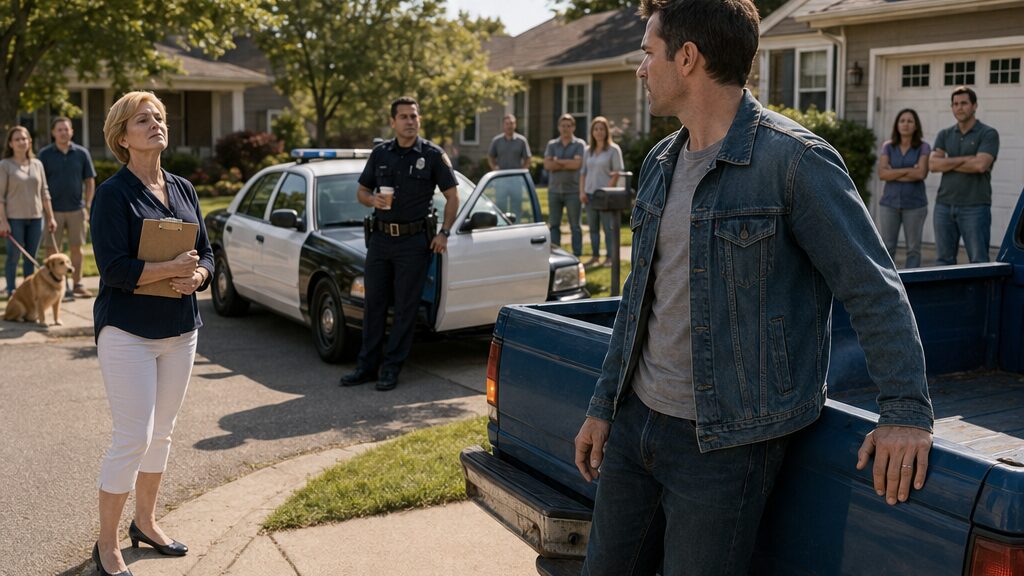
It was a clean Saturday morning in Mill Creek Estates, the kind of neighborhood that made every garbage bin look guilty if it sat at the curb past noon. Lawns were clipped low. Porch flags hung straight. Sprinklers ticked behind white vinyl fences. Benjamin stood in his driveway with one hand on the open tailgate of his old blue pickup, watching the black-and-white cruiser roll toward him like the answer to a question he had not heard anyone ask.
Across the street, Nancy Carter stepped out from the shade of her porch.
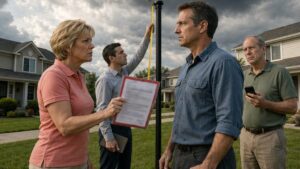
She did not hurry. That was what Benjamin noticed first. She moved with the careful patience of someone who had waited for a moment and wanted to be seen receiving it. Her short blond hair was set neatly away from her face. A sleeveless navy blouse, white capris, clipboard tucked under one arm. She looked less surprised by the patrol car than satisfied.
Benjamin wiped his palm on his jeans.
The cruiser stopped at the curb between his driveway and the Carter house. No siren. No flashing lights. Still, the parked car changed the shape of the street. A garage door two houses down paused halfway open. A woman walking a small dog shortened the leash and slowed her steps.
Nancy crossed the street.
“I told you someone would come,” she said.
Her voice was not loud, but it was pitched for the sidewalk.
Benjamin looked at her, then at the patrol car. “Let’s find out why.”
Her mouth tightened, not quite a smile. “I think we both know why.”
Benjamin did not answer. That was usually his safest choice with Nancy Carter. Anything he said became a sentence she could quote at the next homeowners’ meeting with the edges sharpened. So he closed the tailgate, pressed it until the latch caught, and waited.
The officer stepped out with a paper coffee cup in one hand and his other resting lightly near his belt, relaxed enough that Benjamin’s shoulders lowered a fraction. He was around forty, maybe younger, with a calm face and the practiced squint of someone who had spent too many mornings looking across sunlit windshields.
“Morning,” the officer said. “Benjamin Hall?”
“That’s me.”
“Christopher Rivera.” He gave a small nod, not quite formal, not quite familiar. “You own this blue pickup?”
Nancy’s chin lifted.
Benjamin heard the faint intake of her breath. The whole street seemed to lean into the question. Even the dog walker had stopped near the corner, pretending to adjust one sandal.
“Yes,” Benjamin said. “It’s mine.”
Nancy looked toward the truck with open vindication now. “Officer, I’m glad you asked that. We’ve had some concerns about—”
Officer Rivera raised a hand, polite but firm. “Ma’am, give me one second.”
The interruption landed softly, but it landed. Nancy’s lips pressed together.
Benjamin looked at the truck. The faded blue paint had dulled almost gray along the hood, the front bumper carried a shallow dent from before he owned the house, and the driver’s side mirror had a strip of black tape at the seam. It was not pretty, but it was clean. He washed it every other week, more often than he washed his own car. The tires were good. The tags were current. It sat fully in his driveway, not on the sidewalk, not on the lawn, not blocking anything.
Still, he could feel how Nancy saw it: a bruise in a row of polished doors.
Officer Rivera pointed toward the front of the truck. “Your headlights are on.”
Benjamin blinked.
For one second, he did not understand the words. He had prepared himself, without admitting it, for a complaint, a question about parking, maybe something about a suspicious vehicle. But the officer’s finger was aimed at the dull yellow glow still burning inside the pickup’s headlamp housings.
“You probably bumped the switch,” Rivera said. “I was passing through after a call on Briar Lane and saw them on. Figured I’d stop before your battery died.”
Nancy’s face changed so quickly that Benjamin almost felt sorry for her. The certainty drained first. Then the color rose beneath her makeup, a careful flush that climbed from her neck.
“That’s it?” she asked.
Officer Rivera glanced at her. “That’s it.”
Benjamin walked to the driver’s side, opened the door, and reached inside. The cab smelled faintly of vinyl, dust, and the pine air freshener Amy had hung there two days ago because she said the truck smelled like old coins. He turned the switch until the headlights blinked out.
When he straightened, the front of the truck looked suddenly lifeless.
“Thank you,” Benjamin said.
“No problem.” Rivera took a sip from his coffee. “These older batteries don’t forgive much.”
Benjamin almost smiled. “No, they don’t.”
Nancy shifted the clipboard against her ribs. “Officer, since you’re already here, there are standing community standards regarding vehicles in visible areas. I’m on the HOA board, and this truck has been the subject of—”
“Ma’am,” Rivera said, still calm, “that’s not a police matter unless it’s illegally parked, abandoned, blocking access, or connected to a safety complaint. From where I’m standing, it’s on private property.”
“It has been a concern,” Nancy insisted.
Rivera looked from Nancy to the truck, then back to Benjamin. He did not roll his eyes. He did not smile. He had the decency not to enjoy it.
“I stopped because the lights were on,” he said. “That’s all.”
The garage door two houses down began moving again. The dog walker tugged the leash and continued toward the corner. The street released its breath, disappointed and entertained in equal measure.
Benjamin closed the truck door.
Nancy did not move. Her eyes stayed on the pickup as though the officer’s explanation had not removed the violation but merely delayed its proper name.
Rivera returned to his patrol car. Before getting in, he turned once more toward Benjamin. “Have a good morning.”
“You too, Officer.”
The cruiser pulled away, its tires whispering over clean asphalt. No siren. No lights. Just a city vehicle leaving behind a silence that felt louder than its arrival.
Benjamin picked up the socket wrench he had set on the tailgate earlier, though he had forgotten what he meant to tighten. He could feel Nancy still standing there.
She crossed halfway into his driveway without invitation, stopping just beyond the invisible line where neighborliness ended and trespassing began.
“You must think that was funny,” she said.
“I think my battery would’ve died.”
Her eyes narrowed. “You know, Benjamin, people notice things. They notice when standards start slipping.”
“The truck’s in my driveway.”
“It’s visible from the street.”
“So is your porch furniture.”
“That’s different.”
“I’m sure it is.”
He regretted saying it as soon as the words left his mouth. Not because it was cruel. Because it was enough. Nancy’s face hardened with the relief of being offended. She could use offended.
“You’ve ignored three courtesy reminders,” she said.
Benjamin’s grip tightened around the wrench. “I haven’t received three.”
“That doesn’t make them disappear.”
He looked toward his front door. The porch was clean. The brass mailbox was empty. The only thing taped near the frame was a faded note Amy had stuck there that morning: grocery list on the back of a receipt, written in pencil, because she still apologized every time she used his kitchen.
“What reminders?” he asked.
Nancy hugged the clipboard closer. “The association prefers not to escalate things. But when owners refuse to cooperate, the board has procedures.”
“What procedures?”
Her expression shifted again. Not triumph this time. Something colder, more settled.
“You’ll see,” she said. “The paperwork will speak louder than that officer did.”
Then she turned and crossed back to her side of the street, her sandals tapping the asphalt in even little strikes.
Benjamin stood beside the blue pickup until she disappeared through her front door. He looked down at the wrench in his hand, then at the darkened headlights.
For the first time that morning, he wondered who had really called whom.
Chapter 2: The Notice Taped Beside the Porch Light
The white envelope was taped beside Benjamin’s porch light so neatly that it looked less delivered than displayed.
He found it after lunch, when the sun had shifted hard against the front of the house and the brass light fixture threw a bright reflection over the envelope’s plastic window. He had gone out to bring in the empty trash bin, mostly because Nancy’s words had sat under his skin all morning: The paperwork will speak louder.
The envelope bore the Mill Creek Estates Homeowners Association logo in blue ink, a sketched oak tree above a row of identical roofs. Under his name was his address, printed perfectly. Under that, in smaller capital letters, was: NOTICE OF VIOLATION.
Benjamin stood on the porch without touching it.
Across the street, Nancy’s blinds were angled shut.
He peeled the tape slowly so it would not tear the paint. The envelope came free with a dry snap. Inside were four pages: one formal notice, two printed photographs, and a copy of a section from the community rules. The first photograph showed his blue pickup in the driveway. The second was taken from an angle near Nancy’s front yard, zoomed close on the dented bumper and taped mirror.
He read the first paragraph twice.
Dear Mr. Hall,
This notice concerns repeated violations of Mill Creek Estates Exterior Maintenance and Vehicle Visibility Standards, including but not limited to the continued storage of a visibly deteriorated vehicle within street-facing view, failure to respond to prior courtesy notices, and concerns regarding community safety and neighborhood appearance.
Benjamin felt his jaw tighten.
Visibly deteriorated.
He looked past the paper toward the truck. The blue pickup sat where it always sat, squared between the driveway seams. He had replaced the windshield wipers last month. Changed the oil himself. Kept jumper cables behind the seat, registration in the glove box, tire gauge in the cup holder. It had started every morning except once in February, when the cold got into the battery.
The truck was not deteriorated. It was old.
Those were different things. At least, they were to him.
The front door opened behind him before he could fold the pages away.
Amy Walker stood barefoot just inside the threshold, wearing one of Benjamin’s old sweatshirts and holding a mug of tea in both hands. Her dark hair was pulled into a careless knot. She glanced at the envelope, then at him, and her face went still.
“What is it?”
“HOA notice.”
Her eyes dropped to the truck. “Because of me?”
“No.”
“Ben.”
“It’s about the truck.”
“That’s because I’m here and they’re looking harder.”
He stepped inside and shut the door. The cool house smelled like toast and laundry detergent. Amy had washed the guest towels that morning without asking, as if she needed proof she was not just occupying space.
“It’s not because of you,” he said.
She set the mug on the small table by the entry. Her fingers left faint damp crescents on the ceramic. “What does it say?”
“Nothing that can’t be handled.”
“That is not an answer.”
Benjamin folded the notice, but Amy reached out. Not forcefully. Just enough that he would have had to make a scene to keep it from her. He let her take it.
He watched her read. First the official paragraph. Then the fine schedule. Then the copied section about vehicles visible from the street. Her face did not crumble. That would have been easier. Instead, she went quiet in the way she had gone quiet after losing the apartment, after packing everything she owned into black trash bags because boxes cost money she did not want to ask him for.
“Forty-eight hours,” she said.
“I saw.”
“Two hundred dollars if not corrected. Then daily fines.”
“I saw that too.”
She turned the page. “Possible towing at owner expense.”
Benjamin looked away.
There it was, in print. The part that made the house feel smaller.
Amy lowered the notice. “I can go.”
“No.”
“I can stay at the motel near the highway for a few nights.”
“No.”
“I still have some cash.”
“Not enough.”
“You don’t know that.”
“I know what motels cost.”
Her mouth closed. She had always hated when he sounded like their father, practical in a way that left no room for argument and no room for pride. Benjamin hated it too, but sometimes it came out before he could soften it.
Amy looked toward the front window. The pickup’s hood was visible through the blinds, a wedge of blue beneath the bright afternoon. “If the truck wasn’t here, would they stop?”
“They’d find something else.”
“You don’t know that.”
“Yes,” he said. “I do.”
She gave him the notice back. “You ignored the earlier ones?”
“I didn’t get earlier ones.”
“Did you check the HOA portal?”
Benjamin did not answer.
Amy’s expression changed. Not anger. Recognition.
“Ben.”
“I don’t use it.”
“You own a house in an HOA and you don’t use the HOA portal?”
“I pay dues through autopay. That’s all I need it for.”
“That is exactly how people get fined.”
“I shouldn’t have to log in to find out my neighbor is taking pictures of my driveway.”
“No. But if you don’t respond, they get to say you refused.”
He heard the frustration under her words, and worse, he heard fear. Not fear of Nancy. Fear of becoming a problem big enough that Benjamin would eventually resent her for it.
He took the papers to the kitchen table and spread them flat. The photographs looked worse indoors. Under the clean white light, the truck seemed accused from every angle. The dent looked larger. The tape on the mirror looked careless. Whoever took the pictures had avoided showing the fresh tires, the valid tags, the driveway lines.
Amy stood across from him. “Let me help pay the fine.”
“No.”
“I have to do something.”
“You’re doing enough.”
“I’m sleeping in your guest room and parking my life in your garage.”
“You’re my sister.”
“That doesn’t make it nothing.”
Benjamin looked at the kitchen window. The late sun caught the truck’s windshield and sent a faint reflection across the glass. For a moment, the reflection looked like headlights again, two pale spots trembling over the dark kitchen.
He thought of the officer’s hand pointing toward the truck. Your headlights are on. Didn’t want your battery to die.
A small, ordinary kindness. That was all it had been.
And somehow Nancy had turned the same morning into a paper trail.
Amy picked up the copied HOA rule. “It says vehicles must be maintained in an ‘aesthetically acceptable condition’ as determined by the board.”
“That means whatever they want it to mean.”
“It also says exceptions can be requested.”
“I’m not asking Nancy for permission to keep Dad’s truck.”
The words landed harder than he intended.
Amy looked down.
Benjamin rubbed a hand over his face. He had not meant to bring their father into it. Not like that. Not as a shield. Not in the kitchen, with the notice between them and the blue hood visible through the window.
“I’ll handle it,” he said.
“How?”
He gathered the pages and slid them back into the envelope. “I’ll call the property manager Monday.”
“That’s not handling it. That’s waiting.”
“It’s Saturday.”
“You could email.”
“I’m not writing some long explanation for them to pass around.”
“So you’ll say nothing?”
He did not answer because the truth sounded foolish even inside his own head. He had spent years believing that if he stayed calm, paid what he owed, kept things repaired, and did not invite people into his business, reasonable people would leave him alone. He had mistaken privacy for protection.
Amy reached for the notice again, but this time he held it.
“Please,” she said quietly. “Don’t make this worse just because you don’t want them to know anything.”
Benjamin looked at her then. Really looked. The sweatshirt sleeves covered half her hands. There were shadows under her eyes she would deny if he mentioned them. She had been here only twelve days, and already she was calculating how much space she was allowed to take.
His anger shifted, aiming itself away from Nancy and toward himself.
“I won’t let them tow it,” he said.
Amy swallowed. “That’s not the same as fixing it.”
Before he could answer, his phone buzzed on the counter. An email notification lit the screen.
Mill Creek Estates HOA Portal: Violation Status Updated.
Benjamin opened it.
A red banner stretched across the top of the page. Beneath it, the notice had been uploaded with a due date, a fine amount, and a line he had not seen on the paper copy.
Failure to correct may result in removal of vehicle at owner expense following board authorization.
Amy read it over his shoulder.
Neither of them spoke.
Outside, the blue pickup sat dark in the driveway, exactly where it had been all morning, no louder than a memory and apparently twice as dangerous.
Chapter 3: Nancy Carter Had Her Own Version of Clean
Benjamin saw the photographs before anyone said his name.
They lay on the property manager’s desk in a neat stack, printed on glossy paper and clipped to a complaint form with a yellow tab marked HALL — VEHICLE. His truck appeared in five different angles, each one taken from the street or from somewhere close to Nancy Carter’s front walk. In one picture, the old blue hood caught the morning light. In another, the taped mirror was centered so precisely it looked like evidence from a trial.
Benjamin stood in the doorway of the HOA office, his hand still on the knob.
The property manager looked up from her computer. “Mr. Hall?”
Behind her, the office smelled of toner, carpet cleaner, and burned coffee. A framed copy of the Mill Creek Estates community map hung on one wall, every cul-de-sac shaped like a closed loop. The waiting chair was too low, the kind that made adults feel scolded before they sat.
“Yes,” Benjamin said.
“You’re here about the vehicle notice.”
“I’m here because I found out about it after a police officer came to my house for something unrelated.”
A slight flicker crossed her face. She gestured toward the chair. “Have a seat.”
Benjamin stayed standing.
The property manager glanced at the complaint stack, then at him. “The board has received multiple documented concerns.”
“From Nancy Carter.”
“From a board member and resident.”
“That’s the same person.”
“In this case, yes.”
Benjamin stepped closer to the desk. He did not touch the photographs. He did not trust himself to touch them gently.
“I never received three courtesy notices.”
“They were posted to the portal.”
“I don’t check the portal.”
“That’s still considered notice under the association policy.”
He let out a short breath through his nose. Not quite a laugh. Not safe enough to be one. “So if my neighbor photographs my truck enough times, and I don’t log into a website I never use, suddenly I’m refusing to cooperate?”
The property manager’s posture tightened. “I understand it can feel abrupt.”
“No,” Benjamin said. “It feels arranged.”
She lowered her voice. “Mr. Hall, I’m not on the board.”
That was not an answer, but it was a warning. He took it as one.
The office door opened behind him.
Nancy Carter walked in carrying a binder against her chest, dressed in a pale blue blouse and pressed slacks. She stopped as if surprised to see him, but Benjamin knew performance when he saw it now. Her eyes moved from him to the complaint packet and back.
“Oh,” she said. “I didn’t realize there was an appointment.”
“There isn’t,” Benjamin said.
The property manager stood. “Nancy, your meeting with Gregory is at six.”
“I’m early.” Nancy smiled politely. “Traffic was lighter than expected.”
Benjamin looked out the front window at the nearly empty parking lot.
Nancy set her binder on the side table. Through the clear cover, Benjamin saw more photographs. His truck again. His driveway again. His house from the angle of someone who had stood across the street pretending to admire the landscaping.
“Do you photograph all the houses,” Benjamin asked, “or just mine?”
Nancy’s smile thinned. “Only the ones with repeated violations.”
“Repeated according to you.”
“According to the community standards, which you agreed to when you bought your home.”
The property manager shifted. “Maybe this conversation should wait until the hearing process.”
“I requested a hearing,” Benjamin said.
Nancy turned toward the desk. “A hearing doesn’t pause corrective deadlines, does it?”
The property manager hesitated. “Not automatically.”
Benjamin looked at her. “Then what good is it?”
“It gives the board a chance to review your position.”
“My position is that my truck is registered, maintained, and parked in my driveway.”
Nancy opened her binder with careful hands. “The concern is not simply registration. It is the visible condition, the ongoing refusal to respond, and now the additional matter of safety.”
“Safety?”
“The officer’s visit.”
Benjamin stared at her.
Nancy did not look away. “Law enforcement presence creates concern in a residential community. Several neighbors saw the patrol car.”
“The patrol car came because my headlights were on.”
“That is what the officer said to you.”
“That is what happened.”
“It still indicates the vehicle was left unattended in a way that could have created a problem.”
“A dead battery?”
“An avoidable hazard.”
The words were so polished they almost slid past their own absurdity. Benjamin felt heat rise behind his eyes, not because she was loud, but because she was calm. Calm made lies easier to file.
The office door opened again, and Gregory Smith entered with a leather folio under one arm. He was in his early sixties, silver-haired, clean-shaven, wearing a green polo embroidered with the neighborhood oak tree. He carried himself like a man who disliked disorder but disliked confrontation more.
He stopped when he saw the three of them. “I gather we’re discussing the Hall matter.”
“The Hall matter is standing right here,” Benjamin said.
Gregory gave a restrained nod. “Mr. Hall. I’m Gregory Smith, board president.”
“I know who you are.”
Nancy closed her binder halfway. For the first time, Benjamin saw something in her expression besides certainty. Not guilt. Pressure. She wanted Gregory to see her as prepared, necessary, ahead of a problem before it became one.
Gregory looked at the property manager. “Has Mr. Hall filed a formal hearing request?”
“Yes.”
“Then we’ll schedule it.”
Benjamin’s shoulders eased slightly.
Gregory continued, “But the fine schedule remains active until the board votes otherwise.”
The easing vanished.
“You’re going to keep charging me while I wait for you to decide whether the charge is valid?”
“That is standard procedure.”
“Standard for who?”
Gregory’s mouth tightened. “For all owners.”
Nancy’s voice softened. “Benjamin, if you simply moved the truck into the garage or repaired the visible deficiencies, this could be resolved quickly.”
“My garage is full.”
“With what?”
The question came too fast.
Benjamin saw the opening she wanted. A list. Boxes. Amy’s bags. A reason for Nancy to ask why. A reason for her to look harder.
“Personal property,” he said.
Nancy’s eyebrows lifted. “Of course.”
Gregory looked between them. “Mr. Hall, the board is not interested in personal conflict. We are interested in compliance.”
“Then pause the fine until the hearing.”
“I can’t do that unilaterally.”
“You’re the president.”
“Not the entire board.”
Nancy turned one page in her binder. “We also have a timeline issue. The longer a noncompliant vehicle remains visible, the harder it becomes to enforce similar standards elsewhere. We’ve already had feedback from the inspection consultant about inconsistent curb appeal.”
There it was. Not just his truck. Her report. Her standing. Her need to prove that she still had her hands around the neighborhood’s edges.
Benjamin looked at Gregory. “Is that what this is? Curb appeal?”
Gregory sighed. “The association recently received a less favorable maintenance review than we expected. We’re correcting several issues.”
“By starting with my father’s truck?”
The room went still.
He had not meant to say father. The word came out before he could stop it, dragged from him by anger and the sight of Nancy’s photographs. He saw the property manager glance down. Gregory’s expression shifted, becoming less official for half a second.
Nancy noticed too. Her voice softened in a way that made Benjamin distrust her more.
“If the truck has sentimental value, no one is asking you to get rid of it.”
“You’re threatening to tow it.”
“Only if you refuse reasonable correction.”
“I’m refusing your version of reasonable.”
Gregory raised a hand. “Enough. Mr. Hall, I’ll place your hearing request on the schedule. You’ll receive notice tonight. Until then, I strongly recommend you submit any documentation showing the vehicle is properly registered and maintained.”
“I can do that.”
“And any request for variance.”
“I’m not asking for a variance to park in my own driveway.”
Nancy shut her binder. “Then the board will proceed based on the documents available.”
Benjamin looked at the glossy photographs again. His house, his driveway, his truck, all flattened into proof.
“Those documents are one side of the street,” he said.
Nancy met his gaze. “Then you should have answered sooner.”
He left before he said something that would help her.
Outside, evening had settled over the HOA office parking lot. The decorative lamps clicked on one by one along the sidewalk, each identical glow reflected in the dark windows of the clubhouse next door. Benjamin walked to his car, then stopped.
Across the lot, Nancy stood under one of the lamps, phone pressed to her ear.
“Yes,” she said, not seeing him. “He was confrontational. No, Gregory hasn’t paused anything. Prepare the tow authorization, but hold it until the deadline passes.”
Benjamin’s hand tightened around his keys.
Nancy listened, then added, “Use the safety obstruction wording. It will move faster.”
The lamp hummed above her. Clean light. Clean sidewalk. Clean words.
Benjamin stood in the shadow beside his car and understood, finally, that silence had not protected him at all. It had only given Nancy more room to write the story first.
Chapter 4: The Tow Truck Came Before the Meeting
Amy called Benjamin at 8:17 Wednesday morning and whispered, “There’s a tow truck in front of your house.”
He was standing in the checkout line at the hardware store with a bottle of coolant, a pack of zip ties, and the truck registration folded in his back pocket because he had meant to scan it after work. The line moved. The cashier said, “Next.” Benjamin did not move with it.
“What do you mean in front of the house?”
“I mean the kind with the flatbed.” Amy’s voice dropped lower. “He’s walking around the truck.”
Benjamin left the coolant on the candy shelf and headed for the doors.
“Don’t go outside,” he said.
“I’m already at the window.”
“Amy.”
“I’m not opening the door.”
Through the phone, faint and sharp, he heard the hollow beep of a truck backing up.
Benjamin pushed through the automatic doors into the glare of the parking lot. “I’m ten minutes away.”
“Ben, he has paperwork.”
“Lock the door.”
“It is locked.”
“Stay inside.”
“Okay.”
He got into his car and reversed too fast, earning a horn from a delivery van. His hands felt separate from him on the wheel. For three days he had tried to keep the conflict contained in email drafts he did not send, documents he planned to gather, words he would use once he trusted himself not to sound angry. Nancy had not waited for any of that.
The neighborhood entrance sign appeared after eight minutes: MILL CREEK ESTATES, white letters under the sketched oak. Benjamin took the turn hard enough that the tires chirped. The tow truck was angled at his curb, its flatbed lowered slightly, yellow lights blinking without urgency. The blue pickup sat in the driveway, exactly within the concrete lines, the front wheels straight, the faded hood catching morning sun.
A man in a reflective vest stood near the driver’s side, holding a clipboard and looking bored.
Nancy Carter stood on her own lawn across the street.
Of course she did.
Benjamin parked crooked behind the tow truck and got out before cutting the engine all the way off. The tow driver looked over.
“You the owner?”
“Yes.”
The driver lifted his clipboard. “Need you to move this vehicle or provide proof of correction.”
“You’re not towing it.”
“I’m just doing the job I was sent to do.”
“It’s in my driveway.”
The tow driver glanced down at the paperwork. “Order says community safety obstruction.”
Benjamin stared at him. “Read that again.”
The man shifted his weight. He looked like he had been in enough driveways to know when paperwork and reality did not match. “Community safety obstruction. Vehicle listed as deteriorated, visible from street, and creating concern for residential access.”
“It’s not blocking access.”
“I can see that.”
“It’s not on the street.”
“I can see that too.”
“Then why are you here?”
The driver tapped the paper with his thumb. “Because someone authorized a tow if uncorrected. I don’t write the reasons.”
Benjamin turned toward Nancy. She had crossed her arms now, but she did not come over. She watched from the clean edge of her lawn, far enough to avoid the conversation, close enough to witness the result.
The front door opened behind Benjamin.
Amy stepped onto the porch.
He looked back sharply. “I told you to stay inside.”
“I’m not letting him take it because of me.”
The tow driver’s eyes moved to her, then politely away.
Nancy noticed. Benjamin saw it. Her head tilted just slightly, the way it had in the HOA office when she asked what was in his garage. She had seen a new piece of the story, and Benjamin hated that he had no way to pull it back.
He walked to the truck, opened the driver’s door, and leaned in. The headlight knob was still in the off position. For reasons he did not understand, he touched it anyway, turning it once, then off again, as if confirming the truck had not betrayed him. The old switch clicked under his fingers. Familiar. Mechanical. Honest.
Then he opened the glove box and pulled out the registration.
The tow driver accepted it and compared the paper to the plate. “Current.”
“Yes.”
“Insurance?”
Benjamin handed that over too.
The driver looked toward the driveway beneath the truck. “It runs?”
Benjamin took the keys from his pocket, climbed halfway into the cab, and turned the ignition. The engine caught after one rough second, then settled into a low idle. The sound filled the driveway, not loud, not pretty, but steady.
Amy’s shoulders lowered on the porch.
Nancy’s did not.
Benjamin shut it off.
The driver scratched the side of his jaw. “I’m going to call this in.”
“Call who?”
“The property management number on the order.”
He walked back to the flatbed, phone pressed to his ear. Benjamin stood by the truck with the registration still in his hand. Neighbors had begun appearing in the careful ways neighbors appeared: one man watering a flower bed that did not need water, someone else opening a garage and not backing out, a curtain moving at the house beside Nancy’s.
Amy came down one porch step.
Benjamin shook his head. “Inside.”
“No.”
“Amy, please.”
She stopped. The word please worked where orders had not. Her hand tightened around the porch rail.
The tow driver returned after three minutes. “They’re saying the order stays open, but I’m not taking it today.”
“Not today?”
“I’m noting that it’s registered, on private property, and operable. That usually kicks it back for review.”
“Usually?”
The driver gave a tired half-smile. “HOAs are their own weather system.”
Benjamin almost laughed despite himself.
The tow driver lifted the flatbed with a hydraulic whine. The yellow lights kept blinking as though nothing had changed. He tore off a copy from his form and handed it to Benjamin. “Keep that. Shows I declined removal pending clarification.”
“Declined?”
“That’s the word I’m using.”
“Thank you.”
The driver nodded toward the truck. “For what it’s worth, I’ve seen abandoned vehicles. That’s not one.”
Benjamin folded the paper carefully.
Across the street, Nancy stepped off her lawn and came to the curb.
“Is there a problem?” she called.
Benjamin turned toward her. “The problem is you tried to tow a truck out of my driveway by calling it a safety obstruction.”
Nancy’s eyes went to the tow driver, then to the neighbors pretending not to listen. Her voice stayed even. “The board authorized enforcement based on available information.”
“You mean the information you created.”
“I documented a continuing violation.”
“You wrote safety obstruction.”
“I reported concerns.”
“It’s in my driveway.”
“Visibility standards are still standards.”
The tow driver closed his door but did not drive away yet. He looked straight ahead, professionally deaf.
Amy came down another step. “Please stop.”
Nancy’s gaze shifted to her. “I’m sorry, I don’t believe we’ve met.”
Benjamin moved before he knew he was moving, stepping between Nancy’s line of sight and the porch.
Nancy noticed that too.
“This is private,” Benjamin said.
Nancy’s expression sharpened. “Private matters become relevant when they affect compliance.”
“Nothing about her affects your sidewalk.”
“I didn’t say it did.”
“You were about to.”
A neighbor’s sprinkler ticked in the silence.
Nancy looked past him just once, enough to make Amy fold her arms across herself. Then Nancy took out her phone.
Benjamin felt something in him go cold.
“What are you doing?”
“Documenting the interaction.”
“No, you’re not.”
“I’m on a public street.”
“You’re pointing a phone at my house while my sister is on the porch.”
Nancy lowered the phone halfway. “Your sister?”
Benjamin’s mistake opened in the air between them.
Amy looked at the floorboards of the porch.
Nancy did not smile. That would have made it cleaner, easier to hate. Instead, she looked thoughtful, like a board member discovering a second issue inside the first.
“How long has she been staying here?” Nancy asked.
Benjamin stepped closer, keeping his voice low. “Do not do that.”
Nancy’s face tightened. “Are you threatening me?”
“No. I’m telling you to leave my family alone.”
The tow driver started his engine, possibly to escape being named in whatever came next. His flatbed rolled forward, yellow lights blinking away toward the exit.
Nancy watched it go, then looked back at Benjamin. “I came out here because an authorized correction was scheduled. You raised your voice at a contractor, interfered with enforcement, and now you’re trying to intimidate me out of documenting a compliance concern.”
“That’s not what happened.”
“Then you should have no problem explaining that to Gregory.”
She turned and walked back toward her house with her phone in hand.
Benjamin stood in the street until her front door closed.
Behind him, Amy said, “I’m sorry.”
He turned. “Don’t.”
“She knows now.”
“She knows you exist. That’s not the same thing.”
But his phone buzzed before Amy could answer. An email banner slid across the screen.
Mill Creek Estates HOA: Emergency Hearing Notice.
Benjamin opened it standing there in the driveway, the tow form still folded in his other hand. The hearing was scheduled for 7:00 p.m. that night at the community clubhouse.
Under agenda items, three lines were listed:
Vehicle violation.
Interference with authorized enforcement.
Possible unapproved occupancy.
Amy read the screen from the porch.
Benjamin closed his hand around the phone until the edges pressed into his palm.
For three days, he had told himself he could keep the real reason private if he stayed calm enough. Now the HOA had put Amy on the agenda.
Chapter 5: The Hearing Where Silence Finally Cost Him
The first thing Benjamin saw when he walked into the clubhouse was a blown-up photograph of his truck projected on the wall.
The blue pickup filled the screen above the board table, larger than life, larger than the room deserved. Its headlights glowed pale yellow in the image, caught from across the street on the morning Officer Rivera had stopped by. The dented bumper looked deeper in projection. The taped mirror looked worse. Beneath the photograph, someone had typed the date and time.
Nancy sat at the end of the board table with a binder open in front of her.
Benjamin stopped just inside the door.
There were twelve chairs set out for residents. Nine were occupied. Nobody looked at him for long, which was somehow worse than staring. They glanced, then looked down at their phones, their folded hands, the agenda sheets on their laps. Gregory Smith sat at the center of the table, glasses low on his nose, speaking quietly with the property manager. Two board members flanked him, both wearing the guarded expressions of people who had not expected the evening to become complicated.
Amy was not with Benjamin. He had asked her to stay home.
He had said it gently. She had agreed too quickly.
Now, seeing the photo on the wall, he wished he had not come alone.
“Mr. Hall,” Gregory said. “Thank you for coming on short notice.”
Benjamin walked to the empty chair facing the board. “It didn’t sound optional.”
Gregory’s eyes flicked toward Nancy. “The board felt the matter required timely review.”
Nancy clicked a remote. A second photograph appeared: his truck from the side, sitting squarely in the driveway. Then a close-up of the mirror. Then the front bumper.
Benjamin looked at the pictures and felt, not for the first time, the strange humiliation of being reduced to angles someone else had chosen.
Gregory cleared his throat. “We’re here to review three concerns. Exterior vehicle standards. Conduct during enforcement. And potential occupancy rule issues.”
“There is no occupancy issue,” Benjamin said.
Nancy wrote something on a legal pad.
Gregory raised a hand. “You’ll have a chance to respond fully.”
Benjamin sat back. His pulse beat in his neck.
Nancy began with a voice meant for meeting minutes. She described “resident concerns,” “delayed correction,” “visible deterioration,” and “escalation following noncompliance.” She did not say old. She did not say poor. She did not say ugly. She knew better. She used words that wore clean shoes.
When she reached the patrol car, she changed slides back to the photograph with the headlights on.
“On Saturday morning, law enforcement stopped at the property in relation to the vehicle,” she said. “While Mr. Hall characterizes this as a courtesy matter, the visit was visible to surrounding residents and created understandable concern.”
Benjamin leaned forward. “That’s not what happened.”
Nancy looked at Gregory. “The photograph speaks to visibility.”
“The officer came because the headlights were on.”
“And why were they on?” Nancy asked.
The room went still again.
Benjamin felt the question turn toward him, thin and sharp. Carelessness. Neglect. A man who did not notice his own truck until police had to point at it.
“I must have bumped the switch.”
Nancy nodded as if he had given her something. “Exactly. That is part of the concern. An older vehicle, left in questionable condition, unattended with electrical components active—”
“Headlights,” Benjamin said. “They’re called headlights.”
Gregory’s eyes moved to him, warning.
Benjamin sat back.
The property manager took over the timeline. Notices posted to the portal. Fine deadline. Contractor dispatched. Contractor declined removal pending clarification. Then Nancy spoke again, this time about the tow truck.
“During the attempted enforcement action,” she said, “Mr. Hall confronted the contractor in a raised tone and attempted to prevent documentation by a board member.”
“I prevented you from filming my sister.”
A few residents looked up.
Nancy’s pen paused. “I did not know who she was at that time.”
“You knew she was standing on my porch.”
“Which raised the question of residency.”
Benjamin felt the floor tilt slightly beneath the clean logic of it.
Gregory folded his hands. “Mr. Hall, is someone staying at your property who is not listed with the association?”
“No.”
The answer came too fast. It was not a lie, not exactly. Amy was not listed because he had never thought to list her. She was not a tenant. She was not permanent. She was his sister. She was someone who needed a place to breathe for a few weeks without becoming a form.
Nancy looked at him for a long moment. Then she turned a page in her binder.
“We received photographs this afternoon showing additional household items in the garage and what appears to be repeated overnight occupancy by an adult female.”
Benjamin’s stomach tightened.
“Photographs?” he asked.
Nancy did not answer him. She slid copies toward Gregory.
Benjamin stood. “You photographed inside my garage?”
“The door was open during the tow interaction.”
“It was open because the tow truck was in front of my house.”
“The items were visible from the street.”
He heard a chair scrape near the back.
Amy stood in the doorway.
She wore jeans and a gray sweater, hair pulled back, face pale but steady. Benjamin had never seen her look smaller and more stubborn at the same time.
“Amy,” he said.
She did not look at him. She looked at the board. “I’m the adult female.”
The room held its breath.
Benjamin walked toward her, but she lifted one hand. Not now.
Nancy’s expression changed by only a fraction, but Benjamin saw it. She had wanted the fact. She had not expected the person to step into the room carrying it.
Amy walked to the chair beside Benjamin’s and sat down. Her hands were clasped tightly in her lap.
Gregory adjusted his glasses. “Ma’am, this is a closed association hearing.”
“I live there right now,” Amy said. “Or I’m staying there. Whatever word you need.”
Benjamin sat beside her slowly. “You didn’t have to come.”
“Yes,” she said softly. “I did.”
Nancy recovered first. “No one is objecting to family assistance. The question is whether the governing documents require disclosure of adult residents beyond a certain period.”
“How long is certain?” Amy asked.
The property manager checked a file. “More than fourteen consecutive days.”
Amy looked at Benjamin.
He looked down.
Twelve days when the notice came. Fifteen now.
That was how thin the line was. Three nights.
Nancy turned toward the residents. “This is exactly why the board cannot simply ignore visible indicators. When standards slip in one area, related compliance issues often emerge.”
Amy flinched at related compliance issues.
Benjamin felt it more than saw it.
“She lost her apartment,” he said.
The words came out low. Not enough for the room.
Gregory leaned forward. “Mr. Hall?”
Benjamin swallowed. “My sister lost her apartment. She’s been staying with me temporarily. She’s not renting. She’s not causing a problem. Her things are in my garage because she had nowhere else to put them.”
Amy’s eyes stayed on her hands.
Nancy’s voice softened into something nearly sympathetic. “I’m sorry for her situation. Truly. But personal hardship doesn’t exempt an owner from rules.”
Benjamin looked at her then, and for one clear second he understood what his silence had done. It had not protected Amy from shame. It had delivered her into a room where strangers discussed her housing like an attachment to his truck violation.
“The truck belonged to our father,” Amy said.
Benjamin turned.
She was still looking down, but her voice was steady enough.
Nancy blinked. Gregory’s pen stopped moving.
Amy continued, “Benjamin keeps it running. That’s why it’s there. It’s not abandoned.”
Benjamin wanted to stop her and wanted her to keep going. Both feelings hurt.
Nancy glanced at the projected image. “Sentimental value has not been disputed.”
“It isn’t just sentimental,” Amy said. “It’s how we moved my things. It’s how he’s been helping me. It’s how he helped our father before he died.”
Benjamin said her name quietly.
She stopped.
The room did not become kind. Not exactly. But the shape of the accusation changed. A few residents looked at the photograph again, as if it had turned from evidence into something they had been caught misreading.
Gregory removed his glasses and rubbed the bridge of his nose. “Mr. Hall, why didn’t you provide any of this context earlier?”
Benjamin had no good answer that did not expose the worst of him.
Because I thought if I stayed quiet, no one could touch it.
Because I didn’t want my sister pitied by people who measure lawns.
Because Dad’s truck is nobody’s business.
Because silence feels strong until someone else fills it.
He said only, “I should have responded.”
Nancy took that opening. “And because he did not, the board had to act based on observable facts.”
Benjamin turned toward her. “You called my sister an occupancy issue.”
“I did not know her circumstances.”
“You didn’t ask.”
“I am not required to investigate every private situation before enforcing written standards.”
“No,” Benjamin said. “You just photographed it.”
Gregory looked toward the property manager. “Do we have the contractor’s report from this morning?”
“Yes.” She shuffled papers. “It says removal declined pending clarification due to vehicle being registered, operable, fully on private driveway, and not obstructing access.”
That gave Benjamin one breath of relief.
Nancy immediately said, “The contractor is not qualified to interpret association standards.”
“But he can interpret a driveway,” Benjamin said.
Gregory’s voice cut in. “Enough.”
The room settled.
Gregory looked older than he had at the office. The tidy lines of procedure were fraying in his hands.
“I’m not prepared to vote on final enforcement tonight,” he said. “We need to review the contractor’s report, the vehicle documents, and the residency provision.”
Nancy’s head turned sharply. “Gregory, delaying creates an enforcement gap.”
“It also prevents a mistake.”
“That’s why we have standards.”
“That’s why we have review.”
The first real crack in Nancy’s control passed across her face.
Then the clubhouse door opened behind the residents.
Officer Christopher Rivera stepped in, still in uniform, holding a folded sheet of paper. He scanned the room, saw Benjamin, saw the projected truck, then looked at Gregory.
“Sorry to interrupt,” he said. “I was asked to drop off the dispatch record for Saturday’s call.”
Benjamin felt Amy’s hand grip the edge of her chair.
Nancy went very still.
Chapter 6: The Dispatch Record Changed the Room
“Saturday’s record doesn’t match what I just heard in the hallway,” Officer Rivera said.
No one moved for a second. The projected photograph of Benjamin’s truck still glowed on the wall behind the board, headlights burning in frozen accusation. Rivera stood just inside the clubhouse door with a single folded page in his hand, not dramatic, not triumphant, just present in a way the room could not ignore.
Gregory Smith pushed his chair back. “Officer Rivera, thank you for coming. I only requested the call log from dispatch.”
“I know.” Rivera walked to the board table. “Dispatch printed the call note and my clearance note. I figured it might avoid confusion.”
Nancy’s face tightened. “This is an internal association matter.”
Rivera turned to her politely. “Then I’ll be brief.”
He handed the paper to Gregory.
Benjamin watched Gregory unfold it. The board president read the first lines, then looked at the property manager, who leaned over to read with him. One of the board members shifted forward.
Nancy did not look at the paper. She looked at Rivera.
“Officer,” she said, “the concern was never that you cited Mr. Hall. The concern was the visible pattern leading to law enforcement presence.”
Rivera nodded once. “The visible pattern was headlights left on.”
A small sound moved through the chairs. Not laughter. Not yet. More like the room adjusting its weight.
Gregory read aloud, carefully. “Patrol observation. Vehicle in driveway with headlights illuminated. Courtesy contact made with homeowner to prevent battery drain. No violation observed. No safety issue. Cleared.”
The words did not solve everything. Benjamin knew that instantly. But they removed the shine from Nancy’s phrasing. Law enforcement presence no longer sounded like a concern. It sounded like what it was: a man with coffee stopping before a neighbor’s battery died.
Nancy folded her hands. “That doesn’t address the HOA standards.”
“No,” Gregory said. “But it addresses how the incident was characterized.”
Nancy’s mouth opened, then closed.
Benjamin felt Amy beside him, breathing shallowly. He wanted to tell her it was over, but it was not. Not while the residency line still sat in the agenda. Not while Nancy could pivot from one rule to the next without once touching the human cost.
Rivera looked at Benjamin. “You okay?”
Benjamin almost answered the way he always did.
Fine.
Instead, he looked at the projected photograph. The old truck. The headlights. The moment everyone had decided meant something before asking what.
“No,” he said. “Not really.”
The room quieted in a different way.
Benjamin stood, not because anyone invited him to, but because sitting made him feel like evidence. He put the folded tow report on the table first. Then the registration. Then the insurance card. Three pieces of paper, none of them emotional, all of them harder for Nancy to bend.
“The truck is registered,” he said. “It runs. It’s insured. It’s parked in my driveway. It isn’t blocking a sidewalk or a hydrant or anybody’s view backing out.”
Gregory nodded slowly. “That appears supported.”
Nancy said, “Condition is still subject to board discretion.”
Benjamin looked at her. “Then use discretion.”
She blinked.
He turned back to the board. “My sister is staying with me temporarily. She lost her apartment because the building changed ownership and the rent went up past what she could pay. That’s all I’m saying about that. Her things are in my garage. That’s why the truck is outside. The truck belonged to our father. That is why I won’t hide it like trash.”
Amy’s hand covered her mouth.
Benjamin kept his eyes on Gregory because if he looked at Amy too long, he might stop.
“I should have answered the first notice,” he said. “I didn’t. That’s on me. I thought ignoring it would keep my family out of it. Instead, my silence let somebody else decide what the story was.”
No one spoke.
Nancy’s pen lay untouched in front of her.
Benjamin picked up the projected photo from the packet on the table, the printed version of the same image glowing behind him. “These headlights were on because I made a mistake. That’s not a safety obstruction. That’s not evidence that my house is a problem. It’s a battery warning. That’s all it was until it got turned into something else.”
Gregory’s jaw worked once.
The property manager cleared her throat. “The emergency complaint submitted after Saturday listed possible suspicious vehicle activity and safety concern.”
Rivera looked over. “After Saturday?”
The property manager checked the file. “Submitted Monday morning, referencing Saturday’s police contact.”
Rivera’s expression changed, barely. “My report would have been available by then.”
Nancy sat straighter. “Board members are not required to obtain police reports before submitting association concerns.”
“No,” Rivera said. “But if you’re citing a police contact, it helps not to imply the opposite of what happened.”
The sentence landed harder because he did not raise his voice.
Nancy looked toward Gregory. “This is becoming personal.”
Gregory did not answer immediately. He looked at the dispatch record, then at the complaint packet, then at the projected photograph. Benjamin saw the man’s conflict clearly now: procedure had been his shelter, and suddenly procedure was showing him what it had allowed.
“Mr. Hall,” Gregory said, “would you be willing to submit a temporary occupancy disclosure for your sister for board records?”
Amy stiffened.
Benjamin answered before she could. “Only if it stays confidential and is treated as temporary family assistance, not a violation.”
Nancy’s eyes narrowed. “The governing documents—”
Gregory raised one finger. “Nancy.”
It was quiet, but it stopped her.
He turned to the property manager. “Do we have discretion for temporary hardship occupancy under thirty days?”
“There’s no automatic penalty if disclosed and approved,” she said. “The board can grant temporary approval.”
“How fast?”
“Tonight, if the board votes.”
Nancy’s face flushed. “We are rewarding non-disclosure.”
Benjamin looked at her. “No. You’re stopping damage.”
For the first time all night, Nancy looked genuinely shaken, not because she doubted herself completely, but because the room was no longer arranged around her certainty.
One of the board members spoke quietly. “I don’t like the emergency language on the tow request.”
Nancy turned. “The contractor was instructed to hold pending deadline.”
“He arrived before the meeting.”
“That was a scheduling issue.”
The property manager looked down at her notes. “The order was marked safety obstruction. That prioritized dispatch.”
Gregory took off his glasses again. “By whom?”
The property manager hesitated.
Nancy said, “I recommended that classification based on resident concern.”
Benjamin saw it then: not a collapse, not a confession, but a choice. Nancy could have blamed the system. She could have blamed the property manager. Instead, she admitted enough to protect her authority while still calling it concern.
That was her complexity and her harm in the same breath.
Rivera stepped back from the table. “I don’t have anything else to add unless you need me.”
Gregory nodded. “Thank you, Officer.”
Rivera turned to leave, then paused near Benjamin. “For what it’s worth, I meant what I wrote. No safety issue observed.”
Benjamin nodded. “Thank you.”
When the door closed behind Rivera, the room felt smaller but clearer.
Gregory spoke to the board members in low tones. Nancy sat rigid, hands folded. Amy leaned toward Benjamin.
“You didn’t have to say that much,” she whispered.
“I said less than they wanted.”
A tired smile touched her mouth and vanished.
Gregory faced the room again. “The board will not authorize towing tonight. The fine schedule will be suspended pending review of the vehicle standards application and complaint classification. We will also review emergency enforcement procedures to prevent misuse of safety language.”
Benjamin closed his eyes once.
Not victory. Not yet. But a door had stopped closing.
Gregory continued, “As to temporary occupancy, the board will consider a limited family hardship approval if Mr. Hall submits the required form.”
“I’ll submit it,” Benjamin said.
Amy looked at him, startled.
He gave her a small nod. Not permission. Promise.
Nancy pushed her chair back. “I cannot support ignoring the residency violation.”
Gregory’s patience thinned. “It has not been determined to be a violation.”
“She has already exceeded the disclosure period.”
“Then we will process the disclosure.”
“The rules are clear.”
“So is the need for judgment.”
Nancy gathered her binder with controlled movements, but her voice shook at the edge. “If the board starts making exceptions because someone tells a sad story, we lose enforceability.”
Benjamin stood still.
He could have answered with anger. He had enough of it. He could have told the room exactly what kind of person needed a family crisis translated into paperwork before she recognized it as real.
Instead, Amy spoke.
“I don’t want an exception,” she said. “I want enough time not to be treated like I’m evidence.”
Nancy looked at her, and for a moment there was something like shame in her face. It did not last long enough to become apology.
Gregory closed the folder in front of him. “We’ll reconvene within seven days with a written decision.”
Benjamin gathered his documents. The residents began standing, murmuring, avoiding Nancy’s eyes and his. The projected photograph remained on the wall until the property manager finally clicked it off.
The room dimmed.
Benjamin and Amy walked toward the exit together.
Behind them, Nancy’s voice cut through the low movement of chairs. “For the record, I am not withdrawing the occupancy complaint.”
Benjamin stopped with his hand on the clubhouse door.
Amy did not turn around, but her shoulders tightened.
The truck had survived the night. The fine had paused. The false police story had cracked. But Nancy had found the one word that could still make Amy feel like she had no right to stand inside her brother’s home.
Chapter 7: The Blue Pickup Stayed in the Driveway
Gregory Smith handed Benjamin the withdrawn fine notice across the HOA office desk like it might cut someone.
The paper was on association letterhead, the same oak tree above the same row of roofs, but this time the words were different. Fine suspended. Tow authorization voided. Temporary family hardship occupancy approved through the end of the following month. Benjamin read the lines twice before he let himself believe they were not another trap hidden in clean formatting.
Gregory watched him over the top of his glasses. “The board voted four to one.”
Benjamin did not ask who the one was.
Nancy Carter sat at the far end of the conference table, hands folded, a closed binder in front of her. She had not looked at Benjamin since he walked in. The property manager sat beside Gregory with a folder thick enough to suggest the week had been unpleasant for everyone who preferred forms to people.
Amy had stayed home this time. Not because Benjamin told her to. Because she chose to.
“I appreciate the board correcting it,” Benjamin said.
Gregory nodded. “We should have reviewed the complaint classification more carefully before enforcement advanced.”
It was close to an apology, but not quite one. Benjamin had learned in the past week that official rooms had their own language. Mistake became procedural gap. Harm became inconvenience. Privacy became documentation concern.
He folded the notice once. “What about the emergency policy?”
Gregory glanced at the property manager.
She opened the folder. “Effective immediately, safety-related enforcement classifications require manager review and, when applicable, supporting municipal documentation. A board member can no longer escalate a cosmetic or standards matter under safety language without verification.”
Nancy’s jaw moved once.
Benjamin looked at her then. “That would’ve stopped the tow truck.”
The property manager lowered her eyes.
Gregory said, “Yes.”
The word was simple enough that Benjamin had nowhere to put his anger. He had carried it for seven days like a tool in his pocket, useful and heavy. He had expected to need it today. Instead, the papers were doing their quiet work, and the room felt less like a fight than a repair nobody wanted to describe too plainly.
Gregory slid another document forward. “There is one more item.”
Benjamin did not touch it. “What is it?”
“Settlement of the pending complaints. It states that the association withdraws fines and enforcement actions related to the vehicle and temporary occupancy through the approved period.”
“And?”
Gregory hesitated just long enough.
Benjamin looked down at the document and saw the phrase before anyone said it.
Confidentiality.
He almost smiled.
Nancy finally looked up.
“The association would prefer,” Gregory said carefully, “that internal corrective actions not become public neighborhood discussion.”
Benjamin tapped one finger on the paper. “My truck was public enough for photographs.”
“That was part of the problem,” Gregory said.
“My sister was public enough for an agenda.”
“I understand your point.”
“No,” Benjamin said, still calm. “I don’t think you do.”
The property manager shifted in her chair. Nancy’s hands tightened around each other.
Benjamin pushed the paper back across the desk. “I’m not signing anything that says I have to keep quiet about what happened.”
Gregory leaned back. “It isn’t meant to silence you.”
“It says confidentiality.”
“It’s standard language.”
“So was the fine.”
The room went still.
Nancy’s face colored, but she did not speak.
Benjamin picked up the withdrawn notice and the temporary approval letter. “I’m not posting about it online. I’m not knocking on doors. I’m not trying to embarrass anybody. But if someone asks why the tow truck came, or why the police were here, or why my sister looked like she wanted to disappear in that clubhouse, I’m not lying to protect the association from its own paperwork.”
Gregory looked at him for a long moment. Something like respect moved through his tired expression, though it did not soften the whole face.
“Then we remove that section,” he said.
Nancy turned sharply. “Gregory.”
He did not look at her. “We remove it.”
The property manager made a note.
Nancy opened her binder, then closed it again without taking anything out. “I’d like to say something.”
Benjamin waited.
Nancy’s eyes moved from Gregory to the property manager before settling on him. There was calculation there, but also fatigue. The polished certainty had worn thin at the edges. She looked like someone who had won small battles for so long she had forgotten the cost of being wrong in public.
“The board’s intent,” she said, “was to preserve community standards consistently.”
Benjamin said nothing.
Nancy swallowed. “I should have verified the police contact before referencing it in the complaint.”
It was not an apology yet. It was a hallway leading toward one.
“And the safety classification?” Benjamin asked.
Her expression tightened again. “I believed the matter was escalating.”
“You made it escalate.”
The words landed between them.
Nancy looked down at her closed binder. “I should have used more precise language.”
Gregory closed his eyes briefly, as if pained by the distance between that sentence and the truth.
Benjamin could have pressed harder. Part of him wanted to. He wanted her to say she had been wrong, not imprecise. He wanted her to look at the projected photograph again and admit she had turned a courtesy stop into a weapon. He wanted her to understand that Amy had not been a loophole, not a hidden violation, not a thing to be documented from the street.
But revenge had a way of asking for more than it could give back.
“Fine,” he said.
Nancy looked up.
“That’s not forgiveness,” Benjamin said. “That’s me being done with this room.”
Gregory exhaled quietly. “Understood.”
The property manager printed a revised copy without the confidentiality clause. Benjamin signed only the temporary occupancy disclosure and the acknowledgment of withdrawn enforcement. He read every line first. Twice.
When he left the HOA office, Nancy followed him into the parking lot.
He heard her before he turned, her shoes clicking over the concrete walkway with the same measured rhythm he remembered from the morning of the patrol car.
“Benjamin.”
He stopped beside his car.
Nancy stood a few feet away. No clipboard. No binder. Just her purse strap over one shoulder and a folded copy of the revised policy in her hand.
“I gave you an apology in there,” she said.
“You gave the room one.”
Her mouth tightened, but she accepted the correction. “I’m trying to understand why you let it get this far.”
Benjamin laughed once, not because anything was funny. “I let it?”
“I mean—why didn’t you just tell us?”
He looked past her toward the street. From the office parking lot, he could see the entrance sign, the white letters, the oak tree logo pretending to be shade. Beyond it was the neighborhood, every house arranged to look effortless.
“You were taking pictures of my driveway before you asked me one real question,” he said.
Nancy looked down at the folded policy. “I asked about the garage.”
“That wasn’t a real question. That was a hook.”
She did not deny it.
A car passed on the main road beyond the hedges. The noise rose and faded.
“My husband used to say I notice loose threads,” Nancy said suddenly.
Benjamin looked at her.
She seemed surprised by her own sentence, but continued anyway. “He meant it kindly at first. Then he didn’t. After he left, people started acting like my standards were the problem. The board was the one place where noticing things still mattered.”
It was too personal, and not enough. Benjamin understood the shape of the wound without accepting what she had done with it.
“Nancy,” he said, “your need to be useful almost cost me my truck and made my sister feel like she didn’t belong in a house where she was safe.”
Her eyes flicked away.
“I know,” she said.
This time the words sounded smaller. Truer.
Benjamin unlocked his car.
Nancy stood still as he opened the door. “The truck,” she said. “Why not put it behind the fence? Even now?”
He looked toward the neighborhood entrance again, though his house was too far away to see. He imagined the blue pickup in the driveway, still visible from the street, still offending the part of Mill Creek Estates that wanted life polished until no one could tell what anything had survived.
“Because it starts,” Benjamin said. “Because it’s mine. Because it was his.”
Nancy waited, as if there might be more.
There was more. Too much more. The last hospital ride his father refused. The Saturdays under the hood. The way the headlights used to blink once at the end of the driveway when Benjamin came home late from work and his father wanted him to know someone had waited up.
But those pieces were not for a parking lot outside an HOA office.
“That’s all you get today,” he said.
Nancy nodded once.
At home, the blue pickup was exactly where he had left it. Not hidden. Not corrected. Not removed. Amy stood at the kitchen window when he pulled in, and when he held up the approval letter, she covered her face with both hands before opening the door.
“They withdrew it?” she asked from the porch.
“The fine and the tow.”
“And me?”
“Temporary approval through next month.”
She leaned against the doorframe, closing her eyes. “I hate that I’m relieved to be approved like a storage shed.”
“I know.”
He walked to the truck instead of the house. Amy followed him down the porch steps.
Benjamin opened the driver’s door and turned the headlight switch on. The lamps flared against the garage door in the late afternoon, two pale circles on the painted surface. Then he turned them off.
Amy watched him. “Battery test?”
“Habit.”
“Dad’s?”
Benjamin kept his hand on the switch. “Some of it.”
She did not push.
That evening, after the light began to fade, Benjamin was tightening the loose tape on the driver’s side mirror when Nancy stopped at the edge of his driveway.
He saw her reflection first in the cracked chrome.
She stood with her hands empty.
No clipboard. No phone. No paper shield.
“Why didn’t you ever just tell them?” she asked.
This time, the question sounded less like accusation than something she did not know how to ask gently.
Benjamin set the roll of tape on the hood and looked at the dark headlights, waiting for an answer that would not give away more than he could afford.
Chapter 8: What the Headlights Were Really For
Nancy Carter stood at the edge of Benjamin’s driveway as if there were still an invisible line she needed permission to cross.
The evening had settled into the blue-gray hour when porch lights came on across Mill Creek Estates one by one, each house announcing itself clean, occupied, and in order. Benjamin’s garage door was open. Amy sat inside the blue pickup with the passenger door cracked, sorting through a small box of papers on her lap. The truck’s engine was off, but the key rested in the ignition.
Benjamin wiped his hands on a rag. “You’re asking now?”
Nancy looked toward the pickup, then back at him. “I am.”
He considered telling her to leave. The words were available, sharp and deserved. He could have used them and felt righteous for maybe ten minutes. But Amy was in the truck, pretending not to listen, and the revised HOA letter lay on the kitchen table beside the temporary approval form. The fight had already taken enough from the house.
So Benjamin leaned against the front fender and said, “Because people like you don’t ask to understand. You ask to find the next form.”
Nancy absorbed that without flinching. “That may be fair.”
“It is fair.”
She nodded once. “Then tell me only what is fair for me to know.”
The sentence surprised him. It surprised her too; he could see it in the way her hands shifted at her sides, looking for a clipboard that was not there.
Benjamin looked at the truck. Up close, the flaws were honest. The hood was sun-faded. The bumper dent caught shadow. The taped mirror looked temporary because it was, though it had stayed that way longer than he intended. But the tires were good, the oil was clean, and the engine turned over when he asked it to. Not pretty. Useful.
“My father bought it used,” he said. “Years ago. He said new trucks made people nervous because the first scratch hurt too much.”
Amy’s head lowered over the box, but she had stopped moving papers.
Benjamin ran the rag once along the edge of the hood. Dust came away in a faint gray line. “When I was younger and working late, he’d leave the porch light on. Then when the porch light burned out, he started leaving the truck headlights on for a minute when I turned onto the street. Just a quick flash. His way of saying he saw me come home.”
Nancy’s face changed, but she said nothing.
“He did it for Amy too,” Benjamin continued. “After her divorce, after bad shifts, after nights when she didn’t want anyone asking questions. He’d sit in that cab with the window down, pretending he was checking the radio. But really, he was waiting until he saw the car turn in.”
Amy wiped at her cheek with the back of her hand, still not looking up.
Benjamin swallowed once. He had not told this story out loud since the funeral. Even then, he had said less. He had let people talk about work ethic and loyalty and a man who kept his tools organized. Nobody at the service had mentioned the headlights. They were too small for a church. Too private for a guest book.
“Near the end,” he said, “Dad couldn’t drive much. But he still wanted the truck to start. He said a vehicle that starts gives a family options.”
Nancy looked toward Amy then. Not long. Not in that measuring way from before. Just enough to understand that options had become more than sentimental.
“When Amy needed help moving,” Benjamin said, “the truck started. When her building gave notice, the truck started. When she didn’t want to show up here with everything in garbage bags, I used that truck and told her we’d call it temporary.”
Amy gave a small, broken laugh from inside the cab. “It was temporary until the HOA discovered I existed.”
Benjamin looked at her. “You always existed.”
She pressed her lips together and nodded.
Nancy stood very still.
Benjamin turned the headlight switch. The lamps came on, throwing soft yellow light across the inside of the garage. The beams touched stacked boxes, a folded quilt, two plastic bins with Amy’s handwriting on masking tape. They touched the concrete where the tow truck’s tires had stopped days earlier. They touched Nancy’s shoes at the edge of the driveway.
“This is what you saw,” Benjamin said. “Headlights left on. A careless thing. And you weren’t wrong that I made a mistake. I did leave them on that morning.”
He turned the switch off.
The garage dimmed.
“But you built a whole person out of that mistake,” he said. “Defiant. Unsafe. Noncompliant. Hiding something. And I let you, because I thought staying quiet meant I was above it.”
Nancy looked down.
“That part was mine,” Benjamin said. “I should have answered before Amy had to sit in that room.”
Amy opened the passenger door wider. “Ben.”
“No,” he said, gentle but firm. “That part was mine.”
The admission did not weaken him the way he had feared. It settled something. Not all of it. But enough.
Nancy took one careful step onto the driveway, then stopped again. “I can’t undo the hearing.”
“No.”
“I can’t undo the photographs.”
“No.”
“I can make sure they’re deleted from the complaint archive except what the association has to retain.”
Benjamin studied her. “Can you?”
“Yes.”
“Then do that.”
“I will.”
The neighborhood around them continued being itself. A garage door closed down the street. Someone laughed behind a fence. A sprinkler started too late in the evening and tapped water against the sidewalk in quick, nervous beats. Not everyone had changed. A curtain moved in the house beside Nancy’s. Someone would still talk. Someone would still think the truck looked wrong in the driveway.
But the tow order was gone. The fine was gone. Amy’s name had been moved from complaint to temporary approval. The emergency policy had changed because one old truck with its headlights on had exposed the difference between concern and control.
Nancy looked at the pickup. “Your father sounds like he understood care differently than I did.”
Benjamin did not rescue her from the sentence. “Maybe.”
She accepted that too.
Amy slid the box of papers onto the seat and stepped down from the cab. “I found the title copy,” she said, holding up a folded document. “And the old service records.”
Benjamin took them. Their father’s handwriting filled the margins of one receipt: belt replaced, check coolant, Ben borrowed socket set, Amy hates pine scent.
Amy saw the note at the same time he did.
She laughed first, and then the laugh folded into tears she tried to hide. Benjamin put an arm around her shoulders. She leaned into him for one second, then straightened, embarrassed by the open driveway.
Nancy turned slightly away, giving them the smallest privacy available in public.
That mattered more than an apology would have.
When Amy wiped her face, Benjamin handed her the keys. “You still want to drive?”
She looked startled. “Tonight?”
“You said the apartment office closes at eight. You wanted to pick up the last mail.”
“I thought you’d drive.”
“You can.”
Amy looked at the truck, uncertain. “What if I stall it?”
“It’s automatic.”
“What if I hit the mailbox?”
“Then Nancy will have something real to report.”
Nancy made a small sound that almost became a laugh. It did not fully get there, but it tried.
Amy climbed into the driver’s seat. Benjamin walked around to the passenger side, then paused. He looked back at Nancy standing at the edge of the driveway, no longer blocking it, no longer claiming it.
“Good night,” he said.
“Good night, Benjamin.”
It was the first time she had said his name without making it sound like a file heading.
Benjamin got in beside Amy. The cab smelled like dust, paper, and the faint pine air freshener she had hung from the mirror. Amy adjusted the seat, checked the mirrors, and gripped the wheel with both hands.
“You okay?” he asked.
“No.”
“Good enough?”
She breathed out. “Good enough.”
She turned the key. The engine hesitated for one old second, then caught cleanly. The headlights shone against the garage door until Amy shifted into reverse and eased the truck down the driveway.
At the curb, she stopped and looked both ways twice.
Benjamin glanced toward the passenger window. Nancy still stood there, her shape softened by the porch light behind her. She lifted one hand, not a wave exactly, more an acknowledgment.
Amy saw it and gave the smallest nod back.
Then she turned onto the street.
The blue pickup rolled past the neat lawns and identical mailboxes, headlights reaching ahead of them, not as evidence now, not as a warning anyone else got to define, but as a quiet path home and away at the same time.
Benjamin sat beside his sister and let the lights lead them out.
The story has ended.