Eleven Minivans Were Towed Before Our Neighborhood Finally Asked Who Had Given Them Permission
Chapter 1: The Silver Minivan That Stayed Twenty-Two Minutes
Joseph Williams pressed the garage-door button a second time, although the door was already fully open.
Beyond the hood of his sedan, a silver minivan sat sideways across the mouth of the driveway. Its hazard lights flashed with patient, amber indifference.
“Joseph?”
His team lead’s voice came through the wireless headset.
He looked back at the laptop balanced on the workbench. Six faces waited in small rectangles, frozen in the particular politeness people used when they suspected someone was doing something else during a meeting.
“I’m here,” he said. “Give me thirty seconds.”
The clock in the corner of the screen read 2:47 p.m.
He muted himself and stepped around the sedan. The minivan’s rear bumper rested almost directly beneath the yellow sign he had bolted to the fence post three years earlier.
NO PARKING. PRIVATE PROPERTY.
The letters were large enough to read from the street. Joseph had repainted the black border in the spring when the corners began to fade. He had once thought the sign looked severe. Now it seemed almost embarrassingly hopeful.
Inside the minivan, a woman held a paper coffee cup near the steering wheel. Her phone rested against the instrument panel. She was scrolling with one thumb.
Joseph tapped lightly on the driver’s window.
She looked up without surprise.
He pointed toward the garage. When she lowered the glass, it stopped after two inches.
“Could you move forward, please?” he asked. “You’re blocking my driveway.”
Her eyes moved from his face to the open garage, then back again.
“I’ll move in a minute.”
“I need to leave now.”
“The line isn’t moving.”
“This isn’t part of the line.”
She let out a slow breath, the kind meant to be heard. “I said I’ll move.”
The window rose.
Joseph stood beside the minivan for another second, aware of the open garage behind him and the meeting voices murmuring through his headset. Across the street, two more vehicles waited along the curb. One driver watched him over the rim of a coffee cup.
He returned to the garage.
“Sorry,” he told the meeting. “Driveway issue.”
His team lead nodded and resumed discussing a system migration scheduled for Friday. Joseph tried to follow the shared spreadsheet, but the silver minivan filled the bright rectangle beyond his car.
At 2:52, it had not moved.
At 2:57, the hazard lights continued blinking.
At 3:03, a child with a red backpack climbed into the rear passenger side. The woman did not leave. She leaned across the console to rearrange something on the seat.
Joseph wrote the license plate number on the back of an unopened utility bill.
At 3:09, his phone vibrated.
Ruth’s ride is here but can’t pull in.
His mother had sent the message from the front room. She was sixty-eight feet away.
Joseph muted his microphone again and walked through the kitchen. Ruth stood behind the living-room curtain with one hand resting on the top of her cane. A small white transportation van waited in the street with its turn signal blinking. Cars passed close behind it.
“They can circle,” Ruth said before he spoke.
“They shouldn’t have to.”
“It’s five minutes.”
The driver of the transportation van lifted both hands from the wheel in a questioning gesture.
Joseph went outside again. The woman in the silver minivan had lowered her window before he reached it.
“I really need you to move now,” he said. “A medical transport is trying to enter.”
Her expression changed just enough to show annoyance at the new information.
“The kids are coming out.”
“This is private property.”
“So is half the neighborhood.”
“I’m not asking about half the neighborhood.”
A car behind her honked. She looked toward the school, then at Joseph.
“Fine.”
But she did not put the minivan in gear.
A crossing guard appeared at the far end of the block. Children began spilling along the sidewalk in groups. The woman raised her window again and waved toward someone Joseph could not see.
He felt heat rise along the back of his neck. He wanted to strike the glass with the flat of his hand. Instead, he took out his phone and photographed the minivan, the license plate, the open garage, and the yellow sign in one frame.
The woman saw him.
Her door opened.
“Are you taking pictures of my car?”
“I’m documenting that you’re blocking my driveway.”
“There are children here.”
“I’m photographing your license plate.”
She looked across the street, as though expecting someone to confirm that this was outrageous.
A second parent called from an SUV, “She’s leaving.”
Joseph turned toward the voice. “She said that twenty minutes ago.”
The silver minivan finally reversed six inches, pulled forward, and entered the traffic line. The transportation van turned into the driveway at 3:11.
Twenty-two minutes after Joseph had first tapped on the glass.
Ruth came out slowly while the driver lowered the side step. She wore a blue cardigan despite the warmth. Joseph held the screen door for her.
“You didn’t need to make a scene,” she said quietly.
“I asked her to move.”
“I know.”
“She knew she was blocking us.”
Ruth glanced toward the yellow sign. “People don’t like being corrected in public.”
“I didn’t correct her in public. I asked her through a two-inch opening.”
The transportation driver checked Ruth’s name against a tablet. “This happens a lot?” he asked.
“Lately.”
“You may want to call the school.”
Joseph had already called twice. The front-office clerk had explained that the school could not control vehicles once they left school property. The police nonemergency line had told him that officers might respond if a vehicle prevented access, depending on availability. By the time anyone arrived, the pickup line would be gone.
He watched the van carry Ruth toward her appointment, forced to back into afternoon traffic because another minivan had stopped near the driveway entrance.
At 4:08, after his meeting ended, Joseph printed twelve copies of the same message.
PRIVATE DRIVEWAY. DO NOT BLOCK ACCESS. VEHICLES MAY BE REMOVED AT OWNER’S EXPENSE.
He did not include Ruth’s name. He did not mention transportation appointments or the way she had begun measuring her independence in how rarely she needed to ask him for help. Those facts felt too private to place beneath windshield wipers.
The next afternoon, three vehicles waited on the edge of the driveway. Joseph placed a note under each wiper.
A woman in a dark blue minivan returned first. She read the paper while standing beside the driver’s door. For a moment, Joseph thought the warning had worked.
Then she folded it once, opened her glove compartment, and tucked it inside.
Before closing the door, she glanced directly at his house.
There was no embarrassment in her face. There was certainty.
Chapter 2: The Neighborhood Decided Joseph Was the Problem
By Wednesday morning, thirty-seven people had explained Joseph’s character to him.
The neighborhood app showed his post beneath a photograph of the yellow sign. He had written four sentences: the driveway was private, vehicles had repeatedly blocked access, verbal and written requests had been ignored, and drivers needed to use legal parking areas.
The first reply called the note “needlessly hostile.”
The second asked whether he had considered showing compassion to working mothers.
By the tenth, someone had posted a laughing emoji beneath the photograph of the sign.
Joseph read every comment before getting out of bed.
Ruth was already in the kitchen when he came downstairs. She sat at the table with the local paper folded beside her oatmeal.
“You’re holding your phone like it insulted you,” she said.
He placed it face down.
“People are saying I threatened them.”
“Did you?”
“I said vehicles may be removed.”
“That sounds like a threat.”
“It’s a consequence.”
Ruth spooned oatmeal carefully. “Consequences are often how threats introduce themselves.”
He pulled the coffee canister from the cabinet harder than necessary.
The most active commenter was Angela Miller, the HOA board president. Joseph knew her mostly from annual meetings and the laminated community notices she attached to mailboxes before landscaping inspections. Her profile picture showed her beside two children in matching school shirts.
Angela wrote that temporary driveway access had been part of a “community-based pickup accommodation” intended to reduce congestion near the elementary school.
Joseph read the sentence three times.
He replied: I never agreed to any accommodation involving my property.
Angela answered within two minutes.
No one is claiming permanent access, Joseph. We are asking for reasonable flexibility during a twenty-minute window.
He typed: Yesterday it was twenty-two minutes for one vehicle after I asked the driver to move.
Her response came almost immediately.
Then perhaps you could park on the street during dismissal like everyone else.
Joseph stared at the words until the screen dimmed.
His garage contained one car. The driveway extended from that garage to the road. The absurdity seemed too obvious to require explanation, which made him suspect that any explanation would only weaken it.
He typed a paragraph about ownership boundaries, emergency access, and municipal right-of-way rules. He deleted it. Then he posted only: It is my driveway.
That became the most disliked comment in the thread.
Before noon, someone had cropped his yellow sign from the photograph and added the caption WELCOME TO THE NEIGHBORHOOD. Another resident suggested Joseph had moved near a school and should have expected inconvenience. A parent he did not recognize wrote that nobody had ever blocked him “for more than a few harmless minutes.”
Joseph uploaded the photograph of the silver minivan across the open garage. The license plate was blurred.
The replies changed, but not in the direction he expected.
Why are you photographing women and children?
This feels obsessive.
Have you spoken to the HOA before escalating?
Angela posted that she would be happy to arrange “a calm conversation among neighbors.”
Joseph’s private messages showed a new notification. He opened it expecting more criticism.
The sender was identified only by a house number from the next block.
You are not imagining it. They block the sidewalk too. My father uses a wheelchair, and we had to go into the street last Thursday. I will not comment publicly. Angela makes things difficult.
Joseph read the message twice. He typed Thank you, then added, Would you be willing to document what happened?
The reply never came.
That afternoon, fewer vehicles entered his driveway, but two still stopped across its mouth. Joseph went outside with fresh notes. One driver moved before he reached her. The other lowered her window.
“Angela said we’re allowed to wait here if we stay in the car.”
“Angela doesn’t own this property.”
“She said the HOA worked it out.”
“With whom?”
The driver’s confidence flickered. “I don’t know. The school, I guess.”
“The school told me they don’t control this street.”
“Well, I’m picking up my son.”
Joseph held out the note. “And you’re blocking my driveway.”
She took it without reading and rolled up the window.
At 4:30, an email arrived from the HOA office inviting him to an informal mediation call with Angela and two board members. The proposed time was six that evening.
Joseph read the message while Ruth prepared vegetables at the kitchen counter.
“They want to mediate,” he said.
“That might be useful.”
“There’s nothing to mediate. They cannot grant access to my property.”
“Then tell them that.”
“I already did.”
“On your telephone.”
“In writing.”
Ruth slid chopped carrots into a bowl. “Writing lets you answer the question you prefer.”
He closed the email.
At 5:52, Angela sent a reminder. Joseph replied that he would not participate in a discussion premised on unauthorized use of private property. He attached a photograph of the sign and copies of the notes he had distributed.
The mediation proceeded without him.
At 6:43, Angela posted that the HOA had attempted constructive outreach but that “not every resident was currently willing to participate in a community solution.”
The phrase followed Joseph through the evening.
Not willing to participate.
As though his driveway were a withheld donation.
He carried his laptop to the dining table and began searching the municipal code. The city website opened slowly, each page arranged in dense columns with links that led to scanned ordinances.
Private-property towing required posted notice. The sign had to display specific language, minimum letter height, and contact information for the towing operator. Standing authorization had to be maintained by the property owner. Vehicles obstructing ingress or egress could qualify for removal under separate conditions.
Joseph went outside with a tape measure and a flashlight.
The yellow sign was eighteen inches wide. The lettering exceeded the minimum height. The phrase OWNER’S EXPENSE appeared along the bottom. It lacked the towing company’s contact information, because there had never been a towing company.
He photographed the sign from the street.
Back inside, he called the number listed for municipal code questions. A recording said the office would reopen at eight.
Ruth had gone to bed. Her cane leaned against the living-room chair, its rubber tip worn pale on one side.
Joseph returned to the ordinance and read the towing section again, this time taking notes.
By midnight, the neighborhood thread had grown to eighty-four comments.
Joseph no longer opened it.
On the city website, beneath the requirements for posted notice, one sentence held his attention: a property owner could establish continuing written authorization with a licensed towing operator.
The sign did not yet qualify.
But it could.
Chapter 3: Two Flatbeds Arrived During School Pickup
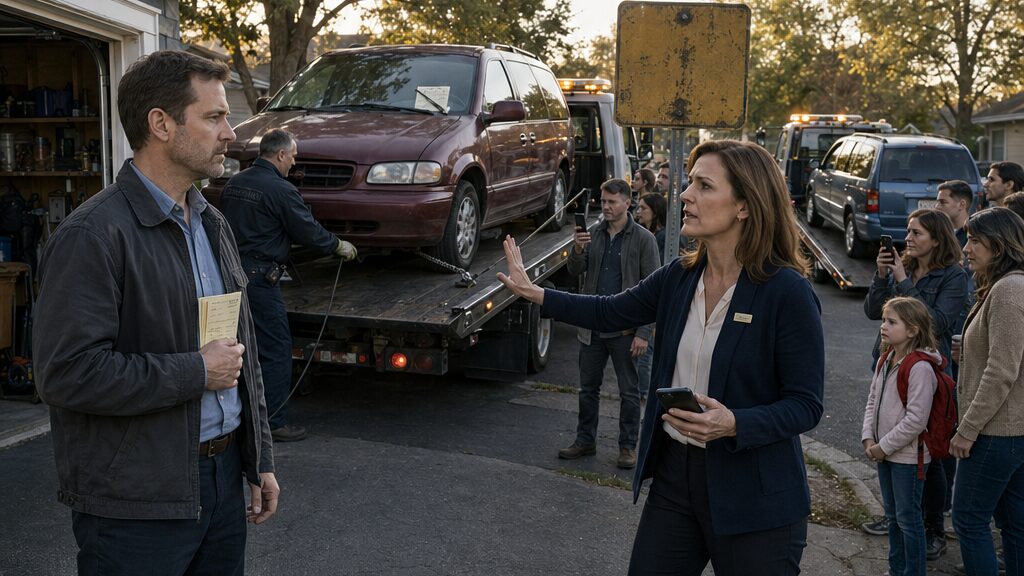
The tow cable tightened beneath the first minivan at 2:58 on Friday afternoon.
Joseph stood inside the garage with his hands in his jacket pockets. The silver hook scraped once against the pavement, then disappeared under the front axle of a dark red vehicle parked across the driveway entrance.
Behind it, the yellow sign remained visible.
NO PARKING. PRIVATE PROPERTY.
Below the original wording, Patrick Clark had installed a smaller metal panel listing the towing company’s number and impound location. He had photographed the signs from three angles, measured them, and placed copies of the standing authorization in his truck.
“You understand,” Patrick had told Joseph that morning, “once I hook a vehicle, I’m not negotiating with the owner. You can cancel before that. Not after.”
“I understand.”
“And you don’t pick which cars. If they’re on the marked private area or blocking access, we apply the same rule.”
“That’s what I want.”
Patrick had watched him for a moment. “Most people say that until the first person starts crying.”
Now the flatbed’s hydraulic bed tilted toward the pavement with a low mechanical groan. Children streamed along the sidewalk half a block away. Parents waiting legally at the curb turned their heads toward the sound.
The red minivan’s owner arrived at a run.
“What are you doing?”
Patrick continued operating the controls.
“That’s my car.”
“Yes, ma’am.”
“My daughter is right there.”
“You’ll need to contact the number on the sign.”
She looked at Joseph. Recognition came before anger. “You called them?”
Joseph kept his voice level. “The property has standing towing authorization now.”
“You never told anyone.”
“I posted the sign yesterday morning. There were warnings on vehicles all week.”
“I didn’t get a warning.”
A white paper remained trapped beneath her windshield wiper.
She saw Joseph looking at it and pulled it free. Her eyes moved over the first line.
“That was not there when I parked.”
Patrick glanced at his phone. “Timestamped photo shows it at 2:44.”
The woman crushed the note in her fist.
A second flatbed turned onto the street.
The sight of it changed the atmosphere. Drivers who had remained in their vehicles started engines. One SUV reversed from the edge of Joseph’s driveway so quickly that a crossing guard blew a whistle.
The second truck stopped behind a blue minivan partially resting on the charcoal-gray pavement. Its driver was nowhere in sight.
Three parents moved toward Joseph at once.
“You can’t tow during pickup.”
“The HOA approved this.”
“You’re stranding children.”
Joseph looked toward the school. No child was stranded. They stood with adults or school staff along the sidewalk. The vehicles being removed had been left unattended on his property.
“The towing company can explain the retrieval process,” he said.
A woman wearing a green cardigan held up her phone. “Angela said this was approved.”
“Show me.”
She hesitated, perhaps because she had expected denial rather than interest. Then she opened a group message and turned the screen toward him.
Angela Miller’s name appeared above a paragraph dated two weeks earlier.
Families may use designated residential overflow areas during the 2:40–3:10 pickup period provided vehicles remain attended and do not obstruct emergency access. The Williams driveway entrance is included in the temporary accommodation while we work with the school on a longer-term plan.
Joseph read it once.
Then again.
The phrase The Williams driveway entrance seemed to detach itself from the rest of the message.
“I never agreed to that.”
The woman drew the phone back. “She said the HOA had coordinated with residents.”
“It did not coordinate with me.”
Another parent stepped closer. “Then why didn’t you say something before towing people?”
“I did. I posted. I left notes. I asked drivers to move.”
“Those notes made it sound like you changed your mind.”
“Changed my mind about what?”
No one answered.
The second flatbed operator lowered his equipment. Metal struck pavement with a sharp clank.
Angela arrived from the direction of the school, walking quickly without running. She wore an HOA badge clipped to her cardigan, though Joseph had never seen board members wear badges outside meetings.
“Stop this,” she called.
Patrick did not look up from the first truck.
Angela entered the driveway and pointed toward the red minivan. “Joseph, tell them to release these vehicles.”
“The first one is already hooked.”
“Then pay the release fee.”
Joseph felt every face turn toward him.
“You represented that I gave permission,” he said.
“This is not the time.”
“It became the time when two tow trucks arrived.”
Angela lowered her voice. “There are children watching.”
“There were children watching when their parents blocked a private driveway after being warned.”
“That sign went up yesterday.”
“That sign has been there for three years. The towing information went up yesterday.”
“You cannot create a financial trap and pretend it is neighborly.”
Joseph looked past her at the woman holding the group message. “Do you have written authorization from me?”
Angela’s expression tightened.
“I’m asking you to de-escalate.”
“Do you have authorization?”
“The board discussed temporary overflow.”
“That wasn’t my question.”
A small circle had formed around them. Phones were raised now, some pointed at Joseph, others at the flatbeds. The red minivan climbed slowly onto the tilted platform, its rear wheels leaving the pavement.
Angela looked toward the parents rather than at him.
“We had a community understanding.”
“With whom?”
“The school was aware of the traffic plan.”
“The school told me it doesn’t control this street.”
“The school does not need to control the street to recognize a safety problem.”
Joseph nodded once. “Then show me the message where I agreed.”
Angela’s jaw shifted. “You attended the spring HOA meeting.”
“For twelve minutes.”
“The pickup issue was discussed.”
“The landscaping budget was being discussed when I left.”
“You did not object afterward.”
“I did not know you assigned my driveway to strangers.”
A parent near the curb said, “She told us residents had signed off.”
Another added, “That’s what the message says.”
Angela turned toward them. “I said we had coordinated.”
“You named his driveway,” the woman in the green cardigan said.
For the first time since the tow trucks arrived, Joseph felt something other than vindication. The parents’ anger had not disappeared, but its direction had loosened. Several were looking at Angela with the same confusion they had brought to his garage.
Patrick secured the first minivan and handed its owner a printed card.
“The vehicle will be available at the address listed,” he said. “You’ll need identification and proof of ownership.”
“How much?”
“Two hundred thirty-five dollars today. Storage begins tomorrow.”
The woman stared at the card.
Joseph had known the fee. He had signed beside it. Hearing it spoken while she stood with a child clutching her sleeve made the number feel different.
Angela seized the moment.
“This is exactly why the board needs to review what you’ve done.”
Joseph looked at the second minivan. Its warning note lay flat beneath the wiper. The yellow sign stood directly behind it, bright against the dark fence.
“Review it,” he said. “Review all of it.”
Angela’s phone chimed.
She read the screen, then lifted her chin. “There will be an emergency board investigation. Effective immediately, you are directed to suspend any activity that creates a safety risk or interferes with established community operations.”
“My driveway is not a community operation.”
“That is what the board will determine.”
The first flatbed began to pull away. The smell of hot rubber drifted across the pavement.
The woman in the green cardigan stepped closer to Joseph and lowered her voice.
“I’m sending you screenshots,” she said. “Not because I agree with towing us. Because she told everyone this was settled.”
Joseph’s phone vibrated almost at once.
Six images arrived. In each one, Angela described the driveway as approved overflow space. In none of them did she mention Joseph’s objections, his notes, or the yellow sign.
Before he could open the last image, another notification appeared.
It was an official HOA email bearing Angela’s electronic signature.
NOTICE OF EMERGENCY COMPLIANCE REVIEW.
The first paragraph accused Joseph of creating a neighborhood safety hazard through unauthorized commercial towing activity.
The second stated that disciplinary measures could include fines, suspension of exterior-use privileges, and legal action.
At the bottom, beneath the hearing date, Angela had added one final sentence:
The homeowner previously indicated verbal acceptance of temporary pickup access.
Chapter 4: Eleven Tows Did Not End the Argument
The eleventh minivan left Joseph’s driveway while its owner stood in his yard crying into her phone.
She did not cry quietly. Her voice carried across the trimmed lawns and over the hydraulic whine of the flatbed.
“They took it with my daughter’s backpack inside,” she said. “No, I don’t have two hundred thirty-five dollars. I said I don’t have it.”
Joseph watched from the kitchen window with a coffee cup in his hand.
The cup had gone cold.
Patrick Clark stood beside the tow truck, checking the vehicle against the authorization form. He did not hurry. He did not look toward the woman except when she stepped too close to the moving platform.
“Please stay clear of the equipment,” he told her.
She turned toward Joseph’s house.
“You could stop this.”
Joseph set the cup on the counter and went outside.
The yellow sign stood beside the fence, brighter than anything else in the gray afternoon. Someone had drawn a black line through the word PRIVATE with a marker. Joseph had not noticed it that morning.
“The vehicle was unattended and blocking access,” he said.
“I was gone for six minutes.”
“The warning was on your windshield.”
“I thought those were old.”
Patrick looked up. “Photo shows it was placed twelve minutes before hookup.”
The woman pressed her phone against her chest. Her daughter stood near the sidewalk, holding the hand of another parent.
“You are enjoying this,” she said to Joseph.
He nearly denied it.
Instead, he looked through the kitchen window at the untouched coffee. On the second day of towing, he had stood there and felt relief when the first flatbed pulled away. On the third day, he had felt something sharper, something clean and satisfying, as if the neighborhood had finally been made to obey a simple fact.
Now the woman’s daughter watched him without blinking.
“No,” he said. “I’m keeping the driveway open.”
The woman laughed once, without humor. “That is not the same answer.”
Patrick handed her a printed card with the impound address. She took it and walked toward the child.
When the flatbed disappeared at the corner, the street became strangely quiet. No one parked in Joseph’s driveway after that.
At 3:18, Ruth’s transportation van arrived.
It turned in without stopping in the roadway.
The driver lowered the side step, and Ruth came down carefully, one hand on the rail and the other on her cane. Joseph met her halfway.
“No trouble today,” the driver said.
“No,” Joseph answered.
Ruth looked at the open driveway, then at the black mark across the sign.
“You got what you wanted.”
“I got access.”
She shifted her weight before taking the next step. “Those are not always the same thing.”
Inside, Joseph cleaned the sign with rubbing alcohol. The marker faded but did not disappear completely. A shadow remained across PRIVATE.
His phone rang while he was scrubbing.
Patrick’s name appeared on the screen.
“Someone’s building a file,” Patrick said when Joseph answered.
“Who?”
“Could be a lawyer. Could be the HOA. I’ve had three requests today for tow times, vehicle conditions, photographs, everything.”
“You gave them the records?”
“I gave vehicle owners their own records. Nothing else without proper process.”
Joseph rinsed the cloth in the sink.
“Are we exposed?”
“My company followed the contract. Signs were compliant. Photos were taken. You didn’t call in specific plates, and you don’t receive any portion of the fees.”
“I know that.”
“I’m telling you what matters if this becomes a claim.”
Patrick paused.
“Did the HOA ever give you anything in writing about pickup access?”
“No.”
“Did you give them anything?”
“No.”
“Did you say anything that could sound like permission?”
Joseph leaned against the counter.
At the spring meeting, Angela had mentioned school traffic while he stood near the clubhouse door. He remembered checking the time. Ruth had called because a prescription delivery had arrived early. Someone had said parents sometimes used nearby driveways to turn around.
Joseph had answered something.
He could not remember the exact words.
“I might have said I didn’t care if someone turned around,” he said.
“That’s not parking.”
“No.”
“But people stretch language when money is involved.”
After the call, Joseph searched his email for spring meeting notes. The summary mentioned landscaping, reserve funding, and “continued coordination with the elementary school regarding neighborhood traffic.” It did not mention his driveway.
At five, an envelope appeared beneath his front door.
The HOA seal was printed in blue at the top. Inside was a notice setting a disciplinary hearing for the following Thursday.
The allegations filled two pages.
Unauthorized commercial activity.
Creation of a safety hazard.
Failure to participate in good-faith mediation.
Conduct causing reputational and financial harm to residents.
Joseph read the last allegation twice.
The packet included statements from four vehicle owners. One said she had relied on HOA instructions. Another said Angela had personally assured her that Joseph’s driveway entrance had been approved for attended waiting.
A third demanded reimbursement for towing and storage.
The fourth statement contained a sentence Joseph had not seen before.
Mr. Williams verbally agreed at the March community meeting that temporary use was acceptable as long as nobody blocked his garage.
Joseph carried the packet into the living room.
Ruth was arranging her medication for the week.
“Do you remember the March HOA meeting?” he asked.
“I remember you left early.”
“Did I tell you what I said there?”
“You told me they spent forty minutes arguing about shrubs.”
He handed her the statement.
Ruth read it slowly. “Did you agree?”
“I said people could turn around. I think.”
“You think?”
“I was leaving. Angela asked whether I objected to cars using the apron for a moment. I said I didn’t care if they didn’t block anything.”
Ruth folded the page along its existing crease.
“That sounds less clear than you usually prefer.”
“It does not mean parking.”
“No.”
“It does not mean twenty minutes.”
“No.”
“It does not mean the HOA could assign my driveway.”
Ruth looked at him. “Then you will need to say all of that to people instead of expecting the paper to say it for you.”
The next morning, a second email arrived from the HOA.
The subject line read EVIDENCE SUPPLEMENT.
Attached was Angela’s written account of the March meeting.
She claimed Joseph had accepted temporary pickup access, had raised no objection when the arrangement expanded, and had refused two opportunities to discuss concerns before towing began.
Joseph scrolled to the final paragraph.
The HOA requested authority to suspend his standing towing arrangement pending review.
For the first time since signing the contract, Joseph understood that he might lose the only mechanism that had kept the driveway clear.
Chapter 5: The Permission Nobody Had Written Down
Sarah Perez did not ask whether Joseph had the legal right to tow vehicles.
She asked why he had never told the school that his mother’s transportation was being blocked.
They sat across from each other in a small conference room beside the elementary-school office. Through the wall came the muffled rhythm of an afternoon announcement.
Joseph had brought a folder containing photographs, warning notes, copies of the towing agreement, and the HOA complaint. Sarah had placed none of them in front of her.
“I contacted the school twice,” he said.
“You reported vehicles on a residential street.”
“They were in my driveway.”
“The messages forwarded to me said congestion and access.”
“That is the problem.”
Sarah folded her hands. “A problem can be described accurately and still leave out the part that changes how people understand it.”
Joseph glanced toward the closed door.
“My mother does not want her medical information discussed.”
“I did not ask for a diagnosis.”
“She uses scheduled transportation.”
“And those vehicles could not enter?”
“More than once.”
Sarah sat back. Her expression changed, but not into the apology Joseph had expected.
“Then we should have known.”
“I tried to get people to stop.”
“You tried to get people to obey.”
He looked at her.
Sarah continued, “That may have been justified. It is not the same as helping the school understand the consequence.”
Joseph opened the folder and removed a photograph of the silver minivan across the driveway. The yellow sign was visible behind it.
“This is what happened.”
Sarah studied the image.
“When was the sign installed?”
“Three years ago.”
“Before the pickup arrangement?”
“There was no arrangement.”
“That is what I’m trying to establish.”
She turned to her computer and opened a file. The screen showed minutes from a traffic-planning meeting held six months earlier. Angela’s name appeared under community representatives.
Sarah rotated the monitor slightly.
“The school proposed staggered dismissal for two grades,” she said. “Parents objected because siblings would have separate pickup times. Angela proposed using residential overflow to move waiting vehicles away from the curb.”
“Did the school approve that?”
“No.”
“Did you reject it in writing?”
“We said private property could not be included without documented consent.”
Joseph leaned closer.
In the notes, beneath Angela’s proposal, one line read: Community representative will obtain written consent from affected homeowners before any residential option is circulated.
“Did she give you consent forms?”
“No.”
“Did you follow up?”
Sarah’s mouth tightened. “Not properly.”
“Why?”
“Because the proposal was not adopted by the school. We believed it had ended.”
“But she circulated it anyway.”
“It appears she circulated a modified version through the parent group and HOA channels.”
The distinction mattered. It also made the problem worse.
Angela had not misunderstood a school policy. She had taken a rejected idea and carried it into the neighborhood under softer language.
Sarah printed the meeting notes.
“This does not resolve everything,” she said. “The HOA can still argue there was informal homeowner consent.”
“There wasn’t.”
“You attended the March meeting.”
“I said drivers could turn around if they did not block access.”
“Was Angela there?”
“Yes.”
“Did she ask specifically about pickup waiting?”
“I don’t remember the exact wording.”
Sarah looked at him for a long moment.
“Then the timeline matters more than any single sentence.”
They spent the next hour assembling it.
The yellow sign had existed for three years.
Angela’s school proposal had been rejected six months earlier.
The parent message naming Joseph’s driveway appeared two weeks before the towing.
Joseph’s handwritten warnings began four days before the contract.
The compliant towing panel was installed one day before the first removal.
The sequence did not produce a dramatic proof. It produced something slower and harder to dismiss: repeated moments when Angela could have clarified that she had no written consent and chose not to.
At the municipal records desk, Joseph obtained the property map confirming that the dark pavement and apron belonged to his parcel rather than the public right-of-way. The clerk warned him that ownership did not automatically settle every towing dispute.
“Notice and procedure matter,” the clerk said.
“I followed them.”
“Then keep every record.”
By the time Joseph returned home, the folder had doubled in thickness.
Ruth sat at the dining table with the HOA complaint open in front of her.
“You went through my desk?” he asked.
“It was on the table.”
“The transportation schedule was underneath it.”
“I was looking for the hearing date.”
Joseph put the new records down.
“Sarah asked why I didn’t tell the school about your rides.”
Ruth did not answer immediately.
“You told me not to.”
“I told you I did not want my health made into an argument.”
“It already is an argument. It just became one without the reason.”
Ruth looked toward the front window. The driveway was empty.
“I have lived in this house for sixteen years,” she said. “I do not want neighbors thinking they must treat me like a fragile object so I can stay.”
“That is not what I would have said.”
“You would have said the vans must enter because of me.”
“Because they must.”
“And then every disagreement becomes your mother’s condition.”
Joseph felt the familiar urge to reduce the conversation to a rule. Access was required. The driveway was private. Transportation schedules were fixed.
None of those sentences answered her.
“You should have let me decide what to disclose,” he said.
“I did decide.”
“And I am the one facing a hearing because nobody understood what was being blocked.”
Ruth’s fingers tightened around the complaint.
“You are facing a hearing because you would rather let eleven vehicles be towed than sit through one conversation with people you dislike.”
The words landed cleanly.
Joseph looked at the folder. Every page supported him. None of them contradicted her.
His phone rang.
Sarah asked if he could return to the school the next morning. She had found older traffic files.
When he arrived, she was waiting in the conference room with a photograph on the table.
It showed the school curb during dismissal the previous year. Cars were stopped in two directions. A child stood between bumpers while an adult reached for his backpack.
“That is Angela’s son,” Sarah said.
Joseph looked closer.
A dark SUV had halted less than a few feet from the child. Angela was visible at the edge of the frame, one arm extended.
“He was almost hit,” Sarah said. “Not injured. But close enough that everyone saw it.”
Joseph lowered the photograph.
“After that, Angela came to every traffic meeting. She pushed for anything that moved waiting cars away from this curb.”
“And when the school rejected her plan?”
“She stopped asking us.”
Sarah slid the old photograph beside the newer image of Joseph’s yellow sign.
“She was wrong to use your property,” she said. “But if you go into that hearing treating her as though convenience was her only motive, you will lose the room even if you win the facts.”
Chapter 6: Angela’s Safety Plan Had One Silent Cost
A boy stepped between two idling cars before either driver saw him.
Joseph saw the backpack first, bright orange in the narrow gap. Then a small shoulder appeared beside a rear bumper.
A crossing guard blew her whistle.
The nearest driver braked hard enough to rock the vehicle. The boy froze until the guard reached him and pulled him toward the sidewalk.
Joseph stood across the street with Sarah’s photograph folded in his jacket pocket.
The current pickup system was still unsafe.
The towing had cleared his driveway, but it had not widened the curb, changed dismissal times, or taught impatient drivers where to wait. Cars now stacked farther down the block. Some stopped in the travel lane.
Angela stood near the school gate, watching the same thing.
She did not wear her HOA badge.
When she saw Joseph, her posture stiffened.
“The hearing is in two days,” she said.
“I know.”
“If you came to pressure me into withdrawing the complaint, the answer is no.”
“I came to understand the traffic plan.”
“You had weeks to understand it.”
“I had weeks of people blocking my property.”
“And I had a year of asking the school to prevent that.”
She pointed toward the curb where the crossing guard was speaking sharply to a driver.
“That is what the driveway arrangement was meant to stop.”
“It shifted the danger onto my access.”
“It moved waiting cars away from children.”
“By putting them on property you did not control.”
Angela looked toward the school.
“My son was nearly hit there.”
“I know.”
Her face changed. “Who told you?”
“Sarah showed me the photograph.”
“She had no right.”
“It was in a school traffic file.”
“She still had no right.”
For a moment Joseph saw not the HOA president or the woman whose messages had named his driveway, but a mother reliving the distance between a bumper and her child.
Then she looked back at him, and the control returned.
“You think that makes me irrational,” she said.
“No.”
“You think it excuses nothing.”
“It explains why you kept pushing.”
“Children do not care whether a solution satisfies a property map.”
“My mother’s driver does.”
Angela exhaled sharply. “You never said anything about your mother.”
“I should not have needed to.”
“No, you should not have needed to. But you expected everyone to understand a consequence you deliberately hid.”
The accuracy of it irritated him more than an unfair accusation would have.
They walked the school route in silence. At the corner, cars narrowed the road to one usable lane. A delivery truck waited while parents maneuvered around it.
Angela stopped beside a fire hydrant.
“The original plan used three locations,” she said. “The church lot, the cul-de-sac entrance, and short residential waiting areas where owners agreed.”
“Which owners agreed?”
“Two.”
“And me?”
Angela did not answer.
“You wrote that I did.”
“I wrote that the HOA had coordinated.”
“You named my driveway.”
“You said at the March meeting that you did not care if cars used the apron.”
“To turn around.”
“You did not say only to turn around.”
“I said as long as nobody blocked access.”
“The distinction became larger later.”
“It was large when you put it in writing.”
Angela crossed her arms.
“The church withdrew after complaints about litter. The cul-de-sac residents threatened to call the police. Your driveway was wide, close, and already being used.”
“So you chose the person least likely to make a scene.”
“I chose the location that caused the least traffic risk.”
“You expected me to complain privately.”
“Yes.”
The word came without hesitation.
Joseph looked at her.
Angela continued, quieter now. “I expected an email. A board discussion. Another compromise. I did not expect you to hire tow trucks without coming to the mediation.”
“I had asked drivers to move. I had left warnings. You told me to park on the street.”
“I was angry.”
“You also knew the towing panel had been installed.”
“I saw it.”
“And you did not tell parents your permission might not be valid.”
“I believed the board could intervene before anyone was removed.”
“You believed I would back down.”
“Yes.”
Again, the honesty was more unsettling than denial.
They reached Angela’s house at the end of the next block. A bicycle lay on its side near the porch steps. A child’s helmet hung from the handlebar.
Angela picked up a watering can but did not use it.
“The sign became one obstacle among many,” she said. “That is how I thought about it. The curb was dangerous. The school had no money. Parents would not accept staggered pickup. The church said no. You had space.”
“I had space for my household.”
“I know that now.”
“You knew it then.”
She looked at him.
“I knew it was yours. I did not know why keeping it open mattered so much.”
“It should not have required a special reason.”
“No. But people are more careful with a reason than with a principle.”
Joseph thought of Ruth saying nearly the same thing in a different form.
Angela set the watering can down.
“I will withdraw the complaint if you cancel the towing agreement permanently.”
“No.”
Her expression hardened.
“I am offering an end to this.”
“You are offering to restore the same condition that caused it.”
“Parents will not use the driveway now.”
“Until the next plan fails.”
“We can post volunteers.”
“Volunteers leave.”
“Then what do you want?”
The answer he had prepared was simple: recognition that the property was his, dismissal of the complaint, and repayment of nothing.
It no longer seemed sufficient.
“I want an enforceable no-obstruction rule for every private driveway near the school,” he said. “I want the school and HOA to publish one approved pickup plan. I want barriers or markings that keep cars away from the curb where children cross.”
Angela gave a short, tired laugh. “You want me to solve the entire traffic system before you stop towing.”
“No. I want the community to stop solving it through my driveway.”
“The board will never approve all of that in two days.”
“Then the towing agreement remains.”
“You are using leverage.”
“So were you.”
A child appeared behind the screen door and called for Angela. She turned, answered that she would be inside in a moment, then faced Joseph again.
“I was trying to prevent another child from nearly being hit.”
“And you decided the cost belonged to someone else.”
Angela’s shoulders lowered slightly.
Neither of them spoke for several seconds.
At last she said, “The system is unsafe.”
“Yes.”
“And the driveway should not have been included without written consent.”
Joseph waited.
She did not go further.
“Will you say that at the hearing?” he asked.
“I will say what I believed I was authorized to do.”
“That is not the same thing.”
“No.”
The screen door opened again. Angela stepped toward it.
“If you present this as a personal victory,” she said, “every parent in that room will stop listening.”
“If you present fear as permission, they should stop listening to you.”
She flinched, almost imperceptibly.
Joseph walked home along the school route. Near his driveway, the yellow sign leaned slightly where someone had pushed against the post. The black marker shadow still crossed the word PRIVATE.
He straightened the post but did not clean the sign again.
Inside, his hearing folder waited beside the laptop. On top lay the property map, the towing records, and Angela’s messages.
Joseph moved them aside.
He opened a blank document and typed a new heading:
PROPOSED SCHOOL PICKUP ACCESS PLAN.
For the first time since the silver minivan had blocked his garage, he prepared to enter a room not merely to prove that he was right, but to insist that the neighborhood become responsible for what it had tried to place on him.
Chapter 7: The Hearing Where Both Stories Became Incomplete
The first sound played in the community clubhouse was a woman crying.
Angela set her phone beside the microphone and let the recording fill the room.
“I don’t have two hundred thirty-five dollars,” the woman’s voice said through the small speaker. “My daughter’s things are still in the van.”
No one moved.
Joseph sat at the end of a folding table with his folder closed in front of him. Beside it rested the coffee Ruth had made before he left home. He had not touched it.
Across the room, parents occupied nearly every metal chair. Some had printed towing receipts in their laps. Others held phones ready to record. The HOA board sat beneath a framed map of the neighborhood, five people behind a long table that normally held holiday food drives and budget meetings.
Angela stopped the audio.
“This,” she said, “is what happened when private frustration became commercial enforcement during school dismissal.”
A parent near the wall murmured agreement.
Angela continued without raising her voice. She described congestion near the elementary school, the failed discussions with school staff, and the informal neighborhood accommodations that followed. She spoke about children stepping between cars and drivers stopping in active lanes. She did not describe Joseph as cruel. That would have been easier to resist.
She described him as inflexible.
“He was invited twice to discuss the problem,” she said. “He declined. He then entered a standing agreement that imposed immediate financial penalties on families who had been told temporary waiting was permitted.”
One board member looked toward Joseph. “Did you decline mediation?”
“Yes.”
The room shifted.
Angela rested both hands on the table. “And did you tell parents, the HOA, or the school that your mother required scheduled transportation access?”
Joseph looked toward Ruth.
She sat in the second row, her cane angled between her knees. She did not rescue him with a gesture.
“No,” he said.
Several parents whispered.
Angela nodded as though his answer completed her case. “Then residents were punished for consequences they were never given the chance to understand.”
Joseph felt the pull of his folder. Inside were the property map, the towing records, the school notes, the messages, and the municipal requirements. He could answer every accusation with paper.
Instead, he kept the folder closed.
“I should have attended the mediation,” he said.
The room became still again.
Angela’s expression changed slightly.
Joseph went on. “I believed there was nothing to discuss because the driveway was private. I believed the sign, the verbal requests, and the written warnings were enough. Legally, they may have been enough. They were not enough to make the situation understandable to everyone involved.”
A parent in the front row said, “So you admit you handled it wrong.”
“I admit I handled part of it wrong.”
The answer drew no approval.
Joseph opened the folder and removed a photograph of the yellow sign. He placed it on the table, then set the school traffic map beside it.
“The sign was installed three years before this conflict. The towing information was added the day before the first removal. Every towed vehicle was photographed in violation. I did not choose individual vehicles. I did not receive any portion of the towing fees.”
Patrick stood near the back wall. At a board member’s request, he approached the microphone.
“Our company had standing authorization from the property owner,” he said. “We applied it to any vehicle on the marked private area or obstructing access. Mr. Williams did not receive payment from us. He did not call in specific parents.”
“Your company made money,” someone called.
Patrick looked toward the voice. “Yes. Towing is our business. That does not change whether the procedures were followed.”
The board chair asked him to sit.
Joseph then placed Angela’s messages on the table, one page at a time.
“This was sent two weeks before the towing,” he said. “It states that my driveway entrance was included in a temporary accommodation.”
Angela leaned forward. “Based on the March discussion.”
Joseph took out the meeting summary.
“The March notes do not mention my driveway. At that meeting, I said I did not object to drivers turning around if they did not block access. I did not agree to parking or waiting.”
“You did not object afterward,” Angela said.
“I did not know you had named my property.”
“You saw cars using it.”
“And I asked them to move.”
Joseph placed the school planning notes beside the messages.
“The school rejected residential overflow without written homeowner consent. Angela agreed to obtain that consent. She did not obtain mine.”
The board chair read the highlighted line.
Angela’s face had gone pale, but her voice remained steady. “The school rejected an official plan. The HOA was still free to coordinate voluntary neighborhood use.”
“Voluntary for whom?” Joseph asked.
A parent in the green cardigan rose from her chair.
“We were told it had been approved,” she said. “I have the messages. I would not have parked there otherwise.”
Another parent stood. “Neither would I.”
Angela turned toward them. “I believed there was informal acceptance.”
“You told us it was settled,” the first parent said.
“I told you we had coordinated.”
“You named his driveway.”
The board chair raised a hand, but the room continued for several seconds before quiet returned.
Angela looked down at the traffic map.
“My son was nearly struck last year,” she said.
Her voice had changed. It no longer carried the board-president cadence.
She described the curb, the blocked sightline, the dark SUV stopping within feet of him. She described attending every traffic meeting afterward and watching each proposal fail because it cost too much, inconvenienced too many families, or required staff the school did not have.
“I thought moving cars away from that curb was the safest available option,” she said. “I thought Joseph’s driveway was wide enough to absorb some of the waiting. I believed his comments in March meant he would tolerate it.”
“Did you know he objected before the towing?” a board member asked.
Angela hesitated.
“Yes.”
“Did you correct the parent messages?”
“No.”
“Why not?”
Angela looked toward Joseph. “I thought he would complain privately. I did not think he would enforce the sign.”
The room changed then, not dramatically, but decisively. The parents still had towing bills. Joseph had still refused mediation. The danger near the school remained real.
But Angela’s assumption had become visible.
She had relied on his reluctance to make conflict public.
The board recessed for twenty minutes.
Joseph remained at the table. Ruth came forward and sat beside him.
“You left your coffee,” she said.
“I know.”
“Good.”
He looked at her.
“You are finally talking without it.”
When the board returned, the chair read the findings.
The commercial-activity allegation was dismissed. The towing company had acted under lawful authorization, and Joseph had received no financial benefit.
The safety-hazard allegation was not sustained.
The board found that Angela had represented an informal traffic arrangement as approved without securing written homeowner consent. She would be removed from traffic-planning authority pending a formal censure vote.
Joseph’s refusal to attend mediation was noted as a failure of community participation, but it did not authorize the HOA to use his property.
Several parents began speaking at once when the board said it could not guarantee reimbursement of towing fees. The charges had been imposed by a private operator under valid procedures. Any individual disputes would need separate review.
“This is not justice,” one parent said.
“No,” another replied from the back. “It is paperwork.”
Joseph understood the anger. A correct finding did not return money.
He stood before the room settled.
“I will suspend the towing agreement,” he said.
Angela looked up.
Several parents exhaled.
Joseph placed his proposed map on the table.
“After the board adopts an enforceable no-obstruction rule for every private driveway near the school, funds physical curb barriers and crossing support, and approves one pickup plan with the school.”
The relief vanished.
“You are making demands,” a board member said.
“I am setting the condition under which I give up the only protection that worked.”
The chair studied the map.
It showed a staggered release for two grade groups, a marked walking zone from the community clubhouse, volunteer positions that did not block private access, and temporary barriers near the dangerous curb.
Sarah, seated along the wall, rose when the board asked whether the school would participate.
“We will review it immediately,” she said. “Several elements are workable.”
Angela looked at the map beside the photograph of the yellow sign.
For the first time that night, neither image made the other incomplete.
Chapter 8: The Sign Stayed, but Its Meaning Changed
The first minivan slowed beside Joseph’s driveway at 2:43, and everyone watching seemed to hold the same breath.
The driver looked toward the yellow sign.
Then she continued past the house and turned into the marked pickup lane beside the community clubhouse.
Joseph remained near the garage, one hand resting on the handle of a broom he had no reason to be holding. Orange traffic barriers lined the curb near the elementary school. A crossing assistant stood where children had once slipped between bumpers. Two grade groups now dismissed ten minutes apart.
The new system was not elegant.
It was working.
Six weeks had passed since the hearing.
The HOA had adopted a no-obstruction policy covering every private driveway and sidewalk ramp in the neighborhood. The board funded portable barriers and part-time crossing support from its emergency reserve. The school published one official pickup map and stopped recognizing instructions circulated through private parent groups.
Angela had been formally censured and removed from traffic planning.
She had not resigned from the board.
Joseph had suspended the standing towing agreement after the new rule took effect, though the compliant panel remained beneath the yellow sign. Patrick had told him to leave it there.
“Rules work better when nobody has to test them,” he had said.
At 2:51, a white transportation van approached from the corner.
For the first time in months, it did not stop in the road or circle the block. It turned directly into the open driveway.
Ruth sat behind the passenger window. She raised two fingers in greeting.
Joseph met her at the side door while the driver lowered the step.
“They painted arrows for us,” Ruth said.
“They painted arrows for everyone.”
“That is better.”
She descended slowly, her cane finding the pavement without hurry. On the sidewalk, parents moved toward the walking zone instead of spreading across the lawns.
A woman in a dark jacket stopped near the driveway.
Joseph recognized her as the owner of one of the towed vehicles.
“My reimbursement request was denied,” she said.
He held the transportation van’s door while Ruth steadied herself.
“I heard.”
“They said the towing was valid.”
“That was the finding.”
“It cost me three hundred ten dollars with storage.”
Joseph did not tell her she had ignored a warning. He did not remind her that the sign had been visible or that the property was his.
“I’m sorry it cost you that,” he said.
She studied him, perhaps waiting for a second sentence that would turn the first into an excuse.
None came.
“You still think you were right.”
“I think the driveway needed to stay open.”
“That is not an apology.”
“No.”
Her mouth tightened. Then she walked toward the clubhouse.
Ruth watched her go.
“You cannot make everyone satisfied,” she said.
“I know.”
“You used to think being correct would do it.”
Joseph smiled faintly. “I was wrong about that.”
Near the school gate, Angela appeared with her son.
She wore no badge and carried no clipboard. They joined the ordinary parent line. Her son said something that made her lean down to hear him, and for a few seconds she looked like any other mother trying to keep pace with dismissal.
When they reached Joseph’s property, Angela slowed.
Her eyes moved from the transportation van to the yellow sign. Joseph had cleaned it again. The marker shadow was still visible if someone knew where to look.
“The board approved permanent barrier funding,” she said.
“I saw the notice.”
“The school wants to keep the staggered schedule next year.”
“It seems to help.”
She nodded.
Her son waited beside her, pulling at one backpack strap.
Angela looked toward Ruth, who had reached the front walk.
“I should have told them I did not have your consent,” she said.
Joseph did not answer immediately.
“Yes,” he said.
“I believed the risk near the curb justified moving quickly.”
“I believe you.”
“That is not forgiveness.”
“No.”
Her gaze settled on the sign.
“You kept it.”
“It was never the problem.”
Angela gave a small nod, neither agreement nor surrender.
Then she and her son continued toward home.
Joseph carried the broom into the garage. Behind him, the transportation van backed out without obstruction. Parents followed the painted arrows. The curb remained clear enough for children to be seen before they stepped into the street.
The yellow sign stayed on the fence post.
It no longer looked like a threat.
It looked like a boundary everyone had finally agreed to see.
The story has ended.