The HOA Charged Him for Reaching His Own Mailbox—Then the Old Road Map Changed Everything
Chapter 1: The Fine Waiting Beside His Mailbox
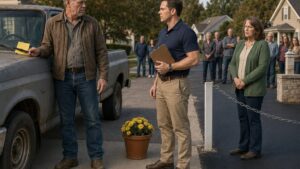
Debra Wilson pressed the white invoice flat against Jacob Martin’s mailbox before he could open it.
“Four hundred dollars,” she said. “Trespass and unauthorized use of association property.”
Jacob stood with one hand still inside the open window of his truck. The engine idled behind him, carrying the dry metallic rattle he had meant to look at after breakfast. He read the bold amount at the bottom of the page, then looked past Debra toward the gravel road he had driven for twelve years.
His mailbox leaned slightly toward the ditch. His fence began twenty yards farther down. Beyond it, the road curved past three homes, a cattle gate, and the low stretch where rainwater collected in spring.
“You’re charging me to get my mail?”
“I’m charging you for using a private road without authorization.”
Debra wore a red blazer too clean for the dust lifting around her shoes. A black folder rested against her hip. Behind her, the rear hatch of a dark SUV stood open.
Inside lay a coil of heavy galvanized chain.
Jacob took the invoice but did not lower his eyes to it again. “Who authorized you to call it private?”
“The board.”
“That isn’t what I asked.”
Two neighbors had stopped at the mailboxes across the road. One pretended to sort through envelopes. The other watched openly, arms folded across his chest.
Debra’s mouth tightened. “You received notice of the revised access policy.”
“I received three envelopes marked urgent. That doesn’t make the road yours.”
“You didn’t attend the meetings.”
“I work.”
“So does everyone else.”
The answer landed harder than Jacob expected. He knew how it sounded: the man at the end of the gravel road who did not attend meetings, did not volunteer, and did not answer letters. He repaired farm equipment for half the county and kept to himself when the workday ended. That had been enough until Debra became board president.
He folded the invoice once.
Debra reached into her folder. “This is not the only matter. Your truck has disturbed the association shoulder near the drainage swale.”
“My truck drove on the road.”
“You widened the edge.”
“The edge washed out.”
“You are not authorized to perform maintenance.”
A short laugh escaped him, though nothing felt funny. “You’re fining me for using the road and warning me not to repair it.”
“I’m enforcing procedure.”
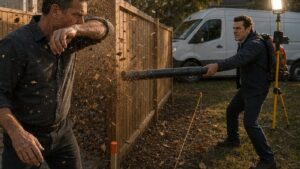
From the SUV, a contractor lifted one end of the chain. Another man carried two steel posts and a gas-powered auger toward the road entrance.
Jacob stepped into their path.
“What are those for?”
Debra did not turn. “Temporary access control.”
“There’s a school bus through here at seven tomorrow.”
“The district has been notified to use the alternate approach.”
Jacob looked toward the low field east of the road. The alternate approach was a tractor track through clay soil. After the weekend rain, water still shone between the tire ruts.
“That route isn’t fit for a bus.”
“That is for the district to determine.”
One contractor stopped beside the ditch, waiting. Debra gave him a small nod.
The auger coughed to life.
Its bit struck the ground with a violent chatter, and the neighbors across the road moved closer. Jacob felt every eye turn toward him, not toward Debra. The noise made it appear that something official was happening and that he was the one interfering with it.
He stepped back.
Debra seemed to read the movement as surrender. “The association has tolerated informal use long enough. Road maintenance costs have increased. Insurance has raised concerns. People cannot continue taking benefits without contributing.”
Jacob held up the invoice. “This doesn’t say maintenance contribution. It says trespass.”
“Because you ignored the contribution notices.”
“So you changed what the road is?”
Her expression remained composed, but a vein moved faintly at her temple. “The legal review supports the board’s authority.”
“Let me see it.”
“It will be available at Friday’s meeting.”
“You can set posts today, but I have to wait until Friday to see why?”
“You had opportunities to participate.”
The auger bit deeper. Dark earth curled around the spinning blade.
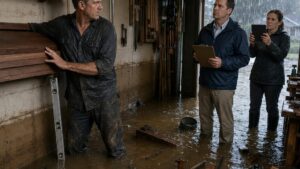
Jacob walked down into the ditch, away from the contractors. He wanted a wider view of where they were setting the post. The slope was littered with pale gravel washed from the road, dead grass, and a crushed aluminum can. Near the culvert, half hidden beneath weeds, something square caught the light.
He crouched and pulled aside the grass.
A concrete marker rose barely two inches above the soil. Its top held a rusted metal disk stamped with a county seal and a number worn shallow by time.
Jacob wiped it with his thumb.
He had seen one like it before, though he could not place where. Not on a recent survey. Not in the packet from the closing when he inherited the property. Somewhere earlier—perhaps in his father’s shed, among rolled maps and coffee-stained receipts.
Debra called from the road. “You need to stay clear of the work area.”
Jacob took out his phone and photographed the marker. Then he photographed the post hole, the road, the mailbox, and the chain still coiled in the SUV.
“What are you doing?” she asked.
“Keeping track.”
“There is nothing improper about documenting an enforcement action.”
“Good.”
Her gaze sharpened.
One of the neighbors crossed the road. “Jacob, maybe you should just pay the road fee. Everybody else does.”
Jacob straightened. “Did she charge you with trespassing?”
The neighbor glanced at Debra before answering. “No, but I go to meetings.”
That was the part Debra understood better than he did. A room full of chairs, a printed agenda, minutes approved by raised hands—those things made decisions feel settled long before anyone examined what had actually been decided.
Jacob climbed back to the shoulder. The first steel post stood upright now, fresh soil packed around its base. The second hole had been marked directly across from it.
“Take the posts out,” he said.
Debra closed her folder. “No.”
“You don’t know what that marker means.”
“It means nothing relevant to the covenants.”
“You didn’t even look at it.”
“I don’t need to inspect every object in a ditch to perform my duties.”
The second contractor restarted the auger.
Jacob’s hand tightened around the folded invoice. For a moment he imagined pulling the first post loose with his truck. He had chains in the bed, real towing chains, not polished hardware meant to make a point. He could remove both posts in five minutes.
Then he saw the two neighbors watching. He saw Debra’s phone angled slightly toward him.
She was waiting for him to become the problem she had already described.
He released the paper before it tore.
“At least leave it open for the bus.”
“The chain will be secured tonight.”
“There are children on that route.”
“There are procedures for route changes.”
“And if the field is still mud?”
“That is not under HOA control.”
Jacob looked at the coil of chain again. The links shone in the morning light, clean and unused.
Debra stepped close enough to lower her voice. “You have mistaken nonparticipation for independence, Mr. Martin. They are not the same thing.”
She walked back toward her SUV.
Jacob remained beside the county marker while the contractors set the second post. By the time they finished, the two posts faced each other across the gravel like the beginning of a gate no one had voted to build.
Debra lifted the chain from the cargo area. It dragged over the bumper with a hard, bright scraping sound.
“The lock goes on before six tomorrow morning,” she said. “The school bus will have to turn around.”
Chapter 2: The Morning the School Bus Stopped
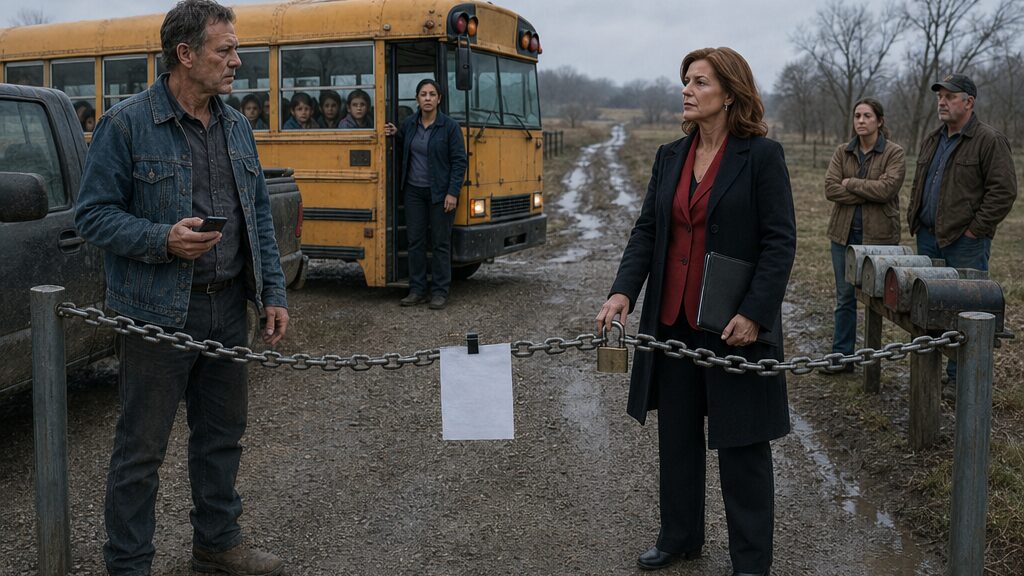
The yellow bus braked ten feet from the locked chain.
Its front end dipped, then rose with a sigh of air brakes. Children leaned toward the windows, their faces appearing one after another in the blue-gray morning. The diesel engine idled heavily, filling the road with vibration.
Jacob stood beside his truck with his phone already recording.
Debra waited on the other side of the chain. She wore the same red blazer beneath a dark coat. A white notice had been clipped to the center link, where it fluttered in the exhaust.
Michelle Garcia opened the bus door.
“What is this?” she called.
“Temporary association access control,” Debra replied.
Michelle climbed down, one gloved hand gripping the rail. “This is my approved route.”
“The district was informed of the alternate entrance.”
“I got an email at nine last night. That isn’t a route change.”
Debra held up a printed sheet. “The road is private association property.”
Jacob moved closer but stopped before the chain. The padlock was new, its brass surface unmarked. The steel posts had hardened in the cold overnight.
“Debra,” he said, “unlock it.”
“You have no authority to direct me.”
“The bus needs through.”
“The bus has another option.”
Michelle looked toward the field. The tractor track disappeared behind a stand of bare trees before climbing toward the subdivision. Water filled the lower ruts.
“That option isn’t safe.”
Debra turned slightly, enough to include Jacob in her answer. “The district has used temporary access points before.”
“Not with forty feet of bus in wet clay.”
A child tapped on the window. Another pressed both hands against the glass.
Debra opened her folder and removed a second sheet. “Mr. Martin, this is notice of an additional two-hundred-dollar violation for interfering with association safety infrastructure.”
She clipped it beneath the first notice.
Jacob stared at the paper moving against the chain.
“You’re fining me while blocking a school bus.”
“I am documenting continued obstruction.”
“I haven’t touched anything.”
“You have refused compliance and encouraged unauthorized use.”
The neighbors had gathered again, this time in jackets and work boots. A parent’s pickup had stopped behind the bus. Its horn sounded once.
Jacob lifted his phone. “Say it again.”
Debra looked at the screen. “Excuse me?”
“State that you’re refusing to open the road for the school bus because the HOA owns it.”
“You are not authorized to record an executive action.”
“We’re standing in the road.”
“This is association property.”
“Then say that clearly.”
Michelle glanced between them. “Jacob, don’t turn this into a performance. I need a decision.”
He felt the rebuke because it was deserved. She had spent years waving from the driver’s seat while he stood near the mailbox. When summer storms cut a channel across the shoulder, he moved gravel after work without calling anyone. When Debra sent notices about cost sharing, he left them unopened on his kitchen counter.
To Michelle, this could still look like two stubborn people measuring power while children waited.
Jacob lowered the phone slightly but did not stop recording.
“I’m trying to preserve what’s happening.”
“What’s happening,” Michelle said, “is I have nineteen minutes before these kids are late.”
Debra stepped toward her. “The alternate path is available.”
Michelle studied the field, then the bus. “If I get stuck, you’re putting in writing that you directed me there.”
“I have already informed the district.”
“That isn’t what I asked.”
For the first time, Debra hesitated.
Jacob caught it on the screen.
Behind the chain, the white notice snapped in a gust. He zoomed in. At the bottom, beneath the HOA letterhead, a paragraph cited “counsel’s review of exclusive association access rights.”
“Where is counsel’s name?” he asked.
Debra’s attention shifted back to him. “The board received legal guidance.”
“There’s no signature.”
“This is not a legal opinion. It is an enforcement summary.”
“Based on what?”
“You may review supporting materials Friday.”
Michelle exhaled sharply. “I’m calling dispatch.”
She climbed back into the bus. Through the open door, Jacob heard her explain the obstruction over the radio. A child asked whether they were going to school. Another voice said they would get stuck.
The answer from dispatch came through distorted and clipped. Use the alternate approach if passable. Do not force the barrier. Report any damage.
Michelle looked down at Jacob. “Move your truck. I need room to back.”
He stepped aside.
The bus reversed slowly until its rear wheels reached the wider patch near the mailbox cluster. Michelle made a three-point turn while the parent’s pickup backed toward the county road. Then the bus entered the field.
The first thirty yards held.
At the low section, the right tires dropped into a rut. Mud rolled outward in a thick wave. The engine rose in pitch. Children grabbed seatbacks as the bus tilted.
Jacob began walking after it.
“Stay out of the field,” Debra called.
He ignored her.
The bus climbed free, but a metal panel beneath its right side scraped against a buried rock with a sound like a shovel dragged across concrete. Michelle stopped on higher ground and set the brake.
By the time Jacob reached her, two children were crying. One had dropped a backpack into muddy water near the temporary pickup point where several parents waited. Brown water soaked the bottom of the bag.
Michelle crouched beside the bus and examined the scraped panel.
“This route has used that road since before I took it,” she said. “Eleven years for me. Longer for the district.”
Jacob looked back toward the chain. Debra stood beside it, small in the distance but unmistakable in red.
“Will you put that in the incident report?”
Michelle rose. “I’ll put in exactly what happened.”
“Include that she refused to unlock it.”
“I heard her.”
“That isn’t what I asked.”
Michelle’s face tightened. “You sound like her when you do that.”
He stopped.
She wiped mud from one glove onto her coat. “You both keep asking people to choose a side before either of you tells the whole truth.”
“I don’t know the whole truth yet.”
“Then find it. But don’t pretend you’ve been helping by throwing every letter in a pile.”
The children watched from the windows.
Jacob looked at the mud around his boots, then at the shallow cut where runoff had eaten through the field edge. He had seen the road shoulder weakening months earlier. He had dumped two loads of gravel near his own entrance but had not touched the lower section because it lay beyond his fence.
Not my road, he had told himself.
Now Debra was saying the opposite in order to control it.
When he returned to the entrance, she was speaking with one of the neighbors.
“The district made the decision to proceed,” she said. “The association cannot be responsible for operational choices.”
Jacob held up his phone. “I have you directing her to the field.”
“You have an incomplete recording of a safety discussion.”
“You also cited legal counsel without a signed opinion.”
Debra’s composure thinned. “The board has authority under the covenants to regulate common infrastructure.”
“Common or private? Pick one.”
The neighbor looked away.
Debra removed the notices from the chain and slid them into her folder. “You will receive formal copies.”
Jacob crouched beside the old county marker. In the early light, the stamped number was clearer than it had been the day before. He traced it with his thumb and suddenly remembered where he had seen the same pattern.
A rolled map had hung behind his father’s workbench for years, held shut with a rubber band. Along one edge, his father had drawn small squares with numbers beside them. Jacob had assumed they marked fence corners.
Debra noticed his attention. “That marker is outside your parcel.”
“Maybe.”
“It has no bearing on this matter.”
“You said that yesterday without looking at it.”
Her phone rang. She answered and turned away.
Jacob photographed the number again, then walked home.
At ten that morning, a certified envelope arrived by courier. The new invoice was for eight hundred seventy-five dollars.
The notice accused him of unauthorized road alteration, interference with association enforcement, and damage arising from the school bus’s use of an unapproved route.
At the bottom, one sentence had been added in bold:
THE ASSOCIATION RESERVES THE RIGHT TO PLACE A LIEN AGAINST THE PROPERTY.
Chapter 3: The Plat That Did Not Tell the Whole Truth
The county records clerk found the road under two different names.
“That usually means somebody renamed it without cleaning up the old index,” she said, sliding one file toward Jacob. “Or everybody kept calling it the wrong thing until the wrong thing became official.”
The first folder bore the current subdivision name. The second was labeled MARTIN ACCESS—NORTH FARM ROAD.
Jacob read the words twice.
“My family name?”
“Looks that way.”
The records office occupied the basement of a county building whose upper floors had been renovated around it. New fluorescent panels hung above old metal shelves. The room smelled of paper, dust, and the warm plastic from a copier that never stopped working.
The clerk placed a gray archival box on the table.
“Anything before 1975 may be oversized. Use gloves if you handle the originals.”
Jacob pulled on the thin cotton gloves she provided. Inside the box lay survey notes, deeds, drainage sketches, and folded plats browned at the creases. He worked slowly, photographing each page before moving it.
The current subdivision file contained HOA covenants, amendments, and a road-maintenance schedule. Debra’s name appeared on recent certifications. Nothing stated that the association owned the entire gravel road.
A legal memorandum referenced in the board minutes was only two pages long. The copy had no signature, no letterhead from a law firm, and no conclusion about exclusive ownership. One paragraph said the board “may possess authority to regulate maintenance and access subject to the rights reserved in the original instruments.”
Subject to the rights reserved.
Debra’s enforcement summary had omitted those words.
Jacob opened the older folder.
The 1962 plat unfolded across most of the table. Faded red parcel lines crossed pale paper. The road appeared as a narrow double line running from the county route through what had once been one large farm. Beside it, in type small enough to require a magnifying glass, were the words:
PERPETUAL TRANSPORTATION EASEMENT FOR OWNERS, OCCUPANTS, INVITEES, PUBLIC SERVICE, AND SCHOOL CONVEYANCE.
Jacob sat back.
For the first time since Debra had pressed the invoice against his mailbox, the pressure behind his ribs loosened.
The HOA did not own the road. It could not lawfully exclude him. The school bus was named by function in an instrument recorded more than sixty years earlier.
He took photographs of the entire plat and close-ups of the easement language. Then he found the numbered markers. One corresponded to the concrete disk near his mailbox. Another lay near the bend beyond the chain.
The line Debra had blocked was not merely traditional access. It was documented access.
The clerk returned carrying a smaller envelope. “There’s a companion agreement listed by book and page, but the original isn’t here.”
“Where is it?”
“Transferred to off-site storage years ago. I can request it. Two or three business days.”
“What kind of agreement?”
She checked the index card. “Maintenance understanding. Private parties.”
Jacob’s relief narrowed.
“Who signed it?”
The clerk adjusted her glasses. “Your father’s name is here. Another owner. County acknowledgment, but not county responsibility.”
“Does it change the easement?”
“Couldn’t tell you. An easement and maintenance duty are separate questions.”
Jacob folded the plat carefully. “I know someone who can read this.”
He had not spoken to Edward Lee in nearly four years.
Edward’s workshop sat behind a low brick house at the edge of town. Survey rods, tripods, and old wooden stakes hung in organized rows along the walls. A woodstove ticked near the door despite the mild afternoon.
Edward opened the door before Jacob knocked twice.
“You look like your father when you’re carrying paper you think proves something,” he said.
Jacob held up the document tube. “Good to see you too.”
Edward stepped aside.
They cleared a space on the central workbench. Jacob unrolled the county copy of the 1962 plat and weighted the corners with steel blocks.
Edward did not touch it at first. He leaned over, reading from left to right, then followed the road with one blunt finger.
“Where’d you get this?”
“County archive.”
“You finally went.”
“I had a reason.”
Edward’s eyes moved to him. “You had reasons before.”
Jacob ignored that. He pointed to the easement language. “The HOA says it owns the road. They chained it yesterday and blocked the school bus this morning.”
Edward read the clause again. “They don’t own the easement.”
“So the chain comes down.”
“Probably.”
“Not probably.”
Edward straightened. “An easement gives a right of use. It doesn’t tell you who owns the underlying ground at every point, and it doesn’t erase maintenance obligations.”
Jacob took out Debra’s invoice and placed it beside the plat. “They charged me with trespassing.”
“That part looks foolish.”
“Foolish?”
“Potentially unlawful, if the facts are what you say.”
“The facts are on the paper.”
“Some of them.”
Jacob felt the old impatience rise. Edward had always spoken that way—never yes when yes might be modified, never no when a footnote could survive.
“The bus clause is right there.”
“I can read.”
“Then tell me what I’m missing.”
Edward folded his arms. “You’re reading only half the page.”
“There is no second page.”
“There was an agreement.”
Jacob stared at him.
“You knew?”
“I knew your father maintained that road.”
“That isn’t the same as giving an HOA control.”
“No. It isn’t.”
“Then why didn’t he put it in the deed?”
“He didn’t own all the land beneath it. The easement crossed three parcels. When the subdivision was approved, the owners needed a way to divide upkeep.”
“Debra claims the association can fine me for using it.”
“That sounds like overreach.”
“Stop saying sounds.”
Edward’s jaw shifted. “You came here for an answer or permission to stay angry?”
Jacob rolled the invoice into a tight cylinder, then forced it flat again.
Edward walked to a cabinet and opened the bottom drawer. He removed a thin file bound with a dried rubber band.
“I kept copies because your father refused to trust the county’s storage system.”
“Yet the county still had the plat.”
“Your father didn’t trust many people. You inherited that part cleanly.”
Edward laid out a photocopied agreement dated twenty-six years after the original plat. Jacob recognized his father’s signature at the bottom, broad and slanted.
The agreement divided routine grading and gravel costs among the properties using the road. It did not grant exclusive control to an association. It did not authorize access fines. But one paragraph assigned Jacob’s father responsibility for inspecting the drainage shoulder near the low field and arranging emergency repairs when washouts threatened safe passage.
Jacob read it twice.
“He signed this without telling me.”
“You weren’t the owner then.”
“He knew I would be.”
“He thought he had time.”
The words struck too close to the months before his father’s death—the unfinished conversations, the papers Jacob had refused to sort, the arguments over what belonged to the farm and what belonged to everyone else.
“Did the HOA inherit this agreement?”
“Parts of it may have been absorbed into the covenants. Parts may still bind the parcels privately. You need a lawyer for that.”
“But they still can’t chain the road.”
“Not under this easement.”
Jacob placed both palms on the workbench. Victory had been within reach an hour earlier. Now it had split into two truths that refused to cancel each other.
Debra had no right to treat him as a trespasser.
He had no right to pretend the road required nothing from him.
Edward turned toward another cabinet.
“What else are you hiding?”
“I wasn’t hiding it from you.”
“You had this agreement.”
“I had a copy.”
“You let me stand there thinking my father tied me to some board behind my back.”
Edward faced him. “Your father asked me not to interfere unless you came looking.”
“That was convenient.”
“For neither of us.”
The silence between them carried years of smaller refusals.
Edward reached behind a row of rolled maps and removed a yellowed envelope. Jacob’s name was written across the front in his father’s hand.
The stamp was never canceled.
“This was supposed to go to you after the property transferred,” Edward said.
Jacob did not take it.
“Why didn’t it?”
“Because your father died before he decided whether he wanted you to know what he had promised.”
Edward set the envelope on top of the 1962 plat.
“He addressed it to you anyway.”
Chapter 4: What His Father Promised the Road
The unopened letter began with an apology.
Jacob read the first line standing at his kitchen counter, still wearing the dust-streaked jacket he had taken to the county office.
I should have told you before the land became yours.
He stopped there.
The envelope lay beside the 1962 plat, the maintenance agreement, and Debra’s latest invoice. The papers covered the counter where his wife used to roll biscuit dough. Since her death, he had used the space for mail, tools, and whatever he did not want to deal with immediately.
The letter had waited longer than all of it.
Jacob made coffee he did not drink. Then he returned to the page.
His father’s handwriting slanted harder as the sentences continued. He explained that the road had never belonged cleanly to one property. The easement kept it open, but openness had required someone to grade ruts, clear drainage, and move snow before the school bus came through. For years, that someone had been him.
I agreed to handle the low shoulder because my equipment did more damage than most, the letter said. The neighbors paid for stone when they could. Sometimes they did not. I kept doing it because a road can be shared even when people are not.
Jacob read the sentence again.
His father had also written about the first subdivision board, before it became the HOA Debra now controlled. The arrangement had been informal because the families trusted one another enough to leave certain duties unwritten. When that trust weakened, the maintenance understanding was recorded, though imperfectly.
Near the end, the letter changed.
I know you think I gave too much away. Maybe I did. But refusing every obligation does not make a man free. Sometimes it only makes his work invisible until no one does it.
Jacob set the page down.
That sounded like his father—plain, certain, and late.
He carried the letter into the equipment shed behind the house. Rusted tools hung above the bench. A broken hydraulic pump sat where he had left it months earlier. Behind an old snow blade, he found a length of chain looped over two nails.
Unlike Debra’s bright galvanized barrier, this chain was dark with age. Red paint clung to three links. His father had used it during winter storms, not to deny access but to hold temporary warning signs across washed-out sections until he could make repairs.
Jacob remembered being sixteen, standing beside that chain in sleet while his father shoveled gravel from the truck bed. He had complained that none of the neighbors ever helped.
His father had said, “They’ll notice when we stop.”
At the time, Jacob had heard bitterness.
Now he was no longer sure.
A school-district vehicle pulled into the yard shortly after eight. Michelle climbed out before Jacob could reach the door.
“I need to ask you something,” she said.
“About the report?”
“About the shoulder.”
She held a clipboard against her coat. Mud still streaked one wheel well of her vehicle.
Jacob glanced toward the kitchen window, where the old letter remained visible on the counter.
“What about it?”
Michelle opened the clipboard. “Dispatch found three complaints about erosion near the field entrance. One last fall, two this spring.”
“Who filed them?”
“I did.”
He said nothing.
“They copied the HOA and the property owners listed near the access road.”
“I never saw them.”
“You never opened them.”
The accuracy of it irritated him more than an accusation would have.
“I opened what looked important.”
“They were marked road safety.”
“They came in HOA envelopes.”
Michelle’s expression hardened. “And that made them unimportant?”
Jacob looked past her toward the gravel road. From the yard, he could see only the upper curve, not the chain.
“I didn’t know the district was involved.”
“You didn’t ask.”
She lowered the clipboard. “I thought you and Debra were the same kind of stubborn. You both decided everybody else should live inside whatever version of the road suited you.”
“She chained a bus out.”
“Yes. And you watched the shoulder wash lower for months because it wasn’t inside your fence.”
The words struck the exact place the letter had opened.
Michelle turned toward her vehicle. “The bus is still rerouted. They may take the route away permanently if the access stays unsafe.”
Jacob followed her two steps. “If I repair the shoulder today, will they reconsider?”
“That depends on inspection.”
“And Debra will fine me again.”
Michelle looked back. “Probably.”
He almost laughed.
By nine, Jacob had the small loader running.
He drove through his lower gate and crossed the field from his own side, avoiding the chained entrance. The shoulder near the muddy track had collapsed into a shallow trench. He cut away the soft edge, packed crushed stone into the low section, and shaped a narrow drainage channel toward the culvert.
He worked without touching the HOA posts.
Two neighbors came outside to watch. Neither offered help. One raised a phone.
Jacob kept grading.
Near noon, Michelle returned with a district safety inspector. The inspector walked the repaired edge, pressed a boot into the compacted gravel, and measured the slope.
“This helps,” the inspector said. “Doesn’t solve the access barrier.”
“It wasn’t meant to.”
A dark SUV stopped on the road above them.
Debra stepped out holding her folder and phone.
She photographed the loader first, then the stone pile, then Jacob behind the controls.
“You were expressly warned not to perform unauthorized work,” she called.
Jacob shut off the engine.
The sudden quiet made every word carry.
“The shoulder was unsafe.”
“The association had scheduled an assessment.”
“When?”
“Next week.”
“The bus needed it yesterday.”
Debra walked closer but remained beyond the edge of the fresh gravel. “This is exactly the problem. You decide what needs doing, perform work without approval, and leave everyone else with liability.”
Jacob climbed down from the loader. “You blocked the approved route.”
“To force compliance with a maintenance structure you have ignored.”
“You mean fines.”
“I mean responsibility.”
For one moment, the two words hung between them because neither belonged entirely to one side.
Then Debra raised a new notice.
“Unauthorized alteration of common infrastructure. Five hundred dollars.”
Michelle stepped between them. “He repaired a documented safety hazard.”
Debra looked at her. “You are not a member of the association.”
“No. I’m the person driving children through the mud you chose.”
Debra’s face changed, not into guilt but something closer to strain. “The reserve account cannot absorb every emergency. We have been trying to stabilize this road for two years while residents refuse assessments.”
“Then tell them that,” Michelle said. “Don’t call a school route trespassing.”
Debra clipped the notice to a temporary stake beside the gravel.
Jacob watched the white page bend in the wind. “You keep using paper like it settles what happened.”
“It records what happened.”
“No. It records what you need the board to believe.”
Her hand paused on the folder.
Then she turned and walked back toward the SUV.
Jacob retrieved the notice after she left. Beneath the violation description, the hearing date had been moved forward to Friday evening.
At the bottom, another sentence had been added:
FAILURE TO CURE MAY RESULT IN PROPERTY ENFORCEMENT ACTION.
That afternoon, Jacob returned to the kitchen and finished his father’s letter.
The final line was shorter than the rest.
If you keep the road open, do it because people need it—not because anyone ordered you.
Jacob folded the page along its old crease.
His phone rang before he could return it to the envelope.
The number belonged to Carol Perez, the HOA treasurer. He knew her mostly by sight—a careful woman who sat beside Debra at meetings and never spoke unless reading figures.
Her voice was low.
“Mr. Martin, I need to show you something before Friday.”
“What?”
“Not over the phone.”
“Why me?”
A silence followed.
Then Carol said, “Because Debra asked me to change what the minutes say happened at the road.”
Chapter 5: The Money Behind the Locked Gate
Carol placed two ledgers on the diner table and kept one hand on each as if they might be taken from her.
The diner had closed an hour earlier. Chairs rested upside down on most tables, and the kitchen lights were off. A single pendant lamp hung above the booth where Carol had asked Jacob to meet.
One ledger was bound in black vinyl. The other was a stack of printed spreadsheets clipped inside a blue folder.
“What am I looking at?” Jacob asked.
“The official books and the working books.”
“Which is which?”
Carol gave him a tired look. “That depends on who is asking.”
She opened the black ledger first. Road-maintenance income appeared in neat columns: annual assessments, emergency contributions, late fees. The reserve account showed a balance of more than forty thousand dollars.
Then she opened the blue folder.
The actual balance was less than four thousand.
Jacob ran a finger down the expenditure list. Insurance. Legal consultation. Drainage work. Clubhouse roof repair. Reimbursement to a board member for “administrative travel.”
“Where did it go?”
“Some of it was legitimate. Some wasn’t road money to begin with. The previous board used reserves to cover the roof after the storm. Then insurance premiums rose. We never recovered.”
“We?”
“I signed the reports.”
“You knew the account was short.”
“I knew it was strained. I did not know Debra planned to claim ownership of the road.”
Jacob turned another page. Several recent entries carried unfamiliar labels.
ACCESS COMPLIANCE FEE.
UNAUTHORIZED USE PENALTY.
SAFETY INFRASTRUCTURE ASSESSMENT.
Beside the last one was an invoice for chain, steel posts, concrete, contractor labor, and a high-security padlock.
“Safety infrastructure,” Jacob said.
Carol looked down. “That was Debra’s wording.”
“She spent reserve money to block the bus.”
“She said the chain would force everyone to sign the revised maintenance plan.”
“Everyone?”
“You were the last holdout with equipment and road frontage.”
“I never saw a plan.”
“You received drafts.”
“I received threats.”
“You received both.”
He looked at her.
Carol did not retreat. “That is part of why this became possible. You ignored everything. Debra learned she could describe your silence any way she wanted.”
Jacob closed the ledger harder than necessary.
“Why are you showing me this now?”
Carol removed a folded page from her purse.
It was a draft of Monday’s meeting minutes. The paragraph concerning the road stated that Jacob had threatened contractors, interfered with emergency safety measures, and directed the school-bus driver onto the field.
None of it matched what had happened.
“Debra emailed this to me this afternoon,” Carol said. “She told me to enter it before Friday’s hearing.”
“You were there Monday?”
“For part of it. I arrived after the posts went in.”
“And Tuesday?”
“I saw the recording online.”
“What recording?”
“One of the neighbors posted your video after Michelle shared the incident report.”
Jacob had sent the clip only to the district and county road office. He had not considered how quickly it might move beyond them.
“Debra says the recording lacks context,” Carol continued. “But she still wants the minutes to say you ordered the detour.”
“And you won’t do it.”
Carol’s fingers tightened on the table edge. “I haven’t decided what I will do.”
“Then why call me?”
“Because I need to know what you’re planning.”
“That depends on what’s true.”
“No. It depends on whether you intend to destroy the association.”
Jacob leaned back.
The fear in her voice was not loyalty to Debra. It was fear of the bills underneath the ledgers, of legal fees, insurance demands, and assessments landing on every homeowner.
“I want the chain removed and the fines canceled.”
“And after that?”
“After that, the road is open.”
“Open roads still wash out.”
He thought of his father’s letter.
Carol opened another spreadsheet. “If the association collapses tomorrow, these obligations do not disappear. The insurer still wants drainage work. The county will not maintain a private road. The bus route still needs a safe shoulder.”
“Debra created fake fines.”
“Yes.”
“She lied about ownership.”
“Yes.”
“She blocked children to pressure me.”
Carol looked away. “Yes.”
“But you want me to protect the board.”
“I want you to understand that exposing her will not produce money.”
Jacob studied the columns again. He had entered the diner expecting proof of misconduct. Carol had given him that, but the numbers did not feel like victory. They looked like deferred work with names attached.
“Who opposed the chain?” he asked.
“Two board members.”
“Why didn’t they stop it?”
“Debra called it an emergency measure. She said counsel had approved it.”
“Did counsel?”
Carol pulled out an email.
The association attorney had warned that the easement language likely prevented exclusion of owners, invitees, public services, and school transportation. The attorney recommended negotiation, a temporary assessment, and county review.
The message was dated three weeks before the chain went up.
At the bottom, Debra had replied:
Understood. We will pursue compliance through available enforcement mechanisms.
Jacob read the sentence twice.
“She knew,” he said.
“She knew ownership was disputed.”
“She knew the bus had access.”
Carol closed her eyes briefly. “Yes.”
The diner’s front door rattled.
Both of them turned.
Debra stood outside beneath the dark awning, holding a ring of keys.
Carol went pale.
The owner had left the side entrance unlocked for her. Debra must have seen their vehicles.
She knocked once, then tried the door. It opened.
“I wondered why the treasurer needed the financial records after business hours,” Debra said.
Carol began gathering the ledgers, but Jacob placed a hand over the blue folder.
“They stay open.”
Debra removed her coat and slid into the opposite side of the booth. Her red blazer looked darker under the pendant lamp.
“You have no right to possess association records,” she said.
“I was invited.”
“By someone exceeding her authority.”
Carol’s voice shook. “You asked me to change the minutes.”
“I asked you to correct an incomplete draft.”
“You asked me to say Jacob directed the bus into the field.”
“He created the circumstances.”
“That isn’t the same thing.”
Debra looked at Jacob instead. “You have what you wanted. Proof that the association has financial problems. Congratulations.”
“I wanted proof you don’t own the road.”
“You have an easement argument. Not a maintenance solution.”
“You had a solution from your attorney. You ignored it.”
Her gaze shifted to the printed email.
For the first time, she looked exposed.
Then she placed the key ring on the table. One brass key was separated from the others by a red plastic tag.
“I came prepared to resolve this,” she said.
Jacob looked at the tag.
MARTIN ACCESS.
“You receive a permanent key to the chain,” Debra continued. “Your fines are reduced to a standard road assessment. The lien process stops. In return, you acknowledge the association’s administrative control and withdraw the school-route complaint.”
Carol stared at her. “You cannot offer that without a board vote.”
“I can propose an emergency settlement.”
“A private key?” Jacob asked.
“You retain access.”
“What about the bus?”
“District access can be scheduled.”
“And the neighbors?”
“Members in good standing will receive credentials.”
The offer was everything he had wanted on Monday, narrowed until it served only him.
His road. His key. His truck passing through while everyone else waited for permission.
Debra pushed the brass key across the table.
“You can end this tonight.”
Jacob picked it up.
The metal was warm from her hand. He imagined unlocking the chain before dawn, driving through, closing it behind him, and returning to the quiet life he understood.
Then he saw the white notice clipped between the links. The bus tilted in the field. His father’s old chain hanging above the workbench, used only until the road was safe.
Jacob set the key back on the table.
“No.”
Debra’s expression hardened. “Think carefully.”
“I am.”
“You have ignored every cooperative process offered to you.”
“You offered me a private escape from a public problem.”
“I offered compromise.”
“You offered silence.”
Carol stopped gathering the papers.
Jacob slid the attorney’s email beside the two ledgers. “Friday’s hearing stays open. All residents see this. The original minutes, the real reserve balance, the legal warning, and every invented fee.”
Debra rose slowly.
“If you force this into a public confrontation,” she said, “you may leave these people with no association, no insurance, and no road fund.”
“Then they should know before choosing.”
“You think admitting a few neglected letters will make them trust you?”
Jacob felt the remark land, because she knew exactly where he was weak.
“No,” he said. “But hiding yours guarantees they shouldn’t trust you.”
Debra took the key ring but left the red-tagged key on the table.
“You may regret refusing it.”
Jacob did not touch it again.
“Put the open meeting on the agenda,” he said. “Or I’ll ask the county to attend without one.”
Chapter 6: The Meeting Where Both Sides Were Exposed
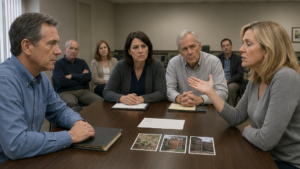
Debra opened the Friday meeting by proposing a lien against Jacob’s property.
The clubhouse was full before she called the room to order. Folding chairs filled the main hall and extended into the corridor. Muddy boot prints crossed the polished floor. Parents stood along the back wall beside residents Jacob had known for years but rarely spoken to.
A projector cast the HOA seal onto a white screen.
Debra sat at the center of the board table. Carol occupied the far end, separated from her by two empty chairs. The black ledger and blue folder rested in front of her.
Jacob sat in the front row with the 1962 plat rolled beneath one arm and his father’s letter in his coat pocket.
“The first item,” Debra said, “concerns repeated violations by Mr. Jacob Martin, including unauthorized road use, interference with safety controls, unapproved grading, and unpaid assessments totaling—”
“Before you total anything,” Jacob said, “show the legal authority for the chain.”
Murmurs moved through the room.
Debra tapped the gavel once. “You will have an opportunity to speak.”
“You’re proposing a lien before the evidence.”
“I am following the agenda.”
The association attorney sat near the board with a thin binder open. He did not look at Debra.
She continued reading. The charges sounded worse in sequence. Trespass. Property damage. Obstruction. Unauthorized infrastructure work. Costs associated with the bus incident.
When she finished, the amount exceeded two thousand dollars.
One neighbor raised a hand. “Did he pay any road assessment last year?”
Debra answered immediately. “No.”
Heads turned toward Jacob.
There it was: the part of the truth she could use cleanly.
Jacob stood.
“No,” he said. “I didn’t.”
The room quieted faster than it had under the gavel.
Debra’s eyes narrowed, as if she had expected denial.
“I received three notices,” Jacob continued. “I left them unopened because they came from the HOA and I assumed they were another demand built on authority the board didn’t have.”
A parent near the back shook his head.
Jacob looked at him. “That was my mistake.”
The words felt heavier than the plat.
“I also knew the low shoulder was washing out. I repaired the section near my place and ignored the rest because it lay outside my fence. Michelle filed safety complaints. I didn’t read them.”
Michelle stood against the side wall in her district jacket. She did not smile or nod. She simply held his gaze.
Debra leaned toward the microphone. “So you admit noncompliance and negligence.”
“I admit I made it easy for you to call anything you wanted compliance.”
A sharper murmur followed.
Jacob walked to the projector table and connected his phone. The HOA seal disappeared. In its place appeared the photograph from Tuesday morning: the steel chain across the road, the yellow bus behind it, and the white fine notice clipped at the center.
Children’s faces were visible through the windshield.
No one spoke.
“This was called safety infrastructure,” Jacob said. “The association paid for it from the road reserve.”
Carol opened the black ledger. “That is correct.”
Debra turned toward her. “Treasurer Perez, you have not been recognized.”
Carol’s hands trembled, but her voice did not. “The official ledger shows a reserve balance of forty-two thousand dollars. The current balance is three thousand eight hundred and eleven.”
The room broke into overlapping questions.
Debra struck the gavel. “The reserve discrepancy reflects authorized transfers and pending reimbursements.”
Carol placed the blue folder upright. “The transfers were not disclosed in the annual statement.”
A board member beside Debra whispered something. She ignored him.
Jacob changed the projected image.
The unsigned enforcement summary appeared next. Then the attorney’s email, enlarged enough for the recommendation to be read from the back row.
Negotiation.
Temporary assessment.
County review.
Do not obstruct easement beneficiaries, public services, or school transportation.
The date stood at the top.
Three weeks before the chain.
The association attorney closed his binder.
Debra’s voice remained even, but the muscles around her mouth had tightened. “Legal guidance is advisory. The board had to act under emergency conditions.”
“What emergency?” a parent called.
“The reserve shortfall and deteriorating road.”
“So you locked the children out?”
“I restricted access to compel a sustainable maintenance agreement.”
Jacob looked at the screen. “You told everyone the association owned the road.”
“The association possesses regulatory authority.”
“Not exclusive ownership.”
“Ownership is not the only basis for control.”
The attorney spoke at last. “Madam President, the easement limits exclusion. I advised against a physical barrier.”
Debra turned to him. “You advised that the documents were ambiguous.”
“I advised that maintenance authority and access authority were distinct.”
Jacob unrolled the 1962 plat across the board table. The paper covered the printed agenda and part of Debra’s folder.
He pointed to the easement clause.
“Owners. Occupants. Invitees. Public service. School conveyance.”
The county marker numbers ran along the road line. Jacob placed his photograph of the ditch marker beside them.
“The posts were set inside this recorded corridor.”
One neighbor leaned forward. “So the HOA can’t charge anything?”
Jacob heard the hope in the question and knew how easy it would be to take it.
“They can’t charge trespass for lawful access,” he said. “They can’t invent fines to force ownership they don’t have.”
“And maintenance?”
He reached into his coat and removed the private agreement bearing his father’s signature.
“My parcel has obligations.”
Debra stared at him.
Jacob placed the agreement beside the plat. “My father accepted responsibility for the low shoulder because his equipment used the road heavily. I inherited the property and ignored that history. I owe a fair share. Probably more than some of you.”
The room shifted again—not toward applause, but toward attention.
A neighbor who had defended Debra on Monday lowered his folded arms.
Jacob took out the unopened letter. He did not read it aloud. He placed it beside the agreement.
“What I don’t owe,” he said, “is obedience to a false ownership claim. And none of you owe fees created to hide an empty reserve account.”
Carol slid forward the draft minutes Debra had sent her.
“She asked me to record that Jacob directed the bus into the field,” Carol said. “He did not.”
Debra stood. “You approved every expenditure in those ledgers.”
Carol’s face went pale.
“Yes,” she said. “I signed reports I should have challenged.”
The admission stripped away the easy shape of the room. There was no single innocent board member stepping forward untouched.
Debra looked around at the residents. “You all demanded lower dues. You delayed assessments. You complained about gravel costs, insurance costs, drainage costs. When the reserve failed, you wanted someone to fix it without charging you.”
No one answered.
Her voice rose only slightly. “I did what leadership requires when people refuse unpleasant decisions.”
“You lied,” Michelle said from the wall.
Debra looked at her. “I forced an issue everyone avoided.”
“You forced a bus into mud.”
The attorney closed his binder completely. “Removing the chain and reversing the fines does not eliminate the funding problem.”
That sentence cut through the room more effectively than the gavel.
A parent asked, “Then what happens if we remove the board?”
“The easement remains,” the attorney said. “So do private maintenance obligations. The county is unlikely to assume the road. Insurance requirements remain unresolved.”
Debra sat down.
For the first time that evening, she looked less like a president than a tired homeowner surrounded by numbers she had tried to command into obedience.
Jacob returned to his seat and lifted a second document.
He had drafted it that afternoon with Edward’s notes beside him, though Edward had refused to attend.
“This is not a solution yet,” Jacob said. “It is a place to start.”
He laid the proposal on the table.
It separated access from maintenance. No resident, school vehicle, emergency service, guest, or delivery driver could be blocked for unpaid fees. Road costs would be listed publicly. Heavy-use parcels would pay a larger share. Safety repairs would be prioritized through inspection rather than board discretion. Any lien would require documented assessments approved in an open vote.
A neighbor scanned the first page. “Who runs it?”
“Not me.”
“Then who?”
“A temporary road committee with county review of the map and an independent account.”
Debra gave a short, humorless laugh. “You think the county will manage your disputes?”
“No. I think they
Chapter 7: The Road Could Not Belong to One Person
The county engineer refused to rescue either side.
He stood at the end of a long conference table with the 1962 plat projected behind him and Jacob’s proposed agreement spread in marked copies before the residents.
“The county recognizes the easement,” he said. “That means lawful access must remain open. It does not mean the county accepts maintenance responsibility.”
A neighbor near the door raised his hand. “Then what exactly are we paying county taxes for?”
“Not this private road.”
The answer drew a low wave of complaint.
Jacob sat beside Carol, who had brought corrected financial statements and three folders of invoices. Debra was absent. Her chair at the end of the table remained empty.
The engineer pointed to the map. “Ownership beneath the road is divided among parcels. Use rights are shared. Maintenance duties come from private agreements and recorded covenants. If you want a public road, you can apply for dedication, but it would require upgrades none of you have budgeted for.”
“How much?” someone asked.
The engineer named a figure large enough to end that line of discussion.
The room went quiet.
“So we are stuck with the HOA,” another resident said.
The association attorney shook his head. “You are stuck with the road. The governing structure can change.”
That distinction had become the center of everything.
Jacob’s proposal divided annual costs by three factors: frontage, household use, and heavy-vehicle impact. The first version had assigned him the largest single share because of his repair business and equipment trailers.
He had expected resentment from others.
Instead, the first objections came from those whose shares were smallest.
“Why should I pay anything?” one homeowner asked. “I enter from the paved side.”
“Your deliveries use this road,” Carol said.
“Not often.”
“Emergency vehicles may.”
“That is hypothetical.”
Michelle, seated against the wall in her school-district jacket, spoke without raising her voice. “The bus is not hypothetical.”
Several people looked toward her.
She had brought the route report, repair estimate, and photographs from the muddy detour. Rather than argue about percentages, she proposed a priority list: drainage first, low shoulder second, grading schedule third, snow access fourth.
“Fund safety before appearance,” she said. “And no barriers across the bus route. Ever.”
The engineer nodded. “That is reasonable.”
The neighbor who had defended Debra on Monday tapped the cost sheet. “Jacob still pays more?”
Jacob answered before anyone else could.
“Yes.”
The man looked surprised. “You agree with that?”
“My trucks wear the surface more than your sedan.”
“But you already repair sections yourself.”
“That work should be credited if it is inspected and documented.”
The engineer added a note to the draft.
A week earlier, Jacob would have heard the larger share as punishment. Now it felt closer to measurement. Not perfect, not flattering, but tied to use rather than obedience.
Carol opened the corrected ledger. “We also need a separate road account. No clubhouse expenses. No transfers without a recorded vote.”
“And no invented penalties,” Jacob said.
The attorney looked over his glasses. “Lawful late fees may still be necessary.”
“Then name them before anyone owes them.”
The discussion lasted three hours. The first cost formula failed. A second failed after two residents objected to the frontage calculation. The third passed narrowly after Jacob agreed to a heavier-use multiplier and Carol accepted temporary oversight of the new account until an outside bookkeeper could be hired.
No one seemed pleased.
That was how Jacob knew it might be fair.
Near the end, the county engineer traced the easement line on the plat.
“The chain must be removed,” he said. “The posts may remain only if they do not narrow access and are repurposed as boundary markers.”
The association attorney added, “The unauthorized road fines should be canceled. Restitution for collected access penalties will require account review.”
Carol nodded. “I have already begun identifying them.”
“What about Debra?” someone asked.
The attorney closed his folder. “She submitted a resignation from the board this morning. She disputes personal liability and reserves her right to respond to the audit.”
There was no cheer.
Jacob looked at the empty chair.
He had expected satisfaction. Instead, he pictured her in the diner, offering the brass key with the red tag. She had believed control would save the association because control was the only form of leadership she trusted.
That did not excuse the chain.
It did explain why removing her did not remove the problem she had tried to dominate.
The sheriff’s deputy met them at the road entrance after the meeting. He inspected the padlock, photographed the posts, and confirmed that the county engineer’s determination had been delivered to the association.
“I can cut it tomorrow morning,” he said. “Seven o’clock, before the bus arrives.”
Jacob looked at the bright links stretched across the gravel.
“Can it be saved?”
The deputy raised an eyebrow. “You want the chain?”
“Not across the road.”
The engineer suggested cutting it into short lengths and hanging them between reflective markers along the drainage boundary. They would warn drivers away from the soft shoulder without blocking passage.
Jacob thought of his father’s rusted winter chain.
“Do that,” he said.
The deputy wrote down the time.
As the others left, Michelle remained beside the bus-route sign.
“You’re really paying the heavy-use share?” she asked.
“I use it heavily.”
“That answer would have saved everybody trouble a year ago.”
“I know.”
She studied him for a moment, then looked toward the chain. “The bus will be here at seven-ten.”
“The deputy said seven.”
“Then we’ll see whether the road is open before the children get here.”
She drove away.
Jacob stayed until the light faded from the gravel. The chain no longer looked like Debra’s authority. It looked like a question that had taken the entire week to ask correctly.
At seven the next morning, the deputy would place a cutting wheel against the same link Jacob had photographed while the bus waited behind it.
Chapter 8: After the Chain Fell Quiet
The cutting wheel touched the same link shown in Jacob’s photograph.
Sparks struck the gravel and vanished.
The deputy leaned into the tool while the chain trembled between the two steel posts. Jacob stood beside the mailbox cluster with Carol, Michelle, the county engineer, and several residents who had arrived without being asked.
No one spoke over the high metallic whine.
The link separated.
One end of the chain dropped first, striking the road with a heavy clatter. The other slid down the post and settled into the dust.
For a second, the entrance looked strangely unfinished.
Then the yellow school bus appeared around the bend.
Michelle slowed before the open gap. The children leaned toward the windows, watching the deputy coil the severed chain away from the tires.
The bus stopped.
Michelle opened the door and looked down at Jacob.
“Clear?”
Jacob glanced at the engineer.
“Clear,” the engineer said.
Jacob stepped back from the road. “Clear.”
The bus crossed the place where the chain had been. Its tires pressed through the shallow line in the gravel, and the children’s faces moved past him one by one.
No one applauded.
The engine faded toward the upper properties, leaving only the ticking sound of the deputy’s cooling tool.
The engineer measured the drainage edge and marked two safe points beyond the shoulder. Later that morning, short pieces of the old chain were hung between reflective posts there—not as a gate, but as a warning against the soft ground.
The remaining links went into Jacob’s truck.
Three weeks later, the first maintenance statement arrived in a plain white envelope.
It listed the current balance, each approved expense, the grading schedule, and Jacob’s heavier-use share. His credit for the shoulder repair appeared on a separate line, supported by the inspector’s report.
There were no unexplained penalties.
No red stamps.
No threats of trespass.
Jacob paid it the same day.
Carol sent copies of the restitution review to every resident. Several access fines had already been refunded. Others required more records. The audit continued, and Debra’s responsibility had not yet been decided.
Her resignation letter contained no apology.
It said only that she had acted under severe financial pressure and believed her decisions had been necessary to preserve community infrastructure.
Jacob read it once and placed it beneath the corrected meeting minutes.
He did not need her to describe the road accurately anymore.
Edward arrived near the end of the month carrying the original 1962 plat in a protective tube.
“You should keep this,” he said.
They stood in Jacob’s kitchen beside the maintenance statement and his father’s letter.
“I thought the county needed the original.”
“They have their copy.”
Jacob set two mugs on the counter. “Coffee?”
Edward looked toward the door.
“Not today.”
The refusal was gentle, but it remained a refusal.
Jacob nodded.
Edward placed the tube beside the letter. “Your father would have argued with the cost formula.”
“He argued with every cost formula.”
“He would have paid it.”
Jacob looked at him. “Eventually.”
A faint smile moved across Edward’s face and disappeared.
At the door, Jacob said, “You could have given me the letter sooner.”
“I could have.”
“I could have asked sooner.”
Edward rested one hand on the frame. “That too.”
They left it there.
After he drove away, Jacob carried the original plat to the equipment shed. He mounted it beneath clear acrylic on the wall above his workbench. Beside it, he hung a length of the cut chain.
Not across an entrance.
Not around a lock.
Just beside the map, where the links could be seen for what they had become: evidence of the harm done by control, and a reminder that an open road still required someone to care for it.
Outside, a delivery truck turned onto the gravel without slowing. Farther up, the school bus returned on its afternoon route.
Jacob listened as both vehicles passed the old mailbox and continued through.
Then he picked up the new maintenance schedule and marked the date for the next drainage inspection.
The road belonged to no single person.
That was why keeping it open had to belong to all of them.
The story has ended.