He Tried to Fine the Old Homeowner Until the Road Beneath His HOA Belonged to Him
Chapter 1: The Notice Under the Old Truck’s Wiper
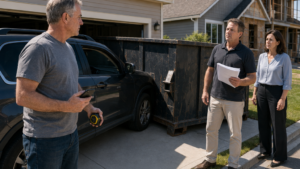
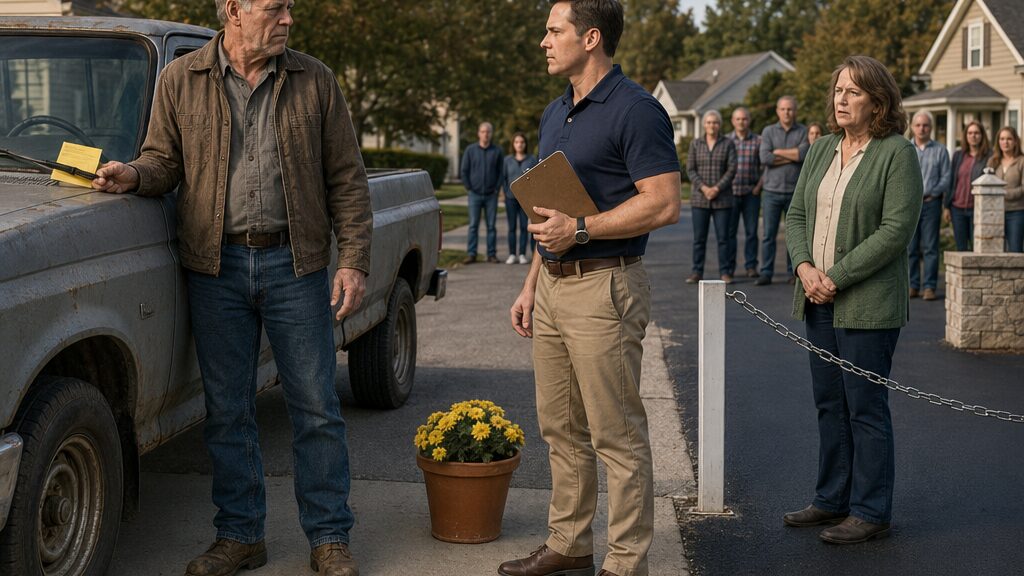
Kevin Thompson slid the yellow violation notice beneath the old pickup’s windshield wiper while William Miller was still standing ten feet away.
He did it slowly.
That was the part William remembered later—not the paper itself, not the printed two-hundred-dollar assessment, not even the half circle of neighbors pretending they had happened to stop near the subdivision entrance at the same time. It was the way Kevin pressed the notice flat against the dusty glass with two fingers, as though tagging abandoned machinery.
“There,” Kevin said. “Now nobody can say you weren’t properly notified.”
William’s right hand tightened around the handle of the coffee mug he had carried out of the garage.
The pickup sat crooked in the morning light, gray paint faded nearly white across the hood, one rear wheel spotted with old brake dust. It was twenty-seven years old and looked every one of them. William knew about the rust over the passenger-side wheel well. He knew about the faint oil shadow on the concrete beneath the engine. He also knew the truck started every morning, hauled more weight than half the decorative pickups in the subdivision, and had belonged to his father before it belonged to him.
Kevin tapped his clipboard.
“The truck. The driveway staining. Improper golf-cart storage. Landscape maintenance. We’ve gone over this.”
“You sent letters.”
“We sent notices.”
“Letters.”
A few neighbors shifted.
Kevin was younger by close to twenty years, trim and carefully dressed in a navy polo with the subdivision logo stitched over his chest. He had been HOA president for six months and carried the clipboard so often William had begun to think of it as an extra rib.
“This isn’t personal,” Kevin said.
William looked at the people behind him. Brenda Young stood near her mailbox with her arms folded. A man from farther down the road sat sideways in a golf cart, making no effort to leave. Two other residents lingered beside the fresh blacktop where the association had installed a temporary chain barrier to keep vehicles from cutting too close to the landscaped entrance.
“No,” William said. “Looks real private.”
Kevin’s jaw tightened.
“The community asked for consistent enforcement.”
“The community ask you to put paper on my truck?”
“The board authorized compliance action.”
William set his mug on the low brick wall beside the driveway. He could feel heat gathering under his collar despite the cool morning.
“You stay off my property.”
Kevin gave a tired breath, the kind a patient man used with someone unreasonable.
“The governing documents allow inspection from common areas.”
“You’re standing in my driveway.”
“I’m at the edge.”
“You’re past the joint in the concrete.”
That earned the smallest sound from the golf-cart neighbor—not quite a laugh.
Kevin heard it too.
His expression changed.
“William, this is exactly the problem. Every conversation becomes an argument over an inch. The truck is visibly deteriorated. The oil stain has been documented. Your cart was left where it could be seen from the road. Residents are tired of one standard for some people and another for—”
His heel caught the clay flowerpot beside the brick wall.
Whether he meant to kick it, William could not later say with certainty. Kevin stepped back sharply, the pot tipped, struck the driveway, and rolled. Dark soil spilled across the concrete. Yellow flowers folded beneath the rim.
Nobody spoke.
Kevin looked down.
Then at William.
“You shouldn’t keep things in the access path.”
Something inside William moved.
Not loudly. Not all at once.
He put his mug down more carefully than necessary.
Brenda uncrossed her arms. “Kevin.”
But Kevin was already turning toward the entrance.
“And that barrier stays in place,” he said. “Until the board is satisfied the access edge is being used properly.”
William followed his gaze.
The temporary chain ran between two square posts near the mouth of his driveway, where his lot narrowed toward the subdivision road. The association had put it up three days earlier after complaints about delivery vehicles cutting over the shoulder. One post stood in mulch. The other had been sunk beside the fresh asphalt.
William stared at that second post.
Kevin mistook the silence for surrender.
“You have until next Friday,” he said. “After that, additional penalties begin. No more excuses.”
William walked past him.
The neighbors watched.
He stopped beside the post, looked down at the seam where black asphalt met older aggregate, then at the shallow drainage cut running toward the ditch.
“Who authorized this?”
Kevin frowned. “The barrier?”
“This post.”
“The board.”
“I asked who authorized putting it on this strip of ground.”
Kevin’s fingers shifted on the clipboard.
“The entrance is maintained by the association.”
“That wasn’t my question.”
“It’s common access.”
“Parcel number?”
Kevin stared at him.
William pointed at the post.
“What parcel is it on?”
Brenda looked from one man to the other.
Kevin’s face hardened. “You’re trying to change the subject.”
“No.”
William bent, picked up the yellow notice from beneath the wiper, and folded it once.
“My father told me something about this strip a long time ago.”
The words tasted old.
He had not intended to say them.
Kevin gave a short, humorless laugh. “Your father?”
“Never sign anything involving the entrance until I checked the old plat.”
The golf-cart neighbor sat upright.
Kevin recovered quickly.
“Then check whatever you want. You still have until Friday.”
He stepped around William, called to the others that the inspection was complete, and walked away with the clipboard tucked against his ribs.
The neighbors dispersed more slowly.
Brenda remained.
“You know,” she said, “people aren’t inventing the stain.”
William crouched beside the broken pot.
“I know what oil looks like.”
“And the truck does look rough.”
He placed the flowers back into the soil with both hands.
“Anything else?”
Brenda’s mouth tightened.
For a moment she looked angry. Then only tired.
“You fixed my alternator in that truck ten years ago.”
“Nine.”
“You wouldn’t take money.”
William said nothing.
“That doesn’t mean everybody else has to understand what the truck means to you.”
He looked up.
“I never asked them to.”
“That might be part of the problem.”
She walked away before he could answer.
By noon, William had cleaned the dirt from the driveway and propped the damaged pot against the garage wall. The yellow notice remained on his workbench.
He tried not to look toward the entrance.
He failed.
The fresh road curved between new brick houses, roofs rising where pasture had once opened toward a stand of pines. William could remember when the entrance had been gravel. Before the monument sign. Before the association. Before his father sold most of the outer acreage to the first developer and spent the next decade complaining that nobody read what they signed.
That night, William went into the garage and stood before a dented green metal cabinet he had not opened in years.
The bottom drawer stuck.
He pulled harder.
Inside lay old tax receipts, survey envelopes, a rusted padlock, and a brown folder with Ronald Brown’s handwriting across the tab.
ENTRANCE / ACCESS.
William sat on the concrete floor.
For several minutes he did not touch it.
Then he opened the folder.
There was a deed copy, an old subdivision sketch, three letters, and the ragged remains of a staple binding.
One page had been removed.
Not lost.
Removed.
The numbered sheet before it ended at page four.
The next began at page six.
William stared at the empty gap until he heard his father’s voice with painful clarity.
Don’t sign blind because somebody puts a clean paper in front of you.
William looked toward the dark outline of the old gray pickup beyond the garage door.
Then back at the missing page.
Chapter 2: The Folder William Refused to Open
The county stamp was hidden inside an oil-stained repair manual.
William found it Saturday morning after pulling half the contents from the pickup’s metal toolbox and spreading them across the garage floor. Sockets. Tow straps. Two cracked work gloves. A fan belt still in its paper sleeve. At the bottom sat the thick diesel manual Ronald had carried even after he stopped doing most of his own repairs.
William almost put it aside.
Then a folded corner of yellowed paper slipped from the binding.
He opened the manual on the workbench.
A plat unfolded across diagrams of fuel pumps and cooling lines.
The paper was brittle at the creases. At the top, beneath a faded county seal, was a recording stamp from more than thirty years earlier. William recognized the outline of the land immediately: the long tract his father had owned before the first houses appeared.
But the lines were wrong.
Or rather, they were older than the lines William knew.
The subdivision entrance crossed what had once been a narrow finger of the family parcel extending toward the county road. A handwritten arrow pointed to it.
RETAINED.
William sat down.
He read the note twice.
Then a third time.
The truck ticked softly as sunlight warmed its hood outside.
He remembered Ronald at this same workbench, older and thinner than William liked to remember, one hand flattened over papers.
They want the entrance cleaned up before phase two.
William had been angry before the conversation started. He could no longer remember why.
Probably because anger had been easier then.
Let them clean it up.
That isn’t what I said.
You never say what you mean.
Ronald’s face had shut down after that.
William folded the plat halfway, stopped, and opened it again.
Beneath the first sheet lay a copy of a deed transfer. Most of the surrounding acreage had been sold. The language was dense, full of bearings and references. William traced the description with one finger until he found the exception.
A retained strip.
Narrow. Irregular.
Near the entrance.
His pulse quickened.
For one hard minute, the solution seemed almost embarrassingly simple.
Kevin had fined him.
Kevin had posted a notice on Ronald’s truck.
Kevin had planted an association barrier on land that might not belong to the association at all.
William pictured the clipboard. The watching neighbors. The broken flowerpot.
He felt the first clean satisfaction he had experienced since Friday.
Then he found the handwritten note.
It was on the back of a letter from the original developer.
Access only if recorded.
Four words.
Ronald’s handwriting.
William’s satisfaction cooled.
He carried everything into the kitchen and spread the papers across the table. By noon he had built three stacks: documents he understood, documents he half understood, and documents that seemed deliberately written to prevent ordinary people from understanding anything.
The deed did not say William owned the road.
It said the family had retained a strip.
Another agreement referred to future access rights.
A draft mentioned maintenance obligations.
None contained the signed page missing from the folder.
He went back outside.
The subdivision road shimmered under the afternoon sun. A delivery van entered, followed by a sedan. Children rode bicycles near a cul-de-sac farther in. The blacktop seemed permanent because everyone behaved as if it were.
William walked the shoulder slowly.
At the entrance, he stopped beside the temporary post.
The land dropped gently toward the ditch. He remembered an old fence line there, gone now. Ronald had once repaired it after a storm and cursed the developer for moving equipment across the wrong side.
William looked toward his house.
Then toward the houses behind him.
If the retained strip was real, it was not a weapon lying neatly in a drawer. It was something dozens of people had crossed for years without thinking.
He returned to the pickup and opened the glove box.
More registration slips. Insurance cards. A flashlight that no longer worked.
Then his fingers touched steel.
He pulled out an old combination wrench, worn smooth at the open end. Two letters had been punched into the handle.
R.B.
William sat behind the wheel.
Ronald had marked every tool that way because, according to him, men became philosophers about ownership the minute somebody else’s wrench entered their toolbox.
William closed his hand around it.
The last argument came back in pieces.
A pen on the kitchen table.
Ronald saying, I need a witness.
William saying, Get one of your developer friends.
Ronald’s chair scraping backward.
You think this is about them?
Everything with you is about land.
That had been the line.
William remembered it because Ronald had gone absolutely still.
Three weeks later, there had been a stroke.
Then a hospital room.
Then too many things left unsaid.
William set the wrench on the passenger seat and returned to the folder.
Near sunset he found a second reference buried in a typed letter. It mentioned a proposed easement agreement “to be recorded concurrently” with another instrument.
There was a number.
Book and page.
William checked every document.
Nothing matched.
He checked again.
The number appeared nowhere else in Ronald’s folder.
By Sunday afternoon, he had stopped imagining Kevin’s face when shown the papers.
That fantasy required certainty.
What William had was a retained strip, an old plat, an ambiguous deed, a handwritten warning, and a missing record that might explain all of it.
Or destroy it.
He wrote the reference number on the back of Kevin’s yellow violation notice.
Then he called the county records office’s automated line and listened until he found Monday’s opening time.
Before going inside for the night, he stood beside the old pickup.
The violation notice lay folded in his shirt pocket.
The R.B. wrench rested in his hand.
Across the road, the temporary barrier post cast a thin shadow over the fresh asphalt.
William looked at the number he had copied.
For the first time, he understood that the missing page was not the only thing absent.
Somewhere in the county record, there was supposed to be another document.
And whatever it contained had been important enough for Ronald to write four words in the margin:
Access only if recorded.
Chapter 3: The Line Missing From the County Map
Katherine Torres found the reference number in less than three minutes.
Then she turned the monitor toward William and showed him a blank screen.
“That’s it?” he asked.
“That’s the index entry.”
“There’s nothing there.”
“I can see that.”
The county land-records office had opened twenty minutes earlier. William had arrived five minutes before the doors unlocked and parked the old gray pickup where he could see it through the broad front windows. Among newer SUVs and county vehicles, it looked exactly like what Kevin had called it: deteriorated.
Katherine tapped the keyboard.
“The index says an instrument was assigned to this book and page.”
“But no instrument.”
“No image.”
“Same thing.”
“No.” She looked at him over the monitor. “Not the same thing.”
William leaned back.
She wore a county badge on a blue lanyard and spoke with the careful patience of someone accustomed to people arriving angry about boundaries.
“Older records get misindexed,” she said. “Pages are scanned incorrectly. Sometimes references appear in drafts for instruments that were never completed.”
“My father wrote the number down.”
“That tells me your father wrote the number down.”
William’s mouth tightened.
Katherine noticed.
“You want me to tell you the HOA road belongs to you.”
“I didn’t say that.”
“You brought me a violation notice with a recording number written on the back.”
He looked down at the yellow paper.
“That was what I had.”
“I can help you trace records. I cannot give you a legal conclusion because you dislike your association president.”
William almost stood.
The old impulse came quickly: another desk, another rule, another person explaining what he could not do.
Then he saw Ronald’s folder on his lap.
He stayed seated.
“Fine,” he said. “Trace it.”
Katherine held his gaze for a second, then nodded.
They began with the family deed.
An hour later, William’s confidence had been reduced to a legal pad covered in arrows.
The retained strip existed.
That much was real.
The original acreage transfer had carved out an irregular piece running from William’s remaining lot toward the county road. Later plats referenced access. Later deeds assumed access. Maintenance records showed the association paying for paving and drainage.
But William could not find a clean transfer of the retained strip.
Neither could Katherine.
“That doesn’t mean you can block anything,” she said.
“I haven’t blocked anything.”
“You asked twice what happens if you close the entrance.”
“I asked once.”
“You asked once out loud.”
He frowned.
Katherine pulled another plat from the digital archive.
“This is the older proposed layout.”
She printed it.
Then she printed the final subdivision plat.
They spread both sheets across a counter.
At first William saw no difference.
Katherine put one finger on the entrance.
“Here.”
The original access corridor ran in a straighter line.
The built road curved.
Not dramatically. A few feet at first, then more near the drainage edge.
William bent closer.
“That pavement crosses the retained strip.”
“Possibly.”
“It does.”
“Possibly, based on these records.”
“The barrier post is right there.”
“Again—”
“It’s right there.”
Katherine lowered her voice.
“Mr. Miller, listen to me. Ownership of a narrow strip is not the same as an unrestricted right to disrupt long-established access. There may be easement rights. There may be implied rights. There may be other recorded instruments we haven’t found. There may be emergency-access issues. The fact that people have used that road for years matters.”
His first reaction was anger.
His second was worse: disappointment.
For two days he had imagined walking into Kevin’s office with a paper and watching the clipboard become useless.
Now the road had people on it.
School buses.
Ambulances.
Brenda, whom he did not particularly like at the moment but who had once sat in his garage while he replaced her alternator because she could not afford a shop.
A young family near the entrance whose child left a bicycle in the yard every afternoon.
William looked through the window at the old pickup.
“What do I own?”
Katherine folded her arms.
“That is finally the right question.”
They traced the chain again.
By early afternoon, the answer was narrower than revenge and stranger than coincidence.
William appeared to retain title to the strip described in the old deed, subject to whatever enforceable access rights existed. The association maintained the road. Residents relied on it. The exact built entrance did not match the planned corridor cleanly.
And the missing instrument remained missing.
William rubbed both hands over his face.
“So Kevin planted a post on my land.”
Katherine hesitated.
“Based on the mapped alignment, part of that barrier may be on the retained strip.”
A small payoff.
Not victory.
But real.
William sat quietly.
Katherine returned to the index.
“There’s another route.”
“What?”
“Association filings.”
He looked up.
“If there was ever a title concern, sometimes it appears in insurance correspondence, maintenance agreements, board exhibits, annexation papers.”
“You keep those?”
“Recorded ones.”
They searched the HOA name.
Most entries were useless. Amendments. Liens. Releases. A maintenance memorandum.
Then Katherine stopped scrolling.
“What?”
She opened a document dated seven months earlier.
William moved closer.
It was a short filing attached to a drainage and entrance-improvement project. The contractor had requested confirmation of site control before installing posts and modifying runoff near the road edge.
A paragraph in the middle referred to an “unverified access discrepancy involving legacy parcel boundaries.”
William read it twice.
At the bottom was a signature.
Kevin Thompson.
For several seconds, William heard only the low hum of the office lights.
“He knew.”
Katherine did not answer.
“He signed this.”
“He acknowledged receipt.”
“Seven months ago.”
“Yes.”
William felt the humiliation of Friday return with a different shape.
Kevin’s finger near his face.
The notice beneath the wiper.
The neighbors watching.
The broken flowers.
No more excuses.
William pointed at the document.
“You said you couldn’t give me legal conclusions.”
“I can’t.”
“Then give me a factual one.”
Katherine looked at the signature, then at him.
“The factual statement is that Mr. Thompson signed a filing acknowledging an unverified discrepancy before the barrier was installed.”
William folded the copy carefully.
His anger no longer felt hot.
That frightened him more.
Outside, the old pickup waited in the parking lot, sun flashing against its scratched windshield. The same truck Kevin had used as proof that William was the sort of man who ignored rules.
William put Ronald’s folder on the passenger seat.
Before starting the engine, he read Kevin’s signature one more time.
The question had changed.
It was no longer whether Kevin had made a mistake.
It was how much he had known before he decided to humiliate William anyway.
Chapter 4: The President Who Needed a Victory
The emergency hearing notice was taped to William’s front door before eight Tuesday morning.
Not mailed.
Not emailed.
Taped at eye level with a strip of blue painter’s tape, as if whoever delivered it wanted to be certain he could not claim he had missed it.
William stood on the porch in his work shirt and read the first line twice.
SPECIAL COMPLIANCE HEARING.
Wednesday, 6:30 p.m.
The date was two days before Kevin’s Friday deadline.
At the bottom, beneath the list of alleged violations, a new paragraph warned that “recent statements concerning access property” could be interpreted as a threat to common ingress and egress.
William pulled the notice down.
He had made no such threat.
Not yet.
Across the road, Brenda Young was watering two hanging baskets. She looked over, saw the paper in his hand, and shut off the hose.
“You knew about this?”
She hesitated just long enough.
“I knew Kevin wanted a meeting.”
“That isn’t what I asked.”
Brenda set the hose against the porch rail.
“You asked if I knew about the hearing. Yes.”
William folded the notice.
“Before Friday.”
“He says the access issue changes things.”
“What access issue?”
“You tell me.”
He almost laughed.
Instead he walked across the street.
Brenda watched him come with the expression of a person who already regretted not going inside sooner.
“You all got a copy of this county filing?” William asked.
He took the document Katherine had printed and held it out.
Brenda did not touch it.
“What is it?”
“Something Kevin signed seven months ago.”
Her eyes moved to the signature.
Then back to William.
“What exactly are you doing?”
There it was.
Not What did Kevin know?
Not Why was the barrier installed anyway?
What are you doing?
William felt his old instinct harden.
“Trying to understand why your president put a post on land he knew might not belong to the association.”
Brenda’s voice dropped.
“People are saying you think you own the road.”
“People say plenty.”
“Do you?”
“I own something.”
“That’s not an answer.”
“No.”
“It isn’t.”
William folded the paper again.
Brenda’s mouth tightened.
“You think this is funny?”
“I haven’t laughed once.”
“My house is most of what I have.”
That stopped him.
Brenda looked past him toward the subdivision.
“I’m trying to sell in a year, maybe two. My daughter needs help. Half the people on this road bought at the edge of what they could afford. We had three years of complaints about loose enforcement. Boats in driveways. Dead lawns. Rental houses with six cars. Every board said they’d fix it, and every board backed down the second somebody yelled.”
“And that makes my truck dangerous?”
“It makes exceptions dangerous.”
William stared at her.
She gave a weary shake of her head.
“That’s what you don’t understand. You know your own reasons. The rest of us see the outside.”
“My outside offend you?”
“Sometimes, yes.”
The honesty landed harder than accusation.
Brenda pointed toward his driveway.
“That truck has looked half-finished for years. The stain is real. The golf cart was parked by the curb for six weeks.”
“Four.”
“See? This. Every fact becomes a trial.”
William said nothing.
Brenda sighed.
“You repaired my alternator. I remember.”
“Nine years ago.”
“I remember that too. And I remember you refusing money like I insulted you by offering.”
He looked away.
She continued more quietly.
“I told Kevin enforcement needed to be consistent. I signed off on the first notices.”
There it was.
William felt a cold satisfaction at finally locating her on the other side.
Brenda saw it.
“Don’t look so pleased. I’m telling you because I’m not pretending.”
“Did you sign off on him kicking my flowerpot?”
“No.”
“Putting the notice on my truck?”
“No.”
“Threatening access?”
Her face changed.
Only slightly.
William noticed.
“What?”
Brenda glanced toward her house.
“Kevin was warned about the entrance.”
William went still.
“By who?”
“A contractor first. Then the insurance people asked questions during the drainage project.”
“When?”
“Months ago.”
“You knew?”
“I knew there was a paperwork issue. Kevin said it was an old mapping inconsistency and legal had no concern.”
“Did legal say that?”
“I don’t know.”
William unfolded the county filing and held Kevin’s signature between them.
Brenda finally took the page.
She read the paragraph.
Her face lost color.
“He told the board this had been cleared.”
“Was that in minutes?”
She looked at him sharply.
“You planning to sue?”
“I’m planning to find out what people knew before they stood in my driveway.”
Brenda folded the page along the same crease.
For the first time since Friday, William saw uncertainty in someone other than himself.
Wednesday evening, the HOA community room was full enough that folding chairs had been added along the back wall.
Kevin stood at the front beside an attorney William had never seen before.
The clipboard was there.
Of course it was.
Kevin opened with photographs: the oil stain, the golf cart, the rusted wheel well, the broken flowerpot before William had repotted it.
The images looked worse projected large.
William understood, unpleasantly, why.
A board member asked whether the truck was operable.
“Yes,” William said.
Kevin interrupted. “Operability is not the only standard.”
The attorney spoke next, carefully.
“The association has also become aware of statements suggesting Mr. Miller may interfere with established neighborhood access.”
William looked around the room.
Faces avoided his.
So that was how fast it had moved.
“What statement?” he asked.
Kevin answered.
“You questioned the board’s authority over the entrance barrier and indicated your family may claim an interest beneath the road.”
“That’s not a threat.”
“Residents are concerned.”
“You made them concerned.”
A murmur moved through the room.
Kevin’s expression tightened.
“This is exactly the confrontational pattern we’ve been dealing with.”
William felt the old anger surge.
He nearly pulled out the county filing.
Nearly laid it on the table and watched Kevin explain his signature.
Then he saw Brenda seated near the aisle.
She gave the smallest shake of her head.
Not now.
William hated that he understood her.
The hearing ended without resolution. The board reserved further action. The attorney requested that William refrain from “self-help measures” affecting access.
Outside, Brenda caught him beside the pickup.
“You were going to show it.”
“Yes.”
“Why didn’t you?”
“Still deciding.”
“That’s not like you.”
“You don’t know me that well.”
She looked at the truck.
“No. That’s probably part of this.”
William opened the driver’s door.
Brenda said, “Kevin really does think he’s fixing something.”
William paused.
“He ran for president because people were furious. Dues up. Maintenance behind. Everybody accusing the last board of favoritism. He promised rules would mean the same thing for everybody.”
“And then ignored one.”
“I didn’t say he was right.”
“You’re working hard not to say he’s wrong.”
Her face sharpened.
“I’m working hard not to pretend you’re easy.”
William almost answered.
Instead he got into the truck.
At home, he spread the plats across his kitchen table.
The Wednesday hearing had clarified one thing.
Kevin would not slow down voluntarily.
William called the number of a county surveyor Katherine had said could independently retrace the boundary.
He asked for the earliest available morning.
“Friday,” the surveyor said.
William looked through the window toward the entrance road.
“Take it.”
“Need to know the purpose.”
“Boundary verification.”
“Any active dispute?”
William watched headlights curve over the fresh asphalt.
“Yes.”
The surveyor gave him a pause.
“Then I recommend you have any affected party notified.”
William’s hand tightened around the phone.
“I’ll handle that.”
He ended the call without deciding whether that was true.
Chapter 5: Friday Morning at the Entrance
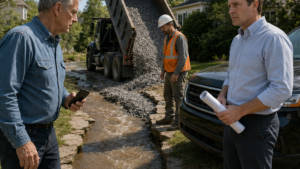
By six-forty Friday morning, three orange cones stood beside the subdivision entrance, fluorescent survey flags had appeared in the grass, and a backhoe waited on a trailer near the county road.
The first resident stopped before sunrise was fully gone.
By seven, everyone knew.
William parked the old gray pickup on the shoulder with its tailgate down. Inside lay stakes, a shovel, the R.B. wrench, a thermos, and copies of the recorded plats beneath a plastic cover.
The road contractor stood beside the backhoe, drinking coffee.
“Still no digging until surveyor confirms,” William said.
“Wasn’t planning to.”
“I’m saying it again.”
“You’ve said it three times.”
William looked toward the houses.
Curtains moved.
Garage doors opened.
A golf cart rolled down, slowed at the cones, then reversed.
The county surveyor arrived at seven-ten with a receiver pole and a case of instruments. No drama. No announcement. He asked William for the deed description, checked control points, and started working.
That ordinary professionalism made the scene look more serious.
At seven-thirty, Kevin came running.
Not walking fast.
Running.
He wore khakis and an untucked polo, no clipboard in sight.
“What is this?”
William stood beside the pickup.
“A survey.”
Kevin looked at the backhoe.
“That is not a survey.”
“That’s a contractor.”
“For what?”
“Depends what the survey finds.”
Kevin’s face reddened.
“You cannot excavate the neighborhood entrance.”
“I haven’t.”
“You brought heavy equipment.”
“It’s parked.”
Residents had gathered now. Some kept their distance. Others came closer.
Brenda arrived last among the board members.
Kevin pointed toward the cones.
“You were warned against interfering with access.”
William folded his arms.
“You warned me against threatening it.”
“This is exactly what the attorney meant.”
The surveyor looked up.
“Gentlemen, I need room.”
Kevin turned on him.
“Who hired you?”
“I did,” William said.
Kevin stared at William.
Then at the old pickup.
Then at the stakes.
For one brief moment the balance from the previous Friday inverted so perfectly that William felt something close to pleasure.
Kevin had put paper under his windshield wiper while neighbors watched.
Now Kevin stood asking what he was allowed to do.
William let the silence stretch.
Too long.
That was the first mistake.
The surveyor moved toward the entrance edge, checked a point, then planted a temporary flag near the asphalt.
Kevin stepped forward.
“What does that mean?”
“It means I found a point.”
“Whose property?”
The surveyor straightened.
“It means I found a point.”
William almost smiled.
The work continued.
A second flag appeared.
Then a third.
The line did not follow the road cleanly.
It cut across the landscaped edge, touched the drainage area, and angled beneath a portion of the entrance pavement before returning toward William’s lot.
The crowd became quieter with each flag.
Kevin saw it too.
“No,” he said.
Nobody answered.
He turned to William.
“You’re insane if you think you can close this road.”
William felt the words land.
There it was.
The line he had imagined.
The moment when Kevin finally understood.
William reached into the pickup and pulled out the county-stamped plat.
“I think,” he said, “you installed a barrier on a strip my family never transferred.”
Kevin’s expression hardened.
“We’ll sue.”
“Then sue.”
Brenda said, “William.”
He did not look at her.
Kevin stepped closer.
“You think a technicality gives you the right to trap thirty-two homes?”
“I didn’t trap anybody.”
“You brought a backhoe.”
The contractor quietly set down his coffee.
William held Kevin’s gaze.
“Repairs can take time.”
A murmur moved through the neighbors.
William heard it.
He also saw Kevin’s fear.
For a few seconds, that fear satisfied him.
Then a woman from the young family near the entrance pushed through the cluster of residents.
“Excuse me.”
She was holding a child’s backpack in one hand.
“Are you closing the road?”
William turned.
“No excavation has started.”
“That’s not what I asked.”
Her voice shook.
“My husband’s at work. My son’s bus comes at eight. My mother lives with us and has oxygen delivered twice a week. Are trucks going to be able to get in?”
William opened his mouth.
Nothing came out.
Behind her, the child stood near the driveway with one shoe untied.
The surveyor approached carrying a field tablet.
“Mr. Miller.”
William looked at him.
“I have a preliminary alignment.”
Kevin stepped in. “Say it.”
The surveyor ignored him.
“To a reasonable field tolerance, the retained description does appear to overlap the constructed entrance and drainage edge.”
William heard one resident curse under his breath.
Kevin’s face changed.
The surveyor continued.
“But I need to be clear. This does not establish that Mr. Miller can obstruct access. That’s a legal question. Long-term use, recorded and unrecorded rights, emergency access—all separate.”
William looked at Kevin.
The victory narrowed.
Exactly as Katherine had warned.
Still, the line was real.
The barrier post was partly on his strip.
The pavement crossed it.
The HOA had built and maintained improvements on land nobody had properly resolved.
Kevin said, “So he owns nothing useful.”
The surveyor gave him a flat look.
“I didn’t say that either.”
A few residents exchanged glances.
William should have stopped there.
He knew it.
Instead he looked toward the backhoe.
The contractor saw him.
“Want me to expose the drainage edge?” the contractor asked. “We can open a small section, verify what crosses the line.”
Kevin spun around.
“No.”
William felt thirty pairs of eyes move to him.
This was the point.
He could say yes.
A small excavation. Technically framed as investigation or repair. Enough noise, enough blocked shoulder, enough uncertainty to make the board feel what he had felt when Kevin threatened consequences in front of everyone.
He imagined the bucket biting into fresh ground.
Kevin watching.
The clipboard useless.
Then the child near the entrance asked his mother, “Are we late?”
The woman checked the road again.
William saw the fear he had created.
Not Kevin.
Him.
His father’s voice came back unexpectedly.
You think this is about them?
William looked at the backhoe.
“Shut it down.”
The contractor blinked.
“What?”
“No excavation.”
Kevin gave a short breath of relief, then tried to hide it.
William pointed at the trailer.
“Load it back up.”
The contractor nodded.
The young mother’s shoulders lowered.
Kevin recovered first.
“So this was a stunt.”
William turned toward him.
“No.”
“It sure looks like one.”
William held up the plat.
“This line exists whether that machine digs or not.”
“You brought it here to frighten people.”
The accusation hit because it was partly true.
William looked at the gathered residents.
He had spent a week telling himself he wanted facts.
But somewhere between booking the survey and calling the contractor, he had wanted fear too.
Brenda was watching him.
Not approving.
Not condemning.
Waiting.
William said, “I nearly made the same mistake you did.”
Kevin stared.
“What mistake?”
“Thinking being able to pressure somebody meant I ought to.”
Nobody spoke.
William folded the plat.
“The survey finishes. No digging. Then I’ll meet.”
Kevin crossed his arms.
“With me?”
“With the full board.”
“We have counsel.”
“Bring counsel.”
“You don’t set terms.”
William looked at the flag planted beside the fresh asphalt.
“Today I set that one.”
Kevin’s face hardened, but Brenda stepped between them before he could answer.
“Full board,” she said.
Kevin turned.
“You don’t speak for everyone.”
“I speak for the treasury you’re about to spend.”
That stopped him.
The backhoe trailer pulled away twenty minutes later.
The crowd dispersed slowly.
The young family left for the bus stop.
William remained beside the old pickup while the surveyor finished measurements.
What he had wanted was a reversal.
He had gotten one.
It did not feel clean.
On the tailgate, beside the R.B. wrench, the county plat shifted in the breeze.
William held it down with one hand.
By noon, the contractor was gone, the road was open, and three bright flags still marked the line nobody in the neighborhood could pretend was imaginary anymore.
Chapter 6: The Agreement Ronald Never Signed
The missing page arrived Friday afternoon in a flat cardboard envelope from an attorney archive William had forgotten existed.
He knew what it was before opening it.
The old firm’s name was printed in the corner. A clerk had located the file after Katherine helped him trace a successor office connected to the original recording reference.
William carried the envelope into the kitchen.
For ten minutes he left it unopened beside the plats.
Then he cut the edge with Ronald’s old pocketknife.
Inside was a copy of page five.
And behind it, an unsigned agreement.
William sat down.
The first paragraph described the retained entrance strip.
The second granted permanent access to future subdivision lots.
The third required shared maintenance costs.
The fourth prohibited obstruction except for necessary repair, emergency conditions, or mutual agreement.
William read it once.
Then again.
There was no trap.
No plan to hold homeowners hostage.
No attempt to squeeze the developer forever.
Ronald had intended to give the road a durable legal foundation while preserving responsibility for drainage, repairs, and any expansion across the retained land.
Fair access.
Fair cost.
Written down.
William’s throat tightened.
At the bottom were signature lines.
Ronald Brown.
Developer representative.
Witness.
The witness line was empty.
A note in Ronald’s handwriting filled the margin.
William will witness after we talk.
William stood so fast the chair scraped backward.
He walked into the garage.
The old gray pickup sat with its hood raised. He had meant to replace a worn hose after the survey but had not touched it.
On the fender lay the R.B. wrench.
He picked it up.
The punched initials matched the cramped handwriting on the agreement—not in shape, but in stubbornness. Ronald marked tools because tools disappeared. He wrote notes because conversations failed.
William leaned against the truck.
The last argument returned whole now.
Ronald at the kitchen table.
The agreement between them.
I need a witness.
Get one of your developer friends.
I’m asking you.
You’re always asking me after you already decided.
Ronald had pressed both palms to the table.
I’m trying to keep them from building a road across land they don’t maintain.
William had laughed.
A bitter sound.
Everything with you is about land.
Ronald’s face changed.
No, he had said. Not everything.
William had walked out.
He had told himself for years that Ronald chose the property over him.
The unsigned page said something harder.
Ronald had expected him to come back.
The phone rang.
William let it ring twice before answering.
It was the attorney he had consulted after the Friday survey.
“I reviewed what you sent.”
William looked at the agreement.
“And?”
“You have leverage.”
“Not ownership of the whole road.”
“No.”
“Can I close it?”
A pause.
“Not safely, and probably not the way you mean. There are strong reliance issues. Potential implied easement arguments. Emergency-access concerns. You could spend years proving a point and still lose pieces of it.”
William closed his eyes.
“What can I do?”
“Force resolution.”
The attorney explained in plain terms. The retained strip mattered. The shifted entrance mattered. The absence of a clean recorded easement mattered. So did decades of neighborhood use.
William could demand recognition.
He could negotiate maintenance.
He could insist future improvements be verified.
He could seek compensation for burdens placed on his land.
He could not responsibly pretend thirty-two households had no rights at all.
After the call, William returned to the agreement.
Ronald had reached the same conclusion decades earlier.
The realization hurt more than being wrong.
Saturday morning, Kevin came alone.
No clipboard.
No board members.
He stood at the edge of William’s driveway and did not step past the concrete joint.
William noticed.
“What?”
Kevin held an envelope.
“I want to resolve this.”
“Full board.”
“This is preliminary.”
William did not move.
Kevin extended the envelope.
Inside was a short proposal.
The HOA would withdraw all current fines.
The access-related notice would be removed.
In exchange, William would execute a quitclaim transferring any interest in the entrance strip to the association.
Confidential terms.
William read it twice.
Then looked up.
“You wrote this?”
“Counsel did.”
“Board approved?”
“Not yet.”
“So you want my signature before theirs.”
“I want to know whether a deal is possible.”
William almost admired the efficiency.
Almost.
Kevin said, “You wanted the fines gone.”
“I wanted you to stop pretending facts didn’t matter.”
“They do matter. So do thirty-two homes.”
“You remembered them quick.”
Kevin’s jaw tightened.
“I’m trying to prevent this from getting worse.”
“For who?”
“For everyone.”
William held up the paper.
“This protects you.”
“It protects access.”
“It hides why there’s a problem.”
Kevin looked toward the road.
For the first time, he seemed tired rather than polished.
“You think I had a choice about enforcement?”
“Yes.”
“You weren’t in the meetings.”
“No.”
“People were furious. Every rule applied to one house and not another. The prior board delayed everything. Dues went up. Contractors quit. Residents blamed us for values, rentals, maintenance. I said I would enforce the documents as written.”
“And when a document said the access was unverified?”
Kevin’s face closed.
“I was told it was an administrative issue.”
“By who?”
“People who should have known.”
“You signed it.”
“Yes.”
“And put the post in anyway.”
Kevin’s silence answered.
William thought of the flowerpot.
The notice under the wiper.
The crowd.
“You could’ve asked me.”
Kevin gave a short laugh without humor.
“You don’t exactly invite conversation.”
That landed.
William looked away.
Kevin continued.
“Every time anyone raises something, you act like they’re trespassing. You don’t explain. You don’t answer. You make people drag every fact out of you.”
William’s hand tightened on the proposal.
“You humiliated me.”
“Yes.”
The answer came so quickly William looked back.
Kevin’s face was rigid.
“I did.”
No excuse followed.
Then Kevin said, “And you brought a backhoe to the entrance.”
There it was.
Not equivalence.
But truth.
William folded the confidential proposal.
“No.”
Kevin frowned.
“No deal?”
“No secret deal.”
“You’re making a mistake.”
“Maybe.”
“What do you want?”
William looked past him toward the road.
Ronald’s unsigned agreement lay inside on the kitchen table.
What do you want?
A week earlier, the answer would have been simple.
He wanted Kevin afraid.
He wanted the board embarrassed.
He wanted the neighbors to know they had chosen the wrong man to corner.
Now he wanted something more difficult.
“Come Monday,” William said, “you’ll have it in writing.”
Kevin’s expression sharpened.
“William—”
“Full board.”
He handed the confidential proposal back.
Kevin did not take it at first.
Then he did.
That evening, William sat at the kitchen table with Ronald’s old agreement on his left and a blank legal pad on his right.
He wrote slowly.
Recognition of the retained parcel.
A permanent recorded access agreement.
Shared maintenance obligations.
Independent verification before future access-related enforcement.
Withdrawal of the fines.
No private release of claims for Kevin.
No road closure except genuine repair or emergency conditions.
He crossed out one sentence that demanded Kevin’s resignation.
Then wrote another requiring the board to disclose the prior discrepancy and the basis for its correction.
By Sunday night, the proposal was finished.
William attached the survey, the county filing bearing Kevin’s signature, and the old access draft.
He read the packet once more.
Then he did something that felt harder than threatening the road.
He sent it to every board member.
No private bargain.
No hidden leverage.
No silence.
The final email went out at 9:17 p.m.
Within a minute, one delivery receipt appeared.
Then another.
Then a third.
William sat alone at the kitchen table, looking at Ronald’s empty witness line.
This time, everyone would know exactly what had been left unfinished.
Chapter 7: The Meeting Without the Clipboard
William began by admitting he had almost used the backhoe to frighten everybody.
The room went still before he finished the sentence.
Monday’s board meeting had drawn more residents than the emergency hearing. Folding chairs filled the community room wall to wall, and two people stood near the door. Kevin sat at the front table with the HOA attorney, Brenda, and the other board members.
His clipboard lay flat on the table.
William noticed that first.
Not tucked beneath an arm. Not held upright like a shield. Flat.
He stood near the center aisle with one copy of his proposal in hand.
“I could tell you Friday was only about confirming a boundary,” he said. “That would be partly true.”
Kevin leaned back.
William continued.
“The survey was necessary. The contractor wasn’t. Not yet.”
A faint movement passed through the audience.
The young mother from the entrance sat near the back.
William looked at her only once.
“I wanted the board to understand what it feels like when somebody else decides your access, your property, your ordinary life can be turned into leverage.”
Kevin said, “So you admit it was retaliation.”
The attorney touched his arm, but Kevin ignored it.
William looked at him.
“I admit I wanted retaliation.”
The room changed.
Not in William’s favor exactly.
But people began listening differently.
He could feel it.
Kevin seemed to feel it too.
“You brought heavy equipment to a residential entrance,” he said. “And now you want to present yourself as reasonable because you changed your mind at the last second?”
“No.”
“Then what?”
William folded the proposal once along its crease.
“I want the record fixed.”
Kevin gave a short laugh.
“This is about a technical defect.”
William looked toward the residents.
“That’s what I thought at first.”
The attorney finally spoke.
“There are legal questions still unresolved.”
“Yes.”
“You do not possess a judicial determination that the association lacks access rights.”
“No.”
“You do not own the entire road.”
“No.”
Kevin frowned.
He had expected resistance.
William was giving him agreement.
The attorney continued more carefully.
“Then we should be clear that the narrative circulating through the neighborhood—that the HOA road somehow belongs entirely to Mr. Miller—is false.”
William nodded.
“It is.”
A murmur moved through the room.
Kevin seized on it.
“Thank you.”
William turned back toward him.
“What’s also false is the idea that you didn’t know there was a boundary problem.”
Silence again.
Kevin’s expression closed.
William placed the county filing on the front table.
“I found this before the survey.”
“I’m aware.”
“You signed it.”
“It acknowledges an unverified discrepancy.”
“Yes.”
“Not a title defect.”
“No.”
“Not proof of your claim.”
“No.”
Kevin spread his hands.
“Then what exactly are we doing?”
William looked at the clipboard lying flat beside him.
“Finding out why you told the board it had been cleared.”
Brenda moved.
Just one hand at first.
She reached into a folder.
Kevin turned toward her.
“Brenda.”
She did not look at him.
“I need to put something into the record.”
The attorney sat straighter.
Kevin’s voice sharpened.
“What?”
Brenda removed three pages.
“Meeting minutes.”
William felt the room tighten.
Brenda placed the pages in front of the other board members.
“From the drainage project review.”
Kevin stared at her.
“We discussed this.”
“No,” Brenda said. “You summarized it.”
“Same thing.”
“It isn’t.”
She looked toward the residents.
Her voice was not dramatic. That made it worse.
“The contractor requested written confirmation that the entrance improvements were fully within association-controlled property. The insurer asked for clarification after that.”
Kevin said, “And counsel said there was no immediate operational issue.”
“Counsel said the discrepancy should be verified.”
Kevin’s jaw tightened.
Brenda tapped the page.
“That’s in the minutes.”
William watched her.
This was not loyalty.
Not to him.
Brenda still disliked his driveway stain. He knew that.
What she could not tolerate now was being made part of a decision she had not actually made.
Kevin looked at the other board members.
“This is being distorted.”
One of them said, “Did you tell us it was cleared?”
Kevin did not answer immediately.
That was enough.
The room shifted again.
The attorney leaned toward him.
Kevin pushed his chair back.
“I was trying to keep a minor issue from derailing a project residents had demanded for two years.”
There it was.
Not innocence.
Reason.
“I had contractors threatening to walk,” Kevin said. “People complaining about drainage. Complaints about cars cutting the shoulder. Complaints about inconsistent rules. Every problem landed on the same table.”
His voice had risen, but it was not theatrical.
It sounded tired.
“You all wanted decisions. You wanted somebody to stop delaying everything.”
A resident near the wall said, “Not by hiding things.”
Kevin turned toward the voice.
“I didn’t hide ownership. There was no confirmed ownership issue.”
Brenda said, “You hid the warning.”
Kevin looked at her.
“You signed every budget I brought.”
“Yes.”
“You pushed for enforcement.”
“Yes.”
“You told me people were threatening to sell.”
“Yes.”
“And now you’re pretending you had clean hands?”
Brenda’s face flushed.
“No.”
The single word stopped him.
She sat straighter.
“I supported the fines.”
William looked at her.
“I thought William believed rules were for everybody else. Sometimes I still think that.”
A few uneasy laughs died quickly.
Brenda continued.
“But I did not authorize humiliating him. I did not authorize you to represent an unresolved access issue as settled. And I will not vote for a private deal that makes this disappear.”
Kevin looked from her to William.
“So that’s the plan.”
William said, “What plan?”
“You two make me the villain, the board saves face, and he gets whatever he wants.”
Brenda’s expression hardened.
“I am not on his side.”
William almost smiled.
“Believe her.”
The tension broke for half a second.
Then William placed his proposal on the table.
“I don’t want the road.”
Kevin stared.
“I want the strip recognized. I want a permanent recorded access agreement. I want maintenance obligations written down. I want the fines withdrawn. And before the board threatens access again, I want somebody to verify the land they’re threatening it over.”
The attorney picked up the proposal.
Kevin said, “And money?”
“Shared repair costs as agreed.”
“No payout?”
“No.”
“Board seat?”
William looked at him.
“What?”
A resident near the front had apparently suggested it earlier; William saw recognition on several faces.
Kevin said, “Some people think this is your way onto the board.”
“I’d rather replace the transmission in Brenda’s car.”
Brenda said, “Don’t.”
A few people laughed.
This time the sound stayed.
Then Kevin said, “You expect me to resign?”
William’s eyes moved to the paragraph he had crossed out before sending the proposal.
“No.”
Kevin seemed surprised.
“I expect the board to decide what to do with you.”
That landed harder than a demand.
The attorney called for a recess.
Fifteen minutes later, the board returned.
The first vote concerned entering formal settlement negotiations under William’s proposal.
One board member voted yes.
The second voted no.
Kevin voted no.
The remaining member voted yes.
Two to two.
Every face in the room turned toward Brenda.
She had the deciding vote.
William watched her place both hands on the table.
Kevin said nothing.
Neither did William.
Brenda looked first at the proposal.
Then at the minutes showing the warning Kevin had minimized.
Then across the room at William.
The man whose truck she had complained about.
The man who had fixed her alternator.
The man who had almost frightened an entire neighborhood because being humiliated had felt like permission.
Her fingers rested on the edge of the paper.
“I need one thing clarified,” she said.
The attorney leaned forward.
Brenda looked directly at William.
“If we vote yes, are you prepared to sign permanent access even if Kevin stays on this board?”
William did not answer immediately.
And for the first time that night, the outcome depended on whether he wanted justice more than he wanted Kevin punished.
Chapter 8: What the Road Was Finally For
The county clerk placed Ronald’s unsigned agreement beside William’s new one.
For a moment, the two documents looked almost identical.
Same narrow strip.
Same entrance.
Same practical problem separated by decades.
One bore Ronald Brown’s notes in the margins and an empty witness line.
The other carried the signatures of William Miller, the HOA representatives, and the notary stamp waiting for final recording.
William stood at the counter with both hands in his jacket pockets.
Katherine Torres looked from one document to the other.
“You understand once this is recorded, access is permanent under the terms.”
“Yes.”
“And the retained parcel remains recognized subject to those terms.”
“Yes.”
“And maintenance responsibilities are shared as written.”
“Yes.”
Katherine gave him a small look.
“You’re easier when you answer questions.”
“Don’t spread it around.”
She almost smiled.
Then she turned the agreement toward him.
“Sign here.”
William picked up the pen.
Three weeks had passed since the board meeting.
Brenda had voted yes.
Not because she trusted William.
She had made that clear.
Her condition was that the agreement survive personalities: permanent access, independent verification of future boundary-sensitive work, shared maintenance, no private concessions, no surprise barriers, no retaliatory road closures.
William had accepted.
Kevin had remained on the board after losing a separate vote demanding his resignation. But the board stripped the president’s office of unilateral compliance escalation in access-related disputes. Any future action touching property boundaries required verification and board review.
It was not a public destruction.
Kevin still lived there.
Still attended meetings.
Still disagreed with William.
Some neighbors thought he should have been removed. Others thought William had been given too much leverage. The settlement satisfied nobody completely.
That was one reason William trusted it.
He signed.
The pen moved over his name.
William Miller.
For an instant he saw Ronald’s empty witness line again.
Then it was done.
Katherine gathered the pages for recording.
“One more thing,” she said.
She handed him a copy of an HOA filing.
William read the first paragraph.
All outstanding appearance fines against his property had been withdrawn.
Not suspended.
Withdrawn.
The board had also adopted a requirement that any enforcement action tied to access, easements, boundary placement, or common-area encroachment be checked against recorded property information before penalties escalated.
William read it twice.
“You look disappointed,” Katherine said.
“I was hoping they’d admit my truck was beautiful.”
“That would be fraud.”
Outside, the old gray pickup waited in the lot.
William had replaced the worn hose.
Fixed the small oil leak.
Cleaned the driveway stain.
He had not touched the rust over the rear wheel.
The truck still looked old.
It simply no longer leaked.
That distinction had come to matter.
When he returned home, Brenda was standing near his driveway.
William slowed.
She pointed toward the pickup.
“No stain.”
“Temporary setback.”
“I knew it.”
He parked and climbed out.
Brenda handed him an envelope.
“What’s this?”
“Board paperwork.”
“I thought we were done.”
“Different issue.”
He opened it.
A nomination form.
William looked at her.
“No.”
“You haven’t read it.”
“No.”
“People think you’d be useful.”
“That’s exactly why no.”
Brenda folded her arms.
“You complain about the board and refuse to serve.”
“I complained about one board.”
“You complained about three.”
“Then I’m consistent.”
She tried not to smile.
William handed the nomination form back.
“I spent enough years thinking authority was something other people used on me. I don’t need to prove anything by holding it.”
Brenda studied him.
“That almost sounded wise.”
“Don’t spread that around either.”
She looked toward the entrance.
The temporary barrier was gone.
In its place stood two low reflective markers installed within the verified line. The drainage edge had been repaired under the new maintenance agreement. Nothing about it looked dramatic.
Cars passed.
A delivery van entered.
The young mother drove out with her child in the back seat.
Ordinary movement.
That evening, William put Ronald’s unsigned draft back into the brown folder.
He did not return it to the dented cabinet.
He placed it on the shelf above his workbench beside the R.B. wrench.
Then he closed the hood of the pickup.
The engine started on the first turn.
William backed out slowly.
At the entrance, he paused before the strip that had carried so much anger because nobody had bothered to finish understanding it.
The fresh recorded agreement lay folded in the glove box.
His signature was on it.
Not Ronald’s.
His.
William turned onto the road.
The old pickup rolled across the entrance without permission from Kevin, without defiance for the neighbors, and without anything left to prove.
Behind him, the subdivision continued with all its imperfect lawns, mortgages, grudges, repairs, rules, and people.
Ahead, the road opened toward the county highway.
William rested one hand on the wheel and drove over land that still belonged partly to him and now, finally, served everyone by agreement.
The story has ended.