They Labeled His Rusted Trunk Trash Before Asking What His Late Wife Left Inside
Chapter 1: The Boxes Were Labeled Before Breakfast
Donald Bennett knew something was wrong before he opened his eyes all the way.
The house had a sound when it was only his. The refrigerator clicked. The old floorboards sighed in the hallway. The kitchen clock tapped out small, stubborn seconds above the stove. On cold mornings, the heat pipes knocked once and then settled, like an old man clearing his throat and deciding not to complain.
This morning, the house had voices in it.
Not loud ones. That was what made Donald keep still under the quilt for a moment, listening. A woman murmured from somewhere near the kitchen. Cardboard scraped across wood. Tape shrieked from a roll and snapped. A cabinet door opened, then another, and then someone said, “No, that can go. He hasn’t used those in years.”
Donald opened his eyes.
The room was gray with early light. Sharon’s side of the bed was smooth except for the folded afghan he had not moved since the week after the funeral. He looked at it longer than he meant to. Then the tape shrieked again.
He sat up slowly, feeling for his slippers with his toes. His knees objected first, then his back, then the old ache in his right hand where a chisel had slipped forty years ago. He waited until each part of him accepted the morning. Sharon used to say he negotiated with his bones like they were union men.
The hallway smelled wrong.
Not bad. Just wrong. Lemon cleaner, black coffee that was not his brand, and the dusty cardboard smell of boxes dragged down from storage. He moved toward the kitchen in his robe, one hand along the wall, passing the framed photograph of Sharon in her blue Sunday dress. Someone had taken it off its nail and leaned it on the hall table.
Donald stopped.
The nail was still there. The pale rectangle on the wallpaper was still there. Sharon smiled from the frame as if she had only been set aside for a minute.
He picked it up.
From the kitchen, his daughter’s voice came clearer. “We’re not throwing away anything important. We’re just making categories.”
Donald looked down the hall.
There were categories everywhere.
Three cardboard boxes sat under the kitchen window, each marked with a thick black marker. KEEP. DONATE. TRASH. Another set stood by the back door. Trash bags slumped against the pantry wall, fat and dark, their yellow drawstrings pulled tight. On the table where Donald usually laid out his toast, a stack of masking tape, markers, legal pads, and plastic bins had replaced the butter dish.
Amanda stood at the counter in jeans and a cream sweater, her brown hair twisted into a tight knot. She had her sleeves pushed up like she was washing dishes, though she was not washing anything. A younger woman Donald recognized only from Amanda’s careful descriptions stood beside her, writing on a clipboard.
Samantha Carter. Professional organizer. That was the title Amanda had used, as though the words themselves would make Donald feel foolish for objecting.
“Dad,” Amanda said, turning fast enough that guilt flickered across her face before she pressed it flat. “You’re up.”
“It’s my house,” Donald said. His voice came out rough from sleep. “I usually am.”
Samantha smiled with the bright caution of someone entering a room where an animal might bite. “Good morning, Mr. Bennett. I’m Samantha. We spoke on the phone briefly last week.”
“You spoke to Amanda.”
Amanda set down a chipped mug. “Dad, we talked about this.”
“We talked about maybe doing some sorting after church next month.”
“We talked about getting help.”
“You talked,” Donald said.
The kitchen fell quiet enough for the clock to make itself known.
Amanda looked toward Samantha, then back at him. “I wanted to get a head start before you got tired. That’s all.”
Donald set Sharon’s photograph upright on the counter. He looked at the boxes. KEEP. DONATE. TRASH. The words were too black, too certain. He could feel them entering rooms they had no business entering.
“What’s in the bags?” he asked.
“Mostly expired pantry items,” Amanda said quickly. “Old newspapers. Some broken things from the laundry room. Nothing personal.”
Donald stepped to the nearest bag and put his hand on the plastic. Something inside shifted with a muffled clink.
“Dad, please don’t dig through trash bags.”
He turned to her.
She swallowed. “I mean, it’s not good for you. There could be sharp things.”
“I have lived in this house since before you knew how to hold a spoon.”
“That doesn’t mean every corner of it is safe.”
The word safe landed between them like a tool dropped on tile.
Donald looked at the stove. The front-left burner was clean now, polished until it showed the window in its black circle. Three weeks ago he had left it clicking without flame for twelve minutes. Amanda had arrived to bring soup and smelled gas from the porch. Since then, the story had grown legs. By the time Matthew called from the city, Donald had nearly blown up the house. By the time Amanda spoke to the nurse evaluator, Donald had become a man who could not be trusted with matches, keys, or stairs.
“I made one mistake,” Donald said.
Amanda’s face pinched. “A mistake that could have hurt you.”
“So now my cereal bowls need a court-appointed marker?”
“Don’t do that.”
“Do what?”
“Make it sound cruel when I’m trying to help.”
He looked at her then, really looked. There were shadows under her eyes. Her sweater had a coffee spot near the cuff. She had the same habit Sharon had when she was holding too much together: thumb rubbing hard against the side of her forefinger, over and over, as if smoothing a seam.
Donald’s anger softened at the edge, and that irritated him. Amanda had always known how to make worry look like love. Maybe it was love. That was the trouble with it.
Samantha cleared her throat. “Mr. Bennett, nothing leaves the house without final approval. We’re only sorting today. It can feel overwhelming at first, but the labels are just a tool.”
Donald looked at the box marked TRASH.
“A hammer is just a tool,” he said. “Still matters who’s swinging it.”
Samantha wrote something on her clipboard and pretended not to have heard.
Amanda opened a cabinet and began removing stacks of plastic containers. “We’ll start with easy things. Duplicates. Broken items. Things nobody needs.”
Donald saw his old lunch thermos in the DONATE box. Green metal, dented near the lid. He had carried coffee in it to job sites before Amanda was born, back when he repaired cabinets in half-built houses and came home smelling of sawdust and varnish. The thermos did not matter. Not really. It had leaked since 1998.
Still, his hand went to it.
Amanda noticed. “Dad.”
He lifted the thermos out.
“You haven’t used that in twenty years.”
“That doesn’t mean it belongs to strangers before breakfast.”
“It’s a thermos.”
“It’s my thermos.”
She breathed out sharply and turned away.
In the hallway, a heavy thump sounded above them.
Donald froze.
Another scrape followed. Wood against wood. Slow. Dragged. From upstairs.
He looked toward the ceiling. “Who else is here?”
Amanda’s hands stilled.
“A couple of guys from the junk company are only bringing things down from the closet,” she said. “Heavy things. So you don’t have to.”
The thermos slipped lower in Donald’s hand.
“What closet?”
Amanda did not answer quickly enough.
Donald moved before either woman could stop him. He crossed the kitchen, past the boxes, past Sharon’s photograph leaning where she did not belong, and into the hall. His slippers slapped against the floorboards. The stairway rose ahead of him, and above it came the low groan of something old being pulled from a place where it had rested a long time.
“Dad, wait,” Amanda called. “Please don’t try the stairs alone.”
He gripped the banister.
Halfway up, he had to stop. Not because he was weak, though Amanda would see it that way, but because he knew that sound. The uneven wooden drag. The metal corner catching on the threshold. The deep, hollow complaint of a box built by hands that expected things to last.
The upstairs closet door stood open.
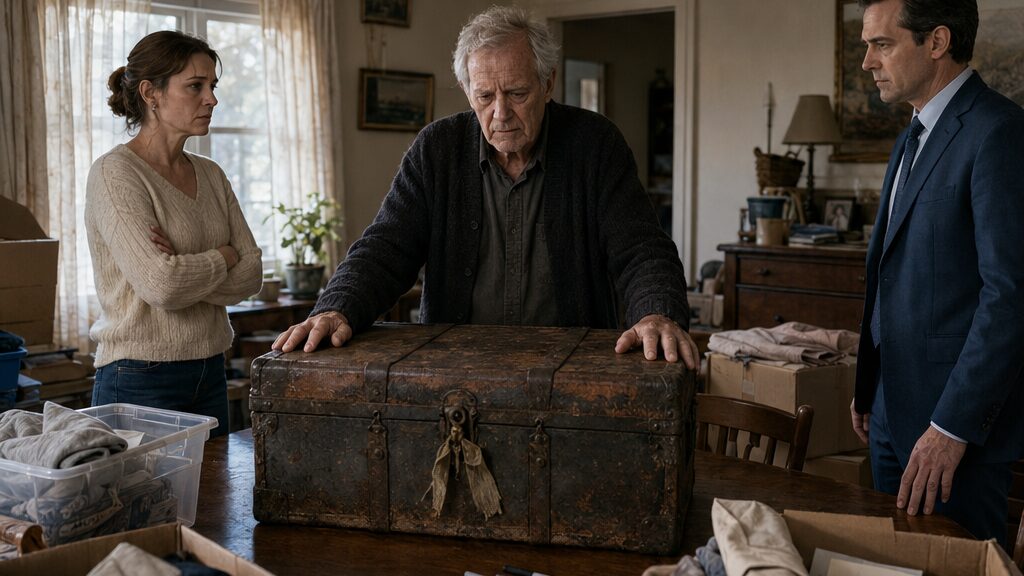
A man in a work shirt backed out first, holding one end of the old trunk. Another man had the far handle. Between them, tilted and awkward, came the battered metal-and-wood trunk with its rusted corners, scarred lid, and one leather strap darkened by age.
Donald’s hand tightened on the banister until his knuckles hurt.
“No,” he said.
The men stopped.
Amanda came up behind him, breathless. “Dad, they’re just bringing it down so we can see what’s inside.”
Donald did not turn around.
The trunk hung between the two men like a body being carried from a room.
“No,” he said again, quieter this time.
Amanda touched his elbow. “It’s too heavy to keep up here. You can’t even move it.”
Donald looked at the trunk, at the place near the latch where Sharon had once tied a strip of blue ribbon so she could tell front from back in dim light.
“You were not supposed to move that,” he said.
One of the men shifted his grip. The trunk dipped.
Donald took one step up.
“Put it down,” he said.
Amanda’s fingers tightened on his sleeve. “Dad, please. You’re scaring me.”
He turned then, and saw not fear on her face but certainty. She had already decided what his refusal meant. Confusion. Stubbornness. Decline. Another item in the wrong category.
Behind her, down in the kitchen, the boxes waited with their black-lettered mouths.
KEEP.
DONATE.
TRASH.
Donald looked past Amanda to Sharon’s photograph on the counter, displaced and watching from below.
Then he looked back at the trunk.
“What label did you make for that one?” he asked.
Amanda did not answer.
At the top of the stairs, one of the junk men said, “Ma’am, where do you want it?”
Donald heard the hesitation before Amanda spoke.
“Dining room,” she said.
Chapter 2: The Trunk Came Down Without Permission
By the time the trunk reached the dining room, Donald was already seated at the table.
He had not helped carry it. Amanda had made sure of that, standing close enough on the stairs that he could feel her worry pressing against him like a hand at his back. The two men brought it down one step at a time, grunting under its awkward weight, while Donald descended behind them with the slow humiliation of a man being escorted through his own house.
The dining room had not been used for dinner since Sharon died. Donald ate in the kitchen now, at the little round table near the window. The dining room was for birthdays, tax papers, Christmas puzzles, and the kind of arguments that needed chairs. Sharon had kept a lace runner down the center of the table until the end. Amanda had folded it into a box marked KEEP sometime that morning.
Now the room had become an office.
Plastic bins lined the wall. A folding table stood beneath the china cabinet. Samantha had taped a sorting chart to the mirror: KEEP, DONATE, TRASH, SELL, REVIEW. The new word made Donald’s jaw tighten. REVIEW looked polite. It meant no one wanted to ask him twice.
The men set the trunk in the center of the dining table with a dull, final thud.
“Careful,” Donald said.
One of them glanced at the rusted corner. “Sorry, sir.”
Amanda paid them from an envelope. Donald watched the money pass from her hand to theirs. His house, his trunk, his stairs, her envelope.
When the men left, cold air followed them out the front door. Through the opening, Donald saw a stack of flattened boxes on the porch and a roll of bubble wrap leaning against the rail. This was not a head start. This was a campaign.
Amanda closed the door and came back rubbing her arms.
“Dad,” she said gently, and he disliked the gentleness more than if she had shouted. “We have to be realistic.”
Donald placed both hands on the trunk lid.
Its surface was cold through his palms. A line of dust marked where it had sat under the eaves of the upstairs closet, untouched except for the times he checked the latch. There was a dark ring near one corner where the roof had leaked in 2006. Sharon had cried when she saw the stain, then laughed because crying over a trunk seemed silly until it was not.
“What does realistic mean today?” he asked.
“It means we can’t keep pretending everything is the same.”
“I don’t pretend that.”
“You do.” Amanda’s voice tightened. “You keep every room like Mom might walk back into it.”
Donald looked at the empty place where the lace runner had been.
Samantha stepped forward with a practiced calm. “Sometimes it helps to start with one contained item. A trunk, a cabinet, a closet. We review piece by piece. You decide what has meaning.”
Donald looked at the marker in her hand. “And if I say all of it has meaning?”
Samantha hesitated.
Amanda answered for her. “Then we talk about what’s reasonable.”
“There it is,” Donald said.
“What?”
“The part where I decide unless you don’t like the decision.”
Amanda closed her eyes. “That is not fair.”
“No. It’s accurate.”
A car door shut outside. Amanda glanced toward the front window and stiffened.
Donald followed her gaze. A dark sedan had parked at the curb. Matthew got out wearing a blue suit and no overcoat, as if weather was something that happened to other people. He held a phone to his ear and a leather folder under one arm.
Donald had not seen him in six weeks.
Matthew ended the call halfway up the walk and came in without knocking, the way both children still did when they forgot they were adults.
“Dad,” he said, too brightly. “How are you feeling?”
“Popular.”
Matthew looked at Amanda, then at the trunk. “So this is the one.”
Donald kept his hands flat on the lid.
Amanda spoke before Donald could. “We brought it down from the closet. He’s upset.”
“I am sitting right here,” Donald said.
Matthew’s expression shifted into the one he used for clients, Donald guessed. Concern arranged to look like patience. He had Sharon’s eyes but none of Sharon’s timing.
“Dad, nobody is trying to take anything from you,” Matthew said.
Donald looked around at the boxes.
Matthew had the grace to look away first.
Amanda moved closer to him. “Benjamin is coming at one. Just to give us an idea of what would need to be done if—”
“No,” Donald said.
Matthew sighed. “You don’t even know what I’m going to say.”
“If it starts with a realtor, I do.”
“It’s an evaluation. Information only.”
“Information for whom?”
“For all of us.”
Donald gave a short laugh. “I must have missed the day my house became a group project.”
Amanda flinched. Matthew did not.
“Dad, after the stove incident—”
“It has a name now?”
“After what happened,” Matthew continued, “we need to consider options.”
“My option is to live in my house.”
“Safely.”
“There’s that word again.”
“It matters,” Amanda said. “You think we like doing this? You think I wanted to come in here and sort through Mom’s things while you glare at me?”
Donald’s hands pressed harder into the trunk. “Then don’t.”
“I can’t just do nothing!”
The room snapped quiet after that.
Amanda looked startled by her own voice. Samantha busied herself with a label that did not need straightening. Matthew set his folder on the sideboard, beside Sharon’s silver candlesticks.
Donald watched that folder touch the wood.
“You brought papers,” he said.
Matthew’s mouth tightened. “Notes.”
“For my house.”
“For possibilities.”
Donald nodded slowly. “Possibilities look a lot like papers when you want somebody else to sign them.”
Matthew rubbed his forehead. “This is exactly why we needed a neutral person here.”
“Neutral,” Donald said, looking at Samantha.
She lowered her clipboard.
Amanda took a breath. “Dad, please. We’re not selling the house today. We’re not moving you today. We’re sorting.”
Donald looked at the trunk. “Then this goes back upstairs.”
“No,” Amanda said.
It was the first clean word she had spoken all morning.
Donald lifted his eyes.
Amanda’s face had gone pale, but she did not retreat. “No, Dad. It doesn’t. You can’t drag this thing around. You can’t get to half the closet because of it. The upstairs smells damp. There could be mold in there. Mice. Old papers. God knows what.”
“You do not get to decide that.”
“I get to decide whether I keep pretending this is manageable.”
“For you?”
“For you!” Her eyes shone. “For once, can you understand that we are scared?”
Donald almost answered. Then he saw Matthew glance at his watch.
Small things could ruin a man’s mercy.
“Your fear does not make my belongings yours,” Donald said.
Matthew stepped in. “Nobody said they were.”
“You moved that trunk.”
“Because it needed to come down.”
“Who said?”
“Dad—”
“Who said?”
Matthew’s jaw worked. “I did.”
Donald nodded once. “Then you carry it back.”
Matthew laughed without humor. “That’s not happening.”
The front doorbell rang.
Amanda wiped under one eye quickly and went to answer it. Benjamin Harris entered behind her a moment later, tall, neat, and carrying a tablet. He paused at the dining room threshold, taking in the boxes, the chart, the trunk, Donald’s hands.
“Mr. Bennett,” he said. “I’m Benjamin. Thank you for letting me come by.”
“I didn’t.”
Benjamin’s smile faded just a little.
Amanda spoke quickly. “He means today is emotional.”
“No,” Donald said. “I mean I didn’t.”
Matthew made a low sound. “Dad, don’t start.”
Donald looked at his son. “I was already here.”
Benjamin cleared his throat. “Maybe I should wait in the kitchen.”
“No,” Amanda said. “We’re all right.”
But they were not all right. Even the house knew it. The heat pipes knocked once and went still.
Samantha, perhaps trying to rescue the room, reached for a blank tag. “Why don’t we simply mark the trunk REVIEW for now?”
Donald looked at the tag.
Amanda looked at Matthew. Matthew looked at Benjamin, then at the trunk.
“Review is fine,” Matthew said. “But if it’s damaged inside, or full of old newspapers, we can’t keep pretending it’s some sacred object.”
Donald’s palms tingled.
Amanda said quietly, “Dad, if you can’t let us throw away one broken trunk, how are we supposed to trust you with the rest of the house?”
The words did not land loudly. They landed precisely.
Donald felt them go through the room, through the table, through the rusted metal under his hands. He looked at his daughter, and for a moment he did not see the woman with the tight hair and tired eyes. He saw a seven-year-old in yellow pajamas, standing in this same doorway after a nightmare, asking if the house could forget people.
Sharon had told her no. Houses remembered everything.
Donald drew the trunk closer by an inch. The old feet scraped across the table.
“That is the wrong question,” he said.
Amanda’s face crumpled and hardened again.
“What’s the right one?” Matthew asked.
Donald looked at the latch Sharon had tied with blue ribbon long ago.
“The right question,” he said, “is why you trusted yourselves to touch it before asking what it was.”
Chapter 3: He Took The Trash Label Off Slowly
The label appeared while Donald was in the bathroom.
That was what he would remember later. Not who wrote it. Not which hand placed it. The small cowardice of timing would stay with him longer than the word itself.
He had left the dining room only because Amanda insisted he take his pills and because his right knee had begun to tremble under the table. Pride was one thing. Falling in front of Matthew’s realtor was another. He had gone down the hall, shut the bathroom door, and stood with both hands on the sink until his breathing settled.
In the mirror, his face looked older than it had that morning.
“Of course it does,” he muttered.
The man in the glass did not answer.
When he returned, the dining room had rearranged itself around a decision.
Amanda stood near the window with her arms crossed. Matthew leaned over Benjamin’s tablet, speaking in a low voice. Samantha was at the folding table, sorting smaller items from a sideboard drawer into clear bins. The trunk remained in the center of the dining table.
A white tag had been taped to its lid.
TRASH / UNSAFE — REVIEW CONTENTS
Donald stopped in the doorway.
No one noticed at first. That was another thing he would remember. They were all busy inside the world they had made, a world in which his absence was useful.
Benjamin saw him first. “Mr. Bennett.”
Amanda turned. “Dad, before you get upset—”
Donald walked to the table.
His slippers made almost no sound on the rug. His hands were steady now, not because he was calm but because something in him had gone colder than anger. He stood over the trunk and looked at the tag. The marker lines were thick and black. Samantha’s writing, probably. Professional. Clear. Easy to read from across a room.
TRASH / UNSAFE.
Donald lifted one corner of the tape.
“Dad,” Amanda said. “It’s just a temporary label.”
The tape pulled away with a soft tearing sound.
“Donald,” Matthew said, using his first name the way people did when they wanted to sound reasonable and powerful at the same time.
Donald removed the label without ripping it. He folded it once, carefully, pressing the crease with his thumbnail. Then he folded it again and set it on the table beside the trunk.
Only then did he look at Amanda.
“Did you ask me what was inside before you decided it was gone?”
Amanda’s mouth opened, then closed.
Matthew stepped forward. “Nobody decided it was gone. The label says review contents.”
“It says trash first.”
“It says unsafe.”
“So do you,” Donald said.
Amanda’s cheeks flushed. “That is not fair.”
“No,” Donald said. “That word has had a hard day in this house.”
Samantha came closer, her clipboard hugged to her chest. “Mr. Bennett, I apologize if the wording felt harsh. In organizing terms, unsafe means the object itself may be difficult to store, move, or preserve. It’s not a judgment of—”
“It is always a judgment of something,” Donald said.
Matthew put both hands on the back of a chair. “Dad, the trunk is rusted. It’s heavy. It smells like damp wood. It was blocking an upstairs closet. If there are papers inside, they may already be ruined. If there’s fabric, it could be mildewed. If there’s nothing important, then yes, we should get rid of it.”
Donald watched his son speak. Clean suit. Clean shave. Clean words. Matthew had always liked a sentence that swept the floor behind itself.
“And if there is something important?” Donald asked.
“Then we keep what matters.”
Donald looked around the dining room: the boxes, the chart, the tablet, the folded lace runner trapped under clear plastic, the candlesticks pushed aside for a folder of possibilities.
“Who is we?”
Amanda’s voice broke through. “Your family.”
He turned to her.
She had tears in her eyes now, angry ones. “You keep acting like we’re strangers breaking in. I am your daughter. Matthew is your son. We watched Mom disappear in this house while you told us everything was fine. We watched you stop opening mail. Stop sleeping upstairs. Stop letting anyone in the back room. And now we’re supposed to believe this trunk is some sacred thing because you say so?”
Donald’s hand went to the latch.
The room seemed to draw closer.
“You want me to say it’s sacred?” he asked.
“I want you to say something real.”
He nodded slowly.
Then he untied the faded blue ribbon.
Amanda made a small sound, but no one moved.
The latch resisted. For a moment Donald thought it would embarrass him, refuse him after all these years in front of everyone. He pressed his thumb into the old metal and lifted again. The latch gave with a dry click.
The sound was not loud, but it changed the room.
Donald raised the lid only halfway.
The smell came first. Cedar, old paper, dust, and the faintest trace of lavender sachets Sharon used to tuck into drawers. It struck him so unexpectedly that his throat closed. He kept his face still and lowered one hand inside.
On top lay a square of muslin wrapped around something flat. Sharon’s handwriting marked the cloth in blue ink.
FOR DONALD, WHEN HE STOPS BEING MAD AT TIME.
Amanda took one step closer.
Beneath that bundle were others, each tied with narrow ribbon. Some white. Some blue. One yellow. All labeled in Sharon’s small, slanted script.
FIRST WINTER.
AMANDA’S ROOM.
MATTHEW, BEFORE HE LEARNED TO HIDE.
THE HOUSE BEFORE WE FIXED IT.
Donald did not let them read more.
He moved the top bundle aside just enough to reveal an old brass key tied with faded ribbon. Its teeth were worn smooth at the edges. A paper tag hung from it, browned with age.
Amanda whispered, “What is that?”
Donald touched the key once.
Not lifted. Not offered. Just touched.
“The first door your mother and I ever opened together,” he said.
The words came out rougher than he wanted, and that angered him, too. He had planned, if this day ever came, to be alone. He had planned to sit upstairs with coffee and the afternoon light, maybe curse Sharon for leaving him instructions he had not asked for, maybe thank her if he could bear it. He had not planned to open the trunk under a label that called it trash.
Matthew’s expression shifted, but only briefly. Practicality returned like armor.
“That’s meaningful,” he said. “No one is saying it isn’t. But Dad, one old key doesn’t mean the whole trunk has to stay exactly where it’s been for years.”
Donald lowered the lid halfway.
Amanda looked at Matthew as if even she wished he had not spoken.
Benjamin had gone very quiet near the doorway. Samantha’s marker hung loose in her hand.
Donald turned to Matthew. “You think I’m arguing about where to store a box.”
“I think you’re using the box to avoid a bigger conversation.”
That one landed close enough to truth that Donald felt it.
He closed the lid gently.
Amanda wiped her face with the heel of her hand. “Why didn’t you tell us Mom did this?”
“Because she didn’t do it for you first.”
Amanda recoiled a little.
Donald regretted the sharpness, but not enough to take it back.
Matthew straightened. “Okay. Then tell us what she did it for.”
Donald looked down at the trunk. His hands settled again on the lid, one on either side of the old stain from the roof leak.
“No.”
“Dad.”
“No,” Donald said, louder. “You do not get the whole story because you got caught throwing away the first page.”
The room went still.
Amanda’s face changed. Hurt, anger, shame, all passing through so quickly he could not tell which one would stay.
Matthew’s voice lowered. “This is exactly the problem. You want control, but you won’t give anyone information. We are supposed to make decisions blind.”
“You are not supposed to make decisions about my life while I’m in the bathroom.”
Amanda looked at the folded label on the table.
For the first time that day, she seemed to see it as he did.
Matthew did not. Or would not.
“The trunk still can’t go back upstairs,” he said. “Not if you refuse to let anyone know what’s in it. Not if it’s blocking access. Not if we’re talking about safety.”
Donald stared at him.
Outside, a vehicle rumbled to the curb. Brakes hissed. Through the front window, the white side of a donation truck filled the lower panes.
Amanda turned toward the sound. “They’re early.”
Donald did not look away from Matthew.
His son picked up the folded TRASH label and set it farther from the trunk, as if distance could undo the word.
“We’re not the enemy,” Matthew said.
Donald thought of the upstairs closet, empty now where the trunk had been. He thought of Sharon’s blue ribbon and the key to a door that no longer existed. He thought of Amanda as a child asking if houses forgot.
“No,” he said. “You’re worse than that today.”
Amanda flinched.
Donald placed his palm flat over the latch.
“You’re helping.”
Chapter 4: The Donation Truck Waited In The Driveway
The donation truck idled outside with its engine knocking harder than the heat pipes ever had.
Donald could see the white side of it through the dining room window, bright and blank, blocking the winter-brown hedge. A man in a dark cap stepped down from the cab and looked at the house number, then at the porch where Amanda had already stacked three boxes. He did not come in. He waited with the patience of someone paid by the hour but trained not to look impatient.
Amanda went to the window and pressed two fingers to her lips.
“They’re early,” she said again, softer this time.
Matthew checked his phone. “They said between two and four.”
“It’s not two.”
“It’s close.”
Donald looked at the trunk. The lid was shut. The blue ribbon lay loose beside the latch, untied for the first time since Sharon’s hands had tied it. That small change disturbed him more than the truck. Something had been opened that should have been opened differently.
Samantha moved carefully around the table, as if approaching a family after a medical diagnosis. “We can pause the truck items.”
“No,” Amanda said too quickly. “No, the porch boxes are ready. They’re not from in here.”
Donald turned his head. “What boxes?”
Amanda glanced at him. “Kitchen duplicates. Some linens. Things we already talked about.”
“We haven’t talked about anything today. You’ve announced things near me.”
Matthew made a tired sound. “Dad, please don’t make every box a trial.”
Donald pushed his chair back.
Amanda stepped toward him. “Where are you going?”
“To see what my house is giving away.”
“You don’t have to inspect every spoon.”
“No,” Donald said. “Only the ones leaving without saying goodbye.”
It came out sharper than he meant. Amanda looked away, hurt rising before anger covered it. Matthew opened his mouth, then shut it when Benjamin shifted uncomfortably by the sideboard.
Donald walked to the front door without asking for help. His knee had stiffened, and he hated the way everyone noticed. He hated even more that none of them offered an arm this time. They were learning his pride faster than they were learning his meaning.
The cold struck his face as he opened the door.
On the porch, three boxes sat in a row. DONATE. DONATE. DONATE. Samantha’s handwriting marked the side of each one, though Amanda must have told her what belonged inside. Donald lowered himself carefully, one hand on the doorframe, and opened the nearest flap.
Dish towels. A spare toaster. A glass pitcher. Two flowered pillowcases. He recognized one from the upstairs linen closet, but it did not pierce him. Sharon had disliked those pillowcases. “Too busy for sleeping,” she used to say.
The second box held old mugs, a stack of paperbacks, a lamp with a crooked shade. He touched the lamp, remembered repairing its switch, and let it go.
The third box was heavier.
Donald opened it and stopped.
A kitchen chair lay on its side inside the cardboard, one of the four from the little breakfast table by the window. Not the dining chairs, not the matched walnut ones Sharon had polished before holidays. This was a plain maple chair with worn rungs and a shallow crescent carved into one leg where Amanda, at five years old, had tried to make “a door for ants” with Donald’s screwdriver.
He gripped the porch rail.
Amanda came up behind him. “Dad, that one wobbles.”
Donald looked at the chair.
“It always wobbled.”
“That’s not a reason to keep it.”
“It was Sharon’s chair.”
Amanda’s face tightened. “Mom sat in all the chairs.”
“No,” Donald said. “She sat in that one.”
The donation driver approached the bottom step, clipboard in hand, then seemed to read the air and stopped. “I can come back in a few minutes.”
“No,” Matthew called from behind them. “We’re fine.”
Donald did not look at him. He bent slowly and reached into the box.
Amanda moved. “Dad, don’t lift that.”
He slid one hand around the chair back and one under the seat. It was not heavy. Awkward, yes. But not heavy. He pulled it free before anyone could decide his body for him. The leg scraped the cardboard. The box tipped against his shin.
“Dad.”
He set the chair upright on the porch.
It rocked once.
Amanda stared at it as though it had embarrassed her personally. “That’s exactly what I mean. Someone could sit on it and fall.”
“Then I won’t invite someone to sit on it.”
“You sit on it.”
“I know where the wobble is.”
“That is not a safety plan.”
Donald ran his thumb over the little crescent in the leg. The cut had darkened over decades until it looked almost intentional. A tiny doorway to nowhere.
Matthew came onto the porch, folding his arms against the cold. “We can take a picture of it. If it means something, keep the picture.”
Donald laughed once, because the alternative was worse.
Amanda said, “Matthew.”
“What? I’m trying to compromise.”
Donald looked at his son. “A picture of a chair does not hold a person up.”
Matthew’s expression hardened, but something uncertain moved behind it.
The driver shifted at the bottom step. “Sir, do you want that one removed from the donation?”
Donald answered without looking away from Matthew. “Yes.”
Amanda closed her eyes.
Donald lifted the chair by the back and carried it into the house. No one helped him, and for once that was mercy. He placed it beside the kitchen table where its absence had left an uneven space. Three chairs looked like a family waiting for someone not coming. Four looked like the room still knew how to count.
He stood there, breathing harder than the chair deserved.
Amanda entered behind him. Her voice was lower now. “It wasn’t only the stove.”
Donald kept his hand on the chair back.
She stood near the sink, arms wrapped around herself. “You didn’t answer the phone twice last month. The mail was stacked in the hall. The nurse said the upstairs bathroom rug was a fall risk. The neighbor called me because your porch light stayed on for three days.”
“The neighbor watches too much.”
“She cares.”
“She reports.”
Amanda looked toward the dining room, where Matthew’s voice drifted, quiet and businesslike. “I found Mom’s sweater in the freezer.”
Donald blinked.
Amanda’s eyes filled again, but she did not let the tears fall. “The blue one. Folded in a grocery bag, behind the peas.”
He remembered that. Not when he had done it, but why. The freezer had smelled faintly of fish from something Matthew brought at Christmas. Sharon hated fish smell in wool. He had meant to move the sweater to the cedar drawer. He had forgotten.
Amanda watched his face. “Dad.”
“I made mistakes,” he said.
“I know.”
“No, you don’t.” He touched the chair once more and let go. “You think mistakes are doors. One opens and the whole house belongs to you.”
Her mouth trembled.
From the front porch came the scrape of boxes being lifted. Donald flinched despite himself.
Amanda saw it. For the first time all day, she did not defend the sound.
“I should have asked about the chair,” she said.
He looked at her.
She swallowed. “I should have asked about all of it. But I don’t know how to do this while you pretend you don’t need anybody.”
The words were not cruel. That made them harder.
Donald looked past her into the dining room. The trunk sat on the table, still surrounded by people who were not Sharon.
“I needed your mother,” he said. “I don’t know yet what needing anybody else costs.”
Amanda’s face changed. The anger went loose around the edges.
Before she could answer, Samantha appeared in the kitchen doorway, holding a small yellow ribbon between two fingers.
“Mr. Bennett?” Her voice was careful. “I’m sorry. This was in one of the donation boxes. I think it may have fallen from the trunk.”
Donald stared at the ribbon.
It had not fallen. Sharon tied bundles tight. She double-knotted everything, even bread bags.
He crossed the kitchen and took it from Samantha. There was a small paper tag still attached.
MATTHEW, BEFORE HE LEARNED TO HIDE.
Donald closed his fist around it.
Amanda looked from the ribbon to his face. “Dad, what is that?”
Donald walked past her toward the dining room.
The trunk was still closed. The folded TRASH label sat beside it, small and white and waiting. Matthew stood near Benjamin, both of them looking toward the driveway. On the floor beside the folding table, half-hidden behind a box of old magazines, was another DONATE carton.
Donald saw a corner of muslin inside it.
He stopped breathing.
Then he bent down, slower than rage wanted him to, and pulled out one of Sharon’s wrapped bundles.
The blue ink was clear.
AMANDA’S ROOM.
Chapter 5: Sharon Had Written On Every Bundle
Donald carried the bundle upstairs before anyone could ask him not to.
They did ask, of course. Amanda said his name twice. Matthew said, “Dad, wait.” Samantha apologized from somewhere near the dining room table, her voice thin with shock. Even Benjamin murmured something about stepping outside.
Donald heard all of them as if through a closed door.
He held the muslin bundle against his chest and climbed one step at a time. His knee burned. His breath shortened. Halfway up, he had to stop and lean against the wall beneath the framed school photographs Amanda had not yet removed. There she was at six, missing both front teeth. There Matthew was at nine, hair sticking up no matter how much Sharon wetted it down. Children in frames, safe because nobody could sort them.
“Dad,” Amanda said from the bottom of the stairs.
He did not look down. “Not now.”
“She didn’t mean to put it in the donation box.”
Donald turned then.
Amanda stood with one foot on the first step, her face pale. Matthew hovered behind her, angry at the delay, worried despite himself. Samantha stood farther back, clutching her clipboard like a shield.
Donald looked at his daughter and saw the girl who used to sleep with one hand tucked under her cheek. He looked at the bundle in his arms and saw the label.
AMANDA’S ROOM.
“That’s the trouble,” he said. “None of you meant to.”
He continued up.
The bedroom was cold. He had kept the heat lower upstairs since Sharon died, partly to save money, partly because warmth in unused rooms felt like a lie. He set the bundle on the bed, on his side, not hers. Then he went back to the doorway and shut it.
The quiet came down around him.
For a moment, he simply stood. The room had the stale sweetness of cedar, old cotton, and the lavender sachets Amanda had once said made everything smell like “church ladies.” Sharon’s dresser remained neat. Her brush lay in the shallow dish beside her perfume bottle. Donald had dusted around both for two years.
He sat on the edge of the bed and placed both hands on the bundle.
The muslin was soft with age. Sharon had used blue thread to stitch the edges, not because she needed to, but because plain things bothered her if they could be made a little kinder. The knot in the yellow ribbon was tight. Donald picked at it with fingers that had once repaired dovetail joints and now fumbled with cloth.
“Damn it, Sharon,” he whispered.
The knot loosened.
Inside was not treasure. That was almost a relief.
A small pink curtain panel folded into a square. A cracked plastic star that had glowed on Amanda’s ceiling. A drawing in purple crayon of a house with four windows and a crooked sun. A photograph of Amanda asleep in a cardboard box because she had wanted to know “what mail felt like.” Beneath those lay a note in Sharon’s handwriting.
Donald did not open it.
He touched the edge of the paper and drew his hand back.
He could hear movement downstairs. Low voices. A box sliding. The front door closing, then opening. The donation truck was leaving, or loading, or waiting. He could not tell which. He thought of Sharon packing this bundle while her hands still obeyed her, while he was downstairs pretending the new medicine would make her hungry again.
He had known she was putting things in the trunk. He had not known how many. She told him only, “Not yet. When you can look without arguing with me.”
He had said, “I don’t argue.”
She had smiled with the tired patience of a woman married to him for fifty-two years.
The door opened without a knock.
Donald turned sharply.
Amanda stood there, then seemed to realize what she had done. “I’m sorry.” She put her hand on the knob. “I’m sorry, I should’ve knocked.”
“Yes,” Donald said.
She stayed in the doorway. Her eyes went to the objects on the bed. The curtain. The plastic star. The drawing.
Her voice changed. “That was my room.”
Donald looked at the note again.
Amanda took one step in, then stopped herself. “I remember those stars.”
“Your mother glued them up there. I told her they’d ruin the paint.”
“You were right.”
“No. I was married.”
Amanda gave a small broken laugh, and it almost undid him.
She came closer but did not touch the bed. “I didn’t know Mom kept that.”
“Neither did I.”
The truth surprised them both.
Amanda looked at him. “You never opened these?”
“No.”
“Why?”
Donald picked up the cracked star. It weighed almost nothing. He remembered standing on a chair while Sharon handed him stars one by one, Amanda below them in pajamas, directing placement with grave authority. Matthew had refused stars in his room because he was “not a baby,” then sneaked into Amanda’s doorway for a week to look at them.
“Because she told me to wait,” he said.
“For what?”
“Until I could do it without hating the world for still being here.”
Amanda’s face folded.
Donald set the star down. “I’m not there most days.”
She sat carefully on Sharon’s side of the bed. The afghan shifted beneath her, and Donald nearly told her not to. He stopped himself. Sharon would have scolded him for making a museum out of a marriage.
Downstairs, Matthew’s voice rose, then lowered. The words did not carry.
Amanda wiped her cheek. “I thought the trunk was full of newspapers. Old receipts. Things you couldn’t make yourself throw away.”
“It may have those too.”
“Dad.”
He looked at her.
“I’m trying to understand.”
He almost said, You should have tried before the truck. But her hands were twisting in her lap, thumb grinding against forefinger, and he saw Sharon so clearly that anger had nowhere clean to stand.
Donald reached for another bundle from the larger trunk of memory in his mind, not the one downstairs. He did not give Amanda all of it. Not yet. But he gave her a piece.
“Your mother started packing after the second diagnosis,” he said. “She said there were things I’d throw out wrong if she left them loose.”
Amanda’s lips parted.
“She knew me,” Donald added.
“What did she mean, wrong?”
Donald looked at the bundle. “Too fast. Too angry. Or never.”
Amanda lowered her eyes.
“She made categories,” he said. “But not like yours.”
The words hit. Amanda looked toward the hallway.
“I didn’t know,” she whispered.
“No,” Donald said. “You didn’t.”
He picked up the note again. The paper had softened along the folds. Sharon had written Amanda’s name on the outside.
AMANDA, WHEN YOU THINK CLEANING IS THE SAME AS CARING.
Donald stared at it.
Amanda saw her name. “Is that for me?”
His first instinct was to close his hand around it. Not because it belonged to him. Because everything in the room felt in danger once seen.
He stood.
Amanda did not reach for the note. That helped.
“I don’t know what it says,” Donald said.
“You didn’t read it?”
“No.”
Her voice was small. “Can I?”
Donald looked at the note. He thought of the label on the trunk. TRASH / UNSAFE. He thought of Amanda’s face when she said she was scared. He thought of the chair in the kitchen, put back where it belonged for now, wobble and all.
“Not today,” he said.
Pain crossed her face.
He held up one hand before she could speak. “Not while the house is full of boxes and strangers. Not while your brother is downstairs measuring my life in square footage.”
Amanda’s eyes flashed. “That’s not fair to Matthew.”
“Probably not.”
The admission quieted her.
Donald folded the note once along its old crease and placed it back on the muslin. He began rewrapping the bundle, slower now. Amanda watched him with the expression of someone seeing a familiar room from a different doorway.
At the threshold, Matthew appeared.
He took in the bed, the objects, Amanda’s tears, Donald’s hands on the cloth.
“We need to talk,” he said.
Donald tied the yellow ribbon.
“Then knock,” he said.
Matthew’s jaw tightened. For a second Donald thought he would argue. Instead, his son lifted his hand and knocked once on the open doorframe.
The sound was ridiculous. It was also something.
Donald nodded.
Matthew came in no farther. “The truck took the porch boxes. I stopped them before they took the one from the dining room.”
Amanda turned. “The one with—”
“Yes.” Matthew looked uncomfortable. “I didn’t know.”
Donald stood with the bundle in both hands. “That sentence is getting crowded today.”
Matthew looked at the floor.
For the first time since he arrived, his son seemed less like a man in a suit and more like a boy caught breaking something he had not meant to touch.
Donald walked past both of them into the hallway. At the top of the stairs he paused, looking down toward the dining room where the trunk waited open in his mind if not in fact.
Sharon had written on every bundle.
That meant she had known every wound by name.
Chapter 6: The Note Was Not An Apology
Donald slept in the chair by the bedroom window and woke before dawn with the yellow-ribboned bundle still on the dresser.
For a moment, he did not know why his neck hurt or why the house felt hollowed out. Then the day returned in pieces: the boxes, the truck, the tag on the trunk, Amanda in the doorway, Matthew knocking once because he had been told to. Downstairs, the dining room table held the trunk like an accusation.
The morning was blue and still.
Donald washed, dressed, and went downstairs without turning on many lights. The house looked bruised after the cleanup. Empty spaces showed everywhere. The hallway table had only Sharon’s photograph now, set back where it belonged but not yet rehung. The kitchen shelves had gaps shaped like mugs, jars, habits. The little maple chair sat by the table, wobble hidden until someone trusted it with weight.
On the dining room table, beside the trunk, lay the folded white label.
TRASH / UNSAFE — REVIEW CONTENTS
Donald picked it up and put it in his shirt pocket.
Then he untied the blue ribbon and opened the trunk.
He did it alone, the way he should have done first and the way he now understood Sharon had never fully intended. She had known him too well to believe he would open grief without being cornered by life. Maybe the trunk had been waiting not for peace, but for trouble strong enough to force his hand.
The bundles filled the trunk in careful rows. Some were wrapped in muslin, some in brown paper, some in old pillowcases tied with ribbon. Sharon’s handwriting appeared on all of them.
FIRST WINTER.
THE YEAR THE ROOF LEAKED AND WE LAUGHED LATER.
DONALD’S HANDS BEFORE THEY HURT.
MATTHEW, BEFORE HE LEARNED TO HIDE.
AMANDA, WHEN YOU THINK CLEANING IS THE SAME AS CARING.
THE HOUSE BEFORE WE FIXED IT.
FOR THE DAY HE THINKS EMPTY MEANS SAFE.
Donald sat down hard.
That last one nearly made him close the lid.
He did not open all of them. He was not ready, and for the first time that did not feel like failure. He opened only the one with Amanda’s name because it had already entered the room between them, and because Sharon had addressed it not as a memory but as a warning.
Inside were three things.
A photograph of Amanda at sixteen, standing in the kitchen with a sponge in one hand, glaring because Sharon had told her not to scrub the scorch mark off the old baking sheet. A small envelope of recipe cards in Amanda’s teenage handwriting, copied badly and stained with tomato sauce. And the note.
Donald held it for a long time before unfolding it.
Sharon’s handwriting was shakier than on the outside label. She must have written this later, when the medicine had thinned her strength but not her aim.
Amanda,
If you are reading this, you are probably doing too much and calling it necessary.
Donald stopped.
The house seemed to hold its breath with him.
He read on.
Your father will let things sit too long. You will move too fast. Both of you will think you are loving the other one correctly. Both of you will be wrong in ways that hurt.
He looked toward the kitchen chair.
Donald is not easy to help because needing help makes him feel accused. You are not easy to stop because stopping makes you feel useless. When I was sick, you cleaned every counter after every nurse left. You thought I did not notice. I noticed. I also noticed you never sat down until there was nothing left to wipe.
Donald pressed the paper flat with one trembling hand.
Do not turn his house into a job before you remember it is his home. Ask him what an object is before you decide what it was. If he refuses to answer, ask again another day. If he still refuses, leave the thing alone unless it can truly hurt him. There is a difference between danger and discomfort. Learn it before you make him small.
The last lines blurred. Donald blinked until they cleared.
And Donald, because I know you will read over her shoulder or before her: do not use my memory as a locked door. Open some windows. Let them help where help is needed. But make them knock.
Donald lowered the note.
There was no apology in it. Not for Amanda. Not for him. Sharon had never cared much for apologies that tried to sweep up the mess without naming who dropped the glass.
He folded the note along its creases and sat until the blue morning turned pale.
At eight, the phone rang.
He knew it would be Amanda before he checked. She had always called too early when she had not slept.
He let it ring twice, then answered.
“Dad?”
“I’m here.”
A pause. “I wasn’t sure you’d pick up.”
“Neither was I.”
Another pause, longer. He heard her breathe.
“Matthew thinks we should all come over later and finish talking.”
“Matthew thinks in groups when he’s nervous.”
“He is nervous.”
“I know.”
“He’s also sorry.”
“Is he?”
“He’s Matthew-sorry.”
Despite himself, Donald’s mouth twitched. Matthew-sorry had existed since childhood: fixing the broken lamp before admitting he had thrown the ball.
Amanda’s voice softened. “I am sorry. Not in a useful enough way yet, maybe. But I am.”
Donald looked at the note in his hand.
“Come at two,” he said.
“I can be there sooner.”
“Come at two.”
“Okay. Should I bring Matthew?”
Donald looked toward the dining room doorway. The trunk sat open, but the bundles remained inside. His house felt less like a crime scene in the morning light and more like a place after a storm, branches down, roof intact.
“Not first,” he said. “You come alone.”
Amanda was quiet.
“Dad, are you going to show me the note?”
“Yes.”
Her breath caught. “Okay.”
“And Amanda?”
“Yes?”
“Nothing leaves this house today.”
“No. Nothing leaves.”
“No boxes get labeled today.”
“I understand.”
“No strangers.”
“I’ll tell Samantha not to come.”
“And Benjamin.”
“Matthew invited him. I’ll handle it.”
Donald nearly said, You should have handled it yesterday. Instead he unfolded the TRASH label from his pocket and placed it beside Sharon’s note.
“Your mother wrote something,” he said.
Amanda made a small sound. “About me?”
“About both of us.”
“Oh.”
“It is not gentle.”
A faint, sad laugh came through the phone. “That sounds like Mom when she was right.”
Donald looked at Sharon’s photograph in the hall, still waiting to be hung. “Yes.”
After they hung up, he made coffee. Not the kind Amanda brought. His own, too strong and a little bitter. He drank it at the kitchen table, sitting carefully in Sharon’s chair. It wobbled under him, familiar as a voice.
For an hour, he did small things.
He rehung Sharon’s photograph. He moved the silver candlesticks off Matthew’s folder and back to the sideboard. He took the sorting chart from the dining room mirror and rolled it neatly, not tearing it, though he wanted to. He gathered the unused labels and put them in a pile beside the empty boxes.
Then he returned to the trunk.
One bundle near the top had loosened during yesterday’s handling. Donald tucked its edge back in, then stopped when he saw the label.
DONALD, FOR WHEN YOU THINK HOLDING ON IS THE SAME AS KEEPING FAITH.
He did not open it.
Not yet.
Instead, he took the folded TRASH label and laid it beside Sharon’s note. The two papers did not belong together. That was why they needed to be seen together.
At one fifty-five, a car pulled into the driveway.
Donald stood in the dining room, one hand on the back of a chair, the trunk open before him. He did not sit at the head of the table. He stood where Amanda would have to see him first, then the trunk, then the boxes.
The door opened softly.
Amanda stepped in without calling out like she used to. She closed the door behind her and stood in the hall, looking at Sharon’s photograph back on the wall.
Then she came to the dining room entrance.
Her eyes went to the trunk. To the bundles. To the note. To the folded label.
Donald watched her read the black marker through the crease.
TRASH / UNSAFE.
Amanda’s face crumpled in a way he had not seen since she was small enough to hide it against his shirt.
“I’m sorry,” she whispered.
Donald picked up Sharon’s note.
“Sit down,” he said. “And this time, we start by asking.”
Chapter 7: He Chose What Stayed And What Left
Amanda sat at the dining room table with Sharon’s note in both hands.
She had read it once silently. Then Donald had asked her to read it again, not aloud, not for his benefit, but because he knew the first reading of Sharon’s words only struck the skin. The second reached bone.
Now the note rested in Amanda’s lap. Her fingers held the edges carefully, as if the paper could bruise.
Donald stood by the trunk. He had not sat down yet. Sitting would have made the room feel like a meeting again, and he was done with meetings held around him. The unused labels lay stacked beside the empty boxes. The folded TRASH label sat apart from them, facing Amanda like a small witness.
“She knew,” Amanda said.
Donald looked at Sharon’s photograph in the hall. “Your mother knew most things before the rest of us finished pretending.”
Amanda wiped under one eye. “I cleaned because I didn’t know what else to do.”
“I know.”
“No, Dad.” She looked up at him. “I mean when she was sick. I mean yesterday. I mean always. If I could make a counter shine, or a drawer close, or a nurse say the house looked good, then for five minutes I felt like something wasn’t falling apart.”
Donald let the words sit.
Outside, a car passed slowly. The old house clicked and settled around them. There were still gaps on the shelves from yesterday’s sorting, and boxes still lined the wall. Nothing had been fixed by one note. That was not how Sharon had worked. She did not fix people. She pointed to the mess and made them decide whether to keep stepping around it.
Amanda lowered her eyes to the note again. “She said I make people small when I’m scared.”
“She said I use memory as a locked door.”
Amanda almost smiled. “She got both barrels loaded.”
“She usually did.”
The front door opened.
Matthew stepped inside carrying no folder this time. Donald noticed that first. No leather folder, no tablet, no papers tucked under his arm. Just Matthew in yesterday’s blue suit, wrinkled now at the elbows, and a cardboard coffee tray in one hand.
He stopped in the hallway when he saw them.
“I knocked,” he said.
“No, you opened the door after touching it,” Amanda said, her voice rough but steady.
Matthew looked at Donald. “I can go back out and do it right.”
Donald considered making him. Then he saw the coffee tray tremble slightly in his son’s hand.
“Come in,” he said.
Matthew entered the dining room as if the rug had become unfamiliar ground. He set the coffee on the sideboard, away from the candlesticks this time.
“No Benjamin,” he said. “No Samantha. I called them both.”
Amanda looked at him. “Thank you.”
Matthew nodded once, uncomfortable with gratitude.
His eyes moved to the open trunk. The bundles inside seemed to quiet him. Donald watched the calculation begin and then stop. His son, for once, did not ask for inventory.
“What happens now?” Matthew said.
Donald picked up the folded TRASH label and held it between two fingers.
“Now you both listen before you plan.”
Matthew’s mouth tightened at the edges, but he nodded.
Donald placed the label on the table between them. “This does not happen again.”
Amanda looked at it and flinched.
Matthew said, “I didn’t put that on there.”
“No,” Donald said. “You only agreed with it.”
His son looked down.
Donald did not enjoy saying it. That surprised him. Yesterday he might have sharpened the sentence and thrown it harder. Today it landed and hurt all three of them enough.
“I am not saying the house is perfect,” Donald continued. “I am not saying I don’t need help. I am not saying every paper and mug and chair leg is holy.”
The chair in the kitchen gave a small creak, as if objecting from the next room.
Amanda folded the note carefully and set it on the table.
Donald rested one hand on the trunk. “I am saying no more labels before questions. No more trucks before answers. No more strangers in my house to make decisions I have not made.”
Matthew drew a breath. “Dad, some things really are safety issues.”
“Yes.”
Both children looked at him, startled by the ease of it.
Donald kept his hand on the trunk. “The rug upstairs can go. The broken step to the basement gets fixed. I’ll put the stove knobs in the drawer when I’m done cooking, if that calms everybody’s imagination.”
Amanda gave a tearful laugh and covered her mouth.
“I’ll answer the phone once a day,” Donald said. “Not six times. Once. If I don’t, you can come by. You knock.”
Matthew nodded slowly. “Okay.”
“And the upstairs closet,” Amanda said carefully. “Can we make it easier for you to reach things?”
“We can make it easier,” Donald said. “We cannot make it empty just because empty photographs well.”
Matthew looked toward the sideboard where his folder had rested yesterday. Shame moved across his face, brief but visible.
“I pushed too hard,” he said.
Donald waited.
Matthew put both hands on the back of a chair. “I keep thinking if we get ahead of the next thing, it won’t knock us down. Mom’s illness. The hospital calls. The stove. The mail. Every time something happens, it feels like proof that I should have acted sooner.”
Donald studied his son. Matthew had always hidden fear under tasks. At nine, he had reorganized the garage after Sharon’s minor car accident, as if a cleaner pegboard could keep roads from icing.
“You cannot organize your way out of losing people,” Donald said.
Matthew’s jaw shifted. “I know.”
“No,” Donald said quietly. “You don’t. But you will.”
Amanda looked at her brother, then at Donald. No one rushed to fill the silence.
Finally, Donald reached into the trunk and lifted the old brass key by its faded ribbon. It swung slightly in the light. The paper tag brushed his knuckle.
“This,” he said, “was from the first apartment your mother and I rented. Third floor. Radiator screamed all winter. Kitchen window stuck shut unless you hit it with a spoon.”
Amanda leaned forward, eyes wet.
Matthew’s face softened despite himself. “You kept the key?”
“Your mother kept the key. I wanted to throw it out when we bought this place.” Donald smiled faintly. “She said a home is not proven by owning it. It’s proven by choosing it every day after you learn what leaks.”
He laid the key on the table.
“That’s why she put it in here. Not because she wanted the trunk worshipped. Because she knew I would forget that a home can change and still be chosen.”
Amanda touched the ribbon but did not pick it up. “What do you want to do with it?”
The question entered the room gently.
Donald looked at her. Then at Matthew.
There it was. Not a solution. A beginning.
“I want the trunk upstairs,” he said. “Not shoved in the closet. In my room for now.”
Amanda nodded.
“I want to open one bundle a week. Maybe with you. Maybe alone. I decide.”
Matthew nodded too.
“I want the kitchen sorted last,” Donald said.
Amanda looked toward the kitchen chair. “Because of Mom?”
“Because I still use it.”
A small smile pulled at her mouth. “Okay.”
Donald lifted the TRASH label. He looked at it for a long moment, then took an empty donation box from the floor and set it on the table. The box had no label yet. Its cardboard flaps stood open, waiting to be told what it was.
He placed the folded TRASH label inside.
Amanda watched him. “What are you doing?”
“Putting it where it belongs.”
Matthew glanced into the box. “The label?”
“The decision,” Donald said. “The one made without asking.”
No one spoke.
Then Amanda reached for the stack of unused labels. For a moment Donald tensed, but she only removed the top sheet, turned it over, and slid the blank side toward him with the marker.
“What should this one say?” she asked.
Donald looked at the blank label.
His hand, when he picked up the marker, was not as steady as he wanted. He wrote slowly, large enough for all of them to read.
ASK FIRST.
Amanda pressed her lips together.
Matthew looked away toward the window.
Donald stuck the label to the outside of the empty box. Not KEEP. Not DONATE. Not TRASH. ASK FIRST.
It looked foolish and necessary.
They worked for an hour after that, though work was a generous word for how slowly they moved. Amanda opened drawers and held up objects without naming their fate. Matthew carried the boxes that Donald pointed to, not the ones he chose. The broken basement step went on a repair list. The upstairs rug went into a bag after Donald agreed it had been trying to kill him since 2014. Three chipped mugs went into DONATE. Sharon’s blue sweater came out of the freezer and into Donald’s hands without comment from anyone.
When they reached the dining room again, Donald closed the trunk.
The blue ribbon lay beside it. He tied it once, not in Sharon’s old double knot, but loose enough to open again.
Matthew moved to one side. “I can carry it.”
Donald put his hand on the handle. “So can I.”
Amanda began, “Dad—” then stopped.
Donald lifted his end.
Pain flashed up his arm. Not sharp enough to stop him, sharp enough to tell the truth. The trunk rose an inch and then thudded back down.
Matthew did not move until Donald looked at him.
“Ask,” Donald said.
Matthew swallowed. “Do you want help carrying it upstairs?”
Donald kept his hand on the handle.
“Yes,” he said.
Matthew took the other side.
Together they lifted. The trunk was as heavy as yesterday, maybe heavier now that everyone knew it held more than old paper. Amanda walked ahead, clearing the path though nothing blocked it. At the stairs, Donald paused.
“I’ll take it halfway,” he said.
Matthew did not argue.
They climbed slowly. One step. Then another. The trunk knocked lightly against the wall, leaving a faint mark in the paint. Amanda started to reach toward it, then let the mark be.
Halfway up, Donald stopped, breathing hard.
Matthew waited below him, holding his end.
“You’ve got it?” Donald asked.
Matthew looked up. “If you’re asking me to take more, yes.”
Donald nodded.
He released his handle.
Matthew accepted the weight without making a show of it. He carried the trunk up the remaining stairs while Donald followed, one hand on the banister, Amanda behind him close enough to catch him and far enough not to insult him.
In the bedroom, they placed the trunk at the foot of Donald’s bed.
Sharon’s brush still rested on the dresser. The afghan still lay on her side. The room did not feel emptied by the trunk’s arrival. It felt, strangely, like something had been returned to the right conversation.
Amanda stood by the doorway. “Do you want us to stay?”
Donald looked at the trunk, then at his children.
“Not today.”
Amanda nodded, but sadness crossed her face.
“Come next Sunday,” Donald said. “After lunch.”
Her eyes lifted.
Matthew cleared his throat. “Both of us?”
Donald looked at him. “If you knock.”
For the first time that weekend, Matthew smiled without hiding behind it.
When they left, Donald sat on the edge of the bed. He listened to the front door close, to the car start, to the house settling back into itself. It was not the same house as yesterday morning. Too much had been moved. Too much had been seen.
But Sharon’s photograph was on the wall again. The kitchen had four chairs. The trunk was in his room, not buried, not worshipped, not labeled by anyone else.
Donald untied the blue ribbon.
He did not open the trunk fully. Not yet. He lifted the lid only enough to see the top bundle, the one with his name.
DONALD, FOR WHEN YOU THINK HOLDING ON IS THE SAME AS KEEPING FAITH.
He touched Sharon’s handwriting.
Then he closed the lid gently, leaving the ribbon loose.
Downstairs, on the empty donation box in the dining room, the new label waited for whoever entered next.
ASK FIRST.
The story has ended.