They Arrested Him Beside His Wife’s Roses, but the Neighborhood Camera Recorded Everything
Chapter 1: The Water Kept Running After They Handcuffed Him
“Get on your knees. Hands where I can see them.”
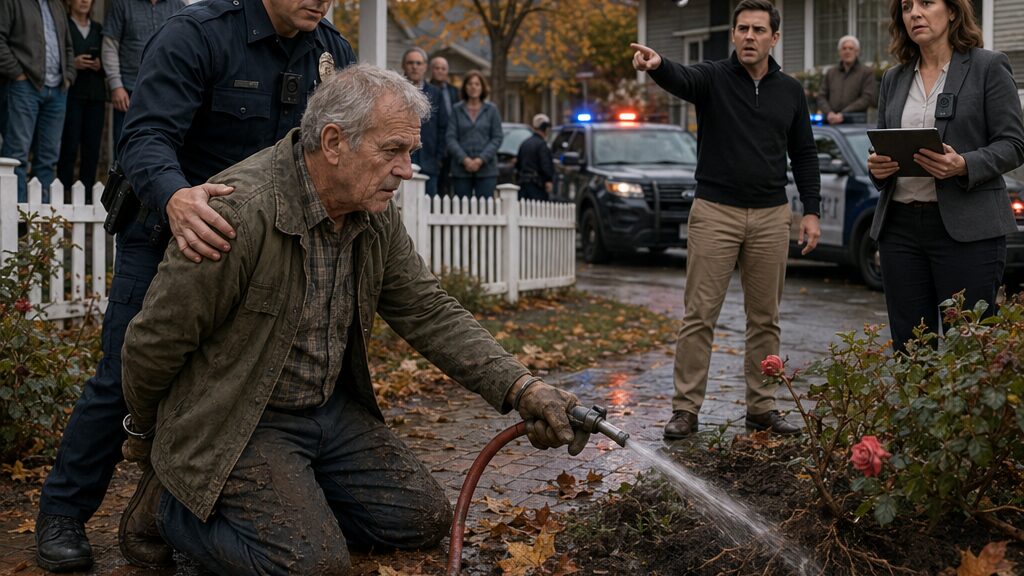
Dennis Hall looked from the officer’s drawn pistol to the red garden hose curled around his boots. Water hissed from the metal nozzle, flattening fallen maple leaves against the walkway and running in a thin stream toward the rose bed.
He was still trying to understand why three patrol cars had stopped in front of his house.
“I’m putting it down,” Dennis said.
“Now.”
He released the nozzle. It struck the bricks with a sharp metallic crack, spun once, and continued spraying beneath the lowest branches of a newly planted rose.
Dennis lowered himself carefully. At sixty-eight, his knees did not bend without negotiation. Wet soil soaked through his work pants before he settled beside the white fence.
An officer moved behind him and pulled his wrists together.
Across the street, Kevin Clark stood at the end of his driveway in a black quarter-zip sweater. One arm rested protectively around his youngest child. His spouse held the other child near the open garage.
Near Dennis’s mailbox, the HOA property manager stood with a tablet pressed to her chest. She had arrived fifteen minutes earlier for what Carol Thompson’s email had called a routine landscaping inspection.
Now half the block watched from porches.
“What exactly am I being detained for?” Dennis asked.
The handcuffs clicked shut.
“Threatening your neighbor with a firearm.”
Dennis turned his head.
“I don’t own a firearm.”
“Face forward.”
Kevin stepped closer to the officer in charge. “He pointed it toward my children. He said he’d kill us if we came onto his property again.”
Dennis stared at him.
That morning, Kevin had complained about the height of the rose canes near the corner sightline. They had argued. Dennis had told him to stay out of the garden. His voice had risen, but no children had been outside then, and there had been no gun.
The only metal object in Dennis’s hand had been the spray nozzle.
“You know that isn’t true,” Dennis said.
Kevin’s expression barely changed. “You’re doing it again. You’re intimidating me in front of the police.”
The officer tightened his grip on Dennis’s shoulder.
“Mr. Hall, stop speaking to him.”
The property manager shifted uneasily. A small camera clipped to her jacket pointed toward Dennis, its status light blinking.
An officer searched the garden, then the porch. Another entered the open garage after receiving Dennis’s reluctant permission. Cabinet doors opened and shut. Toolboxes were inspected. A rusted pair of pruning shears lay on the potting bench beside a narrow gardening knife Dennis used to divide roots.
The officer lifted the knife in a gloved hand.
“That stays on the bench,” Dennis said. “I was transplanting.”
“Did you handle it today?”
“Yes. For the roses.”
Kevin spoke from the sidewalk. “He had something silver in his hand.”
“That is not a gun,” Dennis said.
The officer holding him exhaled through his nose. “We didn’t find a firearm.”
For one hopeful second, the pressure on Dennis’s shoulder eased.
Then Kevin raised his phone.
“I have months of records,” he said. “Threats, hostile behavior, violations. He watches my family from that garden. He came toward me today waving something and shouting. My doorbell camera got all of it.”
The property manager looked at Kevin. “You told me you had video of the sightline issue.”
“I have video of everything.”
Dennis glanced toward Kevin’s porch. The black doorbell camera was angled farther toward the street than any ordinary device needed to be. Kevin had boasted about it the week it was installed.
High definition. Night vision. Continuous event storage.
Nothing happens on this block without a record, he had said.
The water continued running behind Dennis. It gathered around his right knee and carried dark soil across the pale bricks.
One of the officers returned from the house. “No weapons registered to him. Nothing located inside.”
Kevin’s spouse said something quietly, too low for Dennis to hear. Kevin shook his head without looking back.
The officer in charge crouched in front of Dennis.
“Your neighbor alleges you made a specific threat while displaying what he believed was a handgun. Two residents heard raised voices. Given the nature of the report, we’re taking you in while we sort this out.”
“You searched my house.”
“Yes.”
“You found nothing.”
“That doesn’t resolve what happened before we arrived.”
Dennis looked past him at the rose bed.
The newest plant leaned under the force of the spray. Its roots had been moved that morning from a cracked ceramic pot. If the soil washed away before it settled, the plant might not survive the first hard frost.
“Turn the nozzle,” Dennis said.
The officer frowned. “What?”
“Don’t shut the water off. Just turn it away from the stem.”
A few neighbors exchanged looks.
The officer followed Dennis’s gaze. “You’re being arrested, and you’re worried about a flower?”
“It was transplanted today.”
Kevin gave a quiet, disbelieving laugh.
Dennis ignored him. “Point the water at the older rose. It can take it.”
The property manager moved before the officer answered. She crossed the wet path, lifted the nozzle, and laid it gently beneath the thickest bush. Water darkened the soil around its trunk.
“Thank you,” Dennis said.
The officer pulled him upright.
His wet knees trembled. Dennis steadied himself without asking for help.
As they walked him toward the patrol car, he saw his own reflection in the rear window: gray hair disordered by the wind, mud across both knees, hands cuffed behind a faded canvas jacket.
Kevin stood near the curb, composed and clean.
“You should have taken the offer,” he said softly.
Dennis stopped.
The officer urged him forward. “Keep moving.”
“What offer?” the property manager asked.
Kevin looked at her, then toward the watching neighbors. “The offer to resolve the landscaping problems before someone got hurt.”
That was not the offer Kevin meant.
Three months earlier, he had come to Dennis’s kitchen with a printed purchase proposal for the triangular corner of Dennis’s lot. He had called it unused ground.
Dennis had refused without explanation.
Kevin had returned twice.
The second time, he had said the neighborhood entrance could not improve while one man held everyone else back.
The third time, he had left the papers under Dennis’s windshield wiper.
Dennis had thrown them away.
The back door of the patrol car opened. Before Dennis ducked inside, the officer in charge turned to Kevin.
“We’ll need the original video file. Not a recording of your screen.”
“You’ll get it,” Kevin said. “The camera caught the whole thing.”
The door closed between them.
Through the glass, Dennis watched the red hose continue feeding water into the roses as the patrol car pulled away.
Chapter 2: Two Nights Away from the Dog and the Garden
“My dog has been alone since Tuesday.”
Dennis said it through the narrow opening beneath the reinforced glass. The jail clerk did not look up from her monitor.
“Your property was released to your emergency contact.”
“I didn’t give anyone an emergency contact.”
“The arresting officer located your daughter.”
Dennis gripped the edge of the counter. After two nights on a concrete bunk, his fingers were swollen and his knees felt packed with ground glass.
“Did she get the dog?”
The clerk checked another screen.
“She signed for your house key yesterday afternoon.”
Dennis closed his eyes.
Amy knew about the dog. She did not know where Dennis kept the spare food, which medicine went into the morning bowl, or that the animal had recently started refusing water unless the bowl sat beside the back door.
Most of all, Amy did not know about the newly planted rose.
The clerk slid a plastic bag through the opening. His belt, wallet, shoelaces, and watch were inside.
“You have a hearing date on the temporary protection order. The paperwork will be served separately.”
Dennis looked up. “Protection order?”
“Your attorney can explain it.”
“I don’t have an attorney.”
The clerk had already called the next name.
Amy waited outside in her sedan. She stepped out before Dennis reached the curb and pulled him into an embrace so abruptly that his shoulder struck the doorframe.
“You look terrible.”
“I’ve looked worse.”
“No, you haven’t.”
He eased away. Her eyes were red, but her voice had the clipped steadiness she used when she was frightened and determined not to show it.
“Is the dog all right?”
“The dog is fine. He nearly knocked me over when I opened the door.”
“His tablets?”
“I found them.”
“They’re supposed to be broken in half.”
“I read the label, Dad.”
Dennis nodded and got into the passenger seat.
Amy did not start the car.
“You’re coming home with me.”
“No.”
“You have been in jail for two nights because your neighbor accused you of waving a gun.”
“I don’t have a gun.”
“That is not the part I’m worried about.”
“It’s the part I’m worried about.”
She turned toward him. “You’re not safe there.”
“It’s my house.”
“It’s a building.”
Dennis looked through the windshield.
Amy’s hands tightened around the steering wheel. “Mom is not in the kitchen. She’s not in the bedroom. Keeping every chair where she left it will not bring her back.”
The words landed harder because they were not entirely wrong.
Dennis opened the door.
“Drive me home.”
The dog met him in the front hall with a low, broken whine. Dennis lowered himself against the wall while the animal pressed its graying muzzle into his chest.
“I know,” Dennis whispered. “I know.”
The house smelled faintly of damp leaves and the stew Amy had left in the refrigerator. Nothing had been stolen or broken. Yet every room felt searched, its privacy disturbed by gloved hands and official purpose.
Outside, the hose lay where it had fallen. The water had been turned off. Mud had dried in branching lines across the walkway.
Dennis crossed to the rose bed.
The transplanted bush sagged, but its central cane remained green. The older rose stood firm beside it, leaves beaded with the previous night’s rain.
Amy followed him carrying a cardboard box.
“I found these in the kitchen drawer.”
She set the box on the patio table and removed a stack of envelopes. Each bore the HOA logo.
Notice of landscape noncompliance.
Obstruction of neighborhood sightline.
Failure to maintain approved fence finish.
Improper storage of garden equipment.
Dennis had opened some and ignored others.
Amy counted them. “There are fourteen.”
“Most are nonsense.”
“Then why didn’t you answer them?”
“Because answering nonsense gives it dignity.”
“No, it gives you a record.”
Dennis turned toward the roses.
Amy pulled out a thicker envelope. “And what is this?”
He recognized Kevin’s purchase proposal.
“I said no.”
“You didn’t tell me anyone wanted part of the property.”
“He didn’t want part of it. He wanted the corner.”
“For what?”
“He said the entrance needed widening.”
Amy unfolded the drawing attached to the offer. “This is a lot of money for a strip of garden.”
“It wasn’t for sale.”
Her expression softened, then hardened again. “You could sell the whole house. Buy something near me. No HOA. One floor. A smaller yard.”
“No.”
“Why?”
Dennis bent to pinch a damaged leaf from the transplanted rose.
“Because I said no.”
A vehicle stopped at the curb.
A uniformed process server approached the walkway carrying a large envelope.
“Dennis Hall?”
Amy stepped between them. “What is it?”
The server handed Dennis the papers and waited while he confirmed his name.
The temporary protection order prohibited him from approaching Kevin, Kevin’s spouse, their children, their residence, workplace, school, or vehicle. It also required Dennis to remain three hundred yards from them except during court proceedings.
Dennis read the distance twice.
Amy took out her phone and opened a map.
Kevin’s house sat across the street and two lots east. She placed one finger on Kevin’s property, then expanded the measurement circle.
The shaded radius covered Dennis’s garden.
It covered his kitchen, bedroom, garage, and almost the entire rear lot.
“This can’t be right,” Amy said.
The process server kept his voice neutral. “You’ll need to address it at the hearing. Until then, violation may result in arrest.”
“Where is he supposed to go?” she asked.
“I can’t advise you.”
After the server left, Amy held the map toward Dennis.
“You cannot sleep here.”
Dennis looked from the protection order to Kevin’s dark camera across the street.
Three hundred yards did not separate the two houses.
It erased one of them.
Chapter 3: The Camera File Had Eleven Minutes Missing
Katherine Johnson stopped the video at 2:17:08.
On the wall monitor, Dennis was frozen on one knee beside the rose bed. His left hand held the red hose. His right hand was empty.
Katherine tapped the timestamp with the capped end of a pen.
“Then it jumps to 2:28:31.”
Dennis leaned closer. “Play it again.”
“I’ve played it four times.”
“Play the part before the jump.”
She rewound the file.
Kevin’s porch camera showed a wide slice of the street, Dennis’s fence, and most of the rose bed. At 2:16, Dennis crossed into view carrying the hose. At 2:17, he knelt near the transplanted rose.
The image flickered.
Then eleven minutes vanished.
When the picture resumed, the HOA property manager was approaching with her tablet. Dennis was standing near the fence. Kevin appeared at the edge of his own driveway.
Katherine paused it again.
“This is what their attorney produced as the original event file.”
Dennis sat back. “Kevin said the camera recorded everything.”
“It may have.”
“Then where is it?”
“That is the question.”
Her office occupied the second floor of a converted brick house near the county courthouse. The room contained no decorative law books, only labeled binders, two monitors, and a coffeemaker that sounded as though it resented every cup.
Amy sat beside Dennis with the protection order folded in her lap.
“Does the visible part help him?” she asked.
“It helps us establish that Dennis had a hose and no firearm during the period we can see.” Katherine looked at Dennis. “But Kevin’s statement places the threat during the missing interval.”
“He made it up.”
“That is what we intend to prove. Not what we are entitled to assume.”
Dennis disliked the careful distinction.
Katherine opened a technical report. “The file’s metadata shows a total recorded duration longer than the clip produced. The checksum also indicates it was exported through the user account, not downloaded as an untouched device archive.”
“So he edited it,” Amy said.
“Possibly. Or selected only one event segment. Or the system divided the recording automatically. His attorney says they produced everything responsive in their client’s possession.”
“That sounds like a sentence built to hide behind,” Dennis said.
Katherine gave him a brief look. “It often is.”
She resumed the footage after the gap.
The HOA property manager spoke with Dennis beside the fence. There was no audio for the first thirty seconds. Then sound activated with a gust of wind and the scrape of the gate latch.
Dennis heard his own voice: “You can measure it, photograph it, or write me another letter. You’re not cutting it down.”
The property manager answered calmly, though the words were indistinct.
Kevin walked closer.
On the recording, Dennis pointed toward the property line. A silver object flashed on the potting bench behind him.
Katherine froze the image.
“What is that?”
“A pruning knife.”
Amy turned. “You had a knife outside?”
“It was on the bench. I had been dividing roots.”
“Did you touch it during the argument?”
“No.”
Dennis answered too quickly.
Katherine noticed.
“Think before you answer.”
He looked again at the silver blur.
Earlier that afternoon, before the property manager arrived, Kevin had crossed the street carrying a packet of violation notices. Dennis had been using the knife to loosen the rose’s bound roots. When Kevin reached the gate, Dennis had set it down.
Or he believed he had.
“I may have still been holding it when he first came over,” Dennis said.
Amy closed her eyes.
Katherine remained still. “For how long?”
“A few seconds.”
“Did you point it at him?”
“No.”
“Did you raise it?”
“I don’t know. I told him to leave.”
“What words did you use?”
Dennis studied the edge of the table.
Katherine waited.
“I said, ‘Stay off my property before I make you regret coming over here.’”
Amy stared at him. “You never told me that.”
“It wasn’t a death threat.”
“It was a threat,” Katherine said.
“He had been after me for months.”
“That explains anger. It does not erase the sentence.”
Dennis pushed his chair back an inch. “I did not threaten his children. I did not mention a gun. I never went near them.”
“I believe that,” Katherine said. “But the court will hear Kevin describe an angry man holding a metal object and saying he would make him regret approaching. If we pretend none of that happened, he controls the first moment the truth appears.”
Dennis looked toward the monitor, where his own face was caught mid-sentence, jaw hard, finger extended.
In the silent image, he looked less harmless than he remembered.
Katherine advanced the recording.
The police arrived at 2:36. Officers searched him, the garden, the garage, and the house. No firearm appeared at any point. The property manager’s body camera showed the same search from a different angle and recorded an officer saying, “Nothing located.”
That was useful. It was not enough.
At the courthouse later that afternoon, Kevin’s attorney argued that the protection order should remain until the complete evidentiary hearing. Kevin sat behind him in a navy suit, one hand resting on a folder.
He did not look at Dennis.
The judge reviewed the initial report, the neighbors’ statements about raised voices, the missing video interval, and the absence of a recovered gun.
“The visible footage does not substantiate the allegation,” the judge said. “Neither does it conclusively disprove conduct alleged to have occurred during the omitted interval.”
Katherine requested that Dennis be allowed to return home under a narrower no-contact arrangement.
Kevin’s attorney objected. “The residences are too close. My client’s children are frightened.”
Dennis saw Kevin’s spouse in the back row. She looked down when the children were mentioned.
The judge modified the distance restriction but did not dissolve the order. Dennis could enter his home using the rear access road and remain inside, but he was prohibited from entering the front yard while Kevin’s family was present outside.
His own rose garden had become restricted ground.
Back in Katherine’s office, she placed the technical report beside the still image of the missing timestamp.
“We will subpoena the provider’s retention records,” she said. “We’ll request account activity, export history, and any cloud-stored segments. But even if Kevin altered the file, your credibility matters.”
Dennis said nothing.
Katherine folded her hands.
“You did not tell the police about the earlier argument. You did not tell Amy. You did not tell me until I stopped the video on the knife.”
“I was trying not to make it worse.”
“You made it easier for someone else to reveal it first.”
The sentence struck with the clean force of a spade entering soft ground.
Katherine turned the monitor toward him. The frozen image showed Dennis beside the roses, the knife shining behind him and eleven unexplained minutes waiting beyond the timestamp.
“What else have you left out?”
Chapter 4: The Entrance Plan Hidden Behind Safety Complaints
Dennis saw his garden erased before anyone admitted they wanted the land.
The architectural rendering lay across the HOA conference table beneath a sheet of clear plastic. In the drawing, the subdivision entrance had been widened into two clean lanes divided by a stone monument. Low ornamental grasses bordered the sign. Three young maples stood where Dennis’s white fence should have been.
The rose bed did not exist.
Katherine placed a photograph of Dennis’s property beside the rendering. The transparent overlay aligned almost perfectly. The proposed stone sign occupied the oldest rose. The new sidewalk cut through the place where the red hose had lain during his arrest.
“When was this prepared?” Katherine asked.
Carol Thompson sat at the far end of the table with the property manager and the HOA’s insurance attorney. Her gray blazer was buttoned despite the warm room. She kept both hands around a paper cup she had not touched.
“It was conceptual,” Carol said. “The board requested preliminary ideas last spring.”
“Before Kevin began sending violation notices?”
Carol’s gaze shifted toward Dennis. “Some of those notices came from routine inspections.”
“Fourteen of them?” Amy asked.
Dennis had not wanted Amy at the meeting. She had come anyway and taken the chair beside him, her notebook already open.
The insurance attorney leaned forward. “We are here to discuss documents responsive to the subpoena, not to relitigate every maintenance notice.”
Katherine slid a printed email across the table.
The message was from Kevin to Carol and two board members. The subject line read ENTRANCE IMPROVEMENT—PROPERTY RESOLUTION. One sentence had been highlighted.
Dennis will sell once he understands the board is prepared to enforce the covenants consistently.
Dennis read it twice.
The email was dated six weeks before Kevin’s first purchase proposal.
“You knew,” he said.
Carol’s fingers tightened around the cup. “I knew he believed you might be persuaded.”
“He told you I would sell.”
“He was optimistic.”
“He was applying pressure.”
The insurance attorney interrupted. “Mr. Hall, no board vote authorized intimidation, harassment, or any criminal conduct.”
“That is a careful sentence,” Dennis said.
“It is an accurate one.”
Katherine opened another folder. “The board approved funds for a preliminary survey. It authorized Kevin, as compliance chair, to discuss sightline violations with Mr. Hall. It received updates from him stating that the owner was becoming hostile. Yet no one contacted Mr. Hall directly to verify those reports.”
Carol looked at Dennis then. “We had a committee structure. Kevin was responsible for compliance.”
“And you were responsible for Kevin,” Amy said.
Carol flinched, though only slightly.
The property manager spoke for the first time. “I told the board the garden did not block the intersection.”
Everyone turned toward her.
She swallowed. “At least not at the height it was in August. I recommended trimming two canes near the corner, not removing the bed.”
“Was that put in writing?” Katherine asked.
“Yes.”
The insurance attorney closed his eyes briefly.
Carol set down the cup. “The board never authorized Kevin to tell the police that Dennis threatened anyone. We never authorized him to manipulate video, assuming that is what happened.”
“But you authorized the pressure that brought him to my gate,” Dennis said.
Carol’s face hardened, not with anger but exhaustion. “You think this was only about landscaping. It wasn’t.”
She pulled the rendering toward herself.
“The west entrance does not meet the county’s current visibility recommendation. Delivery trucks clip the curb. School buses have to swing wide. Two real estate agents told us buyers notice the bottleneck. Our reserves are low, insurance is rising, and three homes have sat longer than expected.”
“So you wanted a prettier sign,” Dennis said.
“We wanted an entrance that did not make the development look neglected.”
There it was: not safety alone, not beauty alone, but fear translated into stone, grass, and property values.
Carol continued. “Kevin lost money on his previous house. He came here convinced this neighborhood could not survive another downturn. He kept bringing numbers to the board—sale prices, traffic measurements, estimates. He was not wrong about every problem.”
“He was wrong about me having a gun.”
“Yes.”
The word landed without qualification.
Carol looked older after saying it.
“He believed you were becoming unpredictable,” she said. “You stopped attending meetings. You ignored notices. You shouted at him. Residents saw you outside at odd hours.”
“I watered in the morning.”
“You also stood in the garden after midnight.”
Dennis said nothing.
Amy turned toward him.
Some nights, when sleep would not come, Dennis had gone outside with a flashlight to check the oldest rose. He had told himself he was watching for beetles or frost damage. In truth, he had needed to stand near the one place where absence felt located.
Carol mistook his silence for admission.
“You see how it looked,” she said quietly.
“I see how you chose to describe it.”
Katherine gathered the emails into a neat stack. “We need all communications regarding the entrance project, Mr. Hall’s property, complaint enforcement, and Kevin’s reports. Including text messages.”
The insurance attorney’s voice sharpened. “That scope could expose privileged material and create significant coverage issues.”
“Coverage issues already exist.”
“If the carrier determines board members knowingly permitted a coercive campaign, it may reserve rights or deny part of the claim. Assessments could rise. Residents who had nothing to do with this could pay for it.”
Dennis looked through the glass wall toward the clubhouse lobby. A bulletin board displayed photographs from summer picnics, holiday drives, and landscaping awards. People who had waved to him for years might soon receive letters explaining why their dues had increased.
Carol followed his gaze.
“That is what I have been trying to prevent,” she said. “Not protect Kevin. Protect the association.”
“By keeping his emails hidden?”
“By containing a disaster before it takes everyone’s money with it.”
The explanation did not excuse her. That was what made it difficult. She had not remained silent because she enjoyed what Kevin was doing. She had remained silent because each delay seemed cheaper than the truth.
Katherine closed her folder. “Containment ended when Mr. Hall was arrested.”
Outside, Dennis walked to the subdivision entrance. The afternoon traffic came in short bursts: a delivery van, two sedans, a school bus turning carefully past the aging stone marker.
He stood on the strip of grass where the drawing placed the widened sidewalk. From there, his rose bed was visible beyond the fence, red and amber leaves caught around its base.
Amy joined him.
“You knew they wanted the corner,” she said.
“I knew Kevin wanted it.”
“You didn’t know the board had plans?”
“No.”
“And you still never told me.”
Dennis watched the bus clear the curb by inches.
“You would have said the offer was reasonable.”
“Maybe I would have asked why you refused it.”
“You did ask.”
“You said, ‘Because I said no.’”
He had no answer that did not lead to the thing he had guarded for four years.
That evening, they spread Dennis’s property records across the kitchen table. Deeds, tax bills, old surveys, unopened HOA envelopes, and the carbon copy of Kevin’s first offer formed uneven piles.
Amy searched for the original plat map while Dennis made coffee.
“Why are there medical papers in here?” she asked.
Dennis turned.
She had opened a narrow wooden box from the back of the lower cabinet. Beneath the survey was an envelope with her mother’s handwriting on it.
For Dennis, when the roses bloom again.
Amy held it by the edges.
The envelope was still sealed.
Dennis set down the coffee pot too quickly. Hot liquid splashed across the counter.
“Put that back.”
Amy looked from the envelope to his face.
“What did Mom ask you to do?”
Chapter 5: What His Wife Asked Him Never to Move
Amy broke the seal before Dennis could cross the kitchen.
The sound was small, no louder than a dry leaf tearing from a stem, but Dennis felt it in his chest.
“Amy.”
She unfolded the single sheet.
Her mother’s handwriting slanted downward as it always had when fatigue set in. The first lines were addressed to Dennis, not to their daughter, and Amy hesitated.
“You hid this in the property papers.”
“It was mine.”
“She wrote my name.”
Dennis stopped beside the table.
Amy read silently. Her mouth tightened, then opened, but no words came. She looked through the kitchen window toward the dark garden.
“When?” she asked.
“The week before she died.”
“She knew?”
“She knew I would try to keep everything exactly as it was.”
Amy lowered the letter. “What does she mean by ‘the place we chose’?”
Dennis sat down.
For four years he had answered questions with practical facts. The hospital had called at 3:12 in the morning. The funeral home had handled the paperwork. The rose had been moved in early April because the original bed received too much shade.
He had never told Amy what happened after.
“Your mother didn’t want a cemetery plot,” he said. “She said you lived too far away to feel guilty about visiting one, and she didn’t want me driving across town every Sunday because I thought I was supposed to.”
Amy remained standing.
“She wanted to be cremated,” Dennis continued. “You knew that.”
“I thought the ashes were at the funeral home until you decided.”
“I decided.”
The kitchen clock clicked once.
Dennis looked toward the oldest rose, barely visible beyond the glass.
“We placed them beneath the roots.”
Amy’s face changed.
“You buried Mom in the front yard?”
“Not all of them. Some went to the lake, the way she asked. The rest are under the rose.”
“You did that without telling me?”
“She asked me not to make it into a ceremony.”
“I was her daughter.”
“I know.”
“Do you?”
The words came out low, which hurt more than shouting would have.
Dennis reached for the letter. Amy pulled it away.
“She says the garden should not become a locked room,” Amy said. “She says you’re supposed to let people in.”
“I have.”
“Who?”
He could not name anyone.
Amy laughed once, without humor. “You fenced it. You stopped inviting people over. You quit coming to my house for Thanksgiving because the dog supposedly hated the drive.”
“He does.”
“You stood outside at midnight checking a rose because Mom is under it, and you let me think you were just becoming impossible.”
Dennis pushed his chair back. “I made her a promise.”
“What promise?”
“That it would stay.”
Amy looked again at the letter. “She didn’t ask you to stay frozen beside it.”
He went outside before she could say more.
The oldest rose had lost most of its leaves. Its canes were dark against the porch light, thorned and uneven, but one late bloom remained near the center—a small red cup closed against the cold.
Dennis knelt beside it.
Four years earlier, his wife had sat in a folding chair near that same place while he dug the hole. She had been too weak to help but strong enough to criticize the depth.
Not a grave, she had told him. A beginning.
He had remembered the first part and ignored the second.
The back door opened. Amy came out carrying his coat.
“You’ll catch cold,” she said.
He accepted it.
For a while they stood without speaking. Then Dennis told her everything: the ashes, the lake, the note, the promise, and the panic that rose in him whenever someone discussed removing the bed.
“I thought if I told you,” he said, “you’d say it wasn’t legal, or healthy, or sensible. You’d make a list. You’d find a better place.”
“I probably would have made a list.”
“I know.”
“But I wouldn’t have dug her up.”
Dennis rubbed soil between his thumb and forefinger.
“After jail,” he said, “I thought about selling.”
Amy turned toward him.
“For one night. I pictured signing whatever Kevin put in front of me, taking the dog, and going with you. Then I pictured a machine coming through this fence.”
His voice failed on the last word.
Amy crouched beside him. “You could have told me you were afraid.”
“I was not afraid.”
She waited.
Dennis looked at the dark window of Kevin’s house.
“I was afraid,” he said.
Amy sat back on her heels.
The admission changed nothing about the protection order, the missing footage, or the accusation. Yet the air between them loosened slightly, as if a gate had been unlatched.
Katherine arrived the next morning with a proposed settlement.
Kevin would agree to dissolve the protection order without admitting wrongdoing. The HOA would suspend enforcement actions for a year. Dennis would release certain civil claims and keep the terms confidential.
“It gets you back into your front yard,” Katherine said. “It reduces immediate risk.”
Dennis read the first page while Amy made coffee.
“What about the arrest?”
“Separate claim.”
“What about the missing video?”
“We continue requesting records, but this resolves the protection matter.”
“What about the entrance plan?”
“It says the association will not pursue acquisition for twelve months.”
“Twelve months.”
Katherine watched him carefully. “This is not justice. It is a controlled exit from the most dangerous part of the dispute.”
Dennis placed the agreement on the table.
Amy set the coffee down. “Tell her.”
He looked at his daughter.
“She knows about the garden,” Amy said. “She needs to know why.”
Dennis told Katherine where his wife’s ashes rested.
The attorney listened without interrupting. When he finished, she removed her glasses and folded them beside the settlement.
“That matters,” she said. “Emotionally and potentially in negotiations. But we must be careful.”
“Why?”
“Because Kevin’s attorney already describes your attachment to the property as obsessive. If they learn you concealed human remains beneath the rose bed and threatened to make Kevin regret entering the property, they may argue that your grief distorted your judgment.”
Amy’s hand closed around the edge of the counter.
“Would a judge believe that?” she asked.
“A judge could believe Dennis is grieving and still conclude he made a threat. Sympathy is not evidence.”
Dennis looked at the settlement again.
For two weeks, other people had defined him: unstable neighbor, difficult owner, lonely widower, liability, obstacle. He had helped them by withholding every fact that made him look complicated.
He slid the papers back to Katherine.
“No.”
She did not immediately take them. “No to which part?”
“The settlement.”
“Dennis, refusing this means testifying. Kevin’s attorney will ask about the knife, your words, the midnight visits, the ashes, and every notice you ignored.”
“I know.”
“They will try to make your silence look deceptive.”
“It was.”
Amy stared at him.
Dennis continued before courage could become caution.
“I did not have a gun. I did not threaten his family. But I was angry, and I hid the parts that embarrassed me. I’m finished letting him use what I won’t say.”
Katherine studied his face, then returned the agreement to her folder.
“All right,” she said. “Then we prepare the whole truth.”
Dennis looked through the window at the oldest rose.
For the first time, preserving it would require him to stop hiding what lay beneath.
Chapter 6: He Rebuilt the Missing Minutes in Public
“I raised my voice.”
Dennis said it before Kevin’s attorney could ask.
The county courtroom was quiet enough that he heard the faint buzz of the fluorescent lights. Kevin sat at the opposite table, shoulders square, a pale blue tie knotted tightly at his throat.
Dennis kept his hands flat on the witness stand.
“I told Mr. Clark to stay off my property,” he continued. “I said I would make him regret coming over again. I had been using a pruning knife. For several seconds, I may still have been holding it.”
Kevin’s attorney rose slowly.
“You understand that statement sounds threatening.”
“Yes.”
“And you failed to tell the responding officers.”
“Yes.”
“You failed to tell your own attorney.”
“At first.”
“Because you knew it damaged your claim that nothing happened.”
Dennis looked toward Katherine. She gave no signal.
“I knew it made me look worse,” he said. “That is not the same as proving what Mr. Clark reported.”
Kevin’s attorney approached the display monitor.
“What exactly did my client report?”
“That I pointed a handgun toward his children and threatened to kill his family.”
“And you deny that?”
“Yes.”
“Yet eleven minutes of video are unavailable.”
“Unavailable in the file he provided.”
The attorney stopped.
Katherine stood. “Your Honor, may we display the timeline?”
The judge nodded.
Three images appeared side by side: Kevin’s camera footage, the property manager’s body-camera timestamp, and a page of irrigation records from Dennis’s smart hose timer.
The first image showed Dennis entering the garden at 2:16. The second began when the property manager arrived at 2:28. The third listed water flow by minute.
Katherine faced Dennis.
“You installed this timer?”
“Yes. Three summers ago, during watering restrictions.”
“Does it record when the hose is opened and closed?”
“It records flow rate, pressure changes, and duration.”
“Why?”
“I used to maintain city parks. Broken lines waste water. The device alerts my phone when pressure changes unexpectedly.”
She enlarged the log.
“At 2:17, water began flowing at four-point-two gallons per minute. At 2:21, it dropped below one gallon. What happened?”
“I attached the metal spray nozzle and reduced the setting.”
“At 2:23?”
“The flow returned to four gallons.”
“Why?”
Dennis looked at Kevin.
“He came to my gate. I set the nozzle down without closing it.”
The red line on the graph remained steady for nearly five minutes.
“What were you doing during that period?”
“Arguing with him.”
“With the hose running on the ground?”
“Yes.”
“Could you have been holding the nozzle?”
“No. The pressure pattern shows it was fully open.”
Kevin’s attorney stood. “The witness cannot establish where his hands were based on water flow.”
“No,” Dennis said. “But the property manager’s inspection photograph can.”
A photograph appeared on the screen, automatically timestamped 2:27:54. It showed Dennis near the gate, both hands visible. His right hand pointed toward the sidewalk. His left held nothing. The pruning knife lay on the potting bench. The hose nozzle sprayed beneath the rose.
The judge leaned forward.
Katherine changed the image.
“At 2:28:31, Kevin’s produced video resumes. That is thirty-seven seconds after the photograph. Mr. Hall, where were Mr. Clark’s children?”
“Inside their house. I never saw them outside.”
Katherine displayed a second set of records: account activity from the camera provider. Kevin’s user account had exported a twenty-three-minute event clip on the evening of the arrest. The following morning, it exported a twelve-minute edited segment.
Only the second file had been produced.
Kevin’s attorney objected. “There is no evidence my client altered the underlying content. Export tools may divide clips.”
Katherine pointed to the activity log. “The first export was downloaded. It was then deleted from the cloud account at 8:14 the next morning, fourteen minutes before counsel received the preservation request.”
Kevin shifted in his chair.
The judge addressed him directly. “Mr. Clark, do you wish to confer with your attorney?”
Kevin’s attorney requested a recess.
In the corridor, Dennis stood beside Amy and watched Kevin speak in a low, urgent voice near the elevators. Kevin’s spouse remained several feet away, arms folded. When Kevin reached toward her, she stepped back.
Carol Thompson arrived carrying a banker’s box.
She had not been scheduled to testify.
“I need to speak with Katherine,” she said.
Inside the box were printed emails, meeting notes, and screenshots of messages Kevin had sent from his personal phone. Carol’s hands shook as she passed them over.
“I should have produced these earlier.”
Katherine read the first page.
Kevin had written that Dennis’s arrest would “solve the acquisition problem faster than another quarter of violations.” Another message said the board could call the land transfer voluntary once Dennis understood he had no future in the neighborhood.
Carol sat on a bench.
“I thought he was venting,” she said. “Then I thought if I reported it, the insurer would deny coverage and the board would collapse. Every day I waited, admitting it became worse.”
Dennis looked at her. “Did you believe I had a gun?”
“No.”
“Did you believe I threatened the children?”
“I believed you might have frightened him. I did not believe what he told the police.”
“Yet you said nothing.”
Carol met his eyes. “Yes.”
It was not an apology designed to end the matter. It was an admission that left the harm intact.
When the hearing resumed, Kevin did not testify. His attorney argued that the deleted file could not be recovered and that the remaining evidence still showed a hostile confrontation.
The judge reviewed the photograph, timestamps, water-flow record, account activity, and police search.
“The petitioner alleged a displayed handgun and a threat directed toward children,” she said. “No handgun was located. The produced video omits the central interval. Independent records contradict material portions of the petitioner’s account. The temporary protection order is dissolved.”
Amy’s hand found Dennis’s shoulder.
Dennis did not move until the judge left the bench.
Outside, a county investigator asked Kevin to remain for questions concerning the police report and preservation of electronic evidence.
Kevin looked at Dennis then—not smugly, not apologetically, but with exhausted anger.
“You think this fixes anything?” he said. “The entrance is still unsafe. The neighborhood is still losing value. Everyone will pay for what comes next.”
Dennis considered answering.
Instead, he walked past him.
That evening, the clubhouse filled beyond capacity for an emergency HOA meeting. Residents stood along the walls holding copies of the emails Carol had released. Some demanded resignations. Others wanted the matter settled before legal fees consumed the reserves.
Carol sat at the front table without her president’s nameplate.
The insurance attorney presented a proposal: compensation to Dennis, suspension of Kevin from all committees, withdrawal of the entrance project, and a confidentiality agreement covering internal communications.
“Approval tonight limits further exposure,” he said. “Without confidentiality, the carrier may reassess its position.”
A resident near the back asked how much dues would rise.
Another asked why innocent homeowners should pay for Kevin’s actions.
A third blamed Carol.
Dennis listened until the room’s anger began circling toward the easiest target.
Then he stood.
The conversations thinned.
The attorney gestured toward an empty chair at the board table. “Mr. Hall, we can discuss your concerns privately.”
“I have discussed enough things privately.”
He carried a slim folder to the front.
“I will not sign an agreement that requires silence about how complaints were used against me.”
Uneasy murmurs moved through the room.
Dennis placed the folder on the table.
“I am also not asking the association to buy my entire property or abandon every safety improvement.”
Carol looked up.
“This is a proposed permanent easement,” Dennis said. “The rose corner remains part of my lot. It cannot be removed for signage, widening, or decorative construction. A narrow public path may be added outside the bed. Maintenance rules will be specific, measured, and reviewed by someone other than a neighboring complainant.”
The insurance attorney opened the folder.
Amy stood near the back wall, watching him.
Dennis rested one hand on the proposal.
“You wanted a future for the entrance,” he said. “This is mine.”
No one applauded. The room was too divided, and the cost was too real.
But for the first time since the patrol cars arrived, Dennis was not merely refusing someone else’s plan.
He had placed his own on the table.
Chapter 7: The Roses Stayed, but the Garden Was No Longer Closed
The “For Sale” sign appeared across the street on a Tuesday morning.
Dennis noticed it before he noticed Kevin carrying boxes from the garage.
The sign stood in the same strip of lawn where Kevin had once waited beside the police cars, one arm around his child and one hand lifted toward Dennis’s garden. Now the red panel swung in the wind beneath a real estate company’s logo.
Kevin crossed the driveway with a taped carton against his chest. He saw Dennis near the rose bed and looked away.
There had been no conviction yet. The county investigation into the false report and deleted video remained open. Kevin had resigned from the compliance committee, and his attorney had begun communicating through written statements rather than courtroom accusations.
His spouse and children had left the week before.
Dennis knew because the house had gone dark on one side, and because a moving van had come while he was at Katherine’s office signing papers.
Amy stood beside him now, holding two cups of coffee.
“You don’t look pleased,” she said.
“I’m not sure pleased is the right thing.”
“He tried to get you arrested.”
“He succeeded.”
“That does not improve his case.”
Dennis accepted the coffee. Across the street, Kevin placed the box in the back of an SUV and closed the hatch. For a moment, the two men faced each other over the quiet road.
Kevin walked toward the curb.
Amy stiffened, but Dennis remained where he was.
“The board approved your path,” Kevin said.
His voice had lost the polished confidence it once carried at meetings. He looked tired, older than he had three months earlier.
“I heard,” Dennis said.
“They rejected the widened entrance.”
“They approved a smaller visibility cutback near the curb.”
Kevin glanced toward the roses. “It won’t solve the traffic problem.”
“No.”
“Property values will take the hit.”
“Maybe.”
Kevin’s mouth tightened. “You think that means you won.”
Dennis looked at the boxes in the vehicle.
“No,” he said. “I think it means you lost track of what you were willing to do.”
Kevin gave a short breath that might have been a laugh. “Easy to say when everyone is treating you like the injured party.”
“I was handcuffed in my own garden.”
“And my children heard you threaten me.”
“They heard part of an argument.”
“They were scared.”
Dennis did not dismiss that. He had spent enough time rebuilding the missing minutes to understand that innocence in one accusation did not erase every harm around it.
“I should not have said what I said,” he told Kevin. “I should not have held the knife when you came to the gate.”
Kevin looked surprised.
“But you told the police I had a gun,” Dennis continued. “You said I threatened your children. You deleted the part that showed otherwise. Whatever fear you had, you chose what to make from it.”
Kevin stared at the ground between them.
“I thought if you sold,” he said, “everything would calm down.”
Dennis heard the sentence for what it was: not remorse, not justification, but the tired center of Kevin’s reasoning. He had believed removal could be mistaken for resolution.
“You could have asked the board to vote,” Dennis said.
“They would have delayed.”
“You could have gone to the county.”
“They would have delayed too.”
“So you made me the delay.”
Kevin said nothing.
A car turned into the subdivision, slowed near the entrance, and passed without difficulty.
Dennis lifted his coffee. “I hope your next neighborhood is quieter.”
Kevin’s face hardened at the hint of dismissal, but he did not answer. He returned to the SUV and drove away.
At the HOA meeting that evening, every folding chair was occupied.
The board had mailed residents an estimate of the settlement costs, attorney fees, and insurance increase. The amount was high enough that the proposed special assessment had divided the development before anyone entered the room.
One resident held up the notice.
“Why should I pay because Kevin lied?”
Another answered from two rows back. “Because the board let him act for the association.”
Carol sat among the residents rather than at the front table. She had resigned as president after turning over the emails. Her place had been taken by an interim board member who looked as though he had not slept since accepting the role.
The insurance attorney read the final terms.
Dennis would receive compensation from the association and county. His legal fees would be covered. The protection order had been permanently dissolved. The HOA would adopt formal evidence-preservation rules, prohibit complainants from investigating their own alleged violations, and require independent review before repeated enforcement against a single homeowner.
Then came the garden easement.
A narrow pedestrian path would be constructed outside the white fence, curving around the rose bed rather than through it. The corner would remain Dennis’s property. No entrance structure, utility trench, roadway expansion, or common-area project could disturb the protected section without his consent.
In return, Dennis would maintain the sightline below a measured height near the street and permit limited community access during designated daylight hours once the path was complete.
A resident near the aisle raised her hand.
“So we are paying more, and Mr. Hall gets a protected garden?”
Dennis stood before the interim president could answer.
“I am also declining the larger private settlement the insurer offered this morning.”
The room quieted.
Katherine sat against the wall with a closed folder on her lap.
Dennis continued. “The offer required me to keep the board’s internal conduct confidential. I will accept compensation for the arrest, my legal costs, and the damage that was done. I will not take additional money to pretend the process worked.”
The resident lowered her hand.
Someone else asked, “Does that reduce the assessment?”
“A little,” the insurance attorney said.
Not enough to make everyone satisfied.
The vote passed without celebration. Several residents opposed it. One left before the reforms were read. Another told Dennis in the parking lot that the garden had become the most expensive flower bed in the county.
Dennis did not argue.
Justice had invoices. Some of them reached people who had never seen the deleted footage and had never attended a compliance meeting. He could not make that clean.
Three weeks later, the county approved the easement language.
By early spring, workers laid the narrow path along the outside of Dennis’s fence. They used hand tools near the oldest rose because Dennis had marked the protected root zone with stakes and string.
He watched closely but did not stand over them.
Amy designed a small plaque for the path. It did not mention the arrest, Kevin, the HOA, or the settlement.
It carried only her mother’s first initial, the years of her life, and a line from the letter:
Let the garden be a beginning.
On the morning the path opened, Dennis removed the small lock from the side gate.
Only a handful of neighbors came. Carol arrived alone and remained near the back. The property manager brought a new inspection checklist and showed Dennis the section requiring independent review. Katherine stopped by briefly, accepted coffee, and refused to call the gathering a victory ceremony.
“It is a property arrangement,” she said.
“With cake,” Amy replied.
A child from two houses down stood beside a bare patch near the path, holding a young rose in a black nursery pot.
Dennis had chosen the variety for its hardiness rather than its color. His wife would have approved of that and complained that the hole was too shallow.
He handed the child a trowel.
“Loosen the soil around the sides,” Dennis said. “Roots don’t like smooth walls.”
The child knelt and began digging.
Amy walked to the faucet where the red hose had been coiled neatly against the house. The metal nozzle bore scratches from the day it struck the bricks, but it still worked.
“You ready?” she called.
Dennis looked toward the oldest rose.
New leaves had opened along its canes. Beneath it rested what he had spent four years protecting through silence, anger, and refusal. The place had not moved. The promise had not been broken.
But the gate stood open.
He nodded.
Amy turned the handle.
Water rushed through the hose, making it jump once across the grass before settling into a long red curve. Dennis guided the nozzle toward the new plant while the child pressed soil around its roots.
Across the street, Kevin’s house remained empty beneath the sale sign.
Dennis did not look at it again.
He lowered the stream until the water soaked slowly into the earth around the replacement rose. Then he handed the nozzle to the child and stepped aside.
The story has ended.