She Booted the Records Clerk’s Truck, Then Learned the Entire HOA Lot Was Illegal
Chapter 1: The Yellow Boot on Katherine’s County Truck
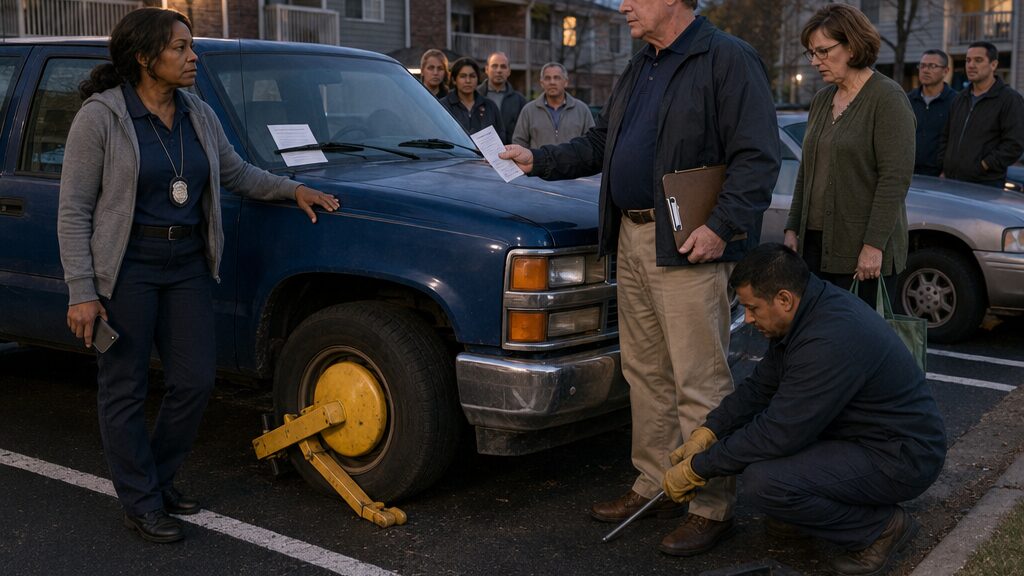
The metal jaws closed around the front wheel just as Katherine Lee stepped between the parked cars.
The sound carried across the Oakwood Commons parking court—a hard, final clank that made three residents turn from the mail kiosk and look toward the blue county truck.
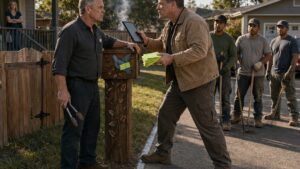
A tow-truck driver straightened from the wheel well, yellow gloves braced against his thighs. Beside him stood Brian Hall, president of the homeowners association, holding a clipboard against his stomach as though he had come to inspect a job site rather than immobilize a neighbor’s vehicle.
Katherine stopped ten feet away.
The truck had been parked in the same outer row where she had left it most workdays for nearly two years. County seal on the door. Equipment case behind the bench seat. Her identification badge still hanging from the rearview mirror because she had removed it before walking to her unit for lunch.
Now a bright yellow boot covered the rim.
Brian noticed her and raised his voice.
“Ms. Lee. Good. We won’t have to track you down.”
The residents near the mail kiosk slowed without pretending otherwise.
Katherine looked at the boot, then at the white paper tucked beneath her windshield wiper. The heading was printed in red.
TOW WARNING.
Below it: NINETY-DOLLAR IMMOBILIZATION FEE.
“You authorized this?” she asked.
Brian tapped the clipboard. “The board authorized enforcement. Commercial and government vehicles may not occupy resident parking overnight.”
“It isn’t overnight.”
“It has been here since this morning.”
“I came home for lunch.”
“And left it unattended.”
Katherine glanced at the tow-truck driver. He kept his eyes on the locking mechanism.
Brian stepped closer to the truck and read from the notice loudly enough for the gathering residents to hear.
“Vehicle subject to removal within forty-eight hours if the owner fails to pay all assessed charges and provide proof of compliance.”
There it was—the part he wanted witnessed. Not the rule itself. Her compliance.
Katherine felt heat rise beneath the collar of her gray work polo. She had spent eleven years behind a county records counter being mistaken for a receptionist, a temporary clerk, someone who fetched documents rather than understood them. She knew the cost of answering too quickly. A raised voice from her would become the story. Brian’s boot would become background.
She walked to the hood, removed her badge from the mirror, and placed it flat against the blue paint.
Brian gave a thin smile. “Your county position doesn’t exempt you from community rules.”
“I didn’t say it did.”
“You were about to.”
“No.”
The smile disappeared.
Katherine lifted the tow notice from the windshield. The paper was fresh, but the bottom corner had been folded beneath the wiper. She photographed the front, then the back, then the boot itself. Brian shifted beside her.
“Taking pictures won’t change the resolution.”
“What resolution?”
“Parking Enforcement Resolution 24-17.”
“When was it adopted?”
“At the last board session.”
“Date?”
Brian looked at the clipboard. “April seventeenth.”
Katherine lowered her phone.
The notice listed the violation date as April fifteenth.
The residents at the kiosk had moved closer. Jennifer Brown, Katherine’s next-door neighbor and the HOA treasurer, stood among them with a grocery bag looped over one wrist. Her expression was apologetic but firm.
“Katherine,” Jennifer said, “we sent reminders about work vehicles.”
“You sent a general email last month asking residents not to store commercial trucks.”
“That’s what this is.”
“This truck isn’t stored. I drove it to work this morning.”
Brian cut in. “You are splitting hairs.”
Katherine looked back at the paper. “The resolution you’re enforcing was adopted two days after the alleged violation.”
“It clarified an existing rule.”
“Then the notice should cite the existing rule.”
“It cites the board’s authority.”
“It cites a document that did not exist when you say I violated it.”
The tow-truck driver quietly closed his tool case.
Brian’s face reddened along the cheeks. “You have forty-eight hours. After that, the vehicle goes.”
Katherine did not answer him. She crouched beside the painted line marking the edge of the space.
The asphalt there was newer than the pavement nearer the buildings. The color difference was subtle in the evening light, but the aggregate was tighter, the surface less cracked. She took another photograph, including the painted number at the head of the space.
O-11.
Her notice identified the location as parcel 279-Oakwood-3B.
That number bothered her.
Condominium parcels were not normally cited by individual parking space unless the spaces had been separately assigned on the recorded plat. Oakwood Commons used common elements and limited common elements. She knew that much from her own closing papers.
She zoomed in on the notice.
279-Oakwood-3B was not the association parcel. At least, she did not think it was.
Brian leaned over her shoulder. “What are you doing now?”
“Checking the location you cited.”
“The location is under your truck.”
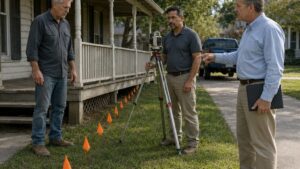
Katherine stood and opened the measurement application on her phone. She walked to the curb where the older pavement ended, then paced the distance back toward the truck.
A few residents exchanged looks.
Brian laughed once. “Are you surveying the parking lot with a phone?”
“No.”
“Then what is this performance?”
Katherine slid the phone into her pocket and examined the base of the curb. A strip of grass had grown over the asphalt edge. Near the storm-drain channel, something round and dark showed beneath the dirt.
She knelt and brushed away leaves with two fingers.
A metal cap emerged, no wider than a quarter. Its top had been stamped with a cross and a number nearly filled by rust.
Survey monument.
Not proof by itself. But it sat more than twelve feet inside the painted outer row.
Katherine looked from the pin to the booted wheel.
The parking stripe crossed beyond it.
Jennifer stepped nearer. “Is that important?”
“It might be nothing.”
Brian exhaled sharply. “Exactly.”
Katherine photographed the pin with the boot visible in the background. Her hand remained steady, though the humiliation had settled deeper now. Not because the neighbors were watching. Because part of her wanted the violation to be real. She wanted Brian to have made a clean, provable mistake large enough to answer the way he had treated her.
That desire made her cautious.
She picked up her badge from the hood and clipped it to her belt.
“You’re going to remove the boot tonight,” she said.
Brian folded his arms. “When you pay the fee.”
“No. You’ll remove it because the county owns the vehicle, and your towing contractor has no agreement with the county.”
“The truck is on private property.”
“Then send the county a lawful invoice.”
“You think your employer is going to defend you for breaking your own HOA rules?”
“I think you should call the number printed on the door before you tow public property.”
The tow-truck driver looked at Brian for the first time. “He said immobilize only.”
Brian did not turn toward him. “The authorization includes removal.”
“Not tonight,” the driver said. “Not without dispatch clearing the government plate.”
A small silence opened around them.
Katherine saw Brian realize that the public demonstration had slipped from his control.
He pointed at the notice. “Forty-eight hours. Wednesday at six. After that, I don’t care who owns it.”
Katherine looked again at the survey monument, then at the row of twelve white rectangles stretching along the outer edge of the lot.
O-1 through O-12.
The paint was uniform. The pavement was newer. Beyond it, the drainage grass sloped toward a line of maples and the rear fence.
She had seen that shape before.
Not here, exactly. On paper.
Months earlier, while processing a routine title request for another unit, she had noticed that the recorded common area seemed narrower than the parking diagram attached to an HOA resale certificate. She had assumed one drawing was simplified. She had not opened the archived plat. She had told herself it was outside the request.
Now Brian’s boot sat on the difference.
Katherine folded the tow notice along its existing crease and placed it in her bag.
“What happens Wednesday?” Jennifer asked.
Katherine looked at the twelve outer spaces.
“I find out whether they were ever supposed to be here.”
Behind her, Brian said, “They’ve been here for years.”
Katherine brushed the last dirt from the stamped metal pin.
“That isn’t the same thing.”
Chapter 2: The Space Missing From the Recorded Plat
The boundary line on the recorded plat stopped before Katherine’s parking space began.
She stood at the oversized review table in the county land-records office at seven forty-eight Tuesday morning, one hand holding down the curling corner of the sheet. On her phone, the photograph from Oakwood Commons showed twelve spaces extending past the same storm-drain angle marked on the plat.
On paper, there was grass.
On the ground, there was asphalt, painted numbers, and a yellow wheel boot.
Katherine adjusted the transparent scale over the drawing. The original condominium plat had been recorded nineteen years earlier. Building footprints, utility easements, drainage reserve, common parking—everything was laid out in precise black lines.
The outer row did not exist.
Her records supervisor stopped beside the table with a paper cup.
“You’re early.”
“I couldn’t move the county truck.”
The supervisor looked at her phone. “That the boot?”
“Yes.”
“Call fleet.”
“I did. They want the association’s written authority before they send anyone.”
“And does the association have it?”
“That’s what I’m checking.”
The supervisor’s gaze moved from the plat to Katherine. “Personal property issue?”
“My residence.”
“Then you use the public terminals and submit every request the same way anyone else would.”
“I know.”
“I mean it, Katherine. Don’t pull internal correspondence. Don’t use staff notes. Don’t search anything that isn’t public.”
“I know.”
The second repetition landed harder. Katherine rolled the scale away from the plat.
The supervisor softened slightly. “Brian Hall called yesterday.”
Of course he had.
“What did he say?”
“That a county employee threatened him with enforcement during a private parking dispute.”
“I asked him the date of his resolution.”
“He used the phrase abuse of office.”
Katherine looked through the glass wall toward the public counter. The office would open in twelve minutes. Blue binders filled the shelving behind it, each spine labeled by subdivision and recording year.
“I never told him I would enforce anything.”
“Good. Keep it that way.”
The supervisor set down the coffee. “Print what you are entitled to print. File a complaint if you have one. But if this becomes an ethics question, being correct about the property line won’t make the other issue disappear.”
Katherine nodded.
Being right would not protect her. She had learned that years ago, but the reminder still stung.
She signed into a public-access terminal under her personal account and searched the Oakwood Commons parcel. The main plat appeared first. Then amendments: utility relocation, balcony repair easement, fire-lane adjustment.
No parking expansion.
She searched the adjacent tract cited on Brian’s notice.
279-Oakwood-3B belonged to a drainage reserve retained by the original developer before dissolution. It was not an HOA parking parcel. The number on the violation notice identified land the association did not own.
Katherine printed the record and laid it beside the photograph.
The painted space occupied the reserve.
That answered one question and opened three more.
How had the asphalt been approved? Who had paid for it? Why had no later instrument transferred the land?
At eight thirty, she submitted a formal request for all planning records connected to the subdivision’s overflow parking. The code-enforcement clerk called fifteen minutes later.
“There’s a variance reference in the index,” the clerk said. “Temporary use, maybe.”
“Can you send the image?”
“No image attached. It’s a physical file.”
“Location?”
“Archive B, planning series, drawer forty-two.”
Katherine wrote it down and waited until her scheduled break before going downstairs.
Archive B smelled of paper dust and old concrete. Fluorescent tubes hummed above rows of steel cabinets. Drawer forty-two contained folders for temporary uses approved during Oakwood Commons’ final construction phase.
She moved through them by permit number.
Fencing.
Construction trailer.
Material storage.
Overflow parking—
The tab was there.
The folder behind it was not.
Katherine checked the neighboring files, then the drawer below. Empty gaps were uncommon in the archive. Files could be checked out, scanned, or misfiled, but the tracking sleeve should remain.
There was no sleeve.
She returned upstairs and requested the archive circulation log.
At ten fifteen, Jennifer texted her.
Brian says county fleet is demanding the truck be released. Is that true?
Katherine typed, They asked for written authority.
Three dots appeared.
Then: I wish you had just talked to us first.
Katherine looked at the message for several seconds.
I did talk to Brian.
You challenged him in front of everyone.
He booted the truck in front of everyone.
Jennifer did not respond.
By noon, the tow-truck driver had left Oakwood Commons, but the boot remained. Fleet had offered Katherine a temporary vehicle after lunch. She declined at first, embarrassed by the attention it would draw, then heard her supervisor’s voice in her head: personal pride was not a work plan.
She accepted the replacement.
Before leaving, she enlarged the plat on the public terminal and compared dimensions. The outer row measured roughly one hundred eighty feet. At standard stall width, that allowed twelve spaces.
Exactly twelve.
The original plan also showed one accessible space near Nancy Adams’s building entrance. On the newer HOA parking map stored with Katherine’s closing documents, that space had shifted farther away and become a standard stall.
Katherine wrote Nancy’s unit number in the margin of her notes, then crossed it out. Not evidence. Not yet.
At two, the archive clerk brought up a thin stack of circulation sheets.
“Planning files aren’t checked out often,” the clerk said. “Most people request copies.”
Katherine scanned the dates. County engineers. A developer’s attorney. A title company.
Then a familiar name.
Brian Hall.
Six months earlier, he had signed out the overflow-parking file for forty-three minutes. The purpose column read HOA renewal inquiry.
He had returned something. The clerk’s initials confirmed it.
Katherine looked again at the blank space where the folder should have been.
“Do you have camera retention from six months ago?” she asked.
The clerk shook her head. “Thirty days.”
“Was the file scanned during checkout?”
“No.”
“Did anyone access it after him?”
The clerk traced the log. “One planning technician, two weeks later.”
“Can I speak to them?”
“They retired in January.”
The answer was ordinary. That made it worse.
Katherine returned to the review table and aligned three things: the recorded plat, the drainage-reserve parcel printout, and the photograph of her booted truck.
The evidence did not yet prove Brian had removed anything. It proved only that he had known enough to search.
Her phone rang.
Brian.
She let it ring twice before answering.
“Ms. Lee,” he said. His tone was calmer than the night before. “I understand the county has concerns about the boot.”
“The county wants your authorization.”
“I can provide it.”
“Then provide it.”
“I would prefer we resolve this neighbor to neighbor.”
Katherine looked at his signature on the archive log.
“What did you find when you came to the records office six months ago?”
Silence.
Not long. Barely a breath. But it was there.
“I don’t know what you’re referring to.”
“You requested the overflow-parking file.”
“I research association matters regularly.”
“The file is missing.”
“That sounds like a county problem.”
“Maybe.”
His voice hardened. “Be careful, Katherine.”
“With what?”
“With making accusations because you’re angry about a parking violation.”
She stared at the line beside his name: HOA renewal inquiry.
“I haven’t accused you of anything.”
“You’re implying it.”
“No,” she said. “I’m asking what you learned.”
Brian ended the call.
Katherine lowered the phone slowly.
On the table, the plat showed the community as it had legally existed. On her screen, twelve bright white parking rectangles covered land that had never become part of it.
And somewhere between those two versions, a folder had vanished after Brian went looking for a renewal.
Chapter 3: The Variance That Expired Without Renewal
The missing folder was found under the name of a company that had ceased to exist fourteen years earlier.
The archive clerk carried it into the records room Tuesday afternoon with both hands, as though the thin blue folder had become fragile during the search.
“Filed under Oakwood Development Group,” she said. “Not Oakwood Commons.”
Katherine looked at the handwritten tab. The label had been replaced at some point; the ink was newer than the cardboard.
“Where was it?”
“Legacy developer correspondence. Different cabinet.”
“Who moved it?”
“No transfer note.”
The clerk placed it on the public review table. “Your supervisor said you should open it here.”
Katherine understood the message. No private desk. No appearance of special access.
She signed the document log and opened the cover.
The first page was a planning memorandum from four years earlier. Oakwood Commons had requested temporary authorization to pave part of the drainage reserve while structural repairs closed several original spaces. The county approved twelve overflow stalls for eighteen months, provided the association renewed drainage certification and restored the accessible-space count before expiration.
The permit date was clear.
So was the expiration.
Thirty-four months ago.
Katherine turned the page.
A renewal application had been started but never completed. The county had requested an updated runoff study, proof of control over the drainage parcel, and a revised accessible-parking layout.
No response appeared in the file.
Then she found a certified letter sent to the HOA board nine months after expiration.
TEMPORARY VARIANCE CLOSED—USE MUST CEASE.
The receipt was attached.
Signed: Brian Hall.
Katherine sat back.
For twenty hours she had wanted a clean answer. There it was, in blue ink.
Yet the satisfaction she expected did not come.
The next document listed potential enforcement remedies: closure of the unauthorized area, removal of pavement if drainage was impaired, civil penalties calculated from the date of formal notice. The daily amount could reach three hundred dollars, though the code allowed discretion based on corrective action.
Katherine counted backward.
Even a fraction of the maximum would cripple the association’s reserves.
Her phone photograph of the yellow boot seemed suddenly smaller than the pages around it.
She copied the public records, paid the standard fees, and submitted a formal zoning complaint from the public terminal. She included no opinion, only parcel numbers, dates, and photographs.
Daniel Wright called before she left the office.
“I saw the complaint,” he said.
Daniel had worked zoning investigations long enough to distrust urgency, especially when the complainant had professional access to the records.
“I filed it personally,” Katherine said. “Not through my department.”
“I noticed.”
“The truck is still immobilized.”
“That is between the county fleet office and your association unless the towing operation violates another code.”
“I’m not asking you to remove it.”
“Good.”
She heard him turning pages.
“The variance is expired,” he said. “That much is straightforward. The rest isn’t.”
“What isn’t?”
“Whether penalties begin at expiration or formal notice. Whether the drainage reserve can support continued temporary use. Whether the association had another approval under a different file.”
“I searched the public index.”
“I know what you searched. I still have to conduct an independent review.”
His caution irritated her because it was correct.
“When will you inspect?”
“Possibly Thursday.”
“Brian plans to tow the truck Wednesday evening.”
“Then resolve the truck separately.”
Katherine closed her eyes.
“You think this is retaliation.”
“I think you live there, your vehicle was booted, and you filed the complaint the next morning. Those facts will be raised whether I think anything or not.”
“What should I have done?”
“Exactly what you did. File through the public process. Then let me do my job.”
The answer gave her no comfort, but it gave her a boundary.
After work, Katherine drove the temporary county sedan to Oakwood Commons and parked inside her garage. The blue truck remained in the outer row, yellow boot bright beneath the lot lights.
Nancy Adams was standing beside it with one hand on her cane.
“You got a new car?” Nancy asked.
“Temporary.”
Nancy looked at the boot. “They shouldn’t have done that.”
Katherine unlocked her unit, then noticed Nancy had not moved toward her own building.
“Do you need help with something?”
Nancy hesitated. “You were taking pictures of the spaces.”
“Yes.”
“Are they changing them again?”
“Not that I know.”
Nancy looked toward the far end of the row. “They changed mine last time.”
Katherine waited.
“My space used to be beside the ramp,” Nancy said. “The blue-striped one. Then they paved this section and repainted everything. Brian said the new arrangement gave us more parking overall.”
“Where is your assigned space now?”
Nancy pointed almost halfway down the building.
“That’s not accessible.”
“He said the ramp space had to become visitor parking because delivery drivers kept blocking the lane.”
“Did the board provide another accessible space?”
“There’s one near Building C.”
Building C was across the central drive.
Katherine looked at Nancy’s cane, then at the distance.
“Why didn’t you file a complaint?”
Nancy’s mouth tightened. “I complained at two meetings.”
“What happened?”
“They said they would review it. Then people started saying the parking shortage affected everyone.” She adjusted her grip on the cane. “I didn’t want to be the reason neighbors lost spaces.”
The sentence struck Katherine with uncomfortable precision.
She had told herself something similar months earlier when she noticed the mismatch between the resale map and the plat reference. Not my request. Not my responsibility. No reason to make trouble without certainty.
“Do you have anything in writing?” Katherine asked.
Nancy nodded. “Emails. A letter from my doctor. Brian’s response.”
“May I see them?”
Nancy studied her. “Will it help get your truck back?”
“Maybe. But that isn’t why I’m asking.”
Inside Nancy’s unit, the furniture formed wide paths between rooms. A folding walker stood beside the kitchen table. Nancy opened a drawer and removed a large envelope, its edges softened by repeated handling.
The emails established dates. Her accessible space had disappeared during the overflow-lot re-striping—after the temporary variance had already expired.
Brian’s response was polite, almost sympathetic.
The board must balance individual accommodation requests against community-wide parking needs.
Katherine read the sentence twice.
“What happens now?” Nancy asked.
“I filed a zoning complaint.”
Nancy’s face changed. “Does that mean they’ll tear up the lot?”
“I don’t know.”
“Will our dues go up?”
“I don’t know.”
“Then what do you know?”
Katherine folded the letter carefully.
“That the overflow approval expired. That the county told the association to stop using it. And that Brian signed for the notice.”
Nancy lowered herself into a chair.
“So he knew.”
“Yes.”
The word felt less victorious spoken aloud.
Nancy looked toward the window facing the lot. “People are going to blame you.”
“They may.”
“And you’re still doing it?”
Katherine thought of the survey pin buried under grass. The blue binders. The wrong parcel number. Her own choice months earlier to let a discrepancy remain someone else’s problem.
“I should have asked questions sooner.”
Nancy gave her a tired look. “So should I.”
“You did.”
“I stopped.”
Neither woman said anything for a moment.
Wednesday morning, Daniel emailed confirmation that an inspection had been opened. By noon, Brian sent a community-wide notice accusing an unnamed resident of creating “unnecessary regulatory exposure over a correctable parking disagreement.”
Jennifer knocked on Katherine’s door that evening.
“You filed with zoning?”
“Yes.”
“You could have brought this to the board.”
“Brian had the county’s closure notice for almost three years.”
Jennifer’s face lost color. “What closure notice?”
Katherine handed her a copy of the certified letter.
Jennifer read Brian’s signature at the bottom.
“This can’t be right.”
“It came from the public file.”
“He told us the renewal was pending.”
“When?”
“Last year. When we approved restriping.”
Katherine heard the plural.
“We approved?”
Jennifer looked away. “The board voted on a parking-management resolution.”
“Did you vote to continue using an expired variance?”
“No.”
“Did you see the county letter?”
“No.”
From the parking court came the rattle of metal. Both women stepped outside.
The tow-truck driver was kneeling beside Katherine’s truck. Brian stood over him with the clipboard.
“Fleet called again,” the driver said when Katherine approached. “They told us to release the government vehicle.”
Brian’s jaw tightened. “The association’s fine remains due.”
The driver unlocked the yellow boot and carried it toward the truck bed.
For one brief second, several residents seemed to believe the conflict was over.
Then Katherine handed Jennifer the second page of the county notice—the section listing closure, pavement removal, and possible daily penalties.
Jennifer read it under the parking-lot light.
“How much could this be?” she whispered.
Katherine looked at the twelve spaces, nearly all occupied now.
“Enough that the boot was never the real problem.”
She turned the copied certified receipt toward Jennifer.
At the bottom, beneath the date the renewal failed, Brian Hall’s signature confirmed that he had known exactly when the association lost permission to use the lot.
Chapter 4: The Money Collected From Spaces That Should Not Exist
Jennifer Brown found the money at 8:17 Thursday morning.
She called Katherine before saying hello.
“There are three years of parking deposits with no approved budget line.”
Katherine sat up on the edge of her bed. Through the blinds, the blue county truck was visible in the outer row, freed from the yellow boot but still parked over the buried survey boundary.
“How much?”
“I don’t know yet. More than I expected.”
“Where are you?”
“The management office.”
“Is Brian there?”
“No. He asked me to prepare a reserve summary for the emergency board meeting.”
Katherine dressed without turning on the bedroom light.
The HOA management office occupied a converted storage room beside the clubhouse. By the time Katherine arrived, Jennifer had spread bank statements, printed ledgers, and annual budgets across the folding conference table.
She looked as though she had not slept. Her grocery-store reading glasses sat low on her nose.
“Close the door,” Jennifer said.
Katherine did.
Jennifer tapped a column highlighted in yellow. The entries had different labels over the years: overflow permits, reserved parking, enforcement recovery, temporary stall fees. None appeared as a separate line in the budgets mailed to residents.
“They were rolled into general operating income,” Jennifer said.
“Who entered them?”
“The management software tracks the user account. Most were Brian.”
Katherine studied the totals. Monthly permits for the outer spaces. Guest-parking passes. Boot-release charges. Late fees.
The number itself was not enormous, but it was steady. Enough to pay invoices. Enough to hide a weakness.
“What were the funds used for?” Katherine asked.
Jennifer pulled forward another stack. “Roof repairs. The retaining wall inspection. Two emergency plumbing jobs.”
“Reserve expenses.”
“We didn’t have enough in reserves.”
Katherine looked up.
Jennifer removed her glasses. “The engineering study three years ago said we were underfunded. Brian said a special assessment would destroy property values. He said we could stabilize without raising dues if we managed parking more aggressively.”
“And the board agreed?”
“We agreed to increase enforcement. We did not agree to use spaces the county had ordered closed.”
“Did he show you the variance?”
“He said renewal was pending.”
The room’s small air conditioner clicked off. In the silence, papers shifted under Jennifer’s hand.
Katherine had expected concealment. She had not expected to understand the temptation behind it.
A special assessment at Oakwood Commons would not be abstract. Retired owners would drain savings. Younger families would add debt. Units might be listed below market by people who could not pay. Brian had not invented that fear.
But he had converted it into permission.
Jennifer pointed to a series of transfers. “He moved the parking income into operating, then used operating funds for reserve work. Technically, the invoices were legitimate.”
“Did he take any money?”
“I haven’t found that.”
“Then don’t say he did.”
Jennifer stared at her. “You’re defending him?”
“No. I’m keeping the accusation accurate.”
“You’re the one who filed the complaint.”
“And that does not make every bad thing true.”
The door opened before Jennifer could answer.
Brian stepped inside carrying a cardboard file box. He stopped when he saw Katherine.
“This is a board records review,” he said.
“I invited her,” Jennifer replied.
“You don’t have authority to invite a complainant into confidential financial work.”
“I’m the treasurer.”
“And I’m the president.”
Jennifer pushed the highlighted ledger toward him. “What is this?”
Brian did not look down immediately. That hesitation answered more than denial would have.
“Parking revenue.”
“From spaces we were ordered to close.”
“From spaces residents were using.”
“You knew the variance expired.”
“I knew the renewal had stalled.”
“You signed for a closure notice.”
Brian set the box on a chair. “The county wanted a drainage study that would have cost nearly twenty thousand dollars. At the same time, the retaining wall needed stabilization. We had sixty-two thousand in reserves and more than ninety thousand in projected work.”
“So you ignored the notice,” Katherine said.
“I prioritized an immediate safety issue.”
“You kept charging people for unauthorized spaces.”
“I kept residents from receiving a four-thousand-dollar special assessment.”
His voice was controlled, but his hands gripped the back of the chair.
Jennifer looked at the figures again. “Why didn’t you tell the board?”
“Because boards panic. Owners panic faster. The moment you say ‘special assessment,’ everyone assumes fraud or collapse.”
“The moment you hide a county order,” Katherine said, “you make both more likely.”
Brian turned toward her.
“You think this is simple because you work with files. You see a date, a signature, a boundary. I see the widow in Building B who cannot pay another two hundred a month. I see buyers walking away because the reserves look weak. I see contractors refusing to wait.”
“And Nancy?”
His expression shifted.
“What about her?”
“You removed her accessible space to create more general parking.”
“We relocated access.”
“Across the central drive.”
“The layout met our internal needs at the time.”
“It did not meet hers.”
Brian looked at Jennifer instead. “This is exactly why I did not bring every operational detail to open meetings. One complaint becomes a moral indictment of every decision.”
“No,” Katherine said. “The concealment does that.”
He picked up the cardboard box.
“The board will address the parking matter Friday. Until then, these records stay here.”
Jennifer put her hand on the ledger. “I’m making copies.”
Brian’s jaw tightened. “You are exposing the association to liability.”
“We’re already exposed.”
“You think owners will thank you when their dues rise?”
Jennifer flinched.
Brian saw it and softened his tone.
“You know their finances. You know what this will do.”
That was his strength, Katherine realized. Not intimidation alone. He knew which fear belonged to which person.
To Jennifer, insolvency.
To the board, embarrassment.
To Katherine, the suggestion that expertise was revenge.
Brian lifted the box and walked out.
Jennifer waited until his footsteps faded.
“He’s right about one thing,” she said. “People will blame whoever makes the cost visible.”
“The cost already exists.”
“That won’t matter.”
Katherine gathered the documents into straight stacks. “Then we show where it came from.”
Jennifer’s phone buzzed.
She read the message, then handed it across the table.
A community petition had been emailed to residents under the subject line PROTECT OAKWOOD COMMONS FROM RETALIATORY ENFORCEMENT.
The opening paragraph described an unnamed county employee who had “used privileged knowledge to escalate a personal parking disagreement into a threat against every homeowner.”
Signatures had already begun appearing.
Jennifer sank into a chair.
“He sent this before coming here.”
Katherine read the names. People who waved to her at the mailbox. A resident whose deed correction she had once explained over coffee. The couple across from Nancy.
She handed the phone back.
“Do you want me to leave?”
Jennifer looked at her. “Why would I?”
“Because he made me the cost.”
Jennifer’s answer came slowly. “I don’t know yet what I want.”
That honesty hurt more than a defense of Brian would have.
Katherine went home without taking copies. At seven that evening, Jennifer knocked on her door carrying a laptop and one printed page.
“I kept checking the board archive,” she said.
Katherine let her inside.
Jennifer opened the laptop on the kitchen counter. “The parking enforcement resolution Brian cited on your notice was uploaded Monday night.”
“The date says April seventeenth.”
“I know.”
Jennifer turned the screen.
The document carried digital approvals from Brian, Jennifer, and the two other board members. At the bottom, Jennifer’s electronic signature appeared beneath a certification that the resolution had been adopted at an April seventeenth session.
Jennifer placed the printed page beside it.
“This is the meeting record from April seventeenth,” she said. “Parking wasn’t on the agenda. We never voted.”
“Could your saved signature have been inserted automatically?”
“Only by an administrator.”
“Who has administrator access?”
Jennifer’s face had gone pale.
“Brian and the management contractor.”
Katherine looked again at the false approval.
The dispute was no longer only about a hidden county letter or money shifted between accounts.
Someone had manufactured authority after the boot was already planned—and had used Jennifer’s name to do it.
Chapter 5: The Meeting Where Everyone Wanted a Smaller Truth
The yellow boot sat in the middle of the clubhouse table like a trophy.
Brian had cleaned the asphalt dust from its metal arms. Beside it lay a ninety-dollar check made payable to Katherine Lee and a one-page statement titled MUTUAL PARKING RESOLUTION.
Every folding chair was occupied.
Katherine remained near the back wall while residents talked over one another. Some held copies of Brian’s petition. Others had printed the county code sections Katherine had never distributed but had already been posted in the community message group.
At seven sharp, Brian struck the table once with his palm.
“The boot has been removed,” he said. “The fine has been refunded. The board considers the original dispute resolved.”
Several residents nodded with visible relief.
A man near the front raised his hand. “Then can the county complaint be withdrawn?”
“That decision belongs to Ms. Lee,” Brian said.
The room turned toward her.
He had arranged the moment carefully. The boot removed. The refund offered. The neighborhood waiting for her to prove she was reasonable.
Katherine walked to the front but did not sit.
Brian pushed the check toward her.
“This restores you completely,” he said.
“No,” she replied. “It restores ninety dollars.”
A murmur crossed the room.
He kept his voice measured. “The association has acknowledged that the enforcement timing was imperfect.”
“The resolution was created after the alleged violation.”
“The underlying rule already existed.”
“Then why use a document that did not?”
Jennifer sat at the end of the table with a closed laptop in front of her. She had not spoken to Katherine since finding the electronic signature.
Brian addressed the residents.
“We can debate administrative phrasing all night, or we can protect the community from a costly misunderstanding.”
Nancy Adams sat in the first row, cane angled against her knee.
“Was my parking space an administrative phrase?” she asked.
Brian paused.
“Nancy, your accommodation is being reviewed.”
“It has been reviewed for two years.”
A resident behind her whispered that everyone had parking problems.
Nancy heard.
“That is what they told me the first time.”
The room shifted uneasily.
Brian lifted the refund check. “This meeting concerns the enforcement complaint.”
“No,” Katherine said. “It concerns why the enforcement happened on land the association was told to stop using.”
She placed copies of the recorded plat and expired variance on the table. Then the certified closure notice bearing Brian’s signature.
No one spoke while the pages moved from hand to hand.
A resident near the window asked the question everyone had been avoiding.
“How much are the fines?”
“They are not determined,” Katherine said.
“But what is the maximum?”
“Potentially three hundred dollars per day after formal notice.”
The room erupted.
Someone began calculating aloud. Another resident accused the county of extortion. A woman in the second row asked whether liens could be placed on individual units.
Brian allowed the fear to build before raising his hand.
“This is exactly why we needed a practical resolution before incomplete information spread.”
“Incomplete?” Jennifer asked.
Every head turned.
She opened her laptop.
“The parking fees have been used to support operating expenses and reserve work for three years,” she said. “They were not separately disclosed in the annual budgets.”
Brian’s expression hardened. “Those records are not final.”
“The deposits are final.”
“You are discussing privileged financial material in open session.”
“I am the treasurer, and my signature was placed on a parking resolution I never approved.”
The room went quiet enough for the refrigerator compressor behind the serving counter to be heard.
Brian looked at her for several seconds.
“That document reflected prior board direction.”
“No,” Jennifer said. “It reflected your decision.”
One of the unnamed board members leaned toward the microphone. “I didn’t sign it either.”
The other shook his head.
Brian’s control did not collapse dramatically. It narrowed. His shoulders stiffened. His voice became almost gentle.
“We had repeated complaints. We had a clear rule. The document formalized what the board had already authorized in principle.”
“You formalized it after you booted my truck,” Katherine said.
“And now the boot is gone.”
Again, he pushed the check toward her.
A woman near the aisle called out, “Take it and end this.”
Another voice followed. “We can deal with the paperwork internally.”
“Why should sixty families pay because two people had an argument?”
The smaller truth was waiting for Katherine on the table: Brian had overreached, the boot had been removed, the money had been returned. Everyone could go home if she agreed that was the whole story.
She looked at Nancy.
Then at the plat.
Months earlier, Katherine had processed a resale request for an Oakwood unit. The HOA parking diagram had not matched the plat reference in the deed package. She had noticed. She had even written the parcel number on a sticky note.
Then she had thrown the note away.
Not because she lacked time. Because she knew what happened when she raised questions outside the narrow task in front of her. She became difficult. Suspicious. The records woman who thought every discrepancy was a crisis.
She had chosen silence before Brian ever placed the boot.
“There is something else,” Katherine said.
The residents settled slowly.
“I saw a mismatch months ago between the HOA parking map and the recorded plat.”
Brian stared at her.
“You knew?” someone demanded.
“I noticed a discrepancy. I did not investigate it.”
“Why not?”
“Because it was outside the request I was processing. Because I did not have proof. And because I did not want to be the person who raised another problem without having every answer.”
Nancy lowered her eyes.
Katherine continued.
“That was a mistake.”
Brian seized the opening.
“So Ms. Lee had concerns and said nothing, but now wants the board punished because her truck was booted.”
“No,” Katherine said. “I am telling you that silence helped this continue. Mine included.”
The admission changed the room. It denied Brian the clean villain he wanted her to become, but it also stripped away her protection.
One resident stood. “So both of you knew something was wrong?”
“No. I knew two diagrams did not match. Brian signed for a county order requiring the association to stop using the spaces.”
She placed his certified acknowledgment on top of the check.
The clubhouse door opened.
Daniel Wright entered carrying a slim case and accompanied by a code-enforcement clerk.
Brian rose. “This is a private association meeting.”
Daniel remained near the doorway.
“I’m not here to participate. I’m here to provide notice.”
The clerk distributed envelopes to the board members.
Daniel addressed the room.
“The county has opened an independent zoning and drainage inspection. Until that review is complete, no conclusion has been made regarding accrued penalties.”
Relief flickered across several faces.
Then he added, “However, the twelve overflow spaces appear to occupy land not approved for permanent parking. Immediate closure may be required if field measurements confirm the records.”
“How immediate?” Jennifer asked.
“Tomorrow.”
Voices rose again.
Brian pointed toward Katherine. “This is the result of a retaliatory complaint.”
Daniel looked at her, then at him.
“The complainant filed through the public system. The inspection is based on county records and will proceed regardless of whether she withdraws.”
The refund check no longer looked like an exit.
It looked like an attempt to close a door after the county had already stepped through it.
The meeting ended without a vote. Residents crowded around Jennifer, demanding figures she did not yet have. Others confronted Katherine in the aisle, asking whether she understood what she had done.
Nancy waited beside the front row.
“You told them,” she said.
“Not soon enough.”
“No,” Nancy replied. “But you told them before they could make the small version true.”
Outside, two county vehicles were parked beside the outer row.
A code-enforcement clerk moved from space to space, attaching fluorescent orange notices to metal stakes.
UNAUTHORIZED AREA—NO PARKING PENDING INSPECTION.
One by one, the twelve spaces were closed.
Residents came out of the clubhouse and stopped beneath the parking-lot lights as the last notice went into the ground beside Katherine’s former space.
The yellow boot was gone.
By morning, an entire row would be unusable, and no refund could make the problem private again.
Chapter 6: Twelve Closed Spaces and One Restored Right
At six fifteen Monday morning, orange barriers stretched across the outer parking row.
Residents stood in bathrobes and work clothes, staring at the blocked spaces as though the asphalt had disappeared overnight. Cars had been relocated along the curb, beside the clubhouse, and into the narrow visitor row. One delivery van could not turn around and had to reverse the full length of the drive.
Nancy’s former accessible space remained marked VISITOR.
Katherine watched from her doorway as a resident dragged one of the orange barriers aside.
Daniel Wright stepped from a county vehicle.
“Put it back,” he said.
The resident pointed toward a truck parked half on the grass. “Where are we supposed to go?”
“That is for the association to manage.”
“You closed the spaces.”
“The association operated them without current approval.”
The distinction did nothing to reduce the anger.
By nine, Katherine was seated in a county conference room with Daniel, Jennifer, Brian, the HOA attorney, and a drainage engineer. A large site plan covered the table.
The inspection had confirmed the recorded boundary. Twelve stalls and part of the turnaround occupied the drainage reserve. Core samples showed the pavement had reduced surface absorption near the lower swale.
The engineer circled a section in red.
“This area must be removed or rebuilt with an approved permeable system,” she said. “The runoff path also needs to be restored.”
“How much?” Jennifer asked.
“Preliminary range, forty-five to seventy thousand.”
Jennifer closed her eyes.
The HOA attorney spoke next. “And the civil penalties?”
Daniel folded his hands.
“The code permits up to three hundred dollars per day after formal notice. Maximum exposure is substantial. Actual assessment depends on cooperation, corrective action, prior history, and intent.”
Brian leaned forward. “The association has cooperated.”
Daniel looked at the certified letter in the file.
“Not consistently.”
“The board was trying to obtain a renewal.”
“There is no completed application.”
“The study cost was prohibitive.”
“That did not authorize continued use.”
Brian’s chair creaked as he leaned back.
Katherine had imagined this moment during the first night: Brian confronted with the record, unable to talk around it. She had thought it would feel clean.
Instead she could see Jennifer calculating assessments in her head. She could see the attorney’s concern. She could picture Nancy walking from the far row if nothing changed quickly.
Daniel slid a draft enforcement summary across the table.
“There is another option. A phased correction agreement. Immediate removal of the most sensitive pavement, restoration of required accessible parking, temporary management of the remaining stalls, and a reserve contribution schedule.”
“The county would reduce the fines?” Katherine asked.
“Potentially.”
Brian turned toward her. “You hear that? This can still be handled reasonably.”
She ignored the invitation in his tone.
“What would the county require?”
“Full disclosure of the approval history. Accurate board records. No use of the closed area until a corrective plan is accepted.”
The HOA attorney cleared his throat.
“There may be an insurance problem.”
Jennifer looked at him. “What kind?”
“If the parking resolution was falsified, the association’s directors-and-officers carrier may deny coverage for claims connected to that act.”
The room became still.
Brian stared at the site plan.
The attorney continued. “That could include defense costs, certain penalties, and resident claims.”
Jennifer’s voice was low. “Because of the electronic signatures?”
“Because knowingly false filings are commonly excluded.”
Brian stood.
“We need a recess.”
He left the conference room without waiting for agreement.
Katherine found him ten minutes later in the hallway beside a vending machine. He was holding the yellow boot notice she had submitted with the complaint.
“You wanted accountability,” he said.
“I wanted the records corrected.”
“You knew this could bankrupt people.”
“I knew hiding it would make the cost worse.”
He folded the notice once.
“If I resign, will you ask Daniel to remove the falsified resolution from the enforcement record?”
Katherine looked at him.
“You want the county to pretend it did not exist?”
“I want the association eligible for insurance.”
“The document was used to boot a county vehicle.”
“No one was harmed.”
“Nancy lost access. Jennifer’s signature was used without permission. Residents paid fees under authority you knew was questionable.”
“I used the money for the property.”
“That does not make the document true.”
His restraint cracked.
“You think truth pays invoices? You think a recorded plat repairs a wall? Every owner praises transparency until transparency sends them a four-thousand-dollar bill.”
Katherine let the words settle.
He was not wrong about fear. He was wrong about what fear permitted.
“If I ask Daniel to suppress it,” she said, “I become part of the concealment.”
“You already admitted you stayed quiet.”
“Yes.”
“Then you understand.”
“I understand why it was easy. That is not the same as agreeing.”
Brian looked down at the notice in his hand.
“I kept dues flat for five years.”
“And made the community dependent on spaces it could not lawfully use.”
“I bought time.”
“You spent it without telling anyone.”
He handed the notice back.
“You’re going to make them pay.”
“No,” Katherine said. “The decisions already made are going to cost them. My choice is whether to lie about why.”
At the afternoon board work session, Katherine placed the yellow boot notice beside a proposed correction plan.
The plan prioritized four actions: restore Nancy’s accessible space immediately; remove pavement from the drainage channel; create temporary parking agreements with a nearby office lot; spread the remaining cost over three years instead of one assessment.
Jennifer read the numbers twice.
“This still raises dues.”
“Yes.”
“Forty-eight dollars a month under the middle estimate.”
“Yes.”
A board member shook his head. “Residents will reject it.”
“Then show them the alternatives,” Katherine said. “Maximum penalties. Immediate pavement removal. Legal costs without a plan.”
Brian sat at the end of the table, silent.
Jennifer looked at the proposed accessible stall near Nancy’s ramp. “Why this first?”
“Because it should never have been removed.”
The HOA attorney tapped the insurance section. “The association must disclose the false resolution.”
Brian finally spoke.
“What if the board characterizes it as an administrative reconstruction of prior authority?”
Jennifer closed her binder.
“You used my signature.”
“I believed the board had approved the substance.”
“You knew we had not approved the document.”
He did not answer.
Katherine pushed the correction plan toward him.
“This is the point where the rule applies to the people writing it.”
For the first time since the boot had been attached, Brian looked tired rather than angry.
The board voted to submit the phased plan to the county. Brian abstained. Jennifer and the two other members approved it.
Daniel accepted the proposal for technical review but made no promise about penalties.
When Katherine returned home, workers had placed temporary blue markings beside Nancy’s ramp. Nancy stood on the sidewalk watching them measure.
“They said it will be ready tomorrow,” she said.
“It should have been ready years ago.”
Nancy touched Katherine’s sleeve.
“Tomorrow still matters.”
Across the lot, Brian waited beside Katherine’s truck.
He held a yellowed envelope bearing the county planning department’s return address. The paper had been opened and refolded so many times that the creases had begun to split.
“What is it?” Katherine asked.
“The original warning.”
“The certified copy is already in the file.”
“Not this one.”
He removed a letter and handed it to her.
The county had offered a ninety-day compliance conference before penalties began. A handwritten note at the bottom listed the date Brian had called to postpone it.
He had not merely received the warning.
He had been given a final chance to correct the problem quietly—and had hidden that chance from the board as well.
Katherine looked up.
Brian’s face had lost the last of its defensiveness.
“I told myself I would fix it after the reserve recovered,” he said. “Then every year there was something else.”
The letter trembled slightly in his hand.
“What are you going to do with this?” Katherine asked.
He looked toward the orange barriers, the temporary blue markings, and the residents searching for places to park.
“What I should have done before any of them had to ask.”
Chapter 7: The Rule Applied to Everyone at Last
Brian entered the emergency meeting carrying the original county warning in one hand and a sealed envelope in the other.
The clubhouse went quiet before he reached the table.
Six weeks had passed since the orange barriers closed the overflow row. During that time, residents had parked in borrowed office spaces across the street, argued over temporary permits, and watched contractors cut a drainage channel through asphalt they had once believed belonged to them. Monthly dues had risen by thirty-two dollars under the first phase of the correction agreement. Another increase would follow if the reconstruction exceeded estimates.
No one needed Brian to explain why he was there.
The yellow wheel boot sat inside a transparent document box near the front of the room. Jennifer had placed it there with the tow notice, the backdated resolution, and copies of the county correspondence.
It no longer looked powerful.
It looked like evidence.
Brian set the yellowed county letter on the table. Then he placed the sealed envelope beside it.
“This is my resignation,” he said.
No microphone. No prepared opening. His voice carried anyway.
One resident crossed his arms. “That doesn’t pay for any of this.”
“No,” Brian said. “It doesn’t.”
Another called from the second row, “Did you steal the parking money?”
Jennifer opened the ledger in front of her.
“We completed the financial review,” she said. “There is no evidence that Brian took association funds for personal use.”
The room did not soften.
She continued. “The parking income went into operating accounts and paid legitimate association expenses. The concealment was in how the money was collected, reported, and used—not in personal theft.”
A woman near the aisle gave a bitter laugh. “So he broke the rules for our own good?”
Brian looked at the floor.
“That is what I told myself,” he said.
Katherine sat beside Nancy in the first row. Nancy’s restored accessible space had been completed three weeks earlier, marked in fresh blue paint beside the ramp. She no longer had to cross the central drive, though she still arrived early to meetings out of habit.
Brian faced the residents.
“The reserve study showed we were short. I believed a special assessment would force people to sell. When the county required the drainage study, I postponed it. When they sent the closure warning, I thought I could rebuild the reserve first.”
“And the fake resolution?” Jennifer asked.
Brian met her eyes.
“I created it.”
A murmur rolled through the room.
“I used stored electronic approvals,” he continued. “The other board members did not authorize that document. Jennifer did not sign it. I did.”
One of the residents stood so abruptly that his chair scraped backward.
“Then you should pay every dollar.”
Several voices agreed.
“The legal fees.”
“The pavement.”
“Our increased dues.”
“Put a lien on his unit.”
Brian did not respond.
The HOA attorney, seated against the side wall, looked toward Katherine. She had spent the previous week reviewing the proposed settlement with Jennifer and Daniel. Brian had agreed to repay the booting charge, cover the legal expense directly tied to the falsified resolution, and waive any claim for board indemnification. His insurer would not cover deliberate document alteration.
That was accountability.
It was not enough for the room.
A resident pointed at the document box. “He used that thing to humiliate her in front of everybody. Now we’re supposed to let him walk away with a resignation?”
Katherine felt the attention shift toward her.
It would have been easy to remain silent. Easier still to let their anger speak for her.
Instead, she stood.
“Brian should be responsible for what he chose,” she said. “Not for every cost the association already carried before he made that choice.”
The man who had stood stared at her. “You’re defending him again.”
“No.”
“Then why stop us?”
“Because punishment is also a rule. It should be applied accurately.”
She opened the correction summary on the table.
“The retaining wall was underfunded before the overflow spaces were created. The drainage study would have cost money whether Brian disclosed it or not. The reserve shortage belongs to years of budgets approved by more than one person.”
A resident near the back said, “He hid it from us.”
“Yes.”
“And you want him protected?”
“I want the truth protected from our anger.”
The room tightened around the sentence.
Katherine looked at Brian.
“He backdated a resolution. He used signatures without permission. He concealed a county order and kept collecting fees after the variance expired. Those are his decisions.”
She turned toward the residents.
“But if we charge him for every dollar of pavement reconstruction, every old reserve shortage, and every inconvenience we suffered, we will be doing what he did—using authority to make the facts fit the outcome we want.”
Nancy tapped the rubber tip of her cane once against the floor.
The sound was small, but it settled the room.
Jennifer pushed a written agreement forward.
“Brian will resign immediately,” she said. “He will reimburse the association for the legal review connected to the false resolution and the improper booting action. He will provide all original records and cooperate with the county. The association will retain its claims if new evidence of personal benefit appears.”
“And the rest?” someone asked.
“The rest belongs to all of us,” Jennifer said.
No one applauded.
That was how Katherine knew they had finally reached something honest.
The vote passed thirty-eight to eleven.
Brian signed the agreement, then the resignation. Before leaving the table, he placed his keys beside the document box.
For a moment, he looked at Katherine.
“I thought keeping dues flat proved I was doing the job,” he said.
Katherine glanced toward the residents holding revised budgets in their laps.
“It proved you could postpone the bill.”
He nodded once.
There was no apology large enough to repair the last three years, and neither of them pretended otherwise.
After Brian left, Jennifer moved to the next agenda item.
“The county has approved the first reconstruction phase,” she said. “The drainage section will reopen only after final inspection. Four general spaces may return before winter.”
“And Nancy’s?” a resident asked.
Nancy straightened.
“Mine is already where it should have been.”
The answer drew no cheers. Only a few lowered eyes.
Jennifer then announced that the board needed an interim president.
Three residents nominated Katherine before she could stop them.
She stood again.
“No.”
The refusal surprised the room more than acceptance would have.
A board member leaned toward her. “You’re the reason we have an accurate record.”
“I’m one reason we finally looked at it.”
“You know the process.”
“That does not mean I should control it.”
Jennifer studied her across the table. “What will you do?”
Katherine had considered the question during every drive past the construction barriers.
“I’ll chair a temporary records committee,” she said. “Six months. Public document index, open financial archive, permit calendar, and written confirmation for every board vote.”
Someone asked, “Then what?”
“Then another resident takes over.”
The proposal passed without debate.
At the end of the meeting, Jennifer lifted the transparent box containing the yellow boot.
“Do we retain this?”
The HOA attorney said the photographs and numbered evidence record were sufficient. The physical device belonged to the towing contractor.
Katherine opened the box.
The metal felt heavier than she remembered. Cold arms, scratched lock housing, yellow paint chipped where it had pressed against the county truck’s wheel.
Six weeks earlier, it had reduced her to a spectacle in her own parking lot. Then it had become proof. Later, a symbol residents could point at so they would not have to look at the harder failures beneath it.
Now it was only a tool someone had chosen to misuse.
She handed it to the tow-truck driver waiting by the door.
“Take it out of here.”
Outside, work lights illuminated the rebuilt entrance to the parking court. The temporary barriers had been moved aside while a contractor laid out measurements for the approved stalls.
Nancy walked slowly toward her restored space. She stopped at the blue access aisle and placed the tip of her cane exactly inside the painted boundary.
“Looks wider than before,” she said.
“It meets the recorded plan.”
Nancy glanced at Katherine. “You always need the paper to say it first?”
Katherine looked toward the clubhouse, where residents were carrying boxes of financial records into the management office.
“Not always.”
Near the drainage strip, a worker stretched a chalk line between two measured points. The old outer stripe had been ground away, leaving a pale scar across the asphalt.
He pulled the cord tight and snapped it.
A straight blue mark appeared inside the lawful boundary.
The first new parking stripe did not recover the lost money, erase Brian’s signature, or return the months Nancy had spent crossing the drive. It did something smaller and more durable.
It showed where the community had finally agreed to stop.
Katherine watched the worker roll white paint over the line, then turned toward the management office, where the blue binders waited to be opened.
The story has ended.