The HOA Rented His Private Dock for Three Summers—Then Forty-Seven Customers Arrived at a Locked Gate
Chapter 1: The Stranger Who Had Reserved Slip B
The unfamiliar boat was tied to Carolyn’s cleat.
Jacob Walker stopped halfway down the slope from his house, one hand still wrapped around the handle of the trash bin he had been dragging toward the road. The boat was a white twenty-foot runabout with blue trim, its bow line looped twice around the galvanized cleat at the end of his dock.
That cleat had been empty for nearly three years.
A man in khaki shorts stood beside the boat, feeding a cooler through the windshield to a woman in the passenger seat. He wore a green plastic wristband. Two children were already stepping from the dock into the boat as if they had done it every summer.
Jacob left the trash bin upright in the grass.
“Excuse me.”
The man turned. He was younger than Jacob by twenty years, broad through the shoulders, sunburned across the nose. His expression held the careful impatience of someone expecting a minor inconvenience.
“Can I help you?”
“You’re on my dock.”
The man glanced toward the house, then back at Jacob. “We’re in Slip B.”
“There is no Slip B.”
The woman in the boat stopped arranging towels.
The man gave a small laugh. “There definitely is. We booked it for the weekend.”
Jacob stepped onto the first board of the dock. Its old timbers flexed beneath his weight. The stranger’s line was pulled tight across the cleat, covering the dull scratch Carolyn’s wedding ring had made years ago when she slipped while fastening a rope.
“Who did you book it through?”
“The lake association.” The man lifted his wrist. “They gave us this at check-in.”
The band carried the Cedar Ridge Homeowners Association logo in dark green ink.
Jacob looked toward the public road above his property. No signs marked a check-in point. No association employee stood nearby. Only three boat trailers were parked along the shoulder, their wheels pressed into the grass.
“How much did you pay?”
“Eighty-five for Friday through Sunday.” The man’s defensiveness sharpened. “Plus a processing fee.”
Jacob kept his voice even. “What’s your name?”
“Joshua Miller.”
“I’m Jacob Walker. I own the dock.”
Joshua’s face changed, though not enough to become an apology. “The association said it belonged to the lake facilities.”
“They were wrong.”
Joshua reached into the open glove compartment and removed a folded page. “Look, I’m not trying to start anything. My family drove two hours. We paid for this.”
He held out the paper.
At the top was the Cedar Ridge logo. Beneath it, in bold type, were the words WEEKEND WATER ACCESS CONFIRMATION. The reservation listed Joshua Miller, two adults, two children, Friday through Sunday, and Slip B. The total was eighty-five dollars, paid in full.
At the bottom, a line read: Managed seasonal access authorized by the Cedar Ridge Board.
Jacob read it twice.
Joshua watched him. “So this isn’t something I made up.”
“No,” Jacob said. “It isn’t.”
The answer seemed to surprise them both.
A second boat moved slowly toward the dock, its engine muttering over the water. The driver raised one hand in greeting. Jacob looked past Joshua and saw another empty cleat near the ladder.
“How many slips did they tell you were here?”
“Three.”
“There are two cleats.”
Joshua followed his gaze. “The map showed A, B, and C.”
“What map?”
“The booking page.”
Jacob extended his hand. “May I photograph that confirmation?”
Joshua hesitated, then passed it over.
Jacob took out his phone. The screen showed eleven unread emails, most from addresses he recognized and had no intention of opening. He photographed the reservation, the wristband, and the rope secured to the cleat. Then he photographed the boat’s registration number.
Joshua stiffened. “Why the number?”
“Because I need a complete record. Not because I’m blaming you.”
The second boat came closer. A woman at the wheel called, “Is this Cedar Ridge weekend parking?”
Jacob felt something cold settle beneath his ribs.
Joshua looked from the approaching boat to him. “What do you want us to do?”
Jacob wanted to cut the rope. He wanted to tell everyone to leave and close the gate at the top of the path. Instead, he looked at the two children. One had already put on an orange life jacket backward.
“You can load your things,” he said. “But you can’t leave the boat here.”
Joshua’s jaw tightened. “We paid.”
“To someone who didn’t own what they sold.”
The woman in the boat said quietly, “Josh.”
He took a breath and nodded once. “Give us ten minutes.”
Jacob walked back toward the house while Joshua untied the bow line. At the top of the slope, he turned. The rope came free from the cleat, leaving the metal exposed again.
He called David King.
David answered on the fourth ring. Music and voices sounded behind him.
“Jacob. Haven’t heard from you in a while.”
“There’s a family at my dock with a paid reservation from the association.”
A pause, then a chair scraping.
“Which slip?”
The question landed harder than denial would have.
“You know about this.”
“Of course I know about it. We’ve run the seasonal program for three summers.”
“You’ve rented my dock for three summers?”
“Let’s not make it sound dramatic.”
Jacob looked down at Joshua’s boat pushing away from the boards.
“How should I make it sound?”
David sighed. “The dock was sitting there doing nothing. You weren’t using it. The board found a practical way to create revenue and give people lake access.”
“You sold access to private property.”
“You’re a member of the association.”
“That doesn’t make my parcel common property.”
“No one said it did.”
“You issued numbered reservations.”
“Managed access. There’s a difference.”
“To the people paying you?”
David lowered his voice. “Jacob, the arrangement has benefited everyone. We avoided a special assessment after the storm repairs. You should be grateful we made use of an idle asset.”
Jacob closed his eyes.
The word idle carried more insult than David could have known. It reduced three summers of silence to wasted space. It turned Carolyn’s absence into an accounting opportunity.
“Show me my written consent,” Jacob said.
“You were notified.”
“That wasn’t my question.”
“You received the same packets everyone did.”
“I never signed anything.”
“Check the welcome materials and the board minutes before you accuse people of theft.”
“I bought this house eleven years ago.”
“And three summers ago, the board discussed lake access. Your name is in the minutes.”
Jacob’s grip tightened around the phone.
“What do the minutes say?”
“I’m not reading them to you over the phone.”
“Then email them.”
“You already have them.”
“I don’t.”
David was silent for a moment.
Then he said, “Read the minutes from three summers ago, Jacob. You may find you agreed to more than you remember.”
The call ended.
Down at the dock, Joshua’s boat moved toward open water. The second boat had turned away. The metal cleat shone in the afternoon sun, bare except for a pale line where the stranger’s rope had pressed against it.
Jacob went inside and opened the email account he had spent three years avoiding.
Chapter 2: The Meeting Minutes With His Name
Jacob found his name beneath a motion he had no memory of making.
The document had arrived as an attachment thirty-four months earlier. He had opened the email then—his account showed that much—but the minutes themselves looked unfamiliar.
The motion appeared halfway down page four.
Proposed by Jacob Walker: establish managed seasonal access to underused waterfront facilities, subject to board scheduling and maintenance oversight.
Seconded by David King.
Approved without objection.
Jacob sat motionless at the dining table.
He remembered that meeting. Or pieces of it.
It had taken place six weeks after a storm tore shingles from the clubhouse roof and dropped a pine across the retaining wall near the community boat ramp. Carolyn had been in the hospital that evening. Jacob had attended by telephone for less than ten minutes because she had insisted he go home long enough to shower and bring back her blue sweater.
He remembered discussing temporary neighbor access to the boat ramp while repairs were underway.
He did not remember speaking about his dock.
He certainly did not remember proposing a rental program.
Jacob printed the minutes. The old printer clicked and shuddered, filling the quiet room with mechanical effort. When the page emerged, he placed Joshua’s reservation beside it.
Managed seasonal access appeared in both documents.
The phrase was too precise to be coincidence.
At nine the next morning, Jacob entered the HOA office for the first time since Carolyn’s memorial service. The office occupied a converted room behind the clubhouse kitchen. A filing cabinet stood beneath a bulletin board crowded with landscaping reminders, pool rules, and a faded notice about storm repairs.
The HOA treasurer was alone behind the desk. She looked at Jacob, then at the folder in his hand.
“I heard about yesterday.”
“From David?”
“From three people.”
Jacob placed the printed minutes on the desk. “I need to see the original meeting packet and the financial records for the dock rentals.”
She pushed her glasses higher. “Members have to request records in writing.”
“I requested them at seven this morning.”
“I haven’t checked.”
“You have now.”
Her mouth tightened, but she opened the computer.
Jacob waited while she searched. On the wall behind her hung a whiteboard calendar. Every summer weekend carried a small blue mark. In one corner, someone had written WATER ACCESS in block letters.
“How long has the association charged for my dock?”
The treasurer kept her eyes on the screen. “The program began the summer after the storm.”
“Who approved the fee?”
“The board.”
“Which meeting?”
She stopped typing.
“That should be in the minutes.”
“It isn’t.”
She looked at him then. “Jacob, the association had bills. The retaining wall failed. The clubhouse roof wasn’t fully covered because the deductible changed. The contractor wanted payment before he finished the ramp.”
“That doesn’t answer the question.”
“The rentals helped.”
“How much?”
She opened a spreadsheet and turned the monitor slightly. The figures were divided by year. Dock access. Weekend permits. Processing fees. The first summer showed a modest total. The second nearly doubled it. The current summer had already surpassed both, though July was not over.
Jacob followed the amounts down the column.
“This money went into the general operating account?”
“Most of it.”
“Most?”
“There were booking charges.”
“Paid to whom?”
“A marina services company.”
“Who signed that contract?”
She looked away.
“David?”
“He was president.”
“That wasn’t my question.”
The treasurer stood and crossed to the filing cabinet. She removed a thick binder and set it on the desk.
Inside were handwritten booking sheets. Names, phone numbers, dates, assigned slips, payments. Some weekends had notes squeezed into the margins: late arrival, trailer space needed, returning guest.
Three summers of strangers had been reduced to neat blue lines.
Jacob turned each page slowly.
The treasurer said, “We didn’t think you cared.”
His hand stopped.
“You didn’t ask me.”
“You stopped coming to meetings.”
“That isn’t consent.”
“You didn’t answer emails.”
“That isn’t consent either.”
“No,” she said. “But it made David’s explanation easier to believe.”
Jacob looked at her.
“What explanation?”
“That you had offered the dock for temporary use after the storm. That you didn’t want to manage it yourself. That the association would handle insurance and maintenance.”
“Did you see anything I signed?”
“No.”
“Did you ask?”
She closed the binder. “Not at first.”
“And later?”
Her expression changed.
“Last year, one of the board members asked whether the title covered commercial access. David said the language had already been reviewed.”
“By whom?”
“He didn’t say.”
Jacob photographed the booking sheets and requested copies of the bank summaries. The treasurer did not stop him. Before he left, she handed him a stack of printed emails.
“These were sent to you.”
Most had subject lines Jacob recognized: BOARD UPDATE, LAKE ACCESS SCHEDULE, COMMUNITY REPAIR STATUS. He had ignored them the way he ignored holiday invitations and neighbors who knocked after Carolyn died.
One email, sent two years earlier, contained a sentence that made his stomach tighten.
As previously discussed with affected owners, seasonal access will continue under the existing managed-use arrangement.
No names. No request for confirmation. No attachment showing boundaries.
Yet Jacob had received it and said nothing.
He left the clubhouse with the records under his arm. Outside, two neighbors stood near the parking lot. Their conversation stopped when they saw him.
At home, Jacob opened the metal fire box in the hall closet. Inside were the deed, title policy, closing statement, and recorded survey from eleven years earlier.
He spread them across the dining table.
The survey showed his parcel extending to the waterline. A narrow strip marked forty-foot access easement crossed the uphill edge of his property, allowing neighboring lots to reach the community ramp. It did not touch the dock.
The dock itself was drawn inside the boundary in plain black lines.
Jacob traced the parcel line with one finger.
The records were clear. His memory was less so.
He called Katherine Roberts.
She had handled a boundary dispute for Carolyn’s sister years earlier and had attended Carolyn’s funeral. Her voice remained brisk even when she recognized him.
“Send me everything,” she said.
“I have a deed, survey, title policy, meeting minutes, reservation form, and three years of booking records.”
“That is not a small misunderstanding.”
“David says I approved it.”
“Did you?”
“No.”
“Did you sign anything?”
“No.”
“Did you object in writing?”
Jacob looked at the unopened emails stacked beside him.
“No.”
Katherine was quiet.
“That matters,” she said, “but not the way David wants it to matter.”
“How does it matter?”
“It gives them an argument about implied permission and reliance. It does not create ownership. It does not automatically create an easement. And it does not give an HOA unlimited authority to operate a business on someone else’s parcel.”
“I want it stopped.”
“Then stop talking to David until I review the title.”
An hour later, Katherine called back.
“There is no recorded easement over your dock,” she said. “None. The forty-foot easement serves the community ramp uphill. Your dock is entirely within your parcel.”
Jacob looked at the meeting minutes.
“Then how can my name be under that motion?”
“It can’t change the deed. But it can complicate the story.”
“What do we do?”
“We verify the original minutes, inspect the contract, notify the booking company, and post the property before the next reservation period.”
“The next one starts Friday.”
“Then we have six days.”
Jacob stared at the line bearing his name.
The property record said the dock was his.
The association record said the idea had been his.
Chapter 3: Forty-Seven Reservations Behind One Locked Gate
The first boat trailer arrived before sunrise.
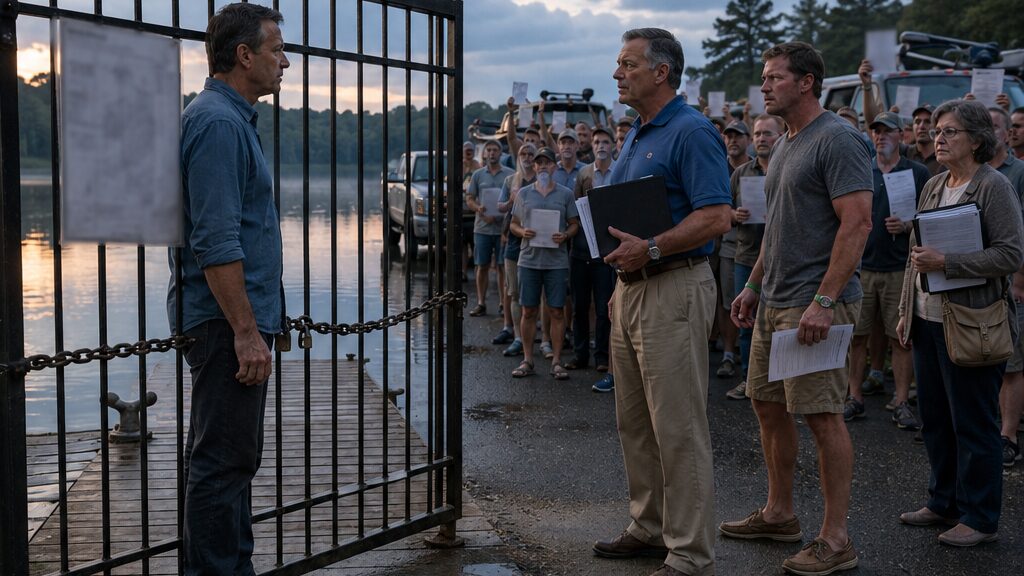
Jacob heard its tires grind over the gravel shoulder at 5:42 Saturday morning. By six, headlights stretched along the lakeside road in both directions. Trucks idled beneath the trees. Trailer hitches clanked. Children climbed out holding life jackets while adults unfolded printed confirmations beneath the yellow glow of their cab lights.
Jacob stood behind the locked gate with a folder under one arm.
The red-and-white PRIVATE PROPERTY signs had been attached to every entrance the previous afternoon. Beside the gate, Katherine had helped him fasten an enlarged copy of the county plat inside a clear plastic sleeve.
Beyond it, the dock lay empty.
The cleat where Joshua’s rope had been tied caught the first gray light over the lake.
A man outside the gate rattled the chain.
“This thing’s locked.”
“It’s supposed to open at six.”
“My code isn’t working.”
Within minutes, more people crowded near the entrance. Some wore green HOA wristbands. Others held confirmation pages or phones displaying digital reservations.
A woman raised her voice. “Who owns this property?”
Jacob stepped forward.
“I do.”
The response came at once.
“Then open the gate.”
“We paid for access.”
“We have two boats waiting.”
“My reservation says Slip C.”
Jacob lifted one hand, not high enough to look commanding.
“The homeowners’ association did not have authority to rent this dock. The booking company canceled the agreement after receiving the deed and county survey.”
A man near the front held up his phone. “Nobody canceled mine.”
“Nor mine,” someone said behind him.
The crowd pressed closer.
Jacob could smell coffee, gasoline, lake water, and the hot rubber of trailer tires. He had imagined this moment all week. In every version, the facts had created order.
Instead, the facts made people angrier.
A pickup truck stopped crookedly behind the trailers. David King climbed out wearing a blue polo shirt with the association logo stitched over the chest.
Relief moved through the crowd.
“There he is.”
“That’s the president.”
David walked toward the gate with a leather folder in his hand. He did not look at Jacob until he stood directly opposite him.
“Open it,” he said.
“No.”
“You are interfering with scheduled association access.”
“This is private property.”
David turned so the crowd could hear him.
“Mr. Walker participated in the original board action establishing this program. The association has operated it openly for three years.”
Voices rose again.
Jacob felt every face turn toward him.
David opened his folder and removed a page.
“These are the approved minutes,” he said. “The motion is listed under Mr. Walker’s name.”
A woman near the gate shouted, “So you changed your mind after taking everybody’s money?”
“I never took your money,” Jacob said.
David held the minutes higher. “You initiated the access arrangement.”
Jacob looked at the page. Even from several feet away, he recognized the line.
Proposed by Jacob Walker.
The gate seemed suddenly smaller between them.
David lowered his voice. “Unlock it now. We can settle the paperwork later.”
“You knew the booking company voided the contract.”
“They acted on incomplete information.”
“They saw the deed.”
“They saw one interpretation.”
“There is only one recorded parcel line.”
David glanced toward the waiting families. “Do you understand what you’re doing? These people planned weekends around this. The association has obligations.”
“Obligations created by selling what it didn’t own.”
A man slammed his confirmation against the fence. “I don’t care which one of you owns it. Somebody owes me three hundred dollars for the cabin I rented because this dock was included.”
The pressure shifted back toward Jacob.
He opened his folder.
His statement was one page long. Katherine had advised him not to improvise.
“My name is Jacob Walker. I own the land, dock, and boat slip behind this gate. The recorded county plat is posted beside me. The HOA has no easement over the dock and no written authorization from me to rent it.”
Someone called, “Then why are your meeting minutes saying you approved it?”
Jacob kept reading.
“I understand that many of you paid in good faith. I will photograph your confirmations, record your contact information, and provide documentation for refund and loss claims. But I will not open the gate.”
The crowd broke into overlapping objections.
David smiled without warmth. “That’s convenient. He shuts down the weekend and offers paperwork.”
Joshua Miller pushed through from the edge of the group.
Jacob recognized the green wristband before he recognized the face.
Joshua stopped near the gate. His wife stood several yards behind him with their children.
“I was here last Friday,” he said.
David looked at him. “Sir, we’re addressing this.”
“No. You’re blaming him.”
The crowd quieted enough to hear.
Joshua pointed at Jacob. “He didn’t know I had a reservation. He asked to see my confirmation because he’d never seen one before. He didn’t charge me. He didn’t give me the wristband. Your office did.”
David’s expression tightened.
Joshua turned toward the others. “I was mad too. But the man let us load our boat before asking us to leave. He could’ve called somebody and had us cited. He didn’t.”
A woman near the front lowered her confirmation.
Jacob looked at Joshua through the chain links. “Thank you.”
“I still want my money back,” Joshua said.
“You should get it.”
“Then write my name down.”
That became the first line.
Jacob placed a folding table inside the gate and slid a clipboard through the bars. Joshua wrote his contact information, reservation number, eighty-five-dollar payment, and additional losses. Then another boater stepped forward.
The anger did not disappear. It changed direction unevenly.
Some people still blamed Jacob for waiting until the weekend. Others asked David where the money had gone. Several neighboring homeowners arrived on foot, drawn by the trailers and raised voices.
One resident pointed at the plat.
“That little strip says easement.”
“To the community ramp,” Jacob said.
“People have used this shore for years.”
“The ramp is uphill. The dock is not part of it.”
David unfolded the minutes again. “The board established managed seasonal access with Jacob’s participation.”
A resident asked, “Why were we charging outsiders if this was neighbor access?”
David did not answer immediately.
Another resident said, “Were these fees in the annual report?”
“They were listed as lake-facility revenue.”
“Which facility?”
David’s face reddened. “This is not the place for a budget hearing.”
A sheriff’s deputy arrived shortly after seven. Katherine had recommended requesting a peacekeeping presence, not enforcement. The deputy examined the deed copy, the plat, and the locked gate, then told the crowd the matter was civil unless someone crossed the fence or damaged property.
No one did.
By eight-thirty, Jacob had collected thirty-one reservation records.
By nine-fifteen, the number reached forty-seven.
The old booking system had assigned three slips to a dock built for one family boat and an occasional guest. Some reservations overlapped. Several customers had paid processing charges above the posted fee. One couple had booked two consecutive weekends.
Jacob copied every page.
Across the gate, David spoke quietly with two board members. One kept glancing at the line of customers. The other studied the posted plat as if it might change under sustained attention.
A resident approached Jacob.
“If the association has to refund all this, reserves will take a hit.”
“That may be true.”
“You know what that means for dues.”
“Yes.”
“So this hurts all of us.”
Jacob looked past him toward the dock.
“For three years, the association transferred that cost to people who didn’t know they were paying for unauthorized access. And to me.”
“You weren’t using it.”
The phrase was softer than when David had said it, but it carried the same assumption.
Jacob met the resident’s eyes. “Unused is not unowned.”
The resident looked away.
Near ten, the HOA treasurer arrived carrying a canvas tote. She stood outside the crowd for several minutes before approaching the gate.
David saw her and moved quickly.
“You shouldn’t be here,” he said.
“I’m the treasurer.”
“This is a legal issue now.”
“It was a financial issue first.”
David lowered his voice, but Jacob could still hear. “Not here.”
She looked at the forty-seven names spread across Jacob’s clipboard.
“Those aren’t all for today.”
“Some are future reservations,” Jacob said. “People started comparing confirmation numbers.”
The treasurer closed her eyes briefly.
David touched her elbow. “We’ll review it Monday.”
She pulled away.
Then she stepped close to the gate and spoke so quietly that Jacob had to lean forward.
“The board never voted to rent the dock.”
Jacob looked at the minutes in David’s hand.
The treasurer continued, “We voted on temporary neighbor access aft
Chapter 4: The Summer the Dock Went Silent
Carolyn’s dock key fell out of the deed folder and struck the dining-room floor.
The brass key spun once, flashing in the morning light, then stopped beside Jacob’s shoe. A faded strip of blue tape still wrapped its head. Carolyn had marked every spare key that way because she said labels should survive rain, grease, and husbands who insisted they would remember.
Jacob did not pick it up immediately.
The house had been crowded with documents since the gate confrontation. Reservation copies covered one end of the table. The county plat lay beneath a clear sleeve. Katherine’s yellow notes marked the disputed minutes, the marina contract, and the association’s bank summaries.
The key had been hidden behind all of it.
Jacob bent and lifted it by the taped end.
It opened the small storage box beneath the dock bench. He knew that without testing it. Inside were old life jackets, spare line, a rusted flashlight, and the collapsible fishing net Carolyn had bought during their last full summer together.
He had not opened the box since she died.
His phone rang before he could put the key away.
Katherine said, “I need the original records from the year the motion passed. Not scans. Paper, if it exists.”
“The treasurer has a binder.”
“She has the approved copy. I want drafts, handwritten notes, email attachments, anything with creation dates.”
“You think the minutes were changed.”
“I think the wording is unusually polished compared with the rest of that meeting.”
Jacob looked at the key in his palm.
“What do you need from me?”
“Search your files. Carolyn kept everything.”
He almost told Katherine there were no more files.
Instead, he said, “I’ll look.”
The boxes were in the closet of the room Carolyn had used as an office. Jacob had closed the door after the funeral and rarely opened it except to reach the circuit panel behind the bookcase.
Three storage cartons sat beneath a folded quilt. Her handwriting appeared on each lid.
HOUSE.
LAKE.
CEDAR RIDGE.
Jacob carried the third box to the desk.
Inside were newsletters, maintenance notices, handwritten lists, envelopes, and meeting packets arranged by year. Carolyn had clipped each packet together and written the date at the top.
The packet from three summers earlier was halfway down.
Jacob removed it slowly.
The original agenda mentioned storm repairs, insurance deductibles, and temporary access to the community ramp. No item referred to his dock. A photocopied map showed the forty-foot easement across the upper edge of his parcel, but someone had drawn a dotted line toward the water.
Beside the map, Carolyn had written in blue ink:
Neighbors can use our dock when the ramp is blocked. Ask first. No charge. Keep one cleat free.
Jacob sat down.
For several seconds he heard only the ceiling fan and the dry movement of paper beneath his fingers.
The note was not permission for a rental program. It was not authority for wristbands, booking fees, or outsiders. But it was more generous than the position he had taken at the gate. Carolyn had imagined the dock as something they might share.
He remembered the evening she wrote it.
The storm had left branches across the road, and the community ramp was partly buried under broken retaining blocks. Two neighboring families had asked whether they could launch small boats from Jacob’s shoreline. Carolyn had said yes before he finished explaining the liability concerns.
“People know how to ask,” she had told him.
“And if they stop asking?”
“Then we remind them.”
He had smiled at the time. He had not known the sentence would outlast her.
A shadow crossed the window.
David stood on the porch.
Jacob remained at the desk until David knocked.
When he opened the door, David’s polo shirt had been replaced by a plain white button-down. He looked older without the association logo.
“I’m not here to argue,” David said.
“Then why are you here?”
“To give you something the board should have given you years ago.”
He held out a copy of Carolyn’s handwritten note.
Jacob did not take it.
“You went through her files?”
“No. She emailed it to the board after the storm.”
“You had this all along.”
David glanced toward the room behind Jacob. “Carolyn wanted neighbors to have access.”
“She said to ask first.”
“She supported community use.”
“Community use is not a commercial rental business.”
“The fees paid for repairs everyone needed.”
“You charged people who didn’t live here.”
“We expanded the program because demand existed.”
Jacob’s hand closed around the brass key in his pocket.
David continued, “You can’t stand at a gate pretending Carolyn wanted that dock sealed off from everyone.”
The words struck exactly where David intended.
Jacob stepped onto the porch and closed the door behind him.
“Don’t use my wife to defend what you did.”
“I knew her too.”
“You knew her at meetings.”
“She cared about this neighborhood.”
“So do I.”
David looked toward the lake. “You stopped acting like it.”
Jacob could have answered with the deed. He could have pointed to the plat or reminded David that grief did not transfer title.
Instead, he said nothing.
David nodded once, as though the silence proved his point.
“That’s what happened, Jacob. You disappeared. The ramp was damaged. The bills came due. People needed decisions. You weren’t there.”
“And that gave you my dock?”
“It gave us a problem no one else would solve.”
David left the copied note on the porch rail.
After he drove away, Jacob remained outside. The key pressed against his leg through the pocket fabric.
He took it down to the dock.
The gate chain was still in place, though the crowd and trailers were gone. Someone had left a crushed green wristband in the gravel. Jacob picked it up and carried it to the trash.
At the end of the dock, the metal cleat remained bare.
He knelt beside the storage box. The key resisted at first, then turned with a scrape.
The lid opened on the smell of old rope, lake mud, and sun-baked plastic.
Carolyn’s fishing net lay across the top. Beneath it was a pair of gloves, a bottle of expired sunscreen, and one of her canvas shoes. Jacob touched the shoe and pulled his hand back.
The last summer had not ended at the dock. It had ended in a hospital room where Carolyn could no longer lift a cup without help. But the dock had been the last place where she had still seemed entirely herself.
She had sat on the edge with her feet in the water, directing him as he repaired the ladder.
“You’re measuring it like the county’s going to inspect it,” she had said.
“They might.”
“They won’t.”
“They could.”
She had laughed, then coughed until she had to turn away.
Jacob closed his eyes.
For three years he had told himself he left the dock unused because there was no reason to launch the boat. The truth was simpler. Every board held a version of Carolyn he could not join without admitting she was gone.
He opened his eyes and found the empty cleat beside him.
David had mistaken abandonment for availability.
Jacob had mistaken avoidance for respect.
Neither had asked what silence meant.
His phone rang again.
Katherine said, “I found something.”
“What?”
“The county archive has a preliminary set of minutes attached to an insurance submission. It was filed six days before the version in the HOA binder.”
Jacob stood.
“Does it have my name?”
“Yes, but not under the same motion.”
“What does it say?”
“That you suggested temporary neighbor use of the community ramp and volunteered your shoreline only if the ramp remained blocked. No fees. No seasonal program.”
Jacob looked at Carolyn’s note in his hand.
“And the approved version?”
“Different language. Different motion. Same meeting date.”
“Could it be a correction?”
“Corrections are supposed to be voted on and identified.”
“Were these?”
“I don’t see any record of it.”
The lake shifted against the pilings below him.
Two versions of the same meeting now existed: one preserving a temporary favor, the other converting it into authority.
Katherine said, “Jacob, someone changed the minutes after the meeting.”
Chapter 5: The Budget David Refused to Admit
David admitted the association could not pay the storm contractor before anyone asked him about the altered minutes.
The closed board meeting began Monday at seven in the clubhouse. No homeowners sat in the folding chairs. No coffee urn had been prepared. Only Jacob, Katherine, David, the treasurer, and two board members occupied the long table.
A county code inspector waited near the door with a thin gray folder.
David placed both hands on the table.
“The contractor threatened to stop work with the retaining wall open,” he said. “We had seventy-two hours to produce the final payment.”
Katherine set a recorder between them. “You understand this meeting is being documented?”
“I understand.”
“Continue.”
David looked at Jacob, not at the recorder.
“The insurance payment was lower than expected. The roof deductible had doubled. The association reserve could cover either the wall or the ramp, not both.”
“How large was the shortfall?” Katherine asked.
“Forty-one thousand dollars.”
One board member shifted in his chair. The other stared at the tabletop.
David continued. “A special assessment would have been at least nine hundred dollars per household. More for the lakefront lots. We had retirees here deciding between medicine and repairs. Families already behind on dues.”
Jacob had expected excuses. He had not expected numbers he remembered hearing neighbors whisper after the storm.
The treasurer opened a binder. “We discussed a line of credit.”
“The bank refused without a dues increase,” David said. “We discussed delaying the ramp. Residents threatened to sue because lake access was part of their purchase expectations.”
“Not access to my dock,” Jacob said.
“No,” David replied. “Not at first.”
The answer quieted the room.
Katherine slid two versions of the minutes across the table.
The preliminary copy contained Jacob’s offer: temporary neighbor access during ramp closure, permission required, no commercial use.
The later copy contained the motion attributed to him: managed seasonal access to underused waterfront facilities.
“Who changed the language?” Katherine asked.
David did not touch either page.
“I did.”
The treasurer closed her eyes.
One board member whispered, “David.”
He raised a hand without looking away from Jacob.
“I changed ‘temporary neighbor access’ to ‘managed seasonal access’ because temporary access had already continued beyond the original repair window.”
“You also removed ‘permission required,’” Katherine said.
“Yes.”
“And added ‘underused waterfront facilities.’”
“Yes.”
“You attributed the revised motion to Jacob.”
“The original discussion began with his offer.”
“That is not the same thing.”
“I know that now.”
Jacob leaned back. The confession should have felt like victory. Instead, he saw Carolyn’s note on the porch rail and David’s tired white shirt.
“When did you decide to charge fees?” he asked.
“Two weeks after the meeting.”
“Who voted?”
“No formal vote.”
The code inspector made a note.
David continued before anyone could interrupt. “We tested six weekend permits through the marina company. The revenue covered the contractor’s interest charge. Then more people asked.”
“So you kept selling,” Jacob said.
“The repairs were still unpaid.”
“For three summers?”
“The first year repaired the deficit. The second rebuilt the reserve.”
“And the third?”
David looked toward the treasurer.
She opened another binder and removed several invoices. “The rental income was being used for lake insurance, ramp maintenance, and the clubhouse drainage project.”
Jacob scanned the totals. Handwritten marks beside the invoices matched figures from the booking sheets.
The system had become ordinary. That was the danger of it. What began as a desperate shortcut had been entered into spreadsheets, labeled as revenue, and repeated until nobody asked whether the first act had been lawful.
Katherine pointed to an email dated the previous spring.
“You received a title question from a board member.”
David nodded.
“The email states the dock appeared to be inside Jacob’s parcel and asked whether the association had written permission.”
“Yes.”
“What did you do?”
“I reviewed the meeting minutes.”
“The version you altered.”
“Yes.”
“Did you contact Jacob?”
“No.”
“Did you contact a title attorney?”
“No.”
“Did you stop bookings?”
“No.”
“Why?”
David rubbed his thumb across the edge of the table.
“Because if I stopped, I had to explain why.”
The room remained still.
He looked at the two board members.
“They trusted me. The neighborhood trusted me. I had told everyone the program was legitimate and the reserves were stable. If I admitted the authority was uncertain, the refunds alone would have exposed everything.”
“So you chose your reputation over his consent,” Katherine said.
David’s face tightened. “I chose continuity.”
“You chose to continue selling access after being warned.”
“Yes.”
The word came quietly.
For the first time, Jacob felt the shape of David’s fear. It was not fear of poverty. It was fear of becoming the man who had failed publicly after years of being asked to solve every leaking roof, delinquent account, insurance dispute, and fallen tree.
The motive made sense.
The choice did not.
The code inspector opened the gray folder.
“The county has reviewed the documentation submitted by Ms. Roberts,” he said. “Operating paid water-access reservations on a private residential parcel may require commercial-use approval, parking review, and liability compliance. None was obtained.”
David straightened. “The association did not construct a business facility.”
“You accepted fees, advertised recurring access, and assigned slips.”
“It was a community program.”
“Most customers were not community residents.”
The inspector placed a notice on the table.
“Commercial activity must cease immediately. The association has ten business days to disclose gross receipts, customer counts, and contracts. Failure to comply may result in daily fines.”
One board member pressed both palms against his forehead.
The treasurer asked, “How much?”
“That depends on the duration and cooperation.”
David stared at the notice.
Jacob could have demanded Katherine serve the civil claim then. She had prepared it: trespass, unauthorized commercial use, reimbursement of legal costs, and compensation for three years of control over the dock.
Instead, he looked at the repair invoices.
“Did the rental money pay the contractor?” he asked.
“Yes,” the treasurer said.
“And prevent the assessment?”
“For that year.”
“How much revenue came after the shortfall was covered?”
She hesitated.
“Approximately twenty-six thousand dollars, before booking costs.”
More than Jacob had expected.
David said, “That money stayed in the association.”
“That doesn’t make it yours,” Jacob replied.
“No.”
The admission held no argument now.
Katherine pushed the proposed demand across the table. “Jacob can file immediately. The altered minutes and continued bookings after the title warning create substantial exposure.”
David read the first page.
One of the board members said, “If this goes to court, legal fees could empty the reserve.”
Jacob looked at the residents’ repair invoices, then at the county notice, then at David.
For days he had imagined forcing the association to account for every dollar in public. He had imagined the satisfaction of watching David answer under oath.
But forty-seven customers were still waiting for refunds. Residents who had not known the truth would pay for David’s defense. Carolyn’s note lay inside Jacob’s folder, its simple instruction—ask first—more difficult than any legal demand.
Katherine turned toward him. “The choice is yours.”
Before he could answer, the inspector added, “The county disclosure is not optional. Whether you negotiate privately or litigate, the financial records must be produced by next Thursday.”
He slid copies of the notice to every person at the table.
David’s altered language had survived three summers because it remained inside association files.
Now the county had ordered the entire operation into the open.
Chapter 6: The Refund List No One Wanted
Forty-seven names covered the clubhouse table, and no one wanted to claim responsibility for the first one.
The old booking sheets lay beside Jacob’s typed refund ledger. Each entry included the customer’s payment, processing charge, reservation date, and additional documented loss. Katherine had separated direct refunds from disputed expenses such as cabins, fuel, and boat rentals.
Around the table, residents filled every chair.
The board had opened the meeting because the county disclosure deadline was two days away. David sat at the far end without the president’s placard. One board member had taken temporary control but spoke as if each sentence might trigger another bill.
“The association can refund reservation fees,” she said. “The question is whether reserve funds should cover additional losses.”
A resident near the window raised her hand. “Why should homeowners pay for somebody’s vacation cabin?”
Joshua Miller stood against the back wall with his confirmation folded in one hand.
“Because the cabin was twelve miles from here,” he said. “We rented it after your booking page promised secure weekend dock access.”
“You still used the cabin.”
“We spent Saturday hauling the boat to another county.”
“That isn’t the association’s fault.”
Joshua looked at David. “Who took the money?”
No one answered.
Jacob watched the booking sheet beneath his hand. The page that had once looked like proof of theft now looked different. Each line represented a family who had trusted a logo, a reservation number, and an organization that presented itself as authorized.
The temporary board president cleared her throat.
“The direct reservation payments total just under six thousand dollars, including fees. Additional documented losses bring the requested amount to nearly fourteen.”
A low murmur moved through the room.
Someone said, “That wipes out the drainage allocation.”
Another resident pointed toward Jacob. “He should collect from David personally.”
David remained still.
Katherine said, “Personal liability may be considered, but recovering money through litigation will take time and cost money. The customers require a prompt remedy.”
The resident turned to Jacob. “And you’re still demanding thirty-two hundred from the association?”
“That was the initial civil demand.”
“So we refund outsiders, pay him, pay attorneys, and maybe pay county fines?”
Jacob met his eyes. “The association collected the revenue.”
“We didn’t know.”
“Neither did they.”
The resident sat back, unsatisfied.
The treasurer distributed a financial summary. Jacob studied the columns. Rental income over three summers had exceeded the storm shortfall and related lake expenses by more than eighteen thousand dollars. Some had gone into general reserves. Some had paid ordinary maintenance.
The numbers made the moral problem harder, not easier. Returning the money would reduce funds used for legitimate community needs. Keeping it would make every homeowner a beneficiary of something unauthorized.
Joshua approached the table.
He placed a receipt beside his name.
“That’s the boat rental we couldn’t cancel,” he said. “Four hundred and sixty dollars. I’m not asking for the gas. I’m not asking for meals. But I booked that boat because your site sold me a slip.”
The resident near the window said, “You could have checked.”
“With whom? The reservation came from the homeowners’ association managing the property.”
Joshua’s voice remained controlled, which made the room quieter.
“My children watched adults argue over who owned the dock while our boat sat on a trailer. Mr. Walker was the only person there who offered to write down what we lost.”
Jacob looked at him.
Joshua placed the green wristband on top of the receipt.
“I thought he was the problem. He wasn’t.”
The plastic band lay beside the refund ledger like a tag removed from mislabeled property.
Katherine leaned toward Jacob. “You don’t have to decide your claim tonight.”
“Yes,” he said. “I do.”
He stood.
The room shifted toward him. For years he had avoided this exact attention. He had believed refusing to participate kept him outside the association’s small contests over authority and reputation.
His absence had not kept him outside. It had made him easier to speak for.
“The association owes the reservation fees,” he said. “It also owes documented losses directly caused by the false promise of access.”
Several residents began talking at once.
Jacob waited.
When the room settled, he continued.
“I will waive half of my civil demand and postpone the rest if every customer receives the direct refund within ten days and the association establishes a process for reviewing additional losses.”
The temporary president stared at him. “You’re willing to reduce your claim?”
“I’m willing to put the people who paid first.”
A man in the second row said, “That sounds generous until you remember he’s the one with the strongest case.”
Jacob looked at him. “It is not generosity. It is an order of responsibility.”
David finally spoke.
“I’ll contribute.”
Every face turned.
He folded his hands on the table. “My insurance office has a professional-liability policy. It may not cover this, but I will submit the claim. If it doesn’t, I’ll sign a repayment agreement for part of the customer losses.”
The temporary president said, “You should speak with counsel before promising that.”
“I have.”
Jacob studied him. David’s voice contained none of the confidence he had used at the gate. But it was not surrender either. It was the first decision he had made without pretending the choice belonged to the board.
A resident asked, “Does that mean we avoid court?”
Katherine answered. “It means litigation may become unnecessary if the disclosures, refunds, restitution, and governance corrections are completed.”
“May?”
“Jacob has not waived his ownership rights or claims.”
The vote took place after another hour.
The association approved immediate refunds from the portion of reserves traceable to dock revenue. Additional losses would be reviewed against receipts. David’s repayment agreement would cover a negotiated share. The county would receive the full customer list, contracts, and revenue history.
No one applauded.
The vote passed because enough people understood that refusing would cost more.
Afterward, residents gathered around the table to sign acknowledgment forms. The booking sheet moved from hand to hand. Beside each name, the treasurer added a refund amount and check number.
Proof of exploitation became a ledger of repair.
Joshua waited until most people had left.
“You’re reopening the dock?” he asked.
“No.”
“Ever?”
Jacob looked through the clubhouse window toward the dark line of the lake.
“I don’t know.”
Joshua nodded. “For what it’s worth, locking it was the only thing that made everyone look at the paperwork.”
“That doesn’t mean I want it empty forever.”
“No,” Joshua said. “But empty should be your decision.”
He left the green wristband on the table.
The temporary president approached with the final form.
“We need to amend the rules regarding all private waterfront access,” she said. “Katherine suggested a general policy.”
“A general policy is fine.”
“And your dock?”
“That needs a separate decision.”
She waited.
Jacob placed Carolyn’s brass key beside the refund ledger.
“I want one final vote,” he said. “Not about whether the association controls it. It doesn’t.”
“What would the vote be about?”
“Whether the association will accept the conditions under which I may choose to share it.”
The temporary president looked from the key to him.
“You’re considering access after all this?”
Jacob closed the old booking binder.
“Access,” he said, “is not the same thing as permission taken without asking.”
Chapter 7: The Rule Written Beside Carolyn’s Key
David placed his resignation on the table before the meeting was called to order.
The single page lay beside the altered minutes, both documents aligned with the edge of the temporary president’s folder. No envelope. No statement prepared for the room. Just his signature beneath a sentence ending his service immediately.
The clubhouse was full again.
Residents occupied every folding chair and stood along the back wall. The refund ledger had been completed that afternoon. Forty-seven payments had been issued, and the first settlement checks for documented losses were scheduled to follow. The county had accepted the association’s disclosure but had not yet determined whether fines would be imposed.
Jacob sat at the front with Katherine. Carolyn’s brass dock key rested on the table between them.
David remained standing.
“I changed language that the board did not approve,” he said. “I allowed the association to rely on that language, and I continued the program after concerns were raised about title authority.”
No one interrupted him.
“The money stayed within the association, but that does not excuse how it was obtained.”
His gaze reached Jacob and stopped there.
“I believed I was protecting this neighborhood from a financial failure. Then I protected myself from admitting how I had done it.”
The temporary president asked, “Are you requesting that the board accept your resignation?”
“Yes.”
A resident near the aisle said, “What about removal?”
David looked toward him. “You cannot remove someone who has already resigned.”
There was no humor in the answer.
The board voted to accept. Three hands rose. The motion passed without applause.
David sat in the back row.
The temporary president turned to Jacob. “You requested a final vote concerning the dock.”
Jacob stood with one sheet of paper in his hand.
For three years, he had avoided this room because every meeting seemed to require people to argue over shrubs, fences, dues, and rules that should have been obvious. He had considered silence a refusal to participate in small power.
Now he understood that power did not disappear when ignored. It simply moved into the hands of whoever was willing to speak.
“The dock remains private property,” he said. “That is not before you for a vote.”
A few people shifted, perhaps expecting a sharper tone.
“The county plat, deed, and title policy establish ownership. The association will have no right to advertise, schedule, number, rent, insure, assign, or manage the dock.”
He placed the page on the table.
“What I am offering is a written permission system for residents.”
A murmur passed through the room.
The temporary president leaned forward. “Limited access?”
“Free access. By request. One household at a time, unless I approve otherwise. No commercial use. No outside bookings. No assumption that permission continues beyond the date given.”
A resident raised her hand. “What about guests?”
“The resident requesting access is responsible for them.”
“Boats?”
“One boat secured at the guest cleat. The second cleat remains reserved.”
“For you?” someone asked.
Jacob looked at the brass key.
“Yes.”
The answer felt unfamiliar in his mouth.
Katherine distributed copies of the proposed agreement. It was short enough to read without a lawyer and precise enough that no one could convert courtesy into permanent authority.
The association would maintain no booking system. Requests would go directly to Jacob. Permission could be denied without explanation. Use would be limited to daylight hours unless otherwise agreed. Anyone damaging the dock would be responsible for repairs. No fee could be charged by any person or organization.
At the bottom, one sentence appeared in bold:
Silence, nonuse, or failure to respond shall not constitute consent.
The temporary president read it twice.
“That addresses more than the dock,” she said.
“It should.”
A man in the second row lifted the agreement. “Why involve the association at all if requests go directly to you?”
“Because the board will acknowledge in writing that it has no control over the property.”
“And if a future board changes its mind?”
“The acknowledgment will be recorded with the association’s property files and referenced in the minutes.”
Katherine added, “The ownership record already governs. This prevents another administrative fiction from growing around it.”
The man lowered the page.
Another resident asked, “Why share it after what happened?”
Jacob had prepared an answer about community relations and practical access. None of it seemed honest enough.
He reached for Carolyn’s key.
“This belonged to my wife.”
The room became still.
“After the storm, she wrote a note about the dock. Parts of that note were later used to suggest she supported the rental program.”
He unfolded the original page. The blue ink had faded slightly along the crease.
David looked down.
Jacob read aloud.
“Neighbors can use our dock when the ramp is blocked. Ask first. No charge. Keep one cleat free.”
He stopped.
“That was the entire note.”
The words settled differently when heard together. Not open access. Not a business. Not a permanent surrender. A simple offer held inside three limits.
Ask first.
No charge.
Keep one cleat free.
Jacob ran his thumb over the blue tape on the key.
“Carolyn believed property could be shared without being taken. I believed that because she was gone, the only way to protect what was ours was not to use it and not to talk about it.”
His throat tightened, but he continued.
“That made it easier for other people to decide what my silence meant.”
No one moved.
“I am not reopening the dock because the association deserves access. It does not. I am reopening it because I want the choice to remain mine, and because Carolyn’s generosity should not be confused with permission that no one asked for.”
The temporary president looked around the table.
“The motion is to accept Mr. Walker’s written terms, acknowledge the association’s lack of control, and prohibit any future commercial use or third-party management of the dock.”
One board member made the motion. Another seconded it.
The vote was unanimous.
Several residents nodded toward Jacob, but no one applauded. He was grateful for that.
After the meeting, the chairs scraped across the floor as people left in small groups. Some stopped to sign the acknowledgment. Others avoided David, who remained seated in the back.
Jacob gathered the copies.
David approached when the room had nearly emptied.
“I owe you more than the repayment agreement,” he said.
“Yes.”
David accepted the answer.
“I thought if I kept everything running, people wouldn’t ask how close we came to failing.”
“They would have survived an assessment.”
“Some would have struggled.”
“So you made the decision for them.”
David looked toward the window. “I made too many decisions for people.”
Jacob placed Carolyn’s key in his pocket.
David said, “I am sorry I used her note.”
Jacob did not answer immediately.
The apology was real. It was also late, and it did not restore the three summers or erase the gate full of customers.
“I believe you’re sorry,” Jacob said.
David waited.
“That isn’t the same as being forgiven.”
“No.”
They stood in silence.
Then David extended his hand.
Jacob looked at it and shook it once.
The gesture did not repair friendship. It marked the end of the argument neither man could continue without becoming smaller.
Two days later, Jacob carried the storage box supplies onto the dock.
He replaced the rusted flashlight, discarded the expired sunscreen, and cleaned Carolyn’s fishing net. He left her canvas shoe in the box. Some objects did not need a use to justify their place.
The association’s new acknowledgment had been filed. The red private-property signs remained at the gate, but beneath one of them Jacob mounted a smaller notice:
Resident access by written permission only. No fees. No commercial use.
Joshua had sent a message that morning.
Glad you kept it yours.
Jacob had read it twice before answering.
That was the point.
His boat had not touched water in almost three years. The engine resisted at first, coughing against old fuel and neglect. Jacob worked slowly, replacing the line and checking every connection.
By late afternoon, he guided it from the trailer into the lake.
The sound of the motor carried across the water. A neighbor stopped on the shoreline and watched but did not wave until Jacob did first.
He made one wide circle beyond the cove.
The seat beside him remained empty.
For a moment, the absence felt as sharp as it had in the hospital corridor. He gripped the wheel and nearly turned back before reaching open water.
Then he remembered Carolyn sitting at the dock’s edge, accusing him of measuring a ladder for an inspection that would never happen.
He could hear the laugh before the cough.
The memory hurt.
It also moved with him.
When he returned, Jacob approached the dock slowly. The afternoon light caught the two metal cleats at the end.
For three summers, strangers had tied their ropes there under authority no one possessed. For three years before that, Jacob had left both cleats empty because using them felt like moving forward without Carolyn.
He stepped onto the dock and took the bow line in his hand.
He secured it to the cleat marked by the faint scratch from Carolyn’s