The HOA Called His Rain Barrel Trash Before Learning Why He Kept It Full
Chapter 1: The Notice Taped Beside the Rain Barrel
Michael Bennett woke before the sprinklers.
At eighty-one, he had learned that mornings belonged to whoever reached them quietly. The neighborhood was still gray when he opened his front door, the sky the color of unpolished pewter, the lawns of Briar Glen Estates shining with dew that the automatic systems had not yet wasted. Across the street, every mailbox stood in a straight black line. Every driveway was clean. Every porch light was the same soft white approved by the homeowners’ association two summers earlier.
His porch, as far as Michael was concerned, had never asked anyone’s permission to be a porch.
The boards creaked under his slippers as he stepped outside in his brown leather jacket. The jacket was too warm for late spring, but he wore it because mornings still carried a bite and because the pockets had shaped themselves to his hands. He pulled his gray knit cap down over his ears, took the dented green watering can from beside the door, and walked the short path toward the cedar bench and the rain barrel.
The barrel sat at the edge of the front walkway, half tucked beside the old jasmine trellis. It was not beautiful in the way the neighborhood liked things to be beautiful. Its oak staves had darkened from years of weather. The metal bands had rust stains around the screws. A fine crack ran down one side where Michael had patched it with marine sealant and a strip of copper flashing. The spigot near the bottom had been replaced twice, once by him and once by Carolyn, who had done it better.
He rested one hand on the barrel’s rim.
“Still holding,” he murmured.
The night’s rain had lifted the water nearly to the top. He could tell by the sound when he tapped the side: a low, full note, not the dry hollow knock that made the porch feel abandoned. He unscrewed the mesh cover, dipped the watering can, and poured slowly around the base of the jasmine.
The vine had not bloomed yet. Some years it waited until June. Some years it surprised him.
“Take your time,” he told it.
He had just bent to pull a piece of chickweed from the mulch when he noticed the paper.
It was taped to the post beside the rain barrel with a strip of bright blue painter’s tape. Not the orange tape contractors used. Not yet. The paper had the Briar Glen seal printed at the top, two pine branches crossed beneath a little drawing of the clubhouse.
Michael wiped his fingers on his pants before he pulled it free. The tape came away too easily, as if the person who had placed it there had not wanted to touch the post for long.
FINAL EXTERIOR COMPLIANCE NOTICE.
He did not read it all at once. His eyes moved to phrases they already knew how to dread.
Unapproved water collection container.
Visible deterioration.
Possible standing water hazard.
Unapproved structure attached to common-view frontage.
Removal required by Friday.
Failure to comply may result in HOA removal and assessment of costs to owner.
Michael folded the paper once, then unfolded it again. The morning had gone very still.
A truck passed at the far end of the street, tires hissing over damp pavement. Somewhere behind the Carter house, a garage door opened with a clean mechanical hum. The neighborhood was waking into its schedule, into coffee makers and dog leashes and cars reversing carefully out of driveways, and Michael stood in front of his rain barrel as though someone had put a hand against his chest.
He read the notice a second time.
The cedar bench was included in the violation by description, not name. “Attached seating element adjacent to container.” He looked at the bench, at the shallow curve worn into the middle plank. Carolyn used to sit there with one foot tucked under the other, pretending she was supervising him while really giving orders.
A sedan slowed in front of his house.
Michael did not look up fast enough to pretend he had not seen it. Donna Miller was behind the wheel, her silver hair swept back, both hands on the steering wheel though she was barely moving. She gave him the small, polite lift of fingers people used when they were not sure if a wave would be welcome.
He lifted the notice instead.
Donna’s mouth tightened. She drove on.
By seven-thirty, the sprinklers had come alive along the boulevard even though it had rained for half the night. Thin arcs of water crossed perfect lawns and tapped against the curbs. Michael stood on his walkway holding the dry watering can, listening to the hiss.
He went inside only long enough to put the notice on the kitchen table.
The kitchen still had Carolyn’s yellow curtains, though Laura had once suggested replacing them with something less faded. The curtains moved slightly in the draft from the old window. On the sill was a chipped blue saucer where Carolyn used to set seed packets she meant to label and never did. Michael placed the notice beside it and weighed the top corner down with the saltshaker.
The house phone rang at eight-oh-five.
He let it ring three times. He knew who it would be. Only two people still called the house line: Laura and the pharmacy robot.
“Morning,” he said.
“Dad.” Laura’s voice was too alert. “Did you get something from the HOA?”
Michael looked through the kitchen window toward the barrel. “Good morning to you too.”
“Donna texted me.”
“Donna has a phone now?”
“She’s had a phone for fifteen years.”
“Still seems sudden.”
“Dad.”
He pressed his lips together. The notice sat under the saltshaker like an insect pinned to a board.
“It’s a piece of paper,” he said.
“It says final?”
“Most pieces of paper say something.”
“Please don’t do that.”
He said nothing. Outside, a robin hopped along the edge of the walkway, stopped near the jasmine, then flew off as a sprinkler burst on across the street.
Laura softened her voice. “I can come by after work. We’ll look at it together.”
“I already looked at it.”
“And?”
“And it’s printed very nicely.”
“Dad.”
He reached for the saltshaker and turned it half an inch so the label faced forward. Carolyn had always hated crooked labels.
“They want the barrel gone by Friday,” he said.
Laura was quiet. He heard traffic on her end, the hollow sound of her car speaker. “And the bench?”
“They called it an attached seating element.”
“Oh, for heaven’s sake.”
That almost made him smile.
Then Laura exhaled. “Maybe we can move them to the backyard.”
“No.”
“You didn’t let me finish.”
“I heard where it was going.”
“I’m not saying throw them away. Just move them where people won’t complain.”
Michael looked at the barrel again, the dark line where the water sat full inside it.
“Your mother didn’t plant jasmine in the backyard.”
The words came out sharper than he intended. Laura said nothing.
He closed his eyes. “I’m sorry.”
“No,” she said, but her voice had changed. “I know.”
She did not know. Not really. She loved her mother. She missed her mother. But she had not been in the house the morning Carolyn gripped his wrist and told him not to let the front go dry just because she wasn’t there to fuss at it. Laura had not watched rain collect in that barrel during the week after the funeral, when Michael could not sleep and could not eat and found himself walking outside before dawn just to hear that low, full sound.
Laura knew grief. She did not know that particular sound.
“I’ll come tonight,” she said.
“I have a hearing Friday.”
“A hearing?”
“Says so at the bottom.”
“Dad, don’t go alone.”
Michael picked up the notice, read the last line, and placed it back under the saltshaker.
“I’ve been going places alone a long time.”
“That is not the point.”
“No,” he said. “It usually isn’t.”
After they hung up, he stood in the kitchen until the sprinklers clicked off outside and silence returned. Then he folded the notice carefully, once lengthwise and once across, and slipped it into the inside pocket of his leather jacket.
He went back to the porch.
The jasmine leaves were still wet. He touched one between finger and thumb. Beside it, the rain barrel stood as it had stood for sixteen years: old, patched, useful, and full.
Michael screwed the mesh cover back on. He tightened it more than necessary.
A faint breeze moved through the street. From somewhere near the clubhouse, the maintenance cart gave its thin electric whine.
He stayed beside the barrel until the sun reached the roofline and warmed the copper patch Carolyn had made. Only then did he notice another line on the notice, printed small beneath the hearing time.
If item remains after deadline, association may authorize removal prior to final billing.
Friday was three days away.
Chapter 2: The Board Calls It an Eyesore
The Briar Glen HOA office smelled of lemon polish and printer heat.
Michael had never liked the room. It was too clean in a way that did not feel cared for. The glass table had no scratches. The framed community awards were arranged with measured gaps between them. A bowl of wrapped peppermints sat at the front desk, each candy twisted at both ends like it had been placed by someone wearing gloves.
Matthew Collins came out from the back office with a tablet under his arm and a practiced smile on his face.
“Mr. Bennett,” he said. “I didn’t expect you until the formal hearing.”
“I had a question before then.”
Matthew glanced toward the receptionist, then back at Michael’s jacket, cap, work boots. “Of course. Come in.”
Michael did not sit. Matthew did, which gave him the advantage of looking up with patience.
“I received the notice,” Michael said.
“Yes. I’m glad you came in. It gives us a chance to resolve this informally.”
“By resolve, you mean I remove it.”
Matthew’s smile thinned. “By resolve, I mean bring the property into compliance.”
Michael took the folded notice from his pocket and laid it on the table. He did not smooth it flat. “The barrel’s been there sixteen years.”
“The current guidelines were updated last fall.”
“The rain didn’t change last fall.”
“No, but exterior standards did.” Matthew tapped his tablet and turned it slightly, showing photographs of Michael’s house. There was the barrel, circled in red. The bench, circled in red. The jasmine, blurred by the camera but present. “We’ve received several complaints.”
“Several?”
“I can’t disclose names.”
“I didn’t ask for names.”
Matthew shifted. “The concerns involve curb appeal, visible deterioration, and potential stagnant water.”
“It has a mesh cover.”
“Still water attracts mosquitoes.”
“So do birdbaths.”
“Approved birdbaths are ornamental.”
Michael looked at him.
Matthew cleared his throat. “The point is consistency. Briar Glen has a standard.”
“The standard is a barrel can’t be old.”
“The standard is that unapproved exterior items visible from the street must be removed or screened.”
“It’s collecting rain.”
“And unfortunately, it is doing so in a manner not consistent with the community aesthetic.”
Michael had heard men say cruel things in gentle voices before. It always took a little longer for the bruise to show.
“Who decided that?” he asked.
“The board adopted the revised guidelines.”
“Patrick Reed?”
“President Reed signed the notice, yes.”
Michael folded the paper again. “I’ll speak at the hearing.”
Matthew leaned back, as if disappointed but not surprised. “You’re entitled to do that. But I want to be clear. The hearing is not a debate over whether the guidelines exist. It’s your opportunity to present a plan for compliance.”
“I have a plan.”
“Good.”
“The plan is the barrel stays.”
Matthew lowered his eyes to the tablet. When he looked up, his smile was gone. “That won’t be sufficient.”
Michael put the notice back in his pocket and turned to leave.
“Mr. Bennett,” Matthew said.
Michael stopped.
“If you force the board to act, the association can remove the item and assess the cost to your account. They don’t like doing that.”
“Then tell them not to.”
“It’s not personal.”
Michael’s hand closed around the door handle.
“That,” he said, “is what people say when they don’t want to carry the weight of what they’re doing.”
He left before Matthew could answer.
By noon, Laura was standing in his kitchen with her work bag still over her shoulder, reading the notice as if a different meaning might appear if she frowned hard enough.
“This is ridiculous,” she said.
Michael was at the sink rinsing the green watering can. He had already watered the jasmine that morning, but he rinsed it anyway.
“It’s an HOA,” he said. “Ridiculous comes with dues.”
Laura set the paper down. “Dad, I’m on your side.”
“Then don’t start your sentence with ‘but.’”
Her mouth opened, closed, then opened again. “I’m worried about you.”
“There it is.”
“That’s not a but.”
“It was wearing a coat.”
She pulled out a chair and sat at the kitchen table. She looked tired in the daylight. There were lines at the corners of her eyes he did not remember giving permission to appear.
“They can fine you,” she said. “They can put charges on your account. If this turns into a legal thing—”
“It won’t.”
“You don’t know that.”
“I know what a rain barrel costs.”
“This isn’t about the cost.”
Michael shut off the tap.
Laura’s face softened immediately, as though she regretted stepping too close. “I know it isn’t.”
He dried his hands on a towel. Carolyn had embroidered small yellow flowers along the edge decades ago, though most had faded to pale thread. He folded the towel and hung it straight.
Laura watched him.
“Could we move it to the side yard?” she asked. “Just until we figure out something better?”
“No.”
“What if we rebuild it? Same wood, same idea, but cleaner-looking.”
“No.”
“What if we put a screen around it?”
Michael looked through the window. From the kitchen, he could see only the top curve of the barrel and the trellis behind it. “Your mother liked seeing the water from the bench.”
Laura’s eyes dropped to the table.
“She liked a lot of things,” she said carefully. “That doesn’t mean every single one has to stay exactly where she left it.”
His hand tightened around the back of the chair. “Don’t.”
“I’m not trying to erase her.”
“No,” he said quietly. “You’re trying to protect me.”
“Yes.”
“And you think those are different.”
Laura blinked. “Dad—”
The doorbell rang.
Neither of them moved at first. Then Michael crossed the living room and opened the front door.
Donna Miller stood on the porch, holding a covered dish she clearly had not come to deliver. Her eyes went past him to Laura, then back to his face.
“I won’t stay,” she said. “I just wanted to say I’m sorry.”
Michael remained in the doorway. “For what?”
“For the notice. For not saying something before it got to this.”
“Did you complain?”
“No.”
“Then it’s not yours to apologize for.”
Donna shifted the dish from one hand to the other. “I’m on the landscape committee. Not the board, but close enough to hear things. Patrick has been getting pressure since the spring tour.”
“The garden tour?”
She nodded. “A few residents said the older homes on this side make the whole entrance look neglected.”
Laura stepped into the hall behind Michael. “Older homes?”
Donna looked embarrassed. “Their words.”
Michael understood then. It was not just the barrel. The barrel was simply where they could put the tape. His house was smaller than the newer houses near the clubhouse. His walkway had settled a little. His porch rails were painted by hand, not replaced by contractors. He had never removed Carolyn’s trellis because the newer aluminum ones looked like hotel furniture.
Donna held out the dish. “It’s chicken casserole. I made too much.”
Michael took it because refusing would have been unkind.
Before she stepped down from the porch, Donna glanced at the barrel. “I always liked that bench,” she said. “Your wife used to wave from there.”
The words struck the air softly.
Laura looked at Michael, but he had already turned away.
That evening, after Laura left and the house settled into its familiar small noises, Michael took the watering can out again. He filled it from the barrel though the soil did not need it. The water came out clear, catching the porch light in a narrow stream.
He watered carefully around the jasmine roots.
Across the street, a curtain shifted.
Michael did not look.
He set the can beside the bench and sat down. The cedar gave under his weight with a sigh. He ran his fingers along the worn middle plank.
Friday would come whether he prepared for it or not.
From the clubhouse at the end of the boulevard, the chandelier glowed through tall glass windows, bright and clean and waiting.
Chapter 3: The Water on His Jacket
Michael arrived at the clubhouse fifteen minutes early and still found the room half full.
Briar Glen called it the Grand Room, though it was only a lobby expanded by money. Marble floor. Leather chairs. Tall windows facing the golf-course pond no one was allowed to fish in. A chandelier hung above the center seating area, its crystals bright even in afternoon light. On a table near the entrance, someone had arranged bottled water in a silver tub of ice.
Michael wore his brown leather jacket and knit cap because the building was always too cold. He felt several people notice both.
Patrick Reed stood near the front with a folder tucked under one arm. He was a tall man in his late sixties, dressed in a navy suit, his silver hair combed back until it seemed fixed there. He smiled at Michael as if they were meeting before a church luncheon.
“Mr. Bennett,” he said. “Thank you for coming.”
“You gave me a time.”
Patrick’s smile held. “We appreciate participation.”
Matthew Collins stood beside him, tablet in hand. Near the wall, Donna Miller sat with two other committee members. She gave Michael a small nod. Laura had wanted to come, but Michael had told her no. He had not wanted his daughter watching strangers discuss what parts of his home were acceptable.
A row of residents occupied the leather chairs. Some looked away when Michael glanced at them. Others did not bother.
Patrick gestured to a chair in the center. “Please.”
Michael sat.
The chair was soft enough to make standing difficult. He noticed that immediately and kept both hands on the arms.
Patrick opened the folder. “We’re here regarding a final exterior compliance matter at 114 Briar Glen Lane. Specifically, an unapproved water collection container and attached seating element visible from the street.”
“Rain barrel,” Michael said.
Patrick looked up. “Pardon?”
“It’s a rain barrel.”
“Yes. An unapproved rain barrel.”
“And a bench.”
Patrick’s gaze flicked to the residents. “Yes. A bench.”
Matthew tapped the tablet, and a photo of Michael’s front walkway appeared on the wall screen. The barrel looked worse enlarged, its rust stains theatrical, the copper patch too bright. Someone had taken the picture before sunrise, when the shadows were long and unkind.
A woman behind Michael whispered, “That’s the one.”
Patrick continued. “The board recognizes that some residents have personal attachments to exterior items. However, Briar Glen’s standards exist to protect everyone’s investment.”
Michael looked at the photo. The jasmine was just visible behind the barrel, blurred green against the post.
“I maintain it,” he said.
“The issue isn’t whether you maintain it to your satisfaction,” Patrick replied. “The issue is whether it meets community standards.”
Matthew stepped forward. “There are also health concerns. Standing water, insects, odor potential.”
“It has a cover.”
Matthew nodded toward the entrance. “Actually, since the item was already in violation and scheduled for inspection, we had maintenance bring it here so the board could assess it directly.”
Michael turned his head slowly.
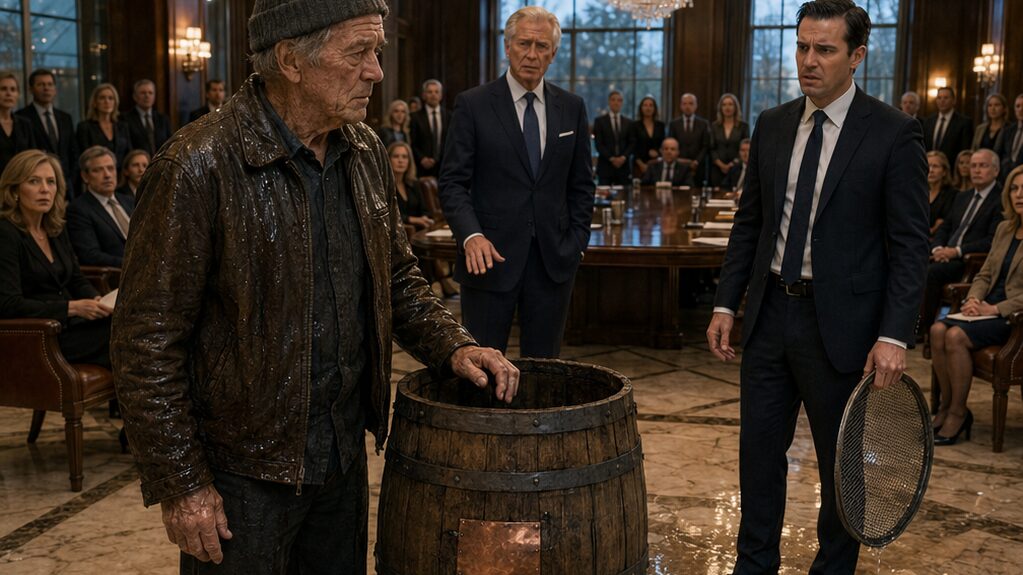
The contractor stood near the glass doors with a hand truck. On it sat the rain barrel.
For a moment, Michael did not understand what he was seeing. His mind rejected the shape out of place. The barrel belonged beside the jasmine, under the little bend of the downspout, where rain found it. It did not belong strapped to a metal dolly beneath a chandelier.
The copper patch caught the lobby lights.
Michael’s hands closed around the arms of the chair.
“You took it,” he said.
Matthew lifted both palms. “Temporarily. For assessment.”
“You went onto my property.”
“The association has enforcement rights after notice.”
“Not before the hearing.”
Patrick said, “Let’s keep this calm.”
Michael did not look at him. “Was the bench taken too?”
“No,” Matthew said. “Not at this time.”
The words not at this time moved through the room like a second notice.
Matthew walked to the barrel and touched the mesh cover. “As you can see, the item shows deterioration. The water inside also demonstrates the concern about stagnation.”
“It rained last night,” Michael said.
“Exactly. It collects water visibly from the front elevation.”
“That is what a rain barrel does.”
A few residents murmured. Someone gave a small laugh, then stopped.
Patrick’s jaw tightened. “Mr. Bennett, sarcasm won’t help.”
“It wasn’t sarcasm.”
Matthew unscrewed the cover.
Michael stood halfway before his knees reminded him of the chair. “Don’t.”
Matthew paused. “We need to show the board—”
“I said don’t.”
The room quieted.
Patrick spoke softly. “Mr. Bennett, you are not permitted to obstruct an inspection.”
Matthew tipped the barrel forward.
It happened with ugly simplicity. Water rushed from the top lip into a plastic cleanup bucket the contractor shoved beneath it, but the angle was wrong, or Matthew’s hands slipped, or he did not care enough to stop it. A sheet of cold rainwater splashed over the bucket’s rim and struck Michael across the chest and lap.
The room gasped.
The water soaked through his jacket, darkening the leather in spreading patches. It ran down his trousers and tapped onto the marble floor. A few drops clung to his eyelashes. His knit cap dripped beside his ear.
For one second, no one moved.
Matthew straightened the barrel. “I—”
“Matthew,” Donna said, sharp enough that even Patrick turned.
Michael lifted one hand slowly and wiped the water from his face. He could smell the rain in it. Not rot. Not dirt. Rain. The same clean metal smell that used to come through the screen door when Carolyn called him outside to listen.
His fingers shook once. He folded them into his palm until they stopped.
Patrick’s face had gone pale in a contained, managerial way. “Mr. Bennett, we regret the accident.”
Michael looked at him.
The word accident settled between them, polished and empty.
He placed both hands on the arms of the leather chair and pushed himself up. It took longer than he wanted. The wet fabric clung to his knees. His right hand slipped once on the smooth leather, and no one offered to help.
Good, he thought.
He stood fully.
Water dripped from the hem of his jacket onto the marble.
Matthew held the empty mesh cover in one hand. The contractor stared at the floor. Residents who had whispered earlier now sat rigidly, eyes fixed on Michael as if his age had changed shape in front of them.
Michael turned toward the barrel. It sat open under the chandelier, less full now, exposed.
He took one step toward it, then another.
“Mr. Bennett,” Patrick said, “please sit down.”
Michael rested his hand on the copper patch.
Carolyn had smoothed that strip with the handle of a screwdriver, tapping the edges until they curved into the wood. She had been wearing the blue sweater with the pulled cuff. She had laughed when the first repair leaked anyway.
He could feel the patch beneath his palm, cold and raised.
“That was the last rain she asked me to keep,” he said.
No one answered.
The sentence had not been loud, but it moved through the Grand Room as if the chandelier had gone dark.
Patrick shifted. “Who are you referring to?”
Michael put the mesh cover back on the barrel. His hands moved slowly, carefully. He screwed it down until the threads caught.
Then he turned to Matthew.
“You spilled enough.”
Matthew’s face flushed. “Mr. Bennett, I apologize if—”
“If,” Michael repeated.
Donna stood. “Patrick, this has gone too far.”
Patrick lifted one hand without looking at her. “Donna, please.”
Michael walked back to the chair, but he did not sit. He picked up the folded consent form from the small table beside it. The paper was damp at one corner where water had splashed.
Patrick watched him. “That form simply acknowledges voluntary removal, which would prevent further action.”
Michael looked at the signature line.
For a moment, he imagined signing. He imagined Laura’s relief. He imagined the bench empty, the jasmine watered from the hose, the front walkway clean enough for people who drove slowly past to approve of it. He imagined the barrel gone and the mornings becoming silent in one more place.
He set the form back down.
“I’m not signing.”
Patrick’s expression closed. “Then the board will proceed according to the rules.”
Michael nodded once, as though Patrick had told him the weather.
He walked toward the entrance. His boots left faint wet prints on the marble. At the door, he heard Donna say his name, but he did not turn. He stepped outside into the white afternoon light with his jacket cold against his shoulders.
Behind him, through the glass, the barrel remained in the Grand Room like something on display.
At the curb, Michael stopped and looked back.
Matthew was pointing toward the barrel. Patrick was speaking to the contractor. Donna stood apart from them, one hand over her mouth.
Michael touched the wet copper patch smell on his palm and closed his fingers around it.
Then he walked home without the rain barrel.
Chapter 4: The Jasmine That Would Not Bloom
By the time Michael reached home, the front of his shirt had dried in stiff patches, but the jacket still held the cold.
He stopped at the place where the rain barrel had stood.
The downspout ended above bare mulch now, its elbow pointing at nothing. The circle beneath it was darker than the rest of the soil, a ring pressed into the ground after sixteen years of weight. A few pale wood splinters had been left behind near the trellis post. One of the contractors must have scraped the barrel against the cedar bench when they took it.
Michael crouched slowly and picked up the largest splinter.
It was no longer than his thumb. Old wood, weathered smooth on one side, fresh and raw on the other. He held it in his palm until his knees complained, then pushed himself upright and sat on the bench.
The jasmine beside him looked wrong without the barrel. It leaned toward the empty space as if still expecting shade.
He took off his knit cap. It was damp at the edge. He wrung it once over the mulch and watched the drops disappear. Then he laughed, but it was a dry, surprised sound, gone almost as soon as it came.
“That what you wanted?” he asked the empty place. “A little left for the roots?”
The front door opened behind him.
Laura did not call out first. She stepped onto the porch in her work shoes, still wearing her office cardigan, and stopped when she saw him. Her eyes moved from his wet jacket to the empty space beside the jasmine.
“Oh, Dad.”
He looked down at the splinter in his hand. “You came fast.”
“Donna called me.” Laura came down the steps, anger and fear making her movements sharp. “She said they dumped water on you.”
“It splashed.”
“Don’t protect them.”
“I’m not.”
“You are. You always do that. You make things smaller when they hurt you.”
Michael closed his fingers around the splinter. “It was a hearing. They made their point.”
“They stole your barrel before the hearing.”
“They called it temporary.”
Laura turned toward the street, then back toward the clubhouse end of the neighborhood, as if she might walk there herself and start knocking on glass. “I’m calling someone.”
“No.”
“Dad, they can’t just—”
“No.”
The word came out tired, but it stopped her. She stood in the walkway, jaw tight, eyes shining.
Michael looked at the empty ring in the mulch. “Not tonight.”
Laura breathed in through her nose. “Fine. Not tonight. Then what are we doing tonight?”
He almost said nothing. He almost stood, went inside, changed his jacket, and let her make tea she would not drink. It would have been easier. Laura would fuss, he would deflect, and by morning they would both pretend the conversation had passed.
But the barrel was gone.
The silence it left was different.
Michael opened his hand and showed her the splinter. “Your mother sanded this bench twice. First time she did it wrong.”
Laura blinked, pulled out of her anger by the sudden turn. “Mom did?”
“She said I left it rough on purpose so she wouldn’t sit outside and supervise.”
“That sounds like her.”
“She bought sandpaper from the hardware store. Wrong grit. Took half a day and made no difference except her hands hurt.” He rubbed the splinter with his thumb. “Next Saturday she came back with the right kind and told me she’d been promoted.”
Laura sat beside him carefully, leaving a little space between them. The bench creaked under both their weights, the old wood accepting her as if it remembered.
The street was quiet. Evening light moved slowly up the driveways across the road.
“She sat here after the first chemo,” Michael said.
Laura’s face turned toward him, but he kept his eyes on the jasmine.
“She didn’t want you to see how tired she was. You had the kids then, work, everything. She said she wanted the front of the house to look alive if people came by.” His mouth tightened. “I told her people could look at their own houses.”
Laura gave a soft, broken laugh.
Michael nodded toward the trellis. “That jasmine was her idea. She said it would climb if I stopped arguing with it.”
“She never told me that.”
“She told you plenty. Just not everything.”
The leaves nearest the porch trembled in a small wind. No flowers yet. Only green, stubborn growth.
“The summer before she died,” he said, “the county put restrictions on outdoor watering. Remember?”
Laura nodded. “Vaguely.”
“She was worried the jasmine would die. I said it was a plant. She said that was a terrible thing to say in front of a plant.”
This time Laura smiled without sound.
“We built the barrel because she wanted rainwater. I told her we could buy one at the garden center. She said everything at the garden center looked like it had never been needed by anybody.” He looked at his hands. “So we built that ugly thing.”
“It wasn’t ugly.”
“It was a little ugly.”
Laura reached for the splinter. He let her take it.
“She made the copper patch,” he said. “After the first leak. She was proud of that patch. Kept saying it looked nautical.”
“It did not.”
“No.”
They sat until the porch light came on behind them.
Laura turned the splinter over in her fingers. “What did you mean today? Donna said you told them it was the last rain she asked you to keep.”
Michael closed his eyes.
There were memories a person could walk around for years without touching. Not because they were forgotten. Because they had edges.
“She knew she was near the end,” he said. “I knew too, but she was braver about saying it. It rained all night. Hard rain. She asked me to open the window so she could hear it. In the morning, she wanted to go outside.”
Laura looked down.
“I carried a chair to the door. She couldn’t make it to the bench. She looked at the barrel from the doorway and told me, ‘Don’t let it go dry just because I’m not out there nagging you.’”
His voice thinned. He waited until it steadied.
“I told her I wouldn’t.”
Laura covered her mouth with one hand.
“That was the last rain before she passed,” Michael said. “Not magic. Not holy. Just rain. But it filled the barrel. And after the funeral, I didn’t know what to do with myself, so I watered the jasmine. Every morning. It gave me a place to stand.”
Laura leaned forward, elbows on her knees. “Dad, why didn’t you tell me?”
“Because you had enough grief.”
“I’m your daughter.”
“I know.”
“Then don’t decide how much I can carry.”
He looked at her then. She was crying, but not loudly. Carolyn had cried like that when she was angry enough to be honest.
Michael slipped the splinter back from Laura’s hand. “I thought keeping it quiet made it mine.”
“Did it?”
He looked at the empty ring beside the trellis.
“No,” he said. “It made it lonely.”
A truck turned onto the street.
Both of them looked up.
A white work pickup rolled slowly past the house, the logo of the HOA maintenance contractor on its door. It did not stop. The driver looked once toward the bench, then down at a paper clipped to a board on the passenger seat.
Laura stood first. “What now?”
Michael watched the taillights recede toward the next cul-de-sac. “They said not at this time.”
“What?”
“The bench.”
He rose from the cedar plank, his joints stiff from cold and sitting too long. He touched the back of the bench the way he had touched the barrel in the lobby.
Laura followed his gaze.
“No,” she said.
Michael did not answer. In the porch light, the jasmine leaves shone dark and clean, watered by what little had fallen from his cap.
The bench waited beside them, still where Carolyn had sat, still visible from the street.
Chapter 5: Orange Tape Around the Bench
The contractor came at nine the next morning with a roll of orange tape hanging from one wrist.
Michael saw him through the kitchen window before the truck had fully stopped. The man stepped down from the cab, checked the address on his clipboard, then looked toward the porch with the wary resignation of someone who had been sent to do a simple job that might not stay simple.
Michael did not hurry. He rinsed his coffee cup, set it in the drying rack, and took his leather jacket from the chair by the back door. The jacket still held a faint water stain down the front, darker along the seam. He put it on anyway.
By the time he opened the front door, the contractor had crossed the lawn and was bending toward the cedar bench.
“Morning,” Michael said.
The contractor straightened fast. “Morning, sir.”
“You lost?”
The man looked at the clipboard. “Bennett residence?”
“That’s what the mailbox says.”
“I’m here on behalf of Briar Glen HOA.” He said it gently, as though the words themselves might be sharp. “Just marking an item for scheduled removal.”
Michael stepped down to the walkway. “That bench is not scheduled for anything.”
The contractor glanced at the bench, then back at the clipboard. “It says unapproved attached seating element.”
“It isn’t attached to the barrel.”
“No, sir.”
“The barrel is gone.”
“I’m aware.”
“So what’s it attached to?”
The contractor’s mouth opened, then closed. He looked again at the clipboard as if it might help him. “I don’t write the orders.”
“No. You only tape them.”
The man had the decency to look uncomfortable.
Michael reached the bench and placed one hand on the back rail. The cedar was cool. The middle plank bore the curve of years, polished by use rather than varnish. Carolyn had once said furniture only became yours when it stopped looking new.
The contractor lifted the roll of orange tape. “I’m not removing it today. Just identifying it for the crew.”
“Then identify it from the street.”
“I’m supposed to tag it.”
“You’re standing on my walkway.”
“Sir, I don’t want any trouble.”
Michael looked at him then. The man was younger than Matthew, older than Laura, with sunburn at the back of his neck and dust on his boots. Not cruel. Not invested. Paid.
“I don’t want any either,” Michael said. “That’s why I’m asking you not to wrap tape around my wife’s bench.”
The contractor’s eyes flicked to him.
Michael had not meant to say it like that. Not so plainly. The words had stepped out before he could dress them.
The man lowered the tape slightly. “I’m sorry.”
Michael nodded once.
The contractor looked toward the truck, then back toward the bench. “If I don’t mark it, they’ll send somebody else.”
“I know.”
“I could put the tape on the leg. Less visible.”
Michael almost smiled. “That your compromise?”
“It’s the only one I’ve got.”
Michael looked at the jasmine, then at the empty place where the barrel had stood. The downspout dripped once from leftover moisture in the gutter. The drop fell into bare mulch and vanished.
“No tape,” he said.
The contractor exhaled through his nose. “They’ll say I refused the work order.”
“Tell them the owner refused access.”
“That might make it worse for you.”
“It already got worse.”
A car slowed near the curb. Donna Miller’s sedan. She did not drive on this time. She pulled to the side and got out, leaving the door open.
“Is there a problem?” she asked.
The contractor looked relieved and miserable at once. “Ma’am, I’m just here to tag the bench.”
Donna came up the walkway. She wore gardening gloves, though she carried no gardening tools. “On whose authorization?”
“Work order from the management office.”
“Signed by whom?”
He checked the page. “Matthew Collins.”
Donna’s expression changed. Not dramatically. It tightened in one small place around her mouth.
“May I see that?”
The contractor hesitated. “I don’t know if—”
“I’m on the landscape committee,” Donna said. “And I was at the hearing yesterday.”
That was not exactly authority, but it was enough to make the contractor hand over the clipboard.
Donna read the order. Michael watched her eyes move down the page, pause, then move up again.
“This references the same notice as the barrel,” she said.
“Yes, ma’am.”
“The board voted on the rain barrel pending compliance. We did not vote on removing the bench.”
Michael looked at her.
The contractor shifted his weight. “I only know what they sent.”
Donna handed the clipboard back. “Then you should ask them to clarify before you touch it.”
The contractor looked from Donna to Michael, then to the bench. The orange tape hung between his fingers, too bright against the morning.
“I’ll call it in,” he said.
He walked back to the truck, phone already out.
Donna waited until he was out of earshot. “I’m sorry.”
Michael looked at the bench. “You said that yesterday.”
“I’ll probably say it again before this is done.”
“That won’t hold the wood together.”
“No,” she said. “It won’t.”
The contractor stood by his truck, one hand on his hip, speaking into the phone. Michael could not hear the words, only the tone: explaining something to someone who did not want explanation.
Donna stepped closer to the bench. “Carolyn used to sit here after dinner.”
Michael nodded.
“She’d ask about my roses. I didn’t know anything about roses. Still don’t.” Donna touched the top rail but did not sit. “She made me feel like I did.”
Michael looked at her in surprise.
Donna kept her eyes on the bench. “That’s what I mean when I say I’m sorry. I saw this becoming something cold, and I told myself it was procedure.”
“Maybe it is.”
“Procedure doesn’t dump water on a man.”
Michael said nothing.
A second car pulled up behind the contractor’s truck. Matthew Collins got out, already buttoning his suit jacket though he had no need for one on a residential street. He approached with quick, contained steps.
“Mr. Bennett,” he said. “Donna.”
Donna turned. “Matthew, who authorized removal of the bench?”
Matthew glanced at the contractor, annoyed that the question was happening publicly. “The bench was included in the exterior violation.”
“No,” Donna said. “It was described. It was not voted for removal.”
“The board gave management authority to enforce compliance.”
“That is not the same thing.”
Matthew’s eyes moved to Michael. “Mr. Bennett, if you interfere with the contractor, additional fees may apply.”
Michael felt the old heat rise behind his ribs. He looked at Matthew’s clean shoes on the edge of Carolyn’s walkway. Yesterday’s water had dried from Michael’s jacket, but the memory of standing wet under the chandelier had not.
He could have shouted. Part of him wanted to. He could have told Matthew about the final rain, about Carolyn’s hands on the copper patch, about the way this bench had held her when her body could not stand long enough to smell the jasmine.
Instead, he rested his palm flat on the cedar.
“No tape,” he said.
Matthew’s jaw worked. “Mr. Bennett—”
“No tape.”
The contractor looked down at his roll and quietly slipped it into his pocket.
Matthew noticed. His face flushed. “I’ll report refusal of access.”
Michael nodded.
“Additional action will be taken.”
“I expect it will.”
Donna crossed her arms. “And I’ll ask Patrick why action is being taken on a vote we didn’t hold.”
Matthew looked at her as if she had stepped out of her assigned place. “You may ask whatever you like.”
“I usually do.”
For the first time that morning, Michael almost laughed.
Matthew turned back toward the contractor. “Pack up.”
The contractor did not need telling twice. He put the clipboard in the truck and climbed in. Matthew lingered a moment longer.
“You’re making this harder than it needs to be,” he said to Michael.
Michael looked from the empty barrel ring to the orange roll half-hidden in the contractor’s truck.
“No,” he said. “I’m finally noticing how hard you were willing to make it.”
Matthew left without answering.
When the vehicles were gone, the street seemed too bright. Donna stood beside Michael in the silence left by engines and threatened fees.
“I should have spoken sooner,” she said.
Michael eased himself down onto the bench. After a moment, Donna sat beside him, leaving the same small respectful space Laura had left the night before.
The cedar held.
“You knew Carolyn?” he asked.
“Not well enough,” Donna said. “But enough to know she would have made a better committee member than any of us.”
“She hated committees.”
“That proves my point.”
The jasmine moved faintly in the breeze. Without the barrel, sunlight reached the lower leaves in a harsh, exposed way. Michael looked at the orange mark the contractor had left in his mind, even though the tape never touched the wood.
“What did you mean,” he asked, “when you said the board never voted?”
Donna glanced toward the clubhouse. “I mean Patrick may have let management move faster than the rules allow. Not enough to make this disappear. But enough to ask questions.”
“Questions don’t bring back the barrel.”
“No,” she said. “But they might keep them from taking the bench before you decide what to do.”
Michael leaned forward, elbows on his knees. He looked at the dry place under the downspout.
For two days he had been reacting. Reading notices. Answering calls. Sitting where they told him to sit. Standing only after water made it impossible not to.
Now the bench was still beneath him. The jasmine was still alive. The rain barrel was somewhere behind locked clubhouse doors or in a maintenance shed, not yet destroyed.
He looked at Donna.
“Who keeps the rulebook?” he asked.
Chapter 6: The Rule No One Read Out Loud
The HOA records room was not meant for residents to linger.
It sat behind the management office, narrow and windowless, with shelves of binders labeled by year. The air smelled of paper, toner, and carpet glue. A small round table had been pushed beneath the only light bright enough to read by. Michael sat there with a binder from 2009 open before him, his jacket folded over the chair beside him.
Donna had arranged the appointment. She had used the phrase “member review rights” on the phone, and Matthew had suddenly found a time slot before lunch.
He did not stay in the room with them. He brought the binders, reminded them that records could not be removed, and left the door open wide enough to suggest supervision.
Donna placed three stacks on the table: bylaws, architectural guidelines, landscape committee minutes. “I should warn you,” she said, “most of this is dull enough to be used medically.”
Michael turned a page. “I was married forty-nine years. I can listen to anything.”
Donna smiled and began with the newest guideline binder.
For the first half hour, they found exactly what Michael expected to find: paragraphs telling residents what color mulch they could use, what height shrubs could reach, what type of porch furniture counted as seasonal, and how long a holiday wreath could remain after the holiday had stopped being useful to retailers.
The rain barrel rule appeared under Exterior Water Features and Containers.
Unapproved visible water collection systems are prohibited on front-facing elevations.
Donna tapped the page. “There.”
Michael read it twice. “Front-facing.”
“Yes.”
“It says systems.”
“Yes.”
“Not barrels.”
“That won’t save you.”
“I wasn’t celebrating.”
She turned another page. “Here. Approved conservation systems may be considered by architectural review if screened from primary street view and maintained in sanitary condition.”
Michael looked at her.
Donna’s eyebrows lifted slightly. “That’s not nothing.”
“It isn’t approval.”
“No. But it means the rule is not absolute.”
Matthew passed the open doorway once, slow enough that both of them saw him. Donna did not look up.
They kept reading.
By noon, Michael’s eyes burned. He had made notes on a yellow pad in block letters. SCREENED. SANITARY. REVIEW. DISCRETION. He did not like any of the words, but they were words he could carry into a room without begging.
The county office was next.
Donna drove because she said the parking lot downtown had been designed by someone who hated elderly people and democracy. Michael sat beside her holding the yellow pad on his lap. He had not ridden as a passenger much since Carolyn died. She had always accused him of pressing an invisible brake. Now he kept both feet flat on the mat and looked out the window.
The county water-conservation clerk was younger than Laura and had a fern tattoo curling around one wrist. She listened without the impatience Michael had come to expect from offices.
“Residential rain barrels are encouraged,” she said, printing a page from the county website. “We don’t regulate HOA aesthetic rules, but we do offer guidelines. Mesh cover, overflow direction, mosquito prevention, stable platform, screened placement if required.”
She highlighted a paragraph and slid it across the counter.
Michael read the words slowly.
“Would this make them approve it?” Donna asked.
The clerk gave the tired smile of someone accustomed to disappointing people kindly. “It gives them a safe way to approve it if they want to.”
If they want to.
On the drive back, Donna did not fill the car with talk. Michael was grateful. He folded the county printout and tucked it into his jacket pocket beside the HOA notice.
When they returned to Briar Glen, Donna pulled up in front of her house instead of his.
“Come sit a minute,” she said.
Michael almost refused, then saw the two rain barrels beside her garage.
They were new, dark green plastic, identical, half hidden behind a lattice screen with climbing roses. Approved, he guessed. Or at least invisible enough not to offend anyone important.
Donna noticed his stare. “Patrick approved those three years ago.”
“Yours aren’t ugly.”
“Mine don’t have a story.”
He looked at her.
She unlocked the gate and led him through to the side yard. One barrel stood beneath a downspout, water tapping into it from a slow roof drip. The sound was smaller than his old barrel’s deeper note, but it made his chest tighten anyway.
Donna set two glasses of iced tea on the patio table and sat across from him. “I called Patrick while you were with the clerk.”
Michael waited.
“He agreed to put the matter on next week’s agenda. Final compliance vote.”
“That kind of him?”
“No. Necessary. I may have mentioned the bench order.”
Michael looked at the county printout. “And the barrel?”
“It’s in the maintenance shed.”
“Empty?”
“I assume so.”
He folded the paper more sharply than he meant to. The crease cut through the county seal.
Donna looked toward her screened barrels. “Michael, can I ask something without you getting angry?”
“You can ask. I can’t promise the rest.”
“Do you want the exact barrel back because it’s useful, because Carolyn built it, or because letting it change feels like losing her again?”
The question landed with no cruelty in it. That made it harder to reject.
Michael looked at his hands. There was dirt under one thumbnail from the jasmine bed.
“Yes,” he said.
Donna nodded as if that were an answer, because it was.
He took a drink of tea. Too sweet. Carolyn would have liked it.
“She used to tell me I was good at fixing things,” he said. “I wasn’t, always. I just didn’t mind trying badly first.”
Donna said nothing.
“After she died, people kept telling me to take time. As if time was something you could take and put in a drawer. The barrel gave me something to do when taking time felt like drowning in it.”
The word drowning surprised him. He looked at the nearest rain barrel, at the thin line of water running down its side from the drip.
“I don’t know what I am if I stop keeping it full,” he said.
Donna’s face softened. “Maybe still the man who kept it full when she needed you to.”
He shook his head once. Not in disagreement. In defense.
A breeze moved through the roses on the lattice. Somewhere beyond the fence, a lawn mower started, the sound rising and falling as it turned a corner.
Donna leaned back. “There may be a way.”
Michael looked up.
“Not to pretend nothing happened. Not to get everything exactly as it was. But the county guidelines help. The HOA guidelines allow reviewed conservation systems. And memorial features can be approved by the board.”
“Memorial features.”
“I know. Terrible phrase.”
“She would hate that.”
“Probably. But the rule exists.”
Michael pulled the yellow pad toward him. The word DISCRETION stared back from the page.
He thought of Patrick in his suit, speaking about everyone’s investment. He thought of Matthew tipping the barrel. He thought of Laura asking why he had decided what grief she could carry. He thought of Carolyn at the doorway, too weak to reach the bench, still bossing him about rain.
“What would it take?” he asked.
Donna folded her hands around her glass. “A proposal. Screen the barrel from direct street view. Clean and seal it. Add a proper cover. Maybe move it six inches back beside the jasmine. Keep the bench if it’s separate and maintained. Ask for a legacy garden review.”
Michael’s first feeling was refusal. Move it. Screen it. Seal it. Words that sounded like surrender wearing clean clothes.
Then he looked at Donna’s barrels behind the lattice. They held water. They did their work unseen.
“What if they say no?” he asked.
“Then they say it out loud with the rules in front of them.”
He sat with that.
For years, he had thought the promise meant the barrel must remain as Carolyn last saw it. Same place. Same wood. Same full note in the morning. But Carolyn had patched leaks. She had changed what needed changing and laughed at his attachment to doing things the hard way.
The promise had not been to rot.
It had been to keep something alive.
Michael took the county paper from his pocket, smoothed it flat on the patio table, and placed the HOA notice beside it. One paper threatened. The other permitted. Neither one understood anything by itself.
“I’ll need the barrel back,” he said.
Donna nodded. “Then ask for it.”
“No.” He looked toward the clubhouse roof visible over the line of homes. “I’ll tell them to bring it to the meeting.”
Donna’s eyes sharpened. “Michael.”
“No dumping this time.”
“That may not be wise.”
“Probably not.”
“Then why?”
He touched the water stain still darkening the front of his jacket.
“Because they should see what they treated like trash before they vote on whether it can come home.”
Donna held his gaze for a moment, then nodded once.
At home that evening, Michael stood beside the empty downspout with the green watering can in his hand. He had filled it from the kitchen sink. The water smelled faintly of chlorine and metal, nothing like rain.
He poured it anyway around the jasmine roots.
“I’m working on it,” he said.
The leaves gave no answer.
From the bench, the empty ring in the mulch looked smaller than it had the day before. Not less painful. Just less final.
Chapter 7: What He Chose to Say in the Same Room
Michael did not wear the leather jacket to the final meeting because it still carried the shape of the stain.
Laura wanted to have it cleaned. She offered twice, once by phone and once standing in his hallway with her keys in her hand, pretending she had not driven over for that reason alone. Michael told her no both times. The jacket hung on the back of the kitchen chair, darkened down the front, sleeves bent at the elbows as though waiting for him to come back to it.
Instead, he wore a clean white shirt, a gray cardigan Carolyn had once bought him because she said every man eventually needed something that made him look less likely to argue with a lawn mower, and the same knit cap. He put the folded county guidelines in one pocket, the HOA notice in the other, and carried a small glass jar in his right hand.
Laura saw it when he opened the door.
“What is that?” she asked.
“Rainwater.”
She looked past him toward the cloudless sky. “From where?”
“Donna’s barrel.”
Laura’s face changed. “Dad.”
“It isn’t a relic,” he said. “It’s water.”
“Then why bring it?”
He tightened the lid with his thumb and forefinger. “Because last time they only saw it when it was on the floor.”
Laura drove him to the clubhouse. She did not argue about going in with him this time. They had already argued at breakfast, and Michael had lost only because he had not truly wanted to win.
The Grand Room looked exactly as it had the week before. Same marble floor. Same leather chairs. Same chandelier above the center of the room. Someone had placed a tall potted plant where the rainwater had splashed, as if leaves could cover memory. The silver tub of bottled water sat on the table near the entrance.
Michael paused just inside the door.
Laura touched his elbow but did not hold it.
At the front, Patrick Reed stood with two binders and a stack of printed agendas. Matthew Collins was beside him, speaking low to a committee member. When Matthew saw Michael, his eyes went first to the cardigan, then to the jar, then quickly away.
Donna was already seated near the front row. She had left an empty chair beside her, but Michael did not take it. He walked to the center chair where they had placed him before.
This time he did not sit.
Patrick cleared his throat when the room settled. “We’ll call this special compliance session to order. First item is 114 Briar Glen Lane, continued from last week. The board has reviewed the management report, the landscape committee’s note, and Mr. Bennett’s submitted materials regarding water conservation.”
Submitted materials. Michael glanced at Donna. She gave nothing away.
Patrick continued. “Before the board discusses next steps, Mr. Bennett has requested time to speak.”
Michael walked to the small table in front of the board. It was the same table that had held the consent form, though today it was bare except for a microphone that did not need to be there.
He did not use it.
He set the jar of rainwater on the table. The glass clicked softly.
No one spoke.
Water looked different in a jar. Smaller. Cleaner. Less guilty of being itself.
Michael rested his hand beside it. “I’m not here to say rules don’t matter.”
Patrick watched him carefully.
“I lived long enough to know people say that right before they ask for a rule to disappear for them.” Michael looked toward the residents. Some of the same faces were there. Some new ones too. “That isn’t what I’m asking.”
Laura stood near the back wall, arms folded tight against herself.
Michael took the county paper from his pocket and unfolded it. His fingers did not shake as much as he had feared.
“The county encourages rain collection with a cover, stable base, overflow control, and maintenance. Your own guideline says approved conservation systems may be considered if they are screened and sanitary. I am asking the board to consider mine.”
Matthew shifted. “The item in question is deteriorated.”
Michael looked at him. “Then say that.”
Matthew blinked.
“Say the wood needs sealing. Say the cover needs replacing. Say the platform needs leveling. Those are things a man can fix.” Michael’s voice stayed even. “Don’t call it trash because you don’t know how to repair it.”
A murmur moved through the room. Patrick lifted a hand and the room quieted.
Michael touched the jar lid.
“My wife’s name was Carolyn. Some of you knew her. Most of you didn’t. She planted the jasmine by our walkway because she said the front of a house should offer something back to the street besides a garage door.”
Donna lowered her eyes.
“She and I built that barrel during the drought. Badly at first. Then less badly. She patched it with copper when it leaked.” He looked down at the jar, not because he needed to but because it helped him keep the words shaped. “Near the end of her life, she asked me not to let the jasmine go dry just because she wasn’t there to remind me.”
The room had gone very still.
Michael heard the small hum of the air system. He heard someone’s bracelet touch the arm of a chair. He heard Laura take one breath and hold the next.
“I kept the barrel full because I told her I would. At first that was all I could do. I couldn’t fix what was happening. I couldn’t make the house less quiet. I couldn’t make breakfast for one feel like breakfast.” He paused. “But I could carry water twelve steps and pour it where she had planted something.”
Patrick’s expression had changed, but Michael did not try to read it.
“What happened here last week should not have happened,” Michael said.
Matthew’s face flushed.
“I am angry about it. I expect I will stay angry for some time.” Michael looked at him directly. “But I am not asking this board to punish anyone to make me feel better.”
Matthew looked down.
“I am asking you to decide whether a neighborhood is protected by making every memory invisible.” He slid the county paper forward, then placed beside it a single handwritten page. “I will clean and seal the barrel. I will replace the cover. I will put a proper overflow line into the garden bed. I will move it back six inches and build a cedar lattice screen no higher than the trellis. The bench is separate. I will sand it, seal it, and keep it safe.”
Patrick leaned forward and picked up the handwritten page. He read silently. The other board members leaned toward him.
Matthew spoke before Patrick could. “The concern is precedent.”
Michael turned to him. “Then make one worth following.”
The words landed harder than he expected. He had not meant them as a challenge, but perhaps they were one.
Matthew’s mouth closed.
Donna stood. “I’d like to add something as landscape committee liaison.”
Patrick looked at her for a long second. “Briefly.”
Donna stepped into the aisle. “We have treated this as a nuisance item because it was easier than asking whether our rules allow discretion. They do. We’ve approved screened water systems before. Mine, for one. We have also approved memorial plantings when they were attractive and maintained. The difference here is that Mr. Bennett’s barrel was old enough for us to assume it had no value.”
A woman in the second row looked away.
Donna continued. “I don’t think every sentimental object belongs in a front yard. But I also don’t think our standards require us to pretend no one has ever lived in these homes.”
Patrick closed the folder in front of him.
For a moment, Michael thought he would postpone. He could feel the room wanting an answer and Patrick resisting being forced into one. That, Michael understood. No one liked being cornered, even when the corner had been built with his own hands.
Patrick removed his glasses and rubbed the bridge of his nose. He looked older without them.
“Mr. Bennett,” he said, “last week was handled poorly.”
Michael waited.
Patrick looked toward Matthew, then back to Michael. “Very poorly.”
Matthew said nothing.
“The board cannot approve an exterior item in its current condition.”
Laura’s shoulders stiffened near the wall.
Michael nodded once. “I know.”
Patrick glanced down at the handwritten proposal. “But we can approve a conditional restoration subject to inspection. Screened placement. Sealed wood. Proper cover. Overflow directed into the bed. Bench maintained as a separate legacy feature.”
Matthew looked up sharply. “Patrick—”
Patrick did not turn. “And I would entertain a motion to draft a formal guideline for legacy garden and conservation features so this is not handled this way again.”
Donna sat down slowly.
One of the board members moved. Another seconded.
Michael did not listen to all the procedural language. The words came wrapped in committee habits, all approvals and conditions and review periods. But beneath them he heard something else.
Not victory. Not apology enough to erase the water on his jacket.
Permission for the promise to come home changed, not buried.
Patrick called for a vote. Hands went up. Not all at once. Not eagerly. But enough.
Matthew kept his hands folded.
Afterward, while people stood and chairs scraped, Patrick approached Michael.
“The barrel is in the maintenance shed,” he said. “It will be returned tomorrow.”
Michael picked up the jar. “Not by him.”
Patrick followed his glance to Matthew. “No. Not by him.”
Matthew approached anyway, stopping several feet away. For once, he seemed unsure what to do with his hands.
“Mr. Bennett,” he said. “I shouldn’t have tipped it like that.”
“No,” Michael said. “You shouldn’t have.”
Matthew swallowed. “I’m sorry.”
Michael looked at him for a long moment. The apology did not repair the barrel. It did not dry the jacket. It did not return the rain Carolyn had asked him to keep. But it stood there, imperfect and late, and Michael had learned from old wood that not everything imperfect had to be thrown away.
“Then help bring it back carefully,” he said.
Matthew nodded.
Laura came to him after the room began to empty. She looked at the jar in his hand.
“Can I walk with you?” she asked.
He gave her the jar.
She held it with both hands.
Outside, the evening air was warm. The clubhouse windows reflected the neighborhood back at itself: clean streets, trimmed hedges, identical porch lights beginning to glow.
Michael looked toward home.
For the first time since the barrel had been taken, he wondered not whether the jasmine would survive, but what might grow beside it.
Chapter 8: The Barrel Behind the Jasmine Screen
The rain barrel came home on a Tuesday morning, strapped upright in the back of a maintenance cart.
Michael was on the porch before the cart turned into his driveway. He had heard its thin electric whine from three houses away. Laura had offered to come, but he told her this part he could do. Donna stood across the street pretending to prune a shrub that did not need pruning.
Matthew drove the cart.
Beside him sat the contractor, holding the barrel steady with one hand. The copper patch faced forward. It had been wiped clean, though a streak of old rust still ran beneath the lower band. The barrel looked smaller than it had beneath the chandelier, and more tired. But it was whole.
Matthew stopped at the edge of the walkway and got out.
“Where would you like it?” he asked.
Michael looked at the old ring in the mulch. For more than two weeks, the empty circle had seemed like a wound. Now, with the barrel waiting, it looked like a question.
“Not there,” he said.
Matthew paused.
Michael pointed six inches back, closer to the trellis, where the lattice screen had been installed the day before. He had built it with the contractor’s help and Donna’s unsolicited supervision. Cedar slats, simple and square, no higher than the jasmine frame. Enough to soften the view from the street. Not enough to hide what mattered from the porch.
“There.”
The contractor lifted the barrel carefully. Matthew took the other side. Together, they carried it up the walkway. Michael watched their hands. No dragging. No bumping the bench. No careless tilt.
They set it on the new leveled platform beneath the downspout. The barrel settled with a wooden sound Michael felt in his ribs.
Matthew stepped back. “Is that right?”
Michael walked around it once. The new mesh cover fit tightly. The overflow tube curved toward the jasmine bed. The copper patch still showed if you stood on the porch, but from the street the lattice broke its outline into shadow and vine.
“It’s right enough,” he said.
Matthew nodded. His face held the awkward relief of a man who had not been forgiven but had been allowed to do one thing properly.
“I’ll send the inspection form later,” he said.
Michael looked at him.
Matthew corrected himself. “I mean, I’ll leave it in your mailbox.”
“Thank you.”
The words surprised both of them.
When the cart left, Donna crossed the street with pruning shears still in hand.
“You didn’t need those,” Michael said.
“I was undercover.”
“You were cutting a plastic tag off your own shrub.”
“I never said I was good at it.”
She stood beside him and studied the barrel. “Carolyn would have opinions.”
“Many.”
“About the lattice?”
“She’d say the top line is crooked.”
“It isn’t.”
“She’d find a way.”
Donna smiled. “The board posted the draft amendment this morning.”
Michael glanced at her. “Already?”
“Patrick likes paperwork when it makes him look decisive.”
The amendment was not perfect. Michael had read the first version the night before when Patrick emailed it to Donna, who printed it because Michael still trusted paper more than attachments. It required review, screening, maintenance, and limits. It used the phrase legacy feature four times, which Carolyn would have mocked. But it made room. Not wide room. Not generous room. Enough room for someone after him to say, this matters, and be heard before the tape came out.
After Donna left, Michael carried the green watering can to the barrel.
The spigot turned stiffly at first. He had cleaned it, but old things sometimes needed to remember they still moved. Then water ran, clear and low, striking the bottom of the can with the sound he had missed more than he admitted.
Not the same water. He knew that.
The last rain Carolyn had asked him to keep had been spilled across marble by a man who had not understood what he held. For days, that fact had sat in Michael’s chest like a stone. He had wanted it back. Not replacement water. Not symbolic water. That water.
But rain did not stay because a person grieved correctly.
It fell, it filled, it spilled, it returned.
He filled the can halfway and shut the spigot.
At the jasmine bed, new buds had appeared. Small green tips, almost invisible unless a person knew where to look. Michael bent slowly, one hand on his knee, and watered around the roots. The soil darkened. The leaves trembled under the gentle splash.
Laura arrived near noon with sandwiches and a paper bag from the garden center.
“I brought something,” she said, too casually.
Michael looked into the bag. A small plant in a black nursery pot sat inside, its leaves silver-green, its stems thin but upright.
“What is it?”
“Lavender.”
He raised an eyebrow.
“Don’t look like that. The clerk said it does well near jasmine if the drainage is good.”
“I wasn’t looking.”
“You were absolutely looking.”
He reached into the bag and touched one leaf. The scent rose immediately, clean and sharp.
“Your mother didn’t plant lavender,” he said.
“No,” Laura said. “You can.”
He looked toward the bench.
The cedar had been sanded and sealed. Not too smooth. Michael had insisted on that. The middle plank still held its old shallow curve, and if he ran his hand along the underside, he could feel the initials Carolyn had carved there with a pocketknife one evening after too much iced tea and not enough sense. He had not told the HOA about the initials. Not every proof belonged in a meeting.
Laura sat beside him while he dug the small hole. She held the plant upright as he pushed soil around it. They worked without saying much. Their hands bumped once. Laura did not pull away.
When the lavender stood on its own, Michael watered it from the barrel.
“That’s enough,” Laura said.
“I know how to water a plant.”
“You overwatered every houseplant Mom ever owned.”
“Those plants were dramatic.”
Laura laughed, and the sound moved across the porch the way Carolyn’s used to, not the same, never the same, but close enough to open a window inside him.
They ate sandwiches on the bench. A few cars passed. One slowed, then continued. Michael found he did not care as much as he had expected.
In the late afternoon, Patrick Reed walked up the driveway.
Michael saw him from the porch and considered pretending not to. Instead, he set down his glass of tea and waited.
Patrick stopped at the edge of the walkway, careful not to step onto the mulch. He wore a short-sleeved shirt today, no suit jacket, though his posture still seemed pressed.
“The installation looks compliant,” he said.
Michael looked at the barrel behind the lattice. “That why you came?”
“Partly.”
Patrick’s eyes moved to the jasmine, then to the new lavender plant. “Donna told me your wife planted that.”
“She told you more than she used to.”
“She has been doing that lately.”
Michael nodded.
Patrick took a breath. “My wife and I moved here after our old neighborhood started declining. We lost value on a house we thought we’d retire in. I suppose I began thinking rules were how you kept life from slipping.”
Michael did not answer.
“It doesn’t excuse last week,” Patrick said.
“No.”
“No,” Patrick repeated. “It doesn’t.”
He looked at the barrel again. “The amendment will likely pass next month.”
“Likely?”
Patrick’s mouth twitched. “I’ve learned not to promise votes before people have complained about font size.”
Michael almost smiled.
Patrick started to leave, then turned back. “For what it’s worth, the front looks good.”
Michael glanced at the lattice, the bench, the jasmine, the lavender, the old barrel showing just enough copper through the cedar slats.
“It looked good before,” he said.
Patrick accepted that with a small nod and walked back to the street.
Evening came slowly.
Laura left after making him promise to call if he needed help carrying anything heavier than a watering can. Donna’s porch light came on across the street. Sprinklers whispered to life along the boulevard, though clouds were gathering above the rooftops.
Michael sat on the bench until the first drops fell.
They tapped the walkway, dotted the cedar lattice, darkened the shoulders of his cardigan. He did not move inside. Rain gathered along the downspout and began to run, first in faint threads, then in a steady ribbon into the barrel.
The sound filled the porch.
Low. Hollow. Then deeper.
Michael closed his eyes.
For years, he had thought keeping the promise meant holding one moment exactly as Carolyn left it. The same barrel, the same bench, the same jasmine, the same grief measured each morning in water. But the barrel had been emptied. The bench had been marked in everyone’s mind if not with tape. The rule had changed. Laura knew more. Donna had spoken. Even Patrick had stood in his walkway without a folder.
Nothing was exactly as it had been.
The barrel filled anyway.
When the rain softened, Michael went inside and returned with a small tin cup Carolyn used to keep in the potting drawer. He dipped it through the top opening before replacing the cover. One cup of rainwater. Not because the barrel needed saving. Because some rituals deserved a shape.
He poured most of it around the jasmine.
The last inch he gave to the lavender.
Then he sat back on the bench and looked at the two plants beside each other: one climbing from the past, one small and new in the wet soil.
“Still holding,” he said.
The barrel answered in its own way, drop by drop, filling in the dark.
The story has ended.