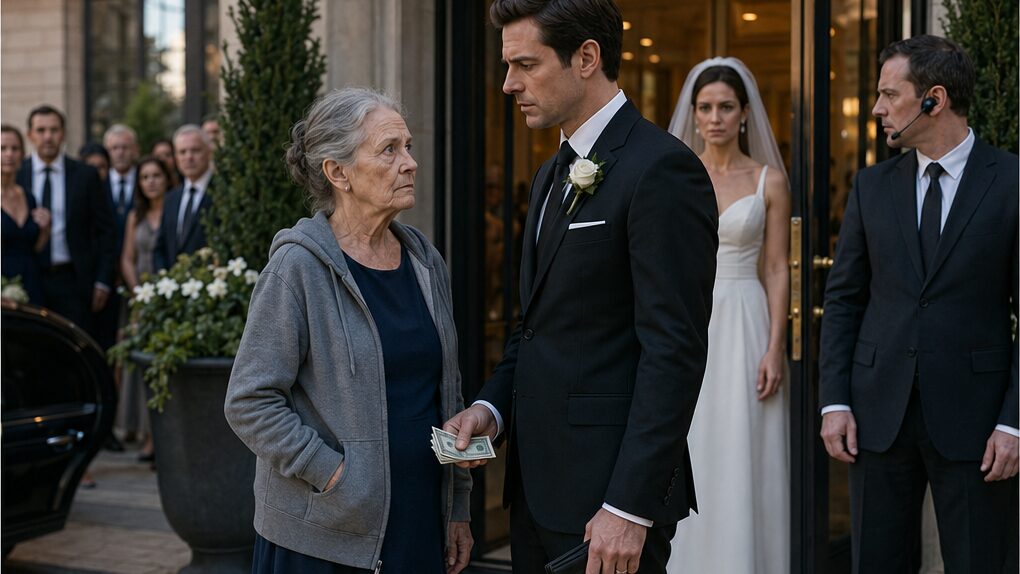
Her Son Offered Her Cash To Leave His Wedding After Throwing Away Her Husband’s Gray Hoodie
Chapter 1: The Boxes Were Labeled Before She Woke Up
Susan Bennett knew the house by sound before she knew it by sight.
The refrigerator hummed with the same tired rattle it had carried for twelve years. The maple tree brushed the gutter whenever the morning wind came from the west. The loose floorboard outside the downstairs bathroom gave one soft complaint if someone stepped too close to the wall. Even after Raymond had been gone nearly nine months, the house still spoke in the language he had taught her to hear.
That morning, the house spoke wrong.
There was the dry rip of packing tape.
Susan opened her eyes and stared at the ceiling. Pale light pressed through the curtains. For a few seconds she held still, listening, hoping she had dreamed it.
Another rip. Longer this time.
Then Kathleen’s voice, low but firm, somewhere near the kitchen. “Put those against the wall. No, not there. Mom will trip over them.”
Susan sat up too fast and had to wait for the room to steady. Her slippers were beside the bed, exactly where she left them every night. Her robe hung from the same hook on the closet door. Nothing in the bedroom had changed, which made the sounds downstairs worse.
She dressed slowly because haste had become its own kind of danger. Her knees had been stiff since the rain last week, and the doctor had warned her about stairs in the morning. She did not need the doctor’s warning. She had lived in this body longer than he had been alive.
At the top of the stairs, she paused with one hand on the railing. The smell of coffee drifted up, too strong and too new. Kathleen had made it. Kathleen always used too much.
Susan came down step by step.
The kitchen was no longer her kitchen.
Cardboard boxes stood in rows on the worn linoleum, their open mouths facing upward. Black marker words shouted from their sides.
KEEP.
DONATE.
TRASH.
A roll of tape sat beside the sugar bowl. A stack of flattened boxes leaned against Raymond’s old chair, the one with the cracked vinyl seat he had promised to recover and never did. Kathleen stood at the counter in leggings and a wedding weekend sweatshirt, her hair twisted into a knot, her phone tucked between cheek and shoulder while she wrote on another box.
“No, Steven, I’m here now,” she said. “I got started before she came down.”
Susan stopped in the doorway.
Kathleen looked up. For one small second, guilt crossed her face. Then the practical mask returned.
“Morning, Mom,” she said into the phone and to Susan at the same time. “I’ll call you back.”
She ended the call before Steven could answer.
Susan’s eyes moved from box to box. The kitchen table had been pushed sideways. The stack of mail she had meant to sort was gone. The blue glass bowl where Raymond used to drop his keys had been placed inside a box marked KEEP, wrapped in dish towels as if it had already lost its place in the house.
“What is this?” Susan asked.
Kathleen set down the marker. “It’s just a start.”
“A start to what?”
“You said we could look through things before the wedding.”
“I said we could look.” Susan kept her hand on the doorframe. “I didn’t say you could bring a store into my kitchen.”
Kathleen breathed in, patience already prepared. “Mom, people are coming into town. Steven and Rebecca are stopping by tomorrow after the rehearsal lunch. Rebecca’s parents might come too. We can’t have the house like this.”
Susan looked around the kitchen. There were coffee cups in the sink, yesterday’s newspaper folded on a chair, and a grocery bag with onions and canned soup near the pantry. There was dust on the top of the china cabinet. There were piles, yes. There had been piles since Raymond’s last hospital stay, when every bill, prescription, sympathy card, insurance form, and funeral envelope had seemed to multiply in the night.
But it was not unclean. It was not abandoned. It was not dead.
“The house is fine,” Susan said.
Kathleen’s mouth tightened. “It isn’t fine. You just don’t see it anymore.”
The words landed softly because Kathleen had not raised her voice. That made them worse.
Susan moved farther into the kitchen. On the back of Raymond’s chair hung the gray hoodie.
It had always looked too ordinary to anyone else. Soft cotton worn thin at the elbows. A frayed drawstring. A small paint mark near the pocket from the summer he repainted the porch railing and dropped the brush laughing because a wasp had flown up his sleeve. The cuffs had been repaired twice, once by Susan, once by Raymond himself with thread so mismatched it still made her smile on good days.
She reached for it before she meant to.
Kathleen watched the gesture.
“I wasn’t touching that yet,” Kathleen said.
“Yet?”
“Mom.”
Susan lifted the hoodie off the chair and held it against her front. It smelled faintly of cedar from the closet and, beneath that, almost nothing. That was the hardest part. Every month Raymond’s smell faded a little more, as if the world was washing him away without asking her.
“Steven wants the front room cleared before Saturday,” Kathleen said. “The photographer may stop by. He thought it would be nice to get a few family pictures here before the ceremony.”
“Steven thought.”
“He’s getting married, Mom. He has a lot on him.”
Susan looked at the boxes again. “So you decided to put my house into categories while I was asleep.”
Kathleen softened, but only around the eyes. “I came early because I knew this would be hard.”
“Hard for who?”
“For all of us.”
Susan nearly laughed, but it would have come out sharp. She sat down at the table because standing among the boxes made her feel like an item waiting to be sorted.
Kathleen moved a box away from Susan’s foot. “I’m not throwing your life away. I’m trying to make space.”
“Space for what?”
“For you to be safe. For people to walk through a room without squeezing sideways. For us to know what you actually need.”
Susan ran her thumb over the hoodie’s cuff. The old repair thread scratched lightly against her skin.
“What I need,” she said, “is for my children to knock before they enter my house and ask before they write on boxes.”
Kathleen’s face flushed. “I did knock. You didn’t hear me.”
“Then you should have waited.”
The kitchen went quiet except for the refrigerator and the maple branches at the gutter.
Kathleen pulled out a chair but did not sit. “Steven is worried.”
“Steven can call me.”
“He has called you.”
“He calls between meetings and tells me what he has decided.”
Kathleen looked toward the hallway, where more boxes waited just beyond Susan’s sight. “Mom, he is trying to help.”
Susan heard the sentence the way older people learned to hear certain sentences: as a door closing politely.
Help meant they had already talked about her.
Help meant decisions had been softened before delivery.
Help meant any objection would be folded into proof that help was needed.
She looked past Kathleen into the living room. A stack of framed photographs had been removed from the mantel and laid faceup on the coffee table. Raymond in his work shirt holding Steven at age six. Kathleen in a red snowsuit missing one mitten. Susan and Raymond at their twenty-fifth anniversary, his arm around her waist, his smile not yet tired.
“Who took those down?”
Kathleen followed her gaze. “I did. Just for dusting.”
“They were fine.”
“They were dusty.”
Susan rose before her knees agreed. She crossed to the living room with the hoodie still in her arms. The mantel looked naked. Pale rectangles marked where the frames had stood for years.
She picked up the photograph of Raymond with Steven. In it, Raymond wore the gray hoodie under a denim jacket, his hair darker, his grin wide enough to embarrass the shy boy tucked beneath his arm. Steven’s little hand clutched the hoodie string.
Susan had forgotten that detail.
Kathleen came to the doorway. “Mom, please don’t start undoing everything.”
Susan set the frame carefully back on the mantel. Then another. Then another.
“I’m not undoing,” she said. “I’m putting people back where they belong.”
Kathleen’s phone buzzed on the counter. She looked at it, then away, then back again.
“Is that Steven?” Susan asked.
Kathleen did not answer quickly enough.
Susan returned to the kitchen. On the screen, before Kathleen turned it facedown, she saw only the beginning of a message.
Do whatever you can today. We can’t—
Kathleen covered the phone with her palm.
Susan looked at her daughter, then at the boxes, then at the hoodie in her hands.
For the first time that morning, fear moved through her clear and cold. Not fear of falling. Not fear of dust, or stairs, or forgetting to turn off the stove, all the things people had begun to mention gently and repeatedly as if they were practicing for a meeting.
This was different.
This was the fear of waking up while still alive and finding out her life had been scheduled for removal.
“I want the boxes out of my kitchen,” she said.
Kathleen pressed her lips together. “We can move them to the garage.”
“No. Out.”
“I’m not loading everything back into my car because you’re upset.”
Susan folded the gray hoodie over one arm. “I’m not upset.”
Kathleen gave a tired little laugh. “Mom.”
Susan looked at the word TRASH written in thick black letters.
“I am awake,” she said. “There’s a difference.”
Kathleen did not answer.
From somewhere outside, a truck passed slowly down the street. Susan heard its brakes sigh near the curb and then continue on. She stood in her kitchen, surrounded by boxes she had not asked for, with her daughter watching her as if she might break.
Then Kathleen stepped past her, lifted the gray hoodie gently from Susan’s arm, and said, “Let’s just put this somewhere for now.”
Before Susan could close her hand, Kathleen dropped it into the open box marked DONATE.
Chapter 2: Kathleen Called It Safety And Susan Called It His Chair
For a moment, Susan did not move.
The hoodie lay at the bottom of the box with one sleeve twisted under itself, as if it had been shoved there by accident and would soon be lifted out with an apology. The black word DONATE faced Susan from the cardboard side. It seemed too large for the room.
Kathleen capped the marker. “I’m not taking it today. I just need to sort.”
Susan bent and picked up the hoodie. Her fingers were not quick anymore, but they were certain.
“No,” she said.
Kathleen sighed. “Mom, it’s a sweatshirt.”
“It is not a sweatshirt.”
“It has holes in it.”
Susan folded it once, carefully, sleeve to sleeve. “So do I.”
“That isn’t funny.”
“I wasn’t trying to be.”
Kathleen rubbed her forehead with the heel of her hand. “This is what I mean. Everything turns into something I can’t touch. A chipped mug, a stack of magazines, a shirt Dad wore to mow the lawn—”
“He did not wear this to mow the lawn.”
“Fine. Whatever he wore it for.” Kathleen’s voice sharpened, then softened too late. “I’m sorry. But you can’t keep every single thing because it passed through his hands.”
Susan placed the hoodie on Raymond’s chair and kept one hand on it.
The chair sat near the kitchen window where the morning light came in strongest. Raymond had eaten toast there, read bills there, tied Steven’s school shoes there when the boy pretended he could not do it himself. In the last year, when the cancer made the stairs impossible, he had sat there under a blanket and told Susan the squirrels were getting organized against them.
Kathleen reached for a stack of plastic containers on the counter. “We need to clear walking paths. That’s all. You almost tripped over the newspaper basket last month.”
“I stepped around it.”
“You grabbed the wall.”
“I grabbed the wall because the wall was there.”
“Mom.”
Susan heard the strain under Kathleen’s tone. Her daughter’s eyes were tired. There were faint shadows beneath them that makeup would not have hidden if Kathleen had bothered with makeup that morning. Susan knew Kathleen had children, work, a husband who traveled, and a brother getting married who had learned too well how to delegate worry.
Knowing all that did not make the boxes less invasive.
Kathleen opened a cabinet and began pulling down old jars.
“What are you doing now?”
“These expired in 2019.”
“They’re jars.”
“They had peaches in them.”
“They had peaches your father canned.”
Kathleen looked at the jar in her hand. The fruit inside had darkened to amber. “Mom, this is not safe to eat.”
“Then don’t eat it.”
“That’s not the point.”
“No. The point is you keep calling things dangerous because it sounds kinder than calling them worthless.”
Kathleen set the jar down too hard. The sound cracked through the kitchen. “I have never called your things worthless.”
“You just don’t use the word.”
Kathleen turned, and Susan saw tears standing suddenly in her eyes. “Do you know what it is like to come here and wonder if I’m going to find you on the floor?”
Susan’s hand tightened on the hoodie.
Kathleen went on, not loud, but unable to stop. “Do you know what it’s like to see mail piled up and dishes in the sink and Dad’s shoes still by the back door like he’s coming in from the garage? You think I don’t know what those things mean? I know. I know so much it makes me sick. But I can’t pretend this house isn’t swallowing you.”
Susan looked toward the back door.
Raymond’s shoes were there.
Brown leather work shoes, cracked across the toes, laces still tied the way he had slipped them off the last time he came inside from the garage. Susan had moved them twice after the funeral and put them back both times. She had not told anyone. Moving them had felt like closing a door he might still need.
“I am not being swallowed,” Susan said.
Kathleen wiped one eye angrily. “Then help me. Choose. Keep, donate, trash. We’ll do it together.”
“You started without me.”
“Because doing it with you means touching one object every twenty minutes and hearing a story until neither one of us can breathe.”
Susan absorbed that quietly.
Kathleen seemed to hear herself. “I didn’t mean—”
“Yes,” Susan said. “You did.”
The doorbell rang.
Both women looked toward the front of the house. Kathleen frowned. “That’ll be the neighbor. I told her we were sorting, and she said she might have extra boxes.”
Susan let out a short breath. “You invited an audience.”
“I invited help.”
The doorbell rang again.
Kathleen went to answer it. Susan stayed in the kitchen, hand on the hoodie, listening to the low murmur at the front door. She heard a woman’s polite voice and Kathleen’s brighter one, the one she used when proving everything was under control.
In the quiet that followed, Susan lifted the hoodie and brought it to her face.
It no longer smelled like Raymond. Not truly. But sometimes, when she pressed close enough, memory supplied what cotton had lost: garage dust, peppermint gum, the hand soap he used after changing oil, the faint hospital antiseptic from the months when he kept telling nurses he was fine because Susan was in the room.
Kathleen returned carrying two more flattened boxes.
Susan looked at them. “No.”
“Mom, she was being kind.”
“You will not make my neighbors part of this.”
Kathleen leaned the boxes against the wall. “No one is judging you.”
Susan glanced at the living room window. The curtains were open. Across the street, the neighbor’s blinds shifted.
“No,” Susan said. “They are watching the show you brought to my house.”
Kathleen’s patience broke. “This is not a show. This is not punishment. This is not me trying to erase Dad. This is me trying to keep you from living in a museum where every object is a trap.”
Susan stared at her daughter.
Kathleen picked up the marker and wrote TRASH on a fresh box with quick, angry strokes. “There. Be mad at the box. But we are not keeping broken appliances, old newspapers, dead batteries, expired food, and clothes nobody wears.”
Susan stepped closer. “Nobody wears?”
Kathleen looked at the hoodie.
“No,” Susan said. “Say what you mean.”
Kathleen swallowed. “You cannot wear that to Steven’s wedding.”
“I wasn’t planning to.”
“Then why are you holding it like that?”
Because Steven used to hold the string when he was little. Because Raymond wore it the night Steven got his fever and would not sleep unless his father walked him from room to room. Because Raymond had asked her, in a voice thinned by morphine and effort, whether she still had that old gray thing, and Susan had said yes, and he had smiled.
Because there was something in the pocket Kathleen had not found.
Susan said none of that.
Instead she asked, “Did Steven tell you to take it?”
Kathleen looked away.
There it was. Not the whole truth, but enough of it.
Susan moved to Raymond’s chair and sat. The vinyl creaked under her. She laid the hoodie across her lap as if warming a child.
Kathleen lowered her voice. “He doesn’t want anything strange happening this weekend.”
“Strange.”
“You know how he gets when he’s nervous.”
“I know how he gets when he’s ashamed.”
Kathleen flinched. “That isn’t fair.”
“Isn’t it?”
“He loved Dad.”
“Yes.”
“He loves you.”
Susan looked at the boxes. “Does he?”
Kathleen came closer, her anger folding into exhaustion. “Mom, don’t do that. Don’t turn this into proof nobody loves you because we’re trying to clean.”
Susan rubbed the repaired cuff between thumb and forefinger. The stitching was uneven. Raymond had been proud of it anyway.
“I gave him this house to come home to,” Susan said quietly. “Every scraped knee, every report card, every slammed door, every birthday cake that fell in the middle. I kept it. Then your father got sick, and I kept him here as long as I could because he asked me to. After he died, I kept breathing in rooms that still expected him. Now you come with boxes and tell me love means making it easier for you to carry pieces out.”
Kathleen’s face crumpled, but she held herself together.
“That’s not what I’m doing,” she whispered.
Susan looked up. “Then stop.”
For a moment, it seemed possible. Kathleen stood with the marker hanging from her hand, the word TRASH still wet and shining on cardboard. The house held its breath.
Then her phone buzzed again.
She looked down.
Susan watched her daughter read. The softness left Kathleen’s face by degrees.
“What did he say?”
Kathleen locked the phone. “Nothing.”
“Kathleen.”
Her daughter looked at the gray hoodie. “He said Rebecca’s mother asked if she could stop by tomorrow to see the house where Steven grew up.”
Susan said nothing.
Kathleen’s voice became practical again, but thinner. “We have to make it decent.”
Susan rose, lifting the hoodie with her. “It is decent. It has grief in it. You have mistaken that for mess.”
Kathleen closed her eyes. “I can’t do this with you all day.”
“Then don’t.”
“I’m not leaving the house like this.”
“It is my house.”
“And I am your daughter.”
They stood there, the words between them as old and as new as anything in the room.
Kathleen picked up one of Raymond’s old magazines from the side table and dropped it into TRASH. “We’re starting with paper.”
Susan watched the magazine fall.
Then, very slowly, she stepped forward, reached into the box, and took it back out.
Kathleen stared at her.
Susan placed the magazine on the table, square with the edge.
“Your father left something in this house for Steven,” she said. “And if you keep deciding what matters before asking, you may throw it away before he ever gets it.”
Kathleen’s face changed. “What are you talking about?”
Susan folded the hoodie over her arm.
From Kathleen’s phone, another message lit the screen on the counter. This time Susan saw it clearly before Kathleen could turn it over.
Do whatever you have to. Mom cannot bring that stuff to the wedding.
Chapter 3: Steven Wanted A Clean House Before A Clean Start
Steven Bennett parked at the curb because the driveway was already crowded with his sister’s car, a stack of collapsed boxes, and three black donation bags slumped near the garage like bodies waiting for instructions.
He sat for a moment with both hands on the steering wheel.
The house looked smaller than it had when he was a boy. That happened to houses, he supposed. Or to memory. The porch railing his father had painted every few summers was chipped again. The maple tree needed trimming. One gutter sagged near the corner. Through the front window, he could see movement: Kathleen crossing the living room, his mother’s shape still and narrow behind her.
His phone buzzed with a message from Rebecca.
Everything okay?
Steven typed, Yes. Just helping Mom with a few things.
He looked at the words before sending them. Helping. Few. Things. Clean, manageable words. He sent them.
In the back seat, his suit jacket hung from the dry cleaner’s plastic, ready for the rehearsal dinner. Tomorrow there would be flowers, photographs, Rebecca’s parents smiling carefully, guests telling him how handsome he looked, how proud his father would have been. People loved saying that. They offered it like a folded napkin, neat and useless.
He got out of the car.
Kathleen met him at the front door before he knocked. Her face was pale with irritation.
“She’s upset,” she said.
Steven glanced past her. “Is she dressed?”
Kathleen stared at him. “That’s your first question?”
“I mean is she okay.”
“No, you mean is she presentable.”
Steven stepped inside. The smell hit him first: coffee, old paper, furniture polish, and the faint closed-up scent he had started noticing after his father died. Not dirty. Worse, somehow. Preserved.
His mother stood by the kitchen table with the gray hoodie folded over one arm.
Of course.
“Hi, Mom,” Steven said, making his voice gentle.
Susan looked at him. “You sent instructions.”
“I sent concern.”
“You sent orders through your sister.”
Kathleen shut the door behind him. “Can we not do this in the entryway?”
Steven looked around. The boxes made the rooms look worse before they looked better. He knew that. Cleanup always had a middle stage. He had told Kathleen they just had to push through it.
“Mom,” he said, “we talked about this.”
“No,” Susan said. “You talked around it.”
He rubbed his jaw. He had not shaved since morning, and the stubble irritated him. “Rebecca’s family is coming by tomorrow.”
“So I’ve been told.”
“They don’t have to come in. We can meet them somewhere else.”
Kathleen made a small sound. “Steven.”
He ignored her. “But if they do, I don’t want you feeling embarrassed.”
Susan glanced at the boxes. “I wasn’t embarrassed until my children labeled my belongings while I slept.”
Steven felt heat rise in his neck. “Nobody is labeling your belongings. We’re sorting junk mail and old food and things Dad doesn’t need anymore.”
His mother’s eyes sharpened.
He regretted it before she spoke.
“Your father does not need anything anymore,” Susan said. “That has never been the question.”
Silence opened between them.
Steven looked away first. He hated that. Hated being thirty-nine years old and still feeling twelve when his mother’s voice went quiet.
Kathleen picked up her keys. “The donation truck comes at three.”
Susan turned toward her. “What truck?”
Steven shot Kathleen a look.
Kathleen lifted both hands. “You told me to schedule it.”
“I told you to see if they had availability.”
“That means schedule it, Steven.”
Susan’s hand closed around the hoodie.
Steven tried to steady himself. “Mom, it’s just a pickup. Anything you want to keep, keep. But we need momentum.”
“Momentum,” Susan repeated.
“Yes. Because otherwise we’ll be having this same conversation in six months.”
“Will I be invited to that one?”
Kathleen looked down.
Steven inhaled slowly. “That’s not fair.”
His mother’s face was lined and composed, but he could see the tremor near her mouth. He almost softened. Then he looked into the living room and saw what Rebecca’s mother would see: frames everywhere, stacks of old magazines, the afghan his father had used during treatment still folded over the couch, dusty shelves, a house that had become less a home than a shrine to refusing change.
He saw wedding photos ruined before they were taken.
He saw Rebecca quietly adjusting to a family heavier than she had expected.
He saw himself explaining, apologizing, managing.
“I’m not trying to hurt you,” he said.
Susan’s eyes rested on him for a long moment. “No. You are trying not to be seen with what hurts.”
The words found the place he kept guarded.
Kathleen moved into action before he could answer. She carried two boxes toward the garage, and Steven followed because movement was easier than conversation.
The garage door was open. Afternoon light spilled across shelves crowded with paint cans, toolboxes, Christmas bins, garden gloves, folded tarps, and Raymond Bennett’s workbench. Steven stopped just inside.
His father’s pegboard still held outlines where tools belonged. Hammer. Pliers. Wrench. Handsaw. Raymond had drawn the shapes in black marker years ago so Steven would put things back properly. Steven had hated those outlines as a teenager. Now they looked like chalk marks around missing bodies.
“What goes?” Kathleen asked.
Steven forced himself to scan the shelves. “Anything broken. Anything duplicate. Anything nobody has used in years.”
“That’s most of it.”
“Then most of it.”
He picked up a dented lunch pail, turned it once, and set it in DONATE.
Kathleen watched him. “Are you sure?”
“No one needs it.”
The words sounded like his own voice and not his own voice at all.
From the doorway, Susan said, “Your father took that to work for twenty-two years.”
Steven turned. He had not heard her follow them.
“It’s rusted,” he said.
“So was his truck. He still got you to school in it.”
Kathleen muttered, “Mom, please.”
Susan stepped into the garage, the hoodie still over her arm. “Do not please me while carrying things out of my house.”
Steven’s phone rang. Scott Walker’s name flashed on the screen. Steven declined it. A second later, a text appeared.
Venue needs final headcount by 4. Also florist wants payment confirmed.
Steven looked at the time. The donation truck would arrive in less than an hour. The rehearsal dinner started at six. Rebecca wanted him at the venue by five to check the seating chart. His mother stood in the garage guarding a hoodie like a flag.
Pressure pinched behind his eyes.
“We don’t have time to turn every object into court testimony,” he said.
Susan looked at him as if he had stepped farther away than the garage allowed.
Kathleen said, “Steven.”
“No, I’m sorry, but we don’t.” He gestured toward the shelves. “This is too much. It’s too much for her, it’s too much for us, and pretending every broken thing is sacred is not love.”
Susan’s face did not change, which somehow made him feel worse.
She crossed to the donation box, lifted out the dented lunch pail, and placed it on the workbench.
“One thing at a time,” she said.
“That’s exactly the problem.”
“No,” she said. “That is exactly the respect.”
A truck rumbled outside.
Kathleen turned toward the driveway. “They’re early.”
The donation truck backed in with a soft beep-beep-beep that seemed far too cheerful for the moment. The driver climbed down and greeted them from the driveway, clipboard in hand.
Steven walked out before Susan could speak. “Thanks for coming. We’ve got bags here and boxes in the garage.”
Susan followed him to the threshold. “Nothing leaves until I say.”
The driver glanced between them.
Steven lowered his voice. “Mom, don’t do this.”
“Do what?”
“Make a scene.”
She looked past him at the truck. “You ordered the scene. I woke up inside it.”
Kathleen carried the first black bag out, her face tight with embarrassment. Steven took another. The bags were light, mostly clothes and linens, things Kathleen had insisted were safe to start with. He told himself that. Clothes. Linens. Extras.
Then he saw gray cotton through the stretched black plastic of the bag in his hand.
He stopped.
The hoodie had not been on his mother’s arm.
For one wild second, he thought she had finally let it go. Then he looked back and saw Susan staring at the bag with a stillness that frightened him.
“Kathleen,” he said quietly.
His sister’s face drained. “I thought it was the other pile.”
Susan came down the driveway one careful step at a time.
The neighbor across the street had come out to retrieve mail and was now pretending not to look. The donation driver shifted beside the truck. Steven felt the entire street narrowing around them.
“Mom,” he said, “wait.”
She did not look at him.
She reached for the bag. He held it reflexively.
For a moment, mother and son stood with the black plastic stretched between their hands.
“Let go,” Susan said.
Steven heard Scott’s earlier text buzzing again in his pocket, heard Kathleen whispering his name, heard the truck idling, heard the invisible clock of his wedding weekend ticking louder than his own conscience.
Then his grip loosened.
Susan pulled the bag open with both hands. The plastic tore jaggedly down the side.
The gray hoodie slid partly out, one sleeve hanging toward the driveway.
Susan gathered it against her chest.
No one spoke.
Steven looked at the repaired cuff, the faded paint mark, the small old thing his mother had carried through the house like it was breathing.
He wanted to say he was sorry. He wanted to say it was a mistake. He wanted to say any sentence that would make the neighbor go inside and the driver stop watching and his mother stop looking at him as if he had become someone she needed to survive.
Instead he said, “You can come to the wedding, Mom. Of course you can. But not in that.”
Kathleen closed her eyes.
Susan held the hoodie tighter.
Steven’s phone buzzed again. This time, the message preview lit bright on the screen in his hand.
From Rebecca: Can’t wait to see the house tomorrow. I want to know every part of where you came from.
Chapter 4: She Pulled The Hoodie Back From The Donation Truck
The donation driver looked at Susan the way strangers looked at older women when they were trying to decide whether to be kind or efficient.
“Ma’am,” he said, “I can come back another time if this isn’t ready.”
Steven turned quickly. “No, it’s ready.”
Susan held the torn black bag against her side with one hand and the gray hoodie with the other. The sleeve dangled from her fist. She could feel the cotton stretching under her grip, fragile in places from years of washing. It had survived paint, rain, furnace dust, hospital chairs, Raymond’s stubborn repairs, and nine months of absence. She would not let it be defeated by a plastic bag and a schedule.
“It is not ready,” she said.
Kathleen stood near the open garage, both hands pressed over her mouth. She looked ashamed now, but shame was not the same as stopping.
Steven stepped closer, lowering his voice. “Mom, please. The whole street can hear.”
“The street did not order a truck.”
His eyes flicked toward the neighbor, who finally retreated with her mail but did not close her door. The donation driver shifted beside the truck and studied his clipboard.
Steven reached for the torn bag. “Let’s take this inside.”
Susan moved it away. “You’ve taken enough inside and outside without asking.”
Kathleen came down the driveway. “It was a mistake. I thought that bag was linens.”
“You thought,” Susan said.
Kathleen flinched.
Steven rubbed the back of his neck. “All right. Fine. Keep the hoodie.”
“It was never yours to give me permission.”
“I’m not doing this in the driveway.”
“No,” Susan said. “You did this in the driveway when you carried it out.”
The truck idled, a low mechanical tremor under everything. Susan looked at the open rear door. Inside, she saw a jumble of other lives: lampshades, boxes of dishes, a child’s bicycle with one handlebar turned down, a floral armchair balanced on its side. Things someone had chosen to release, or things someone else had decided no longer needed choosing.
Her breath tightened.
Steven looked past her at the truck. “Can you take the other bags?” he asked the driver.
“Steven,” Kathleen said.
“What? She has the hoodie.”
Susan stepped between him and the bags. The movement cost her knee, but she did it cleanly.
“Nothing else leaves.”
Steven’s face hardened. “Mom, there are old towels in there.”
“Then they can remain old towels until I decide otherwise.”
“You don’t need six bags of old towels.”
Susan looked at him. “And you don’t need a room full of guests clapping while pretending grief is tidy, but here we are.”
The words struck him in the chest. She saw it. He covered it with anger almost at once.
“This isn’t about Dad,” he said.
Susan almost smiled at the force of the lie. Not because it was funny. Because it was so young.
Kathleen’s voice was careful. “Maybe we should pause for today.”
Steven turned on her. “You were the one who said we had to make progress.”
“I said progress. Not this.”
“This is what progress looks like. It’s uncomfortable.”
Susan looked down at the hoodie. The pocket sagged slightly. She had checked it the night before, after Kathleen left and before she slept badly in short pieces. The folded note was still there, tucked behind the seam where the fabric had worn thin. Raymond had asked her not to show Steven too early. “Not when he’s rushing,” he had whispered in the hospital, his fingers dry and weightless on hers. “He won’t know how to hold it.”
Steven still did not know how.
The driver cleared his throat. “I can wait five minutes.”
“No,” Susan said. “You can go.”
Steven’s head snapped toward her. “Mom.”
She looked at the driver. “Thank you for coming. There has been a misunderstanding.”
The driver glanced at Steven.
Steven said, “I’m paying for the pickup.”
Susan said, “And I am saying there is nothing to pick up.”
The driver held up both hands, not wanting to join a family he did not belong to. “No charge if I don’t load. I’ll head out.”
He climbed into the truck. The engine rose, the brakes sighed, and the truck pulled slowly away from the curb.
Steven watched it go as if it carried his last chance at order.
When the sound faded, the driveway felt too exposed. The neighbor’s door clicked shut across the street. Kathleen bent and began gathering the torn pieces of black plastic, keeping her head down.
Steven faced Susan. “Do you understand how hard we’re trying?”
Susan looked at him for a long time.
He had Raymond’s shoulders. Not his patience. Not yet. His hair was too carefully cut for the boy she remembered, the one who used to come in from the yard with burrs on his socks and ask whether his father could fix anything. But sometimes, when he was cornered by feeling, he held his mouth exactly the way Raymond had.
“I understand that effort does not excuse trespass,” she said.
His jaw moved. “Trespass? I’m your son.”
“Yes. That is why you had a key.”
Kathleen stopped gathering plastic.
Steven looked wounded now, which annoyed Susan because he had done the cutting. “Are you saying I can’t come in?”
“I am saying my door is not an agreement to empty my life.”
He turned away, then back. “This house is not safe.”
“There are unsafe things in it,” Susan said. “That is not the same sentence.”
“There are piles in every room.”
“There is grief in every room.”
“And what are we supposed to do with that?” he asked.
The question rang out sharper than he meant it to. Even Kathleen looked up.
Steven’s face changed as soon as he heard himself. He opened his mouth, but Susan answered before he could soften it.
“Not bag it before lunch.”
The wind stirred the maple leaves overhead. One leaf, already yellow at the edge though summer had not fully left, dropped onto the driveway between them.
Kathleen said quietly, “Mom, what is in the hoodie?”
Susan’s hand closed over the pocket.
Steven noticed. His eyes narrowed. “What do you mean?”
Kathleen kept her gaze on Susan. “Earlier she said Dad left something for you.”
Steven’s attention shifted fully now. “What?”
Susan stepped back. The driveway suddenly felt less like open air and more like a room without walls.
“It is not for this moment,” she said.
Steven gave a short, humorless laugh. “Of course.”
“Steven,” Kathleen warned.
“No. Of course there’s some mysterious thing now. Right when we need to be practical.”
Susan’s voice stayed low. “Your father trusted me with timing.”
“My father also trusted you not to live like this.”
The words came out before he could stop them.
Kathleen whispered, “Steven.”
Susan felt the blow somewhere beneath her ribs. For a moment the driveway tilted, not from dizziness but from memory: Raymond in the hospital bed, Raymond apologizing for leaving too much for her to manage, Raymond crying once and only once when he thought she was asleep.
She folded the hoodie slowly. If her hands shook, the fabric hid it.
“You may be right,” she said.
Steven’s anger faltered. “Mom—”
“But he did not ask you to throw him away to prove it.”
Steven looked down.
Kathleen came closer, tears bright now. “No one is throwing Dad away.”
Susan turned toward the garage. Raymond’s workbench waited in the dimness. The dented lunch pail sat where she had placed it. The outlines of tools remained on the pegboard, black shapes around absence.
“Then stop practicing on his things,” she said.
She walked past them into the garage.
Neither followed at first.
Susan set the hoodie on the workbench and smoothed it flat. The cotton looked small there, almost foolishly soft among screwdrivers and jars of nails. She touched the paint mark near the pocket.
Raymond had worn it the night the basement pipe burst and Steven, twelve years old and dramatic, declared the whole house doomed. Raymond had handed him a flashlight and said, “Then we better save it.” They had worked three hours in freezing water. Steven fell asleep afterward at the kitchen table, his cheek on one sleeve of the hoodie while Raymond filled out a repair list.
Susan turned to find Steven standing in the garage doorway.
His face had changed from anger to impatience to something tired and scared.
“Mom,” he said, “Rebecca’s family is coming tomorrow. I need this weekend to go well.”
“I know.”
“It’s not just about appearances.”
“It is a great deal about appearances.”
He did not deny it.
Kathleen stood behind him, arms wrapped around herself.
Susan lifted the hoodie. “I will come to your wedding.”
Steven exhaled.
“But I will come as myself,” she said. “Not as a version of your mother that fits better in photographs.”
His eyes moved to the hoodie.
“You cannot wear that,” he said.
“I have dresses.”
“Then wear one.”
“I said I have dresses. I did not say I would leave your father behind because he photographs poorly.”
His face tightened again. “If you show up in that, people will talk.”
Susan nodded. “Then give them something true to say.”
Steven looked away first.
Kathleen touched his arm. “Maybe we should go.”
He pulled his arm free, but without force. His phone buzzed again. He looked at it, and Susan saw Rebecca’s name before he turned the screen.
He typed quickly.
Susan waited.
When he finished, he slipped the phone into his pocket and said, “Do what you want.”
The old phrase. The family phrase people used when they meant the opposite.
“No,” Susan said. “I will do what I choose.”
Steven walked down the driveway without answering.
Kathleen lingered. “Mom, I really was scared about you falling.”
“I know.”
“I didn’t mean for it to become…”
Susan looked at the torn plastic near Kathleen’s feet.
Kathleen bent and picked up the last strip. “I don’t know how to help you.”
Susan felt the first tenderness of the day, painful because it arrived too late to undo anything.
“Start,” she said, “by asking what help I am willing to receive.”
Kathleen nodded, but her face showed she did not yet know how.
When their cars finally left, Susan remained in the garage with the hoodie on the workbench. The house behind her was disordered, the kitchen still crowded with boxes, the living room unsettled. Nothing had been fixed.
She reached into the hoodie pocket and felt the folded note.
Still there.
She did not take it out. Not yet.
Instead, she folded the hoodie over her arm and went inside to find a dress for the wedding.
Chapter 5: The Groom Offered Cash Outside His Own Wedding
By Saturday afternoon, the sky had turned the pale polished blue of wedding photographs.
Susan stood in front of her bedroom mirror wearing a navy dress she had bought three years ago for a church anniversary dinner. It still fit if she did not breathe too deeply. She had pinned her hair at the back of her head, applied lipstick with a careful hand, and put on the pearl earrings Raymond had given her the year they could not afford pearls.
Over the dress, she wore the gray hoodie.
She had not planned it that way until she saw the dress alone in the mirror. Respectable. Appropriate. Quiet enough to please a son who wanted no edges on the day. It made her look like a guest who had learned how not to trouble anyone.
The hoodie changed that.
It was not elegant. It bunched slightly over the shoulders. The hem sat wrong against the navy fabric. One cuff showed its crooked repair. But when she put it on, Susan could breathe.
In the pocket, the folded note rested against her hip.
A car horn sounded outside. Not Steven. He had sent a car service. Another kindness arranged from a distance.
Susan locked the front door and placed the key in her purse. The kitchen boxes remained stacked against the wall where Kathleen had left them, but Susan had turned each one so the words faced away.
At the venue, the drive curved past clipped hedges and a fountain throwing water into bright air. Guests moved across the walkway in dresses, suits, polished shoes, small bright clusters of laughter. Susan stepped out of the car slowly.
A photographer near the entrance turned, lifted his camera halfway, then lowered it.
Susan saw the look before he hid it.
She walked on.
Inside the glass doors, the lobby glowed with warm light. White flowers lined the staircase. A framed sign read Steven & Rebecca in looping gold script. For a moment Susan saw Steven at seven years old standing on Raymond’s shoes while they danced in the kitchen, both of them laughing because Steven kept trying to lead.
“Susan.”
Scott Walker crossed the lobby toward her, wearing a headset and a suit that looked too tight at the shoulders. His smile arrived before he did.
“You made it,” he said.
“I was invited.”
“Of course, of course.” His eyes flicked to the hoodie. “Steven’s just outside taking a few photos with the groomsmen. Maybe we can get you seated early?”
“The ceremony isn’t for twenty minutes.”
“Right. But it’s easier before the crowd fills in.”
“I can wait for my son.”
Scott’s smile thinned. “He’s got a lot happening.”
“So I’ve heard.”
Scott touched her elbow lightly.
Susan looked down at his hand.
He removed it. “Sorry. Just trying to keep things smooth.”
“That seems to be going around.”
From beyond the side doors came Steven’s voice, low and strained. Susan turned toward it. Scott shifted as if to block her, but she walked past him.
Outside, under a covered entrance where guests were arriving, Steven stood in his black suit with a white boutonniere pinned to his lapel. He looked handsome. That hurt more than Susan expected. Raymond should have been there to see him. Raymond should have adjusted the tie and pretended not to cry.
Steven saw her.
His face changed so quickly that anyone else might have missed it: relief, then alarm, then anger tucked under a groom’s smile.
“Mom,” he said, coming toward her. “You’re here.”
“Yes.”
His eyes dropped to the hoodie. “We talked about this.”
“You talked.”
A bridesmaid passed behind him, glanced at Susan, then looked away too fast.
Steven lowered his voice. “Please don’t do this.”
“Come to your wedding?”
“Make a statement.”
Susan looked down at herself. “If this is a statement, you wrote most of it.”
Scott hovered a few feet away. “Steven, photos in five.”
Steven raised one hand without looking at him. “Give us a minute.”
Susan noticed the guests near the fountain slowing, sensing tension the way people sensed weather.
Steven stepped closer. “Rebecca’s mother is inside.”
“I look forward to meeting her.”
“Not like this.”
“This is how I am dressed.”
“You know what I mean.”
“I am afraid I do.”
His jaw worked. “Why today? Why can’t you let today be clean?”
The word found her.
Clean.
As if grief were dirt. As if memory were a stain. As if Raymond, folded into cotton and pocket and thread, was something that needed removing before respectable people arrived.
Susan looked at the boutonniere on his lapel. It was white, with a small blue ribbon tied at the stem. Raymond had worn blue to Steven’s high school graduation because Steven said he hated red roses. The detail came back uselessly and pierced her anyway.
“I came to watch my son be married,” Susan said.
“Then be my mother today.”
The sentence dropped between them.
Susan looked up at him. “What do you think I am being?”
Steven’s face flushed. He glanced toward the doors, toward the guests, toward Scott. His voice lowered further. “I mean don’t make this about Dad.”
She almost stepped back. Not from fear. From the sheer exhaustion of hearing Raymond treated as an interruption.
Behind Steven, through the glass doors, Susan saw white fabric move at the top of the lobby stairs. Rebecca, framed in light, speaking to someone out of view.
Steven saw Susan looking. He turned, spotted Rebecca, and panic sharpened him.
“Come over here,” he said.
He guided Susan toward the side of the entrance, near a row of tall planters. He did not touch her, but the movement still felt like being moved.
“What are you doing?” she asked.
“I’m trying to avoid a scene.”
“You keep saying that while creating one.”
He pulled his wallet from inside his jacket.
At first Susan did not understand. Then he opened it, removed several folded bills, and held them low between them.
Her breath stopped.
“Take a car home,” he said. “Please. I’ll come by tomorrow. We’ll talk. I’ll pay the driver, I’ll pay for whatever you need, just… not now.”
The money sat in his hand, green and crisp against the black of his suit.
For a second, Susan saw not her son but a stranger offering payment for removal.
Scott turned his head away.
A guest at the curb stopped pretending not to watch.
Susan looked at the cash. Then at Steven.
“You are paying me to leave your wedding,” she said.
His eyes flashed. “I am trying to help you leave before you embarrass yourself.”
“No,” Susan said. “You are trying to help yourself not be seen with me.”
“That’s not fair.”
“How much is it worth?”
He blinked.
“How much,” she asked, “to make your mother disappear in your father’s hoodie?”
The doors behind him opened.
Steven did not turn.
Rebecca stood in the entrance in her wedding dress, white skirt gathered lightly in one hand. Her veil was pinned back from her face. She looked first at Susan, then at the cash in Steven’s hand.
The fountain behind them kept falling, bright and indifferent.
“Steven,” Rebecca said.
His shoulders stiffened.
Susan saw the moment he understood where Rebecca was standing. Slowly, he closed his hand around the bills.
Rebecca came down the shallow steps. Her gaze remained on the money. “What are you doing?”
Steven’s smile appeared, terrible in its effort. “Nothing. Mom got overwhelmed. I was arranging a ride.”
Susan felt the old pull to protect him. It rose automatically, absurdly, from decades of wiping his face, signing permission slips, standing between him and consequences he was too young to carry.
He was not too young now.
Rebecca looked at Susan. “Are you overwhelmed?”
Susan could have told everything. The boxes. The donation truck. Kathleen’s marker. The torn bag. Steven’s message. The lunch pail. Raymond’s note in the pocket. She could have emptied the whole grief at the bride’s feet.
Instead she held Rebecca’s eyes and said, “Your groom is mistaken.”
Steven’s face tightened. “Mom.”
Susan reached into the hoodie pocket, touched the folded note, and left it there.
Then she looked back at her son.
“Did you throw away your father,” she asked, “or just the part of him you didn’t want people to see?”
The question landed quietly. That made the silence larger.
Rebecca’s face changed. Not dramatically. No gasp, no hand to mouth. Just a stillness, the kind Susan recognized from women who had suddenly understood more than they had been told.
Steven whispered, “Don’t.”
Susan nodded once, as if he had confirmed something.
“I came to sit in a chair,” she said. “I came to hear vows. I came because your father cannot.”
She looked at the cash still trapped in his fist.
“I will not be bought out of the room he should have been standing in.”
A breeze lifted the edge of Rebecca’s veil. Behind her, several guests had gathered in the lobby, their voices dimmed.
Steven put the money back into his wallet with fingers that fumbled once.
Rebecca stepped aside from the doorway, making space.
“Susan,” she said, and her voice was gentle but not pitying, “would you like to come inside with me?”
Steven looked at Rebecca. “This isn’t what you think.”
“What do I think?”
He had no answer ready. Susan could see him searching for one, any one, something polished enough for the day. For the first time since childhood, he looked frightened without knowing where to put his fear.
Susan did not take Rebecca’s arm. She walked beside her.
As they passed Steven, Susan heard him say, low enough that only she and Rebecca could hear, “Why would you do this to me today?”
Susan stopped.
She turned just enough to see him.
“I did not bring shame to your wedding,” she said. “I wore what you tried to throw away.”
Then she went inside beneath the gold-lettered sign with the bride beside her and the gray hoodie plain over her navy dress.
Chapter 6: Rebecca Saw The Family Before She Joined It
Rebecca had planned for many things to go wrong on her wedding day.
The florist might forget the ivory ribbon and bring white. Her uncle might drink too early. The flower child might refuse to walk. Rain might move the photographs indoors. The cake might lean in the heat. She had made peace with these possibilities because they belonged to weddings, and weddings, everyone kept telling her, were not about perfection.
She had not planned to find Steven outside the venue offering cash to his mother.
In the bridal waiting room, the mirrors multiplied everything: her dress, the flowers, Susan sitting in a velvet chair near the window with the gray hoodie folded closed across her front, Steven standing near the door as if he had been placed there for judgment.
Scott had cleared the hallway with brisk whispers. The photographer had been told to wait. Somewhere beyond the door, guests murmured and music played low, patient loops that made time feel more expensive.
Rebecca’s mother had asked if she should come in. Rebecca had said no.
Now she stood in the center of the room, her bouquet on the vanity, her hands empty.
“Explain,” she said.
Steven looked at Susan before answering, as if hoping his mother would rescue him from the shape of what had happened.
Susan looked out the window.
Steven cleared his throat. “Mom has had a hard year.”
Rebecca waited.
“She’s been struggling with the house. With Dad’s things. We’ve been trying to help.”
“By giving her money to leave?”
His jaw tightened. “That’s not what that was.”
“I saw the money.”
“I was getting her a ride.”
“You said she was overwhelmed.”
“She was.”
Susan turned from the window. “I was standing still.”
Rebecca looked at her. The older woman’s voice did not accuse. That made Steven’s explanation feel smaller.
Steven ran a hand through his carefully styled hair, disturbing it. “You don’t understand the context.”
“Then give me the context.”
He paced two steps and stopped because the room was too small for pacing. “The house is full. Not messy like a little clutter. Full. Dad’s stuff is everywhere. She won’t let us touch anything. Kathleen and I tried to help this week, and it turned into—” He gestured toward the hoodie. “This.”
Rebecca looked at the hoodie. The cuff was frayed and repaired with thread a shade too dark. It did not match the dress, the venue, the day, or anything she had been taught a groom’s mother should wear. But it looked clean. Folded. Chosen.
“What is this?” Rebecca asked Susan.
Steven answered. “My dad’s old hoodie.”
Rebecca kept looking at Susan. “Is that all?”
Susan’s mouth softened slightly, but she did not answer.
Steven exhaled. “It’s a sweatshirt, Rebecca. An old one. Kathleen accidentally put it in a donation bag, and Mom decided that meant we were erasing my father.”
Susan’s fingers moved once against the cuff.
Rebecca noticed.
She sat slowly on the edge of the vanity stool, careful of her dress. “Was it accidental?”
Steven looked away.
That was enough.
Rebecca’s stomach sank. The room seemed to rearrange itself around the lie he had not quite told.
Before that week, she had known Susan mostly through Steven’s summaries. His mother was sweet but difficult. Grieving but stubborn. Independent, except when she was not. The house was complicated. Kathleen handled most of it. Steven felt guilty. Rebecca had believed him because she loved him and because he always sounded tired when he talked about it.
But now she saw the missing pieces between his sentences.
Susan was not confused. She was quiet.
There was a difference.
A knock came at the door. Scott opened it two inches. “Sorry. We’re at ten minutes.”
Steven turned on him too quickly. “Not now.”
Scott vanished.
Rebecca looked at Steven. “What happened with the house?”
He spread his hands. “We sorted some things.”
“Susan?”
Susan looked at the bouquet on the vanity. “They brought boxes before I was awake.”
Rebecca’s eyes moved back to Steven.
He said, “Kathleen got there early. That’s all.”
“With labels,” Susan said.
Steven’s face tightened.
“What labels?” Rebecca asked.
Susan’s voice remained even. “KEEP. DONATE. TRASH.”
Rebecca closed her eyes briefly.
Steven stepped toward her. “Rebecca, please. This is not how I wanted you to hear about any of this.”
“Hear about what?”
He had no clean answer.
Susan looked at him then, almost gently. “About the kind of help that starts before permission.”
Steven flinched. “You make it sound cruel.”
“It felt efficient,” Susan said. “Cruelty is not always loud.”
Rebecca watched Steven absorb that, reject it, absorb it again.
The music outside changed to another soft instrumental track. Time pressed against the door.
Rebecca stood and crossed to Susan. “May I?”
Susan looked at her extended hand, uncertain.
“The cuff,” Rebecca said. “May I see it?”
After a moment, Susan lifted her arm.
Rebecca touched the repaired cuff lightly. The stitches were uneven but careful, each one crossing the worn cotton with stubborn purpose. A small knot sat on the outside where whoever repaired it had failed to hide the end.
“My father would have thrown this away,” Rebecca said quietly. “My mother would have fixed it and complained while doing it.”
Susan’s eyes warmed, but she still said nothing.
“Who fixed this?”
“My husband did,” Susan said.
Steven looked up. “Dad sewed that?”
Susan nodded. “Badly.”
Despite everything, Rebecca almost smiled.
Steven stared at the cuff as if seeing it from a distance of many years. “He hated sewing.”
“He hated giving up on things more.”
The room went quiet.
Rebecca let go of the sleeve. “Why didn’t you tell Steven what was in it?”
Susan’s face closed a little.
Steven’s head turned sharply. “What’s in it?”
Susan stood. The movement was slow, but it pulled the room’s attention more strongly than a shout would have. She reached into the front pocket of the hoodie.
Steven took one step forward.
Susan stopped with her hand still inside.
“No,” she said.
He froze.
She withdrew her hand empty.
Rebecca understood then that the pocket mattered, and that Steven had not yet earned what was inside it.
Susan folded the hoodie against herself again. “I am going to sit down before the ceremony begins.”
Steven’s voice roughened. “Mom, wait.”
She looked at him.
For the first time since Rebecca had known him, Steven seemed unsure not of what to say, but of whether he had the right to say anything at all.
“I didn’t know there was something in it,” he said.
“That is why people ask before they throw things away.”
Rebecca felt the sentence pass through the room and settle.
Steven swallowed. “Is it from Dad?”
Susan did not answer.
The knock returned, softer this time. “Rebecca?” her mother called from the hallway. “Sweetheart?”
Rebecca looked at the door, then at Steven, then at Susan.
The wedding was waiting. Guests were seated. Flowers were opening in vases. A ceremony had been built around promises, and here, in a side room, she had found the first test of what promises meant.
She crossed to the door and opened it only enough to speak. “Five more minutes.”
Her mother’s eyes widened, taking in Rebecca’s face, then Susan behind her, then Steven. But she only nodded.
Rebecca closed the door.
Steven said, “Are we postponing the ceremony?”
Rebecca turned back. “I’m deciding whether I understand the man I’m marrying.”
The words struck him harder than anger would have.
Susan looked down, as if she did not want to witness that part. It made Rebecca trust her more.
Steven’s voice dropped. “I was trying to keep today from falling apart.”
Susan answered before Rebecca could. “So was I.”
He looked at his mother. “By wearing that?”
“By bringing your father as close as I could without making him visible to anyone who did not want to see him.”
Steven’s face changed.
Rebecca saw it clearly: not full understanding, not yet, but a crack in the wall he had built out of schedules, embarrassment, and helpful words.
Susan moved toward the door.
Rebecca stepped aside. “I’ll walk with you.”
“No,” Susan said softly. “You have a wedding dress on. Let someone look at you without confusion.”
Rebecca almost laughed, but it would have come out as a sob.
Susan opened the door herself.
In the hallway, guests turned briefly. The old woman in the navy dress and gray hoodie walked toward the ceremony space with her back straight and her hand resting over the front pocket.
Steven did not follow immediately.
Rebecca stayed in the room with him.
He looked at the closed door, then at her. “I told myself if I could just get through today, I’d fix it after.”
Rebecca picked up her bouquet. “You don’t fix people after you hide them.”
He looked down.
Outside, the music shifted again, closer now to the processional.
Rebecca moved toward the door, then stopped beside him.
“I’m going to marry you,” she said quietly, “only if you understand that your mother is not a problem to manage between photographs.”
Steven’s eyes lifted, wet but not relieved.
“And after today,” Rebecca said, “you are going to ask her what help means before you offer it.”
She opened the door.
In the hallway, Susan had paused near the entrance to the ceremony room. Her hand was in the hoodie pocket again, closed around something small.
When she saw Rebecca looking, she withdrew her hand and kept it closed, hiding whatever she held from everyone, including Steven.
Then she turned and went inside.
Chapter 7: The Pocket Held Less Than They Expected And More Than They Knew
The ceremony happened.
Later, Susan would remember it in pieces: Rebecca’s hand trembling once before Steven took it, the white flowers smelling faintly too sweet, the officiant’s voice rising and falling like someone speaking from the next room. She remembered Steven looking toward her only once, just after the words about honor, and then looking away.
She sat in the second row because Rebecca had quietly asked an usher to place her there.
The gray hoodie stayed on.
No one stopped the wedding. No one gasped. No one stood and demanded answers. Guests whispered the way guests whispered at weddings about late arrivals, strange outfits, family tension, and the small human flaws that slipped into expensive rooms. Susan heard none of it clearly. Her hand stayed over the front pocket until the final vows were spoken.
At the reception, she did not join the receiving line. She took a glass of water from a passing server, thanked him, and found a quiet side room off the main hall where extra chairs had been stacked beneath a framed landscape painting. Music thumped gently through the wall. Laughter rose and fell.
She sat with the hoodie folded across her lap and let her body admit how tired it was.
A few minutes later, the door opened.
Steven stood there in his loosened tie, wedding ring bright and new on his finger. Rebecca was behind him, still in her dress but without her veil. Kathleen hovered farther back in the hall, her face uncertain.
Susan looked at them and almost said, Not now.
But grief had taught her that “not now” could become a room people never entered.
Rebecca touched Steven’s arm and stayed in the doorway. “I’ll be right outside.”
Steven stepped in alone.
Susan watched him close the door halfway, not fully. She appreciated that, though she did not say so.
The music became muffled.
Steven looked at the hoodie. “Can I sit?”
“There are chairs.”
He pulled one from the stack and placed it across from her. When he sat, he looked too big for it, the way grown children did in rooms where their parents had once waited through school concerts and dental appointments and meetings with teachers.
For a while neither spoke.
Then Steven said, “I shouldn’t have offered you money.”
“No.”
“I told myself it was for a ride.”
“I heard what you told yourself.”
He nodded once, as if he deserved that.
Susan ran her fingers over the hoodie pocket. The note inside had warmed against her hand during the ceremony. It seemed impossible that paper could carry so much weight and still be only paper.
“Was it really from Dad?” Steven asked.
Susan looked at him. His face was careful now, stripped of the wedding smile. She saw the boy beneath it, but she also saw the man who had chosen convenience when patience became costly.
“Yes.”
He swallowed. “Why didn’t you say that?”
“Because the thing your father left was not meant to defend itself in a driveway.”
Steven looked down at his hands. The ring shone there, almost too new to belong.
“I thought you were using it,” he said quietly.
“The hoodie?”
“Dad. His memory. I thought every time we tried to change anything, you brought him into it so nobody could argue.”
Susan let that sit. It was not entirely false, which made it harder.
“There were times,” she said, “when I did not know where my grief ended and my stubbornness began.”
Steven looked up.
She held his gaze. “But that does not mean you were free to decide for me.”
“I know.”
“Do you?”
His mouth tightened. “I’m trying to.”
That was more honest than an apology. Susan accepted it without softening.
The door opened a little more, and Kathleen stepped in. She did not ask permission, then seemed to realize that and stopped.
“May I?” she asked.
Susan nodded.
Kathleen came inside, closing the door almost shut behind her. She had changed from cleanup clothes to a deep green dress, but Susan could still see the marker in her hand, the black letters on cardboard, the way she had dropped the hoodie into DONATE and expected the word “accident” to cover it.
Kathleen stood rather than sit. “I need to say something before you show him anything.”
Steven turned. “Kathleen—”
“No.” She looked at Susan. “I’m sorry I started while you were asleep.”
Susan did not answer.
Kathleen’s eyes filled, but she did not wipe them. “I told myself it was easier that way. That if I did the first hard part, you wouldn’t have to. But I think I mostly didn’t want to watch your face while I touched things.”
That reached Susan where anger had kept her braced.
Kathleen went on. “I am scared of that house. Not because it’s dirty. Because every room feels like Dad just stepped out, and then I remember he didn’t. I didn’t handle that well. I made it your problem.”
Susan looked down at the repaired cuff.
Steven whispered, “Kath.”
She shook her head. “And you made it worse.”
He accepted that in silence.
Susan reached into the hoodie pocket.
Both her children watched.
Her fingers found the folded note first, then the small square wrapped inside it. She withdrew them together. The paper was soft from being handled and rehandled over the months. Raymond’s handwriting showed through faintly, uneven and slanted from the weakness in his hand.
Steven leaned forward, then stopped himself.
Susan unfolded the outer paper.
A small square of gray fabric lay inside, cut from the inside hem where no one would have noticed. The edges were uneven. Raymond had tried to cut it himself and failed. Susan had finished it after he fell asleep.
Steven stared at it.
“That’s it?” he asked, and immediately looked ashamed of the words.
Susan almost smiled. “Yes.”
No hidden key. No bank number. No dramatic confession. No proof that would turn every argument simple.
Just cloth.
She lifted the note.
“Your father asked me to keep this until your wedding,” she said. “He said if he was not there, he wanted you to have something he had worn while raising you.”
Steven’s face emptied.
Susan looked at the handwriting and began to read, not loudly.
“Steven. If your mother gives you this, it means I missed the day, which makes me angry, so don’t picture me peaceful about it.”
Kathleen pressed a hand to her mouth.
Susan continued.
“She will probably tell you I dictated this badly. She will be right. I want you to put this somewhere no one has to see unless you want them to. Pocket, drawer, toolbox, wherever. It is not magic. It will not make you a good husband. That part is work. But I wore this old thing when you were small enough to sleep on my chest, when you were mad enough to slam doors, when I taught you to patch a pipe, when you pretended not to cry over your first broken heart. I was not a perfect father. You will not be a perfect man. Stay close anyway. To your wife. To your mother. To the life that looks ordinary until it is gone. Dad.”
By the last word, Steven had covered his eyes with one hand.
Susan folded the note once, along the crease Raymond had made.
No one spoke.
The music beyond the wall shifted into something bright and fast. Someone cheered. The sound entered the room like a reminder from another life.
Steven lowered his hand. His face was wet.
“I almost threw it away,” he said.
“Yes.”
He looked at the fabric square, not touching it. “I almost paid you to leave with it.”
“Yes.”
Kathleen sat down then, suddenly, as if her knees had given up.
Steven’s voice cracked. “Why didn’t you give it to me before?”
Susan looked at the note. “Because your father said not when you were rushing.”
The answer hurt him. She saw that too.
“He knew me,” Steven said.
“He loved you.”
“That’s not the same.”
“No,” Susan said. “But sometimes it is close enough to begin again.”
He reached toward the fabric, then stopped. “Can I?”
Susan closed her hand around it.
Steven’s face changed, not with anger this time, but with understanding.
“Not yet?” he asked.
Susan held the cloth and note in her palm. “I was going to give it to you before the ceremony. Before you tried to buy me away from it.”
He looked down.
Kathleen whispered, “Mom.”
Susan folded the paper around the fabric again. Her hands shook slightly, and she let them. “I will not use your father to punish you. But I will not let you use my age to overrule me.”
Steven nodded slowly.
“You will not remove anything else from my house unless I am standing there and agree.”
“Yes.”
“You will not send your sister to do what you are ashamed to ask me.”
His face tightened. “Yes.”
“You will not call my grief unsafe because it makes you uncomfortable.”
A tear slipped down Kathleen’s cheek.
Steven breathed in unsteadily. “Yes.”
Susan looked at Kathleen. “And you will not bring boxes into my kitchen before I have had coffee.”
Kathleen gave a small broken laugh, then covered it quickly. “No. I won’t.”
Susan held the note out, but not to Steven.
She placed it on the chair beside her.
“This is still mine tonight,” she said. “Your father trusted me with it. I will decide when it leaves my hand.”
Steven looked at the note, then at her. For a moment, Susan thought he might argue. The old Steven, the scheduled Steven, the man who believed discomfort was a problem to be solved quickly, rose behind his eyes.
Then he sat back.
“Okay,” he said.
It was not enough to fix anything.
It was enough not to break the next thing.
Rebecca knocked softly and opened the door. She looked from face to face, then to the folded note on the chair.
“The photographer is asking about family pictures,” she said.
Steven wiped his face with both hands and gave a humorless little breath. “Great.”
Rebecca looked at Susan. “Only if you want to.”
The question entered the room like fresh air.
Susan touched the hoodie pocket, now empty.
Then she picked up the note and fabric square and slid them back inside.
“I will take one picture,” she said. “With my children. And with my daughter-in-law.”
Steven looked at Rebecca when she said that. Rebecca’s face softened, but she did not smile fully.
Kathleen stood and moved toward Susan as if to help her rise, then stopped herself.
Susan noticed. She offered her hand.
Kathleen took it.
Steven stood too, but he did not reach for the hoodie, the note, or the right to hurry her.
Susan rose slowly. The gray cotton fell against the navy dress, plain and stubborn and entirely out of place.
For the first time that day, she did not mind who saw.
Chapter 8: Susan Chose What Stayed And What Finally Went
A week after the wedding, Susan woke before the house did.
The refrigerator still hummed. The maple tree still brushed the gutter. The loose floorboard outside the downstairs bathroom still gave its small complaint when she stepped near the wall. For the first time in days, no tape ripped through the morning.
She made coffee her own way.
One scoop less than Kathleen used. A pinch of cinnamon because Raymond had once tried it by accident and insisted afterward that he had invented something. She carried the mug to the kitchen table and looked at the boxes.
They were still there, turned backward so their labels faced the wall.
KEEP. DONATE. TRASH.
Even hidden, the words had weight.
At ten, a car door closed outside. Then another.
Susan did not rise right away. She waited until the knock came.
Not the key in the lock.
A knock.
She set down her coffee and went to the door.
Kathleen stood on the porch holding no boxes. Steven stood beside her with his hands empty. Rebecca was a step behind them, carrying only a paper bag from the bakery.
No one said “We thought we’d get started.”
No one said “This won’t take long.”
Kathleen’s eyes moved over Susan’s face. “Good morning.”
“Good morning.”
Steven looked nervous in ordinary clothes, which suited him better than the groom’s suit had in the side room. “May we come in?”
Susan stepped back.
They entered quietly, as if the house had become a place with rules.
Rebecca lifted the bakery bag. “I brought muffins. I didn’t know if that was helpful or intrusive, so I’m asking before putting them anywhere.”
Susan looked at her for a second, then smiled. “The counter is safe.”
Rebecca set the bag down with exaggerated care. Kathleen almost laughed, then caught herself.
The kitchen held them awkwardly. The same boxes. The same chair. The same absent man occupying space in every pause.
The gray hoodie hung over the back of Raymond’s chair.
Steven saw it immediately. His face changed but he did not speak.
Susan went to the counter drawer and took out a black marker. Kathleen stiffened.
Susan picked up the nearest box and turned it around.
TRASH.
She uncapped the marker.
No one moved.
Slowly, with deliberate pressure, Susan drew one line through the word. Then another. Then she wrote beneath it in large uneven letters:
ASK FIRST.
The marker squeaked against cardboard.
Kathleen covered her mouth, but this time not from shock. Steven looked down at his shoes. Rebecca looked at Susan with something like pride, though she had the grace not to make it too large.
Susan turned the next box.
DONATE.
She crossed it out too.
ASK FIRST.
Then the third.
KEEP.
She paused over that one, then added beneath it:
FOR NOW.
Steven read the words.
Susan capped the marker. “That is the system.”
Kathleen nodded. “Okay.”
“I mean it.”
“I know.”
Susan sat in Raymond’s chair. The hoodie brushed her shoulder. “No truck today.”
“No truck,” Steven said.
“No neighbor boxes.”
Kathleen gave a small grimace. “No neighbor boxes.”
“No clearing a room while I am asleep.”
Kathleen’s eyes filled again, but she smiled through it. “No.”
Rebecca took muffins from the bag and placed them on a plate without asking because Susan had already nodded toward the cabinet. That small thing pleased Susan more than it should have.
They began in the kitchen because Susan chose the kitchen.
Not the garage. Not Raymond’s workbench. Not the shoes by the back door. Not yet.
The first item was a cracked plastic pitcher from a church picnic. Susan held it, remembered lemonade, remembered Kathleen at nine spilling half of it over her sandals, remembered Raymond saying ants deserved a party too.
“Donate,” Susan said.
Kathleen looked surprised. “Are you sure?”
Susan gave her a look.
Kathleen corrected herself. “I mean, thank you for telling me.”
Into the ASK FIRST box it went, on the side Susan had designated for donations. She refused to let the old labels control the new work.
A chipped mug stayed because Susan used it for measuring rice.
Three expired spice jars went into the trash after Susan smelled each one and declared them “dust with ambition.”
A stack of old newspapers went, except for one with Steven and Rebecca’s engagement announcement, which Susan had clipped badly and forgotten she saved. Rebecca blushed when Susan found it. Steven reached for it automatically, then stopped and waited.
Susan handed it to him.
Not everything hurt.
Some things were only things.
That was the part her children had not trusted her to know.
By noon, the table was clearer than it had been in months. Susan was tired, but not the hollow kind of tired that came from being managed. This tiredness belonged to work she had chosen.
Kathleen stood near Raymond’s chair and touched the gray hoodie lightly with one finger. “What do you want to do with it?”
Steven looked at her sharply, but Susan did not.
It was a fair question because Kathleen had asked it as a question.
Susan lifted the hoodie from the chair and placed it in her lap. The fabric had pilled along the front. One sleeve was thinner than the other. The pocket held the folded note and fabric square, returned there after the wedding and kept there since.
“I am keeping it,” Susan said.
Kathleen nodded.
Susan looked at Steven. “But I have something for you.”
He went still.
Rebecca, who had been wiping crumbs from the counter, stopped too.
Susan reached into the pocket and took out the folded note. She opened it and removed the square of gray fabric. For a moment she held both, one in each hand.
“I thought about keeping all of it,” she said. “The note, the cloth, the decision. I thought that might be fair.”
Steven said nothing.
“It would have been fair,” she said. “But your father did not leave it for fairness.”
She held out the fabric square.
Steven did not take it at once. His eyes moved to hers, asking permission twice this time.
Susan nodded.
He accepted it with both hands.
It looked very small against his palm.
“The note stays with me for now,” Susan said.
Steven closed his fingers around the cloth. “Okay.”
“It may not always.”
“Okay.”
She watched him place the fabric carefully inside his wallet, behind a photograph from the wedding. Not hidden exactly. Kept.
Kathleen turned away toward the sink, wiping at her eyes with the back of her wrist.
Susan let the moment be quiet.
After lunch, they moved one box to the hallway. Only one. Susan wrote HALL CLOSET on the side herself. Rebecca held the step stool while Kathleen reached for a stack of old scarves. Steven carried a broken umbrella to the trash after Susan inspected it and declared even Raymond would have given up on it.
Near three, Steven found his father’s shoes by the back door.
He stood there looking at them for so long that Susan came to see what had stopped him.
“I used to hate those,” he said.
“I know.”
“They smelled like the garage.”
“They belonged to a man who spent a lot of time in one.”
He bent and touched the cracked leather near the toe. “Are these staying?”
Susan looked at the shoes.
For months, they had guarded the door. Proof of return. Proof of refusal. Proof that one part of the house still believed Raymond might come in, complain about squirrels, and ask what was for dinner.
She waited for the old panic to rise.
It did, but not as high.
“I don’t know yet,” she said.
Steven nodded and stood. “Then they stay for now.”
For now.
The words loosened something.
Susan returned to the kitchen and looked around. The house was not transformed. There were still stacks to sort, rooms to face, closets waiting with their dark little histories. The garage remained untouched. Raymond’s chair still creaked. The mantel photographs still watched.
But the boxes no longer looked like threats.
They looked like tools, now that they had been renamed.
At the end of the afternoon, Kathleen carried one small donation box to her car. She held it up before leaving.
“This one?” she asked.
Susan checked from the porch. “That one.”
“And the trash bag?”
“That one too.”
Kathleen smiled, tired but real. “Yes, ma’am.”
Steven lingered near the porch steps after Rebecca and Kathleen had gone to the car.
“I changed the lock code back,” he said.
Susan looked at him.
“I mean, I changed it to what you wanted. Kathleen and I won’t use our keys unless you know we’re coming.”
Susan nodded. “Thank you.”
He put his hands in his pockets. “I don’t know how to do this right.”
“No.”
He gave a small, pained laugh. “You could disagree.”
“I could.”
He looked at the porch boards. “I’m sorry for the money.”
“I know.”
“I’m sorry for the truck.”
“I know.”
“I’m sorry I was ashamed.”
Susan studied him then. He did not look like Raymond. Not in that moment. He looked like himself, which mattered more.
“I was ashamed too,” she said.
Steven looked up.
“Of needing help. Of the piles. Of how long I let things sit because touching them made the day too large.” She rested one hand on the porch rail. “But shame is a poor organizer.”
He nodded slowly.
Behind him, Rebecca waited by the car, not hurrying him.
Susan reached for the gray hoodie hanging over her arm. She had brought it outside without noticing, as if it had become part of the weather of her body.
“Come next Thursday,” she said. “After lunch. We’ll do the pantry.”
Steven’s face softened. “Okay.”
“And bring boxes without words on them.”
He smiled faintly. “Blank boxes.”
“And muffins.”
“I’ll tell Rebecca.”
Susan lifted one eyebrow. “You can bring muffins too.”
His smile deepened, then trembled. He came up one step, stopped, and waited.
Susan opened her arm.
He hugged her carefully at first, as if age had made her breakable. She let that last only a second before patting his back with enough firmness to correct him.
When he pulled away, his eyes were wet again, but he did not apologize for it.
After they left, Susan stood on the porch until the car turned the corner.
Inside, the house waited.
She carried the hoodie to the kitchen. For a moment she considered folding it into a drawer, away from dust and accidents and other people’s opinions. Then she looked at Raymond’s chair, at the cleared ta