While Andrew Served Overseas, His HOA Bulldozed the Boundary They Were Ordered Not to Cross
Chapter 1: The Orange Stake in the Empty Yard
Andrew opened the side gate and stopped so abruptly that his duffel bag struck the back of his leg.
There was no fence beyond it.
For several seconds, his mind kept supplying the missing pieces: the cedar boards his father had aligned by hand, the narrow bed of rosemary and black-eyed Susans, the trellis against the rear corner. He could see all of it where it had been, although the afternoon sun fell on nothing but scraped earth.
A track from heavy machinery ran diagonally across the yard. The soil had been pressed flat in some places and torn open in others. Broken roots protruded from the ground like severed rope. At the far edge of the property, a temporary wire barrier leaned between two metal posts.
Andrew set down the bag.
He had been home less than twenty minutes.
The house still smelled closed up despite the neighbor who had checked it twice a month. Dust lay on the kitchen counter. His mail waited in two neat stacks. His uniform garment bag hung from the back-seat hook of his truck.
None of that mattered now.
He walked to where the garden had been.
A piece of cedar lay half buried near the machinery track. He turned it over with his shoe and recognized a screw head his father had stripped six years earlier, then refused to replace because, as he had said, “It’s holding, isn’t it?”
Andrew crouched and brushed away the dirt.
Something orange showed beneath the loose soil.
He pulled gently and uncovered a bent plastic survey stake, snapped near its base. One side was streaked with mud. The other still carried a band of faded fluorescent paint.
Behind him, the gate clicked.
“You’re back.”
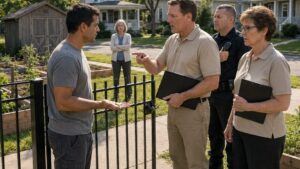
Robert Miller stood on the concrete path with a clipboard tucked under one arm. He wore a pale polo shirt with the neighborhood association emblem stitched above the pocket. He did not look surprised to see the yard.
Andrew rose, holding the broken stake.
“What happened here?”
Robert glanced toward the cleared strip as though inspecting work he had already approved.
“The drainage access was completed three weeks ago.”
“You took down my fence.”
“The contractor removed what obstructed the maintenance corridor.”
Andrew looked past him toward the adjoining yards. Two back windows had curtains shifted just enough to reveal faces.
“What maintenance corridor?”
Robert adjusted the clipboard against his ribs. “The one shown on the association plan. Notices were sent.”
“I was overseas.”
“We were aware of your deployment.”
The sentence landed differently than Robert seemed to intend.
Andrew looked again at the bare ground. “And you did this anyway.”
“We couldn’t postpone a drainage project indefinitely. Samantha Lopez had water against her foundation twice last year. The board voted. The contractor had a schedule. You didn’t respond.”
Andrew’s fingers tightened around the plastic stake.
He had learned, in warehouses and motor pools and crowded briefing rooms, that the quickest way to lose control of a situation was to let anger choose the next sentence.
So he asked, “Who authorized the fence removal?”
“The association authorized access.”
“That wasn’t my question.”
Robert’s jaw shifted. “I supervised the project.”
Andrew nodded once.
Robert seemed to take the nod as surrender. He opened the clipboard and removed a folded sheet inside a clear sleeve.
“This is the maintenance exhibit. You can review it. The corridor predates your purchase.”
The photocopy showed the rear lots of the subdivision, faint lines crossing behind several homes. One shaded strip appeared to pass through Andrew’s yard.
Robert tapped it with a capped pen.
“This is where the equipment went.”
Andrew studied the title block. The print was small and several generations removed from the original.
“Do you have the recorded easement?”
“This is the association plan.”
“Do you have the recorded easement?”
Robert exhaled through his nose. “You can bring questions to the next board meeting. Right now, I need you not to interfere with the temporary access. The contractor may return for grading.”
Andrew looked at the wire barrier.
“You’re planning to come back?”
“The work isn’t complete.”
Andrew handed back the exhibit. “No one enters this yard until I verify the boundary.”
Robert’s expression hardened, but only slightly. “You don’t have the authority to halt common-area maintenance.”
“This isn’t common area.”
“That’s the question, apparently.”
Robert turned toward the gate.
“Leave me a copy of the plan.”
“You’ll receive one by email.”
“I want the version you’re holding.”
Robert paused. Then he slid the photocopy from its sleeve and passed it over.
At the gate, he looked back at the broken orange stake.
“You shouldn’t move markers around while a boundary is under review.”
Andrew stared at him.
“I found this under the dirt.”
Robert left without answering.
That evening, Andrew sat at the kitchen table with the association exhibit on one side and his closing documents on the other.
A neighbor had come by before sunset. The man had stood just inside the gate, speaking quietly, apologizing for not calling sooner.
“You were deployed,” he had said. “I didn’t know how to reach you.”
Then he had held out his phone.
The association’s neighborhood page showed Robert beside the excavation equipment, smiling with one hand on the machine’s track. The caption praised the board for “finally resolving the rear drainage obstruction after years of delay.”
In the background, Andrew’s fence was still standing.
The next image showed it gone.
Andrew had asked the neighbor to send him screenshots. He had not commented on the smile.
Now, alone at the table, he compared the documents line by line.
His father’s brass plant label lay beside his elbow. Andrew had found it near the broken trellis, flattened but readable beneath the dirt. The engraved words were simple: E. THOMAS — FIRST BED, 2018.
His father had been dead eleven months.
Andrew ran his thumb over the letters, then forced himself back to the papers.
His deed referenced a recorded subdivision plat. The plat in his closing folder showed his rear boundary as a solid line. No shaded corridor crossed the lot. No maintenance easement appeared in the legal description.
Robert’s exhibit had a different title.
Andrew leaned closer.
It was labeled Preliminary Drainage Concept.
At the bottom, in print so faint he nearly missed it, were two words:
Not for recordation.
He placed the broken orange stake across the association exhibit, took a photograph, and opened a new notebook.
On the first line, he wrote:
Who decided a concept plan could take my land?
Chapter 2: Two Maps Cannot Own One Boundary
The county clerk set two oversized sheets on the counter and said, “These should not be treated as the same document.”
Andrew stood across from her in the records office, one hand resting on the edge of the table.
The first sheet was the recorded subdivision plat referenced in his deed. Crisp digital lines marked lot numbers, bearings, utility easements, and drainage features. His property ended where he had always understood it to end.
The second was an older planning exhibit. Its paper had yellowed around the edges before being scanned. A broad shaded path crossed the rear portions of several lots, including Andrew’s.
“That one has a county file stamp,” Andrew said.
“It was submitted with an early development review,” the clerk replied. “That doesn’t make it a recorded easement.”
“So why was it kept?”
“We keep many things. Applications, revisions, abandoned designs, staff comments. Filing is not the same as granting a property interest.”
Andrew pointed to the shaded strip. “Could someone mistake this for an easement?”
The clerk gave him a cautious look. “Someone could mistake anything if they read only the part they want.”
She printed certified copies of both documents and clipped the receipts to them.
Outside, Andrew called Steven Garcia, the licensed surveyor recommended by the attorney who had handled his home purchase.
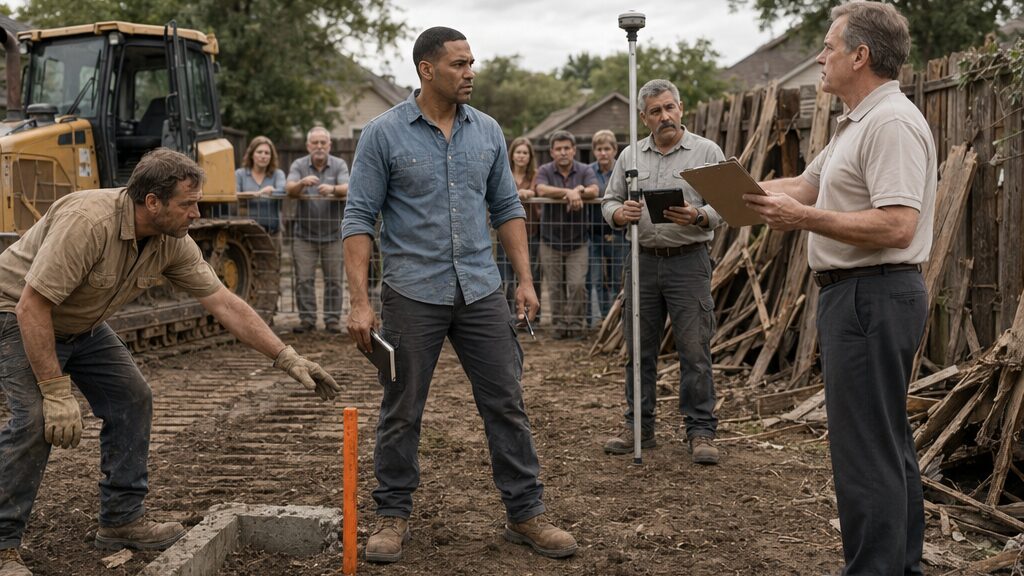
Steven arrived the following morning in a white pickup with metal boxes mounted along the bed. He was in his late fifties, compact and careful in his movements. He listened to Andrew’s explanation without interrupting, then walked the property with a receiver pole and field tablet.
Robert appeared before Steven had finished setting his first control point.
He carried the same clipboard.
“I wasn’t notified that a private survey was happening,” Robert said.
“You don’t have to be,” Andrew replied.
Robert ignored him and addressed Steven. “The association has its own plan.”
“I’ve seen the copy Mr. Thomas provided.”
“And?”
“And I’m surveying the recorded parcel.”
Robert folded his arms. “Does that mean he’s right?”
Steven looked at Andrew, then back at Robert.
“It means his deed refers to a recorded plat. It does not mean I make legal conclusions about every planning document the association possesses.”
Andrew felt a small, unwelcome drop in his stomach.
He had expected precision to simplify things. Instead, Steven’s care made the conflict feel wider.
For three hours, Steven measured along the side boundaries, checked visible pins, and compared elevations. At the rear corner nearest Samantha Lopez’s property, he knelt beside the remains of the old fence footing.
“Don’t touch this,” he said.
Andrew crouched beside him.
Inside a broken collar of concrete, a dull metal cap remained fixed below grade. Steven cleaned the top with a brush until stamped characters appeared.
“Original monument?”
“Looks consistent with the recorded plat.”
“So the fence was inside my line.”
Steven straightened. “The footing appears to have been built just inside the line. I’ll confirm after processing.”
Robert, standing several yards away, heard him.
“The corridor still crosses behind it,” he said.
Steven removed a bright orange stake from his truck and drove it into the soil beside the recovered monument.
“This marks a reconstructed corner for field reference,” he said. “No one should disturb it while the review is open.”
The orange seemed painfully bright against the brown scraped earth.
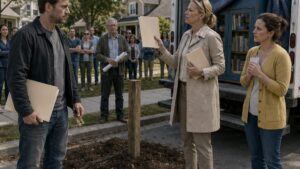
By noon, several neighbors had gathered along the temporary wire barrier. Samantha stood at the far end of her yard with her arms folded. Andrew met her eyes, but she looked down.
The excavation contractor arrived shortly after twelve-thirty.
His truck idled in the alley, towing a compact grading machine. Robert walked out to meet him and pointed toward the rear strip.
Andrew stepped forward. “No work is happening today.”
Robert turned. “The contractor is completing stabilization. We have rain forecast next week.”
“The boundary is disputed.”
“We are not excavating the corner.”
“You’re entering through my property.”
Robert looked toward Steven. “Is that stake permanent?”
“No.”
“Then it’s temporary.”
“It marks the corner I reconstructed from the recorded plat.”
Robert’s mouth tightened. He gestured to the contractor. “Pull it and begin from the west side.”
The contractor took two steps toward the stake.
Andrew moved between them.
He did not raise his hands. He did not touch the contractor. He simply stood with his boots planted in the machinery track.
“Don’t pull that stake.”
Robert’s voice sharpened. “Andrew, get out of the way.”
Andrew took the notebook from his back pocket and opened it.
“Steven, who placed that marker?”
“I did.”
“What does it represent?”
“A reconstructed property corner based on the recorded plat and the surviving monument.”
Andrew wrote down the answer.
Then he looked at Robert. “I’m recording your instruction to remove a surveyor’s field marker after he told you what it represents.”
Robert glanced toward the neighbors.
“You’re turning a drainage correction into a performance.”
“No,” Andrew said. “I’m making a record.”
The contractor stopped moving.
Steven stepped closer, his voice even. “The documents conflict in appearance, not necessarily in legal effect. County review is appropriate before anyone continues across this strip.”
Robert held the clipboard so tightly that the top sheet bowed.
“How long?”
“I can’t answer for the county.”
“We have exposed soil and a contractor already mobilized.”
“Then stabilize what is unquestionably within the association’s access,” Steven said. “Not this corner.”
For a moment, no one spoke.
A sprinkler clicked in a yard two houses away. The grading machine continued idling behind the gate.
Robert finally turned to the contractor. “Stand down for today.”
Relief moved through Andrew, but it was incomplete.
Robert pointed the capped end of his pen at the orange stake.
“This does not settle ownership.”
“No,” Andrew said. “It keeps you from settling it with a machine.”
Robert walked back toward the alley.
Before leaving, he signed the contractor’s field sheet. Andrew watched him write beneath a note describing the delay.
Steven later asked to see the clipboard entry. Robert refused, but the contractor quietly photographed the page for his own records.
That evening, Steven emailed Andrew a preliminary field report. The surviving monument aligned with the recorded plat. The removed fence had stood within Andrew’s parcel.
The report also contained a careful qualification: the shaded corridor on the preliminary exhibit required title or county review to determine whether any later instrument had adopted it.
Andrew read the sentence twice.
Then another email arrived, this one from the HOA management address.
Work Resumption Notice.
The message stated that stabilization and access grading would continue in forty-eight hours unless Andrew produced a court order.
Attached was a scanned field instruction signed by Robert.
At the bottom, beneath the contractor’s note about the reconstructed corner, Robert had written:
Proceed per board-approved corridor. Temporary homeowner objections do not alter association authority.
Andrew looked through the kitchen window.
The orange stake stood alone under the porch light.
Robert had been warned.
And he had put his refusal to pause in writing.
Chapter 3: The Notices Andrew Never Answered
The forwarded email reached Andrew at 6:12 the next morning.
Robert had added only one sentence above it:
For the record, this was your second notice before deployment.
The original message was dated five weeks before Andrew left the country. Its subject line read: SECOND NOTICE — REAR DRAINAGE ACCESS.
Andrew opened it at the kitchen table while the coffee maker clicked behind him.
The message was familiar.
He remembered reading it on his phone in the armory parking lot, between a medical readiness appointment and an equipment inventory. It had asked him to contact management regarding “temporary access coordination.” He had flagged it, intending to answer after his final drill weekend.
Then his deployment date moved forward.
His father’s estate paperwork had still been open. A tire on his truck had split. His unit had changed baggage requirements twice in four days. He had slept in fragments and lived by checklists.
The email had slipped beneath newer tasks.
A second message arrived eleven days later.
Andrew found that one too.
He had opened it.
He had not answered.
Outside the kitchen window, Steven’s orange stake stood in the torn yard, bright enough to accuse him.
At ten, Andrew drove to the HOA management office. Robert was already in the conference room with the treasurer and one other board member. Printed copies of the unanswered emails lay arranged in front of Andrew’s empty chair.
Robert waited until Andrew sat down.
“You stated that the work occurred without notice.”
“I said I did not authorize demolition.”
“You were contacted twice.”
“About access coordination.”
“And you chose not to respond.”
Andrew felt the room narrow.
“I failed to respond.”
Robert leaned back. “Thank you.”
The treasurer glanced between them. “Let’s keep this constructive.”
Andrew placed both notices on the table.
“Neither one says my fence will be removed. Neither says the garden will be cleared. Neither identifies the width of the corridor or the equipment route.”
“The project plan had been discussed for months,” Robert said.
“Not with me.”
“You attended the annual meeting where drainage was on the agenda.”
“Drainage was one line in a forty-page packet.”
Robert tapped the emails. “We cannot compel owners to read every notice.”
“And silence isn’t permission to bulldoze private land.”
“That depends on whether it was private land or association access.”
Andrew looked at the board member, then the treasurer. Neither met his eyes for long.
The treasurer slid a letter across the table. It carried the name of the association’s insurer.
“They’ve assigned a claims adjuster,” she said. “The initial position is that there may be shared responsibility because the association provided notice and you did not cooperate with scheduling.”
Andrew read the sentence twice.
Shared responsibility.
The phrase was neat enough to make destruction sound symmetrical.
His phone vibrated in his pocket.
For one second, memory returned with such force that he could hear the armory hallway: rolling cases, shouted serial numbers, boots striking tile.
A voicemail.
He had received one from the HOA office during deployment processing. He remembered the notification because it had arrived while his commanding supervisor was explaining a documentation error that might delay three soldiers’ movement orders.
Andrew had listened to twelve seconds of the message.
“This is the association office calling regarding rear access. Please return—”
He had deleted it.
Not maliciously. Not carelessly, he had told himself then. He had been clearing distractions, reducing everything to what had to be solved before wheels-up.
Now the deleted message felt like a door he had closed without checking who stood behind it.
Robert noticed the change in his face.
“There was a voicemail too,” he said.
Andrew looked up. “Yes.”
“You received it?”
“Yes.”
“And ignored it.”
“I deleted it.”
The treasurer shifted in her chair.
Robert’s expression did not become triumphant. That would have been easier to resist. Instead, he looked tired.
“You see the problem,” he said. “We had residents with water intrusion. We had a contractor deposit at risk. We had no response from the owner whose lot appeared on the access plan.”
Andrew folded the insurer’s letter.
“I see part of the problem.”
“Which part?”
“My silence.”
Robert waited.
Andrew continued, “Not your right to decide what it meant.”
The meeting ended without resolution. The board agreed to delay work pending county review, but the insurer’s shared-responsibility language remained.
At home, Andrew searched every message associated with the HOA.
The notices asked for coordination. One referred to “vegetation management.” Another said the contractor might require “limited entry.” None mentioned removing the cedar fence, uprooting the garden, or widening an access lane.
He printed them all.
Then he found an attachment he had never opened: a one-page project summary from the month before deployment. It described work behind four homes but listed no measurements. Under access authority, it referenced “existing drainage plan and board resolution.”
No recorded easement.
No owner consent form.
No demolition scope.
The discovery gave him less comfort than he expected. The documents showed Robert had overstated the notices, but they did not erase Andrew’s failure to answer.
Near dusk, someone knocked.
Samantha Lopez stood on the porch holding a covered dish she did not mention.
“I saw you at the office,” she said.
Andrew stepped aside, but she remained outside.
“I should have called you before the work started.”
“Why didn’t you?”
She looked toward the backyard.
“Because my basement flooded twice. The second time, I lost part of the wall. Robert said the access problem had delayed the fix for years.”
“Did you believe him?”
“Yes.”
The answer came quickly.
Samantha pressed both hands around the dish.
“I still believe the drainage work was necessary.”
Andrew said nothing.
“But I don’t believe they should have crossed your marked line.”
The silence between them changed.
“What marked line?”
She looked at him then.
“The orange stakes that were there before you deployed.”
Andrew felt the porch rail beneath his hand.
“There were stakes before I left?”
“Two that I saw. Maybe more.”
“Who put them there?”
“I don’t know. I assumed you had.”
He remembered no new stakes. His last professional survey had been completed when he bought the house.
Samantha lowered her voice.
“I attended the project approval meeting. Robert brought the old drainage exhibit. Someone asked whether it was an easement.”
“Who?”
She looked down at the covered dish.
“I did.”
Andrew waited.
Samantha swallowed.
“I told him the exhibit said conceptual. I told him we should verify the boundary before the contractor went in.”
“Was that entered in the minutes?”
“I don’t know.”
“You were the board secretary.”
“I had resigned by then. I was only there because of the flooding.”
Andrew looked past her toward the torn yard, where the single replacement stake caught the last light.
“What did Robert say?”
Samantha’s grip tightened around the dish.
“He said verification would take too long. Then he asked the contractor how much extra it would cost to come back a second time.”
She finally held out the dish, as if remembering why she had brought it.
Andrew did not take it.
“Do you have notes from that meeting?”
Samantha hesitated.
Then she nodded.
“Not official ones.”
“When can I see them?”
Her eyes moved toward the neighboring houses.
“Tomorrow night. At my dining table. And Andrew—”
“Yes?”
“If I show you, my name is in this too. I voted to approve the project agenda.”
Andrew looked at the scraped earth beyond the house.
For the first time, the question was no longer whether Robert had been warned.
It was how many people had heard the warning and allowed it to disappear.
Chapter 4: The Warning Left Outside the Minutes
Samantha placed three sheets of paper on the dining table and kept one hand over them.
“They aren’t official,” she said.
Andrew remained standing until she removed her hand.
The pages were torn from a yellow legal pad. Dates, names, and short phrases ran down the left margin in Samantha’s compact handwriting. Several lines had been crossed out so heavily the paper had thinned beneath the ink.
A ceramic bowl sat in the middle of the table between them. Andrew recognized the blue glaze from neighborhood cookouts before his deployment, when conversations had concerned trash pickup, school traffic, and whose dog kept slipping beneath the same loose section of fence.
Now the bowl held paper clips.
“Why did you keep these?” he asked.
“I keep notes when people start speaking over each other.”
Samantha sat across from him. “The official minutes usually reduce everything to motions and votes. These were for me.”
Andrew read the first page.
Drainage review. Contractor estimate. Rear access unresolved.
Farther down:
Andrew lot—old exhibit only?
Then, underlined twice:
Verify before entry.
“Is that what you said?” Andrew asked.
Samantha nodded.
“Exactly?”
“Close enough that I remember Robert’s answer.”
Andrew waited.
“He said the developer’s plan had been used for years.”
“That isn’t an answer.”
“I told him that.”
She shifted in her chair and looked toward the window overlooking the narrow side of her property. A dehumidifier hummed somewhere beyond the dining room.
“He said the county had accepted the drainage concept when the subdivision was approved. I said acceptance of a concept wasn’t the same as a recorded easement.”
“Where did you learn that?”
“My husband handled title reviews before he retired. I’m not an attorney, but I knew enough to ask.”
Andrew turned the page.
One sentence had been boxed:
Second mobilization adds $4,800.
Below it:
Robert: proceed now, correct paperwork later.
Andrew looked up.
“Did he say this?”
“Yes.”
“Those words?”
Samantha hesitated. “He said, ‘We can correct the paper trail after the work is protected.’ I shortened it.”
“Protected from what?”
“Delay. Rain. Another contractor charge. Residents blaming the board if someone flooded again.”
The dehumidifier cycled off. The sudden quiet made the room feel larger.
Samantha folded her arms.
“You need to understand something. Water came through my basement window well twice. The second time, it reached the electrical outlets. I had fans running for eleven days. The association had already postponed the drainage project once because another owner threatened legal action.”
“I understand why you wanted it fixed.”
“Do you?”
Andrew looked at the pages again.
“Yes.”
She seemed unsettled by the answer.
He had imagined this conversation differently. In the hours since she appeared on his porch, he had pictured her admitting that Robert had lied from the beginning and that everyone else had been afraid to oppose him.
Instead, she had warned him and supported him.
Both were true.
“What did you vote for?” Andrew asked.
“The project agenda. Not the final scope.”
“Did the agenda include my yard?”
“It included access behind four properties.”
“Did you know my fence would come down?”
“No.”
“Did you ask?”
Samantha looked at the paper clips. “Not clearly enough.”
Andrew understood the sentence too well.
He sat back.
“Where are the official minutes?”
“At the management office.”
“Did you compare them to this?”
“After the work started.”
“And?”
“The warning isn’t there.”
The records room was unlocked the following afternoon by the HOA treasurer, who watched Andrew and Samantha from the doorway as if their presence among the filing cabinets might disturb more than paper.
Meeting binders occupied two metal shelves. The minutes from the project approval session were six pages long.
Andrew read them once standing, then again seated at the narrow worktable.
The document recorded the flooding reports, the contractor deposit, the projected schedule, and a unanimous vote to authorize “rear drainage access work consistent with existing community plans.”
There was no mention of a questioned easement.
No mention of the word conceptual.
No instruction to verify Andrew’s boundary.
Samantha leaned over his shoulder.
“I didn’t draft these.”
“Who did?”
“The management office. Robert reviewed them before approval.”
The treasurer spoke from the doorway. “The board approved them at the next meeting.”
“Were you there?” Andrew asked Samantha.
“No.”
“Did anyone read the full minutes aloud?”
The treasurer answered. “They were circulated in advance.”
Andrew looked at her.
“Did you read them?”
Her face tightened. “I scanned them.”
The same word could have belonged to him.
He copied the pages and requested the contractor records. The treasurer resisted until Andrew showed her the insurer’s claim number and the written confirmation that relevant project documents should be preserved.
The contractor file contained invoices, site sketches, text-message printouts, and two field-change forms.
The first authorized removal of brush and temporary fencing within an eight-foot access path.
Andrew unfolded the site sketch.
The original line stopped short of his cedar fence.
The second field-change form had been signed four days later by Robert.
Increase access width to fourteen feet for machine clearance. Remove fixed obstacles as necessary. Avoid remobilization.
The added width crossed Andrew’s fence line and garden.
At the bottom, beside Robert’s signature, the contractor had written:
Owner unavailable. HOA assumes access authority.
Andrew read it without speaking.
Samantha placed one finger near the date.
“This was after the approval meeting.”
“And after your warning.”
“Yes.”
The treasurer stepped closer. “Robert may have believed the equipment couldn’t operate safely in eight feet.”
“That may be true,” Andrew said.
She seemed surprised.
He turned the form over. “But he changed the project from what the board approved.”
“Operational changes happen.”
“Then why wasn’t this brought back to the board?”
No one answered.
The contractor’s text records showed the reason more plainly.
A message from the contractor warned that the narrower route would require smaller equipment and a second workday. Robert replied that the association would not pay another mobilization charge and instructed him to use the wider corridor shown on the old plan.
Another message mentioned visible orange stakes near the fence.
Robert’s response read:
Temporary owner markers. Proceed carefully and remove obstructions.
Andrew felt his anger settle rather than rise. It became denser, less useful for accusation and more useful for decision.
Samantha stood beside him, reading the same words.
“I should have followed up,” she said.
“Yes.”
She looked at him sharply, perhaps expecting comfort.
Andrew did not offer it.
After a moment, he added, “I should have answered the notices.”
The treasurer lowered herself into the chair opposite them.
“So where does that leave us?”
Andrew gathered the copies into a straight stack.
“With a project that may have been necessary, a boundary that should have been verified, and a decision Robert made after he knew both things.”
As he placed the field-change form on top, the orange marking in the contractor’s photograph caught his eye.
Two stakes stood beside the cedar fence before the machine entered the yard.
One was bent toward the property line.
The other was lying flat.
Robert had not merely expanded the route.
He had widened it precisely where someone had already marked the place he was warned not to cross.
Chapter 5: The Settlement That Required Andrew’s Silence
Margaret Hall placed the settlement figure faceup on the table before Andrew had removed his coat.
The number was enough to rebuild the cedar fence, replace the damaged landscaping, restore the grade, and cover Steven’s survey fees.
For several seconds, Andrew did nothing.
The mediation room belonged to the insurance company’s local counsel. It had no windows, no decoration, and no sound except the ventilation fan. Margaret sat at one end of the table with a legal pad and a narrow binder. The claims adjuster sat beside her. Robert occupied the opposite end with the HOA treasurer.
Andrew took the empty chair between the two sides.
On the table in front of him, he placed the bent orange stake.
Robert looked at it and then away.
Margaret folded her hands.
“This is a compromise proposal,” she said. “It is not an admission by any party.”
Andrew read the first page.
The insurer would fund restoration based on agreed estimates. The HOA would coordinate access for the work. Andrew would release claims arising from the project.
The final paragraph required confidentiality.
“No public statement,” Andrew said.
“No disclosure of the settlement amount or disputed conduct,” Margaret replied.
“No finding that the boundary was crossed.”
“That remains contested in part.”
“Steven’s report says my fence was inside the recorded parcel.”
“It does.”
“And the county found no recorded maintenance easement.”
Margaret’s expression remained neutral. “The association relies on broader governing authority, historic plans, and emergency-maintenance provisions. Those arguments have not been adjudicated.”
Andrew looked at Robert.
Robert’s clipboard sat closed beside him.
“What part is still contested?” Andrew asked.
Robert answered. “Whether access was reasonable under the circumstances.”
“That’s different from whether it was my land.”
“The association was protecting multiple homes.”
“By expanding the route to avoid a second contractor charge.”
The treasurer shifted. Margaret raised one hand slightly.
“We are not here to retry every disputed fact,” she said.
“Then what are we here to settle?”
“Repair costs and potential exposure.”
The claims adjuster opened a spreadsheet. Fence replacement, grading, mature plant loss, survey work, and temporary security were listed in separate rows.
Andrew studied the totals. His father’s garden had been reduced to numbers precise enough to pay and too imprecise to restore.
“What about the survey markers?” he asked.
“Permanent monument replacement is included.”
“And the decision to remove them?”
Margaret looked at the adjuster before answering.
“The policy may cover negligent property damage caused during authorized association operations.”
“May?”
“Coverage remains under reservation.”
Robert leaned forward. “The association acted in good faith.”
Margaret turned toward him.
“Robert, this is where your interests and the association’s may not be identical.”
The room changed.
Robert sat back.
Margaret opened the narrow binder. “The insurer’s preliminary position distinguishes between the board-authorized drainage project and any later decision made after notice of a disputed boundary. If conduct is found intentional, knowing, or outside approved authority, coverage could be limited.”
The treasurer stared at Robert.
“You said the field change was operational.”
“It was.”
“You widened it by six feet.”
“The equipment required clearance.”
“After Samantha warned you about the easement.”
Robert’s face darkened. “Samantha supported the project.”
“She did,” Andrew said. “That doesn’t erase the warning.”
Margaret closed the binder.
“The offer before Mr. Thomas resolves the property claim without requiring a determination of personal responsibility.”
Andrew understood then why the figure was generous enough to tempt him.
The insurer was not buying only repairs. It was buying the absence of a public answer.
He looked again at the estimate. He could have a fence within a month. New soil. New plants. A restored grade before the next heavy rain.
His deployment pay had covered his mortgage, but legal consultation and survey work had already eaten into savings. A lawsuit could take a year. Perhaps longer.
His father would have told him to take the money if the fence could be rebuilt.
Or Andrew wanted to believe he would.
He rested one hand on the orange stake.
The plastic had softened where the machine bent it. Dirt remained trapped in a gouge near the base.
“What happens to the meeting minutes?” he asked.
Margaret paused. “Which minutes?”
“The approval meeting. The warning that was left out.”
“That is a governance issue.”
“Would the settlement require me to stop asking the board to correct them?”
“It would require confidentiality regarding disputed conduct.”
“So yes.”
“It would prevent public characterization of the settlement as proof of wrongdoing.”
Andrew looked at the treasurer. “Would the board amend the record?”
She glanced at Robert.
He said, “The approved minutes reflect the meeting.”
“They reflect the vote,” Andrew said. “Not the warning.”
“They were adopted.”
“That doesn’t make them complete.”
Robert’s voice hardened. “You failed to answer notices. You left no emergency contact. You came home and treated every imperfect decision as evidence of bad faith.”
The words struck because part of them was true.
Andrew had spent weeks building a clean line between himself and the people who crossed his yard. Robert had just stepped across it.
Andrew looked at Margaret.
“The insurer says I share responsibility?”
“The association argues your nonresponse contributed to the circumstances.”
“I agree that it contributed.”
Robert blinked.
Andrew continued, “I should have answered. I should have appointed someone. I should not have assumed a flagged email would stay at the top of a life that was moving faster than I could control.”
No one interrupted him.
“But my silence did not change the recorded boundary. It did not turn ‘temporary access’ into permission to remove a fence. It did not authorize Robert to widen a route after he was warned.”
Margaret studied him.
“What resolution are you seeking beyond restoration?”
“I want the corrected boundary entered into the HOA records. I want the minutes amended to include the warning. I want a policy requiring actual confirmation before nonemergency entry onto an owner’s lot when title is disputed. And I want the field-change decision addressed in an open board meeting.”
Robert gave a short, disbelieving laugh.
“So this is public punishment.”
“No.”
“It certainly sounds like it.”
“If I wanted punishment, I would start with every dollar a lawyer told me I could claim.”
The claims adjuster stopped writing.
Andrew slid the settlement back across the table.
“I’m asking you to repair what was damaged and prevent the same excuse from being used on someone else.”
Margaret tapped the confidentiality paragraph.
“Without confidentiality, the insurer may withdraw this figure.”
“Then withdraw it.”
The treasurer whispered, “Andrew.”
He looked at her.
She had been one of the people who scanned the minutes, one of the people who accepted Robert’s confidence because it was easier than inspecting it.
“We can fix the fence now,” she said. “A hearing could divide the neighborhood for months.”
“It is already divided. Most people just don’t know what the division is about.”
Margaret gathered the pages slowly.
“If the offer is rejected, restoration is not guaranteed on this timetable.”
“I understand.”
“You may face defenses based on your failure to respond.”
“I understand.”
“Personal liability questions could make settlement harder, not easier.”
“I understand.”
Robert pushed his chair back.
“You’re risking your own repairs to make a point.”
Andrew picked up the bent stake.
“No. I’m refusing to let the repair erase how the damage happened.”
He signed the rejection line and dated it.
Then, beneath his signature, he wrote a formal request for an open board hearing.
Chapter 6: The Meeting Where the Clipboard Failed
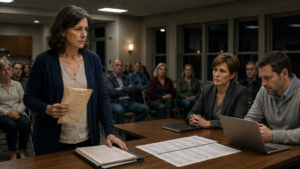
Robert began the hearing by reading Andrew’s unanswered emails aloud.
The clubhouse was full enough that residents stood along the rear wall. Folding chairs faced a long table where the board sat beneath a blank projection screen. Margaret occupied a separate chair near the end, present as insurance counsel but careful not to appear aligned with either side.
Andrew sat in the front row with Steven and Samantha behind him.
The bent orange stake rested inside a clear evidence sleeve on the table beside his documents.
Robert adjusted the microphone.
“First notice,” he said. “Temporary access coordination requested. No response.”
He turned a page on his clipboard.
“Second notice. Rear drainage access. Please contact management. No response.”
His voice was steady, almost weary.
“A voicemail was also left. Mr. Thomas has acknowledged deleting it.”
A low murmur moved through the room.
Robert looked directly at Andrew.
“The board faced active water intrusion, an expiring contractor schedule, and an absent owner who did not communicate. Those are the facts.”
Andrew felt the familiar impulse to wait until every detail was assembled perfectly in his mind.
Silence had always given him time.
Tonight it would give Robert the room.
Andrew stood.
“Those are some of the facts.”
The board chair invited him to the microphone.
He carried no uniform photograph, no deployment orders, no symbols that would ask the room to treat him differently. He brought only the folder, the stake, and his notebook.
“I received the emails,” he said. “I failed to answer them.”
The room quieted.
Robert’s expression shifted, as if the admission had arrived too early.
Andrew continued. “I listened to part of the voicemail and deleted it. I did not appoint a local contact before I left. That was my mistake.”
A resident near the aisle folded her arms less tightly.
Andrew placed the first notice beneath the document camera. It appeared on the projection screen.
“This asks for temporary access coordination. It does not identify a recorded easement. It does not state that my fence will be removed. It does not authorize the destruction of the garden or the widening of the route.”
He placed the second notice beside it.
“This one is no more specific.”
Robert leaned toward his microphone. “The community had discussed drainage for months.”
“Drainage,” Andrew said. “Not fourteen feet through my yard.”
He replaced the notices with the recorded plat and the old planning exhibit. Steven’s reconstructed boundary appeared as orange points across the first document.
“The county found no recorded maintenance easement over my parcel. Steven confirmed the surviving monument aligns with this plat.”
Steven stepped to the microphone when the chair called him.
“My survey locates the parcel boundary as shown,” he said. “The former fence footing was inside that boundary. The older shaded corridor is a conceptual planning feature. I offer no legal opinion regarding broader association rights, but it is not itself a recorded easement.”
Robert opened his clipboard.
“The board relied on long-standing community plans and emergency provisions.”
Samantha stood before anyone called her.
The chair hesitated, then recognized her.
She carried her yellow pages to the microphone.
“I supported the drainage project,” she said. “My basement flooded twice. I wanted the work completed.”
Several neighbors nodded.
“I also told Robert the exhibit was conceptual and asked that the boundary be verified before entry.”
Robert’s mouth tightened.
Samantha looked toward him. “He said the paperwork could be corrected after the work was protected.”
“That is not an exact quotation,” Robert said.
“No,” she replied. “It is my contemporaneous note.”
The official minutes were projected next.
Andrew highlighted the project vote, then the absence of any boundary discussion.
The treasurer spoke from the board table.
“I approved those minutes without reading them closely enough.”
The admission drew a sharper murmur than Andrew’s had.
Robert set down his pen.
“This is becoming an exercise in retrospective perfection. We had to make decisions in real time.”
Andrew placed the contractor’s first scope on the screen.
“Eight-foot access path.”
Then the field-change form.
“Fourteen feet. Remove fixed obstacles as necessary. Signed by Robert four days later.”
Robert leaned forward.
“The contractor advised that the smaller equipment would delay the work and increase cost.”
“How much?”
“Nearly five thousand dollars.”
“And that justified using my property?”
“It justified following the corridor the association believed it controlled.”
Andrew displayed the contractor’s text about the visible orange stakes.
Then Robert’s response:
Temporary owner markers. Proceed carefully and remove obstructions.
The room went still.
Andrew lifted the evidence sleeve.
“This stake was not placed by me. Steven later reconstructed the same corner from the recorded plat and surviving monument. At the inspection, Robert ordered the contractor to pull the new one too.”
Robert’s face reddened.
“That marker was temporary, and the work had already been approved.”
Steven spoke without rising. “I identified it as a professional field marker before the instruction was given.”
Andrew placed Robert’s signed field note beside the stake under the document camera.
On the screen, the bent orange plastic lay next to the sentence:
Proceed per board-approved corridor.
The clipboard in Robert’s hands no longer looked like authority. It looked like a container for decisions.
Robert stared at the projection.
Then he said, “People in this room were afraid of another flood.”
No one contradicted him.
He pointed toward Samantha. “She was afraid. The board was afraid. We had been blamed the year before for postponing maintenance until damage occurred. Every delay became evidence that we were incompetent.”
His voice lost some of its polish.
“I made a decision to keep the project moving.”
Andrew believed him.
That did not make the decision smaller.
“You also made a decision about whose risk mattered,” Andrew said.
Robert’s eyes met his.
“Yes,” he said after a pause. “I did.”
Margaret opened her binder.
“The insurer distinguishes between the approved project and the later expansion of access after notice of a disputed boundary. Coverage remains unresolved.”
Robert turned toward the board.
“If the board believes I exceeded my authority, I will resign tonight.”
The offer came out like a challenge.
A resident called from the rear, “Is that supposed to fix the yard?”
The chair struck the table lightly with the gavel and asked for order.
Andrew felt the hearing shifting toward the outcome he had feared: punishment becoming the only language anyone could hear.
He returned to the microphone.
“I am not asking the board to choose between pretending Robert did nothing wrong and treating him as the only person who failed.”
Robert looked at him sharply.
“I failed to answer. The treasurer approved incomplete minutes. Samantha warned the board but did not follow up. Robert continued after the warning and expanded the scope without returning to the board.”
The room remained quiet.
“These failures are not equal,” Andrew said. “But they are connected.”
He opened the final folder.
“I am proposing settlement terms.”
Margaret looked up.
Andrew handed copies to the board.
“First, restore the fence, grade, garden, and permanent monuments according to independent plans. Second, amend the meeting record to include the boundary warning and field change. Third, adopt a rule that unanswered notice is not consent to enter a privately owned lot when title or access rights are disputed. Fourth, require an emergency contact option for deployed, hospitalized, or otherwise unreachable owners. Fifth, route the remaining drainage work through a lawful access path confirmed before construction.”
Robert read the pages without expression.
A board member asked, “And damages?”
“Documented repair costs, survey fees, temporary security, and reasonable legal review.”
“No punitive demand?”
“No.”
Robert looked up. “And my resignation?”
“That is the board’s decision.”
“You brought everyone here and have no position on whether I stay?”
“I have a position on what you did. I don’t need to decide who you are for the rest of your life.”
The words left Andrew before he could refine them.
For the first time that night, Robert had nothing ready to say.
Margaret requested a recess.
Residents stood, gathered in small groups, and spoke in voices too low to separate. Samantha remained in her chair. Steven studied the projected orange points as though the geometry might offer relief from everything around it.
Andrew stepped outside.
The clubhouse windows reflected the parking lot and, beyond it, the dark line of rooftops. His hands trembled once the room could no longer see them.
Robert came through the door several minutes later, still carrying the clipboard.
“You could have asked for more,” he said.
“I still can if the board refuses.”
Robert nodded.
“You think this makes you reasonable.”
“No.”
“What does it make you?”
Andrew considered the question.
“Present.”
Robert looked away.
When the hearing resumed, the board chair announced that no final vote would occur that night. Margaret would prepare revised terms, the insurer would reconsider restoration without confidentiality, and the board would review Robert’s field authority.
Robert placed his clipboard flat on the table.
Andrew slid his proposed agreement toward the center.
The hearing had established what happened.
Now the board had to decide whether it preferred repair with accountability—or the cost of defending silence.
Chapter 7: The Boundary Restored Without Erasing the Cost
Steven arrived carrying a steel monument in one hand and the county confirmation in the other.
The orange stake still stood at the rear corner of Andrew’s yard, faded now from weeks of sun and rain. Around it, new cedar fence posts had been set but not yet joined. The contractor had left the corner open until Steven completed the permanent work.
Andrew met him beside the exposed footing.
“You’re certain?” he asked.
Steven handed him the document.
“The recorded plat governs the parcel. No later easement was found across this lot. The association’s drainage authority does not relocate your boundary.”
Andrew read the conclusion even though he already knew what it said.
Steven knelt and prepared the hole beside the surviving monument. His tools made small, deliberate sounds against the packed soil. Nothing about the work resembled the machine that had entered the yard before. There was no hurry in it, no assumption that speed proved necessity.
Samantha stood at the edge of her property watching.
The contractor’s crew worked farther down the line, installing a drainage route through a utility access confirmed behind another section of common land. It was longer than Robert’s path and required smaller equipment. The association would pay the additional cost.
Water still needed somewhere to go.
That fact had survived every argument.
Steven set the steel monument and checked it twice. Then he wrapped one hand around the orange stake.
“Ready?”
Andrew looked at the bent plastic marker that had remained in his kitchen, his evidence sleeve, the clubhouse projection, and finally the soil. This replacement stake had stood through the negotiations, bright and temporary, insisting that uncertainty did not grant permission.
“Go ahead.”
Steven pulled it free.
For an instant, the narrow hole remained open beside the permanent cap. Then he pressed soil into it with his boot.
The fence crew began setting the final boards.
Six weeks had passed since the public hearing. The time had been filled with revised drafts, insurance calls, cost estimates, and sentences adjusted one word at a time.
The insurer had agreed to fund the restoration without a confidentiality clause. The settlement stated that the work had crossed Andrew’s recorded boundary and exceeded the scope approved by the board. It did not accuse Robert of intentional trespass. It did not declare Andrew free of contributing fault.
Andrew had insisted on both kinds of accuracy.
The new cedar boards matched the old ones closely, but not perfectly. The color was lighter. The grain ran differently. His father’s screw with the damaged head was gone.
No settlement could specify the replacement of that.
The final board session began that evening at the clubhouse.
Fewer residents attended than had come for the hearing. There was no expectation of confrontation now, only the less dramatic work of deciding what the community would do after the facts had become inconvenient.
Robert’s chair at the board table was empty.
The chair announced his resignation before calling the meeting to order. Robert had submitted a one-page letter stating that continued debate over his role had become a distraction from necessary association business.
There was no apology to Andrew.
There was no admission beyond what the settlement already contained.
The treasurer read the revised minutes from the original project meeting. The new version included Samantha’s warning that the drainage exhibit was conceptual, Robert’s decision to proceed before verification, and the later expansion of the access route.
When the chair asked for corrections, Samantha raised her hand.
“The minutes should also state that I supported the project despite raising that concern.”
The chair looked at her. “That is already reflected in the vote.”
“I want it stated plainly.”
A line was added.
Andrew watched her lower her hand.
The board then considered the new property-access policy.
The first section required management to distinguish between notice and consent. An unanswered email could no longer be treated as authorization to enter a privately owned lot when the right of access was disputed.
The second created an optional emergency-contact registry for owners facing deployment, hospitalization, extended travel, or other periods of unavailability.
The third required independent review before work proceeded across a disputed boundary, except when immediate action was necessary to prevent active danger.
A board member objected to the last provision.
“What if we lose time during a real emergency?”
Margaret, seated near the wall, answered before Andrew could.
“Then the board documents the emergency and acts within the minimum area necessary. This policy is not designed to prevent action. It is designed to prevent urgency from becoming a substitute for authority.”
The language was adopted with one minor revision.
The vote passed unanimously.
No one applauded.
Andrew was grateful for that.
After the meeting, Margaret handed him the final signed agreement.
“The first restoration payment has been released,” she said. “The second follows inspection.”
“And Robert?”
“His personal exposure is resolved within the broader settlement.”
Andrew studied her face. “He agreed?”
“He agreed not to contest the factual findings. That is not the same as agreeing with them.”
“No.”
Margaret closed her binder.
“You could have forced a harsher process.”
“Maybe.”
“Do you regret not trying?”
Andrew looked toward the empty chair.
“Ask me after the garden grows.”
Outside, Samantha waited beside his truck.
“I ordered the plants,” she said. “The nursery found mature rosemary and black-eyed Susans. Not the same age, but close.”
“You didn’t have to do that.”
“I know.”
They drove separately back to the neighborhood.
The fence was complete when Andrew reached home. It cast a straight shadow across the freshly graded soil. The new drainage route curved beyond the property rather than cutting through it.
Samantha arrived with flats of plants and worked without offering explanations. Andrew marked the spacing. She loosened roots. Neither of them tried to turn the afternoon into forgiveness.
At one point, she held up a rosemary plant.
“Here?”
Andrew considered the place where his father had set the original bed.
“Six inches left.”
She moved it.
That was all.
Near sunset, Andrew went inside to wash the dirt from his hands. His phone showed a new message from the association management office.
The subject line read:
NOTICE OF REAR DRAINAGE INSPECTION — RESPONSE REQUESTED.
The message identified the date, the exact area to be inspected, the legal basis for access, and the name of the person who would enter. It included a link to approve, decline, or request another time.
Andrew stood at the kitchen window.
Beyond the new fence, the permanent monument was nearly invisible. It did not need fluorescent paint. It did not need to be held up in a meeting or sealed inside plastic.
It was simply where the boundary was.
Andrew opened the notice and selected Request Another Time.
He wrote that he would be available the following afternoon and asked management to confirm that the inspector would remain outside the fence unless invited.
The reply arrived nine minutes later.
Confirmed.
He saved it.
Then he carried his father’s brass plant label into the yard.
The metal had been cleaned but not polished. Dirt remained in the engraved letters, darkening the name.
E. THOMAS — FIRST BED, 2018.
Andrew pressed the label into the soil beside the rosemary.
The replacement garden was smaller than the old one while the plants took root. The boards were too pale. Trust remained uneven across the neighborhood. Robert’s resignation had ended his authority, not the reasons he had believed he should use it.
Andrew knew that some residents still thought the project delay had been avoidable. Some believed he should have taken the first settlement. Others believed Robert had been treated too gently.
None of those opinions moved the monument.
Samantha gathered the empty plant containers.
“I’ll see you tomorrow?” she asked.
“For the inspection.”
She nodded and left through the gate.
Andrew remained beside the garden until the porch light came on automatically.
Months earlier, he had believed that owning the correct documents was enough. Then he had learned how easily silence could be filed as agreement, how quickly urgency could become permission, and how official records could omit the sentence that mattered most.
The answer had not been to shout louder than Robert.
It had been to answer.
To correct.
To remain present long enough that no one else could write his absence into consent.
Andrew touched the top of the brass label once, then stepped back from the restored boundary.
The story has ended.