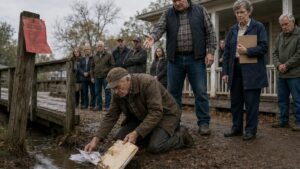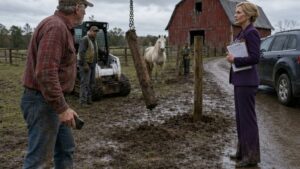
When They Chained Her Tractor, Katherine Let the Iron Gate Expose Six Months of Corruption
Chapter 1: The Tractor Was Already Facing the Road
Katherine Campbell started the tractor before sunrise and drove it away from the field.
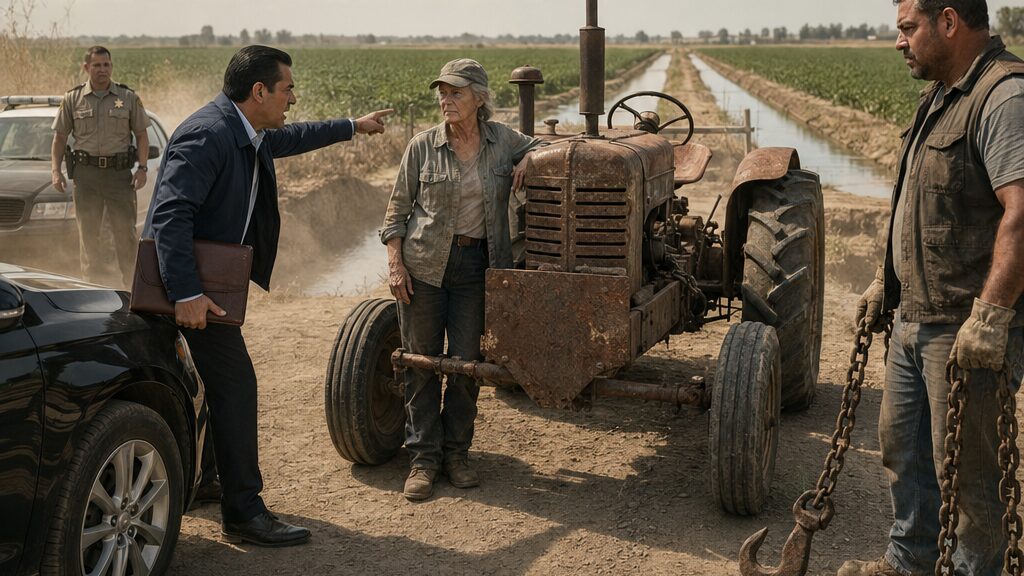
The old machine coughed once, shuddered through its rusted frame, then settled into the deep, steady rhythm she knew better than any hymn. Its headlights cut two pale bars across the dirt road leading into the crop fields, and the narrow entrance appeared between the irrigation ditches like a throat waiting to close.
She did not turn toward the rows.
She rolled straight into the mouth of the road, eased the tractor sideways across the entrance, and stopped it there, iron wheel to ditch, rear blade angled just enough to leave no clean path around it. The ditches on either side were deep from last week’s water run, their muddy banks steep enough to swallow any impatient tire.
Katherine set the brake. She let the engine idle.
For a moment she only listened.
Iron ticking. Birds waking. Water whispering through the ditch grass.
Then she shut the engine off and pocketed the key.
Behind her, the kitchen door of the old farmhouse slapped open.
“Aunt Katherine?”
Rebecca Allen’s voice carried across the yard, sharp with the kind of fear that had been trying to sound practical for weeks.
Katherine climbed down from the tractor slower than she used to, one hand on the fender, one boot finding the welded step her father had added thirty years ago when his knees started going bad. The metal was cold under her palm. It had been painted red once, then orange, then whatever shade rust chose for itself.
Rebecca crossed the yard in work pants and yesterday’s gray sweater, her hair pulled into a knot that had already begun to loosen. She held a folder against her ribs like it might blow apart.
“You’re blocking the road.”
“That’s where a gate belongs.”
“It isn’t a gate. It’s a tractor.”
Katherine looked at the machine. Its hood was dented, one front light fogged, the grill patched with scrap iron from a broken harrow. The front axle had been rebuilt twice, the clutch once, and the steering box so many times that Katherine could take it apart blindfolded.
“It’s both today,” she said.
Rebecca stopped beside the irrigation ditch and looked at the road beyond it. It ran dry and pale toward the county lane, with cottonwood shadows lying across it in strips. Nothing moved yet. That made Rebecca more nervous, not less.
“He’ll use this against you,” she said.
“Paul uses breathing against people if he can bill them for air.”
“That’s not funny.”
“No.”
Rebecca’s eyes dropped to Katherine’s shirt pocket. “Is that the key?”
Katherine patted the pocket once. “It won’t fall out.”
“Aunt Katherine.”
There it was—the voice Rebecca used when she was trying not to sound like the responsible one. Katherine had heard it after every certified letter, every county notice, every suggestion from people who had never touched the soil that perhaps selling before things got worse was just common sense.
Rebecca stepped closer. “We can still move it back. We can call the lawyer again. We can call the county office when it opens.”
“They know my number.”
“That’s not an answer.”
“It’s the one I’ve got.”
Rebecca stared at her, then at the tractor. “You’re waiting for him.”
Katherine did not answer.
That was enough.
Rebecca opened the folder, fingers moving too fast. “I found three more copies of the rezoning notice in the office. Same parcel number, different dates. One of them says there’s a hearing we never attended, one says there was no objection filed, and this one—” She pulled out a folded page, creased hard enough to tear. “This one says enforcement can begin today.”
Katherine turned her face toward the eastern field. The first light had just begun to catch on the irrigation water. Beyond the ditch, the rows waited, low and green and stubborn.
Rebecca thrust the page toward her. “Today, Aunt Katherine. Not next month. Not after another appeal. Today.”
“I read it.”
“You read it and then decided to park the tractor in the entrance?”
“I read it and decided not to leave the entrance empty.”
Rebecca’s mouth tightened. She had Katherine’s sister’s eyes when she was angry—brown, bright, and hurt before she knew it. “Do you understand what this looks like? It looks like obstruction. It looks like you’re daring him.”
Katherine walked to the front of the tractor and ran her fingers over the scrap-iron plate welded across the lower frame. Her father had put it there after a stump tore the original guard loose. It was ugly, thick, and stronger than anything a salesman would have approved.
“Sometimes a thing looks like what it is,” she said.
Rebecca came around the tractor, careful near the ditch. “And what is it?”
“A road too narrow for lies.”
Rebecca let out a short, angry breath. “You keep doing that.”
“What?”
“Talking like a fence post. Like if you say less, it means more.”
Katherine looked at her then.
Rebecca had been balancing the farm accounts since January, after the second notice arrived and Katherine finally admitted the lawyer bills were eating into seed money. She knew which checks cleared late. She knew which repairs Katherine postponed. She knew how many acres were planted and how much was already promised before harvest. She knew enough to be frightened, but not enough to understand why Katherine had stopped being frightened in the usual way.
That was Katherine’s fault.
She had made it that way on purpose.
Rebecca stepped close enough to lower her voice. “There are people who would help us. You don’t have to make every decision like you’re the last person left on earth.”
Katherine touched the top button of her work shirt, not meaning to.
Rebecca saw it.
Her eyes narrowed. “What is that?”
“Nothing.”
“You just checked something.”
“Rebecca.”
“No. Don’t ‘Rebecca’ me.” She reached toward Katherine’s shirt, then stopped herself before touching. “Is that a phone? A recorder? What are you doing?”
Katherine turned away and picked up the dented metal thermos from the tractor’s side step. It was green beneath the scratches, with a black lid that doubled as a cup. She unscrewed it slowly.
Rebecca watched her hands. “Are you recording him?”
Katherine poured coffee into the lid. Steam rose between them.
“I’m drinking coffee,” Katherine said.
“You are the most impossible woman I have ever known.”
“That’s a short list if you stay home more.”
“Don’t joke.” Rebecca’s voice cracked on the last word. She looked down the road again. “Paul Ramirez doesn’t come alone anymore. Last time he brought two county men and that smug aide with the tablet. If he brings deputies today—”
“He will.”
Rebecca went still.
Katherine drank. The coffee was too hot and too bitter. She swallowed it anyway.
“How do you know that?” Rebecca asked.
Katherine screwed the lid back on. “Because he wants it to look official.”
“And you want it to look like you’re refusing an official order.”
“I want the tractor where it is.”
“That’s not the same thing.”
“No.”
Rebecca pressed the folded notice against her chest. For a moment her anger thinned, and fear showed cleanly through. “Please move it. Just for now. Let them come through, let them measure, let the lawyer fight it after. If you force this out here, by the ditch, with everyone watching, you might lose before you ever get to court.”
Katherine looked past her to the fields.
She could still remember her father standing in that same road, hat in hand, arguing with a tax assessor who had called the east acreage “underused.” Her mother had stood at the kitchen window, pretending not to listen. Katherine had been sixteen, barefoot in the dust, old enough to know shame when someone tried to hand it to her family wrapped in official language.
Underused. Unimproved. Noncompliant. Rezoned.
Words changed clothes, but they walked the same.
“This road was cut before the county paved the lane,” Katherine said. “My father dug those ditches with a rented backhoe and a broken wrist. Every truck that comes in has to pass right here. Every seed delivery. Every harvest trailer. Every funeral car when we buried people behind the house.”
Rebecca’s face softened despite herself.
Katherine looked at the tractor. “If they take the gate, they don’t need the rest yet. They just need everyone to see they can enter.”
Rebecca lowered the notice. “Then tell me the rest.”
Katherine hated the smallness in that request. Not weakness. Trust offered one last time before it hardened into something else.
She could have told her about the first call from George Martin, the man from the state Attorney General’s office who had said her complaint matched five others. She could have told her about the wire taped beneath her shirt, about the old kitchen where she had practiced not reacting when men lied close enough for the recorder to catch breath. She could have told her that the case was not ready unless Paul stepped beyond paper into force.
Instead, she said, “Stand behind the tractor when he gets here.”
Rebecca’s expression closed.
“That’s all?”
“For now.”
The road beyond the ditches remained empty for another ten seconds.
Then a low sound reached them.
Not the tractor. Not water. Tires.
Katherine turned before Rebecca did.
Dust lifted at the far bend, pale and spreading. A black luxury SUV came fast down the county lane, too fast for a road that ended at a farm gate. Sun caught the windshield, flashing hard enough to sting the eyes. Behind it, more shapes moved in the haze.
Rebecca whispered something Katherine did not catch.
Katherine set the thermos back on the tractor step, placed one hand over the key in her pocket, and faced the road as Paul Ramirez’s SUV came out of the dust beyond the irrigation ditches.
Chapter 2: The Man With the Rezoned Smile
Paul Ramirez stepped out of the SUV and smiled at the tractor as if it were a stain someone else would clean.
“Well,” he called, adjusting one cuff before his shoes touched the dirt properly. “Look at that. She parked the junk herself.”
Rebecca stiffened beside the tractor, but Katherine did not move. She stood near the front wheel, one boot in the dust, one hand resting lightly on the rusted fender. The tractor’s cold iron steadied her fingers.
Paul shut the SUV door with a polished thud. He wore a navy jacket too clean for the road and dark sunglasses he did not need, the morning sun still low behind him. Two more vehicles pulled in behind his: a county cruiser, then a white contractor’s truck with a flatbed. The flatbed bounced once in the ruts, metal clattering somewhere beneath a tarp.
Paul looked over the entrance, the ditch banks, the tractor blocking every inch between them.
“Morning, Katherine.”
“Paul.”
“You’ve made quite a display.”
“Road was empty.”
“It won’t be.” He glanced back toward the flatbed. “We have work scheduled.”
Rebecca took a step forward. “You don’t have permission to enter.”
Paul turned his smile toward her. “Rebecca Allen, isn’t it? Still helping with the books?”
Rebecca’s chin lifted. “Still reading them too.”
“That’s good. Then you know delays are expensive.”
Katherine felt Rebecca bristle, but she kept her eyes on Paul’s hands. He held a leather folder, thin and expensive, the kind men used when they wanted paper to look heavier than it was.
Paul raised the folder. “I’m going to make this simple. The county approved redevelopment access. This parcel is part of the commercial improvement zone now. The old agricultural designation is no longer controlling. You were notified.”
“I was mailed papers,” Katherine said. “That isn’t the same thing.”
“It is when they come from the right office.”
“Did they?”
His smile thinned. “Don’t start.”
The cruiser door opened. Brian Hill climbed out, hat in hand, his face already pinched with discomfort. He had gone to school with Rebecca’s older cousins. As a boy he used to fish in the west ditch until Katherine’s father caught him and made him clean weeds for an hour before sending him home with two ears of corn.
Now he wore a badge and avoided looking at the tractor too long.
“Morning, Katherine,” Brian said.
“Brian.”
“I’m here to keep things civil.”
Paul gave a short laugh. “You’re here to enforce a lawful order.”
Brian’s jaw worked once. “I’m here to keep things civil,” he repeated.
Katherine looked at the leather folder. “You verify that order yourself?”
Brian’s eyes flicked to her.
Paul stepped between them before he could answer. “The deputy is not here to be cross-examined at a farm gate.”
“It’s my gate.”
“It was your gate.” Paul opened the folder and pulled out a document with a red stamp near the top. He held it toward her but not close enough for her to take. “Rezoning enforcement authorization. Immediate access permitted for survey, demolition preparation, and site development.”
Rebecca reached for it. Paul lifted it away.
“Certified copies are available through the proper channels,” he said.
“Then why bring that one?” Katherine asked.
His smile returned. “Because some people need to see the world changing in black and white.”
The contractor’s truck door opened. A man climbed out in a sleeveless work vest over a faded shirt. He was broad across the shoulders, with a sunburned neck and gloves tucked into his belt. He looked from Paul to Katherine to the tractor and seemed to decide he had not been paid enough for whatever this was.
Paul pointed at him. “Eric Torres. Site access crew.”
Eric nodded once, not quite meeting Katherine’s eyes.
Katherine looked at the road behind them. “Survey crew needs survey stakes. You brought a flatbed.”
Paul’s mouth tightened. “We brought what we need.”
“For a survey?”
“For access.”
Rebecca said, “You mean removal.”
“I mean compliance.” Paul’s voice sharpened for the first time. “This is not a negotiation. The development district has investors, timelines, and community benefit requirements. People here need jobs. Tax revenue. A grocery store that isn’t thirty minutes away. A pharmacy. A place for families to buy shoes without driving into the city.”
Katherine watched him as he spoke. There was heat beneath the polish now, something practiced but not entirely false. Paul believed at least part of his own sermon. Maybe that was how men like him slept.
“This land grows food,” she said.
“This land grows debt.”
Rebecca flinched.
Paul saw it and pressed. “Let’s not pretend sentiment pays property assessments. Half this acreage is one bad season from foreclosure. I’m offering progress before the bank offers humiliation.”
“You’re not offering,” Rebecca said. “You’re taking.”
Paul turned on her gently, which made it worse. “I’m giving your aunt a chance not to be dragged through a process she cannot win.”
Katherine stepped away from the tractor and walked to the edge of the dirt road. Paul’s shoes were planted just inside the shade of the cottonwood, where the private road began. She looked down at the rut line, then at his feet.
“You’re on my side of the marker.”
He glanced down.
“The county right-of-way ends at that limestone rock,” she said, pointing to a half-buried pale stone near the ditch. “My father set it after the survey of sixty-eight. The road past there is farm access. You’re trespassing.”
Paul stared at the stone, then laughed loud enough for everyone to hear. “Brian, are you hearing this? We’re doing boundary folklore now.”
Brian did not laugh.
Katherine said, “You remember that rock.”
Brian swallowed. “I remember it being there.”
Paul snapped the folder shut. “Good. Then remember this too. A redevelopment access order supersedes private obstruction at an approved entry point.”
“Did you verify it?” Katherine asked Brian again.
This time Brian looked at Paul before answering.
That was answer enough.
Paul’s face hardened. “Deputy Hill is not responsible for indulging every paranoid objection from a holdout landowner.”
Rebecca moved closer to Katherine. “Holdout?”
“Yes,” Paul said. “That’s the accurate word. Five families have already agreed to terms. They understood what was coming. They understood that progress does not wait forever because one woman wants to rust in place.”
Katherine felt the words land where he meant them to. Old. Alone. Rusted. In the way.
She did not give him the satisfaction of seeing where they hit.
Instead, she looked at Eric. “Who told you this was settled?”
Eric shifted. “I was hired for equipment removal.”
“By who?”
Paul cut in. “By the authorized project representative. Me.”
“Then he told you wrong,” Katherine said.
Eric’s gaze moved to the tractor. “Lady, I just move what they tell me to move.”
“That’s how a lot of wrong things get done.”
The contractor looked away.
Paul clapped his hands once, brisk and loud. “Enough. Katherine, move the tractor.”
“No.”
“Give me the key.”
“No.”
“Then you are refusing a lawful access order in the presence of a deputy.”
“I’m refusing you.”
Paul’s nostrils flared.
For the first time, his smile disappeared completely.
He turned toward the flatbed. “Eric.”
Eric opened the truck’s rear latch.
Rebecca gripped Katherine’s sleeve. “Aunt Katherine, don’t.”
Katherine did not pull away, but she did not look at her either.
From beneath the tarp, Eric dragged out a length of heavy rusted iron chain. It came over the tailgate link by link, scraping, clanging, throwing red dust onto the road. At the end of it hung a massive steel hook, thick as a fist, swinging low and dark.
Brian stepped forward. “Paul, maybe we should slow this down.”
Paul did not look at him. “We’ve slowed down for six months.”
Katherine’s hand moved once to her shirtfront, barely touching the place where tape pulled against skin.
Rebecca saw it again.
This time she said nothing.
Eric dropped the chain in the dust. The sound rolled between the ditches like thunder trapped close to the ground.
Paul pointed at the antique tractor.
“Chain it,” he said. “Drag her junk out.”
Chapter 3: The Chain Scraped Over Her Father’s Road
The steel hook struck the tractor’s front axle with a sound so hard that Rebecca jerked backward as if it had hit bone.
Katherine stayed where she was.
Eric Torres crouched in front of the machine, the rusted tow chain piled at his boots. He pulled the hook up with both gloved hands, trying to find an angle around the axle. Metal scraped metal. Flakes of old paint and rust dust fell onto the dirt below.
“Careful,” Katherine said.
Eric paused, breathing through his nose. “Now you’re worried about it?”
“I’m worried about your fingers.”
He looked back at Paul, as if permission might come from there for common sense. Paul stood near the SUV with his arms folded, the leather folder tucked beneath one elbow.
“Do your job,” Paul said.
Eric turned back to the tractor. “It’s just equipment.”
“No,” Katherine said. “It’s a machine. Equipment is what men call things when they don’t know how they work.”
Rebecca gave Katherine a quick, frightened look, half warning and half wonder.
Eric threaded the hook again. The front of the tractor was a geography of repairs: welded seams, reinforced brackets, the dull gray scrap-iron plate beneath the grill. The axle housing had a scar from a winter long ago when Katherine had hit frozen ground too fast hauling feed. Her father had cursed for twenty minutes, then spent three nights repairing it under a tarp while sleet clicked against the barn roof.
She could still see his hands on that iron.
Not gentle. Never gentle. Careful was different.
“Your father kept that thing running?” Eric asked, not looking at her.
“My father kept everything running.”
“Looks older than me.”
“It’s more useful too.”
A sound came from Rebecca that might have been a laugh if fear had not strangled it.
Paul stepped closer. “Charming. Eric, hook the axle and connect to the tow truck. I want this entrance cleared.”
Brian Hill moved toward the tractor, boots dragging in the dust. “We don’t have a tow truck here.”
Eric jerked his thumb toward the flatbed. “Winch mount.”
Brian looked from the truck to the chain. “That road drops into the ditch if the load pulls wrong.”
“It won’t,” Paul said.
Katherine looked at Brian. “It will.”
Paul rounded on her. “You’ve had your turn.”
“She’s right,” Eric muttered.
The words surprised him as much as anyone. He lifted the chain and pointed to where it would run from the tractor’s front axle toward the flatbed parked at an angle. “If I pull from there, the front end twists. Maybe it slides, maybe it digs. If it digs, I’m pulling across the ditch line.”
Katherine nodded toward the left bank. “That bank’s soft.”
Eric glanced. “Water run last week?”
“Tuesday.”
He frowned. “Should’ve let it dry longer.”
Paul stared at him. “This is not a farm consultation.”
“It’s physics,” Katherine said.
Paul’s cheeks colored. “It’s obstruction.”
He walked close enough that Brian shifted his weight as if ready to step between them, then stopped. Paul lowered his voice, but not enough. “Let me explain something, Katherine. That tractor, that road, those ditches, all of it is about to be graded into a modern access lane. You keep talking like dirt remembers your family. It doesn’t. It gets bought, cleared, paved, and taxed.”
Katherine looked at the road beneath his shoes.
That dirt had held wagon wheels before she was born. It had held her father’s boots when he carried her mother over a flooded ditch because the bridge plank snapped in spring rain. It had held the hearse tires when both of them left the farm for the last time, and Katherine had walked behind because she could not bear riding away from them while the fields were still visible.
Dirt remembered everything. It just did not argue with fools.
Rebecca stepped in. “You don’t have to talk to her like that.”
Paul smiled without looking away from Katherine. “Someone should have talked plainly to her years ago.”
“Plainly?” Katherine asked.
“Yes. Plainly.” He lifted his voice again, making it for everyone. “This farm is not a shrine. It is underproductive acreage sitting in the path of a development corridor. You want to make this about family because family sounds noble. But what I see is waste. I see a woman clinging to sentimental dirt while this town loses business to every county around us.”
Brian said, “Paul.”
“No, Deputy. She wants an audience. Let’s give her one.” Paul turned toward Rebecca. “You handle the accounts, don’t you? Tell me I’m wrong. Tell me this place can carry another bad season. Tell me she hasn’t been delaying repairs, shifting payments, borrowing against future yield.”
Rebecca’s face went pale.
Katherine’s jaw tightened.
There it was. The pressure point. Not the land record. Not the order. The private numbers dragged into public dust.
Rebecca whispered, “How do you know that?”
Paul’s eyes flicked toward her. “Because I prepare.”
Katherine knew better. He knew because someone at the bank talked. Or someone who wanted the strip mall enough had made it their business to know what fear could buy.
Rebecca looked at Katherine then, and the hurt in her eyes was worse than Paul’s insult. “You told me we were tight. Not that bad.”
Katherine did not answer quickly enough.
Paul saw that too.
“See?” he said softly. “This is what I mean. Pride dressed up as heritage.”
Katherine wanted to tell Rebecca that yes, the accounts were bad, but not beaten. That she had held back the truth because Rebecca already carried too much. That every late bill had become another reason Paul believed she could be cornered.
Instead she kept her mouth shut because Paul was close, because the little device beneath her shirt was warm against her skin, because anger made people sloppy and she could not afford sloppy yet.
Her silence did exactly what silence always did. It protected one thing and wounded another.
Rebecca stepped back from her.
Eric cleared his throat. “I’m going to reset the truck.”
“No,” Paul snapped. “You’re going to tighten the chain where it is.”
“It’s a bad pull.”
“It is a paid pull.”
Eric’s face hardened, not with cruelty but with the tired pride of a man being corrected in front of strangers. He bent and looped the chain under the axle, dragging it across the road. The links scraped over the dirt Katherine’s father had leveled by hand around the ditch stones. That sound reached inside her and found something old.
She took one step forward.
Brian moved too. “Katherine.”
She stopped.
Eric looked up at her. There was sweat already on his forehead. “Don’t make this harder.”
“I was going to tell you the hook’s upside down.”
He stared, then looked at the hook. For half a second irritation fought with recognition. He turned it over with a grunt.
Paul gave a short, humorless laugh. “Are you taking lessons from her now?”
Eric tightened the chain harder than necessary.
Katherine looked at the hook, the axle, the angle to the flatbed. “When that pulls, the left front will bite. If the truck slides, it’ll go ditchward.”
Eric did not answer, but his shoulders knew she was right.
Paul strode to Brian. “Deputy Hill, I want you to document that she is interfering with removal.”
“She just warned him.”
“She is obstructing.”
Brian looked at the paper folder under Paul’s arm. “I need to be clear on the order before we use force on equipment.”
Paul’s voice dropped into something colder. “You need to be clear on your job.”
The deputy’s ears reddened. He turned away from Paul and faced Katherine. His hand rested near his belt, not on his cuffs, not yet.
“Katherine,” he said, and now his voice sounded less like a neighbor and more like the badge had found its way between them. “If this is a lawful removal and you interfere, I may have to arrest you.”
Rebecca inhaled sharply.
Katherine looked at Brian Hill, at the boy who had once carried stolen ditch fish in a coffee can, at the man now standing beside a chain wrapped around her father’s tractor.
Then she looked at the key hidden in her pocket.
“Then you’d better know which law you’re standing on,” she said.
Brian did not answer.
Behind him, Paul smiled again.
Chapter 4: The Paper Proved Less Than the Dirt
Paul slapped the rezoning order onto the tractor hood hard enough to make the old metal ring.
“There,” he said. “Refusal witnessed.”
The paper fluttered under his palm, white and clean against the tractor’s faded rust. Katherine looked at it, then at the streak of dust Paul’s sleeve had left across the hood. Her father would have wiped it off before starting the engine. She did not move.
Brian Hill’s eyes stayed on the document.
Paul lifted his chin toward him. “Deputy, you saw her refuse to move private equipment obstructing a lawful redevelopment access point.”
“I saw her refuse you,” Brian said.
Paul’s smile returned without warmth. “Same thing today.”
Rebecca stepped closer, anger burning through the fear in her face. “No, it isn’t. If that order is real, hand it to us.”
“This is not a courtroom.”
“It isn’t your land either.”
Paul tapped the page with two fingers. “This says otherwise.”
Katherine finally reached toward the hood. Paul pulled the paper back before her fingers touched it.
“Certified copies,” he repeated, “through proper channels.”
“You brought one to use,” Katherine said. “Not one to read.”
Paul folded the paper once and slid it into the leather folder. “You’ve had months.”
Katherine walked to the tractor’s rear wheel, where her own canvas folder rested on the fender under an oil-stained rag. Rebecca’s eyes followed it with surprise; she had searched the farm office, but not the tractor.
Katherine removed the rag and opened the folder.
Paul laughed softly. “Receipts?”
“Some.”
She held up a county tax record, its edges worn from handling. Then a boundary survey with faded ink. Then a copy of her pending complaint stamped received three months earlier.
Brian took one step toward her before catching himself. “May I see that?”
Katherine handed him the complaint.
Paul’s folder snapped shut against his side. “That complaint was reviewed.”
“By who?” Katherine asked.
“By the appropriate office.”
“The same office that sent three notices with three dates?”
Rebecca’s head turned sharply. Paul looked at her and saw he had lost one inch of ground there.
Brian unfolded the complaint carefully. His thumb paused near the county stamp. “This says your objection was received before the final review.”
“It was.”
Paul said, “An objection does not freeze an approved redevelopment district.”
“No,” Katherine said. “But pretending none was filed can make people think it does.”
Brian looked at Paul. “Do you have the final review attachment?”
Paul’s eyes narrowed. “Deputy Hill, the enforcement authorization is enough for access.”
“I’d like to see the attachment.”
“And I would like to get through a simple administrative process without everyone pretending to be a judge.”
Katherine watched Brian read. There was sweat at his temple now. He compared her complaint to something Paul had shown earlier, and his brow creased.
“What?” Rebecca asked.
Brian hesitated.
Paul stepped toward him. “Careful.”
Brian did not look up. “This received date is earlier than the filing date on the order you showed me.”
For a small moment, the whole road seemed to hear it.
Eric Torres stopped coiling the loose end of the chain. One of the deputies by the cruiser looked down at his boots. Rebecca’s lips parted.
Paul’s voice went flat. “Administrative lag.”
“Maybe,” Brian said.
“You know how county paperwork moves.”
“I know what dates are.”
Paul’s face hardened in a way Katherine had seen before, always in men whose charm depended on no one checking the hinge. “You want to make a career decision over a stamp?”
Brian lowered the paper.
Rebecca turned on Katherine. “You had this?”
“Yes.”
“And you didn’t show me?”
“I showed the lawyer.”
“You didn’t show me.”
The accusation hit harder because it was quiet. Katherine closed the canvas folder, but not before Rebecca saw more pages inside. Receipts. Marked maps. Notes. Names maybe, though Katherine shifted the folder before they could be read.
Rebecca stepped around the tractor. “What else?”
“Not now.”
“When?”
Katherine kept her voice low. “Not everything belongs in daylight yet.”
Rebecca stared at her as if Katherine had slapped her.
Paul caught the fracture immediately. “Listen to your niece. Even she knows this has gone too far.”
Rebecca turned on him. “Don’t use me.”
“I’m offering sense. There is still room for a settlement. I can make sure she gets more than the bank will leave her with.”
“The bank?” Rebecca asked.
Paul tilted his head, pretending regret. “You didn’t know?”
Katherine’s hand tightened around the folder.
Rebecca looked at her. “What didn’t I know?”
“Not from him,” Katherine said.
“That’s becoming a habit with you.”
Brian held Katherine’s complaint in one hand and Paul’s order in the other, as if paper could grow heavier by disagreeing. “Paul, we should pause until I call this in.”
“No.” Paul’s voice cracked across the road. “You will not call this in from a ditch like some rookie afraid of a retired woman and her scrap pile.”
Brian’s eyes lifted.
Paul stepped close, lowering his voice but keeping enough volume for the shame to carry. “Do you remember who pushed for department funding last year? Do you remember who kept your office from losing two positions? You want the sheriff hearing that you froze because Katherine Campbell waved old tax bills at you?”
Brian’s jaw tightened. “That isn’t fair.”
“Fair is for people who can afford delays. I have crews scheduled. Investors waiting. A community corridor project tied to grant windows you do not understand.” Paul jabbed a finger toward the tractor. “And she is making fools of all of us because no one wants to tell an old farmer no.”
Katherine saw Brian’s doubt twist into embarrassment. That was dangerous. Men did foolish things to escape being seen hesitating.
She took one slow breath.
George Martin had warned her about this, though not in those words. A man under pressure could become useful evidence or unpredictable damage. Let him choose, George had said. Don’t choose for him unless someone is about to get hurt.
Someone was always about to get hurt, Katherine had thought.
Rebecca moved nearer to her again, but not in trust this time. “What are you waiting for?”
Katherine looked at the ditch water, then at the chain around the axle.
“For him to stop pretending,” she said.
Rebecca followed her gaze to Paul.
Paul had turned away, already finished with persuasion. “Eric.”
Eric straightened.
“Get the cutters.”
Brian frowned. “Cutters?”
Paul pointed at the tractor. “Anything that stops that chain from taking tension, cut it. Anything welded on as obstruction, cut it. If she locked it, cut it. If she chained it, cut it. Clear the entrance.”
Eric did not move at once. “Those cutters won’t do much to tractor steel.”
“I didn’t ask for commentary.”
“They’re bolt cutters, not magic.”
Paul walked to the flatbed himself, yanked back the tarp, and exposed a pair of heavy bolt cutters with long red handles and thick black jaws. He grabbed them, then shoved them against Eric’s chest.
Eric caught them awkwardly.
“Then use them on what they can cut,” Paul said. “And if the old woman steps in, Deputy Hill can finally do what he came here to do.”
Brian looked at Katherine.
For the first time that morning, his hand touched the cuffs on his belt.
Chapter 5: Six Months Hidden Under a Work Shirt
The wire tugged against Katherine’s skin when Paul stepped close enough for his shadow to cover her boots.
It was taped beneath her work shirt, just below the collarbone, where sweat had loosened one edge. Every breath pulled at it. Every angry word spoken near her chest disappeared into it, carried through a device smaller than a seed packet and more dangerous than any tool on the road.
Paul leaned in. “Last chance.”
Katherine smelled his cologne over the ditch water and hot dust.
“Move the tractor.”
“No.”
His mouth barely moved. “You’re making this uglier than it has to be.”
“You brought the chain.”
“You brought the spectacle.”
Katherine let that sit between them. Silence made some men fill the space with truth by accident.
Paul glanced toward Rebecca, toward Brian, toward Eric standing with the bolt cutters. Then he smiled again, careful and public.
“Katherine Campbell has been given every opportunity to comply,” he announced. “This entrance will be cleared.”
The wire pulled again as she straightened.
Six months earlier, George Martin had sat at her kitchen table with his hat beside a chipped coffee mug and told her that her complaint was not the only one.
Katherine had not believed him at first.
Not because Paul seemed honest. She knew better than that. But because people like her learned not to expect patterns to be noticed until after the damage had a ribbon-cutting ceremony.
George had opened a thin state folder and placed five copies of different complaints on her table. Different farms. Different parcels. Same phrases. Underproductive acreage. Redevelopment corridor. Voluntary transition before enforcement.
“Your notice matches theirs,” he had said.
Katherine had touched one paper with the back of her finger. “Did they fight?”
“Two signed. One lost access to a well road. One is still appealing. One stopped answering calls.”
“That supposed to make me brave?”
“No, ma’am. It’s supposed to make me honest.”
He had not looked like a man delivering rescue. He looked tired, cautious, and too aware of everything he could not promise.
“We can investigate filings,” he had said. “Follow money. Interview people. But if Ramirez keeps everything dressed as procedure, he’ll say it was a policy dispute. We need him pressuring outside the paperwork. Direct threats. Knowledge that the orders are disputed. Evidence he’s using access crews to force compliance before review.”
Katherine had poured coffee into his mug and said, “You want him to come through my gate.”
George had looked at her for a long time.
“I want him stopped,” he said. “But I don’t want you hurt.”
Those were not the same thing. They both knew it.
Now Paul stood close enough for the wire to catch the small click in his throat when anger dried it.
Rebecca was staring at Katherine’s shirt.
Katherine saw the exact moment her niece understood that something was hidden there. Not a phone in a pocket. Not a button. Something taped.
Rebecca’s face changed from anger to alarm.
“Katherine,” she said, too loud.
Katherine did not look at her.
Paul did. “Now she wants to talk?”
Rebecca took a step forward. “What is under your—”
Katherine turned sharply. “Stand back.”
The command hit Rebecca harder than any explanation would have. She froze. Her mouth stayed open, and hurt flooded in behind the fear.
Paul enjoyed that too.
“That’s right,” he said. “Stand back and let your aunt finish ruining what’s left.”
Katherine could have told Rebecca then. One sentence. I am wearing a wire. Stay quiet. Trust me.
But trust was exactly the thing she had spent six months withdrawing from the bank between them.
George had warned her not to tell anyone who might react before the case was ready. “Not because they’re weak,” he had said. “Because they love you. Love makes people interrupt.”
Katherine had hated him for being right.
Eric shifted near the tractor. The bolt cutters hung from one hand. “Where do you want me to start?”
Paul pointed at the chain. “If anything blocks a clean pull, cut it free.”
“There’s nothing to cut but hardware.”
“Then break hardware.”
Eric looked at Katherine. “Lady, I don’t want to damage your tractor more than I have to.”
“You don’t have to damage it at all.”
He rubbed his jaw with his gloved wrist. “I got a work order.”
“You saw the dates.”
“I saw people arguing about dates. Not my field.”
Katherine nodded slightly. “No. Yours is chains.”
Eric’s eyes hardened.
It was unfair, and she knew it as soon as she said it. He was not Paul. He was a man with a truck and a job, careless in the way people were careless when someone else signed the papers. But she needed him uncomfortable. Comfortable men did quiet harm quickly.
Paul clapped Eric on the shoulder. “Don’t let her get in your head. These holdouts always try to make working people feel guilty. Meanwhile, they’re sitting on land this town needs.”
Rebecca looked at him. “You keep saying town. Which part of town gets the profit?”
Paul’s smile flickered.
Katherine saw it. So did the wire, if a wire could see.
Paul turned slowly. “The town gets jobs.”
“And you get?”
“A completed district.”
“And your donors?”
Paul took off his sunglasses. His eyes were smaller without them, more tired, more irritated. “You think strip malls build themselves? You think capital comes because a town wishes hard? People invest when officials create certainty. I create certainty.”
“With forged dates?” Rebecca asked.
Brian said, “Rebecca.”
But Paul stepped toward her. “You’re young enough to still think being clever is the same as being useful. Look around. Your aunt’s tractor is older than some houses in town. Her irrigation ditches leak. Her accounts are stretched. The road isn’t even wide enough for emergency vehicles. I am trying to drag this property into a future before it collapses into a foreclosure file.”
His words carried force because some of them wore truth like borrowed clothes.
Katherine felt Rebecca absorb that. The leaking ditch. The bills. The road. Paul had shaped his lie around real weaknesses, and that made it harder to cut clean.
Katherine touched the tractor fender. “If you believed that, you’d wait for review.”
Paul turned back to her. His voice dropped again. “Review is for people with leverage.”
The wire lay still against her skin.
Katherine looked at him.
He realized the sentence had come out too naked. For a second his eyes flicked to her shirtfront. Not knowing. Sensing danger the way animals sensed a storm.
Then pride covered it.
“You don’t have leverage,” he said louder. “You have a tractor in a road.”
“And you have a paper you won’t hand over.”
“I have authorization.”
“Then show it to Brian.”
“I showed him what he needs.”
Brian’s face darkened. “Paul—”
“No,” Paul snapped. “I am done letting this become a committee meeting in the dirt.”
He strode back to the SUV and took out his phone. Katherine’s heartbeat rose once, hard.
George had said the convoy would wait unless Paul crossed the line clearly. Machinery on the land. Threat under color of authority. Self-incriminating statement. But there was always distance between a plan in a kitchen and a man with a chain at your gate.
Paul spoke into the phone, not bothering to lower his voice. “Start the second crew from the north road. If we don’t have this entrance clear by sunset, we cut temporary access through the east ditch.”
Katherine’s hand closed over the fender.
Rebecca whispered, “East ditch?”
Katherine did not answer.
The east ditch fed the lower rows. Cut it wrong and water would scour the soil, take seedlings with it, maybe ruin half the crop before anyone admitted responsibility.
Paul ended the call and looked at Katherine triumphantly, as if he had finally found the part of her that would move.
“You hear that?” he said. “By sunset, this stops being sentimental. The land is mine either way.”
Rebecca went white.
Brian stared at Paul.
Eric lowered the bolt cutters a few inches.
Katherine felt the wire pull with her next breath. The words were there now, captured or lost somewhere beyond her body.
She hoped George had heard them.
She hoped it was enough.
Chapter 6: The Wrong Gate Did Not Move
Eric clamped the bolt cutters near the chain as Paul pointed at the tractor and said, “Open the gate or break it.”
The red handles spread wide in Eric’s hands. The black jaws bit at a smaller fastening point near the front guard, not the main axle chain but a rusted security loop Katherine had added years ago to keep tools from bouncing loose during harvest. It would not free the tractor. It would only make noise and give Paul the first visible wound.
Katherine stepped forward.
Brian moved at the same time. “Katherine, don’t.”
She stopped just beyond Eric’s reach. “Those jaws are cracked.”
Eric looked down despite himself.
“They are not,” Paul snapped.
Katherine pointed at the hinge. “Right side. Hairline. Somebody overstrained them before.”
Eric angled the tool. Dust and grease hid most of it, but the crack was there, a dark crescent where the hinge pin met the plate. His expression changed.
Paul saw hesitation and hated it.
“For the love of—give them to me,” he said.
Eric pulled the cutters back. “No. You don’t know how to handle them.”
“I know how to get a road cleared.”
“You know how to talk.”
The words slipped out rough and low.
Everyone heard them.
Paul’s face went still.
Eric realized too late that he had crossed a line with a man who paid invoices and ruined reputations. “I’m saying this is the wrong tool.”
Katherine looked at him. “It is.”
Paul turned on Brian. “Now even the contractor is taking direction from her. Are you going to stand there while she interferes?”
Brian’s hand hovered near his cuffs. “Eric hasn’t attempted removal yet.”
“He is attempting it. She is obstructing it. Arrest her if she touches that equipment.”
Rebecca stepped between Katherine and Brian. “You touch her and you better know that order is real.”
Brian’s face tightened. “Rebecca, move.”
“No.”
Katherine felt the situation tilt. This was the part she had feared—not Paul’s anger, but the people around her being pulled into it because she had told them too little.
“Rebecca,” she said quietly.
Rebecca did not turn. “Don’t tell me to stand back again.”
The words struck where they were meant to. Katherine had earned them.
Paul smiled faintly. “Wonderful. Family obstruction too.”
Katherine reached out and put a hand on Rebecca’s shoulder. Not pushing. Not commanding. Just enough to make her feel the tremor there.
“Let me,” Katherine said.
Rebecca turned, eyes wet and furious. “Let you what? Get arrested? Get hurt? Lose the farm while you pretend silence is a plan?”
Katherine held her gaze.
Then she said, barely above breath, “Trust me for one more minute.”
Rebecca searched her face and found no explanation, only the old stubbornness and something beneath it that looked almost like pleading.
She stepped aside.
Paul pointed at Katherine. “That’s it. Brian.”
Katherine walked straight to Eric and held out her hand.
Eric stared at her. “No.”
“Give me the cutters.”
“Lady, that is not smart.”
“No,” she said. “It’s exact.”
He looked at Brian. Brian looked trapped, one hand near his cuffs, one near his radio, choosing neither.
Paul barked, “Do not hand her project equipment.”
Katherine did not look away from Eric. “You said it was the wrong tool.”
“It is.”
“Then let me prove it before you ruin my axle.”
Eric’s jaw worked. For one second, he was only a man who knew tools, standing before another person who knew them too. Then he turned the bolt cutters handles first and placed them in her hands.
Paul lunged forward. “Are you insane?”
Brian stepped between Paul and Katherine on instinct, then seemed startled by his own body.
Katherine felt the weight of the cutters pull through her wrists. Heavy, badly balanced, tired at the hinge. She had used better tools and worse ones. Her father used to say every tool told the truth before it failed, if you knew how to listen.
She walked to the front of the tractor.
The scrap-iron plate waited beneath the grill, thick and ugly, welded to the frame with broad beads her father had laid in the year before his hands stopped being steady. Katherine had reinforced the lower edge last winter after George’s second visit, telling Rebecca it was for stump work. That had been true enough to become another kind of lie.
Paul shouted, “Stop her.”
Brian said, “Katherine, put them down.”
She opened the jaws wide.
The cracked hinge gave a faint click.
Eric sucked in a breath. He knew what she was doing now.
Katherine wedged the jaws onto the thick edge of the scrap plate, not cutting, not trying to damage the tractor, only setting the tool where its own weakness would meet something that would not yield. She planted her left hand on the tractor hood.
For a moment she was sixteen again, watching her father kick a bent drawbar loose in this same road while rain ran off his hat brim. He had looked back at her and said, Iron remembers pressure.
Paul came closer. “You break that, and you’re paying for it.”
Katherine looked at him over her shoulder. “Send me a bill.”
Then she lifted her boot and kicked down hard on the handle.
The sound cracked across the ditch road.
Not a clean snap. A violent, layered failure—hinge pin, plate, jaw, handle—metal giving up all at once. The bolt cutters twisted sideways and dropped into the dust in two ruined halves.
Rebecca covered her mouth.
Eric whispered, “Told you.”
For two seconds no one moved.
Katherine stepped back from the tractor, breathing harder than she wanted anyone to see. Her knee burned. Her hip complained. The wire tugged against her damp shirt. But the tractor stood untouched, the chain still useless, the gate still closed.
Paul’s face had gone red beneath the tan.
He pointed at the broken cutters. “Destruction of property. Obstruction. Interference with a lawful order.” His voice rose with every phrase, relief mixing with rage because she had given him something simple to name. “Deputy Hill, arrest her.”
Brian stared at the broken tool in the dust.
“Brian,” Paul snapped.
Rebecca moved toward Katherine again.
Katherine shook her head once.
This time Rebecca stopped, but the hurt in her face had changed. It was still there, but now fear shared space with recognition.
Brian took out his cuffs.
“Katherine,” he said, and his voice was rough. “I don’t want to do this.”
“Then know what you’re doing.”
His eyes lifted to hers.
Behind him, Paul smiled with his teeth.
Then a sound rose from the county lane.
Not one siren. Several.
Brian turned. Paul turned. Eric turned.
From the far bend beyond the irrigation ditches, dust lifted in a long wall. Flashing lights cut through it from the south. Before anyone spoke, more sirens answered from the north road beyond the fields, closing in from the other side.
Paul’s smile vanished.
Katherine stood beside the tractor with the broken bolt cutters at her feet and kept her hand over the key in her pocket.
Chapter 7: The Convoy Came From Both Sides
State vehicles stopped at both ends of the ditch road, trapping Paul Ramirez’s convoy exactly where he had meant to trap Katherine’s tractor.
The first black sedan came in from the south, sliding to a controlled stop behind Paul’s SUV. Two unmarked trucks followed, then a state cruiser with lights flashing but siren cut. From the north road, beyond the field line, more vehicles appeared between rows, their tires throwing dust along the service path Katherine had kept mowed though no one used it except during irrigation repairs.
Paul looked north, then south, and for the first time that day there was no speech ready in him.
Brian Hill still held his cuffs. They hung open from one hand, bright against his dark uniform.
Katherine did not move.
The wire beneath her shirt seemed suddenly heavier now that it had done what it was meant to do. Her knee throbbed from the kick. The broken bolt cutters lay in the dirt beside the tractor’s front tire, one handle bent outward like a snapped red branch.
Rebecca stood a few feet away, one hand at her mouth, staring not at the convoy but at Katherine.
A car door opened.
George Martin stepped out in a gray suit that already had dust at the cuffs. He put on no hat this time. His face was tight, his eyes going first to Katherine, then to the chain around the tractor’s axle, then to the broken cutters.
He saw enough before anyone spoke.
Paul recovered first.
“This is a local enforcement matter,” he said, striding toward George as though he had called the meeting himself. “Whoever authorized this circus can speak with my office.”
George reached into his jacket and removed a badge case.
“State Attorney General’s office,” he said. “Everyone keep your hands visible.”
The words moved through the road like a gate closing.
Eric Torres dropped the loose chain link he had been holding. It struck the dirt with a dull clank. One of the contractors stepped back from the flatbed. Brian’s fingers opened, and the cuffs swung once before he steadied them.
Paul stared at the badge, then laughed.
It was too loud.
“This is absurd,” he said. “Katherine, what did you do?”
Rebecca looked sharply at her aunt.
Katherine’s hand stayed near the tractor fender.
George turned toward Brian. “Deputy Hill.”
Brian swallowed. “Investigator.”
“I need you to step away from Mr. Ramirez’s documents.”
Brian looked at the leather folder under Paul’s arm.
Paul tucked it tighter against his body. “These are municipal records.”
George’s eyes did not move from Brian. “Who personally verified the enforcement order?”
Brian opened his mouth, then closed it.
Paul snapped, “He was presented with sufficient authority.”
George said, “That was not my question.”
The dust settled slowly around them. Somewhere in the field, a killdeer called once and went silent.
Brian looked at Katherine. In his face she saw the boy by the ditch, the man with the badge, and the frightened employee Paul had tried to shame into obedience. His answer cost him more than it should have.
“I did not personally verify it,” Brian said.
Paul spun toward him. “You were not required to.”
Brian continued, voice rougher. “I was given a copy by Mr. Ramirez this morning. I was told the filing had cleared.”
George held out his hand. “Folder.”
Paul stepped back. “No.”
Two state troopers moved closer.
Paul lifted his chin. “You people have no idea how badly you are overstepping. This project has county approvals, state development interest, grant timelines—”
“Folder,” George repeated.
Paul looked toward the deputies, as if searching for the old shape of power. Brian did not move toward him. The other deputies looked at each other and stayed still.
Katherine saw the moment Paul understood that his authority had become only paper and posture.
He threw the folder against George’s chest instead of handing it to him.
George caught it.
“There,” Paul said. “Enjoy your little performance. You’ll find everything in order.”
George opened the folder on the hood of Katherine’s tractor.
Paul’s mouth tightened at the sight of his polished documents spread across rust.
George looked through the first page, then the next. He removed a smaller sheet, glanced at Brian, and held it up.
“This is the copy you saw?”
Brian stepped closer, careful not to cross the chain. “Yes.”
George tapped the lower corner. “And you noticed the date discrepancy?”
Brian’s eyes flicked toward Katherine. “After Mrs. Campbell showed me her stamped complaint.”
“Good.” George handed the sheet to a trooper. “Bag it.”
Paul scoffed. “For what? A filing typo?”
George looked at him. “For a pattern.”
That word reached Paul.
Katherine saw it strike. Pattern was worse than typo. Pattern meant other papers, other gates, other people who had stood where she stood and maybe not had a tractor heavy enough to stop the first truck.
Paul shook his head. “You have nothing but a bitter landowner making allegations.”
George turned toward Katherine. “Mrs. Campbell.”
The formality made Rebecca flinch.
Katherine slowly lifted her hand to the top buttons of her shirt. Rebecca whispered, “No,” not to stop her but because understanding was arriving too fast.
Katherine opened the second button, then the third.
The small black recording unit was taped to the inside of her work shirt, wire running beneath the fabric. Dust had stuck to the tape at the edges. It was not dramatic. It did not shine. It looked like a thing made to be hidden in ordinary fear.
Rebecca stared at it.
Her face changed completely.
“Oh, Aunt Katherine,” she said.
Katherine could not answer her. Not yet.
George nodded to a state technician, who came forward with a small receiver in hand. “We have live capture and backup transmission from the device. Mr. Ramirez, your statements regarding access by sunset, cutting through the east ditch, and proceeding regardless of review status were recorded.”
Paul pointed at Katherine. “She baited me.”
Katherine looked at him then.
The accusation was almost funny, except there were other farmers in those six months who had cried into phones, who had signed papers because men like Paul made surrender sound like the only adult choice. There was nothing funny in that.
George said, “You arrived with contractors, a chain, a hook, and an order whose filing trail is already under investigation.”
“I arrived to clear a legally authorized access point.”
“You arrived after being notified of a pending objection.”
“I was notified of obstruction.”
“You threatened to cut through an irrigation ditch.”
Paul’s voice rose. “Because she blocked the only entrance with a tractor.”
Katherine said, “Yes.”
Everyone looked at her.
She had barely spoken, and the single word carried.
Paul seized on it. “You hear that? She admits obstruction.”
Katherine put her hand on the tractor’s hood. “I blocked the entrance to my land.”
“With knowledge of a lawful order.”
“With knowledge that your order was bad.”
“You don’t decide that.”
“No,” George said. “We do.”
One of the troopers stepped behind Paul.
He noticed. His hand tightened into a fist, then opened because men like him knew the value of being seen calm.
George continued, “Paul Ramirez, you are under arrest on suspicion of land fraud, conspiracy, misuse of public office, and obstruction of an active investigation.”
The words did not bring cheering. No one clapped. The only sound was the distant idle of state engines and the faint ticking of the tractor’s cooling metal.
Paul stared at George. “You are making a mistake that will end your career.”
George’s face did not change. “Hands behind your back.”
Paul turned toward Brian. “Deputy Hill.”
Brian looked at him for a long second.
Then he picked up Paul’s folder from the tractor hood where George had left the outer sleeve and handed it to the nearest trooper.
Paul’s expression split—not fear yet, but disbelief sharpened into rage.
“You coward,” he said.
Brian’s face flushed, but he did not take the folder back.
The trooper cuffed Paul beside the irrigation ditch. Paul jerked once, more insulted than resistant. His polished shoes slid in the loose dirt near the bank, and for a moment Katherine thought he might actually fall into the ditch he had planned to cut.
He caught himself.
Eric stood beside the flatbed, both hands raised slightly though no one had told him to keep them up anymore. George walked to him next.
“You Eric Torres?”
“Yes.”
“You wrapped the chain?”
Eric swallowed. “I was told the removal was legal.”
“By him?”
Eric looked at Paul, then at the tractor, then at the broken bolt cutters. “Yes.”
Paul twisted in the cuffs. “Don’t you say another word.”
Eric’s face hardened with the tired look of a working man who had finally realized whose risk had been cheap. “He told me it was settled.”
George nodded to a trooper. “Get his statement separately.”
Rebecca stepped closer to Katherine, but not too close.
Her eyes stayed on the wire.
“All this time?” she asked.
Katherine looked at the ditch, the road, the tractor, anywhere but at the wound she had put in her niece’s face.
“Yes.”
“Six months?”
Katherine nodded.
Rebecca’s voice dropped. “You let me think you were just being stubborn.”
Katherine closed the buttons over the wire.
“I know.”
That was all she could manage before a trooper called from behind Paul’s SUV.
“Investigator Martin. Vehicles are tagged. We found document boxes in the rear cargo area.”
Paul’s head snapped up. “Those are private campaign files.”
George turned toward him. “They are evidence now.”
Another trooper placed a bright evidence tag on the windshield of Paul’s SUV. A second moved toward the contractor’s truck. The luxury vehicle that had arrived like a verdict now sat hemmed in by state cruisers, dust coating its polished sides.
Paul was still talking as they led him along the ditch.
“This will collapse by Monday. You hear me? All of you. This town needs that project. You think she saved you? She cost you jobs. She cost you development.”
No one answered.
Katherine watched him reach the state cruiser. He turned once more, and for a second his eyes found hers with all the hatred that had been hidden beneath civic language.
“You think dirt loves you back?” he shouted.
Katherine said nothing.
The trooper guided his head down and put him into the back seat.
On the road behind him, another team began placing evidence tags on the doors of his luxury vehicles.
Rebecca stood beside the tractor, close enough now that Katherine could hear her breathing.
But she did not reach for Katherine’s hand.
Not yet.
Chapter 8: Coffee While the Luxury Cars Were Towed Away
A tow truck hooked Paul’s luxury SUV in the same place his men had tried to make the tractor surrender.
The steel line tightened beneath the front frame, and the vehicle rocked once, shining black paint dulled by road dust. A state trooper guided the driver with one raised hand. The SUV’s rear tires dragged through the dirt before catching, then rolled slowly away from the gate it had come to conquer.
Katherine watched without smiling.
Her tractor remained across the entrance, chain still looped uselessly around the front axle, broken bolt cutters lying nearby in the dust. The old machine looked uglier in the slanting sunset, every patch and weld visible, every dent holding shadow. It also looked immovable.
Rebecca stood beside her, arms folded tight, staring at the tow cable.
“They’re taking his car,” she said.
“For evidence.”
“I know why.”
Katherine glanced at her.
Rebecca’s face was dry now, which somehow made the hurt worse. Anger had burned off. What remained was quieter and harder to answer.
George had removed the wire ten minutes earlier beside the tractor, shielding Katherine with the open door of a state truck while the technician untaped it from her skin. When the tape came loose, it had left red marks along her chest. Rebecca saw those too.
Katherine had felt more exposed after the device was gone.
Across the road, Paul sat in the back of a cruiser, still talking to anyone close enough to be forced to hear him. His words no longer carried power across the ditch. They were muffled by glass, engine noise, and the steady work of people who had stopped asking his permission.
Eric gave a statement near the flatbed. Brian stood beside George, answering questions with his hat in both hands. He looked smaller without certainty to lean on.
Katherine bent stiffly and picked up the green thermos from the tractor step.
Rebecca watched the movement. “You brought coffee for this.”
“I bring coffee for mornings.”
“It’s nearly sunset.”
“It was morning when I brought it.”
Rebecca almost smiled. It did not survive.
Katherine unscrewed the lid. The coffee inside had gone darker and bitter from sitting, but steam still lifted faintly when she poured it into the metal cup.
Rebecca said, “Were you ever going to tell me?”
Katherine held the cup in both hands.
There were answers that sounded noble and answers that were true. She had hidden behind noble ones long enough.
“I don’t know,” she said.
Rebecca looked at her sharply.
Katherine kept her eyes on the coffee. “I told myself I would when it was safe. Then safe kept moving.”
“You let me think you didn’t trust me.”
Katherine swallowed. “I trusted you to care.”
“That’s not the same.”
“No.”
Rebecca’s voice trembled once, then steadied. “I thought you were so proud you’d rather lose everything than admit we were in trouble.”
“I was proud.”
Rebecca blinked.
Katherine looked toward the fields. The lower rows caught the sunset in thin green lines. The east ditch still ran clear. Paul had not cut it. That was something.
“I thought if I told you how bad the notices were, how far it had gone, you’d try to save me from it,” Katherine said. “And if I told you about George, you’d look at me exactly like you looked this morning.”
“How?”
“Like I was standing too close to a road with trucks coming.”
Rebecca’s mouth tightened. “You were.”
“Yes.”
“So I was right.”
“Yes.”
The admission settled between them, plain and heavy.
Katherine took a sip of coffee. It tasted burned. She deserved that.
“I didn’t do it because I wanted to be brave,” she said. “I did it because George showed me the others.”
Rebecca turned her head.
“What others?”
Katherine nodded toward the county lane, beyond the convoy. “Farm north of the highway. Two brothers near the creek. Widow with forty acres behind the old mill road. They got letters first. Then visits. Then offers that sounded generous until the deadlines got short. One signed because they threatened his well access. One because his daughter needed money for care. One because Paul’s people told her the county would take it cheaper if she waited.”
Rebecca’s arms loosened. “Why didn’t we hear?”
“Shame is quiet.”
The words came out before Katherine meant them to. Maybe because she knew them too well.
Rebecca looked at the tractor, the chain, the torn ground where Eric’s boots had dug in. “And you thought if they could prove what he was doing…”
“Maybe the next person wouldn’t stand alone at a gate.”
Rebecca’s eyes closed briefly.
Behind them, the tow truck dragged Paul’s SUV past the limestone marker at the edge of Katherine’s road. Its tires slipped near the ditch, and the driver corrected quickly. Another state truck moved in to tag the second vehicle.
George approached, stopping far enough away not to intrude.
“Mrs. Campbell.”
Katherine turned.
“We’ll need your formal statement tomorrow. Not tonight.”
She nodded.
He looked at Rebecca, then back at Katherine. “You did what we needed. More than we had any right to ask.”
Katherine’s expression did not change. “You didn’t ask me to kick the cutters.”
“No, ma’am.”
“Good. I’d hate for that to be in the manual.”
For the first time all day, George smiled faintly.
Then it faded. “The recordings are strong. His folder helps. The vehicle documents may help more. But there will be hearings. Motions. People pretending this was confusion.”
“People pretend a lot,” Katherine said.
“They do.” George glanced at the tractor. “But it gets harder when the confusion shows up with a tow chain.”
He left them then, walking back toward Brian and the state trucks.
Rebecca was quiet for a long moment.
“You should have let me stand with you,” she said.
Katherine looked at her.
“I was there anyway,” Rebecca continued. “Only I was standing outside the truth. That’s worse.”
Katherine’s throat tightened. She had no defense ready. No dry line. No iron answer.
“I know,” she said.
Rebecca looked at the marks where the wire had been beneath the shirt, though the fabric covered them now. “I wanted to sell once.”
Katherine had known. Hearing it still hurt.
“When the second notice came,” Rebecca said. “I thought maybe Paul was wrong in the way people like him are wrong, but maybe not completely. Maybe the farm was swallowing you. Maybe taking money before they crushed us was the only smart thing.”
Katherine stared at the coffee dark in the cup.
Rebecca added, “I hated myself for thinking it.”
“Don’t.”
“You don’t hate me for it?”
“No.”
“Why?”
“Because fear counts money faster than love does.”
Rebecca’s face broke a little then. Not into tears exactly, but into the tired shape of someone who had been holding a door shut from both sides.
Katherine reached into her pocket and took out the tractor key.
For six months she had carried it like a small piece of bone. This morning she had pocketed it as a weapon. Now it sat in her palm, dull silver, old tape wrapped around the head.
She held it out to Rebecca.
Rebecca stared. “What are you doing?”
“Letting you stand inside the truth.”
Rebecca did not take it immediately.
“That tractor hates me,” she said.
“It hates everyone until they learn the clutch.”
“Aunt Katherine.”
“I’ll teach you.”
Rebecca looked from the key to the tractor, then to the fields beyond it. “You’re not dying.”
“No.”
“You make it sound like inheritance.”
“It is. Not because I’m leaving. Because you’re staying.”
Rebecca’s eyes shone then. She took the key.
Katherine looked away to give her privacy, and saw Paul’s second vehicle being pulled from the road. The tow cable tightened. The tires rolled over the place where the rusted chain had scraped that morning.
The road showed every mark.
Eric approached carefully with the loosened tow chain gathered in his arms. “Mrs. Campbell?”
Rebecca slipped the key into her own pocket.
Eric saw it and looked away politely. “They said I could take my equipment once they photograph it, except the chain. State wants that.”
Katherine nodded.
He cleared his throat. “I’m sorry.”
She studied him.
He was dusty, embarrassed, and smaller without the job hiding him. Not innocent. Not the worst one either.
“You should read papers before you hook iron to someone’s home,” she said.
He took that like a fair blow. “Yes, ma’am.”
He walked back to the flatbed.
The sun lowered behind the field, turning the ditch water copper. Brian spoke with George near the cruiser, then looked toward Katherine. He raised one hand slightly, apology held back by distance and work still to do. Katherine nodded once. Not forgiveness. Not condemnation. Just recognition that a man could step wrong and still choose where his next foot landed.
The first tow truck came past with Paul’s SUV behind it.
Katherine poured the last of the coffee into the thermos lid. Her hand was steady now.
Rebecca stood close enough that their sleeves touched.
As the tow driver guided the luxury vehicle down the narrow road between the irrigation ditches, one rear tire drifted near the soft bank.
Katherine lifted the metal cup toward him, voice calm across the fading sirens.
“Careful with the ditch.”
The driver corrected at once.
Paul’s SUV rolled away in the dust.
Katherine drank the bitter coffee beside the immovable tractor, while Rebecca stood with the key in her pocket and the fields remained behind them, unentered.
The story has ended.