The Old Man They Called Dirt Was The President Who Came To Test Their Floor
Chapter 1: The Old Man With The Plastic Bag
The cashier saw Edward White coming and turned off her lane light before he reached the belt.
He was close enough to hear the click.
For half a second, the green number above Register Four glowed against the bright ceiling. Then it died, and the cashier lowered her eyes to the gum rack as though the old man in the faded jacket had vanished with it.
Edward stopped beside an abandoned cart with one crooked wheel. A slick of spilled milk had dried in a pale crescent near the front of the checkout lanes. Someone had dragged a mop over it once, badly, leaving a gray film that caught the light. A yellow wet floor sign stood over the mess like a warning nobody believed.
He shifted the thin plastic bag in his left hand. Inside, old receipts crackled against folded papers, refund slips, printed complaint numbers, and one torn piece of cardboard with a handwritten note from a woman whose voice had shaken on the anonymous hotline.
They made me feel dirty for asking.
Edward looked at the dead lane light again.
The cashier was young. Tired around the mouth. Not cruel yet, perhaps. Or only trained.
“Excuse me,” he said, keeping his voice soft and rough. “I need help with some receipts.”
She slid a closed sign across the end of the lane. “Customer service.”
“I was told this counter could—”
“Customer service,” she repeated, still not looking at him.
A woman in a cream coat stepped around Edward with a basket of imported fruit and sparkling water. The cashier glanced up immediately.
“I can take you here, ma’am,” she said.
The lane light clicked back on.
Edward watched the woman place her groceries on the belt. Apples polished enough to reflect the ceiling. Bottles aligned by label. A wallet already open in her hand.
He moved aside.
His shoes were cheap, deliberately scuffed, one lace replaced with twine. His jacket smelled faintly of dust and the bus station bench where he had sat for twenty minutes before entering the store, rubbing the sleeve against the metal edge until it looked tired enough. He had not needed makeup for the lines in his face. Age had handled that honestly.
Above him, the supermarket announced a two-for-one discount on paper towels in a cheerful recorded voice.
At the customer service counter, three people waited. A man with a return form. A mother asking about a coupon. A delivery worker trying to get someone to sign for a stack of crates near the side door. Edward took his place at the back of the line.
The store was at its busiest hour. Checkout belts hummed. Wheels rattled over tile. Children begged for candy. Scanners beeped with the bright, steady rhythm of money moving through machines. Every surface seemed designed to shine—freezer doors, fruit displays, polished counters, the giant poster above the entrance promising, CLEAN STORE. HAPPY CUSTOMERS. EVERY TIME.
Edward had approved that campaign three years ago.
He had liked the simplicity of it then.
Now his eyes kept returning to the floor.
Under the service counter, a strip of receipt paper had been caught beneath a cart wheel and flattened into the grime. No one picked it up. Customers stepped over it. Employees looked around it. The paper trembled whenever the automatic doors opened.
When Edward reached the counter, the clerk glanced at his plastic bag and sighed before he spoke.
“I need to ask about a refund,” Edward said. “And a complaint I filed.”
The clerk did not reach for the papers. “Receipt?”
“I have several.”
“You need the original.”
“I was told the numbers were enough.”
“Who told you that?”
Edward let his shoulders fold a little. “The phone line.”
The clerk’s expression changed, not much, but enough. The words phone line meant something here. His eyes flicked toward the manager’s office, a glass box raised slightly above the front lanes.
Edward followed the glance.
The small black security camera over the service counter had been turned off-center. It still blinked, still seemed active, but its lens aimed toward the candy display instead of the counter where customers complained.
He felt the old familiar cold inside his ribs.
Not surprise. Confirmation.
For months, headquarters had received complaints that did not match this branch’s numbers. The complaints came anonymously, quietly, often after business hours. Poor customers pushed aside. Elderly people told refunds were no longer valid. Disabled customers made to wait until they gave up. Workers threatened for questioning it.
Yet on paper, this location was perfect.
Highest floor presentation score in the region.
Lowest unresolved complaint rate.
Top five in satisfaction.
Too clean, Rebecca Thomas had said on their last call. No store is that clean.
Edward had insisted on coming himself.
Not in a suit. Not with directors, lawyers, and tablets. Not with the announced inspection that made managers smile until their faces hurt.
He wanted the floor as it was.
The clerk leaned closer. “Sir, if you don’t have a current receipt, I can’t help you.”
Edward opened the plastic bag. “May I show you?”
The crackle of paper drew a look from the woman behind him. The clerk recoiled slightly, as if the bag held spoiled meat.
“Not on the counter,” he said.
Edward paused.
The counter in front of him was spotless. Behind it, a small framed sign read: EVERY CUSTOMER MATTERS.
“I’ll keep them in my hand,” Edward said.
The clerk looked again toward the manager’s office. This time, the man inside noticed.
Anthony Garcia stepped out with a phone in one hand and a clipped silver name badge flashing under the lights. His dark tie was too tight, his shirt cuffs crisp, his shoes polished. He moved through the lanes with the brisk irritation of someone who believed speed was the same as authority.
“What’s the issue?” Anthony asked before he reached the counter.
The clerk straightened. “Customer has old receipts.”
Anthony looked Edward up and down.
Not quickly. Not accidentally.
He started at the broken lace, moved to the worn trousers, the faded jacket, the plastic bag, then stopped at Edward’s face with open disgust.
“Sir,” Anthony said, and the word held no respect. “Are you buying something today?”
“I’m asking for help.”
“That wasn’t my question.”
A few customers turned.
Edward kept his hand around the plastic bag. “I have receipts connected to complaints. I was told someone here could look them up.”
Anthony smiled without warmth. “Complaints.”
“Yes.”
“About what?”
“Refunds denied. Customers removed. Reports closed without contact.”
The clerk lowered his head.
Anthony’s jaw tightened. Not fear yet. Annoyance first. Then calculation.
“This is peak hour,” Anthony said. “We are serving paying customers.”
“I have been a paying customer.”
“Not today.”
The mother with the coupon shifted her child to the other hip. The delivery worker looked away. The woman in the cream coat watched with mild discomfort, as though Edward had spilled something on himself.
Edward felt the test narrowing. He had expected dismissal. Delay. Maybe a lie about policy.
He had not expected his own anger to rise so quickly.
It was not for himself. That was the danger. He could endure insult. He had endured worse before anyone called him president. But he could see the practiced nature of it—the clerk’s glance, the turned camera, the manager’s voice pitched just loud enough to teach the room which people mattered.
“May I sit while we sort this out?” Edward asked. “My leg is bothering me.”
Anthony looked toward the bench near the pharmacy entrance. It was empty except for a child’s mitten.
“No,” he said.
The word landed harder than it should have.
Edward let silence hold.
Anthony stepped closer. “You need to leave the counter.”
“I need my complaint reopened.”
“You need to stop blocking service.”
“I’m not blocking anyone.”
“You are making customers uncomfortable.”
A phone lifted near Register Two. Another followed near the cart return. Anthony saw them and raised his voice, reshaping the moment for witnesses.
“Ladies and gentlemen, we apologize for the disruption. We are handling a situation.”
Edward looked down at the floor between them. The old strip of receipt paper still trembled under the cart wheel. A muddy shoeprint crossed it like a thumbprint on a sealed document.
“Is asking for help a disruption?” Edward said.
Anthony’s face hardened.
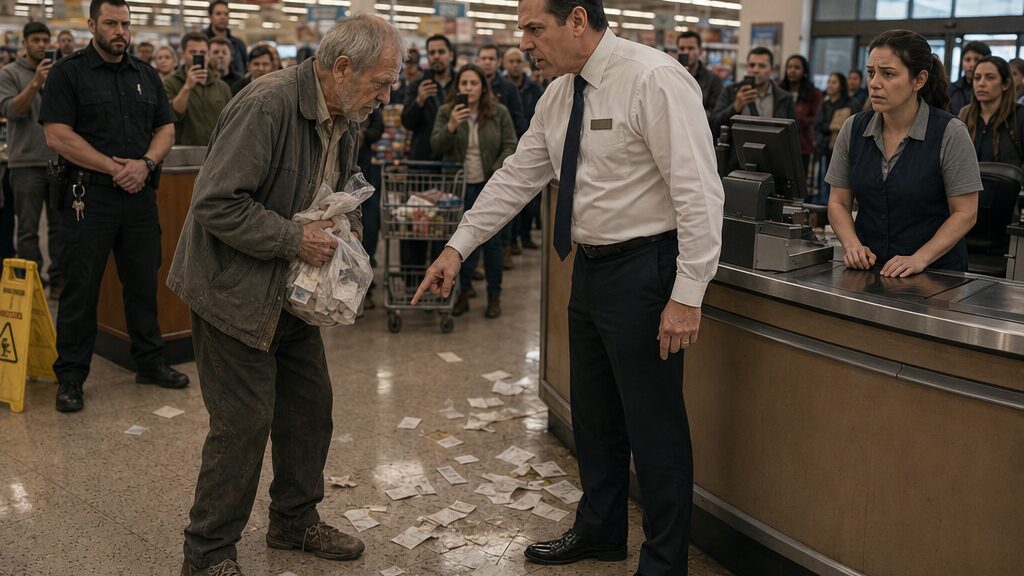
He pointed down, not at the paper, not at the spill, but at the tile beneath Edward’s shoes.
“This floor,” Anthony said, loud enough for the nearest lanes to hear, “is cleaner than your entire life.”
The beeping registers seemed to stop all at once.
Chapter 2: Receipts Scattered Under The Checkout Lights
The first receipt landed beside Heather Moore’s shoe with the word RESOLVED stamped across it in blue ink.
She saw the complaint number before she saw the old man’s hand reaching after it.
The paper slid under the checkout lights, thin and curling, carrying the number she had typed two weeks earlier after an elderly customer called three times about a denied refund. Heather had not handled the complaint. She had only seen it in the system for a moment before it disappeared.
Resolved.
Customer satisfied.
No further action.
The old man was still bent slightly at the service counter, one hand half open where the plastic bag had been.
Anthony Garcia held the bag now.
He had snatched it so fast the handles tore.
Receipts spilled across the floor in a dry rush. Folded papers fanned under carts. A refund slip skidded into the gray line of old milk near the wet floor sign. Several customers stepped back. Several did not. A cart wheel rolled over one paper and pinned it down.
“Look at this,” Anthony said, shaking the torn bag. “This is what he brought to my counter during peak hour.”
The old man lowered himself slowly, knees stiff, fingers searching for the nearest papers.
“I need those,” he said.
Anthony lifted his voice. “No, what you need is to stop harassing my staff.”
Heather stood at Register Six with a loaf of bread in one hand and nothing moving on her belt. The customer in front of her held out a loyalty card, forgotten. Heather could feel the receipt beside her shoe as if it were hot.
The complaint number was still visible.
She had been told never to discuss complaint codes on the floor. Never to say “deleted.” Never to ask why certain customer records closed themselves after Anthony spent ten minutes in the office.
Do your job, Heather. Don’t go digging for problems that aren’t yours.
Anthony had said that the first week after she transferred to this branch. He had smiled when he said it, and somehow that had made it worse.
Edward gathered two papers, but Anthony kicked another away with the side of his polished shoe.
“I asked for help,” Edward said.
“You came in here with trash,” Anthony answered. “You came in here trying to cause a scene.”
A child near the candy shelf stared. His mother pulled him closer but did not leave.
Phones rose now. Not openly at first. Chest-level. Half-hidden behind baskets. The small glass eyes of the crowd.
Anthony saw them. His expression flickered, and he transformed his disgust into performance.
“Everyone,” he said, “we are committed to maintaining a safe, clean shopping environment. Some people abuse that.”
Edward looked up from the floor. “Safe for whom?”
The question made Heather’s throat tighten.
She glanced toward the service counter camera. Its lens was still crooked, staring uselessly at chewing gum. Anthony had moved it himself last month after a man with a walker complained about being made to wait forty minutes. Heather remembered the little twist of his wrist, the careless explanation.
Better angle for theft prevention.
The receipt beside her shoe trembled under the air-conditioning.
Heather shifted her foot, covering the complaint number.
Not to hide it from the old man.
To keep Anthony from seeing that she had seen.
The customer at her register cleared his throat. “Miss?”
Heather blinked. “Sorry.”
Her fingers moved automatically over the bread, the soup cans, the carton of eggs. Beep. Beep. Beep. Her hands knew the work better than her head did.
At the counter, Edward tried to reach a folded paper near the wheel of a cart. The cart belonged to the woman in the cream coat, who moved it back just far enough that he had to stretch.
Anthony laughed once, sharp and humorless.
“Don’t crawl around on my floor.”
Edward’s hand stopped.
My floor.
Heather heard it. So did the clerk at customer service. His eyes dropped.
Edward lifted his head. “Is that how you speak to every customer who looks poor?”
Something in Anthony’s face changed. The word poor had named what everyone had been pretending not to see.
“We do not judge customers here,” Anthony said, more loudly than before. “We judge behavior. And your behavior is disruptive.”
The old man held up a receipt. His fingers were thin, the nails clean despite the worn sleeves. “Then look up this complaint and prove me wrong.”
Anthony slapped the paper from his hand.
It fluttered down and landed near Heather’s counter.
A few people gasped.
Heather moved before she decided to.
She stepped away from her register, bent toward the paper, and saw the number again. Not just one she recognized. Another beneath it, handwritten in faded blue pen. Several numbers. Several dates.
The old man had not come with random scraps.
He had come with a map of buried voices.
“Heather.”
Anthony did not shout her name. He did not need to.
The room seemed to tighten around it.
Her hand hovered inches above the paper.
Anthony walked toward her slowly, every step clean and controlled. “What are you doing?”
Heather’s fingers trembled.
The old man watched her. Not pleading. Not demanding. Just watching, with a kind of tired attention that made her feel more seen than she wanted to be.
“I was just—” she began.
“Just what?”
The customer at her register looked away from her as if fear were contagious.
Heather thought of her rent due Friday. Her younger brother’s community college bill folded inside the chipped bowl on her kitchen table. The warning Anthony had given the stock clerk last month after he helped a woman carry groceries she could not pay for.
We are not running a shelter.
Heather straightened without picking up the receipt.
Anthony smiled with one side of his mouth.
“There you go,” he said softly, then turned to make sure the customers heard the rest. “Touch his garbage and you can leave with him.”
The old man’s face did not change, but Heather saw something in his eyes narrow.
Not hurt.
Measurement.
“I’m sorry,” Heather whispered.
She did not know whether she was speaking to him, to herself, or to the woman whose complaint number lay under the checkout lights.
Anthony nodded toward the floor. “Back to work.”
Heather returned to Register Six. The customer pushed his loyalty card toward her without meeting her eyes. Her scanner would not catch the barcode on the first try. Her hand shook too badly.
The old man gathered what he could. Papers stuck to his palm from the dirty film near the spill. A receipt tore when he pulled it from under a cart wheel.
Anthony watched him with growing irritation, as if Edward’s quietness was an insult worse than shouting.
“You’ve made your point,” Anthony said. “Now leave.”
“I haven’t made it yet.”
“You don’t have one.”
“I have complaint numbers your system says are closed.”
Anthony’s gaze snapped toward him.
There it was.
Heather saw it before he hid it. Not anger. Fear.
Only for a breath, but it was enough.
The old man saw it too.
“I’d like them reopened,” Edward said.
Anthony took one step closer. “You’d like a lot of things, I’m sure.”
“I would like the truth.”
Anthony turned away, jaw tight, and raised two fingers toward the security podium near the entrance.
Tyler Allen looked up from his phone.
He was broad-shouldered, younger than Anthony but eager for his approval in a way that made him seem smaller. His black security shirt was stretched across his arms. A ring of keys hung from his belt and struck his thigh as he walked.
Heather’s stomach sank.
The old man was still kneeling among the receipts, plastic bag torn beside him.
Anthony did not look at Heather when he spoke, but his voice carried straight to her.
“Tyler,” he said, “come remove this problem.”
Heather’s mouth opened.
No sound came.
The old man looked once toward her, and she whispered again, so low only she could hear it.
“I’m sorry.”
Chapter 3: The Guard Who Twisted The Wrong Arm
Tyler Allen twisted Edward’s arm behind his back before asking him to stand.
The old man’s shoulder jerked, and his palm slapped the floor hard enough to smear through the gray film of dried milk and dirt. A sharp gasp moved through the checkout lanes. Someone dropped a box of cereal. It hit the tile with a hollow crack.
Edward did not cry out.
That made Tyler tighten his grip.
“Up,” Tyler said. “Manager told you to leave.”
Edward’s cheek was close enough to the floor that he could see the receipt paper flattened under cart wheels, the crumbs beneath the candy rack, the black rubber mark where someone had dragged a display stand. The store smelled of oranges, disinfectant, and warm plastic bags.
Under it all was the sour trace of something no mop had solved.
“I can stand,” Edward said. “You don’t need to force my arm.”
“You should’ve stood when asked.”
Anthony moved beside them, hands out as if calming a difficult scene he had not created. “Everyone, please continue shopping. We apologize for this man’s behavior.”
“This man asked for help,” a voice said.
It came from near Register Three.
A middle-aged woman with a basket pressed to her hip stared at Anthony with her phone already raised. Her thumb shook but she did not lower it.
Anthony turned toward her. “Ma’am, recording security matters is against store policy.”
“Since when?”
“Since I said this is a security matter.”
“That’s what you said last month when you dragged that elderly woman out by the pharmacy.”
The words hit the room differently than the insult had.
Edward felt Tyler’s grip falter for half a second.
Anthony’s eyes sharpened. “You need to be careful making accusations in public.”
“I saw it.”
“You saw an incomplete situation.”
“I saw her crying.”
“That customer became aggressive.”
“She had a cane.”
“She used it to block staff.”
The woman’s face tightened, uncertain now, not because she believed him, but because Anthony spoke with the confidence of a man who had practiced turning witnesses into liars.
Edward pushed one knee under himself.
Tyler yanked him higher. Pain ran up Edward’s shoulder, hot and clean. For the first time that day, Edward nearly broke character—not to reveal himself, but to stop the hand hurting him. Age had made his body less loyal than his will. He had planned for insult. He had planned for dismissal. He had even planned for being escorted out.
He had not planned for the way helplessness returned like muscle memory.
A boy near the candy rack whispered, “Mom, he’s hurting him.”
The mother pulled him back.
Edward saw the movement. Protect the child from the scene, not the scene from happening.
His old anger rose again.
Not yet, he told himself.
The words tasted worse now.
Anthony stepped toward the woman with the phone. “Delete that video.”
“No.”
“Then you may leave as well.”
A few customers began pushing carts toward other lanes, but the exits had slowed. Tyler, before grabbing Edward, had dragged a red queue barrier halfway across the front path. It did not block anyone completely, only confused the flow enough to make people hesitate.
Anthony liked hesitation. Edward could see that now.
Hesitation gave him space to redefine reality.
“He came in disorderly,” Anthony announced. “He dumped papers on the floor. He interfered with service. My guard is handling it.”
“He dumped them?” the woman said. “You threw them.”
Anthony smiled. “Ma’am, are you with him?”
The question did its work. The woman’s face flushed. She looked around and found no one stepping beside her. Her phone lowered an inch.
Edward finally got his feet under him.
Tyler kept Edward’s wrist pinned high, too high. “Walk.”
“I need my papers.”
“They’re trash.”
“They are mine.”
Anthony bent and picked up one of the receipts using two fingers, holding it away from himself. “These? You expect us to stop an entire store for this?”
Edward saw the handwritten number on it.
Sharon Adams.
The name was not on the receipt, but Edward knew the case attached to that number. Denied reimbursement for spoiled medication bought from the in-store pharmacy counter. Three calls. One in-person visit. File closed in twenty-six minutes. Customer satisfied.
Anonymous note received two nights later: She left crying. Anthony said not to encourage her kind.
Edward had read the note three times.
Anthony flicked the receipt aside.
It landed near Heather’s register.
Heather had gone pale. She stood rigid with a carton of eggs in her hand, the customer gone, the belt empty. Her eyes moved from the receipt to Edward’s arm to Anthony’s face.
Tyler began walking Edward toward the entrance.
The crowd parted. Not from respect. From fear of contact.
Edward’s cheap shoe dragged through a smear of grime and left a broken line behind him. He watched it appear on the floor: a dark, uneven mark across polished tile. The store had passed every inspection for cleanliness. The floor shone from a distance.
Up close, it held everything.
“You’ve done this before,” Edward said quietly.
Tyler leaned close. “What?”
“You heard him. You knew where to stand. You knew which way to turn the cameras.”
Tyler’s breath warmed Edward’s ear. “Old man, you don’t know anything.”
“I know your hand is too tight.”
“Then walk faster.”
Anthony followed behind them, speaking into the room. “Please understand, we care about all customers. But we cannot allow disruptions that affect families, workers, and the shopping experience.”
The words were polished. Corporate. Familiar in their shape.
Edward had heard versions of them in meetings. De-escalation language. Brand protection language. The soft cloth thrown over a hard act.
He had approved too many sentences like that.
A customer near the self-checkout muttered, “This isn’t right.”
Anthony heard. “Sir, if you would like to file feedback, our website is available.”
The man laughed once. “So you can delete it?”
Anthony’s smile disappeared.
Tyler shoved Edward against the edge of the service counter. Pain flashed through Edward’s ribs. His free hand caught the surface, but his palm slid through dust and floor grime transferred from his fall. He looked down at his own hand—creased, reddened, dirty.
For one suspended moment, he saw another hand, decades earlier, his father’s, blackened from warehouse work, holding a rejected coupon while a clerk told him to come back when he could read the rules.
Edward had built a company on the promise that no customer would ever be made to feel small for needing help.
And here he was, letting the promise be tested until it bled.
“Enough delay,” Anthony said. “Move him.”
Tyler adjusted his grip.
Across the floor, Heather stepped from behind Register Six.
She did not come toward Edward. Not openly. Not bravely enough for that.
Instead, as Anthony turned to address a customer with a raised phone, Heather bent as if tying her shoe. Her fingers closed around the receipt Anthony had flicked away—the one with Sharon Adams’s complaint number—and slid it into the pocket of her store vest.
Edward saw it.
Heather rose quickly, eyes lowered, pretending nothing had happened.
Tyler shoved him harder against the counter.
Edward kept his face turned toward the floor so Anthony would not see what had changed in his eyes.
Chapter 4: The Complaint That Was Marked Resolved
Heather typed the complaint number with her left hand because her right hand was still shaking too badly.
The customer service terminal blinked awake in the narrow corridor behind the counter, its screen reflecting her face in blue-white fragments. She had slipped away while Anthony argued with the woman recording near Register Three, while Tyler kept the old man pinned at the service counter like a package waiting to be removed.
The receipt lay flat beside the keyboard.
She had smoothed it with her palm, and now the dirt from the floor marked her skin in a gray crescent.
The number was short. Eight digits. Easy enough to forget if you wanted to. Impossible to forget once you understood what it belonged to.
Heather pressed Enter.
The system spun for two seconds.
Then the complaint opened.
CLOSED — CUSTOMER SATISFIED.
The words sat in a green box at the top of the screen.
Below it, the original entry was still there, half-collapsed behind a tab Anthony always told them not to expand. Heather clicked it before fear could stop her.
Customer states refund denied for spoiled pharmacy item. Customer elderly. Claims staff laughed when she asked for manager. Customer requests call back.
Heather swallowed.
The name field read: Sharon Adams.
She knew the name. Not from a face. From the break-room whisper that had followed the incident for a day and then vanished because Anthony made things vanish. An older woman, medicine in a paper bag, voice trembling at the counter. Tyler standing too close. Anthony saying policy in a tone that made the word sound like a locked door.
Heather scrolled lower.
There was a manager note attached.
Do not encourage this type. Repeat complainer. Mark resolved.
The timestamp showed Anthony’s login.
Heather’s hand hovered over the mouse. She could hear the store beyond the corridor: scanners beeping, carts rattling, Anthony’s voice rising and falling with polished anger.
She clicked another tab.
Deleted activity available only to supervisor profiles.
Heather should not have been able to see it. Her login did not have that access. But Anthony had used the terminal that morning and left his session alive beneath hers. She could see the small initials in the corner: AG.
Her breath caught.
There were more complaint numbers under Sharon Adams’s file. Related records. Closed refunds. Customer removals. Incident notes converted into “satisfaction follow-up.” A disabled customer marked “agitated.” A delivery worker marked “loitering.” A mother with coupons marked “suspected fraud” after asking why her discount had disappeared.
Heather pressed a hand to her mouth.
The receipt was not trash. It was a key.
A shadow cut across the corridor.
“What are you doing?”
Heather turned so fast her hip struck the counter.
Anthony stood at the corridor entrance, his expression empty of performance now. The public smile had been left on the sales floor. Here, under the humming light above the service printer, his face was only hard.
“I was checking the number,” Heather said.
“I didn’t ask what you were checking. I asked what you were doing.”
Behind him, Tyler shoved Edward against the counter again. The old man’s jacket bunched at the shoulder. One side of his face was turned toward the corridor, and though Tyler’s hand held him in place, his eyes were fixed on Heather.
Anthony stepped inside.
Heather instinctively reached for the receipt, but Anthony was faster. He slapped his palm down on it.
“No,” he said softly. “You don’t get to make this worse.”
“It was marked resolved.”
“It was resolved.”
“She wasn’t satisfied.”
“You talked to her?”
Heather hesitated.
Anthony smiled. “Exactly.”
Heather looked at the screen, where Sharon Adams’s complaint still glowed in the green lie of the system.
Anthony followed her eyes and saw his own initials in the corner.
For the first time since Heather had known him, he looked startled.
Not guilty. Not ashamed. Startled that a locked door had opened in front of the wrong person.
He reached over her and clicked out of the file.
“Move,” he said.
Heather did not move quickly enough. Anthony’s shoulder pressed her aside as he took the mouse, closed the complaint, and opened a blank incident report.
The title field appeared.
Customer Disturbance — Front End.
“He came in aggressive,” Anthony said.
Heather stared at the screen.
“No, he didn’t.”
Anthony’s fingers stopped above the keyboard. “Careful.”
“He asked for help.”
“He scattered papers on the floor.”
“You threw them.”
Anthony turned his head slowly.
The corridor seemed to shrink. Heather could smell his aftershave, sharp and expensive, cutting through the stale paper dust of the terminal station.
“You have a younger brother, don’t you?” he said.
Heather went still.
Anthony’s voice remained soft. “Community college. You pick up overtime because tuition went up. You told Rebecca that during your transfer interview.”
Heather’s face went cold.
“That has nothing to do with this.”
“It has everything to do with whether you understand the difference between a job and a feeling.”
On the sales floor, a customer called, “Is he okay?” Another voice answered, “They won’t let anyone near him.”
Anthony opened the incident report and angled the keyboard toward Heather.
“Write what happened,” he said.
She looked at the blank field.
“What you want me to write.”
“What happened,” Anthony repeated. “That a disorderly individual approached the counter with unsanitary items, refused to leave, became disruptive, and created a safety concern.”
Heather’s lips parted, but no answer came.
Anthony lowered his voice further. “And that you witnessed him raising his voice before security intervened.”
“He never raised his voice.”
“He made customers uncomfortable.”
“You made them uncomfortable.”
The words escaped before she could stop them.
Anthony’s eyes changed.
For a second, Heather saw what the old man must have seen from the floor: not just cruelty, but panic dressed as authority.
Anthony took the receipt from under his palm and folded it once, then again, making a small dirty square.
“You think this protects you?” he asked.
“No.”
“You think some old man with garbage papers is worth your job?”
Heather looked past him.
Edward’s face was still turned toward them. Tyler had one hand clamped around his upper arm, the other on his shoulder, but the old man was not watching Tyler. He was watching the folded receipt in Anthony’s hand.
Heather realized then that Edward had known the number mattered. Maybe not the details. Maybe not Sharon Adams’s name. But he had carried that receipt into the store because he expected it to open something.
Or someone.
“I think,” Heather said, though her voice almost failed, “that the complaint was real.”
Anthony stared at her.
Then he laughed once, too quietly for the crowd to hear.
“Real,” he said. “You want real? Real is a district inspection next month. Real is our customer satisfaction score. Real is my staff keeping this place clean enough that people with money don’t turn around and shop elsewhere. Real is you losing your hours because you decided to become a hero for a man who probably sleeps behind a bus stop.”
The old man’s eyes lowered for half a beat.
Heather saw it and hated Anthony for finding a place to cut.
But Edward did not speak.
His silence unsettled her more than shouting would have.
Anthony shoved the keyboard closer.
“Type.”
Heather looked at the blank report. Her name would attach automatically. So would the time. So would whatever lie Anthony needed later.
Her fingers touched the keys.
A clerk appeared at the corridor entrance, pale. “Anthony, people are still recording.”
Anthony did not look away from Heather. “Tell them the police will be called if they interfere.”
“The old man’s arm—”
“Tell them.”
The clerk vanished.
Heather typed one letter by accident.
T.
It appeared alone in the report field.
Anthony leaned close. “Finish it.”
Heather’s eyes burned.
She thought of the woman with medicine in a paper bag. She thought of her brother asking if she could still cover the semester. She thought of the old man’s palm on the dirty floor, the way he had said he wanted the truth as if the word still belonged somewhere.
Her fingers moved again.
Not to complete Anthony’s sentence.
She hit Backspace.
The single T disappeared.
Anthony’s face darkened.
From the counter, Edward spoke. His voice was quiet, but it carried through the corridor and into the lanes beyond.
“Ask her what she just found.”
Anthony turned.
Tyler’s grip tightened on Edward’s arm, but Edward did not wince this time. He looked at Anthony as if the manager were no longer a man blocking him, but a door that had already begun to crack.
Anthony unfolded the receipt slowly in his fist.
“What did you say?”
Edward’s eyes moved from Anthony to Heather, then back again.
“I said,” Edward answered, “ask her what she just found.”
Chapter 5: When Clean Reports Started Looking Rotten
Anthony shoved the tablet into Heather’s hands so hard she nearly dropped it.
“Write it now,” he said. “He smelled drunk. He shouted first. He refused service. Tyler intervened only after he became aggressive.”
The screen glared up at her, blank except for the title Anthony had already entered. Customer Disturbance. The words looked official enough to become true if she touched them.
Around them, the checkout floor had stopped pretending to shop.
Carts sat angled in lanes. A carton of milk sweated on the belt at Register Two. The woman with the phone stood near the candy rack, recording openly now. The customer service clerk hovered beside the counter as if unsure whether to protect his job or his conscience.
Tyler kept one hand locked on Edward’s upper arm.
Edward stood bent but steady. Dirt streaked the heel of his palm. His faded jacket was twisted at one shoulder. Receipts remained scattered under bright checkout lights, little white scraps against the polished tile.
Anthony pointed at the tablet. “Heather.”
She did not type.
“Do you understand what refusal means?”
Heather’s grip tightened around the device. “I understand what lying means.”
A murmur went through the nearest customers.
Anthony’s expression flickered toward the crowd. The performance returned, stretched thin across his anger.
“No one is asking anyone to lie,” he said. “We are documenting an incident involving a disruptive person during peak operations.”
Edward’s eyes moved to the large performance board mounted near the manager’s office.
It was impossible to miss from the front lanes: a glossy screen rotating through branch achievements. CUSTOMER SATISFACTION: 99.8%. FLOOR PRESENTATION: REGIONAL LEADER. COMPLAINT RESOLUTION: TOP SCORE. A smiling stock photo family pushed a cart beneath the numbers, clean and bright and unreal.
Edward had sat in the meeting where that board system was approved.
Clean data creates clean behavior, someone had said.
Maybe he had said it himself.
Anthony followed his gaze and misread it as envy.
“You see that?” Anthony said, jabbing a finger toward the board. “That is why this store works. Standards. Order. People come here because we don’t let the place turn into a shelter lobby.”
Edward looked at him. “And complaints?”
“Handled.”
“Or erased.”
Anthony’s mouth tightened.
A new slide appeared on the board: PROTECT THE SHOPPING EXPERIENCE.
The phrase struck Edward so hard he almost closed his eyes.
He remembered the memo. Not the exact date, but the room. A long table. Bottled water. Regional directors arguing over theft, customer satisfaction, and front-end congestion. Edward had approved a line about protecting the shopping experience from preventable disruptions.
He had meant spills. Broken carts. Long waits. Confused signage.
Anthony had turned it into people.
“Those words,” Edward said quietly, “are not policy for removing human beings.”
Anthony frowned. “What?”
Edward did not answer.
His own silence, which had felt like discipline an hour earlier, now felt like cowardice dressed as strategy. He had come to gather truth. He had gathered it. Yet Tyler’s hand was still on him. Heather was still standing with a tablet that could become a weapon against her. Customers who had been hurt before were being named liars again in public.
The test had begun to resemble the harm.
Anthony stepped close enough that only the first rows of customers could hear him clearly. “Listen to me, old man. I don’t know who filled your head with complaint numbers, but you picked the wrong branch. We are regional leaders. Headquarters loves clean reports.”
Edward looked again at the board.
Headquarters loves clean reports.
The words found a place inside him and stayed there.
Anthony continued, voice lower. “Do you think corporate wants people like you at the front counter every day? Do you think they want videos of arguments, refund fights, people crying over expired coupons? No. They want numbers. They want floors clean. They want lines moving.”
He tapped the screen with two fingers.
“And they reward managers who deliver.”
For the first time, Edward heard not merely contempt, but belief.
Anthony had built his cruelty inside a system of rewards. That did not excuse him. It made the damage larger.
The automatic doors opened.
Cold air rolled in from outside, along with the smell of exhaust and rain on asphalt. Beyond the glass entrance, two black cars sat at the far edge of the parking lot. Not close enough to announce themselves. Not far enough to be accidental.
Rebecca Thomas had arrived early.
Edward spotted her through the reflection first: dark coat, tablet under one arm, standing beside the second car with two auditors and a corporate security executive. Her posture was rigid. Waiting.
Waiting because he had told her to.
No intervention unless I use the code.
He had insisted on that condition. He had wanted the branch unguarded, unrehearsed, unable to hide behind manners. Rebecca had warned him that real people could get hurt between observation and proof.
Now Heather stood with a false report in her hands.
Edward’s shoulder throbbed.
Anthony saw him looking at the doors and snapped his fingers at Tyler. “Don’t let him make eye contact with more people. Back door.”
Tyler blinked. “Back door?”
“Yes. Receiving corridor. No cameras worth worrying about.”
The woman with the phone stepped forward. “Why would you take him where there are no cameras?”
Anthony turned sharply. “Ma’am, final warning.”
“You just said no cameras.”
“I said no interference.”
The performance was cracking now. Too many people had heard. Too many phones had captured something he could not polish.
Anthony jabbed a finger toward the clerk. “Keep the lanes moving.”
The clerk did not move.
Anthony looked at him. “Now.”
The clerk swallowed and turned away, but his hands shook as he picked up a fallen basket.
Heather still held the tablet.
Anthony faced her again. “Sign it.”
“No,” Heather whispered.
“Then I will write that you refused to cooperate during a security incident.”
“Then write that.”
His eyes narrowed.
Heather looked terrified. She was not brave in the clean, shining way people imagined courage. Her face had gone blotchy. Her mouth trembled. The tablet shook in both hands. But she did not type.
Edward felt the decision move closer, unavoidable now.
He could wait another minute. Let Anthony say one more thing. Let Tyler take one more step. Let Rebecca watch from the cars while the test completed itself into undeniable proof.
Or he could end it before someone else paid for his certainty.
Anthony snatched the tablet from Heather and thrust it toward Tyler. “You sign. You saw him resist.”
Tyler’s grip on Edward tightened. “Yeah. He resisted.”
“I asked for help,” Edward said.
“You pulled away.”
“You twisted my arm.”
“You were being removed.”
“Because he told you to.”
Tyler’s jaw bunched. “That’s my job.”
Edward turned his head enough to look at him. “Is it?”
For a moment, Tyler had no answer.
Anthony stepped between them. “Do not engage with him. He’s trying to confuse the situation.”
“No,” the woman with the phone said. “It’s pretty clear.”
A few customers murmured agreement.
Anthony’s face flushed. The crowd, which had been a silent witness he could manage, had begun to become something else. Not a mob. Not applause. Worse for him: a room full of people comparing what they saw to what he said.
His control was slipping.
He slammed his palm against the counter.
The sound cracked across the front end.
“Back door,” he said. “No cameras.”
Tyler jerked Edward away from the service counter.
Edward’s feet shifted over the dirty tile. One torn receipt stuck briefly to the sole of his shoe before sliding free.
Through the glass doors, Rebecca lifted her phone and looked directly at him.
Edward knew she was waiting for permission to move.
He had built the trap.
Now he had to decide whether the trap had already caught the wrong people.
Anthony pointed toward the receiving corridor behind the customer service desk. “Take him out that way.”
Tyler pulled.
Heather stepped forward. “Don’t.”
Anthony spun toward her. “One more word and you are done here.”
Edward looked at the performance board again.
CUSTOMER SATISFACTION: 99.8%.
The number glowed above the scattered receipts, above Heather’s pale face, above Tyler’s hand on his arm, above Anthony’s polished shoes standing inches from the dirty floor he claimed to protect.
Edward’s anger turned inward, sharp and clean.
He had wanted proof of Anthony’s corruption.
He had found proof of his own negligence.
Tyler dragged him another step toward the corridor.
Anthony snapped, “Move him before he makes it worse.”
Then, louder, for everyone: “Back door. No cameras.”
Chapter 6: The Executive Code Behind The Counter
“No.”
Heather said it so quietly that Tyler took another step before the word reached him.
Then he stopped.
The checkout floor seemed to hold its breath. Even the scanners fell silent, one by one, as cashiers looked up from half-filled bags and customers turned from belts loaded with groceries. The old receipts lay across the tile between them like scattered teeth.
Anthony stared at Heather.
“What did you say?”
Heather’s hands were empty now. The tablet was in Tyler’s grip, angled against Edward’s arm. Still, she lifted her chin.
“I won’t sign it. I won’t say he was aggressive. And I won’t say Sharon Adams was satisfied.”
A sound passed through the crowd—not loud, not celebratory. A low shifting of bodies as truth entered the room and made everyone adjust around it.
Anthony’s face changed completely.
Not anger first.
Shock.
For years, Edward imagined, Anthony had built obedience by making each person believe they were alone. A clerk here. A cashier there. A guard needing approval. A customer too embarrassed to return. A complaint number disappearing into a green box.
Heather had just broken the first link in public.
Anthony walked toward her.
Edward felt Tyler’s hand tighten as if the guard needed someone to hold on to.
“You don’t know what you’re talking about,” Anthony said.
Heather’s voice wavered but did not vanish. “I saw the file.”
“There is no file.”
“I saw your note.”
Anthony stopped close enough that Heather had to tilt her head back. “You accessed restricted records during an active security incident.”
“You left your login open.”
A few customers reacted. A cashier at Register Four put a hand over her mouth.
Anthony realized the error at once. His eyes moved to the phones still raised around the lanes.
He lowered his voice. “Heather. Think very carefully.”
“I have.”
“No, you haven’t. You have rent. You have family. You think the people recording this will pay your bills when you get fired?”
Heather blinked fast. Her courage bent under the weight of practical life.
Edward saw it. He saw the trap Anthony had set so neatly: morality on one side, survival on the other. He had seen people choose survival all his life and then hate themselves for it.
He had no right to demand Heather become braver than the company had protected her to be.
“Enough,” Edward said.
This time the word did not come from the poor old man’s performance.
It came from someplace older and harder.
Tyler looked down at him. “What?”
Edward straightened.
Not fully. His back would not permit theater. His shoulder ached, his wrist burned, and one knee trembled from the strain of being dragged across the front end. But he stopped folding himself into the shape they expected.
He stood as tall as he could.
Tyler felt the change before he understood it. “Keep moving.”
“No.”
Tyler pulled.
Edward did not.
The guard was stronger by far, but surprise gave Edward one clean second. He shifted his weight, turned his wrist inward, and freed enough space to step toward the customer service counter instead of the receiving corridor.
Anthony saw the movement. “Tyler.”
Tyler lunged to grab him again.
Edward placed his dirty palm flat on the counter.
The service clerk flinched at the mark it left.
Floor grime. On the clean counter. A dark print beneath the sign that read EVERY CUSTOMER MATTERS.
Edward looked at it and almost laughed, not from humor but from the exactness of it.
There was the company.
The floor brought to the counter.
The hidden thing made visible.
He reached for the internal phone mounted beside the service terminal.
Anthony moved fast.
“Don’t touch that.”
Edward lifted the receiver.
Anthony lunged around the counter, grabbing for the cord. Tyler released Edward and reached across the service desk, knocking over a cup of pens. Heather stepped between Anthony and the terminal before she seemed to know she had moved.
“Get out of my way,” Anthony snarled.
Heather’s face went white.
Edward held the receiver to his ear. The line hummed.
His fingers hovered over the keypad.
For one instant, he saw Rebecca outside the glass doors, still waiting. He saw the customers filming. He saw Heather blocking Anthony with nothing but a shaking body and a decision that could cost her rent.
This was the moment he had designed.
It looked uglier from inside it.
Anthony shoved past Heather’s shoulder. “That phone is for staff only.”
Edward pressed the first digit.
Anthony grabbed the cord.
Edward pressed the second.
The cord stretched taut. Tyler reached for the receiver.
The woman with the phone shouted, “Leave him alone!”
The child near the candy rack began crying.
Edward pressed the third digit.
A tone changed in the line.
Anthony froze.
He knew enough to hear that this was not a normal extension.
Edward pressed the final digit.
The old internal system clicked once. Twice. Then a recorded voice, calm and neutral, spoke through the receiver loudly enough for those nearest to hear.
Executive override accepted.
Anthony’s hand fell from the cord.
Heather turned slowly toward Edward.
Tyler took one step back.
Edward looked at the crooked camera above the service counter, then at the phones in customers’ hands, then at the performance board still glowing its perfect numbers over the dirty receipts.
He spoke into the receiver.
“Lock the front doors. Immediate executive audit.”
For half a second, nothing happened.
Then the automatic doors slid shut and stayed shut.
A metal lock clicked somewhere inside the frame. Then another. Then another, farther down the entrance.
The cheerful store music cut off mid-song.
The performance board blinked.
Anthony stared at the doors as the first black car rolled from the edge of the parking lot toward the entrance. The second followed. Then the third.
People turned, phones rising higher now.
Edward set the receiver back in its cradle with care.
His palm left another gray mark beside the keypad.
Anthony’s mouth opened once, closed, then opened again.
“What did you just do?”
Edward wiped dust from the front of his faded jacket. Not all of it came off. Some had settled deep into the fabric, into the seams, into the part of the disguise that had stopped feeling like a disguise.
He looked at Heather first.
Then Tyler.
Then Anthony.
“I ended the part where you decide what the cameras see,” Edward said.
Chapter 7: The Files Hidden Beneath The Floor Shine
Rebecca Thomas entered with sealed audit folders under one arm and went straight to the old man in the faded jacket.
She did not look at Anthony first.
She did not ask what had happened.
She stopped in front of Edward, her face pale beneath the front-end lights, and said, “Mr. President, we’re ready.”
The words moved through the supermarket like a dropped glass.
Phones rose higher. A cashier stepped backward into her register. The woman near the candy rack lowered her phone for one stunned second, then lifted it again. Tyler’s hand slipped completely away from Edward’s arm as if the old man had turned hot.
Anthony stared at Rebecca, then at Edward, then at the corporate security executive locking the entrance behind the auditors.
“No,” Anthony said.
It came out small.
Rebecca opened the top folder. “This location is under immediate executive audit. All registers remain active only for current customer checkout. No records are to be altered. No staff member is to leave the front end until interviewed.”
Anthony’s mouth worked soundlessly.
Edward flexed his fingers. Pain ran through his wrist and into his shoulder. He saw Tyler notice the movement and look away.
“Are you injured?” Rebecca asked.
“Not enough to leave,” Edward said.
Her eyes flicked to the dirt on his jacket, the marks on his palm, the receipts still scattered under carts. Something tightened in her expression. She had known the test was risky. She had warned him. Now the warning had a body.
Anthony found his voice. “This is a misunderstanding.”
Rebecca looked at him then. “Do not speak over the audit.”
“You can’t just lock my store.”
Edward looked at him.
Anthony corrected himself too late. “The store.”
Rebecca handed one folder to an auditor, who moved behind the customer service counter. Another opened a laptop on the return counter, ignoring the gray print Edward’s palm had left beside the phone. The corporate security executive stepped near Tyler without touching him.
“Badge and keys,” the executive said.
Tyler stiffened. “I didn’t do anything except what I was told.”
“Badge and keys.”
Tyler looked to Anthony.
That look was his confession.
Anthony did not return it.
“Security acted based on his training,” Anthony said quickly. “I was managing a disruption. Staff failed to control the line. Customers started filming. This whole thing became unsafe because people interfered.”
Heather stood near Register Six, both hands clasped in front of her vest. She looked smaller than she had when she said no.
Anthony pointed at her.
“And she accessed restricted records during an incident. She has been unstable for weeks. Ask anyone. She has personal issues. Money problems. She’s been looking for sympathy.”
Heather flinched as if he had slapped the counter again.
Edward turned his head slowly. “Stop.”
Anthony’s eyes darted to him. “Sir, with respect, you don’t understand what she’s been doing here.”
“With respect,” Edward said, “I understand more than you think.”
Rebecca’s auditor called from behind the terminal. “We have an active supervisor session under Anthony Garcia’s credentials. Complaint record accessed sixteen minutes ago. Prior deletion activity visible.”
The front end went quiet except for the buzz of the freezer lights.
Anthony swallowed. “Routine cleanup. Duplicates. We close duplicates all the time.”
The auditor did not look up. “Complaint attached to Sharon Adams. Refund denied. Manager note: ‘Do not encourage this type. Mark resolved.’ Timestamped under Anthony Garcia.”
A murmur moved through the crowd.
Anthony’s face drained, then flushed. “That note is being taken out of context.”
“What context makes that acceptable?” Rebecca asked.
Anthony turned sharply toward Heather again. “She had access. She could have edited it.”
Heather’s mouth opened.
Nothing came out.
Edward saw her fear return—not the fear of being fired now, but the fear of what she had not done before today. The fear that one true act could not erase months of silence.
The auditor clicked again. “Historical login trail confirms manager entry. No edit by Heather Moore.”
Anthony’s hand dropped.
Heather’s eyes filled, but she did not cry.
Rebecca approached her. “Heather, you are protected during this audit. You may answer without retaliation.”
Heather looked at Edward first, not Rebecca.
He hated that she seemed to need permission from the old man who had let the scene go on.
“I saw some of it before,” she said.
Her voice shook.
Anthony seized on it. “There. She admits it.”
Heather closed her eyes briefly. When she opened them, shame had steadied into something harder.
“I saw complaint numbers disappear. I saw customers marked satisfied when they left angry or crying. I heard him tell us not to encourage certain people. I didn’t report it.”
The confession changed the room more deeply than Anthony’s denial had. Not because it proved his guilt, but because it proved how fear had spread beyond him.
Heather kept going, each word costing her. “I needed the job. My brother needs help with school. I told myself someone else would say something. Then today he wanted me to sign a lie about Edward—about Mr. White—and I couldn’t.”
A register light blinked. No one moved to fix it.
Edward looked down at the receipts on the floor.
He had come to find villains. The room kept giving him frightened ordinary people instead, each bent around pressure until they either broke or passed the pressure down.
The auditor connected the laptop to the front display board. The glowing satisfaction score vanished. For a moment the screen went black. Then folders appeared. Complaint logs. Security footage. Incident reports.
A video filled the screen.
An elderly woman stood at the customer service counter with a paper pharmacy bag clutched in both hands. Edward did not need the label to know her: Sharon Adams. She was smaller than he had imagined from the file. Her shoulders folded inward. Her mouth moved silently in the footage while Anthony stood across from her with his arms crossed. Tyler appeared at the edge of the frame.
Anthony looked away from the screen.
The video cut to a later angle. Sharon Adams wiping her face near the exit. The complaint resolution status appeared beside the footage.
CUSTOMER SATISFIED.
A customer whispered, “Oh my God.”
Edward’s jaw tightened.
The auditor advanced through more files. A delivery worker ordered away from the waiting area. A disabled customer left alone while three staff members served people who arrived later. A mother with coupons surrounded by impatient shoppers while Anthony smiled and told her the system was down.
Beside each clip, the report language glowed in clean corporate phrasing.
Customer chose to leave.
Issue resolved at branch level.
No further action requested.
Edward felt each phrase as if someone had placed it in his own hand.
Rebecca stepped closer and lowered her voice. “Sir, I recommend we move the remainder to the office. Customers are recording. We can issue a controlled statement.”
Edward looked at her.
“Controlled,” he said.
Rebecca held his gaze. To her credit, she did not defend the word.
“We can protect the company while we proceed,” she said.
Edward looked from her to the front display, where Sharon Adams’s file remained frozen beside the false status. He looked at Heather, who had told the truth but not forgiven herself. He looked at Tyler, pale and rigid, keys already in the corporate security executive’s hand. He looked at Anthony, who seemed less angry now than cornered.
Then he looked at the floor.
The receipts had been walked over, smeared, folded, dirtied. But they were still readable.
“Protecting the company,” Edward said, “is how we got a floor this clean and records this rotten.”
Rebecca lowered her eyes.
Anthony took a breath, sensing an opening. “Mr. White, I did what your targets demanded. I kept this branch profitable. I kept complaints low. I kept the front end clean. You can’t punish me for understanding what corporate really rewards.”
The cruelty of it was not that he was entirely lying.
It was that he was partly right.
Edward walked to the service counter. His limp was no longer part of the disguise; the pain had settled in his knee for real. He picked up one old receipt, then another. Heather moved to help, stopped, then looked at him.
Edward nodded once.
She bent beside him.
This time no one threatened her.
Together they gathered the dirty scraps from the floor and placed them on the counter beside the printed audit reports. Physical receipts beside digital files. Grime beside polished language. The old paper looked fragile under the fluorescent lights, but it had survived the floor.
Edward lifted Anthony’s false incident report from the tablet screen and placed it beside the receipts.
“How many?” Edward asked.
Anthony stared at him.
Edward’s voice remained calm, but no softness remained in it. “How many people did we train you not to see?”
Chapter 8: The Badge On The Freshly Mopped Floor
Anthony asked for a private conversation as soon as Rebecca told him his access had been suspended.
Edward did not move toward the office.
“No,” he said. “This stays where it happened.”
Anthony’s face tightened. “Mr. White, please. People are filming.”
Edward looked at the phones still raised around the checkout lanes. Some hands trembled. Some faces looked guilty. Some looked relieved in a way that made him wonder how long they had been waiting for someone else to name what they had seen.
“Yes,” Edward said. “They are.”
Anthony lowered his voice. “I have served this company for eleven years.”
“And today you served yourself.”
“I protected the branch.”
“You protected numbers.”
“You wanted numbers.”
Edward absorbed the words because turning away from them would be too easy.
Behind Anthony, a janitorial worker had begun cleaning the scattered mess near the wet floor sign. Not the evidence; those receipts were sealed now in clear audit sleeves on the service counter. But the milk film, the shoe marks, the gray streak left by Edward’s palm when he fell. The mop moved slowly over the tile, spreading shine back across the place where the truth had been dragged out.
Rebecca stood beside the customer service counter with her phone to her ear. She spoke quietly, then looked at Edward.
“She agreed to come,” Rebecca said.
Edward nodded.
Anthony looked between them. “Who?”
No one answered him.
Tyler stood near the entrance with the corporate security executive. His badge and keys were gone. Without them, his black uniform seemed suddenly oversized, costume-like. He stared at the floor as if he could disappear into it.
The executive handed Rebecca a form.
She read it, then faced Tyler. “You are removed from duty pending investigation. The footage of your use of force will be referred for legal review.”
Tyler’s head snapped up. “He told me to remove him.”
Rebecca’s voice stayed flat. “You twisted an elderly customer’s arm behind his back and attempted to remove him through a non-public corridor.”
“He resisted.”
Edward looked at him. “I asked you to stop hurting me.”
Tyler’s mouth opened, but nothing useful came out. His gaze flicked toward Anthony again.
Anthony did not save him.
That silence landed harder than any reprimand.
Tyler looked down.
For a moment Edward saw the young man under the uniform: insecure, obedient, eager to be feared because he did not know how else to be respected. Then the moment passed. Harm still had a body. Excuses did not erase the grip on Edward’s arm.
The automatic entrance doors unlocked only long enough to admit an elderly woman in a dark coat with a paper pharmacy bag clutched under one arm.
She stopped just inside, alarmed by the crowd, the auditors, the frozen checkout lanes, the display screen still showing complaint files instead of smiling advertisements.
Rebecca went to her first. “Ms. Adams?”
Sharon Adams held the pharmacy bag tighter. “You said someone wanted to speak to me.”
Edward stepped forward.
Still in the faded jacket. Still dusty at the shoulder. Still with the cheap shoes and twine lace. He saw Sharon’s eyes take him in and hesitate, deciding whether he was another person needing help or another person who would ask for something from her.
“I’m Edward White,” he said.
Her face changed when the name reached her. Not awe. Suspicion first. Then weariness.
“I wrote to your company,” she said. “Three times.”
“I know.”
“No one called.”
“I know.”
“They told me I was confused. They said I used the product wrong. Then he told the guard to stand by me until I left.”
Anthony shifted behind Edward. Sharon saw him and went very still.
Edward did not ask her to speak louder. He did not ask her to repeat it for the phones. He did not turn her pain into proof for the crowd.
He lowered his head. “I am sorry.”
Sharon watched him carefully. “You’re sorry because you got caught seeing it?”
The question struck clean.
Edward accepted it. “Partly.”
Rebecca glanced at him, surprised.
Edward kept his eyes on Sharon. “And because I should have seen it before anyone had to send anonymous complaints. Your refund will be restored today. So will the records of every complaint tied to this branch. Compensation will be issued where harm is confirmed. But that does not repair what happened at this counter.”
Sharon’s grip loosened slightly on the paper bag. “No,” she said. “It doesn’t.”
“No,” Edward agreed. “It doesn’t.”
That answer seemed to matter more to her than an easy promise would have.
Anthony made a desperate sound. “Mr. White, with all respect, compensation decisions require review. We can’t just open every complaint because of one emotional afternoon.”
Edward turned.
Anthony looked smaller now, not because he had shrunk, but because his authority had. The polished shoes remained. The tie remained. The badge still shone on his chest. But everyone had seen the mechanism beneath the shine.
“You are relieved of your position effective immediately,” Edward said.
Anthony’s lips parted.
“Pending legal and corporate review, you are not to contact staff, customers involved in complaints, or any regional office except through counsel or the audit team.”
The words were not loud, but they carried through the front end.
Anthony’s hand went to his badge instinctively, covering his own name as if hiding it could delay the sentence.
Rebecca stepped forward with a small envelope. “Your access card.”
Anthony looked at her. “Rebecca.”
She held out her hand.
He did not move.
For a second, Edward thought Anthony might refuse, might shout, might make one final performance from the wreckage of the day. Instead, his shoulders sagged. Not in remorse. In calculation reaching the end of its usefulness.
He unclipped the badge.
The metal pin caught on his shirt. He tugged too hard, tearing a thread loose. The badge slipped from his fingers.
It hit the freshly mopped floor with a small, bright sound.
No one clapped.
The absence of applause made the moment heavier.
Anthony stared at the badge as if it belonged to someone else.
The janitorial worker stopped mopping. The wet shine spread around the badge in a thin halo.
Edward looked at Heather.
She stood behind the service counter beside the sealed receipts, eyes red, hands folded around nothing. She had not smiled when Anthony fell. That, too, mattered.
“Heather Moore,” Edward said.
She startled.
“You will give a protected statement to the audit team. Your prior silence will be reviewed in context. Your refusal to sign a false report today will also be part of the record.”
Her eyes filled again. “Am I fired?”
“No.”
The word seemed to remove weight from her body all at once.
Rebecca stepped in. “Effective tomorrow, you’ll report directly to regional operations during the audit. If you accept, you’ll serve as interim front-end supervisor with whistleblower protection while we rebuild staffing procedures.”
Heather looked at Anthony’s badge on the floor, then at the counter where the old receipts were sealed in sleeves.
“I don’t know if I deserve that,” she said.
Edward answered, “Then earn it by protecting the next person faster than you protected me.”
The words hurt her. They were meant to.
They also gave her something clear to hold.
She nodded.
Edward turned toward the remaining staff and customers. He did not raise his voice much. The room was already listening.
“This branch is closing at the end of current checkout for a full audit. Every deleted or closed complaint connected to this location will be restored and reviewed by an independent team. Customers who were denied lawful refunds or mistreated will be contacted. Employees who were threatened may testify safely. Security procedures will be reviewed immediately.”
He paused.
The performance board behind him still showed files instead of slogans.
“And the policies that rewarded clean numbers over honest service will be reviewed at headquarters by me.”
Rebecca looked at him then, and this time her expression held no caution. Only recognition.
Edward felt the cost of the sentence settle around him. Investors would hear. Directors would object. Legal teams would ask why he had said so much with cameras pointed at him. The company’s perfect language would crack in public.
Good.
A perfect lie deserved a public crack.
Customers began moving slowly toward the registers to finish checking out. Not casually. Not as before. The front end had been changed, and every beep sounded different now, less cheerful, more human.
Sharon Adams stood near the entrance, still holding her paper bag. Edward approached her once more.
“Someone from Rebecca’s team will walk through the refund with you,” he said. “Privately.”
Sharon looked at his dirty jacket. “You dressed like that on purpose?”
“Yes.”
“To see if they’d treat you like us.”
Edward did not soften it. “Yes.”
“And did you learn enough?”
He looked at the floor where Anthony’s badge lay, at Heather speaking with an auditor, at Tyler being escorted toward the side exit, at Rebecca collecting the sealed receipts that had been called garbage less than an hour before.
“No,” Edward said. “But I learned where to start.”
Sharon studied him, then gave a small nod that was not forgiveness but was not refusal either.
The janitorial worker glanced at Edward, unsure whether to pick up the badge.
Edward bent first.
His knee protested. His shoulder burned. For a moment he was simply an old man lowering himself toward a clean floor with too much pain in his joints.
He picked up the badge by its edge and placed it on the counter beside the sealed reports.
Then he took one remaining torn receipt from his jacket pocket, the one he had kept separate from the bag all day. It was blank on the back except for a sentence he had copied from the first anonymous complaint.
They made me feel dirty for asking.
Edward folded it once and placed it with the others.
The front doors opened for him.
No black coat was brought. No assistant rushed to cover the faded jacket. Edward walked out as he had entered: poor-looking, slow, carrying the mark of the floor on his sleeve.
Behind him, Anthony’s badge remained on the freshly mopped tile for one final moment before Rebecca picked it up as evidence.
Edward stepped into the evening air without looking back.
The story has ended.