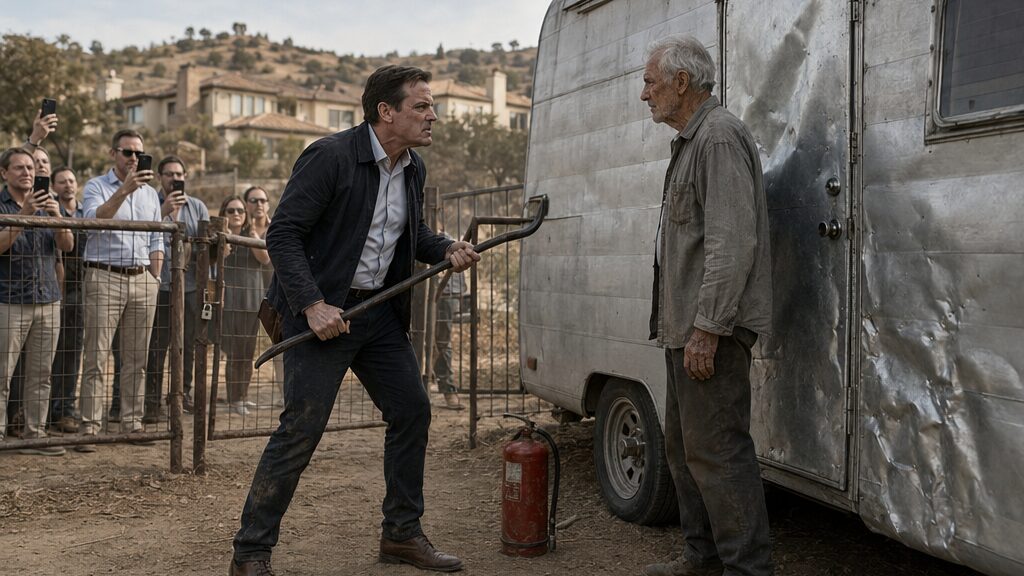
The Old Man in the Dusty Paddock Owned Every Fence They Crossed
Chapter 1: Three Bangs on the Aluminum Door
The first blow hit the RV hard enough to jump the coffee in Edward Nelson’s cup.
The second made the aluminum door bark in its frame.
The third came slower, deliberate, metal on metal, as if the man outside wanted every house along the road to hear it.
Edward kept his hand wrapped around the cup. It was chipped at the rim, brown from years of use, and hot enough to bite the skin below his thumb. He sat at the narrow table beside the small window, a paperback open in front of him, the page held down by a pair of reading glasses. Dusty morning light came through the curtains in strips. Outside, beyond the thin RV wall, someone laughed too loudly.
“Open up!” a man shouted. “Open up, squatter!”
Edward did not move.
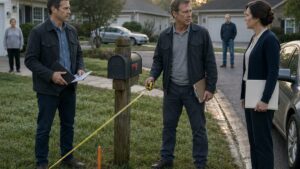
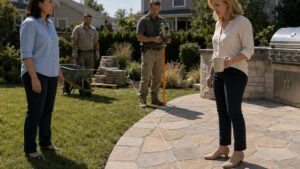
A phone camera lens glinted through the crack in the curtain. Then another. The old paddock fence, which had stood for decades with its peeling white rails and rusted wire, had become a viewing line. Beyond it, the polished faces of the neighborhood gathered in workout clothes, pressed shirts, soft sweaters, sunglasses. People who had once walked their dogs through the back gate and let their children chase fireflies in the tall grass now stood as if the dust itself might stain them.
The Maglite struck again.
This time, the door handle trembled.
Edward looked at it, then lowered his eyes to the folder lying beneath his coffee mug.
The folder was thick, dark, and plain. No name on the front. No warning. Its corners had softened from being moved from drawer to table to dashboard and back again. He had placed it there before dawn, not because he wanted to use it, but because some mornings told a man to keep certain things close.
Outside, the voice rose.
“This property is under private management! You’ve been warned. You’ve had your chances.”
Edward breathed through his nose. He turned one page of the paperback, not reading it now. A habit, more than anything. A small refusal to let the rhythm outside choose the rhythm inside.
The RV had taken many insults over the years. Children had dared each other to touch it and run. Someone had taped a printed notice to the window once, all capital letters and no authority. A delivery driver had asked if Edward needed shelter information, then seemed embarrassed when Edward thanked him and said no. Two boys had thrown gravel at the side panel last summer. Their mother later walked past him without apology, earbuds in, pretending not to know.
This morning was different.
This morning had witnesses waiting for damage.
A shadow crossed the curtain. Broad shoulders. Expensive jacket. Polished shoes sinking badly into paddock dust.
Gregory Green.
Edward had learned the name because Gregory said it often. On calls. At meetings near the curb. To residents who liked the sound of a man promising order. Gregory was the property manager for several streets around the old farmland subdivision, though not for this fenced lot. He wore authority like a tailored coat and carried papers in a leather portfolio even when he did not need them.
The Maglite knocked once more, closer to the latch.
“Edward Nelson,” Gregory called, stretching the name like he had discovered something shameful. “This is your final verbal notice.”
From outside came a woman’s voice, uncertain. “Is he even allowed to be in there?”
Gregory answered loudly enough for the cameras.
“No. This lot belongs under managed community control. That vehicle is unauthorized, unsafe, and a nuisance. We’ve tried the polite way.”
Edward’s mouth tightened, but only for a moment.
Through the side window, he could see the paddock as it had become in the neighborhood’s eyes: overgrown, dusty, useless. A scar left over from before the cul-de-sac curved around it and the houses rose in pale stone and dark glass. The old feed trough leaned near the far fence. A wooden post still bore the rubbed mark where horses had scratched their necks forty years ago. In the corner, the ground dipped where rainwater gathered each spring and children once came home with muddy shoes and stories about frogs.
To the neighborhood, it was an eyesore.
To Edward, it was the only piece that had not lied about what this land used to be.
Another phone lifted beyond the fence. Someone whispered, “Get this. He’s finally doing it.”
Edward set his cup down. Carefully. The bottom of the mug touched the folder with a soft tap.
The silence inside the RV lasted just long enough for those outside to notice.
Gregory took advantage of it.
“You hear me in there?” he shouted. “I have residents out here frightened for their families. You think you can just squat in a derelict vehicle and intimidate decent people?”
Edward folded the corner of his page, closed the book, and placed the glasses on top.
“Come on,” another neighbor muttered. “Just leave.”
A child somewhere near the sidewalk asked, “Is he dangerous?”
No one answered quickly.
Edward stood. His knees gave their usual complaint, quiet but sharp. He waited for the first ache to pass, then reached for the faded work shirt hanging over the chair. He pulled it on over his undershirt, buttoning slowly. In the tiny mirror beside the cupboard, he saw his own face in pieces: white stubble, creased skin, eyes that had learned long ago not to hurry for anyone’s noise.
The Maglite struck again.
The dent it made was small but final.
Edward looked at the door.
Outside, Gregory said, “I’m dragging this wreck out of here today. You can walk out, or you can be removed.”
A murmur of approval moved along the fence. Not loud. People like that rarely wanted to sound cruel on camera. They wanted someone else to do the breaking while they supplied the concern.
Edward took the folder from beneath the mug, weighed it in his hand, then set it back down.
Not yet.
That was the old mistake, perhaps. The same one he had made for years. Let them talk. Let them sneer. Let the fence stand for itself. Let the records sit in their drawers. People revealed themselves eventually.
But what they revealed, he had begun to understand, did not always stop them.
He moved toward the door.
Outside, dust shifted under Gregory’s shoes. “Last chance.”
Edward’s hand touched the latch.
The RV smelled faintly of coffee, paper, old vinyl warmed by sun. Before he opened the door, he looked once at the narrow shelf above the table. A black-and-white photograph rested there in a cheap frame: a younger stretch of the same paddock, open farmland behind it, fence posts straight and bright, no mansions beyond. He had not looked at the picture much lately. Looking too long made the past feel like a thing asking him why he had let strangers rename it.
He slid the bolt.
The sound cut the crowd quiet.
The door opened inward with a tired metallic scrape.
Morning rushed in, dry and bright. Gregory stood one step below, face flushed with triumph before Edward had even spoken. He held the heavy flashlight in his right hand. At his feet sat a large red fire extinguisher, scuffed along one side. A crowbar leaned against his leg, dark iron catching the sun.
Behind him, several neighbors had crossed through the gate and stood inside the paddock, though most kept close to the opening as if distance might preserve innocence. More waited behind the fence, phones raised.
Edward stepped down onto the dusty ground.
He did not look at the cameras first. He looked at the gate.
It hung open.
Someone had unfastened the chain.
Gregory smiled in a way meant for the people watching. “Good. You can understand me after all.”
Edward’s gaze moved from the gate to the copied key ring hanging from Gregory’s hand.
Then to the Maglite.
Then to the dent beside the RV handle.
“You already crossed the fence,” Edward said.
Gregory’s smile twitched.
For the first time that morning, the people along the fence stopped filming the old man as if he were the only thing worth watching.
Chapter 2: The Manager Who Sold a Lie
Gregory Green had deleted the most honest sentence in the notice before sending it.
He sat alone in the management office the afternoon before the confrontation, one hand on the mouse, the other pressed flat against the desk blotter. The notice glowed on the screen beneath the company logo.
Pending ownership verification, residents are advised not to enter the paddock area.
Gregory read it twice, jaw tight.
Then he highlighted the sentence and erased it.
The notice looked cleaner without it. Stronger. Less like a man asking permission from records he had not controlled and more like a man in charge of a neighborhood that paid him to keep things spotless. He replaced the line with something better.
For safety and preservation of community standards, residents are advised that unauthorized vehicles and occupants are being addressed by management.
He leaned back.
Addressed.
That was the kind of word people liked. It promised action without explaining authority. It sounded legal to anyone who did not have the patience to ask what law stood behind it.
His phone vibrated. A message from a resident on the north side of the cul-de-sac.
Any update on the RV situation? Buyers touring this weekend. We can’t have that thing visible.
Gregory stared at the message longer than it deserved.
Buyers. Weekend. Visible.
Those three words had been hammering at him for two weeks. A listing package for the homes along the paddock had just gone live, and the real estate agents had already complained that every drone shot had to crop around the fenced lot. The old RV appeared in too many angles like a stain no editing could fully remove. Residents who had once enjoyed walking through the back gate now spoke of trespassing, danger, sanitation, declining values.
They wanted the paddock when it felt rustic.
They wanted the old man gone when the rustic came with a face.
Gregory picked up his leather portfolio and opened the inner flap. Inside were copies of maps, maintenance requests, old neighborhood newsletters, printed emails, and one thin letter on management letterhead that said far less than residents assumed. None of it showed ownership. None of it granted him enforcement authority over that fenced acre.
But the residents did not read closely. They listened closely.
That had always been enough.
He typed back: Handling tomorrow morning.
Then, after a moment, he added: Final removal attempt scheduled.
The answer came almost instantly.
Thank God. Everyone’s watching.
Gregory set the phone down, but the words remained in his head.
Everyone’s watching.
He got up and crossed the small office to the window. Outside, the parking lot reflected afternoon heat. His own face hovered in the glass: clean-shaven, controlled, expensive enough from a distance. He adjusted his collar.
A framed certificate on the wall announced his company’s excellence in community stewardship. The certificate was not fraudulent, not exactly. It was simply generous. Like most things in his career, it depended on people accepting the frame before studying the paper inside it.
A knock came at the open door.
A woman from the front desk stood there holding a stack of resident complaint forms. “More about the paddock.”
Gregory did not turn. “Put them on my desk.”
“One of them asks why the police didn’t remove him last time.”
Gregory glanced back.
“That’s because patrol officers don’t like touching property disputes unless someone forces clarity,” he said.
The front desk woman hesitated. “Do we have clarity?”
“We have responsibility.”
It was a practiced answer. It made people feel rude for wanting a legal one.
After she left, Gregory opened a drawer under the supply cabinet. He had placed the copied gate key there months earlier, after a landscaping contractor left a maintenance ring unattended near the clubhouse. The key had not been labeled. It did not need to be. It fit the old paddock lock, and that was what mattered.
The first time Gregory used it, he had only walked the perimeter. He told himself it was inspection. The second time, he had let a photographer in to take “community lifestyle” shots without the RV visible. The third time, he had allowed a resident event committee to measure the space for a harvest table arrangement that never happened.
After that, crossing the fence had stopped feeling like crossing anything at all.
Until Edward Nelson arrived in the RV and made the old boundary visible again.
Gregory hated the way the man sat there.
Not loud. Not begging. Not explaining. Just present. Drinking coffee. Reading books. Letting the fence, the dust, and the old vehicle ruin Gregory’s careful language. A true trespasser should have acted nervous. A homeless man should have asked for something. Edward did neither, which made it harder to place him.
So Gregory placed him anyway.
Vagrant.
Squatter.
Liability.
Words were fences too, if enough people repeated them.
That evening, he held an informal meeting on the sidewalk near the paddock, where the grass was trimmed and the mailbox posts matched. Residents gathered with folded arms and reusable water bottles. The RV sat beyond the fence in the falling light, its dull aluminum side catching orange streaks. Edward was visible through the small window, head bent over a book.
“He’s been there for weeks,” one neighbor said.
“Longer than that,” another said. “Off and on, anyway. I’ve seen smoke from a little camp stove.”
“Police came twice,” a man added. “They talked to him and left. Why?”
Gregory let the question hang long enough to make his answer sound measured.
“Soft enforcement,” he said. “Officers don’t always understand community management issues. They see an elderly man, they hesitate. That doesn’t mean he has a right to be there.”
A few people nodded.
“What if he owns it?” a quieter voice asked from the back.
Gregory’s eyes found the speaker, an older resident standing half behind her husband.
“The lot falls within the historic development footprint,” he said. “Our office has maintained access, safety coordination, and resident use standards for years.”
It was not an answer. It was several official-sounding phrases stacked together, and it worked. The older resident looked down.
“He makes my daughter uncomfortable,” someone else said.
“That RV is a health hazard.”
“It’s hurting values.”
“Someone needs to do something.”
Gregory lifted both hands, calming them into the performance he wanted.
“I will handle it,” he said. “But I need everyone to remain behind me and document appropriately. If he refuses to leave, we create a record. If he becomes aggressive, that record matters.”
The crowd absorbed this with the solemn pleasure of people being granted permission to watch cruelty and call it civic duty.
Early the next morning, Gregory parked his SUV near the service path behind the clubhouse. He wore polished brown shoes, not boots, because the image mattered more than the dust. From the back of the vehicle, he took the Maglite, a crowbar he had borrowed from maintenance, and a large fire extinguisher whose label he had not checked. He told himself the extinguisher was for safety. He liked how heavy it looked.
A resident passing with a phone slowed. “Is today the day?”
Gregory gave a tight smile. “Today is the day.”
By the time he reached the paddock, people had begun drifting out of their houses. Curtains moved. Garage doors froze halfway open. The fence line filled slowly, then eagerly.
Edward’s RV sat at the far side of the lot, still, faded, stubborn.
Gregory stopped at the gate.
For one brief moment, with the copied key in his palm, he felt the old uncertainty. Not fear, exactly. Something smaller and more irritating. The knowledge that a thing being easy to open did not make it his.
Then someone behind him said, “We’re recording.”
Gregory straightened.
He put the key in the lock.
The chain slackened with a dry scrape.
He stepped through, carrying the Maglite in one hand, the crowbar in the other, and the shape of authority on his face.
Chapter 3: Coffee, Dust, and the Old Boundary
Edward saw the boot prints before he saw the people.
They cut across the dusty stretch between the gate and the RV in overlapping patterns, some deep, some light, one narrow set from polished shoes with smooth soles that had slid at the heel. The marks were too fresh for yesterday’s wind to have softened them. They passed the old trough, circled near the fence latch, and stopped close to the RV door.
Edward stood on the step with his coffee cooling in one hand.
He knew every honest mark in that dirt.
Birds left small arrows. Rabbits pressed paired ovals near the grass. Children, back when parents still asked before entering, made scattered little storms of footprints, all running and stopping and running again. Landscapers cut straight lines when he allowed brush clearing twice a year. His own boots moved between RV, gate, trough, and fence post with the same dull patience.
These prints had come in like ownership.
He stepped down and followed them to the gate.
The chain hung where it had been replaced, looped twice instead of three times. The lock was closed but turned backward. Edward touched the brass face with his thumb. New scratches shone around the keyhole, bright against old tarnish.
He stood there longer than necessary.
Beyond the fence, the neighborhood was waking behind glass and stone. Sprinklers clicked in perfect arcs. A garage door opened with a smooth mechanical sigh. Somewhere, a dog barked once and was hushed.
A woman on the sidewalk slowed when she saw him. Her phone rose halfway, then lowered when he looked in her direction.
Edward could have called out. He could have asked why strangers had entered his land before breakfast. He could have told her exactly what that fence meant and what it had always meant. Instead he lifted his coffee, took a sip, and turned back toward the RV.
That was the habit.
Let the fence speak.
Let the lock speak.
Let a man’s own behavior speak for him.
Only lately, behavior had begun speaking in a language nobody cared to translate.
Inside the RV, Edward set the mug on the table beside the black folder. The small space was neat without being tidy. Books stacked by subject along the bench: land records, old military histories, a field guide to birds, two mystery novels with cracked spines. A wool blanket folded tight. A toolbox under the sink. On the wall near the cupboard hung a faded photograph of the paddock before the houses, with three horses at the far rail and a line of open fields beyond them.
Edward touched the photo frame with one finger.
“You’d have hated the gates,” he murmured.
The voice was so quiet it barely existed.
He had not always stayed in the RV. The neighborhood had decided that part for him too, building the story backward from what they saw. In truth, he came when the paddock needed watching, when the old ache in his chest sharpened, when the houses pressed too close in his mind. Sometimes he stayed one night. Sometimes a week. Once, after the first fence board was kicked loose and no one admitted it, he stayed nearly a month.
He liked mornings there.
Coffee before traffic. Dust warming under the sun. The sound of mourning doves on the power line. The old feed trough catching rainwater. The fence proving that something could survive being surrounded.
The phone rang on the table.
Edward looked at the number before answering.
“Nelson.”
A woman’s careful voice came through. The county records clerk. He had spoken with her three times that month and liked her because she never pretended uncertainty was clarity.
“Mr. Nelson, I’m calling to let you know the stamped injunction is ready for pickup. The judge signed yesterday afternoon.”
Edward sat slowly.
“Thank you.”
“It does confirm private ownership and restricts unauthorized entry or interference with the parcel, but I need to be clear. For enforcement, you’ll need a documented violation. Someone entering, damaging property, attempting removal, that kind of thing.”
Edward looked through the window at the bright scratches around the lock.
“I understand.”
There was a pause.
“I also wanted to tell you,” the clerk said, lowering her voice though no one on Edward’s end could hear her, “we had a records inquiry from a management company two weeks ago. Same parcel. They asked whether informal maintenance history could establish control.”
“And what did you tell them?”
“That ownership doesn’t work that way.”
Edward closed his eyes.
For a moment, the RV seemed to shrink around him. Not from fear. From the pressure of something old finally becoming foolish.
He had known Gregory was pushing. He had heard enough through open windows and fence-line meetings. But knowing a man was pretending and knowing he had already been told better were different kinds of weight.
“Mr. Nelson?” the clerk asked.
“I’m here.”
“I can’t advise you beyond the paperwork. But if there’s trouble, keep the order with you.”
Edward thanked her and ended the call.
For a long time, he sat with the phone in his hand.
A documented violation.
He almost laughed, though nothing was funny.
How many small violations counted only as manners dying? The first time a resident let their dog run loose after he asked them not to. The first child told to stay away from “that man” while standing on his grass. The first printed complaint taped to his window. The first photograph taken through the RV curtain. The first time someone called land he had preserved “community overflow.”
None of those had seemed worth a courtroom.
So he had waited for people to reveal themselves.
Now the revealing had a schedule.
Outside, tires crunched along the lane. More than one car. Doors shut. Voices gathered behind the fence in sharp morning fragments.
Edward rose and opened the drawer beneath the bench. Inside lay the stamped injunction in a large envelope, its seal pressed heavy into the paper. He had picked it up before dawn from the after-hours county box, though he had not wanted to look at it again. The law made everything plain in a way memory never could.
He slid the injunction into the black folder.
Then he picked up the photograph from the shelf.
In the picture, the old fence had been new. He stood in the background, much younger, one arm braced on a post, his face turned away from the camera. The woman who had taken it was not in the frame. She rarely was. That had been her way—keeping proof of everything but herself.
He returned the photograph to its place.
A shape moved outside the RV window.
Not a neighbor lingering behind the fence this time. Closer. Inside the paddock.
Edward looked toward the gate.
Gregory Green stood there with the copied key still hanging from the lock. A Maglite rested against his thigh. A crowbar angled from his other hand. Behind him, people crowded in the opening and along the rails, phones already lifted, faces bright with the relief of finally seeing someone else force the morning to a conclusion.
Edward took the black folder and put it inside the pocket built into the RV door, low and within reach.
Then came the first blow against the aluminum.
The door rattled.
The coffee trembled.
Edward placed his hand on the latch, but did not open it yet.
Outside, Gregory’s shadow filled the window, and the old fence behind him stood open like a warning no one had bothered to read.
Chapter 4: The Crowbar Crosses the Line
Gregory slammed the Maglite against the RV door again, and this time the aluminum kept the shape of it.
A shallow dent appeared beside the handle, bright where the old paint cracked. The sound ran across the paddock and hit the fence line like a thrown pan. Several neighbors flinched. None of them lowered their phones.
Edward looked at the dent before he looked at Gregory.
“That is enough,” Edward said.
Gregory’s smile showed teeth but no ease. “No, Mr. Nelson. Enough was three complaints ago. Enough was when families stopped feeling safe walking past this eyesore. Enough was when management had to spend weeks dealing with you because you think age makes you untouchable.”
Edward stood on the lower RV step, one hand resting lightly on the doorframe. The black folder sat within reach in the pocket just inside the door. He could feel its presence the way a man felt a tool on his belt.
Not yet.
Gregory needed only one clean violation. A documented one. The clerk’s voice had been clear. Entering, damaging, attempting removal.
The dent already spoke. The open gate spoke. The copied key still dangling from the lock spoke.
But Gregory’s crowd was speaking louder.
“Just cooperate,” someone called from near the gate.
“Don’t make this worse.”
“He’s filming us too, isn’t he?”
Edward’s eyes moved over them. A neighbor in tennis clothes. A man in a pressed shirt with his phone held high. A woman hiding her face behind oversized sunglasses while recording with the other hand. Two people stood fully inside the fence, though they had drifted backward once Edward stepped out.
He pointed toward the gate.
“Every person inside this fence is trespassing.”
A brittle laugh came from Gregory.
“You don’t get to declare that.”
“I just did.”
Gregory’s expression hardened. For one second, the polished manager disappeared and something rawer came through, something frightened by the possibility that the old man might not be confused. Then Gregory turned slightly, letting the cameras catch his profile.
“You hear that?” he said to the neighbors. “He is threatening residents now.”
“I warned you,” Edward said.
“With what authority?” Gregory snapped.
Edward looked at the copied key again.
Gregory followed his gaze and closed his fist around the ring. “This gate has been under community maintenance access for years.”
“Access is not ownership.”
The words landed too cleanly.
A murmur passed through the neighbors, not sympathy, but discomfort. Someone lowered a phone an inch. Gregory heard the change and hated it.
He stepped closer, raising the Maglite again, not striking now, only pointing with it. “Listen carefully. This vehicle is not permitted. You are not permitted. We have documentation.”
Edward glanced at the crowbar against Gregory’s leg. “Then bring documentation.”
“I don’t need to prove anything to you.”
“You came through my gate with a copied key, a flashlight, a crowbar, and that.” Edward nodded toward the heavy fire extinguisher near the RV’s front wheel. “Seems like proving was not your plan.”
Gregory’s jaw flexed.
The fire extinguisher sat in the dust, red paint chipped, hose clipped to the side. It was too large for a simple safety prop. Its base had already been set close to the RV’s passenger window, where one hard swing would shatter glass. Edward saw that. So did Gregory, because his eyes flicked toward it for half a breath.
One of the neighbors whispered, “Why does he have that?”
Gregory heard it.
“It is standard safety equipment,” he barked.
The whispering stopped, but not because anyone believed him.
Edward stepped down fully onto the dirt.
Dust gathered around his boots. His shoulders were narrow under the old work shirt, his face pale and lined in the early light. He looked, to anyone who wanted him small, like a man who should have been easy to move.
That was the trouble with people who measured only the visible thing.
Gregory took another step forward. “You are vacating now.”
“No.”
The word was quiet.
Gregory stared at him. “No?”
“No.”
Something shifted in the paddock then. The fence creaked in a light breeze. A phone gave a tiny electronic chirp as it refocused. The neighborhood, which had expected pleading or panic or a messy old man’s confusion, found itself watching stillness instead.
Gregory could not allow stillness. Not in front of them.
He dropped the Maglite into the dust and grabbed the crowbar with both hands.
A woman near the gate said, “Gregory—”
He ignored her.
“You want to play property owner?” he said. “Then let’s start by removing the illegal attachment.”
He turned toward the RV door and hooked the curved end of the crowbar near the dented latch.
Edward moved one step.
Gregory jerked the bar back. “Don’t touch me.”
“I am touching nothing yet.”
“Good.” Gregory drove the crowbar against the metal frame.
The first strike clanged loud enough to make a child cry somewhere behind the fence.
Edward’s face did not change, but his right hand opened slowly at his side.
Gregory pried at the door seam. The RV shuddered. The old latch bent but held. The sound was ugly, intimate, the sound of a thing being violated by someone who did not care what it had carried.
Edward saw a different door for an instant: a barn door with fresh paint, a woman’s hand pressing it shut against rain, laughter from inside where feed sacks had been stacked too high. He blinked once and the RV returned.
“Stop,” he said.
Gregory raised the crowbar higher. “Or what?”
“Stop.”
Gregory looked toward the cameras.
That was his mistake.
He needed the scene to have a shape everyone understood: dangerous squatter, brave manager, necessary force. Edward’s warning did not fit. It sounded too calm. Too final. So Gregory made the shape himself.
“He’s advancing,” Gregory shouted, though Edward had not moved. “Everyone get that. He’s advancing on me.”
Then he swung.
The crowbar came toward the RV door, not Edward’s head, but close enough that anyone standing between them would have to move or take it. Gregory put both hands into the arc. His polished shoes slipped in the dust, turning the swing wild.
Edward caught the iron bare-handed.
The sound was not loud. A dull smack of flesh on metal. The absence of the expected crash made it worse.
For a second, nobody understood what had happened.
Gregory pulled.
The bar did not move.
Edward’s hand closed fully around it. The veins rose along the back of his wrist. His other hand came up and settled on the iron as calmly as if he were taking hold of a fence rail.
Gregory’s face changed.
“Let go,” he said.
Edward stepped off the RV step.
“Let go,” Gregory said again, but smaller.
Edward twisted.
The crowbar tore out of Gregory’s grip with a short scrape of skin and metal. Gregory stumbled backward, catching himself with one hand against the RV’s side. Dust splashed over his shoes.
No one laughed now.
Edward looked at the crowbar in his hands. Long, dark, heavy. A simple tool made ugly by intention.
“You brought this to my door,” he said.
Gregory backed up two steps. “That’s assault. Everyone saw that. He attacked me.”
Edward placed the center of the crowbar across his raised knee.
A neighbor gasped before anything happened, sensing what the body could not yet believe.
Edward pulled.
At first the iron resisted with a low, strained groan. His shoulders tightened. His jaw set. The old man’s thin frame seemed to gather from somewhere deeper than muscle, from years of fence posts lifted, equipment dragged, burdens carried without witnesses. The crowbar bowed.
Gregory stared, mouth open.
Edward pulled again.
The iron bent visibly, the curve deepening over his knee until the straight tool became wrong, useless, humiliated by the hands that held it. A sharp metallic crack snapped through the paddock as one edge split near the bend.
Phones dipped. Someone swore under their breath.
Edward lowered the warped crowbar, breathing evenly. He did not throw it at Gregory. He did not raise it. He simply let it fall.
It struck the dust at Gregory’s polished shoes.
Gregory looked down at it as if something alive had landed there.
Behind him, the crowd had stopped pretending they were only concerned citizens. Fear had moved into their faces, naked and bright.
Edward stood between Gregory and the dented RV door, his right palm marked red where the iron had dragged against skin.
“What the hell is he?” someone whispered.
Gregory lifted his hand and pointed toward the street with shaking fingers.
“Call the police,” he said. Then louder, finding the cameras again, “Call the police now. He attacked me.”
In the distance, as if the neighborhood itself had been waiting for permission, a siren chirped once at the end of the lane.
Edward looked at the bent crowbar in the dust and then at the open gate.
For the first time that morning, he reached back into the RV and touched the black folder.
Chapter 5: A Victim Story for the Police
“Arrest him!” Gregory shouted before the police officer had even closed the cruiser door.
The cruiser stopped just outside the paddock gate, angled halfway into the lane with its lights pulsing red and blue across the white fence. The colors flashed over the open chain, the dust, the faces gathered in a semicircle. They flashed over Gregory’s jacket, now smeared at one elbow, and over Edward, who stood inside the paddock with one hand resting on the RV doorframe.
Gregory hurried toward the officer, one palm raised as if displaying injury. His fingers were dusty, nothing more.
“He attacked me,” Gregory said. “On managed property. In front of all these residents.”
The officer held up a hand. “Slow down.”
“I will not slow down. That man is violent. I was attempting a lawful removal of an unauthorized vehicle, and he assaulted me with my own equipment.”
Edward said nothing.
The officer looked past Gregory toward the RV. His eyes moved over the dented aluminum door, the fire extinguisher near the front wheel, the warped crowbar in the dirt. He paused there.
“What happened to that?”
Gregory answered too quickly. “He did.”
The neighbors shifted.
Several phones were still recording, but the energy had changed. The people who had lifted their cameras for Edward’s humiliation now held them lower, closer to their chests. They had expected a scene they could send with righteous captions. They had not expected their own fence crossing, their own cheering silence, their own manager’s swing to be part of the record.
The officer stepped to the gate. “Everyone who does not need to be inside this fence, step out.”
Nobody moved at first.
Edward watched them calculate. Inside the fence, they had been witnesses. Outside it, they could become bystanders.
“Now,” the officer said.
Two neighbors retreated through the gate. Then three more. Dust clung to their shoes. One woman whispered, “I didn’t know we weren’t supposed to be in here.”
Edward heard it and looked away.
Gregory stayed inside, planting himself near the gate as if his position could still mean authority. “Officer, I’m Gregory Green with Green Residential Management. We’ve been dealing with this squatter for weeks.”
The officer took out a small notebook. “Does your company own this parcel?”
Gregory’s mouth tightened. “We manage the surrounding community.”
“That is not what I asked.”
“It falls under community maintenance concern.”
“Again,” the officer said, “not what I asked.”
A thin silence formed.
Gregory reached into his leather portfolio, which one of the neighbors had handed him from the fence. “I have documentation.”
Edward’s hand remained on the RV frame. His palm stung where the crowbar had scraped him. He could feel a tacky line of blood beginning to dry under his thumb.
The officer turned toward him. “Sir, your name?”
“Edward Nelson.”
“Do you have ID?”
“Yes.”
Edward stepped into the RV.
A murmur went through the crowd the moment he disappeared.
“He’s getting something.”
“Should he be allowed to go back in?”
“Maybe there’s a weapon.”
The officer turned sharply. “Enough.”
Inside the RV, Edward stood still for one breath. The air was dimmer, cooler. The black folder waited in the door pocket. His wallet lay on the table beside the coffee. The stamped injunction inside the folder was the heavier thing, but he took only the wallet first.
That was another old habit. Answer only the question asked. Give no one more of yourself than necessary.
He returned and handed over his driver’s license.
The officer read the name, then looked from the card to Edward’s face. There was the usual flicker: surprise that the address did not match the story people had already told. Edward saw it and felt no satisfaction.
Gregory saw it too and rushed to fill the gap.
“This is a public nuisance issue,” he said. “He comes and goes. Sometimes he sleeps here, sometimes he disappears. We have residents afraid to use common space.”
“Common space?” the officer asked.
“Yes.” Gregory pulled a paper from the portfolio and unfolded it. “Here. This letter establishes management responsibility for safety, maintenance, and community access.”
The officer accepted it.
Gregory turned slightly so the neighbors could see the page in official hands. Confidence came back into his shoulders.
Edward watched the officer read.
The letter bore the management company logo, a list of resident concerns, and language about maintaining standards “in and around community-adjacent common-use areas.” It named no parcel number. It cited no deed. It did not state ownership. But it had margins, signatures, and enough formal weight to impress anyone already eager to be impressed.
The officer frowned.
“Who signed this?”
“I did,” Gregory said.
“You signed your own authority letter?”
Gregory blinked. “It’s a management notice.”
“It says concern. It says adjacent. It says access. It does not say ownership.”
Gregory’s face flushed. “With respect, officer, you’re not familiar with the history here.”
“No,” the officer said. “I’m asking about the legal authority now.”
A neighbor behind the fence muttered, “But Gregory said they handled the lot.”
Gregory turned on the voice. “We do handle it.”
Edward heard the panic in that. Not fear of Edward. Fear of the crowd losing the story he had sold them.
The officer looked toward the fire extinguisher. “Why is that here?”
“Safety.”
“And the crowbar?”
Gregory’s lips parted. He found no clean word quickly enough.
Edward spoke.
“He used it on my door.”
All eyes swung to him.
Gregory pointed. “He’s lying. He grabbed it out of my hands and bent it. You saw what he did. He is unstable.”
The word hung there: unstable.
Edward felt it hit the place all the others had landed over the years. Vagrant. Squatter. Dangerous. Liability. Words used by people who did not have to prove them before they did damage.
The officer stepped toward the RV door and examined the dent near the handle. He looked at the scraped paint, then at the bent crowbar. “Does anyone have video of the swing?”
No one moved.
The officer looked at the phones.
“I asked a question.”
A man near the fence cleared his throat. “I was recording after. Not before.”
Another neighbor said, “It happened fast.”
A woman in sunglasses said, “The old man just went crazy.”
Edward looked at her then.
She had crossed his paddock with her dog for seven years. He had replaced the loose bottom rail once after her dog slipped under it and got stuck in the drainage dip. She had thanked him without asking his name. Now she looked through him as if memory were inconvenient.
Gregory seized the moment. “Exactly. He went crazy. We were all trying to resolve this peacefully.”
The officer’s eyes hardened slightly, not with belief but with annoyance.
Edward felt something inside him settle.
Silence had allowed them to practice. Silence had let Gregory speak first, longest, loudest. Silence had made room for a woman who knew better to say she did not.
The folder inside the RV seemed suddenly less like a last resort and more like a failure he had delayed.
The officer handed Edward’s license back. “Mr. Nelson, do you have any paperwork related to this property?”
Edward took the card and slid it into his wallet.
“Yes.”
Gregory laughed once, sharp and forced. “Of course he has papers. They always have papers. Printouts, fake notices, old maps. Officer, this is exactly why—”
Edward turned and went into the RV.
This time nobody spoke.
The black folder was where he had left it. He took it from the door pocket and held it against his side. For a second, his fingers rested on the photograph above the table. The old paddock. The straight fence. The open fields. The promise he had made when houses were only stakes in the ground and the developers were still calling everything progress.
He had thought kindness could survive being misunderstood.
He had been wrong.
Edward stepped back out into the sun carrying the massive stamped court injunction.
Gregory stopped talking.
Chapter 6: The Paper That Closed the Gate
The injunction hit the hood of the police cruiser with a sound that silenced the paddock.
It was not loud like the Maglite or sharp like the crowbar. It was heavier than that. A flat, final thud of paper thick enough to carry consequence. The cruiser’s red and blue lights washed over the stamped seal, making the raised mark flash and vanish, flash and vanish.
Edward took his hand away from the folder.
“There,” he said.
The officer looked at him, then at the document.
Gregory stepped forward. “Officer, I object to—”
The officer raised one finger without looking up. “Do not.”
Gregory stopped.
The officer opened the folder on the hood. The first page lifted in the breeze and Edward placed two fingers on the corner to hold it still. His hand was marked red from the crowbar, the skin split in a thin line across his palm. Dust clung to the blood. The officer noticed, but he read first.
The neighbors watched from the fence with the anxious quiet of people realizing a story might have an owner other than themselves.
The officer turned one page.
Then another.
His face changed slowly. Not dramatic. Worse. Official certainty draining into discomfort. He glanced at the parcel number printed near the top, then at the fence, then at Edward.
“Mr. Nelson,” he said carefully, “this says you are the recorded owner of the paddock parcel.”
A sound passed through the crowd, small and scattered.
Gregory laughed under his breath. “That is impossible.”
The officer continued reading. “It also enjoins unauthorized entry, interference with structures, harassment of occupants, and attempted removal of personal property from the parcel.”
Gregory’s voice went thin. “That has to be old.”
“It was stamped yesterday,” the officer said.
The sentence struck harder than the paper had.
Edward felt the fence behind him without turning. The old rails. The open gate. The neighbors beyond it. For years the fence had been treated as decoration, an aesthetic remnant of farmland everyone liked in brochures and ignored in practice. Now, with the injunction open on the cruiser hood, it became what it had always been.
A line.
Gregory looked at the neighbors, searching for the version of himself they had believed. “We’ve maintained access for years. Residents use this space. Our company coordinates—”
“Why,” the officer asked, “did your company claim land it never owned?”
Gregory’s mouth opened.
No answer came cleanly, so he reached for anger.
“You are oversimplifying a complicated community issue.”
The officer tapped the document. “This is not complicated.”
“It is when a derelict vehicle is parked where families—”
“My vehicle,” Edward said.
Gregory turned on him. “You let it rot here to make a point.”
Edward’s eyes moved to the RV. Dented door. Faded aluminum. Books behind the curtain. Coffee cooling on the table. The RV had seen desert roads, hospital parking lots, county offices, and this paddock in every season. It did not need Gregory’s respect, but for a moment Edward felt tired of letting people insult the things that had carried him.
“It runs,” he said. “Unlike your claim.”
Someone at the fence drew in a breath that might have become a laugh if fear had not swallowed it.
Gregory’s face darkened.
The officer looked back at the injunction. “This also references a history of permissive neighborhood access.”
Edward nodded once.
The officer read the next paragraph, then looked up. “Permissive. Revocable. Not common area.”
The words moved through the crowd like a lock turning.
A woman in sunglasses lowered her phone completely.
Another neighbor whispered, “He let us use it?”
Edward heard the surprise and almost answered it with bitterness. He had let them use it. Let children collect tadpoles in the drainage dip. Let dog walkers cross in the mornings before the heat. Let a neighborhood picnic set folding tables under the old shade tree when the clubhouse lawn was being treated. Let people take engagement pictures against the fence because they liked the rural look they had bought after rural life was gone.
He had let them because land did not have to become cruel just because men made money from dividing it.
And then he had let too much pass.
A broken rail no one reported. Trash after a party no one claimed. Rumors spoken loudly enough for him to hear. A complaint that called him “the RV problem” though he had repaired the gate after storms twice without sending a bill.
Kindness, he now understood, could become invisible if it asked for nothing in return.
The officer closed the first section of pages and looked at Gregory. “Do you have any deed, contract, court order, or written authorization from Mr. Nelson?”
Gregory clutched his portfolio to his side. “Our office inherited operational oversight from prior development arrangements.”
“That is not an answer.”
“It is the practical reality.”
“The legal reality is standing here with an injunction.”
Gregory looked past him to the neighbors. His need sharpened into accusation. “You all wanted this handled. Don’t stand there pretending you didn’t call. You wanted him gone.”
Nobody answered.
That was the first moment Edward saw Gregory clearly enough to pity him and still hold him responsible. Gregory had sold them certainty because they had paid him in admiration for it. They had needed a man to say the ugly thing in clean words. He had needed them to need him.
But he had still picked up the crowbar.
The officer turned to Edward. “Mr. Nelson, the order gives you the right to request enforcement and removal of unauthorized persons from the parcel. How would you like to proceed?”
The question opened a space wide enough for the whole past to enter.
Edward looked at the gate. It was still open. Beyond it, the houses stood perfect and pale. Along the fence, residents waited for him to be generous in the exact way they had learned to expect from land that did not complain.
He could stop at clearing himself.
He could say Gregory only. He could let the dog walkers return tomorrow, embarrassed for a week and comfortable by next month. He could allow the same slow erosion to begin again because saying no would make him the hard one, the bitter one, the old man who punished everyone for one man’s pride.
His fingers brushed the edge of the injunction.
Then he looked at the dent in the RV door.
“No more access,” Edward said.
The officer watched him.
Edward raised his voice enough for the fence line to hear, but not enough to become a speech. “All informal permission to enter, use, cross, photograph, stage, maintain, or claim this paddock is revoked. Effective now.”
A neighbor said, “Mr. Nelson, wait—”
Edward looked at her and she stopped.
Gregory barked, “You can’t do that to the entire community.”
Edward faced him. “I just did.”
The officer nodded once, already writing.
The sound of pen on paper seemed to disturb the neighbors more than the siren had. This was not emotion now. It was record.
Gregory stepped back, then looked down and saw the bent crowbar lying near the dust-caked tire track. His face tightened. He moved toward it quickly, as if removing that warped piece of iron could remove the moment everyone had seen.
Edward moved faster.
Not violently. Not with the sudden force he had used before. He simply stepped between Gregory and the crowbar, placing one boot beside the bent metal and one hand against the RV’s dented door.
Gregory stopped so close his polished shoe nearly touched Edward’s boot.
Edward’s voice dropped.
“You don’t take anything else from inside my fence.”
Chapter 7: The Hood Ornament No One Could Ignore
The gate chain slid through the fence links with a slow metallic rasp, and every neighbor outside the paddock seemed to feel it catch around their own wrists.
Edward pulled the chain once, hard enough to make the old gate settle against the post. The lock snapped shut. Not loudly. Not dramatically. Just a small click in the afternoon air, final because no one had permission to undo it.
The residents stood on the lane side now, gathered where they had always believed viewing was safer than involvement. Dust marked their shoes. A few still held phones, though no one lifted them high anymore. The old paddock stretched behind Edward, empty except for the RV, the trough, the bent crowbar, and the pale lines of footprints that no longer looked innocent.
Gregory Green stood nearest the cruiser, his portfolio under one arm, his polished shoes ruined. He kept looking at the lock as if there were still a phrase he could say that would open it.
The officer finished speaking into his radio, then turned back to him.
“Mr. Green,” the officer said, “the immediate issue is not removing Mr. Nelson. It is your entry onto posted private property, the damage to his vehicle, the attempted removal or interference, and the property claim you made without documentation.”
Gregory swallowed. “This is being exaggerated.”
The officer looked at the dented RV door, then at the crowbar lying in the dirt.
“No,” he said. “It is being written down.”
That quiet sentence did more damage than shouting would have.
A neighbor behind Gregory shifted. “But we were told the management company had access.”
Gregory turned fast. “Because we did.”
The officer held out a hand. “Do you have authorization from Mr. Nelson?”
Gregory’s mouth tightened.
The neighbor looked away first.
That was how it began to leave him. Not all at once. Not with confession. With small withdrawals. Faces turning. Phones lowering. People remembering that they had not asked enough questions because Gregory’s confidence had been convenient.
Edward watched without pleasure.
He stood just inside the fence, on his side of the line, the key in his palm. The hand that had caught the crowbar throbbed under a strip of cloth he had wrapped around it. The cloth was not clean anymore. Rust, dust, and blood had marked it in the shape of his grip.
The officer stepped toward the gate. “Mr. Nelson, do you want to make a formal trespass complaint today?”
Gregory’s head snapped up. “For everyone?”
A few neighbors reacted before they could stop themselves.
“Edward,” a woman in sunglasses said, using his name now as if she had earned it. “Surely not all of us.”
Edward looked at her through the fence.
She stood with her phone clutched against her chest. A faint line of dust marked one knee where she had stepped inside earlier. He remembered her dog trapped under the rail years ago, yelping in panic. He remembered kneeling in mud to lift the bottom board while she cried, then her walking away with a shaking thank-you and never once asking whose fence it was.
“Not today,” Edward said to the officer.
Relief flickered along the fence line.
Edward let it live for exactly one second.
“But the access is ended. No walking dogs. No photos. No shortcuts. No events. No maintenance. No keys. If anyone comes through again, then yes.”
The relief died quietly.
A man near the back said, “We didn’t know.”
Edward turned toward him. “You did not ask.”
The man’s face flushed, and this time he did not answer.
Gregory gave a short laugh, trying to catch hold of contempt because it was the only tool left to him. “So that’s it? One misunderstanding and you punish the whole street?”
Edward looked at the open space behind him. The dry grass bowed in patches where children had once played. Near the far rail, a broken bit of blue ribbon still clung to a nail from a birthday party years ago. The family had promised to take everything down. They had taken the balloons and left the trash.
“One misunderstanding did not do this,” Edward said.
Gregory pointed at the RV. “You wanted this. You sat here waiting for a chance to make us look bad.”
Edward studied him for a long moment.
There was a kind of fear in Gregory that had nothing to do with the bent crowbar. The fear of a man whose whole living depended on making people believe that his voice and the rules were the same thing. He had not only lied to the neighborhood. He had needed the lie to be true because without it he was just a man with a copied key and no right to use it.
Edward could see that.
It changed nothing.
“You had a chance to stop at the fence,” Edward said. “Then at the door. Then at the warning.”
Gregory’s face twitched.
The officer bent to pick up the warped crowbar, but Edward lifted his uninjured hand.
“I’ll keep that.”
The officer paused. “It may be evidence.”
Edward looked at the metal lying in the dust. “Then photograph it first.”
The officer considered him, then nodded. He took several pictures: the crowbar in the dirt, the dented RV door, the Maglite, the extinguisher, the copied key, the locked gate, the injunction still resting on the cruiser hood. Each photograph seemed to shrink the crowd further. Documentation no longer belonged to them.
When the officer finished, Edward opened the gate only wide enough to step through, retrieved the crowbar, and carried it back inside. Gregory made an involuntary movement toward him.
Edward stopped.
The officer said, “Mr. Green.”
Gregory froze.
Edward locked the gate again.
He carried the crowbar to a flat stone near the RV and set it down. The bend had cracked the iron near the handle. One section, already weakened by the force, gave under a second controlled pull. Edward braced it against the stone, pressed down, and separated the handle from the warped length with a rough snap.
The neighbors heard it clearly.
A few took one step back.
Edward went into the RV and returned with a small hand drill, two short bolts, and a strip of old bracket metal from his toolbox. He worked without hurry. The officer watched. Gregory watched. The neighborhood watched from the wrong side of the fence.
The front of the RV had a narrow metal bar above the bumper, pitted from years of weather. Edward held the snapped crowbar handle against it, measured by sight, drilled once, then again. The drill whined through the afternoon. Metal filings fell like dull glitter onto the dust.
A neighbor’s voice, quieter now, came from beyond the gate.
“Mr. Nelson… if Gregory apologizes, could the access be restored later?”
Gregory looked humiliated by the suggestion before he looked hopeful.
Edward tightened the first bolt.
The bracket held.
He tightened the second.
Then he stepped back.
The snapped handle sat on the front of the weathered RV like a blunt, crooked hood ornament. Not pretty. Not hidden. A piece of someone else’s force turned into a warning.
Edward looked through the fence at the people who had used his land until they forgot it had been given.
“I kept this place open because I remembered what it was before all this,” he said. “You treated that kindness like a mistake in the paperwork.”
No one interrupted.
The old paddock was silent behind him, but not empty. It held the trough, the dust, the old fence, the locked gate, the RV with its new iron mark. It held every crossing that had been allowed and every one that would not be allowed again.
Edward wiped his injured hand on his shirt and picked up his coffee mug from the RV step. The coffee had gone cold.
Gregory stood behind the fence, pale with dust on his shoes and no authority left in his hands.
Edward met his eyes.
“Privilege revoked.”
The story has ended.