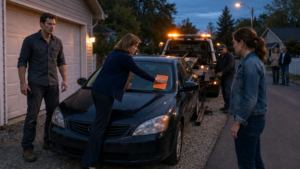
The Will Left Him Nothing But Triple Rent On The 1,300 Acres His Father Promised
Chapter 1: The Reading Ended With A Tripled Rent Notice
“Your rent just tripled.”
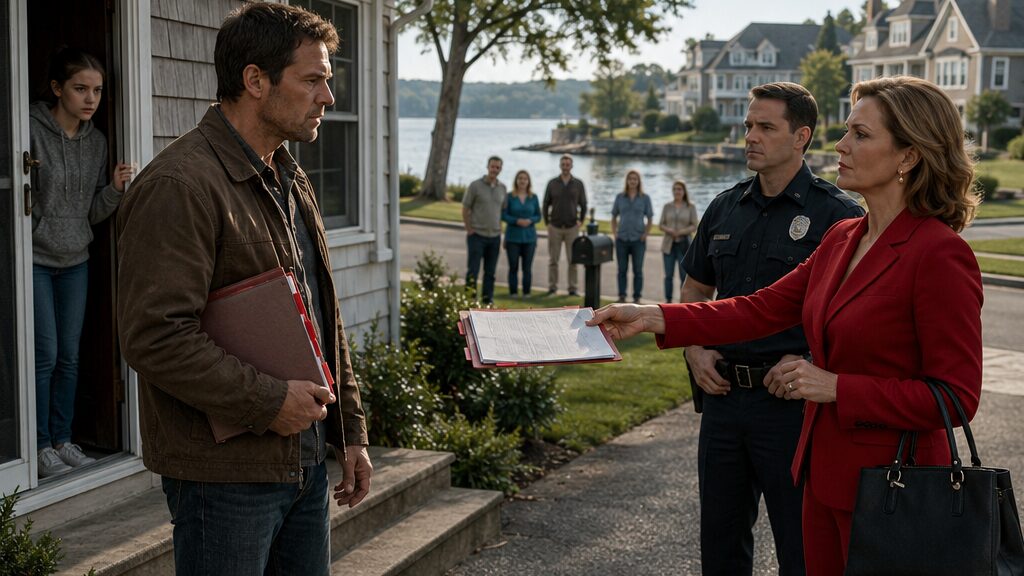
Samantha White said it on Michael Carter’s driveway as if she were telling him the mail had come early.
The uniformed officer beside her kept one hand near his belt and the other resting flat against a folded paper. Samantha did not need him to speak. His presence did enough. Behind Michael, the front door of the cottage stood open, and inside, on the hall table where his father used to drop fishing lures and loose screws, the red-tabbed estate packet waited like a thing still breathing.
Michael looked from the officer to Samantha’s red suit jacket, then to the notice in her hand.
Two weeks after Frank Carter had been lowered into the ground, his daughter had come to his son’s house with a legal packet, a rent demand, and a witness in uniform.
“You brought a cop for rent?” Michael asked.
“For a lawful notice,” Samantha said. “I didn’t want a scene.”
A neighbor across the street had already paused beside his mailbox. Two houses down, a boy with a basketball stopped bouncing it and stared. The lake behind the subdivision flashed silver between the big houses, smooth and indifferent.
Michael held out his hand.
Samantha gave him the paper but did not release it at first. For one second they both had hold of it, brother and sister, a white sheet tugged between them. Then she let go.
The number at the bottom made no sense.
Michael read it twice, waiting for the digits to rearrange into something ordinary. The cottage lease, the one his father had always called “family housekeeping,” had been raised from the token amount Michael paid every month into something larger than his mortgage would have been anywhere else in the county.
“This isn’t rent,” Michael said. “This is a push.”
“It’s the new rate under the estate’s authority.”
“The estate.”
“Yes.”
“You mean you.”
Samantha’s chin lifted. “I mean the trust structure Dad signed.”
The word Dad, coming from her in that driveway, felt polished clean of everything that had happened in the last year: the oxygen machine by the couch, the pill organizer Michael filled every Sunday, the nights Frank woke calling for a dog that had been dead since Michael was nineteen. Samantha said Dad as if the word itself came notarized.
Michael folded the notice once and looked toward the clubhouse at the end of Lake Marrow Drive, where an hour earlier Catherine Allen had read the will in a conference room that smelled of coffee and printer toner.
The reading had been short. Too short.
Catherine had sat at the head of the table with the red-tabbed estate packet open in front of her. Samantha had sat straight-backed in the chair beside her, a black purse at her feet, both hands folded around nothing. Michael had expected a fight over details: the north pasture, the lake access leases, the old machine shed, the cottage. He had expected some version of what Frank had always avoided saying directly.
He had not expected to hear his sister’s name again and again.
To my daughter, Samantha White, I leave full controlling interest in all real property, lease rights, management rights, and development-related income associated with the Carter landholdings, including approximately 1,300 acres surrounding Lake Marrow.
Michael had waited for his own name.
He heard instead the scrape of Catherine turning a page.
“Is there another section?” he had asked.
Catherine’s eyes had lifted over her reading glasses.
“The document before me is the final executed will and accompanying trust assignment.”
“That isn’t what I asked.”
Samantha had looked at the conference table.
Catherine had closed her fingers over the red tab. “Mr. Carter, you are not named as a beneficiary under the estate distribution.”
Not named.
The words had landed quietly. No dramatic crash. No shout in his chest. Just a small, cold click, like a lock closing in another room.
Michael had leaned back in his chair and stared at the packet.
Frank had promised him the cottage would stay his. He had said it in the garage with a socket wrench in his hand. He had said it at the kitchen sink while Michael shaved him before a doctor’s appointment. He had said it the night he forgot where the downstairs bathroom was and cried afterward, furious at his own mind.
This place is yours to keep steady. You kept me steady.
That had been before the final six weeks. Before the argument. Before Michael left for a stretch he still could not defend without feeling the heat of it in his throat.
Now, on the driveway, Samantha watched him with the same composed face she had worn in the conference room.
“You could have told me inside,” he said.
“I thought it was better to handle the lease separately.”
“You mean away from Catherine.”
“I mean clearly.”
The officer shifted his weight. He looked uncomfortable enough to suggest he knew this was not the kind of call that made anyone safer, but not uncomfortable enough to leave.
Michael looked down at the red-tabbed packet under his arm. Catherine had given him a copy “for his records,” as if records could substitute for inheritance, as if the paper’s existence should settle the matter by weight alone.
“How long?” he asked.
Samantha’s brow tightened. “How long what?”
“How long do I have before you try to throw me out?”
The officer answered before she did. “The notice says thirty days, sir. This is civil. I’m only here to keep things calm.”
Michael almost laughed. Calm was apparently something rich neighborhoods outsourced to uniforms.
Emma appeared in the doorway behind him, her hair still damp from her shower, one sock on and one sock in her hand. At fifteen, she had already learned how to read adult silence before adult words.
“Dad?” she said.
Michael turned slightly, blocking the paper from her view. “Go inside.”
Samantha’s face changed at Emma’s voice. Not softened, exactly. Tightened in a different place.
“This doesn’t have to be ugly,” Samantha said.
Michael looked back at her. “You brought it to my driveway.”
“I brought clarity.”
“No. Catherine brought the will. You brought the threat.”
The officer cleared his throat once. Not a warning. Not yet.
Samantha lowered her voice. “Dad made decisions near the end. You may not like them. That doesn’t make them invalid.”
Michael felt the driveway beneath his shoes, the old concrete Frank had patched badly every spring until the surface looked like a map of gray islands. He wanted to ask her what she had said to him in those last weeks. He wanted to ask why no one had called him when the new paperwork was being signed. He wanted to ask whether Frank had known the difference between a will, a lease assignment, and the television remote by then.
Instead, he made himself unfold the notice again.
At the top, beneath the estate letterhead, there was a reference line.
Carter Family Trust Lease Adjustment.
His eyes moved down to the signature block. Samantha’s name was printed as executor and managing trustee. Below it was a notation tied to the will and trust assignment. Michael reached under his arm and opened the red-tabbed packet right there on the driveway, flipping past Catherine’s cover letter, past the clean pages of legal language that had already learned how to exclude him.
Samantha’s hand moved slightly. “Michael, this isn’t the place.”
He kept turning pages.
The officer said, “Sir?”
Michael stopped on the execution page.
Frank Carter’s signature appeared at the bottom, thinner than Michael remembered it, slanting down as if the pen had been too heavy.
Below it was the date.
Michael stared at it.
For the first time since Samantha had stepped out of her car, something in his face must have changed, because she stopped watching the neighbors and watched him instead.
He did not raise his voice. He did not step toward her. He did not give the officer anything to do.
He tapped the date with one finger.
“When exactly did Dad sign this?”
Samantha’s answer came too quickly. “It’s on the page.”
“I can read the date.”
“Then you have your answer.”
Michael looked up at her. “Six weeks before he died?”
Samantha’s mouth pressed into a line.
The boy with the basketball bounced it once, forgot to catch it, and let it roll into the curb.
Michael remembered that week. Frank sitting by the lake window in his robe at three in the afternoon. Frank asking whether the lake had always been there. Frank calling Michael by his brother’s name, then by his own father’s name, then looking ashamed because some part of him knew he had failed to arrive where he meant to.
Samantha reached for the packet. “You should read it when you’re calmer.”
Michael closed the red-tabbed folder and held it against his chest.
“No,” he said. “I’m reading it now.”
Samantha’s eyes flicked to the officer, then back to Michael.
He looked down at the date again, black ink on white paper, six weeks before the funeral, six weeks before the grave, six weeks before everyone spoke of Frank’s peace as if peace had not been taken apart page by page first.
And for the first time that day, Michael stopped hearing the rent notice.
He heard only the question underneath it.
Was Frank Carter still capable of signing away his son?
Chapter 2: The Lake Map Still Had His Father’s Mark
“Do we have to leave before the next rent is due?”
Emma asked it before breakfast, standing barefoot in the kitchen with the tripled-rent notice beside the toaster.
Michael had hidden the red-tabbed estate packet under a stack of old utility bills the night before. He had not hidden the notice well enough. The top corner stuck out, stamped with Samantha’s executor letterhead, and Emma had pulled it free the way children always found the thing adults most wanted them not to see.
“No,” Michael said.
She looked at him with Frank’s eyes. Not the color. The steadiness. “That means maybe.”
“It means I’m not letting your aunt decide that today.”
Emma folded the notice along the crease he had made in the driveway. “Can she?”
Michael took the paper from her gently. He wanted to say no. He wanted to give her a father’s clean answer, the kind that built a wall between a child and the thing coming for them. But the legal words had followed him through the night, every clause and signature lining up like fence posts.
“She can try,” he said.
Emma nodded as if she had expected exactly that kind of half-truth. “Grandpa said this house was yours.”
Michael looked toward the hallway, where Frank’s old cap still hung on a peg because no one had been brave enough to move it.
“He said a lot of things.”
“Did he write them down?”
That was the question.
After Emma left for school, Michael carried the red-tabbed packet into the garage. Frank had kept records the way other men kept tools: not neatly, not beautifully, but with fierce belief that the right thing would turn up if you remembered which pile mattered.
The garage smelled of dust, oil, and lake damp. Cardboard boxes lined the back wall beneath shelves of mismatched paint cans. Michael pulled down the one marked LAND—OLD in Frank’s blocky handwriting and sneezed when the lid came loose.
Inside were maps.
Not the glossy development maps the HOA used in newsletters, with blue water and green lawns and cheerful lot numbers. These were older: county plats, survey sheets, yellowing copies of easement drafts, aerial photographs with the lake still raw around its edges before the subdivision wrapped itself around the shore.
Michael spread them across the hood of Frank’s old truck.
The 1,300 acres looked different on paper. Not like a number from a title card. Not like an empire. It looked like fields cut by creek lines, wooded slopes, pasture, lake edge, access roads, and small rectangles where people had later built houses with stone facades and three-car garages. Frank had owned more than land. He had owned the shape of everybody else’s comfort.
Michael found the cottage on a faded survey from fifteen years earlier. A small square near the original lake road. Beside it, in blue marker, Frank had written: Michael’s protection.
The words stopped him harder than the will had.
They were not legal. He knew that. They were not signed, witnessed, notarized, or blessed by Catherine Allen’s careful voice. But they were his father’s hand. The M had the same hard angle Frank used when writing grocery lists. The apostrophe leaned too far right. Protection was underlined twice, the second line impatient, cutting through the paper.
Michael touched it once.
Frank had made the mark after the first developer meeting, when Samantha had wanted to convert more of the lakefront into premium lease lots. Michael had argued that Frank should not carve the land too thin. Frank had told him he worried about taxes, maintenance, and the cost of staying alive on property everyone else thought should be producing money.
Then later, in the garage, Frank had tapped the cottage square.
This one stays simple. This one keeps you and Emma steady.
Michael folded the map carefully and drove to the lakefront property office before he could talk himself out of it.
The office sat between the clubhouse and the marina, all glass on the lake side and brick on the road side. A framed aerial photograph in the lobby showed the subdivision curling around Lake Marrow like a polished bracelet. A receptionist looked up, recognized him, and suddenly became busy with her keyboard.
“I need to see Daniel Scott,” Michael said.
“He’s in records.”
“I know.”
Her hesitation told him Samantha’s reach had already arrived before him.
Daniel emerged from the back carrying a stack of folders against his chest. He was younger than Michael by a few years, narrow-shouldered, with a tie loosened at the throat and the careful look of a man who survived by not being noticed. He had worked for Frank one summer during college, back when survey stakes still marked half the north shore.
“Michael,” he said quietly. “I’m sorry about your dad.”
“Were you sorry before or after you heard Samantha tripled my rent?”
The receptionist froze.
Daniel’s eyes moved toward the glass office doors. “Come back.”
The records room had no windows. It smelled of toner and cardboard. Michael unfolded the old map on a metal table between them.
Daniel stared at it without touching it.
“You recognize the handwriting?” Michael asked.
Daniel leaned closer. “That’s Frank’s.”
“You’re sure?”
“I saw enough of it. He used to mark up everything. Lease drafts. Road alignments. Tree lines. He hated typed notes because he said they let people pretend nobody made the decision.” Daniel swallowed. “Where did you find this?”
“In his garage.”
Daniel traced the air above the words Michael’s protection but still did not touch the page. “This isn’t in the official file.”
“I figured.”
“It wouldn’t control anything by itself.”
“I figured that too.”
Daniel’s face shifted, something like apology crossing it before fear covered it. “Then what are you asking me?”
Michael looked past him at the locked cabinets full of numbered files. “I’m asking why the final will says the opposite of what he marked here.”
Daniel rubbed the back of his neck. “That’s not something I can answer.”
“But you know something.”
“I know records.”
“Then talk records.”
For a moment Daniel said nothing. Outside the records room, someone laughed in the lobby, a bright, careless sound that seemed to belong to another kind of life.
Daniel moved to the nearest cabinet, unlocked it with a key from his belt, and pulled a folder marked CARTER LEASE STRUCTURE—NORTH SHORE. He did not hand it over. He opened it himself and turned pages until he reached a copy log.
“Samantha requested lease copies,” he said.
“She’s executor. That isn’t strange.”
Daniel tapped the page. “This wasn’t after the funeral.”
Michael looked down.
The request date was six months before Frank died.
His mouth went dry.
Daniel spoke lower. “She asked for every ground lease tied to the cottage road, the north shore, and the lake access parcels. Not just copies. She wanted projected rent authority if control transferred.”
“If control transferred to her.”
Daniel did not answer.
Michael saw the shape of it, not fully, but enough for the room to feel smaller. The rent notice had not been a sudden decision made by a grieving executor. It had been a lever measured months in advance.
“She was preparing,” Michael said.
Daniel closed the folder halfway. “I didn’t say that.”
“You showed me the log.”
“I showed you a date.”
Michael folded Frank’s map and slid it inside his jacket.
Daniel caught his sleeve before he could leave. “Be careful with this. Samantha has people convinced you walked out when Frank needed you. If you come in waving old paper, they’ll say you’re desperate.”
Michael looked at Daniel’s hand until he let go.
“I am desperate,” Michael said. “I’m just not wrong yet.”
At home that evening, Emma found him at the kitchen table with the map under the yellow light. The red-tabbed packet sat beside it, clean and official, its corners sharp. Frank’s old map looked worn, human, handled by weather and hands that had fixed engines and baited hooks and sometimes trembled at the end.
Emma read the blue words.
“Michael’s protection,” she said softly.
He expected that to comfort him.
Instead it made him ashamed.
Because a promise in blue marker meant Frank had once tried to protect him, and the final document meant something had happened after. Something Michael had not seen. Something Samantha had started preparing for while Frank was still alive.
Michael looked again at the copy log Daniel had let him photograph.
Six months before death: lease records requested.
Six weeks before death: will signed.
Thirty days after notice: pay or leave.
The dates made a ladder.
And Samantha had been climbing it long before she knocked on his door.
Chapter 3: She Said He Walked Away First
“Dad changed his mind,” Samantha said. “That was his right.”
She did not invite Michael inside when he came to her lake-view house. She opened the door wide enough to show the marble entry, the staircase, the framed photograph of Frank at a fundraiser, and the red suit jacket hanging over the back of a dining chair like a flag after battle.
Michael stood on the porch with Frank’s folded map in his coat and the red-tabbed estate packet under one arm.
“Six weeks before he died,” he said. “That’s when you’re saying he changed his mind.”
“That is when he signed the documents.”
“That isn’t the same thing.”
“It is legally.”
“Six weeks before he died, he couldn’t remember the lake from his own window.”
Samantha’s face tightened, but not with surprise. With anger that he had said it aloud.
“Don’t use his illness only when it helps you.”
Michael stared at her.
She stepped back then, not as an invitation but as a challenge. He entered.
Her house had the kind of lake view developers put on brochures: floor-to-ceiling glass, pale furniture, nothing out of place. Frank had once said he did not trust rooms where nobody could set down a coffee mug without asking permission. Now his photograph watched from the wall, smiling beside Samantha at some banquet Michael had skipped because he had been home changing Frank’s sheets.
The estate packet lay on the dining table already.
“You knew I was coming,” Michael said.
“You were never good at letting things go.”
“No. I was good at shutting up. There’s a difference.”
Samantha’s laugh was small and bitter. “That’s convenient. Now silence is noble.”
Michael put the old map on the table but kept one hand on it. “This was in Dad’s garage.”
She looked at the blue writing. For half a second her face changed. Not guilt. Recognition.
Then she looked away. “Old notes don’t override executed documents.”
“You requested the north shore lease files six months before he died.”
Her eyes came back to him.
“Daniel talks too much.”
“Daniel keeps records.”
“And you think that proves something?”
“I think it proves you were planning before Dad supposedly changed his mind.”
Samantha folded her arms. “Someone had to plan. Do you know what the tax bill was on that land? Do you know what the maintenance costs were? The road assessments? The insurance? The legal exposure every time some resident wanted to fight lake access?”
“I know Dad didn’t want Emma pushed out of the cottage.”
“Dad wanted a lot of things before he got sick.”
There it was. The line Samantha had carried in her mouth for months, maybe years: before he got sick. As if sickness erased every promise except the ones she found useful.
Michael pulled out a chair and sat because his knees had begun to feel unsteady, and he did not want her to see it.
Samantha remained standing.
“You left,” she said.
The room went quiet around those two words.
Michael looked at the table.
“You had an argument with him,” she continued. “You packed Emma up for part of the summer and went to that rental outside town. You stopped answering some of his calls. I was the one here. I was the one he asked for. I was the one dealing with Catherine, the doctors, the bills, the lease renewals, everything you said was turning him into a landlord instead of a father.”
Michael’s jaw tightened.
He had known this would come. Knowing did not make it smaller.
“I left for three weeks,” he said.
“Five.”
“Three weeks before I came back during the day.”
“You came back when it suited you.”
“I came back because he called me crying.”
Samantha’s voice cut in. “He called everyone crying by then.”
Michael’s hand closed over the edge of the table.
That final argument returned in pieces, never in order. Frank in the garage, thinner than his shirt. Michael saying Samantha was turning the land into a machine. Frank saying money had to come from somewhere. Michael saying he was tired of being the one who cleaned up every human mess while Samantha handled the profitable paper. Frank telling him if he hated the land so much, maybe he should stop living on it.
Michael had left because the words had hit too close to the thing he feared: that he was staying not only out of love, but because he had nowhere else to go.
He had not told Frank that.
He had not told Samantha.
He had told himself silence was restraint. Sometimes it was only pride wearing a cleaner shirt.
“He didn’t cut me out because I left,” Michael said.
Samantha leaned both hands on the table. “How do you know? You weren’t here when he said it.”
“And you were.”
“Yes.”
“Every week.”
“Almost every day.”
“Controlling who came in.”
“Managing care.”
“Managing the story.”
Her face flushed. “You think you get to disappear and then come back as the wronged son because the paperwork hurt your feelings?”
“The paperwork took my home.”
“The cottage was never yours.”
Michael looked down at the map. “He said it was.”
“He said a lot of things when he wanted peace.”
That landed differently. Not like strategy. Like something she believed.
For a moment he saw her not in the red suit, not in executor mode, but years younger, standing outside a hospital room while Michael sat beside Frank, always the one Frank cursed at because Michael was there. Samantha had been the daughter with folders and appointment calendars and a house full of bills she understood better than either man wanted to admit.
“You think he owed you,” Michael said.
Samantha’s eyes shone, but her voice stayed hard. “I think I stayed when staying mattered.”
“I was changing his dressings.”
“I was keeping the land from being eaten alive.”
“He was our father, not a portfolio.”
“And he was also a man whose estate could collapse if nobody acted like an adult.”
Michael pushed the map closer to her. “Then why hide this?”
“I didn’t hide an old map.”
“You ignored what it meant.”
“It meant Dad was sentimental before he understood the pressure.”
“No,” Michael said. “It meant there was a plan before you got him alone.”
Samantha slapped her palm on the table. Not loud enough to be dramatic. Loud enough to end the pretending.
“You want to talk about alone?” she said. “Fine. He was alone every time he asked where you were and I had to decide whether to tell him you were angry or just gone.”
Michael stood.
The room shifted with him.
Samantha breathed hard once, then straightened. The executor returned, smooth and guarded.
“I’m willing to help you transition,” she said.
He blinked. “Transition.”
“There’s a way to resolve this without making a public mess. I can authorize a payment from discretionary funds. Enough for first and last month somewhere else. Maybe more, if you sign that you won’t contest the estate or interfere with trust administration.”
Michael stared at her.
“You tried to raise my rent until I couldn’t breathe,” he said. “Now you want to buy my silence with moving money.”
“I want to avoid destroying what’s left of this family.”
“You served me papers with an officer.”
“Because I knew you’d act like this.”
He almost shouted then. He felt it rise, hot and humiliating, because part of him wanted to become exactly what she had prepared for. Loud. Unstable. Easy to dismiss.
Instead he folded Frank’s map.
The small act steadied him.
“Who was with Dad when he signed?”
Samantha looked toward the lake glass. “Catherine handled the signing.”
“That’s not what I asked.”
“The documents were executed properly.”
“Was he at Catherine’s office?”
“Michael.”
“Was he?”
She turned back, her face composed again. “Catherine can prove he signed without pressure.”
The sentence sounded prepared.
Michael picked up the red-tabbed packet and held it at his side.
“Then I’ll ask Catherine.”
Samantha’s expression hardened, but beneath it something flickered, quick and unwilling.
Fear, maybe.
Or memory.
Michael stepped toward the door.
Behind him, Frank smiled from the framed photograph, fixed forever in the version of himself everyone now wanted as witness.
At the threshold, Samantha spoke again.
“You’re not doing this for Dad,” she said. “You’re doing it because you can’t stand that he chose me.”
Michael did not turn around.
That was the old Michael’s mistake: leaving hard words unanswered until someone else used the silence to fill the record.
This time he opened the door and said, clearly enough for both of them, “No. I’m doing it because I don’t believe he was alone when he signed.”
Then he walked out with the map under his arm and Catherine Allen’s name burning like the next locked door.
Chapter 4: The Signature Date Did Not Match The Window
“Kathleen Miller, I’m not asking you to say my father was incompetent.”
The hospice office went still after Michael said it.
Kathleen sat behind a narrow desk with both hands flat on a closed file, as if pressure alone could keep the past inside. The office was too small for the weight of Frank Carter’s name. A box fan hummed by the window. A calendar with medication reminders hung behind her chair. On the corner of the desk, a framed certificate leaned slightly crooked, and Kathleen kept glancing at it like it might tell her where the safe line was.
“I can’t make legal conclusions,” she said.
“I didn’t ask for one.”
“You’re asking about a signing.”
“I’m asking about his condition.”
Kathleen’s lips pressed together. She had taken care of Frank in the weeks when the house stopped feeling like a home and started sounding like machines: oxygen, pill bottles, the soft rubber squeak of bedside rails, the hollow beep of reminders Michael hated and obeyed. She had seen Frank at his worst and on the strange bright mornings when he could still insult the coffee and remember the exact year he bought his first acre by the lake.
“I remember your father,” she said carefully.
Michael waited.
“He had good hours,” she said. “And lost hours.”
It was not the answer he wanted. It was worse because it was true.
Michael looked down at the copy of the execution page he had placed between them. Frank’s signature leaned across the line, thin and tired. Beside it, the date glared up from the paper. Six weeks before death. Six weeks before everyone spoke gently in funeral clothes. Six weeks before Samantha stood in red on his driveway and used that signature to triple his rent.
“Was that day a good hour?” Michael asked.
Kathleen did not touch the page. “I wasn’t present for a will signing.”
“Were you at the house?”
She looked toward the door. “I’d need to check my notes.”
“Then check.”
“That isn’t how this works.”
Michael leaned back before his voice could sharpen. He had promised himself he would not bully the truth out of people who were afraid of it. Samantha already expected him to act desperate. Catherine probably expected him to act ignorant. Michael needed to be neither.
He took a breath. “I’m not trying to trap you.”
“That’s what people say before they ask for something that can cost someone a license.”
“My father’s final will cut me out of the estate. It gave my sister control over the cottage where I raised my daughter and helped care for him. Now she’s using that control to force us out.” He slid the page closer, still not touching her hand. “All I need to know is whether the date on that page fits the man you were seeing.”
Kathleen’s face changed at the word man.
Not patient. Not chart. Not case.
Man.
She opened the file.
The sound of paper turning seemed too loud.
“I kept shift notes,” she said. “Not because I expected court. Because Frank’s condition changed depending on pain, medication, sleep, hydration. Families remember the version they need. Notes help.”
Michael kept his eyes on the desk.
Kathleen read silently, one page, then another. She stopped, went back, and read the date again.
“This was the week he thought the downstairs bathroom had moved,” she said.
Michael closed his eyes.
“He asked me if the lake had always been outside the window,” she continued softly. “Then the next morning he told me about the first dock he built, how it sank crooked because he was too proud to ask for help.”
“That sounds like him.”
“Yes.” Kathleen’s fingers tightened on the file. “Both things were him.”
Michael opened his eyes. “Did Samantha visit that week?”
Kathleen looked at the file instead of him. “Yes.”
“How often?”
“Several times.”
“Was Catherine there?”
“I don’t recall seeing Catherine Allen at the house.” She lifted one page, then lowered it. “But I wasn’t there every hour.”
“What about a notary?”
Kathleen’s gaze flickered.
Michael sat forward. “You saw a notary.”
“I saw a woman I didn’t recognize leave with a folder. I don’t know her role.”
“When?”
Kathleen’s silence answered before her words did.
“The date on the will?” Michael asked.
“Late afternoon,” she said. “Or close to it.”
A sound left him that was almost a laugh and almost not. “Samantha told me Catherine handled the signing.”
“An attorney can prepare documents without being present when they’re signed.”
“Catherine’s office is twenty minutes away.”
“I’m not saying where it happened.”
“You’re saying what you saw.”
Kathleen closed the file, but not all the way. “I am saying your father had periods of confusion that week. I am saying he also had periods of lucidity. I am saying those two facts can exist together, which is exactly why I don’t want my notes turned into a weapon for either side.”
Michael nodded slowly. The answer did not free him. It trapped him in a narrower, more honest corridor.
Frank had not been simply gone. He had not been cleanly incapable. He had been there and not there, reachable and unreachable, a man moving in and out of himself while people around him decided which version counted.
“Can I get a copy?”
“Not without proper authorization.”
“Of course.”
“But I can write down the dates of my visits,” Kathleen said, so quietly he almost missed it. “And I can state, generally, that his cognitive condition fluctuated. I won’t say more without being compelled or advised.”
Michael looked at her. It was not enough. It was more than he had walked in with.
“Thank you.”
Kathleen’s expression remained guarded. “Don’t thank me yet. If you make this ugly, everyone will say Frank’s last months were nothing but a fight over land.”
“They already made them that.”
“No,” she said. “You still have some control over how you ask.”
The words followed him out.
At the county records room, he requested copies of lease filings, trust references, and any recent changes tied to the Carter holdings. The clerk gave him forms, then more forms, then a look that said she had seen families arrive with grief and leave with folders. By late afternoon, Michael had a stack of certified pages that proved less than he hoped but more than Samantha would want.
The trust assignment referenced the same date as the will.
The lease authority changed that same week.
The rent adjustment formula had been attached afterward, but the power to use it had come from Frank’s signature.
Nothing on paper said Frank had been confused. Nothing on paper said Samantha had pressured him. Nothing on paper said a daughter in a red suit had begun turning a father’s uncertainty into leverage months before he died.
Paper was clean that way.
Before going home, Michael drove to Frank’s old bedroom.
He had not slept there since the funeral. He had barely entered it. The room still held Frank’s robe on the back of a chair, a glass of water gone stale on the nightstand, and the lake window that faced west across the shore. From that chair, Frank could see the dock, the bend in the road, and the long driveway where visitors parked.
Michael stood beside the window and imagined the week of the signing.
Samantha’s car would have pulled in first. She always parked near the walkway, never under the pine because sap spotted the hood. A notary’s car would have looked unfamiliar, maybe dark, maybe compact, something Kathleen would notice because hospice workers noticed changes around frail patients. Frank would have been in the chair or bed. Maybe clear. Maybe tired. Maybe wanting peace badly enough to nod when a daughter told him what the paper meant.
Michael looked at the dresser.
A small stack of photographs sat in a shallow wooden tray. Funeral sorting. Emma had gathered some for the memorial board and left the rejects there: Frank holding a fish too small to brag about, Frank with Samantha at the clubhouse, Frank sitting by the lake window with a blanket over his knees.
Michael picked up that one.
At first it was only another late-life photo, the kind no one framed because it showed too much weakness. Frank in profile, looking out through the glass. The lake beyond him. The driveway reflected faintly in the window.
Then Michael saw the cars.
The reflection caught them like ghosts: Samantha’s white SUV near the walkway and, behind it, another car he did not recognize. Its front end angled toward the road, temporary and official-looking, with a small seal or placard on the windshield too blurred to read.
His pulse kicked.
He turned the photo over.
Emma’s handwriting on the back read: Grandpa at the window. Taken by Aunt Samantha. October 18.
Michael pulled the execution page from his folder.
October 18.
He sat on the edge of Frank’s bed with the photograph in one hand and the will date in the other.
Samantha had said Catherine handled the signing.
But the window had kept its own record.
Chapter 5: The Officer Came Back For The Wrong Reason
The officer returned on the thirtieth day while two neighbors pretended to water lawns that were already wet.
Michael saw the patrol car turn onto Lake Marrow Drive before it reached the cottage. It moved slowly, with the careful pace of a vehicle entering a place where every window had already become an eye. Emma stood behind the screen door, backpack over one shoulder, watching the same way she had watched storms when she was small.
“Go to school,” Michael said.
“Is he here to make us leave?”
“No.”
“Is that true?”
Michael looked at the stamped notice in his hand. OVERDUE, in red, across the top. “It’s true enough for this morning.”
She did not move.
The officer parked behind Samantha’s car.
Samantha stepped out first. She was not wearing the red suit this time, but the red was still there in a scarf tied neatly at her throat. She had brought a folder, not the full estate packet. Smaller paper for a smaller cruelty.
The officer walked beside her with the same uncomfortable expression he had worn before. He kept his hands visible and his voice low when he reached the porch.
“Mr. Carter.”
“Officer.”
“I’m here for a civil standby.”
Michael looked past him to Samantha. “That what we’re calling family now?”
Samantha’s gaze flicked toward the neighbors. “You were given thirty days.”
“To pay an amount you invented.”
“To pay the amount authorized under the trust.”
Emma opened the screen door. It creaked loud enough to make all three adults turn.
“Dad,” she said. “I’ll be late.”
Michael’s anger shifted shape. It wanted somewhere to go. Samantha had known the deadline would make a scene. She had known Emma might see. She had known neighbors would watch and call it unfortunate, then ask each other how long Michael had been behind.
He stepped down from the porch and closed the screen door gently behind him.
“No one is entering the house,” he said.
The officer raised a palm. “No one is forcing entry today. This is notice of further action if the balance isn’t addressed.”
“Further action,” Michael repeated.
Samantha handed him the folder.
He did not take it.
She held it out longer.
The neighbor across the street turned off his hose and left it lying in the grass.
Michael took the folder at last. Inside was a demand summary, late fees, and a warning that failure to cure could trigger eviction proceedings under the estate-managed lease. Samantha’s signature sat at the bottom in blue ink, confident and looped.
“You couldn’t mail this?” he asked.
“I wanted to make sure you received it.”
“You wanted witnesses.”
“I wanted accountability.”
The word almost did it. Accountability, from the person who had two stories about where their father signed away his son.
Michael felt Emma still behind the door. He did not turn. If he looked at her, he might say something that would feel good for three seconds and hurt him for months.
Instead he folded the demand summary and tucked it under his arm.
“I dispute the authority behind this notice.”
Samantha’s eyes hardened. “You can dispute whatever you like. That doesn’t stop deadlines.”
“No. But it records that I said it.”
“For who?”
“For everyone pretending this is rent.”
The officer shifted again. “Mr. Carter, I understand this is emotional—”
“No,” Michael said, still calm. “You understand this is civil. You said that yourself. So stand civil.”
The officer’s mouth closed.
Samantha’s face colored. Around them, the perfect subdivision listened.
Then a voice came from the sidewalk.
“Michael.”
Daniel Scott stood near the mailbox with a file tucked under his jacket. He looked as if he had decided to walk into traffic and was surprised to still be alive.
Samantha turned slowly. “Daniel.”
“Can I speak with him?” Daniel asked.
“This is not your matter.”
“That depends on which file you’re using.”
The words changed the air.
Michael walked to the mailbox before Samantha could stop him. Daniel kept his voice low, his eyes on the patrol car.
“I checked the lease history,” Daniel said. “The HOA isn’t initiating this. They can’t. Not on the cottage parcel.”
“I know Samantha controls it.”
“No. More specific than that.” Daniel pulled one folded page from the file and kept the rest hidden. “The rent increase formula only became enforceable after the trust assignment transferred management authority on the land underlying the original lease parcels. The HOA board can complain, but the estate controls the lever.”
Michael took the page.
There it was in dry language: ground lease, management authority, trust assignment, adjustment rights. The lake subdivision had polished roads and bylaws and committee meetings, but beneath it ran the older Carter land structure. Samantha had not simply raised rent because she inherited money. She had used the old ground-lease machinery Frank once controlled.
The HOA was not the main villain.
It was the tool.
Michael looked back at Samantha, who had watched the exchange with a face gone still.
“How long have you known this?” he asked Daniel.
“Long enough to feel bad.”
“That’s not an answer.”
Daniel looked ashamed. “Since she asked for projections.”
Six months before death.
The ladder again.
Samantha stepped toward them. “Those documents are internal.”
“They’re recorded,” Daniel said, but his voice thinned on the last word.
“And your job depends on understanding what you can release.”
Daniel went pale.
Michael handed the page back. “Don’t get yourself fired for me.”
Daniel’s eyes lifted. “Your father told me once the cottage wasn’t supposed to be treated like a lease lot. I thought he meant emotionally. I didn’t know he marked it that way.”
The old map felt suddenly heavy inside Michael’s house, hidden behind cereal boxes in the kitchen cabinet because he had not known where else to keep it.
Samantha was close enough now to hear. “Frank said many things to many people.”
“He did,” Michael said. “That’s why you needed paper.”
“And you have none.”
He looked at her then, really looked. She was not only angry. She was tired. The red scarf at her throat sat too tight, and beneath her makeup were shadows that had not come from one bad night. For a moment he saw the sister who had spent years converting fear into folders because folders at least stayed where she put them.
Then he saw the overdue stamp.
“You’re trying to make me lose the cottage before anyone questions the will.”
“I’m trying to administer an estate you are interfering with.”
“You’re trying to make my daughter watch an officer stand on our lawn.”
Samantha’s eyes flickered toward the screen door. Something human moved there and was gone.
The officer cleared his throat. “I think we’re done here for today.”
“No,” Samantha said. “We’re done when he understands the consequences.”
Michael held up the demand summary. “I understand them.”
“Then pay.”
“I can’t.”
“Then leave.”
“I won’t.”
The neighbors heard that. Michael let them. He did not shout. He did not perform. He let the refusal sit on the lawn in plain daylight.
Samantha opened her mouth, but her phone rang before she could speak. She glanced at the screen, turned away, and answered in a low voice. Michael heard only pieces.
Catherine.
Meeting.
Specific questions.
Samantha’s shoulders tightened.
When she ended the call, she looked at Michael with irritation sharpened by something else.
“Catherine will meet with you,” she said. “Once. At the clubhouse. But she made it clear this is not a forum for accusations.”
“When?”
“Friday.”
“I’ll be there.”
“You bring specific questions, Michael. Not old grudges. Not feelings. Questions.”
Michael looked at the overdue notice, then at Daniel’s folded page, then through the screen door where Emma stood very still.
He knew the question now.
Not Did Dad love me?
Not Why did you do this?
Not even Was he competent?
Those could be softened, argued, buried.
The question that could cut was smaller.
Where was Frank Carter when the final will was signed?
And why had Samantha told two different stories about the room?
Chapter 6: The Woman In Red Could Not Keep Both Stories
“The documents are legal,” Catherine Allen said. “The signatures are verified.”
Michael sat across from her at the clubhouse conference table where his name had disappeared the first time. Samantha sat to Catherine’s right. She had worn the red suit again, as if returning to costume could restore the first day’s control. The red-tabbed estate packet lay between them. Beside Michael’s hand sat three things: Frank’s old map, the window photograph, and the overdue rent notice.
He did not touch any of them yet.
Catherine folded her hands. “I agreed to this meeting because repeated informal challenges do not help anyone. If you have questions, ask them clearly.”
Samantha leaned back. “And after today, this ends.”
Michael looked at her. “No.”
Her jaw tightened.
Catherine glanced between them. “Mr. Carter.”
Michael opened the estate packet to the execution page. “Did my father sign this at your office?”
Catherine did not answer quickly. That told him the question had found the seam.
“I prepared the documents,” she said.
“That isn’t what I asked.”
“I supervised the process.”
“Were you physically present when he signed?”
Samantha cut in. “This is ridiculous.”
Michael kept his eyes on Catherine. “Were you in the room?”
Catherine removed her glasses and set them beside the packet. “The documents were executed before a notary and witnesses as required.”
“Were you one of them?”
“No.”
The room went quiet enough for the air conditioner to click overhead.
Samantha shifted in her chair. “Catherine’s office handled it. That’s what I said.”
Michael turned to her. “You said Catherine could prove Dad signed without pressure.”
“And she can.”
“No. She can prove a signature was notarized. That’s different.”
Catherine’s expression cooled. “Careful, Mr. Carter.”
“I am being careful.”
He slid the window photograph into the middle of the table.
Frank sat by the lake window in the picture, blanket over his knees, face turned toward water. Reflected in the glass, faint but visible, were two cars in the driveway: Samantha’s white SUV and another vehicle behind it.
Michael placed the execution page beside it.
“Same date,” he said.
Samantha stared at the photograph.
Catherine leaned forward despite herself.
“This proves nothing about capacity,” she said.
“I know.”
“It proves nothing about undue influence.”
“I know that too.”
“Then what do you think it proves?”
Michael looked at Samantha. “That he wasn’t at your office.”
Samantha’s face hardened. “I never said he was.”
“Yes, you did.”
“I said Catherine handled it.”
“You let me believe he signed under her supervision.”
Catherine looked at Samantha, and that small movement mattered more than any accusation Michael could have made.
Samantha noticed. “Don’t look at me like that.”
Catherine’s voice stayed controlled. “I need clarity on what was represented to the family.”
“The family?” Samantha snapped. “You mean Michael. The man who vanished when things got hard and now wants to pretend he was cheated because he found an old photo.”
Michael felt the old heat rise. There was the story she trusted: Michael absent, Samantha responsible, Frank choosing the child who stayed.
He almost answered it with every wound he had saved.
Instead he opened Frank’s map and turned it so Catherine could read the blue mark.
Michael’s protection.
Catherine’s eyes paused on the words.
“This is not testamentary,” she said.
“No. It’s intent.”
“It may be sentiment.”
“It may be. That’s why I’m asking about the day he signed the paper that erased it.”
Samantha laughed once, sharp and humorless. “Erased. You keep using words like that. Dad made practical decisions because you were never practical. You hated the leases. You hated the residents. You hated every dollar that came from this place, but you lived in the cottage and let him carry the costs.”
Michael looked at her hands. They were gripping each other so tightly the knuckles had whitened.
“You think I used him.”
“I think you were happy being the good son when goodness didn’t require reading a tax bill.”
The sentence hit because there was truth buried under the cruelty.
Michael had avoided the money side. He had told himself caregiving was the real work, which it was, but also because spreadsheets made him feel trapped and small. Samantha had known the costs. She had paid attention to the machinery. And in paying attention, she had convinced herself she owned the moral right to steer it.
Catherine turned a page in the packet. “Samantha, I need you to answer something plainly. On the day of execution, where was Frank?”
“At home,” Samantha said.
Catherine’s pen stopped.
Michael did not move.
Samantha seemed to realize too late that she had stepped onto the wrong side of her own story.
“At home,” Michael repeated.
“He was more comfortable there,” she said. “He didn’t travel well by then.”
“But you told me Catherine handled the signing.”
“Her office prepared everything.”
“You told me she could prove there was no pressure.”
Samantha leaned forward. “Because there wasn’t.”
“How would Catherine know?”
The question sat there, plain and unadorned.
Catherine looked down at her notes. For the first time since Michael had met her, she seemed older than her voice.
“I relied on information provided to my office,” she said. “And on the notary’s confirmation that Frank appeared aware of the document he was signing.”
“Appeared,” Michael said.
“That is the standard noted.”
“Did anyone tell you Kathleen Miller had notes showing confusion that same week?”
Samantha’s head turned sharply. “You went to Kathleen?”
“I asked about Dad.”
“You had no right to drag his nurse into this.”
“I had every right to ask who my father was when you put a pen in his hand.”
Samantha stood so fast her chair legs scraped the floor. “You don’t get to come back now and make yourself the protector.”
Michael stood too, but slowly. He kept his palms on the table.
“I’m not pretending I didn’t leave.”
The words surprised Samantha. They surprised him too, though he had felt them forming since her house.
“I left after the fight,” he said. “I was angry. I was ashamed. I thought if I stayed, I’d say something worse. So I went quiet. That was my mistake.”
Samantha’s face flickered.
Michael kept going before silence could reclaim him. “But my mistake did not give you the right to turn his worst weeks into a document that made you the only person with power.”
Samantha’s eyes shone. “I was the one there.”
“I know.”
“No, you don’t. You know bed rails and pills and the parts that let you feel noble. I knew the liens, the calls, the developers circling, the residents threatening lawsuits over access paths. I knew if we split control, this whole place would tear itself apart.”
“So you decided Dad wanted me gone.”
“I decided he needed someone who could handle it.”
Catherine spoke quietly. “That is not the same as him deciding.”
Samantha looked at her as if betrayed.
The door opened before anyone spoke again. Daniel stood in the hallway, not entering, a folder held flat against his chest.
Catherine frowned. “This is a private meeting.”
“He has records,” Michael said.
Samantha’s voice went cold. “He has no authorization to be here.”
Daniel looked ready to leave. Michael could see the fear in his face and knew one more push might break him. He did not ask Daniel to come in. He did not make him the hero of a fight that wasn’t his.
“Leave them with Catherine,” Michael said.
Daniel hesitated, then placed the folder on a side table and stepped back out.
Catherine opened it.
Inside was the lease request log, the ground-rent projection memo, and the copy request from six months before Frank died. Catherine read in silence.
Samantha sat down again, slowly.
“It was planning,” she said before anyone accused her. “Responsible planning.”
Michael nodded once. “That’s what scares me.”
Catherine closed the folder halfway. “There are enough inconsistencies here that I would recommend formal review before any further lease enforcement action.”
Samantha’s head snapped toward her. “You work for the estate.”
“I work within the law.”
“You told me the documents were valid.”
“I said they were executed. I did not say this history was irrelevant.”
Samantha reached into her purse and pulled out a folded paper. Her fingers trembled once before she flattened it on the table.
“I’ll offer this,” she said. “One payment. Enough for relocation, legal consultation, whatever he wants to call it. In exchange, Michael agrees not to contest, not to interfere with administration, and not to discuss estate matters with residents or staff.”
Catherine looked at the paper and did not pick it up.
Michael did.
The amount was larger than he expected. Large enough to solve immediate problems. Large enough to tempt the part of him that had lain awake calculating rent, utilities, Emma’s school costs, and the price of pride.
Confidentiality clause.
Non-disparagement.
No further claim.
Samantha watched him, and for once her confidence did not quite cover the fear beneath it.
“You can keep pretending this is noble,” she said. “But your daughter needs stability more than she needs a crusade.”
That was the cruelest thing she could have said because it was almost true.
Michael looked at Emma in his mind: barefoot in the kitchen, asking if they had to leave. He looked at Frank in the window photograph. He looked at the blue marker on the old map.
Then he placed the settlement paper back on the table.
“No.”
Samantha closed her eyes for half a second.
Michael slid the unsigned paper toward Catherine.
“I won’t sign silence in exchange for moving money,” he said. “If the will stands after review, it stands. But the timeline goes in the record. Kathleen’s statement goes in the record. Daniel’s log goes in the record. And the rent action stops until everyone can see what story the paper left out.”
Catherine did not answer immediately.
Samantha stared at him as if he had refused rescue.
Michael gathered the photograph, the map, and the red-tabbed packet. The estate document still had legal weight. The signature still existed. Nothing had been overturned. No one had confessed.
But Samantha’s two stories could no longer sit together cleanly.
At the door, Michael turned back once.
“You said Dad chose you,” he said. “Maybe part of him did. But you made sure no one could ask which part.”
Then he left the confidentiality agreement lying unsigned under Catherine Allen’s hand.
Chapter 7: The Paper Stayed, But The Truth Did Not
Samantha arrived without the red suit.
Michael noticed that before he noticed the folder in her hand, before he noticed Catherine waiting beside the mediation room door, before he noticed the empty chair set aside for him across the table. Samantha wore a gray jacket, plain blouse, no scarf at her throat. Without the red, she looked less like the person who had stood in his driveway and more like the sister who used to sit at the kitchen table with bills spread around her while Frank pretended not to see them.
She saw him looking.
“What?” she said.
“Nothing.”
“It’s always something with you.”
Michael almost answered the way he used to, by swallowing the sentence and letting her keep the room. Instead he set the red-tabbed estate packet on the table between them.
“It’s just the first time in weeks you didn’t dress like the document already won.”
Catherine’s mouth tightened, not quite a smile. Samantha looked away.
The mediator had not arrived yet. The office was small and neutral in the expensive way: beige walls, glass water pitcher, framed print of a dock that was not Lake Marrow. Outside the conference room window, traffic moved along a road that had nothing to do with the Carter land, and Michael found that almost insulting. Their father’s life had been reduced to folders in a room where nobody could smell the lake.
Catherine opened her folder. “Before we begin, I want the record clear. This meeting is not a court finding. It is an attempt to address disputed facts, preserve estate assets, and prevent avoidable harm while formal review is pending.”
Samantha gave a short laugh. “Avoidable harm.”
Michael looked at her. “You don’t think tripling rent qualifies?”
“I think you made it sound like I woke up one morning wanting you homeless.”
“Didn’t you?”
Her eyes sharpened, then lowered to the table. “No.”
The answer was quieter than he expected.
The mediator entered before he could ask what she meant. Papers moved. Names were confirmed. Catherine stated that the estate would pause further enforcement while specific concerns were reviewed. Samantha objected to the word pause, then accepted suspend. Michael did not argue over the word. He watched Catherine write it down.
Suspended had ink. That mattered.
Kathleen Miller arrived ten minutes late, apologizing to the room without looking at anyone for too long. She carried one page in a sealed envelope. Michael stood when she came in. Samantha did not.
Kathleen sat at the end of the table, folded her hands, and waited while Catherine read the statement.
Frank Carter experienced fluctuating cognitive clarity during the week of October 18. He had periods of conversation that appeared coherent and periods of confusion regarding place, time, and personal context. This statement does not offer a legal opinion regarding testamentary capacity.
Catherine stopped reading.
No one moved.
It was careful. Frustratingly careful. It did not say Frank could not sign. It did not say Samantha had pressured him. It did not rescue Michael with one clean sentence.
But it put something into the estate file that had not been there before: Frank had not been simply the clear-minded signer the paper pretended he was.
Samantha stared at the envelope.
“He had good mornings,” she said.
Kathleen nodded. “Yes.”
“He knew me.”
“Yes.”
“He knew what land was.”
“Sometimes very clearly.”
Samantha’s fingers closed around the edge of her folder. “You make it sound like I dragged a stranger to a pen.”
Kathleen’s face softened, but her voice did not. “I am saying the week required caution.”
Samantha looked at Michael then, angry again, but the anger looked tired now, worn thin at the edges.
“He was scared,” she said. “You know that? He was scared the land would swallow us whole. Taxes, leases, residents, attorneys, repairs. Every person around that lake wanted something from him. You wanted the cottage to stay simple. I wanted the whole thing not to collapse.”
Michael heard the old accusation inside it. He had let Samantha become the person who understood the machine because he hated the machine. He could admit that now without handing her everything.
“Dad wanted both,” he said. “That was his problem. He wanted the land managed and the cottage protected.”
“He couldn’t have both forever.”
“You made sure he didn’t have both at the end.”
She flinched.
The mediator asked for a break. No one took one.
Catherine produced a draft agreement. The will would remain under formal review; no one in the room pretended otherwise. The rent increase on the cottage would be frozen at the previous family rate pending review. The overdue notice would be withdrawn, not merely delayed. Samantha, as managing trustee, would agree to place a portion of north shore lease income into a temporary reserve, with possible redistribution if undue influence or misrepresentation was later established. Michael would not sign confidentiality. He would agree not to harass residents, staff, or witnesses. The estate file would include Kathleen’s statement, Daniel’s lease request log, the window photograph, and Frank’s old marked map as disputed-intent materials.
It was not victory.
It was paperwork admitting there was a wound.
Samantha read the terms twice. “So he gets to keep living there and keep accusing me.”
Michael shook his head. “I get to keep living there while the truth is reviewed. And I’m not accusing you of everything.”
Her eyes lifted.
“I’m accusing you of one thing I know you did,” he said. “You used the rent to make me leave before anyone looked at the date.”
Samantha’s face went pale around the mouth.
Catherine did not interrupt.
Michael leaned forward. “Did you believe Dad wanted you to manage the land? Maybe. Did you believe I made things harder by leaving? I know you did. But that rent notice wasn’t Dad. That was you.”
Samantha looked at the red-tabbed packet. For a moment Michael thought she would deny it again, build another wall out of procedure. Instead she touched the corner of the packet with two fingers and slid it half an inch away from herself.
“I thought if you stayed in the cottage, you would never stop fighting me,” she said.
“I hadn’t started yet.”
“You had started years ago. Every time you rolled your eyes at a lease meeting. Every time Dad asked you to talk to me and you walked into the garage instead. Every time you acted like keeping him fed and clean meant you were the only one loving him.”
Michael absorbed that because some of it belonged to him.
“I should have said more when he was alive,” he said.
Samantha looked startled.
“I should have told him why I left. I should have told you I was drowning too. I didn’t.” He looked at the packet, then back at her. “But my silence was not permission.”
Samantha’s eyes filled, and she hated him for seeing it.
“No,” she said. “It wasn’t.”
The mediator slid the amended rent notice across the table.
The original red overdue stamp had been crossed out. Beneath it, Catherine had written: frozen pending review.
Michael stared at the words longer than he needed to.
The paper stayed. The will stayed. The signature stayed. But the story around it had changed.
By late afternoon, Michael returned to the cottage with the amended notice, Kathleen’s statement copy, and Frank’s old map. Emma was at the kitchen table doing homework she had not touched. She looked up, searching his face before asking anything.
“We don’t have to leave right now,” he said.
Her shoulders dropped in a way that made him wish he had found better words sooner.
“Did you win?”
Michael set the papers on the table. “No.”
Emma’s face fell.
“But they can’t pretend nothing happened anymore.”
She looked at the map. “Is that enough?”
He wanted to lie. Instead he sat across from her.
“It’s what we have today.”
After dinner, Emma carried the old map into Frank’s room without asking. Michael followed as far as the doorway and stopped.
She placed it on the small table beside the lake window, smoothing the fold with her palm. The blue words faced up.
Michael’s protection.
Outside, Lake Marrow held the last light. The houses around it glowed one by one, each of them sitting on land Frank had once walked when there were no roads, no bylaws, no polished signs at the entrance. Michael stood in the doorway and thought of his father in the chair, looking out at water he sometimes remembered and sometimes didn’t.
He still did not know which version of Frank had signed the will.
Maybe the formal review would never answer that cleanly. Maybe no document could.
But the file now held more than Samantha’s version. It held the date, the window, the nurse’s careful truth, the lease log, the map, and Michael’s refusal to be silent.
Emma stepped back from the table. “Grandpa would’ve liked it there.”
Michael looked at the map beside the window.
For the first time since the reading, he let himself answer without swallowing the words.
“Yes,” he said. “He would have.”
The story has ended.