The HOA President Told Him To Move The Green Truck Before She Learned What It Was Protecting
Chapter 1: The Green Truck Stayed Where It Was
“Move this car now.”
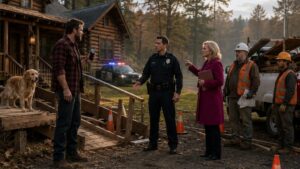
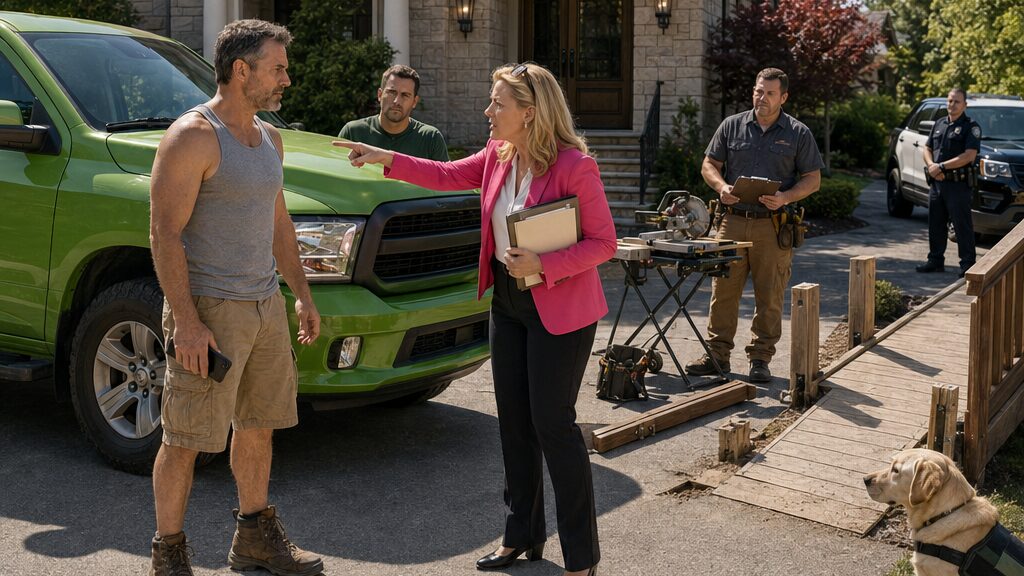
Sharon White’s finger stopped inches from Charles Mitchell’s chest, her pink blazer bright enough to look unreal against the pale stone front of his house. Behind her, the saw on the portable stand was still whining down. One of the crew workers held two sections of wooden rail in his arms as if he had been caught stealing fence boards.
Charles did not move.
The bright green contractor truck sat at an angle across his driveway, its rear bumper blocking the path between Brandon Hill’s crew and the half-torn ramp at Charles’s front steps. It was not a subtle truck. Jonathan Davis had painted the company color on every panel, a loud green that made the vehicle impossible to miss from the street. Right now, Charles was grateful for every inch of it.
Sharon took one step closer. “I said move it. You are obstructing authorized HOA enforcement.”
Charles kept his arms crossed because if he let them fall, Sharon would see his hands shaking.
“Show me the order,” he said.
“I already gave you the notice.”
“You gave me a notice after your crew started cutting.”
Her mouth tightened. Sunglasses sat on top of her smooth blond hair, unused in the morning glare. She looked past him toward the ramp, where one side rail had already been removed and the exposed anchor bolts stuck up like broken teeth.
“This structure was installed without final approval,” she said. “It changes the exterior appearance of the property and violates the community standards.”
A police SUV rolled to a stop at the curb.
Someone across the street lifted a phone.
On the lawn, Elizabeth’s service dog sat perfectly still near the edge of the grass, watching Charles with the kind of patience that made him feel worse than anger would have. The dog’s leash lay looped around the porch post because Elizabeth had not been outside when the crew arrived. Charles had made sure of that. He had wanted to keep this away from her.
He had failed before breakfast.
Jonathan stood beside the truck with his work gloves in one hand, jaw tight. He was a careful man, the kind who measured twice even when the measurement was obvious. The ramp behind him was his work: temporary, sturdy, plain, built to code, with the least visual footprint Charles could afford. It was not pretty. It was not meant to be. It was meant to let Elizabeth get from the front door to the driveway without Charles lifting her chair over two stone steps.
Brandon Hill, the crew supervisor, shifted near the ramp with a clipboard tucked under one arm. “Ms. White, I need to know if we’re continuing or stopping.”
“We’re continuing when he moves the truck,” Sharon snapped.
Charles looked at Brandon, not Sharon. “Did anyone tell you this was an accommodation request?”
Brandon’s eyes flicked to the ramp and then back to his clipboard. “I was told it was an unapproved exterior structure.”
“That’s not what I asked.”
The first police officer stepped onto the driveway. The second stayed near the SUV, one hand resting on his belt, watching the growing knot of neighbors at the sidewalk.
Sharon immediately turned toward the officer. “Thank you. This homeowner is preventing a contracted removal from taking place. He has parked a vehicle to block access and is refusing a lawful HOA enforcement action.”
The officer looked at Charles. “Sir?”
Charles took his phone from his pocket and held it low, the screen already recording. “That truck belongs to my accessibility contractor. The HOA sent a crew onto my property this morning and started dismantling a ramp before I was served notice. I’m asking them to stop until they produce written authority beyond an HOA violation form.”
Sharon gave a sharp laugh. “He knows exactly what this is about. He installed it without permission.”
Charles felt the old instinct rise in him: keep it simple, keep Elizabeth out of it, do not let strangers turn her life into a neighborhood argument. He could say the ramp was temporary. He could say the application was pending. He could say the law required accommodation. All of it was true.
But behind Sharon’s shoulder, one of the removed rail sections slid in the worker’s grip, and the hollow thud of wood against concrete traveled through him.
“That ramp,” Charles said, “is how my daughter gets into this house.”
The driveway went quieter.
Not silent. The saw stand ticked as it cooled. A neighbor murmured from the sidewalk. The service dog’s ears lifted.
Sharon’s expression changed for half a second. Not softening. Calculating.
“No one is questioning anyone’s personal circumstances,” she said, in the voice she used at meetings when she wanted minutes to sound clean. “But residents cannot bypass architectural approval because they believe their situation is special.”
Charles uncrossed his arms then.
The movement was small, but the first officer noticed. Charles kept his voice even.
“I submitted the accommodation packet four weeks ago.”
“And it was incomplete.”
“You never told me that.”
“It is the homeowner’s responsibility to monitor the portal.”
Jonathan rubbed his forehead. “I told him to hold off on the permanent rail until final approval. This is a temporary access structure. We used removable posts.”
Sharon barely glanced at him. “You are not a resident here, Mr. Davis.”
“No,” Jonathan said. “I’m the contractor who was hired to keep a kid from being carried down steps.”
Charles looked at him sharply. Jonathan stopped talking, but the words had already landed.
The second officer moved closer now. The neighbors had gone still in the way people did when they knew they were hearing something they might repeat later. A woman on the sidewalk lowered her phone, then lifted it again.
Sharon saw the shift and stiffened. “This is exactly the kind of emotional framing that makes enforcement difficult. The board cannot manage the community by anecdote.”
Charles turned his phone slightly toward her. “Then manage it by documents. Show me the removal order.”
“I have it.”
“Then show it.”
Sharon reached into the folder tucked under her arm and pulled out a single page. She did not hand it to him. She held it up, angled toward the police officer.
“Notice of Violation and Enforcement Action,” she said. “Issued by the architectural compliance committee under Section 7.4.”
Charles read the top line from where he stood. The date was that morning.
Saturday. 8:10 a.m.
He had heard the first saw at 8:03.
The officer leaned in. “Ma’am, this says notice.”
“It authorizes correction.”
“It authorizes the association to notify the resident,” Charles said. “That’s not a court order. That’s not city enforcement. And it’s dated after your crew walked onto my property.”
Sharon’s cheeks colored, but she held her ground. “You were informed of the violation through the portal.”
“My portal still says pending review.”
“That is not what our records show.”
“Then your records are wrong.”
The words came out harder than Charles intended. Sharon’s eyes sharpened as if she had been waiting for that edge.
“Officer,” she said, “this is the aggression I reported.”
Charles forced his shoulders down. He would not give her that. He would not become the version of him she needed.
The service dog rose from the grass and walked to the bottom of the damaged ramp. He stopped there, nose pointed toward the missing rail.
Charles looked at the anchor bolts, the cut line, the green truck blocking the crew, and Sharon’s notice trembling slightly in her hand.
“Until someone shows me a legal order,” he said, “that truck stays where it is.”
The first officer turned to Sharon. “At this point, this appears civil. We’re not going to force him to move a vehicle on his property for an HOA notice.”
Sharon’s lips parted.
Brandon exhaled like a man who had been waiting for permission to stop. He set his clipboard against his thigh and gestured for the worker to put the rail sections down.
But Sharon was not finished. She stepped close enough for Charles to see the pale line where her sunglasses had pressed into her hair.
“Then we’ll make it official,” she said.
She pulled another folded sheet from her folder and held it out at last.
Charles took it.
The signature line at the bottom was Sharon’s. The timestamp above it was 8:10 a.m. The authorization box had been checked before the crew had even finished removing the first rail.
And beneath the printed language, in blue ink, someone had written: emergency board enforcement pending ratification.
Chapter 2: The Notice On The Door Came Too Late
The notice was under the mat.
Charles found it only after the officer asked exactly when he had received written warning, and Sharon, without blinking, pointed to his front door.
“There,” she said. “It was served this morning.”
Charles walked past the half-dismantled ramp with the officer beside him and lifted the corner of the welcome mat Elizabeth had picked out two years earlier, back when getting in and out of the house meant nothing more complicated than wiping shoes. A folded white envelope lay beneath it, clean and flat, as if it had been placed there by someone who knew the crew noise would pull him to the driveway first.
He picked it up.
The adhesive strip was still sealed.
The officer saw that too.
Behind them, Sharon said, “Service does not require the resident to open it before enforcement begins.”
Charles turned the envelope over in his hand. “You started cutting before I knew this existed.”
Sharon did not answer him. She spoke to the officer instead. “The board has procedures.”
Procedures.
The word followed Charles into the kitchen fifteen minutes later, after the police had stepped back, after Brandon had told his crew to stop work, after Jonathan had moved only far enough to shut off the truck engine but not far enough to clear the driveway.
Procedures sat beside the ramp diagram on Charles’s kitchen table. Procedures glowed from the laptop screen. Procedures had been the reason Charles stayed up past midnight four weeks earlier, scanning medical letters and contractor drawings and photographs of the front steps from every angle.
He had done it right.
He had told himself that every time he wanted to drive to the HOA office and demand a person instead of a portal. He had done it right. No raised voice. No scene. No public explanation of Elizabeth’s body, her appointments, her pain, her fear of neighbors looking at her like an emergency that had not ended.
On the laptop screen, the request still appeared under Architectural Review.
Status: Incomplete.
Charles stared at the word until the letters stopped making sense.
Jonathan stood near the back of the kitchen, too big and too bright in his neon company shirt, holding a rolled copy of the ramp plan. “Charles.”
“I submitted it,” Charles said.
“I know.”
“No, I submitted all of it.”
“I believe you.”
Charles hated that answer because belief did not keep boards from voting or saws from starting. He clicked the document history. The portal opened a list of uploads: ramp diagram, material description, temporary installation plan, contractor license, front elevation photo, physical therapist letter.
He paused.
The diagnosis page was not named plainly. He had labeled it “private medical attachment” and checked the confidentiality box. He remembered doing that with his finger hovering over the mouse, jaw tight, because even attaching it had felt like handing strangers a key to a room Elizabeth had locked.
Jonathan came closer. “There. That’s enough, isn’t it?”
“It should be.”
“Should be isn’t the same thing as safe.” Jonathan looked toward the front window. Through it, the green truck filled half the view, with Sharon beyond it on the phone near the curb. “If the officers decide the worksite is unsafe, I may have to pull out.”
Charles looked up. “You said temporary access had to stay in place until permanent approval.”
“I did. And I’ll stand by that in writing. But my insurance won’t let me keep a crew at a site where police have been called and another contractor is trying to remove our work.”
“You’re leaving?”
“I’m saying I don’t want to. There’s a difference.”
Charles pushed back from the table. The chair scraped louder than he meant it to. He took the folder from the counter, the blue one Elizabeth called his “war binder” even though she hated when he treated ordinary life like a battle. Inside were printed copies of everything he had uploaded, arranged with tabs: request form, contractor specs, therapy letter, photos, correspondence.
The last tab held a sealed envelope.
He had printed the diagnosis page, sealed it, and written Confidential Medical Attachment across the front. He had brought it to the HOA office in person three weeks earlier when the portal would not confirm whether confidential uploads appeared to board members. The clerk had taken it and promised to add it to the private file.
Charles had not asked for a receipt.
That was his mistake. Not because he had been careless. Because he had wanted the exchange to end quickly. Because every second standing at that counter had felt like betraying Elizabeth’s privacy.
He opened his email and searched for the submission confirmation. The result appeared with the HOA logo at the top, cheerful and useless.
Your architectural request has been received.
Nothing about complete. Nothing about incomplete. Nothing about confidential attachments.
Outside, Sharon’s voice rose through the closed window. “The homeowner has refused voluntary compliance.”
Charles printed the confirmation. The machine coughed the page out slowly, as if even it did not want to get involved.
Jonathan unrolled the ramp diagram beside the green truck invoice. The drawing showed the temporary slope, rail height, removable posts, non-damaging anchors. Clean lines. Sensible measurements. A fix that should have been boring.
Charles touched the paper at the place where the ramp met the front threshold.
Four weeks ago, Elizabeth had watched him measure that spot from her chair in the hall. She had said, “Don’t make it look like a hospital.”
“I’ll make it look like a way in,” he had told her.
Now half of that way in lay stacked beside the driveway like scrap.
His phone buzzed.
A text from Sandra Nelson appeared at the top of the screen.
Emergency board meeting tonight. Sharon is asking for ratification of enforcement. You should attend.
Charles stared at the message. He knew Sandra only from annual meetings and dues notices, a woman with careful glasses and a habit of asking budget questions nobody wanted to answer. She had never been warm to him. But she had written, You should attend, not You may attend.
A second message arrived.
Bring proof of submission. They are saying you began work after denial.
Charles’s hand tightened around the phone.
Jonathan read his face. “What?”
“They’re voting tonight.”
“On what?”
“Whether to make this official.”
The service dog scratched once at the hallway door. Elizabeth was awake.
Charles closed the laptop halfway, as if lowering the screen could hide the word incomplete from the room.
From outside came the sound of Sharon’s car door closing, then her voice again, crisp and public.
“We will resolve this through proper channels.”
Charles looked at the sealed envelope tab in his folder. He thought of Elizabeth behind the hallway door, waiting to ask whether she could still get to therapy on Monday without being carried like furniture.
He had believed privacy would protect her.
Now it looked too much like silence.
Chapter 3: The Board Called Safety An Exterior Change
The first image on the clubhouse screen was Charles standing beside the green truck with his arms crossed.
Sharon had frozen the frame at the worst possible second. The police SUV sat behind him. Brandon’s crew stood near the ramp with tools in their hands. The truck blocked half the driveway like a deliberate barricade. Charles’s face, caught mid-breath, looked harder than he remembered feeling.
Sharon stood beside the screen with a remote in one hand.
“This,” she said, “is what the board faced this morning.”
The meeting room held twelve folding chairs, seven residents, three board members, and the heavy smell of burnt coffee. Charles sat in the front row with his blue folder on his knees. Jonathan was two seats behind him, still in work clothes, green paint dust on one sleeve from where the removed rail had scraped his truck.
Sandra Nelson sat at the board table, pen motionless over a yellow pad.
Sharon clicked to the next photo. A close-up of the ramp appeared: unfinished rail, exposed brackets, gray temporary surface against the stone steps.
“Unapproved exterior modification,” Sharon said. “Installed before final written approval. Nonconforming materials. Obstruction of enforcement. Refusal to comply.”
Charles opened his folder but did not stand yet. He had learned enough that morning to know Sharon wanted him to interrupt.
The board chair, a role-only man with a tired expression, cleared his throat. “Mr. Mitchell will have a chance to respond.”
“With respect,” Sharon said, “this is an emergency meeting because the integrity of the approval process is at stake. If one homeowner can install first and explain later, the standards are meaningless.”
A few people nodded. Charles recognized one of them from two streets over, a neighbor with a stone fountain taller than the mailbox. The fountain had appeared last spring without a meeting. Charles remembered because Elizabeth had joked that it looked like a wedding cake for birds.
Sandra finally looked up. “Before we discuss standards, I want the service timeline clarified.”
Sharon’s smile held. “The violation was issued this morning.”
“What time?”
“Eight ten.”
“And the crew arrived?”
Sharon clicked her pen. “The contractor was scheduled for eight.”
Sandra wrote something down. “So the notice was issued after the crew was scheduled to begin removal?”
A small movement passed through the room. Not outrage. Attention.
Sharon’s voice cooled. “The homeowner was already aware the application was incomplete.”
Charles stood.
The chair looked relieved and worried at the same time. “Mr. Mitchell.”
Charles walked to the table and placed three pages in front of the board: the portal confirmation, the ramp diagram, and the physical therapist’s letter with Elizabeth’s private diagnosis lines covered by a clean sheet of paper.
“I submitted the accommodation request four weeks ago,” he said. “The structure is temporary. The contractor specified removable posts. The materials were selected because your guidelines prefer muted surfaces from the street. I did not install a deck. I did not add a porch. I installed a safe access ramp.”
Sharon folded her arms. “You began installation before approval.”
“Because my daughter needed to leave the house.”
The room went still enough for Charles to hear the coffee machine click off behind him.
He hated the way the sentence hung there. Too much and not enough. A door cracked open but not fully. He could almost hear Elizabeth telling him not to make her sound like a reason people should lower their voices.
Sharon recovered first. “No one disputes that families have needs. The question is whether the community has a process.”
Jonathan stood before Charles could stop him. “I install accessibility ramps for a living. Temporary access is common while permanent review is pending. We submitted everything needed to make sure it was safe.”
“You are not the applicant,” Sharon said.
“No, but I am the person whose work your other crew started tearing apart.”
The chair lifted one hand. “Let’s keep this orderly.”
Sandra leaned toward Charles’s documents. “Where is the medical attachment referenced on the request?”
Charles’s chest tightened.
“It was submitted confidentially,” he said.
“To whom?”
“To the portal, and in a sealed envelope at the HOA office.”
Sharon’s head turned. “I have not seen a sealed envelope.”
“I gave it to the clerk.”
“Then it was not part of the architectural packet reviewed by the committee.”
“It was marked private.”
“Then you cannot fault the committee for not considering information you chose to withhold.”
Charles felt heat climb his neck. “I didn’t withhold it. I protected it.”
Sharon nodded as if he had proven her point. “The board cannot approve what it cannot review.”
Sandra’s pen moved again. “Our rules don’t appear to say where medical accommodation material is supposed to go.”
Sharon looked at her. “Because we are not a medical review board. We review exterior changes.”
“It seems,” Sandra said carefully, “that this exterior change may be tied to medical access.”
“That is an emotional argument.”
“It may also be a legal one.”
The chair shifted in his seat. One of the residents whispered to another. Sharon’s lips pressed flat.
Charles slid the contractor plan closer to Sandra. “I am not asking the board to ignore safety or appearance. I’m asking you not to remove the only safe entrance while you decide what box the paperwork belongs in.”
For the first time that evening, Sandra looked directly at him. Not warmly. Not yet. But differently.
Sharon clicked back to the photo of the green truck. “The issue before us tonight is immediate enforcement. Mr. Mitchell blocked a crew authorized by this association. He escalated the situation until police were required.”
“I didn’t call them,” Charles said.
“No. You created the conditions that made the call necessary.”
There it was. The shape Sharon wanted the story to keep. Not a father with documents. Not a ramp with exposed bolts. A difficult man beside a green truck, making a neighborhood problem.
Charles looked at the screen and saw what strangers would see if nobody explained the missing pieces.
The board chair rubbed his forehead. “I propose a temporary pause.”
Sharon turned sharply. “A pause rewards noncompliance.”
“A forty-eight-hour pause,” the chair said, “to determine whether the accommodation request was properly submitted.”
Charles felt his breath return.
“On condition,” Sharon said, “that Mr. Mitchell moves the contractor vehicle immediately and allows the association access if the review confirms the violation.”
Jonathan muttered something behind him.
Charles did not turn around. “If I move the truck, what stops another crew from showing up before the review is complete?”
Sharon’s expression did not change. “The board’s good faith.”
The words landed badly. Even the chair looked down.
Sandra tapped her pen once. “The pause should include no further removal.”
Sharon replied before the chair could. “No. The structure remains unsafe in its current condition because Mr. Mitchell interfered mid-removal. If he wants good faith, he can show it first.”
Charles thought of the missing rail, the anchor bolts, the dog stopping at the bottom of the ramp. Forty-eight hours sounded like mercy until he pictured the green truck gone and Brandon’s crew returning before sunrise with the same clipboard and a cleaner timestamp.
The chair called for a vote.
Sandra hesitated, then voted for the pause. The chair voted for it. Sharon voted no, but the motion carried with her condition attached: Charles would move the truck by morning, and enforcement would resume if the file remained incomplete.
Everyone looked at him as if a reasonable bridge had been built.
Charles closed his folder.
“I won’t move it tonight,” he said.
Sharon’s eyes flashed.
The chair sighed. “Mr. Mitchell, that may put you in further violation.”
Charles picked up the photo Sharon had printed of him beside the green truck and held it by the corner.
“Then make sure the minutes say why.”
Sandra stopped writing.
Charles walked out with Jonathan behind him. In the parking lot, his phone buzzed again before he reached the truck.
Sandra had sent one line.
Do not let them remove anything before we find that private attachment.
Chapter 4: The Dog Waited At The Bottom Step
The service dog would not step onto the ramp.
He stood at the bottom of it Sunday morning, harness clipped, ears forward, nose pointed at the place where the left rail should have been. His front paws rested on the first gray board. His back paws stayed on the driveway.
Elizabeth sat behind him in her chair with both hands on the wheels.
“He knows,” she said.
Charles stood on the porch above her, one hand on the doorframe, the other gripping the loose temporary rail Jonathan had reattached with two clamps before leaving the night before. It was secure enough for caution. It was not secure enough for trust.
“He’s being careful,” Charles said.
“He’s being smarter than everyone on the board.”
The dog glanced up at Charles as if waiting for instructions. Charles gave the forward command. The dog did not move.
Elizabeth’s face tightened, not from pain at first, but from the small humiliation of being stopped by her own front entrance while the neighborhood woke up around her. On the far sidewalk, a neighbor slowed while pretending to check a mailbox. Across the street, sprinklers ticked over a perfect strip of lawn.
Charles came down the porch steps and crouched beside the missing rail. The anchor holes were visible now, dark circles in the concrete where Brandon’s crew had removed the post bases before the police stopped them. One bolt leaned at a slight angle. Jonathan had marked it with orange tape.
“We can use the side path,” Charles said.
Elizabeth looked toward the narrow strip along the garage. “The one with gravel?”
“I can help.”
“I know you can.” Her voice stayed even, which meant she was working hard. “That’s not the point.”
Charles looked away first.
He had built half his life around not letting her become a public argument. After the injury, when neighbors brought casseroles and stood in the doorway too long, Elizabeth had asked him to stop explaining. No updates. No dramatic versions. No “she’s so brave” reports delivered over hedges. Charles understood that kind of pride because he had it too. They came from the same stubborn place.
Now that same silence had put her behind a dog who would not cross a damaged ramp.
“I’m sorry,” he said.
“For what?”
“For not stopping them sooner.”
She looked at the missing rail. “Dad, you were standing in front of a truck with police watching you. I don’t think the problem is that you didn’t do enough.”
That should have made him feel better. It did not.
They took the garage path. Charles lifted the front wheels over the gravel while Elizabeth pressed down on the rims to keep balance. The dog walked beside her, too close, watching every shift. At the driveway edge, her chair caught against a lip where the concrete met the pavers. Charles bent, lifted, corrected.
A car slowed.
Elizabeth’s jaw hardened.
“Don’t,” she said.
“I didn’t say anything.”
“You were about to look at them.”
He kept his eyes on the chair. “Fair.”
At the therapy center, she insisted on going in without him. He waited in the parking lot beside the van, checking the HOA portal again and again, as if repetition could change the word incomplete. The green truck invoice lay folded on the passenger seat with the ramp diagram beneath it. Jonathan had texted once: Call me if they show up.
No one showed up.
That felt worse than a fight. It left too much room for what came next.
When Elizabeth came back out, tired color sat high in her cheeks. She transferred into the van without help, but the effort cost her. Charles pretended not to notice the tremor in her hands until she caught him pretending.
“Just say it,” she said.
“Say what?”
“That the ramp matters.”
He started the engine. “It matters.”
“No. Say the part you won’t say in front of them.”
Charles rested his hand on the gearshift.
Elizabeth looked straight ahead. “If the ramp goes, I can’t get out fast by myself. I can’t come home from therapy without you rearranging your day. I can’t open the door and leave like a normal person when I’m mad at you. I can’t even get to the driveway without feeling like everyone is watching a delivery problem.”
He closed his eyes for one second.
“I didn’t want them talking about you,” he said.
“They already are.”
At home, the side path was worse in reverse. Charles tried to keep the chair steady over the gravel, but one front wheel dipped and jerked sideways. Elizabeth grabbed the armrest. The dog pressed his body against the chair to stop it tipping.
“I’ve got it,” Charles said.
“Dad.”
“I’ve got it.”
He lifted too quickly. The chair cleared the lip but bumped the threshold hard enough that Elizabeth’s face went pale. Not pain exactly. Shock. Anger. Exhaustion. All of it was there and gone before she smoothed it away.
The dog stepped between them.
Charles froze with both hands still on the chair handles.
Elizabeth breathed through her nose. “That is what I mean.”
He let go.
Inside, she rolled herself to the kitchen table and took the blue folder from where he had left it. She opened it, studied the tabs, then pulled out the covered physical therapist letter.
“You blacked out too much,” she said.
“I covered what they don’t need.”
“They need enough.”
“They don’t need your diagnosis on a projector.”
“No. They don’t.” She tapped the letter. “But they need to know I’m not a landscaping choice.”
The sentence broke something in him, not loudly, not all at once. He sat down across from her.
Elizabeth pushed the paper back. “Don’t hide me if hiding me lets them win.”
He could not answer immediately. The green truck was still visible through the kitchen window, parked at its awkward angle like a guard animal. Beyond it, the half-ramp waited in pieces, neither standing nor gone.
His phone buzzed.
Jonathan had sent a link with no comment.
Charles opened it.
The video began with Sharon pointing at him in the driveway. “Move this car now,” she said, her voice sharp and clean. Then the image jumped. The middle was missing. The part where Charles asked for the order was gone. The part where he said the ramp was for his daughter was gone. The edited clip showed only Charles standing with crossed arms beside the green truck while the police SUV rolled into frame.
A caption ran underneath: Homeowner blocks HOA crew over driveway dispute.
Elizabeth watched his face. “What is it?”
Charles angled the phone away too late.
She held out her hand. “Let me see.”
He did not want to give it to her. That was the old reflex again, the one that felt like protection and acted like control.
So he handed it over.
Elizabeth watched the clip once. Then again. Her expression did not change, but the dog placed his chin on her knee.
“They made it about the truck,” she said.
Charles nodded.
The HOA statement appeared an hour later on the community page under Sharon’s name.
The association is aware of a noncompliant exterior modification and an aggressive refusal to permit authorized correction. We are committed to equal enforcement of community standards for the safety and value of all residents.
Charles read it twice. Safety. Value. Aggressive.
Elizabeth set the phone facedown on the table.
“Now,” she said quietly, “they’re talking about me without even admitting I exist.”
Chapter 5: The Missing Page Was Not Missing
“Your file has two versions,” the HOA clerk said.
Charles had one hand on the counter and the other around the blue folder. He had arrived when the office opened Monday morning, before Sharon’s car appeared in its reserved space, before the clubhouse lights fully warmed. The clerk stood behind the desk with the look of someone who had already decided she did not want to know too much.
“Two versions how?” Charles asked.
“One public packet for board review and one full submission archive.”
“Show me the archive.”
“I can’t release private attachments from the office computer.”
“They’re my attachments.”
“I understand that.”
“Then show me that they exist.”
The clerk glanced toward the hallway that led to the small conference room. “Mr. Mitchell, I’m not trying to make this harder.”
He heard himself almost say that everyone kept saying that while making it harder. He stopped before the words came out. His temper would be useful only to Sharon.
Instead, he opened the folder and slid a printed receipt across the counter. “This is the confirmation from the portal. It lists a private medical attachment. I also delivered a sealed envelope here three weeks ago. I need a copy of the intake log.”
The clerk looked at the receipt longer than necessary.
“Please,” Charles said.
That word moved her more than the documents had. She pulled a binder from a lower drawer and turned it so only she could read it. Her finger ran down a column of dates.
“There was an envelope,” she said.
Charles felt the room narrow. “Logged?”
“Yes.”
“To whose file?”
“Architectural request, Mitchell residence.” She turned a page. “Marked confidential. Received by office staff. Routed to private attachments.”
“Not incomplete.”
She did not answer.
“Was my application incomplete?”
The clerk closed the binder carefully. “The architectural packet viewed by the committee did not include medical documentation.”
“That isn’t what I asked.”
“I know.”
Footsteps sounded in the hallway. The clerk’s shoulders tightened.
Sandra Nelson appeared with a tote bag over one shoulder and her glasses pushed up into her hair. She stopped when she saw Charles.
“I thought you might come,” she said.
The clerk looked relieved and frightened at the same time. “I was just explaining the file structure.”
Sandra looked at the binder, then at Charles’s folder. “Come to the copy room.”
The copy room barely had space for the machine and two people. Sandra closed the door but did not lock it. The hum of the copier covered the first few seconds of silence.
“I voted for the pause,” she said.
“You also voted for the condition that I move the truck.”
“I know.”
“Then don’t open with favors.”
She accepted that without flinching. “Fair.”
Charles held up the receipt. “My file has two versions.”
Sandra took it, read it, and exhaled through her nose. “I asked Sharon last night where the accommodation materials were. She said private medical documents were excluded from the board packet to protect the resident’s privacy.”
“That sounds noble.”
“It might have been, if she had paused enforcement until they were reviewed.”
The copier clicked. Sandra set the receipt on the glass and made two copies.
Charles watched her hands. “Did she know what the ramp was for?”
“She knew enough to know it wasn’t decorative.”
That answer hit harder than he expected. Not because it was a full confession. Because it was careful. Because Sandra was still measuring liability even while trying to help.
“What does enough mean?”
Sandra looked toward the door. “Enough to know the application should not have been treated like a normal exterior change.”
Charles picked up one of the copies. “Why didn’t you say that at the meeting?”
“Because last night was the first time I saw the upload trail. Because I believed the packet we were given was the packet you submitted. Because I worry about what happens if this association starts approving exterior structures without standards.” She paused. “And because I did not want to accuse Sharon of withholding context until I knew whether she had.”
There it was: not malice, not courage, something in between.
Charles folded the copy into his folder. “And now?”
“Now I know the private attachment existed. I don’t yet know who removed it from the board packet.”
“You said Sharon.”
“I said she excluded it. She may argue policy.”
“Policy cut my ramp apart.”
Sandra’s mouth tightened. “Yes.”
The word sat between them, plain and late.
At the copy shop two miles away, Charles made three sets of everything: portal receipt, intake log copy Sandra had not technically given him, ramp diagram, therapist letter with only the necessary lines visible, contractor license, photographs of the missing rail and exposed anchors. The clerk behind the counter asked if he wanted the sets stapled.
“No,” Charles said. “Binder clips.”
Staples felt too permanent. Too easy for someone to say the wrong pages had never been there.
By noon, he was at the city records desk asking for the accessibility inspector’s office. The woman behind the glass listened to the words HOA, temporary ramp, removal crew, and medical accommodation with the cautious face of someone who had seen homeowners use emergencies to avoid permits and authorities use permits to avoid people.
“Do you have a contractor drawing?”
Charles slid one forward.
“Photos?”
He slid those forward too.
“Medical necessity?”
He hesitated.
The woman did not reach for anything. “You can redact diagnosis. We need functional need.”
Functional need. Not tragedy. Not spectacle. Just what the structure did.
Charles pulled the therapist letter from the folder. Elizabeth had circled one paragraph before he left the house.
Patient requires stable ramped access with handrail support for safe entry and exit due to mobility limitations. Stairs present fall risk and emergency egress concern.
The woman read the paragraph and nodded once. “I can ask the inspector to review temporary safety. That won’t settle HOA approval.”
“I know.”
“It may stop someone from calling it unsafe just because it is unfinished.”
“That’s enough for today.”
His phone rang as he walked back to the parking lot. Unknown number. He almost let it go, then answered.
“This is counsel for the association,” a man said. “I’m calling regarding a potential resolution.”
Charles stood beside his van, folder under one arm. “Send it in writing.”
“I will. But the board is prepared to avoid further escalation if you voluntarily remove the structure and submit a new application under the next review cycle.”
“How long?”
“Sixty days for review, assuming complete materials.”
Charles looked through the windshield at the empty passenger seat where Elizabeth had sat the day before, hands trembling after the threshold bump.
“No.”
“You may want to consider the alternative. Continued obstruction could expose you to fines and recovery of enforcement costs.”
“The ramp stays.”
“The association cannot have residents self-authorizing exterior construction.”
“My daughter cannot wait sixty days to enter her house safely.”
There was a pause. The attorney’s voice returned softer, not kinder. “Then I suggest you prepare for enforcement to resume.”
When Charles got home, the green truck was still there. Jonathan sat on its tailgate eating from a paper bag. He lifted his chin toward the driveway.
“Any luck?”
“Some.”
“That sounds like a no wearing a jacket.”
Charles handed him the city intake receipt. “Inspector may come out.”
Jonathan read it. “That helps.”
“Enough?”
“Depends who gets here first.”
At 4:18 p.m., Sandra texted again.
Sharon is telling the crew to return at sunrise. She says the settlement offer proves the HOA acted in good faith.
Charles read the message from the bottom of the damaged ramp. The orange tape on the crooked bolt flickered in the breeze.
A second text followed.
If they start cutting, ask for the court order. Not the HOA notice. The court order.
Chapter 6: Sunrise Over The Half-Torn Ramp
The saw started before sunrise.
Charles heard it through the front door, a thin metallic bite in the gray dark, and was already moving before the dog barked once from Elizabeth’s room. He opened the door to the smell of cold dust and gasoline.
At the bottom of the ramp, Brandon Hill stood beside the portable saw with both hands raised toward one of his workers.
“Hold up,” Brandon said. “Just hold up.”
The worker eased off the trigger.
The green truck was already in place. Jonathan had left it overnight at the same angle, engine off, wheels turned, a bright block of color in the driveway before the morning had any color of its own. Its side panel caught the porch light: DAVIS ACCESS SOLUTIONS.
Sharon stood on the sidewalk in a cream coat over another sharp blouse, phone in one hand, folder in the other. No pink blazer today. She looked like she had dressed for court even though she had brought a crew.
Charles stepped onto the porch. “Get off the ramp.”
Sharon looked up. “Mr. Mitchell, you were offered a resolution.”
“No. I was offered sixty days without access.”
“You were offered due process.”
He came down the ramp slowly, one hand near the remaining rail, feeling the weakness where the missing side changed his balance. “Due process doesn’t start with a saw.”
Brandon looked from Charles to Sharon. “I need this clarified before anyone cuts anything else.”
“It has been clarified,” Sharon said. “The association has authorized removal.”
Charles stopped beside the green truck. “Do you have a court order?”
Sharon’s expression sharpened. “This is private association enforcement.”
“That’s not what I asked.”
She turned toward Brandon. “Proceed with removal of the noncompliant materials not blocked by the vehicle.”
Charles took out his phone and began recording. Not hidden. Not dramatic. Just held at chest height.
“I am asking you on video,” he said, “to state whether you have a court order allowing you to remove an accessibility ramp from my property while my accommodation request is pending.”
Sharon walked toward him quickly. “You do not have permission to record me for harassment.”
“We’re outside, on my property line, while your crew is trying to cut apart my ramp.”
A police car rolled slowly around the corner.
Not the same officers, but the same pause passed through the crew. Tools lowered. Heads turned. Sharon’s shoulders went back, as if the arrival confirmed her position. Charles did not move. He had called the nonemergency number himself at five thirty and asked for a civil standby because a crew was expected. He had used those words because Sandra told him to.
Civil standby. Not rescue. Not enforcement. Witness.
The first officer stepped out. “Who’s the homeowner?”
“I am,” Charles said.
Sharon spoke over him. “The HOA has an active enforcement matter. We had officers here Saturday.”
The officer held up one hand. “One at a time.”
Charles handed him copies before Sharon could shape the scene: the portal receipt, city intake receipt, therapist excerpt, and the notice dated after the first cut. “They’re attempting removal again. I am asking whether they can do that without a court order.”
The officer read enough to slow down. He looked at Sharon. “Ma’am, do you have a court order?”
Sharon opened her folder. “We have association authority under the covenants.”
“That’s not a court order.”
“It is a private contractual enforcement right.”
The officer nodded carefully. “I understand what you’re saying. We’re not here to interpret HOA covenants. But I’m not going to order him to move a truck or allow removal based on this paperwork.”
Sharon’s face flushed at the edges. “Then you are allowing him to obstruct lawful enforcement.”
“I’m preventing a breach of peace.”
Charles saw Brandon’s grip loosen on the clipboard.
Jonathan climbed out of the green truck with a travel mug in one hand and dark circles under his eyes. “For the record, my company installed temporary safe access pending permanent approval. I advised against removal until medical accommodation review was complete.”
Sharon looked at him as if he were a stain on the driveway. “You were not retained by the association.”
“No,” he said. “I was retained by the family who needs the ramp.”
Charles could feel neighbors gathering before he looked. Doors opened. A garage lifted halfway down the street. The same neighbor who had filmed Saturday stood near the sidewalk, phone already raised.
This time, Charles turned toward the phone.
He unfolded the receipt from the HOA portal and held it up. His hand shook, but his voice did not.
“Four weeks ago, I submitted an accommodation request for this ramp. The HOA accepted the upload. A private medical attachment was included. A sealed copy was delivered to their office. Yesterday, I learned the board reviewed a packet that left the private attachment out.”
Sharon moved fast. “Stop. You are mischaracterizing confidential handling.”
Charles kept going, careful not to say diagnosis, careful not to say more than Elizabeth had allowed.
“The attachment says the ramp is needed for safe entry and exit. That is all anyone here needs to know.”
“Charles,” Sharon said, lower now, “you are creating liability for everyone by discussing private medical material in public.”
He looked at her then. For a second he saw not the blazer, not the pointing finger, but the fear beneath her control. She was not afraid of Elizabeth’s privacy. She was afraid of the neighbors hearing that the paperwork had not been empty.
“No,” Charles said. “You created this public scene when you sent a saw to my front door.”
Brandon closed his clipboard.
Sharon heard it. “Mr. Hill.”
“I’m not cutting anything until a court tells me to or the city clears this.”
“You have a signed work authorization.”
“I have an HOA work authorization,” Brandon said. “And a homeowner with medical paperwork, cops saying they won’t enforce it, and a city inspector apparently coming. I’m not risking my crew over that.”
For the first time since Charles had met her, Sharon looked briefly alone.
Then she recovered in a different direction. She stepped closer, not shouting now, making her voice small enough that only Charles, Jonathan, Brandon, and the officer could hear.
“Do you understand what happens if every homeowner decides their exception matters most?” she said. “The appraisal is next month. Insurance review is tied to exterior consistency. If this stays, every exception becomes permanent. Every board after us loses control.”
Charles stared at her.
There it was. Not the whole truth, maybe, but a deeper one than Section 7.4. Property values. Appraisal. Control. A ramp turned into a threat because it proved the rules had to bend for a human body.
“My daughter getting through her door is not your loss of control,” he said.
Sharon looked away first.
A white city vehicle pulled up behind the police car at 6:42. The accessibility inspector stepped out with a hard hat tucked under one arm and a tablet in hand. No one spoke for a moment. Even the neighbor’s phone dipped.
The inspector walked the ramp, measured the slope, tested the remaining rail, photographed the missing side, and frowned at the exposed anchors.
“Who removed these posts?”
Brandon raised his hand slightly. “My crew. Under HOA instruction. We stopped Saturday.”
The inspector wrote something on the tablet. “This is currently compromised because removal began, not because the original temporary structure was unsafe.”
Sharon opened her mouth.
The inspector kept talking. “I’m tagging it temporary safe access pending review, with conditions. No further removal. Exposed anchors covered today. Temporary rail restored by licensed contractor. Full review within thirty days.”
Charles heard Jonathan exhale beside him.
The inspector printed a notice from the small device clipped to his belt and affixed it to the remaining rail with a strip of yellow tape.
Temporary Safe Access Pending Review.
Sharon stared at it as if it were graffiti.
The police officer handed Charles back his documents. “Keep copies of everything.”
“I will.”
Elizabeth appeared in the doorway then, wrapped in a gray sweater, her chair just inside the threshold. The dog stood beside her, alert and silent. Charles felt every neighbor see her, and he hated it until he saw her face.
She was not hiding.
Charles turned the phone camera down toward the ground.
Sharon saw Elizabeth too. Something moved across her expression, too quick to name and too late to matter.
The inspector tapped the notice once. “Nobody touches this ramp for thirty days unless it’s to make it safer.”
Charles looked at the green truck, the saw, the police car, the yellow tag, the half-torn ramp. The truck had not saved them. Not by itself. The paper had not saved them. Not by itself. His silence had not saved anyone.
His phone buzzed in his hand.
Sandra’s message was only six words.
Now make the board vote right.
Chapter 7: What The Truck Brought Back
“The ramp can be approved,” Sharon White said, “if Mr. Mitchell removes the existing structure immediately and reapplies under the next review cycle.”
Charles did not look at Elizabeth.
She sat near the back of the HOA meeting room beside her service dog, close enough to hear every word and far enough that no one could pretend she had been placed there for effect. Her chair was angled toward the door, as if she had given herself an exit. Charles had asked twice if she wanted to stay home.
Both times, she had said, “It’s my door.”
Now Sharon stood at the front table with a folder in her hand and the yellow city tag printed in the board packet like an inconvenience. Her voice was measured. There was no finger-pointing now, no pink blazer, no driveway heat. Just polished process.
“Sixty days,” Charles said.
“That is the normal review window.”
“Sixty days without safe access.”
“The temporary tag gives you thirty days.”
Jonathan Davis shifted behind him. The green truck was not outside today. Charles had told him not to bring it until there was something to deliver. The absence of that bright color made the parking lot look strangely empty.
Sandra Nelson sat beside Sharon, her face unreadable. The board chair had the tired look of a man who had discovered that a quiet neighborhood could still produce paperwork with teeth.
Charles placed his folder on the table. Not the whole blue binder this time. Three clipped sets. The portal receipt. The intake log. The city tag. The revised ramp drawing Jonathan had finished at Charles’s kitchen table the night before.
“No,” Charles said.
Sharon’s eyes lifted. “No?”
“No to removing it and starting over. No to pretending the last two weeks didn’t happen. No to treating access like a decorative request that missed a deadline.”
A few chairs creaked behind him. Elizabeth’s dog stayed down, chin on his paws.
Sharon looked toward the chair. “This is exactly why clear process matters.”
Charles opened the top set and slid the revised drawing forward. “Then write one.”
No one moved for a second.
Charles tapped the page. “This design lowers the street visibility. Same slope. Same safe entry. Jonathan can replace the temporary rail with powder-coated material that matches the porch trim. The anchors stay where they are, except the damaged one your crew loosened gets reset. The ramp remains usable during the work.”
Jonathan leaned forward. “I can complete that in one day.”
Sharon’s mouth tightened. “You are asking the association to reward unapproved work.”
“I’m asking the association to stop punishing approved need because the paperwork was put in the wrong stack.”
Sandra finally spoke. “It wasn’t put in the wrong stack.”
The room turned toward her.
Sharon did not. She kept her eyes on the table.
Sandra opened her own folder and removed a thin packet. “The medical attachment was received. It was routed to private attachments, as Mr. Mitchell said. It was not included in the board packet for review. That may have been intended to protect privacy, but the enforcement recommendation should have noted that a confidential accommodation document existed.”
Sharon looked at her then. “We discussed this.”
“We did,” Sandra said. “And I’m choosing to say it clearly.”
The chair rubbed his jaw. “Sandra.”
She did not stop. “We also approved two exterior changes last year outside normal architectural timing. One decorative pergola on Hillcrest Court before the annual garden tour. One stone fountain on Lewis Bend after installation, with a fine waived because removal would have been costly.”
Charles remembered the bird wedding cake.
A murmur went through the room.
Sharon’s voice cut through it. “Those were not medical accommodations.”
“No,” Sandra said. “That is my point.”
The sentence did not land loudly. It landed cleanly.
Charles felt Elizabeth’s gaze on his back. He did not turn. If he turned, the room might turn with him, and he had promised her this would not become a display.
The HOA attorney, seated against the wall with a legal pad, cleared his throat. “The board may want to separate the accommodation issue from general architectural enforcement.”
“That should have happened before a saw touched my ramp,” Charles said.
The attorney looked down.
Sharon folded her hands. For the first time, she looked less angry than cornered. “I made a decision based on the materials placed before the committee and the urgent need to preserve consistent standards before the appraisal review. I will not apologize for protecting the association from uncontrolled exceptions.”
Elizabeth’s chair clicked softly behind him.
Charles looked at Sharon. “My daughter is not an uncontrolled exception.”
Silence took the room.
Not sentimental silence. Not the kind that fixes anything. Just the silence after a sentence removes the last safe hiding place.
Sharon looked briefly toward Elizabeth, then away. “I did not say she was.”
“You treated the ramp like she was.”
The board chair took off his glasses. “We have two issues. First, the violation. Second, the accommodation process.”
Sandra pushed Charles’s revised drawing toward him. “And a third. Whether we make a practical decision tonight.”
The vote took less time than the argument.
The violation was withdrawn. Not forgiven. Withdrawn, because enforcement had begun while accommodation documentation existed in the association’s possession. The ramp was approved under temporary-to-permanent modification, subject to Jonathan’s revised materials and the city inspector’s final clearance. The board agreed to draft a separate accommodation review procedure so private medical information could be acknowledged without being projected, ignored, or buried.
Sharon voted no on the language about enforcement error.
She abstained on the ramp.
When the meeting ended, no one applauded. Charles was grateful for that. Applause would have made it feel like theater, and there had already been too many phones, too many frames, too many versions of him standing beside a truck as if a father could be reduced to obstruction.
Sandra approached him while Sharon gathered her folders at the far end of the table.
“I should have asked harder questions earlier,” Sandra said.
Charles closed his folder. “Yes.”
She accepted it. “I will put the process revision on the next agenda.”
“Put it in writing before the next emergency.”
“I will.”
Elizabeth rolled up beside him then. The dog rose smoothly, pressing his shoulder near her chair.
Sandra looked at her, then lowered her eyes slightly—not in pity, but in acknowledgement. “I’m sorry the board made your doorway harder.”
Elizabeth studied her for a moment. “Thank you for saying doorway instead of situation.”
Sandra gave a small, pained nod. “You’re welcome.”
Sharon passed them on the way out. She stopped close enough that Charles could smell her perfume, faint and expensive.
“The association will expect the revised design to be followed exactly,” she said.
Charles nodded. “It will.”
Her gaze flicked to Elizabeth. Something like an apology moved near her mouth but never became one.
Then she left.
Two days later, the green truck returned.
It rolled into the driveway just after nine, bright as a flag against the stone house, but this time it did not park sideways. Jonathan backed it carefully toward the ramp and lowered the tailgate. Powder-coated rails lay inside, wrapped in moving blankets. New anchor plates. Trim pieces matched to the porch. A box of caps to cover the old holes.
Charles stood on the driveway with coffee cooling in his hand, watching the thing that had once blocked demolition bring back the pieces of a way in.
Jonathan hopped down. “You ready?”
Charles looked at the porch. Elizabeth waited inside, out of sight. She had asked for that too. First crossing private. No neighbors. No phones. No proving.
“Yeah,” Charles said. “Let’s make it boring.”
Jonathan smiled. “Best kind of safe.”
The work took most of the day. No police came. No board member stood on the sidewalk. The city inspector arrived, measured, nodded, and signed the final clearance without ceremony. By late afternoon, the ramp looked less temporary but no less honest. It did not disappear into the house, and Charles no longer needed it to. It belonged there because Elizabeth did.
When Jonathan packed the last tool into the green truck, Charles handed him a check.
Jonathan looked at the amount. “This is too much.”
“No, it isn’t.”
“Charles.”
“You came back before you knew if it would cost you.”
Jonathan folded the check once and put it in his pocket. “She needed a way in.”
After he drove away, the driveway felt wide again.
Charles went inside.
Elizabeth was waiting in the hall with the dog beside her. She had changed into a blue sweater and brushed her hair back from her face. Her hands rested lightly on the wheels, but her eyes were on Charles.
“Ready?” he asked.
“No,” she said.
He nodded. “Okay.”
She breathed out, annoyed at herself, then smiled a little. “Ask me again.”
“Ready?”
“Yes.”
He opened the front door and stepped aside.
Elizabeth rolled forward. The dog moved first, then paused at the threshold, waiting for her command. This time, when she gave it, he stepped onto the ramp without hesitation.
Her wheels followed.
No bump. No lift. No gravel. No hand on the back of her chair. Charles walked beside her but did not touch. At the turn, she adjusted with one clean push. At the bottom, she stopped on the driveway and looked back at the house.
The ramp held.
Charles looked away before she could catch what was in his face.
“Dad,” she said.
He turned back.
“You can be happy. Just don’t make it weird.”
He laughed once, rougher than he expected. “I’ll try.”
Across the street, a neighbor came out to retrieve a trash bin and froze, noticing them. Elizabeth noticed too. Charles waited for her to retreat, to ask him to go inside.
Instead, she lifted one hand.
The neighbor lifted a hand back.
It was not applause. It was not justice made whole. It was only a small ordinary gesture across a quiet street.
Elizabeth looked toward the empty space where the green truck had been.
“Kind of miss it,” she said.
Charles smiled. “It was subtle.”
“It was ugly.”
“It protected the ramp.”
She looked up at him. “No. You did.”
Charles thought about Saturday morning, about the truck angled like a barricade, about his crossed arms and sealed envelopes and all the words he had refused to say until silence started helping the wrong people.
“Not by myself,” he said.
Elizabeth accepted that. Then she turned her chair toward the sidewalk, the dog walking steady beside her, and for the first time in weeks, Charles followed without needing to carry anything.
The story has ended.