The Old Mechanic They Threw From the Control Room Was the Only Man Who Could Open the Dam
Chapter 1: The Cable Began to Breathe
The black cable beneath the control-room floor lifted against its steel bracket as if something inside it had taken a breath.
Samuel Hernandez saw it through the open service grate.
Once.
Then again.
The rubber sheath swelled under the load, glossy with heat. A thin gray thread of smoke curled upward and vanished into the colder air.
Behind him, the reservoir alarm crossed into red.
“Cut the gate feed,” Samuel said.
No one moved.
The control room was all glass, stainless steel, and clean white light. Rain hammered the windows overlooking the spillway. Beyond them, floodwater pressed against the dam in a broad black mass, carrying branches, fencing, and pieces of somebody’s roof.
Brandon Clark stood at the central console with both hands planted beside the gate controls. His pale protective gloves were spotless.
“Gate Three is at twelve percent,” he said. “We keep feeding it until it clears.”
“It isn’t clearing.”
“The position indicator says it moved.”
“The indicator says the motor turned.”
Brandon looked over his shoulder. “That is what opens the gate.”
Samuel crouched beside the grate and laid two fingers against the steel bracket. The vibration entered his scarred fingertips, traveled through his wrist, and settled in the bones of his forearm. It was uneven. A hard electric hum sat beneath a slower mechanical удар, each pulse arriving a fraction later than the one before.
He reached for the old wrench hanging from his belt and rested its jaw against the bracket.
Eric Hall, seated at the electrical panel, watched him.
Samuel closed his eyes.
The wrench trembled twice, then kicked sharply against his palm.
“Motor is spinning against resistance,” Samuel said. “Gearbox isn’t taking the load.”
Brandon turned back to the screen. “The model shows torque within emergency tolerance.”
“The model cannot smell that cable.”
The burnt-rubber odor had begun to reach the upper consoles. One of the operators glanced toward the floor.
Brandon noticed.
“Motor insulation,” he said quickly. “Expected under flood load.”
Samuel rose with effort. His left knee had stiffened during the long night shift, and the floor seemed to tilt beneath him with the low vibration of the turbines.
“That smell is coming from the main feed.”
Brandon gave a small laugh meant for the room, not for Samuel. “Ten thousand volts do not become unsafe because a temporary mechanic dislikes the smell.”
Samuel looked at the gate display.
Gate One: closed.
Gate Two: closed.
Gate Three: twelve percent.
The reservoir line continued climbing.
“Kill the feed,” he said again.
Brandon’s jaw tightened. “We have thirty-seven feet before overtopping risk.”
“Less if debris blocks the intake channel.”
“I know the flood projections.”
“You know the screen.”
Brandon stepped closer.
For a second, the fear showed. Not fear of Samuel. Fear of the water beyond the glass, of the red line climbing while every face in the room waited for him to make the correct decision.
Then the expression hardened into authority.
“We do not shut down the only operating gate motor in the middle of a flood.”
“It is not operating the gate.”
“Eric,” Brandon said, “increase Gate Three feed by eight percent.”
Eric’s hand remained above the controls.
Samuel watched the younger technician’s eyes flick toward the grate, then toward the reservoir reading.
“Sir,” Eric said, “the main cable temperature is already—”
“I can read it.”
“Then read the rate of rise,” Samuel said.
Brandon’s head snapped toward him.
Samuel pointed with the wrench. “Not the temperature. The rate. It doubled after the last cycle.”
Eric called up the graph. The line climbed in a shallow curve, then steepened sharply.
Brandon stared at it.
Samuel stepped to the electrical board. “If you increase the load, breaker B-seven will trip first. The auxiliary bus will try to carry the imbalance. Then you lose the gate controls and half the internal pumps.”
Brandon folded his arms. “B-seven was replaced last year.”
“Not the contact assembly.”
“That assembly passed inspection.”
Samuel looked at him. “By whom?”
The room went still except for the alarms.
Brandon turned away. “Increase feed by five percent.”
Eric swallowed. “Sir—”
“Do it.”
Eric entered the command.
The hum beneath the floor deepened immediately.
Samuel felt it in his teeth.
The cable rose in its bracket, swelling tighter against the clamp. Smoke pushed through the service grate in a thicker ribbon.
“Three seconds,” Samuel said.
Brandon glared at him.
“Two.”
A sharp crack split through the room.
Breaker B-seven exploded open with a flash behind its shield. The lights dimmed. Half the monitors blinked black before emergency power caught them.
Someone cursed.
The gate-position screen froze at twelve percent.
Eric stared at Samuel.
Brandon moved first. He struck the alarm silence button and leaned over the console, rapidly opening system menus.
“Transfer to auxiliary,” he said.
Samuel crossed the room. “Do not.”
“We still have capacity.”
“You have a damaged circuit and a seized mechanism.”
Brandon entered his authorization code.
Samuel caught his wrist.
The gesture was not violent, but every person in the room saw it.
Brandon looked down at Samuel’s hand. Thick knuckles. Old scars. Black grease in the creases no soap had fully removed.
“Take your hand off me.”
“Do not move that load.”
Brandon pulled free. “You predicted a weak breaker. Congratulations.”
“I predicted the sequence.”
“You guessed.”
“The auxiliary bus will not survive the imbalance.”
“It only has to survive long enough to open the gate.”
Samuel glanced at the frozen position indicator. “The gate has not moved.”
Brandon’s face reddened. He keyed in the transfer anyway.
The auxiliary contactors slammed shut.
The lights brightened.
The cable beneath the floor shuddered so violently that the service grate rattled in its frame.
Eric rose halfway from his chair. “Temperature just jumped fourteen degrees.”
“Gate response?” Brandon demanded.
“Motor torque increasing.”
“Position?”
Eric hesitated.
“Position?”
“Still twelve percent.”
Samuel moved toward the window overlooking the spillway housing. Rain streaked the glass. Below, the concrete deck gleamed under emergency lights. Water sprayed from seams around Gate Three’s upper frame.
He rested the wrench head against the window mullion.
The dam’s vibration traveled through the concrete, faint but legible.
Electric hum.
Motor strain.
Then something deeper.
A heavy metallic knock rolled through the structure.
Not a snap. Not yet.
A tooth striking where no tooth should strike.
Samuel felt the sound in his shoulder.
Every monitor in the room trembled.
The operators looked toward the spillway.
Brandon said, “What was that?”
Samuel kept the wrench against the steel.
The knock came again, harder.
He lowered his hand.
“The gearbox has left the safety track.”
Brandon stared at him.
Samuel looked through the rain toward the unseen mechanism below.
“And every amp you send into it is driving it farther out.”
Chapter 2: Your Warning Has No Standing Here
“Tell him what his job title is.”
Brandon stood beside the central console while the second emergency alarm pulsed red across the ceiling.
No one answered.
He pointed at Eric. “Go on.”
Eric looked at Samuel, then down at his screen.
Brandon’s voice sharpened. “What is Hernandez’s assigned position?”
“Temporary maintenance mechanic.”
“Not control engineer?”
“No.”
“Not shift supervisor?”
“No.”
“Not licensed systems operator?”
Eric’s mouth tightened. “No.”
Brandon turned to the room. “Then we will stop treating unsupported opinions like command decisions.”
Samuel watched the reservoir reading rise another tenth of a foot.
He had endured men like Brandon before: men who needed every disagreement reduced to rank because facts were harder to control.
“The emergency chain housing needs to be opened,” Samuel said.
Brandon exhaled through his nose. “The chain was inspected six weeks ago.”
“Then opening it will prove me wrong.”
“We do not send workers onto a flood deck because you heard a noise through a wall.”
Samuel held up the wrench. “I felt it through the structure.”
A few operators looked away, embarrassed for him.
That was worse than laughter.
Brandon saw it and softened his voice.
“This is what panic looks like,” he told them. “A man with old experience mistakes familiarity for authority. We follow instruments, procedure, and documented inspection.”
Samuel walked toward the archive terminal.
Brandon stepped into his path. “Where are you going?”
“To your documents.”
“My documents?”
“The inspection you keep hiding behind.”
Brandon’s expression shifted, too quickly for anyone except Samuel to notice. Then he moved aside with a thin smile.
“Please,” he said. “Educate us.”
Samuel entered the maintenance archive. His access still worked, though the system marked him as temporary staff and restricted most engineering files.
He searched Gate Three emergency chain.
A completion record appeared.
Inspection performed: six weeks earlier.
Chain cleaned, lubricated, tension verified.
Emergency lock engaged and released under manual test.
The authorization box carried Brandon Clark’s initials.
Samuel read it twice.
Behind him, Brandon said, “Satisfied?”
Samuel opened the attached image.
The photograph showed the housing exterior from several feet away. No open cover. No exposed chain. No test gauge.
He enlarged the image.
The security paint across the lower bolt was unbroken.
Samuel looked toward the spillway access corridor. “That housing has not been opened.”
Brandon laughed. “You can determine that from a photograph?”
“I can determine it from the seal I replaced eight months ago.”
“You no longer had inspection authority eight months ago.”
“I had a wrench.”
Samuel left the terminal and headed for the access door.
Brandon followed. “You are not authorized to enter the spillway deck.”
“The housing is inside the protected vestibule.”
“Which is restricted during a flood event.”
Samuel pushed through before Brandon could block him.
The vestibule shook under the force of the water outside. Pipes ran along the concrete walls, sweating with condensation. At the far end, the emergency-chain housing sat waist-high beneath a yellow steel cover.
The security stripe across its bolts was the same faded orange Samuel remembered painting there.
Unbroken.
He crouched and fitted his wrench onto the lower bolt.
Brandon stopped behind him. “Do not tamper with that seal.”
Samuel pulled once.
The bolt did not move.
He changed the wrench angle and leaned his weight into it. The metal gave with a dry shriek. A crust of rust cracked loose around the threads.
Eric had followed them from the control room. He stared at the flakes on the floor.
Samuel removed the bolt and lifted one corner of the cover.
The smell came first—wet iron, old grease, trapped corrosion.
He raised it farther.
The emergency chain was no longer silver-black with lubricant. It had become a rigid brown spine. Rust had fused several links together. Beneath it, the guide wheel sat crooked, pulled sideways under tension.
Eric whispered, “That was inspected six weeks ago?”
Brandon pushed forward. “Close it.”
Samuel pointed with the wrench. “The chain cannot release. The gearbox tried to move against a locked emergency system. That knock was the safety gear jumping out of track.”
“You cannot see the gearbox from here.”
“I do not need to.”
“You are making assumptions.”
Samuel struck the chain lightly with the wrench.
Instead of rattling, the links gave one dead, solid note.
Eric flinched.
“That chain should move,” Samuel said. “It should sing through the housing. This one is part of the wall.”
Brandon seized the cover and forced it down.
“Enough.”
The word carried more fear than anger.
Samuel rose slowly. “Who signed the inspection?”
Brandon did not answer.
Eric looked toward the archive terminal visible through the open door.
Samuel held Brandon’s gaze. “Your initials are on it.”
“The contractor certified the work.”
“You accepted it.”
“Because certified specialists completed it.”
“No one opened that housing.”
“The photograph may have been taken before servicing.”
“The seal was never broken.”
Brandon stepped close enough that Samuel could smell coffee on his breath.
“You lost your license for refusing to follow process. Do not stand here pretending process suddenly matters to you.”
Samuel’s grip tightened around the wrench.
There it was—the fact Brandon kept ready because Samuel had never bothered to tell anyone what sat beneath it.
Revoked license.
Disciplinary finding.
Temporary mechanic.
Each label technically true. None complete.
Behind them, another alarm sounded.
The reservoir crossed the second emergency threshold.
Eric hurried back toward the control room.
Samuel followed, but Brandon reached the terminal first. He entered a command.
Samuel’s access badge chirped at the door and flashed red.
“Your system permissions are suspended,” Brandon said.
Two security officers appeared from the outer corridor, called from somewhere deeper in the facility.
Samuel looked past them at the monitors. The main cable temperature had climbed again. The gate remained at twelve percent.
“Brandon,” he said, quieter now, “if that cable arcs inside the gallery, you will lose the bus before the mechanical lock releases. Then the gate stays where it is.”
“We will force it open before that happens.”
“You cannot force a displaced gear into alignment with voltage.”
“I am done debating.”
“You are not debating. You are hiding.”
Brandon’s face went pale.
The officers took positions beside Samuel.
For one moment, he considered telling the room everything.
The corrosion report.
The pressure calculations.
The years he had spent designing systems that could not be allowed to fail suddenly.
The hearing that had removed his license.
The patient whose heart had stopped while administrators argued over liability.
But the old instinct closed around his throat.
Let the work speak.
It always had.
Except now the work was locked behind a red badge light, and the water was still rising.
One officer touched Samuel’s elbow.
He pulled away.
Brandon pointed toward the exit.
“Your opinion has no legal standing in this control room. Get the hell out!”
The security officers moved in.
Beyond them, Eric stood at the electrical panel with one hand above the auxiliary controls.
Samuel met his eyes.
Eric looked down.
The alarm changed pitch as the reservoir passed the second red mark.
Chapter 3: The Record That Proved Too Little
The lights failed before Samuel reached the security corridor.
Darkness dropped over the dam for half a second.
Then emergency strips ignited along the floor, turning every face gray.
Steel doors slammed shut throughout the level.
The control-room barrier closed behind Samuel with a magnetic boom.
One security officer swore and tried his badge.
Red light.
Locked.
Samuel turned toward the sealed glass. Brandon was visible inside, issuing orders beneath flashing emergency lamps. Eric remained at the electrical station, shoulders rigid.
“The automatic isolation protocol,” one officer said. “We have to take the west stairwell.”
“The spillway platform is the other direction,” Samuel said.
“You are leaving the facility.”
“The gate housing is below us.”
“You heard the supervisor.”
Samuel looked at the officer. “And you heard the cable.”
As if answering, a deep electrical crack traveled through the wall.
The floor lights flickered.
Samuel stepped toward the maintenance stairwell.
The second officer blocked him. “Do not make this harder.”
“Harder is the reservoir overtopping while you escort the only man who knows that gearbox away from it.”
The officer’s jaw shifted, but he did not move.
Samuel took the wrench from his belt.
Both officers stiffened.
He turned it sideways and pressed his thumb into the narrow gap beneath the worn leather wrap around its handle. The strip loosened. From beneath it, Samuel pulled a folded square of oil-stained paper.
He handed it over.
The officer did not take it.
“What is that?”
“Gate Three vibration readings. Eight months apart.”
Samuel unfolded the paper against the wall. Handwritten columns covered both sides: frequencies, load changes, temperature variations, gear-lag intervals.
The newest readings ended three months earlier.
The officer glanced at them without understanding.
Samuel pointed to two sets of numbers.
“Same vibration pattern as tonight. Same delayed impact. It means the gate motor turns before the safety gear engages.”
“You have current readings?”
“I felt them.”
“That is not documentation.”
“No. It is experience.”
The officer shook his head. “We are going upstairs.”
Samuel folded the paper and slid it back beneath the wrench grip.
That hiding place had seemed sensible when his access was reduced. Keep one copy where no administrator could erase it.
Now it made him look secretive because he had been.
They moved toward the west stairwell. Through a narrow wired-glass window, Samuel could see the control room at an angle. Brandon stood near the central console, speaking into the regional emergency link.
A large wall screen showed the operations center of a downstream hospital. Staff moved behind rows of monitors. A woman in dark blue medical clothing leaned toward the camera.
Rebecca Young.
Samuel stopped.
The first officer touched his shoulder. “Keep moving.”
On the screen, Rebecca was explaining evacuation capacity. Then her eyes shifted past the camera feed toward the corridor window.
Toward Samuel.
She stopped speaking.
Even through the glass and distance, he saw recognition strike her.
Not uncertainty.
Recognition.
Her mouth formed his name, but no sound reached the corridor.
Brandon glanced at the screen. “Doctor?”
Rebecca looked at him, then back toward Samuel.
“What is he doing there?” she asked through the speakers.
Brandon turned and saw Samuel watching.
“A dismissed maintenance worker is being removed.”
Rebecca’s face tightened. “That man is not—”
The hospital feed broke into static.
Brandon muted it.
Samuel looked away first.
The old pressure returned beneath his ribs, a memory without shape: surgical lights reflected in polished steel, a monitor tone stretching too long, Rebecca standing behind glass while administrators closed ranks around the dead.
The officer urged him forward.
At the stairwell landing, a maintenance terminal glowed on backup power.
Samuel stopped beside it. “Give me thirty seconds.”
“No.”
“You want proof I warned them?”
The officer stared at him.
Samuel held up the wrench. “If I am lying, you can carry me out.”
Perhaps it was the lights. Perhaps the crack inside the wall. The officer stepped aside.
Samuel entered his employee number.
Access denied.
He tried the public safety archive. Limited files appeared.
He searched corrosion, Gate Three, emergency chain.
His report came up.
Filed eleven months earlier.
Visible sections showed photographs of rust inside the housing, chain-stiffness measurements, and a recommendation for immediate shutdown and full manual inspection.
The final page was missing.
The page that had contained the required authorization, projected failure sequence, and his signature as responsible engineer.
In its place sat a blank administrative cover sheet.
The officer leaned closer. “It says incomplete submission.”
“It was complete.”
“Can you prove that?”
Samuel stared at the empty final-page field.
No.
Not from the terminal.
His paper copy was at home, in a metal box he had not opened since the licensing hearing.
The officer pointed toward the stairs. “We are done.”
Inside the control room, Brandon’s voice came through an overhead speaker.
“All personnel be advised. Samuel Hernandez has attempted unauthorized access to restricted spillway systems during an active emergency. His prior license revocation and known grievance against the utility make deliberate interference a possibility.”
Samuel closed his eyes.
He had handed Brandon that weapon by refusing to explain himself to anyone.
Eric had once asked why a man who understood turbine harmonics better than the engineering staff worked temporary shifts with a hand wrench.
Samuel had answered, “Because the bolts still need turning.”
It had sounded dignified at the time.
Now Eric stood inside the locked control room listening to Brandon call him a saboteur.
The terminal beside Samuel chimed.
A new archive entry had appeared.
Inside the control room, Eric was working at his station with his head lowered. His right hand moved beneath the console, hidden from Brandon.
Samuel opened the entry.
Gate Three emergency-chain service completion.
Original timestamp: six weeks earlier.
Last modified: seven minutes ago.
Authorization code: BCLARK-S2.
Samuel looked through the stairwell glass.
Eric lifted his eyes.
He had found it too.
Brandon had not merely inherited a false maintenance record.
He had edited it after the flood alarm began.
Chapter 4: The Man Who Needed the Evidence Gone
“One final overload,” Brandon announced. “Disable every manual interlock.”
The words came through the ceiling speaker as Samuel stood beneath the emergency lights with two security officers between him and the stairwell.
Inside the control room, Eric turned slowly from the archive terminal.
“Every interlock?” he asked.
“The gate motor is still responsive.”
“The position indicator hasn’t changed.”
“The sensor is lagging.”
Eric glanced through the glass toward Samuel.
Samuel shook his head once.
Brandon saw the exchange.
“You have a problem with the order?”
Eric looked back at his console. “Manual interlocks protect the gearbox if alignment fails.”
“Alignment has not failed.”
A metallic blow struck through the dam, harder than the previous two. Dust sifted from the stairwell lintel.
Brandon gripped the console edge until the tremor passed.
Then he said, “Disable them.”
Eric’s fingers hovered above the keys.
Samuel stepped toward the locked control-room door. One security officer caught his arm.
“Let me speak to him.”
“You are under removal order.”
“Then remove me after the flood.”
The officer tightened his grip. “Do not make me restrain you.”
Samuel looked at the man’s hand on his sleeve, then at the other officer. Neither seemed eager to drag a sixty-eight-year-old mechanic through a failing dam. But neither was prepared to ignore the supervisor whose voice came through every speaker.
Brandon entered the auxiliary-feed menu himself.
Samuel saw enough through the glass to recognize the sequence.
“He’s bypassing the thermal trip,” he said.
The nearer officer glanced toward the control room.
“That means the cable won’t cut itself off when it overheats.”
“Why would anyone do that?”
“Because he needs the gate to move before someone opens the maintenance record.”
Inside, Eric had minimized the archive screen. A transfer window glowed near the bottom of his monitor.
He typed with one hand while pretending to review load values with the other.
Samuel could not see the destination, only the progress bar.
Brandon walked behind him.
Eric closed the window too late.
“What did you send?”
“Reservoir data to regional emergency control.”
“Show me.”
“It already transmitted.”
Brandon leaned down and reopened the activity log.
The room went quiet.
Eric’s face changed first—not relief, not courage, but the look of a man who had finally stepped off a ledge and discovered there was no way back.
Brandon read the recipient aloud.
“David Mitchell. Infrastructure inspection.”
The security officers exchanged a glance.
Brandon straightened. “Why is an inspector receiving internal archive metadata?”
“Because someone altered it seven minutes ago.”
“You are not qualified to interpret audit records.”
“The authorization code is yours.”
Brandon’s eyes flicked toward the corridor.
Samuel saw the calculation happen. Denial would no longer be enough. Not with the altered entry transmitted outside the dam.
Brandon crossed to the access panel and entered another code.
A red symbol appeared above the spillway corridor.
LOCKDOWN ENGAGED.
Steel bolts drove into place behind the vestibule door.
Eric stared at the indicator. “You sealed manual access.”
“I secured the platform from interference.”
“You trapped the crew out there.”
“The platform was evacuated.”
Samuel struck the glass with the flat of his wrench.
Brandon turned.
“What contractor serviced the chain?” Samuel shouted.
The glass muted his voice, but Brandon understood.
He walked to the door speaker.
“You no longer have standing here.”
“The invoice,” Samuel said. “Open the contractor invoice.”
Brandon did not move.
Eric did.
He pulled the payment record onto the main screen before Brandon could stop him.
A maintenance contract filled the display. Gate Three emergency-chain cleaning, guide-wheel realignment, manual safety-lock test. Paid in full.
Eric scrolled.
There was no technician entry badge record for the service date.
No tool checkout.
No platform camera log.
No motor isolation permit.
The work had been paid for without anyone entering the restricted area.
At the bottom of the acceptance form sat Brandon’s electronic signature.
The younger operator at the reservoir desk whispered, “You signed completion.”
Brandon looked around the control room. For the first time, his authority did not meet obedience. It met faces.
He pointed at the rising reservoir graph.
“Do you think that matters if the valley floods?”
“It matters why the gate won’t open,” Eric said.
“It matters after we survive.”
“The overload is making it worse.”
“You learned that from him.”
“I learned it from the readings.”
Brandon struck the console with his palm. “The readings do not care who signed a contract. Water is rising. The gate must open. We have power, and I am going to use it.”
Samuel understood then.
Brandon had not been trying to repair the system. He had been trying to outrun the evidence. If the gate opened under electrical force, the neglected chain might be written off as flood damage. The missing service could be buried beneath an emergency success.
If it failed, the dam might take the proof with it.
A radio crackled on one officer’s belt.
“Inspection vehicle approaching east checkpoint. Estimated arrival six minutes.”
David Mitchell.
Brandon heard it through the speaker.
His face emptied.
Six minutes was long enough for an inspector to seize the logs.
It was also longer than the cable had.
Samuel raised the wrench. Along its handle, beneath old oil stains, shallow scratches marked depths he had measured against the safety-lock shaft years earlier. He held those marks beside the diagram on the maintenance terminal.
The current displacement estimate exceeded the final mark.
The gear was not merely out of alignment.
It was nearly beyond recovery.
“Listen to me,” Samuel told the officers. “If he energizes that motor again, the safety gear can split. Then no manual release will catch it.”
The nearer officer looked toward the monitor showing the false contract.
“What do you need?”
“The platform door open.”
“You heard the lockdown.”
“I can reach the emergency housing from the lower vestibule if someone releases the magnetic bolts.”
“That would violate an active command.”
Samuel looked at the red reservoir line.
“So will drowning.”
Inside the control room, Brandon took Eric’s access card and pushed him away from the console.
“You are relieved.”
Eric did not move.
Brandon opened the final-load screen. A warning box filled the central display.
THERMAL PROTECTION BYPASS REQUIRES SUPERVISOR CONFIRMATION.
He confirmed it.
A countdown appeared.
SIXTY SECONDS TO AUXILIARY SURGE.
The hum inside the walls rose.
Samuel turned to the security officers. “If you take me upstairs now, you will spend the rest of your lives remembering this minute.”
Neither answered.
The first officer released Samuel’s arm.
The second looked at him, then at the locked vestibule.
“That door needs control-room authorization.”
Eric was still near the console. Brandon had ordered him aside, but had not yet removed his system session.
Samuel met his eyes through the glass.
Eric looked toward the lockdown controls.
Brandon followed his gaze.
He seized Eric by the shoulder and dragged him away.
The countdown reached forty seconds.
Samuel moved to the control-room barrier. A manual release panel sat behind a clear cover beside the door, accessible from the corridor but alarmed during emergency isolation.
He raised his wrench.
One officer caught his wrist.
“If you break that, the door unlocks all secure zones.”
“For three seconds.”
“And if you are wrong?”
Samuel looked through the glass.
Brandon stood at the final switch, one hand resting over it.
“I have been wrong before,” Samuel said. “That is why I know what this costs.”
The officer let go.
Samuel smashed the cover.
Alarms erupted.
Inside the control room, magnetic locks clicked.
For three seconds, every secure door in the level released.
Samuel pulled the barrier open.
Brandon’s hand closed over the switch.
Chapter 5: The Weight Behind the Final Switch
The cable sheath split before Brandon finished the countdown.
A bright blue thread appeared in the black rubber beneath the floor, thin as a knife cut.
Samuel smelled ozone.
“Ten,” Brandon said.
Samuel ran.
“Nine.”
The control room seemed to lengthen between them. Operators pushed back from their consoles. Eric twisted free of Brandon’s grip.
“Eight.”
Samuel struck Brandon’s forearm aside.
Brandon turned with surprising speed and drove a shoulder into Samuel’s chest. The impact sent pain through Samuel’s ribs, but he stayed upright.
“You touch that switch,” Samuel said, “and you kill the gate.”
“You are already finished here.”
“Seven.”
The automated voice continued the countdown.
Brandon reached again.
Samuel tackled him.
They struck the wall beside the central console. Brandon’s head hit the padded edge of an equipment cabinet with a dull crack. The remote shutdown panel tore loose beneath their combined weight and fell face-first onto the floor.
Its screen shattered.
The countdown stopped.
So did the emergency cancellation controls.
Eric stared at the broken unit. “We lost remote shutdown.”
Brandon shoved Samuel away, one hand pressed to his temple.
“You assaulted me.”
Samuel was already looking at the load display.
The surge command had armed before the panel broke. The auxiliary bus remained live, waiting for the final contactor to close.
“How long?” he asked.
Eric checked the system. “Maybe ninety seconds before automatic execution.”
“Open the platform.”
“It’s still locked.”
Brandon lunged for the console. “Security!”
One officer entered behind Samuel. He saw Brandon bleeding at the hairline, Samuel standing over him, and the broken panel on the floor.
For a moment, Samuel looked exactly like the saboteur Brandon had described.
Then the cable beneath the grate snapped outward against its bracket.
The steel clamp bent.
The officer stepped back.
Eric ran to the lockdown station. “My credentials were revoked.”
Samuel pulled the old wrench from his belt and pressed it into Eric’s hand.
“Behind the west panel. Mechanical override shaft.”
Eric looked at the wrench. “That’s not on the diagram.”
“It was removed from the diagram after the automation upgrade.”
“How do you know?”
“I installed it.”
Brandon laughed once, breathless and disbelieving. “You expect them to trust that?”
Samuel looked at Eric. “Three-quarter turn clockwise. No farther, or you shear the pin.”
Eric ran.
Samuel crossed to the emergency-tool cabinet and ripped it open. A short-handled sledgehammer hung beside insulated cutters and breathing masks. He lifted it free.
The weight dragged at his shoulder.
Brandon pushed himself upright. “Arrest him.”
The officer did not move.
“You saw him attack me.”
“I also saw that cable.”
“I am the shift supervisor.”
“And he predicted the breaker.”
Brandon’s fear sharpened into rage. “If he opens that platform during an electrical fault, he will flood the access level.”
Samuel moved toward the vestibule.
“That is possible,” he said.
The officer stared at him. “Possible?”
“The lower seal may already be compromised.”
“And you are going out there?”
“The gate will not come back into track from this room.”
Behind the wall, Eric fitted the wrench over the hidden override shaft.
He turned it.
Metal resisted, then gave.
The spillway door indicator flashed amber.
UNLOCKED.
Samuel took the wrench back as Eric emerged.
“Thank you,” Samuel said.
Eric’s face tightened. “Don’t make me regret it.”
Samuel opened the vestibule door.
Water struck him at shin height.
The lower corridor had flooded from a ruptured seal. Emergency lights strobed through spray. Each pulse revealed the platform ahead: grated steel, yellow railings, black machinery, and beyond it all the white violence of water hammering the spillway.
The noise swallowed the control-room alarms.
Samuel stepped into the current.
His boots slid.
Eric caught the back of his shirt and steadied him.
“You cannot go alone.”
“Yes, I can.”
“That is not what I said.”
Samuel looked at the younger man. Fear had not left Eric. It shook visibly in his jaw.
Courage was there anyway.
“Stay at the door,” Samuel said. “If the gear catches, cut the auxiliary feed at the local bus.”
“The cable may arc before then.”
“Then keep your hand off metal.”
Samuel crossed the platform.
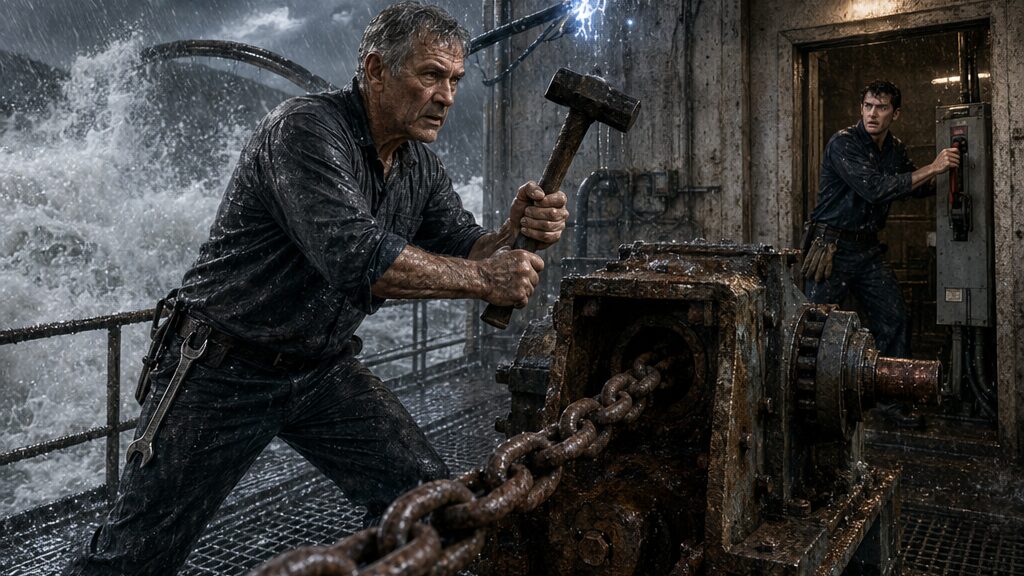
The emergency-chain housing vibrated beneath his boots. He opened the cover he had loosened earlier. The fused chain pulled taut toward the gearbox like a rusted tendon.
He raised the sledgehammer.
The first blow shook the housing but did not break the chain.
The second split a corroded link halfway through.
A spark flashed from the overhead cable tray.
The 10,000V feed had begun leaking through damaged insulation.
The third blow broke the link.
Not cleanly.
The upper length whipped free. The lower half twisted into the guide wheel, jerking the safety gear deeper sideways.
The entire gearbox screamed.
Eric shouted from the doorway, but Samuel could not hear the words.
He dropped the hammer and forced the housing cover wider. The manual lock shaft was visible beyond the chain, displaced several inches from the guide marks.
Too far for the wrench alone.
He fitted the jaws around the shaft and pulled.
Nothing.
Water burst through another seam and struck his back.
Samuel braced one boot against the housing.
He pulled again.
The wrench moved a fraction, then slipped and tore skin from his palm.
Blood made the handle slick.
A blue arc snapped from the cable tray to the wet railing.
Samuel flattened himself against the gearbox as current flashed across the platform. The emergency lights went dark, returned, then dimmed.
The dam’s diagnostic line appeared on a small local display.
Red.
Falling.
The pressure inside the gate pushed the displaced gears outward. If the load released suddenly, the teeth would shatter. Samuel had seen the same principle in smaller systems years earlier: a pump fighting against trapped pressure, a heart circuit that could not tolerate an abrupt opening.
Force was not the answer.
Balance first.
Release in stages.
He set the wrench into the manual adjustment port and turned it one mark—not to open the gate, but to bleed pressure from the locked chamber.
The gearbox pitch lowered.
Eric shouted again. This time Samuel caught two words.
“Thirty seconds!”
The armed surge.
Samuel adjusted the port another quarter turn. Water began moving through the bypass channel. The pressure on the gears eased, but not enough.
The old method had required two people: one to balance pressure, one to reset the lock.
He had one bleeding hand, one ruined shoulder, and no time.
Samuel wedged the wrench in the adjustment port to hold the bypass open.
Then he placed both hands against the rusted safety gear.
The metal was hot.
He pushed.
Nothing.
He lowered his shoulder against it and drove with his legs. Pain tore across his chest. The gear shifted half an inch, then slammed back.
The cable overhead flashed.
Heat swept over his right hand. Rubber burned. Skin split along his palm.
He did not pull away.
He pushed again.
A hospital monitor returned to him—not as memory, but as sound. One long tone. Administrators speaking over it. Rebecca behind glass. Samuel standing silent while they called the procedure his failure.
He had believed silence kept the dead from being used in another argument.
All it had done was leave the lie unchallenged.
“Not again,” he said.
He set his frail shoulder beneath the gear housing and drove upward.
The rusted assembly moved.
One tooth entered the guide.
Then another.
The load from the reservoir fought him through the steel, immense and indifferent. His boots slipped across the flooded grating. His burned hand opened wider against the metal.
Eric reached the local bus.
“Now?” he shouted.
Samuel could not turn his head.
“Wait!”
The gear was still outside the final lock.
The automatic surge engaged.
The motor roared.
For one terrible second, the new force drove the gear against Samuel’s shoulder.
He screamed and pushed harder.
The final tooth crossed the guide mark.
“Cut it!”
Eric pulled the auxiliary disconnect.
The motor died.
Momentum carried the gear the last inch.
The safety lock slammed home with a sound like a vault closing.
Below them, Gate Three shuddered.
Then it began to open.
Water punched through the spillway in a widening silver wall.
Samuel fell to one knee.
The damaged cable arced across the wet platform.
Blue fire crossed his hand and threw him against the housing.
Inside the control room, every diagnostic display dropped to flat red.
Chapter 6: The Green Line and the Buried Name
For three seconds, the dam showed no pulse.
Every diagnostic monitor remained flat red.
No gate position.
No bus voltage.
No reservoir response.
Only the roar beyond the concrete walls proved anything was still moving.
Samuel lay beside the emergency housing with smoke rising from his sleeve.
Eric reached him first.
He crouched without touching the wet railing and pulled Samuel away by the back of his shirt. Samuel’s burned hand had closed around the old wrench so tightly that Eric could not free it.
“Samuel.”
Samuel opened his eyes.
“Gate?”
“No reading.”
“Listen.”
Eric tried.
Under the spillway roar came a slower mechanical rhythm.
Clank.
Pause.
Clank.
The gate descending into its open track.
Inside the control room, Brandon was shouting at the security officers.
“He attacked me. He destroyed the shutdown panel. He interfered with high-voltage equipment. Detain him before he does anything else.”
One officer remained beside the broken console. The other stood at the vestibule door, watching Eric help Samuel inside.
Blood ran from Samuel’s palm onto the wrench.
“Medical station,” the officer said.
“Not until the gate confirms,” Samuel answered.
“You were electrocuted.”
“Not enough to improve my mood.”
Eric gave a strained laugh that ended almost immediately.
A vehicle alarm sounded at the east entrance. Minutes later, boots moved through the upper corridor with deliberate speed.
David Mitchell entered wearing a rain-dark inspection coat and carrying a sealed evidence case.
He took in the room: Brandon’s bloodied temple, the shattered shutdown control, the smoking cable beneath the grate, and Samuel seated against the wall with his hand wrapped in a torn strip of Eric’s undershirt.
“Who is in command?” David asked.
“I am,” Brandon said.
“No,” David replied. “You were.”
He set the evidence case on a console.
“Until I establish what happened, no one touches a control, terminal, tool, or record.”
Brandon pointed at Samuel. “That man assaulted me and sabotaged an active flood response.”
David looked at Samuel. “Did you strike him?”
“I tackled him.”
“Why?”
“To stop the final surge.”
“Did you damage the shutdown panel?”
“My shoulder did.”
David’s expression remained unreadable. “And then you entered a locked spillway platform?”
“Yes.”
“Without electrical isolation?”
“There was no time.”
“That answer usually comes before funerals.”
Samuel looked toward the blank gate display. “Sometimes it comes before survival.”
David turned to Eric. “You transmitted an altered archive timestamp.”
“Yes.”
“Was the record altered during the emergency?”
“Yes.”
“By whom?”
Eric looked at Brandon.
Brandon said, “My authorization was used while I was managing a crisis. That does not prove I edited anything.”
David opened the evidence case and connected an isolated drive to the archive terminal.
“Then the audit chain will help us.”
At the medical station near the back wall, a technician cut away Samuel’s burned sleeve and irrigated his hand. He did not flinch until water reached the deepest split in his palm.
The hospital crisis link returned on a secondary screen.
Rebecca appeared.
“Can you hear me?” she asked.
David glanced over. “Who are you?”
“Dr. Rebecca Young, regional emergency operations. I witnessed part of the event through the live feed.”
Her eyes found Samuel.
He looked away.
The flat red diagnostic line remained unchanged.
Then one point appeared at the far edge of the display.
Green.
Another followed.
The line jumped into a steady rhythm.
Gate Three: twenty-six percent open.
Thirty-one.
Thirty-eight.
Reservoir rise slowing.
No one spoke.
The relief was too large for celebration.
They watched the gate continue opening until the status changed from emergency motion to stable discharge.
Beyond the window, floodwater poured through the spillway in a controlled, thunderous sheet. The reservoir graph bent away from the overtopping line.
Eric lowered his head.
Samuel finally let the medical technician take the wrench from his hand.
David faced Brandon.
“Show me the emergency-chain route.”
Brandon stared at him.
“On the system diagram,” David said. “Identify the chain housing, guide wheel, manual pressure bypass, and safety-lock gear.”
“The diagram is outdated.”
“Then use the current one.”
“The emergency configuration was modified before my appointment.”
David gestured toward Samuel. “He knew it.”
“He worked here for years.”
“You signed a document confirming that you inspected it.”
“I accepted contractor certification.”
“Where is the manual pressure bypass?”
Brandon looked at the diagram.
His finger moved toward a hydraulic return line.
Eric closed his eyes.
David said, “That is the drainage manifold.”
Brandon withdrew his hand.
The audit file opened.
Two records appeared side by side: the original contractor entry and the version edited after the flood alarm. The earlier record listed the inspection as pending. The altered version marked it complete and added a false service date.
Both carried Brandon’s credentials.
David did not raise his voice.
“You did not inherit a bad record. You created one.”
Brandon’s face had gone slack. “I was trying to keep control of the response.”
“You disabled thermal protection.”
“The gate had to open.”
“You suppressed the only correct mechanical diagnosis.”
“I had no reason to trust him.”
Rebecca spoke from the screen.
“You had every reason.”
The room turned toward her.
Samuel’s shoulders stiffened.
Rebecca’s face looked older than he remembered. Not weaker. Simply less protected.
“Samuel Hernandez developed the staged pressure-release sequence used in emergency bypass systems at three hospitals,” she said. “The method he used on that gate was adapted from work he did on cardiac circulation equipment.”
David looked at Samuel.
Samuel said nothing.
Rebecca continued, “Years ago, a patient died during an emergency procedure after administrators refused his pressure-balancing recommendation. They blamed the device design. They blamed him.”
“Rebecca,” Samuel said.
She stopped.
His voice was quiet, but it carried.
“You do not get to clean this up now.”
Pain moved across her face.
“No,” she said. “I don’t.”
The room waited.
Rebecca looked directly at him. “I knew the recommendation had been ignored. I knew the timing logs supported you. I stayed silent because they told me my surgical position would disappear if I contradicted the review.”
Samuel’s bandaged hand rested on his knee.
Brandon had lied to save himself.
Rebecca had remained silent to save her career.
Samuel had withdrawn to save what remained of his dignity.
Different choices. Different damage.
But the same empty space where truth should have been.
“You let them call it my failure,” he said.
“Yes.”
“And I let them.”
Rebecca shook her head. “They forced you out.”
“I left the rest uncontested.”
The admission felt heavier than the gear had.
David closed the archive file.
“The utility also revoked your engineering license after your dam corrosion report?”
Samuel looked at the wrench on the medical tray.
“They said I exceeded my assigned authority.”
“Did you appeal?”
“No.”
“Why?”
Samuel flexed his wrapped fingers and winced. “I was tired of rooms where truth needed permission.”
The east corridor doors opened again.
A communications team entered first, carrying cameras and a rolled utility banner. Behind them came executives in clean emergency jackets that had never touched rain.
One approached Samuel with practiced solemnity.
“Mr. Hernandez, what you did here was extraordinary. The utility intends to restore your credentials immediately.”
Samuel said nothing.
“We also want to discuss a senior executive position. Full authority over safety operations across the entire dam network.”
A photographer raised a camera.
David stepped between the lens and the medical station.
The executive smiled as though the interruption were temporary.
“Mr. Hernandez,” he said, “this is an opportunity to make certain nothing like this happens again.”
Samuel looked from the banner to Brandon, then to Eric, then to Rebecca’s face on the screen.
His hand throbbed beneath the gauze.
Outside, the opened spillway carried the flood safely away.
Inside, the institution had already begun deciding how to use him.
Chapter 7: Fix Who You Promote
The communications team unrolled the utility banner while Brandon was escorted through a side door.
No one asked the workers to move him quietly, but that was how it happened. Two security officers walked on either side of him, not touching his arms, while he kept one hand pressed against the bandage at his temple.
The cameras turned away from him.
They turned toward Samuel.
“Stand here, please,” the communications director said, indicating a strip of clean floor beneath the utility emblem. “We need the spillway visible behind you.”
Samuel remained seated at the medical station.
His right hand was wrapped in fresh gauze from the wrist to the base of his fingers. Blood had already reached the outer layer in two narrow lines. The old wrench lay beside him on a stainless-steel tray, cleaned only by the water that had flooded the platform.
The executive who had offered him the position stepped closer.
“We can delay the statement until you have been transferred to the hospital.”
“There will be no statement,” Samuel said.
The communications director lowered her camera tablet. “We only need a few words.”
“You already have too many.”
The executive gave her a small signal to wait.
Around the inspection floor, workers stood beside consoles and tool cabinets, unsure whether they were permitted to leave. Some still wore rain gear. Others had grease on their sleeves or electrical gloves hanging from their belts. The flood alarms had stopped, but no one had relaxed.
David remained at the archive terminal, copying files to his isolated drive.
Eric stood near him.
On the hospital screen, Rebecca had not disconnected.
The executive pulled a chair nearer to Samuel.
“Mr. Hernandez, I understand your anger.”
“No, you understand its value.”
The man paused.
Samuel nodded toward the cameras. “An old mechanic with a burned hand. A corrupt supervisor led away. A gate opening behind the company logo. That is a useful picture.”
“We are trying to acknowledge what you did.”
“You are trying to finish the story before anyone asks who signed the checks.”
The communications director looked at the executive.
He kept his voice measured. “Brandon Clark will be held accountable.”
“One man did not rust that chain.”
“He falsified the record.”
“After someone paid a contractor who never came. After someone ignored the first report. After someone decided stopping a turbine for inspection cost more than the people below it.”
David looked up from the archive terminal.
“The original corrosion report was distributed to four departments,” he said. “Three marked it received.”
The executive’s expression tightened. “We have not completed an internal review.”
“That is why you should stop preparing an external statement,” David replied.
Samuel turned toward Eric. “Open the withdrawn reports.”
Eric hesitated. “Which reports?”
“The worker safety complaints.”
The executive rose. “Those are confidential personnel records.”
Samuel looked at him. “Then keep the names confidential and show the dates.”
Eric glanced at David.
David nodded once.
Using the isolated terminal, Eric searched the maintenance grievance archive. At first, nothing appeared. Then he removed the filter marked active complaints.
A list filled the screen.
Gate lubrication delayed.
Emergency-chain corrosion.
Cable insulation discoloration.
Auxiliary-bus temperature spikes.
Manual lock access obstructed.
Each report had been filed, reviewed, and withdrawn.
Some had been withdrawn within hours.
Others after disciplinary meetings.
Samuel watched the dates accumulate across the screen.
“Read the reasons,” he said.
Eric opened the first.
“Employee requested withdrawal after scheduling review.”
The second read: concern resolved informally.
The third: reporting worker reassigned; complaint no longer applicable.
The fourth contained no reason at all.
The executive said, “You cannot assume retaliation from administrative language.”
“No,” Samuel said. “You can ask the people standing in the room.”
No one moved.
For a moment, Samuel saw his own silence reflected across the inspection floor. Workers looking at the ground. Workers waiting for someone else to risk the first word.
He reached for the wrench.
His burned fingers failed to close around it.
The medical technician moved to help, but Samuel tried again with his left hand and lifted it from the tray.
He stood.
Pain pulled his shoulders forward, yet when he crossed to the central floor, the workers made space without being told.
Samuel stopped beneath the utility banner.
The communications director raised her camera by instinct.
“Put that down.”
She did.
Samuel looked toward the workers.
“I filed a report eleven months ago,” he said. “When they removed my authorization page, I kept the original at home and came back to work with a smaller title.”
No one interrupted.
“I told myself the bolts still needed turning. I told myself I had done my part because the warning existed somewhere.”
His gaze moved across the room.
“That was not enough.”
The admission landed without drama. It did not absolve anyone. It did not accuse them of what he had also done.
One worker near the rear wall lifted his head.
Samuel gestured toward the complaint list. “Those reports were not withdrawn because the rust disappeared.”
The executive stepped closer. “We can establish a protected review process under your leadership. That is what the position offers.”
“Full authority?” Samuel asked.
“Yes.”
“Independent inspectors?”
“We would determine appropriate oversight.”
“Protection against reassignment or dismissal for reporting safety failures?”
“That would require legal review.”
“Publication of missed maintenance and contractor payments?”
“We cannot release unfinished findings.”
Samuel nodded.
There it was.
Authority over the consequences, but not over the truth.
A title large enough to display and narrow enough to control.
He handed the executive the printed offer without reading the salary.
“No.”
The man stared at the paper. “You could rebuild the entire safety division.”
“Not if I need permission to say why it failed.”
“This offer restores everything that was taken from you.”
Samuel looked at the gauze around his hand.
“No one can restore the years.”
On the screen, Rebecca lowered her eyes.
Samuel did not soften the words for her, but neither did he direct them at her alone.
“The patient does not return because you correct the report. The chain does not become maintained because the gate opened. And these workers do not become safe because you put my face above them.”
He turned toward Eric.
“Read the names.”
Eric looked at the personnel records. “They are protected.”
“Ask them.”
The first worker stepped forward from the electrical bay.
“Use mine.”
Then another voice came from beside the turbine console.
“Mine too.”
A maintenance worker near the rear raised a hand.
Within seconds, seven people had given permission.
Eric read each name from the reports, then the hazard each person had identified. No one applauded. The only sound between entries was the steady rush of water through the opened spillway.
When he finished, Eric removed his badge from his chest.
The executive stiffened. “You are not required to resign.”
“I’m not resigning.”
Eric placed a blank statement form on the console.
“I’m signing.”
He wrote that Brandon had ordered the thermal bypass, altered the archive record, and locked the spillway access after the maintenance fraud was exposed. His hand shook through the first line. By the final line, it had steadied.
David took the statement.
“The inspection authority will attach it to the independent file.”
The executive said, “Independent from whom?”
“From you,” David replied.
The man’s face hardened. “That has not been authorized.”
David closed the evidence case. “Neither was the flood.”
Samuel moved toward the exit.
The workers parted again, forming two uneven lines through the corridor. There was no ceremony in it. They simply stepped aside and remained there.
The executive followed him several paces.
“Mr. Hernandez, what do you expect us to do?”
Samuel stopped.
He looked back at the banner, the cameras, the altered records glowing on the screen, and Eric’s signed statement in David’s hand.
Then he looked at the people who had known something was wrong and had learned to keep their knowledge quiet.
“Fix who you promote.”
He clipped the old wrench to his belt.
The weight pulled against his hip as it always had, familiar and plain.
Then Samuel walked between the silent engineers and out of the dam.
The story has ended.