The Woman by the Window
The Woman by the Window
Part I — The Wrong Kind of Customer
By the time the old woman touched the silver heel, half the store had already decided she did not belong there.
No one said it out loud at first. They did not have to. It lived in the way shoulders tightened, in the glance that slid over her coat and lingered on the frayed hem, in the small silence that fell inside the boutique as if even the polished air had become selective about whom it welcomed.
The store was called Veridian House, though most people in the city simply referred to it as the glass boutique on Mercer. The windows stretched from floor to ceiling. The lights were soft and expensive-looking. Shoes sat on white pedestals like objects in a museum, untouched by dust, ordinary life, or anyone who checked price tags before breathing too hard.
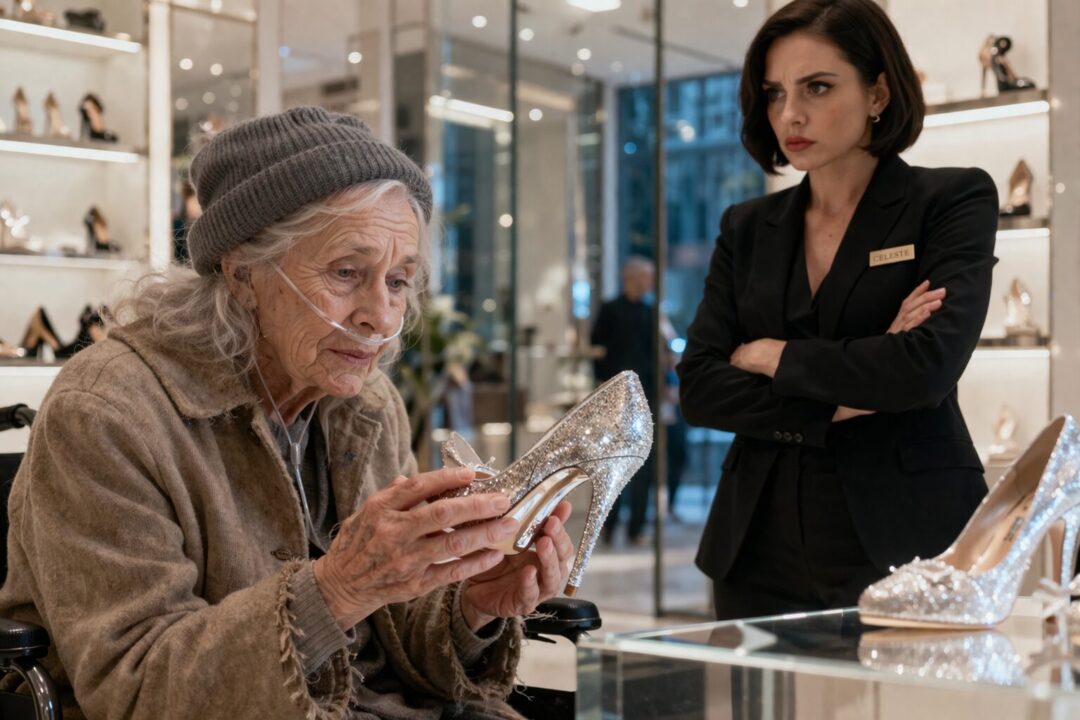
The woman stood near the center display in a faded beige coat that looked too thin for the season. A gray knit cap covered most of her hair. An oxygen tube rested beneath her nose, and every slow step she took seemed measured against a private ache. Her hands trembled a little when she reached for the shoe, but once her fingers closed around it, they became strangely steady.
It was a silver stiletto, delicate and severe, its surface catching the light like frost.
She lifted it with both hands.
Not greedily. Not like a thief. Like someone lifting something breakable from another life.
That was the moment Celeste Warren appeared.
Celeste managed Veridian House with the kind of sharp devotion some people reserved for religion. She wore black as if it were armor rather than fabric. Her dark bob never moved out of place. The silver badge pinned to her blazer flashed when she turned, but the real badge was the expression she carried at work: chin up, eyes cool, every feature arranged around the idea that good taste required strict borders.
She crossed the floor in quick, silent steps.
“Don’t touch that.”
The words landed harder than their volume deserved.
The old woman looked up, startled, though not ashamed. Her face was narrow and deeply lined, but her eyes were clear. They did not dart away the way Celeste expected them to. Instead they returned, calmly, to the shoe.
“It’s beautiful,” she said.
The answer was soft. Almost reverent.
For one strange second, Celeste was irritated not by the woman herself, but by the tone. There was no begging in it. No apology. No embarrassment. Just certainty, as if beauty could still belong to whoever recognized it.
Celeste reached out and took the heel from her hands.
“This store isn’t for you.”
A younger employee folding silk dust bags near the register looked up, then quickly looked down. Another customer near the mirrored wall shifted her purse and pretended to examine a display. The whole room heard the sentence. That was part of what made it unforgivable. Some humiliations were private accidents. This one had been shaped and delivered.
The woman’s fingers remained curved in the air for a moment after the shoe was gone.
Then she lowered her hands.
She seemed smaller suddenly, but only physically. Her back bent. Her shoulders dipped. Yet something in her face did not collapse with the rest of her. She absorbed the insult the way stone absorbs rain: visibly, quietly, without argument.
Celeste pointed toward the front.
“I need you to leave.”
The old woman nodded once. She did not protest. She did not plead. She turned and began walking toward the entrance, one careful step at a time, her coat hanging straight from her narrow frame. She might have made it to the door without incident if shame had not altered the body’s rhythm the way fever did.
Near the glass front, her hand brushed the edge of a display pedestal. She swayed.
At the far side of the room, Rowan Flores noticed.
Rowan was not supposed to be watching the floor. He was supposed to be restocking cleaning cloths and checking the service hallway near the back. At twenty-three, he had learned the invisible map of the store far better than he had learned its customers. He knew which hinge on the staff door squeaked in damp weather, which marble tile needed extra care, which lights flickered when the storm drains backed up beneath the block. He knew where he was welcome and where he was meant to disappear.
But he also knew the difference between a customer lingering and a body losing balance.
He was moving before he fully thought about it.
By the time he reached the front, the old woman had caught herself against the wall, one palm flat against the glass. Her breathing was shallow. Celeste stood three paces away, annoyed rather than alarmed, as if even weakness had become an inconvenience.
“You need to keep moving,” Celeste said.
Rowan stopped between them without planning to.
“Ma’am,” he said to the woman gently, “are you okay?”
Celeste turned to him in disbelief. “Rowan.”
He barely heard her. The woman’s face had gone pale under the boutique lighting. He could see the thin line of the oxygen tube trembling with each breath.
He glanced down and noticed the silver heel still in Celeste’s hand.
Something in him tightened.
He did not think of policies then. He did not think of payroll or hierarchy or how easily a person in his position could be replaced. He thought only of how the woman had held the shoe—as if it had meant more than its price.
“Sit here for a second,” he said.
There was a low bench near the window, meant for clients trying on shoes. Rowan guided her toward it, careful, slow, keeping his touch light enough that she could reject it if she wanted to. She did not. She lowered herself onto the cushion with visible effort.
Then Rowan did something that made no sense inside the logic of places like Veridian House.
He turned to Celeste and held out his hand.
She stared at it. “Excuse me?”
“The shoe.”
The silence that followed was not long, but it was dangerous.
Celeste’s mouth flattened. “Absolutely not.”
Rowan kept his hand there.
He surprised himself with that.
Perhaps she was surprised too, because after one stiff second, she placed the heel in his palm with such visible contempt that it felt less like surrender than accusation.
Rowan took the shoe and crouched in front of the woman.
“You can try it here,” he said.
Her eyes lifted to his face.
There was gratitude there, yes. But something else moved behind it—something older, sharper, impossible to place. It passed so quickly Rowan thought he had imagined it.
Across the polished floor, Celeste stepped forward, fury now replacing disbelief.
“Get back to work.”
This time the sentence was aimed at him.
Rowan looked up, still kneeling.
He should have stood. He should have apologized. He should have retreated into the safe obedience that paid his rent.
Instead he remained where he was.
And behind him, on the bench by the window, the old woman rose.
Part II — The Test Nobody Saw
There are moments when a room changes before anyone understands why.
Celeste heard it first in the silence.
Not the expensive, ambient quiet the boutique cultivated. This was something denser. The kind of stillness that arrived when the ground under a situation shifted and everyone felt it before they could explain it.
Rowan stood slowly and turned.
The woman had removed her knit cap.
Her gray hair, which had looked thin and flattened beneath the wool, fell away from her face in a softer frame than either of them expected. More startling than that, though, was not her appearance but her posture. She was no longer leaning into fragility. The stoop in her shoulders had vanished. Her chin lifted. Her spine straightened. The change was so precise it felt less like recovery than decision.
She still wore the same beige coat. The same oxygen tube remained in place. Nothing magical had happened. Nothing theatrical. And yet she no longer looked like someone asking permission to occupy space.
She looked like someone accustomed to being answered.
Celeste took one involuntary step back.
The woman’s gaze moved from Rowan to Celeste, calm and unhurried.
“I built this store,” she said.
No one moved.
The sentence should have sounded absurd. It should have been easy to dismiss. But the room had already begun recognizing it before reason caught up. It was there in the composure of her voice. In the complete absence of triumph. In the terrible fact that she did not sound like a woman inventing power. She sounded like a woman tired of pretending not to have it.
Celeste laughed once, thinly. “That’s not possible.”
The woman studied her for a moment, and Rowan saw something he would remember long after the rest of the day blurred: disappointment without surprise.
“It is,” she said. “And if you had looked at my face instead of my coat, you might have noticed.”
Her name, Rowan would later learn, was Lenora Vale.
Twenty-two years earlier, before the investors, before the glossy campaigns, before Veridian House became a place people photographed more than inhabited, Lenora had begun with a small workshop and a single principle: that elegance was not decoration but dignity. Shoes, to her, were never just commodities. They changed how a person entered a room. They altered balance, mood, courage. The first designs she made were for women who wanted to feel seen by themselves, not merely admired by others.
The boutique on Mercer had been her fifth store and her favorite.
Then came illness, restructures, a board that treated legacy like clutter, and a long season in which her public appearances dwindled enough for newer employees to know her name only as something buried in old company presentations.
She had let that happen more than once on purpose.
Because anonymity, she discovered, was instructive.
When people believed she was rich, refined, and still useful to their ambition, they offered reverence so quickly it embarrassed her. When people believed she was old, sick, and inconvenient, they revealed something closer to truth.
So every few months, without warning, Lenora visited one of her stores alone.
She wore a coat that erased her silhouette. She covered her hair. She moved more slowly than she needed to. She let the room decide who she was.
Most stores did better than this.
Not perfectly. But better.
Celeste’s face had begun to drain of color.
“I—I didn’t realize—”
“No,” Lenora said. “You realized exactly what you wanted to realize.”
The younger employee at the register had frozen entirely now, dust bag still in her hands. The customer by the mirrors had turned, openly staring.
Rowan was still holding the silver heel.
Lenora noticed and smiled at him then—not broadly, not for effect, but with quiet warmth.
“You offered kindness before certainty,” she said. “That’s rare.”
Rowan swallowed. “I was just trying to help.”
“That is never just anything.”
Celeste found her voice again, though it had lost its edge.
“Ms. Vale, I can explain.”
Lenora turned back to her.
“I’m sure you can,” she said. “That’s another common skill.”
The words were not loud. They were not cruel. If anything, that made them worse. Celeste had built her authority on decisiveness, on the confidence of immediate judgment. To be met not with rage but with clarity was to lose the ground she knew how to fight on.
Lenora reached into the inside pocket of her coat. Rowan saw Celeste flinch before a slim leather card case emerged. Lenora opened it, removed a cream-colored card, and handed it to the manager.
Celeste took it with stiff fingers.
Whatever was written there, Rowan never saw. He did not need to. Celeste’s face changed the moment her eyes landed on it.
All the polish that had made her seem so unshakable seemed suddenly cosmetic.
“I’m sorry,” she whispered.
Lenora did not answer right away. She looked around the boutique—the white pedestals, the gleaming shelves, the mirrored wall that made every human movement look more deliberate than it really was. Then she looked back at Celeste.
“When I first opened my workshop,” she said, “I sold one pair at a time. Some women saved for months to buy them. Some came in wearing clothes much worse than mine. Some had hands rough from factory work. Some came straight from hospitals or funerals or double shifts. But they understood beauty. They understood what it meant to want one thing in your life that made you stand differently.”
Her eyes lowered briefly to the silver heel in Rowan’s hands.
“If your store cannot recognize that, then it is no longer mine in any way that matters.”
Celeste opened her mouth, then closed it again.
Outside, a bus rolled past the window. Its reflection slid across the glass and was gone.
Lenora extended her hand toward Rowan.
“The shoe.”
He passed it to her.
She turned it over once in the light and smiled faintly, almost to herself.
“This was my design,” she said. “A revision of an older line. They kept the shape and lost the soul.”
Then she handed it back.
“To her,” she said, nodding at the sales associate by the register.
The young woman startled. “Me?”
“Yes. For remembering how to look ashamed.”
The employee’s eyes filled at once.
Lenora turned again to Rowan.
“And you.”
He stiffened.
She stepped close enough that he could see the fine exhaustion at the corners of her eyes, the kind illness left behind even on strong days. Yet her hand did not tremble as she reached into her coat again.
This time she withdrew a small metal badge attached to a dark keycard strap.
The surface caught the light, but any lettering remained angled away.
“You start tomorrow,” she said.
Rowan blinked. “Start what?”
Lenora’s expression softened.
“Training. Office and floor operations. Customer experience. Hiring protocols, if you survive the first three weeks.”
For one stunned second, he thought she might be joking.
Then he looked at Celeste and realized she was not.
“I don’t understand,” he said.
“You saw a person before you saw a problem,” Lenora replied. “That is harder to teach than inventory systems.”
Her voice lowered slightly.
“And this place needs at least one person in it who remembers the difference.”
Part III — What Elegance Means
The official announcement did not go out until two days later.
By then the story had already spread through Veridian House in whispers, edits, and versions dramatic enough to become unrecognizable by noon. In one retelling, Lenora had arrived in disguise to expose corruption across the entire chain. In another, Rowan had argued with Celeste for ten full minutes. In still another, the silver heel had been worth ten thousand dollars and covered in hand-set crystals.
The truth was smaller than gossip and more important.
A woman had been treated as disposable because she looked inconvenient.
A man with the least authority in the room had been the only one to act as if dignity did not require proof.
And an old founder, tired enough to stop performing patience for the comfort of others, had decided that the moment should matter.
Celeste was placed on immediate review and disappeared from the Mercer store before the week ended. Rowan never learned exactly what terms accompanied her departure. He only knew that her office door stood open one afternoon, empty except for a faint rectangle on the desk where her tablet used to sit.
The younger sales associate who had received the silver heel—Mina, he learned—kept it in its box for three days before finally taking it home. She cried when she told him that. Not because it was expensive, but because she had almost said nothing.
“I saw it happening,” she admitted. “I kept telling myself it wasn’t my place.”
Rowan thought about that for a long time afterward.
His own first day upstairs felt like an administrative mistake. The office levels of Veridian House were quieter than the boutique, but in a different way. Less performative. More dangerous. Everyone seemed to know terminology he did not, how to read spreadsheets he had never seen, how to speak about “brand posture” and “client flow” with faces that made the phrases sound inevitable.
Lenora did not coddle him.
She also did not let him drown.
Sometimes she called him into her office just to ask what he had noticed on the sales floor that no one else had. He learned quickly that her questions were never random. Why did some clients hesitate near the entrance before committing to come in? Which employees made nervous customers relax without seeming to try? How long did embarrassment linger after a patron was corrected in public? Which greetings felt like welcome, and which felt like inspection?
He answered honestly, and she listened as if honesty were a technical skill.
On the fifth day, he found the courage to ask what had been troubling him since Mercer.
“Why do you do it?” he said. “The disguise.”
Lenora stood by the office window, looking down at the avenue where people moved in quick lines of purpose beneath the late-afternoon light.
“Because success attracts performance,” she said. “And performance is flattering. But it tells you almost nothing.”
She turned to face him.
“People are very kind to power, Rowan. That has never impressed me.”
He thought of Celeste then, of how expertly she had embodied refinement until one powerless woman tested its meaning.
Lenora’s gaze softened.
“The ugly truth,” she said, “is that most institutions begin with values and end with habits. If no one interrupts that, habits become culture. Then culture becomes cruelty, dressed well enough to call itself standards.”
The sentence stayed with him.
Months passed.
Rowan learned faster than anyone expected, including him. He made mistakes. He confused reports, misread purchasing timelines, once sent a scheduling file to the wrong regional lead and had to apologize to three people before lunch. But he listened. He watched. He remembered details others ignored.
He also changed the entrance protocol at Mercer.
Nothing dramatic. No grand poster campaign. No public declarations about compassion. Lenora despised performance when it tried to substitute for structure.
Instead there were training revisions. Greeting standards rewritten around openness instead of qualification. Quiet instructions about how assistance should be offered, how concern should sound, how correction should be done privately if it had to happen at all. Seating was moved closer to the entrance so anyone who needed a pause could take one without feeling they had invaded something sacred. Water was offered more often. So were mirrors angled for older clients who did not want to stand as long.
The boutique looked almost the same.
It felt different.
One evening, months after the day by the window, Rowan was locking up when he noticed Lenora standing again near the central display.
This time she wore a dark wool coat, no knit cap, no attempt at disguise. She was still slight, still carrying her illness with disciplined economy, but anyone with eyes could see the authority around her now.
In her hand was another shoe from the new collection.
“Better?” she asked without looking up.
Rowan considered the design. “More honest.”
She smiled. “Good answer.”
He hesitated, then said, “Did you know that day? Before I said anything?”
“Know what?”
“That I’d help.”
Lenora turned the shoe slowly in the light.
“No,” she said. “That was the point.”
He absorbed that.
Outside, the city was darkening into evening, the windows turning the street into overlapping reflections. Inside, the boutique glowed warm and quiet, no longer like a museum but like a place where human beings might actually arrive with lives still attached to them.
Lenora set the shoe back on its pedestal.
“Elegance,” she said after a moment, “is not the room deciding who deserves beauty.”
She glanced at him.
“It’s the room making space for them to discover it.”
When she left, Rowan remained by the window a little longer than necessary.
People passed outside in coats of every kind—cheap, tailored, stained, careful, inherited. Some glanced in and kept walking. Some slowed. One elderly woman paused for a few seconds, studying the display with a look Rowan recognized immediately: longing mixed with calculation, as if desire itself needed permission.
He crossed the floor and opened the door before she could change her mind.
The last light of day caught the glass behind him.
“Come in,” he said gently. “Take your time.”