
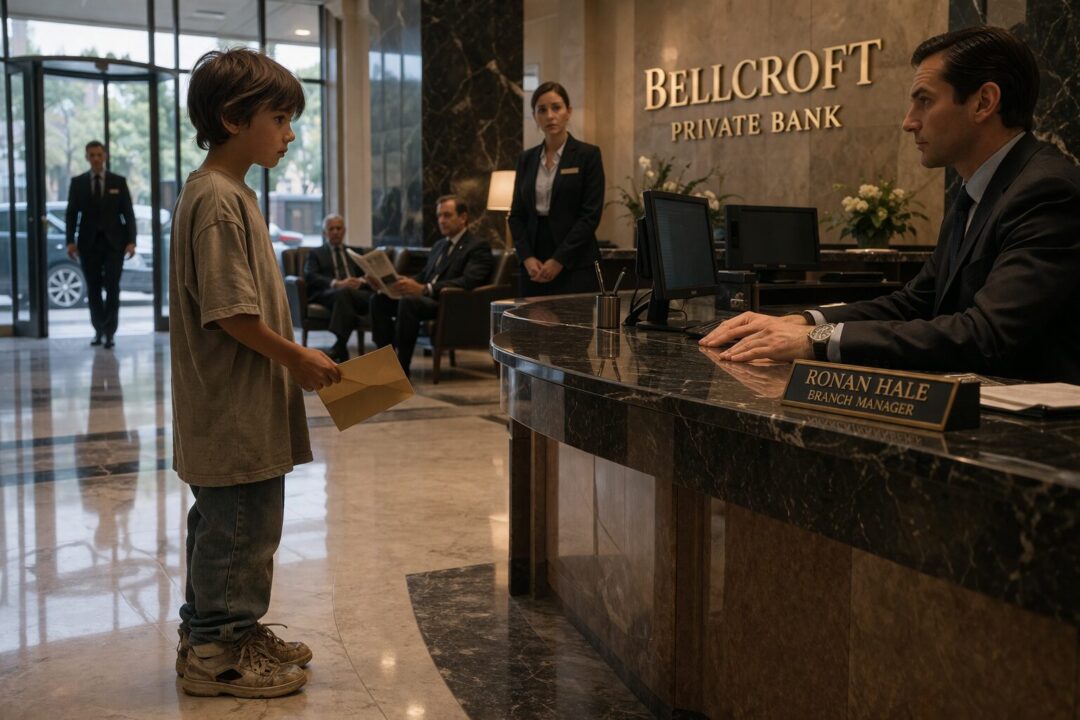
The Boy on the Marble Floor
The Boy on the Marble Floor
Part I — The Shoes
The first thing they noticed was not the boy’s face.
It was his shoes.
They were small, cheap, and badly worn, the kind sold from roadside racks for less than the cost of a banker’s lunch. The rubber had thinned at the toes. One lace had been tied into a knot where it had snapped and frayed. Mud, dried into pale brown cracks, clung stubbornly to the soles and edges. On the shining marble floor of Bellcroft Private Bank, they looked like something dragged in from another world.
Ronan Hale saw them before he saw anything else.
He had spent twenty-three years inside buildings like this one, places where money softened every sound and polished every surface. He knew the rhythm of wealth: the measured footsteps, the low voices, the controlled impatience of people who believed time was the most expensive thing they owned. Disorder did not belong in Bellcroft. Need did not belong in Bellcroft. Certainly not a child in a faded oversized shirt, standing alone at the reception desk with a sealed envelope clenched in both hands as if it contained the answer to a question he was too young to ask.
“Where are your parents?” the receptionist had asked softly at first.
The boy had only shaken his head and kept looking past her, not rude, just fixed on something beyond her authority.
That was when she had sent for Ronan.
Now he stood behind the desk, immaculate in charcoal wool, silver watch gleaming against his wrist, studying the child with a practiced coolness that had once impressed clients and now mostly protected him from inconvenience.
The boy could not have been older than nine. His dark hair was messy, as though it had been cut at home and grown out without care. His cheeks were thin. His face was all quiet nerves and stubbornness. In his hands, the envelope trembled faintly.
Ronan did not ask if the child was lost.
He looked once at the shoes and made a decision.
“You can wait outside,” he said.
The boy did not move.
Behind him, one of the junior associates pretended to organize papers. A pair of customers seated near the glass wall glanced over and then quickly away. Bellcroft ran on discretion, but human curiosity always leaked through the cracks.
The boy swallowed. His grip tightened on the envelope.
“My uncle said wait here.”
His voice was small, but clear enough.
Ronan let his gaze drift from the shoes to the boy’s face. There it was again—that absurd refusal to understand his place.
“This is a private bank,” he said.
He did not raise his voice. Men like Ronan never needed to. His tone was enough to suggest a door closing.
But the boy only drew in a shallow breath and lifted the envelope slightly, as if that explained everything.
“He told me not to leave.”
For the first time, Ronan felt the prickle of annoyance sharpen. Not because the boy had argued, but because he had done so without insolence. Open defiance was easy to crush. Quiet certainty was harder. It implied something.
“Did he?” Ronan said.
The receptionist shifted uncomfortably. She was young, still soft-hearted in ways the bank would eventually sand down. Ronan could feel her wanting him to be kinder. He ignored it.
The boy’s eyes flicked toward the tall front windows, then back to Ronan. They were dark eyes, too serious for his age.
Ronan leaned back a fraction, enough to signal control. Enough to let the expensive watch catch the light as his hand settled on the desk.
“And your uncle is who?”
The faintest smile touched his mouth.
Not a warm smile. Not even a truly amused one. It was the expression of a man who already expected disappointment, and found a certain pleasure in being proved right.
The boy stared at him for one second. Two.
Then he turned his head toward the entrance.
“He’s here.”
For some reason, those two words changed the temperature in the room.
Ronan felt it before he understood it—the pause that ran through the lobby, the slight shift in attention, the kind of silence that means something larger has entered than a person.
Then, through the glass, a long black car eased to the curb.
No one in Bellcroft needed to be told what kind of car it was. Wealth recognized itself faster than kindness ever did.
Ronan’s smile vanished.
The boy did not look triumphant.
That unsettled him most of all.
He only stood there in his oversized shirt and those absurd shoes, the envelope still in his hands, his small body suddenly less like an inconvenience and more like the beginning of a mistake Ronan had not yet measured.
Part II — The Man Who Never Came In
Before he entered Bellcroft Private Bank, Eli Mercer had spent forty minutes on a bus trying not to crush the envelope.
His uncle had warned him about that first.
“Hold it flat,” Garrick had said that morning, kneeling in front of him in the narrow kitchen. “Don’t bend the corners. And no matter what anyone says, you wait inside.”
Eli had nodded.
Garrick’s apartment sat above a laundromat on the wrong side of the river, where the windows rattled in winter and the plumbing made a coughing sound before dawn. But Garrick kept the place neat. Shoes lined by the door. Cups turned upside down to dry. Bills tucked beneath a chipped ceramic bowl. Eli had been living there for almost three months, ever since his mother’s surgery and the long stretch of recovery that left her unable to work and too proud to accept help from anyone but her older brother.
No one looking at Garrick’s apartment would have guessed the truth.
No one looking at Garrick ever guessed it either.
He dressed simply. Drove an old pickup most days. Cut his own grass when he visited his sister. Fixed leaking taps. Bought groceries in bulk. He disliked display the way some rich men disliked honesty.
What Eli knew, because children notice the gaps adults overlook, was that people changed around his uncle when they learned his full name.
Sometimes they straightened up.
Sometimes they smiled too quickly.
Sometimes they turned careful.
Eli did not really understand what Garrick did. Something about investments. Something about buying places before anyone knew they mattered. Something about helping other people put their money where it would grow teeth and come back larger. All Eli really knew was that his uncle was respected by men in expensive coats and feared by men who mistook silence for harmlessness.
That morning Garrick had dressed differently.
Not flashy. Never flashy. But deliberate. Dark overcoat. Crisp shirt. The expensive watch he usually left in a drawer. He had looked at the envelope for a long time before sealing it.
“This goes to Bellcroft,” he had said. “To the branch manager.”
“Why me?” Eli had asked.
Garrick had studied him, then offered the smallest smile.
“Because people show you who they are around a child.”
Eli had frowned. “Is this a test?”
“No,” Garrick said.
But he said it too late.
Now, standing on the marble floor of Bellcroft while men and women in immaculate clothing glanced at him as if he had wandered in by accident, Eli realized it had always been a test. Maybe not of the bank itself. Maybe of one man. Maybe of a whole world that claimed refinement while measuring human worth by fabric, leather, posture, and polish.
He wished suddenly that he had worn better shoes.
Not because he wanted their approval, but because he hated how quickly they had decided what he was. Poor children learned that look early. The weighing glance. The polite distance. The way adults could make exclusion sound like procedure.
He had seen it at stores when his mother counted coins at checkout.
Seen it in waiting rooms.
Seen it at school when forms came home unsigned because they were choosing between electricity and groceries.
But this felt worse because it was so clean.
The bank smelled faintly of cedar and expensive paper. Light spilled through the windows in perfect planes. Even the silence had been arranged.
And in the middle of it stood Ronan Hale, a man whose face looked as if it had been trained never to reveal more than strategy required.
Eli did not hate him.
Children rarely begin with hate. They begin with confusion, then embarrassment, then the slow hardening that adults later call attitude.
What Eli felt was something smaller and sadder.
He felt tired.
Tired of having to prove he had the right to stand in a room.
Tired of watching adults decide what kindness cost before offering any.
When Ronan asked, “And your uncle is who?” the question was almost gentle. That was what made it cruel.
Eli had opened his mouth to answer, but then the car slid up outside, black and silent as a judgment finally arriving.
He turned toward the entrance.
“He’s here.”
Through the glass doors he could see the driver step out first, then Garrick emerge from the back seat, buttoning one cuff with calm, economical movements. He did not rush. He never rushed. The world always seemed to bend itself slightly around his timing.
Inside the lobby, something invisible collapsed.
The receptionist went pale.
One of the seated clients rose halfway, as if unsure whether he ought to stand.
Ronan did not move at first.
Then Garrick stepped through the doors.
He was not taller than every man in the room. He was not louder. He did not need to be. There was a kind of authority built from being answered when you called, expected when you arrived, and remembered long after you left.
His eyes found Eli first.
Not the desk. Not Ronan. Not the watching room.
Eli.
And that, more than the car, more than the coat, more than the instant tension that spread through the bank, redrew the shape of the moment. Because for all the power Garrick carried into the room, his first concern was not insult. It was the boy.
He came to a stop a few feet from the desk.
His voice, when it came, was low and controlled.
“Why is he waiting?”
No one answered immediately.
Ronan’s face changed in a way Eli would remember for years. Not panic. Men like Ronan rarely panicked in public. But certainty left him. It drained so quickly that it seemed almost visible, like water pulled from sand.
“Mr. Mercer,” he said at last. “I wasn’t aware—”
“No,” Garrick said quietly. “You were.”
The silence after that was not empty. It was full of people realizing that a conversation had begun before they understood the subject.
Garrick looked at Eli’s shoes.
Then at Ronan.
“You saw those first, didn’t you?”
Ronan opened his mouth, but there was nothing elegant enough to survive the truth.
Eli felt heat rising in his face, not from shame this time, but from the strange, aching relief of being seen exactly as he was and not found smaller for it.
Garrick held out his hand.
“The envelope.”
Eli gave it to him.
Garrick placed it on the desk in front of Ronan without taking his eyes off the banker.
Inside, Eli later learned, was not just paperwork. It was a notice. Garrick Mercer was moving a substantial portfolio out of Bellcroft by the end of the week. The reason, expressed in language far cleaner than the moment deserved, centered on concerns about judgment, discretion, and client-facing conduct.
It was business language for a moral failure.
Ronan did not reach for the envelope.
For the first time since Eli had entered the bank, the man looked uncertain not of a situation, but of himself.
Part III — The Weight of a Doorway
They left the bank together.
No one tried to stop them.
Outside, the air felt sharper, more honest somehow. The city noise returned all at once—distant traffic, a siren several blocks away, the hiss of tires over damp pavement. Eli stood near the car while Garrick spoke quietly with his driver, then opened the rear door and gestured for Eli to get in.
Once inside, the leather felt too soft under his hands.
He stared straight ahead.
After a moment, Garrick got in beside him.
For a while neither of them spoke.
Then Eli said, “You knew.”
Garrick did not pretend not to understand.
“I suspected.”
“You sent me in there alone.”
“Yes.”
The answer came without defense. That was one of the things Eli both loved and hated about his uncle—he never wrapped the truth to make it easier to swallow.
Eli looked down at his shoes. They seemed even smaller now.
“I thought maybe… maybe if I talked right, it would be different.”
Garrick’s expression shifted, not much, but enough.
“That,” he said, “is the part I was hoping I was wrong about.”
Eli turned to the window. Bellcroft’s doors glinted in the reflection. He could still see the lobby if he looked carefully enough. The polished desk. The tall glass. The place where he had stood feeling as though he had brought dirt into a room built to hide it.
“I hated it,” he admitted.
“I know.”
“I wanted to leave.”
“I know.”
Eli rubbed his thumb along the broken lace knot on one shoe.
“Were you testing me too?”
That time Garrick answered more slowly.
“No. I was trusting you.”
The distinction landed strangely. He was not sure he liked it better.
But Garrick went on.
“You did something hard. You stayed calm while someone smaller on the inside tried to make you feel smaller on the outside. Not many adults can do that.”
Eli let that settle.
Children are often praised for being brave when what they really are is trapped. But this felt different. Not because the moment had hurt less, but because someone had seen the cost of it.
“What happens to him?” Eli asked.
Garrick looked back toward the bank once, then away.
“That depends on whether he learns anything.”
It was not the answer Eli expected. He had imagined punishment, immediate and clean. He had imagined Ronan Hale losing what he valued most. But Garrick sounded almost tired.
“People think humiliation teaches character,” he said. “Usually it teaches performance. Real change is slower. Less satisfying.”
Eli considered that. It felt unfair.
Then again, almost everything important did.
When they reached home, his mother was sitting at the kitchen table with a blanket around her shoulders and tea cooling in both hands. The worry on her face vanished the instant she saw Eli, then returned in another form when she read the silence in him.
Garrick told her only what mattered.
“He did exactly what I asked.”
His sister looked at Eli for a long moment and understood more than Garrick said aloud. Mothers often do.
That night, after dinner, when the apartment had gone quiet and the laundromat below hummed like distant machinery under the floorboards, Eli left his shoes by the door and stared at them.
They were still broken.
Still cheap.
Still ugly in the wrong light.
But they no longer looked shameful to him.
They looked honest.
Weeks later, a package arrived.
Inside was a new pair of sneakers, sturdy and clean, along with a note in an unfamiliar hand.
No signature. No grand apology.
Just one sentence written carefully enough to reveal effort:
I should have seen the child before the shoes.
Eli read it twice.
Then he folded the note and slid it into the kitchen drawer where his mother kept things too important to display and too meaningful to throw away.
He did wear the new shoes eventually. Not at once. For a few days he kept reaching for the old ones out of habit, out of loyalty, perhaps even out of defiance.
But time moves even when pain wants to stay in place.
The old shoes were retired to the back of the closet.
Months later, on a gray morning with rain tapping softly at the windows, Eli found them again while looking for a missing schoolbook. He picked one up by the heel and turned it in his hands. The cracked rubber. The broken lace. The dried mud caught in the seams.
He thought about the marble floor.
About the desk.
About the moment the room had gone silent.
And he realized the memory no longer burned the same way.
The sharpest part was gone.
What remained was something steadier.
Not triumph. Not exactly.
Understanding.
There would be other rooms in his life. Other polished floors. Other people who would glance down before they looked up. Some would do it openly. Others would hide it beneath manners so fine they almost passed for virtue.
He could not control that.
But he would remember what his uncle’s arrival had really changed.
Not the room.
Him.
Because on the day Bellcroft Private Bank measured his worth by his shoes, Eli Mercer had learned a harder and more useful truth than revenge:
Some doors open only for power.
But some remain open forever after you have seen clearly who stands behind them.






Money isn’t everything it’s pride in the way you act & treat people. There is no one more important in life but yourself rich or poor.