The HOA Tore Apart Her Yard, Then Learned She Had Written the County Rules
Chapter 1: The Excavator Crossed the Red String
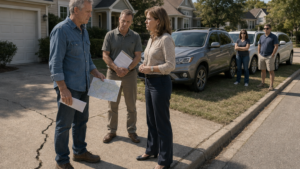
The excavator bucket dropped into Catherine Miller’s front yard before she reached the porch.
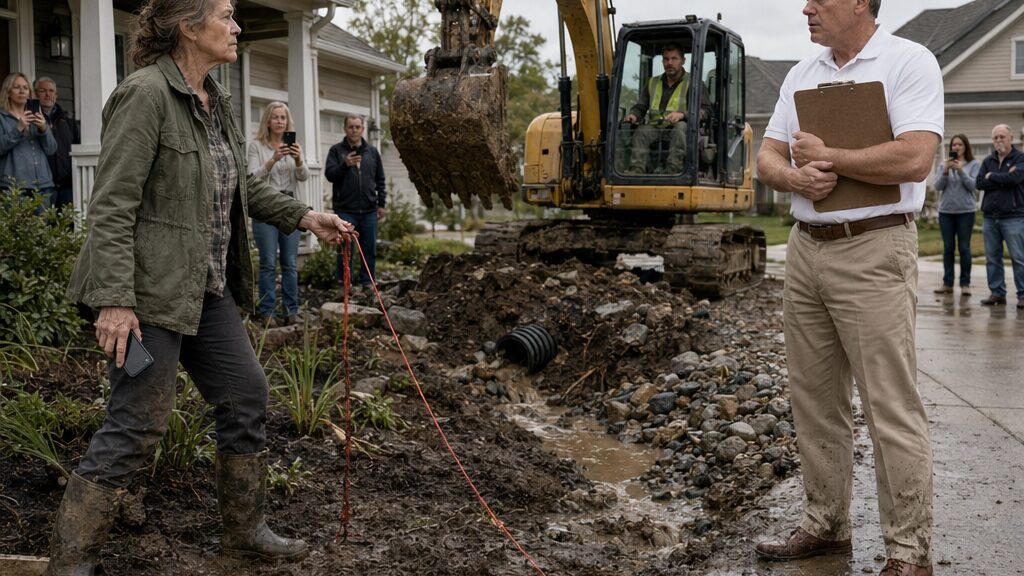
Its steel teeth struck the gravel bed with a grinding crack, lifted a mouthful of river stone, and swung toward the waiting dump trailer. A length of red boundary string snapped beneath the left track and vanished into the mud.
Catherine stopped halfway down the porch steps.
“Shut it down.”
The operator looked toward Gregory Adams instead of her.
Gregory stood beside the driveway in a white polo shirt, khaki pants, and spotless brown shoes. He held a clipboard against his hip as though he were supervising a landscaping delivery rather than the destruction of someone else’s property.
“Keep going,” he called.
The excavator engine rose again.
Catherine crossed the lawn as quickly as her rubber boots allowed. The ground near the drainage bed had already turned soft beneath the machine. Water seeped through the torn gravel and collected in shallow brown pools.
“Gregory, you need to stop the equipment.”
He finally turned to her. “We gave you notice.”
“You sent me a violation letter Friday afternoon.”
“Which followed two warnings.”
“One warning about weeds and one about the edging material. Neither authorized demolition.”
Gregory tapped the clipboard. “The structure was never approved by the architectural committee.”
“It isn’t an architectural structure.”
The operator lowered the bucket again. A flat stone Catherine’s husband had set by hand fifteen years earlier rolled free and broke against the concrete curb.
For a moment, she forgot every careful sentence she had prepared.
“What are you doing?” Her voice rose enough to draw faces toward windows and open garages. “That bed carries runoff away from the foundation.”
A phone appeared across the street. A neighbor stood near the end of a driveway, recording.
Gregory glanced toward the phone, then straightened. “We’re correcting an unauthorized alteration that redirects common drainage.”
“It redirects water into the approved swale.”
“That is your interpretation.”
“No. That is where the swale is.”
Gregory gave the operator a small circular motion with two fingers.
The machine moved forward.
Its track caught the remaining red string and dragged it through the churned soil. Catherine followed the line with her eyes. She had stretched it the previous evening between the old survey stakes after seeing the excavator parked beside the clubhouse. She had hoped the visible boundary would force someone to pause.
Instead, the string surfaced behind the track in muddy loops.
Catherine stepped close enough that the operator lifted both hands from the controls.
“Ma’am, I can’t work with you inside the radius.”
“Then don’t work.”
Gregory came between her and the machine. “Catherine, don’t turn this into a scene.”
“You brought an excavator to my front door.”
“We brought in a contractor after months of noncompliance.”
She looked at the clipboard. Beneath the clear plastic cover was a work authorization bearing the association letterhead.
“May I see that?”
“You’ll receive all relevant documents.”
“That document is relevant now.”
His mouth tightened. “You had every opportunity to cooperate.”
Behind him, two blue collection bags sagged beside the dump trailer. One already held uprooted plants and lengths of black drainage pipe. The sight of the pipe changed the pressure in Catherine’s chest. It was not ornamental stone they were removing. They had cut into the functioning system.
She forced herself to look away from the torn bed and back at Gregory.
“What is the county permit number?”
He blinked once.
It was small, the pause. Most people would have missed it.
Catherine did not.
Gregory shifted the clipboard beneath his arm. “This is association maintenance.”
“Ground disturbance above the exemption threshold requires a permit. What number was issued?”
A second phone appeared farther down the street.
Gregory lowered his voice. “The association owns the drainage easement.”
“An easement does not replace a county permit.”
“We have authority under the declaration.”
“I asked for the permit number.”
The excavator idled between them, its engine shuddering through the wet ground.
Gregory looked toward the watching neighbors. “The board is not required to debate enforcement decisions on a resident’s lawn.”
“No debate. Just state the permit number and the measured square footage.”
Something in his expression changed. The faint patience he had been performing disappeared.
“You retired a long time ago, Catherine.”
The words landed more cleanly than an insult would have.
She saw the neighbor’s phone tilt closer.
Gregory continued. “The county has updated its procedures since you worked there. This is exactly the problem. You think every ordinary maintenance decision needs to pass across your old desk.”
Catherine felt heat rise beneath the collar of her jacket. She knew how the recording would look: an older woman in mud, voice raised, arguing while an official-looking man remained controlled.
She took one step back.
“Then the current procedure should make the permit number easy to provide.”
Gregory turned away from her. “Finish the removal.”
The operator hesitated.
“You heard me,” Gregory said.
Catherine did not step in front of the machine again. She reached into her jacket pocket, took out her phone, and photographed the work authorization beneath Gregory’s arm. He tried to angle it away, but not before she captured the signature line.
GREGORY ADAMS, HOA PRESIDENT.
She photographed the excavator track, the cut pipe, the broken stone, and the red string embedded in mud. She photographed the distance from the porch foundation to the old stake. Then she walked to the second stake and photographed that too.
Gregory watched her.
“You’re documenting your own violation,” he said.
“I’m documenting the condition before you alter it further.”
“You were instructed to remove this weeks ago.”
“I was instructed to submit a landscaping clarification.”
“It became an enforcement matter when you refused.”
Catherine looked at him. “You never scheduled a hearing.”
“The board determined one wasn’t necessary.”
“Which board?”
His jaw shifted.
That was the second pause.
By then, the excavator had lifted most of the gravel bed. Muddy water ran where the pipe had been. It moved slowly at first, then found the newly opened trench and began streaming toward the sidewalk.
The elderly neighbor next door came out holding a cane. He stared at the water and then at Gregory.
“That’s going toward the street,” he said.
“The contractor will stabilize it,” Gregory replied.
The operator climbed down from the cab. “I was told removal only. Stabilization wasn’t in my ticket.”
Gregory’s composure cracked at the edges. “Use the fill from the trailer.”
“That’s not erosion fill.”
“Do what you can.”
Catherine said nothing. The operator’s objection had given her more than another argument would have.
Gregory walked to her porch with a sheet of paper and a strip of weatherproof tape. He pressed the notice against the front door at eye level.
Catherine followed.
At the bottom, under REMOVAL AND ADMINISTRATIVE COSTS, the total read $1,100.
“You’re charging me for this?”
“The association is entitled to recover enforcement expenses.”
“You ordered unpermitted work, damaged an active drainage line, and now you’re billing me.”
“You can appeal at the next regular meeting.”
“That’s in five weeks.”
“Then I suggest you use the time to read the governing documents.”
The line drew a faint laugh from someone near the curb. Catherine could not tell who.
Gregory returned to his black sedan. Before opening the door, he looked over the muddy yard as though confirming a task had been completed.
“You should stop fighting this,” he said. “You’re only making it more expensive.”
He drove away while the excavator operator loaded the last of the broken pipe.
Within ten minutes, the machine and trailer were gone.
The neighbors withdrew more slowly.
One crossed the street and asked if Catherine needed help. Another avoided her eyes. The person who had recorded the argument remained by the mailbox, typing with both thumbs.
Catherine stood in ankle-deep mud and listened to water tick against the curb.
She peeled the notice from her door without tearing it. In the porch light, she examined the authorization number, the contractor reference, and Gregory’s signature. The box marked COUNTY PERMIT contained no number.
Only a short horizontal line.
Near the bottom of the steps, something red showed through the brown water. Catherine bent, pulled the severed boundary string from the mud, and wound it once around her hand.
A folded page had been trapped beneath it.
The invoice.
Gregory had signed that too.
Chapter 2: Nineteen Years Behind the County Counter
The blank permit field was not an oversight.
Catherine knew the difference.
An overlooked field carried some trace of haste—a crooked mark, an incomplete reference, a note to verify later. Gregory’s authorization showed a clean horizontal line placed precisely where the county permit number should have been. Someone had decided the field did not apply.
She laid the document on the desk in her home office and set the muddy red string beside it.
The room had once been a spare bedroom. During her final years with the county, it had become the place where she brought home policy drafts no one else wanted to read. After retirement, the shelves filled with gardening books, tax folders, and her husband’s medical binders. His last calendar still rested in the bottom drawer, though she had stopped opening it.
Catherine switched on the old task lamp.
Nineteen years behind the county land-use counter had trained her to begin with what was missing.
She opened the public permit portal, entered the subdivision parcel number, and waited as the search wheel turned. The county website had changed twice since she retired, but the logic beneath it had not. Every permit generated a parcel entry. Every inspection created a timestamp. Even withdrawn applications left a number.
The search returned the original subdivision grading plan, two roof permits, a water-heater replacement, and the approval for the drainage swale installed when the house was built.
Nothing from the HOA.
She searched by the association’s legal name. Nothing.
By Gregory’s name. Nothing.
By the contractor reference visible in her photograph. A business registration appeared, along with several small landscaping permits elsewhere in the county.
No permit for her address.
Catherine leaned back and listened to the faint sound of water outside. The torn drainage line was still emptying toward the street. She should have been relieved. Instead, she felt the old unease that came whenever a simple answer arrived too quickly.
She opened the county code.
The current section on land disturbance had been reorganized, just as Gregory claimed. The headings were different. The substance was familiar. Routine hand maintenance remained exempt. Mechanical disturbance below one hundred square feet could qualify for an administrative exception if it did not alter drainage.
She printed the page.
Then she pulled up the parcel map and used the measurement tool. From the first visible track impression to the far edge of the removed bed: thirty-two feet. Average disturbed width: just over nine.
Two hundred ninety-one square feet.
She measured again.
Two hundred eighty-seven.
A third time, excluding the narrow strip beside the porch.
Two hundred seventy-nine.
Nearly three times the exemption threshold no matter how generously she calculated.
Catherine wrote each number on a yellow pad. Her handwriting remained square and compact, shaped by years of making notes in permit margins where space was limited.
At six fifteen, someone knocked.
Nicole Perez stood on the porch holding a covered dish and wearing the expression of a person who had come with two purposes but wanted to admit only one.
“I made too much casserole,” she said.
“You never make too much of anything.”
Nicole looked past her toward the torn yard. “I saw the water.”
Catherine stepped aside.
Nicole entered but did not remove her coat. As HOA treasurer, she had sat beside Gregory at meetings for three years. As Catherine’s neighbor, she had brought groceries during the final months of Catherine’s husband’s illness.
The two loyalties showed in the way she held the dish between them.
“Gregory says the contractor found an unapproved pipe.”
“They cut an approved pipe.”
“He says the modification wasn’t in the association file.”
“The association file is not the county record.”
Nicole exhaled. “You know how that sounds.”
“Yes.”
“Like you’re saying the board has no authority.”
“I’m saying authority has boundaries.”
Nicole’s gaze moved to the printed code pages on the desk. “Are you going after the association?”
“I’m finding out what happened.”
“If the county gets involved, they can fine all of us.”
“They can fine the association.”
“With whose money?”
Catherine had no answer that would comfort her.
Nicole set the casserole on the edge of the desk. “The reserve is already below target. We have the insurance renewal next month. Gregory has been warning us that the drainage complaints could raise the premium again.”
“Did the board vote to excavate my yard?”
Nicole’s silence lasted too long.
“Nicole.”
“There was a discussion.”
“At a meeting?”
“By email.”
“Was there a motion?”
“I don’t remember the wording.”
“You’re the treasurer.”
“I know what I am.”
The sharpness surprised them both.
Nicole pressed her lips together. “I came because I didn’t want you standing over here alone thinking everyone approved of how it was done.”
“But you did approve it.”
“I approved enforcement. I did not approve an excavator arriving before breakfast.”
Catherine studied her. Nicole looked tired rather than defensive. Beneath the caution was fear—not of Gregory, exactly, but of numbers she could not control.
“I won’t ask you for anything tonight,” Catherine said.
Nicole nodded, relieved too quickly.
At the door, she paused. “Gregory says you’re relying on old rules.”
“He should hope I am.”
After Nicole left, Catherine returned to the computer.
She opened the association documents stored on the resident portal. The work authorization was not among the posted minutes. Neither was a vote approving contractor expenses. She downloaded the bylaws, but did not yet search Section Nine. First she wanted the land record complete.
Her original drainage approval appeared under a scanned file from fourteen years earlier. The plan showed a gravel infiltration bed, a shallow pipe, and a red boundary line matching the stakes still in her yard.
Approved.
She touched the screen near the old signature block.
Her husband had insisted on doing everything correctly. He had kept receipts for gravel, pipe diameter, even the native plants placed along the swale. After the first installation settled, they had extended the bed by six feet to catch runoff from the downspout.
That extension had required an amendment.
Catherine searched for it.
A scanned application appeared with her name, the revised sketch, and the fee receipt. The review notes were favorable. The technical comments had been resolved.
At the bottom, the final certification box was empty.
She stared at it.
A memory came back without invitation: a hospital corridor, her phone vibrating in her coat, a county clerk leaving a message about one missing signature. Her husband had been admitted again that week. She had told herself she would return the form when he came home.
He had come home with oxygen.
The form had gone into a folder.
Catherine opened the bottom desk drawer.
Medical calendars. Insurance statements. A packet marked HOUSE—DRAINAGE in her husband’s handwriting.
Inside was the amendment.
Unsigned.
Her confidence did not disappear. The HOA had still bypassed permitting. Gregory had still ordered work beyond the exemption threshold. The original system had still been approved.
But the clean shape of the argument broke apart.
Catherine placed the unsigned amendment beside Gregory’s signed authorization. Between them lay the mud-stained red string.
One man had acted as though no approval was needed.
One woman had known approval was needed and failed to finish it.
She could expose Gregory.
She would have to expose herself too.
Chapter 3: The Rule She Had Failed to Finish
Timothy Jones placed Catherine’s incomplete amendment on top of the file before he discussed anything else.
“I need to resolve your parcel status first,” he said.
Catherine sat across from him at the county permit counter, where the chairs were newer but just as uncomfortable as the ones she remembered. Behind Timothy, shelves held rolled plans and inspection binders. A sign instructed visitors not to photograph staff workstations.
“You already know why I’m here,” she said.
“I know what you reported.”
“And you saw the photographs.”
“I did.”
“The association used mechanical equipment over nearly three hundred square feet without a permit.”
Timothy folded his hands. “Your amendment lacks final certification.”
The county lobby was quiet except for a printer feeding pages into a tray. Catherine recognized his method. Establish the full record. Refuse the convenient sequence. Do not let professional familiarity bend the process.
She had taught younger employees the same discipline.
“The original drainage bed was approved,” she said.
“Yes.”
“The extension passed technical review.”
“Yes.”
“The missing item was my signature attesting that the work matched the revised sketch.”
“Yes.”
“And the county never closed the amendment.”
“No.”
Catherine looked through the glass wall toward the parking lot. She had expected shame. What she felt was irritation, which was more dangerous because it could disguise itself as principle.
“My husband was ill.”
Timothy’s expression softened but did not change course. “I remember.”
“That does not make the form signed.”
“No.”
She almost smiled despite herself. “You learned that answer here.”
“I learned it from you.”
The words removed the last excuse available to her.
Catherine opened her folder and slid the original approval, the incomplete amendment, and photographs of the destroyed bed across the counter.
“I’m not asking you to ignore my file.”
“Good.”
“I’m asking whether the association had legal authority to remove the system without a county permit.”
Timothy turned to his computer.
For several minutes, he searched without speaking. He checked the address, association name, contractor license, and excavation date. He opened a second database Catherine did not recognize, then requested an archived inspection record from a county clerk.
“No application,” he said at last.
“For demolition?”
“For grading, drainage alteration, mechanical land disturbance, or emergency stabilization.”
“Any exemption letter?”
“No.”
“Any inspection request?”
“No.”
Catherine’s shoulders loosened by a fraction.
Timothy continued before relief could settle. “That does not validate the six-foot extension.”
“I know.”
“It does mean the association removed an originally approved drainage feature while a corrective amendment remained available.”
“Available?”
“You can reopen it, submit current measurements, and request an after-the-fact inspection.”
“What is the penalty?”
“For the incomplete amendment, likely the standard reactivation fee. Possibly a corrective planting requirement.”
“And for the association?”
“That depends on the disturbed area and whether the work created an active discharge.”
Catherine thought of water running toward the curb.
“It did.”
Timothy looked at the photographs again. He enlarged one showing the broken pipe and muddy stream.
“I need to inspect today.”
By early afternoon, his county vehicle was parked where the excavator trailer had stood the previous morning.
Gregory arrived before Timothy finished measuring.
He came without his clipboard this time, wearing a navy jacket over his polo. Nicole followed in a separate car and remained near the sidewalk.
“What is this?” Gregory asked.
Timothy did not look up from the measuring wheel. “County erosion-control inspection.”
“Requested by whom?”
“The complainant’s identity is not relevant to the site conditions.”
Gregory glanced at Catherine. “You filed a complaint before allowing the association to respond?”
“You responded with an excavator.”
“We acted under the declaration.”
Timothy marked a point with orange paint. “Please remain outside the measurement area.”
Gregory’s eyes narrowed. “The HOA owns an easement here.”
“Ownership interest does not exempt land disturbance from county review.”
Catherine saw recognition move across Gregory’s face. It was not recognition of the rule. He had heard that already. It was recognition that Timothy would not accept his title as proof.
The measuring wheel clicked over the torn ground.
Two hundred eighty-four square feet.
Timothy checked the exposed outlet, the severed pipe, and the soil piled near the sidewalk. He photographed sediment entering the gutter.
“The original bed extends only to this line,” he said, pointing to the old county map.
He stretched a temporary red cord between the two surviving stakes. It crossed the center of the damaged area.
Catherine’s unapproved extension had reached six feet beyond it.
The excavator had disturbed another twelve feet past that.
Gregory seized on the first fact. “So she was in violation.”
“Her amendment was incomplete.”
“Meaning unauthorized.”
“Meaning incomplete,” Timothy repeated. “The original drainage feature remained approved. The extension required correction. Neither condition authorized private demolition.”
Nicole stepped closer. “What happens now?”
Timothy looked toward the water tracking along the curb. “The association receives a stop-work and stabilization order. No further disturbance until a restoration plan is approved.”
“And fines?” she asked.
“If the discharge is not controlled by the deadline, daily penalties may apply.”
Nicole’s face tightened.
Gregory pointed toward Catherine’s porch. “She caused the drainage issue. The association acted because complaints were being ignored.”
“Then the association should have filed a county complaint,” Timothy said. “Or applied for a permit.”
“We believed routine maintenance was exempt.”
“Routine maintenance does not include removing a functioning drainage bed with heavy equipment.”
Gregory turned on Catherine. “You knew your extension wasn’t finalized.”
“Yes.”
Nicole looked at her. “You knew?”
“I found the unsigned amendment last night.”
“And you still called the county?”
Catherine could have answered with Gregory’s blank permit field, the broken pipe, or the $1,100 invoice. All were true. None addressed the fear in Nicole’s question.
“Yes,” she said. “And I gave Timothy my complete file.”
Gregory let out a short breath. “Convenient, now that you’ve brought enforcement down on the whole neighborhood.”
“I brought enforcement to damaged ground.”
“You brought fines.”
“Not yet,” Timothy said. “That depends on compliance from this point forward.”
Gregory looked at the orange markings, the temporary red cord, and the muddy water. His voice lowered.
“What exactly do you require?”
“Immediate sediment control. Engineered restoration plan. Permit application. Written disclosure of the contractor’s scope. Board authorization for the work.”
Nicole turned toward him. “You have the authorization.”
Gregory did not answer.
“You showed us the contractor estimate,” she said. “Where is the board authorization?”
“It was handled under executive enforcement authority.”
“That isn’t what I asked.”
The first crack did not come from the county notice or Catherine’s evidence. It came from Nicole taking one step away from Gregory.
Timothy returned to his vehicle and printed two sheets from the mounted unit. He placed one in Catherine’s hand and one in Gregory’s.
The first page identified Catherine’s incomplete amendment and listed the steps required to reopen it.
The second named the association as the responsible party for unauthorized mechanical disturbance and active sediment discharge.
Gregory read the deadline twice.
“Forty-eight hours?”
“To install temporary controls.”
“Our contractor is booked.”
“You may use another qualified contractor.”
“This is unreasonable.”
Timothy capped his pen. “The discharge is moving now.”
By four o’clock, straw wattles had been placed along the curb under county direction. They slowed the muddy water but did not restore the pipe or the yard.
Catherine stood on the porch after everyone left, holding both her reactivation notice and a copy of the association’s order.
She had won nothing.
Her yard remained torn open. Her own signature was still missing from a fourteen-year-old form. Nicole had driven away without saying goodbye.
Near sunset, a county vehicle returned. A clerk stepped out, walked to the community notice board beside the mailboxes, and fastened a bright white sheet beneath the HOA announcements.
STOP-WORK ORDER.
AUTHORIZED COUNTY ENFORCEMENT ACTION.
The paper faced every resident collecting evening mail.
At the bottom, beneath the compliance deadline, one sentence had been printed in bold:
DAILY CIVIL PENALTIES MAY BEGIN UPON FAILURE TO CORRECT.
Across the street, a homeowner read it, looked toward Catherine’s house, and lifted a phone.
This time, the camera was not pointed at Gregory.
Chapter 4: Every Mailbox Received the Same Warning
Nicole found the county fine notice at 7:12 Wednesday morning, eighteen minutes before Gregory’s email told the board there was “no immediate financial exposure.”
The notice had arrived in the association’s shared inbox overnight. Its subject line was plain: CORRECTIVE DEADLINE—ACTIVE SEDIMENT DISCHARGE.
She opened the attachment twice, hoping she had misread the first page.
Temporary controls had been installed, but they were not enough. The association had forty-eight hours to submit a restoration plan and permit application. Failure to do so could trigger civil penalties calculated from the date of disturbance.
Nicole looked through the glass wall of the HOA office. Gregory’s car was not yet in its usual space.
She printed the notice and placed it beside his email.
No immediate financial exposure.
Potential daily penalty: two hundred fifty dollars.
She called him.
He answered on the fifth ring. “I’m driving.”
“Did you receive the county notice?”
A pause filled with road noise.
“I received a preliminary communication.”
“It says penalties can be backdated.”
“They use standard language.”
“It gives us forty-eight hours.”
“The contractor is preparing a response.”
“Which contractor?”
“The one who performed the work.”
“The operator said stabilization wasn’t in his ticket.”
Gregory’s voice hardened. “Nicole, I need you not to make this larger before we know what it is.”
She stared at the amount printed near the bottom. “I’m the treasurer. It is already my job to know how large it is.”
“I’ll be there in twenty minutes.”
He arrived in twelve.
Gregory entered carrying coffee and a leather folder. He placed both on the conference table and glanced at the printed notice without sitting.
“You should not circulate that yet.”
“I didn’t say I would.”
“You were thinking it.”
“I was thinking the board should have received it before your email.”
His jaw tightened. “The county has not assessed a fine.”
“It says they may calculate from Monday.”
“May.”
“And the reserve account?”
“We can cover emergency stabilization.”
“That wasn’t my question.”
Gregory opened the leather folder. Inside were contractor estimates, photographs of flooded yards from the previous spring, and a letter from the association’s insurer requesting documentation of drainage enforcement.
He pushed the insurer’s letter toward her.
“This is what I’ve been trying to prevent.”
Nicole read the first paragraph. Repeated runoff complaints could affect renewal terms if the association failed to demonstrate active enforcement.
“You didn’t show this to the board.”
“I summarized it.”
“You told us the carrier wanted maintenance records.”
“They do.”
“This says they may require a drainage-risk review.”
“And what do you think happens to premiums after that?”
Nicole looked again at the flood photographs. One showed water pressed against a garage door. Another showed a child’s bicycle half-submerged near a curb.
Gregory lowered his voice. “People have been demanding action for months. Then Catherine extends a drainage bed without closing the permit and refuses to remove it.”
“She asked for a hearing.”
“She would have turned it into a county seminar.”
“Maybe that would have prevented this.”
Gregory took back the insurance letter. “The work was supposed to be routine removal. The contractor was not supposed to disturb that much ground.”
“The authorization bears your signature.”
“As president.”
“Not the board’s.”
He looked at her then. “Be careful.”
The warning was quiet enough to sound almost reasonable.
Nicole felt something inside her settle.
“I am being careful.”
By noon, photographs of the county order had spread through the neighborhood message board. Most comments blamed Catherine.
Some asked why one homeowner had been allowed to alter drainage without approval. Others wanted to know whether dues would rise. A young couple near the entrance wrote that they could not absorb another assessment after replacing their furnace.
Gregory posted a brief statement saying the board was addressing “a complaint arising from a resident’s unapproved installation.”
He did not mention the missing demolition permit.
At three, envelopes began appearing in mailboxes.
Nicole saw Catherine walking the street alone, placing one in each box with the homeowner’s name handwritten across the front. She wore the same green jacket from Monday. Mud still marked the lower hem.
Nicole met her near the community mailbox station.
“What are you sending?”
“The documents everyone should have before the emergency meeting.”
“You called a meeting?”
“I requested one under the bylaws. Four other owners signed.”
Nicole took the envelope Catherine offered.
Inside were five pages: the county stop-work order, Gregory’s signed authorization, a map showing the original approved boundary, the incomplete amendment, and a one-page explanation.
Catherine had highlighted her own missing certification before highlighting Gregory’s blank permit field.
Nicole read the first paragraph.
My original drainage system was approved. A later six-foot extension passed technical review but was not finally certified. I accept responsibility for correcting that omission. The association nevertheless removed both the extension and part of the approved system without a county permit or a board hearing.
“You included your own violation,” Nicole said.
“My incomplete filing.”
“Gregory is going to use it against you.”
“He already has.”
“Then why hand it to every homeowner?”
“Because it belongs in the record.”
Nicole lowered the pages. “Do you understand what a special assessment would do to some people here?”
Catherine’s eyes moved toward the young couple’s house.
“Yes.”
“Then withdraw the complaint.”
“The county has already inspected an active discharge. Withdrawing my complaint would not erase that.”
“You knew that could happen.”
“I knew it could.”
Nicole heard the admission more sharply than she expected.
“So you decided for all of us.”
Catherine did not defend herself at once. That restraint, which had once seemed like confidence, now felt almost cruel.
“I decided not to hide damaged drainage from the county,” she said. “Gregory decided to damage it.”
“That distinction won’t matter when the bills arrive.”
“No. It will matter when we decide who had the power to prevent them.”
Nicole folded the papers back into the envelope.
By evening, the reaction had changed.
Not softened. Changed.
Several homeowners remained angry with Catherine, but the questions beneath Gregory’s statement grew more specific. Where were the meeting minutes? Which board members had approved the contractor? Why was the permit field blank? Why had the association removed part of an approved drainage bed?
At the HOA office, Gregory paced between the conference table and the window.
“You had no right to distribute internal records,” he told Catherine over speakerphone.
“The authorization was attached to my invoice.”
“You are creating panic.”
“I am disclosing the documents.”
“You’re using your former position to intimidate people.”
Catherine’s voice came evenly through the phone. “Then post the board vote.”
Gregory ended the call.
Nicole sat at the conference table with the bylaws open before her. “Was there one?”
“We had consensus.”
“In an email chain?”
“Enough to act.”
“Show me.”
Gregory did not move.
“Show me the chain,” she repeated.
He returned to his office and forwarded six messages.
The first four concerned general drainage enforcement. The fifth contained a contractor estimate. Nicole had replied, We need legal review before authorizing entry onto a lot.
Gregory had answered, I’ll handle scope and access.
The sixth email had gone only to the contractor.
Proceed Monday before the insurance site review. Remove the full installation. Board authority confirmed.
Nicole read it again.
The insurance site review was scheduled for Tuesday—the day after the excavation.
Gregory had not merely acted before a meeting. He had wanted the yard cleared before the insurer saw it.
She checked the timestamp. Sunday, 10:43 p.m.
From the doorway, Gregory said, “You understand what was at stake.”
“You told the contractor the board confirmed authority.”
“The board supported enforcement.”
“That is not the same thing.”
“We did not have time to spend another month debating Catherine.”
Nicole turned the laptop toward him. “Why before the insurance review?”
His face went still.
Outside, metal mailbox doors opened and shut along the street. One envelope after another was being unfolded beneath porch lights.
Nicole pressed Print.
The machine drew in a sheet of paper.
Gregory stepped toward it. “That email is privileged board communication.”
“No,” Nicole said. “It is an expenditure authorization you concealed from the treasurer.”
The page slid into the tray between them, carrying the sentence that changed the dispute from a mistake into a choice.
Proceed Monday before the insurance site review.
Chapter 5: The Flood He Thought Would End Him
The insurer requested the county file at 8:06 Saturday morning.
Gregory read the email at his kitchen counter while water boiled untouched in the kettle. The message asked for all permits, notices, contractor scopes, board authorizations, and corrective plans related to Catherine Miller’s property.
Response requested by Monday at noon.
He closed the laptop, then opened it again.
Beyond the back window, the retention pond sat low and harmless beneath a pale sky. It had looked harmless the week before the spring storm too.
That storm had filled three garages, lifted mulch into the street, and sent brown water across the neighborhood entrance. Gregory still remembered standing ankle-deep beside a homeowner who demanded to know why the board had ignored drainage complaints. He remembered the insurer’s representative walking the curb with a camera. He remembered the first premium estimate afterward.
He had promised visible action.
Catherine’s gravel bed became the obvious place to begin. It extended beyond the association’s old landscape drawing, and runoff complaints had come from the houses downhill. Gregory told himself removal would demonstrate that rules applied to everyone.
He had not expected the contractor to cut the approved pipe.
He had not expected Catherine to know the threshold.
He had not expected Nicole to print his email.
By ten, he was at the HOA office. He spread the insurer’s request beside the contractor estimate and searched for language that might narrow his responsibility.
Routine removal.
Association drainage easement.
Corrective maintenance.
None of it changed the blank permit field.
He called the association attorney. The attorney listened, asked whether the board had formally voted, and became silent when Gregory explained the email consensus.
“Do not alter any records,” the attorney said.
“I’m not asking about records. I’m asking whether executive authority covered the work.”
“That depends on the declaration and whether an emergency existed.”
“There was an insurance deadline.”
“That is not necessarily a property emergency.”
“The neighborhood had flooding.”
“Was Catherine’s installation identified by an engineer as the cause?”
Gregory looked at the old complaint photographs. “Residents believed it contributed.”
“That is not what I asked.”
By noon, he had received no useful reassurance.
He drove to Catherine’s house carrying a roll of red string, two wooden stakes, and her original invoice.
The temporary county cord still crossed the damaged yard. Straw wattles lined the curb. The mud had begun drying into ridges beneath the excavator tracks.
Gregory pushed one stake into the soil near the porch.
Catherine opened the front door.
“What are you doing?”
“Marking the restoration boundary.”
“With whose survey?”
“The association plat.”
“That stake is four feet inside the approved line.”
He pressed harder. The ground resisted, then gave.
“We need to show the county that corrective work has begun.”
“Putting string in the wrong place is not corrective work.”
“It is temporary.”
“So was the excavator, according to you.”
Gregory straightened. “Can we speak privately?”
Catherine stepped onto the porch but did not invite him inside.
He held out the invoice. “I can void this today.”
She looked at the paper, not his face.
“The board can also cover your amendment fee and restore the extension.”
“In exchange for what?”
“You notify the county that the association and homeowner have resolved the dispute.”
“The county violation is no longer a private dispute.”
“You can state that you no longer wish to pursue enforcement.”
“That would not remove Timothy’s observations.”
“It would help.”
“Help whom?”
Gregory set the invoice on the porch rail. “Everyone.”
“Everyone was not consulted before you ordered the work.”
“We were facing an insurance review.”
“So I read.”
His eyes narrowed. “Nicole gave you the email?”
“No.”
That answer unsettled him more than confirmation would have.
Catherine touched the roll of red string beneath his arm. “You are still trying to draw the line yourself.”
“We don’t have time for a survey.”
“That is how this began.”
Gregory looked across the street. Curtains shifted in one window.
“You think this is about my pride,” he said.
“I think your pride made the decision easier.”
“You didn’t sit through the calls after the flood. You didn’t hear people say their homes were losing value because the board did nothing.”
“I spent nineteen years hearing what people said after preventable damage.”
“And yet you left your own amendment unfinished.”
The words hit. Catherine’s hand left the porch rail.
Gregory pressed on. “You knew the rules better than anyone, and you did not finish the process. But now you want to make me the example.”
Her voice changed, losing some of its practiced levelness. “My husband was dying.”
“I know.”
“No, you know the sentence. You don’t know the months.”
Gregory looked down.
For the first time since arriving, he saw the interior beyond her: a narrow hall, a framed photograph on the wall, an oxygen-unit outlet still mounted near the baseboard because she had never removed it.
Catherine continued more quietly. “I should have signed the form. I did not. That failure belongs to me. It does not give you authority to tear out an approved system.”
“I was trying to keep the insurance carrier from deciding this neighborhood was unmanaged.”
“You were trying to make sure they saw a clean yard before they saw an honest file.”
The accuracy of it left him without a response.
A vehicle slowed at the curb, then continued.
Gregory put the red string on the porch rail beside the invoice.
“The reserve cannot absorb full penalties, engineering, and restoration,” he said. “There will be an assessment.”
“Then we reduce the penalties through compliance.”
“And if the homeowners vote to fight?”
“They will spend more.”
“If they remove me?”
“That does not repair my yard.”
He searched her expression for satisfaction and found only exhaustion.
“What do you want?”
“A permitted restoration plan. The approved drainage bed replaced. My amendment corrected through the county. Full disclosure of the authorization. A homeowner hearing requirement before nonemergency entry. And no assessment disguised as my personal charge.”
“You’ve prepared terms.”
“I prepared a way to stop the damage from growing.”
“You left out my resignation.”
“I left it to the membership.”
That surprised him.
“You could force the removal vote under Section Nine.”
“I could request it.”
“Why haven’t you?”
“Because your title is not the most urgent problem.”
Gregory looked toward the county notice board. The white stop-work order moved slightly in the breeze.
“You don’t understand what happens when those bills arrive,” he said. “No one will remember which line I crossed. They’ll remember whose complaint put a number on the page.”
Catherine’s face closed again.
He picked up neither the string nor the invoice.
“The assessment will have your name attached to it in every argument,” he said. “At the mailbox. At the meeting. Every time someone has to choose what not to pay.”
He walked back to his car.
Before opening the door, he heard Catherine behind him.
“Gregory.”
He turned.
She held the invoice in one hand and the roll of red string in the other.
“I will not withdraw the truth to make the cost easier to blame.”
He drove away knowing she had refused his deal.
What he did not know was whether the neighborhood would call that courage or cruelty.
Chapter 6: Section Nine Was Not the Whole Truth
“Two thousand seven hundred fifty dollars.”
The young homeowner read the amount before Catherine reached the front table.
The clubhouse fell quiet.
He stood near the back wall with the county notice raised in one hand. Beside him, his wife held their infant against her shoulder. Neither looked angry in the theatrical way Gregory had predicted. They looked frightened.
“That’s through today,” the man continued. “If the county backdates the full penalty.”
Nicole sat beside three board members at the folding table. Gregory occupied the end seat, his hands clasped over a closed leather folder.
Catherine carried no binder. Only a flat evidence envelope and the severed length of red string.
Every chair was taken. Homeowners lined the walls. The air conditioner clicked on and pushed cold air over the room without easing it.
A woman near the aisle spoke first. “Did you file the complaint knowing this could happen?”
Catherine remained standing. “Yes.”
The room broke into overlapping voices.
“You should have warned us.”
“She did. We got the letters.”
“After the county came.”
“Why should we pay for her yard?”
Gregory lifted one hand. “Let her answer.”
The gesture looked fair. Catherine recognized it as positioning.
She placed the envelope on the table but kept the red string wound around her fingers.
“I knew the county could impose penalties,” she said. “I did not know what amount they would assess. I also knew the drainage system had been cut, sediment was entering the street, and no demolition permit appeared in the public record.”
The young father lowered the notice. “That doesn’t answer why you didn’t come to us first.”
“I asked for a hearing before the work. It was denied.”
“You could have called an emergency meeting afterward.”
“Yes.”
The single word quieted part of the room.
Catherine looked toward Nicole, then back at the homeowners.
“I could have done that before filing. I did not believe Gregory would disclose the missing permit or stop further work without county involvement. I may have been right about him. That does not mean I handled every part correctly.”
Gregory shifted.
A homeowner near the front said, “Your drainage extension was illegal.”
“It was incomplete.”
“Same difference.”
“No,” Catherine said. “But it was still my responsibility.”
She opened the envelope and removed the amendment.
“The original bed was approved fourteen years ago. My husband and I later extended it six feet. The revision passed technical review. I failed to sign the final certification.”
“Why?”
The question came from the elderly neighbor beside the aisle.
Catherine looked at him. He already knew enough not to need the answer. But everyone else waited.
“My husband became seriously ill that week. I put the form in a folder and did not return it.”
No one moved.
“I found it after the excavation,” she continued. “I have reopened the amendment and will pay the reactivation fee myself.”
Gregory opened his folder. “That admission confirms the association had a valid enforcement concern.”
“Yes,” Catherine said.
He stopped.
“A valid concern,” she repeated, “does not make an invalid action lawful.”
She laid Gregory’s authorization beside her amendment.
“Both of these documents show a failure. Mine shows work that reached technical approval but lacked my final certification. His shows demolition ordered without a permit number, without a homeowner hearing, and without a recorded board vote.”
Gregory leaned toward the microphone. “The board had discussed enforcement repeatedly.”
Nicole spoke before he could continue. “The board did not vote to excavate Catherine’s property.”
Faces turned toward her.
Gregory’s voice sharpened. “We had consensus.”
“No,” Nicole said. “We had consensus that drainage violations required action. I specifically requested legal review before entry onto a lot.”
She placed a printed email on the table.
“The contractor was instructed to proceed before the insurance inspection. The message said board authority was confirmed. It was not.”
The room changed then. Not into support for Catherine. Into something less stable and more important: doubt directed both ways.
A man along the wall asked Gregory, “Were you trying to hide the pipe from the insurer?”
“I was trying to demonstrate enforcement before they reviewed our drainage history.”
“By tearing it out without a permit?”
“By removing what we believed was unauthorized.”
“What engineer said it caused flooding?”
Gregory looked toward the association attorney seated near the side wall. The attorney did not rescue him.
“No engineer had completed that determination,” Gregory said.
Murmurs spread.
Catherine unwound the red string and laid it across the table. Mud had dried into the fibers, turning sections almost black.
“This marked the county-approved boundary before the excavator arrived,” she said. “My unfinished extension went six feet beyond it. The excavation went another twelve.”
She placed the county map beneath the string.
A board member traced the distances with one finger. “So they removed part of what was approved.”
“Yes.”
“And damaged more ground beyond it.”
“Yes.”
The woman near the aisle folded her arms. “Then remove Gregory under Section Nine and make him pay.”
Several people voiced agreement.
Gregory’s face hardened, but Catherine noticed relief flicker behind it. A removal vote would reduce the conflict to one man’s position. It would give the room someone to punish without deciding what repair required.
“Section Nine is not the whole truth,” Catherine said.
The voices faded.
She opened the bylaws to the highlighted provision.
“It allows removal of a board member who exposes the association to penalties through unauthorized action. It does not transfer association liability to that board member. It does not cancel county fines. It does not restore drainage.”
Someone said, “Then what good is it?”
“It protects the membership from continued misconduct. It is not a magic eraser.”
She turned several pages.
“The same bylaws require the association to mitigate damage to common systems and individual lots when board-authorized work causes harm. That means the association must act now, whether Gregory remains president tonight or not.”
The young mother near the back spoke quietly. “With our money.”
“With reserve funds first,” Nicole said. “Then, if needed, a limited assessment approved by the membership.”
The room erupted again.
Catherine waited until the anger exhausted its first breath.
“I am not asking you to pay my amendment fee,” she said. “I am asking the association to replace what its contractor destroyed and correct the discharge before penalties grow.”
“You started the fines,” someone called.
“Gregory started the work,” another answered.
The division sharpened.
Catherine could feel herself reaching for the safety of documents—the impulse to read every clause until no one could interrupt. Instead, she pushed the papers aside.
“I promised my husband I would stay in our house,” she said.
The words had no procedural purpose. That was why they cost her.
“For two years after he died, I believed staying meant keeping everything exactly as we left it. The drainage stones. The plants. Even an unsigned form in a drawer. When the machine crossed my yard, I did what I have always done. I found the rule. I found the record. I found the person who failed.”
She looked at Gregory.
“Then I found my own name.”
No one spoke.
“I will not pretend my mistake equals his decision. It does not. But I will not ask this neighborhood to accept accountability from him while I hide from mine.”
The young father sat down.
Nicole drew a yellow legal pad closer. “What are you proposing?”
Catherine removed a single typed page from the envelope.
“An engineered restoration submitted Monday. Temporary stabilization maintained until approval. The association voids my removal invoice and pays to replace the approved drainage bed. I pay the amendment reactivation fee and any work specific to my six-foot extension.”
Gregory watched her without blinking.
“The county receives the complete record,” she continued. “The association requests mitigation of penalties based on immediate correction. The membership adopts permit verification and a homeowner hearing before nonemergency entry. And Gregory signs an admission that he authorized the excavation without a board vote or county permit.”
A low murmur moved through the room.
Gregory opened his leather folder, then closed it again.
“And if I refuse?” he asked.
“Nicole moves for a Section Nine vote. The county and insurer receive the email she printed. The association still restores the yard.”
“You leave me no reason to sign.”
“I leave you a reason to prevent more legal expense.”
The association attorney leaned toward Gregory and whispered something.
Gregory’s eyes stayed on Catherine.
“You want me to admit sole responsibility.”
“No. The association failed too. Some board members supported enforcement without asking how it would be carried out. Neighbors demanded visible action without asking for evidence. I failed to finish my amendment.”
She tapped the page.
“Your admission covers your choice.”
The elderly neighbor raised his cane slightly. “That seems plain enough.”
No applause followed. Several homeowners still looked resentful. The young couple whispered over the county notice. One board member asked whether the reserve transfer required a separate vote.
But no one called Catherine secretive again.
Gregory read the proposed terms. Halfway down, he removed his glasses and pressed two fingers against the bridge of his nose.
“I need until morning.”
“The county needs the restoration application Monday,” Nicole said.
“You’ll have my answer by eight.”
He stood and gathered his folder.
At the door, he paused beside the red string stretched across the table. For one second, Catherine thought he might pick it up.
He did not.
After he left, Nicole wrote a motion to authorize emergency engineering funds. The board approved it by a narrow vote, subject to membership ratification.
Catherine remained while homeowners filed past her. Some nodded. Some did not. The young mother stopped long enough to say, “I still don’t know how we’re going to pay for this.”
“Neither do I,” Catherine said.
The honesty seemed to disappoint her, but not offend her.
When the room emptied, Catherine folded the county map and wound the severed string around it.
Nicole looked toward the closed door.
“Do you think he’ll sign?”
Catherine placed the proposed admission in the center of Gregory’s empty seat.
“No,” she said. “I think he will decide whether being right in his own mind is worth making everyone else pay to prove him wrong.”
Chapter 7: The Invoice Marked Void Before Dawn
Nicole found Gregory’s resignation letter at 6:40 Monday morning, lying beside Catherine’s unstamped invoice on the HOA conference table.
The office lights were still off. Gray dawn pressed against the windows, and the copy machine’s green indicator blinked in the dark.
Gregory had signed the letter in blue ink.
Effective upon execution of the corrective agreement.
Beneath it sat the admission Catherine had drafted. Gregory had changed three words, crossed out none, and signed at the bottom.
Nicole read both documents twice before calling him.
He answered immediately.
“You’re awake,” she said.
“I haven’t slept.”
“Why leave these here?”
“So no one could say you pressured me in private.”
“That concern arrived late.”
“I know.”
Nicole switched on the conference-room lights. The brightness flattened everything—the leather folder, the invoice, the printed county notices, the resignation letter.
“Are you contributing to the uninsured costs?” she asked.
“The amount in the agreement.”
It was not enough to restore the yard by itself. It was more than the bylaws could have forced from him without litigation.
“And the insurer?”
“I sent the full file at five twelve.”
Nicole looked at the wall clock. “Without waiting for the board?”
“They asked for the truth.”
“That did not stop you last week.”
“No.”
His voice held no argument.
Nicole sat down. “The membership still has to approve the reserve transfer.”
“I know.”
“They may reject it.”
“Then they can explain to the county why they chose another week of penalties.”
“You sound almost calm.”
“I ran out of other ways to sound.”
After the call ended, Nicole placed Gregory’s resignation beneath the transparent cover of the meeting binder. She left the signed admission on top.
Catherine arrived twenty minutes later carrying a folder and a cardboard tube containing the restoration drawings.
Her gaze went first to the invoice.
“He signed?”
Nicole slid the admission across the table.
Catherine read it without expression. Gregory acknowledged ordering the work without a recorded board vote, without verifying county permit requirements, and before the insurer’s inspection. He accepted responsibility for his contribution to the resulting costs and resigned as president.
“He removed ‘sole,’” Nicole said.
“He was right to.”
“You could have demanded it.”
“It would not have been accurate.”
Nicole watched her place the document back on the table. “You don’t look relieved.”
“My yard is still open.”
At eight thirty, they carried the restoration package into the county office. Timothy met them at the permit counter with a red correction stamp in one hand.
He reviewed the engineer’s drawing, sediment-control schedule, contractor license, and association authorization. Catherine’s reopened amendment sat in a separate file with her newly signed certification.
“The six-foot extension can remain,” Timothy said, “if the final inspection confirms grade and capacity.”
Catherine nodded.
Nicole pointed to the penalty worksheet. “The association is requesting mitigation.”
“I saw the request.”
“We installed temporary controls within the first deadline.”
“After the county directed the work.”
“We also retained an engineer over the weekend.”
Timothy set down the stamp. “The department can recommend reducing the accrued amount if the restoration is completed by the specified date and no further discharge occurs.”
“How much of a reduction?”
“I cannot promise an amount before final compliance.”
Nicole pressed her lips together.
Timothy looked at her. “That is not refusal. It is the order of the process.”
Catherine almost heard her younger self in the sentence.
“What happens if the membership delays the reserve transfer tonight?” she asked.
“The permit remains incomplete. Penalties continue.”
Nicole gathered the papers more tightly. “Then we have one vote.”
At the evening meeting, the clubhouse was less crowded but more brittle. Homeowners had already calculated what different assessments might cost them. Figures appeared on notepads and phone screens. The young couple sat together near the rear, whispering over a household budget.
Nicole presented the agreement without softening it.
The reserve transfer would cover engineering, the approved portion of Catherine’s drainage bed, stabilization, and most county costs. Gregory’s contribution and Catherine’s payment for her extension would reduce the balance. If the county granted mitigation, no special assessment might be needed. If it did not, a limited assessment remained possible.
A homeowner raised his hand. “Why should the reserve repair private property?”
“Because association-authorized work damaged an approved drainage feature,” Nicole said.
Another asked, “Why not sue the contractor?”
“The association attorney advised that litigation could cost more than the disputed scope and would not pause county penalties.”
“What about Gregory’s insurance?”
“His personal policy does not cover actions taken as board president.”
The room turned toward the empty chair where he used to sit.
Nicole lifted the resignation letter.
“He has resigned and signed the admission required by the settlement.”
There was no cheer. A few people exhaled. Others looked dissatisfied, as though resignation were too small for the money at risk.
Catherine stood only when Nicole asked her to clarify the property costs.
“My amendment expenses are mine,” she said. “The association’s restoration obligation covers only the approved bed and damage caused beyond it.”
The young father spoke from the back. “And if there’s still an assessment?”
“Then I pay my share as a member,” Catherine said.
That answer moved through the room more quietly than any defense could have.
The vote passed by four ballots.
At 5:55 the next morning, Nicole returned to the HOA office with the signed resolution. Catherine’s original invoice still lay on the conference table.
Nicole opened the locked supply drawer and found the large red stamp used for cancelled checks and duplicate notices.
She positioned it over the amount.
$1,100.
For one second, she thought of the machine entering Catherine’s yard, Gregory’s blank permit field, the county penalty climbing day by day, and every resident who had been forced to learn the cost of a decision they never properly made.
Then she pressed down.
VOID.
The red letters crossed the fee, Gregory’s signature, and the line naming Catherine responsible for removal.
Nicole made three copies.
She gave one to the county, placed one in the association record, and carried the original to Catherine’s house.
Catherine opened the door in slippers and the green jacket she wore when the mornings were cold.
Nicole handed her the invoice.
Catherine ran one thumb over the stamped letters.
“I thought this would feel larger,” she said.
“Maybe because it’s only paper.”
“It was always only paper.”
Nicole looked past her toward the damaged yard. The county cord and straw wattles remained in place. Bare soil filled the space where stones and plants had once been.
“No,” Nicole said. “It was authority printed on paper.”
A truck turned onto the street.
It stopped beside Catherine’s curb, and two survey workers stepped out carrying wooden stakes, orange flags, and a spool of red string.
Catherine folded the voided invoice once and placed it in her jacket pocket.
The first worker drove a stake into the ground at the approved corner.
The second unrolled the new line.
Chapter 8: The New Boundary Did Not Shut Anyone Out
The same yellow excavator returned six weeks later with a county permit taped inside its cab window.
Catherine stood at the end of her driveway as it rolled carefully onto protective mats. The operator was the same man who had removed the drainage bed. He recognized her, removed his cap, and waited before lowering the bucket.
“The engineer wants me to confirm the line with you,” he said.
Catherine looked toward the new red string stretched between the survey stakes.
“Not with me,” she said. “With the plan.”
He gave a small nod, unfolded the drawing, and checked the measurements with the site supervisor.
Only then did the machine move.
This time, the bucket did not tear through stone. It lowered soil by measured layers. Workers installed the replacement pipe, rebuilt the approved gravel bed, and extended it six feet under Catherine’s corrected amendment. Native plants waited in black nursery pots along the sidewalk.
The red string remained taut above the work.
It no longer marked territory Gregory claimed to control. It marked the line everyone had agreed to respect.
Catherine watched from the porch with the voided invoice inside a folder on her lap. She had considered framing it. The thought embarrassed her now. Keeping it visible would have turned correction into a trophy, and she did not want to spend the rest of her life looking at Gregory’s mistake.
The association had adopted the new procedures two weeks earlier.
No nonemergency entry onto a homeowner’s lot without written notice, permit verification, and an opportunity for a hearing. Any claimed emergency required photographs, a professional assessment, and review by at least two board officers. Contractor scopes had to match recorded authorization.
The rules were not dramatic.
That was their value.
At midmorning, Nicole crossed the street carrying coffee in two paper cups.
“The county sent the penalty decision,” she said.
Catherine took one cup. “And?”
“Reduced by more than half.”
“No assessment?”
“Not if the final inspection passes and the restoration stays within budget.”
Nicole sat beside her. “The young couple asked me to tell you they’re relieved.”
“They could tell me.”
“They’re embarrassed.”
“So was I.”
Nicole glanced at her. “You hid it better.”
The excavator reversed with a soft warning tone. Workers shifted the protective mats and checked the red line again.
“I listed the house,” Catherine said.
Nicole stopped raising her cup.
“When?”
“Three weeks ago.”
“You didn’t tell me.”
“I didn’t tell anyone.”
“Did you get an offer?”
“Two.”
Nicole looked toward Catherine’s front door, then the rebuilt bed. “Are you leaving?”
“I haven’t decided.”
The truth was less clean than that. Catherine had decided several times.
She decided to leave when the phone across the street recorded her standing in mud. She decided to stay when Nicole printed Gregory’s email. She decided to leave again after the emergency meeting, when two homeowners passed her without speaking. Then the elderly neighbor brought over a bag of grass seed and said nothing about the dispute.
A promise to her husband had kept her in the house longer than certainty did. But Catherine had begun to understand that staying only because of a promise could become another form of avoidance.
A dark sedan stopped beside the curb.
Gregory stepped out.
He no longer wore the white polo associated with board meetings. He wore jeans, a gray work shirt, and an expression Catherine could not immediately name.
Nicole stood. “I can stay.”
“No,” Catherine said. “You should check the budget.”
Nicole understood the dismissal for what it was and walked toward the site supervisor.
Gregory approached the porch holding a short piece of weathered wood.
“I won’t keep you,” he said.
Catherine remained seated.
He held out the object. It was part of the original boundary stake, split along one side and stained dark near the bottom.
“The contractor found it in the debris pile,” he said. “I kept meaning to return it.”
She took it.
The old red string had left a shallow groove around the wood.
“You could have mailed it.”
“I could have.”
The excavator lowered another bucket of washed stone into the bed.
Gregory watched the work. “It looks better than before.”
“It looks inspected.”
A faint, unhappy smile crossed his face. “That too.”
He put his hands in his pockets.
“I told myself the flood justified moving quickly,” he said. “Then I told myself the missing amendment proved I had been right. After that, every fact became something I could use to protect the decision I had already made.”
Catherine turned the broken stake in her hands.
“I am sorry,” he said. “For the yard. For the invoice. For using your age and retirement as reasons not to listen.”
He did not ask her to forgive him.
He did not explain what resignation had cost him or whether neighbors still spoke to him differently. Catherine was grateful for the absence of those details. An apology became smaller when it demanded recognition for the person giving it.
“You were right to be worried about the drainage,” she said.
“I was wrong about what worry allowed me to do.”
“Yes.”
He nodded.
“I won’t run for the board again.”
“That is probably wise.”
Another brief smile appeared, then left.
Gregory looked toward the red string. “You’re selling?”
Catherine followed his gaze to the small real estate lockbox hidden behind a porch column. She had forgotten to remove it before the workers arrived.
“I considered it.”
“Because of me?”
“Not only.”
He waited, but she offered no more.
“That stake belongs to the approved corner,” he said. “Or it did.”
“The new one is better.”
“Yes.”
He walked back toward his car.
“Gregory.”
He turned.
Catherine held up the broken stake. “Thank you for returning it.”
It was not forgiveness. It was also not nothing.
After he left, she carried the stake inside and placed it in the drawer with the old drainage file. She removed her husband’s unsigned amendment, now replaced by the certified copy, and held it for a moment.
Then she wrote COMPLETED across the front and stored both documents together.
By late afternoon, the workers finished grading. The inspector arrived, checked the pipe slope, measured the bed, and photographed the permit displayed in the excavator window. Timothy came last, walking the red line with the approved plan.
He stopped near Catherine.
“The extension matches,” he said.
“So does the original bed?”
“Yes.”
“And the discharge?”
“Contained.”
He signed the final inspection sheet against the hood of the county vehicle.
Catherine expected the moment to feel like victory. Instead, it felt like a door settling correctly into its frame.
Nicole joined her after the vehicles left.
“Do you want help removing the string?” she asked.
“Not yet.”
The red line crossed the restored ground with new plants arranged on both sides. It did not circle the house or block the sidewalk. It marked one boundary clearly and left every path open.
That evening, Catherine called the real estate agent and withdrew the listing.
She did not tell Nicole until the next morning.
The first rain arrived three days later.
It began before dawn and strengthened against the windows. Catherine put on her green jacket and rubber boots, then stepped outside with a flashlight.
Water ran from the downspout into the gravel bed. It spread beneath the stones, entered the pipe, and moved toward the swale without crossing the red string. No mud reached the curb. No pool formed against the foundation.
Across the street, a porch light came on. Nicole stood beneath her awning, watching too.
Catherine raised one hand.
Nicole raised hers in return.
The rain continued, steady and ordinary.
Catherine left the red string in place until the water had passed cleanly through the yard. Then she untied it from the first stake, wound it around her hand, and carried it inside.
The story has ended.