The HOA Towed His Boat Before Learning Why the Dock Had to Be Fixed
Chapter 1: The Orange Strap Was Already Tightening
The orange strap was already biting into the hull of Brian Carter’s boat when he stepped onto the porch with his coffee.
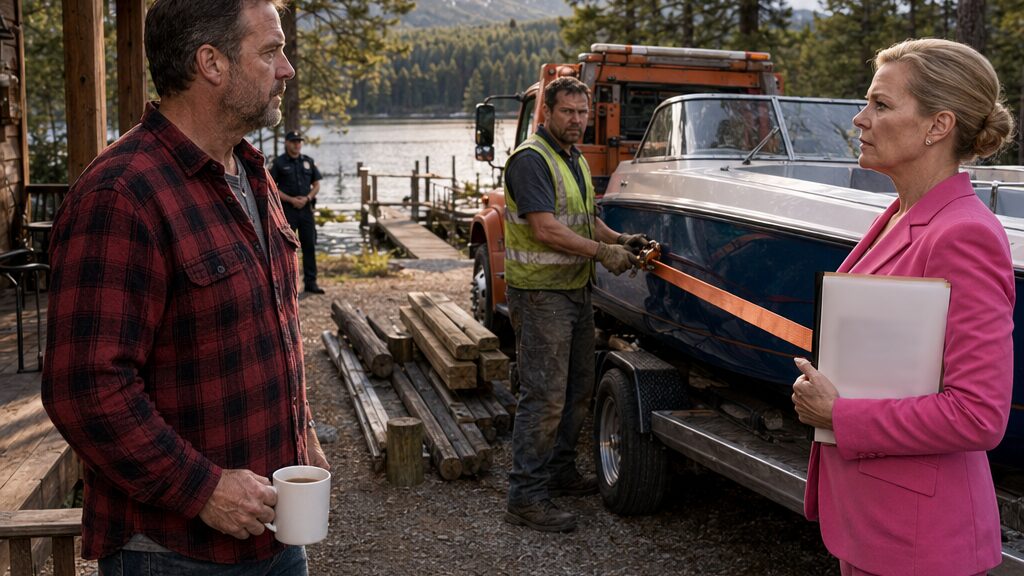
For one second, his mind refused to understand the picture in front of him. The blue-and-white boat sat crooked on its trailer beside the dock path, half pulled toward the gravel drive. A man in a yellow safety vest had one boot on the trailer frame and both hands on the ratchet handle, cranking the strap tighter with short metallic snaps.
Click. Click. Click.
Brian’s white mug hung in his right hand, warm against his fingers. He had come outside to check the water level before driving into town to pick up Kathleen from the clinic. He had expected fog lifting off the lake, the sound of the waterfall through the pines, maybe the contractor’s truck if the man was early.
He had not expected a tow truck.
“Stop,” Brian called.
The man in the vest looked up but did not let go of the handle.
Brian set the mug on the porch rail and walked down the steps barefoot inside his work boots, flannel shirt unbuttoned over a gray undershirt. Gravel shifted under him. The tow truck was bright orange, backed into his driveway like it belonged there, its amber light turning lazily even though the morning was clear.
“I said stop.”
The worker straightened. He was broad through the shoulders, with a tired face and a clipboard tucked under one arm. “You the owner?”
“That’s my boat.”
The worker glanced past him toward the road. “Then you need to speak with the association.”
“The association doesn’t own my driveway.”
“No, sir,” the worker said carefully. “But they authorized removal.”
Brian looked at the strap again. It crossed the hull just below the painted stripe, pressing down over the side where he had patched a scrape last summer. On the gravel near the trailer were two bundles of treated lumber, three aluminum rail posts, and a box of stainless bolts. The repair materials had been stacked beside the dock path under a tarp the night before. Now the tarp was folded and thrown into the bed of the tow truck.
Brian stepped between the man and the ratchet.
The worker lifted both hands. “I don’t want trouble.”
“Then don’t take what isn’t yours.”
A red SUV rolled in from the wooded road before the man could answer. Its doors bore a gold-and-black emblem: PINE HOLLOW LAKES COMMUNITY ASSOCIATION. Beneath it, in block letters, were the words HOA ENFORCEMENT.
Brian felt something go still behind his ribs.
The SUV stopped beside the tow truck. A uniformed driver stayed behind the wheel. The passenger door opened, and Sandra Roberts stepped out in a bright pink suit that looked untouched by dust, lake mist, or work. She held a folder in one hand and a phone in the other.
“Mr. Carter,” she said, as if arriving late to her own ambush was a courtesy. “Please step away from the removal area.”
Brian did not move. “You sent a tow truck to my house before eight in the morning?”
Sandra’s heels clicked once on the gravel. She did not look at the boat first. She looked at the dock path, the stacked materials, the temporary rail Brian had bolted to the first run of planks two days earlier.
“We are enforcing a violation notice regarding unauthorized shoreline equipment and unapproved exterior modification.”
“You mean the dock rail?”
“I mean the boat, the repair materials, the temporary railing, and any non-compliant structure connected to the shoreline.”
“The boat is not a structure.”
“It is being used as part of unauthorized work.”
Brian stared at her. The worker shifted behind him. The lake slapped quietly against the posts below.
“I submitted the emergency repair request three weeks ago,” Brian said. “You know that.”
Sandra opened the folder and removed a paper with a red header. “Your request was incomplete.”
“You never replied.”
“The board cannot approve work that begins before approval is granted.”
“The dock support shifted after the storm. The water line is loose. The rail is temporary.”
“Temporary modifications are still modifications.”
Brian’s jaw tightened. He could hear Kathleen’s voice from the night before: Don’t make a fight out of me, Brian. Just get the rail steady before I come home.
He had told her it would be handled.
Sandra extended the paper toward him. “You were notified.”
Brian took it without looking away from her. “When?”
“This morning.”
“The crew was already touching my boat when I came out.”
“The notice has been served.”
“That’s not the same as notice before removal.”
Sandra’s expression stayed composed, but something sharpened around her eyes. “Mr. Carter, Pine Hollow’s shoreline rules exist to protect the value and safety of this community. You cannot decide, on your own, to alter the lakeside appearance because a project feels urgent to you.”
Brian looked past her to the empty dock path. The boards near the waterline dipped slightly to the left. From the porch, it looked harmless. From the boat, kneeling beside the supports, he had seen the washout under the outer post and the cracked bracket where the intake pipe crossed beneath the deck.
“It does not feel urgent,” he said. “It is urgent.”
Sandra’s gaze flicked to the boat. “Then you should have waited for proper approval.”
“The boat is how I reach the underside safely. The water’s too high to work from the rocks.”
“You have been instructed to cease work.”
“Kathleen comes home today.”
Sandra paused, but only for a breath. “That is not relevant to the violation.”
“It is relevant to why the dock has to be safe.”
The worker in the vest looked down at the gravel.
Sandra did not. “If there is a medical concern, you may submit the appropriate accommodation documentation.”
“I did.”
“Then it will be reviewed.”
“After you tow the boat?”
“If you interfere with an authorized removal, the association may assess additional fines.”
Brian let out a short breath through his nose. Not a laugh. Not quite. “Authorized by who?”
Sandra tapped the folder. “Emergency enforcement provision. Section nine.”
“Show me the board vote.”
“This is not a debate.”
“It is when you’re taking my property.”
The uniformed driver got out of the SUV. He did not walk close, only stood with his hands near his belt, watching.
Brian felt the pressure of that watching. That was the point of it, he knew. Not police, not court, not law. Just enough costume and procedure to make an ordinary man wonder what might happen if he stood still.
He pulled his phone from his pocket and began recording.
Sandra’s face changed for the first time. “Mr. Carter.”
“I want your name, his name, the company name, and the order you’re relying on before that strap moves another inch.”
The worker swallowed. “Joseph Davis,” he said quietly. “Davis Towing and Recovery.”
Sandra turned on him. “You are not required to answer questions from a homeowner in violation.”
Joseph looked at Brian. “I got a work order.”
“From her?”
“From the association office.”
“Does it say my boat is abandoned?”
Joseph hesitated.
Sandra said, “The equipment was staged in violation of shoreline access rules.”
Brian stepped closer to the trailer. “That boat has registration in my name, sits beside my dock, and was used yesterday to reach the damaged support under my property. Nothing here is abandoned.”
Sandra’s voice lowered. “You are making this more difficult than necessary.”
“No,” Brian said. “You did that when you sent a crew before you answered my request.”
For a moment, the only sound was the tow truck idling and the waterfall beyond the trees. Brian could feel the damp sleeve of his flannel against his wrist. His coffee sat cooling on the porch rail behind him. The morning had split cleanly into before and after.
Sandra placed the notice against his chest. He caught it before it fell.
“You have forty-eight hours to remove all unapproved modifications,” she said. “The association is removing the boat and materials today to prevent continued violation.”
“Those materials are mine.”
“They are subject to removal as part of enforcement.”
“They’re for the rail.”
“The rail is not approved.”
“It’s so Kathleen can get from the house to the dock without falling.”
Sandra’s lips pressed together. “Again, the association has received no approved medical accommodation.”
“That’s because you didn’t approve it.”
“That is because process exists for everyone.”
Brian held her stare, and for the first time he understood that she was not confused. She was not missing the point. She had found a place to put the point where it could not bother her.
Behind him, Joseph eased the ratchet handle down.
Brian turned. “Don’t.”
Joseph froze.
Sandra’s voice cut in. “Proceed.”
Joseph did not move immediately. That small delay was the first human thing Brian had seen since he opened the door.
“I need the order in writing,” Brian said.
Sandra lifted the folder. “You have it.”
Brian looked down at the page in his hand. The red header read NOTICE OF EMERGENCY REMOVAL. Below that, in smaller type, the words blurred for a moment before his eyes settled.
Unauthorized shoreline equipment. Unapproved exterior modification. Continued violation. Storage fees assessed daily.
His name was typed correctly. His address was correct. The date was today.
But the time beside the signature line was 8:10 a.m.
Brian looked at his phone screen. It was 7:42.
He raised the phone so the recording caught the paper and the tow truck. “This notice is time-stamped twenty-eight minutes from now.”
Sandra’s face tightened.
Joseph leaned slightly to see.
“The association office clock must be off,” Sandra said.
Brian looked at the orange strap, then at the boat, then back at Sandra. “Or you filled it out for after the work was already done.”
The uniformed driver took one step forward. Sandra did not look at him, but her voice became clipped. “Joseph, complete the removal.”
Joseph’s hand returned to the ratchet. He pulled once. The strap clicked tighter against the hull.
Brian did not grab him. He did not shout. He stood close enough that Joseph had to work around him, phone still recording, paper still in his other hand.
“You’re taking away the only way I can reach the damaged water intake before Kathleen comes home,” Brian said. “Make sure the recording hears that.”
Sandra’s expression did not change, but her fingers curled around the edge of the folder.
Joseph finished securing the strap. The winch cable pulled. The boat shifted forward on the trailer with a low groan, gravel crunching under the tires.
Brian stepped back only when the trailer moved. He watched his boat roll toward the tow truck, watched the lumber and rail posts disappear under the folded tarp, watched the amber light turn over the driveway like a warning that had come too late.
When Joseph climbed into the cab, Brian walked to the driver’s side.
“Give me the work order number.”
Joseph looked through the open window toward Sandra.
Brian kept his voice even. “You’re already taking it. Don’t make me chase the paper too.”
Joseph reached down, tore the top sheet from a clipboard, and folded it once before handing it out.
Sandra snapped, “That is association documentation.”
Joseph did not take it back.
Brian opened the sheet.
Under description of property, someone had typed: abandoned repair equipment subject to removal.
He read the line twice while the tow truck’s engine rumbled harder.
By the time he looked up, his boat was already moving down the wooded road.
Chapter 2: The Notice Said Less Than It Threatened
The notice said the removal had begun at 8:10, but Brian had video of the tow truck leaving at 7:49.
He stood at the kitchen counter with the paper flattened under Kathleen’s ceramic sugar bowl, watching the seconds on his phone recording as if they might change if he stared long enough. The first frame showed his own porch rail and the white mug steaming in the corner. Then the camera swung toward the driveway, and there it was: Joseph’s hands on the orange ratchet strap, the boat still beside the dock path, Sandra’s SUV not yet arrived.
7:39 a.m.
Brian replayed it once. Then again.
The cabin felt wrong without the boat visible through the kitchen window. For fourteen years, the blue-and-white hull had been part of the morning view, tucked beside the path that led down to the dock. It had carried groceries when the access road flooded. It had hauled cedar boards, water filters, Kathleen’s old garden bench, and once, during an ice storm, a neighbor’s generator across the narrow inlet.
Now the slip was empty.
The notice used cleaner language than the tow had. “Emergency removal” sounded almost responsible. “Unauthorized shoreline equipment” sounded temporary and careless. “Correction of continuing violation” sounded like Brian had been warned, ignored everyone, and forced the association’s hand.
It did not mention the unanswered application.
Brian went to the cabinet above the refrigerator and pulled down a blue folder. He hated folders. Kathleen teased him for it, saying he trusted screws more than paper. But after her fall in March, after the doctor used the words “limited mobility” and “environmental risk,” Brian had started keeping receipts, sketches, and letters because every appointment seemed to produce another document someone expected him to understand.
The emergency dock-repair request was clipped behind the contractor’s estimate.
Submitted by email, three weeks earlier.
Request: temporary reinforcement of dock rail, replacement of shifted outer support, access to underside by boat for intake-line stabilization.
Reason: storm damage affecting safe access and water service.
Attached: contractor estimate, photographs, clinic letter for household mobility accommodation.
He had written it plainly. No drama. No begging. He had even included a note saying the visible materials would match the existing dock once the permanent repair was approved.
The email receipt sat beneath it.
Delivered.
No response.
Brian placed the folder beside the violation notice and photographed both together. Then he walked outside.
The strap marks were still visible in the gravel where the trailer had shifted. Two shallow arcs curved away from the dock path toward the driveway. A scrap of orange fiber, no longer than his thumb, had caught on the corner of one rail post Joseph’s crew had left behind. Brian picked it up and rolled it between his fingers.
The dock below looked almost normal from a distance. That was the trouble with damage near water. From the porch, the rail he had installed looked like an extra line of aluminum along old cedar. From underneath, where the lake slapped at the supports, the outer bracket had split, and the pipe feeding the cabin’s intake filter sagged lower than it should.
Kathleen could walk short distances with a cane now, but uneven boards made her freeze. Not from weakness. From memory. A foot slipping, a hip striking, a clean morning ruined by one bad angle.
He had promised the rail would be ready.
He took photos of the empty slip, the missing materials, the temporary rail, the cracked bracket visible between boards, and the path from the house to the dock. He made himself slow down. Wide shot first. Close-up next. Timestamp visible. No angry muttering on the video. No shaking camera.
At the far end of the dock, a faint muddy streak marked where storm water had pushed debris under the boards. Brian crouched and photographed that too.
His phone buzzed while he was still kneeling.
Kathleen.
He stared at her name until it rang a third time, then answered. “Hey.”
“You sound outside,” she said.
“I am.”
“Good. Is the rail done?”
Brian looked at the empty place beside the dock path where the boat should have been. His mouth went dry.
“Not yet.”
There was a small pause. In that pause, he heard clinic noise behind her: a cart wheel, a soft announcement, someone laughing too loudly.
“The contractor didn’t come?”
“Something came up.”
“Brian.”
He closed his eyes briefly. She knew that tone from him. He used it when he thought he could carry bad news quietly enough that it would not become hers.
“I’m handling it,” he said.
“That wasn’t what I asked.”
He turned toward the cabin. The white mug still sat on the porch rail, untouched since the tow truck came. “The HOA stopped the work.”
“Stopped it how?”
“They sent a notice.”
Another pause. “Just a notice?”
Brian looked at the gravel marks. “I’ll explain when you’re home.”
“That means no.”
“It means I don’t want you worrying in a clinic hallway.”
“I worry worse when you edit.”
That landed harder than he expected. He rubbed his thumb against the scrap of orange fiber. “They towed the boat.”
Kathleen said nothing.
“It’s temporary,” he added too quickly. “I’ve got video. The notice timing is wrong. They took the materials too, most of them. I’m going to call the association office and—”
“Brian, how are you fixing the intake without the boat?”
“I’ll find a way.”
“That’s not an answer.”
He looked at the water. The underside of the dock could not be reached safely from the bank. The rocks were slick and uneven. He had done it once years ago and nearly broken an ankle. Now, with the lake high and the support shifted, it would be stupidity dressed up as determination.
“I’ll find the right way,” he said, softer.
Kathleen exhaled. “You were supposed to tell me if they pushed back.”
“I thought it was paperwork.”
“It was never just paperwork if Sandra Roberts was involved.”
Brian opened his eyes. “You knew?”
“I know she likes rules better when they make people ask twice.”
Before he could answer, a clinic staff member spoke near Kathleen. Kathleen covered the phone for a moment, then came back. “They’re discharging me in two hours.”
“I’ll pick you up.”
“Bring the truck close to the side entrance. And don’t pretend the dock is fine when I get there.”
The call ended with that, not angry, not gentle. Just tired.
Brian stood a moment longer, holding the silent phone.
Back inside, he opened his laptop and logged into the HOA portal. The dashboard showed his property in cheerful green except for a new red banner across the top.
ACTIVE VIOLATION: SHORELINE MODIFICATION AND EQUIPMENT STORAGE.
He clicked.
Three photographs loaded.
The first showed his dock from across the water, taken before the temporary rail was installed. The second showed the repair materials under the tarp. The third stopped him.
It was a close shot of the damaged dock support, taken from the shoreline path two days before the tow.
Sandra had photographed the damage before the last storm made it worse.
Brian leaned closer. The image carried a metadata stamp in the corner.
Seven days ago.
Before his second follow-up email. Before the contractor estimate expired. Before Sandra claimed the association had only just discovered the violation.
He opened his sent folder and found his messages. Request submitted. Follow-up one. Follow-up two. Accommodation attachment re-sent.
All unanswered.
His anger changed shape. It became less hot, more precise.
He printed everything. The old printer on the side table groaned through each page as if it resented being part of the fight. He clipped the HOA photographs to his own. He wrote times in the margins. He copied the tow work order number Joseph had given him.
Then he called the association office.
No answer.
He left a message with his name, address, the work order number, and a request for immediate release of the boat and materials. He asked for the board vote authorizing emergency removal. He asked for the complete violation file.
He did not say what he wanted to say.
When he hung up, his email chimed.
The sender was Pine Hollow Lakes Community Association.
Subject: Scheduled Compliance Inspection.
Brian opened it standing up.
A formal inspection of your shoreline area will occur tomorrow at 8:00 a.m. to verify removal of all unauthorized modifications, including but not limited to temporary rail installation, staged materials, and unapproved dock alterations. Continued noncompliance may result in additional enforcement action.
Brian read the message once, then looked through the window at the empty slip and the strap marks in the gravel.
They had taken the boat first.
Tomorrow, they were coming for the rail.
Chapter 3: The Board Called It a View Problem
Sandra arrived with an inspector at 7:53 the next morning, seven minutes before the time printed in her own email.
Brian was already at the dock with his phone recording.
He had placed the temporary rail between himself and the water, not to be dramatic, but because the outer boards shifted if he put his weight near the edge. The rail was simple aluminum, brushed dull so it would not glare across the lake. He had bolted it into the safest run of planks and left the final section unfinished where the support needed replacement from below.
Sandra stepped onto the dock path in the same pink suit, this time with a white coat over her arm and sunglasses perched on her head. Beside her stood a man with a measuring wheel and a tablet. The uniformed HOA driver remained up near the gravel, arms crossed by the red SUV.
“You’re early,” Brian said.
Sandra looked past him toward the rail. “We are here to document ongoing violation.”
“Your notice said eight.”
“It is eight, effectively.”
“It’s 7:53.”
The inspector glanced at his tablet but said nothing.
Brian held the phone steady. “State your name and purpose.”
Sandra’s smile was thin. “This is not a deposition, Mr. Carter.”
“No. It’s my property.”
“It is property within a governed community.”
“And this is a repair connected to a submitted emergency request.”
“The board has not approved any shoreline alteration.”
“Did the board review it?”
Sandra turned to the inspector. “Please photograph the rail attachment points.”
Brian stepped sideways, blocking the clearest angle without touching the man. “Before he does, I want the answer on record. Did the board review my request?”
Sandra’s eyes came back to him. “Your application did not meet the requirements for review.”
“Which requirement?”
“Complete material specifications, color compliance, full contractor license documentation, and shoreline impact statement.”
“I sent the contractor estimate, material list, and photographs.”
“You did not wait for approval.”
“I waited three weeks.”
“That does not create approval.”
“No. But it does prove you had notice.”
The inspector lowered his tablet slightly. The wind off the lake moved the loose edge of Sandra’s coat.
She pointed at the rail. “This is not a repair. This changes the exterior appearance of the shoreline.”
Brian looked at the rail, then at the water beyond it. “It keeps a person from falling.”
“It affects the view corridor.”
“The view corridor?”
“Uniformity matters here.”
He almost laughed then. The sound rose in his chest and stopped, because laughing would make him look careless, and he could not afford careless. Not with the boat gone, the rail next, and Kathleen sitting inside the cabin pretending she had not moved to the window.
Brian raised his phone slightly. “You are calling a safety rail a view problem.”
Sandra’s expression tightened. “I am calling an unapproved structure unapproved.”
“The dock support is cracked.”
“Then submit a repair request.”
“I did.”
The inspector finally spoke. “Do you have a copy?”
Brian looked at him. “Yes.”
Sandra said, “The association office handles application records. The inspector is here only to document the physical condition.”
Brian held Sandra’s gaze for one more second, then walked up to the porch and returned with the blue folder. He had marked the pages with yellow tabs. His hands wanted to shake, so he gripped the folder from the bottom.
He handed the inspector a copy of the first submission, the email receipt, the contractor estimate, and the clinic letter with Kathleen’s private details folded under a blank sheet.
Sandra stepped forward. “Medical documentation should not be distributed casually.”
Brian turned on her. “Then maybe don’t force people to prove need on a dock.”
The inspector looked uncomfortable. “I can note that the owner provided documents.”
“Note the delivery dates,” Brian said.
The man scanned the top page. “Three weeks ago?”
“Yes.”
Sandra’s voice hardened. “Again, incomplete submission.”
“Then why didn’t anyone say that?”
“The association receives many requests.”
“Not many emergency requests for a damaged dock attached to a water line.”
Sandra’s phone buzzed. She glanced at it, then turned slightly away. Brian watched that movement and felt, for the first time, that something behind the rule bothered her more than the rail itself.
The inspector moved to photograph the rail. Brian let him, but recorded each angle. When the inspector stepped near the outer boards, the dock dipped.
He caught himself on the post.
Brian reached out but stopped short of touching him. “That’s why the rail is there.”
The inspector looked down at the boards.
Sandra said quickly, “The instability may be the result of unauthorized work.”
Brian bent, pulled up the edge of one loose board, and pointed to the rusted bracket beneath. “That split happened before I installed anything. I sent a photo.”
The inspector photographed it.
Sandra’s mouth flattened.
An hour later, Brian was sitting across from Sandra in the HOA office, a low building near the community entrance decorated with framed lake photographs and a sign that read PRESERVING PINE HOLLOW’S NATURAL BEAUTY. His boots had left faint damp marks on the polished floor. Sandra sat behind the conference table with the folder closed in front of her.
She had refused to discuss the matter at the dock after the inspector finished.
Now she slid a printed settlement form across the table.
“Pay the initial fine, remove the temporary rail, agree not to resume work without written approval, and the association may release the boat after storage fees are settled.”
Brian did not touch the paper. “You took the boat I need to do the repair. Now you want me to pay to get it back so I can agree not to repair.”
“You are mischaracterizing the offer.”
“I’m reading it.”
“The association is willing to avoid further enforcement if you comply.”
“Where is the tow receipt?”
Sandra’s fingers paused on the folder.
Brian took Joseph’s folded sheet from his pocket. “This is the work order copy I was given. It has a number, but not the full authorization.”
“That document belongs to the contractor.”
“It lists my boat as abandoned repair equipment.”
“You staged equipment in violation.”
“The boat is registered, maintained, and parked beside my dock.”
“Mr. Carter, arguing word choice will not help you.”
“It will if the word choice was used to tow it before proper notice.”
Sandra leaned back. For the first time, the polished confidence thinned enough for him to see irritation underneath. “You chose to begin work without approval. Choices have consequences.”
Brian looked down at the settlement form. It would be easy, in a way, to sign the thing. Pay the fine. Get the boat. Put the rail back quietly. Hope Sandra got tired of him.
But the line near the bottom stopped him.
Owner agrees that all shoreline damage is owner-maintained and unrelated to association common drainage, runoff, or maintenance conditions.
He read it twice.
“Sandra,” he said, “why is drainage in a boat-release agreement?”
Her eyes did not move, but the room changed.
“That is standard language.”
“No, it isn’t.”
“You are not an attorney.”
“I know when a form is trying to make me say something I don’t know yet.”
Sandra closed the folder. “The offer expires at five.”
Brian stood. “Then I need the complete file before five.”
“You can submit a records request.”
“I’m submitting one now.”
He left without signing.
Outside, near the parking lot, Amy Martinez was pinning a notice to the community bulletin board. She had been board secretary two years ago, before Sandra’s first term as president. Brian knew her mostly from nods at the mailboxes and one winter afternoon when he had helped pull her trash bin out of a snowbank.
She watched him come down the steps. “You’re the reason Sandra canceled the landscaping walk-through.”
“I guess.”
“She doesn’t cancel things for small problems.”
Brian stopped. “Do you know how records requests work here?”
Amy looked toward the office window. Sandra’s silhouette moved behind the blinds.
“You didn’t hear this from me,” Amy said.
“I don’t need gossip.”
“It’s not gossip.” She lowered her voice. “If your request was properly entered, it should appear in the board packet log, even if it was incomplete.”
“Where do I get that?”
“Ask for the packet index, not just your property file. Property files can be curated.”
Brian studied her. “Why are you telling me this?”
Amy pushed the pin hard into the board. “Because I used to make those packets. And because after the last dock accident, Sandra started treating every shoreline issue like a lawsuit waiting to happen.”
“What accident?”
Amy shook her head. “Ask for the index.”
Brian pulled out his phone and opened a blank email. “What wording?”
Amy gave him the phrase carefully, like handing over a tool with a sharp edge.
Before he could send it, she added, “One more thing. Your emergency request should have been listed for board review last month.”
“It wasn’t?”
Amy glanced once more at the office window.
“There’s no record of Sandra forwarding it.”
Chapter 4: Kathleen Asked About the Empty Slip
Kathleen noticed the empty boat slip before Brian had shut off the truck.
She was sitting in the passenger seat with one hand braced against the door handle and the other resting on the folded discharge papers in her lap. The clinic had sent her home with a plastic bag of instructions, two new appointments, and a reminder to avoid uneven surfaces. She had said very little on the drive back through the pines.
Brian had hoped the angle of the cabin would hide the lake until he could help her inside.
But the road curved, the trees opened, and the empty space beside the dock showed itself like a missing tooth.
Kathleen turned her head slowly. “Where did they take it?”
Brian parked near the side entrance and killed the engine. “A storage yard outside town.”
“The boat?”
“Yes.”
“And the materials?”
“Most of them.”
She nodded once, too calm. “And the rail?”
“Still there.”
“For now,” she said.
He came around to her side, opened the door, and unfolded her cane. She waited until his hand was extended before she took it. That was new. Before March, Kathleen would have stepped down from the truck without looking at the ground, already telling him where he had left a tool or which cabinet hinge was squeaking. Now she studied gravel like it might betray her.
“I can carry the papers,” he said.
“I have them.”
He did not argue. That was one thing he had learned after the fall: helping too fast could feel like taking.
They moved slowly toward the side door, avoiding the slope that led to the porch. Brian had laid two sheets of plywood over the worst part of the gravel, a temporary path he had meant to replace once the dock rail was finished. Kathleen saw that too.
“You did that last night.”
“Yesterday.”
“After they took the boat.”
He opened the door. “Let’s get you inside.”
The cabin smelled faintly of printer ink, lake damp, and the soup he had forgotten to turn on before leaving. On the kitchen table, his blue folder sat open beside the violation notice. He had meant to move it. He had meant to clear the table, warm the soup, make the house look less like a fight.
Kathleen stopped in the doorway.
Brian followed her gaze to the paper with the red header.
“It’s not as bad as it looks,” he said.
She gave him a tired sideways look. “That sentence has never once been true.”
He pulled out a chair for her. She lowered herself carefully, one hand on the table edge. Her fingers landed on the violation notice before he could slide it away.
“Don’t,” she said.
He froze.
She turned the notice toward herself and read. Her face did not change at first. Then her thumb pressed against the paper, whitening at the joint.
“Daily storage fees,” she said. “Daily violation fines. Removal of all unauthorized modifications.”
“They’re using broad language.”
“They’re using expensive language.”
“I know.”
She looked up. “How much?”
“Not clear yet.”
“That means bad.”
“It means I’m asking for the file.”
“Brian.”
He pulled the chair across from her but did not sit. “I can handle the money for a while.”
“For a while,” she repeated. “And after that?”
He had no clean answer. The repair estimate was already higher than he had admitted. The intake line needed work before winter. The clinic bills were arriving in thin envelopes with polite due dates. He had been moving numbers between accounts like moving buckets under a leaking roof.
Kathleen looked back at the notice. “You didn’t tell them enough.”
“I told them what they needed.”
“No. You told them what let you keep me out of it.”
He sat then, because standing made him look like he was preparing to leave the conversation. “I sent the clinic letter.”
“Which one?”
“The one about household mobility risk.”
“The short one?”
He did not answer quickly enough.
Kathleen closed her eyes. “Brian.”
“It said enough.”
“It said I should avoid uneven walking surfaces. It didn’t say why the dock matters. It didn’t say the water intake is part of the home system. It didn’t say I can’t safely use the lower path without a rail.”
“I wasn’t going to hand Sandra Roberts your whole medical file.”
“I didn’t ask you to.”
“She would use it.”
“She already used the absence of it.”
That silenced him more effectively than anger would have.
Kathleen pushed the notice aside and reached for the medication schedule the clinic had printed. Her hand trembled slightly, whether from fatigue or frustration he could not tell. The white mug from the morning still sat on the far counter, washed now but not put away. He had cleaned it while waiting for her discharge call, as if removing the coffee stain could undo the interruption.
“I heard you on the phone yesterday,” she said.
“When?”
“At the clinic. You thought I couldn’t hear because the nurse came in.”
Brian looked down.
“You told them the boat was tied to the repair, but you didn’t say why it mattered before I came home. You stopped yourself.”
“I didn’t want you to become the argument.”
“I am the reason for the argument.”
“You’re not a reason. You’re—”
“Careful,” she said softly.
He stopped. The room seemed to hold its breath around them.
Kathleen folded the discharge papers once, then again, aligning the edges with the same precision she used to have when balancing the household checkbook. “I don’t want those people discussing me like a project.”
“I know.”
“I don’t want board members reading about my hip, or my balance, or whether I can get from one place to another.”
“I know that too.”
“But I also don’t want to leave this house because you were too proud to make a proper record.”
The words hit him in a place he had been protecting without naming.
“I’m not proud,” he said, too quickly.
Kathleen gave him a look almost gentle enough to hurt. “You are. Not in the ugly way. In the way that makes you fix a thing at midnight because asking for help feels like failing.”
He rubbed both hands over his face. His palms smelled faintly of lake rope and printer paper.
After the fall, when the ambulance lights turned the cabin walls red and white, he had made one promise before she came home from surgery. He had stood alone on the dock, looking at the path she loved, and said out loud that she would not lose the lake because of one bad step. He had treated that promise like a private contract. His to solve. His to carry. His to keep quiet.
Now the quiet had become evidence against him.
Kathleen reached into the clinic bag and pulled out a sealed envelope. “The doctor gave me the longer letter.”
Brian looked at it.
“I asked for it while you were moving the truck.”
“You asked?”
“I knew you wouldn’t.”
He almost smiled, but it did not make it to his face.
Kathleen held the envelope between them. “You may use this. You may show that there is a mobility need and that stable access matters. You may say the dock and water line affect whether this house works for me.”
He reached for it, but she did not let go yet.
“You may not let them turn me into a sad story so they feel better about changing their minds.”
His hand stilled.
“No photographs of me struggling,” she said. “No dramatic description. No making my body the evidence when the dock, the emails, and their own timing should already be enough.”
Brian nodded. “Agreed.”
She released the envelope.
For a while they worked at the table together. Kathleen marked the medical letter with a sticky note: relevant portion only. Brian scanned it, covering the rest with a blank page. He printed a fresh timeline. She corrected his wording when he wrote “Kathleen cannot access the dock,” changing it to “the dock cannot be safely accessed by a household member with documented mobility limitations.”
“That sounds like you,” he said.
“That sounds like someone who has dealt with insurance forms.”
Near dusk, Brian helped her to the living room chair by the window. She could see the lake from there if she leaned slightly to the right. She did not ask to go outside. He was grateful and ashamed at the same time.
His laptop chimed from the kitchen.
He walked over, expecting perhaps a reply to his records request.
The email subject line read: FORMAL HEARING NOTICE AND ASSESSMENT SCHEDULE.
Brian opened it.
A hearing had been scheduled for the following week. Until then, the daily fines would begin immediately. Storage fees for the boat would continue. Failure to remove the temporary rail could result in further enforcement, including permanent removal of unauthorized structures by association-approved contractors.
Kathleen watched him from the chair. “What now?”
Brian read the final line twice.
“They’re charging us every day they keep me from fixing it,” he said.
Chapter 5: The Culvert Behind the Pretty Shoreline
The mud line did not lead from Brian’s dock to the lake. It led from the association culvert to Brian’s dock.
He found it two mornings later after the water dropped three inches overnight. The shoreline looked cleaner from the porch, but close up, the storm had left its handwriting everywhere: pine needles pressed into silt, gravel dragged into thin fans, brown streaks dried across the roots above the bank. Brian followed one of those streaks past the edge of his property, across the common path, toward the stone-lined drainage ditch the HOA maintained behind the lakeside lots.
At the culvert mouth, the grate was half-blocked with leaves, broken branches, and a crushed plastic plant pot.
Brian crouched and took a photograph.
Then another.
Then a video, beginning at the clogged grate and walking slowly back along the washout line toward his dock. He kept his boots on common path gravel until he reached his boundary marker, because now every footstep felt like something Sandra might rename.
The runoff had not simply soaked the bank. It had cut a shallow channel through the slope, aimed almost directly at the outer dock support.
He stood at the edge of the path and stared.
For days, he had been defending himself as though the damage were his private problem. His repair. His mistake. His violation. But the water had come from the part of the shoreline the association controlled, through the culvert that carried runoff from the upper road and landscaping beds.
He took a wide shot that showed the culvert, the path, the channel, and his dock in one frame.
A voice behind him said, “You should not stand there long.”
Brian turned.
Amy Martinez was on the path with a canvas tote over one shoulder and a small pruning shear in her hand. She looked as if she had intended to trim something innocent and discovered a trial exhibit instead.
“I’m on the path,” Brian said.
“I know. Sandra may not care.”
He looked back at the culvert. “Did you know about this?”
Amy came closer but stopped a few feet from the grate. “Everyone who walks this side after rain knows that culvert backs up.”
“That’s not what I asked.”
Her mouth tightened. “When I was secretary, there was a maintenance warning.”
“When?”
“Last fall. Then again after the spring storm.”
Brian held up his phone. “Is there a record?”
“There should be.”
“Should be?”
Amy looked down the path toward the bend, where the roofs of other lake houses showed between trees. “Sandra changed how packets were prepared after the dock accident.”
Brian remembered the phrase from the office parking lot. “What accident?”
Amy hesitated. “A guest slipped on an old dock two summers ago. Not yours. Different lot. The family threatened a claim. It settled quietly, but Sandra was on the safety committee then. After that, she wanted everything visible, uniform, controlled. No homeowner fixes, no odd railings, no temporary anything.”
“That explains strict,” Brian said. “Not hiding my request.”
“I’m not defending her.”
“You’re explaining her.”
“Sometimes explanations matter before people become monsters in your head.”
Brian looked at Amy then. There was a warning in her voice, but not against Sandra alone. Against him too.
He had been building a case clean enough to win. Part of him wanted Sandra simple: pink suit, wrong notice, towed boat, blocked repair. Simple was easier to fight.
But the clogged culvert in front of him was not simple. It turned fear into procedure and procedure into damage.
Amy shifted the tote on her shoulder. “The maintenance warning said runoff from the upper road was undermining lower shoreline supports. It recommended clearing the culvert before heavy storms.”
“Who received it?”
“The board. The president. The maintenance committee.”
“Sandra.”
“Yes.”
Brian took another photo. “Can you get me the warning?”
Amy’s eyes sharpened. “No.”
“Amy—”
“No. I can tell you what to request. I can tell you where it should be. I am not stealing board records for you.”
“I didn’t ask you to steal.”
“You were about to ask me to save you time.”
He looked away first.
She was right. That bothered him more than he wanted it to.
“I’m trying to keep them from tearing out the rail,” he said.
“I know. But if you cut corners now, she’ll use that too.”
The words sank in because they sounded like something Kathleen would have said. Brian put the phone in his pocket and nodded. “Tell me what to request.”
Amy gave him the wording: maintenance committee shoreline drainage report, culvert inspection notes, post-storm common-area runoff correspondence. She spoke quietly, watching the path while she did.
When he finished typing, she added, “Ask for the meeting packet from the month your request should have appeared. Not the minutes. The packet.”
“Because minutes can be cleaned up.”
“Because minutes only show what was discussed. Packets show what was withheld.”
A red shape appeared through the trees at the top of the path.
Amy saw it too. “You need to go.”
Brian did not move fast enough.
Sandra Roberts came down the common path with the HOA enforcement driver several steps behind her. She wore flat shoes today, but the pink suit remained, bright against the pines.
“Mr. Carter,” she said. “Why are you photographing association drainage infrastructure?”
Brian turned his phone so the screen faced his chest. “Because it appears to be directing runoff into my dock support.”
“You are not authorized to inspect or interfere with common drainage.”
“I’m standing on the path.”
“You were observed near the culvert.”
“By you?”
“By a resident concerned about tampering.”
Brian looked at the blocked grate. “If I were tampering, it would be clearer.”
“This is exactly the kind of unilateral behavior that created the current violation.”
Amy stepped back slightly, not abandoning him, but removing herself from the center of the exchange. Brian understood. She had given him what she could.
He kept his voice low. “Did you receive a maintenance warning about this culvert?”
Sandra’s eyes flicked to Amy for half a second.
There it was. Not proof, but reaction.
“This conversation is inappropriate,” Sandra said.
“Did you receive it?”
“Submit your questions in writing.”
“I did. Just now.”
“Then you will receive documents according to association policy.”
“Before the hearing?”
“That depends on the scope of your request.”
Brian looked at the enforcement driver. The man stood with a small camera now, filming from chest height.
“So I’m being recorded for standing near the clogged drain that may have damaged my dock.”
“You are being documented near common infrastructure after being instructed not to continue unauthorized work.”
“I haven’t touched it.”
“Your history of non-compliance makes documentation necessary.”
That phrase landed like a prepared line.
Brian felt anger rise, and with it the temptation to say everything at once: the tow time, the missing request, the storage fees, Kathleen’s discharge papers, the mud line under his boots. But he could feel the driver’s camera on him. He could feel Amy watching to see whether he would hand Sandra the version of him she wanted.
He took one step back from the culvert.
“Fine,” he said. “Document this too.”
He raised his own phone, started a new video, and slowly filmed the clogged grate without crossing the edge stones. “Association culvert, visible blockage, runoff channel toward Carter dock, no contact by homeowner.”
Sandra’s mouth tightened. “You are escalating unnecessarily.”
“No,” he said. “I’m learning.”
He walked back toward his property without waiting for permission.
By afternoon, the records request had been acknowledged with a formal reply stating that broad document retrieval could take up to thirty business days. Brian read the email in the kitchen while Kathleen sorted pills into a weekly case beside him.
“Thirty days,” he said.
“For a hearing next week?”
“Yes.”
Kathleen placed one small white tablet into the Monday slot. “That’s not an accident.”
“No.”
“What can we get faster?”
“Packet index, maybe. Tow authorization, maybe. Anything they already used against me.”
His phone buzzed with another email before he finished speaking.
The subject line made his stomach drop.
NOTICE OF EMERGENCY BOARD VOTE: PERMANENT REMOVAL AUTHORIZATION.
Kathleen stopped sorting.
Brian opened it.
The board would meet in forty-eight hours to vote on authorizing permanent removal of the temporary dock rail and any related unapproved structures if Brian did not sign the compliance agreement before noon.
At the bottom was Sandra’s electronic signature.
Kathleen read it over his shoulder.
“They’re not waiting for the hearing,” she said.
Brian looked through the window at the rail catching dull light over the dock boards.
“No,” he said. “They’re trying to make sure there’s nothing left to hear.”
Chapter 6: The Deal Required Him to Stay Quiet
The boat release form was already waiting on the table when Brian walked into the HOA meeting room.
It sat faceup in front of the empty chair they had left for him, clipped to a thicker packet with yellow signature tabs placed wherever Sandra wanted his name. Through the window behind the board table, he could see the decorative lake fountain turning in the association pond, clean and useless and perfectly centered.
Sandra sat at the head of the table. Three board members sat along one side, avoiding his eyes with varying degrees of effort. A speakerphone rested near the middle, unlit. The emergency vote had not begun, but the paperwork had.
Brian remained standing.
Sandra folded her hands. “Mr. Carter, we are prepared to resolve this today.”
He looked at the first page. “Before the vote?”
“If you accept compliance terms, a vote on further removal may be unnecessary.”
“Convenient.”
A board member shifted in his chair. Sandra ignored the sound.
Brian set his blue folder on the table but did not sit. Inside it were copies of the tow notice, the timestamped video still, his original request, the clinic letter with only the relevant paragraph visible, the photographs of the culvert, and the email delaying drainage records for thirty business days.
Sandra gestured toward the chair. “Please.”
He sat because standing made him look like he had come to perform. He had not. He had come to make them put every condition in the room.
Sandra slid the top page closer. “The association is willing to release your boat from storage upon payment of towing and accrued storage fees, suspend additional daily fines for seven days, and allow you to submit a revised application for shoreline repair.”
Brian read the next paragraph.
Remove temporary railing. Cease all work. Acknowledge owner responsibility for shoreline condition. Waive claims related to association drainage, runoff, enforcement timing, towing procedure, and storage costs.
He turned the page over.
The back was blank.
“That’s not a release,” he said. “That’s a gag with a bill attached.”
Sandra’s face tightened, but her voice stayed even. “It is a standard settlement agreement.”
“Then your standard agreement asks me to say the HOA drainage had nothing to do with my dock before you provide the drainage records.”
A board member looked at Sandra. “Drainage records?”
Sandra answered without turning. “Mr. Carter has expanded this matter beyond the noticed violation.”
Brian opened his folder. “Because the violation keeps expanding. First it was the boat. Then the rail. Then the materials. Now you want me to sign away runoff claims before I’m allowed to repair damage runoff may have caused.”
Sandra leaned back. “You began work without approval.”
“Yes,” Brian said.
The room quieted.
He let the admission sit there. It cost him something, but less than pretending.
“I installed a temporary section of rail before written approval. I did that because the dock was unsafe and because my request had been ignored for three weeks. I should have forced a written emergency accommodation response first.”
Sandra’s eyes narrowed, as if she had expected denial and did not like the shape of honesty.
Brian took out his first email. “But I did submit the request before work began. Here is the delivery receipt. Here is the follow-up. Here is the second follow-up. Here is the clinic letter attachment.”
He slid copies down the table, one to each board member.
Sandra said, “The submission was incomplete.”
“Then where is the notice of deficiency?”
No one answered.
Brian looked at the board. “If a request is incomplete, your rules require written notice within ten business days. I checked.”
One board member turned a page in the packet Sandra had provided. “Is that in here?”
Sandra’s jaw moved slightly. “The emergency nature of the violation superseded standard review.”
“The emergency was created by the lack of review,” Brian said.
Sandra’s palm flattened on the table. “The emergency was created when you installed an unapproved rail and staged equipment along a protected shoreline.”
“Protected from what?”
“Visual inconsistency, liability, and unsafe owner modifications.”
“The unsafe part is the broken support.”
“Which you attempted to address without authorization.”
“Because my family member needed safe access home.”
Sandra glanced at the packet in front of him. “You have not established that the dock is medically necessary.”
Brian touched the envelope Kathleen had given him. He had promised her he would not make her the spectacle. He opened the envelope, removed the redacted letter, and slid forward only one page.
“This is the relevant portion,” he said. “It establishes documented mobility limitations and the need for stable, safe access routes at the residence.”
Sandra reached for it, but Brian held the edge a second longer.
“It does not give permission to discuss her diagnosis in this room,” he said.
One of the board members nodded faintly. Sandra released the page from his hand with visible restraint.
She read it. Her expression changed, but not in the way Brian had expected. Not guilt. Calculation.
“This letter is dated yesterday,” she said.
“The earlier shorter letter was attached to my original request.”
“This expanded documentation was not before the association at the time of removal.”
“Because you ordered removal before review.”
Sandra looked to the board. “This is exactly the concern. Owners begin work, provide partial documentation later, then accuse the association of discrimination when enforcement occurs.”
Brian felt the words trying to pull him into anger. He glanced down at the photograph of the orange strap in his folder. That strap had done its work by tightening one click at a time. Sandra’s argument worked the same way.
He lifted the tow receipt instead.
“Joseph Davis gave me this at the site. The work order describes my registered boat as abandoned repair equipment. Who wrote that description?”
Sandra said, “The association office prepares removal summaries.”
“Who in the office?”
“That is administrative.”
“Was there a board vote?”
“Emergency authority was invoked.”
“By you?”
Sandra did not answer.
A board member put down his copy of Brian’s email. “Sandra, did the board see the Carter request before removal?”
“It was not ripe for board review.”
“That’s not what he asked,” another board member said quietly.
The room shifted.
Sandra’s face remained composed, but Brian saw the pressure arrive: not from him, not entirely, but from the people who had trusted her to handle the file cleanly.
“The request lacked required information,” Sandra said. “Given the prior dock incident and ongoing shoreline liability concerns, I acted within emergency enforcement discretion to prevent further unauthorized work.”
Prior dock incident. There it was again.
Brian looked at the board members. Two of them looked down. One rubbed his forehead.
“So this was about liability,” Brian said.
“This was about compliance.”
“And drainage?”
Sandra’s eyes returned to him. “You are not qualified to determine drainage causation.”
“That’s why I asked for records.”
“Which will be provided under policy.”
“After the rail is removed.”
“If removal is authorized.”
Brian looked at the release form again. Seven days’ suspension. Boat returned if he paid. Rail removed. Claims waived. A fast path back to the water, maybe fast enough to patch the intake before another delay. Kathleen could have a safer route sooner. He could get the boat out of storage. He could stop the fees from bleeding them.
All he had to do was sign a sentence saying the thing under the surface did not exist.
He heard Kathleen’s voice: Don’t turn me into a sad story.
Then Amy’s: If you cut corners now, she’ll use that too.
Brian pushed the release form back across the table.
“No.”
Sandra’s eyebrows lifted. “No?”
“I won’t sign away drainage claims to get back property you towed with defective notice.”
“Then the board will proceed.”
“Proceed in writing.”
A board member cleared his throat. “I’d like to postpone permanent removal until we verify the request timeline.”
Sandra turned sharply. “The rail remains a liability every day it stands.”
“So does an unsafe dock,” Brian said.
Sandra ignored him. “The association cannot allow owners to create facts on the ground and then demand approval afterward.”
“And the association can’t ignore an emergency request, tow the repair access, and call the homeowner reckless for not waiting longer,” Brian said.
The room went still again.
No one applauded. No one declared him right. The board did what boards did when exposed to discomfort: they tabled the hardest part.
The permanent removal vote was delayed pending review of the request timeline. The fines remained active. The boat remained in storage. The rail remained, for now, neither approved nor removed.
It was not a victory. It was a pause with a meter running.
Brian gathered his papers slowly. Sandra stacked hers with clipped, exact movements.
At the door, she spoke without looking up. “You could have resolved this today.”
Brian stopped. “So could you.”
He left before she could answer.
Outside, his phone showed a missed call from the county building office. He played the voicemail in the truck with the door still open.
A calm voice filled the cab.
“This message is for Brian Carter regarding the dock safety inquiry. Based on the photographs you submitted, there may be evidence of undermining from upstream runoff. We recommend no further use of the outer dock section until inspected. Please call to schedule a site visit.”
Brian lowered the phone and looked toward the road that led back to the lake.
For the first time since the tow truck came, the thing Sandra had tried to keep procedural had a voice outside her office.
Chapter 7: The Hearing Started With the Tow Receipt
Brian did not begin with Kathleen’s letter.
He began with the tow receipt.
The formal appeal hearing was held in the larger meeting room at the association office, the one with a wall of windows facing the pond and framed photographs of the lake in every season. Sandra sat at the center of the board table with a neat stack of papers in front of her. The other board members had folders too, though Brian noticed none of them had the same thickness as his.
His blue folder was no longer blue at the edges. It had been opened, closed, carried, dropped on the truck seat, and marked with so many tabs that it looked less like a file than a repair manual.
Kathleen had not come.
That had been her choice, and he had not tried to change it. In the morning, she had sat at the kitchen table while he clipped the redacted medical letter behind the request timeline. She had watched him place the tow receipt on top.
“Don’t lead with me,” she had said.
“I won’t.”
“Lead with what they did.”
So he did.
Brian placed Joseph Davis’s tow receipt on the table and slid copies toward each board member.
“This is the first document I received from anyone connected to the enforcement action,” he said. “Not the violation notice. Not a board decision. This.”
Sandra folded her hands. “Mr. Carter has already submitted this receipt.”
“I’m submitting it in the order I received it,” Brian said. “Because the order matters.”
One board member adjusted his glasses and looked at the receipt. “This says 7:36 a.m.”
“Yes.”
Brian placed the violation notice beside it.
“This notice says 8:10.”
The room stilled in a way he recognized now. It was not agreement. It was the sound of people realizing a clean story had a crooked seam.
Sandra spoke before anyone else could. “As previously explained, the association office timestamp was not synchronized.”
Brian nodded once. “Then I’d like that explanation noted. The tow crew was on my property, strapping my boat, before the notice time printed on the removal document.”
He set down a still image from his video: Joseph’s hand on the orange ratchet strap, the hull of the boat pulled tight under it, Brian’s porch rail visible in the corner of the frame.
The picture looked ordinary and brutal at the same time.
“I am not asking you to guess what happened,” Brian said. “I recorded it.”
Sandra’s chair creaked softly as she shifted. “No one disputes that removal occurred.”
“I dispute that it was properly authorized before it occurred.”
A board member looked at Sandra. “Was the emergency order signed before the tow company arrived?”
Sandra opened her packet. “The association president has discretion under section nine to authorize immediate action when continued violation creates risk.”
“That wasn’t the question,” the board member said.
Brian kept his face still.
Sandra found the page she wanted. “The order was prepared that morning.”
“By you?” Brian asked.
“As association president, yes.”
“And the board had not reviewed my emergency repair request.”
Sandra looked up. “The request was incomplete.”
Brian placed another set of pages on the table. “Here is the first request. Here is the delivery confirmation. Here are the two follow-ups. Here is the shorter clinic letter that was attached at the time. Here is the rule requiring written notice of missing information within ten business days.”
A different board member leaned forward. “Do we have that notice in our packet?”
Sandra said, “The management file did not include a formal deficiency notice because the submission did not reach board review.”
“Why not?” Brian asked.
Sandra’s gaze moved to him. “Because work began.”
“After three weeks without response.”
“Without approval.”
“Yes,” Brian said. “I began temporary work without written approval. That was my mistake.”
He had rehearsed the sentence enough that it came out steady, but his hand tightened around the edge of the folder. Admitting fault in front of Sandra felt like giving her a tool. He did it anyway.
“I should have forced the emergency process in writing before installing the rail. I was trying to make the dock safe before Kathleen came home from the clinic, and I made the wrong assumption that silence meant delay, not denial. But my mistake did not authorize defective notice, removal of my boat, or a refusal to review the accommodation.”
No one spoke for several seconds.
Sandra used the silence. “Mr. Carter’s statement confirms the central violation. He began exterior modification without approval. The association must treat such work consistently, especially after prior shoreline incidents.”
Brian heard the turn coming and reached for the next document before she could finish building it.
“This is the county inspector’s preliminary response to photographs of the dock support,” he said.
Sandra’s eyes sharpened. “Preliminary, not final.”
“Yes. Preliminary. It recommends no further use of the outer dock section until inspected because of possible undermining from upstream runoff.”
He slid the copy down the table.
One board member read the line aloud under his breath.
Brian added the culvert photographs next: clogged grate, washout line, dock support, wide shot connecting them.
Sandra’s voice stayed controlled, but the edges hardened. “The association is not here today to determine drainage causation.”
“No,” Brian said. “You’re here to decide whether the repair was a violation worth punishing before you reviewed why it was needed.”
He placed the redacted medical letter on top of the stack.
Only then.
“This is the portion Kathleen authorized me to share. It establishes that stable access routes at the residence are medically necessary.”
Sandra reached for her own copy. “This expanded letter was not provided until after enforcement.”
“The first letter was provided with the request,” Brian said. “You didn’t review that either.”
“I reviewed the violation.”
The sentence left her mouth cleanly. Too cleanly.
A board member looked up. “Sandra, did you review the accommodation request before ordering removal?”
Sandra’s expression held.
The question remained on the table.
“I reviewed the visible condition of the property,” she said.
“That’s not the same thing,” the board member replied.
Sandra’s fingers pressed against the folder. “The visible condition required immediate action. A temporary rail, staged materials, and a boat being used for unapproved work created liability. If someone had been hurt on that dock, this board would be asking why enforcement failed to act.”
For the first time, Brian heard more than defense in her voice. He heard memory.
The room seemed to tilt around it.
Amy had told him about the old dock accident, the quiet settlement, Sandra’s shift from rules into control. He could see it now: not an excuse, but an origin. Sandra had learned the wrong lesson from someone else’s fall. She had decided nothing unapproved could be safe, and then she had stopped seeing the difference between a careless addition and a necessary repair.
Brian spoke carefully.
“I understand fear of liability.”
Sandra’s eyes met his, wary.
“But fear does not let you ignore the thing that makes a property unsafe. It does not let you remove the equipment needed to fix it. And it does not let you call my boat abandoned because that word makes towing easier.”
He picked up the orange-strap photograph.
“This is not just a picture of a tow. This is the moment the association made the repair impossible and then fined me for not completing compliance.”
A board member turned toward Sandra. “Why did the work order say abandoned?”
Sandra’s answer came slower. “That is standard shorthand for staged equipment subject to removal.”
“It was a registered boat,” Brian said. “Parked beside my dock. Used the day before.”
Another board member looked through the packet. “Do we have confirmation of registration?”
Brian slid it across.
Sandra did not touch it.
The hearing moved from there into details: storage fees, emergency authority, incomplete applications, the county inspection, the temporary rail. No single page solved everything. Each page pulled one thread loose from the version Sandra had presented.
Then the quietest board member, who had said almost nothing all morning, turned to Sandra with a sheet from Brian’s request in one hand and the packet index in the other.
“I don’t see the drainage warning in our meeting materials,” the board member said.
Sandra’s face became very still.
Brian looked at the page.
The board member tapped the index. “There’s a maintenance committee note referenced here. Shoreline runoff and culvert clearing. It is not attached to the packet we received before the emergency order.”
Sandra said, “Maintenance notes are not always included unless action is required.”
“But action was required,” the board member said. “This warning predates the storm.”
Another board member leaned over to read.
Brian did not speak. He knew enough now not to rush into a silence that was finally working without him.
Sandra gathered the edges of her papers. “The warning was general. It did not identify Mr. Carter’s property as damaged.”
“But it identified the culvert above his property,” the board member said.
Sandra looked toward the window. Outside, the fountain kept turning water into decoration.
When she looked back, her voice was lower. “After the prior dock incident, I made a decision to prevent unapproved shoreline work before it created exposure for this association. I stand by that.”
Brian looked at her then and saw, for a brief second, the person inside the position: frightened of being the one who failed to stop the next accident, proud enough to believe control was the same as care, cornered enough to tighten the strap instead of admit what she had missed.
Then she added, “But I did not have the expanded medical letter at the time of enforcement.”
And the person vanished behind the defense again.
The quiet board member looked at her. “You had enough to pause.”
Sandra did not answer.
Brian lowered his eyes to the photograph of the strap. The image no longer felt like humiliation. It felt like a hinge. Everything before it had been private frustration. Everything after it had become record.
The board chair asked for a short recess.
Brian stepped into the hallway with his folder under one arm. Amy was not there. Kathleen was not there. No neighbor observers filled the seats. There was no crowd to witness him being believed or dismissed. Just a vending machine humming beside a corkboard of community notices.
His phone buzzed.
A message from Kathleen.
You started with the receipt?
He typed back: Yes.
A moment later, her reply came.
Good.
The door opened behind him. The board chair stood there, face drawn.
“We have one more question before we deliberate,” the board chair said.
Brian followed him back inside.
The quiet board member still held the packet index.
She looked directly at Sandra this time.
“Why was the drainage warning never added to the meeting packet before you ordered enforcement?”
The question did not sound angry.
That made it harder to avoid.
Chapter 8: The Boat Came Back Without the Siren
The same orange tow truck came back down Brian’s wooded road four days later, but this time its amber light was off.
Brian heard it before he saw it. The low engine rolled through the pines and crossed the gravel bend near the mailbox. Kathleen looked up from the kitchen table, where she had been sorting appointment cards into a small stack.
“Is that it?” she asked.
Brian stood at the window.
The truck eased into the driveway slowly, without the red HOA enforcement SUV behind it. No uniformed driver. No flashing lights. No Sandra stepping out first with a folder raised like a shield.
Just Joseph Davis climbing down from the cab, looking tired and uncomfortable, and Brian’s blue-and-white boat sitting on the trailer behind him.
Brian went outside with the same white mug in his hand. He had not planned that. He had poured coffee after breakfast and forgotten to drink it. Now the mug was warm against his palm, as it had been the morning everything was taken.
Joseph met him halfway up the drive.
“Morning,” Joseph said.
Brian looked past him at the boat. The hull was dusty. The orange strap still crossed it, but loosely now, no longer biting into the side.
“Morning.”
Joseph took a folded paper from his pocket. “Release order.”
Brian accepted it.
The letterhead was Pine Hollow Lakes Community Association. The language was careful, stripped of apology, polished by whoever wanted the least amount of liability in the fewest number of sentences.
Violation temporarily withdrawn pending revised emergency repair approval.
Boat and removed materials to be released without storage fees charged to owner.
Temporary rail permitted under emergency accommodation terms until permanent repair is completed.
Association to schedule inspection of common drainage infrastructure.
Brian read it twice. “Without storage fees.”
Joseph nodded. “That’s what they told us.”
“Materials?”
“In the flatbed behind the truck. Not all pretty, but there.”
Brian looked at him. “You got another work order number?”
Joseph almost smiled. “I figured you’d ask.”
He handed over a copy before Brian had to.
Brian glanced at it. This one said return of owner property. Not abandoned. Not violation equipment. Owner property.
It should not have mattered so much, but it did.
Joseph followed his eyes to the line. “I didn’t write the first one.”
“I know.”
“I should’ve asked more questions.”
Brian folded the paper. “You did ask one when it counted.”
Joseph looked toward the dock path, where the temporary rail still stood. “That enough?”
“For today.”
The unloading took less than twenty minutes. Joseph worked quietly, setting the lumber back under the tarp, stacking the rail posts beside the path, lowering the boat into its old place near the slip. Brian recorded because he had learned not to confuse relief with completion.
When Joseph loosened the orange strap from the hull, the nylon fell slack into his hands. For a moment, Brian saw the first morning again: the same color, the same gravel, the same boat held by someone else’s authority.
Joseph rolled the strap and tucked it away.
“Take care of your dock,” he said.
“I’m trying.”
“I know that now.”
After the tow truck left, a smaller association vehicle arrived. Sandra Roberts stepped out alone.
No pink suit today. She wore a pale gray jacket, still neat, still formal, but less like armor. She carried a folder.
Brian stayed near the boat.
Kathleen watched from the doorway, one hand on her cane.
Sandra saw her and looked away first.
That small movement told Brian more than any apology would have.
“I have the withdrawal notice and the emergency accommodation approval,” Sandra said.
Brian walked up the driveway but stopped before he was close enough for a private conversation. Kathleen had asked not to be made into a spectacle. She had not asked to be hidden.
Sandra opened the folder. “The board has approved temporary use of the rail under revised conditions. Permanent repair must use approved cedar facing on visible sections, brushed aluminum may remain on the interior grip surface, and work below the dock must wait for the county inspection unless necessary to stabilize water service.”
Brian took the papers. “And the culvert?”
“The association has scheduled inspection.”
“That wasn’t my question.”
Sandra’s mouth tightened faintly. “The culvert will be cleared pending inspection. Further drainage remediation will depend on findings.”
“Will the warning be added to the record?”
“It has been added.”
He looked down at the signature line. Sandra’s name was there, controlled and clean.
“You withdrew the fines.”
“The board voted to suspend and withdraw the current violation.”
“Current.”
“If work exceeds the approved scope, new review may be required.”
Kathleen’s cane tapped once against the threshold.
Sandra looked toward her again, and this time she did not look away immediately. “Mrs. Carter.”
Kathleen’s expression cooled. “Carter is fine.”
Sandra accepted the correction with a small nod. “I understand the delay created difficulty.”
Brian waited.
Kathleen did too.
Sandra’s fingers tightened on the folder. “The association must balance individual requests against community safety and liability.”
There it was: not an apology, but the old wall with one brick removed.
Kathleen said, “Safety was the request.”
Sandra’s face changed. Not dramatically. Not enough for anyone watching from the road to notice. But Brian saw the sentence land where all his documents had been pushing.
“Yes,” Sandra said after a moment. “The board recognizes that now.”
Kathleen nodded once. “Then recognize it faster next time.”
Sandra had no answer for that.
She left the signed papers with Brian and walked back to her vehicle. No slammed door. No final threat. No defeat worth celebrating. Just an official leaving a driveway where she had once arrived with enforcement.
The repair contractor came that afternoon. The county inspection followed the next morning. The outer dock section was marked unsafe until the undermined support could be stabilized, but the temporary rail was allowed to stay because removing it would make the safe portion less accessible. The intake line received a temporary brace from the boat, installed with the contractor lying flat across the stern while Brian held the rope steady.
The culvert was cleared by an association crew under the inspector’s observation. Three wheelbarrows of soaked leaves, branches, and mud came out before water flowed cleanly through the grate.
Brian watched from his side of the path and recorded only the first few minutes.
Then he put the phone away.
Not everything needed to become evidence once the danger stopped pretending to be a rule.
The permanent repair took two more days. Brian did not do it alone. That was harder than he expected. He let the contractor set the posts. He let the inspector mark the bracket placement. He let Kathleen sit by the window with the plans and tell him when he was drifting back into stubborn silence.
The new rail did not look exactly like the old dock. The cedar facing matched close enough. The inner grip was brushed aluminum, smooth under the hand, practical in a way no photograph from across the lake would fully explain.
On the third evening, Kathleen stood at the top of the dock path with her cane in one hand and Brian’s arm within reach but not holding her.
“You hovering?” she asked.
“Yes.”
“Try not to look proud of it.”
“I’m working on that.”
She took the first step onto the repaired path. Then another. At the rail, she paused and placed her hand on the aluminum grip.
Brian watched her fingers close around it.
The lake moved below them, small waves touching the posts. The boat rocked gently in its slip, back where it belonged. Beyond the trees, the cleared culvert carried water away without sound or ceremony.
Kathleen walked to the safe section of the dock and stopped where the view opened toward the waterfall. She did not thank the board. She did not thank the forms. She did not say the fight had been worth it.
She breathed in, steadying herself with the rail.
Brian set his white mug on the repaired dock step beside the new post. The ceramic made a soft sound against the cedar.
Kathleen looked at it and then at him. “You finally finished your coffee?”
“No,” he said. “But I stopped letting it get cold inside.”
She smiled a little, and that was enough.
Behind them, the cabin lights came on one by one as the evening settled over the lake. The rail held. The boat stayed. The path home was not perfect, but it was open.
The story has ended.