When The HOA Tore Out His Lake Dock, They Didn’t Know Who Needed It To Survive
Chapter 1: The Crew Was Already Pulling Out The Ramp
The first sound Robert Hall heard when he came around the side of the cabin was not the lake.
It was metal biting wet wood.
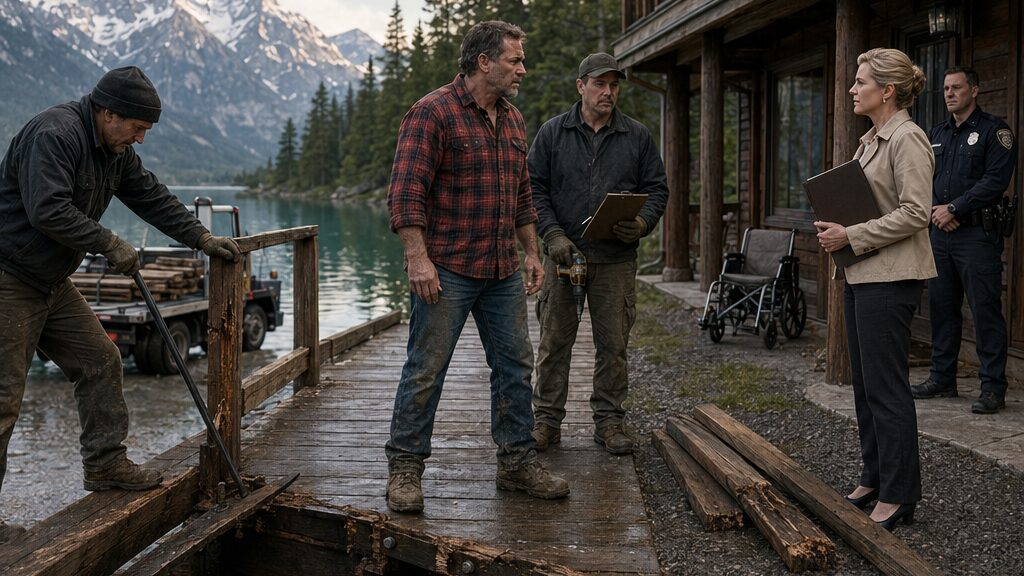
A pry bar shrieked against the new handrail post at the end of his dock, and one of the workers braced his boot against the ramp Robert had spent three nights rebuilding after the storm. Another worker stood beside a flatbed truck with two of Robert’s planks already stacked in the back, their fresh-cut ends still pale against the old gray boards.
Robert stopped with a bundle of cedar rails against his shoulder.
For one second, he did not move. The lake beyond the dock was bright and still, the mountains sharp in the morning light, but the dock looked wounded. A strip of ramp had been pulled loose. Four bolts stuck up where the handrail had been, shining like teeth.
Beside those bolts, under the porch overhang where Robert had left it out of the rain, Ruth’s folded transfer chair sat facing the water.
The crew supervisor turned at the sound of Robert’s boots on the gravel. He was a broad-shouldered man in a work jacket, holding a clipboard under one arm and a cordless drill in the other.
“You Robert Hall?” he asked.
Robert lowered the cedar rails carefully onto the gravel, not on the mud.
“You’re standing on my dock,” Robert said.
The supervisor glanced toward the truck. “Timothy Green. We were told this structure had to come out.”
“By who?”
“Association.”
Robert stepped onto the first board of the dock. It shifted under his weight where the ramp section had been loosened. He looked down at the exposed bolts, then at the worker holding the pry bar.
“Put that down.”
The worker looked at Timothy.
Timothy tightened his jaw. “Sir, we have an order.”
“No,” Robert said. “You have a clipboard.”
Timothy did not answer. The drill in his hand gave one small impatient whine as his finger brushed the trigger.
Robert pulled his phone from his shirt pocket and began recording. He kept his voice low enough that the workers had to listen.
“My name is Robert Hall. It is 7:18 in the morning. There is a crew on my property removing a safety repair from my dock. I have not received a court order, a county order, or written permission from anyone with authority over this parcel.”
Timothy’s eyes moved from the phone to the cabin.
“Sir, I don’t want trouble.”
“Then stop taking apart the rail.”
A car door slammed behind them.
Robert turned just as Sarah Taylor came down the gravel path in neat shoes that were already collecting pine needles. Her beige jacket looked too clean for the shoreline. In one hand she carried a white folder with a red HOA stamp across the front. Behind her, at the top of the path, a police cruiser sat with its lights off, the blue bar still catching morning sun.
The officer followed at a measured pace, one hand resting near his belt, his face set in the tired neutrality of someone called before breakfast to keep adults from doing something foolish.
Sarah did not look at the exposed bolts. She looked at Robert’s phone.
“Mr. Hall, you were notified that unauthorized shoreline construction had to cease.”
Robert kept recording. “No one notified me that a crew would be on my dock before breakfast.”
“You received violation correspondence.”
“I received two emails asking for clarification. I answered both.”
Sarah opened the folder as if the paper inside could steady the whole scene. “The board voted to enforce removal after you continued work without architectural approval.”
Robert glanced back at the ramp. The missing post had left the lower turn of the dock open toward the water. One bad step there, one panicked reach for a rail that was no longer there, and Ruth would go down before he could cross the room.
“This is not architectural work,” he said.
“It changes the exterior appearance of a regulated structure.”
“It keeps someone from falling into the lake.”
Sarah’s eyes flicked toward the cabin for the first time, but only for a breath. “If there is a special circumstance, that should have been disclosed through the proper accommodation process.”
Robert’s fingers tightened around the phone. He had written “storm repair to access ramp and rail.” He had not written Ruth’s diagnosis. He had not written that she could stand for nine seconds on a good morning and none on a bad one. He had not written that she had begged him not to make her body a board agenda item.
“I asked to repair what the storm broke,” he said.
“You asked to install additional railing and ramp materials on a dock within the association’s visual shoreline corridor.”
Robert gave a short laugh, but there was no humor in it. “That’s your phrase?”
“That is the phrase in the recorded violation.”
The officer stepped onto the gravel near the dock. “Let’s keep space between everybody.”
Robert looked at him. “Officer, are you here to enforce a court order?”
“I’m here to keep the peace.”
“Then the peace is easy. They stop removing my property until they show legal authority.”
Timothy shifted his weight. The worker with the pry bar lowered it halfway.
Sarah’s chin lifted. “The association has enforcement rights under the community covenants.”
Robert pointed to the old wooden sign at the head of the path, half-hidden by wet pine boughs. PRIVATE PROPERTY. NO COMMUNITY LAKE ACCESS.
“This parcel was here before your covenants,” he said.
“That is not what our map shows.”
“Then your map is wrong.”
Sarah closed the folder. “The board has already voted.”
There it was. Not a warning. Not a request. Not even a mistake that had wandered onto his land in a reflective vest. They had come while Ruth was still asleep, taken the rail into their hands, and decided the hearing after the damage had begun.
Robert stepped fully onto the dock and stood between Timothy’s crew and the remaining handrail. The loosened plank dipped. He steadied himself but did not look back.
“Mr. Hall,” Sarah said, her voice sharpening, “please step out of the work zone.”
“This is the only safe path from that cabin to the water.”
“Then you should have waited for approval before building it.”
“I rebuilt what the storm tore loose.”
“You expanded it.”
“I made it usable.”
Sarah looked to the officer. “This is exactly why I asked you to be present.”
The officer exhaled through his nose. “Mr. Hall, I can’t decide a property dispute on a dock.”
“I’m not asking you to. I’m asking whether you’re ordering me off my land.”
The officer did not answer quickly enough for Sarah.
She took one step closer, the notice folder pressed flat against her ribs. “If you keep standing there, the officer can remove you from the work zone.”
Robert looked past her, through the cabin window, where the curtain had moved.
Chapter 2: The Notice On The Door Came Too Late
The notice on the cabin door was so fresh that rainwater still sat in beads along the tape.
Robert stared at it while his phone recorded in his right hand. The white paper had been pressed crookedly against the glass beside the handle, one corner wrinkled where someone had smoothed it in a hurry. A thin line of water crawled from the upper strip of tape down the page, cutting through the HOA letterhead before dripping onto the porch boards.
Behind him, the truck idled near the dock with his planks in the bed.
Sarah stood three steps below the porch, watching him read. The officer remained at the edge of the gravel path. Timothy had sent one worker to gather loose tools, but the second stayed near the half-removed rail as if waiting for permission to continue.
Robert leaned closer to the notice.
“Posted today,” he said.
Sarah’s mouth tightened. “Notice was served.”
“What time?”
“The document speaks for itself.”
Robert turned the phone toward the wet tape. “The document is still drying.”
“Mr. Hall, you were aware of the violation.”
“I was aware you wanted to talk about the repair. That’s not the same as permission to send men onto my dock.”
Sarah’s gaze slid briefly toward the officer. “You refused to halt work after multiple communications.”
“I asked what authority you claimed over the dock. You didn’t answer.”
“We don’t litigate covenants over email.”
“No,” Robert said. “Apparently you litigate them with pry bars.”
The cabin door shifted behind the notice.
Robert turned fast and caught it before it opened wider than three inches. Ruth’s voice came through the gap, thin from sleep and effort.
“Robert?”
He lowered the phone. “Stay inside, Ma.”
“Is the rail gone?”
Sarah’s expression changed, but not enough. Not sympathy. Recognition, maybe. Calculation, more likely.
Robert kept his body between the door and the people outside. Through the gap he saw Ruth’s hand on the inside wall, her knuckles pale, her robe sleeve bunched at the wrist. She was trying not to lean too hard because she hated anyone seeing her need the wall.
“Not all of it,” he said softly.
“I heard tools.”
“I know. I’m handling it.”
Ruth’s breath came unevenly. “Don’t let them see me like this.”
That landed harder than Sarah’s threat.
Robert eased the door shut without latching it. He turned back, and his voice returned to the same controlled level.
“The person who uses that rail is inside. She cannot safely cross that dock without it.”
Sarah held the folder tighter. “Then you should submit the appropriate medical accommodation documentation.”
“I submitted a repair request.”
“For work that changed the existing structure.”
“For storm damage.”
“For additional materials.”
“For safety.”
The officer stepped closer to the notice, reading without touching. “Ma’am, does this say removal today?”
Sarah hesitated. “It references enforcement action.”
“Does it say a crew would begin removal before the homeowner was personally notified?”
“It states noncompliant structures are subject to removal.”
Robert looked at the officer. “Is that a yes?”
The officer’s face remained neutral, but his eyes moved to the wet tape. “This looks like a civil matter. I’m not going to order anybody to continue removing anything without clearer authority.”
Timothy heard that. His shoulders dropped a fraction.
Sarah did too.
“The board’s authority is clear,” she said.
“Then you should have no problem giving me the order in writing,” Robert said. “Not a wet notice. The order. The vote. The rule. The map. The jurisdiction. All of it.”
Sarah opened her folder, removed one page, and held it toward him.
Robert did not take it.
“Put it on the chair,” he said.
Her eyes narrowed.
“The chair?” she asked.
Robert pointed to Ruth’s folded transfer chair under the overhang.
For the first time that morning, Sarah had to walk past it. She could not pretend it was a stack of fishing gear or old patio furniture. Its gray wheels were locked. A folded blanket lay across the seat. A small canvas bag hung from one handle with a medical supply label Robert had turned inward.
Sarah placed the paper on the chair as if touching it might admit something.
Robert photographed it.
The document was not an order. It was a violation summary, citing exterior alteration, failure to obtain architectural approval, and potential shoreline liability. Near the bottom, in bold, it stated that costs of removal could be assessed to the owner.
Robert read the amount twice.
“You’re charging me for the crew you sent without notice?”
“Enforcement costs are recoverable under the covenants,” Sarah said.
“You don’t know if the covenants apply here.”
“Our association map includes this shoreline.”
“Your association map includes a lot of wishful thinking.”
The officer gave him a warning look, not hostile, just practical. Robert took one breath and let the sentence die where it was.
Sarah turned to Timothy. “The work is paused until the emergency review.”
Robert looked up. “What emergency review?”
“This afternoon. Four o’clock. Association office.”
“I have to get my mother across that dock before then.”
“You have the main cabin entrance.”
“The main entrance has stairs.”
Sarah frowned. “That is not in your file.”
Robert almost answered. He almost said Ruth could not manage the stairs since the fall, that the lake entrance was the only level transfer point from the bedroom side of the cabin, that she had built her mornings around crossing that dock to sit where the sunlight hit the water.
But he saw Ruth’s hand again in his mind, braced against the inside wall.
“It should have been enough,” he said, “that I told you it was a safety repair.”
Sarah slipped the folder under her arm. “Four o’clock. Bring whatever documentation you think is relevant. Until then, no work resumes.”
“Restore what your crew removed.”
“No.”
The word was not shouted. It was worse because it sounded practiced.
Robert looked to the officer.
The officer shook his head slightly. “I can note that you requested it.”
“Note that they refused.”
“I will.”
Sarah walked back toward the gravel path, already speaking quietly into her phone. The officer followed after telling both sides to keep distance. The two workers loaded their tools with visible relief.
Timothy stayed behind.
Robert crouched at the edge of the ramp and touched the empty bolt holes. The wood around them was splintered where the post had been forced sideways.
“You should go,” Robert said without looking up.
Timothy did not move.
“They told us it was abandoned expansion work,” he said quietly.
Robert turned his head.
Timothy’s eyes went to the cabin door, then back to the torn rail. “They said nobody was using it.”
Chapter 3: The Repair Request Was Filed Under Cosmetic Work
“The file does not mention medical access.”
The HOA clerk said it with the careful politeness of someone who had already decided the sentence was not her fault. She sat behind a narrow counter in the association office, a low building decorated with framed lake photographs and notices about approved stain colors. Between her hands lay Robert’s printed file, clipped at the top with a blue tab that read HALL — SHORELINE ALTERATION.
Robert stood on the other side of the counter with his weathered folder under one arm. His boots had left small half-moons of dried mud on the entry mat. He had wiped them twice before coming in.
“Read the original request,” he said.
The clerk glanced down. “Repair and reinforcement of dock access ramp and railing after storm damage.”
“Keep reading.”
“That’s the complete description in our system.”
“No. It isn’t.”
She tapped the keyboard and turned her monitor slightly, not enough for him to see everything, just enough to prove she was not inventing it. “That is what was logged.”
Robert opened his folder. The old leather hinge creaked the way it had for years. Inside were copies of tax records, dock permits, a faded survey folded into quarters, and the printed repair request he had driven to the office three weeks earlier when the online portal froze.
He laid his copy on the counter.
The clerk leaned forward.
At the bottom of his request, in his own square handwriting, was one sentence: Emergency access repair — call if unclear.
The clerk’s eyes paused there.
Robert watched her face change by almost nothing.
“That line isn’t in the system,” she said.
“I can see that.”
“It may have been scanned poorly.”
“It wasn’t scanned at all?”
“I didn’t process this one.”
“Who did?”
She looked toward the hallway behind her. “Applications go through the architectural committee inbox.”
“Who enters them?”
“It depends.”
Robert let that sit.
The clerk’s fingers returned to the keyboard. “Mr. Hall, I can give you a copy of the file as recorded, but I can’t change it before the review.”
“Can you print the activity log?”
“That requires board authorization.”
“Can Sarah authorize it?”
The clerk stopped typing.
Robert had his answer.
From the hallway, a printer began feeding paper with a dry clicking sound. A framed poster beside the counter read: COMMUNITY STANDARDS PROTECT EVERYONE. Robert looked at the word everyone until it lost shape.
He should have written more. He knew that now. He should have written Ruth’s name, Ruth’s therapist, Ruth’s fall, Ruth’s fear of stairs. He had chosen the smallest words because small words felt decent. Repair. Reinforcement. Storm damage. Access.
He had thought privacy was protection.
The clerk slid the recorded file copy toward him. “Your review is at four.”
“I need the board to know the request was incomplete in your system.”
“You can state that during the review.”
“After they already removed half the rail.”
The clerk had no answer for that. She folded her hands and looked over his shoulder toward the door, a silent invitation for the next person, though there was no one behind him.
Robert put both versions of the request into his folder and left without raising his voice.
The county records office sat twenty minutes away in a brick building near the old courthouse. He had not planned to go there before the board meeting. He had planned to fix the rail, make soup Ruth would pretend was not too salty, and maybe sand the new planks before the evening damp came in.
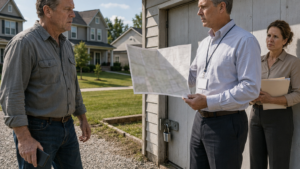
Instead, he stood beneath fluorescent lights while a records clerk rolled out a map so large it took up most of the counter.
“This parcel goes back before the association,” the clerk said, placing two paperweights on the curling corners. “Cabin tract, private lake frontage, dock easement noted here.”
Robert leaned over the map. The lake was drawn in thin blue lines, the shoreline shaped differently from the clean digital version Sarah had once emailed him. His dock sat on a narrow notch of land that looked almost like an afterthought unless you knew where to look.
“There,” he said.
The clerk nodded. “Original Hall parcel.”
“My mother’s family,” Robert said before he could stop himself.
“Association boundary is here.” The clerk traced a line with a pencil eraser. “Their common shoreline begins south of the cove.”
Robert stared at the gap between the line and his dock.
“How much south?”
“Enough that your dock isn’t where their map says it is.”
The words should have felt like victory. For a moment, they almost did. The old survey in his folder was not just family paper. It was a living edge, a line that Sarah’s folder had crossed without knowing or caring.
“Can I get certified copies?”
The clerk looked at the clock. “If the machine behaves.”
“It needs to behave.”
While the copies printed, Robert checked his phone. Three missed calls from the cabin. His chest tightened until he saw the text from Ruth.
I am fine. Don’t be stubborn in the wrong direction.
He almost smiled.
Then another message appeared from the HOA office.
Emergency review remains scheduled for 4:00 p.m. Continued noncompliance may result in further removal and assessment of costs.
Robert typed three different replies and deleted all of them.
The records clerk returned with stamped copies of the old survey, the parcel description, and a tax map showing the cove. “This may not settle an association dispute,” she warned. “Maps get interpreted. Easements get argued.”
“But they can’t just claim it because their map is newer.”
“No,” she said. “Newer doesn’t always mean right.”
He paid the fee and carried the documents to his truck. The folder was thicker now, heavier against his palm. He sat behind the wheel with the door open, looking at the certified seal on the top page.
He had wanted the deed to end it. He had wanted to walk into the meeting, place the survey down, and watch Sarah’s certainty fold.
But the clerk’s warning stayed with him. Maps get interpreted. Easements get argued.
And Ruth still could not cross the dock.
Back at the cabin, he parked near the porch and went first to the truck bed where Timothy’s crew had left nothing behind but sawdust and one bent screw. The transfer chair remained under the overhang, angled toward the missing rail. Ruth had not come outside.
Robert checked the door, the notice still taped there, now dry and stiff.
He carried the folder inside.
Ruth sat at the kitchen table with a mug in front of her she had not lifted. Her eyes went to the folder.
“You found something,” she said.
“I found the old line.”
“The lake line?”
He nodded.
“That should help.”
“It should.”
She heard the part he did not say. She always had.
Robert set the folder on the table and removed his copy of the repair request. He placed the HOA’s logged version beside it. Two pages that should have matched. Two truths, one with the most important sentence missing.
Ruth adjusted the blanket over her knees. “Maybe it was a mistake.”
“Maybe.”
“You don’t sound like you believe that.”
“I don’t know what I believe yet.”
She reached toward the paper, then stopped because the mug blocked her hand and moving it would take more strength than she wanted to spend in front of him. Robert moved the mug aside without comment.
Ruth read the sentence at the bottom of his copy.
Emergency access — call if unclear.
Her mouth pressed into a line. “I told you not to write more than that.”
“I know.”
“I didn’t want them talking about me.”
“I know.”
Outside, a boat motor growled somewhere across the cove, then faded.
Robert looked again at the HOA version. The missing line seemed louder than any argument Sarah had made on the dock.
He slipped both pages back into the folder for the meeting. As he did, the corner of his own copy caught against the metal clasp and flipped over.
On the back, in faint blue ink near the bottom, was a note he had forgotten writing after the clerk had told him the scanner was down.
Emergency access — call if unclear. Mother cannot use stairs.
Robert stared at the words.
Then he saw something else beneath them: a small square stamp from the HOA receiving desk, dated three weeks earlier.
They had received the full page.
The system had not merely missed his note.
Somebody had chosen not to include it.
Chapter 4: The Board Called It A Liability Problem
Robert walked into the boardroom and saw his dock on the wall.
Not the lake. Not the cabin. Not the old private-property sign at the path. Just the dock, enlarged on the projection screen until the half-removed rail looked like evidence from a crime scene. Someone had taken the photograph from an angle that hid the cabin door and Ruth’s transfer chair. Under the image, in red digital letters, were two words.
Violation Site.
Sarah Taylor sat at the center of the long table with a stack of folders aligned in front of her. Two other board members sat to her left, and Angela Perez sat to her right with a pen between her fingers, looking at the screen instead of at Sarah. A few neighbors had come, more curious than involved, taking the folding chairs at the back like they had arrived early for a disagreement they did not have to pay for.
Robert stayed by the door longer than he meant to.
The old survey and his repair request were in his folder. Ruth’s medical letter was in there too, sealed in an envelope she had not wanted opened.
Sarah looked up. “Mr. Hall, we’re ready.”
“Looks like you started without me.”
“This is an emergency enforcement review, not a trial.”
“Then why does it look like I’m the defendant?”
No one laughed. Sarah’s face did not move.
Robert took the chair at the end of the table. He placed his folder in front of him but kept one hand on it, flat, as if the paper might leave without permission.
Sarah clicked a remote. Another image appeared: the ramp, photographed after the storm, before Robert had finished the repair. The railing leaned at a bad angle. One plank was split. The lower edge had pulled from its brackets.
“This structure was altered without prior architectural approval,” Sarah said. “The association received notice of expanded ramp width, nonstandard handrail materials, and additional posts inconsistent with shoreline appearance guidelines.”
Robert opened his mouth, then closed it.
She clicked again. A page of the covenants appeared. The highlighted sentence glowed yellow.
“Exterior modifications visible from common waterline areas require approval before installation.”
“My dock isn’t on your common waterline,” Robert said.
“We’ll get to your map claim.”
“It’s not a claim.”
Sarah looked at him over the folder. “Mr. Hall, please let the board proceed.”
Angela’s pen stopped moving.
Robert leaned back, jaw tight. He had promised Ruth he would keep steady. He had not promised to let Sarah rename everything without challenge.
Sarah continued. “We are not unsympathetic to storm damage. But unapproved work creates liability. After the accident last season near the south cove, our insurer warned us in writing about unreviewed shoreline structures.”
A murmur passed through the back chairs.
Robert had heard about the accident. A guest at a rental unit had slipped on algae-coated steps on the common dock, broken a hip, and named the association in a claim before the family settled. He had not known Sarah was carrying that into his cove like a loaded tool.
Angela glanced toward Sarah. “Is that insurer letter in the packet?”
Sarah’s pause was short. “The board has reviewed it previously.”
“I’m asking if Mr. Hall has it.”
“It concerns association-wide exposure.”
“His dock is the subject of this review.”
Sarah’s fingers tightened around the remote. “We can provide a copy after legal review.”
Robert looked at Angela for the first time. She did not smile at him. That made her question feel more useful.
“I brought county records,” Robert said.
Sarah clicked the remote again before he could open the folder. Another slide: the association’s digital shoreline map, a clean green boundary line sweeping across the lake edge and curving neatly over Robert’s cove.
“Our map places the dock within the visual shoreline corridor,” she said.
Robert pulled out the certified county survey and laid it on the table. “Your map is wrong.”
One of the board members leaned forward. Sarah did not.
“This survey predates the association,” Robert said. “The dock is inside the original Hall parcel. The common shoreline starts south of the cove.”
Sarah’s mouth pressed thin. “Older documents often require interpretation.”
“So do newer mistakes.”
Angela reached for the survey. “May I?”
Robert slid it to her.
Sarah watched the paper cross the table as if it had been passed behind her back.
Angela unfolded it carefully. The old blue lines, certified stamp, and parcel description made the room quieter. Not convinced. Quieter.
“This should have been in the file,” Angela said.
“It was in my first response,” Robert said. “Along with my repair request.”
Sarah folded her hands. “The issue before us is not ownership alone. Even private structures that affect community insurance exposure may fall under review when visible from association property.”
Robert stared at her. There it was again, the slide sideways. When ownership weakened her, she shifted to liability. When liability weakened, she would shift to process. And under every word, Ruth’s rail remained in pieces.
“This is a repair,” he said. “Not an expansion.”
“Your recorded request did not state medical necessity.”
Robert removed two pages from his folder. His copy. Their logged copy. He placed them side by side.
“My submitted request did.”
Angela leaned closer.
Sarah’s face changed before she could stop it. Not much. Just enough that Robert saw she knew what was coming.
He pointed to the bottom of his copy. “Emergency access — call if unclear. Mother cannot use stairs. Received by your office three weeks ago.”
The room went still around the word mother.
Sarah’s eyes flicked toward the back row, then returned to Robert. “That note is not in the official digital file.”
“I noticed.”
“If you had a medical accommodation request, it should have been submitted using the correct form with supporting documentation.”
“I asked for a storm repair.”
“You changed the structure.”
“I made it safe.”
“For whom, specifically?” Sarah asked.
The sentence came out clean, procedural, almost gentle. That made it worse.
Robert felt the envelope in his folder like heat.
Ruth had signed the therapist letter with a hand that trembled by the third letter of her name. Then she had looked at him across the kitchen table and said, Don’t make them discuss me like siding color.
He looked at Sarah, then at Angela, then at the neighbors in the back pretending not to listen.
“My mother lives with me,” he said.
Sarah waited.
Robert stopped there.
Angela’s eyes lowered to the two repair requests. “Sarah, when was removal authorized?”
Sarah turned a page in her folder. “After continued noncompliance and failure to provide sufficient approval materials.”
“That’s not a time.”
“It was authorized after the response deadline passed.”
“Before this meeting was scheduled?”
Sarah did not answer at once.
Robert looked at Angela again. Her pen was moving now, not notes for show, but numbers, times, something she planned to return to.
Sarah cleared her throat. “The emergency review was set to confirm enforcement and determine next steps.”
“But the crew began removal this morning,” Angela said.
“Removal was paused.”
“After Mr. Hall stood in front of it.”
The room shifted. A neighbor in the back crossed his arms. One of the board members stared down at his packet.
Sarah’s confidence cracked so briefly that Robert almost missed it. Her eyes went not to him, but to the projected photo of the ramp. For an instant, she looked tired. Not sorry. Pressed.
Then she straightened.
“We are under a strict insurance review window,” she said. “If unapproved shoreline modifications remain unaddressed, the entire association may face increased premiums or cancellation. That affects every owner.”
“And my mother?” Robert asked.
Sarah’s eyes returned to him. “Then provide the proper medical proof.”
He opened the folder and touched the sealed envelope.
He could still keep Ruth out of it. He could argue map lines, stamps, timing, process. He could force them to admit they moved too fast and still never let a room full of people hear that Ruth could not cross six feet of boards without a rail.
He slid the envelope halfway out.
Then he stopped.
Sarah saw it.
“Mr. Hall,” she said, “without documentation, the board cannot treat this as anything other than an unauthorized alteration.”
Robert pushed the envelope back into the folder.
Angela’s expression tightened, but she did not rescue him.
“My mother’s medical details are not community property,” Robert said.
Sarah looked down at her papers. “Then the board must act on what is properly before it.”
The vote took less than three minutes.
Removal would remain paused until noon the next day. Robert was prohibited from resuming work. He was required to provide medical documentation and proof of lawful exemption. If he failed, removal could continue and costs would be assessed to him.
Robert gathered his papers slowly.
At the door, Angela stepped beside him. “Mr. Hall.”
He stopped.
She kept her voice low. “If you ask for a closed accommodation review, I can support that. But you have to ask.”
Robert looked through the boardroom window toward the dark line of the lake beyond the parking lot.
Behind him, Sarah said to the clerk, “Send the noon deadline in writing.”
By the time Robert reached his truck, the email was already on his phone.
Chapter 5: Ruth Refused To Become Their Evidence
Ruth made it halfway to the bedroom door before her hand missed the rail that was no longer there.
Robert saw the reach before he saw her face. Her fingers opened in the air where the dock-side grab rail had always been visible through the glass, a habit carried from years of crossing that threshold without thinking. Then her body remembered the missing support all at once. Her knees locked. Her shoulder hit the doorframe. The blanket around her waist slipped to one side.
“Don’t,” she said sharply, though Robert had not moved yet.
He stopped at the kitchen table with the sealed envelope in his hand.
Ruth stood frozen in the doorway between the bedroom and the main room, one palm flat against the wall, the other gripping the door trim so hard the skin went white. Beyond her, through the glass, the dock waited in the dark with a gap in its rail.
“I’m not helping unless you ask,” Robert said.
Her jaw moved once. Pride first. Breath second.
“Chair,” she said.
He brought the transfer chair from the corner, set the brakes, and turned it at the angle she preferred. Not too close. Never too close unless she asked. Ruth hated feeling crowded by care.
She lowered herself into it with a controlled drop that made Robert look away before she could catch him watching.
“You went to the meeting,” she said.
“Yes.”
“And?”
He placed the envelope on the table.
Her eyes found it.
“They want proof by noon.”
Ruth gave a short, dry sound. “Of what? That I am inconvenient?”
“Of medical necessity.”
“Same thing to people with forms.”
Robert pulled out a chair and sat across from her. The cabin felt smaller at night, full of practical sounds: refrigerator hum, pine boards settling, lake water touching dock posts below the window. On the table between them lay his folder, the board notice, the two versions of the repair request, and the sealed therapist letter Ruth had allowed him to carry but not open in public.
“They started removal before the hearing,” he said. “Angela noticed.”
“Angela?”
“Board member.”
“Do we like her?”
“We don’t know yet.”
Ruth looked toward the window. “I heard the drill this morning.”
“I know.”
“I thought maybe if I stayed quiet, they’d go away.”
Robert did not answer.
She turned back. “You thought that too.”
That landed where it belonged.
He folded his hands, seeing the half-sentence on his request again. Emergency access. Mother cannot use stairs. He had believed that was enough truth to avoid saying the rest. Enough to be decent. Enough to protect her.
“It was my mistake,” he said.
“No. It was my instruction.”
“I followed it because I wanted to.”
Ruth’s face softened, then hardened again before the softness could become pity. “Don’t do that. Don’t make me harmless just because I’m sitting down.”
“I’m not.”
“You are when you take all the blame. I told you not to write about me. I told you not to call the therapist unless they forced it. I told you I didn’t want those people using words like accommodation while looking at me like a project.”
Robert leaned back. “And now they’re using words like violation while taking apart the only safe way out.”
Ruth closed her eyes.
For a moment, he thought she was angry. Then he saw her hand move under the blanket and press lightly above her knee.
“You’re hurting,” he said.
“I am old enough to hurt without a report being filed.”
“Ma.”
“Don’t Ma me.”
He stood, not because he needed to, but because sitting made him feel trapped. He went to the sink and looked out at the dock. In the porch light, the missing section seemed larger than it had in daylight. The empty bolt holes made little black dots down the edge of the ramp.
“When did you bruise your leg?” he asked.
Ruth did not answer.
He turned.
She was watching him now, expression flat in the way that meant she had decided whether to lie and hated all available options.
“When the storm loosened the rail,” she said.
“You told me you slipped against the chair.”
“I did.”
“On the dock?”
“Yes.”
Robert gripped the counter edge.
“You fell?”
“I caught myself.”
“On what?”
“The rail.”
The rail they had taken.
He saw it too clearly: Ruth alone at dusk, one hand on the loosened post, the lake dark beside her, refusing to call for him because he had gone into town for supplies and she had wanted one look at the water before bed.
“How long were you out there?” he asked.
“Long enough to decide not to tell you.”
“Why?”
“Because you would look exactly like that.”
He released the counter.
Ruth pulled the blanket higher, but not before he saw the yellow-green bruise above her knee, wide as his palm and fading badly at the edges. There was another near her shin. Older. Hidden under wool socks and carefully arranged blankets.
He crossed the room before he could stop himself.
She lifted one hand. “No.”
He stopped again.
The refusal hurt more than if she had let him kneel.
“I can’t keep guessing what you need,” he said.
“I need the rail,” she said. “I don’t need a room of strangers discussing why.”
“They’re going to continue removal.”
“Then use the survey.”
“It may not be enough.”
“Use the mistake in the file.”
“It may not be enough.”
“Then what do you want from me?”
The question shook, and that scared him more than her anger.
Robert sat down slowly. “Permission to ask for a closed review. Not the open meeting. Not neighbors. Not a screen with your name on it. Angela said there may be a way.”
Ruth stared at the envelope.
“What would they see?”
“The therapist’s letter. Maybe the board officers. Maybe only the accommodation committee, if they have one. I don’t know. I’ll ask before I give them anything.”
“And Sarah?”
“She’s the president.”
“That means yes.”
Robert did not answer.
Ruth rolled the chair toward the window with small, efficient pushes. She stopped where she could see the dock but not the missing rail unless she leaned. For a while she said nothing.
“This cabin was the first place I came after your father died,” she said.
Robert looked up.
“You remember?”
“You brought groceries and pretended not to check whether I was eating.”
“I was checking.”
“I knew.” A faint smile touched her mouth, then left. “Everyone wanted me closer to town. Closer to help. Closer to people who could watch me fall apart politely. But here, nobody knocked unless I invited them. The lake didn’t ask me how I was managing.”
Robert swallowed.
“This is the last place,” she said, “where I don’t feel measured.”
The words went into the room and stayed there.
Robert looked at the letter. “Then I won’t let them measure you.”
“You may have to.”
“No. I have to show them enough. Not everything.”
Ruth turned from the window. Her eyes were wet, but her voice was steady. “If you hand them that letter, you ask for limits first. You don’t let them make copies for every folder. You don’t let them read it out loud. You don’t let Sarah use my name in a room full of neighbors.”
“I won’t.”
“And Robert?”
“Yes.”
“You don’t stand there like a martyr. I asked for silence because I was ashamed. That doesn’t mean you have to carry the shame for me.”
He looked down.
His phone lay beside the folder. Angela’s email address was on the board notice. He typed the message with both thumbs, deleted the first line because it sounded too angry, deleted the second because it sounded too small, and finally wrote only what mattered.
I am requesting a closed medical accommodation review before noon. I will provide limited documentation under privacy restrictions. The dock repair is necessary for safe access.
He sent it before he could ask Ruth to approve every word.
For ten seconds, nothing happened.
Then his phone lit again.
Angela’s reply contained one sentence.
Come to the county records office at 8:30 before the review, and bring the old survey.
Chapter 6: The Old Survey Changed The Shoreline
“Your dock isn’t where their map says it is.”
The county records clerk said it while standing over three maps spread across the counter, each one showing a different version of the same lake. On Sarah’s association map, Robert’s cove belonged to the visual shoreline corridor. On the county tax map, the boundary bent south before it reached his dock. On the oldest survey, the one with his mother’s family name written in fading ink, the dock sat inside a notch of private frontage that looked small until someone tried to take it.
Angela Perez stood beside Robert, still wearing her work blouse under a rain jacket, her phone in one hand and a folder in the other. She had not said much since arriving. That was fine with Robert. He trusted quiet more than quick sympathy.
The clerk placed a ruler along the old parcel line. “The association overlay appears to have smoothed the cove.”
“Smoothed?” Robert said.
“Digital maps sometimes simplify irregular boundaries.”
Angela looked at the association printout. “Simplified it onto his dock.”
The clerk did not smile. “That is one way to describe the result.”
Robert stared at the neat green line Sarah had projected on the boardroom wall. It had looked official because it was clean. The older line looked human, imperfect, following rocks and coves and old decisions made by people who had walked the shore before the association existed.
“Can you certify that comparison?” Angela asked.
“I can certify county records. I cannot interpret association authority.”
“I don’t need you to interpret,” Angela said. “I need the records to show what the county shows.”
The clerk nodded and gathered the pages.
Robert looked at Angela. “Why are you here?”
She kept her eyes on the maps. “Because Sarah sent the board packet at midnight.”
“What was in it?”
“Photos, violation language, the insurance memo, and a recommendation to resume removal at noon if you did not release full medical documentation.”
Robert felt his shoulders go still. “Full?”
“That was the word.”
“Ruth agreed to limited documentation.”
“I know. That’s why I asked you to come here first.”
The printer began its dry clicking in the corner. Angela lowered her voice.
“Robert, I need to ask you something directly. Did you tell Sarah your mother couldn’t use the stairs before today?”
He took out his copy of the repair request and turned it over. The stamped note looked smaller in the fluorescent light, but no less real.
Angela read it. Her face changed.
“May I photograph this?”
“No.”
She accepted the refusal without offense. “May I state that I saw it?”
“At the closed review.”
She nodded. “That’s fair.”
He studied her then. “You believed Sarah last night.”
“I believed the file.”
“That’s not the same thing?”
“It should be. That’s the problem.”
The clerk returned with certified copies. Robert paid for them while Angela’s phone buzzed twice. She read the screen, and her mouth tightened.
“Sarah wants the review moved to the main room.”
“No.”
“I already said no.”
Robert slipped the maps into his folder. “Does she listen to you?”
“Not usually the first time.”
The emergency review took place in a smaller conference room at the association office. No neighbor witnesses. No projector. No folding chairs. Just Sarah at one end of the table, Angela across from her, another board member on the side, Robert near the door, and the officer from the morning standing outside in the hallway after being asked to remain available.
Sarah looked at the closed folder in Robert’s hands. “Do you have the documentation?”
“I have limited medical documentation to be reviewed under privacy restrictions.”
“We cannot evaluate what we cannot retain.”
“You can evaluate it without making my mother a permanent attachment to a violation file.”
Sarah’s eyes narrowed. “That is not how records work.”
Angela interjected. “It can be entered as reviewed confidentially for accommodation purposes. We don’t need copies distributed in the enforcement packet.”
Sarah turned to her. “That exposes the association.”
“What exposes us,” Angela said, “is removing an access structure before reviewing an accommodation.”
Silence struck the room hard.
Robert set the certified survey on the table. “And before confirming whether the dock was under your authority.”
Sarah did not touch the document.
“I am not debating ownership at this table,” she said. “The association has relied on the current shoreline map for years.”
“Then you’ve relied on it wrong.”
Her eyes flashed. “Mr. Hall, the entire community is under insurance review because of unapproved lakefront hazards. You may think your parcel exists in isolation, but one injury, one claim, one report of unauthorized structures can affect every owner’s premium.”
“There was already an injury,” Robert said.
Sarah stopped.
Angela looked up.
Robert leaned forward. “At my dock. My mother caught herself on the rail your crew took apart.”
Sarah’s face changed, but again not enough to become admission. “Was that documented?”
“No. She was ashamed.”
“That is exactly why we require documentation.”
“That is why I repaired the rail.”
Angela placed one hand flat on the table. “Sarah, when did you authorize the crew?”
Sarah’s answer came too fast. “After the deadline passed.”
“What deadline?”
“The response deadline in the violation correspondence.”
“The notice posted yesterday morning?”
“The prior email exchange.”
“Those emails requested clarification. They did not warn of removal today.”
Sarah’s jaw tightened. “The board discussed enforcement.”
“Did the board vote to begin removal before the emergency review?”
Sarah looked toward the other board member, who suddenly found interest in the edge of his packet.
Robert watched the room rearrange itself around the absence of an answer.
Sarah opened her folder. “I authorized temporary abatement because the insurance adjuster is scheduled to inspect shoreline compliance this week.”
There it was. Not just rules. Timing. Pressure. A deadline Sarah had not named on the dock, or in the wet notice, or in the boardroom until pushed.
Angela’s voice stayed quiet. “You authorized removal to create proof of enforcement before the adjuster came.”
“I authorized removal of a noncompliant structure.”
“Before confirming the medical note.”
“It was not in the file.”
Robert took out the stamped back page and laid it on the table.
Sarah looked at it.
No one spoke.
Her eyes moved to the receiving stamp, the handwritten note, the line about Ruth not using stairs. The paper did what Robert had not wanted Ruth to do. It sat there, plain and exposed.
“That page was not entered,” Sarah said.
“No,” Robert said. “It wasn’t.”
“I did not personally process this application.”
“I didn’t say you did.”
But he saw something cross her face then that was not innocence. It was calculation under strain. She had not processed it, maybe. But she had benefited from the absence. She had pushed the file forward as if the absence proved something.
Angela looked at Sarah. “We need the activity log.”
Sarah’s voice chilled. “That requires board authorization.”
“Then I’m requesting it as a board member.”
Robert opened the sealed envelope. He removed the therapist’s letter, folded it so only the necessary paragraph showed, and slid it toward Angela first.
“Limited review,” he said. “No copies without my mother’s written consent.”
Angela read. Her expression softened in a way Robert almost resented because it meant the words were doing what Ruth feared they would do. Turning her body into evidence.
She passed it to the other board member. He read quickly, then looked away.
Sarah took it last. Her gaze moved down the page, stopped at the transfer requirement, the fall risk, the notation that the dock-side away.
Sarah took it last. Her gaze moved down the page, stopped entrance was the safest level access point from Ruth’s bedroom.
For once, she did not speak immediately.
Then she placed the letter down. “Even if the accommodation is valid, any repair must meet safety code. We cannot allow work to resume without inspection.”
Robert looked at the ceiling for half a second.
Angela’s pen hit the table. “Sarah.”
“No,” Robert said.
Both women looked at him.
“No, she’s right about inspection,” he said.
Sarah seemed surprised enough to blink.
Robert touched the folded survey, then the therapist letter. “I’ve been arguing ownership because it was easier than saying why the rail mattered. That’s on me. But don’t use inspection as another way to stall. Send someone today. Let them see what your crew left.”
Angela looked toward the hallway. “The physical therapist is available?”
Robert nodded. “She’s on call until noon. She knows the dock.”
Sarah gathered her papers, but her hand was not as steady as before. “An association representative must be present.”
“Fine,” Robert said.
“And the work remains paused until assessment.”
“The removal remains paused too.”
Angela looked at Sarah. “Agreed?”
Sarah’s answer came through tight teeth. “Agreed pending inspection.”
The door opened before anyone could stand.
The physical therapist stood in the hallway holding a small black bag, her eyes moving from Robert’s face to the folder in his hands.
“I’m sorry to interrupt,” she said. “I was told there was a missing ramp I needed to see before I could put my name on anything.”
Chapter 7: The Empty Bolts Said More Than The Notice
The physical therapist put one foot on the dock and stopped before her weight fully settled.
“Don’t bring her out here,” she said.
Robert stood behind her with his hands at his sides. Angela was a few steps back on the gravel. Sarah stood near the private-property sign with her folder held tight against her body, as if the papers could keep the scene from becoming what it already was.
The therapist looked down at the ramp. At the missing handrail. At the splintered post base. At the dark empty bolt holes where Robert’s new rail had been.
“This is no longer safe for transfer,” she said.
Sarah’s face hardened. “It was under review before the removal was paused.”
The therapist looked at her. “I’m not reviewing your process. I’m reviewing whether a person with limited mobility can safely use this access point right now. The answer is no.”
The lake made a soft sound beneath the boards.
Robert did not look at Sarah. He looked at the bolts. In daylight, they were worse than they had been in the morning. Not because they looked dramatic, but because they looked ordinary. Four empty holes. A strip of torn wood. A simple absence that could decide whether Ruth reached the water or stayed behind glass.
The therapist crouched carefully, touched the side of the loosened ramp, and shook her head. “The rail was carrying transfer support?”
“Yes,” Robert said.
“Height?”
“Thirty-six inches. Matched her grip.”
“Anchored into the stringer?”
“Yes.”
“And this lower turn is the route from the bedroom-side entrance?”
“Yes.”
Sarah’s pen scratched against paper. “For the record, this was not an approved finished installation.”
Robert turned then. “For the record, your crew removed the part she needed before anyone inspected it.”
Sarah’s jaw worked once.
Angela stepped closer to the dock, her eyes on the exposed holes. “The assessment needs to note the condition before and after removal.”
The therapist stood. “I can note what I see now and what I previously recommended.”
Sarah looked up sharply. “Previously?”
Robert felt that word reach him at the same moment it reached her.
The therapist opened her black bag and removed a folded copy from a clipboard. “I recommended a stable rail and graded transition at this entrance after Ruth’s fall risk increased. That was six weeks ago.”
Sarah looked at Robert. “That recommendation was not submitted to the association.”
“No,” Robert said. “It was submitted to me.”
“And you began work without filing it?”
“I filed a storm repair.”
“With no attached medical recommendation.”
Robert looked toward the cabin window. The curtain moved, barely.
“My mother did not want her medical condition passed around as a neighborhood document,” he said.
Sarah’s voice was quieter now, but not softer. “Then you left the board with incomplete information.”
Robert took the hit because part of it was true.
“Yes,” he said. “I did.”
Angela glanced at him.
Sarah seemed briefly wrong-footed by the admission.
Robert stepped down from the dock to the gravel, leaving the exposed bolts between them all. “But incomplete information is not permission to send a crew before a hearing. It is not permission to tape a notice to my door after the pry bars are already out. It is not permission to remove a safety rail and then ask whether somebody needed it.”
The therapist looked toward the cabin. “Is Ruth willing to speak with me?”
Robert hesitated.
The bedroom-side door opened before he answered.
Ruth stood in the doorway with one hand on the interior frame and the other on the transfer chair Robert had left just inside. She wore a blue cardigan over her robe, her hair combed back, her chin lifted. She had taken the time to look like herself, which made the effort visible.
Robert moved instinctively.
Ruth’s eyes cut to him.
He stopped.
The therapist went still. Angela lowered her papers. Even Sarah did not speak.
Ruth looked past all of them to the dock, to the place where the rail had been. Her eyes lingered there, not on the people.
“So that’s what it looks like now,” she said.
Robert could hear the breath under her words.
The therapist stepped toward the doorway, keeping distance. “You don’t need to come out.”
“I know.”
“Would you like me to make a statement for the board?”
Ruth’s mouth tightened. “I would like everyone to stop making statements around me.”
No one answered.
She looked at Sarah then. “You’re Sarah Taylor?”
Sarah straightened. “Yes.”
“You sent the crew?”
“I authorized enforcement of an unapproved structure under the information available at the time.”
Ruth nodded once, as if Sarah had answered a different question and failed the easier one. “Did the information available at the time include my son’s note that I cannot use stairs?”
Sarah did not answer quickly.
Angela’s gaze sharpened.
Robert felt something in the air shift. Ruth had not raised her voice. She had not asked for sympathy. She had simply chosen the narrowest truth and placed it where no one else could move it.
“That note was not in the digital file,” Sarah said.
“But it existed.”
Sarah looked at the folder in Robert’s hand. “Apparently.”
Ruth’s hand tightened on the chair. “I need the rail. I don’t need pity.”
The words came out clean and hard.
Robert looked at her, and something in his chest loosened painfully. He had spent weeks trying to protect her from being seen. She had just shown him the difference between being exposed and speaking.
The therapist nodded. “That is enough for my functional statement.”
Sarah looked toward the dock again. The exposed holes had become more than damage now. They were a sentence she could not edit. For the first time, she seemed to see the route as Ruth would see it: cabin door, chair, threshold, sloped boards, missing grip, water waiting beside the lower turn.
Angela stepped beside Sarah. “We need to reverse the removal order.”
Sarah’s eyes flashed. “We need to manage risk.”
“This is the risk.”
“The insurer is inspecting shoreline compliance tomorrow morning.”
Robert looked at her. There it was, no longer tucked behind covenant language.
“That’s why you rushed it,” he said.
Sarah exhaled sharply. “You think I wanted a crew out here at seven in the morning? You think I enjoy this? If the carrier decides we’re ignoring unapproved structures after last year’s claim, every owner pays for it. Some can’t. People on fixed incomes, people who barely managed this year’s dues increase. If the policy is canceled, the lenders start asking questions. This is not just about your dock.”
“No,” Robert said. “It’s about whether you get to make my mother unsafe to make your paperwork look clean.”
Sarah’s face flushed, but she did not deny it.
Angela closed her folder. “We are calling an emergency vote.”
Sarah turned on her. “You can’t call a vote here.”
“I can request one, and I am. Removal order suspended pending accommodation review, materials returned, temporary rail authorized today if the therapist signs off, and full board review of the shoreline map and activity log.”
“The board will not appreciate being pressured in the field.”
“The field,” Angela said, looking at the dock, “is where the damage is.”
The therapist began writing on her form, bracing the clipboard against her bag. Timothy’s truck came slowly down the road then, not the flatbed from morning, but a pickup. He stopped near the path and got out, cap in his hands.
Sarah’s face closed again. “Why is he here?”
Timothy looked at Robert before answering. “I brought back the loose fasteners. Figured they belonged here until this got sorted.”
He lifted a small box from the passenger seat. Inside were screws, bolts, and two brackets still marked with Robert’s pencil lines.
Robert took the box.
Timothy lowered his voice. “I also have the work text. It says remove abandoned nonmedical expansion before adjuster walkthrough.”
Sarah’s head snapped toward him.
Angela held out her hand. “I need to see that.”
Timothy looked at Sarah, then at Ruth in the doorway, then at the holes in the dock.
He handed Angela his phone.
Angela read the message once. Then again. Her expression did not change, but her voice did.
“I am calling the board now.”
Sarah said her name, sharp and warning.
Angela was already dialing.
Chapter 8: He Rebuilt The Dock Without Raising His Voice
Timothy unloaded the same planks his crew had taken.
He carried them one at a time from the flatbed to the dock, setting each board on the gravel instead of dropping it into the mud. The pale ends were scuffed now. One board had a dark scrape from the truck bed. Robert noticed each mark and said nothing.
The morning was clear. Two days had passed since Angela called the emergency vote from the lakeshore. Two days of emails, revised language, a temporary access authorization, one hurried inspection, and an activity log that showed the removal order had gone out before the posted notice. The association did not call it wrongdoing in the written decision. They called it a procedural deficiency.
Robert had read the phrase twice and set the paper aside.
Procedural deficiency had taken the rail out of Ruth’s hand.
Timothy placed the final plank beside him. “Where do you want to start?”
Robert looked at the empty bolt holes. “Where they stopped.”
Timothy nodded.
The crew worked differently this time. No idling truck near the path. No pry bar biting wood. No folder-waving audience. Just measured cuts, stainless bolts, washers set cleanly, a temporary support clamped in place while Robert checked the line against the old pencil marks.
Angela arrived midmorning with a rolled document under one arm and a coffee she forgot to drink.
“Board approved the emergency accommodation policy revision,” she said.
Robert kept the drill in his hand. “Temporary or permanent?”
“Permanent procedure. Emergency safety repairs can be stabilized immediately if notice is given within forty-eight hours. Accommodation documents go to a restricted file. No open-meeting disclosure without written consent.”
Robert looked at her then.
Angela handed him the document. “I said I’d bring it when it was more than a promise.”
He read the first page slowly. He had learned not to trust headings. Beneath the formal language were the details he had insisted on before signing anything: no removal before review when medical access was asserted; no distribution of medical letters in enforcement packets; field inspection before physical abatement; property boundary review required when disputed.
At the bottom, Sarah Taylor’s signature sat above Angela’s.
“Where’s the withdrawal?” Robert asked.
Angela pulled a second paper from the roll.
Violation withdrawn. Removal costs waived. Materials returned. Repair approved subject to the inspected handrail height and non-slip surface.
Robert folded both papers and slid them into his old folder beside the survey. “Thank you.”
Angela seemed to understand the limit of the words. “I should have asked more questions earlier.”
“Yes,” Robert said.
She absorbed that without flinching. “I know.”
Near the truck, Timothy showed one of the workers how to set the bracket without splitting the edge. The worker nodded, quieter than he had been the first morning.
Sarah came down the path just before noon.
She wore a dark jacket this time, not beige. The heels were gone, replaced by flat shoes more suited to gravel. She carried one folder, not a stack. When Timothy saw her, his drill slowed. Robert kept tightening the bolt in front of him until the washer seated flush.
Sarah stopped at the head of the dock.
“Mr. Hall.”
Robert set the drill down.
She stepped no farther without asking. That was something, though not everything.
“I have the final signed copy,” she said.
“Angela brought it.”
Sarah looked at Angela, then back at Robert. “Then I won’t repeat it.”
Silence moved between them with the lake air.
Robert waited.
Sarah’s folder edge bent slightly under her fingers. “The removal should not have begun before the review.”
“No,” Robert said. “It shouldn’t have.”
“The file was incomplete.”
“The file was made incomplete.”
Her face tightened. “The activity log is being reviewed.”
“That’s not an answer.”
“No,” she said. “It isn’t.”
Angela looked down at her coffee.
Sarah drew a breath. “I was trying to prevent a larger problem for the association.”
“You created one in my doorway.”
Her eyes went toward the cabin. The bedroom-side door was closed, but the curtain had shifted. Ruth was watching. Robert knew without turning.
Sarah lowered her voice. “I saw her standing there.”
Robert said nothing.
“I did not understand the layout.”
“You didn’t come to understand it. You came to remove it.”
That one reached her. He saw it, and he did not soften the sentence to make it easier.
Sarah opened her folder and removed a paper. “This confirms the violation withdrawal and the approval conditions.”
“I have it.”
“This copy is for Ruth Wilson, if she wants her own.”
Robert did not take it immediately.
Sarah held it out without stepping closer. No speech. No performance. No request to be forgiven in front of witnesses.
Robert took the paper.
“I’ll give it to her,” he said.
Sarah nodded once. “The insurer will inspect the common shoreline tomorrow. Your cove has been removed from that map pending legal review.”
“My cove was never on it.”
“Pending correction,” Sarah said.
It was not an apology. It was also not nothing.
Robert turned back to the rail.
By late afternoon, the handrail stood again. Not pretty in the way the association liked things to be pretty. Strong. Smooth where Ruth’s palm would slide. Anchored where the therapist had measured. The replacement plank covered the worst of the torn wood, but two old bolt marks remained visible beside it, dark circles the stain would not fully hide.
Robert decided to leave them.
Ruth came out when the tools were packed but before the sun dropped behind the trees. She had changed into her green sweater, the one she wore when she wanted people to know she had chosen the day instead of been carried through it. Robert brought the transfer chair to the door, set the brakes, and stepped back.
“You hover like a nervous waiter,” she said.
“I’m at least a nervous owner.”
“Of the lake, apparently.”
He smiled despite himself. “Of the cove. The lake can keep its own counsel.”
She placed one hand on the restored rail.
For a moment, she did not move. Her fingers tested the wood, curling around the smooth line Robert had sanded twice. Her thumb crossed one of the new screw heads. She looked at the path ahead, not at the people behind her.
Angela stood near the gravel with her papers held against her chest. Timothy waited by the truck. Sarah remained farther back, close enough to witness, too far to intrude.
Ruth pushed herself up.
Robert took half a step.
She cut him a look.
He stopped.
She shifted her weight to the rail, then to the first board, then the next. The therapist had told her not to rush, and Ruth obeyed in the annoyed way of someone who had decided obedience was faster than argument. At the lower turn, where the rail had been missing, she paused. Her hand tightened.
Robert stood beside her, close enough to catch, far enough not to claim the crossing.
“You all right?” he asked.
“No,” she said.
He looked at her.
She kept her eyes on the water. “But I am here.”
They continued to the end of the dock.
The lake opened around them, turquoise under the late light, the mountains holding their snow like a distant promise. Ruth sat on the bench Robert had left bolted to the inner side of the dock. She rested both hands on the rail, not because she had to now, but because she could.
Behind them, Sarah spoke quietly to Angela, then walked back up the path alone.
Robert did not watch her go.
Ruth looked at the folded paper he had brought for her and placed beside the bench.
“That mine?”
“Violation withdrawal. Approval. Policy change.”
“Does it say I’m a public hazard?”
“No.”
“Good.”
The smallest smile touched her mouth.
Robert sat beside her, the old survey folded in his jacket pocket. For weeks, he had thought the paper would be the thing that proved everything. The line on the map. The old parcel. The private cove. But paper had only drawn the edge of ownership. It had not shown what the rail meant when Ruth’s hand reached for it.
At the path entrance, the old private-property sign still hung crooked between two pines.
The next morning, Robert added a smaller sign beneath it, printed from the association office and laminated by Angela before anyone could change their mind.
Emergency access repair approved. Do not remove without accommodation review.
It was not beautiful. It was not the kind of sign anyone would put in a lake brochure.
But when Ruth crossed the dock that afternoon and placed her hand on the rail without searching for what was missing, Robert left the sign