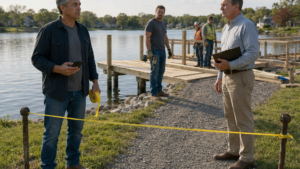
The Foggy Marina Dock Where The Service Animal Statute Stood Unbroken
CHAPTER 1: THE COLD CLATTER ON SLIP FORTY-TWO
The glacial mist rolling off the dark surface of Lake Pend Oreille was cold enough to numb bone, drifting in thick, ghostlike curtains through the towering western red cedars along the Sandpoint shoreline. At thirty-six degrees, the morning air smelled of wet cedar heartwood, decaying tamarack needles, and the clean, mineral chill of deep mountain water. The timber piers of the municipal marina groaned gently against their heavy pilings as the predawn swell rocked the moored sloops and fishing trawlers. Overhead, the aluminum halyards of forty sailboats clinked in an irregular, metallic chorus against their hollow masts.
Edith Calloway walked slowly down the damp wood of Dock C, her steps quiet, steady, and unhurried. She was seventy-four years old, a retired alpine botanical curator who had spent forty seasons documenting subalpine plant ecosystems for the University of Washington. She wore a heavy quilted navy wool coat over a thick cream-colored turtleneck sweater, dark wool trousers, and sturdy leather walking boots with deep rubber treads. Around her neck was a soft Scottish tartan scarf, and on her shoulder hung a canvas floral tote bag.
Walking at her left heel was Barnaby, a six-year-old English golden spaniel with a lustrous honey-colored coat and soulful, vigilant amber eyes. Barnaby wore a snug, crimson working harness equipped with a rigid leather guide handle and two embroidered patches declaring his official status: MEDICAL ALERT SERVICE CANINE — DO NOT PET. Around his chest, a specialized biometric sensor collar synchronized with the miniature cardiac monitor resting beneath Edith’s sweater, calibrated to detect subtle biochemical shifts in sweat salinity and pulse variability caused by her mild ventricular arrhythmia.
A sudden, violent metallic impact made the weathered dock shudder.
An anodized aluminum citation binder was slammed hard onto the flat top of a heavy timber mooring piling just three feet in front of Edith. The sudden concussive crack echoed sharply across the water, startling a flock of roosting western gulls into the gray mist with harsh, rasping shrieks.
Ranger Todd Meachum blocked the narrow wooden walkway, his legs spread wide and his thumbs hooked into the tactical nylon belt supporting his radio, pepper spray, and heavy Maglite. He was thirty-four years old, lean and angular, with high, sharp cheekbones and a narrow jaw set in an expression of rigid, aggressive self-importance. His official khaki Department of Parks and Recreation uniform was pressed with razor creases, and an oversized bronze state ranger star was pinned with military precision above his left pocket. In his right hand, he held a stainless-steel citation stylus, tapping the metal barrel against his clipboard with rapid, impatient clicks.
“Marina regulations are crystal clear, ma’am,” Meachum barked, his voice grating and nasal, cutting through the damp stillness with practiced arrogance. “Bonner County code chapter seventeen, section four. Domestic animals are strictly prohibited on state-adjacent marina walkways between October first and May first. Uncontrolled pet in a commercial marine slipway. That’s an immediate two-hundred-and-fifty-dollar administrative fine.”
Edith stopped. Barnaby immediately ceased walking, pivoting smoothly to sit squarely beside her left boot, his chin resting gently against her knee in a trained protective posture. Edith looked at the young ranger through her wire-rimmed glasses, her soft blue eyes utterly devoid of fear or annoyance. She reached down with a gloved hand and gently scratched Barnaby behind his silky ears.
“Good morning, Ranger Meachum,” Edith said, her voice calm, melodious, and carrying the unshakeable weight of an educator who had spent a lifetime teaching unruly adolescents. “Barnaby is not an uncontrolled pet. He is a fully certified medical alert service animal operating under federal statutory authorization. He is on a six-foot braided nylon lead, and he is currently performing active medical monitoring.”
Meachum threw his head back, letting out a sharp, mocking snort that made the edges of his thin mustache twitch. He unclipped his stylus and clicked it three times against his teeth.
“Sure he is, lady,” Meachum sneered, leaning down until his mirrored sunglasses reflected the gray expanse of the lake. “Everyone walking down these docks has a magic story. Half the summer tourists buy a twenty-dollar red vest off the internet and think it gives them a free pass to ignore municipal park ordinances. In this marina, state water jurisdiction supersedes your pet tricks. You have thirty seconds to turn around, or I will impound this dog with county animal control and cite you for non-compliance with a lawful administrative order.”
Edith did not shift her weight, and she did not raise her voice. With slow, deliberate grace, she reached her right hand into the open top of her floral canvas tote bag.
“Don’t bother digging for excuses or forged internet certificates, ma’am,” Meachum added, stepping forward until his boots were inches from Barnaby’s paws. “I’ve written twenty of these tickets this month. Nobody talks their way out of my ledger.”
Edith withdrew her hand, holding a rigid, gold-embossed plastic credential encased in heavy weather-resistant lamination. She held it chest-high, allowing the morning light to illuminate the official seal of the United States Department of Justice and the Idaho State Human Rights Commission.
“Title Three of the Americans with Disabilities Act, twenty-eight Code of Federal Regulations part thirty-six, section three-zero-two,” Edith recited with effortless statutory precision. “Under federal law, no state or municipal entity operating a public accommodation may exclude, segregate, or penalize an individual accompanied by a trained service animal. Barnaby’s certification is cross-referenced with the state medical board under serial number Idaho-Bravo-four-eight-eight-two. The full statutory text is printed on the reverse, young man. I suggest you read it before you write a single word in that binder.”
Meachum’s mouth curled into an ugly, dismissive sneer. He raised his hand to bat the laminated card aside.
“Meachum.”
The voice was low, gravelly, and saturated with cold, undeniable authority.
From the fog-shrouded stern deck of the state patrol vessel Selkirk Ranger, moored quietly at Slip 40 directly behind Meachum’s left shoulder, Superintendent Lena Ortiz stepped out from the wheelhouse. She was fifty-two years old, her dark hair woven into a tight braid beneath an unadorned green park service fleece jacket. She stood with her arms crossed over her chest, her dark, weathered eyes fixed directly upon the young ranger’s trembling hand.
Edith remembered the rigorous eighteen-month training regimen Barnaby had completed at the Pacific Northwest Assistance Dog Institute in Spokane. Every day had been devoted to desensitizing the young canine to sudden acoustic shocks, crowded urban transit hubs, maritime movement, and high-stress confrontations. Most crucially, Barnaby had been trained to recognize the microscopic biochemical cues released by the human body during episodes of autonomic cardiovascular distress. In the eyes of federal civil rights law, Barnaby was not a companion; he was a highly sophisticated biometric medical device wrapped in golden fur and boundless devotion.
The young ranger’s aggressive posture was a familiar symptom of petty bureaucratic entitlement that Edith had observed for decades in academic and municipal circles. Men who lacked real competence often sought solace in rigid, punitive enforcement of arbitrary rules, mistaking cruelty for authority and inflexibility for strength. But Edith had spent half a century navigating hostile faculty committees, state legislative hearings, and complex ecological impact negotiations. She was not intimidated by a badge pinned to a stiff khaki vest.
“We had this exact conversation in yesterday’s supervisory briefing, Todd,” Ortiz said, stepping off the boat’s gunwale onto the wet dock planks without making a sound.
Meachum froze mid-motion, the color instantly draining from his face as his citation book slipped from his fingers and crashed onto the timber below.
CHAPTER 2: THE STATUTE ON THE WOODEN PLANKS
The clatter of the aluminum citation binder against the cedar planks echoed across the glassy expanse of Slip 42. For three long seconds, nobody moved. The cold morning breeze whispered through the stays of Edith’s 36-foot wooden ketch, The Osprey, rocking the hull slightly against its vulcanized rubber bumpers.
Ranger Meachum’s hand hung suspended in the freezing air, his fingers curled around the metal stylus. He looked down at the fallen binder, then slowly raised his head, swallowing with a visible jerk of his Adam’s apple. His arrogance, which had seemed so impenetrable a moment earlier, evaporated into thin, nervous tension.
“Superintendent Ortiz,” Meachum stammered, frantically stooping down to snatch the binder from the wet wood. “I… I didn’t see the Selkirk Ranger tied up at the fuel dock. I was conducting standard shoreline compliance interdiction under County Resolution Forty-Two. We’ve had multiple complaints about unauthorized domestic animals contaminating the shoreline wildlife preserve.”
Superintendent Lena Ortiz did not move from her position five feet away. She was a veteran of twenty-eight years with the Idaho Department of Parks and Recreation, having risen through the ranks from an alpine backcountry trail crew to overseer of seven hundred square miles of state parkland and navigable waterways. She had fought Crown fires in the Selkirks, coordinated winter avalanche rescues, and stood toe-to-toe with hostile timber executives. Her presence commanded absolute silence.
“There is no County Resolution Forty-Two, Todd,” Ortiz said, her voice dangerously quiet. “And if there were, federal accessibility statutes signed by the President of the United States render county pet ordinances completely inapplicable to certified service animals. You were explicitly briefed on this statute at our regional training conference in Coeur d’Alene three weeks ago. You were told in writing that medical alert dogs are exempt from seasonal slipway closures.”
Meachum straightened his shoulders, his face flushing crimson around the bridge of his nose. He pointed his stylus defensively toward Barnaby, who remained seated calmly, his ears perked toward Ortiz’s steady voice.
“With all due respect, Superintendent,” Meachum argued, his voice acquiring a desperate, defensive pitch, “the marina revitalization task force established strict public health standards. The private concessionaire who is preparing to take over harbor management in January specifically requested a clean operational log. If we allow grandfathered slipholders to bring animals onto the main pier, it compromises the commercial valuation of the slips!”
Edith Calloway stepped forward half a pace, her hand resting lightly on Barnaby’s harness. Her expression remained serene, but her sharp gaze pierced through Meachum’s excuses like a jeweler’s loupe.
“The slips are not commercial commodities for a private concessionaire, Ranger Meachum,” Edith said gently. “My late husband, Dr. Thomas Calloway, was the chief hydrologist who designed the Sandpoint municipal breakwater in nineteen-eighty-four. When the city deeded this land to the State Park system, the covenant included an irrevocable perpetual public easement for working residents and regional citizens. That covenant was recorded in the Bonner County registry of deeds under book one-eighty-six, page seventy-two. It specifically prohibits private commercial exclusion.”
Superintendent Ortiz turned her gaze to Meachum, her eyes narrowing to slits.
“Todd,” Ortiz said, extending her open hand toward the ranger. “Give me your citation binder. Right now.”
Meachum hesitated, his knuckles tightening around the metal hinge. For a split second, a flash of insubordinate panic flared in his eyes.
“Superintendent, this is my assigned field book—”
“Hand it over, Todd,” Ortiz said, her tone dropping half an octave, carrying the unmistakable finality of a court order. “Or I will suspend your peace officer commission before the sun clears the Selkirks.”
Meachum’s shoulders slumped. Bitterly, he thrust the heavy aluminum binder into Ortiz’s outstretched palm.
Ortiz flipped open the front cover. She turned past the carbon-paper violation slips, her eyes skimming the entries written in Meachum’s sharp, aggressive handwriting. As she turned to the back section, where the pink administrative copies were filed, her eyebrows drew together in a dark frown.
“What is this, Todd?” Ortiz asked, tapping a printed carbon form tucked inside the rear sleeve.
The form was not an official Department of Parks and Recreation document. It was a printed legal notice titled Notice of Administrative Lease Default and Waterfront Slip Eviction, bearing the formal letterhead of Northridge Capital Partners—a private luxury resort developer based in Spokane, Washington.
At the bottom of the form, pre-filled in Meachum’s handwriting, was the name: Edith Calloway, Slip 42, Vessel: The Osprey.
Superintendent Ortiz examined the carbon copies with the practiced eye of an investigator who had audited hundreds of state procurement and environmental enforcement files. As an administrative officer sworn to uphold both state and federal law, Ortiz knew that under Title 18 of the United States Code, Section 242, depriving an individual of their federally protected civil rights under color of state law was a federal misdemeanor that escalated to a felony when accompanied by intimidation or bodily threat.
“The Americans with Disabilities Act was enacted by Congress to dismantle the very barriers you are attempting to construct here on Dock C, Todd,” Ortiz said, her voice cutting through the damp lake mist. “When you demand that a citizen with a disability surrender their service animal, or when you fabricate administrative pretexts to exclude them from public facilities, you are not merely violating agency policy; you are exposing this department and this county to devastating federal liability. The Department of Justice does not look kindly on park rangers acting as private enforcers for real estate developers.”
Attached to the pink carbon slip was a formal transmittal cover letter addressed directly to the private legal office of Marcus Vance in Coeur d’Alene—the primary counsel for the Northridge resort development group.
Meachum’s eyes darted frantically toward the marina parking lot, where a sleek black pickup truck with tinted windows sat idling quietly beneath the misty pines.
CHAPTER 3: THE PULSE BENEATH THE GOLDEN FUR
The discovery of the private eviction notice turned the morning mist into an atmosphere of suffocating tension. Superintendent Ortiz held the carbon paper between two fingers, the cold lake wind causing the flimsy pink sheet to flutter against her palm.
“You’re serving civil eviction paperwork for a private Spokane development syndicate on state park property, Todd?” Ortiz asked, her voice vibrating with cold indignation. “Using state park uniform authority and municipal citation books to build a default file against a seventy-four-year-old widow?”
“It’s… it’s an inter-agency administrative courtesy!” Meachum stammered, his fingers twitching toward his empty duty belt. “Northridge Capital has an option agreement with the county board of commissioners! The county attorney said any slipholder with three consecutive environmental or safety citations would face expedited lease termination! I was just documenting the non-compliance!”
“Non-compliance?” Edith said softly. She looked down at the paper in Ortiz’s hand. “My family has occupied Slip Forty-Two for thirty-eight years. We have paid our annual municipal maintenance dues every January like clockwork. The only ‘violation’ you have documented is the presence of my medical service dog, whom you attempted to classify as an unauthorized nuisance.”
Suddenly, Barnaby’s posture transformed.
The golden spaniel’s tail stiffened, his ears pitching forward. He did not bark or whine. With surgical precision, he rose to his feet, turned ninety degrees, and firmly pressed his broad head against the front of Edith’s knee, leaning his entire body weight against her leg in a firm, insistent pressure.
Simultaneously, a tiny electronic chirping sounded from the biometric monitor strapped beneath Edith’s sweater.
Barnaby’s specialized olfactory training had detected the minute spike in salivary cortisol and the subtle change in peripheral skin temperature triggered by Edith’s rising ventricular arrhythmia. The stress of the confrontation, combined with the bitter mountain cold, had caused her heart rate to spike erratically into supraventricular tachycardia.
“Good boy, Barnaby,” Edith whispered, her breathing suddenly shallow as she reached with both hands to grip the rigid guide handle of his harness.
Barnaby did not waver. He backed up two inches, positioned himself directly between Edith’s legs, and braced his body into a living brace, allowing her to bear down on his shoulders without losing her balance on the wet planks. Then, using his cold snout, he nudged the side flap of her tote bag, where a small silver canister of prescription sublingual nitroglycerin tablets was stored.
Superintendent Ortiz instantly closed the distance, stepping beside Edith and supporting her right elbow with a gentle, firm grip.
“Edith, take your time,” Ortiz said softly. “Sit down on the mooring locker right here. Todd, get your hands out of your pockets and retrieve the emergency medical oxygen kit from the wheelhouse of the Selkirk. Move!”
Meachum stood paralyzed, his eyes wide as he watched the six-year-old spaniel execute the multi-step medical assistance protocol with absolute, calm perfection. Every lie Meachum had spun—that the dog was a fake pet, that the vest was a cheap internet prop, that the animal had no legitimate function—was shattered into dust before his eyes.
“I… I didn’t know…” Meachum whispered, his voice trembling.
“You didn’t care to know, Todd,” Ortiz said fiercely, glaring at him over Edith’s shoulder. “Because knowing the truth would have ruined your kickback deal with Northridge Capital. Now get that oxygen kit before I arrest you for criminal reckless endangerment!”
Edith sat on the wooden storage box, placing a small white tablet beneath her tongue. Within thirty seconds, the nitro dissolved into her bloodstream, dilating her coronary arteries and bringing her racing pulse back under control. She exhaled a long, steady breath into the cold morning air, feeling Barnaby’s warm head resting against her knuckles.
“I am fine, Lena,” Edith said quietly, tapping Barnaby’s shoulder with a fond pat. “Good boy, Barnaby. Task complete. Rest.”
Barnaby relaxed his posture, sitting faithfully beside her boots, his golden eyes watching Meachum with watchful vigilance.
Edith turned to Ortiz, pointing toward the stern of The Osprey, where the vintage bronze rudder assembly extended down into the clear green water of the slip.
“Lena,” Edith said, her voice regaining its steady, melodic timbre. “Before you send Todd away, there is another matter you should inspect. Yesterday afternoon, when Barnaby and I came down to check the bilge pumps, Barnaby refused to let me step onto the boarding ladder. He kept pawing at the stern cleat.”
The physiological connection between Edith and Barnaby had been forged through years of shared life on the shores of Lake Pend Oreille. During the long winter months following Thomas’s passing, when the silent grief threatened to overwhelm her, Barnaby had remained by her side, pressing his warm body against her legs whenever the erratic flutter in her chest warned of impending arrhythmia. Dr. Reynolds, her cardiologist at the University of Washington, had documented that Barnaby’s early scent alerts allowed Edith to administer therapeutic sublingual medication minutes before her condition could degenerate into acute ventricular distress, eliminating the need for emergency hospitalizations.
To see this sacred bond mocked and trivialized by an arrogant municipal officer was an outrage that cut deeper than any cold mountain wind. Yet Edith knew that anger was the enemy of clear judgment. True strength lay in calm, uncompromising precision—in allowing the corrupt system to expose its own fatal contradictions while maintaining one’s moral equilibrium.
Superintendent Ortiz walked to the edge of the dock, kneeling down on the wet planks to peer beneath the ketch’s transom.
Affixed magnetically to the bronze rudder stock, just two inches above the waterline, was a small, waterproof black plastic housing—a commercial GPS cellular tracker, its tiny green LED blinking in a slow, silent rhythm.
CHAPTER 4: THE FOG LIFTING OVER LAKE PEND OREILLE
Superintendent Ortiz reached down with a gloved hand and pried the magnetic tracking unit from the bronze rudder stock of The Osprey. The plastic casing was cold and slick with lake slime, but the manufacturer’s serial number and a barcode label were clearly visible: Garmin Fleet Track Pro — Registered Asset.
Ortiz stood up, holding the device in front of Ranger Meachum’s face.
“You want to explain why a commercial vehicle and vessel tracking beacon is mounted to a private citizen’s boat, Todd?” Ortiz asked, her voice dropping into an icy register that made Meachum’s knees tremble.
Meachum took a step backward toward the main marina walkway. His face was slick with cold sweat despite the freezing temperature.
“I don’t know anything about that!” Meachum said, his voice cracking. “People put all kinds of gear on their boats! That could belong to anybody!”
“It has an Idaho Parks and Recreation inventory barcode on the battery housing, Todd,” Ortiz said, flipping the device over to reveal the Department’s yellow asset tag: IDPR-WTR-8814. “This unit was checked out from the Sandpoint district maintenance depot three weeks ago. Signed out under your employee badge number.”
Meachum’s jaw hung open. He looked toward the parking lot, where the black pickup truck had suddenly put its transmission into gear, its reverse lights illuminating the pine trees before it turned and sped out onto the highway toward Sandpoint.
“Todd,” Ortiz continued, her eyes hard as obsidian. “You were using state surveillance equipment to track Mrs. Calloway’s movements. You were monitoring her schedule so you could stage this encounter at dawn, before the public docks opened, and fabricate an eviction record before anyone arrived to witness it.”
Edith stood up from the wooden locker, Barnaby stepping gracefully at her side. Her heart rate had completely stabilized, and her eyes were bright with sharp, investigative clarity.
“Lena,” Edith said, “the county planning and zoning commission is meeting at ten o’clock this morning at the Bonner County Administration Building. The third item on their consent agenda is the preliminary approval of the Sandpoint Waterfront Urban Renewal District.”
Ortiz turned to Edith, understanding dawning across her face.
“The urban renewal district,” Ortiz repeated. “That’s the statutory mechanism they’re using to condemn the marina. Under Idaho Code fifty-zero-two-zero-zero-four, the county can only declare waterfront property ‘blighted’ and transfer it to a private developer if there is a documented history of chronic municipal violations, health hazards, or persistent safety non-compliance.”
“Precisely,” Edith said. “And to prove blight, they needed a thick file of citations against the long-term slipholders. If they could evict the five grandfathered liveaboards and the elderly residents on Dock C, there would be no standing leaseholders left to invoke the nineteen-eighty-four historic easement. Northridge Capital would acquire sixty-five million dollars worth of public lakefront for a token commercial lease fee of one dollar a year.”
Ortiz looked at Meachum with utter disgust.
“You sold out your uniform, your colleagues, and this entire community for what, Todd? A promised job as head of security at their private yacht club?”
Meachum didn’t answer. He turned on his heel and began to march hurriedly down the dock toward his patrol truck.
“Todd!” Ortiz called out, her voice cracking across the water like a rifle shot. “Leave your department keys, your radio, and your official badge on the dock railing. You are relieved of duty under administrative suspension effective immediately. If you attempt to access the district office server or enter county property, I will have the Idaho State Police take you into custodial arrest.”
Meachum stopped. With shaking hands, he unclipped his heavy Motorola radio, unpinned his bronze ranger star, and dropped them onto the wooden handrail. Without looking back, he broke into a frantic run toward his personal vehicle.
Ortiz picked up the badge and radio, then turned to Edith.
“Edith, we have exactly two hours before that planning commission gavel drops in Sandpoint. Do you still have Thomas’s original engineering records and the signed nineteen-eighty-four state covenants?”
The Selkirk Range formed a natural amphitheater around Lake Pend Oreille, its granite ramparts carved by ancient glaciers that had shaped the Pacific Northwest over millennia. Dr. Thomas Calloway had spent his life studying the delicate hydrological balance of these glacial waters, proving that the public marina’s natural breakwater protected not only civilian watercraft, but also vital spawning shoals for the native bull trout and kokanee salmon.
The nineteen-eighty-four covenant had been drafted with visionary foresight. Thomas had anticipated that as urban wealth expanded across the western United States, private real estate syndicates would inevitably attempt to privatize the shoreline, transforming public alpine vistas into gated enclaves for the ultra-wealthy. By anchoring the marina’s charter in an irrevocable public trust, Thomas had ensured that generations of Idaho citizens would retain unimpeded access to the lake’s pristine shores.
Edith smiled, her hand gently resting on Barnaby’s warm head.
The Garmin tracking beacon was placed into an anti-static evidence bag from the patrol boat’s emergency field kit. As Ortiz sealed the clear plastic, she noted down the hardware MAC address and the internal cellular SIM registration number. In contemporary digital forensics, every mobile tracking transmitter leaves an indelible electronic breadcrumb trail through cellular tower handoffs. The records from the cellular network would pinpoint the exact coordinates of the mobile device that monitored this beacon, creating an unbroken chain of custody linking the illegal surveillance directly to Meachum’s personal smartphone.
Edith looked down at the calm, green water laping gently against the dock pilings, where schools of young kokanee fry darted through the sunlit shallows. She had spent thirty years monitoring these aquatic ecosystems, teaching graduate students how to preserve the delicate balance between human recreation and natural conservation. The thought of this pristine alpine sanctuary being dredged and paved into an exclusive corporate enclave filled her with quiet, sorrowful resolve. She knew that defending the marina was not merely a matter of retaining a boat slip; it was a sacred responsibility to protect the ecological integrity of the lakebed for future generations.
“Lena,” Edith said, “I have every document Thomas ever drafted, along with fifty years of botanical lakebed impact studies. Barnaby and I are ready to take the witness stand.”
CHAPTER 5: THE LEDGER IN THE HARBORMASTER’S VAULT
By eight-thirty in the morning, the dense lake fog had begun to burn off under the pale rays of the autumn sun, unveiling the jagged, snow-dusted peaks of the Selkirk Range rising majestically against a crystalline blue sky. Lake Pend Oreille lay like a vast sheet of polished turquoise, reflecting the autumn golds and deep greens of the surrounding mountains.
Inside the Sandpoint Harbormaster Station—a sturdy, timber-framed cedar lodge situated at the base of the municipal pier—Superintendent Lena Ortiz sat before the district’s primary terminal. Beside her stood Edith Calloway, holding a thick, worn leather binder containing the original 1984 state waterfront deed and the handwritten field surveys of Dr. Thomas Calloway. Barnaby lay calmly at Edith’s feet, his paws crossed over the brass threshold of the office door, maintaining a tranquil guard.
Ortiz’s fingers flew across the keyboard, bypassing the localized user interface to access the root server logs of the park service’s northern district.
“Look at this, Edith,” Ortiz said, pointing to the glowing monitor screen.
On the screen was an internal database audit of all citations issued within the Sandpoint Marina jurisdiction over the preceding six months. A total of eighty-four administrative citations had been logged. Every single one of them had been authored by Ranger Todd Meachum.
More crucially, the data audit revealed that fifty-two of those citations had been retroactively entered into the system over the past seven days, all assigned fictitious backdated timestamps. The charges were uniformly absurd: Unlawful accumulation of biological marine matter for having harmless freshwater moss on mooring fenders; Excessive auditory disturbance for playing classical radio below forty decibels inside a closed cabin; and Unlicensed domestic fauna issued exclusively to Edith and two other elderly residents who owned certified medical assistance animals.
“He was flooding the county docket with ghost infractions,” Ortiz said, her jaw tight with anger. “The county planning commission was given an administrative summary showing an eight-hundred-percent increase in ‘marina safety violations’ over the summer quarter. Commissioner Bradley Vance used that exact summary to argue that the public marina had become a dangerous, uncontrolled nuisance requiring private commercial takeover.”
Suddenly, a loud ping sounded from the terminal’s secure email inbox.
An automated data recovery protocol, which Ortiz had initiated on Meachum’s department cloud account thirty minutes prior, had successfully retrieved a cache of deleted files from his recycle bin.
Among the recovered documents was an encrypted PDF titled Northridge Master Operating Agreement — Confidential Draft.
Ortiz entered her master supervisory decryption key and opened the document.
The draft contract detailed a private corporate partnership between Northridge Capital Partners and a shell company named Selkirk Shoreline Consulting LLC. The registered agent for Selkirk Shoreline Consulting was none other than Bonner County Commissioner Bradley Vance.
Beneath the ownership structure was an employment appendix. It explicitly designated Todd Meachum as the future Vice President of Marine Security and Operations for the proposed Sandpoint Bay Luxury Yacht Resort, complete with a six-figure annual salary and a five-percent equity grant in the resort’s commercial slips.
“It’s an open-and-shut racketeering conspiracy,” Ortiz whispered, printing three hard copies of the contract on the laser printer. “They used Meachum as an administrative hitman. In exchange for manufacturing a fraudulent record of blight, Vance and Northridge promised him an equity stake in the stolen public land.”
Edith touched the rim of her glasses, her eyes bright with resolute determination.
“Thomas always said that public land is the true test of a democracy’s soul,” Edith said softly. “When private greed tries to steal what belongs to the children and the working families of this state, the law must become an impenetrable shield.”
The harbormaster’s office was filled with the tangible artifacts of maritime history—brass barometers mounted on varnished oak plaques, yellowed nautical charts of the lake’s seven-hundred-foot depths, and leather-bound logbooks dating back to the turn of the twentieth century. For sixty years, the facility had served as a sanctuary for working watermen, recreational sailors, and travelers seeking safe harbor from the sudden, ferocious squalls that frequently swept down from the Canadian border.
To convert this historic commons into a high-priced playground for multi-million-dollar mega-yachts was a betrayal not merely of a legal contract, but of the democratic spirit of the Pacific Northwest. Ortiz recalled her own grandfather, a timber faller who had brought his family to these public docks every summer to fish for rainbow trout. The public slipways were the soul of the community, where millionaire boaters and retired teachers shared tools, tied each other’s lines, and weathered storms as equals.
The wall clock in the harbormaster station chimed nine o’clock.
The digital trail went far deeper than isolated emails and forged citations. As Ortiz combed through the archived server backup, she discovered a series of encrypted calendar entries mapping out clandestine meetings between Commissioner Vance, Northridge executives, and representatives of a regional offshore equity syndicate based in the Cayman Islands. The investors had pledged sixty million dollars in venture capital to construct high-rise luxury condominiums, private helipads, and a deep-draft yacht basin on the very ground currently occupied by the public park and historic boatyard.
Edith turned the pages of Thomas’s handwritten field journal, pointing to a series of geological core samples taken along the Sandpoint shoreline in 1982. Thomas had proven that the shoreline rested on a delicate glacial silt stratum that could not support heavy multi-story commercial foundations without catastrophic shoreline subsidence and massive environmental degradation. The private developers had deliberately concealed these geological hazard reports from the public, intending to secure county rezoning approval before the dangerous structural vulnerabilities could be exposed.
“We have sixty minutes, Edith,” Ortiz said, gathering the printed dossiers and slipping them into a heavy manila folder. “Let’s go show the county commissioners what real public service looks like.”
CHAPTER 6: THE EMERGENCY SESSION AT THE COUNTY SEAT
The third-floor hearing room of the Bonner County Administration Building in Sandpoint was packed to maximum capacity. Over seventy local citizens—commercial fishermen in plaid wool coats, elderly retirees from the liveaboard slips, local small-business owners, and environmental advocates—filled the oak pews, their murmurs creating an undercurrent of restless frustration.
At the raised dais sat the three-member Board of County Commissioners. In the center chair sat Commissioner Bradley Vance, sixty-two years old, wearing a tailored charcoal suit and a silver silk tie. His silver hair was swept back with expensive pomade, and his florid face radiated the slick, practiced confidence of a seasoned political operator.
“Ladies and gentlemen, please take your seats,” Commissioner Vance announced into the microphone, tapping his wooden gavel twice against the sound block. “We are proceeding directly to Item Three on the consent agenda: the formal adoption of Resolution Two-Zero-Two-Six Dash Nine, designating the Sandpoint Municipal Marina as a Blighted Waterfront District and authorizing the execution of a ninety-nine-year master development lease with Northridge Capital Partners.”
Vance cleared his throat and adjusted his reading glasses.
“The administrative record before this commission is clear and undisputed,” Vance continued smoothly. “The Department of Parks and Recreation’s own seasonal interdiction logs demonstrate widespread sanitation failures, persistent municipal code violations, and uncontrollable public safety hazards along the public slips. The liveaboard structures are aging, unmonitored animals represent a clear public health liability, and the county cannot justify expending public tax dollars to maintain a substandard facility when a world-class private partner is prepared to invest forty million dollars in revitalizing our shoreline.”
“That administrative record is a fraudulent fabrication, Commissioner Vance!”
The voice rang out from the rear double doors of the chamber with the force of an alpine gale.
The entire assembly turned in their seats as Superintendent Lena Ortiz strode down the center aisle in her official dress uniform, her bronze badge gleaming under the fluorescent lights. Walking beside her with unshakeable composure was Edith Calloway, her floral tote bag resting on her arm, and Barnaby stepping in perfect cadence at her heel, his red service harness pristine.
Commissioner Vance’s face tightened, his eyes narrowing in sudden anger.
“Superintendent Ortiz, you are out of order!” Vance shouted, striking his gavel hard. “This is a formal board deliberation. Public comment on this agenda item was closed at the preliminary hearing last month! Bailiff, remove these individuals from the floor!”
The county bailiff, a burly veteran deputy, took half a step forward from the wall, but stopped dead when he recognized the severity in Ortiz’s expression.
“You touch that gavel again, Bradley, and you will be answering to the Idaho State Attorney General!” Ortiz declared, reaching the speaker’s podium and slamming a heavy stack of forensic audit documents onto the microphone stand. “I have in my hands the official forensic audit of Ranger Todd Meachum’s field logs, certified thirty minutes ago by the state Department of Parks and Recreation.”
Ortiz turned to face the audience and the other two commissioners.
“Fifty-two of the eighty-four violations cited in the county’s blight report were retroactively forged by a terminated employee,” Ortiz stated clearly. “Furthermore, the state digital forensic unit has recovered a draft partnership agreement between Northridge Capital and Selkirk Shoreline Consulting LLC—a shell corporation registered directly to your home address, Commissioner Vance.”
A collective gasp swept through the crowded hearing room, followed by an explosive roar of outrage from the assembled citizens.
Vance’s face drained of color, his hand hovering uselessly above his gavel.
Edith Calloway stepped up to the microphone. Barnaby immediately sat at her feet, his watchful eyes sweeping the dais.
“Gentlemen of the commission,” Edith said, her voice gentle yet carrying a profound moral clarity that silenced the room. “Thirty-eight years ago, my late husband Dr. Thomas Calloway signed the master deed granting these shorelines to the people of Idaho in perpetuity. He wrote into that covenant that the waters of Lake Pend Oreille belong equally to the child learning to skip stones, the veteran seeking solace in the dawn mist, and the elder who relies on a faithful service animal to navigate each day. That covenant cannot be erased by forged citations, and it cannot be bought with private luxury contracts.”
The two junior commissioners leaned away from Vance, their eyes filled with horror and disgust as they reviewed the documents Ortiz had placed before them.
The senior commissioner on the left, an independent rancher named Frank Miller, leaned toward his microphone and spoke with absolute resolve:
“In light of this evidence, I move for the immediate and permanent rejection of Resolution Two-Zero-Two-Six Dash Nine, and I request the county prosecutor initiate an immediate criminal investigation into Commissioner Bradley Vance for bribery and official misconduct.”
The atmosphere inside the county hearing chamber was electric with tension. In the rows behind Edith, elderly residents from Dock C exchanged quiet nods of solidarity. Among them was Arthur Pendelton, an eighty-two-year-old Navy veteran who had lived aboard his wooden cutter for three decades, and Maria Santos, whose family operated the public boat rental concession. For months, they had lived under the dark shadow of impending eviction, receiving anonymous notices and threatening letters demanding they surrender their grandfathered slips.
Seeing Edith stand tall at the podium, flanked by the district superintendent and accompanied by her faithful golden spaniel, galvanized the entire community. It was a visual testament to the power of citizen resistance against municipal arrogance. The people of Sandpoint were not merely defending boat slips; they were defending their right to belong in the place they called home.
“Second!” the other commissioner shouted without hesitation.
Before Vance could speak, two plainclothes investigators from the Idaho State Police entered the chamber through the side door, walking directly toward the dais with an emergency grand jury subpoena in hand.
CHAPTER 7: THE CLEAR HORIZON OVER THE SELKIRKS
Two weeks later, the brilliant morning sun broke cleanly over the jagged ridges of the Cabinet Mountains, illuminating Lake Pend Oreille in a dazzling panorama of emerald and sapphire light. The autumn air was crisp and invigorating, filled with the rich, resinous scent of sun-warmed cedar and the gentle, rhythmic lap of clear water against the marina pilings.
At Slip 42, The Osprey floated gracefully in her berth, her brightwork freshly oiled and her brass fittings gleaming in the morning sun. On the wide timber dock outside the slip, a brand-new bronze plaque had been permanently bolted to the primary harbor piling by the Sandpoint City Council. It read:
DR. THOMAS AND EDITH CALLOWAY PUBLIC HARBORWAY
Dedicated in perpetuity to public accessibility, community heritage, and the equal protection of all citizens under the laws of Idaho.
On the aft deck of the ketch, a small folding teak table was set with a porcelain teapot, two steaming mugs of Earl Grey, and a plate of warm honey oat scones.
Superintendent Lena Ortiz sat across from Edith, wearing her comfortable green fleece jacket and smiling warmly as she watched the harbor activities. Along the docks, local families walked their children, fishermen prepared their lines, and the liveaboard residents went about their morning chores with a shared sense of profound relief and renewal.
“The grand jury in Boise returned formal indictments yesterday afternoon, Edith,” Ortiz said, taking a sip of hot tea. “Bradley Vance and the primary partners of Northridge Capital are facing fourteen counts of conspiracy, fraud, and attempted extortion under color of official authority. Todd Meachum accepted a full cooperation plea; his peace officer commission has been permanently revoked, and he will be performing five hundred hours of community service clearing backcountry trails in the Clearwater wilderness.”
Edith smiled gently, buttering a scone and resting her hand on the varnished teak coaming.
“Justice is often quiet, Lena,” Edith said softly. “It does not always arrive with sirens and shouting. Sometimes, it begins simply with refusing to step aside when someone demands that you surrender your dignity.”
At Edith’s feet, stretched comfortably across a soft wool blanket on the cockpit sole, Barnaby let out a contented sigh. The golden spaniel basked in the warm autumn sunlight, his shiny coat gleaming like spun gold. He opened one amber eye, gave Edith’s boot an affectionate nudge with his nose, and closed his eyes again, his breathing deep and peaceful.
A gentle breeze drifted across the lake, rustling the golden tamarack needles along the shoreline and sending soft ripples through the clear water. Across the wide bay, the snowy peaks of the Selkirk Mountains stood tall, silent, and eternal—guardians of a public heritage that had been defended, honored, and preserved for generations to come.
Edith lifted her porcelain cup, meeting Ortiz’s eyes with quiet gratitude.
The afternoon sunlight warmed the teak deck of The Osprey, casting dancing ripples of golden reflection across the white cabin trunk. The smell of freshly baked scones and fragrant tea mingled with the crisp pine breeze, creating an atmosphere of profound serenity that washed away the tension of the preceding weeks.
Edith looked down at Barnaby, whose silky golden fur shone brilliantly in the autumn warmth. She gently stroked his back, feeling the slow, rhythmic beat of his healthy heart beneath her fingers. Across the water, a pair of bald eagles circled lazily above the cedar canopy, their majestic wings catching the thermal updrafts off the lake. The water was calm, the sky was limitless, and the covenants of honor and justice stood firm upon the deep, enduring waters of Lake Pend Oreille.
“To Thomas,” Edith said softly. “And to the open waters that belong to everyone.”
As the morning tea grew comfortably warm in the porcelain cups, Ortiz pulled an official certificate from her leather briefcase, presenting it across the teak table to Edith. The document bore the gold seal of the State of Idaho and the signature of the Governor. It was the formal proclamation establishing the Lake Pend Oreille Public Shoreline Trust, designating the entire Sandpoint marina basin as an inviolable public wildlife preserve and historic recreational common, protected against commercial privatization in perpetuity.
Around them, the life of the marina flourished in the crisp mountain air. Down on Dock B, young parents were helping their children untie a small wooden rowboat, their laughter carrying across the water. On the breakwater, a group of elderly veterans sat on folding chairs, casting fishing lines into the tranquil depths where the morning sun turned the ripples into dancing gold. Justice had triumphed not through force or political privilege, but through the enduring power of truth, quiet courage, and the unyielding protection of the law.
As the noon bells from the Sandpoint clock tower echoed softly across the shimmering waters, Edith reached into her floral bag, retrieving a fresh linen napkin to wrap a warm scone for later. Barnaby lifted his head, stretching his front legs forward with a soft canine yawn before resting his chin gently across Edith’s boot. The gentle rocking of The Osprey against her fenders was the ancient, comforting rhythm of a life well lived in harmony with the natural world.
In the distance, the white sails of a local high school sailing dinghy caught the brisk alpine wind, skimming across the azure surface of the bay with effortless grace. The water was free, the docks were safe, and the legacy of Dr. Thomas Calloway remained anchored in the heart of the community, unbroken and enduring as the granite peaks that watched over the lake.
“To Thomas, to you, and to Barnaby,” Ortiz replied, clinking her mug against Edith’s. “The best crew on Lake Pend Oreille.”