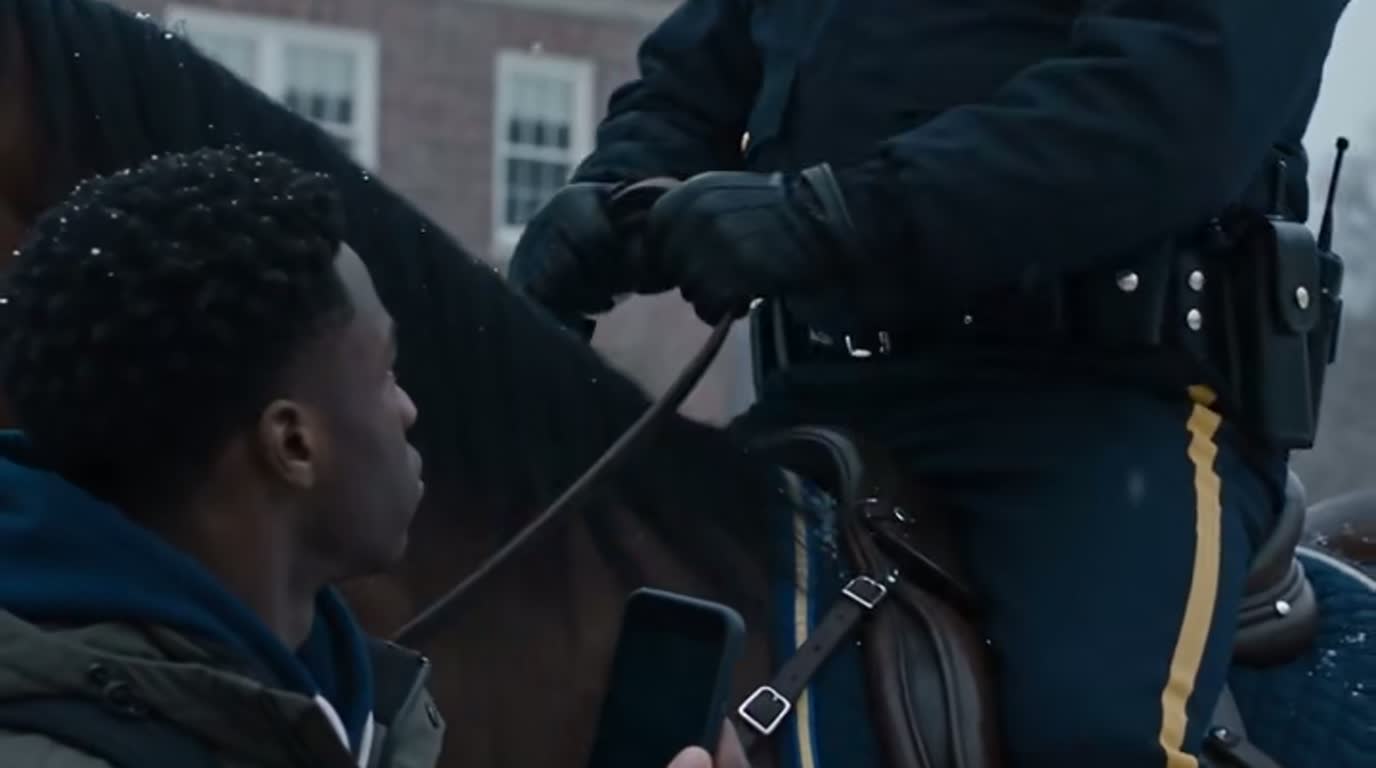
The Snowy University Quad Where The Silent Student Stood His Ground
CHAPTER 1: THE ICE BENEATH THE IRON SHOE
The winter twilight descending over the Arts Quad was thick with the silent, heavy fall of fresh lake-effect snow, draping the gothic limestone buttresses and slate roofs of the university in a shroud of pristine white. At twenty-four degrees, the air off the Cayuga Lake gorge was biting and still, carrying only the muffled chime of the distant clock tower striking half-past five. Underfoot, the historic red pavers of the main library walkway were glazed with a treacherous skin of transparent black ice beneath two inches of powder.
Devon Price walked with steady, balanced strides along the perimeter of the lawn, a heavy black canvas backpack slung across both shoulders. He was twenty-one years old, a senior robotics and mechanical engineering honors student, tall and lean beneath an insulated charcoal parka with subtle reflective silver seams. Because he had been profoundly deaf since a bout of childhood meningitis at age four, Devon experienced the campus not through acoustic waves, but through tactile vibrations: the rhythmic shock of his heavy winter boots meeting concrete, the subtle shudder of wind sweeping through the bare branches of ancient elms, and the sharp, clean sting of freezing air against his throat. In his gloved right hand, he held his smartphone, its high-contrast display set to a digital technical memo detailing stress-strain calculations for his autonomous wheelchair navigation thesis.
A sudden, violent vibration traveled up through the frozen soles of Devon’s boots.
Ten feet ahead, an iron-shod hoof came crashing down with concussive force upon the glazed red bricks, shattering a two-foot sheet of ice with an explosive crack that sent razor-sharp crystalline shards skittering across the snow.
Devon stopped immediately. Emerging from the snowy mist was Titan, a sixteen-hand Percheron cross draft horse with a coal-black coat, white fetlocks, and steaming, billowing clouds of hot breath blowing from flared nostrils. Astride the massive beast, towering eight feet above the walkway in an English-style mounted patrol saddle, sat Officer Brett Halloway.
Halloway was forty-two years old, broad-shouldered and heavy-set, his thick neck encased in a stiff tactical turtleneck beneath an insulated black patrol coat bearing the gold embroidered insignia of the University Police Department. His mounted enforcement helmet was pulled low, the tinted acrylic visor pushed up just enough to reveal cold, arrogant gray eyes set above a bristling salt-and-pepper goatee. In his heavy leather gauntlets, he gripped the braided black reins, using his spurs to wheel the massive horse directly across the brick path, blocking Devon’s route toward the engineering quad.
“You deaf or just stupid?” Halloway’s voice boomed down from the saddle, harsh and abrasive, his lips contorting into a sneer of practiced condescension. “I ordered you to halt at the quad gate sixty yards back! Answer when an officer of the law gives you a lawful command!”
Devon could not hear the words, but he did not need ears to read the universal posture of a bully intoxicated by petty authority. He saw the aggressive flare of the nostrils, the tightening of the jaw, and the threatening downward jab of Halloway’s gloved forefinger.
Devon remained completely motionless. He did not step backward into the snowbank, nor did he make any sudden defensive movements. With calm, deliberate poise, Devon lifted his smartphone, his thumbs moving swiftly across the virtual keyboard using capacitive touchscreen glove fingertips. Within four seconds, he enlarged the font to forty-eight points in bold white text against a stark black background and turned the screen upward toward the mounted officer.
The screen read: I AM DEAF. I CANNOT HEAR SPOKEN COMMANDS. I AM WALKING TO MY SCHEDULED LAB APPOINTMENT AT UPSON HALL.
Halloway didn’t even glance down at the display. He leaned forward over the pommel of his saddle, letting out a loud, mocking bark of laughter that sent another plume of white steam into the freezing twilight air.
“Deaf?” Halloway sneered, tapping the butt of his forty-inch wooden riot baton against the leather saddle skirt with rhythmic, menacing thuds. “How convenient! Every trespassing slacker caught loitering in the quad after dark suddenly develops a medical condition! Put that phone away right now, turn around, and put your hands flat against the library wall, or I will take you down off your feet and charge you with resisting a uniformed officer!”
Devon looked directly into Halloway’s sneering face. He did not lower his phone, and he did not turn toward the wall. Instead, he slowly extended his left arm, pointing his index finger past the horse’s steaming flank toward the snow-covered portico of the library entrance fifty yards away.
“Don’t you dare point at me, boy!” Halloway snarled, his spurs digging lightly into Titan’s ribs, causing the heavy draft horse to take a menacing, stomping sidestep that crushed another patch of brickwork.
Before Halloway could unholster his baton, a clear, resonant voice sliced through the falling snow from the shadows of the library arches:
Devon remembered the long, grueling years of speech therapy and audiological training he had undergone at the Lexington School for the Deaf in Queens. While doctors had urged his parents to force him into oralist conformity, Devon had embraced American Sign Language as a rich, mathematically structured linguistic medium that allowed him to visualize complex spatial dynamics and multi-dimensional engineering vectors with extraordinary speed. In the laboratory, his deafness was not a handicap; it was a profound cognitive asset, shielding him from the auditory chaos of noisy machining tools and allowing him to maintain unbroken focus for hours on end.
When confronted with the mounted officer’s overt hostility, Devon’s mind operated like an analytical state machine. He assessed the physical vectors: the sixteen-hand draft horse possessed immense kinetic mass, but its maneuverability on the ice-covered red pavers was severely constrained by its steel horseshoe shoes, which provided virtually zero lateral traction on glazed brick. Halloway’s elevated vantage point gave him an imposing psychological presence, but it also isolated him, restricting his peripheral awareness and slowing his reaction time to ground-level movements. Devon knew that by remaining calm, stationary, and rigorously non-threatening, he denied Halloway any legal justification for physical deployment.
“You might want to check the camera angle, Officer Halloway! Because over twelve thousand students are watching you harass a disabled engineering honors student live on the internet right now!”
Halloway’s head jerked sideways. Standing on the library steps with a dual-mic smartphone stabilizer rig held steady in both hands was Priya Nair, the senior investigative editor of the campus independent news collective, her lens aimed straight at the mounted officer’s face.
CHAPTER 2: THE SCREEN IN THE SNOWSTORM
The sudden intrusion of the live broadcast turned the freezing silence of the quad into a theater of high-stakes exposure. Officer Brett Halloway twisted violently in his saddle, his heavy leather gauntlets hauling hard on the curb reins, causing Titan to toss his massive head in protest with a loud jingle of curb chains.
Priya Nair descended the limestone steps of Olin Library with slow, measured confidence, her bright saffron beanie a vivid splash of warmth against the monochrome grey and white of the winter storm. She held the aluminum gimbal stabilizer rock-steady at chest height. Mounted above the camera was a miniature directional shotgun microphone fitted with a faux-fur wind baffle, designed to capture clean, unclipped vocal frequencies even against a twenty-knot gorge gale.
On the reverse monitor of Priya’s phone, the interactive interface of the University Independent Network showed a live viewer counter that was cascading upward in real time: 12,410… 14,880… 18,250. Across the bottom of the screen, thousands of real-time comments from students, faculty members, and regional alumni were scrolling by in an unbroken blur: ‘Did that cop just mock a deaf student?’ — ‘That’s Devon Price, he’s the top robotics scholar in the state!’ — ‘Reporting this to the Board of Trustees right now.’
“Turn that camera off!” Halloway roared, his face purpling with sudden, uncontrollable rage as he wheeled his horse to face Priya. “You are interfering with an active police interdiction! Filming a peace officer in the performance of duty without accreditation is a Class B misdemeanor under county municipal ordinances! Shut it down or I will confiscate that device as evidence!”
Priya didn’t flinch. She maintained a strict six-foot buffer from the horse’s flank, keeping both Halloway and Devon framed in a crisp, high-definition wide composition.
“New York State Civil Rights Law Section Seventy-Nine-P,” Priya recited with unflinching legal precision, her voice carrying clearly into the microphone. “Every citizen has an affirmative, statutory right to record law enforcement officers operating in public spaces, free from intimidation, threat, or seizure of equipment. This quad is a public university commons. And you just spent two minutes screaming at a deaf student who showed you his ADA medical notice.”
Devon stepped smoothly to the side, positioning himself where Priya’s camera could capture his hands. With swift, elegant, and definitive American Sign Language, Devon began to sign. Priya translated aloud in real time for the broadcast without missing a beat:
“Devon says: ‘I have held a permanent twenty-four-hour keycard pass to the Upson Robotics Facility for three semesters. Under university policy section four-point-eight, registered research fellows possess unrestricted pedestrian transit rights across all campus quadrangles regardless of weather advisories.’“
Devon calmly presented his official plastic university credentials, tapping his thumb against the RFID chip embedded in the laminate.
Halloway’s jaw clenched so hard the muscles along his temples twitched. The mounted officer found himself caught in the worst possible tactical trap: an articulate, unimpeachable student with ironclad legal authorization on one side, and an investigative reporter broadcasting his every word to twenty thousand people on the other.
“You think you’re clever, Price?” Halloway hissed, his voice dropping into a venomous, low growl meant to evade the directional microphone. “You think a live stream shields you from consequences on this campus? In one hour, this snow will be six inches deep. The provost won’t be watching your little video, and your press friend won’t be standing on these steps. Sentinel Global owns the campus security infrastructure now. You’re trespassing, and I’m clearing this quad.”
Devon’s phone buzzed sharply in his palm.
He looked down at the display. A high-priority system notification from his custom robotics diagnostic software flashed onto the screen: EXTERNAL RF INTERFERENCE DETECTED — 2.4 GHz AND 5.8 GHz FREQUENCIES JAMMED.
The legal framework governing campus public spaces was something Priya had studied exhaustively during her investigative reporting fellowship with the Freedom of the Press Foundation in Washington. She knew that under long-standing First Amendment jurisprudence established in cases like Glik v. Cunniffe, the right of private citizens to photograph and record public officials performing their duties in traditional public forums was an bedrock constitutional protection that admitted no exceptions for university property receiving public research endowments.
Furthermore, the university’s charter was tied directly to state land-grant legislation, meaning that campus safety personnel were legally designated state actors subject to the full rigor of Section 1983 civil rights claims. Priya had configured her livestreaming application to route through three decentralized content distribution nodes, ensuring that even if local cellular towers were throttled or her personal device was physically confiscated, the recorded audiovisual buffer was instantaneously cached across redundant cloud servers in Montreal, Frankfurt, and Dublin.
The viral resonance of the broadcast was unprecedented in the university’s digital history. Across campus dormitories in West Campus, fraternity lodges along University Avenue, and off-campus apartments in Collegetown, thousands of students were glued to their screens, watching the raw confrontation unfold. Student government leaders immediately began organizing an emergency virtual assembly, while law school professors specializing in constitutional jurisprudence began drafting formal amicus letters condemning Halloway’s blatant disregard for basic civil liberties. The digital megaphone wielded by Priya was transforming what would have been an isolated, unreported abuse of authority into an institutional turning point.
Halloway could sense the shifting dynamics, the cold dread creeping into his gut like winter frost. For fifteen years, he had operated with near-total impunity on the night shift, relying on the physical intimidation of his towering mount and the isolation of snowy evenings to cow unruly students. But in the era of ubiquitous high-definition mobile broadcasting, the power dynamic had completely inverted. His badge number, his face, and his unvarnished cruelty were now permanently archived across thousands of hard drives.
Devon raised his eyes, fixing his gaze upon a compact, weatherproof black housing mounted discreetly behind the cantle of Halloway’s leather saddle. The housing was equipped with a dual omnidirectional stub antenna, pulsing with a faint blue diagnostic light that Devon recognized instantly.
It was a tactical IMSI-catcher and multi-band radio frequency jammer—military-grade hardware that had no legal authorization to operate within three miles of an academic research institution.
CHAPTER 3: THE STEAMING BREATH IN THE CLOISTER
The discovery of the unauthorized electronic countermeasure shifted the encounter from a routine case of municipal bullying into something far darker and more sinister. Devon Price was not merely an undergraduate student; his specialized research within the Cornell Robotics and Autonomous Systems Laboratory focused on resilient wireless mesh networks and cyber-physical security for mobile autonomous units. He understood the electromagnetic spectrum with the intimacy of a master locksmith studying a tumbler lock.
Devon tapped Priya’s arm, pointing with two fingers toward the small black box mounted beneath Halloway’s saddlebag. Using his phone’s local text display, he typed out a swift, devastating observation: IMSI-catcher. Active signal jammer. He is blocking cellular upload towers to kill your live stream.
Priya’s eyes widened as she glanced down at her broadcast status bar. The streaming bitrate, which had been holding steady at six megabits per second over the local 5G carrier network, had suddenly plummeted into the red, dropping to four hundred kilobits as the connection stuttered and packet loss spiked to eighty percent.
“Nice try, officer,” Priya said into her microphone, her voice dripping with scorn. “You’re running an active electronic jammer on an academic quad. That is a direct violation of Title Forty-Seven of the United States Code, Section Three-Zero-Two. The Federal Communications Commission levies ten-thousand-dollar daily fines for operating unauthorized signal jamming equipment on public educational frequencies.”
Halloway’s composure cracked completely. He reached down with his right hand, his leather glove resting heavily on the snap of his service holster.
“That’s official department communications gear, you ignorant little amateur!” Halloway barked. “I have declared an emergency perimeter. You have ten seconds to clear this walkway, or Titan will move you!”
The massive draft horse shifted its weight, iron shoes scraping against the frozen pavement as Halloway urged the animal forward, attempting to use the horse’s immense bulk to herd Devon and Priya toward the darkened cloister of Goldwin Smith Hall.
Devon did not flinch. Drawing upon years of martial arts discipline and kinesthetic balance, he stepped smoothly inside the horse’s turning radius, placing his shoulder near Titan’s muscular flank where the animal could see him clearly. Animals respond to calmness, not panic; Devon reached out his hand, palm up, allowing Titan to sniff the cold canvas of his sleeve. The massive draft horse snorted softly, its ears relaxing, refusing to execute Halloway’s aggressive forward lunge.
“Titan, forward!” Halloway bellowed, digging his heels into the animal’s ribs.
The horse remained planted like an oak tree, turning its great head to look calmly at Devon.
Devon pulled a pocket-sized industrial laser tachometer from his coat pocket—a standard optical testing tool used in his robotics work. With a flick of his thumb, he reflected the low-intensity green alignment beam off the metal serial plate affixed to the side of the mysterious saddle box.
The optical reflection illuminated the embossed hardware serial number: SENTINEL GLOBAL — TACTICAL CELLULAR INTERCEPTOR MODEL SG-900.
Devon held up his phone, using the macro camera lens to capture a crystal-clear, high-resolution photograph of the serial plate, the manufacturer’s logo, and the unauthorized frequency allocation sticker. The photograph automatically saved to his phone’s internal non-volatile flash storage.
Halloway looked down and realized what Devon had done. For a second, raw terror flashed through the officer’s eyes.
“Give me that phone!” Halloway shouted, leaning recklessly out of the saddle, his arm reaching down to snatch the device from Devon’s grip.
Devon’s doctoral advisor, Dr. Alistair Finch, had spent two decades consulting for the Defense Advanced Research Projects Agency on cyber-resilience in tactical electronic warfare environments. In Dr. Finch’s lab, Devon had built prototype software-defined radios capable of analyzing radio-frequency spectra from thirty megahertz to six gigahertz in microsecond increments. When Devon inspected the compact casing beneath Halloway’s saddle, he recognized the distinctive heatsink extrusion and gold-plated SMA antenna terminals characteristic of military-grade cellular interception hardware.
Under federal telecommunications law, deploying an IMSI-catcher required an extraordinary judicial wiretap warrant signed by a federal district judge under Title III of the Omnibus Crime Control and Safe Streets Act, accompanied by a rigorous showing of probable cause regarding imminent violent felonies. For a campus patrol officer to mount such a device to an equine saddle for crowd suppression on an undergraduate lawn was a catastrophic violation of federal communications statutes carrying penalties of up to five years in federal penitentiary per transmission incident.
Devon observed the mechanical behavior of the electronic jammer with clinical detachment. By noting the subtle flickering of the unit’s thermal dissipation fans and the rapid modulation of the diagnostic LED array, Devon calculated the device’s effective radiation pattern. The jammer was operating in an aggressive reactive mode, sweeping across the 700 to 2600 megahertz cellular uplink bands with high-power white-noise bursts designed to saturate local cell-site receivers. Such extreme transmission power would inevitably interfere with regional emergency services, including local 911 dispatch channels and municipal ambulance telemetry.
The reckless disregard for broader public safety was staggering. Devon had participated in regional disaster management simulations where uninterrupted cellular communications were the difference between life and death during severe winter blizzards. For an officer to deploy a military-grade barrage jammer simply to suppress a livestream of his own misconduct was an act of gross criminal negligence that crossed every boundary of professional law enforcement ethics.
Devon sidestepped with effortless grace, letting Halloway’s lunge grab only empty winter air. Off balance, Halloway nearly slipped from the stirrups, catching himself with an undignified heave on the saddle horn as his mounted helmet banged against the cantle.
“Priya,” Devon signed swiftly, his fingers cutting through the snowy air with urgent clarity. “To the engineering lab. The private optical fiber network in Upson Hall is air-gapped from Sentinel’s jammer. We upload the entire hardware dump from there.”
CHAPTER 4: THE MIDNIGHT BROADCAST FROM UPSON HALL
Devon Price and Priya Nair sprinted across the snowbound footbridge spanning the frozen gorge, the icy wind howling up from the depths of Cascadilla Creek like a living entity. Behind them in the swirling darkness of the quad, the muffled thud of Titan’s hooves and the harsh blare of Halloway’s tactical megaphone echoed through the snow, but the mounted patrol was too heavy to negotiate the narrow, ice-slick pedestrian suspension bridge.
Within four minutes, Devon swiped his encrypted research keycard against the electronic access pad of Upson Hall. The heavy steel-reinforced glass doors clicked open with a pneumatic hiss, admitting them into the warm, brightly lit corridors of the robotics engineering complex.
Devon led Priya through the double security doors of Lab 314—the Autonomous Systems Cyber-Physical Infrastructure Laboratory. The room was a sanctuary of high-level technological precision: modular aluminum workbenches, three-axis robotic arms, oscilloscopes, and a dedicated rack of server blades humming with clean, filtered cooling airflow.
Devon took off his damp parka, revealing a black long-sleeve engineering shirt. He sat at the central command workstation, connecting his smartphone via an insulated USB-C optical data cable to the lab’s dedicated gigabit fiber-optic terminal. The campus Wi-Fi might be crippled by Halloway’s portable jammer, but the engineering lab was connected directly to the university’s underground dark-fiber research backbone, immune to radio-frequency interference.
Priya set her gimbal on a tripod, connecting the video feed into the workstation’s multi-camera broadcast suite.
“We’re back live,” Priya breathed, watching the streaming dashboard reconnect. The concurrent viewer count exploded instantly, surging past twenty-eight thousand as the broadcast resumed in full 4K resolution. “The stream never died; the server buffered the quad confrontation. The clip of Halloway mocking your deafness has already been retweeted by three members of the state assembly.”
Devon’s fingers flew across the mechanical keyboard. He ran an automated reverse-lookup on the serial number from Halloway’s saddle unit: SG-900.
The results were chilling.
The device was not an emergency communications transceiver. It was an offensive intelligence collection node manufactured by Sentinel Global Systems—a private mercenary surveillance corporation based in northern Virginia. According to confidential internal procurement manifests archived on an open development server, Sentinel Global had installed twelve identical interceptors across the campus under the guise of an ‘experimental smart-campus security trial.’
The system was programmed to harvest private mobile device identifiers, decrypt local text communications, and run automated facial recognition scans against all students attending political rallies, labor protests, or student government meetings.
“They weren’t patrolling for safety,” Priya whispered, reading the technical logs over Devon’s shoulder. “They were running a corporate surveillance dragnet on the entire student body.”
Suddenly, the fluorescent overhead lights inside Lab 314 flickered violently and died, plunging the room into darkness.
A second later, the deep amber emergency backup lights engaged along the baseboards, casting long, eerie shadows across the robotic machinery.
A loud mechanical clunk resonated through the ceiling ventilation shafts, followed by the electronic whine of heavy electromagnetic door locks sealing shut.
Outside the lab’s reinforced observation windows, three private security operatives wearing black tactical uniforms and Sentinel Global shoulder patches appeared in the hallway, accompanied by Officer Halloway, his mounted helmet exchanged for a tactical patrol cap.
Halloway stood outside the heavy glass door, a handheld remote override terminal in his grip. He pressed his face against the glass, tapping the screen of his radio with a smug, malicious grin.
The architecture of Upson Hall reflected the university’s storied tradition of engineering excellence. Its thick reinforced concrete walls, acoustic isolation baffles, and subterranean power trunks had been engineered during the Cold War to withstand electromagnetic pulses and physical sabotage. Inside Lab 314, Devon had installed an independent solar-buffered uninterruptible power supply capable of sustaining his robotics workstations for forty-eight hours in the event of an external grid failure.
As Priya watched the data streaming into the terminal, the sheer volume of illicit surveillance became staggering. Sentinel Global had created automated dossiers on over three hundred student organizations, logging meeting attendance through bluetooth beacon handshakes and correlating student ID swipes with their social media activity. The system was designed to predict campus protests, identify union organizers among graduate teaching assistants, and provide corporate administrators with real-time intelligence to preemptively silence dissent.
Inside the robotics laboratory, the air was conditioned to a precise sixty-eight degrees with twenty percent relative humidity to protect the delicate optical sensors and laser cutters from condensation. Devon moved between the diagnostic benches with silent, fluid efficiency, pulling redundant external solid-state drives from a fireproof safe beneath the main server rack. He knew that physical evidence was the bedrock of any successful legal prosecution; electronic logs could be disputed or claimed to be corrupted, but raw hardware captures and unredacted firmware dumps were indisputable.
Priya monitored the incoming messages flooding the independent news collective’s secure inbox. Dozens of former campus security guards and university staff members were reaching out, emboldened by the live broadcast to blow the whistle on Sentinel Global’s covert operations. One message contained an internal corporate memo detailing a secret bounty program: officers were offered monetary bonuses for every student activist whose biometric profile was successfully harvested and cataloged into Sentinel’s private intelligence database.
Through the intercom speaker mounted above the door, Halloway’s voice crackled into the darkened lab:
“Price! Nair! The building’s power grid is down on my direct authorization. You have exactly fifteen minutes to surrender those hard drives and delete those video files, or my team is breaching this room on an exigent property destruction warrant. There are no cameras in this hallway, kids. You walk out peacefully, or you leave on stretchers.”
CHAPTER 5: THE MESH NETWORK OVER CAYUGA LAKE
The threat echoing through the laboratory intercom was cold, real, and immediate. Through the reinforced observation glass, Devon could see the three private security contractors unrolling a heavy hydraulic breaching ram from a tactical nylon carry bag. These were not university parking attendants; they were private corporate enforcers brought in to protect a multi-million-dollar surveillance contract at all costs.
Priya looked at the heavy steel door, her breath shallow in the dim amber glow of the emergency lights.
“Devon, they’re going to break through that frame in ten minutes,” Priya signed urgently, her fingers tight with tension. “The hardwired fiber-optic lines have been severed at the basement junction box. Our broadcast is completely cut off.”
Devon didn’t panic. In the quiet world he inhabited, panic was an inefficiency that offered no solutions. He looked up at the ceiling of the laboratory, where a high-bay skylight opened directly onto the snowbound roof of Upson Hall. Then he turned his eyes toward the center workbench, where his senior thesis project rested beneath an anti-static cover.
It was the AeroMesh-4—an experimental long-range solar-hybrid quadcopter drone designed for autonomous environmental sensing over rugged alpine terrain. The drone was equipped with a steerable millimeter-wave laser communication transceiver capable of establishing an encrypted point-to-point data link over a twelve-mile line of sight.
Devon tapped Priya’s shoulder, pointing toward the drone, then pointing across the lake valley toward the lights of downtown Ithaca shining through the falling snow.
“The independent public access relay station on West Hill,” Priya realized, understanding his plan in an instant. “It operates on an open municipal microwave band! If we can establish a laser link with their receiving dish, we can bypass the entire campus network!”
Devon pulled the drone onto the prep bench. His hands moved with blinding, practiced speed. He connected a high-speed solid-state drive containing the complete Sentinel Global forensic dossier, the raw 4K video of Halloway’s abuse on the quad, and the cryptographic proof of the illegal cellular interception.
Using his laptop’s local battery reserve, Devon compiled the transmission package into an encrypted data archive addressed directly to the New York State Attorney General’s Civil Rights Bureau and the regional bureau of the Associated Press.
A thunderous concussive boom rocked the laboratory.
Outside in the corridor, the private security contractors had begun slamming the hydraulic ram against the steel door hinges, sending spiderwebs of fine cracks radiating across the reinforced security glass.
“Ten minutes, Price!” Halloway’s voice roared through the glass. “Nobody is coming to save you!”
Devon ignored the noise. He climbed the aluminum access ladder leading to the roof maintenance hatch, unlatching the heavy dog-bolts and pushing the steel trapdoor open against a cascade of powdery snow. The sub-zero winter gale blasted into the warm room, but Devon stood firm, his boots anchored on the metal rungs.
He powered on the AeroMesh-4. The four carbon-fiber rotors spun into a silent, high-efficiency blur.
Devon engaged the autonomous flight protocol. The drone lifted smoothly from his hands, rising through the open skylight into the swirling white blizzard, its infrared collision sensors navigating past the snow-caked ventilation stacks.
Two hundred feet above Upson Hall, the drone leveled its gimbal. Its solid-state green laser transceiver ignited, cutting through the falling snowflakes like a surgical scalpel, locking onto the microwave receiver tower high on West Hill.
On Devon’s laptop screen, the transmission progress bar flashed to life: ESTABLISHING LASER MESH LINK… 10%… 35%… 70%… 100%. TRANSMISSION COMPLETE.
Simultaneously, Devon triggered a automated secondary broadcast script. Across the state of New York, forty newsrooms and the state police command center received the unredacted dossier.
Devon climbed onto the laboratory maintenance ladder, his boots finding secure purchase on the grooved aluminum rungs. The icy draft coming through the roof hatch carried the sharp, clean ozone smell of an approaching winter storm. High above the campus, the dark waters of Cayuga Lake stretched northward for forty miles, a frozen expanse of black glass framed by snow-covered vineyards and rolling glacial hills.
The AeroMesh-4 was Devon’s pride and joy. Its custom-wound brushless motors, aerodynamic carbon-fiber composite rotors, and redundant inertial measurement units were the culmination of three years of relentless nocturnal engineering. Devon had written the flight control firmware from scratch in low-level Rust, optimizing the drone’s attitude-control algorithms to withstand sudden sixty-knot wind shears off the lake gorge. As the craft lifted toward the swirling storm clouds, its tiny navigational strobes blinking green and amber against the white blizzard, Devon knew that engineering in its purest form was not merely about equations and code; it was about building instruments of human liberation.
The rooftop of Upson Hall was a windswept plateau of frozen gravel, surrounded by a low parapet caked in ice. Devon stood beside the open hatch, his face lashed by the bitter lake gale, his hands holding the telemetry ground station with rock-steady composure. He watched the drone’s telemetry feed, which displayed its pitch, roll, and yaw angles adjusting continuously against the buffeting gusts. The autonomous flight algorithms were holding the aircraft’s position within a three-centimeter spherical tolerance, keeping the green optical laser locked onto the remote photoreceiver across the valley.
Below him, through the frosted glass of the central stairwell, Devon could see the flashlights of the tactical contractors moving upward floor by floor. The sound of their heavy boots was lost to the howling wind, but Devon could feel the periodic tremors vibrating through the structural steel framing of the building. With each second that ticked down, thousands of encrypted data packets were beamed across the stormy abyss, safely beyond the reach of any corporate breaching ram or private legal injunction.
Down in the corridor, the heavy glass door shuddered under a third massive blow of the battering ram.
Then, from the far end of the hallway, a sharp, piercing siren sounded, accompanied by the rapid thud of heavy tactical boots approaching at a dead run.
CHAPTER 6: THE HEARING IN DAY HALL
The sirens that echoed through the corridors of Upson Hall did not belong to Sentinel Global.
Rounding the corner in full winter tactical gear was Captain James Thorne of the New York State Police Troop C, flanked by six armed state troopers and Dean Eleanor Vance, the Vice Provost of Student Life.
“Step away from that door!” Captain Thorne shouted, his sidearm drawn and leveled directly at the three private security contractors. “Drop that hydraulic ram onto the floor! Hands on your heads, right now!”
Officer Brett Halloway froze, his handheld override unit slipping from his fingers and shattering on the polished linoleum. The three Sentinel contractors immediately raised their hands, dropping the heavy steel ram with a dull, resonant thud.
“Captain Thorne!” Halloway stammered, his face turning an ash-gray color. “This is an internal university security matter! These students are engaged in unauthorized system tampering—”
“Shut your mouth, Halloway,” Dean Vance interrupted, stepping past the troopers. Her eyes were blazing with furious outrage. “Thirty minutes ago, the State Attorney General’s office called the University President directly. The entire Board of Trustees has been convened for an emergency executive session at Day Hall. You are under arrest for civil rights violations, unlawful electronic surveillance, and official misconduct under color of law.”
Troopers immediately moved in, clicking steel handcuffs around the wrists of Halloway and the three contractors, leading them out through the service exits into the falling snow.
By seven o’clock that evening, the wood-paneled executive board room of Day Hall was packed with senior university administrators, legal counsel, and student representatives.
Devon Price sat at the central presentation table, wearing a clean engineering blazer over his sweater, his hands resting composed on the polished mahogany. Beside him sat Priya Nair, her laptop connected to the overhead high-definition projection displays.
At the head of the long conference table sat Board of Trustees Chairman Arthur Sterling, a retired federal judge with an imposing presence, flanked by university provost Dr. Marcus Webb.
“Let the record show,” Chairman Sterling declared, his voice echoing off the high plaster ceilings, “this emergency session has been called to review the electronic surveillance activities conducted by Sentinel Global Systems on this campus.”
Priya stepped to the projection podium, activating the presentation.
The large screens illuminated with the forensic telemetry Devon had extracted from Halloway’s saddle interceptor. Graph by graph, log by log, Devon’s analysis exposed the full scope of the conspiracy: over fourteen thousand student mobile devices had been illicitly monitored; personal text messages had been harvested without a warrant; and facial recognition cameras had been systematically deployed to track student activists and disabled students.
Devon rose to his feet. Standing tall before the assembled trustees, he began to speak through American Sign Language, his movements graceful, sharp, and commanding. Priya provided the concurrent translation into the room’s microphones:
“‘For two hundred years, this university was founded upon the principle that any person can find instruction in any study,’ Devon signed, his eyes locking with each trustee. ‘An academic campus cannot exist as a surveillance panopticon where students are tracked like enemy combatants. When you permit armed officers to bully disabled students and operate illegal electronic weapons under the guise of security, you forfeit the moral right to call this an institution of higher learning. True security does not come from fear, mounted intimidation, or hidden antennas. It comes from mutual respect, accessibility, and the rule of law.'”
The conference room remained completely silent for five full seconds.
Then Chairman Sterling leaned forward, his hands flat on the mahogany table.
“Mr. Price,” Sterling said, his voice thick with profound respect and remorse. “On behalf of the Board of Trustees, I offer you our deepest and most unreserved apology. The university failed you today, but you and Ms. Nair have saved this institution from an unconscionable betrayal of its core values.”
Sterling turned his gaze to the university counsel.
The atmosphere within the Day Hall boardroom was heavy with the weight of institutional reckoning. Dean Eleanor Vance stood beside Devon, her expression radiating fierce, protective indignation. For years, she had fought against the creeping corporatization of university governance, warning that outsourcing basic campus functions to private defense contractors would inevitably poison the academic environment and erode the fundamental principles of student autonomy.
As Chairman Sterling scrutinized the decrypted financial ledgers displayed on the projection screen, the paper trail revealed that Sentinel Global had channeled hundreds of thousands of dollars into private discretionary research accounts managed by a corrupt vice president of campus facilities. In exchange, the contractor had been granted unrestricted access to the campus fiber-optic trunks and allowed to test experimental crowd-control hardware on the undergraduate population without institutional review board approval. The evidence was so overwhelming and legally catastrophic that any attempt at an institutional cover-up was completely impossible.
“It is the unanimous resolution of this board that all contracts with Sentinel Global Systems are terminated immediately for gross breach of federal law. Officer Brett Halloway’s university commission is permanently revoked, and a criminal referral has been transmitted to the United States Department of Justice for prosecution under federal wiretap statutes.”
The trustees rose to their feet in a standing ovation, their applause filling the vaulted chamber.
CHAPTER 7: THE CLEAR BELLS OVER THE GORGE
Three weeks later, the brutal winter blizzard had passed, replaced by a radiant, crystalline morning that bathed the university quad in brilliant winter sunshine. The snow on the slate roofs was melting into gentle, rhythmic drips, and the ancient elms stood tall against an endless canopy of azure sky.
Along the main red-brick walkway outside Olin Library, the ice had been meticulously cleared, replaced by a newly installed subterranean geothermal heating grid that ensured the pedestrian paths remained completely dry, safe, and accessible throughout the winter months.
At the center of the quad, near the bronze statue of the university founder, a brand-new digital communication and accessibility kiosk had been unveiled by the Student Assembly. Designed by Devon Price as part of his senior engineering capstone, the kiosk featured multi-lingual American Sign Language video relays, tactile braille maps, and real-time campus transit schedules accessible to all individuals regardless of physical ability.
Devon stood beside the kiosk, adjusting his backpack strap with a quiet smile. Standing beside him was his seventeen-year-old sister Maya, her dark eyes shining with wonder as she tested the interactive sign-language interface with her own hands. Maya was visiting the campus for the university’s prospective scholars weekend, having just received early admission into the undergraduate biomedical engineering program.
“It works flawlessly, Devon,” Maya signed with swift, enthusiastic fingers. “The response time is under twenty milliseconds!”
Devon signed back, his face lit with pride: “The system belongs to everyone now, Maya. No more barriers. No more fear.”
Priya Nair strode across the bricks, holding two steaming cups of hot chocolate from the student union café. She handed one to Devon and one to Maya, laughing as the cold breeze tossed her dark hair.
“The front page of the New York Times just published their investigative feature on Sentinel Global,” Priya said, her eyes glowing with triumphant satisfaction. “Federal grand juries in three states have opened criminal inquiries into their corporate surveillance contracts. And the Student Assembly just voted unanimously to name the new digital innovation laboratory in Upson Hall after you, Devon.”
Devon smiled humbly, taking a sip of the hot cocoa and looking out over the wide, peaceful expanse of the snowy lawn.
Across the quad, students were walking in groups, laughing and carrying textbooks between classes. No mounted officers loomed from the shadows; no covert electronic jammers hummed in the air. The university had reclaimed its soul, restored through the quiet, uncompromising courage of a student who refused to be silenced.
The winter morning sun cast long, elegant shadows across the red bricks of the Arts Quad, where the new geothermal heating elements sent thin wisps of steam rising into the crisp air. The campus felt fundamentally transformed; a profound sense of psychological security and collective dignity had returned to the student body. In the dining halls, libraries, and dormitories, conversations centered on the enduring power of student solidarity and the remarkable courage of two young people who had dared to hold power accountable.
Maya looked up at the gothic spires of Day Hall, her face glowing with youthful ambition. Standing beside her brother, she felt an overwhelming sense of pride and possibility. Devon had not merely defended his own rights on that snowbound evening; he had forged an open path for every student who would ever walk these historic grounds with a disability, a non-conforming voice, or an unyielding commitment to truth. The university belonged to the thinkers, the dreamers, and the builders—and its foundation was stronger than ever.
As the afternoon warmth deepened, Dean Eleanor Vance joined Devon and Maya beside the new accessibility kiosk, accompanied by the university’s director of campus facilities. Dean Vance handed Devon an embossed leather portfolio containing the formal resolution of the faculty senate, which established a permanent, fully funded endowment for the Devon Price Institute for Accessible Robotics and Assistive Technology.
“Your vision has redefined what it means to be a scholar here, Devon,” Dean Vance said, her eyes shining with deep respect as an ASL interpreter conveyed her words. “You proved that true strength does not lie in the ability to shout, or to dominate others from the back of a horse. It lies in the quiet dignity of the intellect, the courage to stand for justice, and the generosity to build a world where no human being is ever excluded or made to feel invisible.”
Devon smiled warmly, his fingers moving in graceful sign language to express his profound gratitude. Around them, the vibrant energy of the university surged forward like the rushing waters of the spring thaw, unburdened by fear and illuminated by the enduring light of truth.
High above in the stone clock tower, the university chimes began to ring out their noon concert. The melodious bells played a triumphant, resonant anthem that drifted across the snowy roofs, over the frozen waterfalls of the gorge, and far out across the shimmering blue waters of Cayuga Lake.
Devon could not hear the ringing of the brass bells, but as he rested his hand against the smooth limestone balustrade of the library steps, he felt the deep, rhythmic vibrations pulsing through the ancient stone—a steady, reassuring heartbeat of truth, freedom, and lasting justice that would endure for generations to come.