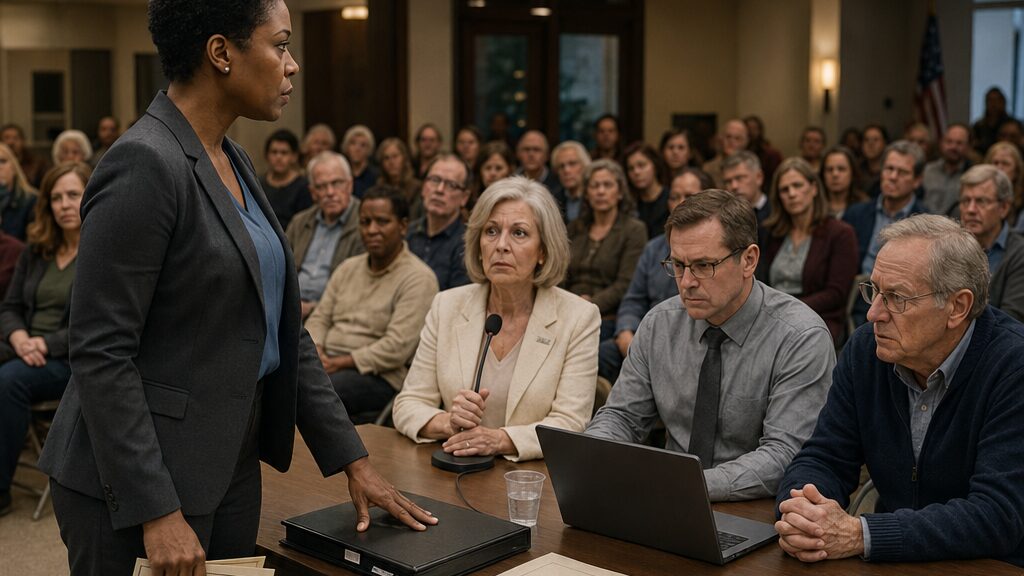
The HOA President Said They Had Forty Hours of Her on Camera—Then Amanda Audited the People Watching Her
Chapter 1: Smile for the Camera, Sweetheart
“Smile for the camera, sweetheart.”
Pamela Scott raised a black telephoto camera between them before Amanda Green had fully opened the front door.
The lens pointed past Amanda’s shoulder into the dim hallway.
Amanda kept one hand on the door. “Excuse me?”
Pamela lowered the camera just enough to show the pleased curve of her mouth. She wore a cream jacket despite the heat already gathering over the pavement, and a laminated HOA badge hung from a blue cord at her neck.
“We have forty hours of you on tape,” she said. “So I wouldn’t waste time pretending.”
The camera rose again. Amanda turned her face away before the shutter clicked.
Behind Pamela, the neighborhood looked painfully ordinary. Sprinklers ticked across trimmed lawns. A delivery van rolled past the mail kiosk. Somewhere, a garage door groaned open.
Amanda looked down at the paper in Pamela’s other hand.
VIOLATION NOTICE appeared in bold red letters.
Pamela slapped it against the glass storm door. “Two hundred dollars. Unapproved activity along the east-side access.”
“The side gate?”
“You know which gate.”
“I haven’t changed anything out there.”
“This isn’t about changing it. It’s about use.”
Amanda read the first line beneath the heading. Multiple unauthorized nighttime entries. Dates followed in a neat column, each with a time rounded to the minute.
August 7, 11:18 p.m.
August 9, 12:06 a.m.
August 12, 10:43 p.m.
Amanda’s thumb stopped halfway down the page.
On August 9, she had been in Richmond, sleeping badly in a hotel across from a client’s office. She still had the receipt in her email. On August 12, she had returned after midnight because her flight was delayed. The notice claimed someone had entered through the gate nearly two hours before she reached the neighborhood.
“I wasn’t home on two of these dates.”
Pamela’s smile held. “The footage says otherwise.”
“Then show me the footage.”
“Owners may review association evidence during an appeal.”
“I’m not the owner.”
“Exactly.”
Pamela folded her observation sheet against the back of the violation notice. Amanda caught a glimpse of handwritten notes in blue ink: curtains open, vehicle absent, side light on.
Pamela tucked the page beneath her clipboard.
Amanda’s irritation sharpened into something colder. “Who wrote those notes?”
“We take community safety seriously.”
“That wasn’t my question.”
“And this isn’t a debate on your porch.” Pamela stepped back. “Your landlord has been copied. Payment is due in fifteen days unless the owner files an appeal.”
Amanda looked at the camera hanging against Pamela’s jacket. “Why do you need forty hours of video for a side gate?”
For the first time, Pamela’s expression shifted. Not guilt. Annoyance.
“Consistency protects everyone,” she said. “People always think their exception is harmless until the neighborhood pays for it.”
She turned toward the walkway.
“Pamela.”
Pamela looked back.
“Were you filming through my windows?”
The smile returned, smaller now. “Enjoy your morning, Ms. Green.”
Amanda closed the door without slamming it. She stood in the hallway until Pamela’s shoes faded along the concrete path.
Then she locked the deadbolt.
The violation notice remained in her hand while she walked through the townhouse. The side yard ran along the narrow wall beside her bedroom, separated from the common lawn by a six-foot wooden gate. She rarely used it. The latch stuck in humid weather, and the path beyond it led only to the trash enclosure and utility meters.
In the bedroom, the blinds were tilted upward. From inside, she could see sky. From outside, someone close to the wall could see much more.
Amanda lowered them.
She told herself to call her landlord. Instead, she carried the notice into her home office and placed it beside her keyboard.
Facts first.
That habit had once paid her salary. Later, it had cost her a career.
She opened the doorbell-camera application and selected the previous night. The porch view showed nothing unusual. She switched to the side camera she had installed after a package disappeared six months earlier.
At 5:42 that morning, motion had triggered a recording.
Pamela entered the frame from the common lawn.
She was not walking past.
She crouched beside the side gate, one knee pressed into the mulch. A long lens extended through a gap where the gate had warped away from the post. For twelve seconds, she aimed toward Amanda’s bedroom wall.
Then she shifted higher.
Toward the window.
Amanda stopped the video.
The room seemed to contract around the quiet hum of her computer. She replayed it once, without sound, watching Pamela’s posture. Careful. Practiced. Not the stance of someone checking a broken latch.
The recording continued. Pamela lowered the camera, wrote something on a small sheet, then glanced directly at Amanda’s side camera.
She knew it was there.
She smiled at it before walking away.
Amanda downloaded the file to her hard drive and copied it to an encrypted folder. Then she emailed the file to herself, attaching the violation notice and typing only the date in the subject line.
She opened a message to her landlord.
Pamela Scott delivered a violation this morning and—
Amanda stopped.
Her landlord lived two states away and disliked “association complications.” Six months earlier, when the HOA complained about a planter on Amanda’s porch, he had asked whether she could simply remove it rather than create friction before lease renewal.
If she sent the video now, he might call Pamela. Pamela might deny it. The board might close ranks before Amanda understood what they had collected.
Facts first, she thought again.
She deleted the message.
By noon, Amanda had built a spreadsheet listing every date and time on the violation. She matched travel receipts, grocery transactions, client calls, and camera logs against each allegation.
Three entries were impossible.
Two were technically possible but unsupported.
Only one corresponded to Amanda using the gate—at 7:14 p.m., not at night, to roll a trash bin to the enclosure.
At 2:20, she went outside to inspect the latch. The gate opened with its usual scrape. Nothing had been altered. No new sign, no damaged lock, no reason for an emergency inspection.
As she stepped back into the parking area, she noticed a man across the street.
He stood beside a silver sedan with a clipboard resting against the roof. When Amanda looked over, he pretended to study the houses behind her.
Then he glanced down at her car.
His pen moved.
Amanda walked slowly toward him.
The man closed the clipboard and got into the sedan before she reached the curb. He drove away without looking at her.
She returned to her car and crouched beside the rear bumper.
Her license plate was clean and unobstructed.
On the pavement near the curb lay a torn corner of yellow paper. Amanda picked it up.
Only three handwritten items remained:
Green—departed 2:23.
Black sedan.
Plate confirmed.
Chapter 2: The Neighbors Who Timed Her Life
Rebecca Rivera waved from beside the mail kiosk with a blue pen held between two fingers.
Amanda nearly waved back.
The gesture had been automatic for the three years they had lived across the lane from each other. Rebecca watered her porch plants before work. Amanda collected her packages when she traveled. They spoke about cracked sidewalks, grocery prices, and the impossible wait at the nearest urgent-care clinic.
That morning, Amanda saw only the pen.
The same bright blue ink had filled Pamela’s hidden observation sheet.
“Everything okay?” Rebecca asked.
Amanda forced her hand upward. “Fine.”
Rebecca’s gaze moved toward Amanda’s side yard, then away. “Pamela said there was some trouble near your unit.”
“What kind of trouble?”
“Packages. People coming through where they shouldn’t.” Rebecca capped the pen. “You know how rumors get.”
“Do I?”
Rebecca laughed too quickly. “I’m just saying what I heard.”
Amanda unlocked her mailbox. Inside sat a grocery circular, two envelopes, and a printed notice reminding residents to report suspicious activity to the board.
When she looked up, Rebecca had already gone.
For four days, Amanda changed nothing about her routine.
She left for coffee at the same time. She rolled her trash bin out on Wednesday evening. She opened the bedroom blinds each morning and closed them at night, though now she stood to one side when touching the cord.
Each action became an experiment.
Her cameras recorded Pamela twice near the common lawn. The man with the clipboard returned on Thursday and sat in his car for thirty-seven minutes. Another neighbor paused while walking a small dog and photographed Amanda’s driveway.
Amanda logged every appearance.
She did not confront anyone.
Silence gave people room to become careless.
On Friday afternoon, she walked to the kiosk carrying a padded envelope she had no intention of mailing. The structure contained resident boxes on one side and a shallow association cabinet on the other. The cabinet door was supposed to hold landscaping schedules and board notices.
It stood slightly open.
Inside, beneath a stack of pest-control flyers, was a black composition book.
Amanda stared at it before touching it.
A strip of white tape crossed the cover. EAST ROW OBSERVATIONS was written in blue block letters.
She took photographs of the book where it lay, then lifted it.
The first pages contained ordinary complaints: sprinklers running too long, a broken porch bulb, a vehicle parked overnight in a visitor space. Halfway through, the entries narrowed.
Unit 18B.
Amanda’s address.
The handwriting changed from page to page. Blue block letters. Tight black cursive. Heavy green print.
7:08 a.m.—blinds opened.
7:41 a.m.—subject departed alone.
12:16 p.m.—delivery, male driver, three minutes.
6:03 p.m.—subject returned.
One entry included her license plate. Another described a client who had visited to drop off tax documents.
Then Amanda found the line that made her grip tighten around the book.
10:22 p.m.—bedroom blinds opened approximately four inches. Light remained on until 11:47.
The entry was signed with the initials R.R.
Amanda closed the book.
Through the kiosk opening, she could see Rebecca’s front window across the lane. The blinds shifted, then became still.
Fear had a clean shape when Pamela held the camera. It had been easier to direct at one person.
This felt different.
This had borrowed cups of sugar. It had accepted packages. It had waved.
Amanda photographed every page. Near the back, the entries changed again. Dates were grouped into weekly totals, each beside initials and dollar amounts.
P.S.—14.5 hrs—$725.
R.R.—9 hrs—$450.
Misc. coverage—$300.
The watchers had not simply been persuaded.
They had been paid.
Amanda returned the book exactly where she had found it and closed the cabinet to the same narrow gap. Back home, she printed the photographs and arranged them across her dining table.
Three handwriting styles. At least three participants. Six weeks of observations.
Forty hours could have been Pamela’s boast, but the log represented far more than forty hours of people waiting, watching, and recording.
A knock sounded at the door.
Amanda checked the camera first.
Pamela stood outside without the telephoto lens. She held a small stack of community safety notices.
Amanda opened the door only as far as the chain allowed.
“We’re asking residents to be especially careful,” Pamela said. “There have been concerns about unauthorized access and package theft.”
“Have there been police reports?”
“Not everyone wants law enforcement involved over every little thing.”
“Then what evidence do you have?”
Pamela’s eyes settled on Amanda’s face. “Several residents have noticed unfamiliar visitors near your gate.”
“My clients deliver documents.”
“At night?”
“One came at seven fifteen.”
“We have later times.”
“On dates when I wasn’t home.”
Pamela’s jaw tightened. “You’re becoming defensive.”
“You’re photographing my bedroom.”
For half a second, Pamela said nothing.
Then she held out the notice. “This is exactly why the board documents interactions.”
Amanda did not take it.
Pamela slipped it through the narrow opening, and it fell to the floor between them.
“People here are frightened,” she said. “You may not realize how your choices affect homeowners whose entire savings are tied up in these properties.”
“My choices?”
“A renter can leave. Owners remain with the consequences.”
There it was. Not shouted. Not crude. Delivered with the patience of someone explaining a rule to a child.
Amanda closed the door.
That evening, she searched old association emails her landlord had forwarded during the lease application. Most were routine budgets and meeting summaries. One attachment from the previous winter listed operating expenses.
Landscaping. Insurance. Pool maintenance. Legal.
Then, beneath administrative services:
Community compliance—$2,800.
No vendor was named.
Amanda checked the date.
The expense had been posted three weeks before her first alleged nighttime gate violation.
The fine had not started the surveillance.
The surveillance had come first.
Chapter 3: You Rent Here, So Sit Down
The surveillance logbook struck the clubhouse table hard enough to rattle Pamela Scott’s water glass.
Conversation stopped.
Amanda stood at the end of the crowded meeting room with forty copied pages inside a black binder and the original photographs stored safely at home. Every folding chair was occupied. Several residents lined the back wall beneath framed photographs of community landscaping projects.
Pamela looked at the binder, then at Amanda.
“We are in the middle of the consent agenda.”
“I know,” Amanda said. “That’s where you’re approving last month’s reimbursements.”
Edward Moore, seated beside Pamela, adjusted his glasses. Michael Baker stopped typing on his laptop.
Pamela folded her hands. “Resident comments are at the end.”
“My name appears in records used to justify association spending. I’m asking that the reimbursement vote be postponed.”
A murmur moved through the room.
Pamela’s face remained composed, but the pulse at her throat quickened. “You are not an owner, Ms. Green.”
“No.”
“Then you have no vote on association business.”
“I didn’t ask for one.”
Pamela gave the room a weary smile. “This is a landlord matter being turned into theater.”
Amanda opened the binder.
The first page displayed a photograph of the logbook cover. The next showed entries recording her movements, visitors, license plate, and bedroom blinds. Beside several dates, Amanda had placed the corresponding payment periods from public budget summaries.
“I found this in the association kiosk,” she said. “It contains at least forty pages of surveillance notes concerning my home. Several entries correspond to reimbursements listed as community compliance.”
Rebecca sat in the second row. Her hands were locked together in her lap.
Pamela did not look at her.
“That book is not an official association record,” Pamela said.
“Then why does it contain payment totals?”
“It could contain anything. You found an unattended notebook and decided to assign meaning to it.”
Edward leaned toward the binder but did not touch it. “Are these copies?”
“Yes.”
“Where is the original?”
“Preserved.”
Pamela’s gaze sharpened. “You removed association property?”
“I documented material stored in an unlocked common cabinet. I did not remove it.”
“That distinction may matter less than you think.”
Amanda felt the old instinct rise inside her—the need to answer every implication, close every opening, prove every point before anyone could twist it.
That instinct had kept her working nights during the nonprofit audit that ended her career. It had also kept her silent until management had time to rewrite the story around her.
She placed a second document beside the binder.
“This is the association’s reimbursement policy,” she said. “It requires a stated purpose, supporting documentation, and board authorization for nonroutine expenditures.”
Michael shifted in his chair.
Pamela saw it. “Michael, there’s no need to respond to an unscheduled allegation.”
Amanda aligned a third paper with the first two. “This is my formal demand to inspect records related to community-compliance spending, surveillance services, security reimbursements, and payments to individual residents.”
Pamela laughed softly.
It was not a pleasant sound, but it was measured enough to invite others to join. A few did.
“Honey,” Pamela said, “you rent here. You don’t get a vote, and you certainly don’t get to read the owners’ books.”
Amanda waited until the scattered laughter died.
“The association is a nonprofit corporation,” she said. “My landlord has authorized me in writing to inspect records affecting his unit, and state law allows examination through an authorized agent.”
That was not yet true.
Her landlord had not answered.
Amanda felt the risk of the sentence as soon as she spoke it. She had prepared an authorization letter and sent it that afternoon, but no signed copy had returned.
Michael looked up sharply.
Pamela noticed.
“Do you have that authorization with you?”
Amanda opened the binder to the notarized demand. “I have a certified records request delivered to the management office this morning.”
“That is not what I asked.”
“No. It’s what starts the deadline.”
Silence settled differently now.
Michael’s fingers hovered over his keyboard.
Amanda turned toward him. “Did your office receive the certified demand at 10:14 this morning?”
Every face shifted to the property manager.
Michael cleared his throat. “A package was received.”
“Addressed to the association?”
“Yes.”
“Signed for by your office?”
“Yes.”
Pamela’s voice hardened. “Michael, counsel will determine whether it is valid.”
“Counsel may determine scope,” Amanda said. “Receipt is not in dispute.”
Edward finally touched the binder, turning one page. “You’ve matched dates to reimbursements.”
“Only periods. I have not seen the ledger.”
“And you believe this proves misappropriation?”
“I believe it justifies inspection.”
Pamela leaned back. “What exactly qualifies you to make that determination?”
Amanda had hoped to avoid the question.
The room seemed to tilt toward a memory she disliked: a conference table in another building, executives reading her findings in silence, then asking why she had not been more collaborative. Nine years of audits reduced to a personnel concern.
She looked at the residents watching her now.
“I audited nonprofit organizations for nine years.”
The response was not dramatic. No one gasped. But Edward stopped turning pages.
Michael closed his laptop halfway.
Amanda continued. “Grant funds, restricted accounts, board approvals, vendor payments, reimbursements. I know what proper documentation looks like. I also know what questions are reasonable before accusing anyone of fraud.”
Pamela seized on the last word. “There. She has now accused this board of fraud in a public meeting.”
“No,” Amanda said. “I said inspection.”
“You brought a binder and slammed it onto a table.”
“I brought dates.”
Pamela’s cheeks colored. “This community has experienced package theft, trespassing, and rising insurance costs. The board has a duty to respond. Some people have spent years volunteering to protect what residents own.”
“And that duty includes photographing bedroom windows?”
Rebecca made a small sound.
Pamela turned toward her. Rebecca lowered her eyes.
The room shifted again.
Edward closed the binder. “We should postpone the reimbursements until counsel reviews the request.”
Pamela stared at him. “There is no reason to disrupt routine operations because a tenant is unhappy.”
Edward’s voice remained quiet. “There is now a record request.”
Michael reopened his laptop. “Counsel should review retention obligations immediately.”
Pamela looked from one man to the other. Her expression did not collapse; it condensed.
“Fine,” she said. “I move that the board defer consideration of the disputed reimbursement items and authorize counsel to determine whether Ms. Green has any inspection right.”
The motion passed three to two.
Not a victory. A delay.
But it was the first decision Pamela had not controlled before the meeting began.
As residents stood, several avoided Amanda. One older homeowner paused beside the binder as though wanting to speak, then followed his wife out.
Rebecca left through the side door.
Amanda packed her documents slowly. Her hands had begun to shake now that no one was looking closely.
She had claimed authorization she did not yet possess. Facts first, she had always told herself, then stepped half an inch beyond them because the room had demanded certainty.
Her phone vibrated.
A message from her landlord appeared.
Call me immediately. The HOA says you may be creating legal exposure for my property.
Amanda closed her eyes.
“Ms. Green.”
Michael stood near the exit, holding his laptop bag against his chest.
“What?”
He glanced toward Pamela, who remained at the board table speaking to Edward in a low, furious voice.
“You should know something,” Michael said. “She asked counsel to draft an emergency records amendment last week.”
“Before my demand?”
“Yes.”
“What would it change?”
“Access through tenant agents. Copying rights. Electronic ledgers.” He lowered his voice. “If the board adopts it before counsel confirms your request, they may argue the new policy controls.”
“Can they do that?”
Michael looked at the binder in her hands.
“They can try.”
Across the room, Pamela turned and met Amanda’s eyes.
Then she lifted her phone and photographed the binder.
Chapter 4: The Story Pamela Told About the Gate
Rebecca Rivera appeared on Amanda’s porch before sunrise and whispered through the door camera.
“Please turn that thing off.”
Amanda watched her on the phone screen from the hallway. Rebecca kept glancing toward Pamela’s house, though the street was still dark and most windows were unlit.
Amanda opened the door but left the chain secured.
“What do you want?”
Rebecca lowered her voice. “Not out here.”
“You asked me to disable my camera.”
“I don’t want another recording.”
“That makes one of us.”
Rebecca flinched. In one hand she held a folded grocery bag. In the other, several torn notebook pages curled at the edges.
Amanda looked at them and felt her exhaustion harden.
“Where did you get those?”
Rebecca moved closer to the narrow opening. “Can I come in?”
“No.”
“Amanda, please.”
“No. You can speak from there.”
Rebecca stared at the chain, then at Amanda’s face. She looked older than she had four days earlier, the skin beneath her eyes gray with lost sleep.
“I wrote some of the entries,” she said.
Amanda did not move.
Rebecca held up the torn pages as though they might soften the admission. Blue ink covered them.
“I know you figured that out.”
“You recorded when I opened my bedroom blinds.”
“I didn’t stand outside your window.”
“You wrote it down.”
“I could see from my kitchen.”
“That isn’t better.”
Rebecca’s mouth opened, then closed. From somewhere behind the houses came the soft mechanical cough of a sprinkler system starting.
“Pamela told us there had been thefts,” Rebecca said. “Packages, tools from garages. She said someone was using your gate because it opened toward the service path.”
“Someone?”
“Visitors. Delivery people. Men coming late.”
“My clients.”
“That’s what I know now.”
Amanda looked at the pages again. “When did you stop believing her?”
Rebecca’s fingers tightened around the bag.
“That isn’t a difficult question.”
“After the second week.”
“And how long did you keep writing?”
Rebecca looked down.
“How long?”
“About a month.”
The answer entered the space between them without drama. That made it worse.
Amanda had wanted the truth to divide the neighborhood cleanly: Pamela on one side, everyone she had manipulated on the other. Rebecca’s confession ruined that arrangement. Pamela had lied. Rebecca had doubted her. Then Rebecca had continued.
“Why?”
Rebecca wiped one thumb along the paper’s torn edge. “Because Pamela asked whether I wanted people asking questions about my son.”
Amanda said nothing.
“He’d been coming home late,” Rebecca continued. “He was using the visitor lot after work because our driveway was being repaired. Pamela said if the board started looking closely, there could be towing fees. Maybe a violation. She said people were already uneasy about teenagers in the neighborhood.”
“So you watched me instead.”
“I thought it would end quickly.”
“You were paid.”
Rebecca’s face tightened. “She called it a volunteer stipend.”
Amanda almost laughed. “Four hundred and fifty dollars is not a thank-you card.”
“I returned two hundred.”
“After you knew I had the log?”
“No. Before.”
Amanda studied her. Rebecca seemed to want credit for a partial conscience, and seemed ashamed of wanting it.
“What are those pages?”
“Copies. I tore them from the packet Pamela gave me before she moved everything into the notebook.” Rebecca lifted them toward the opening. “These are older.”
Amanda did not reach for them.
Rebecca pushed them through the gap beneath the chain. They landed on the entry rug.
“I’m not asking you to forgive me,” she said.
“You came before dawn to ask me not to name you.”
Rebecca closed her eyes.
“That is what you came for, isn’t it?”
“If you put my name in a state complaint, my son will know. My neighbors will know.”
“I know.”
Rebecca opened her eyes again.
“That’s the part you still don’t understand,” Amanda said. “You’re afraid people will know what you did. I’m afraid people know when I sleep.”
Rebecca’s shoulders sagged.
For a moment, Amanda thought she might apologize. Instead, she said, “Pamela is going after your lease.”
Amanda’s hand tightened on the edge of the door.
“What did you hear?”
“She told Michael there may be an occupancy issue. Something about business visitors and unregistered use. She said your landlord will cooperate if he thinks renewal is at risk.”
Amanda glanced toward the pages on the floor.
“Take them,” Rebecca said. “The first entries started before the package theft story. Before the fine.”
“How long before?”
“Three weeks. Maybe four.”
Amanda looked back at her.
Rebecca stepped away from the door. “I’m sorry.”
The words were small, nearly swallowed by the sprinkler hiss.
Amanda closed the door without answering.
She waited until Rebecca crossed the lane before picking up the pages.
The earliest entry was dated June 14.
Amanda’s first violation date had been July 8.
The surveillance had started twenty-four days before the board claimed there was suspicious use of the gate.
At nine that morning, her landlord called.
He did not ask whether Pamela had photographed her bedroom. He began with the notice he had received.
“They’re saying you may be operating a business from the unit.”
“I work remotely. You knew that when I signed the lease.”
“They’re saying clients are coming and going.”
“Two people dropped off documents in six months.”
“And there’s a gate issue?”
“There is no gate issue.”
A pause.
“Amanda, I don’t live there. I need the association not to be hostile.”
“They are surveilling me.”
“I saw your message about the meeting.”
“You didn’t answer the authorization request.”
“I’m trying to understand the exposure.”
“My exposure or yours?”
Another pause, longer this time.
“I want to keep you as a tenant,” he said. “But if the board can make renewal difficult—”
“So you want me to drop it.”
“I want you to avoid turning this into something bigger than it needs to be.”
Amanda looked at the copied pages arranged across her desk. “It was already bigger.”
After the call, she drove to Michael Baker’s property-management office.
He met her in a conference room with glass walls and a bowl of wrapped peppermints at the center of the table. The office smelled of printer toner and coffee that had been sitting too long.
“The board has approved a limited production,” he said.
“Limited how?”
“Financial summaries, meeting minutes, and selected vendor records for the current fiscal year.”
“My demand covered the previous year.”
“Counsel believes your landlord’s authorization is incomplete.”
“He signed it this morning.”
Amanda slid the scanned letter across the table.
Michael read it twice.
She watched the color leave his face by degrees.
“I’ll forward this.”
“You already knew he would authorize me.”
“I didn’t know.”
“You warned me about the amendment.”
“That conversation was off the record.”
“There is no off the record between a property manager and a resident whose files you control.”
Michael pressed his lips together. “I’m trying to prevent this from becoming more expensive.”
“For whom?”
“The association’s legal fees come from residents.”
“So did the surveillance payments.”
His eyes shifted toward the glass wall.
Amanda leaned forward. “When did those payments begin?”
“I can’t discuss unproduced records.”
“Before or after the alleged gate violations?”
Michael said nothing.
That was enough to confirm the sequence, though not the reason.
The records arrived electronically at 4:57 p.m. on the tenth day, three minutes before the management office closed.
Amanda downloaded the folder immediately.
The production contained board minutes, monthly summaries, vendor invoices, and a general ledger exported to PDF. She opened the ledger first.
January. February. March. April.
Then July.
Amanda scrolled back.
There was no May.
No June.
No first half of July.
Three months had been removed from the file, including the period when the surveillance began.
She checked the page numbering.
Page 18 ended with April 30.
Page 19 began July 16.
No notation explained the gap.
Amanda opened the email from Michael again.
Attached please find the responsive records currently available.
Currently available.
She called him. The line went to voicemail.
Amanda looked at Rebecca’s copied page dated June 14, then at the ledger that pretended June had never happened.
Someone had not merely delayed the records.
Someone had decided which months she was allowed to see.
Chapter 5: Fourteen Thousand Dollars With No Vote
The same check number appeared twice.
Amanda noticed it at 1:13 in the morning, after hours of comparing the partial ledger against bank-summary totals.
Check 4178 had been entered once as Gate Drainage Repair for $3,600 and again six days later as Community Safety Reimbursement for $2,800.
One check could not clear twice. Either the number had been reused in error, or one description had been changed after payment.
Amanda printed both pages and placed them side by side.
The vendor line for the drainage repair named a maintenance contractor she recognized from community trucks. The reimbursement entry named no recipient.
She opened the meeting minutes for that month.
No vote.
No discussion of a security emergency.
No authorization for paid surveillance.
Amanda did not write fraud in her notes. She wrote duplicate check reference—requires source document.
That distinction mattered.
Years earlier, when she had audited a nonprofit housing group, her supervisor had praised her precision until her findings threatened a major donor. Then precision became inflexibility. Questions became accusations. By the time the board admitted the books were wrong, Amanda had already been made into the problem.
She would not give Pamela the same opening.
At the county records counter the next morning, Amanda requested the contractor’s registration filings and ownership information. The clerk handed her a printed packet and pointed toward a row of plastic chairs.
The contractor’s business address matched a residential property owned by Pamela’s brother-in-law.
Amanda sat very still.
The connection proved an association. It did not prove the work was false. The drainage near the side gate had, in fact, been repaired the previous spring.
But the invoice date was four months after the work.
And the check number matched the unnamed reimbursement.
She photographed the filing, paid the copy fee, and left.
Edward Moore was waiting beside her car.
He stood with both hands resting on the curved handle of a cane Amanda had never seen him use at meetings.
“You’ve been asking the county about vendors,” he said.
“That’s public information.”
“I didn’t say it wasn’t.”
“Did Pamela send you?”
His mouth tightened. “Pamela doesn’t send me anywhere.”
Amanda unlocked her car but did not open the door. “Then why are you here?”
Edward looked across the parking lot before answering. “The board knew there were concerns.”
“About my gate?”
“About access. Thefts. Insurance exposure.”
“Was there a formal emergency declaration?”
“No.”
“A board vote?”
“No.”
“Then why did you sign the reimbursements?”
Edward’s fingers shifted on the cane.
“There are times a president has to act between meetings.”
“For fourteen thousand dollars?”
His gaze snapped back to her. “You don’t know the total.”
“I know enough to ask.”
He exhaled through his nose. “Pamela has held that neighborhood together for eleven years. When the pool contractor walked off, she found another one. When the insurer threatened not to renew, she spent six weeks documenting repairs. People criticize the board until their roof leaks.”
“That does not answer my question.”
“No, it explains the context.”
“Context is not authorization.”
Edward looked suddenly tired. “You auditors always believe paperwork is the same thing as reality.”
“No. We believe paperwork shows what people were willing to put their names on.”
The words landed harder than Amanda intended.
Edward glanced down at his cane. “The payments were classified as emergency security.”
“After the fact?”
He did not answer.
“Who received them?”
“Residents who helped document activity. The contractor provided lighting and gate monitoring.”
“Monitoring equipment?”
“Labor. Cameras. Consultation.”
“Was the board informed?”
“Pamela briefed us.”
“In a meeting?”
“Not formally.”
Amanda opened the car door.
Edward stepped closer. “If you accuse everyone who signed a check, you’ll lose the people who might correct this.”
She looked at him. “Are you offering to correct it?”
“I’m telling you the association cannot survive a public scandal.”
“There it is.”
“What?”
“You’re still asking me to protect the institution from the record it created.”
Edward’s face hardened. “I am asking you to understand that sixty-three households depend on that institution.”
“And one household was watched to protect it.”
He let go of the cane with one hand. “Pamela believed you were allowing unauthorized access.”
“The surveillance began before the first gate allegation.”
Edward said nothing.
Amanda saw the recognition in his face. He had not known that, or had not allowed himself to place the dates in that order.
She got into the car.
Before she closed the door, he said, “There was no vote.”
This time, it sounded less like a defense.
At home, Amanda rebuilt the missing months from fragments.
Budget summaries revealed transfers. Rebecca’s copied pages supplied dates and hours. County filings connected the contractor to Pamela’s family. A bank reconciliation included ending balances that did not match the produced ledger unless several omitted checks were added back.
By midnight, Amanda had identified $14,050 in likely surveillance-related spending.
Four residents had received payments in varying amounts.
The maintenance contractor had received $7,200 through two invoices.
One invoice referenced gate-security observation equipment, although no permanent equipment appeared in the fixed-asset list.
Amanda annotated the copied logbook differently now. Beside each observation date, she wrote a payment date and ledger reference.
The notebook that had reduced her life to times and movements became a map of the association’s decisions.
At 8:30 the next morning, Pamela knocked.
No camera this time.
Amanda opened the door with the chain in place.
Pamela held a white envelope.
“I thought we could resolve this privately.”
“Through the door?”
Pamela’s expression tightened. “The board is prepared to waive the two-hundred-dollar violation.”
“There should never have been a violation.”
“We are also prepared to confirm to your landlord that the association does not oppose renewal of your lease.”
Amanda looked at the envelope. “And in exchange?”
“You withdraw the records demand and agree that the safety observations were made in good faith.”
“Were they?”
Pamela’s voice softened. “You see yourself as the only person at risk. Some of these homeowners are elderly. Some have their life savings tied up here. When property values fall, they cannot simply recover.”
“Did my bedroom blinds threaten property values?”
Pamela’s eyes cooled. “You are choosing the most inflammatory interpretation.”
“You photographed through my gate.”
“I documented visibility from common property.”
“With a telephoto lens.”
“There had been reports.”
“Before the alleged violations?”
A small pause.
Amanda saw it.
Pamela extended the envelope. “This association has limited reserves. A state investigation, legal review, and special audit could cost every household thousands. You could have your fine removed, your lease protected, and your privacy respected going forward.”
Going forward.
As though the past could be bargained away because it had already been consumed.
Amanda thought of her landlord’s call. Of lease renewal. Of the practical relief of taking the envelope, closing the binder, and no longer checking every parked car.
She also thought of Rebecca continuing to write after she stopped believing.
“How many people did you pay?” Amanda asked.
Pamela lowered the envelope. “This offer expires today.”
“Did Edward know the contractor was connected to your family?”
Pamela’s face changed, not much, but enough.
“You should be careful,” she said. “Professional experience can create overconfidence.”
Amanda almost smiled. It was the same warning, dressed differently, that she had heard years ago.
Do not make yourself difficult.
Do not mistake accuracy for authority.
Do not force people to see what they have chosen not to see.
She closed the door.
For the next hour, Amanda assembled the complaint.
She did not call the conduct criminal. She did not claim every landscaping charge was false. She did not allege motives she could not prove.
She listed dates.
She attached the door-camera stills, the logbook copies, the duplicate check references, the missing ledger months, the reimbursement policy, the meeting minutes, the contractor filing, and Pamela’s written offer.
At the final page, the form required the complainant’s name and signature.
Amanda’s cursor hovered over the box.
During her last audit, she had sent findings through internal channels without attaching her name to the first report. Management later described the document as anonymous and unreliable.
She had told herself then that caution was professionalism.
Now she recognized fear wearing professional clothes.
Amanda typed her full name.
Amanda Green.
She signed electronically and submitted the complaint to the state community-association office.
The confirmation appeared immediately.
Complaint received. The association may be contacted for response.
Outside, a vehicle slowed in front of her townhouse.
Amanda walked to the window but did not hide behind the curtain.
Pamela sat in the passenger seat.
She looked toward Amanda’s house while the driver continued past.
Amanda’s phone rang.
Her landlord’s name appeared on the screen.
She answered.
“Amanda,” he said, “the board just sent me a notice of noncompliance that could affect renewal.”
The retaliation had started before the state had even assigned a case number.
Chapter 6: The Meeting Where Silence Became a Vote
Pamela began the annual meeting by telling sixty-three households that one unnamed resident might bankrupt them.
Amanda sat in the third row with the surveillance logbook closed on her lap.
“Legal fees have already increased,” Pamela said from behind the clubhouse lectern. “Insurance renewal is approaching. A state complaint based on misunderstandings could require a special assessment.”
The room stirred.
A man near the back asked, “How much?”
“It is too early to estimate.”
“Then why mention it?”
“Because transparency matters.”
Amanda looked at Edward Moore.
He sat at the board table with a stack of papers aligned precisely before him. He did not look up.
Michael Baker occupied the far end, beside counsel’s empty chair. His company’s contract renewal appeared later on the agenda.
Pamela continued. “The board acted in response to legitimate safety concerns. No resident was targeted for improper reasons.”
Amanda felt several people turn toward her.
The state investigator had not yet issued findings. But the notice requiring the HOA to preserve records had arrived three days earlier. Since then, Pamela had sent two community emails describing “outside interference” and “potential financial harm.”
Amanda had prepared twenty-three exhibits.
She intended to use six.
That choice had taken more discipline than collecting them.
When resident comments opened, Amanda walked to the front carrying the logbook and one thin folder.
Pamela glanced at the folder. “You have three minutes.”
“I need two.”
Amanda placed the book on the table, opened to the final blank page, and turned it toward the board.
“This notebook recorded my movements for weeks,” she said. “Today I’m asking that it record something else.”
Pamela folded her arms.
Amanda distributed copies of a single-page timeline.
It showed the first surveillance entry, the first reimbursement, the first alleged violation, the records demand, and the missing ledger period.
No adjectives.
No accusation beyond what each date established.
“The observations began twenty-four days before the first claimed gate violation,” Amanda said. “Four residents and one contractor received at least fourteen thousand dollars in related payments. No board vote appears in the minutes.”
A resident raised a hand. “Were there thefts or not?”
“There were reports of missing packages,” Pamela answered before Amanda could speak.
Amanda looked at the resident. “I found no record tying those reports to my address or gate.”
Pamela leaned toward the microphone. “Because security work often prevents an incident before evidence exists.”
“Then the board should be able to show when it authorized the work.”
“We have already explained that emergency action was required.”
Edward’s hand moved over the papers before him.
Amanda turned to him. “Was there an emergency vote?”
The room quieted.
Edward adjusted his glasses. “No formal vote occurred.”
Pamela’s head turned sharply.
“But the treasurer approved the payments,” she said.
Edward’s face reddened. “I signed checks based on descriptions provided to me.”
“You reviewed the invoices.”
“I reviewed summaries.”
Michael spoke without being asked. “The full electronic ledger was not maintained in the board packet.”
Pamela looked at him now. “Your firm maintained the ledger.”
“At the board’s direction.”
The careful neutrality in his voice no longer sounded neutral. It sounded like a man placing distance between himself and the next subpoena.
Pamela gripped the lectern. “This is becoming a coordinated attempt to avoid responsibility.”
The side door opened.
Rebecca Rivera entered carrying a notarized statement.
She did not look at Amanda as she walked to the front.
Pamela’s voice dropped. “Rebecca, this is not on the agenda.”
Rebecca handed the statement to the board secretary. “I was asked to observe Amanda’s home.”
A murmur spread through the chairs.
“By whom?” someone called.
Rebecca swallowed. “Pamela.”
Pamela stepped away from the lectern. “You volunteered to help with community safety.”
“I was paid.”
“You were reimbursed for time.”
“I wrote down when Amanda left, when she came back, who visited, and when her blinds opened.”
The room went still.
Rebecca’s face had gone pale, but she continued.
“At first I believed there was a theft risk. Pamela told me Amanda’s gate was being used for unauthorized access. After two weeks, I didn’t believe that anymore.”
“Then why did you continue?” a woman in the first row asked.
Rebecca looked toward the floor. “Because Pamela reminded me the board could start enforcing parking rules against my son.”
Pamela’s voice sharpened. “That is not an accurate characterization.”
“It’s what happened.”
“You accepted money.”
“Yes.”
Rebecca finally looked at Amanda.
“I accepted money, and I kept doing it after I knew it was wrong.”
There was no request in her face. No plea for rescue.
Only ownership.
Amanda felt something inside her shift—not toward forgiveness, but away from the clean satisfaction of having one villain.
Pamela had built the system.
Others had kept it standing.
Amanda returned to the blank page in the logbook.
“I’m asking for three actions,” she said. “An independent audit. Suspension of surveillance-related fines. And a recorded vote on whether the current officers should remain.”
Pamela gave a short, disbelieving laugh. “A renter is now dictating board governance.”
“No,” Amanda said. “I’m asking the owners to put their choices on the record.”
The removal motion came first.
Proxies were counted. Ballots were checked twice.
Pamela survived by one vote.
A breath moved through the room—relief from some, disbelief from others.
Pamela sat down slowly, victory settling over her features.
“This confirms the community understands the damage caused by reckless accusations,” she said.
Amanda closed her folder.
For one painful second, the old lesson returned: evidence could be complete and still fail if people preferred comfort.
Then Edward stood.
The chair legs scraped behind him.
“The vote removed the president from office,” he said, “but it does not prevent the board from ordering an audit.”
Pamela stared at him. “Sit down.”
Edward placed his check-signing records on the table.
“I signed payments without a recorded authorization,” he said. “I told myself Pamela had handled emergencies before and that delaying would create risk. That was not oversight. It was avoidance.”
“You are exposing the association to liability.”
“We are already exposed.”
Michael lowered his gaze.
Edward continued. “I move that we authorize an independent forensic review of community-compliance expenditures, preserve all related records, suspend disputed fines, and refer vendor conflicts to the state investigator.”
The motion received a second from the board secretary.
Pamela stood. “Any director voting for this should understand that our insurer may decline renewal.”
Amanda did not argue.
Neither did Rebecca.
The room had heard enough warnings disguised as protection.
The vote passed three to two.
Edward signed the motion on the blank final page of the surveillance logbook. The board secretary added the tally beneath it.
For weeks, the book had held times, plates, windows, arrivals.
Now it held names beside choices.
Pamela watched the signatures appear. Her face did not break. She removed the blue HOA badge from around her neck and placed it on the table.
“If this board no longer trusts my judgment,” she said, “then it no longer requires my service.”
No apology followed.
No acknowledgment of Amanda.
Pamela gathered her papers and walked out through the side door.
Several residents began speaking at once. Others left without meeting Amanda’s eyes.
Edward remained standing.
“I will also resign as treasurer when the audit begins,” he said.
Michael closed his laptop. His contract renewal remained on the unfinished agenda.
Amanda looked down at the logbook.
The vote had changed the board.
It had not changed the fact that Rebecca knew when her blinds opened. It had not restored the missing months. It had not guaranteed her lease.
But when the board secretary asked who would retain the original book for the investigator, Amanda did not pull it back toward herself.
She slid it across the table.
“Put it in the official record,” she said.
For the first time, the burden was no longer hers alone.
Chapter 7: The Gate Opened, but Not for Everyone
The workers arrived at eight in the morning and removed the camera without asking Amanda where it had been pointed.
One man steadied a ladder against the fence while the other loosened the metal bracket Pamela had authorized near the side-yard gate. The small black housing came free with a dry snap. A pale rectangle remained on the wood where the sun had not reached.
Amanda stood on the patio with a mug cooling between her hands.
“That the only one?” the worker asked.
“The only one listed in the work order,” Amanda said.
He gave her a look that suggested he understood the distinction, then wrapped the camera in brown paper and placed it in a plastic bin marked ASSOCIATION PROPERTY.
The gate itself had been repaired two days earlier. The warped post was straight now, the latch aligned, the narrow gap closed. Amanda tested it after the truck left. The gate opened without scraping and shut with a clean metallic click.
For weeks, that sound had meant someone could be standing on the other side.
Now it meant the latch worked.
The independent audit report arrived that afternoon.
Amanda read it once at her desk, then again with a pencil in hand.
The findings were narrower than many residents had expected and broader than Pamela had claimed. The auditors confirmed that $14,050 had been paid without properly recorded board approval. Four residents received “observation stipends.” The maintenance contractor received two payments unsupported by adequate invoices, including one tied to equipment that could not be located.
The report found no documented evidence that Amanda, her visitors, or her side gate had been connected to theft, trespassing, or any other security incident.
It did not call the payments theft.
It did not determine Pamela’s private motives.
It did state that the association’s controls had failed, that the board had allowed one officer excessive discretion, and that the management company had produced incomplete records after receiving a valid demand.
Amanda underlined that sentence once.
By evening, the association sent residents a formal notice.
Her $200 fine was voided.
All surveillance-related violations were suspended.
Michael Baker’s management contract would not be renewed.
Future reimbursements above five hundred dollars required two officer signatures and a recorded vote.
Residents could inspect financial records through an owner or authorized agent without a special policy designed to exclude tenants.
The notice ended with an apology to “affected community members.”
Amanda read the phrase twice.
Affected community members.
It was the kind of wording institutions used when they wanted regret without naming harm.
Still, the fine was gone. The camera was down. The records rules had changed.
Her landlord called that night.
“I received the audit notice,” he said.
“So did I.”
“They’ve withdrawn the occupancy concern.”
“Yes.”
“I should have listened sooner.”
Amanda waited.
He cleared his throat. “I was worried about the property.”
“I know.”
“I didn’t understand what they were doing.”
“You understood enough to ask me to stop.”
The silence on the line was not hostile. It was simply accurate.
“I’d like to renew your lease,” he said. “Same terms for another year.”
Amanda looked through the office window toward the repaired gate.
“I’ll let you know by Friday.”
He seemed surprised she did not accept immediately.
Amanda was surprised too.
Two months earlier, renewal had felt like safety. Now she understood that remaining could be a choice rather than a favor granted by people with more ownership on paper.
The following Saturday, she carried the surveillance logbook into the clubhouse records room.
The room had once been a supply closet. Metal shelves held tax filings, insurance binders, minutes, and boxes labeled by year. The board secretary had cleared a space for the audit materials.
Amanda placed the logbook inside an archival envelope.
Before sealing it, she opened to the final page.
Edward’s motion remained there in dark ink, followed by the board’s vote and the secretary’s certification.
Above it, faint pressure marks from older pages had left the ghost of someone’s handwriting: departed, returned, blinds open.
Amanda ran one finger across the indentations.
The book had not changed what happened. It had changed who was required to acknowledge it.
She closed the cover and sealed the envelope.
Rebecca was waiting outside the records room.
She had not approached Amanda since the annual meeting. She stood with both hands visible, as though avoiding any suggestion that she carried another document or request.
“I heard you might stay,” Rebecca said.
“I haven’t decided.”
Rebecca nodded. “I wanted to say something before you did.”
Amanda waited.
Rebecca looked toward the clubhouse windows. “I’m sorry.”
“You already said that.”
“I said it when I was afraid of being named.”
Amanda said nothing.
“This time I’m not asking you to leave my name out of anything. I’m not asking you to tell me it’s okay.” Rebecca swallowed. “It wasn’t.”
The simple statement carried more weight than the first apology.
Amanda studied her face. “Why did you really keep doing it?”
Rebecca did not answer immediately.
“Not the money,” Amanda said. “Not your son’s parking.”
Rebecca rubbed her palms together. “Because once I had started, stopping would have meant admitting Pamela was wrong. And admitting she was wrong would have meant admitting I had helped her.”
There it was.
Not coercion alone. Not confusion. Pride protecting shame.
Amanda felt no sudden softness. Trust did not return because someone finally described its absence correctly.
“Thank you for telling the truth at the meeting,” she said.
Rebecca’s eyes lifted.
“That doesn’t repair it.”
“I know.”
“I may never be comfortable with you near my house.”
“I know that too.”
Amanda walked past her toward the exit.
Rebecca did not follow.
The new resident records committee met that evening at Amanda’s townhouse because the clubhouse air-conditioning had failed. Amanda had agreed to serve for six months, long enough to help organize retention schedules and access procedures.
Not forever.
Not because the neighborhood deserved her labor.
Because she wanted the next person asking a reasonable question to meet a process instead of a wall.
Edward arrived first, no longer treasurer, carrying a box of old minutes. The board secretary brought labels and folders. Two residents Amanda barely knew came with laptops.
No one applauded her.
No one made a speech.
They sat around the dining table and argued quietly about document dates, privacy rules, and who should hold backup access to the electronic ledger.
It was tedious, imperfect work.
Amanda found that reassuring.
When the meeting ended, she walked everyone through the side yard because the front path was blocked by a landscaping truck.
She opened the repaired gate.
Edward paused beside it. “This is what the original violation was about?”
“This was what they said it was about.”
He touched the new latch but did not try to explain himself.
After the last person left, Amanda stood alone beneath the porch light.
Across the lane, Rebecca closed her blinds.
Not quickly. Not guiltily.
Simply because night had come.
Amanda looked at the gate, still open between the private yard and the common path.
For months, other people had treated that boundary as theirs to inspect, document, and define. Closing it had once felt like hiding. Leaving it open had felt like surrender.
She pulled it toward her.
The latch caught with a clean click.
Amanda tested it once, not from fear, but because it belonged to her routine now.
Then she turned off the porch light and went inside, leaving the gate locked on her own terms.
The story has ended.