The HOA Ordered George to Bury His Family’s Ditch—Then Its Fountains Ran Dry
Chapter 1: The Notice Nailed Beside the 1897 Wheel
“You have until Friday to move it.”
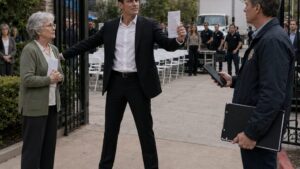
Donald Caldwell said it with one hand resting on George Harris’s fence and the other holding a thick white envelope against his chest, as if the paper carried enough weight to shift a ditch dug through hard ground more than a century ago.
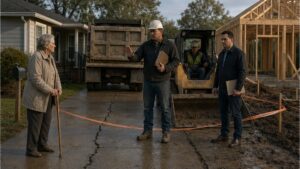
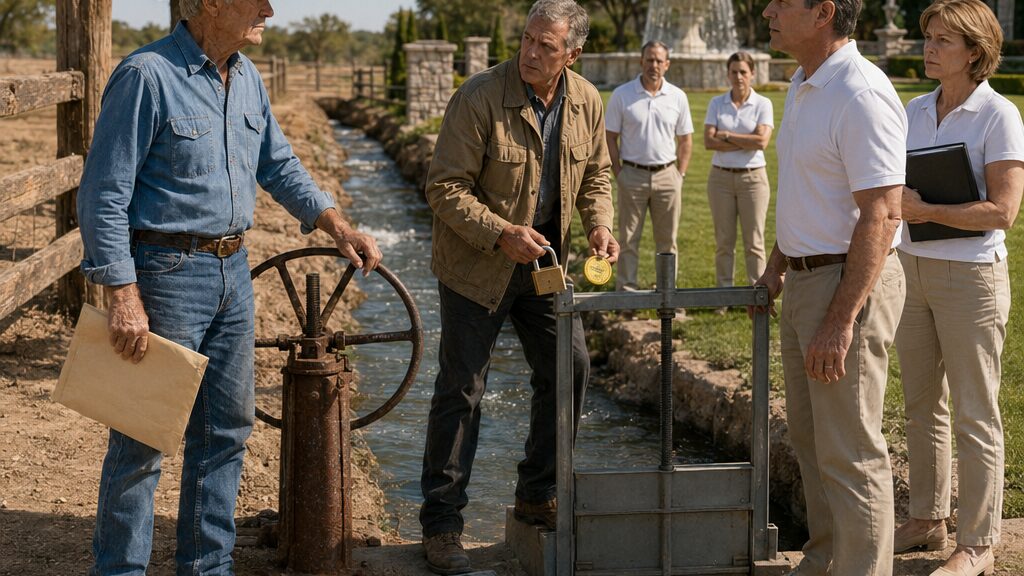
George looked past him at the three people in matching white polo shirts standing beside a polished utility cart. Beyond them, the irrigation water moved quietly through the narrow channel, clear over dark stones, making the same low scraping sound it had made every summer of George’s life.
“Move what?” George asked.
Donald’s smile tightened.
“The ditch.”
George glanced down at it. “Where to?”
“That’s for you to determine.”
Donald extended the envelope. George took it but did not open it.
The morning had already warmed the dust between the sagebrush. Donald’s white shoes remained clean because he had stopped on the gravel. George’s boots were dark with ditch mud. His faded blue shirt was damp along the spine from clearing willow roots before sunrise.
Donald pointed toward the development rising beyond the east fence. Stone columns framed its entrance. Young cottonwoods stood in exact rows. A fountain threw silver water above a bed of red flowers.
“The board has classified this channel as an aesthetic and safety violation,” he said. “It conflicts with the community landscape plan, and it presents an open-water hazard within our visual corridor.”
George looked at the ditch again.
A grasshopper landed on the rusted iron control wheel beside him. The cast numbers on its center hub—1897—were worn smooth at the edges but still readable.
“Our visual corridor,” George repeated.
Donald stepped closer. “You know what I mean.”
“I know those words.”
One of the board members shifted, but none spoke.
Donald tapped the envelope with two fingers. “Beginning Saturday, the association will assess two hundred dollars per day until the violation is corrected.”
George opened the envelope. The top page bore the development’s blue-and-gold seal. Beneath the words CEASE AND DESIST was a color map showing the eastern boundary of his ranch as a straight line. The ditch appeared as a blue curve crossing a shaded area labeled COMMON LANDSCAPE BUFFER.
The map left out the iron wheel, the headgate, the maintenance road, and the easement strip his family had walked since horses pulled the first scraper through the soil.
George folded the pages once.
“Your map’s missing something.”
Donald glanced toward the paper. “It was prepared from the county parcel layer.”
“Then the county layer’s missing something.”
“We’ve had counsel review it.”
George looked at him. “Did counsel come out here?”
Donald’s expression hardened. “This isn’t a negotiation about history. The board is giving you an opportunity to correct the problem voluntarily.”
The word voluntarily made one of the silent board members look down.
George tucked the envelope beneath his arm.
Donald stepped over the shallow line where George’s gravel met the ditch road. “We’ve tried to be reasonable. We have residents complaining about stagnant water, mosquitoes, erosion—”
“The water’s moving.”
“Residents perceive it as stagnant.”
“That doesn’t slow it down.”
Donald inhaled through his nose. He was a man accustomed to meetings where everyone waited for him to finish. George had seen him at the feed store once, correcting a cashier over nine cents.
“This community represents a substantial investment,” Donald said. “People bought homes based on a certain standard. They shouldn’t have to look at scrap metal and an open trench.”
He pointed at the control wheel.
The grasshopper jumped away.
George’s great-grandfather had installed the wheel after a spring flood tore out the original wooden gate. George’s father had replaced the spindle in 1968. George had packed grease into the housing every April for fifty-one years.
Donald reached out and pinched the front of George’s shirt between two fingers.
“You need to understand the seriousness of this.”
George caught his wrist, removed the hand from his shirt, and let go.
“Keep your hands off me.”
The utility cart’s electric motor clicked as one board member shifted his foot against the pedal.
Donald stared at George’s hand, then at his face. For the first time that morning, his confidence appeared to require effort.
“You just put your hands on the president of the association.”
“You put yours on me first.”
“This can become more complicated than it needs to be.”
“It already has.”
Donald stepped back across the gravel line. He brushed the front of his polo as though George had left dust there.
“We will document your refusal.”
George lifted the envelope. “You already printed it.”
Donald turned toward the others, then stopped.
“And do not interfere with any community infrastructure while this matter is under review.”
George’s attention sharpened.
“What infrastructure?”
Donald pointed east, toward a low concrete box partly hidden behind ornamental junipers. A steel stem rose from it, painted the same green as the landscaping equipment inside the development.
“Our irrigation diversion.”
“Your what?”
Donald’s smile returned. “The side gate. It has served the community for twelve years.”
George walked toward the concrete box. Donald followed, talking about established use, maintenance costs, and board responsibility, but George barely heard him.
A narrow steel gate had been cut into the ditch bank. Water slipped through it into a buried pipe leading beneath the fence. The installation was tidy. The bolts were newer than the concrete. A small brass plate named the contractor, but there was no permit number.
George crouched and ran one thumb along the flange.
He remembered his father complaining about unexplained water loss during the last dry years of his life. At the time, George had blamed seepage and a cracked measuring weir.
“Who signed for this?” he asked.
Donald folded his arms. “The developer installed it.”
“Who signed on my side?”
“The gate predates the current board.”
“That wasn’t my question.”
Donald glanced at the board members. “The association has maintained continuous use.”
George stood slowly. The old wheel was visible behind him, rust-red against the pale ground.
Donald gestured toward the ditch. “Move the channel, leave the gate connection intact, and the board may consider waiving the initial penalties.”
George looked from the unauthorized steel flange to the map in his hand.
The blue line on the HOA document did not merely omit the easement. It bent around the side gate, placing the diversion entirely inside community property.
That was not an error made by someone who had never visited.
George returned to the wheel. Donald and the others climbed into the utility cart. Before leaving, Donald called across the dust.
“Friday, Mr. Harris. After that, the fines are automatic.”
The cart rolled toward the stone entrance.
George waited until it disappeared behind the cottonwoods. Then he opened the metal toolbox mounted beside the headgate. Beneath grease rags, spare bolts, and a cracked measuring stick lay a small oilskin notebook that had belonged to his father.
The cover had stiffened with age. Several pages were filled with flow figures and repair dates. Near the back, in handwriting that slanted harder with every line, George found a note beside a rough drawing of the eastern boundary.
New people asking about access. Told them no promises without records. George—if they push, county book, page 41.
George read the line twice.
Then he looked east, where the fountain rose above the wall in the morning sun, and wondered how much of its water had crossed his land without anyone ever asking.
Chapter 2: The Gate Nobody Had Permission to Open
Water was pouring beneath the development’s stone monument.
George saw it through a grated inspection opening near the entrance, moving fast enough to tremble the ornamental grasses planted around it. The pipe from his ditch ran directly under the wall and divided somewhere below the lawn.
Donald stood near the koi pond with two board members and a landscape contractor. He had changed nothing about his appearance since the morning confrontation except the addition of sunglasses.
“You were instructed not to interfere,” he called.
“I haven’t touched it.”
George stepped off the paved walking path and knelt beside the grate. The sound below was stronger than it had been at the side gate. This was not a minor landscape tap. It was a distribution line.
The koi pond covered nearly half an acre. Orange and white fish moved beneath a wooden footbridge. Beyond it, rotating sprinklers cast overlapping arcs across a lawn wide enough for a school playground. Two fountains operated at the entrance, and farther uphill a green water tank stood behind a screen wall.
George pointed toward the tank. “That fed from the same line?”
Donald removed his sunglasses.
“Our irrigation system is integrated.”
“That tank for irrigation too?”
“It provides landscape storage and emergency reserve.”
George stood.
The landscape contractor stopped adjusting a sprinkler head.
“How much reserve?”
Donald’s jaw shifted. “That information isn’t relevant to your violation.”
“It’s relevant to the gate.”
“The gate is association property.”
“The steel may be. The opening isn’t.”
Kimberly Clark came down the path carrying a binder against her chest. George recognized her as the board member who had looked away when Donald used the word voluntarily.
Donald turned to her. “Did you bring the maintenance agreement?”
Kimberly opened the binder but did not remove anything.
“I brought the invoices.”
“That isn’t what I asked.”
“The agreement isn’t in the current records.”
Donald’s face remained controlled. “We have established use.”
Kimberly looked toward George, then back at Donald. “Do we have an updated water opinion?”
“We have counsel.”
“The opinion in the archive is old.”
“Kimberly.”
She closed the binder.
George walked toward the pond’s intake box. A bronze plaque on the lid read DESERT VIEW COMMUNITY WATER FEATURE—DEDICATED 2013. He counted backward. Twelve years.
The same year his father had started recording unusual summer losses.
Donald moved between him and the intake.
“You are trespassing on private common property.”
“You invited me to look at what you wanted moved.”
“I invited you to understand the community’s standards.”
George looked across the bright green lawn. Beyond the development wall, his pasture grass stood pale and short. The difference was not simply money. It was water applied daily without anyone asking where it ranked when the river ran low.
“How many acre-feet do you pull?” he asked.
Donald gave a short laugh. “This is exactly the attitude that makes cooperation impossible. You speak as though you own every drop passing your fence.”
“I don’t.”
Donald spread his hands toward the pond, confident again. “Then we agree.”
George looked at him.
“I said I don’t own every drop. I said nothing about who gets it first.”
The contractor straightened.
Kimberly’s grip tightened around the binder.
Donald’s smile faded by a fraction. “First according to whom?”
“The recorded date.”
“What recorded date?”
George let the question hang.
A sprinkler rotated behind Donald and darkened one shoulder of his white polo. He stepped aside, irritated, while the board members pretended not to notice.
George walked to a low valve enclosure near the pond. The pipe diagram inside had faded, but he could still trace the system: side diversion, filter vault, pond circulation, landscape mains, reserve tank.
The green line from his ditch fed all of it.
He closed the enclosure.
Donald followed him toward the entrance. “Any attempt to restrict community water will result in immediate legal action.”
“Legal action based on what right?”
“Continuous beneficial use.”
“You filed that use?”
“The developer handled the entitlement.”
“You seen it?”
Donald stopped walking.
“The association acquired all necessary infrastructure rights when control transferred from the developer.”
“That answer come with a page number?”
Donald’s voice lowered. “You should be very careful about making accusations.”
“I’m asking where the paper is.”
Kimberly came up behind them. “Donald, we should postpone enforcement until counsel confirms the diversion.”
He turned on her. “The enforcement concerns an aesthetic violation. They are separate matters.”
“They share the same ditch.”
“They do not share the same authority.”
George watched Kimberly. She was not defending him. She was trying to keep the board from stepping farther into something she already suspected was dangerous.
Donald faced George again.
“You will receive a second notice this afternoon. It will include resident complaints regarding mosquito exposure, bank instability, and reduced market appeal.”
“The bank isn’t unstable.”
“Our engineer will determine that.”
“You have an engineer?”
“We will retain one.”
George almost smiled.
Instead, he removed the folded HOA map from his pocket and held it beside the real boundary. On paper, the ditch crossed a shaded community buffer. On the ground, old survey pins ran outside the wall, following the maintenance road.
“The map moves my line twenty-three feet,” he said.
Donald barely looked. “Parcel displays are approximate.”
“Not where your gate is.”
“Enough.”
Donald raised his voice so the contractor and board members could hear.
“This association will not allow one landowner’s neglected infrastructure to threaten hundreds of families.”
A resident walking a small dog slowed near the pond.
Another person emerged from the clubhouse.
George understood the purpose of the volume. Donald was no longer speaking to him. He was creating the first public version of the dispute.
George folded the map.
“You ought to check what you bought before you tell me what I own.”
Donald pointed toward the exit. “Leave.”
George did.
By the time he reached his truck, his phone vibrated. An email had arrived from the HOA office with the subject line PUBLIC SAFETY NOTICE—EASTERN DITCH CORRIDOR. It warned residents to avoid the ranch boundary and described the ditch as an unregulated hazard under active enforcement.
Attached was the same altered map.
George sat behind the wheel and read it twice. His first impulse was to answer every false statement in a single reply. He could have photographed the survey pins, the maintained banks, the measuring wheel, and the clean water.
Instead, he locked the phone and placed it facedown on the seat.
His father had once told him that arguing before you had the record was just giving the other man time to improve his lie.
George drove past the stone entrance. Donald stood beneath the monument, speaking to two residents while the fountains rose behind him.
George slowed enough to lower the window.
Donald looked over.
“You do not own this water,” George said.
Donald gave a dismissive laugh. “Neither do you.”
“No,” George said. “But you built below my first date.”
Then he drove toward the county seat, leaving Donald beside the fountain with one hand still lifted and no answer ready.
Chapter 3: Page Forty-One Beneath the Green Lamp
“The original ditch book isn’t here.”
The county records clerk said it before George had finished writing the district name on the request slip.
He stood at the counter beneath fluorescent lights, his hat in his hands. The courthouse clock showed six minutes past four. The office closed at five.
“Where is it?” he asked.
“Off-site storage, possibly.” The clerk adjusted her glasses and studied the slip. “Some water ledgers were moved after the basement leak. Others went to imaging.”
“Can you check?”
“I am checking.”
She turned to her computer. George looked past her at rows of gray file cabinets and shelves holding bound volumes with cracked leather spines. The office smelled of paper, dust, and the lemon oil used on the old wood counter.
He had not been inside the records room since his father’s estate was settled. Back then, he had signed where the attorney pointed and left before anyone could begin discussing development offers.
The clerk typed for several seconds.
“Harris Ditch,” she said. “Established eighteen ninety-seven?”
“March third.”
She glanced at him.
“You know the priority date?”
“My father did.”
“That helps.”
She disappeared through a door marked STAFF ONLY.
George checked the time again. On his phone, the HOA’s public safety notice had already been forwarded twice by neighbors outside the development. One message asked whether he had been ordered to fill the ditch. Another asked whether children had fallen into it.
He did not respond.
The clerk returned carrying a cardboard archive box.
“Not the original book,” she said. “Microfilm copy, index cards, and a decree abstract. The easement references may be in the road records.”
“Page forty-one.”
She paused. “Of what?”
“I was hoping you’d tell me.”
For the next forty minutes, they worked beneath a green banker’s lamp at a side table. The microfilm reader hummed. Dates and handwritten names slid across the screen, some backward, some blurred at the edges.
George found the decree abstract first.
HARRIS DITCH COMPANY. Priority date: March 3, 1897. Point of diversion described by survey bearings. Irrigated acreage: amended twice. Senior use recognized subject to annual call and beneficial application.
The language was dry, but the effect was physical. Something inside George’s chest, tight since Donald’s hand had closed on his shirt, loosened slightly.
“Still need the easement,” the clerk said.
The road record index led to an old subdivision plat filed when the ranch was larger. Page forty-one showed a twenty-five-foot maintenance corridor following the ditch, including the exact ground the HOA map shaded as common landscape buffer.
More importantly, a handwritten notation referenced all later parcels as subject to the ditch easement and access for operation, inspection, repair, and lawful conveyance.
George leaned closer.
The side gate sat directly inside that corridor.
The clerk made certified copies. While the machine warmed, George searched later filings for any transfer, license, or shared-use agreement.
Nothing appeared under the HOA’s name.
Nothing appeared under the developer’s name.
At 4:57, the clerk set the copies on the table.
“This confirms the easement and priority,” she said. “It doesn’t tell you whether later permits exist with the water district.”
“I know.”
“And it doesn’t decide current administration.”
“I know that too.”
She looked at him over her glasses. “People come in here every summer thinking an old paper gives them permission to turn a river off.”
George met her eyes. “I’m not trying to turn off a river.”
“What are you trying to turn off?”
He thought of Donald’s fingers on his shirt, the altered map, the phrase neglected infrastructure spoken loudly enough for residents to hear.
“A gate nobody asked for.”
The clerk stamped the final copy.
Outside, the courthouse steps still held the day’s heat. George sat in his truck and called the district office. A recorded voice instructed senior users seeking administration to submit a formal call with evidence of current need, diversion capacity, and priority documentation.
He drove home in the dark.
At his kitchen table, he spread the decree, easement, HOA map, and old notebook beneath a hanging lamp. Then he opened a county satellite archive on his computer and moved year by year through aerial images.
The side gate first appeared as disturbed earth twelve summers earlier.
The following image showed the pipe trench.
Every year after that, the lawn inside the development became greener while a thin wedge of George’s lower pasture faded earlier than the rest.
He printed each image.
At midnight, the printer jammed. He pulled out a wrinkled sheet, cleared the rollers, and began again. He made two complete sets: one for the district and one for himself.
The repetition calmed him. Decree. Easement. Plat. Satellite image. Maintenance log. Flow records.
Near two in the morning, he found a photograph tucked into the back of his father’s notebook.
His father stood beside the iron wheel wearing a denim coat, one hand on the rim. A younger George was visible in the background, half turned away, angry about something he could no longer remember.
On the reverse, his father had written: Water makes neighbors whether they like it or not.
George placed the photograph beside the decree.
Then he returned to the notebook and found several pages stuck together by old oil. He separated them carefully.
The first page listed unexplained flow losses.
The second contained the names of two representatives from the original development company.
Met with them at the house. Offered measured seasonal access if they pay maintenance and accept shutoff in shortage. They want permanent flow and no meter. Told them no.
George sat back.
His father had never mentioned a meeting.
Below the entry, another sentence continued onto the next page, but the paper had folded inward near the binding. George could make out only the beginning.
If George ever has to settle this—
His phone rang.
It was the district’s after-hours intake line returning his message. The official asked whether his current ranch demand exceeded available flow and whether a junior diversion was operating upstream or from his conveyance system.
George looked at the satellite photographs spread across the table.
“Yes,” he said.
“Do you have documentation of priority?”
“Yes.”
“We can accept an electronic filing tonight. A commissioner will review it in the morning.”
George opened the form.
For one moment, his eyes returned to the unfinished sentence in his father’s notebook.
If George ever has to settle this—
He could have read the rest first.
Instead, he attached the decree, the page forty-one easement, the flow records, and the twelve years of photographs. He signed the declaration, checked the box requesting immediate administration, and submitted a formal call on the river at 2:41 a.m.
The confirmation arrived seconds later.
Only then did George unfold the damaged page.
But the bottom half remained stuck beneath the binding, and pulling harder would tear it.
He closed the notebook without reading the rest.
Chapter 4: The Yellow Seal Across the Water Gate
The white government truck reached the ditch before the sun cleared the low ridge.
George was already beside the iron wheel, holding a mug he had forgotten to drink from. The water ran below him in a narrow, steady sheet. Upstream, the light was still gray. Downstream, the development’s fountain rose above the wall as if nothing had changed.
Mark Johnson stepped from the truck wearing work boots, tan trousers, and a faded district jacket. He carried a metal case in one hand and George’s filing in the other.
“You George Harris?”
“Yes.”
Mark looked at the wheel, the ditch bank, and the concrete side gate without offering a handshake.
“You filed an immediate call at two forty-one this morning.”
“I did.”
“You’re claiming current beneficial need on the ranch and interference from a junior diversion.”
“Yes.”
Mark set the case on the truck hood. “I’m going to inspect the point of diversion, your measuring structure, your current use, and the downstream gate. I’m not here to settle a property dispute.”
“I didn’t ask you to.”
Mark glanced at him. “Most people say that before they ask me to.”
They began at the headgate. Mark checked the decree against survey coordinates, measured flow at the weir, and walked the easement with a handheld receiver. He asked George when the lower pasture had last received a full irrigation.
“Three weeks.”
“Why?”
“Not enough through the lateral.”
“You report the loss?”
“I thought it was seepage.”
Mark made a note.
At the side gate, he crouched beside the steel flange and scraped dirt away from the concrete base. A small brass installation plate emerged under the dust.
“No district tag,” he said.
George said nothing.
Mark opened his case and removed a level, measuring tape, and inspection mirror. He examined the gate stem and pipe alignment, then followed the buried line toward the development wall.
“The approved measurement point on the old plat is six feet upstream,” he said.
“This gate’s below it.”
“Fourteen feet below it, and outside the recorded control structure.”
“Meaning?”
“Meaning whoever installed it bypassed the place where diverted flow was supposed to be measured.”
George looked toward the fountain.
Mark straightened. “That does not automatically prove theft.”
“I didn’t use that word.”
“You were thinking it loud enough.”
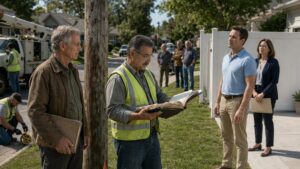
A utility cart appeared beyond the fence. Donald drove, with Kimberly beside him. Two board members followed in a second cart.
Donald stopped on the development side of the gate.
“What is happening here?”
Mark showed his identification. “District water administration.”
Donald’s gaze moved to George. “You filed against the community without notifying us?”
“You notified me Monday,” George said.
Donald got out of the cart. “Our counsel will need to be present before any action is taken.”
Mark turned toward him. “Counsel is welcome to observe. Administration doesn’t wait for counsel to arrive.”
Donald held up both hands in a gesture meant to appear reasonable. “The association has used this diversion continuously for more than a decade. Hundreds of residents rely on it.”
“For domestic supply?” Mark asked.
“Community infrastructure.”
“That wasn’t my question.”
Donald hesitated. “Landscape irrigation, water features, reserve capacity.”
Mark looked at Kimberly. “Do you have a permit, change decree, carriage agreement, or recorded authorization from the senior user?”
Kimberly opened her binder. “We have maintenance invoices and installation records.”
“Authorization?”
She looked at Donald.
Donald answered. “The developer transferred all necessary rights.”
“Show me the transfer.”
“Our records are being reviewed.”
Mark nodded once, as if Donald had confirmed something rather than answered.
He walked back to George’s side and reread the decree. Then he checked the current river call sheet on his tablet.
“Your priority date is senior to the diversions currently shorting the ditch,” he told George. “Your demand is within the decreed acreage and season. The call is valid pending continued measurement.”
Donald stepped forward. “You cannot cut off a residential community over one man’s complaint.”
Mark closed the tablet.
“I can administer priority. That’s my job.”
“The consequences will be enormous.”
“The consequences existed before I got here.”
For the first time, George saw uncertainty pass openly across Donald’s face.
Mark removed a heavy brass padlock, a length of chain, and a yellow district seal from his case. He threaded the chain through the side-gate wheel and around the steel frame.
Donald moved toward him.
“I am instructing you not to alter association property.”
Mark stopped and looked at him.
“You may instruct your board. You may instruct your attorney. You may not instruct this office to ignore a valid senior call.”
He closed the padlock.
The snap of the shackle was quieter than George expected.
Mark attached the yellow seal so it lay across the gate mechanism. Black lettering warned that unauthorized removal carried penalties under state water law.
No one spoke.
Behind the wall, the fountain continued to run.
Mark turned to George. “Your main gate stays within the measured setting we just established. You don’t increase it. You don’t touch their sealed gate. You keep daily records.”
George rested one hand on the iron wheel.
“How long?”
“Until the shortage ends, the call is released, or another lawful arrangement is approved.”
Donald pointed at George. “He is doing this to retaliate.”
Mark looked at the grease on George’s hand, then at Donald’s white shoes.
“His motive doesn’t change the priority date. His conduct from this point forward might.”
The board members drove away first. Kimberly remained for several seconds, staring at the yellow seal.
“We need to know how much time we have,” she said.
Mark answered before George could.
“That depends on your storage, your consumption, and whether the figures you gave residents were accurate.”
Kimberly’s face tightened. “Donald?”
He climbed into the cart. “We will address this through counsel.”
By noon, the difference at the ditch was visible. Water that had disappeared into the side pipe continued downstream instead, filling the shallower reaches beyond George’s ranch. The current lifted dry leaves from stones and carried them toward the river.
George opened his lower lateral and watched water spread into the first pasture furrow. The ground darkened in a slow widening line.
He expected satisfaction.
What he felt was closer to relief, and even that did not last.
At two, a landscape contractor parked outside the development and began shutting sprinkler zones. At three, workers lowered the fountain pumps. By evening, the koi pond had dropped enough to leave a pale ring around the stone edge.
The next morning, the lawn lost its gloss.
By Thursday, yellow blades appeared along the south slope. One entrance fountain coughed air between bursts. The second stopped completely, leaving only a wet stone basin beneath the monument.
Cars slowed to look.
Donald arrived at George’s fence shortly before sunset. He did not wear the white polo. His sleeves were rolled, and his face was flushed.
“You’re killing our property values.”
George stood on the other side of the wire, replacing a broken fence staple.
“I didn’t build your houses on a fountain.”
“We have listings under contract. We have families calling the management office. The pond aerators are failing.”
“Then use the water you have rights to.”
“You know perfectly well there isn’t enough.”
George drove the staple into the post.
Donald gripped the fence wire. “You waited twelve years.”
“I found the gate Monday.”
“You found a reason.”
George looked up.
Donald’s anger had something frightened beneath it now.
“If this community loses insurability,” Donald said, “people will lose their homes. Not vacation houses. Homes.”
“You should’ve thought of that before sending me a fine.”
“You think everyone behind that wall wrote the notice?”
“No.”
“Then act like it.”
Donald walked back toward his car.
The words remained after the engine started.
An hour later, headlights turned onto the ditch road. Not one vehicle but six. They stopped along the fence, raising dust that drifted through the beams.
A woman got out of the first car carrying a printed warning with a red bar across the top. Several residents followed her. One held a child’s bicycle helmet. Another carried an empty plastic water jug, though the homes still had domestic water.
The woman came directly to the fence.
“I’m Amanda Wilson,” she said. “Our reserve tank dropped below the fire district recommendation this afternoon.”
George looked toward the development’s green tank.
Amanda held the warning through the wire.
“Did you know that would happen when you filed?”
Chapter 5: The Residents Who Never Saw the Warning
Amanda did not lower the paper.
Behind her, residents stood in a loose line along the fence, uncertain whether they had come to demand something or witness it. The red warning bar shook slightly in her hand.
George read the first paragraph.
The domestic system was separate, but the development’s irrigation reservoir supplemented exterior fire protection. With the side gate sealed, reserve capacity had fallen below the level used in the community’s emergency plan.
“Who sent this?” he asked.
“The management office.”
“Signed by the fire district?”
“No.”
“Then it isn’t a fire district order.”
Amanda’s mouth tightened. “Does that mean the tank isn’t low?”
George handed the paper back.
“No.”
A man behind her called, “He knew.”
Another resident said, “Donald told us he planned this for months.”
George looked along the line of faces. They were not the uniform board bloc from Monday. A woman still wore hospital scrubs. An older man leaned on a cane. One couple had brought their teenage son, who stared at the ditch rather than at George.
Amanda stepped closer to the fence.
“My husband died four years ago. I’m carrying the mortgage by myself. I don’t care about the fountain. I care that my insurance company sees a reserve warning and decides my house is a different risk.”
“I didn’t issue the warning.”
“You shut the gate.”
“The district shut it.”
“Because you called.”
George could have explained the priority system. He could have shown her the decree, the altered map, the unauthorized flange. Instead, Donald’s sentence returned to him.
You think everyone behind that wall wrote the notice?
“I called because my pasture was being shorted,” George said.
Amanda searched his face. “That wasn’t my question.”
The directness irritated him because it was deserved.
“Did you know?” she repeated.
“I knew the pond would drop. The lawns. The fountains.”
“The reserve?”
“I saw the tank on their diagram. I didn’t know the operating level.”
“But you didn’t ask.”
“No.”
The group grew quiet.
George felt the truth land without helping him.
A vehicle approached from the development side and stopped at the gate. Donald emerged with Kimberly and the two board members. He had timed his arrival well enough that George wondered who had called him.
Donald addressed the residents first.
“We are working around the clock to restore service. Unfortunately, Mr. Harris has refused all attempts at reasonable cooperation.”
George’s hand tightened around the fence staple he still carried.
Amanda turned. “What attempts?”
Donald gestured toward George’s land. “The board has sought a practical resolution for years.”
George laughed once.
Donald faced him. “Do you deny that your father discussed community access with the developer?”
Several residents looked back at George.
He thought of the notebook entry.
Offered measured seasonal access if they pay maintenance and accept shutoff in shortage.
“That wasn’t an agreement,” George said.
“It was negotiation.”
“They refused the meter.”
Donald spread his hands. “According to your private notes.”
Kimberly shifted beside him.
Amanda noticed.
“What do the association records say?” she asked.
Donald answered without looking at Kimberly. “They establish long-standing use and infrastructure investment.”
“That is not what she asked,” George said.
Donald’s tone hardened. “You have made your point. The community now understands you possess leverage. Release the call, and we can discuss compensation for the ditch relocation.”
George stared at him.
“Still want it moved?”
“It remains an aesthetic and safety issue.”
A resident near the back muttered something under his breath.
Amanda folded the reserve warning. “You told us the ditch had no legitimate claim against the community.”
Donald turned toward her. “The property issue and water administration are separate legal questions.”
“They run through the same gate.”
It was almost exactly what Kimberly had said beside the koi pond.
This time Kimberly opened her binder.
“We need an emergency meeting,” she said.
Donald looked at her. “Not here.”
“Tonight.”
“We have counsel reviewing options.”
“We have residents standing at a fence because they learned about the reserve from a mass email.”
Donald lowered his voice. “Kimberly.”
She did not close the binder.
George watched the division form—not between the ranch and the development, but inside the board itself.
Amanda looked at him again. “Can you release enough water to bring the reserve above the warning level?”
Mark had been clear. George could release his call, modify it, or enter a temporary arrangement, but he would need measurements.
“How much?” George asked.
Kimberly checked a sheet. “The emergency plan calls for two hundred thousand gallons above current storage.”
Donald cut in. “And restoration of minimum pond circulation. The fish are already under stress.”
“No,” Amanda said.
Everyone looked at her.
“The fish can be moved. The lawn can die. We’re asking about safety.”
Donald’s face changed, not dramatically, but enough. Amanda had removed the decorative losses from the argument he wanted to make.
George looked toward the iron wheel. The rim held the last light of evening along one rusted edge.
He did not like being pushed. He liked being watched even less. Part of him wanted to tell them the gate would remain sealed until the district released it and that their emergency plan was not his responsibility.
Then he remembered the photograph on his kitchen table.
Water makes neighbors whether they like it or not.
“I’ll call Mark,” he said. “If he approves a measured temporary release for the reserve, I won’t object.”
Donald stepped forward. “The system cannot be operated in fragments.”
“It can tonight.”
“You are not qualified to manage our infrastructure.”
George looked at the silent fountain behind him.
“That makes two of us.”
Amanda almost smiled, but stopped herself.
Mark arrived after dark with an irrigation-company technician. Under portable work lights, they installed a temporary meter on a bypass connection upstream of the sealed gate. Mark recorded the opening, the required volume, and the condition that no water be diverted to ornamental zones.
Donald objected twice.
The second time, Mark handed him the written order and asked him to point to the line authorizing pond circulation.
Donald said nothing more.
George turned the old iron wheel by less than a quarter rotation. Water pressed into the bypass with a deep metallic shudder. The meter began counting.
Amanda stood beside the technician, watching each digit.
“That sound normal?” she asked.
“It’s an old gate,” George said. “Old doesn’t mean broken.”
When the required volume had passed, George closed the wheel to the measured setting. The reserve tank began to recover. The pond remained low. The fountain remained silent.
For the first time since Monday, the wheel no longer looked like a weapon or an ornament. It looked like a control that had to be understood.
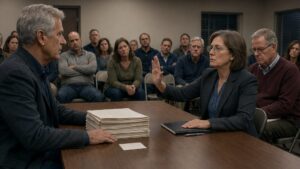
The emergency HOA meeting began at nine in the clubhouse.
George had not planned to attend. Amanda told him that staying outside would make it easier for Donald to describe his motives, so he sat in the back row beneath a framed photograph of the entrance fountain in its first year.
Nearly every chair was filled.
Donald stood at the front with a microphone. He described the temporary release as proof that the crisis could be solved through cooperation if George would abandon “punitive enforcement.”
George felt heads turn toward him.
Donald displayed a photograph of the iron wheel on the screen.
“This obsolete structure controls infrastructure serving hundreds of residents.”
George looked at the enlarged rust stains, the worn numbers, the grease around the spindle. The photograph had been taken from an angle that excluded the maintained banks and measuring weir.
Amanda raised her hand.
Donald did not call on her.
Kimberly sat at the board table with her binder open.
Donald continued. “The association has paid for maintenance and operated the diversion openly for twelve years. Mr. Harris’s sudden action was not prompted by a new shortage. It followed an enforcement notice.”
“That’s not the whole sequence,” Kimberly said.
The room went still.
Donald turned away from the microphone. “We agreed counsel would present the timeline.”
“No,” Kimberly said. “You agreed.”
A board member leaned toward her and whispered something.
Kimberly slid a document from the binder. “I will not certify the statement that the association believed its water access was secure.”
A murmur moved through the room.
Donald’s face remained composed, but one hand flattened against the table.
“We had a legal-use opinion.”
“An old one.”
“We had continuous use.”
“We also had unanswered questions.”
Amanda stood. “How long?”
Kimberly looked at her.
“Longer than this week.”
Donald reached toward the microphone. “This discussion is moving into privileged material.”
Kimberly closed the binder, but she did not withdraw the document.
George watched her struggle. She was afraid—not of him, but of what her own signature might mean.
The meeting dissolved into overlapping questions. Assessments. Insurance. The altered map. The reserve tank. The fine notice. Donald called for order until the microphone squealed.
George left before the shouting ended.
Outside, he leaned against his truck and listened to the clubhouse doors open and close behind him.
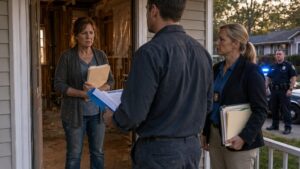
Amanda emerged ten minutes later, followed by Kimberly.
Kimberly carried a sealed brown envelope.
She stopped several feet from George.
“I signed the first notice,” she said.
“I saw.”
“I told myself it was only about appearance.”
“It wasn’t.”
“No.”
She handed the envelope to Amanda rather than to him.
Donald appeared in the clubhouse doorway.
“Kimberly,” he called.
She flinched, but did not take the envelope back.
Amanda looked down at it.
“What is this?”
Kimberly’s voice was barely above the sound of the dry fountain pumps cycling uselessly near the entrance.
“A consultant’s memorandum Donald told us not to circulate.”
Chapter 6: The Memorandum Buried Under Property Values
Donald had placed a settlement agreement in front of George before Kimberly finished reading the first page of the memorandum.
They sat the next morning in a county mediation room with beige walls, a long laminate table, and no windows. Mark occupied one end. A county mediator sat at the other. Amanda and Kimberly were together on one side. Donald sat opposite them with the two board members and a stack of documents aligned squarely before him.
The proposed agreement was six pages long.
George read only the first two provisions before pushing it away.
Permanent access. No seasonal shutoff except by state order. No meter controlled solely by the senior user. Release of all claims arising from prior diversion. In exchange, the HOA would withdraw its aesthetic fine and pay a one-time maintenance contribution.
Donald folded his hands.
“This resolves the immediate conflict.”
“It takes my right and gives me back a fine you couldn’t collect.”
“It recognizes your historic interest while protecting the community’s reliance.”
“It recognizes the pipe.”
The mediator raised a hand. “Let’s keep the language practical.”
George tapped the document. “This is practical. It says permanent.”
Donald leaned back.
“People cannot finance homes around a water supply one individual can interrupt whenever he feels insulted.”
George’s chair scraped as he shifted forward.
Mark spoke before he could answer.
“The call was valid. Let’s not rewrite that.”
Donald turned to him. “Valid does not mean responsible.”
“No,” Mark said. “It means valid.”
Kimberly unfolded the consultant’s memorandum. Her fingers trembled at the corners.
The report was dated two years earlier. It had been commissioned during an insurance review of the development’s reserve system.
She read aloud.
“‘The association’s diversion appears to operate through a private conveyance subject to an 1897 easement and senior appropriation. No recorded carriage agreement or permanent diversion authorization was located. Continued reliance without formalization presents material interruption risk.’”
The room changed.
No one moved, but the settlement in front of George no longer looked like an offer. It looked like an attempt to erase two years of known exposure.
Kimberly continued.
The consultant had recommended a metered seasonal agreement, payment toward ditch maintenance, drought-stage restrictions, and a separate source for ornamental landscaping.
Exactly the terms George’s father had written in his notebook.
Amanda stared at Donald.
“You knew.”
Donald’s answer came carefully.
“I knew a consultant had raised a concern. Consultants identify risk. Boards decide which risks require immediate action.”
“You told us our water access was permanent.”
“I told residents the association had long-standing infrastructure rights.”
“That isn’t the same thing.”
“The distinction would have caused panic without changing the physical reality. Water had flowed for twelve years.”
Kimberly turned the final page.
“My written objection is attached.”
One of the board members looked at her. “You agreed not to circulate privileged advice.”
“I agreed to let counsel review it. I did not agree to tell residents it didn’t exist.”
Donald’s composure cracked.
“You signed every budget that relied on that water.”
Kimberly swallowed. “Yes.”
The admission landed harder than a denial would have.
George looked at her. Until then, he had placed her on the cleaner side of the table. Her face made clear she did not place herself there.
Donald saw the opening.
“This is what I have been trying to explain. Every person in this room made decisions based on continuity. The board funded roads, reserves, and landscaping under that assumption. Mr. Harris himself watched the community use the gate for years.”
“I didn’t know it was there,” George said.
“You knew your ditch was losing water.”
“I thought the channel leaked.”
“And when you discovered otherwise, you did not call us. You filed at two in the morning.”
George felt Amanda look at him.
Donald leaned forward.
“You wanted the seal. You wanted the fountain to stop where everyone could see it.”
The accusation was not entirely false.
George’s silence stretched long enough to become an answer.
The mediator removed her glasses.
“Mr. Harris?”
George looked at the iron handle lying beside his papers. He had brought it from the old wheel to show the control structure’s maintenance requirements. The handle was dark with oil and worn smooth where four generations of hands had gripped it.
“I wanted them to understand the ditch wasn’t trash,” he said.
Amanda’s expression changed slightly.
Donald sat back as if he had won something.
George continued.
“I wanted him to understand.”
He looked directly at Donald.
“That’s not the same as wanting every family behind the wall to lose water. But I didn’t make much room between the two.”
No one spoke.
Mark broke the silence by opening the district call sheet.
“Under current conditions, Mr. Harris can maintain the senior call through the hottest part of the month. His ranch demand remains within decree. The temporary reserve release does not waive priority.”
Donald turned toward George.
“There. You have what you wanted. Maximum leverage.”
George looked at the settlement again.
The easy response was to reject it and walk out. The law would continue carrying water past the sealed gate. Donald would absorb the blame until the residents replaced him, and George would never again need to explain why he had waited.
Amanda placed a sheet of paper beside the memorandum.
It was a list of monthly HOA assessments.
“We paid an extra charge for water security,” she said. “For three years.”
Donald’s eyes narrowed. “Those funds supported system resilience.”
“Where are they?”
“Allocated across reserve operations.”
Kimberly answered quietly. “Some went to entrance renovations and pond lining.”
Amanda closed her eyes for one second.
George saw the calculation behind her anger: mortgage, insurance, assessments already paid, another special assessment certain to come.
This was not a gathering of people protecting a fountain. It was a room full of people discovering they had purchased certainty that never existed.
The mediator asked for proposals.
Donald returned to the permanent-access agreement.
Kimberly proposed suspending the fines and hiring outside counsel.
Amanda asked for household and safety water first, with no ornamental use until the legal arrangement was resolved.
George said nothing.
The mediator finally turned to him.
“What terms would you consider?”
George picked up the iron handle.
“My father offered terms once.”
Donald’s expression sharpened. “There is no signed offer.”
“No. Developer didn’t want a meter.”
George described what he had found in the notebook: seasonal access, maintenance payment, shortage shutoff.
Kimberly glanced at the consultant’s report.
“The same structure,” she said.
“Near enough.”
Amanda asked, “Why didn’t your father finish it?”
“Because they wanted permanent flow without measurement.”
“And what did he want you to do?”
George looked down at the handle.
“I don’t know.”
That was not quite true. He knew the sentence existed. He had simply chosen not to uncover it before filing.
The mediator called a recess.
In the hallway, Amanda found him standing beside a drinking fountain that rattled whenever the compressor started.
“You could keep the call all month?” she asked.
“Yes.”
“Would your ranch use all of it?”
“Not every day.”
“But you could send the unused portion downstream.”
“That’s where it belongs.”
She nodded. “And none to us.”
“Not without an agreement.”
“I understand that now.”
Her lack of accusation made the next words harder.
“Did you really not read the rest of your father’s note?”
George looked at her.
“How do you know there was more?”
“You said you didn’t know what he wanted. You don’t strike me as someone who loses family papers.”
Before George could answer, Kimberly came through the mediation-room door.
She held several scanned pages the county clerk had emailed after receiving George’s request for help separating the notebook binding. The clerk had used a preservation light to reveal writing hidden beneath the fold in the photographed page.
Kimberly handed the pages to Amanda.
“I thought he should see this before we reconvene.”
George took them.
The recovered sentence appeared faintly beneath the oil stain.
If George ever has to settle this, tell him not to give away the date. But don’t let the date turn him into a man who can only say no.
Below it, his father had written one final line.
Measured water makes neighbors honest.
George read the words twice.
Through the mediation-room door, Donald’s voice could be heard telling a board member that the residents would accept the permanent agreement once they understood the cost of uncertainty.
Amanda stood beside George without touching the page.
“What are you going to do?” she asked.
He folded the copy along the old crease.
Inside the room, Mark was explaining that the sealed gate could remain closed for weeks.
George placed his hand around the worn iron handle and realized that the law had left the next movement entirely to him.
Chapter 7: The Day George Chose What the Right Was For
George tore Donald’s settlement in half.
The sound was sharp in the mediation room. One of the board members leaned back as though the paper had broken closer to his face.
Donald stared at the two pieces in George’s hands.
“So that is your answer.”
“No.”
George placed the halves on the table.
“That’s my answer to permanent access without a meter.”
The mediator looked from the paper to George. “Do you have another proposal?”
George set the old iron handle beside his father’s recovered note.
“Yes.”
Donald gave a tired, humorless laugh. “We have spent the morning listening to conditions from a man who can close our supply with one phone call.”
Mark corrected him. “The district closed an unauthorized diversion after a valid senior call.”
“Residents do not care which hand holds the padlock.”
Amanda sat forward. “They care that you knew the gate could be closed.”
Donald turned toward her. “And they will care more when their assessments double.”
“That may happen,” Amanda said. “But they should know why.”
Kimberly placed the consultant’s memorandum flat on the table. Her signature appeared beside the old budget approval, and she did not cover it.
George opened a blank legal pad.
“Household safety and emergency reserve get first consideration,” he said. “Not the pond. Not the entrance grass. Not the fountains.”
Donald shook his head. “You cannot dictate how the association uses its own system.”
“I can dictate what crosses my ditch easement under an agreement bearing my name.”
The mediator lifted a pen. “Continue.”
“A permanent meter at the side diversion. District-approved. Readings available to both sides.”
Mark nodded. “That can be certified.”
“Seasonal limit based on actual need. Automatic reduction when the river reaches shortage stages. Full shutoff if my senior acreage is shorted.”
Donald folded his arms.
“Who decides whether you are shorted?”
“The measuring structures do.”
George tapped the iron handle.
“That’s what measurement is for.”
Kimberly asked, “Maintenance?”
“The association pays a share of ditch inspection and repair proportional to the amount carried. No payment, no access after notice.”
One board member looked at Donald. “That was in the consultant’s recommendation.”
Donald ignored him.
George continued.
“The reserve tank can be filled to an agreed safety level. Household trees and small residential lots get a limited allocation. The common lawn gets reduced. Decorative water features stay off during shortage.”
“The pond contains living animals,” Donald said.
“Move them or maintain them from another lawful source.”
“The entrance is part of our property standard.”
“So is telling buyers the truth.”
Donald’s jaw tightened.
Amanda took the legal pad and scanned George’s notes.
“What happens in a normal water year?”
“Higher seasonal allocation, if the river and senior demand allow it.”
“And if you do not use all your share?”
“What I don’t lawfully divert continues downstream unless the agreement permits a measured portion to the community.”
Amanda looked at him carefully. “You would allow that?”
George glanced at his father’s sentence.
Don’t let the date turn him into a man who can only say no.
“Yes,” he said. “Under the meter.”
Donald pushed his chair back.
“This is not an agreement. It is submission to private control.”
George met his eyes.
“You sent me a notice ordering me to bury the structure that carries the water you depend on. You called it trash. Then you offered to forgive your own fine if I gave you permanent use.”
Donald’s face colored.
George’s voice remained level.
“I’m not asking you to submit. I’m asking you to measure.”
The mediator asked for a recess so the parties could draft terms.
Donald objected, but the other board members requested time to speak privately. Kimberly joined them only after Amanda asked her to remain involved. George stepped into the hallway with Mark.
“You understand what you’re giving up?” Mark asked.
“Some control.”
“More than some. Inspections. Joint records. Notice requirements. If you sign a carriage agreement, you can’t wake up angry and close the gate.”
“I didn’t close it angry.”
Mark looked at him.
George slipped the iron handle into his coat pocket.
“Not only angry.”
Mark nodded. “That’s closer.”
The residents gathered that afternoon in the clubhouse for a special vote. The entrance fountain remained empty outside. Its stone basin had dried to a pale chalk color, and leaves collected where water used to fall.
Donald stood before the room without the microphone.
He presented the proposed agreement as costly, restrictive, and uncertain. Those things were true. He warned that replacing ornamental water with a separate source would require a special assessment. That was likely true as well.
Then Kimberly read the consultant’s memorandum and described the budgets she had approved after receiving it.
“I told myself continuity was evidence,” she said. “It was only continuity.”
No one applauded.
Several residents looked down at the assessment sheets in their laps.
Amanda asked Donald whether he had directed management to describe George’s ditch as unregulated after reading the consultant’s warning.
Donald did not deny it.
“I was protecting the community from panic and declining values,” he said. “Once uncertainty enters a market, it becomes its own damage.”
A resident near the front asked, “So you hid the uncertainty?”
“I managed it.”
“You fined the person who could expose it.”
Donald looked toward George.
“The ditch remained an aesthetic problem.”
That answer decided more votes than the memorandum had.
The board rescinded the violation notice first. The motion passed with only Donald opposed.
The residents then voted to authorize the metered agreement, fund an independent system audit, and begin a recall process for the presidency. Donald remained seated while paper ballots were counted around him.
When the result was announced, he gathered his documents slowly.
At the door, he stopped beside George.
“You think they will thank you when the assessment arrives?”
“No.”
“When the lawns brown?”
“No.”
“When the first house sells for less?”
George looked through the open doors at the silent fountain.
“They shouldn’t have to thank me for not taking what’s theirs.”
Donald followed his gaze.
“And what is theirs?”
“That’s what we should’ve measured twelve years ago.”
The permanent meter was installed three weeks later.
The new assembly did not match the development’s landscaping. It was stainless steel, waist-high, and protected by yellow posts. A clear display showed the flow passing from the ditch into the community line. Beside it, a locked control box recorded every adjustment.
Mark inspected the installation with George, Amanda, Kimberly, and an irrigation-company technician present.
The yellow enforcement seal came off, but Mark did not hand it to anyone. He placed it back in his case.
“Temporary order is released,” he said. “Agreement controls from here.”
Amanda had been appointed chair of the resident water committee. She carried a clipboard and asked more questions than Donald ever had, including several George considered unnecessary.
He answered them anyway.
Kimberly handled the first maintenance payment. She no longer served as treasurer, but she stayed long enough to correct the prior budgets and provide records to the county administrative review.
Donald resigned before the recall vote was completed. No police came. No one escorted him from the clubhouse. He sold his house later that season, though not at the price he had once advertised.
On the first morning of the autumn allocation, George stood beside the 1897 wheel with Amanda.
The koi had been moved to a smaller lined pond supplied by a legal well. Most of the common lawn had been replaced with native grass. The fountains remained dry because the residents had voted not to pay for a separate decorative source.
The fire reserve was full.
George fitted the old handle into the wheel.
“Quarter turn,” he said.
Amanda checked the meter. “That gives us the agreed rate?”
“Once the pressure settles.”
She placed one hand on the opposite side of the rim.
Together they turned it.
The wheel resisted at first, then moved with a low iron groan. Water entered the metered pipe. The numbers on the display began to rise.
At the same time, most of the flow continued past the gate, through George’s lower pasture and on toward the downstream farms and river.
Amanda watched the two channels.
“It feels smaller than all the arguing.”
“Most real things do.”
She looked at the cast date in the wheel’s center.
“Your great-grandfather ever imagine this?”
“He probably imagined everyone downstream was trying to cheat him.”
“Was he wrong?”
“Not always.”
Amanda smiled.
George removed the handle and wiped the grease from his palm. For years, he had thought protecting the ditch meant keeping other hands away from the wheel.
Now the meter stood beside it, plain and visible, recording what passed and what remained.
The development’s stone entrance looked less grand without the fountains. George found that he preferred it. The sign was easier to read, and the silence allowed the sound of moving water to carry across the road.
He placed the handle in Amanda’s care long enough to sign the opening record.
Then he took it back—not because he distrusted her, but because maintenance remained his responsibility.
The old right had not been surrendered. The old date had not been weakened. Yet water moved toward homes, a fire tank, fields, and the river under terms everyone could see.
George closed the logbook.
His father had been right.
Water made neighbors whether they liked it or not.
Measurement merely gave them a chance to become honest ones.
The story has ended.