She Paid Him Twice, Then He Came Back With Police While Her Kitchen Had No Walls
Chapter 1: The Kitchen Had No Walls Left
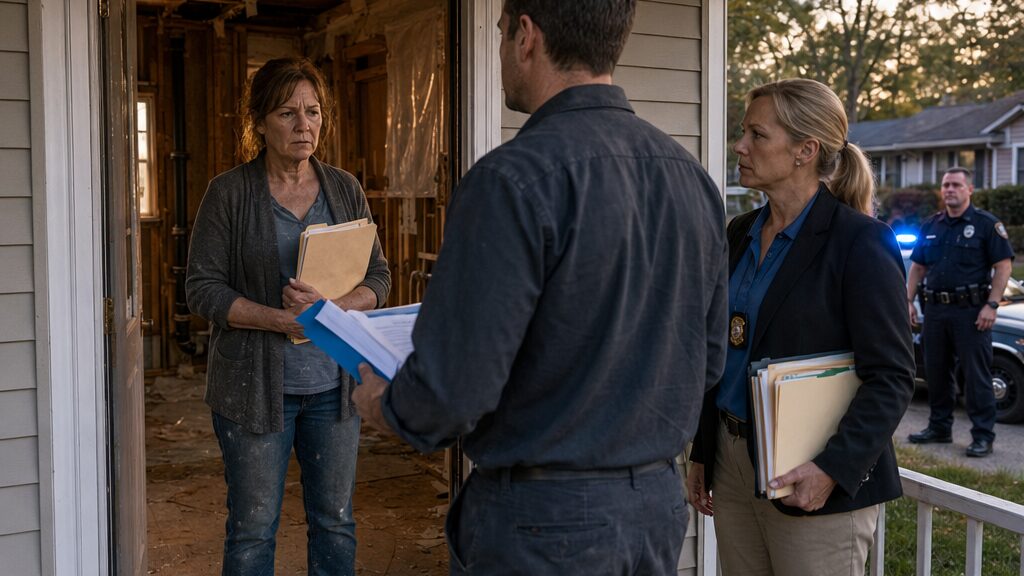
The police lights hit Pamela Johnson’s bare kitchen studs in flashes of red and blue.
They came through the open front door, swept across the exposed copper pipe where her sink should have been, and caught on the torn edge of plastic Samuel Harris had stapled over a hole in the drywall six weeks ago. Pamela stood in the doorway with one hand on the frame, not because she wanted to block anyone, but because there was almost nowhere else to stand without stepping over loose subfloor, a curled length of electrical wire, or the empty line of cabinets that had once held her coffee mugs.
Samuel stood on her porch with a blue folder tucked under one arm.
Behind him, at the curb, a uniformed officer waited beside the cruiser. The officer had not come to arrest anyone. He had already said that twice. Civil standby, he called it. Samuel had used the phrase first, as if bringing the police to Pamela’s house were no different from bringing a level or a measuring tape.
“I’m not here to argue with you, Pamela,” Samuel said.
The way he said her name made several curtains move in the houses across the street.
Pamela looked past him once, toward the cruiser, then forced her eyes back to the folder. He had always looked younger than she expected a contractor to look, but he dressed like a man who wanted clients to believe he had crews waiting on his word. Clean work boots. Pressed dark shirt. Phone clipped at his belt. The blue folder looked too neat against the torn paper and dust inside her house.
“You said that on the phone,” she said. “Then you stopped answering.”
Samuel breathed out through his nose. “Because every call turned into accusations. I can’t run a business like that.”
Pamela almost laughed. The sound rose, scraped the back of her throat, and died before it escaped. Behind her, the kitchen had no lower cabinets, no upper cabinets, no counter, no floor worth calling a floor. Six weeks ago, a pipe under the sink had failed while she was at work. Water had swollen the cabinet base and buckled three boards. Samuel had stood in this same doorway then, sympathetic and efficient, telling her he could take care of everything before the damage spread.
She had paid him $18,000 to start.
Then $13,500 when he said materials had to be ordered before prices jumped again.
Now he held out the blue folder like it contained the answer to a problem she had created.
“I need the next installment to order the remaining materials,” he said. “Nine thousand eight hundred. Once that clears, I can get you back on schedule.”
Pamela turned slightly so he could see behind her.
“What schedule?”
Samuel did not look at the kitchen. That was the first thing she noticed. He looked at her face, then at the officer, then at the folder, but not once at the open wall where insulation hung like torn stuffing.
“The revised schedule,” he said. “It’s all here.”
He opened the folder and drew out a stack of papers clipped at the top. The first page had her address printed across it. Under that, in bold letters, was a phrase she did not remember seeing on any of the original documents.
CHANGE ORDER AND ACCESS AGREEMENT.
“I didn’t agree to a change order,” Pamela said.
“You agreed to the work.”
“I agreed to the price you signed.”
Samuel’s mouth tightened. “Prices changed.”
“The kitchen didn’t.”
For a moment, nothing moved except the police lights on the ceiling joists. Pamela felt the officer watching from behind Samuel. She hated that she was standing there in the clothes she had changed into after work, with drywall dust on the hem of her jeans and a plastic storage bin where her pantry used to be. She hated that anyone could see straight through the doorway into the part of the house she had been trying to hide from every delivery driver and neighbor for more than a month.
Samuel held the papers closer.
“This is standard. It protects both of us.”
“From what?”
“From misunderstandings.”
Pamela took the stack because refusing to touch it felt like giving him one more thing to narrate. The top sheet smelled faintly of printer ink. His finger came down near a signature line marked HOMEOWNER ACKNOWLEDGMENT.
“Sign there,” he said. “I’ll have a crew here Monday.”
“You said that two Mondays ago.”
“Pamela.”
“No. You did.”
He glanced back at the officer. Not dramatically, just enough to remind her that someone else was present. The officer remained still, hands resting near his belt, face professionally empty.
Samuel lowered his voice. “I’m trying to solve this before it turns into a lien issue.”
The word landed harder than she expected.
Pamela knew what a lien was only in the vague, frightening way homeowners knew words that could attach themselves to a house. She had looked it up at midnight three days before and understood just enough to become afraid.
“You can’t put a lien on my house for work you didn’t finish,” she said.
“I can file for unpaid contracted balance if access is denied and progress is stopped by the owner.”
“I didn’t deny access. You didn’t show up.”
“I came today.”
“With police.”
“For everyone’s safety.”
Pamela looked down at the papers again because her hands had begun to tremble. That angered her more than anything Samuel had said. She wanted her hands to look steady. She wanted the officer to see a rational person, not a woman who had trusted the wrong man with almost all the money she had set aside for emergencies.
A paragraph halfway down the page pulled her attention.
By signing, homeowner acknowledges contractor is not responsible for delays, damages, material changes, loss of use, inconvenience, or prior verbal agreements not included in this revised document.
Pamela stared at the words until the rest of the porch blurred.
Loss of use.
Inconvenience.
Prior verbal agreements.
The kitchen behind her had become an inconvenience in his paperwork.
She turned the page. A new total sat near the bottom, broken into three columns that made the number seem less insulting by dividing it into parts.
ADDITIONAL MATERIAL ALLOCATION: $6,200
RESTART LABOR FEE: $2,400
ADMINISTRATIVE RESCHEDULING: $1,200
Total due before continuation: $9,800.
Pamela lifted her eyes.
“What is a restart labor fee?”
Samuel shifted the folder under his arm. “It costs money to get crews back after a stop.”
“What crews?”
“I’m not going to debate line items on your porch.”
“My porch is the only part of my house that still works.”
The officer’s eyes flicked toward the doorway. Samuel’s did not.
Pamela heard a car slow on the street. She did not turn. A month earlier, she would have stepped back, lowered her voice, apologized for the scene. She would have said, Maybe we can talk inside, then remembered there was no inside room left to talk in. That had been her habit all her life: keep the embarrassing thing contained, make the other person comfortable, find the quiet solution.
Quiet had cost her $31,500 and a kitchen.
She folded the papers back just enough to hold the waiver page on top.
“You want me to sign away damages before you order materials I already paid for.”
“I want you to acknowledge the project conditions.”
“The condition is that you took my cabinets out, opened my wall, disconnected my sink, left the floor unfinished, and came back asking for another check.”
“You approved demolition.”
“For a repair.”
Samuel’s jaw worked once. “You’re upset. I understand that.”
Pamela stepped backward, not away from him, but into the doorway so the ruined kitchen framed her on both sides. She picked up the manila envelope she had left on a plastic bin beside the entry. It held the original contract, the two payment receipts, and three printed photos she had taken from the same spot on three different Fridays. The first photo showed the kitchen after demolition. The second looked almost identical. The third, taken that morning, showed less: the small stack of drywall sheets had disappeared.
She held them against the change order.
“Tell me what changed,” she said.
Samuel finally looked past her.
For one second, the porch was silent.
Then he looked away again. “You need to be careful. A partial picture doesn’t tell the whole story.”
“No,” Pamela said. “That’s why I called licensing.”
The word changed him.
It was small. A tightening at the corner of his eyes. A shift of weight from one boot to the other. The blue folder pressed flatter under his arm.
“You did what?”
Pamela felt the tremor in her hands stop.
“I filed a complaint,” she said. “And since you brought an officer to watch you hand me papers, we can wait right here for the woman from licensing to call me back.”
Samuel did not answer.
The police lights kept moving over the empty place where her kitchen wall used to be.
Chapter 2: The Blue Folder Changed The Price
The first thing Pamela saw after Samuel left was not the missing cabinets or the plastic over the wall. It was the sentence that tried to make all of it her fault.
Homeowner-caused delay.
She sat at the folding card table she had been using as a kitchen table for five weeks, Samuel’s copied papers spread in front of her, the porch still echoing with the sound of his boots going down the steps. The cruiser had pulled away. The neighbors’ curtains had stilled. The house, emptied of witnesses, seemed to hold its breath.
Pamela read the phrase again.
Homeowner-caused delay resulting in project restart, administrative rescheduling, and additional material allocation.
It was written so cleanly she almost believed it belonged there.
Her original contract sat to the left, held flat by a chipped mug. She had printed it from the email Samuel sent the night she hired him, when he was still using phrases like “don’t worry” and “we’ll get your kitchen back.” The contract was four pages, not fancy, but clear enough for her at the time. Scope of work. Fixed price. Timeline. Payment schedule. Cabinet removal and replacement. Plumbing reconnect. Subfloor repair. Drywall patch and paint. Cleanup.
At the bottom of the last page, Samuel Harris had signed in blue ink.
Pamela had signed beneath him.
She remembered the relief of it more than the signing itself. Water damage made a house feel vulnerable in a way she had not expected. Once the cabinet base swelled and the flooring lifted, the kitchen no longer felt like the center of her home. It felt like an injury. Samuel had stood beside the sink, clicked his pen, and told her he could keep it from getting worse.
“You caught it early,” he had said. “That’s the good news.”
She had wanted good news so badly she did not ask enough questions.
Now his revised document lay beside that promise, thicker, sharper, full of phrases that sounded legal without explaining themselves. Pamela turned back to the waiver paragraph and placed her finger under each line as if she were teaching herself to read something dangerous.
Not responsible for delays.
Not responsible for damages.
Not responsible for prior verbal agreements.
She flipped to the invoice page again. The $9,800 total sat there, indifferent.
Her phone buzzed.
A message from Samuel appeared at the top of the screen.
I’ll give you until 7 PM to sign. After that I document refusal and move forward accordingly.
Pamela stared at it, thumb hovering.
Her first instinct was to answer. Not with anger. With proof. She wanted to type the dates, the payments, the unanswered calls, the mornings she had waited for crews who never came. She wanted to tell him she had eaten microwave soup in her living room for weeks and washed coffee cups in the bathroom sink.
Instead, she took a screenshot.
The action steadied her.
She opened a blank folder on her laptop and named it KITCHEN—SAMUEL. Then she dragged the screenshot into it. The folder name looked harsh on the screen. She almost changed it to something softer, something less accusing, but stopped herself.
The original contract was in her email from six weeks earlier. She opened it, downloaded it, and saved a copy. Then she opened the payment receipts.
The first receipt was straightforward. Deposit received: $18,000. Kitchen water-damage repair and renovation. The second one had bothered her even when Samuel sent it, though she had not admitted that to herself then.
Payment received: $13,500. Materials ordered.
That was all.
No supplier name on the receipt itself. No list. No order number. At the time, when she asked for details, Samuel had replied by text.
Cabinets, flooring, drywall, plumbing materials. They bundle it under my contractor account. Normal.
Normal.
Pamela pressed both hands over her face until she saw dull sparks in the darkness behind her eyes.
She had paid the second installment because Samuel told her the cabinets had to be ordered immediately. She had been standing beside the torn-out sink line while he explained that delays were everywhere and suppliers would not hold prices. He had sounded annoyed, not at her, but at the situation. That had made him seem honest. He had blamed the world, not Pamela.
She had transferred the money that afternoon.
Three days later, his crew came for half a day, removed the last of the old cabinet frames, and left a roll of clear plastic over the opening in the wall. After that, Samuel’s messages became shorter. Then later. Then absent.
Pamela opened the folder again and lined up the papers in date order. Original contract. First receipt. Second receipt. Her photos. Samuel’s revised agreement. His text from seven minutes ago.
Her own mistake sat among them, plain as any signature.
She had not taken a photo on the first day of demolition. She had not asked for a cabinet order confirmation. She had not checked his license beyond glancing at the number on his business card and believing the state seal printed beside it meant something. She had not wanted to be the kind of homeowner contractors complained about: suspicious, difficult, demanding.
Now Samuel had written her silence into a delay.
Pamela stood and walked to the doorway between the living room and kitchen. The room had a smell she could not get out of the house anymore: dry wood, dust, old dampness, and the faint chemical odor of adhesive from flooring that no longer existed. The old cabinet line was still visible on the wall, a ghost rectangle where paint had been covered for years. Above it, the studs showed. A pipe ended in a cap that Samuel’s worker had tightened with two quick turns before leaving.
On the subfloor, a pencil mark circled a soft patch Samuel had promised to replace.
Pamela lifted her phone and took another photo from the doorway.
Then another from the opposite corner.
Then one of the pipe.
Then one of the missing cabinets.
She emailed them to herself before she could decide it was excessive.
By six-thirty, the house had darkened around the edges. Pamela turned on a lamp in the living room because the kitchen ceiling light had been disconnected. She opened Samuel’s revised agreement one more time, this time searching for anything that mentioned the original fixed price.
It was gone.
The new document did not say the old contract was canceled. It simply behaved as if the old contract had never mattered. It called the $9,800 an “additional allocation,” but the signature line beneath it said Pamela accepted “all revised financial terms as controlling.”
Controlling.
The word made her push back from the table.
Her phone buzzed again.
Samuel.
I’m trying to keep this civil. If you don’t sign, I can’t be responsible for what happens next.
Pamela took another screenshot.
She did not reply.
Instead, she searched the supplier name she had found in the fine print of one of Samuel’s attached estimates. The company had a branch twelve miles away. The website listed a main number and, below it, a line for contractor account inquiries.
She almost waited until morning.
Then she imagined Samuel filing something at seven o’clock because she had been polite enough to wait.
Pamela called.
The phone rang four times before a clerk answered in a bored, practiced voice. Pamela gave Samuel’s company name first. Then his name. Then her address. She said she was trying to confirm whether cabinets, flooring, drywall, or plumbing materials had been ordered for her kitchen.
The clerk asked her to hold.
Pamela stood beside the card table, eyes fixed on the gutted doorway.
The hold music played for so long she began to think the call had disconnected. Then the clerk returned, voice less bored now, more careful.
“I do see the contractor account,” the clerk said. “But I don’t show an order connected to that address.”
Pamela gripped the edge of the table.
“Could it be under his business name only?”
“It could,” the clerk said. “But not with your address as the delivery or job site. And I’m not seeing anything matching the materials you described.”
Pamela looked at the receipt marked materials ordered.
The paper did not change. That was the worst part. It sat there as clean and official-looking as before.
“Are you saying nothing was ordered for my house?”
A pause.
“I’m saying I don’t show an order for your address.”
Pamela thanked the clerk, ended the call, and saved the number in her evidence folder.
A minute later, Samuel texted again.
7 PM.
Pamela did not answer.
The kitchen doorway stood open in the dark, and for the first time since the cabinets came out, she did not see only what was missing.
She saw a record.
Chapter 3: A Receipt With Nothing Delivered
“The receipt number is real,” the supplier said. “It just doesn’t belong to your job.”
Pamela stood at the contractor counter with Samuel’s paper flattened under both palms, the morning rush moving around her in work boots and hoodies and the smell of lumber dust. A forklift beeped somewhere beyond the shelves. Men in paint-stained pants leaned over invoices without looking at her. Everyone seemed to know what they were doing except her.
She kept her voice low.
“What job does it belong to?”
The supplier looked at the receipt again. He was not unkind, but his caution made the space between them feel official. “I can’t give you another customer’s information.”
“I’m not asking for their information. I’m asking why my contractor gave me this when I paid for my kitchen.”
“I understand.” He tapped the paper once. “What I can say is this number is tied to a contractor-account transaction from around the same period. But the items don’t match cabinets, kitchen flooring, drywall sheets, or sink-line materials. And it wasn’t set up for delivery to your address.”
Pamela heard Samuel’s voice from six weeks ago: They bundle it under my contractor account. Normal.
She had repeated the word to herself then. Normal. Normal meant she could stop worrying. Normal meant she was not being naive. Normal meant he knew how this worked and she did not.
Now the supplier slid the receipt back.
“If you’re in a dispute, you’ll want everything in writing,” he said. “Dates. Amounts. Photos. Messages. If there was supposed to be a material order, ask for the itemized invoice.”
“I did.”
“And?”
“He brought police to my house and asked for more money.”
For the first time, the supplier’s professional expression cracked. Not much. Enough.
“Then don’t handle it by phone unless you have to.”
Pamela put the receipt into her folder. Not the blue folder. She had refused to use Samuel’s. Hers was plain manila, already bent at one corner from being carried in and out of the house. It did not look intimidating. It looked like something a school might send home. But inside it, each paper had begun to hold its place.
As she crossed the parking lot, her phone rang.
Samuel.
Pamela stopped beside her car and let it ring twice. The old Pamela would have ignored it and then spent the day afraid of the voicemail. The new Pamela opened her recording app first, saw the red dot begin, then answered.
“Pamela Johnson.”
“What are you doing calling my suppliers?”
His voice was too quick. That told her the supplier had called him, or someone there had.
“I’m verifying what I paid for.”
“You’re interfering with my vendor relationships.”
“You gave me a receipt.”
“I gave you documentation.”
“For materials that weren’t ordered for my house.”
There was a sharp silence. She could hear traffic on his end, or maybe the open window of his truck.
“You don’t understand how contractor accounts work,” he said.
“Then send me the itemized order.”
“I don’t have to send you internal purchasing records.”
“You told me the money was for cabinets, flooring, drywall, and plumbing materials.”
“And it is allocated.”
“Allocated is not ordered.”
“You need to be very careful with what you accuse people of.”
Pamela looked across the lot at a stack of wrapped cabinets near the loading doors. Each box had a label, a number, a destination. Simple things had records. That was what she had learned in the last hour. Things that existed left trails.
“I’m asking for the trail,” she said.
Samuel gave a short laugh with no humor in it. “If you keep calling around, I file the lien this afternoon. I tried to avoid that. You’re making it impossible.”
A man pushing a cart of trim boards passed close enough to hear the word lien. Pamela stepped between two parked cars.
“You haven’t finished the job.”
“You stopped progress.”
“You stopped answering.”
“You created a hostile environment.”
Pamela almost said, My kitchen has no sink. My refrigerator is in the dining room. I have been rinsing vegetables in the bathtub. Instead, she said, “Please send all future communication in writing.”
“Fine,” Samuel said. “You’ll get it in writing.”
He ended the call.
Pamela saved the recording with shaking fingers, then wrote the time and date on the receipt before she could forget. She did it on the hood of her car, the paper warm from the sun. The act felt small and almost ridiculous. But by the time she slipped the receipt back into the folder, the panic in her chest had narrowed into something usable.
At home, she did not go inside immediately.
She stood in the driveway and looked at the front of her house. From the street, it still appeared whole. White trim. Potted rosemary by the steps. Curtains drawn halfway across the living-room window. No one walking past would know the kitchen behind the door had been opened like a wall in a half-built house.
That was part of the problem.
Damage hidden inside a house could be argued with. Reframed. Delayed. Blamed on the owner’s emotions. Samuel could stand on the porch and talk about access and scheduling because the worst of what he had done was behind Pamela’s shoulder.
She opened her camera and took a picture from the driveway.
Then she walked inside and took the same photo of the kitchen from the doorway she had taken the night before. When she compared it to the photo from three weeks earlier, the sameness was almost violent. Same exposed studs. Same pipe. Same missing floor line. Same plastic. The only difference was the absence of the drywall stack she had once thought meant progress.
She searched her photos for the first week of work.
There was one shot of Samuel’s truck in the driveway. One picture of the old cabinets half removed, taken accidentally when she meant to photograph the water damage for insurance. Then nothing for four days. No image of the first demolition day. No video of the worker removing the sink base. No proof that the subfloor had been cut open before Samuel claimed Pamela delayed him.
Pamela sat back on her heels in the doorway.
That gap was hers.
She had been embarrassed by the mess and had not wanted evidence of it on her phone. She had believed documenting too much would make her seem distrustful. Now the missing photographs felt like a door Samuel could walk through.
Her phone buzzed with an email.
The subject line made her stomach tighten.
NOTICE OF INTENT TO FILE MECHANIC’S LIEN.
For a moment, she only stared at it. Then she opened the email and read the first paragraph three times before the words settled.
Samuel claimed she had refused access, interfered with supplier relations, failed to approve revised material allocation, and owed the remaining balance plus restart fees.
He had attached the revised agreement she had not signed.
Unsigned, it still looked official.
Pamela printed the email at the small desk in the living room. The printer clicked and hummed, slow as a thing unwilling to participate. She added the pages to the folder, then searched online for what a preliminary notice required in her state. The language was dense, but one thing became clear enough: a threat was not the same as a filed lien, and a filed lien was not automatically valid just because the word appeared on letterhead.
By late afternoon, Pamela had made a list.
Original contract. Payments. Photos. Supplier call. Samuel call recording. Lien threat. Licensing complaint.
Under that, she wrote: Missing first demolition photos.
She circled it once, hard enough to tear the paper.
A knock sounded at the door.
Pamela froze, pen still in hand.
She expected Samuel. She expected the officer again. She expected another folder, another accusation, another version of the story where she had somehow damaged herself.
But when she opened the door, no one stood there.
A folded piece of paper rested under the edge of the porch mat.
Pamela picked it up and unfolded it.
The message was written in careful block letters.
Don’t sign anything from him.
No name. No explanation.
Only, at the bottom, an address two houses down.
Patricia Mitchell.
Chapter 4: The Neighbor Knew His Real Name
Patricia Mitchell opened her front door only as wide as the chain would allow, looked at the manila folder under Pamela’s arm, and said, “He used a different last name with me.”
Pamela had not even finished introducing herself.
The porch light behind Patricia made a narrow line across her face. She was older than Pamela had guessed from two houses away, maybe early sixties, with her gray-blonde hair pulled back tight and a cardigan held closed at the throat. Her eyes flicked past Pamela toward the street, as if Samuel might be parked there listening.
Pamela held up the note. “You left this?”
Patricia unhooked the chain but did not open the door wider. “You shouldn’t have come over with that in your hand.”
“I didn’t know what else to bring.”
“Nothing,” Patricia said. “That would’ve been better.”
The words stung, though Pamela knew they were not meant as an insult. She looked down at the folder anyway, at its soft bent corner and the edge of Samuel’s lien notice peeking out.
“I’m not trying to pull you into anything,” Pamela said.
Patricia’s mouth tightened. “That’s what I told myself too.”
She stepped back, and Pamela entered a living room that was painfully orderly. Two armchairs faced a muted television. A stack of mail sat squared with the edge of a side table. Near the hallway, a small patch of ceiling showed a faint brown stain under a coat of white paint, as if someone had tried to cover it and given up before believing it was gone.
Patricia noticed Pamela looking.
“Storm damage,” she said.
Pamela stopped near the door. “Samuel?”
“He called himself Sam Nelson then.”
Pamela felt the room shift around that name. “Nelson?”
“That’s what was on the card.” Patricia went to a drawer under the side table and removed a plastic envelope. She did not hand it over right away. She held it against her chest, thumb pressed white against the flap. “I almost threw this out three times.”
“Why didn’t you?”
Patricia gave a short, dry laugh. “Because I was embarrassed, not stupid.”
Pamela did not answer. Something in the sentence found the exact place in her ribs where she had been carrying her own silence.
Patricia opened the envelope and pulled out a business card. It was glossy, with a roofline logo and a phone number printed in dark blue. The company name was not the same as the one on Samuel’s contract with Pamela, but the license number beneath it was familiar. Pamela had seen the same number on the card Samuel gave her, next to a different company name.
Her throat tightened.
“Can I take a picture of this?”
Patricia hesitated.
“I won’t send it anywhere without asking,” Pamela said. “I just need to compare it.”
“That’s what he counts on,” Patricia said.
“What?”
“People asking permission from everyone except him.”
She handed the card over.
Pamela photographed it carefully on the coffee table. The light caught the glossy surface, so she shifted closer to the lamp and took another. Patricia watched every movement as if each one might become something she could not take back.
“He came after the windstorm last fall,” Patricia said. “Not knocking door to door exactly. More like he happened to be in the neighborhood. Said he saw the tarp on my roof and could fit me in before the next rain. He sounded like he was doing me a favor.”
Pamela sat slowly on the edge of the sofa.
“He did that with my kitchen,” she said. “He said he could keep the water damage from spreading.”
Patricia nodded once, not surprised. “They always find the part that makes you scared.”
The television flashed silently across Patricia’s face. Pamela could hear her own kitchen in her mind: plastic shifting in the doorway, the hollow sound of walking over exposed subfloor.
“What happened with your roof?” Pamela asked.
“He patched enough that it looked better from the street. Then he said the decking underneath was worse than expected and needed another payment. I paid.” Patricia looked toward the ceiling stain. “Two weeks later, it leaked again. He said it was a different section.”
“Did you file anything?”
Patricia’s fingers worked the edge of the plastic envelope. “I started.”
“Started?”
“I went to the website. Filled out half the complaint. Then it asked for dates, documents, pictures. I had some. Not enough. And then I thought, what if they say it’s my fault? What if he says I approved it? What if my kids find out I paid a man with a business card I barely checked?”
Pamela felt heat rise behind her eyes, not from crying, but from recognition so sharp it felt like anger.
“I paid the second installment without an itemized order,” she said.
Patricia looked at her then, really looked. “How much?”
Pamela almost lied. Not because Patricia had not earned the truth, but because the number still felt like an accusation.
“Thirty-one thousand five hundred total.”
Patricia closed her eyes briefly.
“He asked me for another nine thousand eight hundred yesterday,” Pamela added. “With police on the curb.”
Patricia’s eyes opened. “He brought police?”
“He called it civil standby.”
Patricia’s mouth thinned. “Of course he did.”
Pamela leaned forward. “Why?”
“Because then it looks like he’s the reasonable one trying to finish. If you shut the door, he says you refused access. If you get upset, he says you’re hostile. If the neighbors see lights, they don’t know what happened. They just know police were at your house.”
The words settled with sick precision.
Pamela thought of Samuel glancing at the officer before saying the word lien. She thought of the unsigned revised agreement, still official-looking enough to frighten her. She thought of the missing first demolition photos, the one gap in her timeline.
“He sent a notice today,” Pamela said. “Saying I denied access.”
Patricia’s face changed. Not surprise. Memory.
“He did that to me by email,” she said. “I didn’t answer because I didn’t want to make it worse.”
“What happened after?”
“He stopped trying to collect. I thought that meant it was over. Then I saw his truck at your house.”
Pamela looked down at the business card again. “Why didn’t you warn me?”
Patricia’s shoulders rose and fell. For a moment, she looked older.
“Because I told myself maybe he’d do your job right. Maybe what happened here was just bad luck. Maybe if I warned you, I’d have to admit I let him scare me into silence.”
The honesty was not clean. It had edges. Pamela felt one of them because it matched her own. She could be angry that Patricia had watched Samuel walk into her life and said nothing. She could also understand the closed door, the hidden papers, the way shame disguised itself as privacy.
Patricia took another paper from the envelope. “This is the estimate he gave me. Different company, same license number. I never checked if the license covered roofing.”
“Licensing might need this.”
“I know.”
“You don’t have to decide tonight.”
Patricia gave her a look. “That’s what I keep saying.”
Pamela did not push. She gathered her folder, then paused at the ceiling stain again. It was small, but once seen, impossible to unsee.
“I thought hiding my kitchen made me less foolish,” Pamela said. “It just made his story easier to tell.”
Patricia’s eyes lowered to the envelope.
Outside, the evening had gone blue. Pamela walked back toward her house with a photo of the business card on her phone and the feeling that her private disaster had widened into something both worse and less lonely.
Her own porch light flickered on as she crossed the yard.
A white envelope was clipped to her front door.
For one second she thought Patricia had followed and left something else. Then she saw Samuel’s company name in the return corner, printed above the same license number from both business cards.
Pamela opened it where she stood.
The notice inside claimed she had denied access, interfered with completion, refused revised terms, and owed the remaining balance plus penalties. At the bottom, above Samuel’s typed name, one sentence had been underlined.
Failure to cure homeowner breach may result in immediate lien filing and recovery action.
Behind her, two houses down, Patricia’s door remained closed.
Chapter 5: The Badge Arrived At The Door
Kathleen Roberts stepped between Samuel’s blue folder and Pamela’s open kitchen doorway as if she had already decided which one needed more light.
The police cruiser was back at the curb, not flashing this time, but its presence made the street feel watched. Samuel had arrived fifteen minutes earlier with the same folder, a cleaner shirt, and an expression carefully arranged into patience. Pamela had opened the door with her manila folder in one hand and Samuel’s breach notice in the other.
Then Kathleen’s sedan pulled up behind the cruiser.
She wore a blue polo under a black blazer, khaki pants, and a badge clipped where no one could miss it. A thick file rested against her hip, marked with two colored tabs. Her eyes moved once from Samuel to Pamela, then past Pamela into the kitchen.
She did not hide her reaction, but she did not dramatize it either.
“This is the active work area?” Kathleen asked.
“Yes,” Pamela said.
Samuel answered at the same time. “It’s secured.”
Kathleen looked at him. “I asked the homeowner.”
Pamela tightened her grip on the folder. Samuel’s jaw flexed.
The uniformed officer stood near the walkway, neutral as before. But this time Pamela did not feel the police lights burning through her. This time she had invited the official file, and Samuel had not known exactly when it would arrive.
Kathleen opened her folder. “Mr. Harris, I received a complaint regarding abandonment, disputed payment, possible misrepresentation of material orders, and license-scope concerns. I understand you also submitted documentation alleging homeowner breach.”
Samuel gave a small nod. “That’s right. I’ve tried repeatedly to continue work. Mrs. Johnson has refused access and interfered with suppliers.”
“Ms. Johnson,” Pamela said quietly.
Samuel glanced at her, irritated by the correction.
Kathleen made a note.
“Access was refused?” Kathleen asked.
Samuel opened the blue folder. “I came out with a revised agreement and payment schedule. She declined to sign and became confrontational.”
Pamela’s face warmed, but she kept still.
Kathleen turned to her. “Did you decline to sign?”
“Yes.”
“Did you deny him physical access to the property?”
“No. I refused to sign away damages and pay another nine thousand eight hundred dollars before seeing proof that the materials I already paid for were ordered.”
Samuel’s laugh was soft. “That’s not how project financing works.”
Kathleen held out her hand. “May I see the revised agreement?”
For the first time since he arrived, Samuel looked reluctant to use the papers he had brought. He drew them out anyway and handed them over.
Kathleen read standing on the porch. Pamela watched her eyes move down the page. The house seemed to make every small sound louder: the flap of plastic inside the kitchen, the officer’s radio clicking, Samuel shifting his weight.
“This paragraph,” Kathleen said, tapping the page, “waives delay and damage claims tied to prior agreements.”
“It clarifies current conditions,” Samuel said.
“It also says revised financial terms are controlling.”
“Standard language.”
Kathleen looked up. “It is not standard to present a waiver as a condition of returning to a disputed residential job without clearly explaining what rights are being waived.”
Samuel’s face colored. “With respect, this is a civil contract dispute. She’s unhappy about delays. That doesn’t make it a licensing issue.”
Pamela almost moved then, almost thrust her folder forward. Instead, she waited until Kathleen turned to her.
“Ms. Johnson, original contract?”
Pamela handed it over with the payment receipts clipped behind it.
Kathleen laid Samuel’s revised agreement over the original contract against her file. The blue folder faced the badge file like two versions of the same event trying to occupy one porch.
“This contract lists a fixed price,” Kathleen said.
“Subject to conditions,” Samuel replied.
“Where?”
Samuel pointed to a paragraph about unforeseen structural damage. “There.”
Kathleen read it. “This requires written documentation of unforeseen damage and homeowner approval before additional charges.”
“I documented it.”
“Where?”
“In the revised agreement.”
“After the dispute began?”
Samuel looked toward the officer, then back. “After the conditions became clear.”
Pamela opened her folder to the photos. She had arranged them chronologically with dates written on sticky notes. Her hands shook only once when she passed them over.
“These are from three Fridays,” she said. “Almost nothing changed. And the supplier said the receipt number he gave me was tied to a different transaction, not my address.”
Samuel’s head snapped toward her. “You’re misrepresenting that conversation.”
“I recorded my call with you after it.”
Kathleen looked up sharply. “You recorded Mr. Harris?”
“My call,” Pamela said. “After he threatened to file a lien if I kept calling around.”
Samuel raised both hands slightly. “That’s not what happened.”
Pamela opened her mouth, then stopped. The old urge rose: explain too much, fill the silence, make sure everyone understood she was not lying. She swallowed it and took out the printed call log instead.
“I can provide the recording if requested,” she said.
Kathleen accepted the page. Something in her expression changed, not triumph, but focus.
“Mr. Harris,” she said, “what license classification were you working under for plumbing reconnect and electrical-related work?”
Samuel’s answer came too fast. “My subcontractors handle specialty items.”
“Names?”
“I don’t have them on me.”
“Permit number?”
“This was a repair.”
“A repair can still require permits depending on scope.”
“The homeowner wanted it done quickly.”
Pamela felt the sentence hit like a hand placed between her shoulders and shoved. There it was: her fear turned into his defense.
Kathleen turned toward the kitchen doorway. “May I step close enough to observe from outside the work area?”
Pamela nodded.
Kathleen walked to the threshold but did not cross the torn subfloor. She looked at the capped pipe, the exposed wiring near the open wall, the missing cabinet line, the plastic sheeting curled at one corner. She took no pictures yet. She simply looked long enough that Samuel began speaking again.
“The house had existing water damage. That’s documented.”
“Existing water damage is why she hired you,” Kathleen said without turning.
Samuel’s mouth closed.
A neighbor’s car slowed. Pamela did not look. Let them see, she thought, and the thought surprised her. Let them see the room.
Kathleen returned to the porch. “I can’t adjudicate repayment on this doorstep,” she said. “I can document the complaint, request records, review license status, and refer possible violations. If there’s a lien dispute, that is a separate process. If there are unsafe conditions, you need an independent inspection.”
Samuel seized on the limitation. “Exactly. So this isn’t something to handle like I’ve done something criminal.”
“No one here said criminal,” Kathleen replied. “I said licensing.”
The word landed again.
Samuel pressed his lips together.
Kathleen removed a form from her file and handed it to Pamela. “You should organize everything by date. Contract, payments, photos, texts, calls, supplier contact, today’s notice. Don’t exaggerate. Don’t summarize what you can document. Facts first.”
Pamela nodded.
Kathleen handed another sheet to Samuel. “You will receive a formal request for records. Material orders, subcontractor information, permit documentation if applicable, change-order history, and proof of license coverage for the work represented.”
Samuel took it without looking at Pamela.
“How long does this take?” Pamela asked before she could stop herself.
Kathleen’s face softened only a little. “Longer than it should when you don’t have a kitchen. But the complaint is stronger if the unsafe or incomplete work is documented by someone qualified. Get the plumbing and electrical conditions inspected immediately.”
“Is it that bad?” Pamela asked.
Kathleen looked back at the open wall.
“I’m not the inspector,” she said. “But I wouldn’t assume abandoned means harmless.”
Samuel closed the blue folder. The sound was small, final, and not nearly as powerful as it had seemed two days before.
Kathleen gave Pamela one more card. “Send the timeline by Friday.”
Pamela looked past her into the kitchen, at the pipe end and the exposed wire she had been stepping around for weeks as if inconvenience were the only danger.
Samuel had already started down the steps when Kathleen added, “And Ms. Johnson—do not use any system he opened until it’s inspected.”
Pamela’s hand tightened around the card.
Behind her, the kitchen no longer looked merely unfinished.
It looked unsafe.
Chapter 6: The Inspection Made The Damage Worse
David Allen took one look under the temporary plastic and said, “Don’t run water to this line.”
Pamela stood behind him at the edge of the kitchen with a roll of blue painter’s tape in her hand, though she could not remember picking it up. David was crouched where the sink cabinet used to be, one knee on the exposed subfloor, a flashlight angled toward the capped pipe Samuel’s worker had left behind. He had arrived expecting to write an estimate. Within ten minutes, he had stopped talking about cabinets.
“What does that mean?” Pamela asked.
“It means this cap isn’t something I’d trust under pressure.” He shifted the flashlight. “And this section here should not have been left like this if the system was going to sit.”
Pamela looked at the pipe, then at the wall, as if the danger might become visible now that he had named it.
“I haven’t used the kitchen water since they disconnected it.”
“Good.”
The word should have reassured her. Instead it made her knees feel weak.
David stood carefully, avoiding a soft patch in the subfloor. He was not dramatic, not angry on her behalf, not eager to become part of a fight. That made everything worse. His caution had weight because it did not perform.
“You also have wiring exposed where it shouldn’t be,” he said. “I’m not touching that. You need the right trade for it.”
“Samuel said his subcontractors handled specialty work.”
“Do you have their names?”
“No.”
“Permit?”
“No.”
David’s face did not change much, but his silence made Pamela look away.
She hated that answer. No. No names. No permit. No itemized material order. No early demolition photos. Every missing thing sounded like a confession she had made on Samuel’s behalf.
David walked to the doorway and looked back at the kitchen as a whole. “I can document what I see for an estimate. I can tell you what needs correction before I finish anything. I can’t certify what I didn’t inspect behind closed walls, but luckily for you, he didn’t close much.”
Pamela gave a short, bitter breath. “That’s lucky?”
“In this situation,” he said, “yes.”
He marked the doorway with blue tape and wrote DO NOT USE on it in black marker. The words looked too harsh against the painted trim. Pamela almost asked if that was necessary, then remembered Kathleen’s warning and said nothing.
David took photos with her permission. Not quick, casual shots, but deliberate ones: pipe, wire, subfloor, wall opening, missing support near the cabinet line, plastic sheeting, the old water stain. Each click sounded like another cost.
By the time he finished, Pamela had a number written on a yellow estimate sheet that made her sit down on the living-room sofa before she read the last line.
To make the kitchen safe and finish it properly would cost more than she had left.
David stood near the doorway, hat in his hands. “I’m sorry.”
Pamela wanted to say, It isn’t your fault. Instead, she asked, “Can you put the unsafe parts in writing?”
“Yes. Factual only.”
“That’s what I need.”
“Good,” he said. “Keep it that way.”
After he left, Pamela stood in front of the taped kitchen doorway. DO NOT USE cut across the entrance at chest height. Until then, the kitchen had been humiliating. Now it had become evidence she was not allowed to cross casually.
Her phone rang at noon.
Samuel.
She let it go to voicemail.
A text followed immediately.
We can settle this privately if you stop escalating. I’ll waive restart fees and come back next week if you withdraw complaint and sign no-fault completion agreement.
Pamela read it twice. Then she saw what had changed.
He was no longer asking for $9,800 in the same way. He was offering to waive something he had invented. He was offering to come back if she withdrew the thing that scared him most.
Another message came.
You don’t want this dragging out. Neither do I. Nobody wins once the state gets involved.
Pamela screenshotted both.
She thought of Samuel arriving with police. The performance of reasonableness. The folder. The breach notice. At the time, she had believed he brought the officer to frighten her into signing. He had. But it was more than that. He had needed a record: contractor attempted access, homeowner refused. He was building his paper trail before hers existed.
Pamela opened her laptop and began arranging the timeline.
The first hour was ugly.
She typed the date of the leak. Date of Samuel’s first visit. Contract signed. Deposit paid. Demolition began. Second payment made. Materials supposedly ordered. First missed workday. Second missed workday. Text unanswered. Call unanswered. Samuel returned with revised agreement. Police present. Complaint filed. Supplier call. Lien threat. Patricia’s card. Kathleen’s visit. David’s inspection.
The dates did not care how she felt about them.
Under the second payment, she wrote: Paid before receiving itemized order confirmation. Believed contractor statement.
She stared at the sentence, then almost deleted it. It made her look careless.
But it was true.
Kathleen had said facts first.
Pamela left it.
At the permit office that afternoon, a clerk searched by address and found no active permit connected to Pamela’s kitchen. The clerk did not look shocked. That was somehow worse. Pamela asked what she should request, and the clerk slid a form across the counter with boxes for records, inspections, and complaint support.
“Do I need all of this?”
“If there’s open plumbing and electrical work, start with documentation,” the clerk said. “You don’t want to repair over an unknown.”
An unknown.
That was what her kitchen had become. Not a room. Not a project. An unknown.
Back home, a voicemail from Samuel waited.
His voice had softened.
“Pamela, look, I know this got out of hand. I’ve got supplier issues, labor issues, and now you’ve got people in your ear who don’t know the whole job. I can fix it. But I need you to stop making it impossible for me to fix it. We can both lose here.”
She played it once, saved it, and did not play it again.
The next day, Kathleen emailed confirmation that Pamela’s complaint file had been opened for review and requested the timeline by Friday. A second paragraph explained that mediation might be available for payment disputes, but licensing review would proceed separately if documentation supported it.
Pamela read the email at the card table, surrounded by papers that no longer fit neatly in the manila folder. She had started using binder clips. One for contract and payments. One for communications. One for photos. One for outside verification.
Her shame had become office supplies.
The thought almost made her smile.
Then she opened Patricia’s contact and stared at the number Patricia had written on the back of the business card photo. Pamela had not called since their porch conversation. She knew why. Asking Patricia to submit a statement meant asking her to reopen the thing she had hidden. It also meant Pamela had to go first, fully, officially, with every mistake written down.
She called.
Patricia answered on the fifth ring.
“I saw the tape on your kitchen doorway,” Patricia said without greeting.
Pamela glanced toward the blue strip crossing the entrance. From Patricia’s house, through the front window at the right angle, it would be visible.
“The inspection was bad,” Pamela said.
“How bad?”
“Bad enough that I have to put it in the complaint. Bad enough that I can’t pretend this is only about money.”
Patricia was quiet.
Pamela pressed her fingers against the timeline pages. “I’m submitting everything Friday. Including the part where I paid too early. Including the parts I should’ve checked. I’m not leaving those out just because they embarrass me.”
On the other end, Patricia breathed in and let it out slowly.
“I don’t have as much as you do,” she said.
“You have enough to show he changed names.”
“That won’t make me look good either.”
“No,” Pamela said. “It won’t. It’ll make him look familiar.”
The silence stretched so long Pamela thought the call had failed.
Then Patricia said, “If you send yours first, I’ll send mine after.”
Pamela closed her eyes.
It was not victory. It was a bargain between two women who had both mistaken silence for protection.
“All right,” Pamela said.
“No,” Patricia said, voice firmer now. “Not all right. You go first. Then I’ll stop hiding behind you.”
Pamela opened her eyes and looked at the taped doorway, at the room Samuel had left dangerous and unfinished because he had expected her to want privacy more than truth.
By Friday, privacy would no longer be an option.
Chapter 7: The House Was Finished Differently
Samuel Harris slid the settlement paper across the mediation table and said, “This gets your kitchen done faster than dragging everybody through a hearing.”
Pamela did not touch it.
The room was small enough that every page turn sounded rude. A round table. Four chairs. A box of tissues no one had used. The mediation officer sat with a pen in hand, expression neutral. Samuel had come without the blue folder this time, but Pamela had brought a copy of it anyway, clipped behind her timeline and David Allen’s inspection notes.
The first line of Samuel’s offer was simple.
Partial refund: $11,000.
The second line was not.
Homeowner agrees to withdraw all pending complaints and refrain from public, administrative, or further civil claims related to work performed.
Pamela read it once. Then again. The words were cleaner than Samuel’s kitchen cuts had ever been.
“No,” she said.
Samuel leaned back. He looked tired in a way she had not seen before. Not sorry. Not ashamed. Tired, like a man who had been holding a door shut and could feel pressure building on the other side.
“You want money back or you want a fight?” he asked.
“I want the lien threat released first.”
The mediation officer looked at Samuel. “Mr. Harris?”
Samuel’s hand moved toward his papers and stopped. “There isn’t an active lien filed yet.”
“Then releasing the threat should be simple,” Pamela said.
His eyes moved to her timeline binder. She had placed it on the table with the pages facing him: contract, payments, dated photos, supplier statement, his messages, Patricia’s business card copy, Kathleen Roberts’s record request, David’s estimate. Not one thing in the binder could solve everything. Together, they had become harder to step around.
“You’re making this personal,” Samuel said.
Pamela felt the old instinct rise—explain, soften, prove she was reasonable. She let it pass.
“It was my house,” she said. “It was already personal.”
The mediation officer made a note.
Samuel tapped one finger against the table. “I had material costs jump. I had crews quit. I had homeowners changing their minds and wanting champagne work on repair budgets. You think you’re the only person who got stuck in the middle of that?”
“No,” Pamela said.
That made him pause.
“No,” she repeated. “I don’t think I’m the only one.”
His face hardened.
Patricia’s statement had gone in two days after Pamela’s. It was shorter than Pamela’s timeline, less complete, but it carried the same license number under a different business name. Patricia had not come to mediation. She had sent what she could and refused to answer Samuel when he called her afterward. Pamela knew because Patricia had texted only three words: I didn’t pick up.
Samuel looked toward the mediation officer. “A neighbor’s old complaint doesn’t belong in this room.”
“This room is about settlement,” the officer said. “The licensing process is separate.”
“Exactly,” Samuel said.
Pamela opened her binder to the page with his private settlement text.
We can settle this privately if you stop escalating.
She turned it so he could see.
“You knew they were separate when you asked me to withdraw the complaint.”
Samuel’s jaw shifted. For a moment, she saw the man who had stood in her ruined kitchen six weeks ago with a pen and an easy voice. Not a monster. That would have been simpler. He was a man who had learned how long people would tolerate inconvenience before they paid to end it, how deeply shame could hide a bad bargain, how official-looking paper could make a homeowner doubt her own doorway.
“You don’t understand what happens to a small business when complaints pile up,” he said quietly.
Pamela thought of rinsing dishes in the bathroom sink. Of DO NOT USE written across blue tape. Of Patricia’s ceiling stain painted over but still visible. Of the receipt number tied to someone else’s transaction.
“I understand what happens to a house when a contractor uses the next customer to fix the last problem,” she said.
For the first time, Samuel looked away.
The settlement took three hours because nothing came cleanly. Samuel would not agree to full repayment. Pamela could not afford a longer court process without delaying the repair again. Kathleen’s office would not promise an outcome. David’s estimate sat between them like a second kitchen, the cost of doing things correctly after the cost of doing them wrong.
In the end, Samuel signed a lien-release acknowledgment, agreed to return part of the money in two payments, and removed the confidentiality language. The complaint would remain active. Patricia’s statement would remain attached. Samuel’s records would still be requested.
It was not enough.
It was also the first thing that had moved in the right direction since the cabinets came down.
When the mediation officer asked Pamela to sign the final page, her hand hesitated above the line. Not because she doubted the terms, but because signing had become frightening. The first signature had opened her kitchen. The second payment had deepened the damage. Samuel’s revised agreement had tried to trap her in words she had not written.
She looked at this page until each line settled.
No confidentiality clause.
Lien threat withdrawn.
Partial repayment schedule.
Complaint unaffected.
Pamela signed.
Several weeks later, David Allen carried the last cabinet door through the front doorway without stepping around plastic, tape, or exposed wire. The kitchen still smelled faintly of sawdust and paint, but it no longer smelled abandoned. The sink was connected. The subfloor had been cut back and repaired. The wall was closed. The cabinets were not the ones Pamela had imagined when she first signed Samuel’s contract. They were simpler, less expensive, chosen after the refund and what remained of her savings were counted twice.
They were level.
That mattered more than she expected.
David adjusted the final hinge, opened the door, closed it, then nodded once.
“You’re good,” he said.
Pamela stood at the threshold. For weeks, that place had been the line between what she showed people and what she hid. Then it had become evidence. Now it was only a doorway again, though not an innocent one.
“Thank you,” she said.
David picked up his tool bag. “Keep the inspection packet. Even after all this is over.”
“I will.”
After he left, Pamela made coffee in her own kitchen for the first time in months. She stood at the counter while it brewed, listening to the ordinary sound of water moving safely through a line that had been checked, permitted, and finished by someone who did not ask her to trust what he refused to show.
Her phone buzzed.
A message from Patricia.
Did they finish?
Pamela took a picture from the doorway. Cabinets, sink, floor, wall. Nothing dramatic. Nothing that would make strangers stop scrolling. Just a room returned to use.
She sent it.
Patricia replied a minute later.
Looks different.
Pamela looked at the photo again.
Different was right. Not better in the way it would have been if Samuel had simply done the job. Not restored to the version she had planned before the leak, before the folder, before police lights crossed exposed studs. Different because she knew what the walls had hidden and what the papers had tried to hide.
That evening, Pamela gathered the binder, the settlement copy, Kathleen’s emails, David’s report, and the old blue-folder pages. She put them into a storage box in the hall closet. Before she closed it, she took one photograph from the stack.
It was the picture she had taken the morning after Samuel came back: the gutted kitchen doorway, bare studs visible, plastic curled back, subfloor exposed, no cabinets, no sink. At the edge of the frame, almost out of sight, the red-blue reflection from the cruiser still marked the wall.
Pamela taped that photo inside the front cover of the repair folder.
Not where guests would see it. Not where it could become a shrine to being wronged. Just where she would find it if she ever began to tell herself that hiding damage made it smaller.
Then she closed the folder, walked into the kitchen, and turned on the light over the sink.
The room held.
The story has ended.