The HOA Sent a Crew to Tear Out the Ramp Before His Mother Could Come Home
Chapter 1: The Crew Was Already Pulling Out the Ramp
The first board came loose with a wet cracking sound that carried all the way through William Miller’s front door.
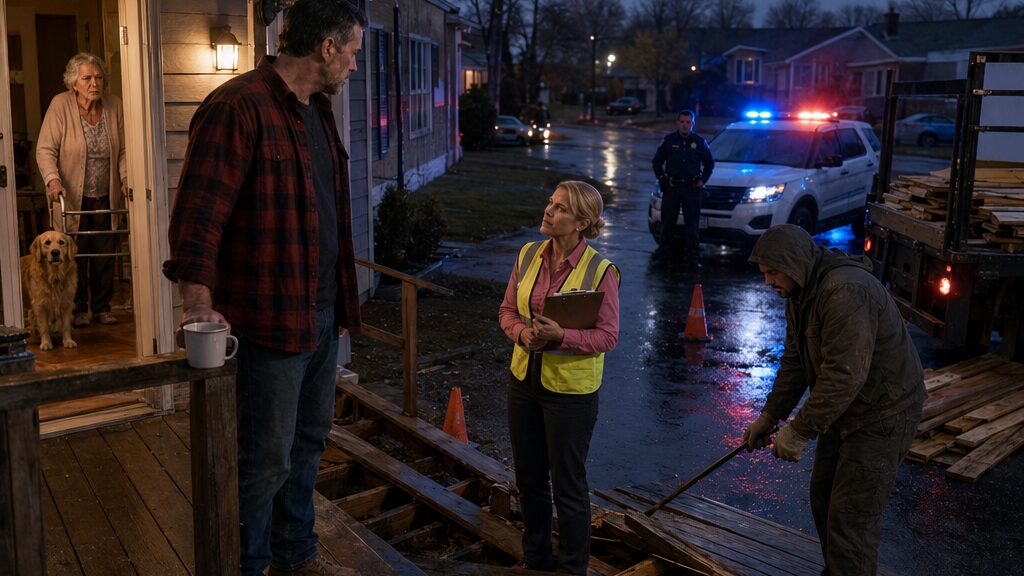
He stepped onto the porch with a white coffee mug in one hand and stopped before his boot touched the top step. The ramp that had been bolted there four days earlier was already half-open like a wound. One worker knelt at the lower landing with a pry bar. Another stood beside a pickup bed stacked with boards, rails, and orange cones. A gas saw sat idle on the driveway, its motor ticking as if it had only just been shut off.
Blue and red police lights flashed across the wet pavement.
William did not move for a second. The rain had slowed to a mist, but every surface held the storm. His porch rail shone black. The torn ramp boards gleamed pale where fresh wood showed beneath the stain. At the bottom of the steps, in a bright yellow safety vest over a pink shirt, Laura Perez looked up from her clipboard as if she had been expecting a fight and was disappointed to find a man holding coffee.
Behind William, the golden retriever pressed close to the storm door and gave one uncertain bark.
“Mr. Miller,” Laura said, lifting her clipboard, “please remain on the porch.”
William looked past her to the two police vehicles. One marked SUV sat angled at the curb. Another cruiser had pulled partly into the driveway, blocking the contractor’s truck that had delivered the lumber earlier in the week.
“You’re removing my property,” William said.
“We are removing an unauthorized exterior alteration.” Laura’s voice was controlled, official, practiced. “You were notified.”
The worker with the pry bar glanced up at him, then back at Laura. The pry bar shifted under the next board.
William set the mug on the porch rail. The small click of ceramic against damp wood sounded too delicate for the scene around it.
“Stop,” he said.
The worker froze.
Laura took one step toward the porch, enough to make her vest catch the strobing police lights. “Mr. Miller, interference with an authorized enforcement action can result in additional penalties.”
William came down one step. Not quickly. Not with his hands raised. Just enough that the worker understood the ramp was not an abandoned object.
“Who authorized you to enter my property and dismantle a medical access ramp?”
Laura’s eyes narrowed at the word medical, but she did not look surprised. That was the first thing that made William feel cold.
“The association authorized removal after repeated noncompliance.”
“Show me the court order.”
“This is not a court matter. This is an HOA enforcement matter.”
“That wasn’t my question.”
One of the responding officers shifted beside the cruiser. William knew the body language. Uncertain call, civil issue, nobody wanting to be the first to say the wrong thing. He kept his eyes on Laura, not on them.
Laura tapped the papers on her clipboard. “You received written notice that the structure violated Willow Creek exterior standards. Temporary or permanent, it changes the appearance of the home, blocks the approved walkway line, and presents a liability risk.”
“It keeps someone from falling down those steps.”
“It was not approved.”
“It was submitted.”
“It was not approved,” she repeated, as if the difference between submitted and approved could hold up a person’s body.
The worker with the pry bar lowered his eyes.
William took out his phone and started recording. “State your name and the authority you are relying on to remove this ramp.”
Laura’s jaw tightened. “Laura Perez, compliance chair for Willow Creek Homeowners Association. We have issued notice under section seven, exterior modifications, and section twelve, hazard abatement.”
“Does section twelve let you remove a medical accommodation before a hearing?”
“It allows the association to address unsafe construction.”
William looked at the ramp. Daniel Garcia had built it with treated lumber, a low slope, double rail, nonskid strips, and temporary anchors that could be removed without damaging the porch. It was not pretty. It was not part of Willow Creek’s matching front elevations and approved colors. But William had watched Daniel test the rail with both hands and say, “Your mother can use this if she takes it slow.”
Now one rail was already gone.
“Who declared it unsafe?” William asked.
Laura lifted her chin. “It was installed without association review.”
“That means unapproved. Not unsafe.”
“It means we cannot verify that it is safe.”
“Then pause the removal and inspect it.”
“The time for review was before installation.”
William’s hand tightened around the phone. He saw the golden retriever through the glass, watching him with the anxious patience of a dog waiting for the rules of a room to make sense again. He saw the mug beside him, steam fading into the damp air. He saw the lower ramp post wobble where a worker had loosened the bolts.
One of the officers finally came closer. “Mr. Miller, can you step aside while we sort this out?”
William turned enough for the porch light to catch the small star-shaped badge clipped near the opening of his red-and-black plaid shirt. The officer saw it, then looked at William’s face with quick recognition.
Laura saw it too.
For one breath, everything on the driveway changed. The worker’s grip loosened on the pry bar. The officer straightened. Laura’s expression flickered, not fear exactly, but the alarm of a person whose version of the room had shifted under her feet.
William hated that part most.
He reached up and unclipped the badge.
“I’m off duty,” he said, holding it in his palm. “Tonight I’m the homeowner. Treat me like one.”
The officer’s eyes moved from the badge to the torn ramp.
William put the badge in his shirt pocket and aimed his phone back at the ramp. “Nobody touches another board until I see a lawful order.”
Laura recovered first. “This is precisely the kind of intimidation I was concerned about.”
William looked at her. “I’m asking for paperwork.”
“You are using your position to obstruct enforcement.”
“I’m using my front steps to keep my mother from being trapped in my house.”
That stopped the nearest worker more completely than the badge had. He looked up at the porch, then toward the front door.
Laura’s grip tightened around the clipboard. “Mr. Miller, the association has a hearing scheduled for tomorrow morning. You will have a chance to present your explanation then. Until that time, the violation remains active, and removal will continue.”
“No.”
The word came out flat. Not loud. Not heated. Just final enough that the officer beside the cruiser shifted again.
Laura glanced toward the crew supervisor. “Document the obstruction.”
The supervisor took a phone from his pocket and began filming William from below, catching the badge-shaped weight in his shirt pocket, the police lights, the porch, but not the lower landing where boards had already been loaded into the truck.
William moved down one more step.
The golden retriever whined behind the door.
“Tell your crew to put the boards down,” William said.
“I will not,” Laura said. “The board voted to authorize enforcement.”
“Then show me the vote.”
“It will be provided at the hearing.”
“Show me the notice that allowed you to enter my property before the hearing.”
Laura flipped one page on her clipboard and held it up without letting him take it. Rain speckled the plastic sleeve. The top line said Notice of Continuing Violation. The delivery date was that morning.
William stared at it. “This morning?”
“It was posted properly.”
“The crew was already here this morning.”
“Removal was scheduled after posting.”
“What time?”
Laura did not answer.
The worker holding the pry bar slowly set it down on the grass.
Laura turned to him. “Do not stop work unless directed by me.”
The worker looked at William, then at the officer. The officer said nothing.
William felt the old training rise in him: keep distance, lower voice, control hands, ask one question at a time. It was useful on calls. It was less useful when the thing being torn apart was the only safe path between his mother and the outside world.
He looked back toward the door.
“Mom,” he called, keeping his voice steady, “stay inside.”
There was a pause, then a faint scrape from the other side of the entry hall. The sound of a walker. Metal against hardwood. Slow. Uneven.
Laura’s eyes flicked toward the door.
William turned sharply. “Mom, don’t come out.”
The storm door rattled as the golden retriever pressed against it. From inside, Betty Miller’s voice came thin and frustrated, carrying through the wood and glass.
“William?”
He took one step up.
The walker scraped again. Closer.
“Stay there,” he said.
Her voice came again, strained this time, with more fear than she would have wanted anyone outside to hear.
“I can’t get down the steps.”
Chapter 2: The Notice Said Structure, Not Mother
Betty’s walker stopped at the top of the porch where the ramp had been, and the space in front of her looked larger than it had any right to be.
Morning light made everything worse. At night, the police lights had painted over the damage. Now the empty anchor holes showed plainly in the damp porch boards. Mud marked the grass where workers had carried lumber to the truck. A strip of nonskid tape lay curled near the bottom step like a shed skin.
William stood inside the open doorway with one hand on the storm door, blocking more with his body than the glass ever could.
“Back up, Mom.”
“I can see it from here.”
“I know.”
“You told me it was only one rail.”
“I told you what I needed you to hear last night.”
Betty looked at him over the tennis balls on the front legs of her walker. She wore the blue cardigan she insisted made her look less like a patient and more like a person who happened to need help reaching things from high cabinets. Her left hand gripped the walker harder than her right. The right had improved since rehab, but not enough. Not for wet steps. Not for three porch boards and a drop where a ramp should have been.
The golden retriever sat beside her, body angled as if ready to herd her backward.
Betty stared at the porch holes. “They took it.”
“Most of it.”
“That woman took it.”
“The HOA took it.”
“That woman held the paper.”
William had no answer for that.
On the kitchen counter behind him, his white mug sat untouched beside three folders, a phone charger, a stack of HOA notices, and the medical accommodation form he had filled out too carefully and not honestly enough. He had slept for less than two hours, mostly in his clothes, waking every time the dog lifted its head.
Betty eased the walker backward. The rubber feet clicked against the entry tile.
“You should have told them,” she said.
William turned. “Told them what?”
She gave him a look. The kind she had used when he was twelve and pretending a broken window had happened by weather.
“You know what.”
He closed the door before the neighbor across the street could pretend not to be watching through the blinds. “You asked me not to.”
“I asked you not to hand my life to the committee women.”
“You asked me not to say stroke. You asked me not to say fall risk. You asked me not to say discharge conditions.”
Her mouth tightened.
William regretted the list as soon as it left him. He picked up the accommodation form and stared at the section where he had written: temporary mobility-related access need. He had thought it was enough. He had thought the contractor’s diagram, the date of Betty’s discharge, and the words temporary ramp would make the rest obvious to anyone with a pulse.
He should have known better. He had spent half his career writing reports that survived because nothing was left obvious.
The phone buzzed. Daniel Garcia’s name appeared.
William answered on speaker before Betty could retreat into the living room. “Daniel.”
“Tell me they didn’t keep working after I left.”
“They stopped after the officers decided nobody was touching anything until the hearing.”
“That’s something.”
“They took half of it.”
A rough exhale came through the phone. “I drove by at six. Boards are still stacked in their maintenance trailer near the clubhouse. I saw the side rail too.”
“You emailed them the specs, right?”
“Four weeks ago. Same day you called me. Slope, materials, temporary anchors, load notes. I sent it to the general HOA address and Laura Perez because you said she handled compliance.”
William opened the folder and pushed aside the printed notices. “I have my copy.”
“Check the header. I copied you.”
William searched his email on the laptop. His inbox opened slowly, as if the house itself had decided to resist him. He typed Daniel’s name. The message appeared: Ramp specs for temporary medical access — Miller residence. Sent twenty-seven days ago.
Attached were drawings, measurements, and a note from Daniel: Built to be removable after recovery period, no permanent alteration to front elevation.
William clicked the delivery details. It had gone to Laura’s HOA address. No bounce-back. No reply.
Betty leaned a hip against the counter, watching.
“Got it,” William said.
“Good. Because they can say they didn’t approve it, but they can’t say they didn’t know what it was.”
William looked at the form again. “They can say the medical part was incomplete.”
Daniel was quiet for a moment. “Was it?”
Betty turned away first.
William lowered his voice, though there was no reason to. “I didn’t include the full discharge note.”
“Why not?”
Because his mother had cried in the rehab parking lot and told him she would not come home if every neighbor with a clipboard got to read what she could not do anymore. Because he had promised to protect her pride as fiercely as he protected her body. Because there were kinds of exposure that did not leave bruises but still made a person flinch.
“Privacy,” William said.
Daniel did not push. “Then get the therapist to write something limited. Functional need only. No diagnosis if she doesn’t want that.”
Betty looked over then.
William met her eyes. “Can we ask?”
She lifted her chin. “Ask. Not beg.”
“Ask,” he said.
After the call, William printed the email, the specs, the notice, and the association rules. He laid them across the kitchen table in rows. Betty sat nearby, pretending to read the newspaper while tracking every page he touched.
Section seven spoke of approved materials, exterior harmony, and sightline consistency. Section twelve allowed emergency abatement of hazards presenting immediate risk to common areas or neighboring lots. It said nothing about tearing out a ramp from a private porch before an accommodation hearing. It said nothing about people.
Laura’s notice did.
Unauthorized exterior structure.
Failure to obtain prior written approval.
Potential liability hazard.
Continued noncompliance subject to removal at owner expense.
William read the words twice. Then a third time, slower.
“What?” Betty asked.
He slid the paper toward her. “They never called it a ramp.”
She adjusted her glasses and read. Her face changed almost imperceptibly. Not surprise. Not fear. Something closer to insult.
“Structure,” she said.
“Yes.”
“As if I built a gazebo.”
William almost smiled. He did not.
Betty tapped the paper with one finger. “That is why words matter.”
“I know.”
“No,” she said. “You know when it is your report. You forgot when it was me.”
The sentence landed cleanly. He did not defend himself. He had defended too much already by leaving too much unsaid.
A truck door closed outside.
William moved to the window. A folded notice had been tucked under the edge of the porch planter. No knock. No doorbell. Whoever left it was already getting into a small HOA maintenance cart at the curb.
He opened the door and stepped carefully around the missing ramp edge to retrieve it.
The golden retriever stayed just behind him, nails clicking nervously.
The notice was dry, sealed in a plastic sleeve. Laura’s signature sat at the bottom in blue ink.
William opened it at the kitchen table.
Betty watched him read the first line, then the second.
His thumb stopped halfway down the page.
“What is it?” she asked.
William laid the paper beside the others.
“They filed a second violation.”
“For what?”
He looked at the empty porch through the glass, then back at the words that had already turned his refusal into an offense.
“Obstruction of authorized enforcement.”
Chapter 3: The Clipboard Reached the Board Before the Truth Did
The first image on the clubhouse screen was William’s porch, cropped so tightly that the missing person was easier to overlook than the missing ramp.
Unauthorized exterior alteration, the slide read.
William stood at the back of the meeting room with a folder under his arm and watched his house become evidence against him. The photo showed the temporary ramp from an angle that made it look bulky and crooked. It did not show Betty’s walker. It did not show the top step slick after rain. It did not show the way the front door opened awkwardly when someone needed both hands for balance.
Laura Perez stood beside the screen in the same safety vest she had worn the night before, though now there was no crew, no rain, no police lights. Only fluorescent ceiling panels, stacked folding chairs, and a long table where three board members sat with paper cups and tired expressions.
Karen Campbell, the treasurer, sat in the center. She wore reading glasses low on her nose and had a binder open in front of her, color-coded tabs along the edge. When William entered, she looked at him longer than the others did. Not warmly. Not coldly. Assessing, as if trying to decide whether he was a neighbor with a problem or a deputy with an advantage.
Laura clicked to the next slide. Close-up of the ramp base. Close-up of the rail. Close-up of a temporary anchor bracket.
“The issue before us is not whether Mr. Miller has personal circumstances,” Laura said. “The issue is whether owners may install exterior structures without approval, then demand retroactive acceptance after the fact.”
William heard the phrase personal circumstances and felt his jaw tighten.
He sat in the chair nearest the aisle. The folder stayed closed on his lap.
The board chair, a role-only older man with a strained voice, cleared his throat. “Mr. Miller will be allowed to respond after Ms. Perez summarizes the compliance timeline.”
Laura nodded as though granting fairness by continuing to speak first. “Initial visual confirmation occurred last week. Notice was posted. Removal was authorized after no approval was found in the file. Yesterday’s action was paused due to interference at the site.”
William looked down at his hands.
Interference.
Not mother. Not ramp. Not access.
Karen turned a page in her binder. “Laura, before we get too far, was there any modification request submitted?”
Laura’s mouth moved into a line. “There was incomplete correspondence.”
William opened his folder.
Karen looked up. “Correspondence or request?”
“Incomplete request materials,” Laura said. “No final medical documentation. No architectural approval. No safety inspection. No board vote.”
The chair nodded slowly, as if the number of missing items made the conclusion obvious.
William stood. “May I respond to that?”
The chair hesitated, then gestured.
William walked to the front, not to the screen but to the board table. He removed the email printout from his folder and placed three copies down, one in front of each board member.
“Daniel Garcia sent temporary ramp specifications to the HOA four weeks ago. Materials, slope, rail height, load notes, anchor type, and removal plan.”
Laura said, “Specifications are not approval.”
“I did not say they were.” William kept his voice even. “I said you had notice of what it was.”
Karen picked up the page. Her eyes moved across the header.
William placed the next page down. “This is the accommodation form I submitted the same week.”
Laura stepped closer. “An incomplete form.”
William looked at her then. “Incomplete is not the same as nonexistent.”
“No one said nonexistent.”
“You just showed my porch under the title unauthorized exterior alteration.”
“Because that is what it is under our governing documents.”
“It is a temporary access ramp.”
“It is an unapproved structure attached to the front elevation.”
Karen lifted one hand, stopping them both. “Mr. Miller, why is the medical section limited to one sentence?”
The room went still in the way small rooms did when people sensed a private thing had been moved too close to the center.
William could have answered with Betty’s diagnosis. He had the discharge summary in his folder now, folded behind a blank sheet. He could have slid it across the table and watched the room rearrange itself around the words stroke, fall risk, assisted mobility, supervision on stairs. He could have ended that part quickly.
Instead, he heard Betty’s voice from that morning.
Ask. Not beg.
“My mother requested privacy,” he said.
Laura’s expression shifted just enough to suggest she had expected that answer.
Karen’s pen stopped. “Is your mother the resident needing access?”
“Yes.”
“Is she currently in the home?”
“Yes.”
Karen looked toward the screen again, at the cropped ramp photo. “Was she home when removal began?”
William turned to Laura.
Laura answered before he could. “We had no confirmation that any resident was unable to exit the property.”
“You had a form saying mobility-related access need,” William said.
“A vague phrase,” Laura replied. “Not a medical order.”
“You had contractor specs saying temporary medical access.”
“From your contractor, not a provider.”
William felt the trap closing, not because Laura was right about the need, but because she had found the gap he had left for her. He had wanted to protect Betty from being reduced to paperwork. Now the paperwork could not fully protect Betty.
Karen looked at him over her glasses. “Do you have provider documentation now?”
“Yes.”
“Will you submit it?”
William’s hand moved toward the folder, then stopped.
The room watched that hesitation with more attention than it deserved. Laura saw it too. He could feel her gathering it.
“My mother has not authorized me to distribute her medical details to the full board,” he said.
Laura’s face softened into procedural regret. “Then we are exactly where we were yesterday.”
“No,” William said. “Yesterday you sent a crew before the hearing.”
Laura clicked off the projector. The sudden blank screen made his porch disappear.
“The association has an obligation,” she said, turning back to the board, “to protect homeowners from unsafe construction and inconsistent enforcement. We had a prior injury claim in this community less than a year ago. We cannot allow residents to install structures first and ask questions later.”
Karen’s eyes dropped to her binder. “That claim involved a loose decorative step on common property.”
“It involved liability,” Laura said.
William heard fatigue under her tone then. Not sympathy. Not doubt. Something harder to dismiss. Fear with a policy manual around it.
The chair rubbed his forehead. “We need a clean record. Mr. Miller, the hearing tomorrow will address both violations. Until then, no reconstruction, no additional modification, no contractor work.”
William stared at him. “My mother cannot use the front steps.”
“Temporary arrangements may be necessary.”
“What temporary arrangements?”
The chair did not answer.
Karen closed her binder halfway. “Could the back entrance be used?”
“No ramp. Narrower steps. No rail on the left.”
Laura made a note on her clipboard. “That was not included in the request either.”
William looked at the pen in her hand. He wondered how many things had been turned into violations because they were easier to write that way.
The meeting ended without a vote. Nothing removed was restored. Nothing damaged was admitted. The board would reconvene the next night for a formal hearing, and until then, the front of William’s house remained an approved absence: no ramp, no rail, no safe way down.
In the hallway outside the meeting room, neighbors avoided looking directly at him. A few did not. A man near the bulletin board glanced at William’s shirt pocket, where the badge was not visible but apparently still present in everyone’s imagination.
Karen came out last, binder against her chest.
“Mr. Miller,” she said quietly.
William stopped.
“I am not saying Laura handled this perfectly.”
“That’s generous.”
Karen accepted the hit without blinking. “But you need to understand what the board sees. A deputy installs an unapproved structure, blocks removal, refuses full documentation, and asks us to trust that the rules should bend.”
“The rules are bending around the wrong thing.”
“Maybe.” Her voice lowered. “But if tomorrow goes badly, the board can suspend access for any contractor doing exterior work on your lot until compliance is resolved.”
William thought of Daniel’s truck, the stacked boards near the clubhouse, the holes in the porch, Betty’s walker stopped at the doorway.
Karen adjusted her grip on the binder. “That means even if you win later, nobody touches that ramp now.”
Chapter 4: The Badge Made Everyone Listen for the Wrong Reason
The doorbell clip had been posted before William got home.
He saw it on his phone while standing in the driveway beside the empty place where the ramp had been. The video started with blue and red light washing over his porch. It showed him stepping down in his red-and-black plaid shirt. It paused just as the badge caught the porch light. Then the caption appeared beneath it.
Off-duty deputy uses badge to stop HOA enforcement.
The clip did not show the worker prying up the first board. It did not show Laura holding the notice that had been posted that same morning. It did not show him removing the badge and putting it away.
It did show his face.
William stood with the phone in his hand and heard a curtain shift across the street.
The golden retriever sat at the door inside, watching him through the glass. On the porch rail, where the mug had rested the night before, rainwater had collected in a pale ring. William set the phone face down on the rail, then immediately picked it up again when it buzzed.
A message from Daniel appeared.
You need to see what they’re saying in the neighborhood group.
William did not open it. He already knew enough.
From two houses down, a neighbor stepped onto the porch with a trash bag, saw William looking, and turned back inside without taking the trash out. At the corner, a delivery driver slowed as he passed, glanced at the house, then at William’s shirt pocket, though the badge was not there.
The badge had become visible even when he was not wearing it.
Inside, Betty sat in the front room with the television off and her walker angled toward the hall. She had asked him not to help her to the recliner. She had crossed the room in three careful sections, resting once against the wall, once against the table where the mail sat unopened.
“You saw it?” she asked when he came in.
William stopped with his hand still on the door.
Betty turned the tablet toward him. The video was frozen on the same frame. His badge shone like the whole point of the night.
“Who showed you?”
“I am old, not buried. The neighbor sent it to me by accident, then sent another message saying she was sorry.”
William took the tablet gently and closed the screen.
“She should be,” he said.
Betty looked toward the porch. “You look angry in it.”
“I was angry.”
“You looked official.”
“That’s what they wanted it to look like.”
She studied him for a moment. “Were you?”
William knew what she meant. He could still feel the badge in his pocket from the night before, heavier than metal had any right to be. There had been one second when the officer recognized him, one second when Laura recalculated, one second when the crew stopped because of who they thought he was instead of what they were doing. It would have been easy to let that second stretch.
“No,” he said. “Not enough to stop them.”
Betty turned her eyes away first.
His phone rang before either of them could make peace with that answer. The number belonged to one of the responding officers from the night before.
William stepped into the kitchen. The white mug sat beside the sink, still unwashed. He answered.
“William,” the officer said, skipping formalities. “You got a minute?”
“I’m guessing this isn’t a social call.”
“No. I heard there’s a clip going around.”
“I’ve seen it.”
There was a pause. “Dispatch call came in as an armed homeowner obstructing authorized removal.”
William closed his eyes.
The refrigerator hummed behind him. The dog’s nails clicked in the front room as he shifted closer to Betty.
“Armed,” William said.
“That was the language.”
“I never touched my weapon. I never referenced it. I never threatened anyone.”
“I know what I saw.”
“What did the call say exactly?”
The officer exhaled. “Female caller reported off-duty law enforcement resident was interfering with HOA enforcement action, possibly armed, refusing to allow workers to leave or continue. Units responded as a caution.”
William put one hand flat on the counter. “Workers were already on my property.”
“That part was not in the initial call.”
“Of course it wasn’t.”
“I’m not calling to argue. I’m telling you because if this goes to the board, they may already have a version that makes you look like the escalation.”
William looked through the kitchen doorway at Betty. She was pretending not to listen.
“What time did the call come in?”
“Six thirteen.”
William turned toward the printed notice on the table. “I stepped outside after six twenty.”
“I can’t give you an official report over the phone.”
“I’m not asking for one.”
“You’ll want the incident number.”
The officer gave it to him. William wrote it on the back of Laura’s second violation notice because it was the nearest paper. When he finished, the contradiction sat there in blue ink beneath the word obstruction.
After the call, he opened the neighborhood group.
There were already dozens of comments.
Some were cautious. Some were curious. Some were exactly what people said when they wanted permission to be cruel without admitting they were curious.
Rules are rules.
If everyone built whatever they wanted, the neighborhood would look terrible.
Why does he get special treatment?
I heard he flashed his badge.
Someone else wrote: That ramp was for his mother.
A reply appeared beneath it almost immediately: Then he should have filled out the paperwork like everyone else.
William closed the group before he could answer. His thumb hovered over the screen anyway. He could write the timeline. He could post the email. He could explain every gap. He could say stroke. He could say fall risk. He could make them stop guessing by giving them Betty.
He put the phone down instead.
Betty’s voice came from the front room. “Do not protect me by letting them make you into something you are not.”
William walked back in. “I’m not posting about you.”
“I did not ask you to.”
“You’re asking something close.”
“I am asking you not to let silence do all the talking.”
That was worse because it was fair.
He sat on the edge of the sofa, facing her. The dog put his head on William’s knee, and William rested one hand behind the dog’s ear. Outside, a car slowed, then moved on.
“I have the dispatch time,” he said. “Police were called before I stepped outside.”
Betty absorbed that. “So she made you dangerous before you were even there.”
“She made the situation dangerous.”
Betty’s mouth tightened. “And tomorrow they will call that procedure.”
William did not answer.
The tablet lit up again on the table beside her. Another message. Another apology maybe. Another little window into what the neighborhood had decided while Betty sat ten feet from steps she could not safely descend.
She reached for it.
“Mom.”
“I want to see.”
“You don’t.”
“You keep telling me what I do not want to see.”
The words stopped him.
Betty opened the tablet. She read silently. Her face did not collapse. That almost made it harder. A younger William would have mistaken her stillness for strength. Now he understood it as labor.
“They think you built it for convenience,” she said.
“They don’t know.”
“They think I am an excuse.”
“No.”
She looked at him then, and he hated how quickly he had answered, as if speed could make it true.
“They do,” she said. “Because I let you make me invisible.”
“You were trying to keep your privacy.”
“I was trying to stay the person I was before I needed a ramp.”
The dog lifted his head at the change in her voice.
William reached for the tablet, but Betty kept it in her lap.
“I don’t want my medical papers passed around a clubhouse,” she said. “I don’t want Laura Perez saying my body needs board review.”
“She doesn’t get to.”
“She already did.”
William sat back.
Betty looked toward the front door. “Maybe I should not come home after all.”
The sentence did not sound dramatic. It sounded like a practical adjustment. That was what made it land so hard.
“Mom.”
“If the house requires a hearing, if every step requires a vote, maybe it is not my house anymore.”
William looked at the missing line of light beneath the door where the ramp had once met the porch. He had spent two days trying to preserve her dignity by keeping her condition out of the room. Now the room had filled itself with guesses, and each one was worse than the truth.
Betty set the tablet down.
“Tomorrow,” she said, “you will not make me the exhibit.”
William swallowed. “Then tell me what I can do.”
She looked at him for a long moment.
Then she turned the tablet back toward him. The frozen video showed his badge, bright and useless, while the ramp sat just outside the frame.
“Start by proving what they cut out.”
Chapter 5: Betty Asked Not to Be the Exhibit
The physical therapist looked at the discharge form, then at William, then at Betty’s wheelchair, and asked the question everyone at the rehab center had avoided until it became unavoidable.
“How will you enter the house today?”
Betty’s hands tightened around the folded cardigan in her lap. William had loaded her overnight bag into the truck already. Her prescriptions were in a paper sack near his boot. The discharge nurse had gone through medication timing, fall precautions, follow-up visits, and the exercises Betty called humiliating until she was alone and then did exactly as instructed.
Everything was ready except the front door.
William stood beside the chair with the folder under one arm. “I can get her in.”
The therapist did not soften. “That was not my question.”
Betty looked up sharply. “He can help me.”
“He can assist you,” the therapist said. “He cannot become the ramp.”
William felt Betty turn away from the sentence as if it had touched a bruise.
The therapist crouched slightly so she was speaking to Betty, not over her. “I can document a functional access need without listing every diagnosis. But I need to know what you are willing to say.”
Betty’s chin rose. “I am willing to say I have trouble with stairs.”
“That is true,” the therapist said. “It may not be enough.”
William looked at the folder. He had brought the incomplete form, Daniel’s specifications, the HOA notices, the incident number, the printed still from the doorbell clip. It was absurd how much paper a missing ramp could create.
Betty saw the folder too.
“Do not open that here,” she said.
“I wasn’t.”
“You were thinking about it.”
The therapist stood. “I’ll give you two a moment.”
When the door closed, the room seemed smaller. A walker leaned against the wall, tagged with Betty’s name. The afternoon sun fell across the polished floor in a hard rectangle Betty’s chair could roll through easily, unlike the front of her own house.
William sat in the visitor chair. It was too low. He had to look slightly up at her, which seemed only fair.
“You told me not to say stroke,” he said.
Betty’s eyes flashed. “Because I did not want strangers whispering it every time I watered my plants.”
“You told me not to write fall risk.”
“Because that sounds like a warning label.”
“You told me not to include the discharge conditions.”
“Because I thought temporary meant temporary.”
William’s voice dropped. “I listened.”
“No,” Betty said. “You obeyed. There is a difference.”
He had no immediate answer.
She pressed the cardigan flatter across her lap. “When your father died, people came by with casseroles and voices they used only for widows. Soft voices. Careful voices. I hated them. I hated the way they looked at me like the hard part of my life had become the only part worth mentioning.”
William remembered the casseroles. He remembered Betty giving most of them away because everyone had used too much cream and too little salt. He remembered her on a ladder two months later, cleaning gutters while he stood below begging her to come down.
“You were strong,” he said.
“I was busy,” she replied. “There is a difference there too.”
The edge in her voice faded. She looked at the walker near the wall.
“When I fell, I saw your face before I felt the floor. You tried so hard not to look scared.” Her fingers twisted into the cardigan. “Then at rehab, everyone praised me for standing. For lifting my foot two inches. For moving from chair to bed. I know they meant kindness. But every compliment felt like a receipt for something I had lost.”
William’s throat tightened.
“So when you brought that form,” she said, “and it asked what accommodation I needed, I told you to write as little as possible. I thought if the words were small, the change would be small.”
“Mom.”
“I was wrong. But you let me be wrong because it was easier than arguing with me.”
That one found him cleanly.
He leaned forward, elbows on knees. “I thought I was respecting what you wanted.”
“You were also avoiding what I needed.”
The door opened before he could answer. The therapist returned with a single-page form.
“I can write it as functional limitations only,” she said. “No diagnosis. No detailed medical history. It will say that stairs present a safety risk, that a temporary ramp with handrails is necessary for safe home entry and exit, and that delay may affect discharge safety.”
Betty’s eyes stayed on the paper.
“Will it say I cannot live alone?”
“No.”
“Will it say stroke?”
“No.”
“Will it say I am helpless?”
The therapist’s expression softened. “No. Because you are not.”
Betty looked away toward the window.
William waited. It took effort not to fill the silence. He had filled too many silences for her already.
Finally she held out her hand.
The therapist gave her the pen.
Betty did not sign immediately. She read every word, lips moving faintly once. Then she crossed out the phrase requires assistance with exterior access and wrote above it in careful uneven letters: requires safe exterior access.
The therapist looked at the edit, then nodded. “Better.”
Betty signed.
William stared at the change.
Requires safe exterior access.
Not pity. Not permission. Not an exhibit. A sentence with its spine straight.
On the drive home, Betty sat in the passenger seat with the form in her purse, not in William’s folder. That had been her condition. The document belonged to her until she chose to hand it over.
When they pulled into Willow Creek, two neighbors paused on the sidewalk. One lifted a tentative hand. Betty looked straight ahead. William kept driving.
At the house, Daniel Garcia’s truck was parked near the curb. He stood by the driveway with a tape measure clipped to his belt and his phone in hand. The removed boards were not there; the HOA still had them. But one shorter board lay across the grass, left behind in the mud. Betty noticed it before William did.
“Stop,” she said.
William parked.
“I can bring the wheelchair around.”
“No.”
“Mom.”
“I said stop. Not lift me.”
He came around anyway, opened the door, and waited. She took the walker from him without looking grateful for it. That was how he knew she was trying not to cry.
The trip from truck to porch took too long. Daniel came forward once, then stopped when William shook his head. Betty reached the bottom step and looked at the exposed anchor holes, the scuffed paint, the raw marks where the ramp had been.
The golden retriever barked from inside.
Betty bent slowly, one hand on the walker, and touched the board lying in the grass. Her fingers found the dark circles where screws had held the nonskid strip.
“He sanded this edge,” she said.
Daniel cleared his throat. “Yes, ma’am.”
“So I wouldn’t catch my shoe.”
“Yes.”
Laura’s notice had called it a structure. Betty’s fingertips recognized it as care.
William looked away.
Daniel stepped closer with his phone. “I hate to add to this, but Laura just sent the contractor suspension notice to me too.”
William’s head came up. “Already?”
“Final vote tomorrow night. Until then, any exterior work I do here could get me barred from Willow Creek jobs for six months.”
Betty straightened slowly. “Can they do that?”
“They can make it expensive to argue,” Daniel said.
William took the paper bag of medications from the truck and tucked it under one arm. “We have the therapist’s statement now.”
Betty’s hand moved to her purse.
Daniel looked toward the porch. “That helps. But there’s something else.”
William turned.
Daniel walked to the porch and pointed to the side where the lower rail bracket had been attached. “When they pulled the rail, they twisted the anchor plate. See this split?”
William climbed the steps and crouched. A hairline crack ran through the porch board, narrow but long enough to matter. Another bracket hole had widened where the bolt had been forced sideways.
“I didn’t install it like that,” Daniel said.
“I know.”
“If I rebuild on this without replacing the damaged boards, it won’t be safe. Not for Betty. Not for anyone.”
Betty stood at the bottom of the steps, both hands on the walker.
William touched the cracked wood. The ramp had been removed as a hazard, and the removal had made the entrance more dangerous than before.
His phone rang.
Laura’s name did not appear, only the HOA office number. William answered on speaker.
“Mr. Miller,” Laura said. “The board has scheduled a final vote for tomorrow at seven. No reconstruction may occur before then. Any attempt to rebuild will be treated as continued violation.”
William looked at the cracked anchor plate, then at his mother standing below a porch she could not climb safely without help.
“Laura,” he said, “your crew damaged the porch.”
There was a pause just long enough to tell him she had not expected the sentence.
“That can be reviewed after the hearing.”
“It affects safe access now.”
“Tomorrow at seven,” she said. “Bring whatever documentation you intend to provide.”
The line went dead.
Daniel lowered his eyes to the cracked board. “Even if they approve it, I can’t put the ramp back the same way.”
William looked at Betty. Her purse hung from her wrist, holding the sentence she had finally claimed for herself.
He had the proof now, but the porch itself had become another problem.
Chapter 6: The Empty Porch Became the Evidence
“It was not a structure,” Betty Miller said before William could open his folder. “It was my front door.”
The clubhouse hearing room went silent.
Laura Perez stood beside the screen with the first slide half-lit behind her: Unauthorized Exterior Structure — Miller Residence. She had barely finished the phrase when Betty spoke from the front row, seated in her wheelchair with her purse in her lap and her walker folded beside her like an argument waiting its turn.
William stood behind her, one hand on the chair handle, not pushing, not steering. Betty had told him in the parking lot she would decide when to move and when to stop.
Karen Campbell looked up from her binder. The board chair blinked as if the hearing had begun out of order.
Laura recovered by touching the edge of her clipboard. “Mrs. Miller, you will have time to make a statement.”
“I just did,” Betty said.
William lowered his eyes, not to hide a smile but to keep from helping her when she had not asked.
The room was fuller than the day before. A few neighbors stood near the back wall. Daniel Garcia sat along the side with a folder on his knees. The crew supervisor was not present, but the removal showed up anyway in photographs: the half-dismantled ramp, the boards in the wet grass, the orange cones, the police lights painting the driveway in colors that made everything look more official than it had been.
Laura clicked to the next slide. “The association’s position is straightforward. The owner installed an exterior modification without approval. The construction was not inspected by the architectural committee. The modification changed the approved front elevation and created potential liability.”
Betty leaned slightly toward William without turning. “She makes wood sound guilty.”
A neighbor coughed into a hand.
Laura continued. “When enforcement began, Mr. Miller obstructed the removal and introduced confusion by invoking his law enforcement position.”
William felt the room look at him.
He stepped to the table and placed his badge on the surface, closed inside its flat leather holder.
“I’m not invoking it,” he said. “I’m removing it from the discussion.”
Laura’s mouth tightened. “The incident video suggests otherwise.”
“The edited neighborhood clip suggests otherwise,” William said. “My recording does not.”
He connected his phone to the room’s small projector with the help of the board chair, whose hands shook slightly over the cable. The video appeared on the screen. Rain. The porch. The worker with the pry bar. Laura’s vest bright under police lights. William’s own voice asking for a court order.
The room watched the worker set the pry bar down.
They watched Laura say, “The association authorized removal.”
They watched William unclip the badge and say, “Tonight I’m the homeowner. Treat me like one.”
Karen’s pen stopped moving.
William ended the clip there, before Betty’s voice came from inside. That part was not his to play.
Laura exhaled through her nose. “The video confirms obstruction.”
“It confirms the crew was already dismantling the ramp when I came out,” William said.
Karen turned to Laura. “What time was final notice posted?”
Laura glanced at her clipboard. “Approximately six fifteen.”
William slid a printed incident summary request across the table. “Police were called at six thirteen.”
The board chair frowned. “Before notice?”
“Before I stepped outside,” William said.
Laura reached for the page, but Karen took it first.
“I called for standby assistance because there was a risk of confrontation,” Laura said.
“Before notifying the owner?” Karen asked.
“The owner had prior notice.”
“Of a hearing,” William said. “Not a crew.”
Laura looked at Karen now, not William. “Emergency abatement allows immediate action when an unapproved structure presents risk.”
Karen flipped through her binder, finding the section with her colored tab. “Immediate risk to common areas or neighboring lots.”
“The front elevation is visible to the community.”
“That is not the same as common area risk.”
Laura’s face flushed, but her voice stayed steady. “With respect, Karen, you know what happened last year. One loose step, one claim, months of legal bills, owners demanding why we did not enforce standards sooner. If we start allowing uninspected construction because someone writes the word temporary on a form, we expose everyone.”
There it was, William thought. Not cruelty. Fear with a rulebook.
Betty looked at Laura for a long moment. “Did you ever look at the top step?”
Laura turned to her.
“Not the photograph,” Betty said. “The step.”
Laura did not answer.
Betty opened her purse and removed the therapist’s statement. Her hand trembled once, then steadied. She held it out, not to William, but to Karen.
Karen rose and took it.
“It says what I need,” Betty said. “Not everything that happened to me. Not every doctor. Not every bad morning. Just what I need.”
Karen read. The board chair leaned toward her. The third board member took off his glasses and rubbed them with a cloth.
William watched Laura read Karen’s face instead of the paper.
“My son left the first form vague because I asked him to,” Betty said. “I thought if the board did not know the details, then the neighborhood would not know them either. I thought I could come home quietly and use the ramp quietly and get stronger quietly.”
Her voice did not break. William wished it would, only because it would have given him something to hold. Instead she sat straight in the wheelchair, speaking as if each sentence had been measured before being allowed into the room.
“I was embarrassed,” Betty said. “That was my mistake. But the ramp was not a mistake.”
William felt the shift then. Not victory. Not even sympathy. Attention. The room stopped looking at the ramp as lumber and started seeing the space it had crossed.
Daniel stood when Karen asked him to.
“I sent specifications four weeks ago,” he said. “Temporary build. Low slope. Double rail. Removable anchors. I also inspected the porch after removal. Two anchor boards are now damaged. I would not reinstall without replacing them.”
Laura’s head snapped toward him. “That damage was not documented by the removal crew.”
“No,” Daniel said. “It was created by the removal crew.”
The words hung there.
William did not pile on. He wanted to. He could have shown the stills of the crew prying sideways. He could have played the part of the clip where Laura ordered them not to stop. He could have made the room turn fully on her.
Instead, he looked at Betty. She was staring at the screen, not at Laura. On it, the ramp existed in pieces under police lights.
William stepped forward. “I’m not asking this board to punish anyone tonight. I’m asking you to withdraw both violations, return my materials, approve a temporary medical accommodation, and allow Daniel Garcia to repair the porch damage safely before my mother has to use those steps again.”
Laura looked at him as if restraint was another tactic.
The board chair whispered with the third board member. Karen kept the therapist’s statement in front of her.
Laura lifted her clipboard one last time. “If the board grants approval after unauthorized installation, every resident will expect the same exception.”
Betty answered before William could.
“Then write a better rule.”
Karen looked up.
Betty’s hands rested on her purse. “A rule that says if someone needs to get into their house, you do not send men with tools before you ask why.”
No one moved for a second.
Karen closed her binder. “I want the timeline clarified.”
Laura’s eyes sharpened. “Karen.”
“No.” Karen’s voice stayed quiet, but the room heard the change. “We have receipt of ramp specifications four weeks ago. We have an accommodation form, however limited. We have a final notice posted after police were already called. We have removal before a scheduled hearing. And we now have provider documentation that stairs present a safety risk.”
Laura stared at her. “You are setting precedent.”
Karen looked at Betty, then at the projected image of the empty place where the ramp had been. “Maybe we need one.”
The board chair shifted. “What are you proposing?”
Karen slid the therapist’s statement back toward Betty, not William. “A vote. Withdraw the obstruction violation. Withdraw the exterior alteration violation without prejudice. Approve temporary accommodation subject to safe rebuild specifications from the contractor. Require review of the emergency abatement process before it is used again on owner-occupied access modifications.”
Laura’s face went still.
William looked at Betty. She gave him no smile, no victory look. She only placed the statement back into her purse and closed the clasp.
Karen raised her hand slightly, not yet voting, but calling the room toward one.
“All in favor of restoring access first,” she said, “and arguing about procedure after no one is trapped inside?”
Chapter 7: The Ramp Came Back Lower Than His Pride
“The old anchor holes are useless,” Daniel Garcia said, kneeling at the edge of William’s porch with a pencil tucked behind one ear. “If I build over this, it’ll look faster. It won’t be safer.”
William stood on the grass below him with the returned ramp boards stacked beside his driveway. They had come back that morning in the HOA maintenance trailer, damp at the edges, one rail scratched white where it had scraped against metal. The vote had passed two nights earlier, but the lumber looked as if it had not heard.
Betty sat just inside the front door, watching through the glass.
The golden retriever lay beside her walker with his chin on his paws, positioned in the only path she could not yet take.
Daniel tapped the split porch board with the end of his pencil. “This one comes out. That one too. I’ll lower the landing by half an inch, widen the turn, add a second grab point here.”
William looked at the pencil mark. “That changes the original specs.”
“It improves them.”
“Will the board call it a new modification?”
Daniel looked up. “The board approved safe rebuild specifications from the contractor. I’m the contractor.”
William almost smiled. “You sound like you enjoyed saying that.”
“A little.”
The approval letter sat on the porch rail beneath William’s white mug, held down by the mug’s base because the morning breeze kept lifting the corner. The words were careful, narrow, and reluctant.
Temporary medical accommodation approved.
Exterior alteration violation withdrawn.
Obstruction violation withdrawn.
Emergency abatement procedure pending review.
There was no apology in the letter. No admission that the crew should not have come. No sentence saying a woman had been trapped by a rule that forgot to ask what it was blocking. But the vote was there in black ink, and the notice had Laura Perez’s signature beneath the board chair’s.
William had read it three times before showing Betty.
She had read it once and said, “They finally learned the word ramp.”
Now Daniel set a new board across two supports and tested the angle. The saw whined to life in the driveway, sharp and ordinary. No police lights bounced off the wet pavement. No orange cones marked the ramp as a violation. The only vehicle at the curb was Daniel’s truck, and the only person watching from across the street was a neighbor who lifted a hand, then seemed unsure whether the gesture was welcome.
William did not lift his hand back.
He carried the scratched rail to Daniel. “Use this?”
Daniel ran his palm along the gouge. “Structurally fine. Ugly now.”
“Ugly is allowed?”
“For temporary medical access, ugly may be the most code-compliant thing in the neighborhood.”
Betty’s laugh came through the open screen door, small and surprised. William turned. She looked away quickly, as if he had caught her doing something private.
He left her that dignity.
By late morning, the new landing frame sat lower and stronger than the first. Daniel worked without rushing, checking each measurement twice. William helped when asked and stayed out of the way when not. That took effort. He wanted to hold every board, tighten every screw, correct every angle before anyone else could fail Betty again.
Daniel noticed.
“You hired me because I know what I’m doing,” he said, not looking up.
William handed him the drill. “I know.”
“You standing there like a building inspector with family guilt doesn’t make the ramp safer.”
William lowered his hands.
From inside, Betty called, “Listen to the man, William.”
Daniel grinned.
William stepped back to the porch rail and picked up his mug. The coffee had gone lukewarm. He drank it anyway.
A small car stopped at the curb just after noon.
Laura Perez got out without her safety vest.
For a moment William saw the old scene overlay the new one: wet driveway, clipboard, police lights, workers waiting for permission to destroy something they had not built. But Laura stood alone this time, in a plain gray cardigan, holding a folder against her ribs.
Daniel’s drill stopped.
Betty’s wheelchair shifted inside the doorway.
Laura approached the driveway slowly, stopping at the edge of the lawn as if there were a line now that she had learned to see.
“Mr. Miller,” she said.
William set the mug down. “Laura.”
Her eyes moved to the rebuilt frame, then to Daniel, then to the front door where Betty was visible through the screen. “I brought the formal withdrawal copies.”
“We received the email.”
“These have signatures.”
She held the folder out.
William walked down the grass to take it. For the first time since the crew came, Laura did not try to step closer to the porch than he did. The papers inside were dry, clipped, and stamped. Their neatness felt almost insulting beside the gouged rail and replaced porch boards.
“The board will review the emergency procedure next month,” she said. “Karen is drafting language for accommodation-related access requests.”
“That’s good.”
Laura’s fingers tightened around the folder after he had already taken it, delaying the release by half a second. “I believed I was preventing a liability problem.”
William waited.
“I still believe uninspected structures can put communities at risk.”
“I know.”
Her eyes lifted then, sharper than before. “But I should have paused when I saw the accommodation request.”
The words cost her. Not enough to balance anything. Enough to be real.
William looked toward the porch. Betty had turned her wheelchair slightly, not hiding, not inviting.
“You should tell her,” he said.
Laura’s face changed. “I don’t want to make her uncomfortable.”
William almost answered for Betty out of habit. Then he stopped.
He turned toward the door. “Mom?”
Betty looked at him.
“Do you want to speak with Laura?”
The question sat in the warm air between the sawdust and the grass. Betty’s hand rested on the wheel of her chair. The dog raised his head.
At last she said, “She can come to the bottom of the ramp when it is done.”
Laura looked down.
Daniel went back to work.
The final boards went in after lunch. Daniel added the second grab point, sanded the rail where the scratch had been, and replaced the damaged porch boards with a precision that made the repair look less like a surrender and more like an answer. The new ramp was lower, steadier, slightly wider at the turn. Not beautiful. Not invisible. Built for a person, not a brochure.
When Daniel finished, he stood at the bottom with one hand on the rail and nodded toward William. “You want to test it first?”
William looked through the screen door.
Betty was already reaching for her walker.
“No,” he said. “She does.”
He opened the door and moved the dog back with one knee. “Slow.”
Betty gave him a look. “That word is not a plan.”
“What is?”
“You walk beside me. You do not pull. You do not count out loud. If I stop, I stop.”
William swallowed. “Yes, ma’am.”
She stood with effort, her right hand slower than her left, her weight shifting until the walker settled squarely before her. The first step onto the new landing took everything out of the scene. Daniel stopped packing. Laura stood at the lawn edge with the signed withdrawals in her hands. The neighbor across the street lowered her phone without recording.
Betty gripped the rail.
William walked beside her with his hands open and ready, touching nothing.
At the turn, she paused. Her breath came hard. The dog whined from the doorway.
“You all look like I’m crossing a canyon,” she said.
Daniel looked at the boards. “Technically, ma’am, it’s a slope.”
Betty snorted once, then took the next step.
The ramp held.
Another step.
The rail held.
When she reached the bottom, Laura straightened but did not move forward. Betty stopped in front of her, still holding the walker, still breathing through the work of arriving.
Laura held out the signed notice. “Mrs. Miller, I’m sorry the process failed you.”
Betty looked at the paper, then at Laura. “Processes do not come to houses with pry bars.”
Laura’s face flushed.
William looked down, hiding nothing this time.
Betty took the notice and folded it once. “But you came back without the vest. That is something.”
Laura nodded, not forgiven exactly, but released from the need to defend herself for one breath.
Karen’s car passed slowly at the end of the street. She did not stop, only lifted two fingers from the steering wheel. William returned the gesture this time.
By evening, Daniel had packed his truck and left the porch swept clean. The replaced boards were slightly lighter than the old ones. The ramp smelled of fresh sawdust and rain-dried lumber. Betty sat on the porch in a chair William had carried out only after asking where she wanted it. The dog lay at the top of the ramp, guarding the route as if it had always been his job.
William brought his white mug outside and set it on the rail where it had been the night the crew came.
Betty noticed. “You going to leave it there forever?”
“Maybe.”
“It is not a monument.”
“No.”
“It is a mug.”
He picked it up, took a drink, and sat on the porch step beside her chair.
Across the street, porch lights came on one by one. No cruiser idled at the curb. No blue and red lights washed over the driveway. No clipboard waited at the bottom of the steps.
Betty rested one hand on the chair arm and the other near the rail.
“Tomorrow,” she said, “I want to go down once without everyone staring.”
William nodded. “You tell me when.”
“I just did.”
He looked at her, then smiled because she was not joking.
The dog rose, stretched, and walked halfway down the ramp before turning back to make sure they were following. Betty laughed under her breath. William stood, offered his arm, and waited until she decided whether to take it.
She did, lightly.
Together they moved toward the ramp, not as proof for anyone, not as a scene for neighbors, but as a woman leaving her own house by the door that had finally been returned to her.
The story has ended.