The HOA Called His Backyard Container an Eyesore Until the Doors Opened
Chapter 1: The Blue Container Behind the Fence
“You can’t have that here.”
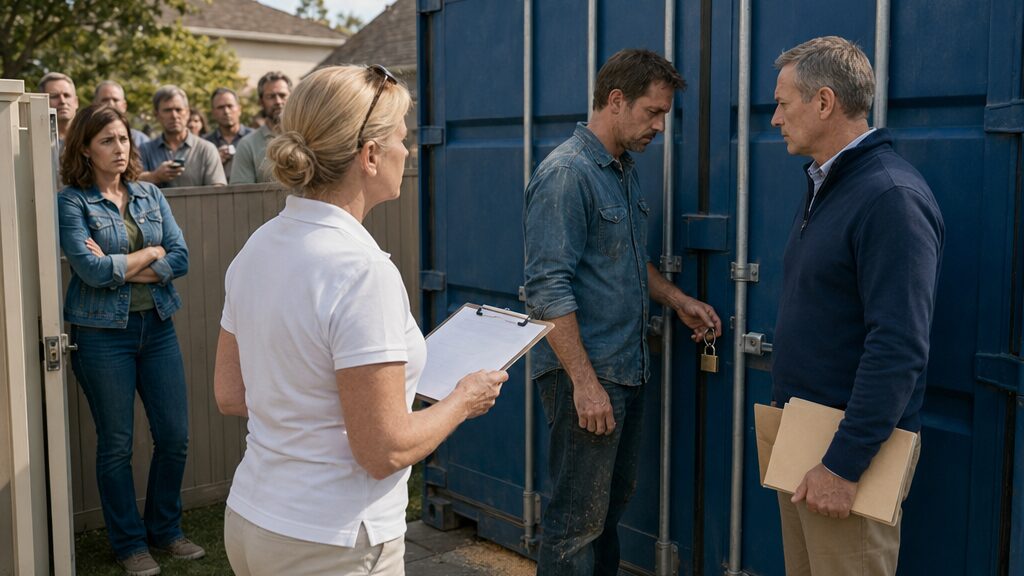
Daniel Harris stopped with one hand on the padlock and the other wrapped around the cold steel handle of the blue shipping container. The words cut across his backyard before the latch had even clicked shut.
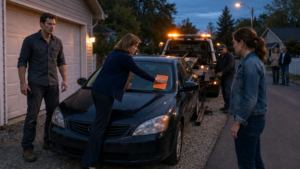
Katherine Clark stood at the edge of his patio as if she had been placed there by the neighborhood rules themselves. White polo, sunglasses pushed up in her hair, clipboard tucked under one arm. She had not come through the gate. She had stepped around the side path between Daniel’s house and the fence line, the way HOA officers did when they wanted homeowners to understand that privacy had limits.
Behind her, the container took up almost the whole back stretch of the yard. It was forty feet long, painted a deep industrial blue that looked even brighter against the trimmed grass and beige privacy fence. From the second-story windows on either side, it must have looked like someone had dropped part of a freight yard into the middle of Stonebridge Hollow.
Daniel let go of the handle.
“Morning, Katherine.”
“This is not a morning issue.” She pointed her pen at the container. “This is a covenant issue.”
He looked at the pen, then at the clipboard. “I figured.”
“You figured?” Her eyebrows rose. “Daniel, a shipping container is sitting in your backyard.”
“It is.”
“It makes the whole street look industrial.”
From where Daniel stood, the container looked like what it was: blunt, square, unpretty from the outside. A thing built to take weather and weight, not compliments. He had known what people would think when the delivery truck backed it down the service lane three weeks ago. He had heard the air brakes sigh. He had seen blinds lift in three houses before the driver even unhooked the chain.
“It’s temporary,” he said.
Katherine’s pen paused. “Temporary how?”
Daniel touched the padlock again. He had not meant to. His thumb found the edge of it like a habit. “Give it one week.”
“One week for what?”
He looked past her shoulder. A curtain shifted in Ashley Martin’s kitchen window next door. On the other side, above the fence, Daniel could see the top of a man’s gray baseball cap. Not enough of a face to accuse anyone of watching. Enough to know they were.
“For me to finish,” Daniel said.
Katherine glanced toward the fence too, and Daniel saw her expression tighten, not with embarrassment, but opportunity. Witnesses made her taller.
“Finish what?”
He took a breath. The air smelled faintly of cut pine from inside the container, even through the sealed doors. He had swept before sunrise, but sawdust always escaped. It clung to cuffs, worked into cracks, traveled under doors like a secret trying to become public.
“It’s not storage,” he said.
“That does not answer my question.”
“I know.”
Katherine stared at him. “Are you refusing to answer?”
“I’m asking for one week.”
She shifted the clipboard to the front of her body. The paper on top had his address printed in neat black type. She had come prepared, then. This was not a neighborly warning. This was step one.
“Daniel,” she said, in the tone people used when they wanted witnesses to hear how reasonable they were being, “I have had three complaints. Three. Residents are concerned about property values, safety, noise, and the general appearance of the neighborhood.”
“Noise?”
“The delivery alone was disruptive.”
“That was twenty minutes.”
“It blocked the service lane.”
“The driver moved when Ashley needed to get through.”
“That is not the point.” Katherine looked at the container again, and this time she did not hide the disgust. “This is not a workshop district. This is a residential community.”
The word workshop landed harder than she knew.
Daniel slid his hands into his pockets so she would not see the sawdust beneath his fingernails. He had tried washing them twice before coffee. It never all came out. His father used to say sawdust was like guilt: if you did real work, some of it stayed with you.
He almost smiled at the memory. Almost.
Katherine saw the movement and mistook it. “You think this is funny?”
“No.”
“Because I assure you, the board will not.”
“I’m not trying to make trouble.”
“Then remove it.”
“One week.”
“No.” The pen tapped against the clipboard. “I’m not waiting while every homeowner on this street wonders why the rules only apply to them.”
Daniel looked over the fence again. Ashley’s curtain had gone still, but the cap remained visible. Somewhere behind the houses, a dog barked once and stopped.
He could have opened the doors.
The thought passed through him clean and sharp. He could turn the key, swing the left door wide, let Katherine see the pegboard he had mounted last night, the clamps lined by size, the workbench bolted level, the shelves made from reclaimed maple. He could show her the permit folder tucked beside the first-aid kit. He could point to the vent fan, the insulated wall panels, the fire extinguisher, the child-height bench still wrapped in brown paper.
He could explain.
Instead he remembered the last time he had explained anything important in public. The lowered voices. The sympathetic head tilt. The way people heard grief and then stopped hearing anything else.
So he kept the doors closed.
Katherine wrote something down.
“That’s your choice,” she said.
Daniel felt heat rise behind his ears. “What is?”
“Being difficult.” She tore a yellow sticky note from the stack clipped to her board and pressed it against the metal door. It did not stick well. The ribbed steel pushed one corner up. “I’ll file the inspection report today. If the board determines this is an architectural violation, you’ll receive a formal notice.”
“I already checked with the county.”
“The county does not enforce Stonebridge Hollow covenants.”
“I know that.”
“Then you know better.”
Her voice had sharpened enough that the man behind the fence lowered his cap and disappeared. Ashley’s curtain moved again. Daniel kept his gaze on the yellow note as it curled at the edge. There was no official language on it, only Katherine’s tight handwriting: REMOVE CONTAINER.
The container looked uglier with the note on it. That bothered him more than it should have.
“Katherine,” he said, and stopped.
She waited, ready for either apology or argument.
The words he might have said gathered behind his teeth. My father drew this before he died. I’m not storing trash. I’m trying to finish what I should have started years ago. I’m trying to make something that does not disappear.
None of it belonged to her. Not yet.
“Saturday,” he said.
Her mouth tightened. “Excuse me?”
“Next Saturday morning. Nine. Come back then.”
“Daniel, this is not a negotiation.”
“Bring whoever you need to bring.”
That changed something in her face. Not softening. Calculation. If he had begged, she would have stayed in full authority. If he had shouted, she would have had a cleaner report. But an invitation made her suspicious.
“What exactly do you think will happen next Saturday?”
He turned the padlock once to make sure it had caught. The click sounded louder than it needed to.
“You’ll see.”
Katherine gave a small laugh without humor. “That is not how compliance works.”
“No,” Daniel said. “It’s how doors work.”
For the first time, Katherine looked less certain of the script she had brought with her. Then her posture returned, shoulders squared, clipboard high.
“I will return,” she said. “But not because you invited me. I’ll return with the board notice.”
She walked back along the side path without asking permission. At the corner of the house, she paused just long enough to look back at the container, as though memorizing its offense.
Daniel waited until she was gone before peeling the yellow note off the door. The adhesive left a pale smear on the blue paint.
From Ashley’s window, the curtain finally dropped.
Daniel folded the note once, then again, and put it in his pocket. Behind the locked doors, the unfinished workbench waited in the dark, and for the first time since the container arrived, Daniel wondered whether one week was enough time to finish the thing he had spent years refusing to name.
Chapter 2: A Notice Taped to the Gate
The official violation notice was taped to Daniel’s front gate where the whole sidewalk could read it before he did.
It was bright orange, laminated, and fastened with two strips of clear packing tape that caught the morning sun. Daniel saw it from the porch while holding a mug of coffee he had not yet tasted. For a moment he simply stood there, bare feet on cold concrete, watching a delivery driver slow his van enough to glance at the sign.
The van rolled on.
Daniel set the coffee on the porch rail and walked down the path.
NOTICE OF ARCHITECTURAL VIOLATION
UNAPPROVED INDUSTRIAL STRUCTURE
POTENTIAL DAILY FINES PENDING BOARD REVIEW
His name and address were printed beneath that. Not handwritten. Printed. Official enough to turn a house into a warning.
Someone across the street closed a garage door halfway and stopped it there.
Daniel pulled at the tape carefully, but the notice tore at the top corner anyway. The sound was small and mean. He folded the paper before looking around, which made him feel guilty though he had not done anything wrong.
The container sat behind the house, invisible from the street except for the faint blue edge seen through the side gate. That was the part that irritated him. From here, the thing was barely visible. The notice was louder than the container had ever been.
He found the second envelope in his mailbox.
This one had the HOA logo, Katherine’s signature, and a hearing date left blank. The language was clean and bloodless. He had fourteen days to remove the “unapproved structure” or submit proof of compliance. Failure to comply could result in fines, legal fees, removal at owner expense, and suspension of community privileges.
Community privileges. He almost laughed. The pool had been closed half the summer because the board could not agree on resurfacing bids.
He went inside, laid the notice on the kitchen table, and opened the bottom drawer beside the sink. The permit folder was exactly where he had left it. County temporary accessory structure permit. Electrical inspection request. Delivery receipt. Site placement sketch. He had more paperwork than most people had patience.
He could send it all. He could be done with the county part by lunch.
But the HOA part sat outside the folder like a locked room with no key.
By ten, he had driven to the small HOA management office near the strip mall, a narrow storefront wedged between a tax preparer and a tutoring center. The glass door had frosted vinyl lettering and a basket of artificial flowers beside it. Nobody had flowers like that unless they wanted irritation to enter calmly.
A clerk behind the counter accepted his permit copies without comment and disappeared into the back. Through a half-open door, Daniel heard a printer running, then low voices. He recognized Katherine’s before he saw her.
When she came out, she had changed from the white polo into a pale blouse, but her expression had not changed at all.
“Daniel,” she said. “You could have emailed.”
“I wanted to make sure you got these.”
She glanced at the folder. “County permits do not equal HOA approval.”
“So I’ve been told.”
“That is not a technicality.”
“I didn’t say it was.”
She looked at him as if calmness were another violation. “The architectural guidelines require prior approval for exterior structures visible from neighboring lots. Especially structures inconsistent with residential character.”
“Temporary structures are allowed for renovation work.”
“Exterior impact still applies.”
“Then send someone to look at the placement.”
“I did.”
Daniel held her gaze. “You looked at the outside.”
“That is what exterior review means.”
He nearly opened his mouth. Nearly said, There is more than an outside.
But saying that here, beneath fluorescent lights, with the clerk pretending not to listen, would only turn the workshop into an exhibit before it was ready. He slid the folder across the counter.
“Please add it to my file.”
Katherine did not touch it right away. “You understand daily fines may begin after the cure period.”
“I understand what the notice says.”
“And if the board finds you acted knowingly—”
“I understand.”
“No,” she said quietly, and for the first time the public tone fell away. “I don’t think you do. People are tired of being told their small changes are violations while something like that appears overnight.”
“It didn’t appear overnight.”
“To them it did.”
That landed closer than he wanted. Daniel picked up his empty envelope and folded it into thirds.
On the drive home, he passed three identical mailboxes, two lawn crews, a child’s scooter lying on its side, and the entrance sign Katherine had helped repaint last spring. Stonebridge Hollow. Established 1998. A place built to look settled even when everyone inside it was still negotiating what belonged.
Ashley Martin was standing near his driveway when he pulled in.
She had one hand on the handle of a stroller and the other shielding her eyes. Her child slept beneath a little striped canopy. Ashley looked embarrassed to be there, which made Daniel more careful as he got out.
“Hey,” she said.
“Hey.”
“I’m not trying to get in the middle.”
“Nobody ever is.”
She winced. “That came out wrong.”
“It’s fine.”
She looked toward his side gate. “Is there anything dangerous in there?”
Daniel’s fingers tightened around the folder. “No.”
“I don’t mean that like—” She stopped, tried again. “People are saying there might be chemicals. Or equipment. Or that it’s not secured.”
“It’s secured.”
“I know. I mean, I assumed. It’s just…” She glanced down at the stroller. “When there are kids around, people get nervous.”
Daniel nodded. That was fair. More fair than the orange sign.
He opened the folder and pulled out the county permit. “Here.”
Ashley seemed surprised he offered anything. She took it and read the top half. He watched her eyes slow over the stamped approval.
“So it’s legal?”
“With the county, yes.”
“But the HOA can still…”
“Yes.”
She handed the permit back. “Why not just tell people what it is?”
The question was not sharp. That made it harder.
Daniel slid the permit into the folder. “Saturday.”
Ashley studied him for a long second. “That’s what you told Katherine.”
“Yes.”
“Daniel, she’s making this sound bad.”
“I know.”
“Then why let her?”
A breeze moved through the front yard, lifting one corner of the torn orange notice still in his hand. He thought of the unfinished child-height bench and the practice boards stacked against the interior wall. He thought of his father’s sketch, folded so many times the creases had become permanent. He thought of neighbors turning kindness into attention and attention into questions he did not trust himself to answer.
“Because it isn’t ready,” he said.
Ashley looked past him, toward the closed gate. “Whatever it is?”
“Whatever it is.”
Her child shifted in the stroller, making a soft waking sound. Ashley rocked it gently with her foot.
“I’m not against you,” she said. “But parents are texting. Screenshots of the notice. Photos from upstairs windows. You should know that before Saturday.”
Daniel looked at the folded orange paper in his hand. He had thought Katherine made the container public. He was wrong. The neighborhood had taken care of the rest.
“What are they saying?”
Ashley’s face gave him the answer before she did.
“That if you won’t open it,” she said, “there must be a reason.”
Chapter 3: Seven Days Before the Doors Open
Daniel unlocked the container after midnight because darkness made it easier to pretend no one was waiting for him to fail.
The left door opened with a low metal groan. He caught it before it could swing wide and pulled it just far enough to slip inside. The battery lantern on the workbench came on with a click, throwing a clean circle of light across the plywood floor, the unfinished shelves, the clamps hanging in a crooked row he had meant to straighten.
Outside, the container was an eyesore.
Inside, it was almost a room.
Almost was the part that kept him awake.
Daniel shut the door behind him and stood in the dark blue hush. The air smelled of pine, oil, rubber mats, and the faint metallic cold of the container walls. Insulated panels covered most of the interior now, painted a warm off-white to soften the steel. He had built the long workbench from maple salvaged from a closing school library. Pegboard ran along the left side. A small miter saw sat bolted to a rolling stand. The child-height bench waited at the back, still missing its vise.
He had seven days if Katherine honored the date.
He had less if the board decided not to.
He pulled on his safety glasses and went to work without music. Music carried. So did saws. So did anything that gave irritated neighbors a reason to confirm what they already believed.
The first hour went smoothly. He cut cleats for the shelf above the hand tools. He sanded the edge of the child bench until it would not catch small palms. He mounted a strip of LED lights and stepped back when they flickered on, bright and even, turning the narrow container into something almost brave.
At two fifteen, while searching for shorter screws in an old metal toolbox, he found the carpenter pencil.
It had rolled beneath a tray of drill bits, flat-sided, dull-ended, with HARRIS written in his father’s blocky handwriting along one side. Not Daniel’s handwriting. His father’s. The letters had faded, but the pressure of the pencil had left shallow grooves in the wood.
Daniel sat down on the edge of the unfinished bench.
For several minutes, he did not move.
His father had hated mechanical pencils. Too delicate, he used to say. Too easy to lose. A carpenter pencil stayed where you put it and made a mark wide enough for a tired man to see. Daniel had not seen this one since the garage cleanout, three months after the funeral, when he boxed up tools with the same cold efficiency he had used for hospital forms.
He turned the pencil over.
On the other side, in smaller writing, were two words: SMALL HANDS.
Daniel closed his eyes.
The sketch had started as a joke. His father, already moving slower then, had drawn a rough plan on the back of a grocery receipt: a backyard skill shed where neighborhood kids could learn how to measure twice, sand with the grain, fix a loose chair leg, build a birdhouse that would not collapse in the first rain. “Everybody teaches them screens,” his father had said. “Somebody ought to teach them how to hold a tool without being afraid of it.”
Daniel had laughed and said the HOA would have a stroke.
His father had said, “Then build it inside something they don’t understand until it’s too late.”
Now Daniel sat inside that very thing, with the pencil across his palm and an orange violation notice folded in his pocket.
A noise came from outside.
He froze.
Not loud. A scrape near the side gate, then a whisper, then the quick retreat of shoes on concrete. Daniel turned off the lantern and waited. Through the vent fan opening, he saw the glow of a phone screen bob past the fence crack and disappear.
The next morning, the complaint arrived by email.
POWER TOOL NOISE AFTER APPROVED QUIET HOURS. POSSIBLE UNPERMITTED COMMERCIAL USE. SAFETY CONCERNS REMAIN UNRESOLVED.
Katherine’s message was brief.
Daniel read it twice at the kitchen table, then looked at the time stamp on his own security camera. 2:23 a.m. A shadow at the side gate. Someone had come close enough to record the light through the door seam. Maybe not Katherine. Maybe one of the parents Ashley had mentioned. It did not matter. The container was no longer just ugly. Now it was suspicious.
He replied with one sentence: I will be ready Saturday at 9 a.m.
Then he deleted the second sentence he wanted to send.
For the next five nights, Daniel worked like a man racing a storm he could hear but not see. During the day, he answered customer-support calls from a desk in his spare bedroom, speaking gently to people angry about subscription charges and missed deliveries. During lunch breaks, he ordered safety latches, sandpaper, rubber corner guards. After dinner, he carried lumber through the side gate in small loads so no one could say he blocked the lane again.
He made mistakes.
On Wednesday, he cut a shelf board half an inch short because his hands were shaking from too much coffee. On Thursday, he snapped at a delivery driver who asked if the “big blue thing” was his. He apologized before the man left, but the shame stayed with him, hot and childish.
On Friday afternoon, Ashley stopped at the edge of his driveway without the stroller.
“People are saying Katherine’s bringing Gregory Walker on Saturday,” she said.
Daniel wiped his hands on his jeans. “Treasurer?”
“And maybe two board members.”
“Good.”
She tilted her head. “Good?”
“If they’re going to judge it, they should see it.”
“You could have let people see it earlier.”
He looked toward the side gate. “No. I couldn’t.”
Ashley’s expression shifted. She heard more than he meant to say, and he regretted giving her the opening.
“It’s personal,” she said.
Daniel said nothing.
She did not push. That made him like her more and trust the situation less.
After she left, he went back inside the container and installed the vise on the child-height bench. It took longer than expected because one bolt refused to catch. When it finally tightened, he placed both palms on the bench and leaned over it, breathing hard.
The little bench stood solid.
Not fancy. Not perfect. Solid.
He took his father’s carpenter pencil from the shelf and laid it in the shallow tray at the back of the bench. Then he removed it, uncomfortable with how exposed it looked, and tucked it into the top drawer of the main workbench instead.
The next morning, just after sunrise, Daniel swept the floor. Sawdust gathered in pale curls near the threshold. He brushed most of it into a dustpan but left a faint trace in the seam where the doors met. It would fall out when he opened them. There was no avoiding that.
At eight forty-five, he changed into a clean gray T-shirt, then changed again into an old denim work shirt because it hid the dust better. He placed the permit folder on the workbench beside the fire extinguisher. He checked the first-aid kit, the outlet covers, the latch, the fan, the lights.
At eight fifty-eight, he walked outside and found three neighbors already visible above fences.
At eight fifty-nine, Katherine stepped through the side gate without smiling.
Daniel took the orange notice from his pocket, smoothed it against the blue door, and wrote across the back in block letters with his father’s pencil.
Saturday, 9 a.m.
Then he unlocked the padlock and waited for the rest of the street to arrive.
Chapter 4: When the Whole Street Came to Look
Neighbors had gathered before Daniel even turned the key.
Ashley Martin stood near the side gate with her arms folded, trying not to look like she had come to watch a man be embarrassed. Two houses down, a couple hovered by the fence as if they had only happened to be trimming shrubs at exactly nine in the morning. Across the yard, Katherine Clark held her clipboard against her chest with both hands, and beside her stood Gregory Walker in a navy quarter-zip, his expression fixed in the flat patience of someone already calculating consequences.
Ashley had expected Daniel to look defensive.
He did not.
He stood in front of the blue container in a faded denim work shirt, sleeves rolled to his forearms, a key ring in his left hand. He looked tired enough that the skin under his eyes seemed bruised, but his posture had a strange steadiness to it. Not proud. Not beaten. Just ready.
Katherine checked her watch.
“It is nine o’clock,” she said.
Daniel nodded once. “It is.”
Gregory glanced at the container doors. “Mr. Harris, before you open anything, I want to be clear that this is not an approval inspection. We are here to document the condition of the structure.”
“Understood.”
“Any photographs taken today may be used in board review.”
“Fine.”
Ashley heard a woman behind her whisper, “Why is he so calm?”
Daniel heard it too. Ashley saw his jaw shift, but he did not turn.
Katherine stepped forward until she was just outside the faint line of sawdust at the base of the doors. “You said we would see something today.”
“Yes.”
“I hope you understand that decorative changes to the interior will not address the exterior violation.”
A few neighbors murmured. Someone lifted a phone. Ashley wanted to tell them to put it down, but her own curiosity kept her still.
Daniel inserted the key into the padlock.
Katherine added, “I’m not impressed yet.”
The lock opened.
For one second, the yard seemed to hold its breath. Daniel removed the padlock, set it on the ground, and pulled the left door. The metal groaned, then swung outward. A thin veil of sawdust dropped from the seam and scattered across the concrete pavers like pale sand.
The smell came first.
Not mildew. Not gasoline. Not trash. Fresh wood, clean oil, and something warm Ashley remembered from her grandfather’s garage when she was small.
Daniel opened the second door.
Sunlight poured into the container and revealed an entire room.
Ashley took one step forward before she knew she had moved. The inside walls were no longer bare metal. They had been insulated and paneled, painted soft white, lined with shelves and pegboard. Clamps hung in order by size. Hand saws, squares, chisels, sanding blocks, and measuring tapes had their own places. A long maple workbench ran along one side, smooth enough to catch the light. A small miter saw sat secured on a rolling stand. Safety glasses hung beside ear protection. A red fire extinguisher was mounted near the door. Rubber mats covered the floor.
At the back, half in shadow, stood a smaller bench built low to the ground.
Ashley heard herself say, “Oh.”
Katherine did not move.
Gregory leaned in, eyes narrowing, but not with disgust now. With surprise he did not want to show.
Daniel stepped aside. “It’s not storage.”
No one answered.
A neighbor behind Ashley whispered, “He built all that in there?”
Ashley looked at Daniel’s hands. The fingers were rough at the edges, one knuckle nicked, the nails clean but still rimmed with faint dust. She remembered asking him if anything dangerous was inside. Heat rose in her face.
Katherine recovered first.
“This is a workshop,” she said.
“Yes.”
“Inside a shipping container.”
“Yes.”
“On a residential lot.”
Daniel took a slow breath. “Yes.”
Ashley looked from Katherine to the workbench. The sentence sounded different after the doors opened. It sounded less like an accusation and more like someone refusing to admit a mistake.
Gregory stepped closer and looked at the permit folder placed neatly on the workbench. “You wired this?”
“Temporary power connection. Inspected. No hardwired panel yet.”
“You have ventilation?”
Daniel pointed to the fan mounted near the rear. “Intake and exhaust. Fire extinguisher. First-aid kit. Lockable tools. Rubber flooring. No stains, no chemicals except sealed finishes in a metal cabinet.”
Gregory’s attention sharpened at the word finishes. “Commercial use?”
“No.”
“You selling furniture out of here?”
“No.”
Katherine wrote something on her clipboard. The scratch of pen against paper sounded loud in the quiet.
Ashley stepped close enough to see the small bench at the back. Three rectangular boards were stacked beside it, edges rounded, each marked with faint pencil lines. One had a crooked row of practice nail holes, as if meant for someone learning to hammer without splitting wood.
She pointed before thinking. “What are those?”
Daniel’s eyes followed her hand.
For the first time that morning, his expression changed. The steadiness faltered, not much, but enough.
“Practice boards,” he said.
“For what?”
He closed his mouth.
Katherine noticed. “For what, Mr. Harris?”
Daniel looked toward the gathering of neighbors, then at the phone still raised near the fence. His face shut down again.
“Just practice.”
Ashley hated the way everyone leaned into his silence.
Gregory picked up the permit folder and opened it. “County permit is here. Placement sketch. Temporary structure approval. Electrical request.” He looked mildly annoyed to find the documents in order. “That addresses certain safety concerns.”
Katherine turned sharply. “Certain concerns, yes. Not the covenant issue.”
“No,” Gregory said. “Not the exterior issue.”
The neighbors shifted. Ashley felt the collective mood wobble, as if everyone had come ready for one story and been handed another with missing pages.
A woman near the gate said, “But it looks nice inside.”
Katherine’s shoulders lifted. “The inside was never the complaint.”
“It kind of was,” Ashley said before she could stop herself.
Katherine looked at her.
Ashley felt the stroller handle that was not in her hands today, remembered the texts, the warnings, her own question about danger. “People were saying it might be unsafe.”
“And now we are confirming what it is,” Katherine replied. “That does not mean it belongs here.”
Daniel stood beside the open door, letting them argue around him. That bothered Ashley more than Katherine’s tone. He had opened the container, shown the work, proven one thing, and still seemed unwilling to claim any of it.
Gregory closed the folder. “Mr. Harris, even with county documents, the HOA can require screening, modification, or removal if the board determines the structure violates community appearance standards.”
Daniel nodded. “I read that.”
“Daily fines may still apply after review.”
A little sound moved through the neighbors. Not outrage. Discomfort. The kind that came when people enjoyed a reveal but did not want responsibility for what happened after it.
Daniel took the folder from Gregory when he offered it back.
Katherine stepped into the open doorway. Her shoes stopped just before the sawdust line. Ashley saw her take in the smooth bench, the tool wall, the carefully labeled drawers. Something in her face tightened. Not because it was ugly. Because it was not.
“This does not change the fact that you bypassed approval,” she said.
“I know.”
“Then why not submit this from the beginning?”
Daniel ran his thumb along the folder edge. “Because it wasn’t ready.”
“That is not an answer.”
“It’s the only one I have today.”
Katherine’s gaze went back to the low bench, the stack of boards, the small safety glasses hanging from a hook beside adult ones.
“What is that children’s equipment doing in here?”
The yard went quiet again.
Ashley looked at Daniel. So did everyone else.
Daniel turned slightly, as if his body wanted to block the view of the small bench even though the doors were wide open now.
Katherine pointed with her pen, no longer triumphant, but intent.
“Mr. Harris,” she said, “why are there children’s practice boards stacked in an unapproved structure behind your house?”
Chapter 5: The Rules Changed After They Admired It
Katherine Clark studied the printed photo of Daniel’s open container as if it had insulted her personally.
The image lay on the HOA boardroom table, glossy and too bright under the fluorescent lights. The blue doors framed the workshop like a magazine spread: pale walls, neat tools, clean bench, sunlight falling across the floor. In the corner of the photo, Daniel stood half turned away, one hand on the door, his face unreadable. The picture should have helped him. That was exactly why it made Katherine uneasy.
Around the table, the other board members kept picking it up, looking at it, and setting it down again.
“Well,” one of them said, “it’s not exactly junk.”
“No one said it was junk,” Katherine replied.
Gregory Walker looked over the top of his reading glasses. “Several emails used that word.”
“Residents used that word. The board did not.”
“But residents were responding to our notice.”
Katherine pressed her lips together. She had not asked for the photo to travel through the neighborhood. Someone had posted it in the community group with a caption that said, Not what I expected. By Sunday evening, the thread had turned into a mess of admiration, jokes about secret workshops, complaints about HOA overreach, and three separate arguments about whether sheds were allowed.
A violation was simple when everyone disliked it.
It became dangerous when people liked it.
She straightened the stack of papers in front of her. “The issue before us is not whether Mr. Harris has good taste in tools. The issue is whether a forty-foot shipping container is permitted under our architectural guidelines.”
Gregory tapped the photo. “And liability.”
“Yes. Liability.”
“And precedent.”
“Exactly.”
He leaned back. “If we allow this, someone else will want a container for a home gym, then a detached office, then storage for business equipment. If we deny the next person after allowing Harris, we look selective.”
Katherine nodded, grateful for the practical language. Practical language was safer than saying what she had felt in Daniel’s yard: the sharp embarrassment of being wrong in front of people who had expected her to be right.
She had spent three years trying to make enforcement consistent. Before she became compliance chair, the board had ignored one homeowner’s fence extension for six months, then fined another for the same thing in two weeks. The second homeowner had come to a meeting with printed photographs and a shaking voice. Katherine had been new then, sitting at the far end of the table, watching the board president apologize without fixing anything.
After that, she had promised herself no one would accuse her of playing favorites.
Then Daniel Harris had placed a blue industrial box where everyone could see it from upstairs windows and refused to explain himself.
“He knew the rules,” she said.
Gregory nodded. “He did submit county permits.”
“Not HOA approval.”
“No.”
“And when asked directly what the container was for, he refused to answer.”
“That helps us,” Gregory said. “Procedurally.”
The word should have comforted her. Instead it sounded thin.
A board member slid the photograph closer to Katherine. “People are impressed, though.”
“Impressed is not approved.”
“I’m just saying the comments are split now.”
Katherine looked at the photo again. She noticed details she had missed in person. A child-sized pair of safety glasses on a hook. Rounded corners on the small bench. Labels written by hand on drawer fronts. It was not casual. It was not weekend clutter. Daniel had built the inside with a kind of care that made the outside harder to dismiss and harder to allow.
“That may make it worse,” Gregory said.
Katherine looked up.
“If he is planning any kind of group activity, instruction, or neighborhood use, we have insurance exposure. Who signs waivers? Who supervises? Are tools locked? Is the structure rated for occupancy? Are children invited? Are parents present? Does his homeowner’s policy cover it? Does ours get dragged in if something happens?”
The room quieted.
Katherine seized on that because it was solid. Not pride, not embarrassment, not the uncomfortable memory of Daniel standing silent while half the street stared into his work.
“Exactly,” she said. “This is no longer just aesthetic.”
“But we don’t know that he’s inviting children,” another board member said.
“There were children’s practice boards,” Katherine said.
“Maybe they’re for a relative.”
“Then he can explain that at a hearing.”
Gregory pulled a form from his folder. “We should issue notice of formal review and possible removal. That protects the association. We can offer him the chance to submit architectural plans retroactively, but I would not pause the fine schedule unless he agrees in writing not to use the structure.”
Katherine glanced at the blank signature line.
For a moment she saw Daniel’s thumb rubbing the edge of his permit folder. She heard Ashley Martin say, It kind of was. She saw neighbors leaning forward, drawn despite themselves to the open doors.
She told herself that sympathy was not governance.
“Prepare the hearing notice,” she said.
Gregory slid the form toward her.
While the others discussed dates, Katherine looked out the boardroom window at the parking lot. The HOA office after hours always made her feel both important and foolish. A rented room above the management company. Folding chairs. A coffee machine that burned everything. A shelf full of binders containing rules people ignored until they needed them enforced against someone else.
Her phone buzzed.
A message preview appeared from a neighbor: I don’t envy you. Cute workshop but rules are rules.
Another followed almost immediately from someone else: Please don’t let this turn into another fence situation.
Katherine set the phone facedown.
She did not hate Daniel Harris. That would have been easier. She disliked his silence, his calm, the way he made her look unreasonable by refusing to give her anything except the outside of a thing. She disliked the fact that, after seeing the inside, she still had to act as if the outside mattered more.
Maybe it did.
Property values were not imaginary. Rules were not imaginary. Liability was not imaginary. Communities did not fall apart because of one exception, but they did learn from one exception how many more to ask for.
Gregory placed the final notice in front of her. “Hearing next Thursday. Possible fines and removal order.”
Katherine picked up the pen.
The signature line blurred for half a second, then cleared. She wrote her name carefully, the way she always did on documents that could be challenged.
Katherine Clark.
The pen left a small dot at the end where she pressed too hard.
Gregory gathered the papers. “I’ll have management send it certified and post a copy.”
“Post it?” one board member asked.
“Per enforcement procedure.”
Katherine hesitated. The orange notice on Daniel’s gate had already done enough damage. But hesitation in a boardroom had a smell; people noticed it.
“Yes,” she said. “Follow procedure.”
That evening, long after the boardroom emptied, Katherine paused by the copier and looked once more at the photo of Daniel’s workshop. The open blue doors had turned the container from an eyesore into a question she could not answer neatly.
She placed the photo in the evidence packet anyway.
Then she signed the hearing notice with Daniel Harris’s name printed at the top, and the next morning, the management office taped another bright paper to his gate.
Chapter 6: The Repairs Nobody Knew Were His
Elizabeth Baker recognized Daniel’s work by the way the porch rail no longer wobbled.
She was carrying a small bag of potting soil from her car when her hand closed around the wooden rail beside the steps and found it steady. Not a little steadier. Solid. The kind of solid that did not announce itself until your body expected weakness and found care instead.
Elizabeth stopped halfway up the steps.
The rail had been loose for months. She had meant to call someone, then meant to ask her nephew, then meant to stop pretending she did not lean on it harder when her knee hurt. Three mornings ago, she had noticed a faint line of pale sawdust in the corner of the porch. She had blamed the wind, or insects, or old wood giving up another small piece of itself.
Now she bent closer.
The screw heads had been replaced and countersunk cleanly. A cracked bracket had been reinforced from underneath, invisible unless someone knew to look. The splintered underside had been sanded smooth. Whoever fixed it had even matched the stain well enough that a passing eye would miss the repair.
But Elizabeth had taught art for thirty-one years. She noticed hands. She noticed lines. She noticed when work was done by someone who did not want credit.
“Daniel,” she whispered.
The bag of soil sagged against her hip.
That afternoon she walked to Ashley Martin’s house and found Ashley in the driveway wiping cracker crumbs from the back seat of her car. A small wooden step stool sat near the garage, turned upside down on a towel.
Elizabeth pointed to it. “That yours?”
Ashley looked down. “My child’s. It split last month. I was going to throw it away.”
“But you didn’t.”
“No. It showed up on the porch fixed.” Ashley frowned slightly. “I thought maybe my husband did it, but he said no.”
Elizabeth crouched with some effort and turned the stool. The crack had been glued, clamped, sanded, and reinforced with two narrow strips underneath. Not pretty in a decorative way. Strong. Thoughtful. The edges had been rounded where small feet would drag across them.
Ashley watched her face change.
“What?”
“Same hand,” Elizabeth said.
“Same as what?”
“My porch rail.”
Ashley’s expression shifted slowly from confusion to understanding. “Daniel?”
Elizabeth ran her thumb along the repaired edge. There was a faint dusting of sawdust caught in one corner, pale against the old paint.
“He didn’t say anything?”
“No.” Ashley sat back on her heels. “He wouldn’t, would he?”
They both looked down the street toward Daniel’s house. From here, the blue container could not be seen, but Elizabeth felt its presence anyway, like a closed mouth at the center of the block.
She had been among the people who came to look. She had stood near the back, wearing the yellow sweater her daughter said made her easier to spot, and peered into the container with everyone else. She had asked, “Wait, you built all of this in there?” Daniel had nodded but not smiled.
At the time, she had thought he was stubborn.
Now she wondered how many things in the neighborhood had his silence built into them.
Over the next two days, Elizabeth noticed more. A repaired planter box near the mail cluster. A loose gate latch at the corner house that no longer clattered in the wind. A wooden library box by the walking trail with a new bottom panel, fitted so neatly the old paint almost hid it. None of the repairs were dramatic. That was the point. They had been made to disappear into usefulness.
On Wednesday morning, she found Daniel in his driveway carrying a stack of papers toward his truck.
“Did you fix my porch rail?” she asked.
He stopped.
That was answer enough.
Elizabeth folded her arms. “And Ashley’s step stool?”
Daniel looked toward Ashley’s house. “It was on the curb.”
“It was beside her garage.”
“Close enough.”
“Daniel.”
He shifted the papers under one arm. “It was cracked. I had glue mixed.”
“You broke into her garage?”
“No. It was outside. I left it on the porch.”
“Without a note.”
“Didn’t need one.”
Elizabeth stared at him until he looked away first. She had known him since he moved into the neighborhood eight years ago. Quiet, polite, always taking trash bins in for people during storms, never staying long at cookouts. After his father died, he became even quieter. People mistook quiet for distance because it asked less of them than concern did.
“They’re going to make you remove it,” she said.
“I know what the notice says.”
“Then let someone speak for you.”
“No.”
“Why?”
“Because then it becomes something else.”
“What does that mean?”
His grip tightened on the papers. “It means people like a story more than they like a person. I don’t need everyone turning this into some neighborhood redemption thing.”
Elizabeth felt the sting of that because part of her had wanted exactly that: the meeting, the reveal, the grateful residents, Katherine forced to see what she had missed. A clean moral picture. A retired teacher’s favorite shape.
“This is not about making you a hero,” she said.
“Good.”
“But you are letting them make you a problem.”
His face hardened.
There it was, the wall. Not anger exactly. A door closing from the inside.
“I can handle the board,” he said.
“Can you?”
“Yes.”
“By showing permits and not answering questions?”
Daniel looked at her then, and for the first time she saw fear under the tiredness. Not fear of Katherine. Not fear of fines. Something older.
“Elizabeth, please don’t.”
The softness of it stopped her.
He glanced toward the backyard, though the container was hidden behind the gate. “If people know I fixed things, they’ll start asking why. Then they’ll ask why I built the small bench. Then they’ll ask whose idea it was. Then I’ll have to stand in a clubhouse under bad lights and talk about my father to people who were calling me unsafe last week.”
Elizabeth had no quick answer.
Daniel opened his truck door, then paused. “I’m not ashamed of him.”
“I didn’t think you were.”
“I just don’t want to use him.”
He got into the truck and left before she could say that silence could use a person too.
The hearing was the next evening.
Elizabeth spent most of that day telling herself she would respect his request. She watered her porch plants. She folded laundry. She reheated soup and let it go cold. Every time she touched the porch rail, it held her with the quiet firmness of work done in the dark.
By five o’clock, she went to the hall closet.
The small chair sat in the back beneath a box of Christmas lights. It had belonged to her classroom years ago, one of the little wooden chairs from the art corner. Last winter, one leg had cracked while she was moving boxes, and she had set it near the curb on bulk pickup day. The next morning it was back on her porch, repaired with a neat brace underneath and sanded smooth where children’s hands had once worn the edges.
She had never known who fixed it.
Now she did.
Elizabeth carried the chair to her car. It was light, but by the time she set it in the back seat, her hands were shaking.
At the community clubhouse, residents were already gathering beneath the fluorescent lights. Daniel stood near the side wall alone, a folder in one hand, his face closing when he saw what she carried.
“Elizabeth,” he said quietly.
“I know what you asked.”
“Then why?”
She set the small repaired chair beside her feet.
“Because you asked me not to speak for you,” she said. “You didn’t ask me not to bring the truth.”
Chapter 7: The Hearing Under Fluorescent Lights
The removal order was already printed before Daniel said a word.
He saw it the moment he stepped closer to the board table: three pages, stapled at the corner, with his address centered beneath the HOA letterhead. The top sheet faced upside down from where he stood, but the words were large enough to read anyway.
ORDER TO REMOVE UNAPPROVED STRUCTURE.
Daniel stopped so abruptly that the folder in his hand bumped against his thigh.
Katherine sat behind the table with her hands folded over a legal pad. Gregory Walker sat to her right, a pen clipped to his binder, the expression on his face carefully neutral. Two other board members were present, along with a management clerk who had already arranged a small recording device in the center of the table. Folding chairs filled the clubhouse room. More residents had come than Daniel expected.
Of course they had.
An open container was entertainment. A hearing was a sequel.
Elizabeth Baker stood near the front holding the small repaired chair against her hip. When Daniel looked at her, she did not apologize. Ashley Martin sat two rows back, arms crossed, eyes moving between Daniel and the printed order.
Katherine cleared her throat. “Mr. Harris, this is a formal compliance hearing regarding the unapproved shipping container structure located on your property.”
Daniel set his folder on the narrow table reserved for homeowners. It wobbled under the weight.
“I understand.”
“You’ll have a chance to speak. The board will review the violation history, the evidence collected during inspection, and any documents submitted.”
Gregory opened his binder. “For the record, the county permit has been received. The permit does not constitute architectural approval from the association.”
Daniel nodded. He had rehearsed a dozen answers at home. Practical answers. Short ones. Permit. Safety. Temporary use. Screening options. None of them felt steady now with the removal order already waiting.
Katherine lifted a photograph.
It was the one of the open container doors. Someone had printed it in color. The sunlit workshop looked almost unreal under the clubhouse lights, too warm for the room it had been brought into.
“Mr. Harris,” Katherine said, “when asked before installation, you did not submit an architectural request. When approached after installation, you declined to explain the purpose of the structure. When inspected, the container was found to contain workshop equipment and what appeared to be child-sized work materials.”
Murmurs moved through the chairs.
Daniel felt his hands curl at his sides. He looked at the photograph instead of the people.
“That is correct,” he said.
Ashley leaned forward slightly, as if waiting for more.
Katherine waited too.
Daniel gave them nothing else.
Gregory tapped his pen once. “Mr. Harris, do you intend to use the structure for classes, childcare, commercial woodworking, or any group activity involving minors?”
“No childcare. No commercial woodworking.”
“That is not the full question.”
Daniel swallowed. The room seemed smaller than when he walked in.
Elizabeth shifted the small chair in her hands. One wooden leg knocked softly against the metal folding chair beside her.
Katherine’s gaze went to it. “Mrs. Baker, we’ll allow resident comment after Mr. Harris’s statement.”
Elizabeth did not sit.
Daniel looked at her, and something in his chest tightened. He had asked her not to do this. He had asked because if she began, he would either have to stop her or stand there while his private life was laid out like evidence. He did not know which would be worse.
Then Elizabeth stepped forward and placed the small chair on the floor in front of the board table.
It was a child’s chair, old and plain, with one repaired leg reinforced neatly underneath. The brace was not decorative. It was useful, almost invisible unless the chair was turned. But under the fluorescent lights, Daniel could see the sanded edge, the matched stain, the place where his fingers had held it steady while glue dried.
Katherine looked at the chair as if Elizabeth had set down an argument no rulebook had anticipated.
“What is this?” Gregory asked.
“Something Daniel fixed,” Elizabeth said.
Daniel closed his eyes for half a second.
“Mrs. Baker,” Katherine said, “this hearing concerns—”
“It concerns whether people know what they are looking at.”
The room went quiet enough for the recording device to pick up the hum of the lights.
Elizabeth’s voice did not rise. That made it harder to dismiss. “That chair came from my old classroom. I put it out for bulk pickup last winter because one leg cracked. The next morning it was on my porch, repaired. I did not know who did it until this week.”
Daniel stared at the tabletop.
Ashley stood halfway from her chair, then seemed to think better of it. “My child’s step stool too,” she said. “I didn’t know either.”
A neighbor in the back muttered, “The little library box by the trail.”
Another voice: “Our gate latch.”
Daniel wanted to leave.
He wanted the container sealed again, the doors closed, the sawdust swept, the pencil hidden. Gratitude pressed on him harder than accusation. Accusation let him be silent. Gratitude asked him to become visible.
Katherine looked at him. Something in her expression had changed. Not surrender. Not apology. Uncertainty, tightly controlled.
“Mr. Harris,” she said, “is this true?”
Daniel rested both hands on the table. His palms were dry, but he could feel every nick in the wood beneath them.
“Yes.”
“Why did you not disclose that earlier?”
Because kindness became debt when people named it. Because grief turned into a performance when people learned its shape. Because his father had died before Daniel could stop being embarrassed by the things that mattered to him.
He did not say those things.
Not first.
He opened his folder and took out a folded sheet of yellowed paper. It was not an official document. It was thin from handling, the creases soft, the ink faded where his father had pressed too hard with a ballpoint pen. Daniel unfolded it carefully and placed it beside the photograph of the container doors.
A rough drawing of a workbench. A little shelf for safety glasses. A child-height table. In the corner, his father’s uneven handwriting: small hands need real tools, not toy ones.
“This was my father’s idea,” Daniel said.
No one moved.
Daniel kept his eyes on the paper. “He was a finish carpenter most of his life. He fixed things for people who could pay him and people who couldn’t. After he retired, he talked about setting up a small place where kids in the neighborhood could learn basic skills. Measuring. Sanding. How to fix a chair instead of throwing it away.”
His voice tightened. He stopped, picked up his father’s carpenter pencil from the folder, and set it on top of the drawing.
“He got sick before we built it.”
The word sick sat in the room with enough weight that no one asked what kind.
Daniel forced himself to look up. “I bought the container because it was the only way I could build something secure, weatherproof, and separate from the house without tearing up the yard. I got the county permit. I handled the safety pieces first. I didn’t submit the HOA request because I knew what it looked like from the outside, and I thought if I could finish the inside first, maybe people would understand before they judged it.”
Katherine’s mouth tightened, but she said nothing.
“I was wrong,” Daniel said.
Ashley’s face changed.
It cost him more to say that than to show the workshop.
“I made it easier for people to think the worst because I refused to explain. Katherine asked me directly, and I gave her nothing. Ashley asked if it was dangerous, and I gave her paperwork instead of an answer. That’s on me.”
Gregory’s pen paused over his notes.
Daniel looked at Katherine then. “But the container is not junk. It is not commercial storage. It is not a business. And it is not going to be used without rules.”
Katherine folded her hands again. “What rules?”
He had expected that. It still felt like stepping onto a narrow board.
“No open access. No power tools for children. No drop-offs. No more than four kids at a time, with a parent present. Only hand tools for youth projects. Posted hours. Signed permission forms. Locked cabinets. I’ll add exterior screening on the fence-facing sides. Paint or wrap the visible panels in a board-approved color if that is required. Quarterly inspection, if the board wants it.”
Gregory leaned forward despite himself. “You came prepared.”
“I should have come prepared earlier.”
Katherine looked at the removal order, then at the drawing, then at the small chair.
“Mr. Harris,” she said, “even if the board considered a conditional exception, community use creates safety and fairness concerns. Other residents may claim equal treatment. The association cannot simply approve a private workshop because people find it touching.”
The words were not cruel, but they were guarded. Daniel heard the fear beneath them because he had finally stopped listening only for insult.
“I’m not asking you to approve it because it’s touching.”
“Then why?”
“Because the guidelines allow accessory structures if approved with conditions. Because the county has already signed off on placement. Because I am offering screening, limits, insurance documentation from my own carrier, and a written agreement that the association is not responsible for activities inside my property.” He took one more page from the folder. “And because removal is not the only way to enforce a rule.”
Gregory reached for the page. Katherine did not stop him.
The room held still while he read.
Daniel looked at Elizabeth. She stood beside the small chair, one hand resting lightly on its back. She had disobeyed him. She had also made it impossible for him to disappear. He did not know whether to thank her or resent her.
Maybe both.
Katherine leaned toward Gregory. They spoke quietly. The other board members leaned in. The management clerk paused the recording only after asking permission, then restarted it when Katherine called the hearing back to order.
Katherine’s face was composed, but tired now.
“The board will not vote on final approval tonight,” she said.
A breath moved through the room.
“However,” she continued, “we will table immediate removal for thirty days pending submission of revised architectural materials, exterior screening plans, proof of homeowner’s insurance coverage for workshop activity, and a written use policy. Daily fines will be suspended during that period if no group activity occurs before conditional approval.”
Daniel stood very still.
It was not victory. Not yet. It was a narrow opening, and narrow openings could still close.
Katherine looked directly at him. “If you violate those conditions, removal returns to the table.”
“I understand.”
Elizabeth exhaled.
Ashley sat back slowly.
Gregory slid the unsigned removal order into his binder. Daniel watched it disappear, not destroyed, only delayed.
Katherine lifted her pen again. “Mr. Harris, submit your proposal by Monday.”
Daniel touched the carpenter pencil on the table. His father’s handwriting faced up beneath it.
“I can submit it now,” he said.
Chapter 8: The Day the Doors Stayed Open
Daniel unlocked the blue doors while neighbors waited quietly on the other side of the gate.
No one leaned over the fence this time. No one held up a phone. The four children standing in line beside the patio wore safety glasses too large for their faces, each with a parent behind them holding a signed permission form. Ashley Martin’s child held a plain pine board with both hands as if it were something fragile and important.
The container looked different from the outside now.
Not pretty, exactly. Daniel would never call it pretty. But the visible side had been screened with horizontal cedar slats, stained to match the fence. A small sign beside the door read HARRIS WORKSHOP — SATURDAY REPAIR HOURS BY PERMISSION ONLY. Beneath it, in smaller letters, were the rules Katherine had insisted on and Daniel had agreed to: parent present, no power tools for children, closed-toe shoes, tools locked when not in use.
The blue still showed at the doors.
Daniel had kept that part.
He removed the padlock and felt the familiar weight of it in his palm. For a month, every time he opened the container, he had expected another objection. Another notice. Another reason the inside did not matter. But the revised approval had arrived two weeks ago, conditional, careful, full of phrases like limited accessory use and owner responsibility. Gregory had added insurance language. Katherine had added screening requirements and hours. Ashley had suggested parent sign-ins. Elizabeth had brought cookies to the first planning meeting and then pretended they were not meant as peacekeeping.
Daniel swung the left door open.
The smell of wood moved into the morning.
For a second, no one stepped forward. The open workshop seemed to ask for a different kind of quiet now. Not suspicion. Respect.
“All right,” Daniel said, his voice rougher than he wanted. “One at a time. Safety glasses stay on. No one touches a tool unless I hand it to you. Parents stay inside the doorway unless we need more room.”
Ashley’s child raised the pine board. “Are we making something?”
“We’re learning how to sand an edge first.”
“That’s not making.”
Daniel almost smiled. “It is if you do it right.”
Ashley laughed softly, and the sound loosened the line.
The first group entered. Small shoes stepped over the threshold where sawdust had once spilled like evidence. Daniel showed them the hand-sanding blocks, the direction of the grain, the difference between rushing and smoothing. He kept the power tools unplugged and covered. He had placed the sharp tools high, the clamps low, the first-aid kit in full view because Katherine had asked twice where it would be.
The children took sanding more seriously than most adults took apologies.
Ashley’s child worked with narrowed eyes, pushing the block along the board in short, determined strokes. Pale dust gathered near small fingers.
“Not back and forth so hard,” Daniel said. “Longer. Let the paper do the work.”
The child tried again.
“There,” Daniel said. “Feel the difference.”
The child touched the edge and looked surprised. “It’s smooth.”
“That’s the point.”
Ashley watched from just inside the door. “I think that’s the quietest anyone has ever made sanding sound.”
“It gets louder when they discover hammers.”
“Please don’t let that be today.”
“Not today.”
At the yard entrance, someone cleared her throat.
Daniel turned.
Katherine Clark stood by the gate, wearing a pale blouse instead of her white polo, clipboard absent for once. She had a folder tucked under one arm, but she did not lift it. She looked at the cedar screening, then at the sign, then at the open blue doors.
Ashley’s shoulders stiffened slightly. Daniel noticed, and Katherine noticed Daniel noticing.
“I’m not here for an inspection,” Katherine said.
Daniel wiped his hands on a rag. “All right.”
“I wanted to see the approved setup during use.”
“That sounds like an inspection.”
A flicker crossed her face. Not quite a smile. “Observation, then.”
Daniel stepped aside. “You can observe from there.”
Katherine accepted the boundary with a small nod. A month ago, she would have stepped past him as if access came with responsibility. Today she stood at the threshold and watched Ashley’s child sand the board with fierce concentration.
“The screening looks good,” she said.
“Gregory said the same thing.”
“He would. It was expensive.”
Daniel looked at her.
She glanced down. “That was not meant as criticism.”
“I know.”
The words surprised him because they were true.
Inside the workshop, one of the children lifted a board too quickly and spilled a little line of sawdust across the threshold. Daniel started to reach for the broom, then stopped. The dust lay pale against the rubber mat and the concrete outside, no longer something to hide.
Elizabeth arrived carrying the repaired classroom chair with both hands. She had sanded nothing, signed no child in, and yet she looked like she belonged there more than anyone.
“I brought this back,” she said.
Daniel frowned. “You didn’t need to.”
“I know.” She set it near the doorway. “But the first project should have somewhere to dry.”
The first project was a simple repair: a loose chair from the clubhouse storage room, approved by the board because Katherine had insisted the workshop begin with association property if it was going to claim community purpose. Daniel had tightened the joints while the children watched. Ashley’s child had sanded one rail. Another child had brushed glue carefully along a seam. Now the chair waited on a drop cloth, clamped and drying in the sun just outside the container doors.
Daniel looked at it, then at Elizabeth’s old classroom chair beside it.
Two small chairs. One repaired in secret. One repaired openly.
His throat tightened.
He turned toward the main workbench, pretending to check the sign-in sheet. In the top drawer, beneath a clean cloth, lay his father’s carpenter pencil. He had kept it there through the hearing, the approval process, the screening work, the insurance calls, the awkward conversations with neighbors who wanted to confess they had assumed worse of him. Every time someone thanked him, he touched the drawer handle and left the pencil hidden.
Private things could remain private.
But not everything private had to stay buried.
Ashley’s child held up the sanded pine board. “Mr. Harris, is this done?”
Daniel opened the drawer.
For a moment, his hand hovered over the pencil. The flat wood was worn smooth where his father’s thumb had rested. HARRIS on one side. SMALL HANDS on the other. Daniel picked it up and felt the old ache rise, familiar but no longer sharp enough to stop him.
He carried it to the child-height bench.
“Not done,” he said. “Now you mark where the hook goes.”
The child looked at the pencil. “That’s a weird pencil.”
“It’s a carpenter pencil.”
“Why is it flat?”
“So it doesn’t roll away.”
“Can I use it?”
Daniel looked toward the doorway. Elizabeth had gone still. Ashley watched him carefully. Katherine, at the threshold, lowered her eyes as if giving him the privacy of not staring.
Daniel placed the pencil in the child’s hand.
“Press lightly,” he said.
The child bent over the board, tongue caught between teeth, and made a small uncertain mark.
Daniel did not look away.
The morning moved on in careful pieces. Boards were sanded. A hook was attached. A repaired chair sat clamped in sunlight. Parents spoke quietly near the gate. Katherine stayed for twenty minutes, long enough to see the rules working and not long enough to make herself the center of them.
Before she left, she paused beside Daniel.
“I should have asked what it was before posting the first notice,” she said.
The apology was not polished. It had no audience. That made it easier to accept and harder to dismiss.
Daniel looked at the cedar screening, the sign, the open doors. “I should have answered.”
Katherine nodded once. “Maybe both things can be true.”
“Usually are.”
She adjusted the folder under her arm. “The board will review the first thirty days at the next meeting. If there are no issues, I don’t expect opposition to continuing the conditional approval.”
“Thank you.”
Her gaze moved to the child-height bench, where the carpenter pencil now lay in the tray, visible among ordinary tools.
“For what it’s worth,” she said, “it does look less industrial with the screening.”
Daniel almost laughed, but it came out softer. “That’s the nicest insult I’ve gotten all month.”
This time, Katherine did smile, briefly and with restraint. Then she left through the side gate without touching it open wider than necessary.
By noon, the children had gone home with small sanded boards and instructions not to hang anything without parent help. Ashley stayed to sweep, though Daniel told her she did not have to. Elizabeth sat in the shade beside the two chairs, one old and one newly repaired, watching the glue dry as if it were a lesson completing itself.
When the yard finally emptied, Daniel stood alone at the threshold.
The blue doors remained open.
Inside, the workshop was not perfectly clean. Sawdust dusted the rubber mats. A sanding block sat crooked on the child bench. The carpenter pencil lay in the shallow tray, not hidden, not displayed, simply ready. Outside, the first repaired chair dried in the sun, its clamp holding steady, its shadow falling across the line where the container’s blue paint met the cedar screen.
Daniel reached for the door out of habit.
Then he stopped.
For years, he had thought dignity meant keeping the important things where no one could mishandle them. Behind a closed garage door. In a drawer. In a promise spoken only to the dead. But the open doorway did not feel like surrender now. It felt like work paused between uses.
He picked up the broom and swept the sawdust into a small pale pile near the threshold. A little escaped into the yard anyway.
Daniel left it there.
Then he left the doors open while the repaired chair dried in the sun.
The story has ended.